Blended Learning: 
A Territory Approach. 
Amanda McCubbin 
• Charles Darwin University 
John Morton 
• Kormilda College 
Martin Yeaman 
• Centralian Senior College
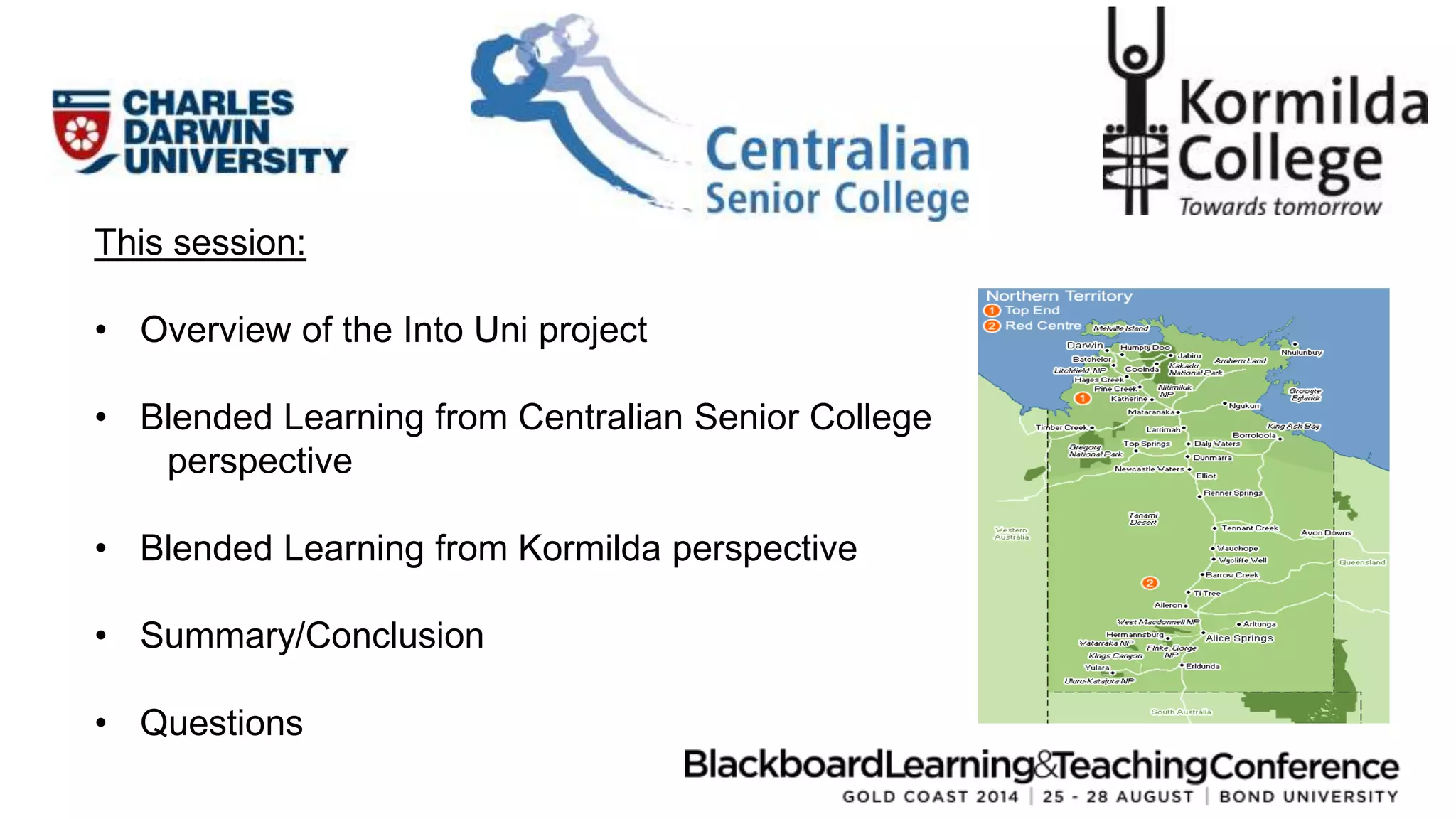
This session: 
• Overview of the Into Uni project 
• Blended Learning from Centralian Senior College 
perspective 
• Blended Learning from Kormilda perspective 
• Summary/Conclusion 
• Questions
Background: 
• Higher Education Participation and Partnerships Program 
• Federal Government funded project. 
• Known as ‘Into Uni’ among the three partnership institutions. 
• Three year project with ongoing support.
4 
Structure: 
• The project consists of a number of different strategies : 
• Mentoring and Enrichment 
• Education Outreach 
• Monitoring and Evaluation 
• Learnline in Colleges 
• This presentation will be focussing on Learnline in Colleges.
Purpose: 
• Support secondary students in the Northern Territory so they complete 
Year 12 and successfully articulate into university. 
• Specifically targeting students from a low socio-economic 
background. 
• Indigenous students. 
• Students from rural or remote communities and towns.
6 
Charles Darwin University: 
• Unique position for a university 
• Students accessing Learnline from middle school to post graduate level 
Learnline in Colleges: 
• Students and teachers at both colleges have access to the CDU learning 
management system called Learnline (Blackboard).
Underlying Philosophy: 
• Blended and online learning is used in the Colleges as part of the best 
practice learning and teaching. 
• Students access and use Learnline, including a wide range of Blackboard 
tools, while at school. The aim is to remove the online learning 
environment as a challenging factor in the transition between school and 
university.
Role of Charles Darwin University: 
• To provide teachers in partner schools with training and support to 
develop learning materials for online and flexible delivery in the CDU 
Learnline Learning Management System 
• 
To support the production of high quality teaching and learning materials 
that enhances the timely and tailored delivery of school subjects to 
students in NT that are accessible and culturally appropriate and 
sensitive to the life environment of students
9 
Role of Charles Darwin University: 
• To develop a sustainability plan for schools to work directly with the Learnline 
Development Team from 2015-2016, when training support will no longer be 
available.
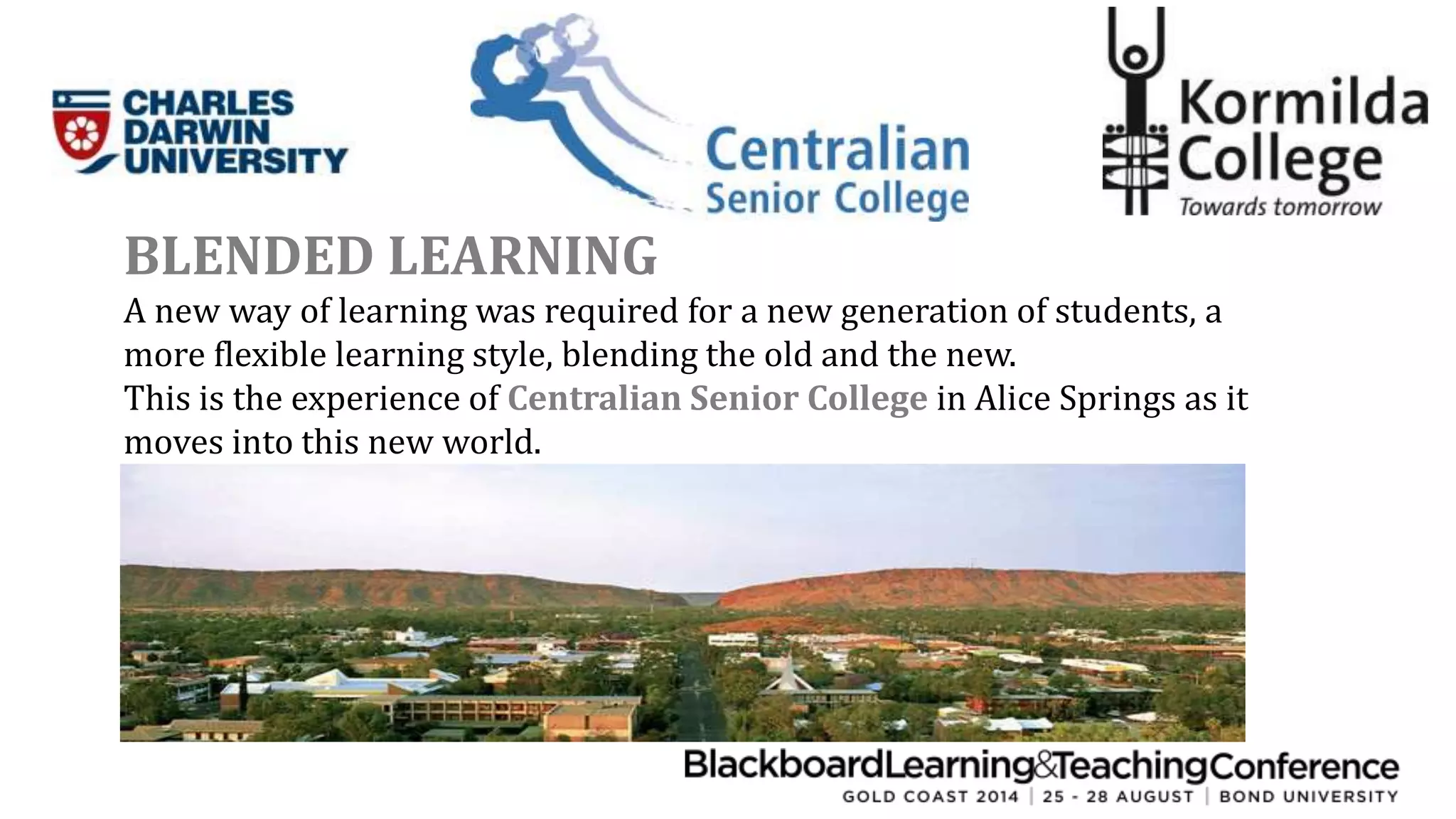
BLENDED LEARNING 
A new way of learning was required for a new generation of students, a 
more flexible learning style, blending the old and the new. 
This is the experience of Centralian Senior College in Alice Springs as it 
moves into this new world.
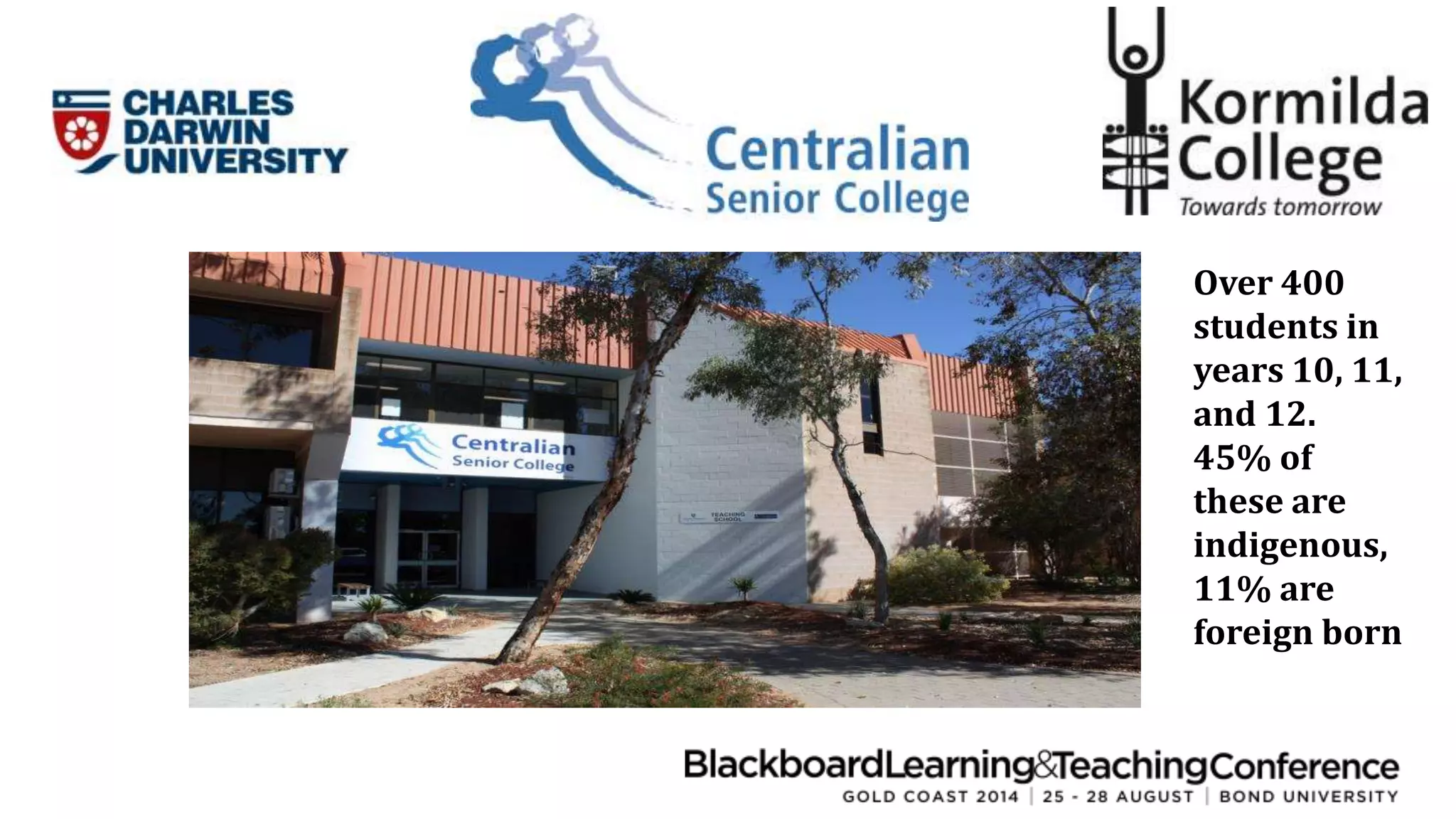
Over 400 
students in 
years 10, 11, 
and 12. 
45% of 
these are 
indigenous, 
11% are 
foreign born
INTO UNI PROGRAM 
Opportunity in this technology to help overcome many challenges it faces with 
engaging students and helping them achieve their goals. 
A third of teaching staff became involved in the Project to provide students with 
access to online lessons. 
Use ranges from a resource access point to delivery of entire lessons and units 
(enabling students to move at their own pace, or catch up on missed lessons).
Why and How we use Blended Learning 
Main educational challenges - how Blended Learning can help 
the school meet these challenges. 
Challenges of integrating Blended Learning and lessons we have 
learned thus far.
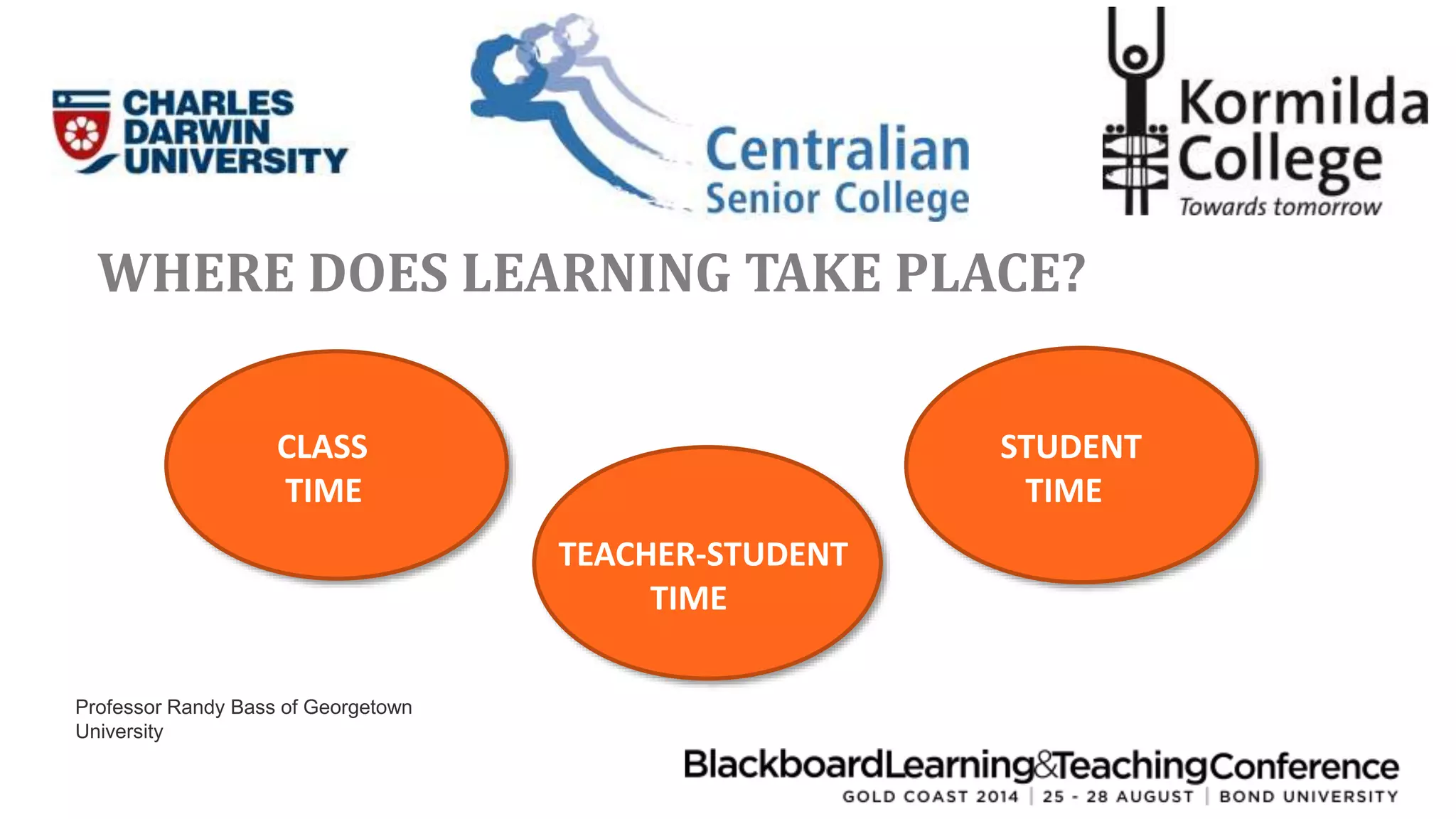
WHERE DOES LEARNING TAKE PLACE? 
CLASS 
TIME 
STUDENT 
TIME 
TEACHER-STUDENT 
TIME 
Professor Randy Bass of Georgetown 
University
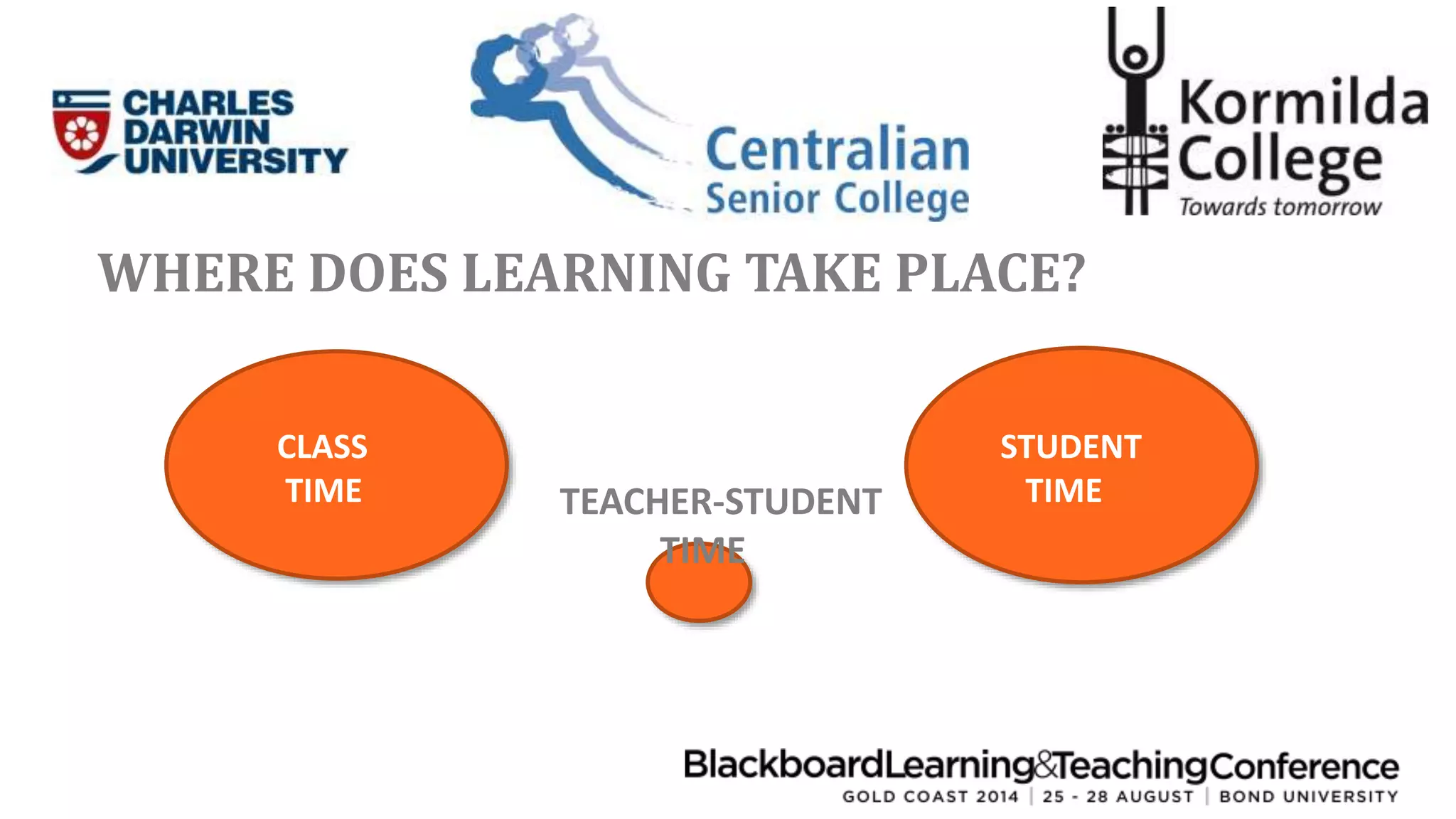
WHERE DOES LEARNING TAKE PLACE? 
CLASS 
TIME 
STUDENT 
TEACHER-STUDENT TIME 
TIME
Insufficient Teacher-Student Time 
LMS a means to increase quality interaction. 
via: 
Information & Resource Dissemination. 
= teacher-student time can be devoted to actual teaching/learning and 
relationship building. 
Online Interaction & Modelling 
Some higher order thinking is transferable to online interaction
CHALLENGES: 
ATTENDANCE TEACHER TRAINING & SITE 
DEVELOPMENT 
ACCESS TO 
TECHNOLOGY 
TEACHER PARTICIPATION 
TECHNOLOGY AVAILABILITY MEASURING OUR 
PROGRESS 
WHAT DOES BLENDED LEARNING LOOK LIKE?
ATTENDANCE
ATTENDANCE: 
Over a third of the school’s students failing to meet minimum 
attendance requirements. 
We need to find ways to make students want to engage with 
learning, and to have access to learning outside of traditional school 
hours.
Clontarf, Polly Farmer, and the Girls Academy 
Incentive of sport and social learning groups to attract students to attend and engage. 
Involve group travel on sporting, academic, and cultural trips 
Disrupt regular lessons amongst mainstream classes that the students are involved 
with.
SOLUTION: 
Lessons online = 
Access to their school work 
Contact with classroom teachers. 
Homework tasks: delivered and completed outside of the home. 
varied to optimise the use of blended learning strategies. 
i.e. 
using smartphones to videotape tours, interviews, or training sessions. 
Online class discussions via the site when absent, without needing to do 
so in real time.
OUTCOME: 
Mixed 
Attendance amongst students enrolled in the programs has 
improved. 
Work output has not improved as the program leaders have not 
participated in the Learnline project, given their own goals and time 
constraints.
CHALLENGE: TEACHER TRAINING & SITE 
DEVELOPMENT: 
THE TIME BARRIER 
Teachers have just one 50 min block of free time during the school day. 
In 2014 the school increased teacher load by an additional 50 
minutes a week. 
A number of teachers then withdrew from the Learnline program 
citing time problems.
SOLUTION 
Paid Relief: 
To alleviate this Into Uni team asked and received from the Steering 
Committee a full week of paid relief for each involved teacher in order to 
release them to create courses. 
Pre-Developed Sites: 
To encourage teachers to stay with the program I have created and 
developed sites for a number of teachers with minimal interaction.
OUTCOME: 
Paid Relief : Mixed 
Still requires time away from their students 
Unlikely to get a relief teacher who knows the specific subject matter. 
Pre-Developed Sites: Successful 
Four new sites running this year as a result of lower demand on teacher time. 
New teachers to the school have enjoyed the benefit of being able to run with 
a subject they have had no time to learn or prepare for.
ACCESS TO TECHNOLOGY: 
Not all students have computer or internet access at home. 
SOLUTION: 
The Learnline project investment $100,000 to replace laptops from the BER 
program. MacAirs were chosen due to battery life and portability. 
Student access to a home laptop is based on attendance. 
After hours study sessions after hours where students have access to 
technology and mentors in a safe environment.
OUTCOME: 
The tutor sessions are well attended during crunch times and will be 
ongoing. 
All year 12s and 70% of year 11 students have access to a home laptop
TEACHER PARTICIPATION & TECHNOLOGY AVAILABILITY 
Technology available to teachers differed by room. 
Individual Experience in/with: 
Elearn 
LAMS 
Sharepoint 
Wikispaces 
Interactive Whiteboards 
React & Adobe Connect 
MS Office
SOLUTION: 
How we set up online learning: what was already available and what we 
have now and for the future 
Ongoing Professional Development of involved staff. 
Installing projectors and laptops docking stations across the whole 
school. 
Learnline Trainer & Developer - hardware and software help on call to 
ensure a smooth use of technology.
OUTCOME: 
TEACHER PARTICIPATION: Mixed 
TECHNOLOGY AVAILABILITY: Success 
The school has the appropriate technology to deliver blended learning, 
but staff expertise to adapt to and use new technologies blended 
appropriately to pedagogy must be ongoing. 
To incorporate it across all school the College would need to make it 
mandatory and provide adequate training and creation time, or employ 
someone to create basic sites for all subjects.
MEASURING OUR PROGRESS 
What measurement determines whether we have used Blended Learning 
effectively? 
Has this has had an positive effect on student learning?
SOLUTION: 
Comparison to Pedagogical Models 
Unit and User Data from Blackboard 
Student and Staff Surveys
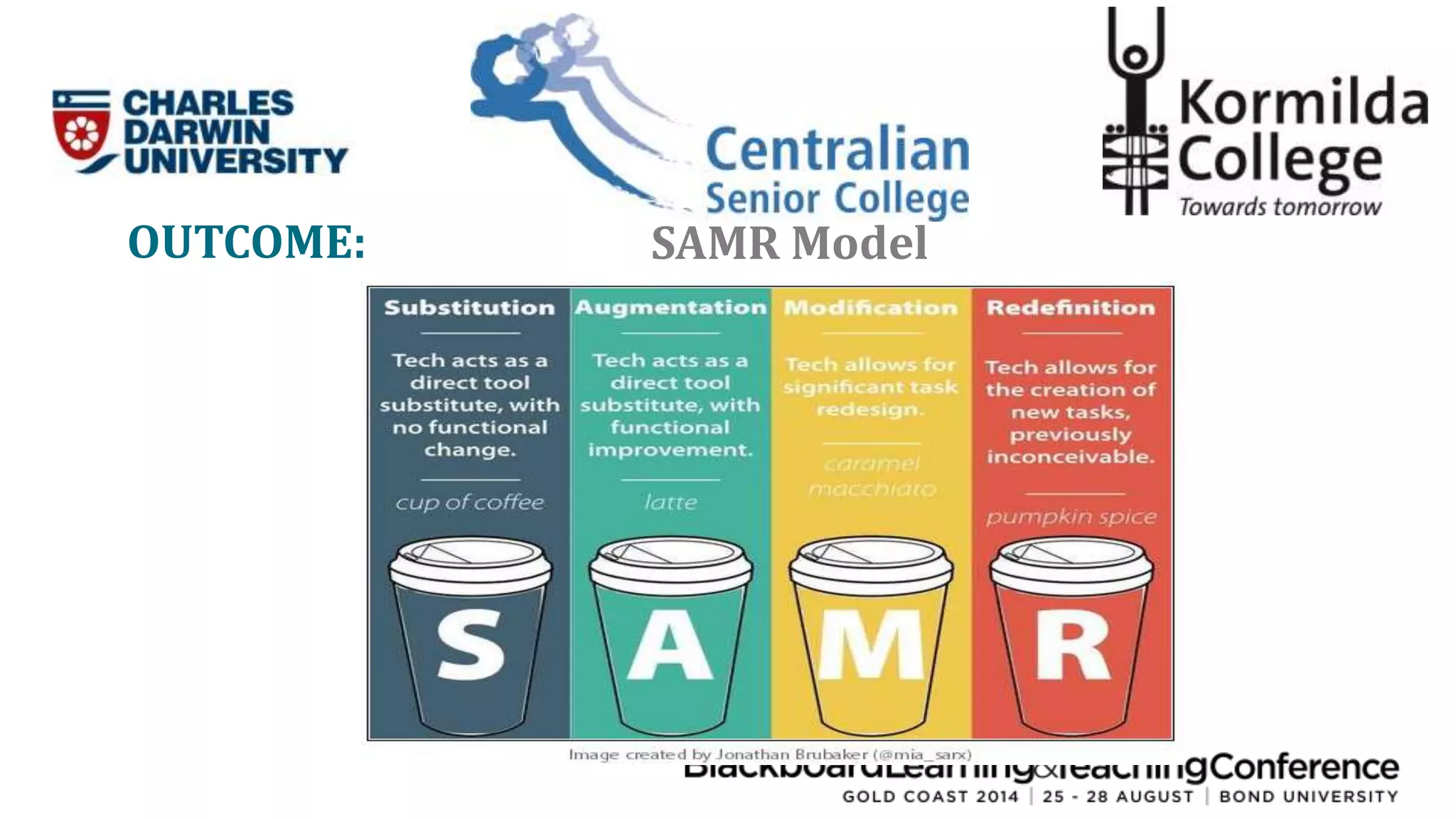
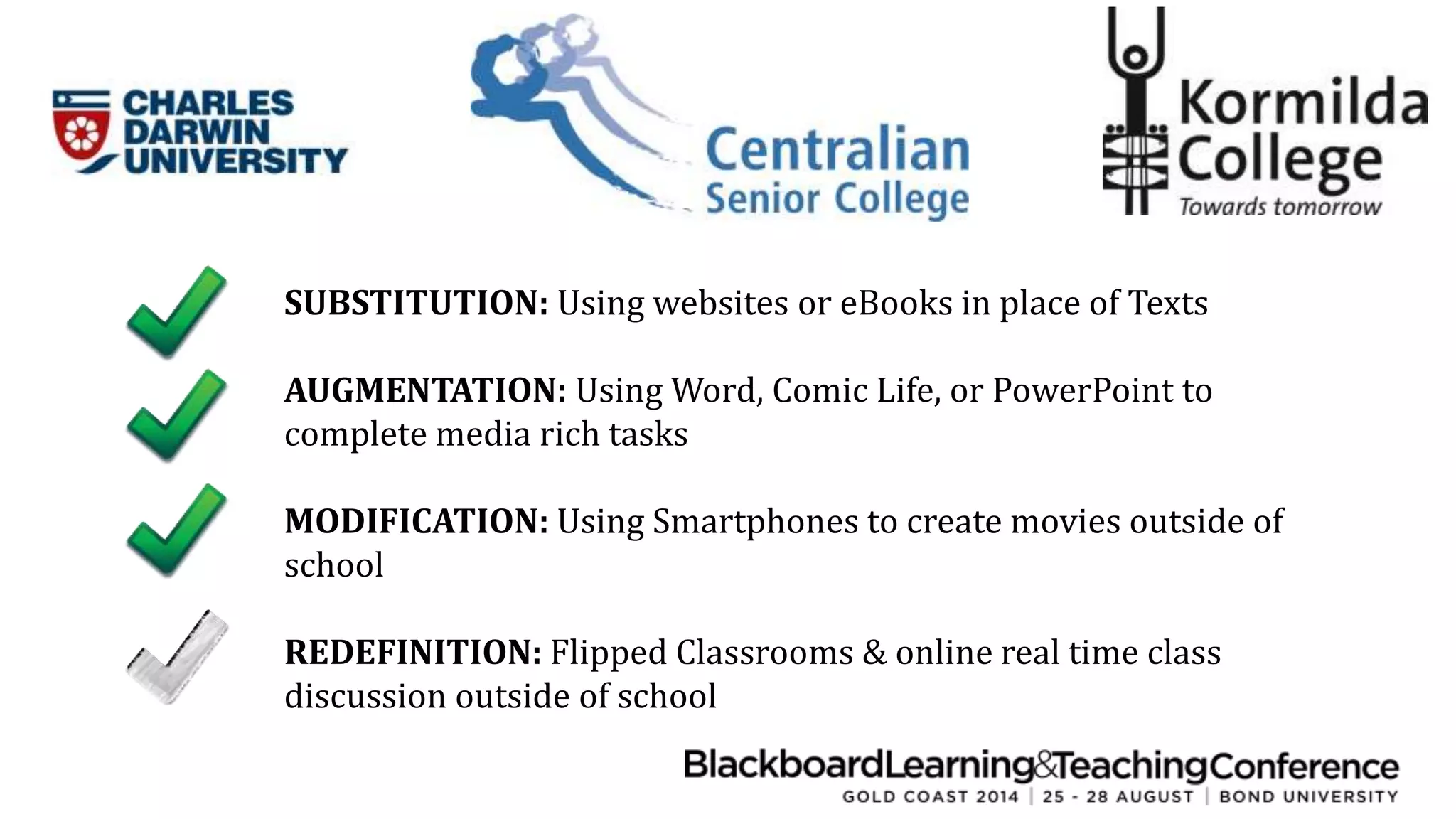
OUTCOME: SAMR Model
SUBSTITUTION: Using websites or eBooks in place of Texts 
AUGMENTATION: Using Word, Comic Life, or PowerPoint to 
complete media rich tasks 
MODIFICATION: Using Smartphones to create movies outside of 
school 
REDEFINITION: Flipped Classrooms & online real time class 
discussion outside of school
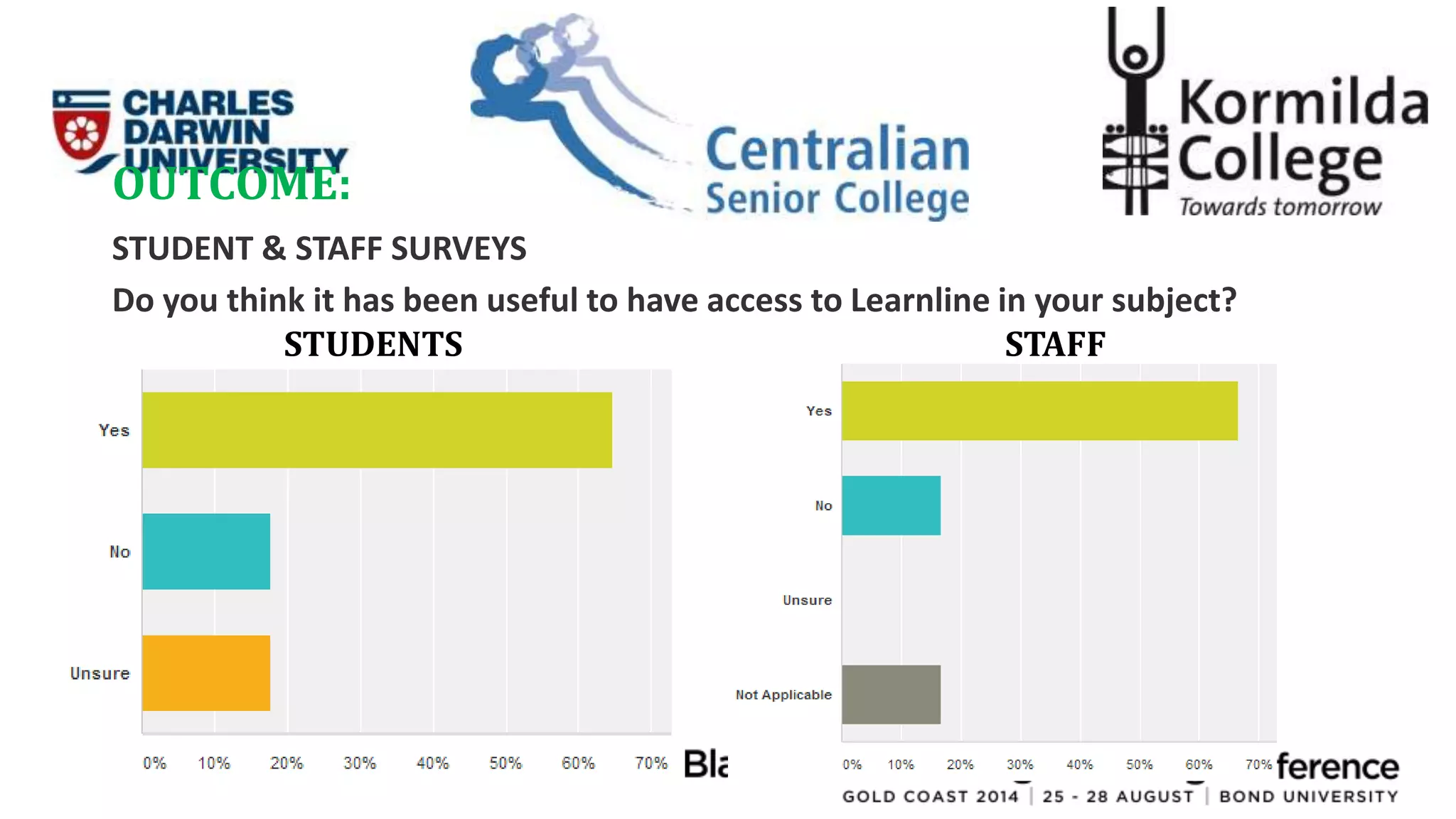
OUTCOME: 
STUDENT & STAFF SURVEYS 
Do you think it has been useful to have access to Learnline in your subject? 
STUDENTS STAFF
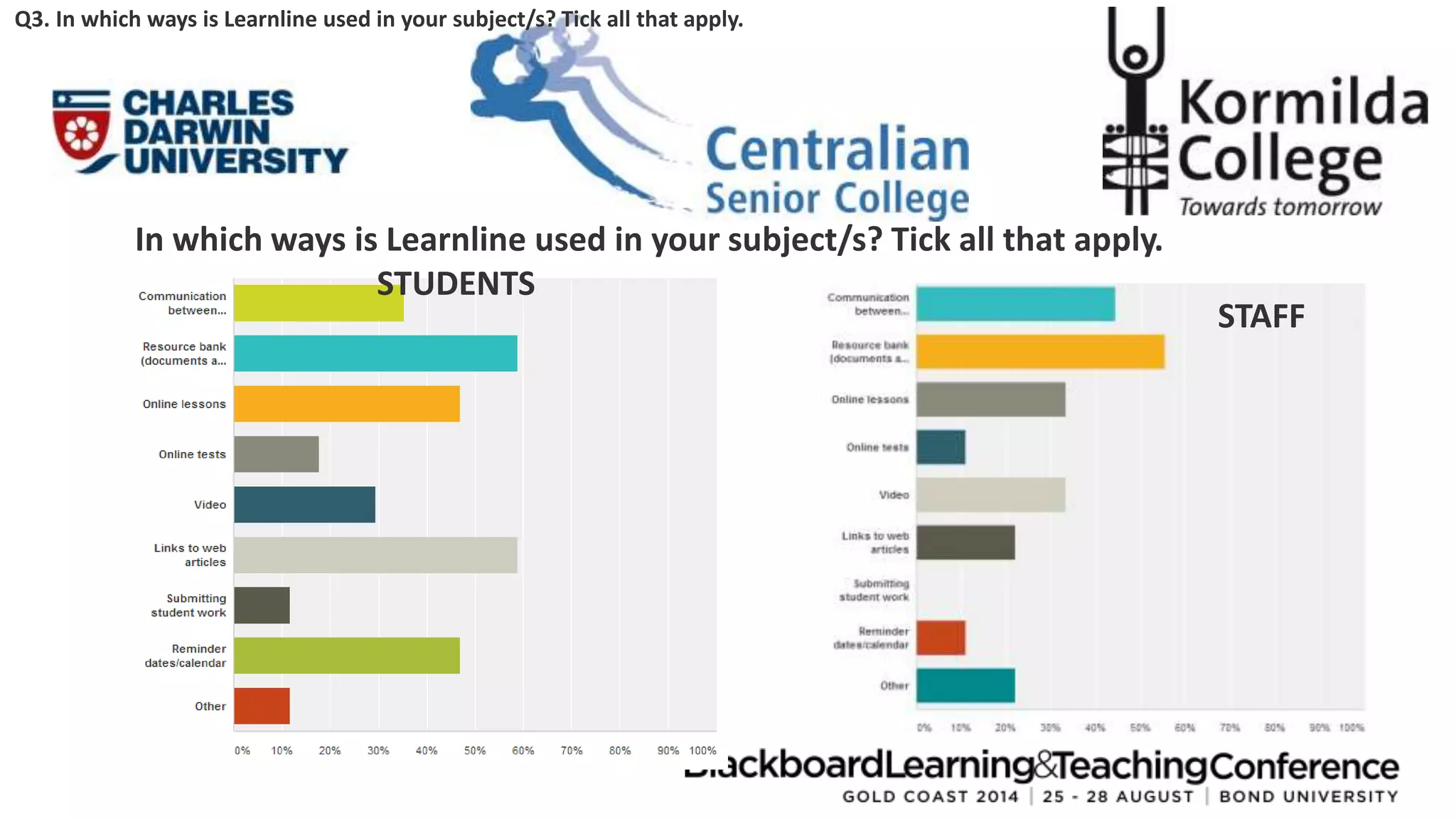
Q3. In which ways is Learnline used in your subject/s? Tick all that apply. 
In which ways is Learnline used in your subject/s? Tick all that apply. 
STUDENTS 
STAFF
WHAT DOES BLENDED LEARNING LOOK LIKE?
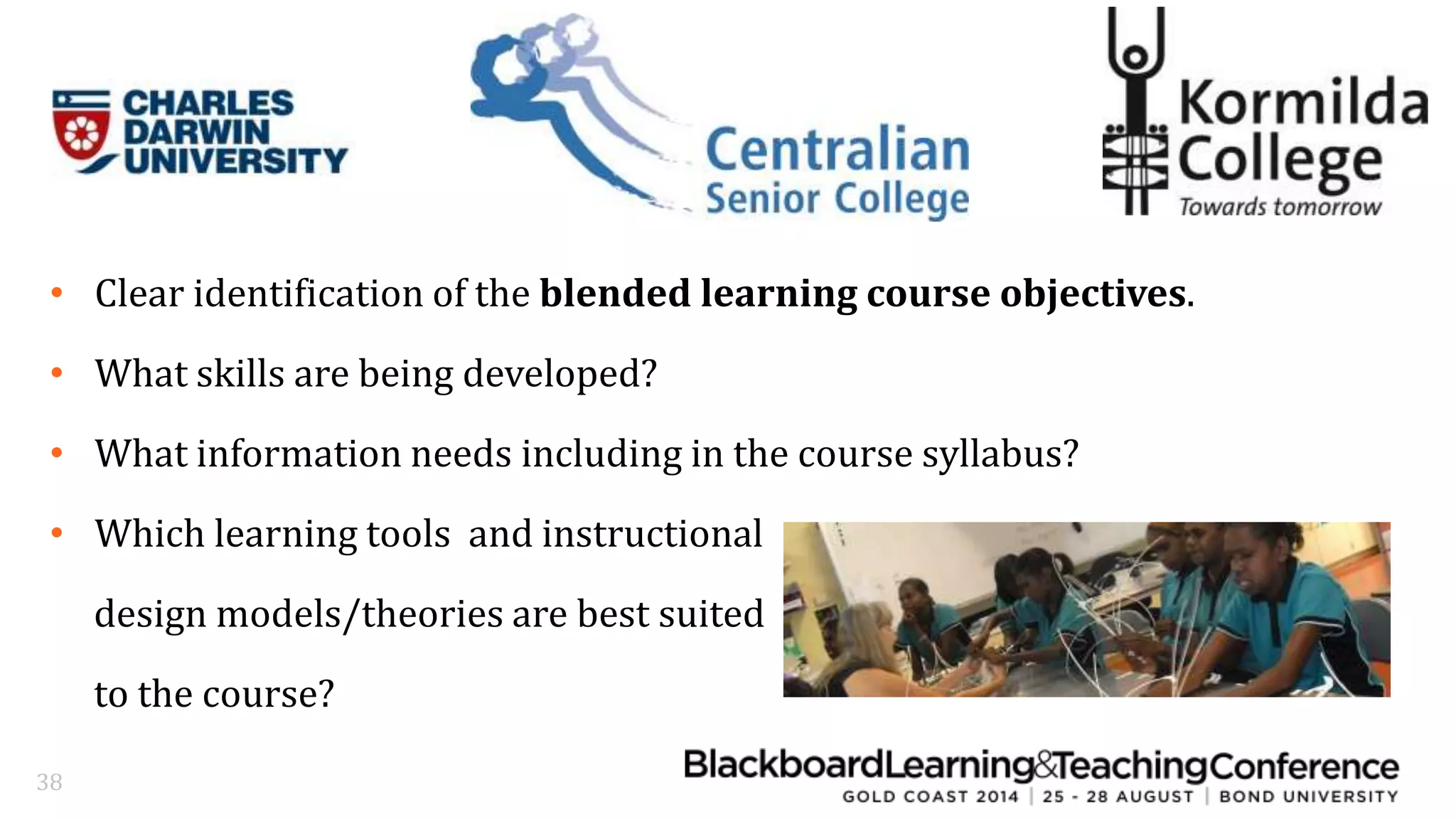
• Clear identification of the blended learning course objectives. 
• What skills are being developed? 
• What information needs including in the course syllabus? 
• Which learning tools and instructional 
design models/theories are best suited 
to the course? 
38
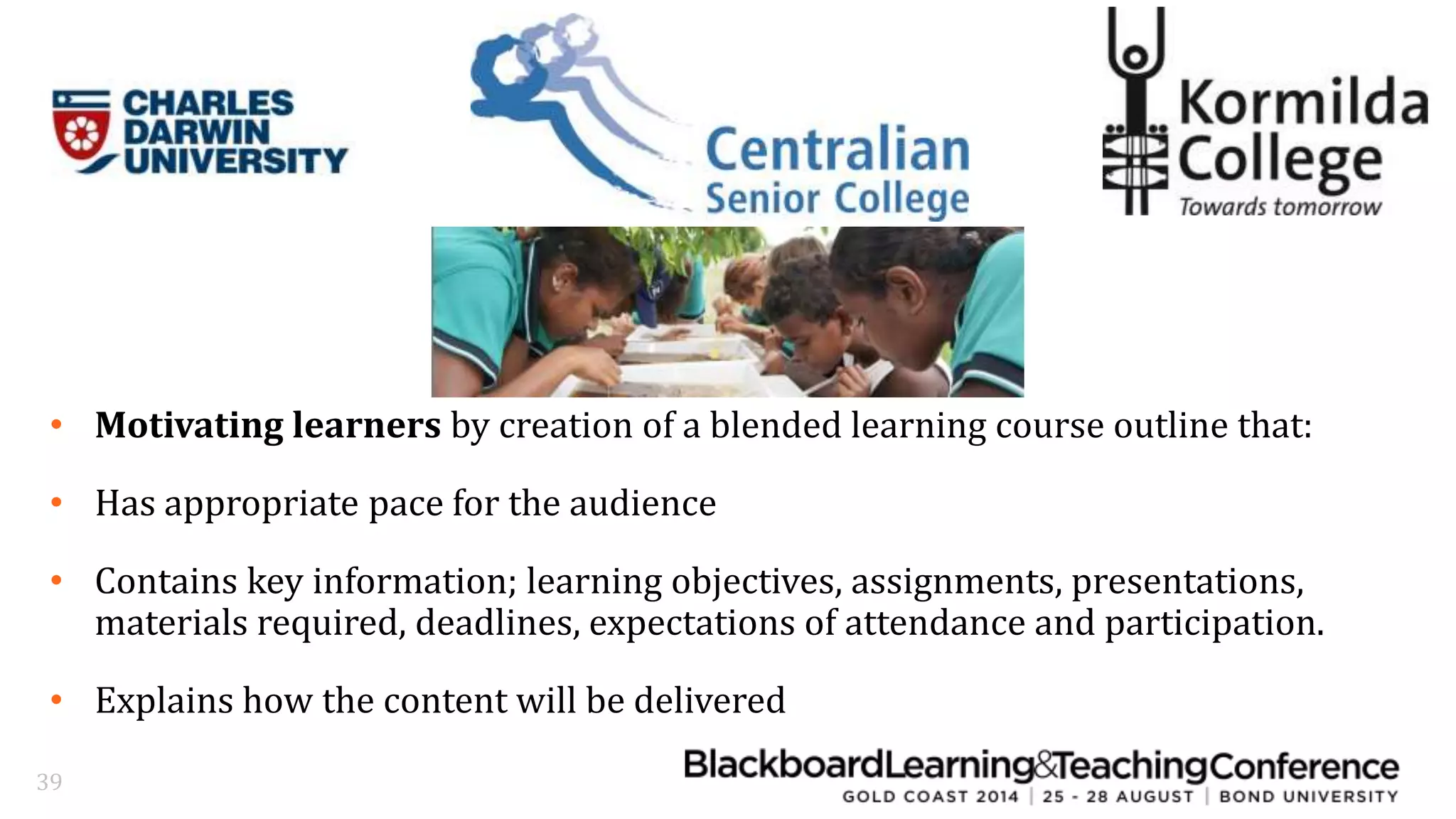
• Motivating learners by creation of a blended learning course outline that: 
• Has appropriate pace for the audience 
• Contains key information; learning objectives, assignments, presentations, 
materials required, deadlines, expectations of attendance and participation. 
• Explains how the content will be delivered 
39
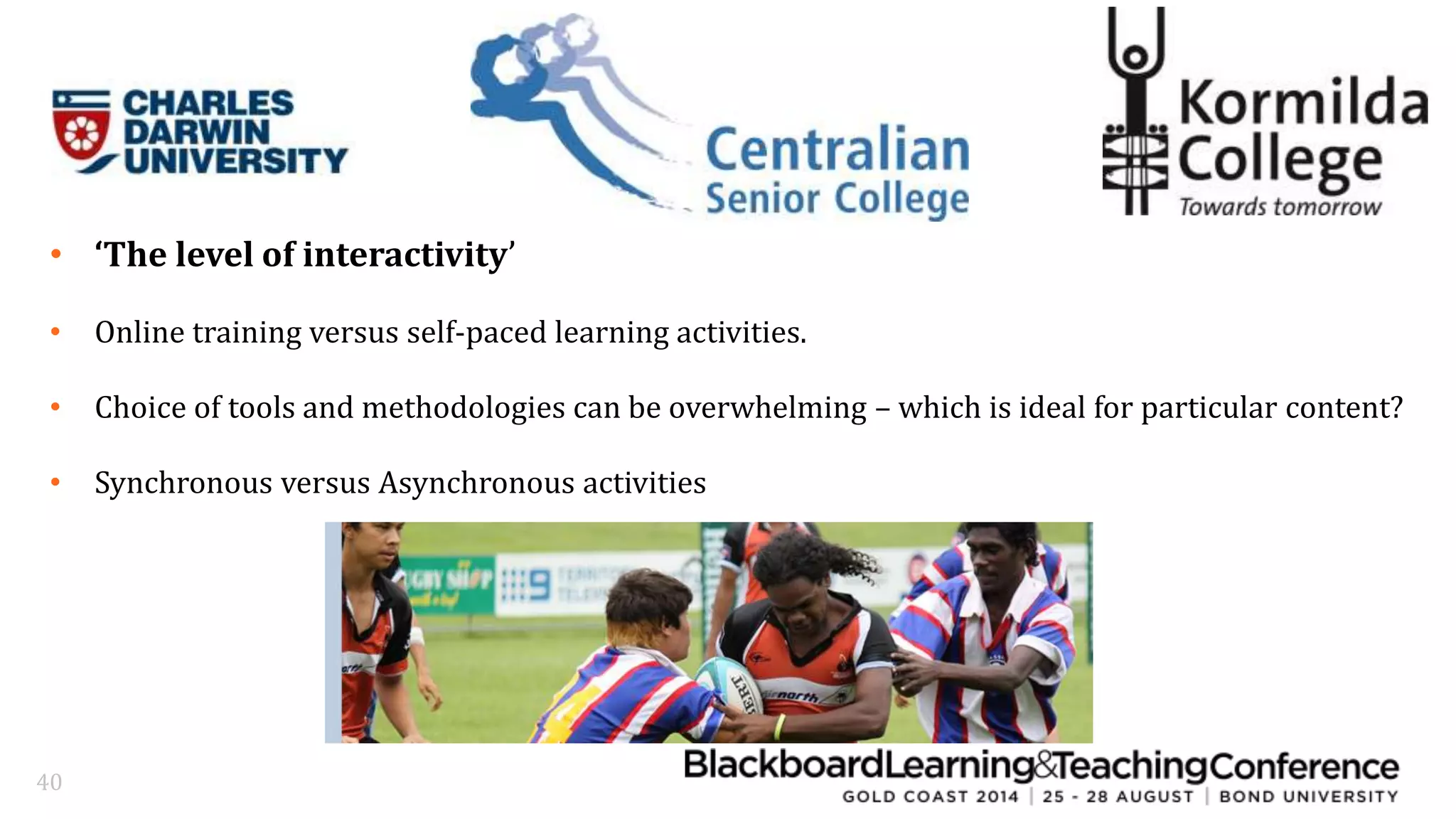
• ‘The level of interactivity’ 
• Online training versus self-paced learning activities. 
• Choice of tools and methodologies can be overwhelming – which is ideal for particular content? 
• Synchronous versus Asynchronous activities 
40
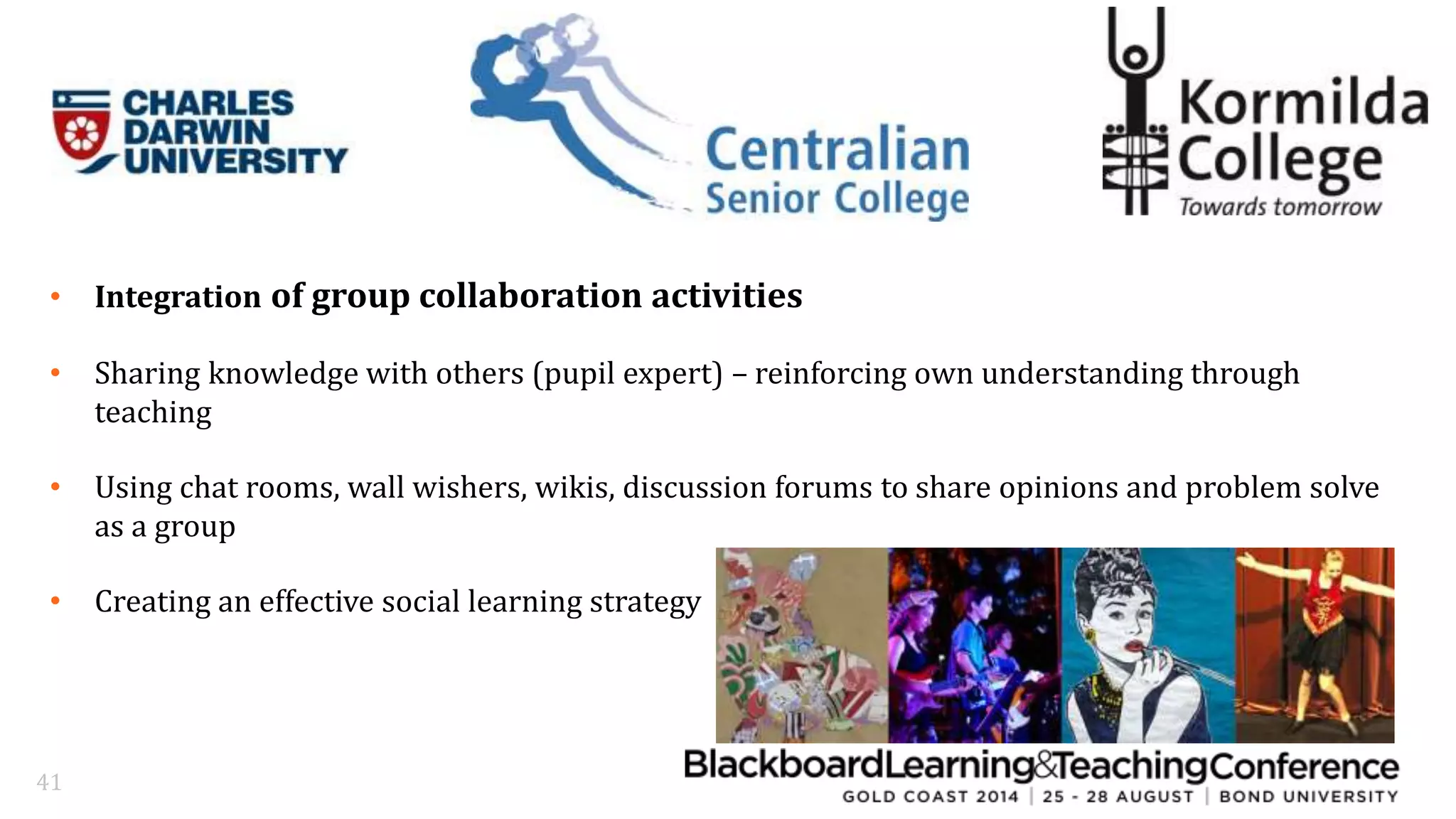
• Integration of group collaboration activities 
• Sharing knowledge with others (pupil expert) – reinforcing own understanding through 
teaching 
• Using chat rooms, wall wishers, wikis, discussion forums to share opinions and problem solve 
as a group 
• Creating an effective social learning strategy 
41
• Developing communication and feedback guidelines 
• Contact with course leader with 24 hour response – solid support 
• Feedback through surveys, class discussion or live chat 
42
• Gathering in the good stuff – compiling resources 
• Links to reference sites and articles to broaden and deepen experience 
• Course plan tied to relevant news stories to create a narrative 
• Enabling students to contribute further resources from course research 
43
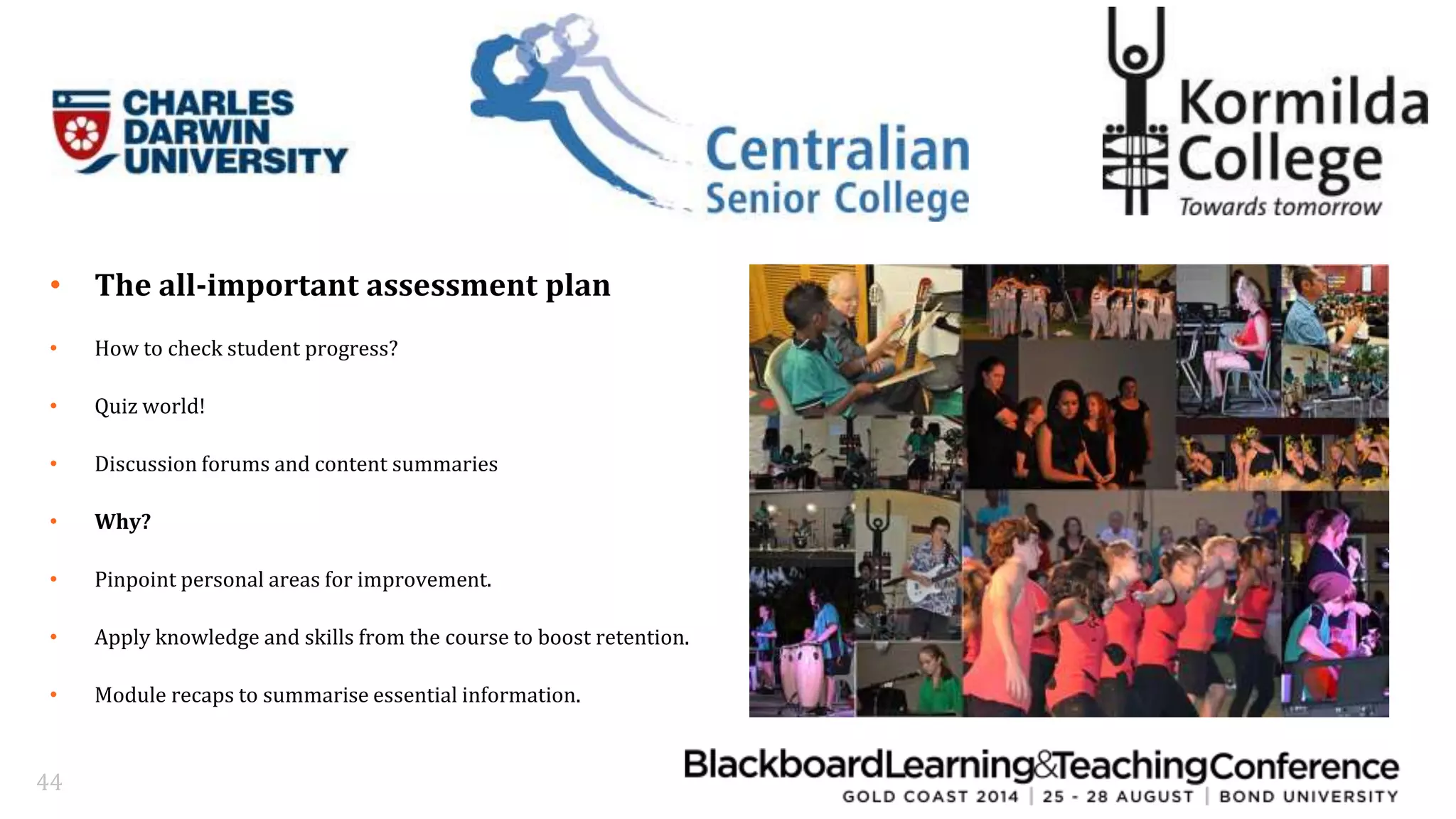
• The all-important assessment plan 
• How to check student progress? 
• Quiz world! 
• Discussion forums and content summaries 
• Why? 
• Pinpoint personal areas for improvement. 
• Apply knowledge and skills from the course to boost retention. 
• Module recaps to summarise essential information. 
44
• In conclusion: 
– Measures of Success of Blended Learning: 
• Increase in equity and access to learning for students 
• Increase in on-task learning time for students. 
• Increase in technology skills for both teachers and students. 
• Increase in motivation for students to access learning content/resources in 
unit. 
• Increase in range of pedagogies used by teachers. 
45
• Issues to be worked on: 
– Engagement by some teaching staff with the blended learning model. 
– Technology issues associated with tyranny of distance. 
Questions? 
46

HE Blended Learning - Charles Darwin University

  • 1.
    Blended Learning: ATerritory Approach. Amanda McCubbin • Charles Darwin University John Morton • Kormilda College Martin Yeaman • Centralian Senior College
  • 2.
    This session: •Overview of the Into Uni project • Blended Learning from Centralian Senior College perspective • Blended Learning from Kormilda perspective • Summary/Conclusion • Questions
  • 3.
    Background: • HigherEducation Participation and Partnerships Program • Federal Government funded project. • Known as ‘Into Uni’ among the three partnership institutions. • Three year project with ongoing support.
  • 4.
    4 Structure: •The project consists of a number of different strategies : • Mentoring and Enrichment • Education Outreach • Monitoring and Evaluation • Learnline in Colleges • This presentation will be focussing on Learnline in Colleges.
  • 5.
    Purpose: • Supportsecondary students in the Northern Territory so they complete Year 12 and successfully articulate into university. • Specifically targeting students from a low socio-economic background. • Indigenous students. • Students from rural or remote communities and towns.
  • 6.
    6 Charles DarwinUniversity: • Unique position for a university • Students accessing Learnline from middle school to post graduate level Learnline in Colleges: • Students and teachers at both colleges have access to the CDU learning management system called Learnline (Blackboard).
  • 7.
    Underlying Philosophy: •Blended and online learning is used in the Colleges as part of the best practice learning and teaching. • Students access and use Learnline, including a wide range of Blackboard tools, while at school. The aim is to remove the online learning environment as a challenging factor in the transition between school and university.
  • 8.
    Role of CharlesDarwin University: • To provide teachers in partner schools with training and support to develop learning materials for online and flexible delivery in the CDU Learnline Learning Management System • To support the production of high quality teaching and learning materials that enhances the timely and tailored delivery of school subjects to students in NT that are accessible and culturally appropriate and sensitive to the life environment of students
  • 9.
    9 Role ofCharles Darwin University: • To develop a sustainability plan for schools to work directly with the Learnline Development Team from 2015-2016, when training support will no longer be available.
  • 10.
    BLENDED LEARNING Anew way of learning was required for a new generation of students, a more flexible learning style, blending the old and the new. This is the experience of Centralian Senior College in Alice Springs as it moves into this new world.
  • 11.
    Over 400 studentsin years 10, 11, and 12. 45% of these are indigenous, 11% are foreign born
  • 12.
    INTO UNI PROGRAM Opportunity in this technology to help overcome many challenges it faces with engaging students and helping them achieve their goals. A third of teaching staff became involved in the Project to provide students with access to online lessons. Use ranges from a resource access point to delivery of entire lessons and units (enabling students to move at their own pace, or catch up on missed lessons).
  • 13.
    Why and Howwe use Blended Learning Main educational challenges - how Blended Learning can help the school meet these challenges. Challenges of integrating Blended Learning and lessons we have learned thus far.
  • 14.
    WHERE DOES LEARNINGTAKE PLACE? CLASS TIME STUDENT TIME TEACHER-STUDENT TIME Professor Randy Bass of Georgetown University
  • 15.
    WHERE DOES LEARNINGTAKE PLACE? CLASS TIME STUDENT TEACHER-STUDENT TIME TIME
  • 16.
    Insufficient Teacher-Student Time LMS a means to increase quality interaction. via: Information & Resource Dissemination. = teacher-student time can be devoted to actual teaching/learning and relationship building. Online Interaction & Modelling Some higher order thinking is transferable to online interaction
  • 17.
    CHALLENGES: ATTENDANCE TEACHERTRAINING & SITE DEVELOPMENT ACCESS TO TECHNOLOGY TEACHER PARTICIPATION TECHNOLOGY AVAILABILITY MEASURING OUR PROGRESS WHAT DOES BLENDED LEARNING LOOK LIKE?
  • 18.
  • 19.
    ATTENDANCE: Over athird of the school’s students failing to meet minimum attendance requirements. We need to find ways to make students want to engage with learning, and to have access to learning outside of traditional school hours.
  • 20.
    Clontarf, Polly Farmer,and the Girls Academy Incentive of sport and social learning groups to attract students to attend and engage. Involve group travel on sporting, academic, and cultural trips Disrupt regular lessons amongst mainstream classes that the students are involved with.
  • 21.
    SOLUTION: Lessons online= Access to their school work Contact with classroom teachers. Homework tasks: delivered and completed outside of the home. varied to optimise the use of blended learning strategies. i.e. using smartphones to videotape tours, interviews, or training sessions. Online class discussions via the site when absent, without needing to do so in real time.
  • 22.
    OUTCOME: Mixed Attendanceamongst students enrolled in the programs has improved. Work output has not improved as the program leaders have not participated in the Learnline project, given their own goals and time constraints.
  • 23.
    CHALLENGE: TEACHER TRAINING& SITE DEVELOPMENT: THE TIME BARRIER Teachers have just one 50 min block of free time during the school day. In 2014 the school increased teacher load by an additional 50 minutes a week. A number of teachers then withdrew from the Learnline program citing time problems.
  • 24.
    SOLUTION Paid Relief: To alleviate this Into Uni team asked and received from the Steering Committee a full week of paid relief for each involved teacher in order to release them to create courses. Pre-Developed Sites: To encourage teachers to stay with the program I have created and developed sites for a number of teachers with minimal interaction.
  • 25.
    OUTCOME: Paid Relief: Mixed Still requires time away from their students Unlikely to get a relief teacher who knows the specific subject matter. Pre-Developed Sites: Successful Four new sites running this year as a result of lower demand on teacher time. New teachers to the school have enjoyed the benefit of being able to run with a subject they have had no time to learn or prepare for.
  • 26.
    ACCESS TO TECHNOLOGY: Not all students have computer or internet access at home. SOLUTION: The Learnline project investment $100,000 to replace laptops from the BER program. MacAirs were chosen due to battery life and portability. Student access to a home laptop is based on attendance. After hours study sessions after hours where students have access to technology and mentors in a safe environment.
  • 27.
    OUTCOME: The tutorsessions are well attended during crunch times and will be ongoing. All year 12s and 70% of year 11 students have access to a home laptop
  • 28.
    TEACHER PARTICIPATION &TECHNOLOGY AVAILABILITY Technology available to teachers differed by room. Individual Experience in/with: Elearn LAMS Sharepoint Wikispaces Interactive Whiteboards React & Adobe Connect MS Office
  • 29.
    SOLUTION: How weset up online learning: what was already available and what we have now and for the future Ongoing Professional Development of involved staff. Installing projectors and laptops docking stations across the whole school. Learnline Trainer & Developer - hardware and software help on call to ensure a smooth use of technology.
  • 30.
    OUTCOME: TEACHER PARTICIPATION:Mixed TECHNOLOGY AVAILABILITY: Success The school has the appropriate technology to deliver blended learning, but staff expertise to adapt to and use new technologies blended appropriately to pedagogy must be ongoing. To incorporate it across all school the College would need to make it mandatory and provide adequate training and creation time, or employ someone to create basic sites for all subjects.
  • 31.
    MEASURING OUR PROGRESS What measurement determines whether we have used Blended Learning effectively? Has this has had an positive effect on student learning?
  • 32.
    SOLUTION: Comparison toPedagogical Models Unit and User Data from Blackboard Student and Staff Surveys
  • 33.
  • 34.
    SUBSTITUTION: Using websitesor eBooks in place of Texts AUGMENTATION: Using Word, Comic Life, or PowerPoint to complete media rich tasks MODIFICATION: Using Smartphones to create movies outside of school REDEFINITION: Flipped Classrooms & online real time class discussion outside of school
  • 35.
    OUTCOME: STUDENT &STAFF SURVEYS Do you think it has been useful to have access to Learnline in your subject? STUDENTS STAFF
  • 36.
    Q3. In whichways is Learnline used in your subject/s? Tick all that apply. In which ways is Learnline used in your subject/s? Tick all that apply. STUDENTS STAFF
  • 37.
    WHAT DOES BLENDEDLEARNING LOOK LIKE?
  • 38.
    • Clear identificationof the blended learning course objectives. • What skills are being developed? • What information needs including in the course syllabus? • Which learning tools and instructional design models/theories are best suited to the course? 38
  • 39.
    • Motivating learnersby creation of a blended learning course outline that: • Has appropriate pace for the audience • Contains key information; learning objectives, assignments, presentations, materials required, deadlines, expectations of attendance and participation. • Explains how the content will be delivered 39
  • 40.
    • ‘The levelof interactivity’ • Online training versus self-paced learning activities. • Choice of tools and methodologies can be overwhelming – which is ideal for particular content? • Synchronous versus Asynchronous activities 40
  • 41.
    • Integration ofgroup collaboration activities • Sharing knowledge with others (pupil expert) – reinforcing own understanding through teaching • Using chat rooms, wall wishers, wikis, discussion forums to share opinions and problem solve as a group • Creating an effective social learning strategy 41
  • 42.
    • Developing communicationand feedback guidelines • Contact with course leader with 24 hour response – solid support • Feedback through surveys, class discussion or live chat 42
  • 43.
    • Gathering inthe good stuff – compiling resources • Links to reference sites and articles to broaden and deepen experience • Course plan tied to relevant news stories to create a narrative • Enabling students to contribute further resources from course research 43
  • 44.
    • The all-importantassessment plan • How to check student progress? • Quiz world! • Discussion forums and content summaries • Why? • Pinpoint personal areas for improvement. • Apply knowledge and skills from the course to boost retention. • Module recaps to summarise essential information. 44
  • 45.
    • In conclusion: – Measures of Success of Blended Learning: • Increase in equity and access to learning for students • Increase in on-task learning time for students. • Increase in technology skills for both teachers and students. • Increase in motivation for students to access learning content/resources in unit. • Increase in range of pedagogies used by teachers. 45
  • 46.
    • Issues tobe worked on: – Engagement by some teaching staff with the blended learning model. – Technology issues associated with tyranny of distance. Questions? 46