SUBJECT-FINANCIAL MANAGEMENT
Unit-2
Working Capital Management
1
WORKING CAPITAL MANAGEMENT
I) Working Capital Management:
Concept, types and significance, Factors determining
working capital requirements, Sources of Working
Capital: Accruals, trade credit, commercial banks, public
deposits, inter-corporate-deposits, short-term loans from
financial institutions, commercial paper (CP) and
factoring, Computation of Working Capital
Requirement(Practical Problems)
II) Cash Management:
Meaning, Motives for holding cash
,Techniques of Cash Management, Online Payment:
Wallets, Fund
Transfer, National Electronic Fund Transfer (NEFT) and
Real Time
Gross Settlement (RTGS), Payment apps
2
I) WORKING CAPITAL MANAGEMENT:
What is Working Capital ?
 ‘Working Capital’ is the term used basically to indicate the
financial condition of a firm or an organization in the short term.
In other words, it can be called a scale to measure the overall
efficiency of the business entity.
 To obtain the working capital of a specific firm or organizations
one is required to subtract the current liabilities from the total
current assets of the entity. This ratio suggests whether the
particular organization has sufficient assets with it to take care
of its short-term debt. To put it the other way, working capital is
an indicator of the liquidity levels of an organization for taking
care of day-to-day expenditure and cash, accounts payable,
inventory, accounts receivable and also due short-term debt. 3
I) WORKING CAPITAL MANAGEMENT:
What is Working Capital ?
 ‘Working Capital’ is the term used basically to indicate
the financial condition of a firm or an organization in the
short term. In other words, it can be called a scale to
measure the overall efficiency of the business entity.
 To obtain the working capital of a specific firm or
organizations one is required to subtract the current
liabilities from the total current assets of the entity. This
ratio suggests whether the particular organization has
sufficient assets with it to take care of its short-term
debt. To put it the other way, working capital is an
indicator of the liquidity levels of an organization for
taking care of day-to-day expenditure and cash,
accounts payable, inventory, accounts receivable and
also due short-term debt.
4
WORKING CAPITAL MANAGEMENT
 Working capital is obtained from many company
operations like inventory and debt management,
revenue collection and supplier payments.
 Now with the concept of working capital being clear,
one needs to know about different types of working
capital and the various sources from which it can be
derived for the company or the firm.
5
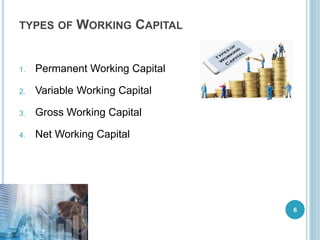
TYPES OF WORKING CAPITAL
1. Permanent Working Capital
2. Variable Working Capital
3. Gross Working Capital
4. Net Working Capital
6
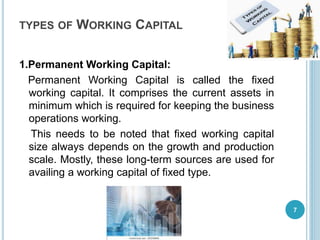
TYPES OF WORKING CAPITAL
1.Permanent Working Capital:
Permanent Working Capital is called the fixed
working capital. It comprises the current assets in
minimum which is required for keeping the business
operations working.
This needs to be noted that fixed working capital
size always depends on the growth and production
scale. Mostly, these long-term sources are used for
availing a working capital of fixed type.
7
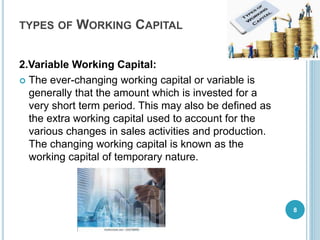
TYPES OF WORKING CAPITAL
2.Variable Working Capital:
 The ever-changing working capital or variable is
generally that the amount which is invested for a
very short term period. This may also be defined as
the extra working capital used to account for the
various changes in sales activities and production.
The changing working capital is known as the
working capital of temporary nature.
8
TYPES OF WORKING CAPITAL
2.Gross Working Capital:
Gross Working Capital is the fund that is invested by a
company’s current assets which serve as an indicator
for Gross Working Capital. Below mentioned are the
parts of the gross working capital:-
Cash, Inventory, Accounts receivables, Marketable
securities ,Short span investments
3.Net Working Capital:
This is an important working capital. The networking
capital shows the amount under which the company’s
current assets would surpass the then-current liabilities.
This is the difference between the current liabilities and
a business’s total assets.
9
SIGNIFICANCE OF WORKING CAPITAL
10
SIGNIFICANCE OF WORKING CAPITAL
 It allows a smooth production flow
 Helps in boosting the liquidity
 Also ensures proper use of the fixed assets
 It aids a project in getting a positive image of the
firm
 Also enables the firms for availing benefits for the
cash discounts
 Aids in availing financial assistance such as loans
easily
 It also allows meeting the contingencies very
effectively 11
FACTORS DETERMINING THE REQUIREMENTS OF
WORKING CAPITAL
1. Sales
2. Length of Operating Cycle
3. Nature of Business
4. Terms of Credit
5. Seasonal Variations
6. Nature of Production Technology
7. Contingencies
12
FACTORS DETERMINING THE REQUIREMENTS
OF WORKING CAPITAL
13
FACTORS DETERMINING THE REQUIREMENTS
OF WORKING CAPITAL
1. Sales:
 Among the various factors, size of the sales is one of the
important factors in determining the amount of working capital.
In order to increase sales volume, the enterprise needs to
maintain its current assets.
 In the course of period, the enterprise becomes in the position
to keep a steady ratio of its current assets to annual sales. As
a result, the turnover ratio, i.e., current assets to turnover
increases reducing the length of operating cycle. Thus, less
the operating cycle period, less will be requirements for
working capital and vice versa.
2. Length of Operating Cycle:
 Conversion of cash through various stages viz., raw material,
semi-processed goods, finished goods, sales, debtors and
bills receivables into cash takes a certain period of time that is
known as ‘length of operating cycle’. Longer the operating
cycle time, the more is the working capital required. 14
FACTORS DETERMINING THE REQUIREMENTS OF
WORKING CAPITAL
3. Nature of Business:
 The requirement of working capital also varies among the enterprises
depending upon the nature of the business. For instance, trading
companies require more working capital than manufacturing companies.
This is because that the trading business requires large quantities of
goods to be held in stock and also carry large amounts of working capital
than manufacturing concerns.
 In both these types of businesses, the value of current assets is 80% to
90% of the value of total assets. The investment in current assets is
relatively smaller in the case of hotels and restaurants because they
mostly have cash sales, and only small amounts of debtors’ balances.
4. Terms of Credit:
 Another important factor that determines the amount of working capital
requirements relates to the terms of credit allowed to the customers. For
instance, an enterprise may allow only 15 days credit, while another may
allow 90 days credit to its customers. Besides, an enterprise may extend
credit facilities to its all customers, while another enterprise in the same
business may extend credit only to select and those too reliable
customers only.
15
FACTORS DETERMINING THE REQUIREMENTS OF
WORKING CAPITAL
 Then, the requirements for working capital will naturally be
more if the credit period is longer and credit facilities are
extended to all customers, no matter reliable or non-reliable
they are. This is because there will be longer balance of
debtors and that too for a relatively longer period which will
obviously demand for more capital.
 On the contrary, if supplies of raw materials are available on
favourable conditions or terms of credit i.e., the payment will
be made after a relatively longer period of time, the
requirement for working capital will be correspondingly
smaller.
 5. Seasonal Variations:
 The seasonal enterprises, i.e., the enterprise whose
operations pick up seasonally may require more working
capital to meet their increased operations during the particular
season. A popular example of seasonal enterprise may be
sugar factory whose operations are highly seasonal. 16
FACTORS DETERMINING THE REQUIREMENTS
OF WORKING CAPITAL
6. Turnover of Inventories:
 If inventories are large in size but turnover is slow,
the small-scale enterprise will need more working
capital. On the contrary, if inventories are small but
their turnover is quick, the enterprise will need a
small amount of working capital.
17
FACTORS DETERMINING THE REQUIREMENTS
OF WORKING CAPITAL
7. Nature of Production Technology:
 In case of labour intensive technology, the unit will need more
amount to pay the wages and, therefore, will require more
working capital. On the other hand, if the production
technology is capital- intensive, the enterprise will have to
make less payment for expenses like wages. As a result,
enterprise will require less working capital.
8. Contingencies:
 If the demand for and price of the products of small- scale
enterprises are subject to wide variations or fluctuations, the
contingency provisions will have to be made for meeting the
fluctuations. This will obviously increase the requirements for
working capital of the small enterprises. While one can add
certain other factors to this list, the said factors appear to be
the major ones in determining the requirement of working
capital of a small-scale enterprise.
18
SOURCES OF WORKING CAPITAL
19
SOURCES OF WORKING CAPITAL
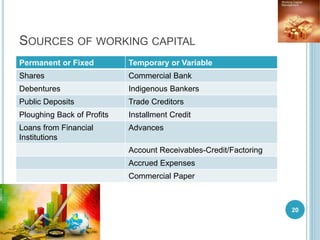
Permanent or Fixed Temporary or Variable
Shares Commercial Bank
Debentures Indigenous Bankers
Public Deposits Trade Creditors
Ploughing Back of Profits Installment Credit
Loans from Financial
Institutions
Advances
Account Receivables-Credit/Factoring
Accrued Expenses
Commercial Paper
20
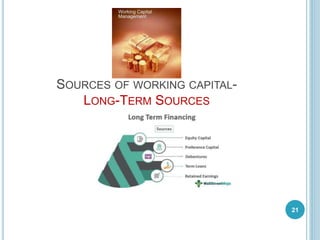
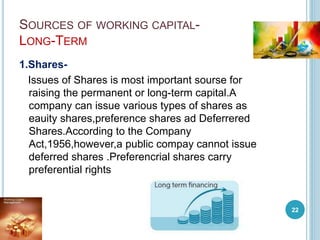
SOURCES OF WORKING CAPITAL-
LONG-TERM SOURCES
21
SOURCES OF WORKING CAPITAL-
LONG-TERM
1.Shares-
Issues of Shares is most important sourse for
raising the permanent or long-term capital.A
company can issue various types of shares as
eauity shares,preference shares ad Deferrered
Shares.According to the Company
Act,1956,however,a public compay cannot issue
deferred shares .Preferencrial shares carry
preferential rights
22
SOURCES OF WORKING CAPITAL- LONG-TERM
2.Debentures –
A Debenture is an instrument issued by the
company acknowledge its debt to its holders are
the creditors of the company. A fixed rate of interest
is paid on Debentures. The interest on Debentures
is a charge against profit and loss account. The
debentures are generally given floating charge on
the assets of the company. When the debentures
are secured, they are paid on priority to other
creditors. The debentures may be of various kinds
such as simple, unsecured debentures, redeemable
debentures ,irredeemable debentures, etc.
23
SOURCES OF WORKING CAPITAL- LONG-TERM
3.Public Deposits
Public Deposits are the fixed deposits accepted by
a business enterprise directly from the public. This
source of raising short-term and medium term
finance was very popular in the absence of banking
facilties.In the past ,generally ,public deposits were
accepted by Textile Industries in Ahmadabad and
Bombay for period of 6 months to 1 year. But now,
even long-term deposits for 5 to 7 years are
accepted by the business houses.
24
SOURCES OF WORKING CAPITAL- LONG-TERM
4.Ploughing back of profit
 It means the re-investments by concern of its surplus
earning in its business. it is an internal source of
finance and is most suitable for established firm for
its expansaion,modenisation,replacement etc.This
method of finance has a number of advantages as it
is the cheapest rather cost free course of finance;
there s no need to keep securities, there is no
dilution of control, it ensures stable dividend policy
and gains confidence of the public. But excessive
resort to ploughing back of profits may lead to
monolpolies,misuse of funds,over-capitalisation and
speculation etc. 25
SOURCES OF WORKING CAPITAL- LONG-TERM
5.Loan from Financial Institution-
Financial Institution such as commercial Banks,
Life Insurance Corporation, Industrial Finance
Corporation of India, State Financial Corporations,
State Industrial Development Coproations,IDBI et
also provide short-term, medium-term and long-
term loans. This source of finance is more suitable
to meet the medium-term demands of working
capital .Interest is charged on such loans at a fixed
rate and the amount of loan is to be repaid by way
of installments in a number of years.
26
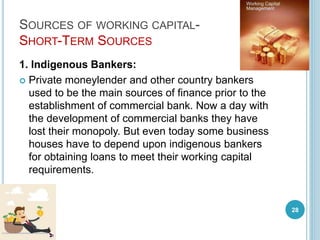
SOURCES OF WORKING CAPITAL-
SHORT-TERM SOURCES
27
SOURCES OF WORKING CAPITAL-
SHORT-TERM SOURCES
1. Indigenous Bankers:
 Private moneylender and other country bankers
used to be the main sources of finance prior to the
establishment of commercial bank. Now a day with
the development of commercial banks they have
lost their monopoly. But even today some business
houses have to depend upon indigenous bankers
for obtaining loans to meet their working capital
requirements.
28
SOURCES OF WORKING CAPITAL-
SHORT-TERM SOURCES
2. Trade Credit:
 Trade credit refers to the credit extended by the
supplier of goods in the normal course of business.
The trade credit arrangement of a firm with its
suppliers is an important source of short-term
finance. The credit worthiness of a firm and the
confidence of its supplier are the main basis of
securing trade credit. Every firm must utilize this
source to the fullest extent, because this source is
cost free. i.e., borrower need not pay any interest.
29
SOURCES OF WORKING CAPITAL-
SHORT-TERM SOURCES
3.Commercial Banks:
Commercial banks are the most important source of short- term capital. The
different forms in which the banks normally provide loans and advances are as
follows-
a. Loans:
 When a bank makes an advance in lump sum against some security, it is called a
loan. In case of a loan a specified amount is sanctioned by the bank to the
customer. The entire loan amount is paid to the borrower either in cash or by credit
to his account. The borrower is required to pay interest on the entire amount of
loan from the date of sanction.
b. Cash Credit:
 Cash credit is an arrangement by which a bank allows his customer to borrow
money up to a certain limit against some tangible securities. A customer can
withdraw from his cash credit limit according to his need and interest is calculated
on the daily balance and not on the entire amount.
c. Over Draft:
 Over draft is an arrangement by which a current account holder is allowed to
withdraw more than the balance to his credit up to a certain limit. The interest is
charged on daily over drawn balances.
 d. Discounting of Bill of Exchange:
 Purchasing and discounting of bills of exchange is the most important form in
which the banks lend money without any collateral security.
30
SOURCES OF WORKING CAPITAL-
SHORT-TERM SOURCES
4. Installment Credit:
 This is another method by which the possession of
goods is taken immediately. The payment is made
in installment over a predetermined period of time.
Generally interest is charged on the unpaid price
but in any case, it provides fund for some time and
is used as a source of short-term working capital by
many business houses.
31
SOURCES OF WORKING CAPITAL-
SHORT-TERM SOURCES
5. Advances:
Some business houses get advances from the
customers and middlemen against order and this
source is a short-term source of finance. It is a
cheap source of finance and in order to minimize
their investment in working capital the
manufacturing industries prefer to take advances
from their customers.
32
SOURCES OF WORKING CAPITAL-
SHORT-TERM SOURCES
6. Factoring/Account Receivable Credit:
 Another method of raising short-term finance is through
account receivable or credit offered by commercial
banks and factors. A commercial bank may provide
finance through discounting the bills or invoices of its
customers. Thus, a firm gets immediate payment for
sales made on credit through factoring.
 Factoring is an arrangement by which the factor
purchases, on a continuous basis, all the debts of the
suppliers of goods and services to customers. It is a
contract between the supplier and factor with regard to
the realization of supplier’s credit sales. The factor may
assume risk of non-payment by the customer also. He
charges a predetermined commission for his services. 33
SOURCES OF WORKING CAPITAL-
SHORT-TERM SOURCES
7. Accrued Expenses:
Accrued expenses, which have been incurred but
not yet paid. These simply represent a liability that
a firm has to pay services already received by it.
Thus, all accrued expenses can be used as a
source of short-term finance.
34
SOURCES OF WORKING CAPITAL-
SHORT-TERM SOURCES
8.Deferred Incomes:
 Deferred incomes are incomes received in advance
before supplying services. They represent funds
received by a firm for which it has to supply goods
or services in future. These funds increase the
liquidity of a firm and constitute an important source
of short-term finance.
35
SOURCES OF WORKING CAPITAL-
SHORT-TERM SOURCES
9.Commercial Paper:
 Commercial paper represents unsecured
promissory notes issued by firms to raise short-term
funds. It is an important money market instrument
in advanced countries like U.S.A. Commercial
paper is a cheapest source of raising short-term
finance as compared to the bank credit.
 Commercial paper is usually bought by investors
including Banks, Insurance Companies, Unit Trust
of India and firms to invest surplus funds for a short
period.
36
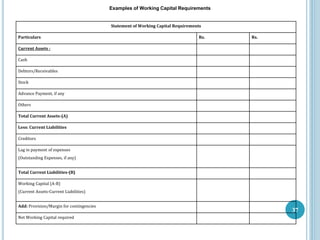
Statement of Working Capital Requirements
Particulars Rs. Rs.
Current Assets :
Cash
Debtors/Receivables
Stock
Advance Payment, if any
Others
Total Current Assets-(A)
Less: Current Liabilities
Creditors
Lag in payment of expenses
(Outstanding Expenses, if any)
Total Current Liabilities-(B)
Working Capital (A-B)
(Current Assets-Current Liabilities)
Add: Provision/Margin for contingencies
Net Working Capital required
Examples of Working Capital Requirements
37
II) CASH MANAGEMENT:
Meaning, Motives for holding cash
,Techniques of Cash Management, Online
Payment: Wallets, Fund
Transfer, National Electronic Fund Transfer (NEFT)
and Real Time
Gross Settlement (RTGS), Payment apps
38
MEANING OF CASH:
 Cash is the primary asset individuals and
companies use regularly to settle their debt
obligations and operating expenses, e.g., taxes,
employee salaries, inventory purchases, advertising
costs, and rents, etc.
 Cash is used as investment capital to be allocated
to long-term assets, such as property, plant, and
equipment (PP&E) and other non-current assets.
Excess cash after accounting for expenses often
goes towards dividend distributions.
39
MEANING OF CASH:
 Companies with a multitude of cash inflows and
outflows must be properly managed to maintain
adequate business stability. For individuals,
maintaining cash balances is also a major concern.
NATURE OF CASH
 Cash is the medium of exchange for purchase of
goods and services and for discharging liabilities.
40
INTRODUCTION TO CASH MANAGEMENT
 Management of cash is one of the most important
areas of overall working capital management due to
the fact that cash is the most liquid type of current
assets.
 As such it is the responsibility of the finance
function to see that the various functional areas of
the business have sufficient cash whenever they
require the same. 41
WHAT IS CASH MANAGEMENT?
Cash management, also known as treasury
management, is the process that involves collecting
and managing cash flows from the operating,
investing, and financing activities of a company. In
business, it is a key aspect of an organization’s
financial stability.
42
WHAT IS CASH MANAGEMENT?
 Cash management is important for both companies
and individuals, as it is a key component of financial
stability.
 Financial instruments involved in cash management
contain money market funds, Treasury bills, and
certificates of deposit.
43
WHAT IS CASH MANAGEMENT?
 Companies and individuals offer a wide range of
services available across the financial marketplace
to help with all types of cash management. Banks
are typically a primary financial service provider.
There are also many different cash management
solutions for both companies and individuals
seeking to get the best return on cash assets or the
most efficient use of cash.
44
CASH MANAGEMENT-
The process of collecting and managing cash flows
from the operating, investing, and financing
activities of a company
45
INTRODUCTION TO CASH MANAGEMENT
 At the same time, it has also to be ensured that the funds are
not blocked in the form of idle cash, as the cash remaining idle
also involves cost in the form of interest cost and opportunity
cost.
 As such the management of cash has to find a mean between
these two extremes of shortage of cash as well as idle cash.
46
OBJECTIVES OF CASH MANAGEMENT
 The prime objective of cash management is to
channelize the flow of cash from the surplus to
deficit units to maintain the appropriate liquidity
position of the organization.
 In addition, the objectives of cash management can
be broadly subdivided into two heads –
1) maintaining the inflow and outflow of cash
2) sustaining the cash position held by the
organization to meet the current obligations.
47
MOTIVES FOR HOLDING CASH
1. Transaction Motive
2. Precautionary Motive
3. Speculative Motive
48
7. MOTIVES FOR HOLDING CASH
A company may hold the cash with the various
motives as stated below:
1.Transaction Motive: The transaction motive refers
to the cash required by a firm to meet the day to
day needs of its business operations. In an ordinary
course of business, the firm requires cash to make
the payments in the form of salaries, wages,
interests, dividends, goods purchased, etc.
 Likewise, it also receives cash from its sales,
debtors, investments. Often the firm’s cash inflows
and outflows do not match, and hence, the cash is
held up to meet its routine commitments.
49
7. MOTIVES FOR HOLDING CASH
2.Precautionary Motive:
The precautionary motive refers to the
tendency of a firm to hold cash, to meet the
contingencies or unforeseen circumstances arising
in the course of business. Since the future is
uncertain, a firm may have to face contingencies
such as an increase in the price of raw materials,
labor strike, lockouts, change in the demand, etc.
Thus, in order to meet with these uncertainties, the
cash is held by the firms to have an uninterrupted
business operations.
50
7. MOTIVES FOR HOLDING CASH
3.Speculative Motive:
The firms hold cash for the speculative purposes to
avail the benefit of bargain purchases that may arise in
the future. For example, if the firm feels the prices of raw
material are likely to fall in the future, it will hold cash and
wait till the prices actually fall.
Thus, a firm holds cash to exploit the possible
opportunities that are out of the normal course of
business. These opportunities could be in the form of the
low-interest rate charged on the borrowed funds,
expected fall in the raw material prices or favorable
change in the government policies.
51
7. MOTIVES FOR HOLDING CASH
 However, receipts of the cash and the payments by
cash may not always match with each other. In
such situations, the company will like to hold the
cash to honour the commitments whenever they
become due.
 This requirement of cash balances to meet routine
needs is known as transaction motive.
52
ONLINE PAYMENT:
1. WALLETS
2.FUND TRANSFER
3.NATIONAL ELECTRONIC FUND TRANSFER
(NEFT)
4.REAL TIME GROSS SETTLEMENT (RTGS),
5.PAYMENT APPS
53
WHAT ARE ONLINE PAYMENTS?
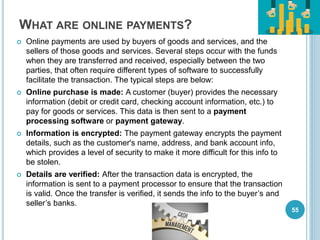
 Online payments refer to the electronic exchange of
currency through the internet. These payments
usually consist of the transfer of monetary funds
from a customer's bank or debit or credit card
account, into the seller's bank account, in exchange
for products or services. These funds can come
directly from a customer's credit card or checking
account, or from an online payment system that is
linked to both the buyer and seller's bank accounts.
54
WHAT ARE ONLINE PAYMENTS?
 Online payments are used by buyers of goods and services, and the
sellers of those goods and services. Several steps occur with the funds
when they are transferred and received, especially between the two
parties, that often require different types of software to successfully
facilitate the transaction. The typical steps are below:
 Online purchase is made: A customer (buyer) provides the necessary
information (debit or credit card, checking account information, etc.) to
pay for goods or services. This data is then sent to a payment
processing software or payment gateway.
 Information is encrypted: The payment gateway encrypts the payment
details, such as the customer's name, address, and bank account info,
which provides a level of security to make it more difficult for this info to
be stolen.
 Details are verified: After the transaction data is encrypted, the
information is sent to a payment processor to ensure that the transaction
is valid. Once the transfer is verified, it sends the info to the buyer’s and
seller’s banks.
55
WHAT ARE ONLINE PAYMENTS?
 Funds are approved: Assuming there are no red flags from the payment
gateway or processor, the banks authorize the transaction. There are,
however, several reasons as to why a transaction might not be approved by
either bank:
 Insufficient funds
 Frozen account status
 Invalid credit card number or expiration date
 Transaction limits
 The card has been reported lost or stolen
 The address does not match the card
 Invalid Card Code Verification (CCV)
 Funds are requested: After the funds and corresponding transfer are
approved, the payment processor requests the funds to be sent from the
buyer's source of funds to the seller's bank account.
 The seller receives funds: The transfer of funds is completed and the
purchase price has been sent from buyer to seller.
 56
TYPES OF ONLINE PAYMENTS
1.Credit cards
2.Debit cards
3.Third-party payment services
4.Electronic checks
5.Bank transfers
57
TYPES OF ONLINE PAYMENTS
 Credit cards: This is a payment issued from a financial institution that lends money to the cardholder,
which allows them to purchase products and services online. Using credit cards for purchases is a
popular type of online payment because the buyer usually has little to no liability for fraudulent charges,
and most sellers accept this type of payment.
 Debit cards: Using debit cards (sometimes referred to as check cards or bank cards) for online
purchases deducts the price directly from the user’s bank account. Similar to credit cards, the purchaser
is often protected from unauthorized charges, and debit cards are widely accepted online.
 Third-party payment services: These online and mobile services help facilitate the sending and
receiving of payments online between buyer and seller. Once a bank account is attached to a third-party
payment service, transactions can often be made via mobile phones, tablets, smartwatches, and within
apps.
 Electronic checks: This form of online payment (sometimes referred to as eChecks or ACH) deducts
cash from a checking account, which eliminates the need for the buyer to write a paper check or the
seller to deposit it. Electronic checks require the payer’s name, checking account routing, and account
number, as well as the amount of the payment.
 Bank transfers: A bank transfer is similar to the debit card method because it transfers funds directly
from one bank account to another. The difference with a bank transfer is that a physical debit card is not
needed, providing an even faster and more secure form of payment.
58
BENEFITS OF USING ONLINE PAYMENTS
 Online payments provide both the buyer and seller with many benefits, such as security,
efficiency, convenience, and contactless options.
 Security: Online payment options use encryption to protect consumer information and
ensure data and funds are transferred securely from buyers to sellers. These safety
protocols also decrease the chance of personal information being stolen.
 Efficiency: Payments made online are efficient because they are fast, sometimes
instantaneous, and don’t have any constraints, such as distance, time, or location.
 Convenience: Vendors who accept online payments are providing a convenience that
allows their customers to easily pay for goods or services, which improves the buying
experience. If the vendor accepts credit card payments, the customer can buy goods on
credit and pay later. Payments can also be made from anywhere at any time, eliminating
the need to go to a bank or another financial institution.
 Contactless option: Contactless online payments allow buyers to pay for items by
simply holding a smart device near a terminal that processes the transaction and
transfers the funds to the seller via the internet. Customers can also make payments
using QR codes or one-time passwords (OTP), both of which eliminate the need for
human touch.
59
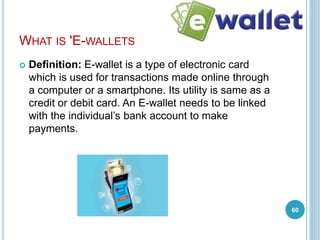
WHAT IS 'E-WALLETS
 Definition: E-wallet is a type of electronic card
which is used for transactions made online through
a computer or a smartphone. Its utility is same as a
credit or debit card. An E-wallet needs to be linked
with the individual’s bank account to make
payments.
60
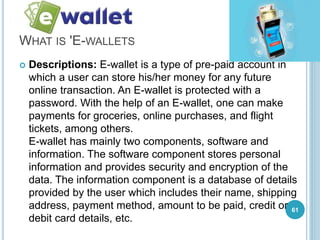
WHAT IS 'E-WALLETS
 Descriptions: E-wallet is a type of pre-paid account in
which a user can store his/her money for any future
online transaction. An E-wallet is protected with a
password. With the help of an E-wallet, one can make
payments for groceries, online purchases, and flight
tickets, among others.
E-wallet has mainly two components, software and
information. The software component stores personal
information and provides security and encryption of the
data. The information component is a database of details
provided by the user which includes their name, shipping
address, payment method, amount to be paid, credit or
debit card details, etc.
61
ELECTRONIC FUNDS TRANSFER (EFT
 is the electronic transfer of money from one bank
account to another, either within a single financial
institution or across multiple institutions, via computer-
based systems, without the direct intervention of bank
staff.
 EFT transactions are known by a number of names
across countries and different payment systems. For
example, in the United States, they may be referred to
as "electronic checks" or "e-checks". In the United
Kingdom, the term "bank transfer" and "bank payment"
are used, in Canada, "e-transfer" is used, while in
several other European countries "giro transfer" is the
common term.
62
WHAT IS NEFT?
NEFT stands for National Electronic Funds Transfer. It was
introduced by the Reserve Bank of India (RBI) to help
send money electronically.
How does NEFT work?
NEFT is a payment method that helps you send money to
someone electronically. In its early days, NEFT was
available only during set times of the day during working
days. The idea was that banks would collect payments
from different customers and send them together at a
particular time.
63
WHAT IS NEFT?
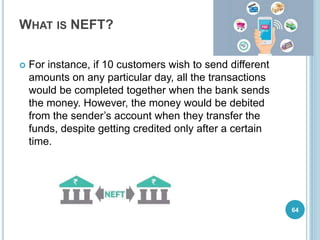
 For instance, if 10 customers wish to send different
amounts on any particular day, all the transactions
would be completed together when the bank sends
the money. However, the money would be debited
from the sender’s account when they transfer the
funds, despite getting credited only after a certain
time.
64
4.REAL TIME GROSS SETTLEMENT (RTGS)
 The term Real-time Gross Settlement (RTGS)
refers to a funds transfer system that allows for the
instantaneous transfer of money and/or securities.
RTGS is the continuous process of settling
payments on an individual order basis
without netting debits with credits across the books
of a central bank.
 Once completed, real-time gross settlement
payments are final and irrevocable. In most
countries, the systems are managed and run by
their central banks.
65
4.REAL TIME GROSS SETTLEMENT (RTGS)
 Real Time Gross Settlement (RTGS) was
introduced in the year 2004, is an electronic form of
fund transfer where the transfer of money takes
place from one bank to another bank on a real-time
and gross basis. Reserve Bank of India (RBI)
maintains and operates the RTGS system by
providing the efficient and faster fund transfer
among banks facilitating their financial operations
 Therefore, RTGS is the continuous process of
settling payments on an individual order basis
without netting debits with credits across the books
of a central bank (e.g. bundling transactions). Once
completed, real-time gross settlement payments
are final and irrevocable. 66
4.REAL TIME GROSS SETTLEMENT (RTGS)
 Under RTGS, the settlement means the transaction
made are settled as soon as they are processed
without any waiting period. ‘ Gross settlement’
means the transaction is settled on one to one
basis without bunching or netting with any other
transaction.
 Considering that funds transfer takes place in the
books of the Reserve Bank of India, the payment is
taken as final and irrevocable.
67
ADVANTAGE OF RTGS
 The benefits of RTGS given to the customer are as follows:
 Real-time Payment Settlement: Payments settled in real time
on a transaction-by-transaction basis, as soon as the system
accepts them.
 No Credit Risk: There is no credit and settlement risk involved
in RTGS system for receiving participant as each payment
transaction is settled instantly.
 Predictability of Cash Flows: RTGS facilitates predictability of
cash flows as customers know when their accounts will be
debited or credited.
 Benefits to Economy: The instant finality of payments ensures
fast, secure and irrevocable settlement of major business and
financial market transactions.
68
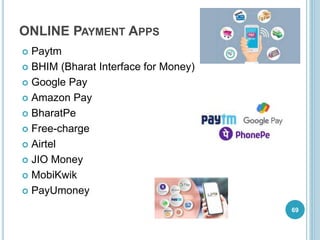
ONLINE PAYMENT APPS
 Paytm
 BHIM (Bharat Interface for Money)
 Google Pay
 Amazon Pay
 BharatPe
 Free-charge
 Airtel
 JIO Money
 MobiKwik
 PayUmoney
69

FM-SEM-V-UNIT-2-FINAL-2022-23.ppt

  • 1.
  • 2.
    WORKING CAPITAL MANAGEMENT I)Working Capital Management: Concept, types and significance, Factors determining working capital requirements, Sources of Working Capital: Accruals, trade credit, commercial banks, public deposits, inter-corporate-deposits, short-term loans from financial institutions, commercial paper (CP) and factoring, Computation of Working Capital Requirement(Practical Problems) II) Cash Management: Meaning, Motives for holding cash ,Techniques of Cash Management, Online Payment: Wallets, Fund Transfer, National Electronic Fund Transfer (NEFT) and Real Time Gross Settlement (RTGS), Payment apps 2
  • 3.
    I) WORKING CAPITALMANAGEMENT: What is Working Capital ?  ‘Working Capital’ is the term used basically to indicate the financial condition of a firm or an organization in the short term. In other words, it can be called a scale to measure the overall efficiency of the business entity.  To obtain the working capital of a specific firm or organizations one is required to subtract the current liabilities from the total current assets of the entity. This ratio suggests whether the particular organization has sufficient assets with it to take care of its short-term debt. To put it the other way, working capital is an indicator of the liquidity levels of an organization for taking care of day-to-day expenditure and cash, accounts payable, inventory, accounts receivable and also due short-term debt. 3
  • 4.
    I) WORKING CAPITALMANAGEMENT: What is Working Capital ?  ‘Working Capital’ is the term used basically to indicate the financial condition of a firm or an organization in the short term. In other words, it can be called a scale to measure the overall efficiency of the business entity.  To obtain the working capital of a specific firm or organizations one is required to subtract the current liabilities from the total current assets of the entity. This ratio suggests whether the particular organization has sufficient assets with it to take care of its short-term debt. To put it the other way, working capital is an indicator of the liquidity levels of an organization for taking care of day-to-day expenditure and cash, accounts payable, inventory, accounts receivable and also due short-term debt. 4
  • 5.
    WORKING CAPITAL MANAGEMENT Working capital is obtained from many company operations like inventory and debt management, revenue collection and supplier payments.  Now with the concept of working capital being clear, one needs to know about different types of working capital and the various sources from which it can be derived for the company or the firm. 5
  • 6.
    TYPES OF WORKINGCAPITAL 1. Permanent Working Capital 2. Variable Working Capital 3. Gross Working Capital 4. Net Working Capital 6
  • 7.
    TYPES OF WORKINGCAPITAL 1.Permanent Working Capital: Permanent Working Capital is called the fixed working capital. It comprises the current assets in minimum which is required for keeping the business operations working. This needs to be noted that fixed working capital size always depends on the growth and production scale. Mostly, these long-term sources are used for availing a working capital of fixed type. 7
  • 8.
    TYPES OF WORKINGCAPITAL 2.Variable Working Capital:  The ever-changing working capital or variable is generally that the amount which is invested for a very short term period. This may also be defined as the extra working capital used to account for the various changes in sales activities and production. The changing working capital is known as the working capital of temporary nature. 8
  • 9.
    TYPES OF WORKINGCAPITAL 2.Gross Working Capital: Gross Working Capital is the fund that is invested by a company’s current assets which serve as an indicator for Gross Working Capital. Below mentioned are the parts of the gross working capital:- Cash, Inventory, Accounts receivables, Marketable securities ,Short span investments 3.Net Working Capital: This is an important working capital. The networking capital shows the amount under which the company’s current assets would surpass the then-current liabilities. This is the difference between the current liabilities and a business’s total assets. 9
  • 10.
  • 11.
    SIGNIFICANCE OF WORKINGCAPITAL  It allows a smooth production flow  Helps in boosting the liquidity  Also ensures proper use of the fixed assets  It aids a project in getting a positive image of the firm  Also enables the firms for availing benefits for the cash discounts  Aids in availing financial assistance such as loans easily  It also allows meeting the contingencies very effectively 11
  • 12.
    FACTORS DETERMINING THEREQUIREMENTS OF WORKING CAPITAL 1. Sales 2. Length of Operating Cycle 3. Nature of Business 4. Terms of Credit 5. Seasonal Variations 6. Nature of Production Technology 7. Contingencies 12
  • 13.
    FACTORS DETERMINING THEREQUIREMENTS OF WORKING CAPITAL 13
  • 14.
    FACTORS DETERMINING THEREQUIREMENTS OF WORKING CAPITAL 1. Sales:  Among the various factors, size of the sales is one of the important factors in determining the amount of working capital. In order to increase sales volume, the enterprise needs to maintain its current assets.  In the course of period, the enterprise becomes in the position to keep a steady ratio of its current assets to annual sales. As a result, the turnover ratio, i.e., current assets to turnover increases reducing the length of operating cycle. Thus, less the operating cycle period, less will be requirements for working capital and vice versa. 2. Length of Operating Cycle:  Conversion of cash through various stages viz., raw material, semi-processed goods, finished goods, sales, debtors and bills receivables into cash takes a certain period of time that is known as ‘length of operating cycle’. Longer the operating cycle time, the more is the working capital required. 14
  • 15.
    FACTORS DETERMINING THEREQUIREMENTS OF WORKING CAPITAL 3. Nature of Business:  The requirement of working capital also varies among the enterprises depending upon the nature of the business. For instance, trading companies require more working capital than manufacturing companies. This is because that the trading business requires large quantities of goods to be held in stock and also carry large amounts of working capital than manufacturing concerns.  In both these types of businesses, the value of current assets is 80% to 90% of the value of total assets. The investment in current assets is relatively smaller in the case of hotels and restaurants because they mostly have cash sales, and only small amounts of debtors’ balances. 4. Terms of Credit:  Another important factor that determines the amount of working capital requirements relates to the terms of credit allowed to the customers. For instance, an enterprise may allow only 15 days credit, while another may allow 90 days credit to its customers. Besides, an enterprise may extend credit facilities to its all customers, while another enterprise in the same business may extend credit only to select and those too reliable customers only. 15
  • 16.
    FACTORS DETERMINING THEREQUIREMENTS OF WORKING CAPITAL  Then, the requirements for working capital will naturally be more if the credit period is longer and credit facilities are extended to all customers, no matter reliable or non-reliable they are. This is because there will be longer balance of debtors and that too for a relatively longer period which will obviously demand for more capital.  On the contrary, if supplies of raw materials are available on favourable conditions or terms of credit i.e., the payment will be made after a relatively longer period of time, the requirement for working capital will be correspondingly smaller.  5. Seasonal Variations:  The seasonal enterprises, i.e., the enterprise whose operations pick up seasonally may require more working capital to meet their increased operations during the particular season. A popular example of seasonal enterprise may be sugar factory whose operations are highly seasonal. 16
  • 17.
    FACTORS DETERMINING THEREQUIREMENTS OF WORKING CAPITAL 6. Turnover of Inventories:  If inventories are large in size but turnover is slow, the small-scale enterprise will need more working capital. On the contrary, if inventories are small but their turnover is quick, the enterprise will need a small amount of working capital. 17
  • 18.
    FACTORS DETERMINING THEREQUIREMENTS OF WORKING CAPITAL 7. Nature of Production Technology:  In case of labour intensive technology, the unit will need more amount to pay the wages and, therefore, will require more working capital. On the other hand, if the production technology is capital- intensive, the enterprise will have to make less payment for expenses like wages. As a result, enterprise will require less working capital. 8. Contingencies:  If the demand for and price of the products of small- scale enterprises are subject to wide variations or fluctuations, the contingency provisions will have to be made for meeting the fluctuations. This will obviously increase the requirements for working capital of the small enterprises. While one can add certain other factors to this list, the said factors appear to be the major ones in determining the requirement of working capital of a small-scale enterprise. 18
  • 19.
  • 20.
    SOURCES OF WORKINGCAPITAL Permanent or Fixed Temporary or Variable Shares Commercial Bank Debentures Indigenous Bankers Public Deposits Trade Creditors Ploughing Back of Profits Installment Credit Loans from Financial Institutions Advances Account Receivables-Credit/Factoring Accrued Expenses Commercial Paper 20
  • 21.
    SOURCES OF WORKINGCAPITAL- LONG-TERM SOURCES 21
  • 22.
    SOURCES OF WORKINGCAPITAL- LONG-TERM 1.Shares- Issues of Shares is most important sourse for raising the permanent or long-term capital.A company can issue various types of shares as eauity shares,preference shares ad Deferrered Shares.According to the Company Act,1956,however,a public compay cannot issue deferred shares .Preferencrial shares carry preferential rights 22
  • 23.
    SOURCES OF WORKINGCAPITAL- LONG-TERM 2.Debentures – A Debenture is an instrument issued by the company acknowledge its debt to its holders are the creditors of the company. A fixed rate of interest is paid on Debentures. The interest on Debentures is a charge against profit and loss account. The debentures are generally given floating charge on the assets of the company. When the debentures are secured, they are paid on priority to other creditors. The debentures may be of various kinds such as simple, unsecured debentures, redeemable debentures ,irredeemable debentures, etc. 23
  • 24.
    SOURCES OF WORKINGCAPITAL- LONG-TERM 3.Public Deposits Public Deposits are the fixed deposits accepted by a business enterprise directly from the public. This source of raising short-term and medium term finance was very popular in the absence of banking facilties.In the past ,generally ,public deposits were accepted by Textile Industries in Ahmadabad and Bombay for period of 6 months to 1 year. But now, even long-term deposits for 5 to 7 years are accepted by the business houses. 24
  • 25.
    SOURCES OF WORKINGCAPITAL- LONG-TERM 4.Ploughing back of profit  It means the re-investments by concern of its surplus earning in its business. it is an internal source of finance and is most suitable for established firm for its expansaion,modenisation,replacement etc.This method of finance has a number of advantages as it is the cheapest rather cost free course of finance; there s no need to keep securities, there is no dilution of control, it ensures stable dividend policy and gains confidence of the public. But excessive resort to ploughing back of profits may lead to monolpolies,misuse of funds,over-capitalisation and speculation etc. 25
  • 26.
    SOURCES OF WORKINGCAPITAL- LONG-TERM 5.Loan from Financial Institution- Financial Institution such as commercial Banks, Life Insurance Corporation, Industrial Finance Corporation of India, State Financial Corporations, State Industrial Development Coproations,IDBI et also provide short-term, medium-term and long- term loans. This source of finance is more suitable to meet the medium-term demands of working capital .Interest is charged on such loans at a fixed rate and the amount of loan is to be repaid by way of installments in a number of years. 26
  • 27.
    SOURCES OF WORKINGCAPITAL- SHORT-TERM SOURCES 27
  • 28.
    SOURCES OF WORKINGCAPITAL- SHORT-TERM SOURCES 1. Indigenous Bankers:  Private moneylender and other country bankers used to be the main sources of finance prior to the establishment of commercial bank. Now a day with the development of commercial banks they have lost their monopoly. But even today some business houses have to depend upon indigenous bankers for obtaining loans to meet their working capital requirements. 28
  • 29.
    SOURCES OF WORKINGCAPITAL- SHORT-TERM SOURCES 2. Trade Credit:  Trade credit refers to the credit extended by the supplier of goods in the normal course of business. The trade credit arrangement of a firm with its suppliers is an important source of short-term finance. The credit worthiness of a firm and the confidence of its supplier are the main basis of securing trade credit. Every firm must utilize this source to the fullest extent, because this source is cost free. i.e., borrower need not pay any interest. 29
  • 30.
    SOURCES OF WORKINGCAPITAL- SHORT-TERM SOURCES 3.Commercial Banks: Commercial banks are the most important source of short- term capital. The different forms in which the banks normally provide loans and advances are as follows- a. Loans:  When a bank makes an advance in lump sum against some security, it is called a loan. In case of a loan a specified amount is sanctioned by the bank to the customer. The entire loan amount is paid to the borrower either in cash or by credit to his account. The borrower is required to pay interest on the entire amount of loan from the date of sanction. b. Cash Credit:  Cash credit is an arrangement by which a bank allows his customer to borrow money up to a certain limit against some tangible securities. A customer can withdraw from his cash credit limit according to his need and interest is calculated on the daily balance and not on the entire amount. c. Over Draft:  Over draft is an arrangement by which a current account holder is allowed to withdraw more than the balance to his credit up to a certain limit. The interest is charged on daily over drawn balances.  d. Discounting of Bill of Exchange:  Purchasing and discounting of bills of exchange is the most important form in which the banks lend money without any collateral security. 30
  • 31.
    SOURCES OF WORKINGCAPITAL- SHORT-TERM SOURCES 4. Installment Credit:  This is another method by which the possession of goods is taken immediately. The payment is made in installment over a predetermined period of time. Generally interest is charged on the unpaid price but in any case, it provides fund for some time and is used as a source of short-term working capital by many business houses. 31
  • 32.
    SOURCES OF WORKINGCAPITAL- SHORT-TERM SOURCES 5. Advances: Some business houses get advances from the customers and middlemen against order and this source is a short-term source of finance. It is a cheap source of finance and in order to minimize their investment in working capital the manufacturing industries prefer to take advances from their customers. 32
  • 33.
    SOURCES OF WORKINGCAPITAL- SHORT-TERM SOURCES 6. Factoring/Account Receivable Credit:  Another method of raising short-term finance is through account receivable or credit offered by commercial banks and factors. A commercial bank may provide finance through discounting the bills or invoices of its customers. Thus, a firm gets immediate payment for sales made on credit through factoring.  Factoring is an arrangement by which the factor purchases, on a continuous basis, all the debts of the suppliers of goods and services to customers. It is a contract between the supplier and factor with regard to the realization of supplier’s credit sales. The factor may assume risk of non-payment by the customer also. He charges a predetermined commission for his services. 33
  • 34.
    SOURCES OF WORKINGCAPITAL- SHORT-TERM SOURCES 7. Accrued Expenses: Accrued expenses, which have been incurred but not yet paid. These simply represent a liability that a firm has to pay services already received by it. Thus, all accrued expenses can be used as a source of short-term finance. 34
  • 35.
    SOURCES OF WORKINGCAPITAL- SHORT-TERM SOURCES 8.Deferred Incomes:  Deferred incomes are incomes received in advance before supplying services. They represent funds received by a firm for which it has to supply goods or services in future. These funds increase the liquidity of a firm and constitute an important source of short-term finance. 35
  • 36.
    SOURCES OF WORKINGCAPITAL- SHORT-TERM SOURCES 9.Commercial Paper:  Commercial paper represents unsecured promissory notes issued by firms to raise short-term funds. It is an important money market instrument in advanced countries like U.S.A. Commercial paper is a cheapest source of raising short-term finance as compared to the bank credit.  Commercial paper is usually bought by investors including Banks, Insurance Companies, Unit Trust of India and firms to invest surplus funds for a short period. 36
  • 37.
    Statement of WorkingCapital Requirements Particulars Rs. Rs. Current Assets : Cash Debtors/Receivables Stock Advance Payment, if any Others Total Current Assets-(A) Less: Current Liabilities Creditors Lag in payment of expenses (Outstanding Expenses, if any) Total Current Liabilities-(B) Working Capital (A-B) (Current Assets-Current Liabilities) Add: Provision/Margin for contingencies Net Working Capital required Examples of Working Capital Requirements 37
  • 38.
    II) CASH MANAGEMENT: Meaning,Motives for holding cash ,Techniques of Cash Management, Online Payment: Wallets, Fund Transfer, National Electronic Fund Transfer (NEFT) and Real Time Gross Settlement (RTGS), Payment apps 38
  • 39.
    MEANING OF CASH: Cash is the primary asset individuals and companies use regularly to settle their debt obligations and operating expenses, e.g., taxes, employee salaries, inventory purchases, advertising costs, and rents, etc.  Cash is used as investment capital to be allocated to long-term assets, such as property, plant, and equipment (PP&E) and other non-current assets. Excess cash after accounting for expenses often goes towards dividend distributions. 39
  • 40.
    MEANING OF CASH: Companies with a multitude of cash inflows and outflows must be properly managed to maintain adequate business stability. For individuals, maintaining cash balances is also a major concern. NATURE OF CASH  Cash is the medium of exchange for purchase of goods and services and for discharging liabilities. 40
  • 41.
    INTRODUCTION TO CASHMANAGEMENT  Management of cash is one of the most important areas of overall working capital management due to the fact that cash is the most liquid type of current assets.  As such it is the responsibility of the finance function to see that the various functional areas of the business have sufficient cash whenever they require the same. 41
  • 42.
    WHAT IS CASHMANAGEMENT? Cash management, also known as treasury management, is the process that involves collecting and managing cash flows from the operating, investing, and financing activities of a company. In business, it is a key aspect of an organization’s financial stability. 42
  • 43.
    WHAT IS CASHMANAGEMENT?  Cash management is important for both companies and individuals, as it is a key component of financial stability.  Financial instruments involved in cash management contain money market funds, Treasury bills, and certificates of deposit. 43
  • 44.
    WHAT IS CASHMANAGEMENT?  Companies and individuals offer a wide range of services available across the financial marketplace to help with all types of cash management. Banks are typically a primary financial service provider. There are also many different cash management solutions for both companies and individuals seeking to get the best return on cash assets or the most efficient use of cash. 44
  • 45.
    CASH MANAGEMENT- The processof collecting and managing cash flows from the operating, investing, and financing activities of a company 45
  • 46.
    INTRODUCTION TO CASHMANAGEMENT  At the same time, it has also to be ensured that the funds are not blocked in the form of idle cash, as the cash remaining idle also involves cost in the form of interest cost and opportunity cost.  As such the management of cash has to find a mean between these two extremes of shortage of cash as well as idle cash. 46
  • 47.
    OBJECTIVES OF CASHMANAGEMENT  The prime objective of cash management is to channelize the flow of cash from the surplus to deficit units to maintain the appropriate liquidity position of the organization.  In addition, the objectives of cash management can be broadly subdivided into two heads – 1) maintaining the inflow and outflow of cash 2) sustaining the cash position held by the organization to meet the current obligations. 47
  • 48.
    MOTIVES FOR HOLDINGCASH 1. Transaction Motive 2. Precautionary Motive 3. Speculative Motive 48
  • 49.
    7. MOTIVES FORHOLDING CASH A company may hold the cash with the various motives as stated below: 1.Transaction Motive: The transaction motive refers to the cash required by a firm to meet the day to day needs of its business operations. In an ordinary course of business, the firm requires cash to make the payments in the form of salaries, wages, interests, dividends, goods purchased, etc.  Likewise, it also receives cash from its sales, debtors, investments. Often the firm’s cash inflows and outflows do not match, and hence, the cash is held up to meet its routine commitments. 49
  • 50.
    7. MOTIVES FORHOLDING CASH 2.Precautionary Motive: The precautionary motive refers to the tendency of a firm to hold cash, to meet the contingencies or unforeseen circumstances arising in the course of business. Since the future is uncertain, a firm may have to face contingencies such as an increase in the price of raw materials, labor strike, lockouts, change in the demand, etc. Thus, in order to meet with these uncertainties, the cash is held by the firms to have an uninterrupted business operations. 50
  • 51.
    7. MOTIVES FORHOLDING CASH 3.Speculative Motive: The firms hold cash for the speculative purposes to avail the benefit of bargain purchases that may arise in the future. For example, if the firm feels the prices of raw material are likely to fall in the future, it will hold cash and wait till the prices actually fall. Thus, a firm holds cash to exploit the possible opportunities that are out of the normal course of business. These opportunities could be in the form of the low-interest rate charged on the borrowed funds, expected fall in the raw material prices or favorable change in the government policies. 51
  • 52.
    7. MOTIVES FORHOLDING CASH  However, receipts of the cash and the payments by cash may not always match with each other. In such situations, the company will like to hold the cash to honour the commitments whenever they become due.  This requirement of cash balances to meet routine needs is known as transaction motive. 52
  • 53.
    ONLINE PAYMENT: 1. WALLETS 2.FUNDTRANSFER 3.NATIONAL ELECTRONIC FUND TRANSFER (NEFT) 4.REAL TIME GROSS SETTLEMENT (RTGS), 5.PAYMENT APPS 53
  • 54.
    WHAT ARE ONLINEPAYMENTS?  Online payments refer to the electronic exchange of currency through the internet. These payments usually consist of the transfer of monetary funds from a customer's bank or debit or credit card account, into the seller's bank account, in exchange for products or services. These funds can come directly from a customer's credit card or checking account, or from an online payment system that is linked to both the buyer and seller's bank accounts. 54
  • 55.
    WHAT ARE ONLINEPAYMENTS?  Online payments are used by buyers of goods and services, and the sellers of those goods and services. Several steps occur with the funds when they are transferred and received, especially between the two parties, that often require different types of software to successfully facilitate the transaction. The typical steps are below:  Online purchase is made: A customer (buyer) provides the necessary information (debit or credit card, checking account information, etc.) to pay for goods or services. This data is then sent to a payment processing software or payment gateway.  Information is encrypted: The payment gateway encrypts the payment details, such as the customer's name, address, and bank account info, which provides a level of security to make it more difficult for this info to be stolen.  Details are verified: After the transaction data is encrypted, the information is sent to a payment processor to ensure that the transaction is valid. Once the transfer is verified, it sends the info to the buyer’s and seller’s banks. 55
  • 56.
    WHAT ARE ONLINEPAYMENTS?  Funds are approved: Assuming there are no red flags from the payment gateway or processor, the banks authorize the transaction. There are, however, several reasons as to why a transaction might not be approved by either bank:  Insufficient funds  Frozen account status  Invalid credit card number or expiration date  Transaction limits  The card has been reported lost or stolen  The address does not match the card  Invalid Card Code Verification (CCV)  Funds are requested: After the funds and corresponding transfer are approved, the payment processor requests the funds to be sent from the buyer's source of funds to the seller's bank account.  The seller receives funds: The transfer of funds is completed and the purchase price has been sent from buyer to seller.  56
  • 57.
    TYPES OF ONLINEPAYMENTS 1.Credit cards 2.Debit cards 3.Third-party payment services 4.Electronic checks 5.Bank transfers 57
  • 58.
    TYPES OF ONLINEPAYMENTS  Credit cards: This is a payment issued from a financial institution that lends money to the cardholder, which allows them to purchase products and services online. Using credit cards for purchases is a popular type of online payment because the buyer usually has little to no liability for fraudulent charges, and most sellers accept this type of payment.  Debit cards: Using debit cards (sometimes referred to as check cards or bank cards) for online purchases deducts the price directly from the user’s bank account. Similar to credit cards, the purchaser is often protected from unauthorized charges, and debit cards are widely accepted online.  Third-party payment services: These online and mobile services help facilitate the sending and receiving of payments online between buyer and seller. Once a bank account is attached to a third-party payment service, transactions can often be made via mobile phones, tablets, smartwatches, and within apps.  Electronic checks: This form of online payment (sometimes referred to as eChecks or ACH) deducts cash from a checking account, which eliminates the need for the buyer to write a paper check or the seller to deposit it. Electronic checks require the payer’s name, checking account routing, and account number, as well as the amount of the payment.  Bank transfers: A bank transfer is similar to the debit card method because it transfers funds directly from one bank account to another. The difference with a bank transfer is that a physical debit card is not needed, providing an even faster and more secure form of payment. 58
  • 59.
    BENEFITS OF USINGONLINE PAYMENTS  Online payments provide both the buyer and seller with many benefits, such as security, efficiency, convenience, and contactless options.  Security: Online payment options use encryption to protect consumer information and ensure data and funds are transferred securely from buyers to sellers. These safety protocols also decrease the chance of personal information being stolen.  Efficiency: Payments made online are efficient because they are fast, sometimes instantaneous, and don’t have any constraints, such as distance, time, or location.  Convenience: Vendors who accept online payments are providing a convenience that allows their customers to easily pay for goods or services, which improves the buying experience. If the vendor accepts credit card payments, the customer can buy goods on credit and pay later. Payments can also be made from anywhere at any time, eliminating the need to go to a bank or another financial institution.  Contactless option: Contactless online payments allow buyers to pay for items by simply holding a smart device near a terminal that processes the transaction and transfers the funds to the seller via the internet. Customers can also make payments using QR codes or one-time passwords (OTP), both of which eliminate the need for human touch. 59
  • 60.
    WHAT IS 'E-WALLETS Definition: E-wallet is a type of electronic card which is used for transactions made online through a computer or a smartphone. Its utility is same as a credit or debit card. An E-wallet needs to be linked with the individual’s bank account to make payments. 60
  • 61.
    WHAT IS 'E-WALLETS Descriptions: E-wallet is a type of pre-paid account in which a user can store his/her money for any future online transaction. An E-wallet is protected with a password. With the help of an E-wallet, one can make payments for groceries, online purchases, and flight tickets, among others. E-wallet has mainly two components, software and information. The software component stores personal information and provides security and encryption of the data. The information component is a database of details provided by the user which includes their name, shipping address, payment method, amount to be paid, credit or debit card details, etc. 61
  • 62.
    ELECTRONIC FUNDS TRANSFER(EFT  is the electronic transfer of money from one bank account to another, either within a single financial institution or across multiple institutions, via computer- based systems, without the direct intervention of bank staff.  EFT transactions are known by a number of names across countries and different payment systems. For example, in the United States, they may be referred to as "electronic checks" or "e-checks". In the United Kingdom, the term "bank transfer" and "bank payment" are used, in Canada, "e-transfer" is used, while in several other European countries "giro transfer" is the common term. 62
  • 63.
    WHAT IS NEFT? NEFTstands for National Electronic Funds Transfer. It was introduced by the Reserve Bank of India (RBI) to help send money electronically. How does NEFT work? NEFT is a payment method that helps you send money to someone electronically. In its early days, NEFT was available only during set times of the day during working days. The idea was that banks would collect payments from different customers and send them together at a particular time. 63
  • 64.
    WHAT IS NEFT? For instance, if 10 customers wish to send different amounts on any particular day, all the transactions would be completed together when the bank sends the money. However, the money would be debited from the sender’s account when they transfer the funds, despite getting credited only after a certain time. 64
  • 65.
    4.REAL TIME GROSSSETTLEMENT (RTGS)  The term Real-time Gross Settlement (RTGS) refers to a funds transfer system that allows for the instantaneous transfer of money and/or securities. RTGS is the continuous process of settling payments on an individual order basis without netting debits with credits across the books of a central bank.  Once completed, real-time gross settlement payments are final and irrevocable. In most countries, the systems are managed and run by their central banks. 65
  • 66.
    4.REAL TIME GROSSSETTLEMENT (RTGS)  Real Time Gross Settlement (RTGS) was introduced in the year 2004, is an electronic form of fund transfer where the transfer of money takes place from one bank to another bank on a real-time and gross basis. Reserve Bank of India (RBI) maintains and operates the RTGS system by providing the efficient and faster fund transfer among banks facilitating their financial operations  Therefore, RTGS is the continuous process of settling payments on an individual order basis without netting debits with credits across the books of a central bank (e.g. bundling transactions). Once completed, real-time gross settlement payments are final and irrevocable. 66
  • 67.
    4.REAL TIME GROSSSETTLEMENT (RTGS)  Under RTGS, the settlement means the transaction made are settled as soon as they are processed without any waiting period. ‘ Gross settlement’ means the transaction is settled on one to one basis without bunching or netting with any other transaction.  Considering that funds transfer takes place in the books of the Reserve Bank of India, the payment is taken as final and irrevocable. 67
  • 68.
    ADVANTAGE OF RTGS The benefits of RTGS given to the customer are as follows:  Real-time Payment Settlement: Payments settled in real time on a transaction-by-transaction basis, as soon as the system accepts them.  No Credit Risk: There is no credit and settlement risk involved in RTGS system for receiving participant as each payment transaction is settled instantly.  Predictability of Cash Flows: RTGS facilitates predictability of cash flows as customers know when their accounts will be debited or credited.  Benefits to Economy: The instant finality of payments ensures fast, secure and irrevocable settlement of major business and financial market transactions. 68
  • 69.
    ONLINE PAYMENT APPS Paytm  BHIM (Bharat Interface for Money)  Google Pay  Amazon Pay  BharatPe  Free-charge  Airtel  JIO Money  MobiKwik  PayUmoney 69