PANTALOON :REVOLUTIONIZING
THE INDIAN RETAILING INDUSTRY
SUBMITTED TO
MRS SHAILJA MANOCHA
SUBMITTED
BY:
ANITA
DEEPAK
MOONGA
NEHA YADAV
PANKAJ LODHI
PRIYANKA
INTRODUCTION
 India’s leading retailer operating in value and
lifestyle segment of the indian consumer
market.
 From a small single format store in
1993.PRIL had grown to become the largest
multi-format store by 2004,comprising
pantaloons(department store),big
bazaar(hyper market),food bazaar(grocery
store),gold bazaar(gold retail store) and
central(malls).It was one of the largest
players in discounting retail.
 A flagship company of Future Group.
FUTURE GROUP
 VISION:-”to deliever everything,every
where,every time to every indian consumer
in the most profitable manner”
 MISSION:-”Indianess as a core value”
 CORPORATE CREDO:-”rewrite rules,retain
value”
RETAIL INDUSTRY IN INDIA
 In 2003 India had over 10 million retail outlets
selling worth $200 billion.Unorganized sector
accounted for over 98% of the retail stores,the small
individual proprietor store called “kirana” shops
dominating the scene.
 The organized retail sector in India was
characterized by high attrition rates,lack of trained
manpower and low salaries.
 Food & Groceries,which accounted for nearly 50% of
the consumer’s total expenditure,had a miniscule
share of 0.3% in organized retailing.
 Apparel retailing was the second largest opportunity
for the organized retailers.Branded apparel
accounted for 20% of the total apparel market,of
which men’s clothing accounted for 70%,children’s
wear 20% and women’s wear 8%.
Contd.
 In 2002-2003 discounts store made an entry into
Indian retailing industry
 In 2003-2004 international retailers plan to enter
India but FDI was not allowed in retail segment.
MAJOR MILESTONE
 1987: Company incorporated as Manz Wear Private
Limited. Launch of Pantaloons
 trouser, India’s first formal trouser brand.
 1991: Launch of BARE, the Indian jeans brand.
 1992: Initial public offer (IPO) was made in the
month of May.
 1994: The Pantaloon Shoppe – exclusive menswear
store in franchisee format launched
 across the nation. The company starts the distribution
of branded garments through multi-
 brand retail outlets across the nation.
 1995: John Miller – Formal shirt brand launched.
 1997: Pantaloons – India’s family store launched in
Kolkata.
CONTD.
 2001: Big Bazaar, ‘Is se sasta aur accha kahi nahin’ -
India’s first hypermarket chain
 launched.
 2002: Food Bazaar, the supermarket chain is
launched.
 2004: Central – ‘Shop, Eat, Celebrate In The Heart
Of Our City’ - India’s first seamless
 mall is launched in Bangalore.
PANTALOON MODEL
 Pantaloon adopted a pan-indian model that captured
the value chain and allowed it to evolve with the
customer prefrences.
 Biyani believed that growth lays in.”setting up new
stores,getting new customers,by introducing new
retail formats,by introducing new products and by
making no mistakes”.
 He repositioned Pantaloons from a family to a lifestyle
store as the market involved.
 He emphasized on cheaper sourcing,efficient supply
chain,affordable price,private labels,location and floor
space of the store.
PRODUCTS
 Pantaloon sold aparrels and accessories categorized
under:-
Men’s formal
Men’s casual
Ladies ethnic
Ladies western
Children’s wear
 Pantaloon develops three types of merchandise:-
Classic type
Fashion type
Collection type
Contd.
 In 2000 pantaloon launched a new brand of casual
sports wear.
 In 2003 pantaloon decided to launch designer
labels,like Spring Board for women.
 In same year it launched a new apparel line called
Passion Wear.The merchandize focus on World Cup.
 In early 2003,Pantaloons also acquried the trademark
and exclusive liscening rights for a apparel brand
Norules.it gots the right to use the youth characters
of norules such as one eye jack,justin etc.
 He also acquried the licensing right for Popeye and
Disney characters, which he used for kids wear.
Contd.
 In late 2003 Pantaloons tied up with the Italian
apparel company Moda & Musica for the latter’s UMM
brand.
 It also launched a youth brand Rig.
 In 2001,Pantaloon tied up with Andhra Pradesh
handloom weaver’s cooperative society and NIFT to
launch a womens’s ethnic wear made from handloom.
BRANDS
 Pantaloons focuses on company owned private labels
and some other brands also.
Men’s wear John Miller,Rig,Ajile,Bare
denim
Ladies wear Ajile,Rig
Children’s wear Rig,Bare
POSITIONING
 With a tag line “0-80”(age group),first pantaloon was
positioned as a family store targeting the middle and upper
class customers.
 In 2003 they focused more on youth segment and try to
establish itself high on style graph.
 The company had partnered with Gibam, an Italian firm
known for its stylish stores, to create a unique image for its
stores.
 Garments was displaced on hangers, rather than stacked in
shelves.
 In april 2004 pantaloons in partnership with Mattel india ltd.
Opened a ‘Barbie Concept Store’ named as a Magical world of
Barbie which targeted at young girls,in age group of 3-10.
PROMOTION
 To gain customer loyalty pantaloons launched following
loyalty programmes
*Green cards
*Kids bank
*Gift vouchers
* Weekend adventure programmes
 Hoardings:-Pantaloon puts its hoarding at prime
locations, featuring the upcoming Fashion events or its
brand ambassadors who are generally eminent
celebrity.
DISTRIBUTION
 Pantaloons located at up market accessible & high
footfall locations.
 Initially,property was purchased & developed by
Biyani but after 2002 he decided to buy properties on
lease.
 In beginning the stores had a floor space of 4,500 sq
ft but later it grew bigger and occupied between
30,000-90,000 sq ft.
 It takes 20,000-25,000 sq ft in high traffic areas like
entertainment complexes and shopping malls.
 Pantaloon entered into a strategic alliance with Inox
leisure to take up spaces in multiplexes.
 One level distribution.
PRICING
 Pantaloons sold branded garments at affordable prices.
 More than 70% of apparel sales at pantaloons consisted
of private labels like Bare, HNY,John Millers,AFL etc
while rest were brands such as Levis,Arrow,reebok etc.
 The price of private labels was 20%-25% lower as
compared to the branded once.
 In men’s wear retailers earned margin between 55%-
60% on private labels while in women’s wear it was
between 48%-50%.
 Special event pricing
 Promotional pricing
SERVICES
 As it is a family store the staff was trained to handle
older people.
 Pantaloons also changed the store layout.Earlier it
was in aisle format but they changed it into L & U
shaped counters.
 Pantaloons had a “No Question Asked” exchange
policy.
 They also launched a unique customized tailoring for
trousers,blazers and suits which are delievered to
customers within 48hrs.
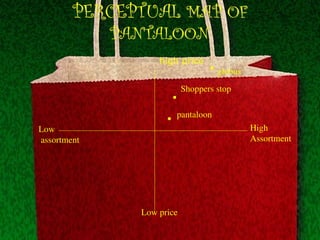
PERCEPTUAL MAP OF
PANTALOON
high price
Low
assortment
High
Assortment
Low price
pantaloon
Shoppers stop
globus
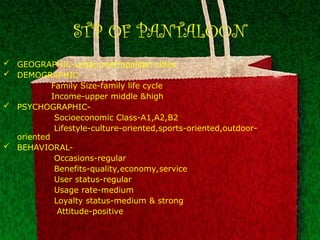
STP OF PANTALOON
 GEOGRAPHIC-urban,metropolitan cities
 DEMOGRAPHIC-
Family Size-family life cycle
Income-upper middle &high
 PSYCHOGRAPHIC-
Socioeconomic Class-A1,A2,B2
Lifestyle-culture-oriented,sports-oriented,outdoor-
oriented
 BEHAVIORAL-
Occasions-regular
Benefits-quality,economy,service
User status-regular
Usage rate-medium
Loyalty status-medium & strong
Attitude-positive
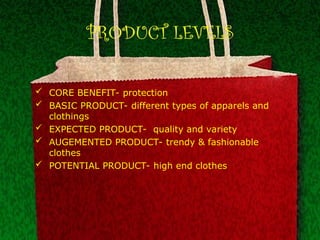
PRODUCT LEVELS
 CORE BENEFIT- protection
 BASIC PRODUCT- different types of apparels and
clothings
 EXPECTED PRODUCT- quality and variety
 AUGEMENTED PRODUCT- trendy & fashionable
clothes
 POTENTIAL PRODUCT- high end clothes
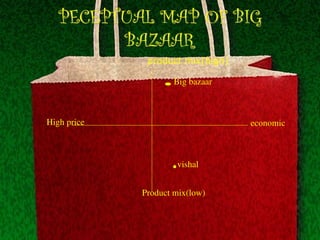
PECEPTUAL MAP OF BIG
BAZAAR
product mix(high)
Product mix(low)
High price economic
Big bazaar
vishal
STP OF BIG BAZAAR
 GEOGRAPHIC- urban
 DEMOGRAPHIC-
Income- middle,lower middle
Family size- family life cycle
 PSYCHOGRAPHIC-
Socioeconomic class-B1,B2
Life style- outdoor-oriented,culture-oriented
 BEHAVIORAL-
Occasions- regular
Benefits- economy
User status- regular
TARGET AUDIENCE
 Big bazaar target middle class consumers who are
highly price conscious and seeks value in purchase
made.
PRICING
 EDLP(every day low price)
 Promotional pricing
 Differentiated pricing-
 Bundling
PROMOTION
 SAAL KAY SABSE SASTE TEEN DIN
 Future card
 Wednesday bazaar
TARGET AUDIENCE
 They are targeting the whole family in urban area.
STP OF FOOD BAZAAR
 GEOGRAPHIC- metro cities
 DEMOGRAPHIC-
Age-30 & above
Family size-family life cycle
Income- upper middle
 BEHAVIORAL-
Benefits- economy,fresh stock
POSITIONING
 Consistent positioning-always low price
PRICE
 EDLP(every day low price)
 Promotional pricing
 Psychological discounting
 Special event pricing
 Differentiating pricing- time pricing
PROMOTION
 SAAL KAY SABSE SASTE TEEN DIN-26jan,15aug or diwali
 Future card(3%)
 Shakti card
 Advertisements-print ads,T.V ads,radio ads
 HAFTE KA SABSE SASTA DIN(Wednesday)
DISTRIBUTION CHANNEL
 Distribution is done by distributors who is the middle
man between the manufacturer and retailer.
SUPPLY CHAIN MANAGEMENT
 In 1998,Pantaloons recurited ex Ernest & Young employees
to develop in-house supply chain mgmt. tools such as point
of sales software.
 Pantaloon adopted MIS with a reporting module for its back
office transactions.
 It monitored price fluctions daily in whole sale market.
 A vendor mgmt. system enabled vendors to send report
directly to the pantaloons.
 Pantaloon instituionalised both at vendor primese & its own
warehouses.
 In 2001 pantaloons switched to bought out sales,where
pantaloons was responsible for the merchandise sold in the
stores.
THE ROAD AHEAD
 Pantaloon planed to expand its retail stores to small
cities like lucknow,nagpur etc.
 By the end of 2005,pantaloon is expected to have 30
food bazaars,22 big bazaars,21 pantaloons & 4
centrals.
 Pantaloon also had plan to venture into
footwear,consumer durables,music & car acessories
retailing.
 The company also had an forged alliance with a
sports retail footwear company called Royal sports
house.
 As a repositioning Biyani planned to give a new
makeover to pantaloons.
 To re-establish and rejuvenate its existing
brands,pantaloons intended to spend INR 2 crores &
additional INR 1 crore on its upcoming brands.
CONTD.
 The company was planning to reduce the number of
vendorsfor both Pantaloons and Big bazaar
 To meets it growing technology meet,they planned to
deploy a retail ERP solution,which would support
functions such as HR & Marketing.
 Pantaloons planned to launch a B2B portal,to bring
transparency in the value chain.
THANK YOU

28392755-Pantaloon-Ppt (1).ppt bbbbbbbbb

  • 1.
    PANTALOON :REVOLUTIONIZING THE INDIANRETAILING INDUSTRY SUBMITTED TO MRS SHAILJA MANOCHA SUBMITTED BY: ANITA DEEPAK MOONGA NEHA YADAV PANKAJ LODHI PRIYANKA
  • 2.
    INTRODUCTION  India’s leadingretailer operating in value and lifestyle segment of the indian consumer market.  From a small single format store in 1993.PRIL had grown to become the largest multi-format store by 2004,comprising pantaloons(department store),big bazaar(hyper market),food bazaar(grocery store),gold bazaar(gold retail store) and central(malls).It was one of the largest players in discounting retail.  A flagship company of Future Group.
  • 3.
    FUTURE GROUP  VISION:-”todeliever everything,every where,every time to every indian consumer in the most profitable manner”  MISSION:-”Indianess as a core value”  CORPORATE CREDO:-”rewrite rules,retain value”
  • 4.
    RETAIL INDUSTRY ININDIA  In 2003 India had over 10 million retail outlets selling worth $200 billion.Unorganized sector accounted for over 98% of the retail stores,the small individual proprietor store called “kirana” shops dominating the scene.  The organized retail sector in India was characterized by high attrition rates,lack of trained manpower and low salaries.  Food & Groceries,which accounted for nearly 50% of the consumer’s total expenditure,had a miniscule share of 0.3% in organized retailing.  Apparel retailing was the second largest opportunity for the organized retailers.Branded apparel accounted for 20% of the total apparel market,of which men’s clothing accounted for 70%,children’s wear 20% and women’s wear 8%.
  • 5.
    Contd.  In 2002-2003discounts store made an entry into Indian retailing industry  In 2003-2004 international retailers plan to enter India but FDI was not allowed in retail segment.
  • 6.
    MAJOR MILESTONE  1987:Company incorporated as Manz Wear Private Limited. Launch of Pantaloons  trouser, India’s first formal trouser brand.  1991: Launch of BARE, the Indian jeans brand.  1992: Initial public offer (IPO) was made in the month of May.  1994: The Pantaloon Shoppe – exclusive menswear store in franchisee format launched  across the nation. The company starts the distribution of branded garments through multi-  brand retail outlets across the nation.  1995: John Miller – Formal shirt brand launched.  1997: Pantaloons – India’s family store launched in Kolkata.
  • 7.
    CONTD.  2001: BigBazaar, ‘Is se sasta aur accha kahi nahin’ - India’s first hypermarket chain  launched.  2002: Food Bazaar, the supermarket chain is launched.  2004: Central – ‘Shop, Eat, Celebrate In The Heart Of Our City’ - India’s first seamless  mall is launched in Bangalore.
  • 8.
    PANTALOON MODEL  Pantaloonadopted a pan-indian model that captured the value chain and allowed it to evolve with the customer prefrences.  Biyani believed that growth lays in.”setting up new stores,getting new customers,by introducing new retail formats,by introducing new products and by making no mistakes”.  He repositioned Pantaloons from a family to a lifestyle store as the market involved.  He emphasized on cheaper sourcing,efficient supply chain,affordable price,private labels,location and floor space of the store.
  • 9.
    PRODUCTS  Pantaloon soldaparrels and accessories categorized under:- Men’s formal Men’s casual Ladies ethnic Ladies western Children’s wear  Pantaloon develops three types of merchandise:- Classic type Fashion type Collection type
  • 10.
    Contd.  In 2000pantaloon launched a new brand of casual sports wear.  In 2003 pantaloon decided to launch designer labels,like Spring Board for women.  In same year it launched a new apparel line called Passion Wear.The merchandize focus on World Cup.  In early 2003,Pantaloons also acquried the trademark and exclusive liscening rights for a apparel brand Norules.it gots the right to use the youth characters of norules such as one eye jack,justin etc.  He also acquried the licensing right for Popeye and Disney characters, which he used for kids wear.
  • 11.
    Contd.  In late2003 Pantaloons tied up with the Italian apparel company Moda & Musica for the latter’s UMM brand.  It also launched a youth brand Rig.  In 2001,Pantaloon tied up with Andhra Pradesh handloom weaver’s cooperative society and NIFT to launch a womens’s ethnic wear made from handloom.
  • 12.
    BRANDS  Pantaloons focuseson company owned private labels and some other brands also. Men’s wear John Miller,Rig,Ajile,Bare denim Ladies wear Ajile,Rig Children’s wear Rig,Bare
  • 13.
    POSITIONING  With atag line “0-80”(age group),first pantaloon was positioned as a family store targeting the middle and upper class customers.  In 2003 they focused more on youth segment and try to establish itself high on style graph.  The company had partnered with Gibam, an Italian firm known for its stylish stores, to create a unique image for its stores.  Garments was displaced on hangers, rather than stacked in shelves.  In april 2004 pantaloons in partnership with Mattel india ltd. Opened a ‘Barbie Concept Store’ named as a Magical world of Barbie which targeted at young girls,in age group of 3-10.
  • 14.
    PROMOTION  To gaincustomer loyalty pantaloons launched following loyalty programmes *Green cards *Kids bank *Gift vouchers * Weekend adventure programmes  Hoardings:-Pantaloon puts its hoarding at prime locations, featuring the upcoming Fashion events or its brand ambassadors who are generally eminent celebrity.
  • 15.
    DISTRIBUTION  Pantaloons locatedat up market accessible & high footfall locations.  Initially,property was purchased & developed by Biyani but after 2002 he decided to buy properties on lease.  In beginning the stores had a floor space of 4,500 sq ft but later it grew bigger and occupied between 30,000-90,000 sq ft.  It takes 20,000-25,000 sq ft in high traffic areas like entertainment complexes and shopping malls.  Pantaloon entered into a strategic alliance with Inox leisure to take up spaces in multiplexes.  One level distribution.
  • 16.
    PRICING  Pantaloons soldbranded garments at affordable prices.  More than 70% of apparel sales at pantaloons consisted of private labels like Bare, HNY,John Millers,AFL etc while rest were brands such as Levis,Arrow,reebok etc.  The price of private labels was 20%-25% lower as compared to the branded once.  In men’s wear retailers earned margin between 55%- 60% on private labels while in women’s wear it was between 48%-50%.  Special event pricing  Promotional pricing
  • 17.
    SERVICES  As itis a family store the staff was trained to handle older people.  Pantaloons also changed the store layout.Earlier it was in aisle format but they changed it into L & U shaped counters.  Pantaloons had a “No Question Asked” exchange policy.  They also launched a unique customized tailoring for trousers,blazers and suits which are delievered to customers within 48hrs.
  • 18.
    PERCEPTUAL MAP OF PANTALOON highprice Low assortment High Assortment Low price pantaloon Shoppers stop globus
  • 19.
    STP OF PANTALOON GEOGRAPHIC-urban,metropolitan cities  DEMOGRAPHIC- Family Size-family life cycle Income-upper middle &high  PSYCHOGRAPHIC- Socioeconomic Class-A1,A2,B2 Lifestyle-culture-oriented,sports-oriented,outdoor- oriented  BEHAVIORAL- Occasions-regular Benefits-quality,economy,service User status-regular Usage rate-medium Loyalty status-medium & strong Attitude-positive
  • 20.
    PRODUCT LEVELS  COREBENEFIT- protection  BASIC PRODUCT- different types of apparels and clothings  EXPECTED PRODUCT- quality and variety  AUGEMENTED PRODUCT- trendy & fashionable clothes  POTENTIAL PRODUCT- high end clothes
  • 21.
    PECEPTUAL MAP OFBIG BAZAAR product mix(high) Product mix(low) High price economic Big bazaar vishal
  • 22.
    STP OF BIGBAZAAR  GEOGRAPHIC- urban  DEMOGRAPHIC- Income- middle,lower middle Family size- family life cycle  PSYCHOGRAPHIC- Socioeconomic class-B1,B2 Life style- outdoor-oriented,culture-oriented  BEHAVIORAL- Occasions- regular Benefits- economy User status- regular
  • 23.
    TARGET AUDIENCE  Bigbazaar target middle class consumers who are highly price conscious and seeks value in purchase made. PRICING  EDLP(every day low price)  Promotional pricing  Differentiated pricing-  Bundling PROMOTION  SAAL KAY SABSE SASTE TEEN DIN  Future card  Wednesday bazaar
  • 24.
    TARGET AUDIENCE  Theyare targeting the whole family in urban area.
  • 25.
    STP OF FOODBAZAAR  GEOGRAPHIC- metro cities  DEMOGRAPHIC- Age-30 & above Family size-family life cycle Income- upper middle  BEHAVIORAL- Benefits- economy,fresh stock POSITIONING  Consistent positioning-always low price
  • 26.
    PRICE  EDLP(every daylow price)  Promotional pricing  Psychological discounting  Special event pricing  Differentiating pricing- time pricing PROMOTION  SAAL KAY SABSE SASTE TEEN DIN-26jan,15aug or diwali  Future card(3%)  Shakti card  Advertisements-print ads,T.V ads,radio ads  HAFTE KA SABSE SASTA DIN(Wednesday)
  • 27.
    DISTRIBUTION CHANNEL  Distributionis done by distributors who is the middle man between the manufacturer and retailer.
  • 28.
    SUPPLY CHAIN MANAGEMENT In 1998,Pantaloons recurited ex Ernest & Young employees to develop in-house supply chain mgmt. tools such as point of sales software.  Pantaloon adopted MIS with a reporting module for its back office transactions.  It monitored price fluctions daily in whole sale market.  A vendor mgmt. system enabled vendors to send report directly to the pantaloons.  Pantaloon instituionalised both at vendor primese & its own warehouses.  In 2001 pantaloons switched to bought out sales,where pantaloons was responsible for the merchandise sold in the stores.
  • 29.
    THE ROAD AHEAD Pantaloon planed to expand its retail stores to small cities like lucknow,nagpur etc.  By the end of 2005,pantaloon is expected to have 30 food bazaars,22 big bazaars,21 pantaloons & 4 centrals.  Pantaloon also had plan to venture into footwear,consumer durables,music & car acessories retailing.  The company also had an forged alliance with a sports retail footwear company called Royal sports house.  As a repositioning Biyani planned to give a new makeover to pantaloons.  To re-establish and rejuvenate its existing brands,pantaloons intended to spend INR 2 crores & additional INR 1 crore on its upcoming brands.
  • 30.
    CONTD.  The companywas planning to reduce the number of vendorsfor both Pantaloons and Big bazaar  To meets it growing technology meet,they planned to deploy a retail ERP solution,which would support functions such as HR & Marketing.  Pantaloons planned to launch a B2B portal,to bring transparency in the value chain.
  • 31.