Mergers, Acquisitions, and Strategic
    Human Resource Management
                             Chapter 3


 Copyright © 2009 Pearson Education, Inc.   3-1
publishing as Prentice Hall
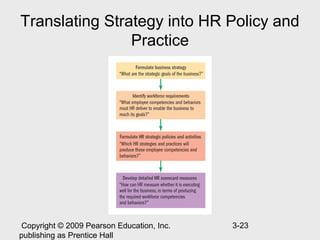
What is strategic HRM?
 Strategic HRM is developed through three steps:

          1. Decide on the strategic goals
          2. Identify employee skills and
             behaviors necessary for success
          3. Formulate HR management policies
                  and practices that will produce
            these       required skills


 Copyright © 2009 Pearson Education, Inc.   3-2
publishing as Prentice Hall
The Strategic Management Process

 The process begins by
 developing a strategic
 plan that describes how
 internal strengths and
 weaknesses will be
 matched with external
 opportunities and
 threats


 Copyright © 2009 Pearson Education, Inc.   3-3
publishing as Prentice Hall
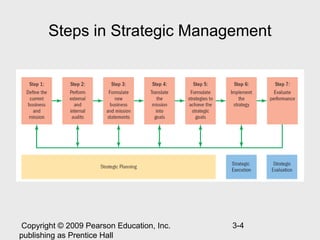
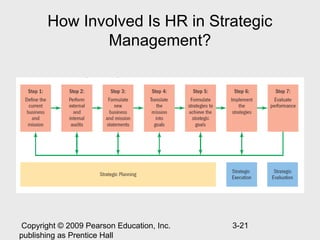
Steps in Strategic Management


 Copyright © 2009 Pearson Education, Inc.   3-4
publishing as Prentice Hall
Step 1: Define the current business

Begin by asking these questions:
    – What products do we sell?

    – Where do we sell these products?

    – How do our products or services differ from
      our competitors?


 Copyright © 2009 Pearson Education, Inc.   3-5
publishing as Prentice Hall
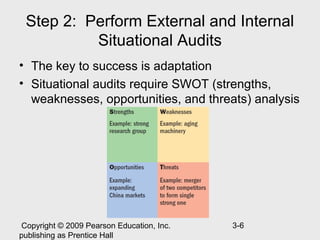
Step 2: Perform External and Internal
          Situational Audits
• The key to success is adaptation
• Situational audits require SWOT (strengths,
  weaknesses, opportunities, and threats) analysis


 Copyright © 2009 Pearson Education, Inc.   3-6
publishing as Prentice Hall
Step 3: Formulate a New Business
                Direction
• What should our new business be in terms of
  product, placement and competitive advantage?
• The vision statement describes the following:
     What do we want to become?
• The mission statement explains the following:
     Where are we now?


 Copyright © 2009 Pearson Education, Inc.   3-7
publishing as Prentice Hall
Step 4: Translate the Mission into
              Strategic Goals
• Operationalize the mission for managers
• What does the mission mean to each
  department?
• What goals follow implementation?


 Copyright © 2009 Pearson Education, Inc.   3-8
publishing as Prentice Hall
Step 5: Formulate Strategies to
         Achieve the Strategic Goals
• What is the game plan?

• Decide on a course of
  action

    – Best strategies are
      concise

    – Easily communicated


 Copyright © 2009 Pearson Education, Inc.   3-9
publishing as Prentice Hall
Step 6: Implement the Strategies

• Get the game plan going
• Do what needs to be done
    – Hire or fire people
    – Build or close plants
    – Adding or eliminating products and product
      lines


 Copyright © 2009 Pearson Education, Inc.   3-10
publishing as Prentice Hall
Step 7: Evaluate Performance

• Evaluate, evaluate, evaluate
• Ongoing process vis-à-vis strategic control
• Addresses the following questions:
    – Are resources being utilized as planned?
    – Are discrepancies explained?
    – Do changes in our situation suggest change?


 Copyright © 2009 Pearson Education, Inc.   3-11
publishing as Prentice Hall
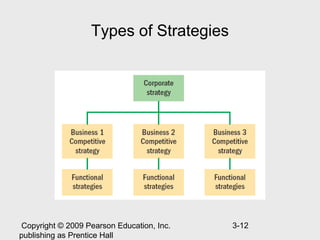
Types of Strategies


 Copyright © 2009 Pearson Education, Inc.   3-12
publishing as Prentice Hall
Corporate Strategy

• Top-level, company-wide
• Identifies the portfolio of existing business
  segments
• Strategic possibilities include the following:
    – Diversification or vertical integration
    – Consolidation
    – Geographic expansion


 Copyright © 2009 Pearson Education, Inc.   3-13
publishing as Prentice Hall
Competitive Strategy

• Identifies how to build upon and strengthen the
  business’s
  long-term
  marketplace
  position
• Identifies and
  develops
  competitive
  advantage


 Copyright © 2009 Pearson Education, Inc.   3-14
publishing as Prentice Hall
Competitive Advantage
• Cost leadership indicates that the enterprise
  intends to become the low-cost leader in the
  industry
• Differentiation strategies seek to be unique in its
  industry along dimensions valued by buyers
• Focusers carve out niche markets and compete
  by providing a product/service that customers
  can get through no other means


 Copyright © 2009 Pearson Education, Inc.   3-15
publishing as Prentice Hall
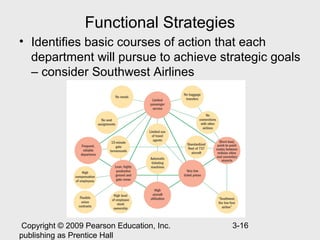
Functional Strategies
• Identifies basic courses of action that each
  department will pursue to achieve strategic goals
  – consider Southwest Airlines


 Copyright © 2009 Pearson Education, Inc.   3-16
publishing as Prentice Hall
The Importance of Leverage

                               • Leverage means
                                 supplementing what you
                                 have and doing more
                                 with what you’ve got!
                               • Human resources can
                                 be a crucial competitive
                                 advantage!


 Copyright © 2009 Pearson Education, Inc.        3-17
publishing as Prentice Hall
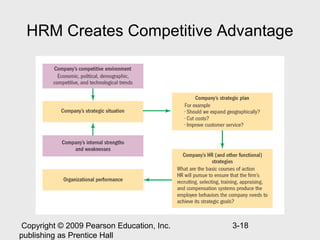
HRM Creates Competitive Advantage


 Copyright © 2009 Pearson Education, Inc.   3-18
publishing as Prentice Hall
Four Important Strategic HR Issues

1. HR must understand that employees play a
   key role in employers’ performance
   improvement efforts
2. HR teams should support corporate
   productivity and performance improvement
   efforts


 Copyright © 2009 Pearson Education, Inc.   3-19
publishing as Prentice Hall
Four Important Strategic HR Issues, cont.

 3. HR units must be more involved in designing –
    not just executing – the strategic plan
 4. HR managers must understand how to create
    value


  Copyright © 2009 Pearson Education, Inc.   3-20
 publishing as Prentice Hall
How Involved Is HR in Strategic
              Management?


 Copyright © 2009 Pearson Education, Inc.   3-21
publishing as Prentice Hall
What Roles Does HR Play?

     • Strategy
       execution
     • Strategy
       formulation
     • SWOT analysis


 Copyright © 2009 Pearson Education, Inc.   3-22
publishing as Prentice Hall
Translating Strategy into HR Policy and
                Practice


 Copyright © 2009 Pearson Education, Inc.   3-23
publishing as Prentice Hall

Fall2012 ppt ch03 dessler

  • 1.
    Mergers, Acquisitions, andStrategic Human Resource Management Chapter 3 Copyright © 2009 Pearson Education, Inc. 3-1 publishing as Prentice Hall
  • 2.
    What is strategicHRM? Strategic HRM is developed through three steps: 1. Decide on the strategic goals 2. Identify employee skills and behaviors necessary for success 3. Formulate HR management policies and practices that will produce these required skills Copyright © 2009 Pearson Education, Inc. 3-2 publishing as Prentice Hall
  • 3.
    The Strategic ManagementProcess The process begins by developing a strategic plan that describes how internal strengths and weaknesses will be matched with external opportunities and threats Copyright © 2009 Pearson Education, Inc. 3-3 publishing as Prentice Hall
  • 4.
    Steps in StrategicManagement Copyright © 2009 Pearson Education, Inc. 3-4 publishing as Prentice Hall
  • 5.
    Step 1: Definethe current business Begin by asking these questions: – What products do we sell? – Where do we sell these products? – How do our products or services differ from our competitors? Copyright © 2009 Pearson Education, Inc. 3-5 publishing as Prentice Hall
  • 6.
    Step 2: PerformExternal and Internal Situational Audits • The key to success is adaptation • Situational audits require SWOT (strengths, weaknesses, opportunities, and threats) analysis Copyright © 2009 Pearson Education, Inc. 3-6 publishing as Prentice Hall
  • 7.
    Step 3: Formulatea New Business Direction • What should our new business be in terms of product, placement and competitive advantage? • The vision statement describes the following: What do we want to become? • The mission statement explains the following: Where are we now? Copyright © 2009 Pearson Education, Inc. 3-7 publishing as Prentice Hall
  • 8.
    Step 4: Translatethe Mission into Strategic Goals • Operationalize the mission for managers • What does the mission mean to each department? • What goals follow implementation? Copyright © 2009 Pearson Education, Inc. 3-8 publishing as Prentice Hall
  • 9.
    Step 5: FormulateStrategies to Achieve the Strategic Goals • What is the game plan? • Decide on a course of action – Best strategies are concise – Easily communicated Copyright © 2009 Pearson Education, Inc. 3-9 publishing as Prentice Hall
  • 10.
    Step 6: Implementthe Strategies • Get the game plan going • Do what needs to be done – Hire or fire people – Build or close plants – Adding or eliminating products and product lines Copyright © 2009 Pearson Education, Inc. 3-10 publishing as Prentice Hall
  • 11.
    Step 7: EvaluatePerformance • Evaluate, evaluate, evaluate • Ongoing process vis-à-vis strategic control • Addresses the following questions: – Are resources being utilized as planned? – Are discrepancies explained? – Do changes in our situation suggest change? Copyright © 2009 Pearson Education, Inc. 3-11 publishing as Prentice Hall
  • 12.
    Types of Strategies Copyright © 2009 Pearson Education, Inc. 3-12 publishing as Prentice Hall
  • 13.
    Corporate Strategy • Top-level,company-wide • Identifies the portfolio of existing business segments • Strategic possibilities include the following: – Diversification or vertical integration – Consolidation – Geographic expansion Copyright © 2009 Pearson Education, Inc. 3-13 publishing as Prentice Hall
  • 14.
    Competitive Strategy • Identifieshow to build upon and strengthen the business’s long-term marketplace position • Identifies and develops competitive advantage Copyright © 2009 Pearson Education, Inc. 3-14 publishing as Prentice Hall
  • 15.
    Competitive Advantage • Costleadership indicates that the enterprise intends to become the low-cost leader in the industry • Differentiation strategies seek to be unique in its industry along dimensions valued by buyers • Focusers carve out niche markets and compete by providing a product/service that customers can get through no other means Copyright © 2009 Pearson Education, Inc. 3-15 publishing as Prentice Hall
  • 16.
    Functional Strategies • Identifiesbasic courses of action that each department will pursue to achieve strategic goals – consider Southwest Airlines Copyright © 2009 Pearson Education, Inc. 3-16 publishing as Prentice Hall
  • 17.
    The Importance ofLeverage • Leverage means supplementing what you have and doing more with what you’ve got! • Human resources can be a crucial competitive advantage! Copyright © 2009 Pearson Education, Inc. 3-17 publishing as Prentice Hall
  • 18.
    HRM Creates CompetitiveAdvantage Copyright © 2009 Pearson Education, Inc. 3-18 publishing as Prentice Hall
  • 19.
    Four Important StrategicHR Issues 1. HR must understand that employees play a key role in employers’ performance improvement efforts 2. HR teams should support corporate productivity and performance improvement efforts Copyright © 2009 Pearson Education, Inc. 3-19 publishing as Prentice Hall
  • 20.
    Four Important StrategicHR Issues, cont. 3. HR units must be more involved in designing – not just executing – the strategic plan 4. HR managers must understand how to create value Copyright © 2009 Pearson Education, Inc. 3-20 publishing as Prentice Hall
  • 21.
    How Involved IsHR in Strategic Management? Copyright © 2009 Pearson Education, Inc. 3-21 publishing as Prentice Hall
  • 22.
    What Roles DoesHR Play? • Strategy execution • Strategy formulation • SWOT analysis Copyright © 2009 Pearson Education, Inc. 3-22 publishing as Prentice Hall
  • 23.
    Translating Strategy intoHR Policy and Practice Copyright © 2009 Pearson Education, Inc. 3-23 publishing as Prentice Hall