Unit 1A and 1B No exams A lot of practical activities involving the use of a digital cameras Some written work Not suitable  for entry into university (unless by portfolio)  Good chance to create a portoflio for TAFE or uni entry.
The focus for this unit is  design basics .  What is the difference between this unit and lower school photography?   Focus on the DESIGN of photos (the planning and the portfolio processes) Learning advanced technical aspects– EG: how to control the amount of light that goes into your camera, using advanced manual controls.
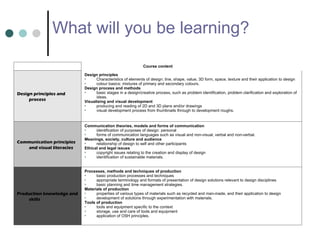
What will you be learning? Course content Design principles and process Design principles Characteristics of elements of design: line, shape, value, 3D form, space, texture and their application to design colour basics: mixtures of primary and secondary colours. Design process and methods basic stages in a design/creative process, such as problem identification, problem clarification and exploration of ideas. Visualising and visual development producing and reading of 2D and 3D plans and/or drawings visual development process from thumbnails through to development roughs. Communication principles and visual literacies Communication theories, models and forms of communication identification of purposes of design: personal forms of communication languages such as visual and non-visual, verbal and non-verbal. Meanings, society, culture and audience relationship of design to self and other participants Ethical and legal issues copyright issues relating to the creation and display of design identification of sustainable materials. Production knowledge and skills Processes, methods and techniques of production basic production processes and techniques appropriate terminology and formats of presentation of design solutions relevant to design disciplines basic planning and time management strategies. Materials of production properties of various types of materials such as recycled and man-made, and their application to design development of solutions through experimentation with materials. Tools of production tools and equipment specific to the context storage, use and care of tools and equipment application of OSH principles.
Three types of assessments:
Homework? You will be required to work on finishing tasks and working on your portfolio at home. Although….if you use your class time effectively you should be able to complete most activities in class!
Timetable I only see you two days a week. Be prepared to catch up on work at home if you miss a day of school. It is your responsibility:  See me, I will not always see you!
Brad Hicks [email_address]  - email @BradHicks - Twitter Write it down for future reference! You are expected to be in contact with me if you miss any classes.  Let me know why you have been away and ask what we have been doing!
Assessment policy 10% will be deducted from your task for every school day that the assessment is late. Extensions for medical or personal reasons must be asked for by at least the day BEFORE the task is due.
Using your own camera? You may use your own digital camera However: It must have the same functions as the school cameras. YOU are responsible for the safety and operation of your own camera.  ie: Bring your camera manual if you are not sure how to operate it!
Facilities and equipment 1 computer per student 1 camera per 2 students Lighting studio We have great facilities that have cost a lot of money.  Please look after them and report any issues to Cara.  ALWAYS record any loaned equipment.
Food and drinks Not to be consumed near the computers or camera equipment. Step outside in the corridor if necessary.
Breaks? You are ultimately responsible for managing your own time. If YOU need to go to the toilet or get a drink feel free, just let me know that you are leaving the class. Groups are not permitted to leave together as we need to minimise disruptions to other classes.
Mobile Phones Not seen and not heard! As in the workplace, distractions will not be tolerated.  I will model this behaviour.
Taking photos around the school You must tell me where you are going at all times. I put my  trust into your hands  and at times you will be unsupervised. If you break this trust, that is, wander off to have a conversation on your mobile, walk off campus, or are generally off task, you will loose this freedom.
SO: if you are enrolled in this unit remember that you need to be prepared to: Be involved with and complete practical activities. Spend equal amounts of time planning your photos as you do taking the photos. Complete written research and investigation work. Develop your sketching and design skills.   There is a waiting list for this class, so if you are not happy with the course outline, see Rod immediately to allow room for others to come in!!
Loan of equipment Camera’s need to be signed out, even if you are using it at school Cameras can be loaned for weekends only.

Desp1 a unitintroduction

  • 1.
  • 2.
    Unit 1A and1B No exams A lot of practical activities involving the use of a digital cameras Some written work Not suitable for entry into university (unless by portfolio) Good chance to create a portoflio for TAFE or uni entry.
  • 3.
    The focus forthis unit is design basics . What is the difference between this unit and lower school photography? Focus on the DESIGN of photos (the planning and the portfolio processes) Learning advanced technical aspects– EG: how to control the amount of light that goes into your camera, using advanced manual controls.
  • 4.
    What will yoube learning? Course content Design principles and process Design principles Characteristics of elements of design: line, shape, value, 3D form, space, texture and their application to design colour basics: mixtures of primary and secondary colours. Design process and methods basic stages in a design/creative process, such as problem identification, problem clarification and exploration of ideas. Visualising and visual development producing and reading of 2D and 3D plans and/or drawings visual development process from thumbnails through to development roughs. Communication principles and visual literacies Communication theories, models and forms of communication identification of purposes of design: personal forms of communication languages such as visual and non-visual, verbal and non-verbal. Meanings, society, culture and audience relationship of design to self and other participants Ethical and legal issues copyright issues relating to the creation and display of design identification of sustainable materials. Production knowledge and skills Processes, methods and techniques of production basic production processes and techniques appropriate terminology and formats of presentation of design solutions relevant to design disciplines basic planning and time management strategies. Materials of production properties of various types of materials such as recycled and man-made, and their application to design development of solutions through experimentation with materials. Tools of production tools and equipment specific to the context storage, use and care of tools and equipment application of OSH principles.
  • 5.
    Three types ofassessments:
  • 6.
    Homework? You willbe required to work on finishing tasks and working on your portfolio at home. Although….if you use your class time effectively you should be able to complete most activities in class!
  • 7.
    Timetable I onlysee you two days a week. Be prepared to catch up on work at home if you miss a day of school. It is your responsibility: See me, I will not always see you!
  • 8.
    Brad Hicks [email_address] - email @BradHicks - Twitter Write it down for future reference! You are expected to be in contact with me if you miss any classes. Let me know why you have been away and ask what we have been doing!
  • 9.
    Assessment policy 10%will be deducted from your task for every school day that the assessment is late. Extensions for medical or personal reasons must be asked for by at least the day BEFORE the task is due.
  • 10.
    Using your owncamera? You may use your own digital camera However: It must have the same functions as the school cameras. YOU are responsible for the safety and operation of your own camera. ie: Bring your camera manual if you are not sure how to operate it!
  • 11.
    Facilities and equipment1 computer per student 1 camera per 2 students Lighting studio We have great facilities that have cost a lot of money. Please look after them and report any issues to Cara. ALWAYS record any loaned equipment.
  • 12.
    Food and drinksNot to be consumed near the computers or camera equipment. Step outside in the corridor if necessary.
  • 13.
    Breaks? You areultimately responsible for managing your own time. If YOU need to go to the toilet or get a drink feel free, just let me know that you are leaving the class. Groups are not permitted to leave together as we need to minimise disruptions to other classes.
  • 14.
    Mobile Phones Notseen and not heard! As in the workplace, distractions will not be tolerated. I will model this behaviour.
  • 15.
    Taking photos aroundthe school You must tell me where you are going at all times. I put my trust into your hands and at times you will be unsupervised. If you break this trust, that is, wander off to have a conversation on your mobile, walk off campus, or are generally off task, you will loose this freedom.
  • 16.
    SO: if youare enrolled in this unit remember that you need to be prepared to: Be involved with and complete practical activities. Spend equal amounts of time planning your photos as you do taking the photos. Complete written research and investigation work. Develop your sketching and design skills. There is a waiting list for this class, so if you are not happy with the course outline, see Rod immediately to allow room for others to come in!!
  • 17.
    Loan of equipmentCamera’s need to be signed out, even if you are using it at school Cameras can be loaned for weekends only.