CAR SAFETY ANDACCIDENT PRECAUTION SYSTEM
DAYALBAGH EDUCATIONL INSTITUTE
AGRA
EGC581
DETD
2.
CONTENTS
1. Title Slide
2.Introduction
3. Problem Statement
4. Realisation of Need
5. Agenda
6. Need Analysis
7. Features
8. Unique Aspects
9. Cost Analysis
10. Circuit Design and Components
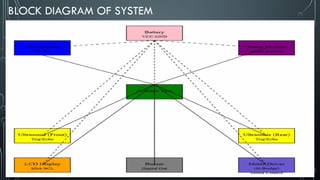
11. Block Diagram of System
12. Conclusion
3.
CAR SAFETY ANDACCIDENT PRECAUTION SYSTEM
Under the supervision of G. Shailesh Babu
Submitted by
Madhav Gautam - 2201741
Harsh Katara - 2201731
Kavya Mittal - 2201735
Anil Kumar - 2201720
4.
INTRODUCTION
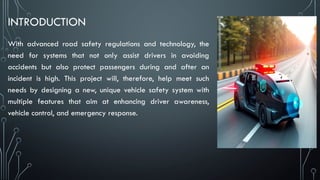
With advanced roadsafety regulations and technology, the
need for systems that not only assist drivers in avoiding
accidents but also protect passengers during and after an
incident is high. This project will, therefore, help meet such
needs by designing a new, unique vehicle safety system with
multiple features that aim at enhancing driver awareness,
vehicle control, and emergency response.
5.
PROBLEM STATEMENT
This projectaims to design a system with less risk from road accidents on challenging terrains,
for instance, mountainous terrains and curved roads through one package containing real-time
monitoring, hazard detection, and emergency response. Basically, it will be interested in
preventing the accident from taking place in the first instance or causing minimum damage to
reduce harm when the accident happens.
6.
REALISATION OF NEED
1.Critical Road Conditions
Traditional measures of protection seem insufficient on difficult terrains.
2. Reduce Accident Rate
Focus on winding or mountainous roads.
3. Real-Time Alerts
Provide active interventions to drivers.
4. Emergency Assistance
Ensure immediate help following the accident.
5. Responsive Demand
Cater to consumers and regulation bodies for reducing traffic fatalities.
7.
AGENDA
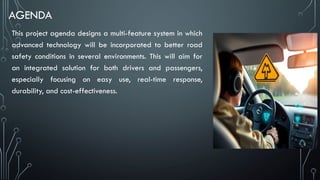
This project agendadesigns a multi-feature system in which
advanced technology will be incorporated to better road
safety conditions in several environments. This will aim for
an integrated solution for both drivers and passengers,
especially focusing on easy use, real-time response,
durability, and cost-effectiveness.
8.
NEED ANALYSIS
1. Easeof Operation
Simple design and non-intrusive features.
2. Real-Time Performance
Sensors react immediately to hazards.
3. Reliability and Durability
Function across various conditions with minimal maintenance.
4. Ergonomic and Modern Design
Modern design integrated with the car’s interior.
5. Comfort in Use
Clear, audible alerts and comfortable components.
9.
FEATURES
1. Curve Detection
Ituses GPS data to detect sharp turns and reduce speed.
2. Automatic Emergency Braking(AEB)
Activates brakes upon predicting an imminent collision.
3. Forward Collision Warning(FCW)
Warns the driver of potential risks.
4. Blind Spot Detection(BSC)
Monitors and alerts for vehicles in blind spots.
5. Traction Control System(TCS)
Prevents wheel slip by adjusting power output.
6. Electronic Stability Control(ESC)
Maintains control during sudden steering.
7. Emergency Alert System
Sends alerts to emergency services post-accident.
10.
FEATURES
8. Driven DrowsinessDetection
Uses AL to detect sign for Drivers
9. Alcohol and Speed Detection Alerts
Detect alcohol and issue warnings
11.
UNIQUE ASPECTS
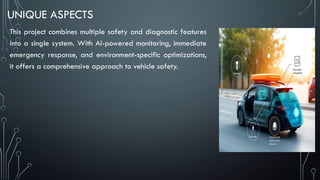
This projectcombines multiple safety and diagnostic features
into a single system. With AI-powered monitoring, immediate
emergency response, and environment-specific optimizations,
it offers a comprehensive approach to vehicle safety.
12.
COST ANALYSIS
• Theestimated costs for the main components are summarised:
• Arduino Uno: 500
₹
• GPS Module: 800
₹
• Ultrasonic Sensors (2): 1000
₹
• Relay Module: 1200
₹
• LCD Display: 700
₹
• Buzzer: 100
₹
• Airbags alternative (Optional, 2): 1000
₹
• Remote control Car: 3000
₹
• Miscellaneous (Wires, Connectors): 700
₹
• Total Estimated Cost: 8000
₹
13.
CIRCUIT DIAGRAM COMPONENT
•Arduino Uno
Acts as the central controller, processing inputs from sensors and modules to manage the system’s responses. It’s
programmed to handle the logic for emergency braking, proximity detection, and GPS-based alerts.
• GPS Module
Communicates with the Arduino to detect the vehicle's location and determine if it’s approaching a curve. This
data is used to control speed and alert drivers
• Ultrasonic Sensors
Placed at the front and rear of the vehicle, these sensors measure the distance between the car and potential
obstacles. When an obstacle is detected within a certain range, it triggers the automatic braking system.
• Relay Module
Controls the braking mechanism. When the Arduino receives a proximity alert, it activates the relay, which
applies the brakes automatically, enhancing the safety of the vehicle.
14.
CIRCUIT DIAGRAM COMPONENTS
•LCD Display
Displays real-time alerts, warnings, and system diagnostics, keeping the driver informed of
any imminent dangers or system statuses.
• Buzzer
Provides audible alerts for events like driver drowsiness, obstacle proximity, or alcohol
detection. This immediate feedback allows the driver to respond without diverting attention
from the road
• AI Module for Driver Drowsiness
This module monitors driver behavior, such as eye movement and blinking patterns, to detect
fatigue. If signs of drowsiness are detected, it alerts the driver to take a break.
CONCLUSION
This project deliversinnovations in vehicle safety with a user-centric approach, ensuring either
prevention or prompt response to improve road safety standards, especially in challenging
driving conditions.






![[IJET-V1I4P10] Authers :EiEi Thwe, Theingi](https://cdn.slidesharecdn.com/ss_thumbnails/ijet-v1i4p10-150810164804-lva1-app6892-thumbnail.jpg?width=640&height=640&fit=bounds)


