BUSINESS MODEL
Prepared By
Mrs. C. Ranganayaki, MBA, SLET, MPhil
Assistant Professor,
Sri Ramakrishna College of Arts & Science
Nava India, Coimbatore
BUSINESS MODEL
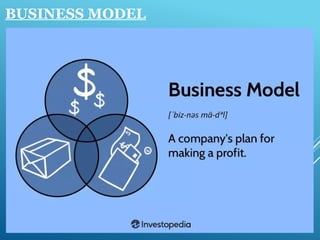
A business model is a company's profit-making plan which
defines:
- the products or services it will sell,
- its target market &
- any expected costs
A business model is a company's core strategy for profitably
doing business
There are dozens of types of business models including:
- retailers
- manufacturers
- fee-for-service
- freemium providers
The two levers of a business model are: Pricing & Costs
Investors, while evaluating a business model, considers
whether product being offered matches a true need in market
BUSINESS MODEL
EVALUATING SUCCESSFUL “BUSINESS MODEL”
A common mistake is to underestimate the costs of funding the
business until it becomes profitable
Counting costs to the introduction of a product is not enough
A company has to keep the business running until
its revenues exceed its expenses
One way to evaluate success of business model is by gross profit
Gross profit is a company's total revenue minus the cost of goods
sold (COGS)
Comparing a company's gross profit to that of its main
competitor or its industry sheds light on the efficiency and
effectiveness of its business model
Analysts also see to cash flow or net income
That is gross profit minus operating expenses and is an
indication of just how much real profit the business is generating
EVALUATING SUCCESSFUL “BUSINESS MODEL”
The two primary levers of a company's business model are:
- pricing &
- costs
A company can raise prices & can find inventory at reduced
costs
Both actions increase gross profit
Many analysts consider gross profit to be more important in
evaluating a business plan
A good gross profit suggests a sound business plan
If expenses are out of control, the management team could be
at fault, and the problems are correctable
As this suggests, many analysts believe that companies that run
on the best business models can run themselves
BUSINESS MODEL - TYPES
Retailer
A retailer is the last entity along a supply chain
They often buy finished goods from manufacturers or
distributors and interface directly with customers
Eg: Costco Wholesale, Aldi, Amazon.com, Walmart
Manufacturer
A manufacturer is responsible for sourcing raw materials and
producing finished products by leveraging internal labor,
machinery, and equipment
A manufacturer may make custom goods or highly replicated,
mass produced products
A manufacturer can also sell goods to distributors, retailers or
directly to customers
Eg: Ford Motor Company, Apple, IKEA, Mercedes-Benz
BUSINESS MODEL - TYPES
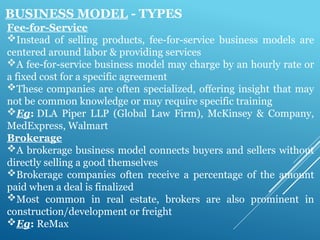
Fee-for-Service
Instead of selling products, fee-for-service business models are
centered around labor & providing services
A fee-for-service business model may charge by an hourly rate or
a fixed cost for a specific agreement
These companies are often specialized, offering insight that may
not be common knowledge or may require specific training
Eg: DLA Piper LLP (Global Law Firm), McKinsey & Company,
MedExpress, Walmart
Brokerage
A brokerage business model connects buyers and sellers without
directly selling a good themselves
Brokerage companies often receive a percentage of the amount
paid when a deal is finalized
Most common in real estate, brokers are also prominent in
construction/development or freight
Eg: ReMax
BUSINESS MODEL - TYPES
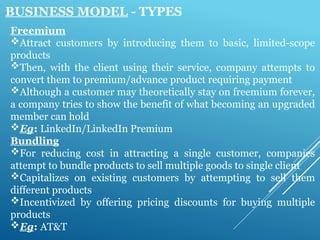
Freemium
Attract customers by introducing them to basic, limited-scope
products
Then, with the client using their service, company attempts to
convert them to premium/advance product requiring payment
Although a customer may theoretically stay on freemium forever,
a company tries to show the benefit of what becoming an upgraded
member can hold
Eg: LinkedIn/LinkedIn Premium
Bundling
For reducing cost in attracting a single customer, companies
attempt to bundle products to sell multiple goods to single client
Capitalizes on existing customers by attempting to sell them
different products
Incentivized by offering pricing discounts for buying multiple
products
Eg: AT&T
BUSINESS MODEL - TYPES
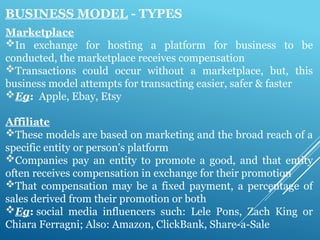
Marketplace
In exchange for hosting a platform for business to be
conducted, the marketplace receives compensation
Transactions could occur without a marketplace, but, this
business model attempts for transacting easier, safer & faster
Eg: Apple, Ebay, Etsy
Affiliate
These models are based on marketing and the broad reach of a
specific entity or person's platform
Companies pay an entity to promote a good, and that entity
often receives compensation in exchange for their promotion
That compensation may be a fixed payment, a percentage of
sales derived from their promotion or both
Eg: social media influencers such: Lele Pons, Zach King or
Chiara Ferragni; Also: Amazon, ClickBank, Share-a-Sale
BUSINESS MODEL - TYPES
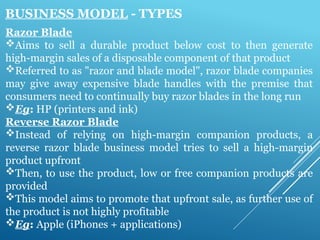
Razor Blade
Aims to sell a durable product below cost to then generate
high-margin sales of a disposable component of that product
Referred to as "razor and blade model", razor blade companies
may give away expensive blade handles with the premise that
consumers need to continually buy razor blades in the long run
Eg: HP (printers and ink)
Reverse Razor Blade
Instead of relying on high-margin companion products, a
reverse razor blade business model tries to sell a high-margin
product upfront
Then, to use the product, low or free companion products are
provided
This model aims to promote that upfront sale, as further use of
the product is not highly profitable
Eg: Apple (iPhones + applications)
BUSINESS MODEL - TYPES
Franchise
This business model leverages existing business plans to
expand and reproduce a company at a different location
Often food, hardware, or fitness companies, franchisers work
with incoming franchisees to finance the business, promote the
new location, and oversee operations
Franchisor receives a % of earnings from the franchisee
Eg: Domino's Pizza, Ace Hardware Stores, McDonald’s, The
UPS Store
Pay-As-You-Go
Instead of charging a fixed fee, some companies may
implement a pay-as-you-go business model where the amount
charged depends on how much of the product or service was used
May charge a fixed fee for offering the service in addition to an
amount that changes each month based on what was consumed
Eg: Utility companies, Apple, Amazon Web Services, Mint
Mobile
BUSINESS MODEL - TYPES
Subscription
Strives to attract clients in the hopes of luring them into long-
time, loyal patrons
This is done by offering a product that requires ongoing
payment, usually in return for a fixed duration of benefit
Though largely offered by digital companies for access to
software, subscription business models are also popular for
physical goods such as monthly reoccurring agriculture/produce
subscription box deliveries
Eg: Spotify, Apple, Amazon Prime, Netflix
Some companies can reside within multiple business model types at the
same time for the same product. For example, Spotify (a subscription-
based model) also offers a free version and a premium version
"Tying" is an illegal razor blade model strategy that requires the
purchase of an unrelated good prior to being able to buy a different (and
often required) good. For example, imagine Gillette released a line of
lotion and required all customers to buy three bottles before they were
allowed to purchase disposable razor blades
HOW TO CREATE A: BUSINESS MODEL
Identify the audience
Define the problem
Understand the offerings
Document the needs
Find key partners
Set monetization solutions
Test the model
It is also important to periodically review the business model;
Once the model is launched, feel free to evaluate the plan &
adjust the target audience, product line or pricing, as & when
needed
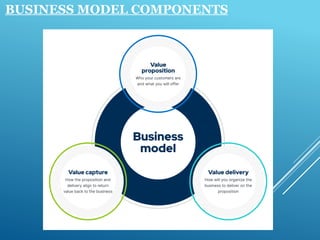
BUSINESS MODEL COMPONENTS
Vision and mission: Overview of what you want to achieve and how you
will do it.
Objectives: High-level goals that will support your vision and mission,
along with how you will measure success.
Customer targets and challenges: Description of target customers
(written as archetypes or personas) and their pain points.
Solution: How your offering will solve customer pain points.
Differentiators: Characteristics that differentiate your product or
service.
Pricing: What your solution will cost and how it will be sold.
Positioning and messaging: How you will communicate the value of
your offering to customers.
Go-to-market: Proposed approach for launching new offerings and
services.
Investment: Resources required to introduce your offering.
Growth opportunity: Ways that you will grow the business over time.
BUSINESS MODEL VS. BUSINESS PLAN
BUSINESS MODEL
A business model captures hypothesis for how the business will
generate revenue & reach profitability — charging a price for an
offering that has been created at a sustainable cost
A business model will include a brief overview of what the
company offers & to whom
BUSINESS PLAN
A business plan drops down one level to show how the company
will implement the business model
It includes specifics such as:
- operational practices,
- experience & structure of the management team,
- milestones to be reached on a set timeline and
- comprehensive financial projections
BUSINESS MODEL VS. BUSINESS PLAN
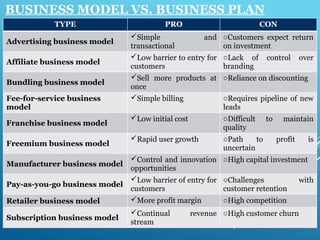
TYPE PRO CON
Advertising business model
Simple and
transactional
oCustomers expect return
on investment
Affiliate business model
Low barrier to entry for
customers
oLack of control over
branding
Bundling business model
Sell more products at
once
oReliance on discounting
Fee-for-service business
model
Simple billing oRequires pipeline of new
leads
Franchise business model
Low initial cost oDifficult to maintain
quality
Freemium business model
Rapid user growth oPath to profit is
uncertain
Manufacturer business model
Control and innovation
opportunities
oHigh capital investment
Pay-as-you-go business model
Low barrier of entry for
customers
oChallenges with
customer retention
Retailer business model More profit margin oHigh competition
Subscription business model
Continual revenue
stream
oHigh customer churn
FATAL FLAWS IN BUSINESS MODEL
Two fatal flaws can render a business model
untenable from the beginning:
- A complete misread of the customer
- Utterly unsound economics
Business models that fall victim to one of these
two flaws have lost the race before leaving the
starting gate
A FLAWED BUSINESS MODEL
Solving relevant customer jobs and finding product-market fit
is just one of many important factors that make up a business
Great technologies, products and services must also have the
right business models to support and sustain them
Even with value propositions that customers want or
technologies that customers crave, failure can happen if business
model is flawed
Eg: Kodak - filed for bankruptcy in 2012, helped invent the
digital camera that crushed its business model
When a business model's value propositions generate more
costs than revenues from customers
……..Conti ……….
A FLAWED BUSINESS MODEL
Hence, business will inevitably disappear, even with the most
successful value propositions
Might pick the wrong revenue model or pricing structure or
underestimate the costs being incurred from the activities,
resources and partnerships required to create & deliver the value
proposition
Failure to establish the proper channels to reach & deliver value
to customers
Failure to establish customer relationships that helps to
successfully retain and grow customer base sustainably
Focus on the wrong activities or lack access to the right key
partners & resources to reliably create, deliver & capture value
long term
Design a business model that works not only for customers but
also for the company
A FLAWED BUSINESS MODEL
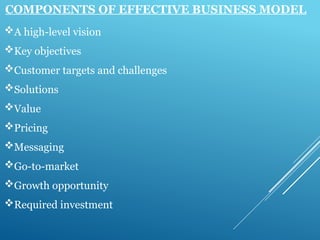
COMPONENTS OF EFFECTIVE BUSINESS MODEL
A high-level vision
Key objectives
Customer targets and challenges
Solutions
Value
Pricing
Messaging
Go-to-market
Growth opportunity
Required investment
BUSINESS MODEL: COMPONENTS
Core Strategy (how a firm competes)
- Business Mission
- Product/ Market Scope
- Basis for Differentiation
Strategic Resources (how a firm acquires and uses
its resources)
- Core Competencies
- Strategic Assets
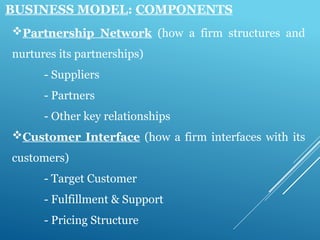
BUSINESS MODEL: COMPONENTS
Partnership Network (how a firm structures and
nurtures its partnerships)
- Suppliers
- Partners
- Other key relationships
Customer Interface (how a firm interfaces with its
customers)
- Target Customer
- Fulfillment & Support
- Pricing Structure

Business Model, Types, Components .pptx

  • 1.
    BUSINESS MODEL Prepared By Mrs.C. Ranganayaki, MBA, SLET, MPhil Assistant Professor, Sri Ramakrishna College of Arts & Science Nava India, Coimbatore
  • 2.
    BUSINESS MODEL A businessmodel is a company's profit-making plan which defines: - the products or services it will sell, - its target market & - any expected costs A business model is a company's core strategy for profitably doing business There are dozens of types of business models including: - retailers - manufacturers - fee-for-service - freemium providers The two levers of a business model are: Pricing & Costs Investors, while evaluating a business model, considers whether product being offered matches a true need in market
  • 3.
  • 4.
    EVALUATING SUCCESSFUL “BUSINESSMODEL” A common mistake is to underestimate the costs of funding the business until it becomes profitable Counting costs to the introduction of a product is not enough A company has to keep the business running until its revenues exceed its expenses One way to evaluate success of business model is by gross profit Gross profit is a company's total revenue minus the cost of goods sold (COGS) Comparing a company's gross profit to that of its main competitor or its industry sheds light on the efficiency and effectiveness of its business model Analysts also see to cash flow or net income That is gross profit minus operating expenses and is an indication of just how much real profit the business is generating
  • 5.
    EVALUATING SUCCESSFUL “BUSINESSMODEL” The two primary levers of a company's business model are: - pricing & - costs A company can raise prices & can find inventory at reduced costs Both actions increase gross profit Many analysts consider gross profit to be more important in evaluating a business plan A good gross profit suggests a sound business plan If expenses are out of control, the management team could be at fault, and the problems are correctable As this suggests, many analysts believe that companies that run on the best business models can run themselves
  • 6.
    BUSINESS MODEL -TYPES Retailer A retailer is the last entity along a supply chain They often buy finished goods from manufacturers or distributors and interface directly with customers Eg: Costco Wholesale, Aldi, Amazon.com, Walmart Manufacturer A manufacturer is responsible for sourcing raw materials and producing finished products by leveraging internal labor, machinery, and equipment A manufacturer may make custom goods or highly replicated, mass produced products A manufacturer can also sell goods to distributors, retailers or directly to customers Eg: Ford Motor Company, Apple, IKEA, Mercedes-Benz
  • 7.
    BUSINESS MODEL -TYPES Fee-for-Service Instead of selling products, fee-for-service business models are centered around labor & providing services A fee-for-service business model may charge by an hourly rate or a fixed cost for a specific agreement These companies are often specialized, offering insight that may not be common knowledge or may require specific training Eg: DLA Piper LLP (Global Law Firm), McKinsey & Company, MedExpress, Walmart Brokerage A brokerage business model connects buyers and sellers without directly selling a good themselves Brokerage companies often receive a percentage of the amount paid when a deal is finalized Most common in real estate, brokers are also prominent in construction/development or freight Eg: ReMax
  • 8.
    BUSINESS MODEL -TYPES Freemium Attract customers by introducing them to basic, limited-scope products Then, with the client using their service, company attempts to convert them to premium/advance product requiring payment Although a customer may theoretically stay on freemium forever, a company tries to show the benefit of what becoming an upgraded member can hold Eg: LinkedIn/LinkedIn Premium Bundling For reducing cost in attracting a single customer, companies attempt to bundle products to sell multiple goods to single client Capitalizes on existing customers by attempting to sell them different products Incentivized by offering pricing discounts for buying multiple products Eg: AT&T
  • 9.
    BUSINESS MODEL -TYPES Marketplace In exchange for hosting a platform for business to be conducted, the marketplace receives compensation Transactions could occur without a marketplace, but, this business model attempts for transacting easier, safer & faster Eg: Apple, Ebay, Etsy Affiliate These models are based on marketing and the broad reach of a specific entity or person's platform Companies pay an entity to promote a good, and that entity often receives compensation in exchange for their promotion That compensation may be a fixed payment, a percentage of sales derived from their promotion or both Eg: social media influencers such: Lele Pons, Zach King or Chiara Ferragni; Also: Amazon, ClickBank, Share-a-Sale
  • 10.
    BUSINESS MODEL -TYPES Razor Blade Aims to sell a durable product below cost to then generate high-margin sales of a disposable component of that product Referred to as "razor and blade model", razor blade companies may give away expensive blade handles with the premise that consumers need to continually buy razor blades in the long run Eg: HP (printers and ink) Reverse Razor Blade Instead of relying on high-margin companion products, a reverse razor blade business model tries to sell a high-margin product upfront Then, to use the product, low or free companion products are provided This model aims to promote that upfront sale, as further use of the product is not highly profitable Eg: Apple (iPhones + applications)
  • 11.
    BUSINESS MODEL -TYPES Franchise This business model leverages existing business plans to expand and reproduce a company at a different location Often food, hardware, or fitness companies, franchisers work with incoming franchisees to finance the business, promote the new location, and oversee operations Franchisor receives a % of earnings from the franchisee Eg: Domino's Pizza, Ace Hardware Stores, McDonald’s, The UPS Store Pay-As-You-Go Instead of charging a fixed fee, some companies may implement a pay-as-you-go business model where the amount charged depends on how much of the product or service was used May charge a fixed fee for offering the service in addition to an amount that changes each month based on what was consumed Eg: Utility companies, Apple, Amazon Web Services, Mint Mobile
  • 12.
    BUSINESS MODEL -TYPES Subscription Strives to attract clients in the hopes of luring them into long- time, loyal patrons This is done by offering a product that requires ongoing payment, usually in return for a fixed duration of benefit Though largely offered by digital companies for access to software, subscription business models are also popular for physical goods such as monthly reoccurring agriculture/produce subscription box deliveries Eg: Spotify, Apple, Amazon Prime, Netflix Some companies can reside within multiple business model types at the same time for the same product. For example, Spotify (a subscription- based model) also offers a free version and a premium version "Tying" is an illegal razor blade model strategy that requires the purchase of an unrelated good prior to being able to buy a different (and often required) good. For example, imagine Gillette released a line of lotion and required all customers to buy three bottles before they were allowed to purchase disposable razor blades
  • 13.
    HOW TO CREATEA: BUSINESS MODEL Identify the audience Define the problem Understand the offerings Document the needs Find key partners Set monetization solutions Test the model It is also important to periodically review the business model; Once the model is launched, feel free to evaluate the plan & adjust the target audience, product line or pricing, as & when needed
  • 14.
  • 15.
    BUSINESS MODEL COMPONENTS Visionand mission: Overview of what you want to achieve and how you will do it. Objectives: High-level goals that will support your vision and mission, along with how you will measure success. Customer targets and challenges: Description of target customers (written as archetypes or personas) and their pain points. Solution: How your offering will solve customer pain points. Differentiators: Characteristics that differentiate your product or service. Pricing: What your solution will cost and how it will be sold. Positioning and messaging: How you will communicate the value of your offering to customers. Go-to-market: Proposed approach for launching new offerings and services. Investment: Resources required to introduce your offering. Growth opportunity: Ways that you will grow the business over time.
  • 16.
    BUSINESS MODEL VS.BUSINESS PLAN BUSINESS MODEL A business model captures hypothesis for how the business will generate revenue & reach profitability — charging a price for an offering that has been created at a sustainable cost A business model will include a brief overview of what the company offers & to whom BUSINESS PLAN A business plan drops down one level to show how the company will implement the business model It includes specifics such as: - operational practices, - experience & structure of the management team, - milestones to be reached on a set timeline and - comprehensive financial projections
  • 17.
    BUSINESS MODEL VS.BUSINESS PLAN TYPE PRO CON Advertising business model Simple and transactional oCustomers expect return on investment Affiliate business model Low barrier to entry for customers oLack of control over branding Bundling business model Sell more products at once oReliance on discounting Fee-for-service business model Simple billing oRequires pipeline of new leads Franchise business model Low initial cost oDifficult to maintain quality Freemium business model Rapid user growth oPath to profit is uncertain Manufacturer business model Control and innovation opportunities oHigh capital investment Pay-as-you-go business model Low barrier of entry for customers oChallenges with customer retention Retailer business model More profit margin oHigh competition Subscription business model Continual revenue stream oHigh customer churn
  • 18.
    FATAL FLAWS INBUSINESS MODEL Two fatal flaws can render a business model untenable from the beginning: - A complete misread of the customer - Utterly unsound economics Business models that fall victim to one of these two flaws have lost the race before leaving the starting gate
  • 19.
    A FLAWED BUSINESSMODEL Solving relevant customer jobs and finding product-market fit is just one of many important factors that make up a business Great technologies, products and services must also have the right business models to support and sustain them Even with value propositions that customers want or technologies that customers crave, failure can happen if business model is flawed Eg: Kodak - filed for bankruptcy in 2012, helped invent the digital camera that crushed its business model When a business model's value propositions generate more costs than revenues from customers ……..Conti ……….
  • 20.
    A FLAWED BUSINESSMODEL Hence, business will inevitably disappear, even with the most successful value propositions Might pick the wrong revenue model or pricing structure or underestimate the costs being incurred from the activities, resources and partnerships required to create & deliver the value proposition Failure to establish the proper channels to reach & deliver value to customers Failure to establish customer relationships that helps to successfully retain and grow customer base sustainably Focus on the wrong activities or lack access to the right key partners & resources to reliably create, deliver & capture value long term Design a business model that works not only for customers but also for the company
  • 21.
  • 22.
    COMPONENTS OF EFFECTIVEBUSINESS MODEL A high-level vision Key objectives Customer targets and challenges Solutions Value Pricing Messaging Go-to-market Growth opportunity Required investment
  • 23.
    BUSINESS MODEL: COMPONENTS CoreStrategy (how a firm competes) - Business Mission - Product/ Market Scope - Basis for Differentiation Strategic Resources (how a firm acquires and uses its resources) - Core Competencies - Strategic Assets
  • 24.
    BUSINESS MODEL: COMPONENTS PartnershipNetwork (how a firm structures and nurtures its partnerships) - Suppliers - Partners - Other key relationships Customer Interface (how a firm interfaces with its customers) - Target Customer - Fulfillment & Support - Pricing Structure