Presenter: Animesh Tikariha
“The opinions expressed in this presentation and on the following slides are solely those of the presenter”
▪ Typical Design Thinking Model
▪ Delivery Efficiency and Effectiveness
▪ Design Thinking Perceptions
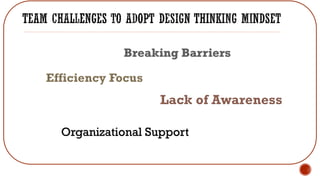
▪ Team Challenges to Adopt Design Thinking
▪ How various roles can use Design Thinking
▪ Design Thinking for Productivity Improvement
Source: Stanford D.School design thinking model
Author/Copyright holder: Paris-Est d.school at Ecole des Ponts .Copyright terms and licence: CC BY-SA 4.0
Effectiveness
User
Business
Value
Market
Relevance
Improvement
Efficiency
Scope
Cost
Time
Quality
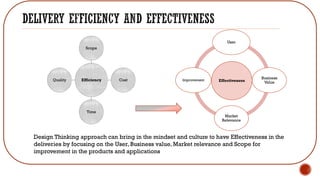
Design Thinking approach can bring in the mindset and culture to have Effectiveness in the
deliveries by focusing on the User, Business value, Market relevance and Scope for
improvement in the products and applications
Organizational Support
Who is the user of the system ?
➢ Identify different Personas and understand the user behavior and needs
through interviews and observations
What is that he wants to accomplish ?
➢ Create various hypothesis and then iteratively try to validate it through user
interactions
How the user aspires to use the system ?
➢ Ideate with cross functional teams, create quick prototypes and validate
➢ Consider Human Interactions based on the behaviors while designing solutions
➢ Understanding the Accessibility needs of various personas who would be using the
application
➢ Create various diverge solution options so that the final solution can be converged upon
➢ Consider that the solution also should have room and provision to improve or customize
➢ Identify other users of the system/application, empathize and get their POV
• Other Developers
• Support Staff
• Operations
➢ Use of appropriate technical tools that are effective for other users
• Logs
• Error Messages
➢ Incorporate intuitive responses
• Information
• Corrections
• Indications
➢ Refined Acceptance criteria that are centric to the behavior patterns and the
personas
➢ More connected to the user scenarios and environment
• Work with actual users
• Go out and observe personas
➢ Make testing more iterative from the prototyping phase and then validating
again with the sprint goals
• Implement processes inspired by Design Thinking concepts
➢ Plan and facilitate the journey mapping at the beginning of the development
➢ Encourage brain storming across the teams
➢ Promote prototyping in the development process and validating them
➢ Help in building an environment of user focused thinking across all levels
Case - Internet Banking Portal
Problem - One of the Listing feature was getting spilled over across multiple sprints due
to rejection in the sprint reviews
Reasons - Usability or Performance or Technical Complexity
Solution – Design Thinking approach – “Design Sprints” / “In the working sprint”
• User observation and interviews
• Brain storming of the requirements captured by whole team
• Journey Mapping
• Affinity diagrams
• Assessing the plausible solutions then finalizing it
• Double Diamond Approach – Diverge-Converge Model
Design thinking for delivery effectiveness v3.0

Design thinking for delivery effectiveness v3.0

  • 1.
    Presenter: Animesh Tikariha “Theopinions expressed in this presentation and on the following slides are solely those of the presenter”
  • 2.
    ▪ Typical DesignThinking Model ▪ Delivery Efficiency and Effectiveness ▪ Design Thinking Perceptions ▪ Team Challenges to Adopt Design Thinking ▪ How various roles can use Design Thinking ▪ Design Thinking for Productivity Improvement
  • 3.
    Source: Stanford D.Schooldesign thinking model Author/Copyright holder: Paris-Est d.school at Ecole des Ponts .Copyright terms and licence: CC BY-SA 4.0
  • 4.
    Effectiveness User Business Value Market Relevance Improvement Efficiency Scope Cost Time Quality Design Thinking approachcan bring in the mindset and culture to have Effectiveness in the deliveries by focusing on the User, Business value, Market relevance and Scope for improvement in the products and applications
  • 6.
  • 7.
    Who is theuser of the system ? ➢ Identify different Personas and understand the user behavior and needs through interviews and observations What is that he wants to accomplish ? ➢ Create various hypothesis and then iteratively try to validate it through user interactions How the user aspires to use the system ? ➢ Ideate with cross functional teams, create quick prototypes and validate
  • 8.
    ➢ Consider HumanInteractions based on the behaviors while designing solutions ➢ Understanding the Accessibility needs of various personas who would be using the application ➢ Create various diverge solution options so that the final solution can be converged upon ➢ Consider that the solution also should have room and provision to improve or customize
  • 9.
    ➢ Identify otherusers of the system/application, empathize and get their POV • Other Developers • Support Staff • Operations ➢ Use of appropriate technical tools that are effective for other users • Logs • Error Messages ➢ Incorporate intuitive responses • Information • Corrections • Indications
  • 10.
    ➢ Refined Acceptancecriteria that are centric to the behavior patterns and the personas ➢ More connected to the user scenarios and environment • Work with actual users • Go out and observe personas ➢ Make testing more iterative from the prototyping phase and then validating again with the sprint goals
  • 11.
    • Implement processesinspired by Design Thinking concepts ➢ Plan and facilitate the journey mapping at the beginning of the development ➢ Encourage brain storming across the teams ➢ Promote prototyping in the development process and validating them ➢ Help in building an environment of user focused thinking across all levels
  • 12.
    Case - InternetBanking Portal Problem - One of the Listing feature was getting spilled over across multiple sprints due to rejection in the sprint reviews Reasons - Usability or Performance or Technical Complexity Solution – Design Thinking approach – “Design Sprints” / “In the working sprint” • User observation and interviews • Brain storming of the requirements captured by whole team • Journey Mapping • Affinity diagrams • Assessing the plausible solutions then finalizing it • Double Diamond Approach – Diverge-Converge Model