DESIGN PRINCIPLES
• BY:- DIVYA BALANI
Seven principles encompass an interesting
design.
•Balance
•Rhythm
•Emphasis
•Proportion and scale
•Movement
•Contrast
•Unity
DESIGN PRINCIPLES
BALANCE
• Parts of the design are equally distributed to create a sense of
stability. Both physical and visual balance exist.
• Types
•Symmetrical or formal balance
•Asymmetrical or informal balance
•Radial balance
•Vertical balance
•Horizontal balance
Symmetrical or Formal Balance
The elements within the design are identical in
relation to a centerline or axis.
BALANCE
The Taj Mahal Mausoleum
Agra, Uttar Pradesh, India
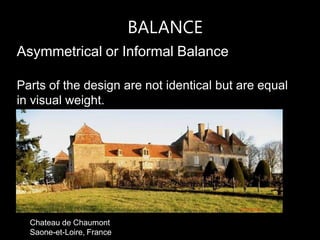
Asymmetrical or Informal Balance
Parts of the design are not identical but are equal
in visual weight.
BALANCE
Chateau de Chaumont
Saone-et-Loire, France
Wikipedia.org
Radial Balance
BALANCE
Design elements radiate outward from the center.
Microsoft Office clipart
Galleria Vittorio Emanuele II
Milan, Italy
Architect: Giuseppe Mengoni
Dresden Frauenkirche
Deresden, Germay
Vertical Balance
The top and bottom parts are equal.
BALANCE
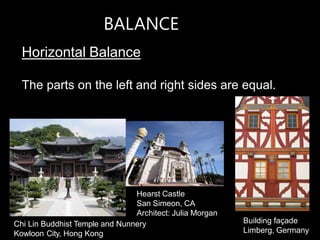
Horizontal Balance
The parts on the left and right sides are equal.
BALANCE
Building façade
Limberg, Germany
Hearst Castle
San Simeon, CA
Architect: Julia Morgan
Chi Lin Buddhist Temple and Nunnery
Kowloon City, Hong Kong
BALANCE
Repeated use of line, shape, color, texture
or pattern
Types
•Regular rhythm
•Graduated rhythm
•Random rhythm
•Gradated rhythm
RHYTHM
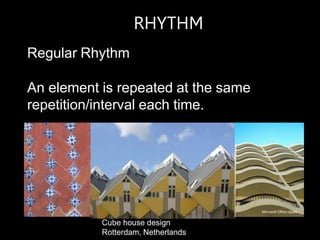
Regular Rhythm
An element is repeated at the same
repetition/interval each time.
RHYTHM
Microsoft Office clipart Microsoft Office clipart
Cube house design
Rotterdam, Netherlands
Random Rhythm
The beats of the
element are random
or are at irregular
intervals.
RHYTHM
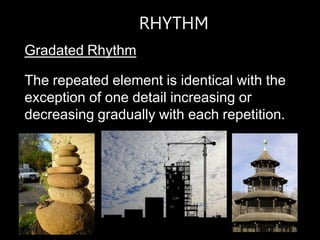
Gradated Rhythm
The repeated element is identical with the
exception of one detail increasing or
decreasing gradually with each repetition.
RHYTHM
Left: Stack of rocks used
as focal point in
landscaping
Right: The Chinese Tower
English Gardens
Munich, Germany
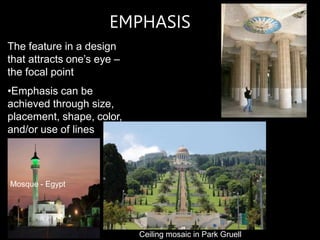
The feature in a design
that attracts one’s eye –
the focal point
•Emphasis can be
achieved through size,
placement, shape, color,
and/or use of lines
EMPHASIS
Ceiling mosaic in Park Gruell
Mosque - Egypt
Wikipedia.org
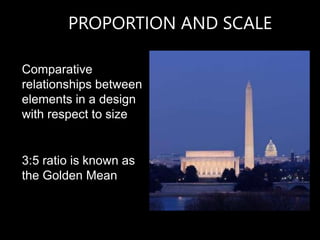
Comparative
relationships between
elements in a design
with respect to size
3:5 ratio is known as
the Golden Mean
PROPORTION AND SCALE
Flow or feeling of action
Movement
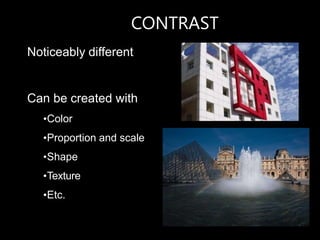
CONTRAST
Noticeably different
Can be created with
•Color
•Proportion and scale
•Shape
•Texture
•Etc.
©iStockphoto.com
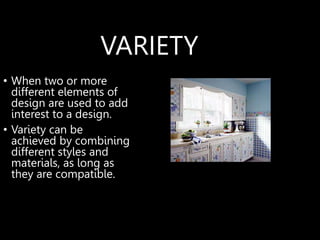
VARIETY
• When two or more
different elements of
design are used to add
interest to a design.
• Variety can be
achieved by combining
different styles and
materials, as long as
they are compatible.
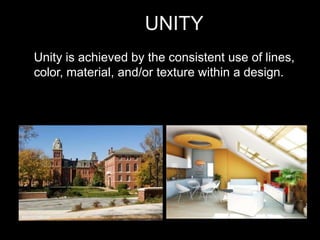
Unity is achieved by the consistent use of lines,
color, material, and/or texture within a design.
UNITY
©iStockphoto.com
UNITY

Design Principles_100615.pptx

  • 1.
  • 2.
    Seven principles encompassan interesting design. •Balance •Rhythm •Emphasis •Proportion and scale •Movement •Contrast •Unity DESIGN PRINCIPLES
  • 3.
    BALANCE • Parts ofthe design are equally distributed to create a sense of stability. Both physical and visual balance exist. • Types •Symmetrical or formal balance •Asymmetrical or informal balance •Radial balance •Vertical balance •Horizontal balance
  • 4.
    Symmetrical or FormalBalance The elements within the design are identical in relation to a centerline or axis. BALANCE The Taj Mahal Mausoleum Agra, Uttar Pradesh, India
  • 5.
    Asymmetrical or InformalBalance Parts of the design are not identical but are equal in visual weight. BALANCE Chateau de Chaumont Saone-et-Loire, France Wikipedia.org
  • 6.
    Radial Balance BALANCE Design elementsradiate outward from the center. Microsoft Office clipart Microsoft Office clipart Galleria Vittorio Emanuele II Milan, Italy Architect: Giuseppe Mengoni Dresden Frauenkirche Deresden, Germay
  • 7.
    Vertical Balance The topand bottom parts are equal. BALANCE
  • 8.
    Horizontal Balance The partson the left and right sides are equal. BALANCE Building façade Limberg, Germany Hearst Castle San Simeon, CA Architect: Julia Morgan Chi Lin Buddhist Temple and Nunnery Kowloon City, Hong Kong
  • 9.
  • 10.
    Repeated use ofline, shape, color, texture or pattern Types •Regular rhythm •Graduated rhythm •Random rhythm •Gradated rhythm RHYTHM
  • 11.
    Regular Rhythm An elementis repeated at the same repetition/interval each time. RHYTHM Microsoft Office clipart Microsoft Office clipart Cube house design Rotterdam, Netherlands
  • 12.
    Random Rhythm The beatsof the element are random or are at irregular intervals. RHYTHM
  • 13.
    Gradated Rhythm The repeatedelement is identical with the exception of one detail increasing or decreasing gradually with each repetition. RHYTHM Left: Stack of rocks used as focal point in landscaping Right: The Chinese Tower English Gardens Munich, Germany
  • 14.
    The feature ina design that attracts one’s eye – the focal point •Emphasis can be achieved through size, placement, shape, color, and/or use of lines EMPHASIS Ceiling mosaic in Park Gruell Mosque - Egypt Wikipedia.org
  • 15.
    Comparative relationships between elements ina design with respect to size 3:5 ratio is known as the Golden Mean PROPORTION AND SCALE
  • 16.
    Flow or feelingof action Movement
  • 17.
    CONTRAST Noticeably different Can becreated with •Color •Proportion and scale •Shape •Texture •Etc. ©iStockphoto.com
  • 18.
    VARIETY • When twoor more different elements of design are used to add interest to a design. • Variety can be achieved by combining different styles and materials, as long as they are compatible.
  • 19.
    Unity is achievedby the consistent use of lines, color, material, and/or texture within a design. UNITY ©iStockphoto.com
  • 20.