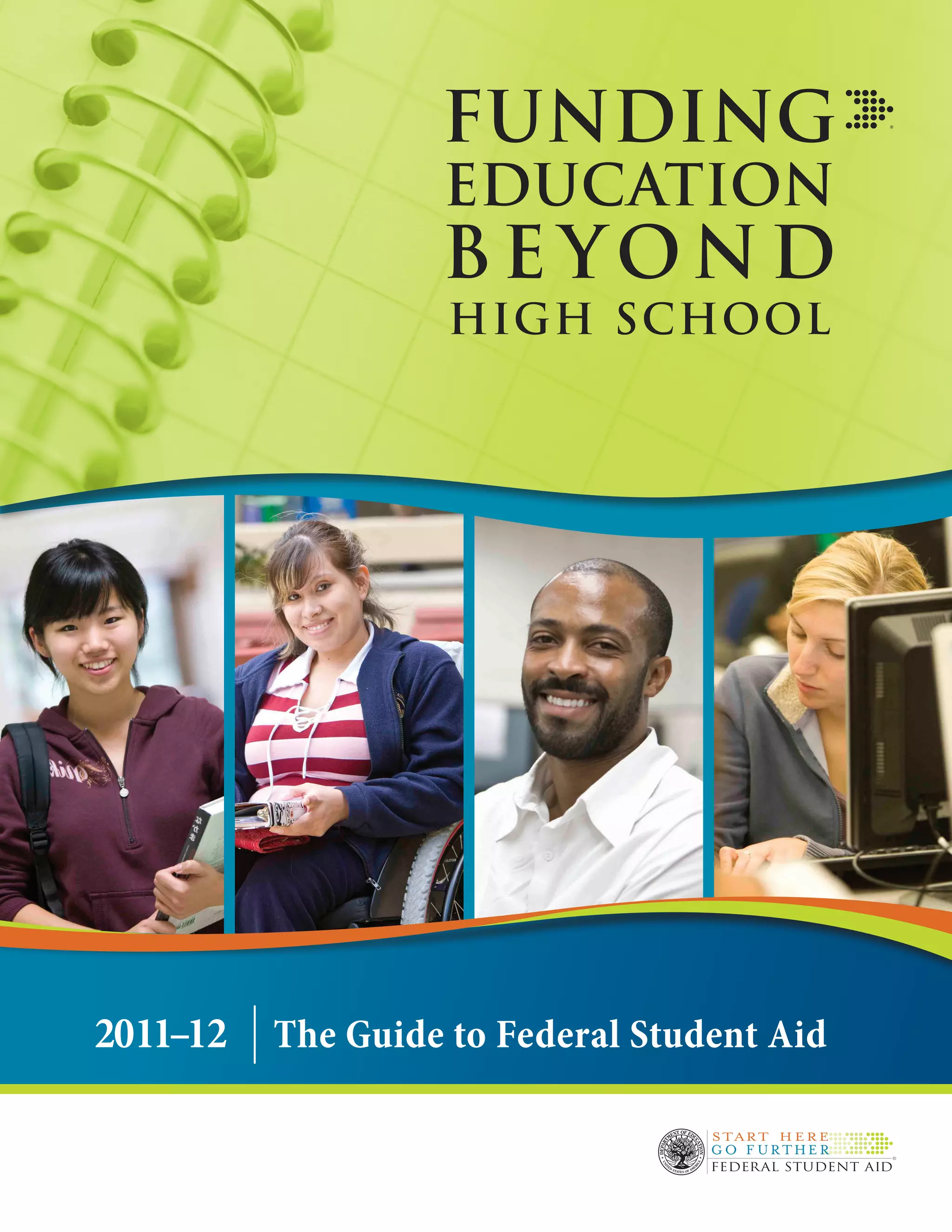

FUNDING
                   EDUCATION
                   BEYOND
                   HIGH SCHOOL


2011–12  The Guide to Federal Student Aid
Useful Websites                                                              Contact Information
                                                                                Federal Student Aid Information Center (FSAIC)
College.gov                                                                             1-800-4-FED-AID (1-800-433-3243)
www.college.gov                                                                                     P.O. Box 84
                                                                                            Washington, DC 20044-0084
This website is designed to motivate high school students with
inspirational stories and information about planning, preparing,                              TTY users can call 1-800-730-8913.
and paying for college.                                                              Callers in locations without access to 1-800 numbers
                                                                                    may call 319-337-5665 (this is not a toll-free number).
Student Aid on the Web
www.studentaid.ed.gov
                                                                             The FSAIC staff will answer your federal student aid questions including:
At this U.S. Department of Education’s Federal Student Aid website
you can                                                                      •• information about federal student aid programs,
••  ind detailed information on Federal Student Aid programs; research
   F                                                                         •• help completing the FAFSA,
   school and career choices; learn about the entire federal student         •• help making any corrections or updates to your FAFSA,
   aid process, eligibility, and the application process; and access other
                                                                             ••  elp in understanding your Student Aid Report (SAR),
                                                                                h
   Federal Student Aid websites and publications online.
                                                                                which contains your application results,
••  reate a “MyFSA,” a federal student aid personalized folder to help
   C
                                                                             •• nformation about the process of determining financial
                                                                                i
   you decide on a career, research schools, and find scholarships. Track
                                                                                need and awarding aid, and
   your progress in the college planning and application process and
   access other sources of nonfederal aid.                                   •• general information about your current federal student loans.
                                                                             You also can use an automated response system at the FSAIC to find
                                                                             out if your FAFSA has been processed and to request a copy of your
FAFSA on the Web             SM
                                                                             Student Aid Report or SAR. Or you can write to the FSAIC.
www.fafsa.gov
Apply for federal student aid online using FAFSA on the Web SM               State Higher Education Agencies
(the online version of the Free Application for Federal Student Aid,
or FAFSASM.)                                                                 www.ed.gov/programs/bastmp/SHEA.htm
                                                                             List of agencies responsible for administering state financial aid programs.
Military
www.studentaid.ed.gov/military
If you are in the armed forces or have a family member in the
service, visit this site to find out more about grants, repayment,
and forgiveness options.


National Student Loan Data SystemSM (NSLDSSM)
www.nslds.ed.gov
Use your personal identification number, called Federal Student Aid PIN,
to access all your federal student loan records and obtain contact
information on your loan servicer.


Office of Inspector General Hotline
www.ed.gov/misused
To report student aid fraud (including identity theft), waste,
or abuse of U.S. Department of Education funds.
                                                                                       If you paid for a copy of this FREE publication,
1-800-MIS-USED (1-800-647-8733)                                                        please write to the FSAIC at the address above.
E-mail: oig.hotline@ed.gov
FUNDING EDUCATION
BEYOND HIGH SCHOOL

The Guide to Federal Student Aid | 2011–12
           U.S. Department of Education
                Federal Student Aid
U.S. Department of Education
Arne Duncan
Secretary

Federal Student Aid
William J. Taggart
Chief Operating Officer

Student Experience Group
Michele Y. Brown
Acting General Manager


December 2010

This publication is in the public domain. Authorization to reproduce              Counselors, Mentors, and
it in whole or in part is granted. While permission to reprint this               Other Professionals
publication is not necessary, the citation should be: U.S. Department
                                                                                  Order online at: www.fsapubs.gov
of Education, Federal Student Aid, Student Experience Group
Funding Education Beyond High School: The Guide to Federal                        E-mail your request to: orders@fsapubs.gov
Student Aid, 2011–12, Washington, D.C., 2010.                                     Call in your request toll free: 1-800-394-7084
                                                                                  Those who use a telecommunications device for the deaf (TDD)
Updates:                                                                          or a teletypewriter (TTY) should call 1-877-576-7734.

Any changes to federal student aid programs since this publication
                                                                                  Online Access
was printed are available at www.studentaid.ed.gov.
                                                                                  This publication is also available at www.studentaid.ed.gov/pubs.


To order copies of this publication                                               Alternate Formats
                                                                                  On request, this publication is available in alternate formats, such
Students and Parents                                                              as Braille. For more information, please contact Federal Student Aid
Order online at: www.edpubs.gov                                                   using the information provided on this page.
E-mail your request to: edpubs@inet.ed.gov
Call in your request toll free: 1-877-433-7827 (1-877-4-ED-PUBS)                  Some of the Web addresses in this publication are for sites created
                                                                                  and maintained by organizations other than the U.S. Department
Those who use a telecommunications device for the deaf (TDD)                      of Education. They are provided for the reader’s convenience. The
or a teletypewriter (TTY) should call 1-877-576-7734.                             U.S. Department of Education does not control or guarantee the
                                                                                  accuracy, relevance, timeliness, or completeness of this outside
                                                                                  information. Further, the inclusion of particular Web addresses
                                                                                  is not intended to reflect their importance, nor is it intended to
                                                                                  endorse any views expressed or products or services offered on
                                                                                  these outside sites, or the organizations sponsoring the sites.


All website addresses included in this publication were accurate at press time.
                                                                                    The information in this guide was compiled in the summer
Front cover photos:                                                                 of 2010. For changes to the federal student aid programs since
© 2010 iStockPhoto (Getty Images, Inc.)                                             then, visit www.studentaid.ed.gov.
© 2010 123RF Limited
© 2010 Shutterstock Images LLC
CONTENTS

Our Mission........................................................... vi                                Am I Eligible?....................................................... 10
                                                                                                         Basic requirements........................................................................... 10
                                                                                                         Financial need.................................................................................. 10
Federal Student Aid At-a-Glance...................1                                                      Education requirements.................................................................. 11
What is federal student aid?................................... 1                                        Intellectual disabilities..................................................................... 11
                                                                                                         Children of military personnel killed in Iraq or
Who receives federal student aid?.......................... 1                                            Afghanistan after Sept. 11, 2001..................................................... 11
How do I apply for federal student aid?.................. 2                                              Legal and other requirements......................................................... 11
   Steps to Federal Student Aid............................................... 3                         Agency matching of selected requirements.................................. 12
   Federal Student Aid Process............................................... 3                          Financial need and Expected Family Contribution (EFC).......... 12
   Table 1. Federal Student Aid: Type of aid, eligibility, award                                         Unusual family circumstances........................................................ 13
   amount, interest rate, and other details, by program......... 4                                       Types of Federal Student Aid................................ 13
                                                                                                         There are three types of federal student aid.................................. 13
Part I. What You Should Know                                                                             Grants................................................................... 13
Before You Apply....................................... 7                                                There are four types of federal student aid grants........................ 13
                                                                                                         What is a Federal Pell Grant?.......................................................... 13
Why Should I Invest in an Education?                                                                     What is a Federal Supplemental Educational Opportunity
Can’t I Get a Job Now?............................................ 7                                     Grant (FSEOG)?............................................................................... 14
                                                                                                         What is a TEACH Grant?................................................................. 14
Choosing the Right School..................................... 7
                                                                                                         What is an Iraq and Afghanistan Service Grant?.......................... 14
What type of school is right for me?................................................ 7
                                                                                                         How much financial aid can I get?................................................. 14
What should I consider?.................................................................... 7
                                                                                                           Pell Grant...................................................................................... 14
  Table 2. Earnings and unemployment rate for people
  25 years and over................................................................ 8                      FSEOG........................................................................................... 15
Where can I find this information about college?.......................... 8                               TEACH Grant............................................................................... 15
Take the next steps............................................................................. 8         Iraq and Afghanistan Service Grant........................................... 15
What additional information should I get from a school?............. 8                                   How will I be paid?........................................................................... 15
Find out about financial aid at the school........................................ 8                     How often will I receive funds?....................................................... 15
  You have the right to receive the following information                                                Can I receive a grant if I’m enrolled less than half-time?............. 15
  from the school.............................................................................. 8        Work-Study.......................................................... 15
Find out the school’s tuition refund policy...................................... 9                      What is the Federal Work-Study (FWS) Program?....................... 15
Find out the school’s return-of-aid policy....................................... 9                      What kinds of jobs are there?......................................................... 15
Find out the school’s completion and transfer-out rates................ 9                                Are Federal Work-Study jobs on campus or off campus?............ 15
MyFSA.................................................................... 9                              How much can I earn?..................................................................... 15
What can I do with a MyFSA account?............................................ 9                        How will I be paid?........................................................................... 16
                                                                                                         Can I work as many hours as I want?............................................. 16
Early Eligibility Indicator: FAFSA4caster SM............ 9
What is the purpose of FAFSA4caster?............................................ 9                       Loans.................................................................... 16
Who should use FAFSA4caster?....................................................... 9                    Federal Perkins Loan Program....................................................... 16
How do you use FAFSA4caster?...................................................... 10                    William D. Ford Direct Loan (Direct Loan) Program.................. 16
What information does FAFSA4caster provide?........................... 10                                  Direct Stafford Loans................................................................... 16
                                                                                                           Direct PLUS Loans....................................................................... 16
Reducing the Cost of Education........................... 10                                               Direct Consolidation Loans........................................................ 16
Lower-cost schools........................................................................... 10
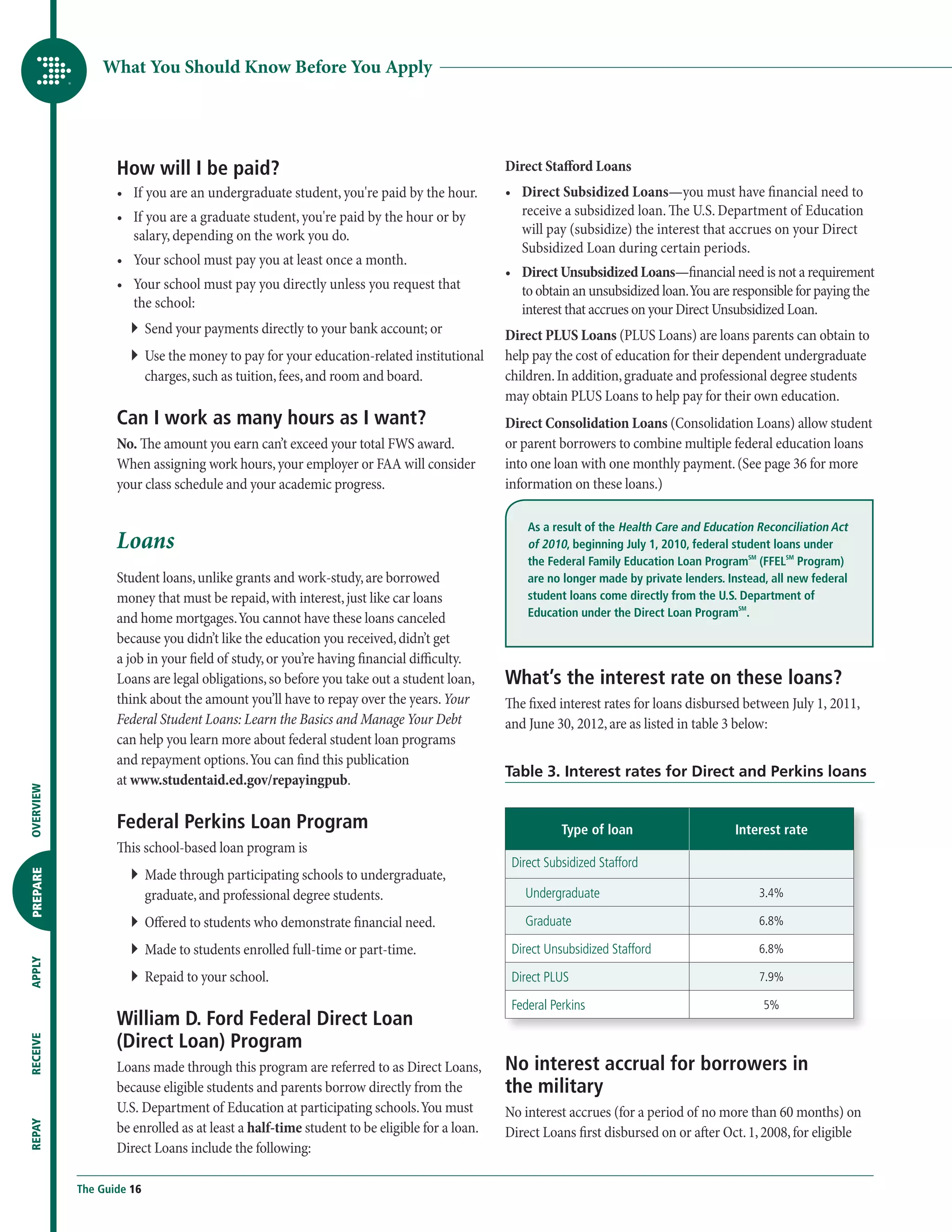
                                                                                                         What’s the interest rate on these loans?......................................... 16
State Higher Education Agencies.................................................... 10
                                                                                                           Table 3. Interest rates for Direct and Perkins loans...........16
Work or volunteer opportunities.................................................... 10
                                                                                                         No interest accrual for borrowers in the military......................... 16
Federal income tax credits.............................................................. 10
                                                                                                         How much can I borrow?................................................................ 17
Tax breaks......................................................................................... 10
                                                                                                           Perkins Loans............................................................................... 17


                                                                                                                                                                                                         The Guide iii
Direct Stafford Loans................................................................... 17           Identity theft..................................................................................... 22
          Subsidized Direct Stafford Loan................................................. 17                     What is identity theft?................................................................. 22
          Unsubsidized Direct Stafford Loan............................................ 17                        How can this happen?................................................................. 22
          For an unsubsidized loan:........................................................... 17                 What happens if someone steals my identity and gets
          Table 4. Maximum annual aggregate loan limits for                                                       a student loan in my name?........................................................ 22
          Subsidized and Unsubsidized Direct Stafford Loans,                                                      How can I avoid identity theft?................................................... 22
          by type of student and number of years in school..............18
       Other than interest, are there any fees or charges required
       to get these loans?............................................................................ 18       Part II. How Do I Apply?......................... 25
       How will I be paid?........................................................................... 18
          Perkins Loans............................................................................... 18
                                                                                                                Applying for Federal Student Aid......................... 25
          Direct Stafford Loans................................................................... 18           Completing the FAFSASM...................................... 25
       Can I cancel a loan?.......................................................................... 18        What information do I need to complete a FAFSA?..................... 25
                                                                                                                Do I need a PIN?.............................................................................. 26
       Direct PLUS Loans............................................... 19
                                                                                                                How and when should I get a PIN?................................................ 26
       Who can apply for a PLUS Loan?................................................... 19
                                                                                                                Don’t I get one automatically?......................................................... 26
       How do I apply for a PLUS Loan?................................................... 19
                                                                                                                When should I apply for federal student aid?................................ 26
       What are the eligibility requirements for PLUS Loans?............... 19
                                                                                                                Can I apply online?........................................................................... 26
       Are there any other requirements?................................................. 19
                                                                                                                Why should I apply online?............................................................. 26
       Do I need to find a lender?.............................................................. 19
                                                                                                                How do I apply online?.................................................................... 26
       How much can a parent or graduate and professional degree
       student borrow?............................................................................... 19        Can I only apply online?.................................................................. 27
       Who receives the loan money—the parent or the student?........ 19                                        Dependency status........................................................................... 27
       Can the PLUS Loan be transferred to the student and become                                                  Independent students report their own income and assets
       the student’s responsibility to repay?.............................................. 19                     (and those of a spouse, if married)............................................ 27
       Can a borrower cancel a PLUS Loan?............................................ 19                        What if I’m considered a dependent student but have no
                                                                                                                contact with my parents or access to their information?............. 28
       Other than interest, are there any fees or charges to get
       a PLUS Loan?.................................................................................... 19         Special circumstances................................................................. 28
       Is there a grace period?.................................................................... 19          What if I’m a dependent student but my parents are divorced
                                                                                                                or separated?..................................................................................... 29
       Need to Find Out More?....................................... 20                                         Do I report stepparents’ information?............................................ 29
       Other Sources of Information.............................. 20                                            Do I need to fill out a FAFSA every year I apply for aid?.............. 29
       School financial aid office................................................................ 20              If you filled out FAFSA last year................................................. 29
       When should I first contact the financial aid office?.................... 20                             What if I need help filling out my FAFSA?.................................... 29
          What questions can my FAA answer for me?........................... 20                                How do the schools I’m interested in
                                                                                                                attending get my FAFSA information?.......................................... 30
       State Higher Education Agency...................................................... 21
                                                                                                                What if I want to add or change schools later?............................. 30
       AmeriCorps...................................................................................... 21
                                                                                                                How do I sign my application?........................................................ 30
       Robert C. Byrd Honors Scholarship Program (Byrd Program)... 21
       Public libraries and the Internet..................................................... 21                What Happens After I Submit My
       Businesses and labor organizations................................................ 21                    FAFSA Online?..................................................... 30
       Organizations, foundations, etc....................................................... 21                After you apply for federal student aid, you’ll receive
       U.S. armed forces.............................................................................. 21       your processed FAFSA results......................................................... 30
       U.S. Department of Veterans Affairs.............................................. 21                        Federal Student Aid notice of SAR results
       College.gov........................................................................................ 22      available online: Sample e-mail.........................................31
                                                                                                                What do I do with my SAR?............................................................ 31
       It’s a Jungle Out There … Be Careful!................... 22                                              If you need to make corrections to your SAR............................... 31
       Scholarship scams............................................................................ 22         How do I find out if I’m eligible for federal student aid
         What about scholarship search services?.................................. 22                           and how much I’ll receive?.............................................................. 31
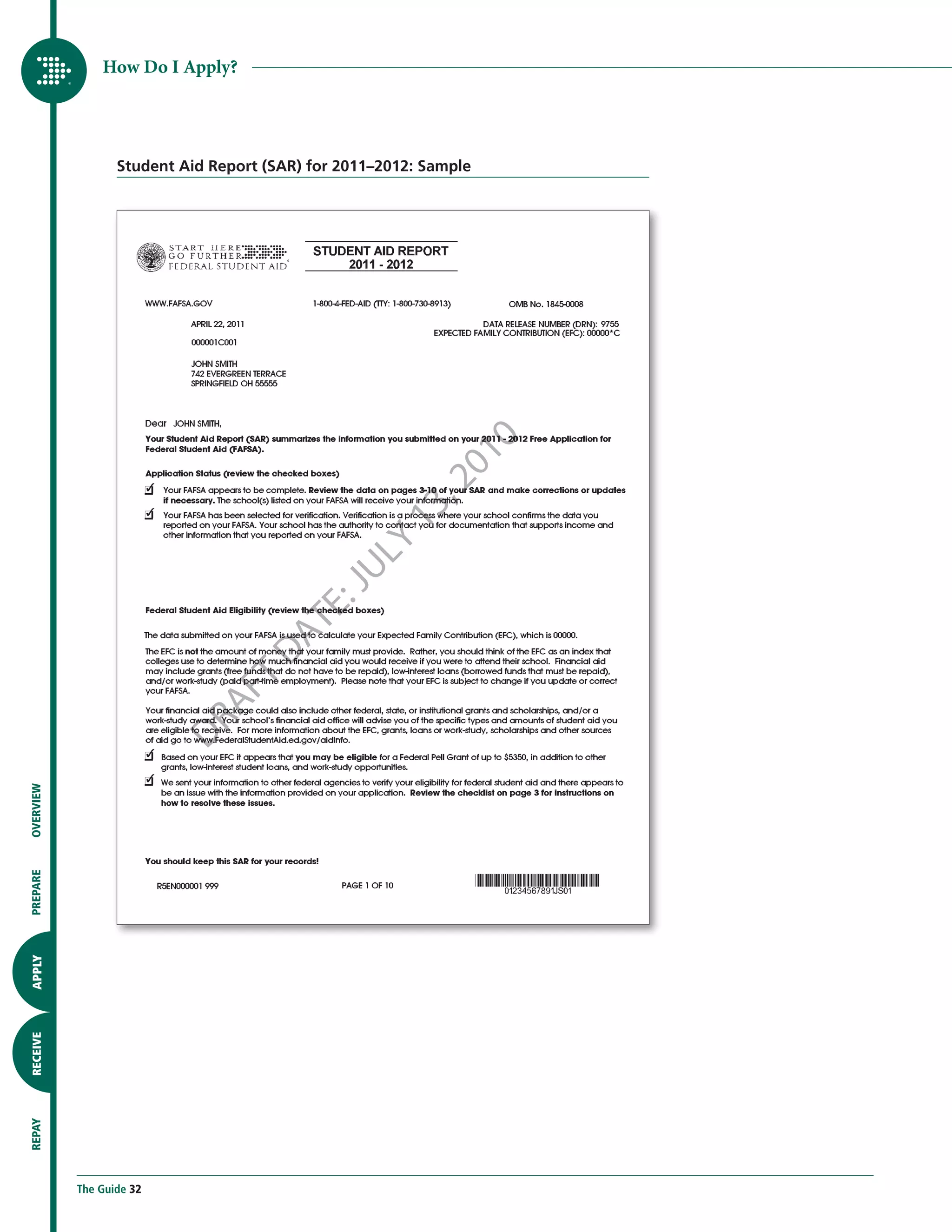
         How can I tell which scholarship services are scams?............. 22                                      Student Aid Report (SAR) for 2011–2012: Sample
                                                                                                                   Your SAR will look like this...............................................32


The Guide iv
Part III. Repaying Your Student Loan....... 33
Borrower’s Responsibilities.................................. 33
    Think about how much you’re borrowing..........................33
    Sign a promissory note......................................................33
    Make payments on time.....................................................33
    Continue to pay your loans while waiting for
    deferment or forbearance approval...................................33
    Keep in touch with your loan servicer...............................33
    Receive entrance and exit counseling................................33
Borrower’s Rights................................................. 34
    Details about your loan.....................................................34
    Grace period......................................................................34
    Loan repayment schedule..................................................34
    Change in loan servicers....................................................34
Loan Repayment.................................................. 34
When do I start paying back my student loans?........................... 34
How much time do I have to repay my student loans?................. 34
How much will I have to repay each month?................................ 34
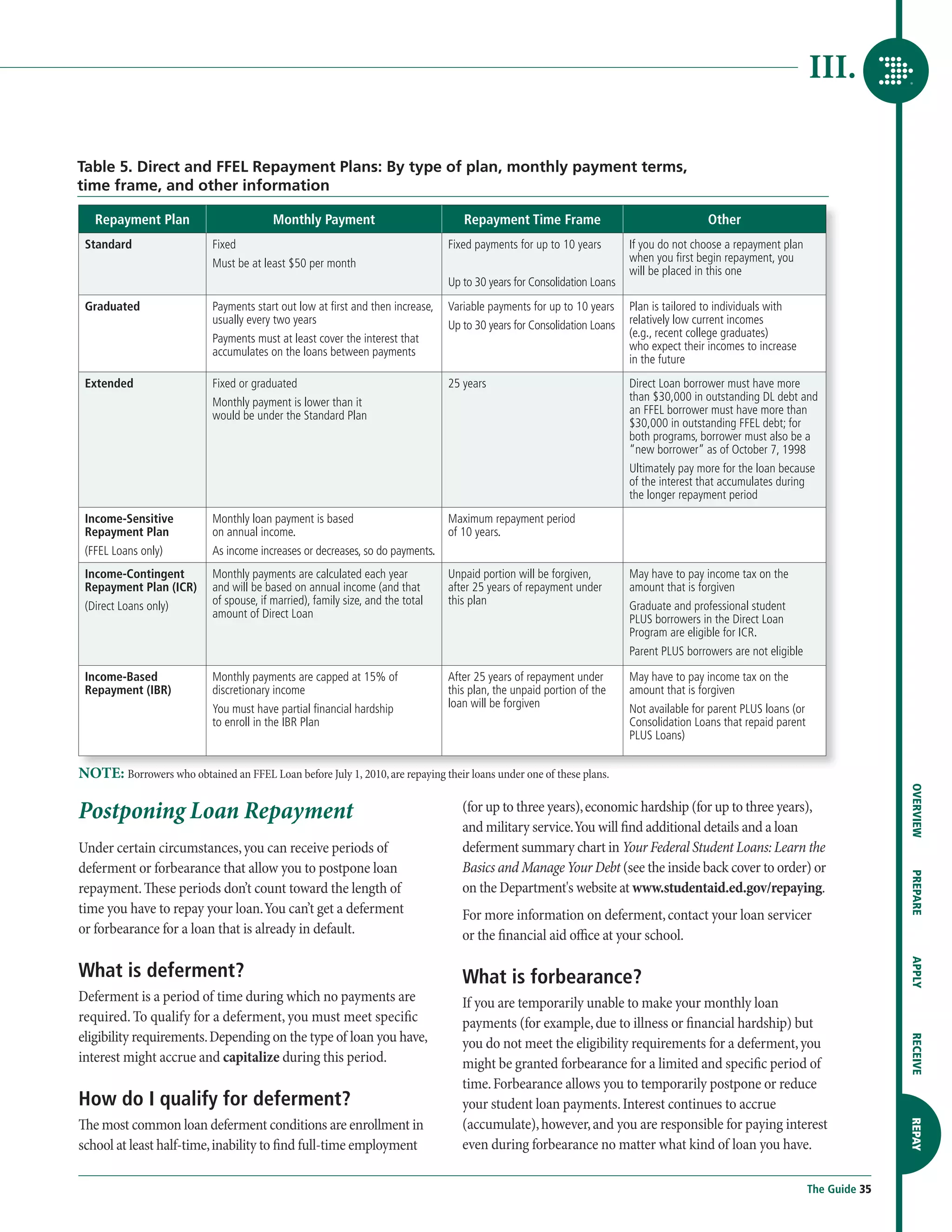
What repayment plans are available for Stafford Loans?............. 34
  Table 5. Direct and FFEL Repayment Plans:
  By type of plan, monthly payment terms, time frame,
  and other information....................................................35
Postponing Loan Repayment.......................................................... 35
What is deferment?.......................................................................... 35
How do I qualify for deferment?.................................................... 35
What is forbearance?....................................................................... 35
Applying for deferment or forbearance......................................... 36
Consolidating Your Loans.................................... 36
What is loan consolidation?............................................................ 36
When can I consolidate my loans?................................................. 36
What’s the interest rate on a Consolidation Loan?........................ 36
Loan Cancellation................................................ 36
Is it ever possible to have my federal student loan canceled?...... 36
Total and permanent disability....................................................... 37
Death................................................................................................. 37


Glossary................................................... 39
Other Federal Student
Aid Publications..............Inside Back Cover


                                                                                                            The Guide v
Our Mission

       F       ederal Student Aid, an office of the U.S. Department of Education, plays a central and essential role
               in the nation’s postsecondary education community.

       Federal Student Aid’s core mission is to ensure that all eligible individuals benefit from federal financial assistance—grants,
       work-study, and loans—for education beyond high school. The programs we administer comprise the nation’s largest source
       of student aid. Every year, we provide more than $150 billion in aid to nearly 14 million postsecondary students and their families.
       Our staff is based in 10 cities in addition to our Washington, DC headquarters.
       You have many postsecondary education options from which to choose. Whether you decide to attend a four-year college or
       university, community college, or career school, the knowledge you gain will be of value to you for the rest of your life, no matter
       where you go or what you do.


       Glossary
       Definitions of financial aid terms frequently used in this publication can be found in the Glossary on page 39.


      As a result of the Health Care and Education Reconciliation Act of 2010, beginning July 1, 2010, federal student loans
      under the Federal Family Education Loan ProgramSM (FFELSM Program) are no longer made by private lenders. Instead,
      all new federal student loans come directly from the U.S. Department of Education under the Direct Loan ProgramSM.


The Guide vi
Federal Student Aid
At-a-Glance


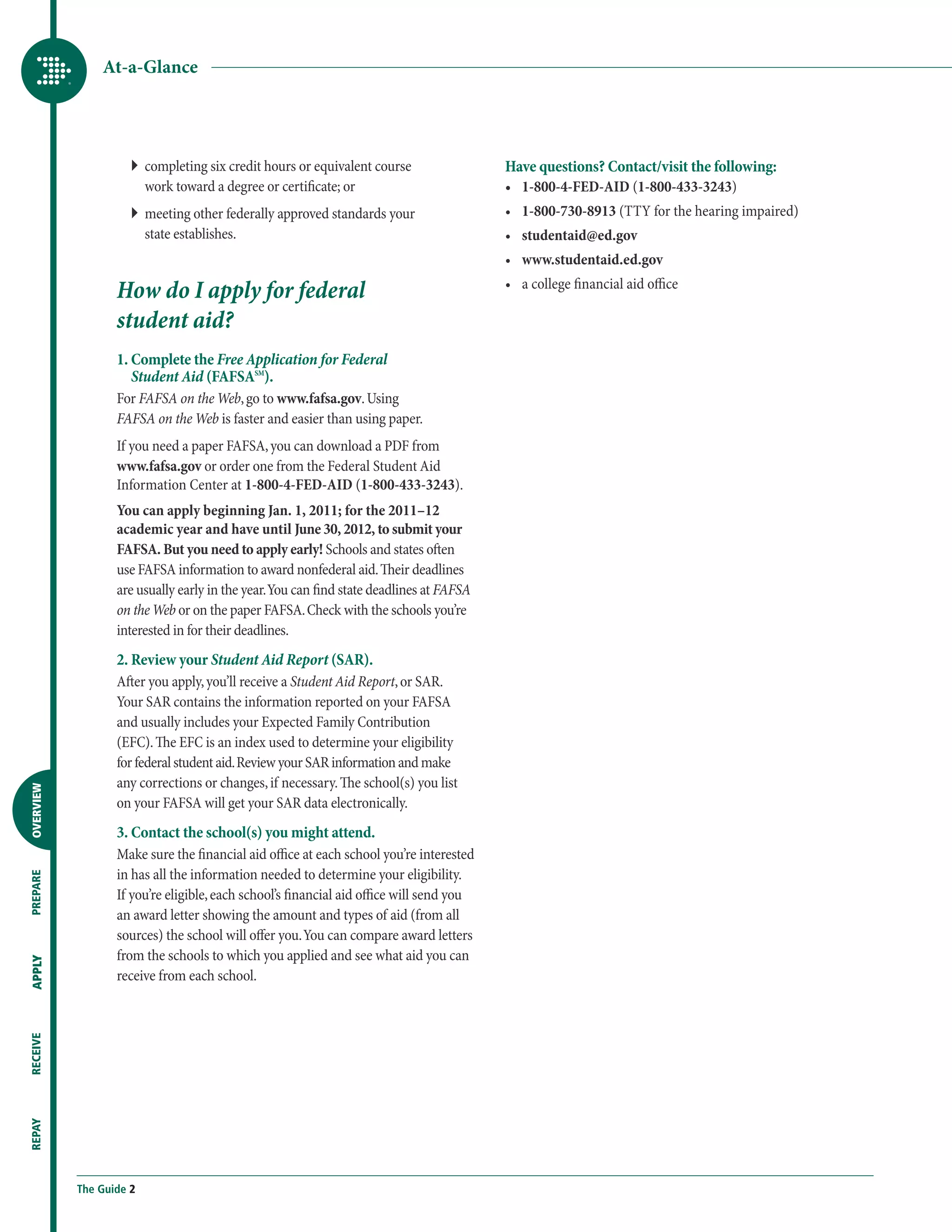
T      his section is a quick reference to federal student
       aid programs and how to apply for aid. The rest
of the publication provides more detail of what you need
                                                                   Who receives federal student aid?
                                                                   Our most basic eligibility requirements are that you must
                                                                   •	 demonstrate financial need,
to know as you go through the federal student aid process.
                                                                   •	 be a U.S. citizen or an eligible noncitizen,
                                                                   •	 have a valid Social Security number,
What is federal student aid?                                       •	  egister (if you haven’t already) with Selective Service,
                                                                      r
It’s financial help for eligible students to pay for education        if you’re a male between the ages of 18 and 25,
expenses at an eligible postsecondary school (e.g., college,       •	  aintain satisfactory academic progress in postsecondary
                                                                      m
vocational school, graduate school).                                  school, and


                                                                                                                                                   OVERVIEW
There are three categories of federal student aid: grants, work-   •	 show you’re qualified to obtain a postsecondary education by
study, and loans. Check with your school to find out which           ``  aving a high school diploma or General Educational
                                                                        h
program(s) it participates in.                                          Development (GED) certificate;


                                                                                                                                                   PREPARE
Federal student aid covers such expenses as tuition and fees,        ``  ompleting a high school education in a homeschool setting
                                                                        c
room and board, books and supplies, and transportation.                 approved under state law;
Aid also can help pay for other related expenses, such as a
                                                                     ``  assing an approved ability-to-benefit test (if you don’t
                                                                        p
computer and for dependent care.
                                                                        have a diploma or GED, a school can administer a test to
                                                                                                                                                   APPLY


                                                                        determine whether you can benefit from the education
                                                                        offered at that school);
                                                                                                                                                   RECEIVE


    This section is a quick reference to our federal student              The graphic at the lower left and right of each
    aid programs and how to apply for this aid. The rest of
    this publication provides more detail of what you need to
                                                                          page provides a key to the primary topic—
                                                                          based on the Prepare-Apply-Receive-Repay            
    know as you go through the federal student aid process.               cycle—covered in the text on that page.
                                                                                                                                                   REPAY


                                                                                                                                     The Guide 1
At-a-Glance


                     ``  ompleting six credit hours or equivalent course
                        c                                                                Have questions? Contact/visit the following:
                        work toward a degree or certificate; or                          •	 1-800-4-FED-AID (1-800-433-3243)
                     ``  eeting other federally approved standards your
                        m                                                                •	 1-800-730-8913 (TTY for the hearing impaired)
                        state establishes.                                               •	 studentaid@ed.gov
                                                                                         •	 www.studentaid.ed.gov

                  How do I apply for federal                                             •	 a college financial aid office

                  student aid?
                  1. Complete the Free Application for Federal
                     Student Aid (FAFSASM).
                  For FAFSA on the Web, go to www.fafsa.gov. Using
                  FAFSA on the Web is faster and easier than using paper.
                  If you need a paper FAFSA, you can download a PDF from
                  www.fafsa.gov or order one from the Federal Student Aid
                  Information Center at 1-800-4-FED-AID (1-800-433-3243).
                  You can apply beginning Jan. 1, 2011; for the 2011–12
                  academic year and have until June 30, 2012, to submit your
                  FAFSA. But you need to apply early! Schools and states often
                  use FAFSA information to award nonfederal aid. Their deadlines
                  are usually early in the year. You can find state deadlines at FAFSA
                  on the Web or on the paper FAFSA. Check with the schools you’re
                  interested in for their deadlines.
                  2. Review your Student Aid Report (SAR).
                  After you apply, you’ll receive a Student Aid Report, or SAR.
                  Your SAR contains the information reported on your FAFSA
                  and usually includes your Expected Family Contribution
                  (EFC). The EFC is an index used to determine your eligibility
                  for federal student aid. Review your SAR information and make
                  any corrections or changes, if necessary. The school(s) you list
OVERVIEW


                  on your FAFSA will get your SAR data electronically.
                  3. Contact the school(s) you might attend.
                  Make sure the financial aid office at each school you’re interested
                  in has all the information needed to determine your eligibility.
PREPARE


                  If you’re eligible, each school’s financial aid office will send you
                  an award letter showing the amount and types of aid (from all
                  sources) the school will offer you. You can compare award letters
                  from the schools to which you applied and see what aid you can
APPLY


                  receive from each school.
RECEIVE
REPAY


           The Guide 2
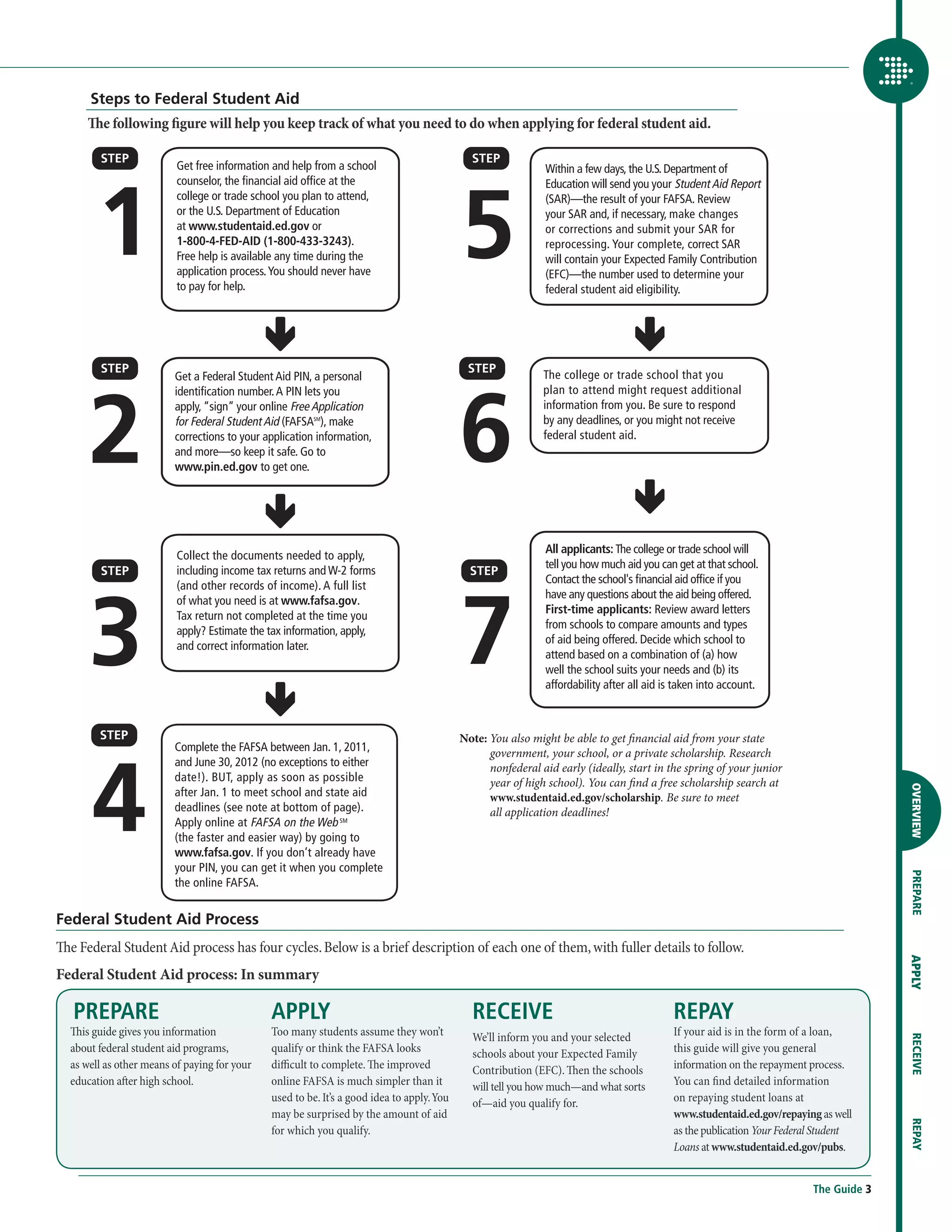
Steps to Federal Student Aid
     The following figure will help you keep track of what you need to do when applying for federal student aid.

                          Get free information and help from a school                                        Within a few days, the U.S. Department of


        1                                                                                  5
                          counselor, the financial aid office at the                                         Education will send you your Student Aid Report
                          college or trade school you plan to attend,                                        (SAR)—the result of your FAFSA. Review
                          or the U.S. Department of Education                                                your SAR and, if necessary, make changes
                          at www.studentaid.ed.gov or                                                        or corrections and submit your SAR for
                          1-800-4-FED-AID (1-800-433-3243).                                                  reprocessing. Your complete, correct SAR
                          Free help is available any time during the                                         will contain your Expected Family Contribution
                          application process. You should never have                                         (EFC)—the number used to determine your
                          to pay for help.                                                                   federal student aid eligibility.


                         Get a Federal Student Aid PIN, a personal                                           The college or trade school that you


      2                                                                                    6
                         identification number. A PIN lets you                                               plan to attend might request additional
                         apply, “sign” your online Free Application                                          information from you. Be sure to respond
                         for Federal Student Aid (FAFSASM), make                                             by any deadlines, or you might not receive
                         corrections to your application information,                                        federal student aid.
                         and more—so keep it safe. Go to
                         www.pin.ed.gov to get one.


                                                                                                             All applicants: The college or trade school will
                          Collect the documents needed to apply,
                                                                                                             tell you how much aid you can get at that school.
                          including income tax returns and W-2 forms
                                                                                                             Contact the school's financial aid office if you


      3                                                                                    7
                          (and other records of income). A full list
                                                                                                             have any questions about the aid being offered.
                          of what you need is at www.fafsa.gov.
                                                                                                             First-time applicants: Review award letters
                          Tax return not completed at the time you
                                                                                                             from schools to compare amounts and types
                          apply? Estimate the tax information, apply,
                                                                                                             of aid being offered. Decide which school to
                          and correct information later.
                                                                                                             attend based on a combination of (a) how
                                                                                                             well the school suits your needs and (b) its
                                                                                                             affordability after all aid is taken into account.


                                                                                           Note:  ou also might be able to get financial aid from your state
                                                                                                 Y
                         Complete the FAFSA between Jan. 1, 2011,


      4
                                                                                                 government, your school, or a private scholarship. Research
                         and June 30, 2012 (no exceptions to either                             nonfederal aid early (ideally, start in the spring of your junior
                         date!). BUT, apply as soon as possible                                  year of high school). You can find a free scholarship search at


                                                                                                                                                                                       OVERVIEW
                         after Jan. 1 to meet school and state aid                               www.studentaid.ed.gov/scholarship. Be sure to meet
                         deadlines (see note at bottom of page).                                all application deadlines!
                         Apply online at FAFSA on the Web SM
                         (the faster and easier way) by going to
                         www.fafsa.gov. If you don’t already have
                         your PIN, you can get it when you complete


                                                                                                                                                                                       PREPARE
                         t
                          he online FAFSA.


Federal Student Aid Process
The Federal Student Aid process has four cycles. Below is a brief description of each one of them, with fuller details to follow.
                                                                                                                                                                                       APPLY


Federal Student Aid process: In summary

   PREPARE                                    APPLY                                          RECEIVE                                       REPAY
  This guide gives you information            Too many students assume they won’t            We’ll inform you and your selected            If your aid is in the form of a loan,
                                                                                                                                                                                       RECEIVE


  about federal student aid programs,         qualify or think the FAFSA looks               schools about your Expected Family            this guide will give you general
  as well as other means of paying for your   difficult to complete. The improved            Contribution (EFC). Then the schools          information on the repayment process.
  education after high school.                online FAFSA is much simpler than it           will tell you how much—and what sorts         You can find detailed information
                                              used to be. It’s a good idea to apply. You     of—aid you qualify for.                       on repaying student loans at
                                              may be surprised by the amount of aid                                                        www.studentaid.ed.gov/repaying as well
                                                                                                                                                                                       REPAY


                                              for which you qualify.                                                                       as the publication Your Federal Student
                                                                                                                                           Loans at www.studentaid.ed.gov/pubs.


                                                                                                                                                                         The Guide 3
At-a-Glance


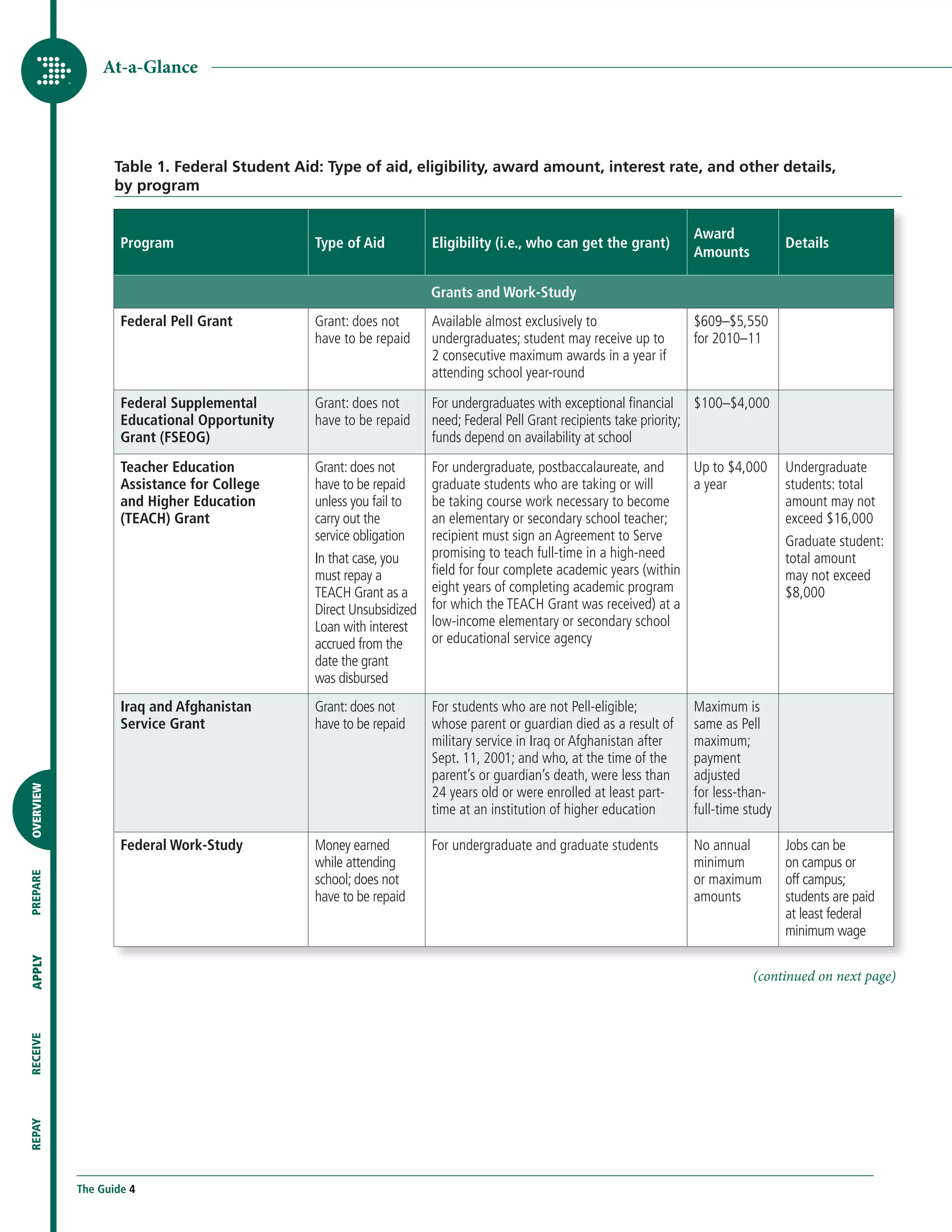
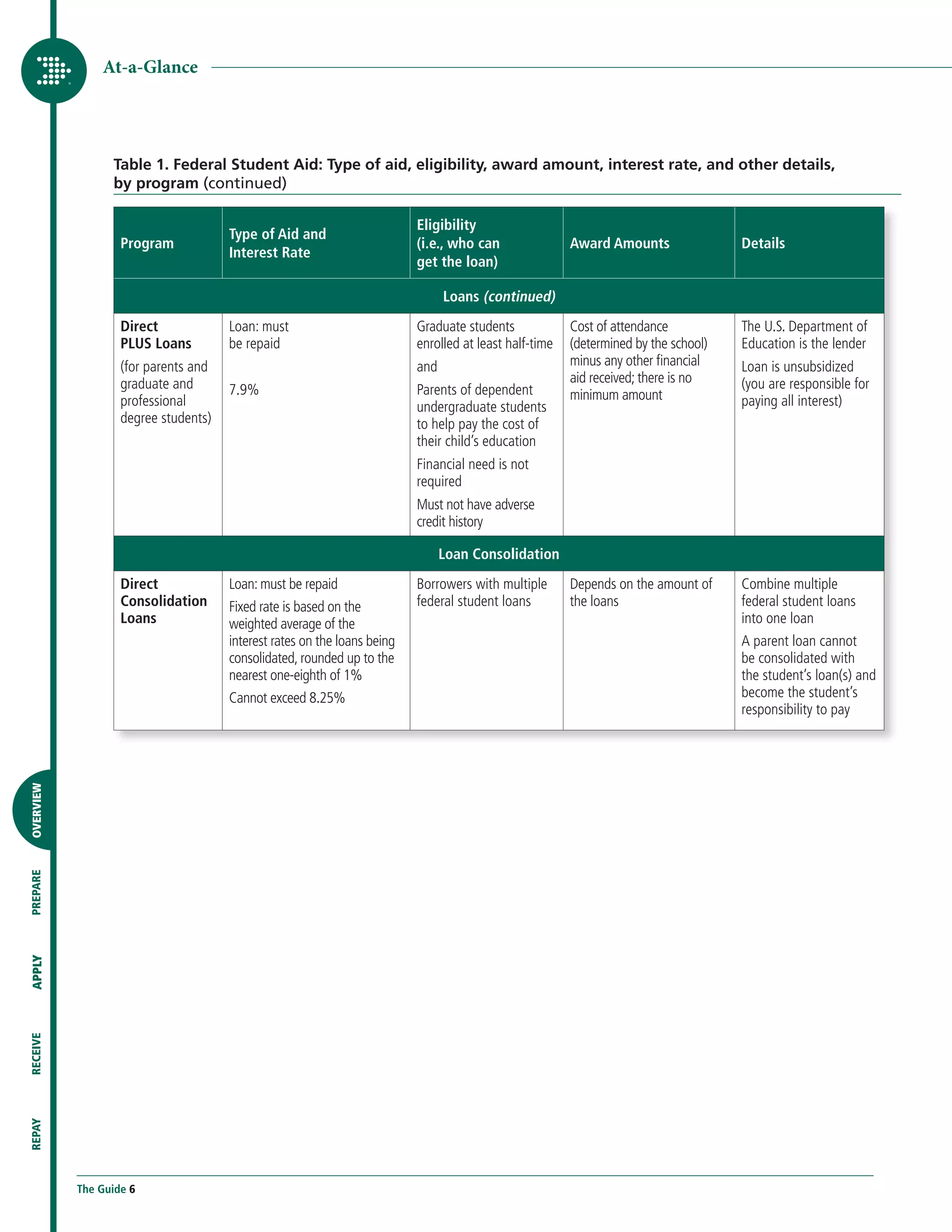
                  Table 1. Federal Student Aid: Type of aid, eligibility, award amount, interest rate, and other details,
                  by program


                                                                                                                    Award
                   Program                    Type of Aid           Eligibility (i.e., who can get the grant)                         Details
                                                                                                                    Amounts

                                                                    Grants and Work-Study
                   Federal Pell Grant         Grant: does not       Available almost exclusively to                 $609–$5,550
                                              have to be repaid     undergraduates; student may receive up to       for 2010–11
                                                                    2 consecutive maximum awards in a year if
                                                                    attending school year-round

                   Federal Supplemental       Grant: does not       For undergraduates with exceptional financial $100–$4,000
                   Educational Opportunity    have to be repaid     need; Federal Pell Grant recipients take priority;
                   Grant (FSEOG)                                    funds depend on availability at school
                   Teacher Education          Grant: does not       For undergraduate, postbaccalaureate, and      Up to $4,000       Undergraduate
                   Assistance for College     have to be repaid     graduate students who are taking or will       a year             students: total
                   and Higher Education       unless you fail to    be taking course work necessary to become                         amount may not
                   (TEACH) Grant              carry out the         an elementary or secondary school teacher;                        exceed $16,000
                                              service obligation    recipient must sign an Agreement to Serve                         Graduate student:
                                              In that case, you     promising to teach full-time in a high-need                       total amount
                                              must repay a          field for four complete academic years (within                    may not exceed
                                              TEACH Grant as a      eight years of completing academic program                        $8,000
                                              Direct Unsubsidized   for which the TEACH Grant was received) at a
                                              Loan with interest    low-income elementary or secondary school
                                              accrued from the      or educational service agency
                                              date the grant
                                              was disbursed
                   Iraq and Afghanistan       Grant: does not       For students who are not Pell-eligible;         Maximum is
                   Service Grant              have to be repaid     whose parent or guardian died as a result of    same as Pell
                                                                    military service in Iraq or Afghanistan after   maximum;
                                                                    Sept. 11, 2001; and who, at the time of the     payment
                                                                    parent’s or guardian’s death, were less than    adjusted
OVERVIEW


                                                                    24 years old or were enrolled at least part-    for less-than-
                                                                    time at an institution of higher education      full-time study

                   Federal Work-Study         Money earned          For undergraduate and graduate students         No annual         Jobs can be
                                              while attending                                                       minimum           on campus or
PREPARE


                                              school; does not                                                      or maximum        off campus;
                                              have to be repaid                                                     amounts           students are paid
                                                                                                                                      at least federal
                                                                                                                                      minimum wage
APPLY


                                                                                                                               (continued on next page)
RECEIVE
REPAY


           The Guide 4
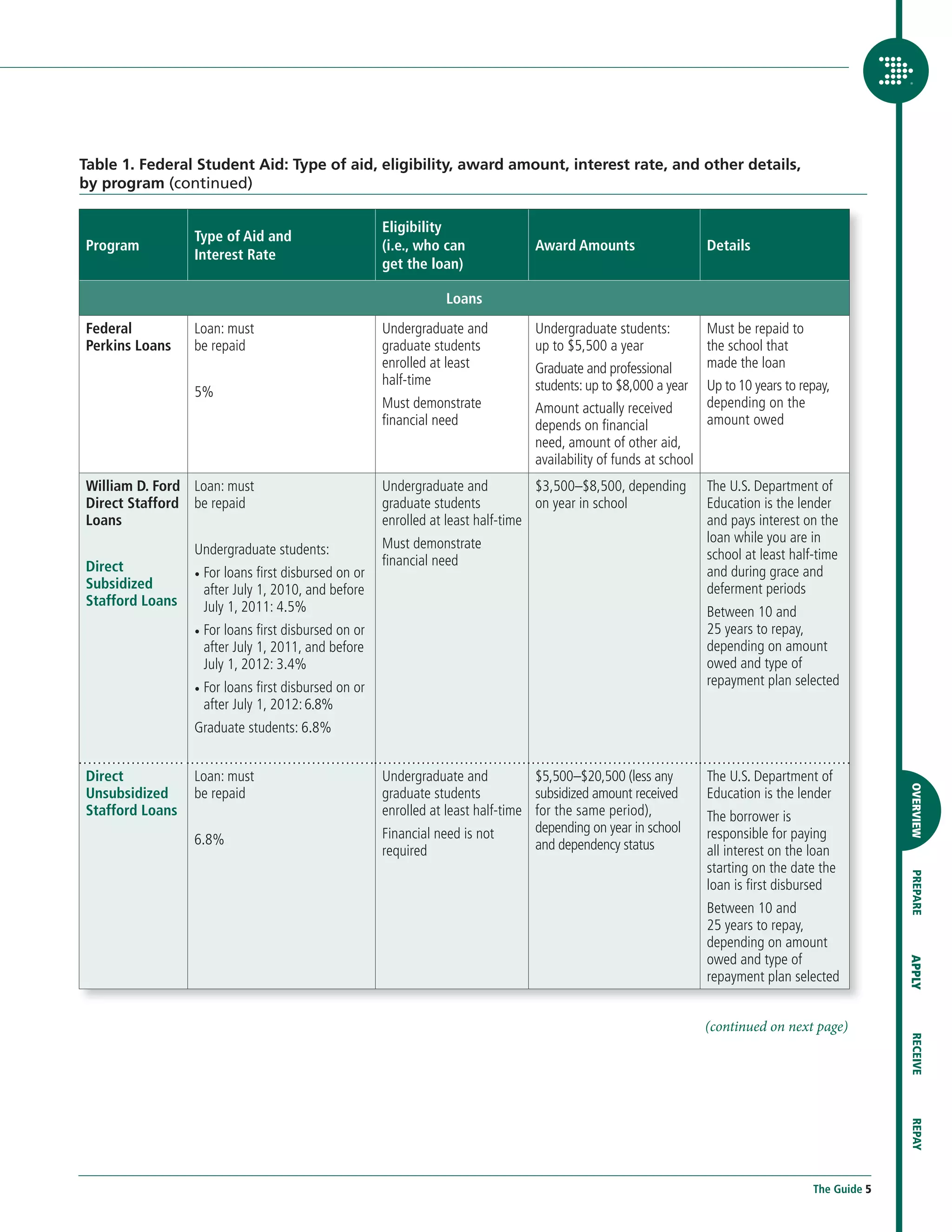
Table 1. Federal Student Aid: Type of aid, eligibility, award amount, interest rate, and other details,
by program (continued)

                                                      Eligibility
                 Type of Aid and
Program                                               (i.e., who can              Award Amounts                     Details
                 Interest Rate
                                                      get the loan)

                                                                 Loans
Federal          Loan: must                           Undergraduate and           Undergraduate students:           Must be repaid to
Perkins Loans    be repaid                            graduate students           up to $5,500 a year               the school that
                                                      enrolled at least           Graduate and professional         made the loan
                                                      half-time                   students: up to $8,000 a year     Up to 10 years to repay,
                 5%
                                                      Must demonstrate            Amount actually received          depending on the
                                                      financial need              depends on financial              amount owed
                                                                                  need, amount of other aid,
                                                                                  availability of funds at school
William D. Ford Loan: must                            Undergraduate and           $3,500–$8,500, depending          The U.S. Department of
Direct Stafford be repaid                             graduate students           on year in school                 Education is the lender
Loans                                                 enrolled at least half-time                                   and pays interest on the
                                                      Must demonstrate                                              loan while you are in
                 Undergraduate students:                                                                            school at least half-time
Direct                                                financial need
                 •  or loans first disbursed on or
                   F                                                                                                and during grace and
Subsidized         after July 1, 2010, and before                                                                   deferment periods
Stafford Loans     July 1, 2011: 4.5%                                                                               Between 10 and
                 •  or loans first disbursed on or
                   F                                                                                                25 years to repay,
                   after July 1, 2011, and before                                                                   depending on amount
                   July 1, 2012: 3.4%                                                                               owed and type of
                 •  or loans first disbursed on or
                   F                                                                                                repayment plan selected
                   after July 1, 2012: 6.8%
                 Graduate students: 6.8%


Direct           Loan: must                           Undergraduate and           $5,500–$20,500 (less any          The U.S. Department of


                                                                                                                                                      OVERVIEW
Unsubsidized     be repaid                            graduate students           subsidized amount received        Education is the lender
Stafford Loans                                        enrolled at least half-time for the same period),             The borrower is
                                                      Financial need is not       depending on year in school       responsible for paying
                 6.8%                                                             and dependency status
                                                      required                                                      all interest on the loan
                                                                                                                    starting on the date the

                                                                                                                                                      PREPARE
                                                                                                                    loan is first disbursed
                                                                                                                    Between 10 and
                                                                                                                    25 years to repay,
                                                                                                                    depending on amount
                                                                                                                    owed and type of
                                                                                                                                                      APPLY


                                                                                                                    repayment plan selected


                                                                                                                    (continued on next page)
                                                                                                                                                      RECEIVE
                                                                                                                                                      REPAY


                                                                                                                                        The Guide 5
At-a-Glance


                 Table 1. Federal Student Aid: Type of aid, eligibility, award amount, interest rate, and other details,
                 by program (continued)

                                                                          Eligibility
                                      Type of Aid and
                   Program                                                (i.e., who can                Award Amounts                Details
                                      Interest Rate
                                                                          get the loan)

                                                                                Loans (continued)
                   Direct             Loan: must                          Graduate students             Cost of attendance           The U.S. Department of
                   PLUS Loans         be repaid                           enrolled at least half-time   (determined by the school)   Education is the lender
                   (for parents and                                       and                           minus any other financial    Loan is unsubsidized
                   graduate and                                                                         aid received; there is no    (you are responsible for
                                      7.9%                                Parents of dependent          minimum amount
                   professional                                           undergraduate students                                     paying all interest)
                   degree students)                                       to help pay the cost of
                                                                          their child’s education
                                                                          Financial need is not
                                                                          required
                                                                          Must not have adverse
                                                                          credit history

                                                                                Loan Consolidation
                   Direct             Loan: must be repaid                Borrowers with multiple       Depends on the amount of     Combine multiple
                   Consolidation      Fixed rate is based on the          federal student loans         the loans                    federal student loans
                   Loans              weighted average of the                                                                        into one loan
                                      interest rates on the loans being                                                              A parent loan cannot
                                      consolidated, rounded up to the                                                                be consolidated with
                                      nearest one-eighth of 1%                                                                       the student’s loan(s) and
                                      Cannot exceed 8.25%                                                                            become the student’s
                                                                                                                                     responsibility to pay
OVERVIEW
PREPARE
APPLY
RECEIVE
REPAY


           The Guide 6
PART I.
What You Should
Know Before You Apply


T      he amount and type of federal aid the U.S. Department
       of Education provides doesn’t always depend solely
on financial need. Once students apply for aid, many are
                                                                           When we refer to “school” in this guide, we mean a two-year
                                                                           or four-year public or private college or university, or a career
                                                                           or trade school.

surprised by the amount of aid they receive. So a good rule
of thumb is: Don’t assume you’re not eligible. Take the time               Choosing the Right School
to complete and submit the Free Application for Federal
Student Aid—the FAFSASM.                                                   What type of school is right for me?
                                                                           If you can’t decide where to go to school or need help
Why Should I Invest in an Education?                                       planning for college, talk to your school counselor or visit


                                                                                                                                                        OVERVIEW
                                                                           www.studentaid.ed.gov and click on “Choosing a School.”
Can’t I Get a Job Now?                                                     Here you can learn more about the types of schools available in
                                                                           the field you interested in, start comparing schools, and learn
Yes, maybe you could, but a college degree will make your chances
                                                                           how to assess them. You can even create a personal portfolio at
even better. Over a working life, a person with a bachelor’s degree

                                                                                                                                                        PREPARE
                                                                           www.studentaid.ed.gov/myfsa to keep track of your college
will earn almost twice as much as someone with just a high school
                                                                           search and access other U.S. Department of Education databases
diploma. Higher education equates to more job options and higher
                                                                           with detailed college information and career options.
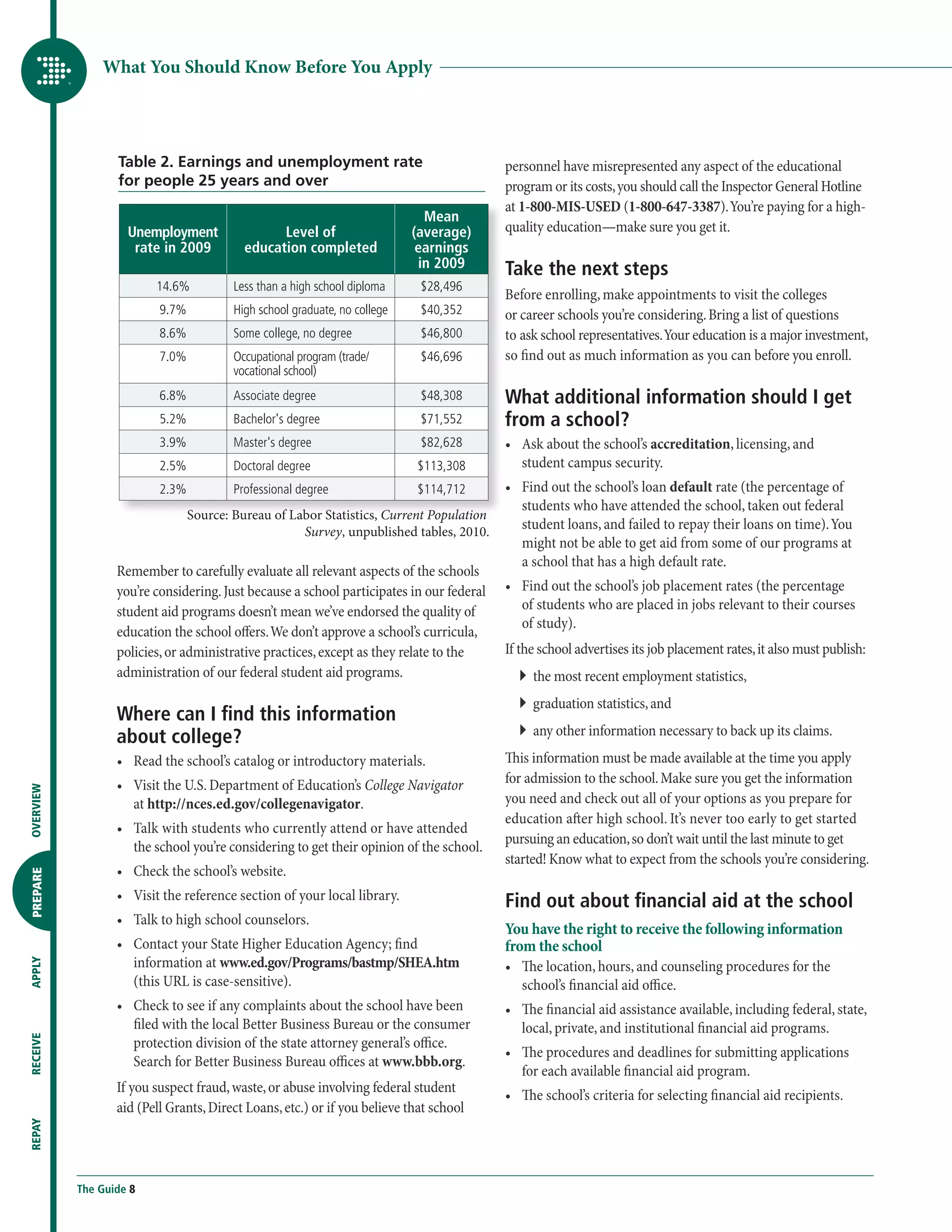
earnings. Check out the earnings and unemployment rates for
people 25 years and older with different levels of education in table 2.
                                                                           What should I consider?
                                                                                                                                                        APPLY


The more education you have, the more you earn.
                                                                           •	  oes the school offer the courses and type of program I want?
                                                                              D
                                                                           •	  o I meet the admissions requirements?
                                                                              D
  Not sure what a term means?
                                                                           •	  oes the school offer a high-quality education?
                                                                              D
                                                                                                                                                        RECEIVE


  What does this word mean? You will encounter
                                                                           •	  oes the school participate in Federal Student Aid programs?
                                                                              D
  financial aid terms that might be new to you.
  These words will be highlighted in bold at first                         •	  oes the school offer services I need and activities
                                                                              D
  mention. If you find a word you don’t understand,                           I’m interested in?
                                                                                                                                                        REPAY


  see the Glossary on page 39 or visit our online
  glossary at www.studentaid.ed.gov/glossary.
                                                                                                                                          The Guide 7
What You Should Know Before You Apply


                  Table 2. Earnings and unemployment rate                                 personnel have misrepresented any aspect of the educational
                  for people 25 years and over                                            program or its costs, you should call the Inspector General Hotline
                                                                                          at 1-800-MIS-USED (1-800-647-3387). You’re paying for a high-
                                                                              Mean
                    Unemployment                 Level of                   (average)     quality education—make sure you get it.
                     rate in 2009          education completed               earnings
                                                                             in 2009      Take the next steps
                         14.6%           Less than a high school diploma     $28,496
                                                                                          Before enrolling, make appointments to visit the colleges
                          9.7%           High school graduate, no college    $40,352      or career schools you’re considering. Bring a list of questions
                          8.6%           Some college, no degree             $46,800      to ask school representatives. Your education is a major investment,
                          7.0%           Occupational program (trade/        $46,696      so find out as much information as you can before you enroll.
                                         vocational school)
                          6.8%           Associate degree                    $48,308      What additional information should I get
                          5.2%           Bachelor's degree                   $71,552      from a school?
                          3.9%           Master's degree                     $82,628      •	  sk about the school’s accreditation, licensing, and
                                                                                             A
                          2.5%           Doctoral degree                    $113,308         student campus security.
                          2.3%           Professional degree                $114,712      •	  ind out the school’s loan default rate (the percentage of
                                                                                             F
                                                                                             students who have attended the school, taken out federal
                                 Source: Bureau of Labor Statistics, Current Population
                                                     Survey, unpublished tables, 2010.
                                                                                             student loans, and failed to repay their loans on time). You
                                                                                             might not be able to get aid from some of our programs at
                                                                                             a school that has a high default rate.
                  Remember to carefully evaluate all relevant aspects of the schools
                  you’re considering. Just because a school participates in our federal   •	  ind out the school’s job placement rates (the percentage
                                                                                             F
                  student aid programs doesn’t mean we’ve endorsed the quality of            of students who are placed in jobs relevant to their courses
                                                                                             of study).
                  education the school offers. We don’t approve a school’s curricula,
                  policies, or administrative practices, except as they relate to the     I
                                                                                           f the school advertises its job placement rates, it also must publish:
                  administration of our federal student aid programs.                       `` the most recent employment statistics,
                                                                                            `` graduation statistics, and
                  Where can I find this information
                  about college?                                                            `` any other information necessary to back up its claims.
                  •	 Read the school’s catalog or introductory materials.                 This information must be made available at the time you apply
                  •	  isit the U.S. Department of Education’s College Navigator
                     V                                                                    for admission to the school. Make sure you get the information
OVERVIEW


                     at http://nces.ed.gov/collegenavigator.                              you need and check out all of your options as you prepare for
                                                                                          education after high school. It’s never too early to get started
                  •	  alk with students who currently attend or have attended
                     T
                                                                                          pursuing an education, so don’t wait until the last minute to get
                     the school you’re considering to get their opinion of the school.
                                                                                          started! Know what to expect from the schools you’re considering.
                  •	  heck the school’s website.
                     C
PREPARE


                  •	  isit the reference section of your local library.
                     V                                                                    Find out about financial aid at the school
                  •	  alk to high school counselors.
                     T
                                                                                          You have the right to receive the following information
                  •	  ontact your State Higher Education Agency; find
                     C                                                                    from the school
                     information at www.ed.gov/Programs/bastmp/SHEA.htm
APPLY


                                                                                          •	  e location, hours, and counseling procedures for the
                                                                                             Th
                     (this URL is case-sensitive).                                           school’s financial aid office.
                  •	  heck to see if any complaints about the school have been
                     C                                                                    •	  e financial aid assistance available, including federal, state,
                                                                                             Th
                     filed with the local Better Business Bureau or the consumer             local, private, and institutional financial aid programs.
RECEIVE


                     protection division of the state attorney general’s office.
                                                                                          •	  e procedures and deadlines for submitting applications
                                                                                             Th
                     Search for Better Business Bureau offices at www.bbb.org.
                                                                                             for each available financial aid program.
                  If you suspect fraud, waste, or abuse involving federal student
                                                                                          •	  e school’s criteria for selecting financial aid recipients.
                                                                                             Th
                  aid (Pell Grants, Direct Loans, etc.) or if you believe that school
REPAY


           The Guide 8
I.

•	  e school’s process for determining your financial need.
   Th                                                                What can I do with a MyFSA account?
•	  e school’s process for determining the type and amount
   Th                                                                With your MyFSA account, you can:
   of assistance in your financial aid package.
                                                                     Create a profile. The information you enter about yourself will
•	  e method and timing of financial aid payments made to you.
   Th
                                                                     be stored in your profile. Make sure to keep your information
•	  e school’s basis for determining whether you’re making
   Th                                                                as accurate and up-to-date as possible.
   satisfactory academic progress and what happens if you’re not.
   (Whether you continue to receive federal student aid depends,     Search for colleges and scholarships. Any colleges you add to
   in part, on whether you make satisfactory academic progress.)     MyFSA will be stored and can be used in worksheets and tables you
                                                                     use in MyFSA. You may add or delete colleges from this list at anytime
•	  f you’re offered a Federal Work-Study job, the nature of the
   I
   job, the hours you must work, your job duties, the pay, and       and search for potential scholarships that match your profile.
   the method and timing of payment to you.                          Apply for colleges. MyFSA will track where you stopped entering
                                                                     your information and will link you to all applications in progress.
Find out the school’s tuition refund policy                          It will also provide the date and confirmation number of your
If you enroll but never begin classes, you should get most of        submitted applications.
your money back. If you begin attending classes but leave before     Store and access financial aid information. Any scholarship,
completing your course work, you might be able to get some of        loan, and cost of attendance information is saved in the
your money back.                                                     Financial Aid Wizard. You also can calculate an estimated
                                                                     family contribution (EFC)—the eligibility index. This section
Find out the school’s return-of-aid policy                           of MyFSA also uses the schools you're interested in to calculate
If you receive federal student aid from any program mentioned        approximate costs and also has the option of completing
in this publication (except for Federal Work-Study), and you         electronic college admission applications.
withdraw from school, some of that money might have to be            Create an event calendar. Access your personal events on a daily,
given back to the source by you or by your school. Even if you       weekly, or monthly basis.
don’t finish your course work, you’ll have to repay the loan funds
                                                                     Research careers. Once you have completed the Self Assessment
you received, minus any student loan funds your school has
                                                                     and Career Finder, any careers or majors that have met your
returned to the U.S. Department of Education.
                                                                     specifications can be stored and accessed.

Find out the school’s completion
and transfer-out rates                                               Early Eligibility Indicator:
If many students withdraw from a school, it might indicate a
                                                                     FAFSA4casterSM


                                                                                                                                                       OVERVIEW
problem with the school. A school is required to tell current and
prospective students the percentage of students who complete the
school’s programs and the percentage of students who transfer out.   What is the purpose of FAFSA4caster?
                                                                     FAFSA4casterSM, at www.fafsa.gov, is a free online tool that

                                                                                                                                                       PREPARE
                                                                     provides you with early estimates of your eligibility for federal
MyFSA                                                                student aid. Having such information helps families plan ahead
                                                                     for college.
Create a personal portfolio at Federal Student Aid to keep track
of your college searches, college applications, career interests,
                                                                     Who should use FAFSA4caster?
                                                                                                                                                       APPLY


and other items related to your college and career search. Go to
www.studentaid.ed.gov/myfsa to create your MyFSA account.            FAFSA4caster is for anyone who is not yet ready to file an
                                                                     official FAFSA. You do not have to be a high school senior to
                                                                     use FAFSA4caster; in fact, the tool is recommended for juniors,
                                                                                                                                                       RECEIVE


                                                                     and even as early as middle school.
                                                                                                                                                       REPAY


                                                                                                                                         The Guide 9
What You Should Know Before You Apply


                  How do you use FAFSA4caster?                                               agreements” with four-year colleges under which the course work
                                                                                             taken at the community college transfers into the four-year degree
                  In FAFSA4caster, you answer financial and other questions
                                                                                             program. Be sure to ask about the types of articulation agreements
                  that are used to estimate your federal student aid eligibility.
                                                                                             the community college has, with whom, and for what programs of
                  No signatures are required to submit FAFSA4caster because
                                                                                             study. Discuss any concerns you have about transfer courses and
                  it is not the official federal student aid application.
                                                                                             credits with the college registrar at the college you’re transferring to.

                  What information does
                                                                                             State Higher Education Agencies
                  FAFSA4caster provide?
                                                                                             Contact your state Higher Education Agency about any
                  When you complete FAFSA4caster, the tool displays a worksheet to
                                                                                             aid program or scholarship sponsored by your state.
                  help you determine the net cost of attending your chosen school.
                                                                                             Contact information, by state, is available at
                  At the top of the page, you can enter the school’s cost of attendance
                                                                                             www.ed.gov/Programs/bastmp/SHEA.htm
                  (there is a link to College Navigator in case you need to look up
                                                                                             (this URL is case-sensitive)
                  the cost). Next, a number of sources of college funding are listed.
                  FAFSA4caster indicates your estimated Pell Grant amount (if any),
                  Federal Work-Study amount (based on the average nationally), and           Work or volunteer opportunities
                  maximum Stafford Loan eligibility. There are fields where you can          You can work part-time to pay part of your costs. Be sure your
                  fill in the amounts of state and college aid and private scholarships      work and school schedules don’t conflict and that you save enough
                  you expect (or hope) to get. Finally, there is a field where you can       time for studying.
                  indicate how much in savings you (or your family) will contribute
                  toward the cost of college. At the bottom of the page, FAFSA4caster        Federal income tax credits
                  summarizes the cost, the aid entered, and the difference (the net cost     There are three tax credits available to help you offset the costs
                  of attending college). You can compare schools by changing cost of         of higher education by reducing the amount of your income tax:
                  attendance, deleting state aid if you will be an out-of-state student at   the Hope Credit, American Opportunity Credit, and the Lifetime
                  a particular school, amending the amount of aid available from the         Learning Credit, also referred to as education credits. See Internal
                  school, and so on.                                                         Revenue Services (IRS) Publication 970, Tax Benefits for Education
                                                                                             at www.irs.gov.
                  Note:
                  It is important to understand that the federal aid amounts
                  provided by FAFSA4caster are estimates.
                                                                                             Tax breaks
                                                                                             Certain borrowers can take a tax deduction for the interest
                                                                                             actually paid on student loans. This benefit applies to all loans
                  Reducing the Cost of Education
OVERVIEW


                                                                                             used to pay for postsecondary education school expenses. The
                                                                                             maximum deduction is $2,500 a year. See IRS Publication 970,
                  There are other options you might consider to lower the cost               Tax Benefits for Education, chapter 4, at www.irs.gov.
                  of your education after high school. The following are a few
PREPARE


                  ideas to think about.
                                                                                             Am I Eligible?
                  Lower-cost schools
                  If you’ll be working toward a bachelor’s degree, you might consider        Basic requirements
                  starting at a two-year community college and then transferring to
APPLY


                                                                                             To receive aid from the federal student aid programs discussed
                  a four-year school. Community colleges are usually less expensive
                                                                                             in this guide, you must meet certain criteria.
                  than four-year schools. (Some four-year schools that are partially
                  funded by local or state taxes can be less expensive as well.) If
                                                                                             Financial need
RECEIVE


                  attending a community college allows you to live at home, you
                  can save money on room and board. If you decide to start at a              Except for some loan programs, you must show that you have
                  community college, make sure your community college courses will           financial need, according to our requirements (see “Financial
                  transfer to your four-year college and that they will count toward         Need and Expected Family Contribution (EFC)” on page 12).
                  your bachelor’s degree. Many community colleges have “articulation
REPAY


           The Guide 10
I.

Education requirements                                                 •	  s designed to support students with intellectual disabilities
                                                                          i
                                                                          who are seeking to continue academic, career and technical
•	  ou must demonstrate by one of the following means that
   Y
                                                                          training for education, and independent living instruction to
   you are qualified to enroll in postsecondary education:
                                                                          prepare for gainful employment;
  ``  ave a high school diploma or a General Educational
     H
                                                                       •	  ffers academic advising and a structured curriculum; and
                                                                          o
     Development (GED) certificate.
                                                                       •	  equires students with intellectual disabilities to participate on
                                                                          r
  ``  omplete a high school education in a homeschool setting
     C                                                                    a not less than half-time basis with nondisabled students in (1)
     approved under state law.                                            regular enrollment in credit-bearing courses, (2) auditing or
  ``  ass an approved ability-to-benefit (ATB) test. If you don’t
     P                                                                    participating in courses for which the student does not receive
     have a diploma or GED, you can take an approved ATB test             regular academic credit, (3) enrollment in noncredit-bearing,
                                                                          nondegree courses, or (4) participation in internships or work-
     to determine whether you can benefit from the education
                                                                          based training.
     offered at that school.
  ``  f you don’t have a high school diploma or its equivalent,
     I                                                                 Children of military personnel killed in Iraq
     or pass an ATB test, you may become eligible to receive           or Afghanistan after Sept. 11, 2001
     federal student aid if the institution you plan on
                                                                       If your parent or guardian died as a result of military service in
     attending determines you have the ability to benefit from
                                                                       Iraq or Afghanistan after Sept. 11, 2001, you may be eligible for
     postsecondary education because you have satisfactorily
                                                                       additional aid if, at the time of your parent’s or guardian’s death,
     completed six credit hours or the equivalent course work
                                                                       you were less than 24 years of age or enrolled at least part-time at
     toward a degree or certificate offered by the institution.
                                                                       an institution of higher education. Payments are adjusted if you
     You may not receive aid while earning the six credit hours.
                                                                       are enrolled less than full-time.
  ``  eet other standards your state has established and that the
     M
                                                                       •	 Pell Grants: If you meet these requirements and are eligible
     U.S. Department of Education has approved.
                                                                           to receive a Pell Grant, your EFC will be equated to zero,
•	  ou must be enrolled or accepted for enrollment as a
   Y                                                                       which can increase your eligibility for all federal student aid
   regular student working toward a degree or certificate                  programs and maximize your Pell amount.
   in an eligible program.                                             •	  raq and Afghanistan Service Grants: If you meet these
                                                                          I
•	  ou must meet satisfactory academic progress standards
   Y                                                                      requirements, but you are not eligible to receive a Pell Grant
   set by the postsecondary school you are or will be attending.          you will be eligible to receive this non-need-based grant;
•	  ou might be able to receive aid for distance education
   Y                                                                      however, your EFC will not be changed, and, therefore
   courses as long as they are part of a recognized certificate           neither will your eligibility for any need-based federal
   or degree program.                                                     student aid. The maximum amount of this grant is the same
                                                                          as the maximum Pell Grant award but may not exceed the


                                                                                                                                                        OVERVIEW
                                                                          cost of attendance.
Intellectual disabilities
Students with intellectual disabilities can receive federal student
                                                                       Legal and other requirements
aid under the Federal Pell Grant Program, FSEOG Program, and
                                                                       •	  ou must be a U.S. citizen or eligible noncitizen.
                                                                          Y

                                                                                                                                                        PREPARE
Federal Work-Study Program. To be eligible, you must
                                                                       •	  ou must have a valid Social Security number (SSN).
                                                                          Y
•	  e enrolled or accepted for enrollment in a comprehensive
   b
                                                                          If you don’t have an SSN, you can find out more
   transition and postsecondary program for students with
                                                                          about applying for one at www.ssa.gov or by calling
   intellectual disabilities at an institution of higher education;
                                                                          1-800-772-1213; TTY users can call 1-800-325-0778.
                                                                                                                                                        APPLY


•	  e maintaining satisfactory progress; and
   b
                                                                       •	  hen you apply for federal student aid you sign a statement
                                                                          W
•	  eet the other student eligibility criteria.
   m                                                                      that certifies that you will use federal student aid for
A comprehensive transition and postsecondary program for                  educational purposes only. You also certify that you are not
students with intellectual disabilities means a degree, certificate,      in default on a federal student loan and do not owe a refund
                                                                                                                                                        RECEIVE


or nondegree program that                                                 on a federal student grant (which could happen if you have
                                                                          withdrawn from school, for example).
•	  s offered by an institution of higher education and approved
   i
   by the U.S. Department of Education;
                                                                                                                                                        REPAY


                                                                                                                                         The Guide 11
What You Should Know Before You Apply


                  •	  ou must comply with Selective Service registration.
                     Y                                                                       status. Most males between the ages of 18 and 25 must register
                     If you’re a male aged 18 through 25 and you have not                    with Selective Service in order to be eligible for federal student aid,
                     registered you can, at the same time you complete your                  so we check with this agency as well.
                     FAFSA, give the Selective Service System permission to
                     register you by means of the FAFSA. You can also register
                                                                                                 DID YOU KNOW?
                     online at www.sss.gov or call 1-847-688-6888; TTY users
                                                                                                 Federal Student Aid issues over $150 billion in aid
                     can call 1-847-688-2567.
                                                                                                 every year.
                  •	  ou have limited eligibility for federal student aid while you're
                     Y
                     incarcerated. Generally, you're only eligible for a Pell Grant
                     and then only if you're NOT incarcerated in a federal or state
                     penal institution. Check with the financial aid office at the
                                                                                             Financial need and Expected Family
                     school you plan on attending.                                           Contribution (EFC)
                  •	  enerally, if you have been convicted for the possession or sale
                     G                                                                       Aid for most of our programs is awarded based on financial
                     of illegal drugs for an offense that occurred while you were            need (except for unsubsidized Stafford Loans, PLUS Loans,
                     receiving federal student aid, you will be ineligible for a period of   and TEACH Grants; see pages 16–20 for more information on
                     time based on the type and number of convictions. If you have           these programs). The EFC is the number used to determine your
                     been convicted of a drug-related offense, it is very important that     eligibility for federal student aid.
                     you complete and submit the FAFSA to determine your eligibility.
                                                                                             The EFC is calculated from the information you report on the
                     If you are submitting a paper FAFSA, you will be mailed a
                                                                                             FAFSA and according to a formula established by law. Your
                     worksheet to assist you in determining whether your conviction
                     affects your eligibility for federal student aid. If you are applying   family’s income (taxable and untaxed) and assets are considered in
                     using FAFSA on the Web at www.fafsa.gov, your eligibility will          determining your EFC. Your family size and the number of family
                     be determined during your online session. If you need assistance        members who will be attending a college or career school also are
                     or have any questions on how to answer this question, call              considered. Your EFC will appear on the Student Aid Report (SAR)
                     1-800-4-FED-AID (1-800-433-3243) for help from the Federal              you receive from the Department after you file your FAFSA. To
                     Student Aid Information Center. Even if you’re ineligible for           determine your financial need for federal student aid programs
                     federal student aid because of a drug conviction, you should still      (except for an unsubsidized Stafford Loan), your school subtracts the
                     complete the FAFSA because most schools and states use FAFSA            Expected Family Contribution (EFC) from your cost of attendance.
                     information to award nonfederal aid.
                     I
                      f you have lost federal student aid eligibility due to a
                     drug conviction, you can regain eligibility if you pass two
                     unannounced drug tests conducted by a drug rehabilitation                   Calculating Your Financial Need
                     program that complies with criteria established by the U.S.                 Your Expected Family Contribution (EFC) is used
OVERVIEW


                     Department of Education.                                                    to determine your financial need:
                                                                                                 	 Cost of Attendance
                  Agency matching of selected requirements                                       –	 Expected Family Contribution (EFC)
                  When you apply for federal student aid, the Department verifies                =	Financial Need
PREPARE


                  some of your information with certain federal agencies, including
                  the Social Security Administration (for verification of Social
                  Security numbers and U.S. citizenship status) and the Department
                  of Homeland Security (to verify Alien Registration numbers). If            The school also uses federal grants and other financial aid to meet
                  the information doesn’t match, the discrepancy must be resolved            your financial need. Because the EFC formula must be applied to each
APPLY


                  before you can receive federal student aid. We also check your             family’s financial information, it can't be stated here whether you will
                  information against our National Student Loan Data SystemSM                be eligible for federal student aid or estimate how much aid you might
                  (NSLDSSM), to verify that you haven’t defaulted on your federal            receive. However, if you’d like to get an early estimate of your financial
                                                                                             aid award use FAFSA4caster at www.fafsa.gov; but, to find out exactly
RECEIVE


                  student loan, haven’t received an overpayment on a federal grant
                  or a Federal Perkins Loan, and haven’t borrowed more than the              what you will be eligible to receive, you must apply for financial aid.
                  total limit you are allowed. We also check your information against        To see how the EFC formula works, you can get detailed worksheets
                  Veterans Affairs if you answer the question regarding veteran              from www.studentaid.ed.gov/pubs. Click on the year under The EFC
REPAY


           The Guide 12
I.

Formula or you can call the Federal Student Aid Information Center           •	  eacher Education Assistance for College and Higher
                                                                                T
at 1-800-4-FED-AID (1-800-433-3243).                                            Education (TEACH) Grant. If you don’t fulfill your teaching
                                                                                service obligation, this grant will be converted to a Federal
After you receive your SAR, you also will receive an award letter from
                                                                                Direct Unsubsidized Loan that you must repay, with interest.
the school(s) listed on your FAFSA that offer you admission. Contact
the financial aid office at the school(s) that sent you an award letter if   •	  raq and Afghanistan Service Grant
                                                                                I
you have questions about your student financial aid award.                   Unlike loans, grants are not repaid unless, for example, you are
                                                                             awarded funds incorrectly or you withdraw from school prior to
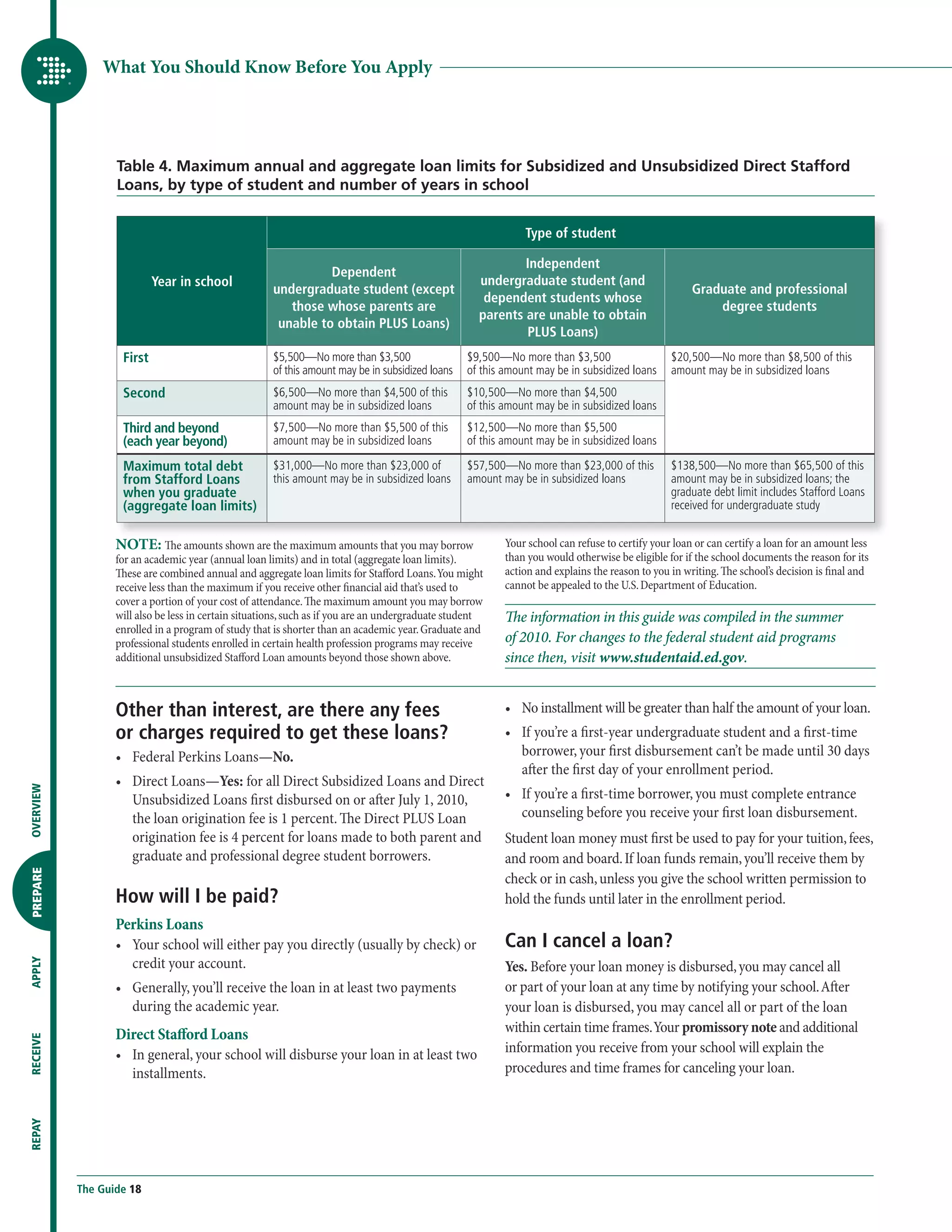
Unusual family circumstances                                                 the planned end of term or, if you have a TEACH Grant, you do
                                                                             not meet the terms in your “Agreement to Serve” (see page 14).
The EFC formula is basically the same for all applicants; however,
if your family has unusual circumstances, your financial aid                 Almost all federal grants are awarded to students with financial
administrator (FAA) can use professional judgment authority to               need. The amount of your Federal Pell Grant depends on your cost
adjust the cost of attendance or the information used to calculate           of attendance, expected family contribution, enrollment status
your EFC. These circumstances could include your family’s                    (full- or part-time) and whether you attend for a full academic year
unusual medical expenses, tuition expenses, or unemployment.                 or less. To receive an FSEOG, you must first be eligible to receive
The FAA must have good reasons to use professional judgment                  a Federal Pell Grant. For an FSEOG, priority is given to Pell Grant
to make adjustments because of unusual circumstances. You will               recipients; non-Pell recipients can receive awards if the institution
have to provide documentation to support any adjustments. The                has sufficient funds. The amount of your FSEOG depends on your
FAA’s decision as to whether to make changes is final and can’t be           financial need and other criteria (see “Financial Need and Expected
appealed to the Department.                                                  Family Contribution (EFC)” on page 12).
Additional examples of unusual circumstances that FAAs may
consider as factors in making an adjustment in the expected
family contribution calculation or to the cost of attendance are:                The Academic Competitiveness Grant and the National Science
                                                                                 and Mathematics Access to Retain Talent (SMART) Grant are no
•	  ursing home expenses not covered by insurance;
   n                                                                             longer available as of July 1, 2011.
•	  ependent care costs;
   d
•	  student or family member who is a dislocated worker; and
   a
•	  change in housing status that results in homelessness.
   a                                                                         What is a Federal Pell Grant?
                                                                             •	  ell Grants are the foundation of federal student financial
                                                                                P
                                                                                aid, to which aid from other federal and nonfederal sources
Types of Federal Student Aid                                                    might be added.
                                                                             •	  ell Grants are generally awarded only to undergraduate
                                                                                P


                                                                                                                                                               OVERVIEW
                                                                                students—those who haven’t earned a bachelor’s or
There are three types of federal student aid                                    graduate degree.
•	  rants—financial aid that doesn’t have to be repaid (unless,
   G                                                                         •	  n some limited cases, however, you might receive a Pell
                                                                                I
   for example, you withdraw from school and owe a refund).                     Grant if you’re enrolled in a post-baccalaureate teacher

                                                                                                                                                               PREPARE
•	  ork-Study—allows you to earn money for your education.
   W                                                                            certificate program.
•	  oans—allow you to borrow money for your education; you
   L                                                                         •	  mounts can change yearly. The maximum award for the
                                                                                A
   must repay your loans, with interest.                                        2010–11 award year is $5,550.
                                                                             •	  ou may receive up to two consecutive Pell Grant awards during
                                                                                Y
                                                                                                                                                               APPLY


                                                                                a single award year to accelerate your program toward your
Grants                                                                          degree. You must be enrolled at least half-time and in a program
                                                                                that leads to an associate or bachelor’s degree or certificate.
There are four types of federal student                                      •	  e maximum award grant is given for any Pell Grant-eligible
                                                                                Th
                                                                                                                                                               RECEIVE


aid grants                                                                      student whose parent or guardian was a member of the
                                                                                U.S. armed forces and died as a result of service performed in
•	  ederal Pell Grant
   F
                                                                                Iraq or Afghanistan after Sept. 11, 2001. You must be under
•	  ederal Supplemental Educational Opportunity Grant (FSEOG)
   F                                                                            24 years old or enrolled at least part-time in college at the time
                                                                                                                                                               REPAY


                                                                                                                                                The Guide 13
What You Should Know Before You Apply


                     of your parent’s or guardian’s death. If you are not eligible for a   What is a TEACH Grant?
                     Pell Grant but your parent or guardian met the same post-Sept.
                                                                                           The Teacher Education Assistance for College and Higher
                     11, 2001 conditions above, you will be eligible to receive an
                     Iraq and Afghanistan Service Grant equal to the amount of a           Education (TEACH) Grant Program provides you with up to
                     maximum Pell Grant for the award year, although the amount            $4,000 a year in grant assistance if you are completing or plan to
                     will not exceed the cost of attendance for that award year.           complete course work needed to begin a career in teaching.
                  •	  f you’re eligible for a Pell Grant you’ll receive the full
                     I                                                                     As a condition for receiving a TEACH Grant, you must sign an
                     amount you qualify for—each school participating in                   Agreement to Serve promising to teach full-time in a high-need
                     the program receives enough funds each year from the                  field at a low-income school or educational service agency, or
                     U.S. Department of Education to pay the Pell Grant amounts            teach at certain low-income schools and within certain high-need
                     for all its eligible students.                                        fields for at least four complete academic years within eight years
                  •	  e amount of other student aid you might qualify for does
                     Th                                                                    after completing (or ceasing enrollment in) the course of study for
                     not affect the amount of your Pell Grant.                             which you received the grant.
                  •	  ou are not eligible to receive a Pell Grant if you are
                     Y                                                                     If you do not complete your teaching service obligation, the
                     subject to an involuntary civil commitment upon                       amounts of the TEACH Grants you received will be converted
                     completion of a period of incarceration for a forcible
                                                                                           to a Direct Unsubsidized Loan that you must repay with interest
                     or nonforcible sexual offense.
                                                                                           charged from the date of each TEACH Grant disbursement.
                  •	  f you received a Pell Grant for the first time on or after
                     I
                     July 1, 2008, you can only receive Pell Grants for up to 18           For detailed information on this grant, visit
                     semesters, or the equivalent.                                         www.teachgrant.ed.gov.

                  W
                   hat is a Federal Supplemental                                          What is an Iraq and Afghanistan
                  Educational Opportunity Grant (FSEOG)?                                   Service Grant?
                  •	  SEOGs are awarded to undergraduate students with
                     F                                                                     If you are not eligible for a Pell Grant but your parent or guardian
                     exceptional financial need—those with the lowest Expected             was a member of the U.S. armed forces and died as a result of
                     Family Contribution (EFC) numbers.                                    service performed in Iraq or Afghanistan after Sept. 11, 2001,
                  •	  ederal Pell Grant recipients receive priority for FSEOG awards.
                     F                                                                     you may be eligible for this grant. To receive the grant, you must
                  •	  SEOG awards range from $100 to $4,000 a year.
                     F                                                                     be under 24 years old or enrolled in college, at least part-time, at
                     The amount of the award is determined by your school’s                the time of your parent’s or guardian’s death. The amount of the
                     financial aid office.                                                 grant will be equal to the maximum Pell Grant for the award year,
                  •	  nlike Pell Grants, the amount of an FSEOG you receive
                     U                                                                     although the amount will not exceed the cost of attendance for
                                                                                           that award year.
OVERVIEW


                     depends not only on your financial need but also on the
                     amount of other aid you get and the availability of funds
                     at your school.                                                       How much financial aid can I get?
                  •	  eceiving other aid might reduce the amount of your
                     R                                                                     Pell Grant
PREPARE


                     FSEOG program.                                                        •	  ell Grant award amounts can change yearly. The maximum
                                                                                              P
                  •	  ot all schools participate in the FSEOG Program.
                     N                                                                        award for the 2010–11 award year is $5,550.
                  •	  he school’s financial aid office decides how to award
                     T                                                                     •	  ow much grant aid you get depends on:
                                                                                              H
                     these funds.                                                            `` Your EFC.
APPLY


                  •	  ach school participating in the FSEOG Program receives
                     E
                                                                                             ``  our cost of attendance.
                                                                                                Y
                     a certain amount of FSEOG funds each year from the
                     U.S. Department of Education’s office of Federal Student Aid.           ``  hether you’re a full-time or half-time student.
                                                                                                W
                     When all of those funds have been disbursed for that award              ``  hether you attend school for a full academic year.
                                                                                                W
RECEIVE


                     year, no more FSEOG awards can be made for that year.
                                                                                           •	  ou may receive up to two Pell Grants in an award year.
                                                                                              Y
                  •	  ue to limited program funds, it’s important to apply early to
                     D
                     be considered for these funds. Not everyone who qualifies             •	  ou may not receive Pell Grant funds from more than one
                                                                                              Y
                     for an FSEOG will get one.                                               school at a time.
REPAY


           The Guide 14
I.

•	  f you received your first Pell Grant on or after July 1, 2008,
   I
   you can only receive the Pell Grant for up to 18 semesters or
                                                                      Work-Study
   the equivalent.
FSEOG
                                                                      What is the Federal Work-Study
•	  ou can get between $100 and $4,000 per academic year,
   Y                                                                  (FWS) Program?
   depending on:                                                      Under the FWS Program, you can work part-time to earn money
  ``  hen you apply.
     W                                                                for your education. The FWS Program:

  ``  our financial need.
     Y                                                                •	  rovides part-time employment while you are enrolled
                                                                         P
                                                                         in school.
  ``  e amount of funding the school you’re attending has.
     Th
                                                                      •	  elps pay your educational expenses.
                                                                         H
  ``  e policies of your school’s financial aid office.
     Th                                                               •	  s available to undergraduate and graduate students.
                                                                         I
TEACH Grant                                                           •	  s available to full-time or part-time students.
                                                                         I
•	  p to $4,000 per year.
   U                                                                  •	 Is administered by schools participating in the FWS Program.
Iraq and Afghanistan Service Grant
 •	  aximum is same as Pell Grant maximum.
    M                                                                 What kinds of jobs are there?
                                                                      The FWS Program provides jobs for students demonstrating
How will I be paid?                                                   financial need and emphasizes employment in civic education
Your school will:                                                     and work related to your course of study, whenever possible.
•	  redit your grant funds to your school account;
   C
                                                                      Are Federal Work-Study jobs on campus
•	  ay you directly (usually by check);
   P
                                                                      or off campus?
•	  ombine these methods; or
   C
                                                                      Both. If you work on campus, you’ll usually work for your
•	  ith your permission, credit your bank account.
   W
                                                                      school. If you work off campus, your employer will usually be a
                                                                      private nonprofit organization or a public agency, and the work
How often will I receive funds?                                       performed must be in the public interest.
•	  chools must pay you at least once per term (semester,
   S
   trimester, or quarter).                                            Some schools might have agreements with private for-profit
                                                                      employers for FWS jobs. These jobs must be relevant to your
•	  chools that don’t use formally defined, traditional terms
   S
                                                                      course of study (to the maximum extent possible). If you attend
   (e.g., semester, quarter, etc.) must pay you at least twice per
                                                                      a proprietary school (i.e., a for-profit institution), there may be
   academic year.


                                                                                                                                                      OVERVIEW
                                                                      further restrictions on the types of jobs you can be assigned.
Can I receive a grant if I’m enrolled less
than half-time?                                                       How much can I earn?
                                                                      You’ll earn at least the current federal minimum wage. However,
Yes, less than half-time students are eligible for Pell, FSEOG,

                                                                                                                                                      PREPARE
                                                                      the amount might be higher depending on the type of work you
TEACH, and Iraq and Afghanistan Service Grants.
                                                                      do and the skills required for the position.
The information in this guide was compiled in the summer              Your total FWS award depends on:
of 2010. For changes to the federal student aid programs
                                                                      •	  hen you apply,
                                                                         w
                                                                                                                                                      APPLY


since then, visit www.studentaid.ed.gov.
                                                                      •	  our level of financial need, and
                                                                         y
                                                                      •	  our school’s funding level. (The U.S. Department of
                                                                         y
                                                                         Education’s office of Federal Student Aid provides a certain
                                                                                                                                                      RECEIVE


                                                                         amount of work-study funds to participating schools; when
                                                                         all funds have been awarded, no additional work-study
                                                                         awards can be made for that year.)
                                                                                                                                                      REPAY


                                                                                                                                       The Guide 15
What You Should Know Before You Apply


                  How will I be paid?                                                      Direct Stafford Loans
                  •	  f you are an undergraduate student, you're paid by the hour.
                     I                                                                     •	 Direct Subsidized Loans—you must have financial need to
                  •	  f you are a graduate student, you're paid by the hour or by
                     I                                                                        receive a subsidized loan. The U.S. Department of Education
                     salary, depending on the work you do.                                    will pay (subsidize) the interest that accrues on your Direct
                                                                                              Subsidized Loan during certain periods.
                  •	  our school must pay you at least once a month.
                     Y
                                                                                           •	  irect Unsubsidized Loans—financial need is not a requirement
                                                                                              D
                  •	  our school must pay you directly unless you request that
                     Y                                                                        to obtain an unsubsidized loan. You are responsible for paying the
                     the school:                                                              interest that accrues on your Direct Unsubsidized Loan.
                     ``  end your payments directly to your bank account; or
                        S                                                                  Direct PLUS Loans (PLUS Loans) are loans parents can obtain to
                     ``  se the money to pay for your education-related institutional
                        U                                                                  help pay the cost of education for their dependent undergraduate
                        charges, such as tuition, fees, and room and board.                children. In addition, graduate and professional degree students
                                                                                           may obtain PLUS Loans to help pay for their own education.
                  Can I work as many hours as I want?                                      Direct Consolidation Loans (Consolidation Loans) allow student
                  No. The amount you earn can’t exceed your total FWS award.               or parent borrowers to combine multiple federal education loans
                  When assigning work hours, your employer or FAA will consider            into one loan with one monthly payment. (See page 36 for more
                  your class schedule and your academic progress.                          information on these loans.)

                                                                                               As a result of the Health Care and Education Reconciliation Act
                  Loans                                                                        of 2010, beginning July 1, 2010, federal student loans under
                                                                                               the Federal Family Education Loan ProgramSM (FFELSM Program)
                  Student loans, unlike grants and work-study, are borrowed                    are no longer made by private lenders. Instead, all new federal
                  money that must be repaid, with interest, just like car loans                student loans come directly from the U.S. Department of
                  and home mortgages. You cannot have these loans canceled                     Education under the Direct Loan ProgramSM.

                  because you didn’t like the education you received, didn’t get
                  a job in your field of study, or you’re having financial difficulty.
                  Loans are legal obligations, so before you take out a student loan,      What’s the interest rate on these loans?
                  think about the amount you’ll have to repay over the years. Your         The fixed interest rates for loans disbursed between July 1, 2011,
                  Federal Student Loans: Learn the Basics and Manage Your Debt             and June 30, 2012, are as listed in table 3 below:
                  can help you learn more about federal student loan programs
                  and repayment options. You can find this publication
                                                                                           Table 3. Interest rates for Direct and Perkins loans
                  at www.studentaid.ed.gov/repayingpub.
OVERVIEW


                  Federal Perkins Loan Program                                                        Type of loan                     Interest rate
                  This school-based loan program is
                                                                                            Direct Subsidized Stafford
                     ``  ade through participating schools to undergraduate,
                        M
PREPARE


                        graduate, and professional degree students.                          Undergraduate                                  3.4%

                     ``  ffered to students who demonstrate financial need.
                        O                                                                    Graduate                                       6.8%

                     `` Made to students enrolled full-time or part-time.                   Direct Unsubsidized Stafford                    6.8%
APPLY


                     ``  epaid to your school.
                        R                                                                   Direct PLUS                                     7.9%

                                                                                            Federal Perkins                                  5%
                  William D. Ford Federal Direct Loan
                  (Direct Loan) Program
RECEIVE


                  Loans made through this program are referred to as Direct Loans,         No interest accrual for borrowers in
                  because eligible students and parents borrow directly from the           the military
                  U.S. Department of Education at participating schools. You must          No interest accrues (for a period of no more than 60 months) on
                  be enrolled as at least a half-time student to be eligible for a loan.
REPAY


                                                                                           Direct Loans first disbursed on or after Oct. 1, 2008, for eligible
                  Direct Loans include the following:

           The Guide 16
I.

military borrowers while serving on active duty or performing         •	  ligible students can apply for a subsidized Stafford Loan
                                                                         E
qualifying national guard duty during a war or other military            to cover some or all of their need.
operation or other emergency, and serving in an area of hostilities   •	  or a subsidized loan, the U.S. Department of Education pays
                                                                         F
qualifying for special pay. You also may qualify for deferment           the interest:
of repayment on your loans while serving on active duty in the          ``  hile you’re in school at least half-time.
                                                                           W
military (see page 35).
                                                                        ``  or the first six months after you leave school
                                                                           F
The information in this guide was compiled in the summer                   (referred to as a “grace period”).
of 2010. For changes to the federal student aid programs
                                                                        ``  uring a period of deferment (a postponement
                                                                           D
since then, visit www.studentaid.ed.gov.
                                                                           of loan payments).
                                                                      The amount of your Direct Subsidized Loan may not exceed
                                                                      your financial need.
   DID YOU KNOW?
   The value of a postsecondary education as a credential             Unsubsidized Direct Stafford Loan
   for future employment and earnings is expected to                  •	  ere is no requirement for students to demonstrate
                                                                         Th
   rise. About 90 percent of the fastest-growing jobs in                 financial need.
   the new knowledge-driven market economy require                    •	  ou are responsible for paying interest on unsubsidized
                                                                         Y
   some postsecondary education.                                         loans during all periods.
                                                                      To determine the amount of your unsubsidized loan,
                                                                      your school considers:

How much can I borrow?
Perkins Loans                                                             	   Cost of Attendance
The Federal Student Aid summary table on page 5 shows the                 –	 Federal Pell Grant (if eligible)
maximum Perkins Loan funds you can receive, depending on                  –	 Subsidized Stafford Loan amount (if eligible)
whether you’re an undergraduate, graduate, or professional degree         –	 Any other financial aid you receive

student. However, the amount you can borrow might be less than            =	 mount of unsubsidized loan you receive
                                                                            A
the maximum available.                                                      (up to the annual maximum loan amount)

•	  ach school participating in the Federal Perkins Loan
   E
   Program receives a certain amount of Perkins funds each
   year from the U.S. Department of Education’s office of


                                                                                                                                                      OVERVIEW
   Federal Student Aid.                                               Depending on your financial need, you may receive both
                                                                      subsidized and unsubsidized loans for the same enrollment
•	  ue to limited funds, it’s important to apply early to be
   D
   considered for these funds. Not everyone who qualifies             period, but the total amount of these loans may not exceed the
   for a Perkins Loan might get one.                                  annual loan limit.

                                                                                                                                                      PREPARE
•	  ubmit your FAFSA early so you can be considered for
   S                                                                  For an unsubsidized loan:
   these funds.                                                       •	  ou’re responsible for paying the interest that accrues on the
                                                                         Y
                                                                         loan from the time the loan is disbursed until it’s paid in full.
Direct Stafford Loans
Table 4 on page 18 shows that the maximum amount you can              •	  ou can pay the interest while you’re in school or during
                                                                         Y
                                                                                                                                                      APPLY


                                                                         a period of deferment or forbearance.
borrow for subsidized and unsubsidized Direct Stafford Loans
depends on:                                                           •	  r, you can allow the interest to accrue (accumulate) and
                                                                         O
                                                                         have the interest added to the principal amount of your loan.
•	  hat year you are in school; and
   W
                                                                         This is called capitalization. If you choose not to pay the
                                                                                                                                                      RECEIVE


•	  hether you are a dependent or independent student.
   W                                                                     interest as it accrues and allow it to be capitalized, this will
Subsidized Direct Stafford Loan                                          increase the total amount that you have to repay because you
                                                                         will be charged interest on a higher principal amount.
•	  vailable to students who demonstrate financial need.
   A
                                                                                                                                                      REPAY


                                                                                                                                       The Guide 17
What You Should Know Before You Apply


                  Table 4. Maximum annual and aggregate loan limits for Subsidized and Unsubsidized Direct Stafford
                  Loans, by type of student and number of years in school


                                                                                                              Type of student

                                                                                                             Independent
                                                                Dependent
                           Year in school                                                            undergraduate student (and
                                                      undergraduate student (except                                                                  Graduate and professional
                                                                                                      dependent students whose
                                                         those whose parents are                                                                         degree students
                                                                                                     parents are unable to obtain
                                                       unable to obtain PLUS Loans)
                                                                                                             PLUS Loans)
                   First                              $5,500—No more than $3,500                  $9,500—No more than $3,500                    $20,500—No more than $8,500 of this
                                                      of this amount may be in subsidized loans   of this amount may be in subsidized loans     amount may be in subsidized loans
                   Second                             $6,500—No more than $4,500 of this          $10,500—No more than $4,500
                                                      amount may be in subsidized loans           of this amount may be in subsidized loans
                   Third and beyond                   $7,500­ No more than $5,500 of this
                                                            —                                     $12,500—No more than $5,500
                   (each year beyond)                 amount may be in subsidized loans           of this amount may be in subsidized loans

                   Maximum total debt                 $31,000—No more than $23,000 of             $57,500—No more than $23,000 of this          $138,500—No more than $65,500 of this
                   from Stafford Loans                this amount may be in subsidized loans      amount may be in subsidized loans             amount may be in subsidized loans; the
                   when you graduate                                                                                                            graduate debt limit includes Stafford Loans
                   (aggregate loan limits)                                                                                                      received for undergraduate study


                  NOTE: The amounts shown are the maximum amounts that you may borrow                     Your school can refuse to certify your loan or can certify a loan for an amount less
                  for an academic year (annual loan limits) and in total (aggregate loan limits).         than you would otherwise be eligible for if the school documents the reason for its
                  These are combined annual and aggregate loan limits for Stafford Loans. You might       action and explains the reason to you in writing. The school’s decision is final and
                  receive less than the maximum if you receive other financial aid that’s used to         cannot be appealed to the U.S. Department of Education.
                  cover a portion of your cost of attendance. The maximum amount you may borrow
                  will also be less in certain situations, such as if you are an undergraduate student    The information in this guide was compiled in the summer
                  enrolled in a program of study that is shorter than an academic year. Graduate and
                  professional students enrolled in certain health profession programs may receive        of 2010. For changes to the federal student aid programs
                  additional unsubsidized Stafford Loan amounts beyond those shown above.                 since then, visit www.studentaid.ed.gov.


                  Other than interest, are there any fees                                                 •	  o installment will be greater than half the amount of your loan.
                                                                                                             N
                  or charges required to get these loans?                                                 •	  f you’re a first-year undergraduate student and a first-time
                                                                                                             I
                  •	  ederal Perkins Loans—No.
                     F                                                                                       borrower, your first disbursement can’t be made until 30 days
                                                                                                             after the first day of your enrollment period.
                  •	 Direct Loans—Yes: for all Direct Subsidized Loans and Direct
OVERVIEW


                     Unsubsidized Loans first disbursed on or after July 1, 2010,                         •	  f you’re a first-time borrower, you must complete entrance
                                                                                                             I
                     the loan origination fee is 1 percent. The Direct PLUS Loan                             counseling before you receive your first loan disbursement.
                     origination fee is 4 percent for loans made to both parent and                       Student loan money must first be used to pay for your tuition, fees,
                     graduate and professional degree student borrowers.                                  and room and board. If loan funds remain, you’ll receive them by
PREPARE


                                                                                                          check or in cash, unless you give the school written permission to
                  How will I be paid?                                                                     hold the funds until later in the enrollment period.
                  Perkins Loans
                  •	  our school will either pay you directly (usually by check) or
                     Y                                                                                    Can I cancel a loan?
                     credit your account.                                                                 Yes. Before your loan money is disbursed, you may cancel all
APPLY


                  •	  enerally, you’ll receive the loan in at least two payments
                     G                                                                                    or part of your loan at any time by notifying your school. After
                     during the academic year.                                                            your loan is disbursed, you may cancel all or part of the loan
                  Direct Stafford Loans                                                                   within certain time frames. Your promissory note and additional
RECEIVE


                  •	  n general, your school will disburse your loan in at least two
                     I                                                                                    information you receive from your school will explain the
                     installments.                                                                        procedures and time frames for canceling your loan.
REPAY


           The Guide 18
I.

Direct PLUS Loans                                                       endorser who does not have an adverse credit history. An endorser is
                                                                        someone who agrees to repay the loan if the borrower fails to do so.

Who can apply for a PLUS Loan?                                          Do I need to find a lender?
Parents of dependent students and students pursuing a graduate          No. The U.S. Department of Education is the lender.
or professional degree can borrow from the PLUS Loan program.
                                                                        How much can a parent or graduate and
How do I apply for a PLUS Loan?                                         professional degree student borrow?
Graduate and professional degree students and dependent
                                                                        The maximum PLUS Loan amount that a parent or graduate and
undergraduate students whose parents are applying for a PLUS
                                                                        professional degree student can borrow is the student’s cost of
Loan must complete a FAFSA.
                                                                        attendance minus any other financial aid the student receives.
The school's financial aid office can provide additional
instructions on applying for a PLUS Loan and may offer                  Who receives the loan money—the parent
the option of completing the PLUS application and Master                or the student?
Promissory Note (MPN) online at www.studentloans.gov.
                                                                        •	  e school will first apply the PLUS Loan funds to the
                                                                           Th
The MPN is a legal document in which the borrower promises
                                                                           student’s school account to pay for tuition, fees, room and
to repay the loan and any accrued interest and fees to the U.S.            board, and other school charges.
Department of Education.
                                                                        •	  f any loan funds remain, they will be sent to the parent
                                                                           I
                                                                           borrower, unless the parent authorizes the school to hold
What are the eligibility requirements for                                  the funds or release them to the student.
PLUS Loans?                                                             •	  ny remaining loan funds must be used for the student's
                                                                           A
PLUS applicants must meet the general eligibility requirements             education expenses.
for federal student aid. If a parent is borrowing on behalf of a
dependent undergraduate student, the student also must meet             Can the PLUS Loan be transferred to
these general eligibility requirements. For example, the PLUS           the student and become the student’s
applicant and the student must:                                         responsibility to repay?
•	  e a United States citizen or eligible noncitizen;
   b                                                                    No. A PLUS Loan made to the parent cannot be transferred to the
•	  ot be in default on a federal student loan; and
   n                                                                    student. The parent is responsible for repaying the PLUS Loan.
•	  ot owe a refund on a federal education grant.
   n
                                                                        Can a borrower cancel a PLUS Loan?


                                                                                                                                                            OVERVIEW
In addition, graduate and professional degree students must
have their annual loan maximum eligibility under the Stafford           Yes. A borrower can cancel and return the funds of a PLUS
Loan program determined by the school before they apply for a           Loan the same way that a borrower would cancel a Perkins or
PLUS Loan.                                                              Stafford Loan.


                                                                                                                                                            PREPARE
Are there any other requirements?                                       Other than interest, are there any fees or
The terms and conditions applicable to parent PLUS Loans (made          charges to get a PLUS Loan?
to parents of dependent students) also apply to PLUS Loans made         Yes. There is a fee of 4 percent of the loan amount.
to graduate and professional degree students. These terms and
                                                                                                                                                            APPLY


conditions include that the applicant not have an adverse               Is there a grace period?
credit history. The fixed interest rate is 7.9%.
                                                                        The repayment period for a Direct PLUS Loan begins when the loan
A PLUS Loan applicant must not have an adverse credit history.          is fully disbursed, and the first payment is due 60 days after the final
                                                                                                                                                            RECEIVE


(A credit check will be conducted.) If a PLUS Loan applicant does       disbursement. However, you may defer repayment while you (the
have an adverse credit history, he or she may still receive a loan by   borrower) are enrolled at least half-time and (for Direct PLUS Loans
documenting existing extenuating circumstances or by obtaining an       first disbursed on or after July 1, 2008) for an additional six months
                                                                                                                                                            REPAY


                                                                                                                                             The Guide 19
What You Should Know Before You Apply


                          Direct Stafford and PLUS Loans: Summary of borrowing guidelines
                      	   •	  ndergraduate and graduate or professional degree students
                             U                                                                      	   •	  he maximum Stafford Loan amount you can borrow each
                                                                                                           T
                             may receive Stafford Loans. Graduate and professional degree                  academic year depends on your academic level in school and
                             students and parents of dependent undergraduate students may                  whether you are a dependent or independent student.
                             receive PLUS Loans.
                                                                                                    	   •	  tudents who demonstrate financial need are eligible for a
                                                                                                           S
                      	   •	  ou must be enrolled at least half-time at an eligible school in a
                             Y                                                                             subsidized Stafford Loan to cover some or all of that need.
                             program leading to a degree or certificate.
                                                                                                    	   •	  or students who are eligible for a subsidized Stafford Loan,
                                                                                                           F
                      	   •	  tudent loans are borrowed money that must be repaid, with
                             S                                                                             the U.S. Department of Education pays the interest while you’re
                             interest, just like car loans and home mortgages.                             in school at least half-time, for the first six months after you
                      	   •	  tudent loans cannot be canceled because you didn’t get—or
                             S                                                                             leave school (your grace period), and during a deferment (a
                             didn’t like—the education you paid for with the loans, didn’t get             postponement of loan payments).
                             a job in your field of study, or you’re having financial difficulty.   	   •	  nsubsidized Stafford Loans do not require a student to have
                                                                                                           U
                      	   •	  oans are legal obligations, so think about the amount you’ll
                             L                                                                             financial need. The borrower is responsible for paying all interest
                             have to repay before you take out a loan.                                     on unsubsidized Stafford Loans.


                  after you cease to be enrolled at least half-time. If you are a parent            Other Sources of Information
                  Direct PLUS Loan borrower, you may defer repayment of Direct PLUS
                  Loans first disbursed on or after July 1, 2008, while the student for
                  whom you obtained the loan is enrolled at least half-time and for an              School financial aid office
                  additional six months after the student ceases to be enrolled at least            Talk to the financial aid staff at each school you’re interested in
                  half-time.                                                                        to find out about the school’s financial aid programs and the total
                  Interest that accrues on a PLUS Loan during a period of deferment                 cost of attending that school. Staff at the financial aid office also
                  may be paid by the borrower or capitalized when the deferment                     help students apply for, receive and—in many cases—learn how to
                  period ends.                                                                      repay their student aid.

                  The information in this guide was compiled in the summer                          When should I first contact the
                  of 2010. For changes to the federal student aid programs                          financial aid office?
                  since then, visit www.studentaid.ed.gov.
                                                                                                    While researching the school before applying, be sure to find out
OVERVIEW


                                                                                                    what types of financial aid are available at that school by visiting
                  Need to Find Out More?                                                            their office and website. Later, as you prepare to apply for aid at that
                                                                                                    school, the Financial Aid Administrator (FAA), or the staff at that
                  Most student financial aid comes from the U.S. Department of                      office, will be able to answer your questions about the process.
PREPARE


                  Education grant, work-study, and loan programs you read about
                                                                                                    What questions can my FAA answer for me?
                  here. Most aid is based on need; your high school grades and
                                                                                                    •	  hat financial aid can I apply for through the school and
                                                                                                       W
                  class ranking are not considered in this process. If you still have                  through the state education agency?
                  questions about federal student aid programs after reviewing this
                                                                                                    •	  hat are the financial aid application deadlines at the school?
                                                                                                       W
                  publication, you can:
APPLY


                                                                                                    •	  o I need to complete additional forms to apply for
                                                                                                       D
                  •	  o online to www.studentaid.ed.gov. This site provides
                     G
                                                                                                       institutional and/or state aid?
                     comprehensive, FREE information on the student aid process,
                     and it links to other student aid-related sites.                               •	  hat am I supposed to do with my Student Aid Report (SAR)?
                                                                                                       W
RECEIVE


                  •	  all our Federal Student Aid Information Center at
                     C                                                                              •	  hat is verification, what documents must I provide and
                                                                                                       W
                     1-800-4-FED-AID (1-800-433-3243).                                                 when, and why was I chosen in the first place?
                                                                                                    •	  hen will I find out how much aid I’ve been awarded?
                                                                                                       W
REPAY


           The Guide 20
I.

•	  hat are all these different kinds of aid the school has
   W                                                                 Businesses and labor organizations
   awarded me?
                                                                     Many companies, businesses, and labor organizations have
•	  hat if I’m not awarded enough money to pay for all school-
   W                                                                 programs to help employees or members and their families
   related expenses?                                                 pay the cost of postsecondary education. Ask if they have a
If you have any other questions or concerns about the financial      scholarship program and about the application process.
aid process, contact the financial aid office at your school. Your
FAA is there to help you.                                            Organizations, foundations, etc.
                                                                     Foundations, religious organizations, fraternities or sororities, and
State Higher Education Agency                                        town or city clubs usually offer financial aid. Include in your search
Your state agency can give you important information about state     community organizations and civic groups, such as the American
aid—including aid from the Leveraging Educational Assistance         Legion, YMCA, 4-H Club, Elks, Kiwanis, Jaycees, and the Girl or Boy
Partnership (LEAP) Program, funded jointly by states and the         Scouts. Organizations connected with your field of interest can also
U.S. Department of Education. See the “State Higher Education        be helpful. For example, the American Medical Association and the
Agency” at www.ed.gov/Programs/bastmp/SHEA.htm (this                 American Bar Association are good sources for students seeking to
URL is case-sensitive) for contact information.                      specialize in medicine and law, respectively.

AmeriCorps                                                           U.S. armed forces
This program provides full-time educational awards in return for     The armed forces offer financial aid for service members and
community service work. These awards consist of working before,      their families. For more information on recruitment incentives,
during, or after your postsecondary education, and you can use       contact your local military recruiter or visit the U.S. Department
the funds either to pay current education expenses or to repay       of Defense at www.todaysmilitary.com, click on “Benefits” and
federal student loans. For more information, contact:                then go to “Tuition Support.” For more information, go to our
                                                                     website at www.studentaid.ed.gov/military for those serving in
Corporation for National and Community Service
                                                                     our armed forces.
1201 New York Avenue, NW
Washington, DC 20525
1-800-942-2677 (TTY: 1-800-833-3722)                                 U.S. Department of Veterans Affairs
www.americorps.org                                                   If you (or your spouse) are a veteran or you’re the dependent
                                                                     of a veteran, education benefits may be available. Under the
Robert C. Byrd Honors Scholarship                                    Post-9/11 Veterans Education Assistance Act of 2008, many post-
                                                                     Sept. 11 veterans and service members will be eligible for a new
Program (Byrd Program)


                                                                                                                                                      OVERVIEW
                                                                     comprehensive education benefits package that goes beyond
To receive this scholarship, you must demonstrate
                                                                     helping to pay for tuition. Many veterans who served after Sept.
outstanding academic achievement and show promise of
                                                                     11, 2001, will get full tuition and fees, a monthly housing stipend,
continued academic excellence. For more information,
                                                                     and a $1,000 a year stipend for books and supplies. The new bill
call toll-free 1-800-4-FED-AID (1-800-433-3243) or visit

                                                                                                                                                      PREPARE
                                                                     also gives reserve and national guard members who have been
www.ed.gov/programs/iduesbyrd/index.html.
                                                                     activated for more than 90 days since Sept. 11 access to the same
                                                                     GI Bill benefits. Information is available at www.gibill.va.gov or
Public libraries and the Internet                                    by calling 1-888-GI-BILL-1 (1-888-442-4551).
These are excellent sources of information on state and private
                                                                                                                                                      APPLY


sources of financial aid. When using either source, search using
keywords like “financial aid,”“student aid,”“scholarships,” etc.
Beware of scams and services that will search for financial aid
                                                                                                                                                      RECEIVE


money for you for a fee. You should not have to pay for this
information. For more tips on looking for student aid, go to
www.studentaid.ed.gov/LSA.
                                                                                                                                                      REPAY


                                                                                                                                       The Guide 21
What You Should Know Before You Apply


                  College.gov                                                             Make sure the information you receive and offers for assistance
                                                                                          are legitimate. Don’t fall prey to fraud. To file a complaint
                  This website motivates students with inspirational stories and
                                                                                          with the FTC, or for more detailed information on scams, call
                  information about planning, preparing, and paying for college.
                                                                                          1-877-FTC-HELP (1-877-382-4357); TTY 1-866-653-4261.
                  With students’ input and participation, College.gov was created for
                                                                                          Or visit www.ftc.gov/scholarshipscams.
                  high school students and their families as a single online resource
                  with the help and tools students need to get started. College.gov
                  shows that postsecondary education is an achievable goal for            Identity theft
                  anyone, regardless of income, ethnicity, age, or gender.                Besides scholarship scams, you need to be aware of identity theft.

                  Remember, you can get FREE help in finding financial aid from           What is identity theft?
                  the sources mentioned in this section. You also can check with          This crime involves the theft of your personal information, such
                  the colleges or career schools you’ll be applying to. You don’t         as your name, address, telephone number and Social Security
                  have to pay for someone to help you.                                    number. Identity theft is a widespread and growing national
                                                                                          problem for everyone. Identity thieves steal your personal
                                                                                          information and often run up thousands of dollars in credit card
                  It’s a Jungle Out There … Be Careful!                                   debt, just to name one problem, and can ruin your credit. Even
                                                                                          though it’s not your fault, you’re the one who has to clean up the
                  Scholarship scams                                                       damage, which can take months or even years.

                  What about scholarship search services?                                 How can this happen?
                  Many private scholarship search services provide sources of             Identity theft occurs when someone wrongly gets your personal
                  financial assistance. The Department does not evaluate those            information, such as your Social Security number or driver’s
                  services. If you decide to use a search service, check its reputation   license number, and uses that information to obtain credit cards,
                  by contacting the Better Business Bureau or your state attorney         loans (including student loans), or merchandise and services
                  general’s office. You can search for scholarships for free at           in your name. Identity thieves can get this information from a
                  www.studentaid.ed.gov/scholarship.                                      personal computer that you used for online banking, purchasing
                                                                                          transactions, and many other ways. Sometimes just using a cell
                  How can I tell which scholarship services are scams?
                                                                                          phone or using your Social Security number for identification
                  Be careful when searching for information on student financial          can leave you at risk. Why? Each of these transactions requires
                  aid. Estimates show that families lose millions of dollars every year   that you share personal information, such as your name, address,
                  to scholarship fraud. The College Scholarship Fraud Prevention Act      and phone number, and your bank and credit card numbers.
                  of 2000 was enacted to protect against fraud in student financial       Occasionally, this information falls into the wrong hands.
OVERVIEW


                  assistance. The Federal Trade Commission (FTC) cautions
                  students to look for these telltale lines when speaking with a          What happens if someone steals my identity and gets a
                  service representative or reading a service's literature:               student loan in my name?
                                                                                          A Stafford Loan or PLUS Loan may be discharged (canceled) if a
                  •	  The scholarship is guaranteed or your money back.”
                     “
                                                                                          court determines that the loan was made as a result of a crime of
PREPARE


                  •	  You can’t get this information anywhere else.”
                     “                                                                    identity theft.
                  •	  I just need your credit card or bank account number to hold
                     “
                     this scholarship.”                                                   How can I avoid identity theft?
                                                                                          •	  on’t throw credit card applications you don’t want into the
                                                                                             D
                  •	  You’ve been selected by a ‘national foundation’ to receive
                     “                                                                       trash. Cut them into several pieces, or shred them, so no one
APPLY


                     a scholarship.”                                                         can retrieve them and apply for credit in your name.
                  •	  You’re a finalist” in a contest you never entered.
                     “                                                                    •	  afeguard your Social Security number at all times. You
                                                                                             S
                                                                                             generally have to provide it to your employer or your bank,
                                                                                             but if a business wants it, ask why it’s needed and how it will
RECEIVE


                                                                                             be used before you give it out. There probably is no legitimate
                                                                                             reason for any business to need your Social Security number.
                                                                                             Never give it or your driver’s license number to anyone who
REPAY


           The Guide 22
I.

   calls you on the phone or contacts you online saying they
   need this information to verify your identity.
•	  ever give personal or financial information over the phone
   N
   or the Internet unless you initiated the contact.
•	  f you apply for our federal student aid programs over
   I
   the Internet, do so at the Department of Education’s
   www.fafsa.gov or www.studentaid.ed.gov, which are official
   U.S. government websites that are safe and protected from
   unauthorized disclosure.
•	  fter completing any online application or transaction,
   A
   remember to log off your session.
•	  eview your financial aid award documents and keep track
   R
   of the amount of student aid applied for and awarded.
•	  eep your Federal Student Aid PIN, which is your online
   K
   student identifier, in a safe place and never give it to anyone.
These are just a few steps you can take to protect yourself
from identity theft. For more information, contact the
Federal Trade Commission (FTC) at www.ftc.gov/idtheft,
or call 1-877-IDTHEFT (1-877-438-4338). To report
identity theft that affects your federal student aid, call the
U.S. Department of Education’s Office of Inspector General
Hotline at 1-800-MISUSED (1-800-647-8733), or go to
www.ed.gov/misused.


    DID YOU KNOW?
    Identity theft is a growing problem. Typical ways a
    student becomes a victim include leaving personal
    information lying around the dorm room or failing to
    shred credit card offers before throwing them away.


                                                                                     OVERVIEW
The U.S. Department of Education works hard to ensure that
your personal information is secure. However, students should

                                                                                     PREPARE
do their part as well. Make sure you keep your information safe.
                                                                                     APPLY
                                                                                     RECEIVE
                                                                                     REPAY


                                                                      The Guide 23
What You Should Know Before You Apply
OVERVIEW
PREPARE
APPLY
RECEIVE
REPAY


           The Guide 24
PART II.
How Do I Apply?


I   n spite of all the acronyms you'll encounter, the student
    aid process is fairly straightforward and completing the
FAFSA is easier than ever. You can apply and check the
        SM
                                                                     for financial aid for you for a fee. The College Scholarship Fraud
                                                                     Prevention Act of 2000 protects you from this type of fraud. We
                                                                     tell you some ways to protect yourself from this and scams on
                                                                     page 22.
progress of your application online. We’ve added a feature
that lets you skip the questions that don’t relate to you, and
we have help text and live chat to help answer questions you         Completing the FAFSASM
have while you’re online.
                                                                     What information do I need to complete
                                                                     a FAFSA?


                                                                                                                                                     OVERVIEW
    DID YOU KNOW?
    Applying for federal student aid grants, work-study,             You will need your Social Security number and your parents’
    and loans is FREE! Why pay a third party for help with           numbers, if you’re a dependent student; your driver’s license
    the FAFSA? Help in completing the FAFSA is available             number (if any); 2010 W-2 forms; 2010 federal income tax
    from our office for free, and there are no fees of any           returns; bank statements; alien registration number (if you are

                                                                                                                                                     PREPARE
    kind assessed by the government when you submit a                not a U.S. citizen), and other records. For a detailed list, visit
    FAFSA.                                                           www.fafsa.gov.
                                                                     If you apply before your tax return has been completed, you’ll
                                                                     have to estimate your income and tax information on your
                                                                                                                                                     APPLY


Applying for Federal Student Aid                                     application and make corrections later if your estimated income
                                                                     or tax information was not accurate.
Applying for Federal Student Aid is free, that is why the
application is called the Free Application for Federal Student Aid
                                                                                                                                                     RECEIVE


(FAFSA). If you need help completing the FAFSA, that help is free
too. You don’t have to pay anyone for help or share your personal
information. Also beware of scams and services that will search
                                                                                                                                                     REPAY


                                                                                                                                      The Guide 25
How Do I Apply?


                  Do I need a PIN?                                                         When should I apply for federal student aid?
                  Your PIN (Personal Identification Number) is an electronic access        For the 2011–12 academic year, you must apply between
                  code that serves as your personal identifier. Your Federal Student       Jan. 1, 2011, and June 30, 2012. To determine your eligibility
                  Aid PIN allows you to:                                                   for federal student aid, you need to complete the FAFSA. You may
                  •	  ign your FAFSA electronically and complete the student aid
                     S                                                                     also need to complete an additional application in order to be
                     process completely online—no paper is involved. If you’re             considered for financial aid from your state or the school you’re
                     a dependent student and one of your parents has a Federal             interested in attending.
                     Student Aid PIN, he or she can sign your FAFSA electronically
                     online as well.                                                       Can I apply online?
                  •	  orrect your FAFSA online.
                     C                                                                     Yes. We encourage you to complete the FAFSA online at
                  •	 Access your Student Aid Report (SAR).                                www.fafsa.gov. Applying online is the fastest and easiest
                  •	  ign a master promissory note for a federal student loan.
                     S                                                                     way to apply.
                  •	  ccess your federal student aid records online, including
                     A
                     your student loan history information on NSLDSSM.                     Why should I apply online?
                  We encourage you to apply online because that process is much            As you complete the online application, FAFSA on the Web SM looks
                  faster and easier. The electronic FAFSA process has edits built into     at your answers and uses skip logic to display questions that only
                  the application that dramatically reduce the chance for errors. That     apply to your situation. This makes the application process shorter
                  saves you time and trouble. But, even if you don’t apply online, you     and simpler. FAFSA on the Web also identifies potential errors
                  need your PIN to access all your federal student aid information.        right away and prompts you to make on-the-spot corrections.


                  How and when should I get a PIN?                                         How do I apply online?
                  You, and your parents if you’re a dependent student, can apply for       Complete the Free Application for Federal Student Aid (FAFSA)
                  a PIN anytime at www.pin.ed.gov, and you will be offered one             at www.fafsa.gov. For the 2011–12 academic year, you can apply
                                                                                           beginning Jan. 1, 2011; you have until June 30, 2012, to submit
                  when you fill out a FAFSA, the application for federal student aid.
                                                                                           your FAFSA. But you need to apply early! Schools and states
                                                                                           often use the FAFSA information to also award nonfederal aid.
                  Don’t I get one automatically?                                           Their deadlines are usually early in the year. You can find state
                  If you did not already apply for a PIN, either before submitting         deadlines at FAFSA on the Web or check with the schools you’re
                  your FAFSA or while you completed the FAFSA, your personal               interested in for their deadlines.
                  data, such as your Social Security number, full name and date of
OVERVIEW


                  birth, will be matched with the Social Security Administration’s
                                                                                               Applying Online
                  data. If the match is successful, we’ll automatically send you a PIN.
                                                                                               	 •	  online to www.fafsa.gov.
                                                                                                    Go
                  NOTE:                                                                        	 •	  s an alternative, go online to www.studentaid.ed.gov
                                                                                                    A
                                                                                                    and click on “FAFSA.”
                  If you opted to receive your PIN by e-mail, you should add
PREPARE


                  FederalStudentAidPIN@cpsemail.ed.gov to your e-mail
                  address book or “safe list” to help avoid delivery problems.

                                                                                               Can't remember your PIN?
APPLY


                                                                                               You can request a duplicate PIN at www.pin.ed.gov.
                      You cannot receive federal student aid unless all your information       You can choose to view the PIN immediately on the
                      is complete and accurate.
                                                                                               screen, have it e-mailed, or have it mailed. After you
                                                                                               receive your duplicate PIN, you should return to the
                                                                                               PIN site and use the “Change My PIN” function to
RECEIVE


                                                                                               choose a PIN you will be able to remember.
REPAY


           The Guide 26
II.

NOTE:                                                                  NOTE:
Initially, your PIN can be used only to sign your FAFSA. Once          No paper or electronic FAFSA will be accepted prior to
your personal data (i.e., Social Security number, full name,           Jan. 1, 2011 for the 2011–12 academic year. Any FAFSA
and date of birth) successfully matches with the data the              received before Jan. 1, 2011, will not be accepted or processed.
Social Security Administration has on file for you, your PIN
can be used for other federal student aid purposes, such as            Dependency status
signing a promissory note and accessing other federal student
                                                                       You’ll need to determine whose information to report on the
aid websites. Your SAR will contain a comment that lets you
                                                                       FAFSA—if you’re an independent student, you will report yours
know whether your data successfully matched with the Social
                                                                       (and, if married, your spouse’s); if you’re a dependent student,
Security Administration’s data or not. If your data does not
                                                                       yours and your parents’.
match you will receive a notice with information to help you
resolve the issue.                                                     When you apply for federal student aid, your answers to questions
                                                                       on the FAFSA determine whether you are considered a dependent
Can I only apply online?                                               or independent student.
In addition to applying online, you can also apply using the print     Dependent students must report their parents’ income and assets
version of the FAFSA. You can get a paper FAFSA—in English             on the FAFSA as well as their own. Federal Student Aid programs
or Spanish—from our Federal Student Aid Information Center             are based on the concept that a dependent student’s parents have
by calling 1-800-4-FED-AID (1-800-433-3243). Complete, sign,           the primary responsibility for paying for their child’s education.
and mail the FAFSA in the pre-addressed envelope. You also can
                                                                       Independent students report their own income and
download a Portable Data Format (PDF) FAFSA by going to                assets (and those of a spouse, if married).
www.studentaid.ed.gov or www.fafsa.gov. The PDF FAFSA                  For the 2011–12 academic year, you’re an independent student
is identical to the paper FAFSA.                                       if at least one of the following applies to you:
Your FAFSA will be processed in two to three weeks. But, before        •	  ou were born before Jan. 1, 1988.
                                                                          Y
mailing it, you should check to see if your school, or a school that
                                                                       •	  ou’re married on the day you apply (even if you are
                                                                          Y
you’re interested in, can submit your FAFSA for you electronically.
                                                                          separated but not divorced).
If you don’t hear anything within three weeks of the date you
submitted your application, check your status through FAFSA            •	  ou are or will be enrolled in a master’s or doctoral degree
                                                                          Y
                                                                          program (beyond a bachelor’s degree) at the beginning of the
on the Web at www.fafsa.gov. You can also check your status
                                                                          2011–12 academic year.
by contacting the Federal Student Aid Information Center at
1-800-4-FED-AID (1-800-433-3243).                                      •	  ou are currently serving on active duty in the
                                                                          Y
                                                                          U.S. armed forces for purposes other than training.


                                                                                                                                                     OVERVIEW
                                                                       •	  ou’re a veteran of the U.S. armed forces. (A “veteran”
                                                                          Y
                                                                          includes students who attended a U.S. service academy and
    Safeguard Your PIN and Remember It!                                   were released under a condition other than dishonorable.
    www.pin.ed.gov                                                        For more details on who is considered a veteran, see the
                                                                          explanatory notes on the FAFSA or go to www.fafsa.gov.)

                                                                                                                                                     PREPARE
    	 •	 
         Your PIN is used to sign legally binding documents
         electronically. It has the same legal status as a             •	  ou have children who will receive more than half their
                                                                          Y
         written signature.                                               support from you between July 1, 2011, and June 30, 2012.
    	 •	 
         Don’t give your PIN to anyone—not even to someone
         helping you fill out the FAFSA. Sharing your PIN could
                                                                       •	  ou have legal dependents (other than your children or
                                                                          Y
                                                                          spouse) who live with you and who receive more than half
                                                                                                                                                     APPLY


         put you at risk of identity theft!
    	 •	 
         Remember your PIN! You’ll use this same PIN for future           their support from you now and through June 30, 2012.
         online FAFSAs and the many different actions regarding        •	  t any time since you turned age 13, both your parents were
                                                                          A
         your student aid records. Change your PIN to one you             deceased, you were in foster care or you were a dependent or
         can easily remember if you think you might forget the
                                                                          ward of the court.
                                                                                                                                                     RECEIVE


         one issued.
                                                                       •	  ou are or were an emancipated minor as determined
                                                                          Y
                                                                          by a court in your state of legal residence.
                                                                                                                                                     REPAY


                                                                                                                                      The Guide 27
How Do I Apply?


                  •	  ou are or were in legal guardianship as determined
                     Y                                                                     information due to special circumstances. Before you proceed to
                     by a court in your state of legal residence.                          skip the parental section of your FAFSA, consider the following:
                  •	  t any time on or after July 1, 2010, your high school or
                     A                                                                     Examples of special circumstances where you may be able to submit
                     school district homeless liaison determined that you were             your FAFSA without providing parental information include:
                     an “unaccompanied youth” who was homeless.
                                                                                           •	  our parents are incarcerated.
                                                                                              Y
                  •	  t any time on or after July 1, 2010, the director of an emergency
                     A
                     shelter or transitional housing program, funded by the U.S.           •	  ou have left home due to an abusive family environment.
                                                                                              Y
                     Department of Housing and Urban Development, determined               •	  ou do not know where your parents are and are unable
                                                                                              Y
                     that you were an unaccompanied youth who was homeless.                 to contact them (and you have not been adopted).
                  •	  t any time on or after July 1, 2010, the director of a runaway
                     A                                                                     •	  ou are older than 21 but not yet 24, and are unaccompanied
                                                                                              Y
                     or homeless youth basic center or transitional living program            and either homeless or self-supporting and at risk of
                     determined that you were an unaccompanied youth who was                  being homeless.
                     homeless or self-supporting and at risk of being homeless.            Not all situations are considered a special circumstance.
                  If none of these criteria apply to you, you’re a dependent student.      The following are situations that would not be considered
                                                                                           a special circumstance:
                  NOTE:
                                                                                           •	  our parents do not want to provide their information on
                                                                                              Y
                  Financial aid administrators may make determinations
                                                                                              your FAFSA.
                  regarding a student’s independent student status based on
                  a documented determination of independence by another                    •	  our parents refuse to contribute to your college expenses.
                                                                                              Y
                  financial aid administrator in the same award year.                      •	  our parents do not claim you as a dependent on their
                                                                                              Y
                                                                                              income taxes.
                                                                                           •	  ou do not live with your parents.
                                                                                              Y
                  If you do not have a determination that you are homeless, you
                  should contact your financial aid office for assistance if you           I
                                                                                            f you believe you have a special circumstance and are unable
                  believe you are an unaccompanied youth who is homeless or                to provide parental information, you should complete the
                  self-supporting at risk of being homeless and answer “No” to the         information about you and your finances and skip any questions
                  FAFSA questions concerning being homeless.                               about your parents. You should sign your FAFSA with your PIN
                                                                                           and leave your parent's PIN blank. It is important to note:
                                                                                           •	  e will allow you to submit your FAFSA without
                                                                                              W
                      Not living with parents or not being claimed by them on tax forms       parental information; however, your FAFSA will not
                      does not determine dependency status for federal student aid.           be considered complete.
                                                                                           •	  ecause your FAFSA is not considered complete, we will
                                                                                              B
OVERVIEW


                                                                                              not calculate your Expected Family Contribution (EFC),
                                                                                              which is the number used by colleges to determine how
                                                                                              much student aid you are eligible to receive.
                  What if I’m considered a dependent
                                                                                           •	  f you are approaching any deadlines for your state, college
                                                                                              I
                  student but have no contact with my
PREPARE


                                                                                              or scholarship aid, you may want to contact your financial
                  parents or access to their information?                                     aid administrator (FAA) before submitting your FAFSA
                  Under federal law you and your family are primarily responsible             without parental data.
                  for paying for your college expenses. To determine how much              •	  nce you submit your FAFSA without parental data, you must
                                                                                              O
                  your family can afford to pay toward your college expenses, the             follow up with the FAA at the school you plan to attend in
APPLY


                  Department must collect your financial information and, if you              order to complete your FAFSA.
                  are a dependent student, the Department also must collect your             ``  ou will have to provide documentation to verify your
                                                                                                Y
                  parents’ financial information.                                               situation. Gather as much written evidence of your situation
RECEIVE


                  Special circumstances                                                         as you can. Written evidence may include court or law
                  Under very limited circumstances, an otherwise dependent                      enforcement documents, letters from a clergy member,
                  student may be able to submit the FAFSA without parental                      school counselor or social worker, and/or any other relevant
                                                                                                data that explains your special circumstance.
REPAY


           The Guide 28
II.

  ``  fter reviewing your circumstances carefully, your FAA
     A                                                                 You can complete your FAFSA online at www.fafsa.gov between
     will decide if you must provide parental information or if        Jan. 1, 2011, and June 30, 2012. Remember that states and schools
     your circumstances allow you to proceed without providing         may have earlier deadlines for nonfederal aid, so it’s important to
     parental data. Your FAA’s decision is final and cannot be         check your state or school deadlines. State contact information is
     appealed to the Department.                                       provided on page 21.
                                                                       If you filled out FAFSA last year
What if I’m a dependent student but                                    •	  n January 2011, you will receive notice (by e-mail or regular
                                                                           I
my parents are divorced or separated?                                      mail) reminding you to apply for federal student aid for the
•	  ou should report information about the parent you lived
   Y                                                                       2011–12 award year. The 2011–12 award year is July 1, 2011,
   with for the greater amount of time during the 12 months                to June 30, 2012.
   preceding the date you file your FAFSA application.                 •	  ou will need your PIN to access your 2011–12 FAFSA on the
                                                                           Y
•	  f you didn’t live with either parent, or if you lived with each
   I                                                                       Web (also called a Renewal FAFSA). Go to www.fafsa.gov
   parent an equal amount of time, then use information about              and select “Start Here.” You will be presented with an option
   the parent who provided the greater amount of financial                 to access your Renewal FAFSA. Review the information on
   support during the 12 months prior to the date you file your            your FAFSA and change or add information as needed, sign
   FAFSA application.                                                      and submit it.
•	  f you didn’t receive any parental financial support during the
   I                                                                   •	  f you prefer to complete a paper application, you will
                                                                           I
   12 months prior to filling your application, you must report            have to answer all questions on the form, sign, and mail
   information about the parent who most recently provided the             it in for processing.
   greater amount of parental support.                                 •	  ou’ll then receive your Student Aid Report (SAR) containing
                                                                           Y
                                                                           your application results (see page 30 for details on the SAR).
Do I report stepparents’ information?                                  •	  eview your SAR to make sure all your information is correct.
                                                                           R
Your stepparent’s financial information is required on the FAFSA       •	  heck with your financial aid office, or contact the Federal
                                                                           C
if the parent you received financial support from (your mother             Student Aid Information Center at 1-800-4-FED-AID
or father) was                                                             (1-800-433-3243) if you have questions about the FAFSA
•	 a single parent who is now married (to your now stepparent); or         process for subsequent years.
•	  ivorced or widowed but has remarried (to your now stepparent).
   d
                                                                       What if I need help filling out my FAFSA?
This does not mean your stepparent is obligated to give financial
                                                                       •	  elp text is available and accessible for every question
                                                                          H
assistance to you, but his or her income and assets are important
                                                                          on the FAFSA if you apply online using FAFSA on the Web
pieces of your family’s financial situation. Including this               at www.fafsa.gov.


                                                                                                                                                     OVERVIEW
information on the FAFSA helps us form an accurate picture of
                                                                       •	  ou also can get free live help online at www.fafsa.gov while
                                                                          Y
your family’s total financial strength.
                                                                          you complete the application.
                                                                       •	  ree help is also available online at
                                                                          F
Do I need to fill out a FAFSA every year                                  www.studentaid.ed.gov/completefafsa.
I apply for aid?
                                                                                                                                                     PREPARE
                                                                       •	  ontact the Federal Student Aid Information Center
                                                                          C
Yes. You must reapply for federal student aid every year. If you          1-800-4-FED-AID (1-800-433-3243) for assistance with any
change schools, your aid doesn’t automatically transfer with you.         questions you have on either the paper or electronic FAFSA.
Remember to check with your new school to find out what you            •	  ou also can contact your high school guidance counselor or
                                                                          Y
                                                                                                                                                     APPLY


need to do to continue receiving financial aid.                           your college financial aid office.
For those who applied in 2010–11 award year, there will be fewer
questions to answer for 2011–12 award year because your FAFSA
                                                                       Remember, you can get all the help you need for FREE from
for the new year contains much of the information given in the
                                                                                                                                                     RECEIVE


                                                                       one of these sources. NEVER pay anyone for assistance in
2010–11 application. Only the information that has changed since
                                                                       completing the online or paper FAFSA.
last year, such as your income and tax information, and any new
questions that appear in the FAFSA must be answered.
                                                                                                                                                     REPAY


                                                                                                                                      The Guide 29
How Do I Apply?


                  How do the schools I’m interested in                                    What Happens After I Submit My
                  attending get my FAFSA information?
                                                                                          FAFSA Online?
                  Schools you listed on your FAFSA will automatically receive your
                  FAFSA results electronically. You can list up to four schools on a
                  paper FAFSA and up to 10 schools on FAFSA on the Web.                   After you apply for federal student aid,
                                                                                          you’ll receive your processed FAFSA results
                  What if I want to add or change schools later?                          When you complete and submit your online application, be sure
                  Go to www.fafsa.gov and select “Start Here” to make changes             to print the summary page of your FAFSA on the Web data and
                  online, or you can call the Federal Student Aid Information Center      print your confirmation page. Once your FAFSA is processed, you
                  1-800-4-FED-AID (1-800-433-3243). If you call, you’ll need your         will receive your Student Aid Report (SAR). The SAR summarizes
                  Data Release Number (DRN), which is located on your FAFSA on            all the information you provided on your FAFSA and will usually
                  the Web confirmation page and on your SAR.                              contain your Expected Family Contribution (EFC), the number
                                                                                          used in determining your eligibility for federal student aid. Your EFC
                                                                                          will appear in the upper right-hand portion of a paper SAR or an
                                                                                          electronic SAR. You might not get an EFC if the Department needs
                      REMEMBER!                                                           more information from you to process your data. This means your
                      Save all records and materials used to complete your FAFSA.         application is incomplete and you need to make corrections (to learn
                      Make a copy of your paper FAFSA or print the summary page
                                                                                          how to make corrections, see page 31).
                      of your FAFSA on the Web data and your confirmation page.
                      You might need them later to prove the information you              The delivery of your SAR depends on whether or not you provided
                      reported was accurate.                                              an e-mail address when you apply for aid:
                      The process of documenting the information you provided             •	  ou will receive your SAR by e-mail within three–five days
                                                                                             Y
                      on the FAFSA is called verification. If your application             after your FAFSA has been processed, if you provided an
                      is selected for verification and you do not provide the                e-mail address when you applied. This e-mail will contain a
                      documents requested on time, you will not receive federal              secure link so you can access your SAR online. If you have a
                      student aid, and you might not receive aid from other                  “junk” folder or “spam” folder in your e-mail files, check it.
                      nonfederal sources.                                                    The e-mail from us might be delivered there instead of to
                                                                                             your in-box. We encourage you to add our e-mail address,
                                                                                             FederalStudentAidFAFSA@cpsemail.ed.gov, to your e-mail
                                                                                             address book to help avoid delivery problems. The e-mail you
                  How do I sign my application?                                              receive will look like the one on page 31.
                                                                                          •	  ou will receive a paper SAR by mail within seven to 10 days
                                                                                             Y
OVERVIEW


                  If you’re in FAFSA on the Web, a separate screen will appear
                                                                                             after your FAFSA has been processed, if you do not provide an
                  when you select the option to apply for a PIN. You will be given
                                                                                             e-mail address when you apply. Whether you apply online or by
                  the option of instantly receiving your PIN on screen, having it
                                                                                             paper, we will automatically send your data electronically to the
                  e-mailed to you immediately, or having it sent to you via postal           schools you listed on your FAFSA.
                  mail (seven to 10 days). If you choose to have it displayed on
PREPARE


                  the screen, you can sign your FAFSA right then and there. If you        Your DRN also will be on the SAR, and if you applied for a PIN
                  choose to have your PIN e-mailed to you or sent by postal mail,         during the FAFSA on the Web signature process, you’ll receive
                  you’ll need to save your FAFSA on the Web and sign with your PIN        information about the status of your PIN.
                  when you receive it. Or, you can print a “signature page” and sign
APPLY


                  and mail it to the address indicated on the page. You also can select       SAR Submission Deadline
                  the option to process the application without a signature. If you           If the school you want to attend is not listed on your SAR, you
                  select this option, you will be mailed a paper SAR that you must            must add that school to your SAR and submit your data to that
                  sign and mail back to us for processing. The process can take two           school for processing by the last day of enrollment for 2011–12
RECEIVE


                                                                                              OR by mid-September 2011, whichever comes first. Be sure you
                  or more weeks. This option is not recommended because it is the
                                                                                              know what the last day of enrollment is at the school(s) you
                  most time-consuming.                                                        want to attend—that date could be earlier than mid-September.
REPAY


           The Guide 30
II.


Federal Student Aid notice of SAR results available online: Sample e-mail
      From: Federal Student Aid [mailto:FederalStudentAidFAFSA@cpsemail.ed.gov]
      Sent: Thursday, January 08, 2011 11:12 PM
      To: John Smith
      Subject: FAFSA Results - 2011-2012 Student Aid Report

      Dear John Smith,

      Your Free Application for Federal Student Aid (FAFSA) has been processed and the data will be made
      available to the school(s) listed on your FAFSA. The financial aid office at your school will contact you
      if additional information is required.

      Your Student Aid Report (SAR), which contains a summary of your FAFSA information, is now available for
      you online. Review your SAR as soon as possible to see if any additional information or corrections may
      be needed.

      Use the link below to view your SAR. You can select the link or copy the entire link and paste it into the
      address or location line of your Web browser. Make sure you copy and paste the entire link; it may appear
      on multiple lines.

      https://fafsa.ed.gov/FOTWWebApp/sar/90?key=rmBPyoCvCU5IngPxKSadIbLvfJT2KC5m

      If you are an AOL user, click here:

      a href=https://fafsa.ed.gov/FOTWWebApp/sar/90?key=rmBPyoCvCU5IngPxKSadIbLvfJT2KC5mView SAR/a

      If you encounter any problems retrieving your SAR, go to www.fafsa.ed.gov/faq016.htm for assistance.
      You may also call the Federal Student Aid Information Center at 1-800-4-FED-AID (1-800-433-3243).

      Thank You,

      U.S. Department of Education
      Federal Student Aid


What do I do with my SAR?                                         •	  our mailing or e-mail address;
                                                                     y
Review it carefully to make sure it’s correct and complete.       •	  he names of schools that you want to receive your FAFSA
                                                                     t
                                                                     information; and
The school(s) you’ve selected to receive your SAR will use this
information to determine if you’re eligible for federal—and       •	  our answer to the question concerning a drug conviction.
                                                                     y
possibly nonfederal—financial aid funds.                          For all other changes, you must correct your FAFSA using one
                                                                  of the other options above.
If you need to make corrections
to your SAR                                                       How do I find out if I’m eligible for federal
•	  ou can make them online using your PIN by going to
   Y                                                              student aid and how much I’ll receive?


                                                                                                                                                 OVERVIEW
   www.fafsa.gov and selecting “Start Here.”                      If you’re eligible for federal student financial aid, the schools
•	  our school might be able to make them for you
   Y                                                              listed on your FAFSA (who also have offered you admission) will
   electronically (check with your school).                       send you an award letter. The award letter tells you the type of
•	  r, if you received a paper SAR, make any necessary
   O                                                              financial aid you are eligible to receive from federal, state, and

                                                                                                                                                 PREPARE
   corrections on that SAR and mail it to the address on the      institutional sources and how much you may receive.
   form for processing.                                           This combination of aid is your financial aid package. Review
You can make a few changes to your FAFSA by calling the           each award letter very carefully and compare how much aid you
Federal Student Aid Information Center at 1-800-4-FED-AID         can receive at each school. Once you accept a school’s award letter,
                                                                                                                                                 APPLY


(1-800-433-3243). You must have the Data Release Number           sign it and return it to the school for processing.
(DRN) available. The DRN is located on your SAR and on your
FAFSA on the Web confirmation page. Here’s what you can change
over the phone:
                                                                                                                                                 RECEIVE
                                                                                                                                                 REPAY


                                                                                                                                  The Guide 31
How Do I Apply?


                  Student Aid Report (SAR) for 2011–2012: Sample


                                                                   0 10
                                                           3 ,2
                                                          1
                                                     LY
                                                : JU
                                          A TE
                                         D
                                    FT
                             D RA
OVERVIEW
PREPARE
APPLY
RECEIVE
REPAY


           The Guide 32
PART III.
Repaying Your Student Loan


I   f you’re a federal student loan recipient, the interest
    rate you pay is lower than commercial rates because
the federal government subsidizes the loan and you don’t
                                                                     education, can’t get a job after you complete the program, or you
                                                                     didn’t like the education you received. The U.S. Department of
                                                                     Education does not guarantee the quality of education you receive
                                                                     or that you will find a job in your field of study.
have to begin to repay your Perkins or Stafford Loans
                                                                     Make payments on time: You are required to make payments
until you leave school or drop below half-time. If you have          on time even if you don’t receive a bill, repayment notice, or a
a loan, you need to remember that it must be repaid.                 reminder. You also must make monthly payments in the full
                                                                     amount required by your repayment plan. Partial payments do
This section outlines repayment options; you can                     not fulfill your obligation to repay your student loan on time.
get detailed information on repaying loans at                        Continue to pay your loans while waiting for deferment or


                                                                                                                                                   OVERVIEW
                                                                     forbearance approval: Continue to make payments until you
Your Federal Student Loans: Learn the Basics and
                                                                     have been notified that your request has been approved.
Manage Your Debt (see the inside back cover to order)
                                                                     Keep in touch with your loan servicer: Notify your servicer when
or at www.studentaid.ed.gov/repaying.                                you graduate; withdraw from school; drop below half-time status;

                                                                                                                                                   PREPARE
                                                                     change your name, address, or Social Security number; or transfer
Borrower’s Responsibilities                                          to another school. New Social Security numbers are issued only in
                                                                     very rare circumstances.
When you obtain a federal student loan, you have certain
                                                                     Receive entrance and exit counseling: First-time borrowers
                                                                                                                                                   APPLY


responsibilities. You will receive detailed information from
                                                                     must complete an entrance counseling session before your
your school on your rights and responsibilities, but here are
                                                                     first loan disbursement for useful tips and tools to help you
some highlighted examples.
                                                                     develop a budget for managing your education expenses
Think about how much you’re borrowing: Think about how the           and help you to understand your loan responsibilities.
                                                                                                                                                   RECEIVE


amount of the loan will affect your future finances, and what your   Parent PLUS Loan borrowers do not participate in entrance
repayment obligation means before you take out a student loan.       counseling. You also must receive exit counseling before you
Sign a promissory note: You’re agreeing to repay the loan            leave school to make sure you understand your rights and
according to the terms of the note even if you don’t complete your   responsibilities as a borrower.
                                                                                                                                                   REPAY


                                                                                                                                    The Guide 33
Repaying Your Student Loan


                  Borrower’s Rights                                                         •	  f you are called to active military duty for more than 30 days,
                                                                                               I
                                                                                               the grace period will be delayed.
                  You have a right to know the details of your loan (depending on           •	  LUS Loans do not have a grace period (see page 19 for more
                                                                                               P
                  your loan, some of the following might be included as part of your           on PLUS Loans).
                  entrance counseling). Below is what you need to know and must
                  receive from your loan servicer.                                          How much time do I have to repay my
                  Details about your loan: You are entitled to know the full                student loans?
                  amount of the loan and the current interest rate; the date you            Depending on the types of loans you have and repayment plan you
                  must start repayment; a complete list of any charges you must             choose, you have from 10 to 25 years to repay your loans. When
                  pay (loan fees) and how those charges are collected; information          it comes time to repay, you can pick a repayment plan that’s best
                  about the total amounts you can borrow; and information on                suited to your financial situation. You’ll receive more information
                  consolidation. Before you leave school, you will receive more             about repayment choices before you leave school at exit counseling
                  information about your loan (as part of exit counseling) from             and from your loan servicer during your grace period.
                  your school or loan servicer.
                                                                                            The information in this guide was compiled in the summer
                  Grace period: If you are attending school at least half-time, you         of 2010. For changes to the federal student aid programs
                  have a set period of time after you graduate, leave school, or drop       since then, visit www.studentaid.ed.gov.
                  below half-time status before you must begin repayment on a
                  Stafford or Perkins loan. This period of time is called a grace period.
                                                                                            How much will I have to repay each month?
                  Loan repayment schedule: Your school or servicer must give                Your monthly repayment amount will depend on the type of loan
                  you a loan repayment schedule that states when your first                 you have, size of your debt, the length of your repayment period,
                  payment is due, the number and frequency of payments, and                 and the repayment plan you choose.
                  the amount of each payment.
                  Change in loan servicers: If you change loan servicers, both the          What repayment plans are available for
                  old and new servicer must give you the identity of the new loan           Stafford Loans?
                  servicer and the address where payments must be sent, and the
                                                                                            Borrowers may choose from several repayment plans.
                  telephone numbers of both the old and new servicer.
                                                                                            As a result of the Health Care and Education Reconciliation Act,
                                                                                            beginning July 1, 2010, federal student loans under the Federal
                  Loan Repayment                                                            Family Education Loan ProgramSM (FFELSM Program) are no longer
                                                                                            made by private lenders. Instead, all new federal student loans
OVERVIEW


                  This section gives you basic information on loan repayment. For           come directly from the U.S. Department of Education under the
                  more information, go online to www.studentaid.ed.gov/repaying             Direct Loan ProgramSM. However, borrowers who obtained a FFEL
                  or read Your Federal Student Loans: Learn the Basics and Manage           Loan before July 1, 2010, are repaying their loans under one of
                  Your Debt (see the inside back cover to get a copy).                      the repayment plans listed in table 5. These repayment plans are
                                                                                            available to Direct and FFEL Loan borrowers.
PREPARE


                  When do I start paying back my
                  student loans?
                  If you are attending school at least half-time, there is a set period         Key Facts About Repaying Direct and FFEL Loans
                  of time after you graduate, leave school, or drop below half-time
APPLY


                                                                                                	 •	  you don’t choose a repayment plan when you first
                                                                                                     If
                  status before you must begin repayment on your loan(s). This                       begin repayment, you’ll be placed under the Standard
                  period of time is called a grace period and gives you time to get                  Repayment Plan (with fixed payments for up to 10 years).
                  financially settled and select your repayment plan.                           	 •	 
                                                                                                     You can change plans to suit your financial circumstances.
RECEIVE


                  •	  ou will receive a grace period before your repayment period
                     Y
                     begins on a Direct Stafford or Perkins Loan.
                                                                                            Find more details and examples of repayment amounts at
                  •	  our grace period will be six months for Direct Stafford
                     Y
                     Loans and nine months for Perkins Loans.                               www.studentaid.ed.gov/repaying (interactive calculators are
                                                                                            also available).
REPAY


           The Guide 34
III.

Table 5. Direct and FFEL Repayment Plans: By type of plan, monthly payment terms,
time frame, and other information

   Repayment Plan                         Monthly Payment                           Repayment Time Frame                                   Other
 Standard                   Fixed                                                Fixed payments for up to 10 years        If you do not choose a repayment plan
                            Must be at least $50 per month                                                                when you first begin repayment, you
                                                                                                                          will be placed in this one
                                                                                 Up to 30 years for Consolidation Loans
 Graduated                  Payments start out low at first and then increase,   Variable payments for up to 10 years     Plan is tailored to individuals with
                            usually every two years                              Up to 30 years for Consolidation Loans   relatively low current incomes
                            Payments must at least cover the interest that                                                (e.g., recent college graduates)
                            accumulates on the loans between payments                                                     who expect their incomes to increase
                                                                                                                          in the future
 Extended                   Fixed or graduated                                   25 years                                 Direct Loan borrower must have more
                            Monthly payment is lower than it                                                              than $30,000 in outstanding DL debt and
                            would be under the Standard Plan                                                              an FFEL borrower must have more than
                                                                                                                          $30,000 in outstanding FFEL debt; for
                                                                                                                          both programs, borrower must also be a
                                                                                                                          “new borrower” as of October 7, 1998
                                                                                                                          Ultimately pay more for the loan because
                                                                                                                          of the interest that accumulates during
                                                                                                                          the longer repayment period
 Income-Sensitive           Monthly loan payment is based                        Maximum repayment period
 Repayment Plan             on annual income.                                    of 10 years.
 (FFEL Loans only)          As income increases or decreases, so do payments.
 Income-Contingent          Monthly payments are calculated each year            Unpaid portion will be forgiven,         May have to pay income tax on the
 Repayment Plan (ICR)       and will be based on annual income (and that         after 25 years of repayment under        amount that is forgiven
 (Direct Loans only)        of spouse, if married), family size, and the total   this plan                                Graduate and professional student
                            amount of Direct Loan                                                                         PLUS borrowers in the Direct Loan
                                                                                                                          Program are eligible for ICR.
                                                                                                                          Parent PLUS borrowers are not eligible

 Income-Based               Monthly payments are capped at 15% of                After 25 years of repayment under        May have to pay income tax on the
 Repayment (IBR)            discretionary income                                 this plan, the unpaid portion of the     amount that is forgiven
                            You must have partial financial hardship             loan will be forgiven                    Not available for parent PLUS loans (or
                            to enroll in the IBR Plan                                                                     Consolidation Loans that repaid parent
                                                                                                                          PLUS Loans)


NOTE: Borrowers who obtained an FFEL Loan before July 1, 2010, are repaying their loans under one of these plans.


                                                                                                                                                                                   OVERVIEW
Postponing Loan Repayment                                                           (for up to three years), economic hardship (for up to three years),
                                                                                    and military service. You will find additional details and a loan
Under certain circumstances, you can receive periods of                             deferment summary chart in Your Federal Student Loans: Learn the
deferment or forbearance that allow you to postpone loan                            Basics and Manage Your Debt (see the inside back cover to order) or

                                                                                                                                                                                   PREPARE
repayment. These periods don’t count toward the length of                           on the Department's website at www.studentaid.ed.gov/repaying.
time you have to repay your loan. You can’t get a deferment                         For more information on deferment, contact your loan servicer
or forbearance for a loan that is already in default.                               or the financial aid office at your school.
                                                                                                                                                                                   APPLY


What is deferment?                                                                  What is forbearance?
Deferment is a period of time during which no payments are                          If you are temporarily unable to make your monthly loan
required. To qualify for a deferment, you must meet specific                        payments (for example, due to illness or financial hardship) but
eligibility requirements. Depending on the type of loan you have,
                                                                                                                                                                                   RECEIVE


                                                                                    you do not meet the eligibility requirements for a deferment, you
interest might accrue and capitalize during this period.                            might be granted forbearance for a limited and specific period of
                                                                                    time. Forbearance allows you to temporarily postpone or reduce
How do I qualify for deferment?                                                     your student loan payments. Interest continues to accrue
The most common loan deferment conditions are enrollment in                         (accumulate), however, and you are responsible for paying interest
                                                                                                                                                                                   REPAY


school at least half-time, inability to find full-time employment                   even during forbearance no matter what kind of loan you have.

                                                                                                                                                                    The Guide 35
Repaying Your Student Loan


                                                                                          Carefully review your consolidation options before you apply. Talk
                      You must continue making payments on your student loan until        to your loan servicer for more information before you consolidate.
                      you have been notified that your request for deferment has
                      been granted. If you don’t, and your deferment is not approved,
                      you will become delinquent and may default on your loan.
                                                                                          When can I consolidate my loans?
                                                                                          You can consolidate during your grace period, once you’ve entered
                                                                                          repayment (the day after the end of the six-month grace period),
                                                                                          and during periods of deferment or forbearance.
                  For more information on forbearance, contact your servicer or the
                  financial aid office at your school.                                    What’s the interest rate on
                                                                                          a Consolidation Loan?
                  Applying for deferment or forbearance                                   The interest rate for Consolidation Loans is a fixed rate for the life of
                  Receiving deferment or forbearance is not automatic. You must           the loan. The fixed rate is based on the weighted average of the interest
                  apply for it. For Perkins Loans, contact your school. For all other     rates on all of the loans you consolidate, rounded up to the nearest
                  loans contact your servicer. If you’re not sure who is your servicer    one-eighth of 1 percent. The interest rate will never exceed 8.25%.
                  you can go to NSLDS at www.nslds.ed.gov and use your PIN to
                  access all your federal student aid information including how to
                  contact your loan servicer.                                             Loan Cancellation

                  Consolidating Your Loans                                                Is it ever possible to have my federal
                                                                                          student loan canceled?
                                                                                          Under certain specific circumstances, you can have all or part of
                  What is loan consolidation?                                             your loan canceled, discharged, or forgiven. For more information,
                  Student and parent borrowers can consolidate (combine) multiple         go to www.studentaid.ed.gov/discharges or review Your Federal
                  federal student loans with various repayment schedules into a           Student Loans: Learn the Basics and Manage Your Debt (see inside
                  Direct Consolidation Loan. The result is a single monthly payment       back cover to order).
                  instead of multiple monthly payments.
                                                                                          In certain cases, you may be able to have all or a part of your loan
                  A Consolidation Loan can affect your payment amount, payment            canceled because:
                  period, and amount of interest:
                                                                                          •	  our school closed before you completed your program.
                                                                                             Y
                  •	  our monthly payment might be lower because your
                     Y                                                                    •	  our school forged your signature on your promissory note or
                                                                                             Y
                     repayment period is extended.
OVERVIEW


                                                                                             falsely certified that you were eligible to get the loan.
                  •	  our repayment period may be extended (up to 30 years,
                     Y                                                                    •	  our loan was falsely certified because of identity theft
                                                                                             Y
                     depending on the amount of your consolidation loan and                  (additional requirements apply).
                     your other student loan debt) therefore increasing the amount
                     of interest you repay.                                               •	  ou withdrew from school but the school didn't pay a refund
                                                                                             Y
PREPARE


                                                                                             that it owed under its written policy or our regulations. Check
                  Compare the cost of repaying your unconsolidated loans with the            with the school to see how refund policies apply to federal aid
                  cost of repaying a Consolidation Loan. You should consider:                at the school.
                  •	  hether you’ll lose any borrower benefits if you consolidate,
                     W                                                                    •	  our loan may be canceled if it is discharged in bankruptcy. This
                                                                                             Y
                     such as interest rate discounts or principal rebates, as these          is not an automatic process—you must prove to the bankruptcy
APPLY


                     benefits can significantly reduce the cost of repaying your loans.      court that repaying the loan would cause undue hardship.
                  •	  f you include a Perkins Loan in your consolidation loan, you
                     I                                                                    •	  f teacher service—If you teach in a low-income school or
                                                                                             O
                     will lose cancellation benefits that are only available in the          educational service agency you may qualify for this benefit.
RECEIVE


                     Perkins Loan Program.                                                   This provision is not available for borrowers of PLUS Loans.
                                                                                             For more information visit www.studentaid.ed.gov/TC or
                                                                                             contact your loan servicer.
REPAY


           The Guide 36
III.

•	  f public service—If you are employed in certain public
   O
   service jobs and have made 120 payments on your Direct
   Loan(s) (after Oct. 1, 2007), the remaining balance that you
   owe may be forgiven. Only payments made under certain
   repayment plans may be counted toward the required 120
   payments. You must not be in default on the loans that are
   forgiven. For more information, go to www.studentaid.ed.gov
   and click on Public Service Loan Forgiveness.
For more information, go to www.studentaid.ed.gov/discharges.

Total and permanent disability
Your loan may be discharged if you are determined to be totally
and permanently disabled and you meet certain requirements.
To apply for this discharge, you must provide a physician's
statement that you are totally and permanently disabled.

Death
The loan is discharged based on the death of the borrower or, in the
case of a parent PLUS Loan, the death of the student on whose behalf
the loan was obtained. The loan will be canceled if a family member
or other representative provides acceptable documentation of the
borrower's or student's death to the loan servicer.
You can find more information at www.disabilitydischarge.com

The information in this guide was compiled in the summer
of 2010. For changes to the federal student aid programs
since then, visit www.studentaid.ed.gov.


                                                                                      OVERVIEW
                                                                                      PREPARE
                                                                                      APPLY
                                                                                      RECEIVE
                                                                                      REPAY


                                                                       The Guide 37
Repaying Your Student Loan
OVERVIEW
PREPARE
APPLY
RECEIVE
REPAY


           The Guide 38
Glossary


Ability-to-Benefit (ATB) One of the criteria used to establish          Agreement to Serve (ATS) A contractual obligation by the
student eligibility in order to receive federal student aid is that a   recipient under which a student receiving a TEACH Grant
student must have earned a high school diploma or its equivalent.       commits to teach full-time in a high-need field at a low-income
Students who are not high school graduates (or who have not             school or educational service agency that serves certain
earned a General Educational Development [GED] Certificate)             low-income schools and within certain high-need fields for
can demonstrate that they have the “ability to benefit” from the        at least four complete academic years within eight years after
education or training being offered by passing an approved              completing (or ceasing enrollment in) the course of study for
ability-to-benefit (ATB) test. Another way to demonstrate your          which the student received the grant.
ability-to-benefit is to successfully complete six credit hours or      If you do not complete your teaching service obligation, the
the equivalent course work that are applicable toward a degree or       amounts of the TEACH Grants you received will be converted
certificate program offered by the institution.                         to a Direct Unsubsidized Loan that you must repay with interest
Academic Year This is the measure of the academic work                  charged from the date of each TEACH Grant disbursement.
to be accomplished by a student each year as defined by the             Award Letter Coming from a school, this letter states the type
school and that meets minimum requirements in the law. For              and amount of financial aid the school is willing to provide if
example, a school’s academic year may consist of a fall and             you accept admission and register to take classes at that school.
spring semester during which a full-time undergraduate student          To continue to receive awards, recipients will need to meet the
must complete at least 24 semester hours. Academic years vary           eligibility requirements of the aid program(s).
from school to school and even from educational program to
educational program at the same school.                                 Capitalization This is the addition of unpaid interest to
                                                                        the principal balance of a loan. With certain loans, such
Accreditation Accreditation means that the school meets                 as subsidized Direct and FFELSM Stafford Loans, the U.S.
certain minimum academic standards, as defined by the                   Department of Education pays the interest that accrues
accrediting body. The school must have accreditation from an            while the student is enrolled at least half-time, during the
accrediting body recognized by the U.S. Department of Education         grace period, and during periods of deferment. However, for
to be eligible to participate in federal student aid programs.          Unsubsidized Stafford Loans or PLUS Loans, the borrower
                                                                        is responsible for paying the interest as it accrues during all


                                                                                                                                          The Guide 39
Glossary


       periods. Interest also is charged to the borrower during periods       you might find it difficult to borrow money from a bank to buy
       of forbearance on all loan types (subsidized or unsubsidized).         a car or a house. In addition, the Internal Revenue Service can
       When the interest is not paid, it is capitalized at the end of the     withhold your U.S. individual income tax refund and apply it to
       grace, deferment, or forbearance period. This increases the            the amount you owe, or the agency holding your loan might ask
       outstanding principal amount due on the loan. Interest is then         your employer to deduct payments from your paycheck. Also,
       charged on that higher principal balance, increasing the overall       you may be liable for loan collection expenses. If you return to
       cost of the loan to the borrower.                                      school, you’re not entitled to receive additional federal student
       Cost of Attendance (COA) It is the total amount it will cost           financial aid. Legal action also might be taken against you. In
       you to go to school—usually expressed as a yearly figure. It’s         many cases, default can be avoided by submitting a request
       determined using rules established by law. The COA includes            for a deferment, forbearance, discharge, or cancellation and by
       tuition and fees; on-campus room and board (or a housing               providing the required documentation.
       and food allowance for off-campus students); and allowances            Direct Loan ProgramSM The William D. Ford Federal Direct
       for books, supplies, transportation, loan fees, and, if applicable,    Loan Program. Loans made through this program are referred
       dependent care. It also includes miscellaneous and personal            to as Direct Loans. Eligible students and parents borrow directly
       expenses, including an allowance for the rental or purchase of a       from the U.S. Department of Education at participating schools.
       personal computer. Costs related to a disability also are covered.     Direct Loans include subsidized and unsubsidized Direct
       The COA includes reasonable costs for eligible study-abroad            Stafford Loans (also known as Direct Subsidized Loans and
       programs as well. For students attending less than half-time,          Direct Unsubsidized Loans), Direct PLUS Loans, and Direct
       the COA includes tuition and fees and an allowance for books,          Consolidation Loans. You repay these loans directly to the U.S.
       supplies, transportation, and dependent care expenses, and can         Department of Education.
       also include room and board for up to three semesters or the           Educational Service Agency An educational service agency is
       equivalent at the institution. But no more than two of those           a regional public multiservice agency (not a private organization)
       semesters, or the equivalent, may be consecutive. Talk to the          that is authorized by state law to develop, manage, and provide
       financial aid administrator at the school you’re planning to           services or programs to local education agencies, such as public
       attend if you have any unusual expenses that might affect your         school districts.
       cost of attendance.
                                                                              Eligible Noncitizen You must be one of the following to receive
       Data Release Number (DRN) A four-digit number assigned                 federal student aid:
       to your application by Federal Student Aid. It will appear close
                                                                              •	 U.S. citizen
       to the top right-hand corner on the first page of your paper or
       electronic Student Aid Report (SAR). If you file electronically,       •	  .S. national (includes natives of American Samoa or
                                                                                 U
       you also will find your DRN below the Confirmation Number on              Swains Island)
       your submission confirmation page. You will need the DRN if            •	  .S. permanent resident who has an I-151, I-551, or I-551C
                                                                                 U
       you contact the Federal Student Aid Information Center to make            (Permanent Resident Card). If you’re not in one of the
       corrections to your mailing address or the schools you listed on          previous I categories, you must have an Arrival-Departure
       your FAFSA. The DRN also allows you to release your FAFSA                 Record (I-94 Form) from U.S. Citizenship and Immigration
       data to schools you did not list on your original FAFSA.                  Services (USCIS) showing one of the following designations:
                                                                                `` “Refugee”
       Default This refers to the failure to repay a loan according to
       the terms agreed to when you signed a promissory note. For the           `` “Asylum Granted”
       FFEL and Direct Loan programs, default is more specific—it               ``  Cuban-Haitian Entrant, Status Pending”
                                                                                   “
       occurs if you fail to make a payment for 270 days if you repay
                                                                                ``  Conditional Entrant” (valid only if issued before
                                                                                   “
       monthly (or 330 days if your payments are due less frequently).
                                                                                   April 1, 1980)
       The consequences of default are severe. Your school, the lender,
       or agency that holds your loan, the state, and the federal               ``  ictim of human trafficking, T-visa holder, or your parent is
                                                                                   V
       government may all take action to recover the money, including              the holder of a T-1 visa.
       notifying national credit bureaus of your default. This may affect
       your credit rating for as long as seven years; that is, for example,


The Guide 40
Glossary


  ``  Parolee” (You must be paroled into the United States for
     “                                                                 scholarships and employment programs. The FAA and staff
     at least one year, and you must be able to provide evidence       help students apply for and receive student aid. The FAA is also
     from the USCIS that you are in the United States for other        capable of analyzing student needs and making professional
     than a temporary purpose and that you intend to become a          judgment changes when necessary.
     U.S. citizen or permanent resident.)                              Financial Aid Package This is the total amount of financial
If you only have a Notice of Approval to Apply for Permanent           aid (federal and nonfederal) a student is offered by the school.
Residence (I-171 or I-464), you’re not eligible for federal            The financial aid administrator at a postsecondary institution
student financial aid. If you’re in the United States on certain       combines various forms of aid into a “package” to help meet
visas, including an F1 or F2 student visa, or a J1 or J2 exchange      a student’s education costs. Using available resources to give
visitor visa, you’re not eligible for federal student financial aid.   each student the best possible package of aid is one of the aid
Also, people with G series visas (pertaining to international          administrator’s major responsibilities. Note that because funds
organizations) are not eligible for federal student financial aid.     are often limited, an aid package might fall short of the amount
For more information about other types of visas that are not           a student needs to cover the full cost of attendance. Also, the
acceptable, check with your school’s financial aid office. Citizens    amount of federal student aid in a package is affected by other
and eligible noncitizens may receive loans from the Direct             sources of aid received (scholarships, state aid, etc.).
Loan Program at participating foreign schools. Citizens of the         FFELSM Program The Federal Family Education Loan
Federated States of Micronesia, the Republic of the Marshall           ProgramSM. As a result of the Health Care and Education
Islands, and the Republic of Palau are eligible only for certain       Reconciliation Act of 2010, beginning July 1, 2010, federal
types of federal student aid. These applicants should check with       student loans under the FFEL Program are no longer made
their schools’ financial aid offices for more information.             by private lenders. Instead, all new federal student loans come
Eligible Program An eligible program is one of organized               directly from the U.S. Department of Education under the
instruction or study that leads to an academic, professional, or       Direct Loan Program.
vocational degree or certificate, or other recognized education        General Educational Development (GED) Certificate
credential. To receive federal student financial aid, you must be      Students who've passed a specific, approved high school
enrolled in an eligible program, with two exceptions:                  equivalency test receive this certificate. A school that admits
•	  f a school has told you that you must take certain course
   I                                                                   students without a high school diploma must make available
   work to qualify for admission into one of its eligible              a GED program in the vicinity of the school and must inform
   programs, you can get a Stafford Loan for up to 12                  students about the program.
   consecutive months while you’re completing that preparatory
   course work. You must be enrolled at least half-time, and you       Half-time This term refers to an enrolled student who is
   must meet the basic federal student financial aid eligibility       carrying a half-time academic workload, as determined by the
   requirements (see pages 10–12 for those basic requirements).        institution, that amounts to at least half of the workload of
•	  f you’re enrolled at least half-time in a program to obtain a
   I                                                                   the applicable minimum requirement outlined in the definition
   professional credential or certification required by a state for    of a full-time student, or a student enrolled solely in a program
   employment as an elementary or secondary school teacher,            of study by correspondence who is carrying a workload of at
   you can get a Federal Perkins Loan, Federal Work-Study, a           least 12 hours of work per week, or is earning at least six credit
   Stafford Loan, or your parents can get a PLUS Loan, while           hours per semester, trimester, or quarter. However, regardless of
   you’re enrolled in that program.                                    the work, no student enrolled solely in correspondence study is
Expected Family Contribution (EFC) This is the                         considered more than a half-time student.
number that’s used to determine your eligibility for federal           National Student Loan Data SystemSM (NSLDSSM)
student financial aid. This number results from the financial          The U.S. Department of Education database for federal student
information you provide in your FAFSASM application. Your EFC          financial aid is where you can find out about the aid you’ve
is reported to you on your Student Aid Report (SAR).                   received. NSLDS receives data from schools, guaranty agencies,
Financial Aid Administrator (FAA) He or she who works                  and U.S. Department of Education programs. The NSLDS
at a college or career school and is responsible for preparing         website is generally available 24 hours a day, seven days a week.
and communicating information on student loans, grants, or             By using your PIN, you can get information on federal loan


                                                                                                                                       The Guide 41
Glossary


       and Pell Grant amounts, outstanding balances, the status of
       your loans, and disbursements made. You can access NSLDS at
       www.nslds.ed.gov.
       Principal This is the amount of money borrowed. Interest is
       charged on this amount.
       Promissory Note The document you must sign before you
       receive a student loan is a promissory note, which is a legally
       binding agreement to repay the loan. It lists the terms and
       conditions under which you agreed to repay the loan and explains
       your rights and responsibilities as a borrower. It will include
       information on how interest is calculated and what deferment
       and cancellation provisions are available to the borrower. It’s very
       important to read and save this document because you’ll need
       to refer to it later when you begin repaying your loan or at other
       times when you need information about provisions of the loan,
       such as deferments or forbearances.
       Regular Student This term refers to a student who is enrolled
       or accepted for enrollment at an institution for the purpose of
       obtaining a degree, certificate, or other recognized education
       credential offered by that institution. Generally, to receive federal
       student financial aid from the programs discussed in this guide,
       you must be a regular student. There are exceptions to this
       requirement for some programs.
       Satisfactory Academic Progress This is the school’s standards of
       satisfactory academic progress toward a degree or certificate offered
       by that institution. Check with your school to find out its standards.
       Selective Service Registration Males born on or after
       Jan. 1, 1960, at least 18 years old, and not currently on active duty
       in the U.S. armed forces, must register, or arrange to register, with
       the Selective Service System before their 26th birthday to receive
       federal student aid. (Citizens of the Federated States of Micronesia,
       the Republic of the Marshall Islands, or the Republic of Palau are
       exempt from registering.) There is a check box on the FAFSA that
       allows you to register with the Selective Service System.
       Student Aid Report (SAR) Your FAFSA results are either sent
       in an e-mail report within a few days after your FAFSA has been
       processed or by mail in a few weeks, depending how application
       was originally completed (online or paper, respectively). This
       report detailing all the information you provided on your
       FAFSA is called a Student Aid Report or SAR. If there are no
       corrections or additional information you must provide, the
       SAR will contain your Expected Family Contribution (EFC),
       which is the number that’s used to determine your eligibility for
       federal student aid. Whether you applied online or by paper, the
       Department will automatically send your data electronically to
       the schools you listed on your FAFSA.


The Guide 42
Other Federal Student Aid Publications
You can find these and other publications at
www.studentaid.ed.gov/pubs


College Preparation Checklist                                                  Save Your Money, Save Your Identity
This foundational booklet for students (elementary, junior and high school,    This brochure provides information on how financial aid applicants can
adult) considering college explains how to prepare academically and            avoid fraud and identity theft.
financially for college through to do lists aimed at students and parents.
Simply worded information about federal aid, the application process,          Your Federal Student Loans:
and how to find information on scholarships also is included. Readers are
directed to publications and websites for more detailed discussions of the
                                                                               Learn the Basics and Manage Your Debt
topics in the checklist.                                                       This booklet covers what you should consider when you’re planning
                                                                               on borrowing money to pay for your education, such as what types
Funding Education Beyond High School:                                          of federal student loans are available, how much to borrow, tips on
Audio Highlights                                                               repaying your loan successfully, the difference between private and
                                                                               federal student loans, the consequences of default, and other helpful
This resource for the visually impaired describes our federal student aid      hints on how to manage your debt.
programs. You can order a CD or listen online at the address above.
                                                                               Stafford Loan Forgiveness Program for Teachers
Completing the FAFSASM                                                         This brochure describes the eligibility criteria for having a Stafford Loan
This online resource contains detailed instructions for completing the         forgiven for service as a teacher.
Free Application for Federal Student Aid (FAFSASM).
Guide to Federal Student Aid Beyond High School

Guide to Federal Student Aid Beyond High School

  • 1.
    FUNDING EDUCATION BEYOND HIGH SCHOOL 2011–12  The Guide to Federal Student Aid
  • 2.
    Useful Websites Contact Information Federal Student Aid Information Center (FSAIC) College.gov 1-800-4-FED-AID (1-800-433-3243) www.college.gov P.O. Box 84 Washington, DC 20044-0084 This website is designed to motivate high school students with inspirational stories and information about planning, preparing, TTY users can call 1-800-730-8913. and paying for college. Callers in locations without access to 1-800 numbers may call 319-337-5665 (this is not a toll-free number). Student Aid on the Web www.studentaid.ed.gov The FSAIC staff will answer your federal student aid questions including: At this U.S. Department of Education’s Federal Student Aid website you can •• information about federal student aid programs, •• ind detailed information on Federal Student Aid programs; research F •• help completing the FAFSA, school and career choices; learn about the entire federal student •• help making any corrections or updates to your FAFSA, aid process, eligibility, and the application process; and access other •• elp in understanding your Student Aid Report (SAR), h Federal Student Aid websites and publications online. which contains your application results, •• reate a “MyFSA,” a federal student aid personalized folder to help C •• nformation about the process of determining financial i you decide on a career, research schools, and find scholarships. Track need and awarding aid, and your progress in the college planning and application process and access other sources of nonfederal aid. •• general information about your current federal student loans. You also can use an automated response system at the FSAIC to find out if your FAFSA has been processed and to request a copy of your FAFSA on the Web SM Student Aid Report or SAR. Or you can write to the FSAIC. www.fafsa.gov Apply for federal student aid online using FAFSA on the Web SM State Higher Education Agencies (the online version of the Free Application for Federal Student Aid, or FAFSASM.) www.ed.gov/programs/bastmp/SHEA.htm List of agencies responsible for administering state financial aid programs. Military www.studentaid.ed.gov/military If you are in the armed forces or have a family member in the service, visit this site to find out more about grants, repayment, and forgiveness options. National Student Loan Data SystemSM (NSLDSSM) www.nslds.ed.gov Use your personal identification number, called Federal Student Aid PIN, to access all your federal student loan records and obtain contact information on your loan servicer. Office of Inspector General Hotline www.ed.gov/misused To report student aid fraud (including identity theft), waste, or abuse of U.S. Department of Education funds. If you paid for a copy of this FREE publication, 1-800-MIS-USED (1-800-647-8733) please write to the FSAIC at the address above. E-mail: oig.hotline@ed.gov
  • 3.
    FUNDING EDUCATION BEYOND HIGHSCHOOL The Guide to Federal Student Aid | 2011–12 U.S. Department of Education Federal Student Aid
  • 4.
    U.S. Department ofEducation Arne Duncan Secretary Federal Student Aid William J. Taggart Chief Operating Officer Student Experience Group Michele Y. Brown Acting General Manager December 2010 This publication is in the public domain. Authorization to reproduce Counselors, Mentors, and it in whole or in part is granted. While permission to reprint this Other Professionals publication is not necessary, the citation should be: U.S. Department Order online at: www.fsapubs.gov of Education, Federal Student Aid, Student Experience Group Funding Education Beyond High School: The Guide to Federal E-mail your request to: orders@fsapubs.gov Student Aid, 2011–12, Washington, D.C., 2010. Call in your request toll free: 1-800-394-7084 Those who use a telecommunications device for the deaf (TDD) Updates: or a teletypewriter (TTY) should call 1-877-576-7734. Any changes to federal student aid programs since this publication Online Access was printed are available at www.studentaid.ed.gov. This publication is also available at www.studentaid.ed.gov/pubs. To order copies of this publication Alternate Formats On request, this publication is available in alternate formats, such Students and Parents as Braille. For more information, please contact Federal Student Aid Order online at: www.edpubs.gov using the information provided on this page. E-mail your request to: edpubs@inet.ed.gov Call in your request toll free: 1-877-433-7827 (1-877-4-ED-PUBS) Some of the Web addresses in this publication are for sites created and maintained by organizations other than the U.S. Department Those who use a telecommunications device for the deaf (TDD) of Education. They are provided for the reader’s convenience. The or a teletypewriter (TTY) should call 1-877-576-7734. U.S. Department of Education does not control or guarantee the accuracy, relevance, timeliness, or completeness of this outside information. Further, the inclusion of particular Web addresses is not intended to reflect their importance, nor is it intended to endorse any views expressed or products or services offered on these outside sites, or the organizations sponsoring the sites. All website addresses included in this publication were accurate at press time. The information in this guide was compiled in the summer Front cover photos: of 2010. For changes to the federal student aid programs since © 2010 iStockPhoto (Getty Images, Inc.) then, visit www.studentaid.ed.gov. © 2010 123RF Limited © 2010 Shutterstock Images LLC
  • 5.
    CONTENTS Our Mission........................................................... vi Am I Eligible?....................................................... 10 Basic requirements........................................................................... 10 Financial need.................................................................................. 10 Federal Student Aid At-a-Glance...................1 Education requirements.................................................................. 11 What is federal student aid?................................... 1 Intellectual disabilities..................................................................... 11 Children of military personnel killed in Iraq or Who receives federal student aid?.......................... 1 Afghanistan after Sept. 11, 2001..................................................... 11 How do I apply for federal student aid?.................. 2 Legal and other requirements......................................................... 11 Steps to Federal Student Aid............................................... 3 Agency matching of selected requirements.................................. 12 Federal Student Aid Process............................................... 3 Financial need and Expected Family Contribution (EFC).......... 12 Table 1. Federal Student Aid: Type of aid, eligibility, award Unusual family circumstances........................................................ 13 amount, interest rate, and other details, by program......... 4 Types of Federal Student Aid................................ 13 There are three types of federal student aid.................................. 13 Part I. What You Should Know Grants................................................................... 13 Before You Apply....................................... 7 There are four types of federal student aid grants........................ 13 What is a Federal Pell Grant?.......................................................... 13 Why Should I Invest in an Education? What is a Federal Supplemental Educational Opportunity Can’t I Get a Job Now?............................................ 7 Grant (FSEOG)?............................................................................... 14 What is a TEACH Grant?................................................................. 14 Choosing the Right School..................................... 7 What is an Iraq and Afghanistan Service Grant?.......................... 14 What type of school is right for me?................................................ 7 How much financial aid can I get?................................................. 14 What should I consider?.................................................................... 7 Pell Grant...................................................................................... 14 Table 2. Earnings and unemployment rate for people 25 years and over................................................................ 8 FSEOG........................................................................................... 15 Where can I find this information about college?.......................... 8 TEACH Grant............................................................................... 15 Take the next steps............................................................................. 8 Iraq and Afghanistan Service Grant........................................... 15 What additional information should I get from a school?............. 8 How will I be paid?........................................................................... 15 Find out about financial aid at the school........................................ 8 How often will I receive funds?....................................................... 15 You have the right to receive the following information Can I receive a grant if I’m enrolled less than half-time?............. 15 from the school.............................................................................. 8 Work-Study.......................................................... 15 Find out the school’s tuition refund policy...................................... 9 What is the Federal Work-Study (FWS) Program?....................... 15 Find out the school’s return-of-aid policy....................................... 9 What kinds of jobs are there?......................................................... 15 Find out the school’s completion and transfer-out rates................ 9 Are Federal Work-Study jobs on campus or off campus?............ 15 MyFSA.................................................................... 9 How much can I earn?..................................................................... 15 What can I do with a MyFSA account?............................................ 9 How will I be paid?........................................................................... 16 Can I work as many hours as I want?............................................. 16 Early Eligibility Indicator: FAFSA4caster SM............ 9 What is the purpose of FAFSA4caster?............................................ 9 Loans.................................................................... 16 Who should use FAFSA4caster?....................................................... 9 Federal Perkins Loan Program....................................................... 16 How do you use FAFSA4caster?...................................................... 10 William D. Ford Direct Loan (Direct Loan) Program.................. 16 What information does FAFSA4caster provide?........................... 10 Direct Stafford Loans................................................................... 16 Direct PLUS Loans....................................................................... 16 Reducing the Cost of Education........................... 10 Direct Consolidation Loans........................................................ 16 Lower-cost schools........................................................................... 10 What’s the interest rate on these loans?......................................... 16 State Higher Education Agencies.................................................... 10 Table 3. Interest rates for Direct and Perkins loans...........16 Work or volunteer opportunities.................................................... 10 No interest accrual for borrowers in the military......................... 16 Federal income tax credits.............................................................. 10 How much can I borrow?................................................................ 17 Tax breaks......................................................................................... 10 Perkins Loans............................................................................... 17 The Guide iii
  • 6.
    Direct Stafford Loans...................................................................17 Identity theft..................................................................................... 22 Subsidized Direct Stafford Loan................................................. 17 What is identity theft?................................................................. 22 Unsubsidized Direct Stafford Loan............................................ 17 How can this happen?................................................................. 22 For an unsubsidized loan:........................................................... 17 What happens if someone steals my identity and gets Table 4. Maximum annual aggregate loan limits for a student loan in my name?........................................................ 22 Subsidized and Unsubsidized Direct Stafford Loans, How can I avoid identity theft?................................................... 22 by type of student and number of years in school..............18 Other than interest, are there any fees or charges required to get these loans?............................................................................ 18 Part II. How Do I Apply?......................... 25 How will I be paid?........................................................................... 18 Perkins Loans............................................................................... 18 Applying for Federal Student Aid......................... 25 Direct Stafford Loans................................................................... 18 Completing the FAFSASM...................................... 25 Can I cancel a loan?.......................................................................... 18 What information do I need to complete a FAFSA?..................... 25 Do I need a PIN?.............................................................................. 26 Direct PLUS Loans............................................... 19 How and when should I get a PIN?................................................ 26 Who can apply for a PLUS Loan?................................................... 19 Don’t I get one automatically?......................................................... 26 How do I apply for a PLUS Loan?................................................... 19 When should I apply for federal student aid?................................ 26 What are the eligibility requirements for PLUS Loans?............... 19 Can I apply online?........................................................................... 26 Are there any other requirements?................................................. 19 Why should I apply online?............................................................. 26 Do I need to find a lender?.............................................................. 19 How do I apply online?.................................................................... 26 How much can a parent or graduate and professional degree student borrow?............................................................................... 19 Can I only apply online?.................................................................. 27 Who receives the loan money—the parent or the student?........ 19 Dependency status........................................................................... 27 Can the PLUS Loan be transferred to the student and become Independent students report their own income and assets the student’s responsibility to repay?.............................................. 19 (and those of a spouse, if married)............................................ 27 Can a borrower cancel a PLUS Loan?............................................ 19 What if I’m considered a dependent student but have no contact with my parents or access to their information?............. 28 Other than interest, are there any fees or charges to get a PLUS Loan?.................................................................................... 19 Special circumstances................................................................. 28 Is there a grace period?.................................................................... 19 What if I’m a dependent student but my parents are divorced or separated?..................................................................................... 29 Need to Find Out More?....................................... 20 Do I report stepparents’ information?............................................ 29 Other Sources of Information.............................. 20 Do I need to fill out a FAFSA every year I apply for aid?.............. 29 School financial aid office................................................................ 20 If you filled out FAFSA last year................................................. 29 When should I first contact the financial aid office?.................... 20 What if I need help filling out my FAFSA?.................................... 29 What questions can my FAA answer for me?........................... 20 How do the schools I’m interested in attending get my FAFSA information?.......................................... 30 State Higher Education Agency...................................................... 21 What if I want to add or change schools later?............................. 30 AmeriCorps...................................................................................... 21 How do I sign my application?........................................................ 30 Robert C. Byrd Honors Scholarship Program (Byrd Program)... 21 Public libraries and the Internet..................................................... 21 What Happens After I Submit My Businesses and labor organizations................................................ 21 FAFSA Online?..................................................... 30 Organizations, foundations, etc....................................................... 21 After you apply for federal student aid, you’ll receive U.S. armed forces.............................................................................. 21 your processed FAFSA results......................................................... 30 U.S. Department of Veterans Affairs.............................................. 21 Federal Student Aid notice of SAR results College.gov........................................................................................ 22 available online: Sample e-mail.........................................31 What do I do with my SAR?............................................................ 31 It’s a Jungle Out There … Be Careful!................... 22 If you need to make corrections to your SAR............................... 31 Scholarship scams............................................................................ 22 How do I find out if I’m eligible for federal student aid What about scholarship search services?.................................. 22 and how much I’ll receive?.............................................................. 31 How can I tell which scholarship services are scams?............. 22 Student Aid Report (SAR) for 2011–2012: Sample Your SAR will look like this...............................................32 The Guide iv
  • 7.
    Part III. RepayingYour Student Loan....... 33 Borrower’s Responsibilities.................................. 33 Think about how much you’re borrowing..........................33 Sign a promissory note......................................................33 Make payments on time.....................................................33 Continue to pay your loans while waiting for deferment or forbearance approval...................................33 Keep in touch with your loan servicer...............................33 Receive entrance and exit counseling................................33 Borrower’s Rights................................................. 34 Details about your loan.....................................................34 Grace period......................................................................34 Loan repayment schedule..................................................34 Change in loan servicers....................................................34 Loan Repayment.................................................. 34 When do I start paying back my student loans?........................... 34 How much time do I have to repay my student loans?................. 34 How much will I have to repay each month?................................ 34 What repayment plans are available for Stafford Loans?............. 34 Table 5. Direct and FFEL Repayment Plans: By type of plan, monthly payment terms, time frame, and other information....................................................35 Postponing Loan Repayment.......................................................... 35 What is deferment?.......................................................................... 35 How do I qualify for deferment?.................................................... 35 What is forbearance?....................................................................... 35 Applying for deferment or forbearance......................................... 36 Consolidating Your Loans.................................... 36 What is loan consolidation?............................................................ 36 When can I consolidate my loans?................................................. 36 What’s the interest rate on a Consolidation Loan?........................ 36 Loan Cancellation................................................ 36 Is it ever possible to have my federal student loan canceled?...... 36 Total and permanent disability....................................................... 37 Death................................................................................................. 37 Glossary................................................... 39 Other Federal Student Aid Publications..............Inside Back Cover The Guide v
  • 8.
    Our Mission F ederal Student Aid, an office of the U.S. Department of Education, plays a central and essential role in the nation’s postsecondary education community. Federal Student Aid’s core mission is to ensure that all eligible individuals benefit from federal financial assistance—grants, work-study, and loans—for education beyond high school. The programs we administer comprise the nation’s largest source of student aid. Every year, we provide more than $150 billion in aid to nearly 14 million postsecondary students and their families. Our staff is based in 10 cities in addition to our Washington, DC headquarters. You have many postsecondary education options from which to choose. Whether you decide to attend a four-year college or university, community college, or career school, the knowledge you gain will be of value to you for the rest of your life, no matter where you go or what you do. Glossary Definitions of financial aid terms frequently used in this publication can be found in the Glossary on page 39. As a result of the Health Care and Education Reconciliation Act of 2010, beginning July 1, 2010, federal student loans under the Federal Family Education Loan ProgramSM (FFELSM Program) are no longer made by private lenders. Instead, all new federal student loans come directly from the U.S. Department of Education under the Direct Loan ProgramSM. The Guide vi
  • 9.
    Federal Student Aid At-a-Glance T his section is a quick reference to federal student aid programs and how to apply for aid. The rest of the publication provides more detail of what you need Who receives federal student aid? Our most basic eligibility requirements are that you must • demonstrate financial need, to know as you go through the federal student aid process. • be a U.S. citizen or an eligible noncitizen, • have a valid Social Security number, What is federal student aid? • egister (if you haven’t already) with Selective Service, r It’s financial help for eligible students to pay for education if you’re a male between the ages of 18 and 25, expenses at an eligible postsecondary school (e.g., college, • aintain satisfactory academic progress in postsecondary m vocational school, graduate school). school, and OVERVIEW There are three categories of federal student aid: grants, work- • show you’re qualified to obtain a postsecondary education by study, and loans. Check with your school to find out which `` aving a high school diploma or General Educational h program(s) it participates in. Development (GED) certificate; PREPARE Federal student aid covers such expenses as tuition and fees, `` ompleting a high school education in a homeschool setting c room and board, books and supplies, and transportation. approved under state law; Aid also can help pay for other related expenses, such as a `` assing an approved ability-to-benefit test (if you don’t p computer and for dependent care. have a diploma or GED, a school can administer a test to APPLY determine whether you can benefit from the education offered at that school); RECEIVE This section is a quick reference to our federal student The graphic at the lower left and right of each aid programs and how to apply for this aid. The rest of this publication provides more detail of what you need to page provides a key to the primary topic— based on the Prepare-Apply-Receive-Repay  know as you go through the federal student aid process. cycle—covered in the text on that page. REPAY The Guide 1
  • 10.
    At-a-Glance `` ompleting six credit hours or equivalent course c Have questions? Contact/visit the following: work toward a degree or certificate; or • 1-800-4-FED-AID (1-800-433-3243) `` eeting other federally approved standards your m • 1-800-730-8913 (TTY for the hearing impaired) state establishes. • studentaid@ed.gov • www.studentaid.ed.gov How do I apply for federal • a college financial aid office student aid? 1. Complete the Free Application for Federal Student Aid (FAFSASM). For FAFSA on the Web, go to www.fafsa.gov. Using FAFSA on the Web is faster and easier than using paper. If you need a paper FAFSA, you can download a PDF from www.fafsa.gov or order one from the Federal Student Aid Information Center at 1-800-4-FED-AID (1-800-433-3243). You can apply beginning Jan. 1, 2011; for the 2011–12 academic year and have until June 30, 2012, to submit your FAFSA. But you need to apply early! Schools and states often use FAFSA information to award nonfederal aid. Their deadlines are usually early in the year. You can find state deadlines at FAFSA on the Web or on the paper FAFSA. Check with the schools you’re interested in for their deadlines. 2. Review your Student Aid Report (SAR). After you apply, you’ll receive a Student Aid Report, or SAR. Your SAR contains the information reported on your FAFSA and usually includes your Expected Family Contribution (EFC). The EFC is an index used to determine your eligibility for federal student aid. Review your SAR information and make any corrections or changes, if necessary. The school(s) you list OVERVIEW on your FAFSA will get your SAR data electronically. 3. Contact the school(s) you might attend. Make sure the financial aid office at each school you’re interested in has all the information needed to determine your eligibility. PREPARE If you’re eligible, each school’s financial aid office will send you an award letter showing the amount and types of aid (from all sources) the school will offer you. You can compare award letters from the schools to which you applied and see what aid you can APPLY receive from each school. RECEIVE REPAY The Guide 2
  • 11.
    Steps to FederalStudent Aid The following figure will help you keep track of what you need to do when applying for federal student aid. Get free information and help from a school Within a few days, the U.S. Department of 1 5 counselor, the financial aid office at the Education will send you your Student Aid Report college or trade school you plan to attend, (SAR)—the result of your FAFSA. Review or the U.S. Department of Education your SAR and, if necessary, make changes at www.studentaid.ed.gov or or corrections and submit your SAR for 1-800-4-FED-AID (1-800-433-3243). reprocessing. Your complete, correct SAR Free help is available any time during the will contain your Expected Family Contribution application process. You should never have (EFC)—the number used to determine your to pay for help. federal student aid eligibility. Get a Federal Student Aid PIN, a personal The college or trade school that you 2 6 identification number. A PIN lets you plan to attend might request additional apply, “sign” your online Free Application information from you. Be sure to respond for Federal Student Aid (FAFSASM), make by any deadlines, or you might not receive corrections to your application information, federal student aid. and more—so keep it safe. Go to www.pin.ed.gov to get one. All applicants: The college or trade school will Collect the documents needed to apply, tell you how much aid you can get at that school. including income tax returns and W-2 forms Contact the school's financial aid office if you 3 7 (and other records of income). A full list have any questions about the aid being offered. of what you need is at www.fafsa.gov. First-time applicants: Review award letters Tax return not completed at the time you from schools to compare amounts and types apply? Estimate the tax information, apply, of aid being offered. Decide which school to and correct information later. attend based on a combination of (a) how well the school suits your needs and (b) its affordability after all aid is taken into account. Note: ou also might be able to get financial aid from your state Y Complete the FAFSA between Jan. 1, 2011, 4 government, your school, or a private scholarship. Research and June 30, 2012 (no exceptions to either nonfederal aid early (ideally, start in the spring of your junior date!). BUT, apply as soon as possible year of high school). You can find a free scholarship search at OVERVIEW after Jan. 1 to meet school and state aid www.studentaid.ed.gov/scholarship. Be sure to meet deadlines (see note at bottom of page). all application deadlines! Apply online at FAFSA on the Web SM (the faster and easier way) by going to www.fafsa.gov. If you don’t already have your PIN, you can get it when you complete PREPARE t he online FAFSA. Federal Student Aid Process The Federal Student Aid process has four cycles. Below is a brief description of each one of them, with fuller details to follow. APPLY Federal Student Aid process: In summary PREPARE APPLY RECEIVE REPAY This guide gives you information Too many students assume they won’t We’ll inform you and your selected If your aid is in the form of a loan, RECEIVE about federal student aid programs, qualify or think the FAFSA looks schools about your Expected Family this guide will give you general as well as other means of paying for your difficult to complete. The improved Contribution (EFC). Then the schools information on the repayment process. education after high school. online FAFSA is much simpler than it will tell you how much—and what sorts You can find detailed information used to be. It’s a good idea to apply. You of—aid you qualify for. on repaying student loans at may be surprised by the amount of aid www.studentaid.ed.gov/repaying as well REPAY for which you qualify. as the publication Your Federal Student Loans at www.studentaid.ed.gov/pubs. The Guide 3
  • 12.
    At-a-Glance Table 1. Federal Student Aid: Type of aid, eligibility, award amount, interest rate, and other details, by program Award Program Type of Aid Eligibility (i.e., who can get the grant) Details Amounts Grants and Work-Study Federal Pell Grant Grant: does not Available almost exclusively to $609–$5,550 have to be repaid undergraduates; student may receive up to for 2010–11 2 consecutive maximum awards in a year if attending school year-round Federal Supplemental Grant: does not For undergraduates with exceptional financial $100–$4,000 Educational Opportunity have to be repaid need; Federal Pell Grant recipients take priority; Grant (FSEOG) funds depend on availability at school Teacher Education Grant: does not For undergraduate, postbaccalaureate, and Up to $4,000 Undergraduate Assistance for College have to be repaid graduate students who are taking or will a year students: total and Higher Education unless you fail to be taking course work necessary to become amount may not (TEACH) Grant carry out the an elementary or secondary school teacher; exceed $16,000 service obligation recipient must sign an Agreement to Serve Graduate student: In that case, you promising to teach full-time in a high-need total amount must repay a field for four complete academic years (within may not exceed TEACH Grant as a eight years of completing academic program $8,000 Direct Unsubsidized for which the TEACH Grant was received) at a Loan with interest low-income elementary or secondary school accrued from the or educational service agency date the grant was disbursed Iraq and Afghanistan Grant: does not For students who are not Pell-eligible; Maximum is Service Grant have to be repaid whose parent or guardian died as a result of same as Pell military service in Iraq or Afghanistan after maximum; Sept. 11, 2001; and who, at the time of the payment parent’s or guardian’s death, were less than adjusted OVERVIEW 24 years old or were enrolled at least part- for less-than- time at an institution of higher education full-time study Federal Work-Study Money earned For undergraduate and graduate students No annual Jobs can be while attending minimum on campus or PREPARE school; does not or maximum off campus; have to be repaid amounts students are paid at least federal minimum wage APPLY (continued on next page) RECEIVE REPAY The Guide 4
  • 13.
    Table 1. FederalStudent Aid: Type of aid, eligibility, award amount, interest rate, and other details, by program (continued) Eligibility Type of Aid and Program (i.e., who can Award Amounts Details Interest Rate get the loan) Loans Federal Loan: must Undergraduate and Undergraduate students: Must be repaid to Perkins Loans be repaid graduate students up to $5,500 a year the school that enrolled at least Graduate and professional made the loan half-time students: up to $8,000 a year Up to 10 years to repay, 5% Must demonstrate Amount actually received depending on the financial need depends on financial amount owed need, amount of other aid, availability of funds at school William D. Ford Loan: must Undergraduate and $3,500–$8,500, depending The U.S. Department of Direct Stafford be repaid graduate students on year in school Education is the lender Loans enrolled at least half-time and pays interest on the Must demonstrate loan while you are in Undergraduate students: school at least half-time Direct financial need • or loans first disbursed on or F and during grace and Subsidized after July 1, 2010, and before deferment periods Stafford Loans July 1, 2011: 4.5% Between 10 and • or loans first disbursed on or F 25 years to repay, after July 1, 2011, and before depending on amount July 1, 2012: 3.4% owed and type of • or loans first disbursed on or F repayment plan selected after July 1, 2012: 6.8% Graduate students: 6.8% Direct Loan: must Undergraduate and $5,500–$20,500 (less any The U.S. Department of OVERVIEW Unsubsidized be repaid graduate students subsidized amount received Education is the lender Stafford Loans enrolled at least half-time for the same period), The borrower is Financial need is not depending on year in school responsible for paying 6.8% and dependency status required all interest on the loan starting on the date the PREPARE loan is first disbursed Between 10 and 25 years to repay, depending on amount owed and type of APPLY repayment plan selected (continued on next page) RECEIVE REPAY The Guide 5
  • 14.
    At-a-Glance Table 1. Federal Student Aid: Type of aid, eligibility, award amount, interest rate, and other details, by program (continued) Eligibility Type of Aid and Program (i.e., who can Award Amounts Details Interest Rate get the loan) Loans (continued) Direct Loan: must Graduate students Cost of attendance The U.S. Department of PLUS Loans be repaid enrolled at least half-time (determined by the school) Education is the lender (for parents and and minus any other financial Loan is unsubsidized graduate and aid received; there is no (you are responsible for 7.9% Parents of dependent minimum amount professional undergraduate students paying all interest) degree students) to help pay the cost of their child’s education Financial need is not required Must not have adverse credit history Loan Consolidation Direct Loan: must be repaid Borrowers with multiple Depends on the amount of Combine multiple Consolidation Fixed rate is based on the federal student loans the loans federal student loans Loans weighted average of the into one loan interest rates on the loans being A parent loan cannot consolidated, rounded up to the be consolidated with nearest one-eighth of 1% the student’s loan(s) and Cannot exceed 8.25% become the student’s responsibility to pay OVERVIEW PREPARE APPLY RECEIVE REPAY The Guide 6
  • 15.
    PART I. What YouShould Know Before You Apply T he amount and type of federal aid the U.S. Department of Education provides doesn’t always depend solely on financial need. Once students apply for aid, many are When we refer to “school” in this guide, we mean a two-year or four-year public or private college or university, or a career or trade school. surprised by the amount of aid they receive. So a good rule of thumb is: Don’t assume you’re not eligible. Take the time Choosing the Right School to complete and submit the Free Application for Federal Student Aid—the FAFSASM. What type of school is right for me? If you can’t decide where to go to school or need help Why Should I Invest in an Education? planning for college, talk to your school counselor or visit OVERVIEW www.studentaid.ed.gov and click on “Choosing a School.” Can’t I Get a Job Now? Here you can learn more about the types of schools available in the field you interested in, start comparing schools, and learn Yes, maybe you could, but a college degree will make your chances how to assess them. You can even create a personal portfolio at even better. Over a working life, a person with a bachelor’s degree PREPARE www.studentaid.ed.gov/myfsa to keep track of your college will earn almost twice as much as someone with just a high school search and access other U.S. Department of Education databases diploma. Higher education equates to more job options and higher with detailed college information and career options. earnings. Check out the earnings and unemployment rates for people 25 years and older with different levels of education in table 2. What should I consider? APPLY The more education you have, the more you earn. • oes the school offer the courses and type of program I want? D • o I meet the admissions requirements? D Not sure what a term means? • oes the school offer a high-quality education? D RECEIVE What does this word mean? You will encounter • oes the school participate in Federal Student Aid programs? D financial aid terms that might be new to you. These words will be highlighted in bold at first • oes the school offer services I need and activities D mention. If you find a word you don’t understand, I’m interested in? REPAY see the Glossary on page 39 or visit our online glossary at www.studentaid.ed.gov/glossary. The Guide 7
  • 16.
    What You ShouldKnow Before You Apply Table 2. Earnings and unemployment rate personnel have misrepresented any aspect of the educational for people 25 years and over program or its costs, you should call the Inspector General Hotline at 1-800-MIS-USED (1-800-647-3387). You’re paying for a high- Mean Unemployment Level of (average) quality education—make sure you get it. rate in 2009 education completed earnings in 2009 Take the next steps 14.6% Less than a high school diploma $28,496 Before enrolling, make appointments to visit the colleges 9.7% High school graduate, no college $40,352 or career schools you’re considering. Bring a list of questions 8.6% Some college, no degree $46,800 to ask school representatives. Your education is a major investment, 7.0% Occupational program (trade/ $46,696 so find out as much information as you can before you enroll. vocational school) 6.8% Associate degree $48,308 What additional information should I get 5.2% Bachelor's degree $71,552 from a school? 3.9% Master's degree $82,628 • sk about the school’s accreditation, licensing, and A 2.5% Doctoral degree $113,308 student campus security. 2.3% Professional degree $114,712 • ind out the school’s loan default rate (the percentage of F students who have attended the school, taken out federal Source: Bureau of Labor Statistics, Current Population Survey, unpublished tables, 2010. student loans, and failed to repay their loans on time). You might not be able to get aid from some of our programs at a school that has a high default rate. Remember to carefully evaluate all relevant aspects of the schools you’re considering. Just because a school participates in our federal • ind out the school’s job placement rates (the percentage F student aid programs doesn’t mean we’ve endorsed the quality of of students who are placed in jobs relevant to their courses of study). education the school offers. We don’t approve a school’s curricula, policies, or administrative practices, except as they relate to the I f the school advertises its job placement rates, it also must publish: administration of our federal student aid programs. `` the most recent employment statistics, `` graduation statistics, and Where can I find this information about college? `` any other information necessary to back up its claims. • Read the school’s catalog or introductory materials. This information must be made available at the time you apply • isit the U.S. Department of Education’s College Navigator V for admission to the school. Make sure you get the information OVERVIEW at http://nces.ed.gov/collegenavigator. you need and check out all of your options as you prepare for education after high school. It’s never too early to get started • alk with students who currently attend or have attended T pursuing an education, so don’t wait until the last minute to get the school you’re considering to get their opinion of the school. started! Know what to expect from the schools you’re considering. • heck the school’s website. C PREPARE • isit the reference section of your local library. V Find out about financial aid at the school • alk to high school counselors. T You have the right to receive the following information • ontact your State Higher Education Agency; find C from the school information at www.ed.gov/Programs/bastmp/SHEA.htm APPLY • e location, hours, and counseling procedures for the Th (this URL is case-sensitive). school’s financial aid office. • heck to see if any complaints about the school have been C • e financial aid assistance available, including federal, state, Th filed with the local Better Business Bureau or the consumer local, private, and institutional financial aid programs. RECEIVE protection division of the state attorney general’s office. • e procedures and deadlines for submitting applications Th Search for Better Business Bureau offices at www.bbb.org. for each available financial aid program. If you suspect fraud, waste, or abuse involving federal student • e school’s criteria for selecting financial aid recipients. Th aid (Pell Grants, Direct Loans, etc.) or if you believe that school REPAY The Guide 8
  • 17.
    I. • eschool’s process for determining your financial need. Th What can I do with a MyFSA account? • e school’s process for determining the type and amount Th With your MyFSA account, you can: of assistance in your financial aid package. Create a profile. The information you enter about yourself will • e method and timing of financial aid payments made to you. Th be stored in your profile. Make sure to keep your information • e school’s basis for determining whether you’re making Th as accurate and up-to-date as possible. satisfactory academic progress and what happens if you’re not. (Whether you continue to receive federal student aid depends, Search for colleges and scholarships. Any colleges you add to in part, on whether you make satisfactory academic progress.) MyFSA will be stored and can be used in worksheets and tables you use in MyFSA. You may add or delete colleges from this list at anytime • f you’re offered a Federal Work-Study job, the nature of the I job, the hours you must work, your job duties, the pay, and and search for potential scholarships that match your profile. the method and timing of payment to you. Apply for colleges. MyFSA will track where you stopped entering your information and will link you to all applications in progress. Find out the school’s tuition refund policy It will also provide the date and confirmation number of your If you enroll but never begin classes, you should get most of submitted applications. your money back. If you begin attending classes but leave before Store and access financial aid information. Any scholarship, completing your course work, you might be able to get some of loan, and cost of attendance information is saved in the your money back. Financial Aid Wizard. You also can calculate an estimated family contribution (EFC)—the eligibility index. This section Find out the school’s return-of-aid policy of MyFSA also uses the schools you're interested in to calculate If you receive federal student aid from any program mentioned approximate costs and also has the option of completing in this publication (except for Federal Work-Study), and you electronic college admission applications. withdraw from school, some of that money might have to be Create an event calendar. Access your personal events on a daily, given back to the source by you or by your school. Even if you weekly, or monthly basis. don’t finish your course work, you’ll have to repay the loan funds Research careers. Once you have completed the Self Assessment you received, minus any student loan funds your school has and Career Finder, any careers or majors that have met your returned to the U.S. Department of Education. specifications can be stored and accessed. Find out the school’s completion and transfer-out rates Early Eligibility Indicator: If many students withdraw from a school, it might indicate a FAFSA4casterSM OVERVIEW problem with the school. A school is required to tell current and prospective students the percentage of students who complete the school’s programs and the percentage of students who transfer out. What is the purpose of FAFSA4caster? FAFSA4casterSM, at www.fafsa.gov, is a free online tool that PREPARE provides you with early estimates of your eligibility for federal MyFSA student aid. Having such information helps families plan ahead for college. Create a personal portfolio at Federal Student Aid to keep track of your college searches, college applications, career interests, Who should use FAFSA4caster? APPLY and other items related to your college and career search. Go to www.studentaid.ed.gov/myfsa to create your MyFSA account. FAFSA4caster is for anyone who is not yet ready to file an official FAFSA. You do not have to be a high school senior to use FAFSA4caster; in fact, the tool is recommended for juniors, RECEIVE and even as early as middle school. REPAY The Guide 9
  • 18.
    What You ShouldKnow Before You Apply How do you use FAFSA4caster? agreements” with four-year colleges under which the course work taken at the community college transfers into the four-year degree In FAFSA4caster, you answer financial and other questions program. Be sure to ask about the types of articulation agreements that are used to estimate your federal student aid eligibility. the community college has, with whom, and for what programs of No signatures are required to submit FAFSA4caster because study. Discuss any concerns you have about transfer courses and it is not the official federal student aid application. credits with the college registrar at the college you’re transferring to. What information does State Higher Education Agencies FAFSA4caster provide? Contact your state Higher Education Agency about any When you complete FAFSA4caster, the tool displays a worksheet to aid program or scholarship sponsored by your state. help you determine the net cost of attending your chosen school. Contact information, by state, is available at At the top of the page, you can enter the school’s cost of attendance www.ed.gov/Programs/bastmp/SHEA.htm (there is a link to College Navigator in case you need to look up (this URL is case-sensitive) the cost). Next, a number of sources of college funding are listed. FAFSA4caster indicates your estimated Pell Grant amount (if any), Federal Work-Study amount (based on the average nationally), and Work or volunteer opportunities maximum Stafford Loan eligibility. There are fields where you can You can work part-time to pay part of your costs. Be sure your fill in the amounts of state and college aid and private scholarships work and school schedules don’t conflict and that you save enough you expect (or hope) to get. Finally, there is a field where you can time for studying. indicate how much in savings you (or your family) will contribute toward the cost of college. At the bottom of the page, FAFSA4caster Federal income tax credits summarizes the cost, the aid entered, and the difference (the net cost There are three tax credits available to help you offset the costs of attending college). You can compare schools by changing cost of of higher education by reducing the amount of your income tax: attendance, deleting state aid if you will be an out-of-state student at the Hope Credit, American Opportunity Credit, and the Lifetime a particular school, amending the amount of aid available from the Learning Credit, also referred to as education credits. See Internal school, and so on. Revenue Services (IRS) Publication 970, Tax Benefits for Education at www.irs.gov. Note: It is important to understand that the federal aid amounts provided by FAFSA4caster are estimates. Tax breaks Certain borrowers can take a tax deduction for the interest actually paid on student loans. This benefit applies to all loans Reducing the Cost of Education OVERVIEW used to pay for postsecondary education school expenses. The maximum deduction is $2,500 a year. See IRS Publication 970, There are other options you might consider to lower the cost Tax Benefits for Education, chapter 4, at www.irs.gov. of your education after high school. The following are a few PREPARE ideas to think about. Am I Eligible? Lower-cost schools If you’ll be working toward a bachelor’s degree, you might consider Basic requirements starting at a two-year community college and then transferring to APPLY To receive aid from the federal student aid programs discussed a four-year school. Community colleges are usually less expensive in this guide, you must meet certain criteria. than four-year schools. (Some four-year schools that are partially funded by local or state taxes can be less expensive as well.) If Financial need RECEIVE attending a community college allows you to live at home, you can save money on room and board. If you decide to start at a Except for some loan programs, you must show that you have community college, make sure your community college courses will financial need, according to our requirements (see “Financial transfer to your four-year college and that they will count toward Need and Expected Family Contribution (EFC)” on page 12). your bachelor’s degree. Many community colleges have “articulation REPAY The Guide 10
  • 19.
    I. Education requirements • s designed to support students with intellectual disabilities i who are seeking to continue academic, career and technical • ou must demonstrate by one of the following means that Y training for education, and independent living instruction to you are qualified to enroll in postsecondary education: prepare for gainful employment; `` ave a high school diploma or a General Educational H • ffers academic advising and a structured curriculum; and o Development (GED) certificate. • equires students with intellectual disabilities to participate on r `` omplete a high school education in a homeschool setting C a not less than half-time basis with nondisabled students in (1) approved under state law. regular enrollment in credit-bearing courses, (2) auditing or `` ass an approved ability-to-benefit (ATB) test. If you don’t P participating in courses for which the student does not receive have a diploma or GED, you can take an approved ATB test regular academic credit, (3) enrollment in noncredit-bearing, nondegree courses, or (4) participation in internships or work- to determine whether you can benefit from the education based training. offered at that school. `` f you don’t have a high school diploma or its equivalent, I Children of military personnel killed in Iraq or pass an ATB test, you may become eligible to receive or Afghanistan after Sept. 11, 2001 federal student aid if the institution you plan on If your parent or guardian died as a result of military service in attending determines you have the ability to benefit from Iraq or Afghanistan after Sept. 11, 2001, you may be eligible for postsecondary education because you have satisfactorily additional aid if, at the time of your parent’s or guardian’s death, completed six credit hours or the equivalent course work you were less than 24 years of age or enrolled at least part-time at toward a degree or certificate offered by the institution. an institution of higher education. Payments are adjusted if you You may not receive aid while earning the six credit hours. are enrolled less than full-time. `` eet other standards your state has established and that the M • Pell Grants: If you meet these requirements and are eligible U.S. Department of Education has approved. to receive a Pell Grant, your EFC will be equated to zero, • ou must be enrolled or accepted for enrollment as a Y which can increase your eligibility for all federal student aid regular student working toward a degree or certificate programs and maximize your Pell amount. in an eligible program. • raq and Afghanistan Service Grants: If you meet these I • ou must meet satisfactory academic progress standards Y requirements, but you are not eligible to receive a Pell Grant set by the postsecondary school you are or will be attending. you will be eligible to receive this non-need-based grant; • ou might be able to receive aid for distance education Y however, your EFC will not be changed, and, therefore courses as long as they are part of a recognized certificate neither will your eligibility for any need-based federal or degree program. student aid. The maximum amount of this grant is the same as the maximum Pell Grant award but may not exceed the OVERVIEW cost of attendance. Intellectual disabilities Students with intellectual disabilities can receive federal student Legal and other requirements aid under the Federal Pell Grant Program, FSEOG Program, and • ou must be a U.S. citizen or eligible noncitizen. Y PREPARE Federal Work-Study Program. To be eligible, you must • ou must have a valid Social Security number (SSN). Y • e enrolled or accepted for enrollment in a comprehensive b If you don’t have an SSN, you can find out more transition and postsecondary program for students with about applying for one at www.ssa.gov or by calling intellectual disabilities at an institution of higher education; 1-800-772-1213; TTY users can call 1-800-325-0778. APPLY • e maintaining satisfactory progress; and b • hen you apply for federal student aid you sign a statement W • eet the other student eligibility criteria. m that certifies that you will use federal student aid for A comprehensive transition and postsecondary program for educational purposes only. You also certify that you are not students with intellectual disabilities means a degree, certificate, in default on a federal student loan and do not owe a refund RECEIVE or nondegree program that on a federal student grant (which could happen if you have withdrawn from school, for example). • s offered by an institution of higher education and approved i by the U.S. Department of Education; REPAY The Guide 11
  • 20.
    What You ShouldKnow Before You Apply • ou must comply with Selective Service registration. Y status. Most males between the ages of 18 and 25 must register If you’re a male aged 18 through 25 and you have not with Selective Service in order to be eligible for federal student aid, registered you can, at the same time you complete your so we check with this agency as well. FAFSA, give the Selective Service System permission to register you by means of the FAFSA. You can also register DID YOU KNOW? online at www.sss.gov or call 1-847-688-6888; TTY users Federal Student Aid issues over $150 billion in aid can call 1-847-688-2567. every year. • ou have limited eligibility for federal student aid while you're Y incarcerated. Generally, you're only eligible for a Pell Grant and then only if you're NOT incarcerated in a federal or state penal institution. Check with the financial aid office at the Financial need and Expected Family school you plan on attending. Contribution (EFC) • enerally, if you have been convicted for the possession or sale G Aid for most of our programs is awarded based on financial of illegal drugs for an offense that occurred while you were need (except for unsubsidized Stafford Loans, PLUS Loans, receiving federal student aid, you will be ineligible for a period of and TEACH Grants; see pages 16–20 for more information on time based on the type and number of convictions. If you have these programs). The EFC is the number used to determine your been convicted of a drug-related offense, it is very important that eligibility for federal student aid. you complete and submit the FAFSA to determine your eligibility. The EFC is calculated from the information you report on the If you are submitting a paper FAFSA, you will be mailed a FAFSA and according to a formula established by law. Your worksheet to assist you in determining whether your conviction affects your eligibility for federal student aid. If you are applying family’s income (taxable and untaxed) and assets are considered in using FAFSA on the Web at www.fafsa.gov, your eligibility will determining your EFC. Your family size and the number of family be determined during your online session. If you need assistance members who will be attending a college or career school also are or have any questions on how to answer this question, call considered. Your EFC will appear on the Student Aid Report (SAR) 1-800-4-FED-AID (1-800-433-3243) for help from the Federal you receive from the Department after you file your FAFSA. To Student Aid Information Center. Even if you’re ineligible for determine your financial need for federal student aid programs federal student aid because of a drug conviction, you should still (except for an unsubsidized Stafford Loan), your school subtracts the complete the FAFSA because most schools and states use FAFSA Expected Family Contribution (EFC) from your cost of attendance. information to award nonfederal aid. I f you have lost federal student aid eligibility due to a drug conviction, you can regain eligibility if you pass two unannounced drug tests conducted by a drug rehabilitation Calculating Your Financial Need program that complies with criteria established by the U.S. Your Expected Family Contribution (EFC) is used OVERVIEW Department of Education. to determine your financial need: Cost of Attendance Agency matching of selected requirements – Expected Family Contribution (EFC) When you apply for federal student aid, the Department verifies = Financial Need PREPARE some of your information with certain federal agencies, including the Social Security Administration (for verification of Social Security numbers and U.S. citizenship status) and the Department of Homeland Security (to verify Alien Registration numbers). If The school also uses federal grants and other financial aid to meet the information doesn’t match, the discrepancy must be resolved your financial need. Because the EFC formula must be applied to each APPLY before you can receive federal student aid. We also check your family’s financial information, it can't be stated here whether you will information against our National Student Loan Data SystemSM be eligible for federal student aid or estimate how much aid you might (NSLDSSM), to verify that you haven’t defaulted on your federal receive. However, if you’d like to get an early estimate of your financial aid award use FAFSA4caster at www.fafsa.gov; but, to find out exactly RECEIVE student loan, haven’t received an overpayment on a federal grant or a Federal Perkins Loan, and haven’t borrowed more than the what you will be eligible to receive, you must apply for financial aid. total limit you are allowed. We also check your information against To see how the EFC formula works, you can get detailed worksheets Veterans Affairs if you answer the question regarding veteran from www.studentaid.ed.gov/pubs. Click on the year under The EFC REPAY The Guide 12
  • 21.
    I. Formula or youcan call the Federal Student Aid Information Center • eacher Education Assistance for College and Higher T at 1-800-4-FED-AID (1-800-433-3243). Education (TEACH) Grant. If you don’t fulfill your teaching service obligation, this grant will be converted to a Federal After you receive your SAR, you also will receive an award letter from Direct Unsubsidized Loan that you must repay, with interest. the school(s) listed on your FAFSA that offer you admission. Contact the financial aid office at the school(s) that sent you an award letter if • raq and Afghanistan Service Grant I you have questions about your student financial aid award. Unlike loans, grants are not repaid unless, for example, you are awarded funds incorrectly or you withdraw from school prior to Unusual family circumstances the planned end of term or, if you have a TEACH Grant, you do not meet the terms in your “Agreement to Serve” (see page 14). The EFC formula is basically the same for all applicants; however, if your family has unusual circumstances, your financial aid Almost all federal grants are awarded to students with financial administrator (FAA) can use professional judgment authority to need. The amount of your Federal Pell Grant depends on your cost adjust the cost of attendance or the information used to calculate of attendance, expected family contribution, enrollment status your EFC. These circumstances could include your family’s (full- or part-time) and whether you attend for a full academic year unusual medical expenses, tuition expenses, or unemployment. or less. To receive an FSEOG, you must first be eligible to receive The FAA must have good reasons to use professional judgment a Federal Pell Grant. For an FSEOG, priority is given to Pell Grant to make adjustments because of unusual circumstances. You will recipients; non-Pell recipients can receive awards if the institution have to provide documentation to support any adjustments. The has sufficient funds. The amount of your FSEOG depends on your FAA’s decision as to whether to make changes is final and can’t be financial need and other criteria (see “Financial Need and Expected appealed to the Department. Family Contribution (EFC)” on page 12). Additional examples of unusual circumstances that FAAs may consider as factors in making an adjustment in the expected family contribution calculation or to the cost of attendance are: The Academic Competitiveness Grant and the National Science and Mathematics Access to Retain Talent (SMART) Grant are no • ursing home expenses not covered by insurance; n longer available as of July 1, 2011. • ependent care costs; d • student or family member who is a dislocated worker; and a • change in housing status that results in homelessness. a What is a Federal Pell Grant? • ell Grants are the foundation of federal student financial P aid, to which aid from other federal and nonfederal sources Types of Federal Student Aid might be added. • ell Grants are generally awarded only to undergraduate P OVERVIEW students—those who haven’t earned a bachelor’s or There are three types of federal student aid graduate degree. • rants—financial aid that doesn’t have to be repaid (unless, G • n some limited cases, however, you might receive a Pell I for example, you withdraw from school and owe a refund). Grant if you’re enrolled in a post-baccalaureate teacher PREPARE • ork-Study—allows you to earn money for your education. W certificate program. • oans—allow you to borrow money for your education; you L • mounts can change yearly. The maximum award for the A must repay your loans, with interest. 2010–11 award year is $5,550. • ou may receive up to two consecutive Pell Grant awards during Y APPLY a single award year to accelerate your program toward your Grants degree. You must be enrolled at least half-time and in a program that leads to an associate or bachelor’s degree or certificate. There are four types of federal student • e maximum award grant is given for any Pell Grant-eligible Th RECEIVE aid grants student whose parent or guardian was a member of the U.S. armed forces and died as a result of service performed in • ederal Pell Grant F Iraq or Afghanistan after Sept. 11, 2001. You must be under • ederal Supplemental Educational Opportunity Grant (FSEOG) F 24 years old or enrolled at least part-time in college at the time REPAY The Guide 13
  • 22.
    What You ShouldKnow Before You Apply of your parent’s or guardian’s death. If you are not eligible for a What is a TEACH Grant? Pell Grant but your parent or guardian met the same post-Sept. The Teacher Education Assistance for College and Higher 11, 2001 conditions above, you will be eligible to receive an Iraq and Afghanistan Service Grant equal to the amount of a Education (TEACH) Grant Program provides you with up to maximum Pell Grant for the award year, although the amount $4,000 a year in grant assistance if you are completing or plan to will not exceed the cost of attendance for that award year. complete course work needed to begin a career in teaching. • f you’re eligible for a Pell Grant you’ll receive the full I As a condition for receiving a TEACH Grant, you must sign an amount you qualify for—each school participating in Agreement to Serve promising to teach full-time in a high-need the program receives enough funds each year from the field at a low-income school or educational service agency, or U.S. Department of Education to pay the Pell Grant amounts teach at certain low-income schools and within certain high-need for all its eligible students. fields for at least four complete academic years within eight years • e amount of other student aid you might qualify for does Th after completing (or ceasing enrollment in) the course of study for not affect the amount of your Pell Grant. which you received the grant. • ou are not eligible to receive a Pell Grant if you are Y If you do not complete your teaching service obligation, the subject to an involuntary civil commitment upon amounts of the TEACH Grants you received will be converted completion of a period of incarceration for a forcible to a Direct Unsubsidized Loan that you must repay with interest or nonforcible sexual offense. charged from the date of each TEACH Grant disbursement. • f you received a Pell Grant for the first time on or after I July 1, 2008, you can only receive Pell Grants for up to 18 For detailed information on this grant, visit semesters, or the equivalent. www.teachgrant.ed.gov. W hat is a Federal Supplemental What is an Iraq and Afghanistan Educational Opportunity Grant (FSEOG)? Service Grant? • SEOGs are awarded to undergraduate students with F If you are not eligible for a Pell Grant but your parent or guardian exceptional financial need—those with the lowest Expected was a member of the U.S. armed forces and died as a result of Family Contribution (EFC) numbers. service performed in Iraq or Afghanistan after Sept. 11, 2001, • ederal Pell Grant recipients receive priority for FSEOG awards. F you may be eligible for this grant. To receive the grant, you must • SEOG awards range from $100 to $4,000 a year. F be under 24 years old or enrolled in college, at least part-time, at The amount of the award is determined by your school’s the time of your parent’s or guardian’s death. The amount of the financial aid office. grant will be equal to the maximum Pell Grant for the award year, • nlike Pell Grants, the amount of an FSEOG you receive U although the amount will not exceed the cost of attendance for that award year. OVERVIEW depends not only on your financial need but also on the amount of other aid you get and the availability of funds at your school. How much financial aid can I get? • eceiving other aid might reduce the amount of your R Pell Grant PREPARE FSEOG program. • ell Grant award amounts can change yearly. The maximum P • ot all schools participate in the FSEOG Program. N award for the 2010–11 award year is $5,550. • he school’s financial aid office decides how to award T • ow much grant aid you get depends on: H these funds. `` Your EFC. APPLY • ach school participating in the FSEOG Program receives E `` our cost of attendance. Y a certain amount of FSEOG funds each year from the U.S. Department of Education’s office of Federal Student Aid. `` hether you’re a full-time or half-time student. W When all of those funds have been disbursed for that award `` hether you attend school for a full academic year. W RECEIVE year, no more FSEOG awards can be made for that year. • ou may receive up to two Pell Grants in an award year. Y • ue to limited program funds, it’s important to apply early to D be considered for these funds. Not everyone who qualifies • ou may not receive Pell Grant funds from more than one Y for an FSEOG will get one. school at a time. REPAY The Guide 14
  • 23.
    I. • fyou received your first Pell Grant on or after July 1, 2008, I you can only receive the Pell Grant for up to 18 semesters or Work-Study the equivalent. FSEOG What is the Federal Work-Study • ou can get between $100 and $4,000 per academic year, Y (FWS) Program? depending on: Under the FWS Program, you can work part-time to earn money `` hen you apply. W for your education. The FWS Program: `` our financial need. Y • rovides part-time employment while you are enrolled P in school. `` e amount of funding the school you’re attending has. Th • elps pay your educational expenses. H `` e policies of your school’s financial aid office. Th • s available to undergraduate and graduate students. I TEACH Grant • s available to full-time or part-time students. I • p to $4,000 per year. U • Is administered by schools participating in the FWS Program. Iraq and Afghanistan Service Grant • aximum is same as Pell Grant maximum. M What kinds of jobs are there? The FWS Program provides jobs for students demonstrating How will I be paid? financial need and emphasizes employment in civic education Your school will: and work related to your course of study, whenever possible. • redit your grant funds to your school account; C Are Federal Work-Study jobs on campus • ay you directly (usually by check); P or off campus? • ombine these methods; or C Both. If you work on campus, you’ll usually work for your • ith your permission, credit your bank account. W school. If you work off campus, your employer will usually be a private nonprofit organization or a public agency, and the work How often will I receive funds? performed must be in the public interest. • chools must pay you at least once per term (semester, S trimester, or quarter). Some schools might have agreements with private for-profit employers for FWS jobs. These jobs must be relevant to your • chools that don’t use formally defined, traditional terms S course of study (to the maximum extent possible). If you attend (e.g., semester, quarter, etc.) must pay you at least twice per a proprietary school (i.e., a for-profit institution), there may be academic year. OVERVIEW further restrictions on the types of jobs you can be assigned. Can I receive a grant if I’m enrolled less than half-time? How much can I earn? You’ll earn at least the current federal minimum wage. However, Yes, less than half-time students are eligible for Pell, FSEOG, PREPARE the amount might be higher depending on the type of work you TEACH, and Iraq and Afghanistan Service Grants. do and the skills required for the position. The information in this guide was compiled in the summer Your total FWS award depends on: of 2010. For changes to the federal student aid programs • hen you apply, w APPLY since then, visit www.studentaid.ed.gov. • our level of financial need, and y • our school’s funding level. (The U.S. Department of y Education’s office of Federal Student Aid provides a certain RECEIVE amount of work-study funds to participating schools; when all funds have been awarded, no additional work-study awards can be made for that year.) REPAY The Guide 15
  • 24.
    What You ShouldKnow Before You Apply How will I be paid? Direct Stafford Loans • f you are an undergraduate student, you're paid by the hour. I • Direct Subsidized Loans—you must have financial need to • f you are a graduate student, you're paid by the hour or by I receive a subsidized loan. The U.S. Department of Education salary, depending on the work you do. will pay (subsidize) the interest that accrues on your Direct Subsidized Loan during certain periods. • our school must pay you at least once a month. Y • irect Unsubsidized Loans—financial need is not a requirement D • our school must pay you directly unless you request that Y to obtain an unsubsidized loan. You are responsible for paying the the school: interest that accrues on your Direct Unsubsidized Loan. `` end your payments directly to your bank account; or S Direct PLUS Loans (PLUS Loans) are loans parents can obtain to `` se the money to pay for your education-related institutional U help pay the cost of education for their dependent undergraduate charges, such as tuition, fees, and room and board. children. In addition, graduate and professional degree students may obtain PLUS Loans to help pay for their own education. Can I work as many hours as I want? Direct Consolidation Loans (Consolidation Loans) allow student No. The amount you earn can’t exceed your total FWS award. or parent borrowers to combine multiple federal education loans When assigning work hours, your employer or FAA will consider into one loan with one monthly payment. (See page 36 for more your class schedule and your academic progress. information on these loans.) As a result of the Health Care and Education Reconciliation Act Loans of 2010, beginning July 1, 2010, federal student loans under the Federal Family Education Loan ProgramSM (FFELSM Program) Student loans, unlike grants and work-study, are borrowed are no longer made by private lenders. Instead, all new federal money that must be repaid, with interest, just like car loans student loans come directly from the U.S. Department of and home mortgages. You cannot have these loans canceled Education under the Direct Loan ProgramSM. because you didn’t like the education you received, didn’t get a job in your field of study, or you’re having financial difficulty. Loans are legal obligations, so before you take out a student loan, What’s the interest rate on these loans? think about the amount you’ll have to repay over the years. Your The fixed interest rates for loans disbursed between July 1, 2011, Federal Student Loans: Learn the Basics and Manage Your Debt and June 30, 2012, are as listed in table 3 below: can help you learn more about federal student loan programs and repayment options. You can find this publication Table 3. Interest rates for Direct and Perkins loans at www.studentaid.ed.gov/repayingpub. OVERVIEW Federal Perkins Loan Program Type of loan Interest rate This school-based loan program is Direct Subsidized Stafford `` ade through participating schools to undergraduate, M PREPARE graduate, and professional degree students.  Undergraduate 3.4% `` ffered to students who demonstrate financial need. O  Graduate 6.8% `` Made to students enrolled full-time or part-time. Direct Unsubsidized Stafford 6.8% APPLY `` epaid to your school. R Direct PLUS 7.9% Federal Perkins 5% William D. Ford Federal Direct Loan (Direct Loan) Program RECEIVE Loans made through this program are referred to as Direct Loans, No interest accrual for borrowers in because eligible students and parents borrow directly from the the military U.S. Department of Education at participating schools. You must No interest accrues (for a period of no more than 60 months) on be enrolled as at least a half-time student to be eligible for a loan. REPAY Direct Loans first disbursed on or after Oct. 1, 2008, for eligible Direct Loans include the following: The Guide 16
  • 25.
    I. military borrowers whileserving on active duty or performing • ligible students can apply for a subsidized Stafford Loan E qualifying national guard duty during a war or other military to cover some or all of their need. operation or other emergency, and serving in an area of hostilities • or a subsidized loan, the U.S. Department of Education pays F qualifying for special pay. You also may qualify for deferment the interest: of repayment on your loans while serving on active duty in the `` hile you’re in school at least half-time. W military (see page 35). `` or the first six months after you leave school F The information in this guide was compiled in the summer (referred to as a “grace period”). of 2010. For changes to the federal student aid programs `` uring a period of deferment (a postponement D since then, visit www.studentaid.ed.gov. of loan payments). The amount of your Direct Subsidized Loan may not exceed your financial need. DID YOU KNOW? The value of a postsecondary education as a credential Unsubsidized Direct Stafford Loan for future employment and earnings is expected to • ere is no requirement for students to demonstrate Th rise. About 90 percent of the fastest-growing jobs in financial need. the new knowledge-driven market economy require • ou are responsible for paying interest on unsubsidized Y some postsecondary education. loans during all periods. To determine the amount of your unsubsidized loan, your school considers: How much can I borrow? Perkins Loans Cost of Attendance The Federal Student Aid summary table on page 5 shows the – Federal Pell Grant (if eligible) maximum Perkins Loan funds you can receive, depending on – Subsidized Stafford Loan amount (if eligible) whether you’re an undergraduate, graduate, or professional degree – Any other financial aid you receive student. However, the amount you can borrow might be less than = mount of unsubsidized loan you receive A the maximum available. (up to the annual maximum loan amount) • ach school participating in the Federal Perkins Loan E Program receives a certain amount of Perkins funds each year from the U.S. Department of Education’s office of OVERVIEW Federal Student Aid. Depending on your financial need, you may receive both subsidized and unsubsidized loans for the same enrollment • ue to limited funds, it’s important to apply early to be D considered for these funds. Not everyone who qualifies period, but the total amount of these loans may not exceed the for a Perkins Loan might get one. annual loan limit. PREPARE • ubmit your FAFSA early so you can be considered for S For an unsubsidized loan: these funds. • ou’re responsible for paying the interest that accrues on the Y loan from the time the loan is disbursed until it’s paid in full. Direct Stafford Loans Table 4 on page 18 shows that the maximum amount you can • ou can pay the interest while you’re in school or during Y APPLY a period of deferment or forbearance. borrow for subsidized and unsubsidized Direct Stafford Loans depends on: • r, you can allow the interest to accrue (accumulate) and O have the interest added to the principal amount of your loan. • hat year you are in school; and W This is called capitalization. If you choose not to pay the RECEIVE • hether you are a dependent or independent student. W interest as it accrues and allow it to be capitalized, this will Subsidized Direct Stafford Loan increase the total amount that you have to repay because you will be charged interest on a higher principal amount. • vailable to students who demonstrate financial need. A REPAY The Guide 17
  • 26.
    What You ShouldKnow Before You Apply Table 4. Maximum annual and aggregate loan limits for Subsidized and Unsubsidized Direct Stafford Loans, by type of student and number of years in school Type of student Independent Dependent Year in school undergraduate student (and undergraduate student (except Graduate and professional dependent students whose those whose parents are degree students parents are unable to obtain unable to obtain PLUS Loans) PLUS Loans) First $5,500—No more than $3,500 $9,500—No more than $3,500 $20,500—No more than $8,500 of this of this amount may be in subsidized loans of this amount may be in subsidized loans amount may be in subsidized loans Second $6,500—No more than $4,500 of this $10,500—No more than $4,500 amount may be in subsidized loans of this amount may be in subsidized loans Third and beyond $7,500­ No more than $5,500 of this — $12,500—No more than $5,500 (each year beyond) amount may be in subsidized loans of this amount may be in subsidized loans Maximum total debt $31,000—No more than $23,000 of $57,500—No more than $23,000 of this $138,500—No more than $65,500 of this from Stafford Loans this amount may be in subsidized loans amount may be in subsidized loans amount may be in subsidized loans; the when you graduate graduate debt limit includes Stafford Loans (aggregate loan limits) received for undergraduate study NOTE: The amounts shown are the maximum amounts that you may borrow Your school can refuse to certify your loan or can certify a loan for an amount less for an academic year (annual loan limits) and in total (aggregate loan limits). than you would otherwise be eligible for if the school documents the reason for its These are combined annual and aggregate loan limits for Stafford Loans. You might action and explains the reason to you in writing. The school’s decision is final and receive less than the maximum if you receive other financial aid that’s used to cannot be appealed to the U.S. Department of Education. cover a portion of your cost of attendance. The maximum amount you may borrow will also be less in certain situations, such as if you are an undergraduate student The information in this guide was compiled in the summer enrolled in a program of study that is shorter than an academic year. Graduate and professional students enrolled in certain health profession programs may receive of 2010. For changes to the federal student aid programs additional unsubsidized Stafford Loan amounts beyond those shown above. since then, visit www.studentaid.ed.gov. Other than interest, are there any fees • o installment will be greater than half the amount of your loan. N or charges required to get these loans? • f you’re a first-year undergraduate student and a first-time I • ederal Perkins Loans—No. F borrower, your first disbursement can’t be made until 30 days after the first day of your enrollment period. • Direct Loans—Yes: for all Direct Subsidized Loans and Direct OVERVIEW Unsubsidized Loans first disbursed on or after July 1, 2010, • f you’re a first-time borrower, you must complete entrance I the loan origination fee is 1 percent. The Direct PLUS Loan counseling before you receive your first loan disbursement. origination fee is 4 percent for loans made to both parent and Student loan money must first be used to pay for your tuition, fees, graduate and professional degree student borrowers. and room and board. If loan funds remain, you’ll receive them by PREPARE check or in cash, unless you give the school written permission to How will I be paid? hold the funds until later in the enrollment period. Perkins Loans • our school will either pay you directly (usually by check) or Y Can I cancel a loan? credit your account. Yes. Before your loan money is disbursed, you may cancel all APPLY • enerally, you’ll receive the loan in at least two payments G or part of your loan at any time by notifying your school. After during the academic year. your loan is disbursed, you may cancel all or part of the loan Direct Stafford Loans within certain time frames. Your promissory note and additional RECEIVE • n general, your school will disburse your loan in at least two I information you receive from your school will explain the installments. procedures and time frames for canceling your loan. REPAY The Guide 18
  • 27.
    I. Direct PLUS Loans endorser who does not have an adverse credit history. An endorser is someone who agrees to repay the loan if the borrower fails to do so. Who can apply for a PLUS Loan? Do I need to find a lender? Parents of dependent students and students pursuing a graduate No. The U.S. Department of Education is the lender. or professional degree can borrow from the PLUS Loan program. How much can a parent or graduate and How do I apply for a PLUS Loan? professional degree student borrow? Graduate and professional degree students and dependent The maximum PLUS Loan amount that a parent or graduate and undergraduate students whose parents are applying for a PLUS professional degree student can borrow is the student’s cost of Loan must complete a FAFSA. attendance minus any other financial aid the student receives. The school's financial aid office can provide additional instructions on applying for a PLUS Loan and may offer Who receives the loan money—the parent the option of completing the PLUS application and Master or the student? Promissory Note (MPN) online at www.studentloans.gov. • e school will first apply the PLUS Loan funds to the Th The MPN is a legal document in which the borrower promises student’s school account to pay for tuition, fees, room and to repay the loan and any accrued interest and fees to the U.S. board, and other school charges. Department of Education. • f any loan funds remain, they will be sent to the parent I borrower, unless the parent authorizes the school to hold What are the eligibility requirements for the funds or release them to the student. PLUS Loans? • ny remaining loan funds must be used for the student's A PLUS applicants must meet the general eligibility requirements education expenses. for federal student aid. If a parent is borrowing on behalf of a dependent undergraduate student, the student also must meet Can the PLUS Loan be transferred to these general eligibility requirements. For example, the PLUS the student and become the student’s applicant and the student must: responsibility to repay? • e a United States citizen or eligible noncitizen; b No. A PLUS Loan made to the parent cannot be transferred to the • ot be in default on a federal student loan; and n student. The parent is responsible for repaying the PLUS Loan. • ot owe a refund on a federal education grant. n Can a borrower cancel a PLUS Loan? OVERVIEW In addition, graduate and professional degree students must have their annual loan maximum eligibility under the Stafford Yes. A borrower can cancel and return the funds of a PLUS Loan program determined by the school before they apply for a Loan the same way that a borrower would cancel a Perkins or PLUS Loan. Stafford Loan. PREPARE Are there any other requirements? Other than interest, are there any fees or The terms and conditions applicable to parent PLUS Loans (made charges to get a PLUS Loan? to parents of dependent students) also apply to PLUS Loans made Yes. There is a fee of 4 percent of the loan amount. to graduate and professional degree students. These terms and APPLY conditions include that the applicant not have an adverse Is there a grace period? credit history. The fixed interest rate is 7.9%. The repayment period for a Direct PLUS Loan begins when the loan A PLUS Loan applicant must not have an adverse credit history. is fully disbursed, and the first payment is due 60 days after the final RECEIVE (A credit check will be conducted.) If a PLUS Loan applicant does disbursement. However, you may defer repayment while you (the have an adverse credit history, he or she may still receive a loan by borrower) are enrolled at least half-time and (for Direct PLUS Loans documenting existing extenuating circumstances or by obtaining an first disbursed on or after July 1, 2008) for an additional six months REPAY The Guide 19
  • 28.
    What You ShouldKnow Before You Apply Direct Stafford and PLUS Loans: Summary of borrowing guidelines • ndergraduate and graduate or professional degree students U • he maximum Stafford Loan amount you can borrow each T may receive Stafford Loans. Graduate and professional degree academic year depends on your academic level in school and students and parents of dependent undergraduate students may whether you are a dependent or independent student. receive PLUS Loans. • tudents who demonstrate financial need are eligible for a S • ou must be enrolled at least half-time at an eligible school in a Y subsidized Stafford Loan to cover some or all of that need. program leading to a degree or certificate. • or students who are eligible for a subsidized Stafford Loan, F • tudent loans are borrowed money that must be repaid, with S the U.S. Department of Education pays the interest while you’re interest, just like car loans and home mortgages. in school at least half-time, for the first six months after you • tudent loans cannot be canceled because you didn’t get—or S leave school (your grace period), and during a deferment (a didn’t like—the education you paid for with the loans, didn’t get postponement of loan payments). a job in your field of study, or you’re having financial difficulty. • nsubsidized Stafford Loans do not require a student to have U • oans are legal obligations, so think about the amount you’ll L financial need. The borrower is responsible for paying all interest have to repay before you take out a loan. on unsubsidized Stafford Loans. after you cease to be enrolled at least half-time. If you are a parent Other Sources of Information Direct PLUS Loan borrower, you may defer repayment of Direct PLUS Loans first disbursed on or after July 1, 2008, while the student for whom you obtained the loan is enrolled at least half-time and for an School financial aid office additional six months after the student ceases to be enrolled at least Talk to the financial aid staff at each school you’re interested in half-time. to find out about the school’s financial aid programs and the total Interest that accrues on a PLUS Loan during a period of deferment cost of attending that school. Staff at the financial aid office also may be paid by the borrower or capitalized when the deferment help students apply for, receive and—in many cases—learn how to period ends. repay their student aid. The information in this guide was compiled in the summer When should I first contact the of 2010. For changes to the federal student aid programs financial aid office? since then, visit www.studentaid.ed.gov. While researching the school before applying, be sure to find out OVERVIEW what types of financial aid are available at that school by visiting Need to Find Out More? their office and website. Later, as you prepare to apply for aid at that school, the Financial Aid Administrator (FAA), or the staff at that Most student financial aid comes from the U.S. Department of office, will be able to answer your questions about the process. PREPARE Education grant, work-study, and loan programs you read about What questions can my FAA answer for me? here. Most aid is based on need; your high school grades and • hat financial aid can I apply for through the school and W class ranking are not considered in this process. If you still have through the state education agency? questions about federal student aid programs after reviewing this • hat are the financial aid application deadlines at the school? W publication, you can: APPLY • o I need to complete additional forms to apply for D • o online to www.studentaid.ed.gov. This site provides G institutional and/or state aid? comprehensive, FREE information on the student aid process, and it links to other student aid-related sites. • hat am I supposed to do with my Student Aid Report (SAR)? W RECEIVE • all our Federal Student Aid Information Center at C • hat is verification, what documents must I provide and W 1-800-4-FED-AID (1-800-433-3243). when, and why was I chosen in the first place? • hen will I find out how much aid I’ve been awarded? W REPAY The Guide 20
  • 29.
    I. • hatare all these different kinds of aid the school has W Businesses and labor organizations awarded me? Many companies, businesses, and labor organizations have • hat if I’m not awarded enough money to pay for all school- W programs to help employees or members and their families related expenses? pay the cost of postsecondary education. Ask if they have a If you have any other questions or concerns about the financial scholarship program and about the application process. aid process, contact the financial aid office at your school. Your FAA is there to help you. Organizations, foundations, etc. Foundations, religious organizations, fraternities or sororities, and State Higher Education Agency town or city clubs usually offer financial aid. Include in your search Your state agency can give you important information about state community organizations and civic groups, such as the American aid—including aid from the Leveraging Educational Assistance Legion, YMCA, 4-H Club, Elks, Kiwanis, Jaycees, and the Girl or Boy Partnership (LEAP) Program, funded jointly by states and the Scouts. Organizations connected with your field of interest can also U.S. Department of Education. See the “State Higher Education be helpful. For example, the American Medical Association and the Agency” at www.ed.gov/Programs/bastmp/SHEA.htm (this American Bar Association are good sources for students seeking to URL is case-sensitive) for contact information. specialize in medicine and law, respectively. AmeriCorps U.S. armed forces This program provides full-time educational awards in return for The armed forces offer financial aid for service members and community service work. These awards consist of working before, their families. For more information on recruitment incentives, during, or after your postsecondary education, and you can use contact your local military recruiter or visit the U.S. Department the funds either to pay current education expenses or to repay of Defense at www.todaysmilitary.com, click on “Benefits” and federal student loans. For more information, contact: then go to “Tuition Support.” For more information, go to our website at www.studentaid.ed.gov/military for those serving in Corporation for National and Community Service our armed forces. 1201 New York Avenue, NW Washington, DC 20525 1-800-942-2677 (TTY: 1-800-833-3722) U.S. Department of Veterans Affairs www.americorps.org If you (or your spouse) are a veteran or you’re the dependent of a veteran, education benefits may be available. Under the Robert C. Byrd Honors Scholarship Post-9/11 Veterans Education Assistance Act of 2008, many post- Sept. 11 veterans and service members will be eligible for a new Program (Byrd Program) OVERVIEW comprehensive education benefits package that goes beyond To receive this scholarship, you must demonstrate helping to pay for tuition. Many veterans who served after Sept. outstanding academic achievement and show promise of 11, 2001, will get full tuition and fees, a monthly housing stipend, continued academic excellence. For more information, and a $1,000 a year stipend for books and supplies. The new bill call toll-free 1-800-4-FED-AID (1-800-433-3243) or visit PREPARE also gives reserve and national guard members who have been www.ed.gov/programs/iduesbyrd/index.html. activated for more than 90 days since Sept. 11 access to the same GI Bill benefits. Information is available at www.gibill.va.gov or Public libraries and the Internet by calling 1-888-GI-BILL-1 (1-888-442-4551). These are excellent sources of information on state and private APPLY sources of financial aid. When using either source, search using keywords like “financial aid,”“student aid,”“scholarships,” etc. Beware of scams and services that will search for financial aid RECEIVE money for you for a fee. You should not have to pay for this information. For more tips on looking for student aid, go to www.studentaid.ed.gov/LSA. REPAY The Guide 21
  • 30.
    What You ShouldKnow Before You Apply College.gov Make sure the information you receive and offers for assistance are legitimate. Don’t fall prey to fraud. To file a complaint This website motivates students with inspirational stories and with the FTC, or for more detailed information on scams, call information about planning, preparing, and paying for college. 1-877-FTC-HELP (1-877-382-4357); TTY 1-866-653-4261. With students’ input and participation, College.gov was created for Or visit www.ftc.gov/scholarshipscams. high school students and their families as a single online resource with the help and tools students need to get started. College.gov shows that postsecondary education is an achievable goal for Identity theft anyone, regardless of income, ethnicity, age, or gender. Besides scholarship scams, you need to be aware of identity theft. Remember, you can get FREE help in finding financial aid from What is identity theft? the sources mentioned in this section. You also can check with This crime involves the theft of your personal information, such the colleges or career schools you’ll be applying to. You don’t as your name, address, telephone number and Social Security have to pay for someone to help you. number. Identity theft is a widespread and growing national problem for everyone. Identity thieves steal your personal information and often run up thousands of dollars in credit card It’s a Jungle Out There … Be Careful! debt, just to name one problem, and can ruin your credit. Even though it’s not your fault, you’re the one who has to clean up the Scholarship scams damage, which can take months or even years. What about scholarship search services? How can this happen? Many private scholarship search services provide sources of Identity theft occurs when someone wrongly gets your personal financial assistance. The Department does not evaluate those information, such as your Social Security number or driver’s services. If you decide to use a search service, check its reputation license number, and uses that information to obtain credit cards, by contacting the Better Business Bureau or your state attorney loans (including student loans), or merchandise and services general’s office. You can search for scholarships for free at in your name. Identity thieves can get this information from a www.studentaid.ed.gov/scholarship. personal computer that you used for online banking, purchasing transactions, and many other ways. Sometimes just using a cell How can I tell which scholarship services are scams? phone or using your Social Security number for identification Be careful when searching for information on student financial can leave you at risk. Why? Each of these transactions requires aid. Estimates show that families lose millions of dollars every year that you share personal information, such as your name, address, to scholarship fraud. The College Scholarship Fraud Prevention Act and phone number, and your bank and credit card numbers. of 2000 was enacted to protect against fraud in student financial Occasionally, this information falls into the wrong hands. OVERVIEW assistance. The Federal Trade Commission (FTC) cautions students to look for these telltale lines when speaking with a What happens if someone steals my identity and gets a service representative or reading a service's literature: student loan in my name? A Stafford Loan or PLUS Loan may be discharged (canceled) if a • The scholarship is guaranteed or your money back.” “ court determines that the loan was made as a result of a crime of PREPARE • You can’t get this information anywhere else.” “ identity theft. • I just need your credit card or bank account number to hold “ this scholarship.” How can I avoid identity theft? • on’t throw credit card applications you don’t want into the D • You’ve been selected by a ‘national foundation’ to receive “ trash. Cut them into several pieces, or shred them, so no one APPLY a scholarship.” can retrieve them and apply for credit in your name. • You’re a finalist” in a contest you never entered. “ • afeguard your Social Security number at all times. You S generally have to provide it to your employer or your bank, but if a business wants it, ask why it’s needed and how it will RECEIVE be used before you give it out. There probably is no legitimate reason for any business to need your Social Security number. Never give it or your driver’s license number to anyone who REPAY The Guide 22
  • 31.
    I. calls you on the phone or contacts you online saying they need this information to verify your identity. • ever give personal or financial information over the phone N or the Internet unless you initiated the contact. • f you apply for our federal student aid programs over I the Internet, do so at the Department of Education’s www.fafsa.gov or www.studentaid.ed.gov, which are official U.S. government websites that are safe and protected from unauthorized disclosure. • fter completing any online application or transaction, A remember to log off your session. • eview your financial aid award documents and keep track R of the amount of student aid applied for and awarded. • eep your Federal Student Aid PIN, which is your online K student identifier, in a safe place and never give it to anyone. These are just a few steps you can take to protect yourself from identity theft. For more information, contact the Federal Trade Commission (FTC) at www.ftc.gov/idtheft, or call 1-877-IDTHEFT (1-877-438-4338). To report identity theft that affects your federal student aid, call the U.S. Department of Education’s Office of Inspector General Hotline at 1-800-MISUSED (1-800-647-8733), or go to www.ed.gov/misused. DID YOU KNOW? Identity theft is a growing problem. Typical ways a student becomes a victim include leaving personal information lying around the dorm room or failing to shred credit card offers before throwing them away. OVERVIEW The U.S. Department of Education works hard to ensure that your personal information is secure. However, students should PREPARE do their part as well. Make sure you keep your information safe. APPLY RECEIVE REPAY The Guide 23
  • 32.
    What You ShouldKnow Before You Apply OVERVIEW PREPARE APPLY RECEIVE REPAY The Guide 24
  • 33.
    PART II. How DoI Apply? I n spite of all the acronyms you'll encounter, the student aid process is fairly straightforward and completing the FAFSA is easier than ever. You can apply and check the SM for financial aid for you for a fee. The College Scholarship Fraud Prevention Act of 2000 protects you from this type of fraud. We tell you some ways to protect yourself from this and scams on page 22. progress of your application online. We’ve added a feature that lets you skip the questions that don’t relate to you, and we have help text and live chat to help answer questions you Completing the FAFSASM have while you’re online. What information do I need to complete a FAFSA? OVERVIEW DID YOU KNOW? Applying for federal student aid grants, work-study, You will need your Social Security number and your parents’ and loans is FREE! Why pay a third party for help with numbers, if you’re a dependent student; your driver’s license the FAFSA? Help in completing the FAFSA is available number (if any); 2010 W-2 forms; 2010 federal income tax from our office for free, and there are no fees of any returns; bank statements; alien registration number (if you are PREPARE kind assessed by the government when you submit a not a U.S. citizen), and other records. For a detailed list, visit FAFSA. www.fafsa.gov. If you apply before your tax return has been completed, you’ll have to estimate your income and tax information on your APPLY Applying for Federal Student Aid application and make corrections later if your estimated income or tax information was not accurate. Applying for Federal Student Aid is free, that is why the application is called the Free Application for Federal Student Aid RECEIVE (FAFSA). If you need help completing the FAFSA, that help is free too. You don’t have to pay anyone for help or share your personal information. Also beware of scams and services that will search REPAY The Guide 25
  • 34.
    How Do IApply? Do I need a PIN? When should I apply for federal student aid? Your PIN (Personal Identification Number) is an electronic access For the 2011–12 academic year, you must apply between code that serves as your personal identifier. Your Federal Student Jan. 1, 2011, and June 30, 2012. To determine your eligibility Aid PIN allows you to: for federal student aid, you need to complete the FAFSA. You may • ign your FAFSA electronically and complete the student aid S also need to complete an additional application in order to be process completely online—no paper is involved. If you’re considered for financial aid from your state or the school you’re a dependent student and one of your parents has a Federal interested in attending. Student Aid PIN, he or she can sign your FAFSA electronically online as well. Can I apply online? • orrect your FAFSA online. C Yes. We encourage you to complete the FAFSA online at • Access your Student Aid Report (SAR). www.fafsa.gov. Applying online is the fastest and easiest • ign a master promissory note for a federal student loan. S way to apply. • ccess your federal student aid records online, including A your student loan history information on NSLDSSM. Why should I apply online? We encourage you to apply online because that process is much As you complete the online application, FAFSA on the Web SM looks faster and easier. The electronic FAFSA process has edits built into at your answers and uses skip logic to display questions that only the application that dramatically reduce the chance for errors. That apply to your situation. This makes the application process shorter saves you time and trouble. But, even if you don’t apply online, you and simpler. FAFSA on the Web also identifies potential errors need your PIN to access all your federal student aid information. right away and prompts you to make on-the-spot corrections. How and when should I get a PIN? How do I apply online? You, and your parents if you’re a dependent student, can apply for Complete the Free Application for Federal Student Aid (FAFSA) a PIN anytime at www.pin.ed.gov, and you will be offered one at www.fafsa.gov. For the 2011–12 academic year, you can apply beginning Jan. 1, 2011; you have until June 30, 2012, to submit when you fill out a FAFSA, the application for federal student aid. your FAFSA. But you need to apply early! Schools and states often use the FAFSA information to also award nonfederal aid. Don’t I get one automatically? Their deadlines are usually early in the year. You can find state If you did not already apply for a PIN, either before submitting deadlines at FAFSA on the Web or check with the schools you’re your FAFSA or while you completed the FAFSA, your personal interested in for their deadlines. data, such as your Social Security number, full name and date of OVERVIEW birth, will be matched with the Social Security Administration’s Applying Online data. If the match is successful, we’ll automatically send you a PIN. • online to www.fafsa.gov. Go NOTE: • s an alternative, go online to www.studentaid.ed.gov A and click on “FAFSA.” If you opted to receive your PIN by e-mail, you should add PREPARE FederalStudentAidPIN@cpsemail.ed.gov to your e-mail address book or “safe list” to help avoid delivery problems. Can't remember your PIN? APPLY You can request a duplicate PIN at www.pin.ed.gov. You cannot receive federal student aid unless all your information You can choose to view the PIN immediately on the is complete and accurate. screen, have it e-mailed, or have it mailed. After you receive your duplicate PIN, you should return to the PIN site and use the “Change My PIN” function to RECEIVE choose a PIN you will be able to remember. REPAY The Guide 26
  • 35.
    II. NOTE: NOTE: Initially, your PIN can be used only to sign your FAFSA. Once No paper or electronic FAFSA will be accepted prior to your personal data (i.e., Social Security number, full name, Jan. 1, 2011 for the 2011–12 academic year. Any FAFSA and date of birth) successfully matches with the data the received before Jan. 1, 2011, will not be accepted or processed. Social Security Administration has on file for you, your PIN can be used for other federal student aid purposes, such as Dependency status signing a promissory note and accessing other federal student You’ll need to determine whose information to report on the aid websites. Your SAR will contain a comment that lets you FAFSA—if you’re an independent student, you will report yours know whether your data successfully matched with the Social (and, if married, your spouse’s); if you’re a dependent student, Security Administration’s data or not. If your data does not yours and your parents’. match you will receive a notice with information to help you resolve the issue. When you apply for federal student aid, your answers to questions on the FAFSA determine whether you are considered a dependent Can I only apply online? or independent student. In addition to applying online, you can also apply using the print Dependent students must report their parents’ income and assets version of the FAFSA. You can get a paper FAFSA—in English on the FAFSA as well as their own. Federal Student Aid programs or Spanish—from our Federal Student Aid Information Center are based on the concept that a dependent student’s parents have by calling 1-800-4-FED-AID (1-800-433-3243). Complete, sign, the primary responsibility for paying for their child’s education. and mail the FAFSA in the pre-addressed envelope. You also can Independent students report their own income and download a Portable Data Format (PDF) FAFSA by going to assets (and those of a spouse, if married). www.studentaid.ed.gov or www.fafsa.gov. The PDF FAFSA For the 2011–12 academic year, you’re an independent student is identical to the paper FAFSA. if at least one of the following applies to you: Your FAFSA will be processed in two to three weeks. But, before • ou were born before Jan. 1, 1988. Y mailing it, you should check to see if your school, or a school that • ou’re married on the day you apply (even if you are Y you’re interested in, can submit your FAFSA for you electronically. separated but not divorced). If you don’t hear anything within three weeks of the date you submitted your application, check your status through FAFSA • ou are or will be enrolled in a master’s or doctoral degree Y program (beyond a bachelor’s degree) at the beginning of the on the Web at www.fafsa.gov. You can also check your status 2011–12 academic year. by contacting the Federal Student Aid Information Center at 1-800-4-FED-AID (1-800-433-3243). • ou are currently serving on active duty in the Y U.S. armed forces for purposes other than training. OVERVIEW • ou’re a veteran of the U.S. armed forces. (A “veteran” Y includes students who attended a U.S. service academy and Safeguard Your PIN and Remember It! were released under a condition other than dishonorable. www.pin.ed.gov For more details on who is considered a veteran, see the explanatory notes on the FAFSA or go to www.fafsa.gov.) PREPARE • Your PIN is used to sign legally binding documents electronically. It has the same legal status as a • ou have children who will receive more than half their Y written signature. support from you between July 1, 2011, and June 30, 2012. • Don’t give your PIN to anyone—not even to someone helping you fill out the FAFSA. Sharing your PIN could • ou have legal dependents (other than your children or Y spouse) who live with you and who receive more than half APPLY put you at risk of identity theft! • Remember your PIN! You’ll use this same PIN for future their support from you now and through June 30, 2012. online FAFSAs and the many different actions regarding • t any time since you turned age 13, both your parents were A your student aid records. Change your PIN to one you deceased, you were in foster care or you were a dependent or can easily remember if you think you might forget the ward of the court. RECEIVE one issued. • ou are or were an emancipated minor as determined Y by a court in your state of legal residence. REPAY The Guide 27
  • 36.
    How Do IApply? • ou are or were in legal guardianship as determined Y information due to special circumstances. Before you proceed to by a court in your state of legal residence. skip the parental section of your FAFSA, consider the following: • t any time on or after July 1, 2010, your high school or A Examples of special circumstances where you may be able to submit school district homeless liaison determined that you were your FAFSA without providing parental information include: an “unaccompanied youth” who was homeless. • our parents are incarcerated. Y • t any time on or after July 1, 2010, the director of an emergency A shelter or transitional housing program, funded by the U.S. • ou have left home due to an abusive family environment. Y Department of Housing and Urban Development, determined • ou do not know where your parents are and are unable Y that you were an unaccompanied youth who was homeless. to contact them (and you have not been adopted). • t any time on or after July 1, 2010, the director of a runaway A • ou are older than 21 but not yet 24, and are unaccompanied Y or homeless youth basic center or transitional living program and either homeless or self-supporting and at risk of determined that you were an unaccompanied youth who was being homeless. homeless or self-supporting and at risk of being homeless. Not all situations are considered a special circumstance. If none of these criteria apply to you, you’re a dependent student. The following are situations that would not be considered a special circumstance: NOTE: • our parents do not want to provide their information on Y Financial aid administrators may make determinations your FAFSA. regarding a student’s independent student status based on a documented determination of independence by another • our parents refuse to contribute to your college expenses. Y financial aid administrator in the same award year. • our parents do not claim you as a dependent on their Y income taxes. • ou do not live with your parents. Y If you do not have a determination that you are homeless, you should contact your financial aid office for assistance if you I f you believe you have a special circumstance and are unable believe you are an unaccompanied youth who is homeless or to provide parental information, you should complete the self-supporting at risk of being homeless and answer “No” to the information about you and your finances and skip any questions FAFSA questions concerning being homeless. about your parents. You should sign your FAFSA with your PIN and leave your parent's PIN blank. It is important to note: • e will allow you to submit your FAFSA without W Not living with parents or not being claimed by them on tax forms parental information; however, your FAFSA will not does not determine dependency status for federal student aid. be considered complete. • ecause your FAFSA is not considered complete, we will B OVERVIEW not calculate your Expected Family Contribution (EFC), which is the number used by colleges to determine how much student aid you are eligible to receive. What if I’m considered a dependent • f you are approaching any deadlines for your state, college I student but have no contact with my PREPARE or scholarship aid, you may want to contact your financial parents or access to their information? aid administrator (FAA) before submitting your FAFSA Under federal law you and your family are primarily responsible without parental data. for paying for your college expenses. To determine how much • nce you submit your FAFSA without parental data, you must O your family can afford to pay toward your college expenses, the follow up with the FAA at the school you plan to attend in APPLY Department must collect your financial information and, if you order to complete your FAFSA. are a dependent student, the Department also must collect your `` ou will have to provide documentation to verify your Y parents’ financial information. situation. Gather as much written evidence of your situation RECEIVE Special circumstances as you can. Written evidence may include court or law Under very limited circumstances, an otherwise dependent enforcement documents, letters from a clergy member, student may be able to submit the FAFSA without parental school counselor or social worker, and/or any other relevant data that explains your special circumstance. REPAY The Guide 28
  • 37.
    II. `` fter reviewing your circumstances carefully, your FAA A You can complete your FAFSA online at www.fafsa.gov between will decide if you must provide parental information or if Jan. 1, 2011, and June 30, 2012. Remember that states and schools your circumstances allow you to proceed without providing may have earlier deadlines for nonfederal aid, so it’s important to parental data. Your FAA’s decision is final and cannot be check your state or school deadlines. State contact information is appealed to the Department. provided on page 21. If you filled out FAFSA last year What if I’m a dependent student but • n January 2011, you will receive notice (by e-mail or regular I my parents are divorced or separated? mail) reminding you to apply for federal student aid for the • ou should report information about the parent you lived Y 2011–12 award year. The 2011–12 award year is July 1, 2011, with for the greater amount of time during the 12 months to June 30, 2012. preceding the date you file your FAFSA application. • ou will need your PIN to access your 2011–12 FAFSA on the Y • f you didn’t live with either parent, or if you lived with each I Web (also called a Renewal FAFSA). Go to www.fafsa.gov parent an equal amount of time, then use information about and select “Start Here.” You will be presented with an option the parent who provided the greater amount of financial to access your Renewal FAFSA. Review the information on support during the 12 months prior to the date you file your your FAFSA and change or add information as needed, sign FAFSA application. and submit it. • f you didn’t receive any parental financial support during the I • f you prefer to complete a paper application, you will I 12 months prior to filling your application, you must report have to answer all questions on the form, sign, and mail information about the parent who most recently provided the it in for processing. greater amount of parental support. • ou’ll then receive your Student Aid Report (SAR) containing Y your application results (see page 30 for details on the SAR). Do I report stepparents’ information? • eview your SAR to make sure all your information is correct. R Your stepparent’s financial information is required on the FAFSA • heck with your financial aid office, or contact the Federal C if the parent you received financial support from (your mother Student Aid Information Center at 1-800-4-FED-AID or father) was (1-800-433-3243) if you have questions about the FAFSA • a single parent who is now married (to your now stepparent); or process for subsequent years. • ivorced or widowed but has remarried (to your now stepparent). d What if I need help filling out my FAFSA? This does not mean your stepparent is obligated to give financial • elp text is available and accessible for every question H assistance to you, but his or her income and assets are important on the FAFSA if you apply online using FAFSA on the Web pieces of your family’s financial situation. Including this at www.fafsa.gov. OVERVIEW information on the FAFSA helps us form an accurate picture of • ou also can get free live help online at www.fafsa.gov while Y your family’s total financial strength. you complete the application. • ree help is also available online at F Do I need to fill out a FAFSA every year www.studentaid.ed.gov/completefafsa. I apply for aid? PREPARE • ontact the Federal Student Aid Information Center C Yes. You must reapply for federal student aid every year. If you 1-800-4-FED-AID (1-800-433-3243) for assistance with any change schools, your aid doesn’t automatically transfer with you. questions you have on either the paper or electronic FAFSA. Remember to check with your new school to find out what you • ou also can contact your high school guidance counselor or Y APPLY need to do to continue receiving financial aid. your college financial aid office. For those who applied in 2010–11 award year, there will be fewer questions to answer for 2011–12 award year because your FAFSA Remember, you can get all the help you need for FREE from for the new year contains much of the information given in the RECEIVE one of these sources. NEVER pay anyone for assistance in 2010–11 application. Only the information that has changed since completing the online or paper FAFSA. last year, such as your income and tax information, and any new questions that appear in the FAFSA must be answered. REPAY The Guide 29
  • 38.
    How Do IApply? How do the schools I’m interested in What Happens After I Submit My attending get my FAFSA information? FAFSA Online? Schools you listed on your FAFSA will automatically receive your FAFSA results electronically. You can list up to four schools on a paper FAFSA and up to 10 schools on FAFSA on the Web. After you apply for federal student aid, you’ll receive your processed FAFSA results What if I want to add or change schools later? When you complete and submit your online application, be sure Go to www.fafsa.gov and select “Start Here” to make changes to print the summary page of your FAFSA on the Web data and online, or you can call the Federal Student Aid Information Center print your confirmation page. Once your FAFSA is processed, you 1-800-4-FED-AID (1-800-433-3243). If you call, you’ll need your will receive your Student Aid Report (SAR). The SAR summarizes Data Release Number (DRN), which is located on your FAFSA on all the information you provided on your FAFSA and will usually the Web confirmation page and on your SAR. contain your Expected Family Contribution (EFC), the number used in determining your eligibility for federal student aid. Your EFC will appear in the upper right-hand portion of a paper SAR or an electronic SAR. You might not get an EFC if the Department needs REMEMBER! more information from you to process your data. This means your Save all records and materials used to complete your FAFSA. application is incomplete and you need to make corrections (to learn Make a copy of your paper FAFSA or print the summary page how to make corrections, see page 31). of your FAFSA on the Web data and your confirmation page. You might need them later to prove the information you The delivery of your SAR depends on whether or not you provided reported was accurate. an e-mail address when you apply for aid: The process of documenting the information you provided • ou will receive your SAR by e-mail within three–five days Y on the FAFSA is called verification. If your application after your FAFSA has been processed, if you provided an is selected for verification and you do not provide the e-mail address when you applied. This e-mail will contain a documents requested on time, you will not receive federal secure link so you can access your SAR online. If you have a student aid, and you might not receive aid from other “junk” folder or “spam” folder in your e-mail files, check it. nonfederal sources. The e-mail from us might be delivered there instead of to your in-box. We encourage you to add our e-mail address, FederalStudentAidFAFSA@cpsemail.ed.gov, to your e-mail address book to help avoid delivery problems. The e-mail you How do I sign my application? receive will look like the one on page 31. • ou will receive a paper SAR by mail within seven to 10 days Y OVERVIEW If you’re in FAFSA on the Web, a separate screen will appear after your FAFSA has been processed, if you do not provide an when you select the option to apply for a PIN. You will be given e-mail address when you apply. Whether you apply online or by the option of instantly receiving your PIN on screen, having it paper, we will automatically send your data electronically to the e-mailed to you immediately, or having it sent to you via postal schools you listed on your FAFSA. mail (seven to 10 days). If you choose to have it displayed on PREPARE the screen, you can sign your FAFSA right then and there. If you Your DRN also will be on the SAR, and if you applied for a PIN choose to have your PIN e-mailed to you or sent by postal mail, during the FAFSA on the Web signature process, you’ll receive you’ll need to save your FAFSA on the Web and sign with your PIN information about the status of your PIN. when you receive it. Or, you can print a “signature page” and sign APPLY and mail it to the address indicated on the page. You also can select SAR Submission Deadline the option to process the application without a signature. If you If the school you want to attend is not listed on your SAR, you select this option, you will be mailed a paper SAR that you must must add that school to your SAR and submit your data to that sign and mail back to us for processing. The process can take two school for processing by the last day of enrollment for 2011–12 RECEIVE OR by mid-September 2011, whichever comes first. Be sure you or more weeks. This option is not recommended because it is the know what the last day of enrollment is at the school(s) you most time-consuming. want to attend—that date could be earlier than mid-September. REPAY The Guide 30
  • 39.
    II. Federal Student Aidnotice of SAR results available online: Sample e-mail From: Federal Student Aid [mailto:FederalStudentAidFAFSA@cpsemail.ed.gov] Sent: Thursday, January 08, 2011 11:12 PM To: John Smith Subject: FAFSA Results - 2011-2012 Student Aid Report Dear John Smith, Your Free Application for Federal Student Aid (FAFSA) has been processed and the data will be made available to the school(s) listed on your FAFSA. The financial aid office at your school will contact you if additional information is required. Your Student Aid Report (SAR), which contains a summary of your FAFSA information, is now available for you online. Review your SAR as soon as possible to see if any additional information or corrections may be needed. Use the link below to view your SAR. You can select the link or copy the entire link and paste it into the address or location line of your Web browser. Make sure you copy and paste the entire link; it may appear on multiple lines. https://fafsa.ed.gov/FOTWWebApp/sar/90?key=rmBPyoCvCU5IngPxKSadIbLvfJT2KC5m If you are an AOL user, click here: a href=https://fafsa.ed.gov/FOTWWebApp/sar/90?key=rmBPyoCvCU5IngPxKSadIbLvfJT2KC5mView SAR/a If you encounter any problems retrieving your SAR, go to www.fafsa.ed.gov/faq016.htm for assistance. You may also call the Federal Student Aid Information Center at 1-800-4-FED-AID (1-800-433-3243). Thank You, U.S. Department of Education Federal Student Aid What do I do with my SAR? • our mailing or e-mail address; y Review it carefully to make sure it’s correct and complete. • he names of schools that you want to receive your FAFSA t information; and The school(s) you’ve selected to receive your SAR will use this information to determine if you’re eligible for federal—and • our answer to the question concerning a drug conviction. y possibly nonfederal—financial aid funds. For all other changes, you must correct your FAFSA using one of the other options above. If you need to make corrections to your SAR How do I find out if I’m eligible for federal • ou can make them online using your PIN by going to Y student aid and how much I’ll receive? OVERVIEW www.fafsa.gov and selecting “Start Here.” If you’re eligible for federal student financial aid, the schools • our school might be able to make them for you Y listed on your FAFSA (who also have offered you admission) will electronically (check with your school). send you an award letter. The award letter tells you the type of • r, if you received a paper SAR, make any necessary O financial aid you are eligible to receive from federal, state, and PREPARE corrections on that SAR and mail it to the address on the institutional sources and how much you may receive. form for processing. This combination of aid is your financial aid package. Review You can make a few changes to your FAFSA by calling the each award letter very carefully and compare how much aid you Federal Student Aid Information Center at 1-800-4-FED-AID can receive at each school. Once you accept a school’s award letter, APPLY (1-800-433-3243). You must have the Data Release Number sign it and return it to the school for processing. (DRN) available. The DRN is located on your SAR and on your FAFSA on the Web confirmation page. Here’s what you can change over the phone: RECEIVE REPAY The Guide 31
  • 40.
    How Do IApply? Student Aid Report (SAR) for 2011–2012: Sample 0 10 3 ,2 1 LY : JU A TE D FT D RA OVERVIEW PREPARE APPLY RECEIVE REPAY The Guide 32
  • 41.
    PART III. Repaying YourStudent Loan I f you’re a federal student loan recipient, the interest rate you pay is lower than commercial rates because the federal government subsidizes the loan and you don’t education, can’t get a job after you complete the program, or you didn’t like the education you received. The U.S. Department of Education does not guarantee the quality of education you receive or that you will find a job in your field of study. have to begin to repay your Perkins or Stafford Loans Make payments on time: You are required to make payments until you leave school or drop below half-time. If you have on time even if you don’t receive a bill, repayment notice, or a a loan, you need to remember that it must be repaid. reminder. You also must make monthly payments in the full amount required by your repayment plan. Partial payments do This section outlines repayment options; you can not fulfill your obligation to repay your student loan on time. get detailed information on repaying loans at Continue to pay your loans while waiting for deferment or OVERVIEW forbearance approval: Continue to make payments until you Your Federal Student Loans: Learn the Basics and have been notified that your request has been approved. Manage Your Debt (see the inside back cover to order) Keep in touch with your loan servicer: Notify your servicer when or at www.studentaid.ed.gov/repaying. you graduate; withdraw from school; drop below half-time status; PREPARE change your name, address, or Social Security number; or transfer Borrower’s Responsibilities to another school. New Social Security numbers are issued only in very rare circumstances. When you obtain a federal student loan, you have certain Receive entrance and exit counseling: First-time borrowers APPLY responsibilities. You will receive detailed information from must complete an entrance counseling session before your your school on your rights and responsibilities, but here are first loan disbursement for useful tips and tools to help you some highlighted examples. develop a budget for managing your education expenses Think about how much you’re borrowing: Think about how the and help you to understand your loan responsibilities. RECEIVE amount of the loan will affect your future finances, and what your Parent PLUS Loan borrowers do not participate in entrance repayment obligation means before you take out a student loan. counseling. You also must receive exit counseling before you Sign a promissory note: You’re agreeing to repay the loan leave school to make sure you understand your rights and according to the terms of the note even if you don’t complete your responsibilities as a borrower. REPAY The Guide 33
  • 42.
    Repaying Your StudentLoan Borrower’s Rights • f you are called to active military duty for more than 30 days, I the grace period will be delayed. You have a right to know the details of your loan (depending on • LUS Loans do not have a grace period (see page 19 for more P your loan, some of the following might be included as part of your on PLUS Loans). entrance counseling). Below is what you need to know and must receive from your loan servicer. How much time do I have to repay my Details about your loan: You are entitled to know the full student loans? amount of the loan and the current interest rate; the date you Depending on the types of loans you have and repayment plan you must start repayment; a complete list of any charges you must choose, you have from 10 to 25 years to repay your loans. When pay (loan fees) and how those charges are collected; information it comes time to repay, you can pick a repayment plan that’s best about the total amounts you can borrow; and information on suited to your financial situation. You’ll receive more information consolidation. Before you leave school, you will receive more about repayment choices before you leave school at exit counseling information about your loan (as part of exit counseling) from and from your loan servicer during your grace period. your school or loan servicer. The information in this guide was compiled in the summer Grace period: If you are attending school at least half-time, you of 2010. For changes to the federal student aid programs have a set period of time after you graduate, leave school, or drop since then, visit www.studentaid.ed.gov. below half-time status before you must begin repayment on a Stafford or Perkins loan. This period of time is called a grace period. How much will I have to repay each month? Loan repayment schedule: Your school or servicer must give Your monthly repayment amount will depend on the type of loan you a loan repayment schedule that states when your first you have, size of your debt, the length of your repayment period, payment is due, the number and frequency of payments, and and the repayment plan you choose. the amount of each payment. Change in loan servicers: If you change loan servicers, both the What repayment plans are available for old and new servicer must give you the identity of the new loan Stafford Loans? servicer and the address where payments must be sent, and the Borrowers may choose from several repayment plans. telephone numbers of both the old and new servicer. As a result of the Health Care and Education Reconciliation Act, beginning July 1, 2010, federal student loans under the Federal Loan Repayment Family Education Loan ProgramSM (FFELSM Program) are no longer made by private lenders. Instead, all new federal student loans OVERVIEW This section gives you basic information on loan repayment. For come directly from the U.S. Department of Education under the more information, go online to www.studentaid.ed.gov/repaying Direct Loan ProgramSM. However, borrowers who obtained a FFEL or read Your Federal Student Loans: Learn the Basics and Manage Loan before July 1, 2010, are repaying their loans under one of Your Debt (see the inside back cover to get a copy). the repayment plans listed in table 5. These repayment plans are available to Direct and FFEL Loan borrowers. PREPARE When do I start paying back my student loans? If you are attending school at least half-time, there is a set period Key Facts About Repaying Direct and FFEL Loans of time after you graduate, leave school, or drop below half-time APPLY • you don’t choose a repayment plan when you first If status before you must begin repayment on your loan(s). This begin repayment, you’ll be placed under the Standard period of time is called a grace period and gives you time to get Repayment Plan (with fixed payments for up to 10 years). financially settled and select your repayment plan. • You can change plans to suit your financial circumstances. RECEIVE • ou will receive a grace period before your repayment period Y begins on a Direct Stafford or Perkins Loan. Find more details and examples of repayment amounts at • our grace period will be six months for Direct Stafford Y Loans and nine months for Perkins Loans. www.studentaid.ed.gov/repaying (interactive calculators are also available). REPAY The Guide 34
  • 43.
    III. Table 5. Directand FFEL Repayment Plans: By type of plan, monthly payment terms, time frame, and other information Repayment Plan Monthly Payment Repayment Time Frame Other Standard Fixed Fixed payments for up to 10 years If you do not choose a repayment plan Must be at least $50 per month when you first begin repayment, you will be placed in this one Up to 30 years for Consolidation Loans Graduated Payments start out low at first and then increase, Variable payments for up to 10 years Plan is tailored to individuals with usually every two years Up to 30 years for Consolidation Loans relatively low current incomes Payments must at least cover the interest that (e.g., recent college graduates) accumulates on the loans between payments who expect their incomes to increase in the future Extended Fixed or graduated 25 years Direct Loan borrower must have more Monthly payment is lower than it than $30,000 in outstanding DL debt and would be under the Standard Plan an FFEL borrower must have more than $30,000 in outstanding FFEL debt; for both programs, borrower must also be a “new borrower” as of October 7, 1998 Ultimately pay more for the loan because of the interest that accumulates during the longer repayment period Income-Sensitive Monthly loan payment is based Maximum repayment period Repayment Plan on annual income. of 10 years. (FFEL Loans only) As income increases or decreases, so do payments. Income-Contingent Monthly payments are calculated each year Unpaid portion will be forgiven, May have to pay income tax on the Repayment Plan (ICR) and will be based on annual income (and that after 25 years of repayment under amount that is forgiven (Direct Loans only) of spouse, if married), family size, and the total this plan Graduate and professional student amount of Direct Loan PLUS borrowers in the Direct Loan Program are eligible for ICR. Parent PLUS borrowers are not eligible Income-Based Monthly payments are capped at 15% of After 25 years of repayment under May have to pay income tax on the Repayment (IBR) discretionary income this plan, the unpaid portion of the amount that is forgiven You must have partial financial hardship loan will be forgiven Not available for parent PLUS loans (or to enroll in the IBR Plan Consolidation Loans that repaid parent PLUS Loans) NOTE: Borrowers who obtained an FFEL Loan before July 1, 2010, are repaying their loans under one of these plans. OVERVIEW Postponing Loan Repayment (for up to three years), economic hardship (for up to three years), and military service. You will find additional details and a loan Under certain circumstances, you can receive periods of deferment summary chart in Your Federal Student Loans: Learn the deferment or forbearance that allow you to postpone loan Basics and Manage Your Debt (see the inside back cover to order) or PREPARE repayment. These periods don’t count toward the length of on the Department's website at www.studentaid.ed.gov/repaying. time you have to repay your loan. You can’t get a deferment For more information on deferment, contact your loan servicer or forbearance for a loan that is already in default. or the financial aid office at your school. APPLY What is deferment? What is forbearance? Deferment is a period of time during which no payments are If you are temporarily unable to make your monthly loan required. To qualify for a deferment, you must meet specific payments (for example, due to illness or financial hardship) but eligibility requirements. Depending on the type of loan you have, RECEIVE you do not meet the eligibility requirements for a deferment, you interest might accrue and capitalize during this period. might be granted forbearance for a limited and specific period of time. Forbearance allows you to temporarily postpone or reduce How do I qualify for deferment? your student loan payments. Interest continues to accrue The most common loan deferment conditions are enrollment in (accumulate), however, and you are responsible for paying interest REPAY school at least half-time, inability to find full-time employment even during forbearance no matter what kind of loan you have. The Guide 35
  • 44.
    Repaying Your StudentLoan Carefully review your consolidation options before you apply. Talk You must continue making payments on your student loan until to your loan servicer for more information before you consolidate. you have been notified that your request for deferment has been granted. If you don’t, and your deferment is not approved, you will become delinquent and may default on your loan. When can I consolidate my loans? You can consolidate during your grace period, once you’ve entered repayment (the day after the end of the six-month grace period), and during periods of deferment or forbearance. For more information on forbearance, contact your servicer or the financial aid office at your school. What’s the interest rate on a Consolidation Loan? Applying for deferment or forbearance The interest rate for Consolidation Loans is a fixed rate for the life of Receiving deferment or forbearance is not automatic. You must the loan. The fixed rate is based on the weighted average of the interest apply for it. For Perkins Loans, contact your school. For all other rates on all of the loans you consolidate, rounded up to the nearest loans contact your servicer. If you’re not sure who is your servicer one-eighth of 1 percent. The interest rate will never exceed 8.25%. you can go to NSLDS at www.nslds.ed.gov and use your PIN to access all your federal student aid information including how to contact your loan servicer. Loan Cancellation Consolidating Your Loans Is it ever possible to have my federal student loan canceled? Under certain specific circumstances, you can have all or part of What is loan consolidation? your loan canceled, discharged, or forgiven. For more information, Student and parent borrowers can consolidate (combine) multiple go to www.studentaid.ed.gov/discharges or review Your Federal federal student loans with various repayment schedules into a Student Loans: Learn the Basics and Manage Your Debt (see inside Direct Consolidation Loan. The result is a single monthly payment back cover to order). instead of multiple monthly payments. In certain cases, you may be able to have all or a part of your loan A Consolidation Loan can affect your payment amount, payment canceled because: period, and amount of interest: • our school closed before you completed your program. Y • our monthly payment might be lower because your Y • our school forged your signature on your promissory note or Y repayment period is extended. OVERVIEW falsely certified that you were eligible to get the loan. • our repayment period may be extended (up to 30 years, Y • our loan was falsely certified because of identity theft Y depending on the amount of your consolidation loan and (additional requirements apply). your other student loan debt) therefore increasing the amount of interest you repay. • ou withdrew from school but the school didn't pay a refund Y PREPARE that it owed under its written policy or our regulations. Check Compare the cost of repaying your unconsolidated loans with the with the school to see how refund policies apply to federal aid cost of repaying a Consolidation Loan. You should consider: at the school. • hether you’ll lose any borrower benefits if you consolidate, W • our loan may be canceled if it is discharged in bankruptcy. This Y such as interest rate discounts or principal rebates, as these is not an automatic process—you must prove to the bankruptcy APPLY benefits can significantly reduce the cost of repaying your loans. court that repaying the loan would cause undue hardship. • f you include a Perkins Loan in your consolidation loan, you I • f teacher service—If you teach in a low-income school or O will lose cancellation benefits that are only available in the educational service agency you may qualify for this benefit. RECEIVE Perkins Loan Program. This provision is not available for borrowers of PLUS Loans. For more information visit www.studentaid.ed.gov/TC or contact your loan servicer. REPAY The Guide 36
  • 45.
    III. • fpublic service—If you are employed in certain public O service jobs and have made 120 payments on your Direct Loan(s) (after Oct. 1, 2007), the remaining balance that you owe may be forgiven. Only payments made under certain repayment plans may be counted toward the required 120 payments. You must not be in default on the loans that are forgiven. For more information, go to www.studentaid.ed.gov and click on Public Service Loan Forgiveness. For more information, go to www.studentaid.ed.gov/discharges. Total and permanent disability Your loan may be discharged if you are determined to be totally and permanently disabled and you meet certain requirements. To apply for this discharge, you must provide a physician's statement that you are totally and permanently disabled. Death The loan is discharged based on the death of the borrower or, in the case of a parent PLUS Loan, the death of the student on whose behalf the loan was obtained. The loan will be canceled if a family member or other representative provides acceptable documentation of the borrower's or student's death to the loan servicer. You can find more information at www.disabilitydischarge.com The information in this guide was compiled in the summer of 2010. For changes to the federal student aid programs since then, visit www.studentaid.ed.gov. OVERVIEW PREPARE APPLY RECEIVE REPAY The Guide 37
  • 46.
    Repaying Your StudentLoan OVERVIEW PREPARE APPLY RECEIVE REPAY The Guide 38
  • 47.
    Glossary Ability-to-Benefit (ATB) Oneof the criteria used to establish Agreement to Serve (ATS) A contractual obligation by the student eligibility in order to receive federal student aid is that a recipient under which a student receiving a TEACH Grant student must have earned a high school diploma or its equivalent. commits to teach full-time in a high-need field at a low-income Students who are not high school graduates (or who have not school or educational service agency that serves certain earned a General Educational Development [GED] Certificate) low-income schools and within certain high-need fields for can demonstrate that they have the “ability to benefit” from the at least four complete academic years within eight years after education or training being offered by passing an approved completing (or ceasing enrollment in) the course of study for ability-to-benefit (ATB) test. Another way to demonstrate your which the student received the grant. ability-to-benefit is to successfully complete six credit hours or If you do not complete your teaching service obligation, the the equivalent course work that are applicable toward a degree or amounts of the TEACH Grants you received will be converted certificate program offered by the institution. to a Direct Unsubsidized Loan that you must repay with interest Academic Year This is the measure of the academic work charged from the date of each TEACH Grant disbursement. to be accomplished by a student each year as defined by the Award Letter Coming from a school, this letter states the type school and that meets minimum requirements in the law. For and amount of financial aid the school is willing to provide if example, a school’s academic year may consist of a fall and you accept admission and register to take classes at that school. spring semester during which a full-time undergraduate student To continue to receive awards, recipients will need to meet the must complete at least 24 semester hours. Academic years vary eligibility requirements of the aid program(s). from school to school and even from educational program to educational program at the same school. Capitalization This is the addition of unpaid interest to the principal balance of a loan. With certain loans, such Accreditation Accreditation means that the school meets as subsidized Direct and FFELSM Stafford Loans, the U.S. certain minimum academic standards, as defined by the Department of Education pays the interest that accrues accrediting body. The school must have accreditation from an while the student is enrolled at least half-time, during the accrediting body recognized by the U.S. Department of Education grace period, and during periods of deferment. However, for to be eligible to participate in federal student aid programs. Unsubsidized Stafford Loans or PLUS Loans, the borrower is responsible for paying the interest as it accrues during all The Guide 39
  • 48.
    Glossary periods. Interest also is charged to the borrower during periods you might find it difficult to borrow money from a bank to buy of forbearance on all loan types (subsidized or unsubsidized). a car or a house. In addition, the Internal Revenue Service can When the interest is not paid, it is capitalized at the end of the withhold your U.S. individual income tax refund and apply it to grace, deferment, or forbearance period. This increases the the amount you owe, or the agency holding your loan might ask outstanding principal amount due on the loan. Interest is then your employer to deduct payments from your paycheck. Also, charged on that higher principal balance, increasing the overall you may be liable for loan collection expenses. If you return to cost of the loan to the borrower. school, you’re not entitled to receive additional federal student Cost of Attendance (COA) It is the total amount it will cost financial aid. Legal action also might be taken against you. In you to go to school—usually expressed as a yearly figure. It’s many cases, default can be avoided by submitting a request determined using rules established by law. The COA includes for a deferment, forbearance, discharge, or cancellation and by tuition and fees; on-campus room and board (or a housing providing the required documentation. and food allowance for off-campus students); and allowances Direct Loan ProgramSM The William D. Ford Federal Direct for books, supplies, transportation, loan fees, and, if applicable, Loan Program. Loans made through this program are referred dependent care. It also includes miscellaneous and personal to as Direct Loans. Eligible students and parents borrow directly expenses, including an allowance for the rental or purchase of a from the U.S. Department of Education at participating schools. personal computer. Costs related to a disability also are covered. Direct Loans include subsidized and unsubsidized Direct The COA includes reasonable costs for eligible study-abroad Stafford Loans (also known as Direct Subsidized Loans and programs as well. For students attending less than half-time, Direct Unsubsidized Loans), Direct PLUS Loans, and Direct the COA includes tuition and fees and an allowance for books, Consolidation Loans. You repay these loans directly to the U.S. supplies, transportation, and dependent care expenses, and can Department of Education. also include room and board for up to three semesters or the Educational Service Agency An educational service agency is equivalent at the institution. But no more than two of those a regional public multiservice agency (not a private organization) semesters, or the equivalent, may be consecutive. Talk to the that is authorized by state law to develop, manage, and provide financial aid administrator at the school you’re planning to services or programs to local education agencies, such as public attend if you have any unusual expenses that might affect your school districts. cost of attendance. Eligible Noncitizen You must be one of the following to receive Data Release Number (DRN) A four-digit number assigned federal student aid: to your application by Federal Student Aid. It will appear close • U.S. citizen to the top right-hand corner on the first page of your paper or electronic Student Aid Report (SAR). If you file electronically, • .S. national (includes natives of American Samoa or U you also will find your DRN below the Confirmation Number on Swains Island) your submission confirmation page. You will need the DRN if • .S. permanent resident who has an I-151, I-551, or I-551C U you contact the Federal Student Aid Information Center to make (Permanent Resident Card). If you’re not in one of the corrections to your mailing address or the schools you listed on previous I categories, you must have an Arrival-Departure your FAFSA. The DRN also allows you to release your FAFSA Record (I-94 Form) from U.S. Citizenship and Immigration data to schools you did not list on your original FAFSA. Services (USCIS) showing one of the following designations: `` “Refugee” Default This refers to the failure to repay a loan according to the terms agreed to when you signed a promissory note. For the `` “Asylum Granted” FFEL and Direct Loan programs, default is more specific—it `` Cuban-Haitian Entrant, Status Pending” “ occurs if you fail to make a payment for 270 days if you repay `` Conditional Entrant” (valid only if issued before “ monthly (or 330 days if your payments are due less frequently). April 1, 1980) The consequences of default are severe. Your school, the lender, or agency that holds your loan, the state, and the federal `` ictim of human trafficking, T-visa holder, or your parent is V government may all take action to recover the money, including the holder of a T-1 visa. notifying national credit bureaus of your default. This may affect your credit rating for as long as seven years; that is, for example, The Guide 40
  • 49.
    Glossary `` Parolee” (You must be paroled into the United States for “ scholarships and employment programs. The FAA and staff at least one year, and you must be able to provide evidence help students apply for and receive student aid. The FAA is also from the USCIS that you are in the United States for other capable of analyzing student needs and making professional than a temporary purpose and that you intend to become a judgment changes when necessary. U.S. citizen or permanent resident.) Financial Aid Package This is the total amount of financial If you only have a Notice of Approval to Apply for Permanent aid (federal and nonfederal) a student is offered by the school. Residence (I-171 or I-464), you’re not eligible for federal The financial aid administrator at a postsecondary institution student financial aid. If you’re in the United States on certain combines various forms of aid into a “package” to help meet visas, including an F1 or F2 student visa, or a J1 or J2 exchange a student’s education costs. Using available resources to give visitor visa, you’re not eligible for federal student financial aid. each student the best possible package of aid is one of the aid Also, people with G series visas (pertaining to international administrator’s major responsibilities. Note that because funds organizations) are not eligible for federal student financial aid. are often limited, an aid package might fall short of the amount For more information about other types of visas that are not a student needs to cover the full cost of attendance. Also, the acceptable, check with your school’s financial aid office. Citizens amount of federal student aid in a package is affected by other and eligible noncitizens may receive loans from the Direct sources of aid received (scholarships, state aid, etc.). Loan Program at participating foreign schools. Citizens of the FFELSM Program The Federal Family Education Loan Federated States of Micronesia, the Republic of the Marshall ProgramSM. As a result of the Health Care and Education Islands, and the Republic of Palau are eligible only for certain Reconciliation Act of 2010, beginning July 1, 2010, federal types of federal student aid. These applicants should check with student loans under the FFEL Program are no longer made their schools’ financial aid offices for more information. by private lenders. Instead, all new federal student loans come Eligible Program An eligible program is one of organized directly from the U.S. Department of Education under the instruction or study that leads to an academic, professional, or Direct Loan Program. vocational degree or certificate, or other recognized education General Educational Development (GED) Certificate credential. To receive federal student financial aid, you must be Students who've passed a specific, approved high school enrolled in an eligible program, with two exceptions: equivalency test receive this certificate. A school that admits • f a school has told you that you must take certain course I students without a high school diploma must make available work to qualify for admission into one of its eligible a GED program in the vicinity of the school and must inform programs, you can get a Stafford Loan for up to 12 students about the program. consecutive months while you’re completing that preparatory course work. You must be enrolled at least half-time, and you Half-time This term refers to an enrolled student who is must meet the basic federal student financial aid eligibility carrying a half-time academic workload, as determined by the requirements (see pages 10–12 for those basic requirements). institution, that amounts to at least half of the workload of • f you’re enrolled at least half-time in a program to obtain a I the applicable minimum requirement outlined in the definition professional credential or certification required by a state for of a full-time student, or a student enrolled solely in a program employment as an elementary or secondary school teacher, of study by correspondence who is carrying a workload of at you can get a Federal Perkins Loan, Federal Work-Study, a least 12 hours of work per week, or is earning at least six credit Stafford Loan, or your parents can get a PLUS Loan, while hours per semester, trimester, or quarter. However, regardless of you’re enrolled in that program. the work, no student enrolled solely in correspondence study is Expected Family Contribution (EFC) This is the considered more than a half-time student. number that’s used to determine your eligibility for federal National Student Loan Data SystemSM (NSLDSSM) student financial aid. This number results from the financial The U.S. Department of Education database for federal student information you provide in your FAFSASM application. Your EFC financial aid is where you can find out about the aid you’ve is reported to you on your Student Aid Report (SAR). received. NSLDS receives data from schools, guaranty agencies, Financial Aid Administrator (FAA) He or she who works and U.S. Department of Education programs. The NSLDS at a college or career school and is responsible for preparing website is generally available 24 hours a day, seven days a week. and communicating information on student loans, grants, or By using your PIN, you can get information on federal loan The Guide 41
  • 50.
    Glossary and Pell Grant amounts, outstanding balances, the status of your loans, and disbursements made. You can access NSLDS at www.nslds.ed.gov. Principal This is the amount of money borrowed. Interest is charged on this amount. Promissory Note The document you must sign before you receive a student loan is a promissory note, which is a legally binding agreement to repay the loan. It lists the terms and conditions under which you agreed to repay the loan and explains your rights and responsibilities as a borrower. It will include information on how interest is calculated and what deferment and cancellation provisions are available to the borrower. It’s very important to read and save this document because you’ll need to refer to it later when you begin repaying your loan or at other times when you need information about provisions of the loan, such as deferments or forbearances. Regular Student This term refers to a student who is enrolled or accepted for enrollment at an institution for the purpose of obtaining a degree, certificate, or other recognized education credential offered by that institution. Generally, to receive federal student financial aid from the programs discussed in this guide, you must be a regular student. There are exceptions to this requirement for some programs. Satisfactory Academic Progress This is the school’s standards of satisfactory academic progress toward a degree or certificate offered by that institution. Check with your school to find out its standards. Selective Service Registration Males born on or after Jan. 1, 1960, at least 18 years old, and not currently on active duty in the U.S. armed forces, must register, or arrange to register, with the Selective Service System before their 26th birthday to receive federal student aid. (Citizens of the Federated States of Micronesia, the Republic of the Marshall Islands, or the Republic of Palau are exempt from registering.) There is a check box on the FAFSA that allows you to register with the Selective Service System. Student Aid Report (SAR) Your FAFSA results are either sent in an e-mail report within a few days after your FAFSA has been processed or by mail in a few weeks, depending how application was originally completed (online or paper, respectively). This report detailing all the information you provided on your FAFSA is called a Student Aid Report or SAR. If there are no corrections or additional information you must provide, the SAR will contain your Expected Family Contribution (EFC), which is the number that’s used to determine your eligibility for federal student aid. Whether you applied online or by paper, the Department will automatically send your data electronically to the schools you listed on your FAFSA. The Guide 42
  • 51.
    Other Federal StudentAid Publications You can find these and other publications at www.studentaid.ed.gov/pubs College Preparation Checklist Save Your Money, Save Your Identity This foundational booklet for students (elementary, junior and high school, This brochure provides information on how financial aid applicants can adult) considering college explains how to prepare academically and avoid fraud and identity theft. financially for college through to do lists aimed at students and parents. Simply worded information about federal aid, the application process, Your Federal Student Loans: and how to find information on scholarships also is included. Readers are directed to publications and websites for more detailed discussions of the Learn the Basics and Manage Your Debt topics in the checklist. This booklet covers what you should consider when you’re planning on borrowing money to pay for your education, such as what types Funding Education Beyond High School: of federal student loans are available, how much to borrow, tips on Audio Highlights repaying your loan successfully, the difference between private and federal student loans, the consequences of default, and other helpful This resource for the visually impaired describes our federal student aid hints on how to manage your debt. programs. You can order a CD or listen online at the address above. Stafford Loan Forgiveness Program for Teachers Completing the FAFSASM This brochure describes the eligibility criteria for having a Stafford Loan This online resource contains detailed instructions for completing the forgiven for service as a teacher. Free Application for Federal Student Aid (FAFSASM).