DESIGN AND IMPLEMENTATION OF
DATA ENCRYPTION SOFTWARE
Presented By
AYANDA DEMILADE ISAAC
B.Sc.inComputerScience
Supervisor: Mrs T.TSalau
Background of Study
• Data has historically been used primarily to
protect mission critical data, government
records and has been used increasingly over
many years by financial industry to protect
money transfers; by business to protect credit
card information for electronic commerce, and
by corporation to secure sensitive transmission
of proprietary information. (Oaks, 2000)
• Also, the use of encryption/decryption is as old
as the art of communication.
• In wartime, a cipher, often incorrectly called a
"code," can be employed to keep the enemy
from obtaining the contents of transmissions.
(Technically, a code is a means of representing a
signal without the intent of keeping it secret;
examples are Morse code and ASCII.) Simple
ciphers include the substitution of letters for
numbers, the rotation of letters in the alphabet,
and the "scrambling" of voice signals by
inverting the sideband frequencies. (Java
Security, 2001)
Statement of Problem
• There is need for protection and security which
include system protection against hardware or
software malfunction (or crashes) and security
protection against unauthorized or malicious
access. This requires some data not available to
other user. However, the structure of data files is
embedded in the application programs, so any
changes to the structure of a file may require
changing all programs that access that file.
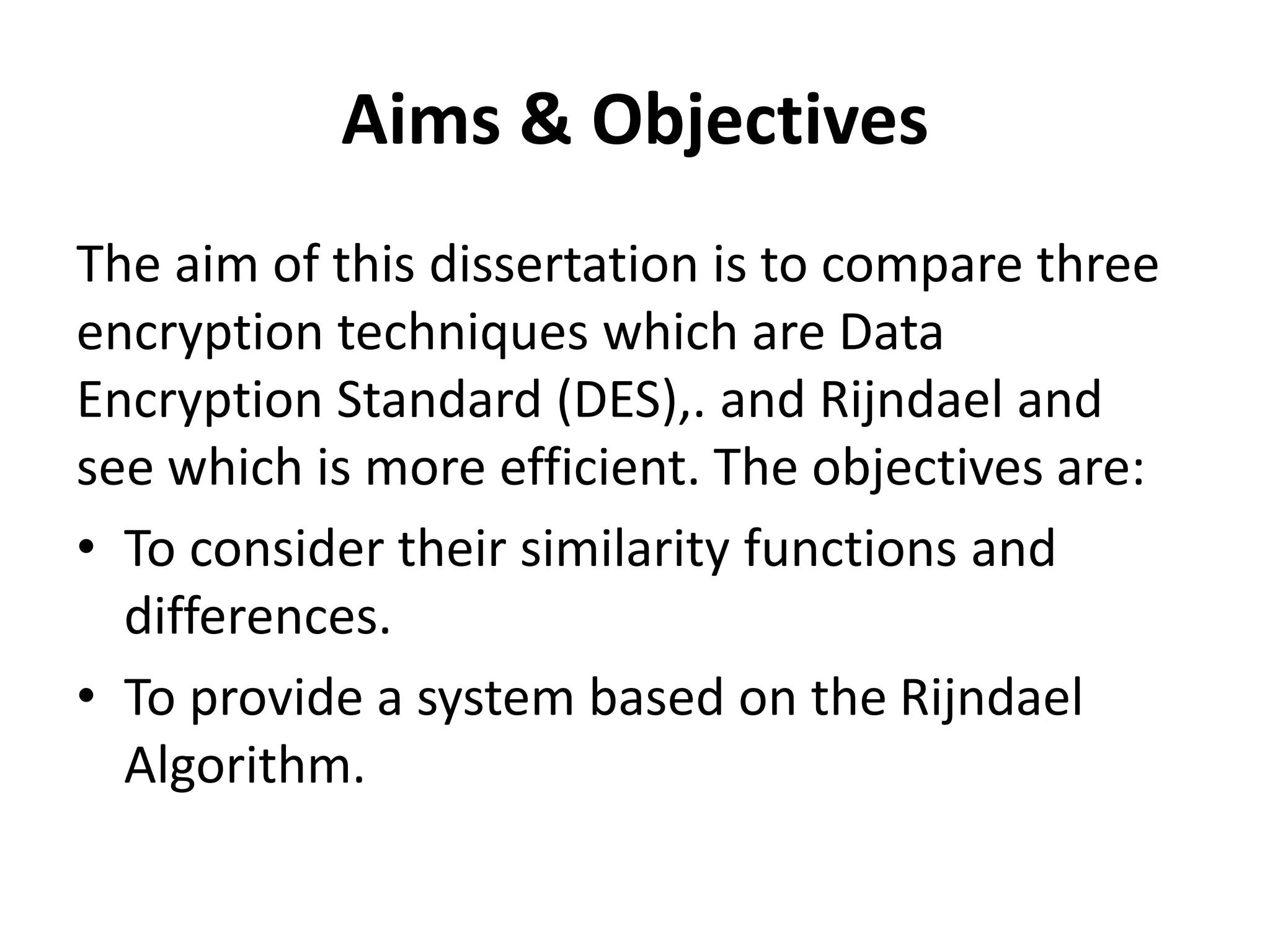
Aims & Objectives
The aim of this dissertation is to compare three
encryption techniques which are Data
Encryption Standard (DES),. and Rijndael and
see which is more efficient. The objectives are:
• To consider their similarity functions and
differences.
• To provide a system based on the Rijndael
Algorithm.
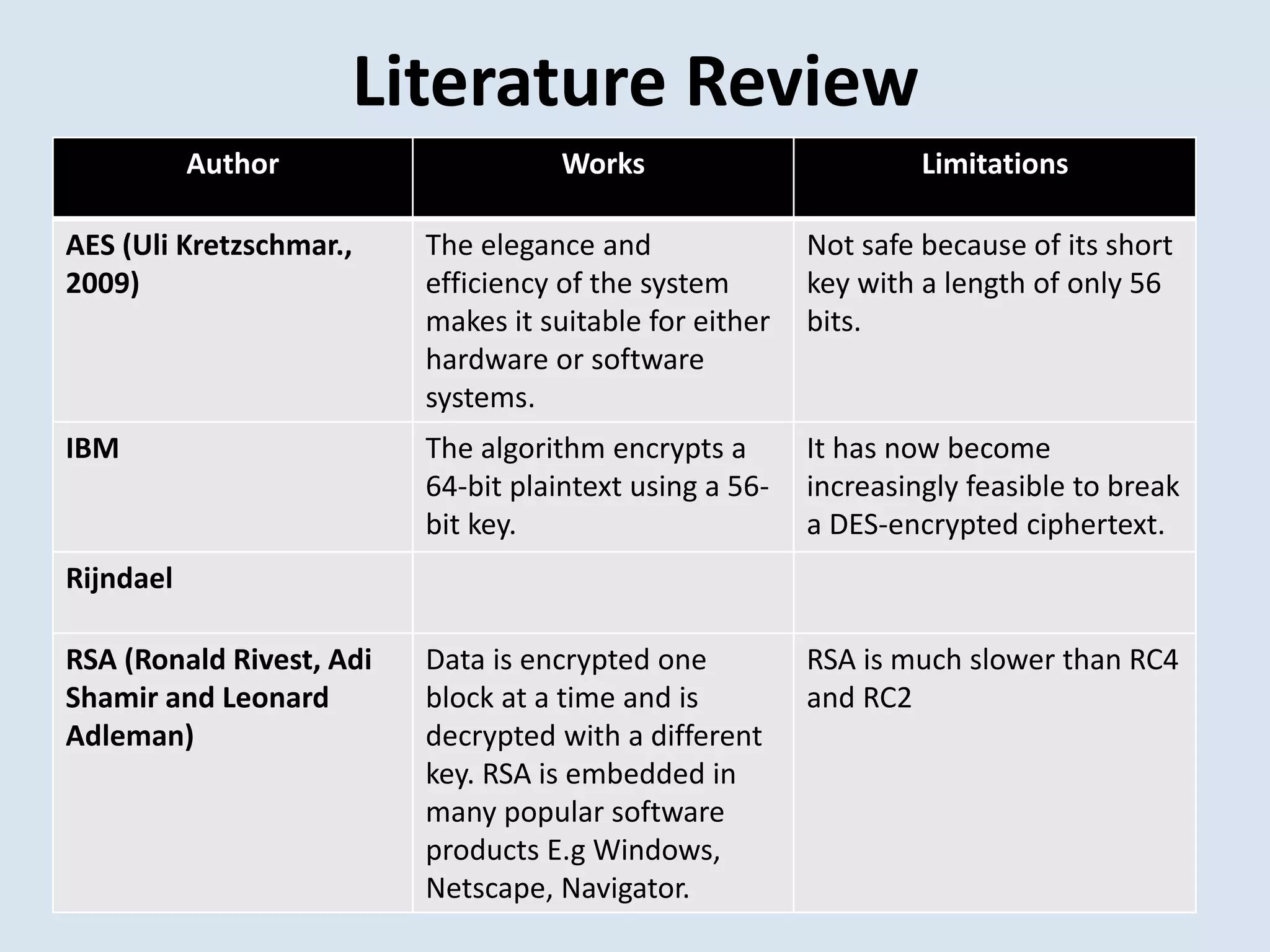
Literature Review
Author Works Limitations
AES (Uli Kretzschmar.,
2009)
The elegance and
efficiency of the system
makes it suitable for either
hardware or software
systems.
Not safe because of its short
key with a length of only 56
bits.
IBM The algorithm encrypts a
64-bit plaintext using a 56-
bit key.
It has now become
increasingly feasible to break
a DES-encrypted ciphertext.
Rijndael
RSA (Ronald Rivest, Adi
Shamir and Leonard
Adleman)
Data is encrypted one
block at a time and is
decrypted with a different
key. RSA is embedded in
many popular software
products E.g Windows,
Netscape, Navigator.
RSA is much slower than RC4
and RC2
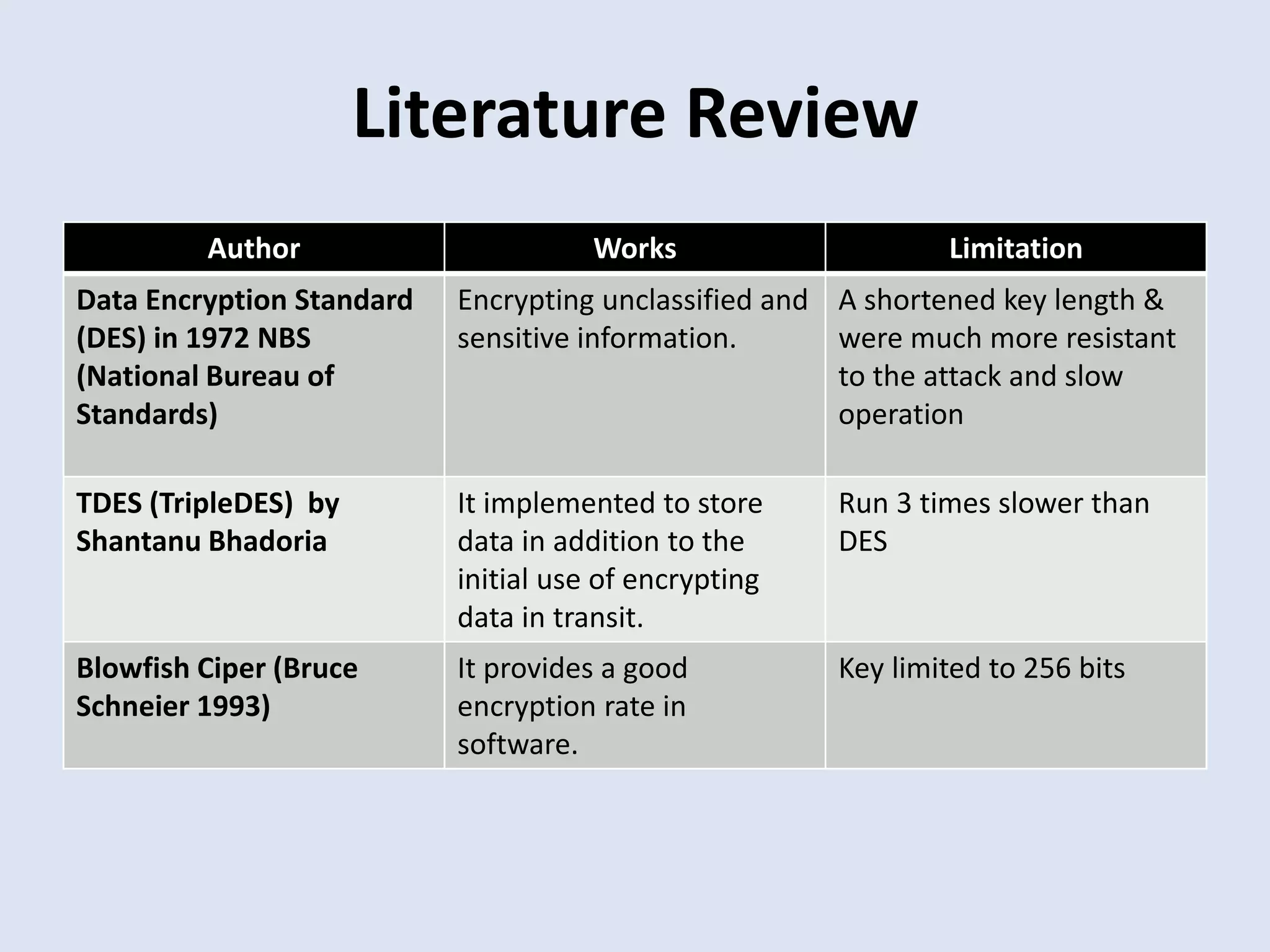
Literature Review
Author Works Limitation
Data Encryption Standard
(DES) in 1972 NBS
(National Bureau of
Standards)
Encrypting unclassified and
sensitive information.
A shortened key length &
were much more resistant
to the attack and slow
operation
TDES (TripleDES) by
Shantanu Bhadoria
It implemented to store
data in addition to the
initial use of encrypting
data in transit.
Run 3 times slower than
DES
Blowfish Ciper (Bruce
Schneier 1993)
It provides a good
encryption rate in
software.
Key limited to 256 bits
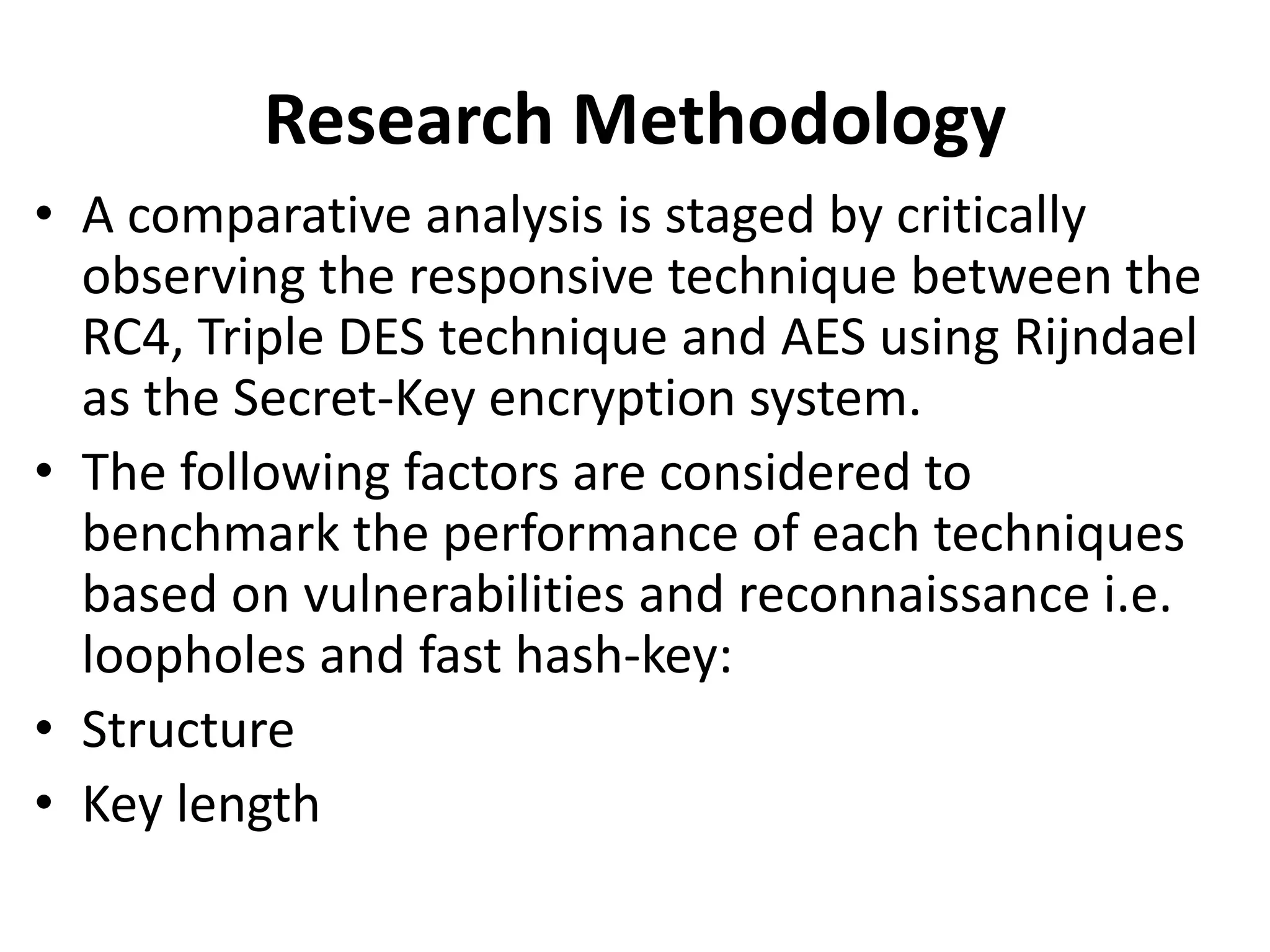
Research Methodology
• A comparative analysis is staged by critically
observing the responsive technique between the
RC4, Triple DES technique and AES using Rijndael
as the Secret-Key encryption system.
• The following factors are considered to
benchmark the performance of each techniques
based on vulnerabilities and reconnaissance i.e.
loopholes and fast hash-key:
• Structure
• Key length
Research Methodology
• Block length
• Operations
• Security
• Implementation
• Similarity
• Cipher type
• Cryptanalysis resistance and possible keys.
Result
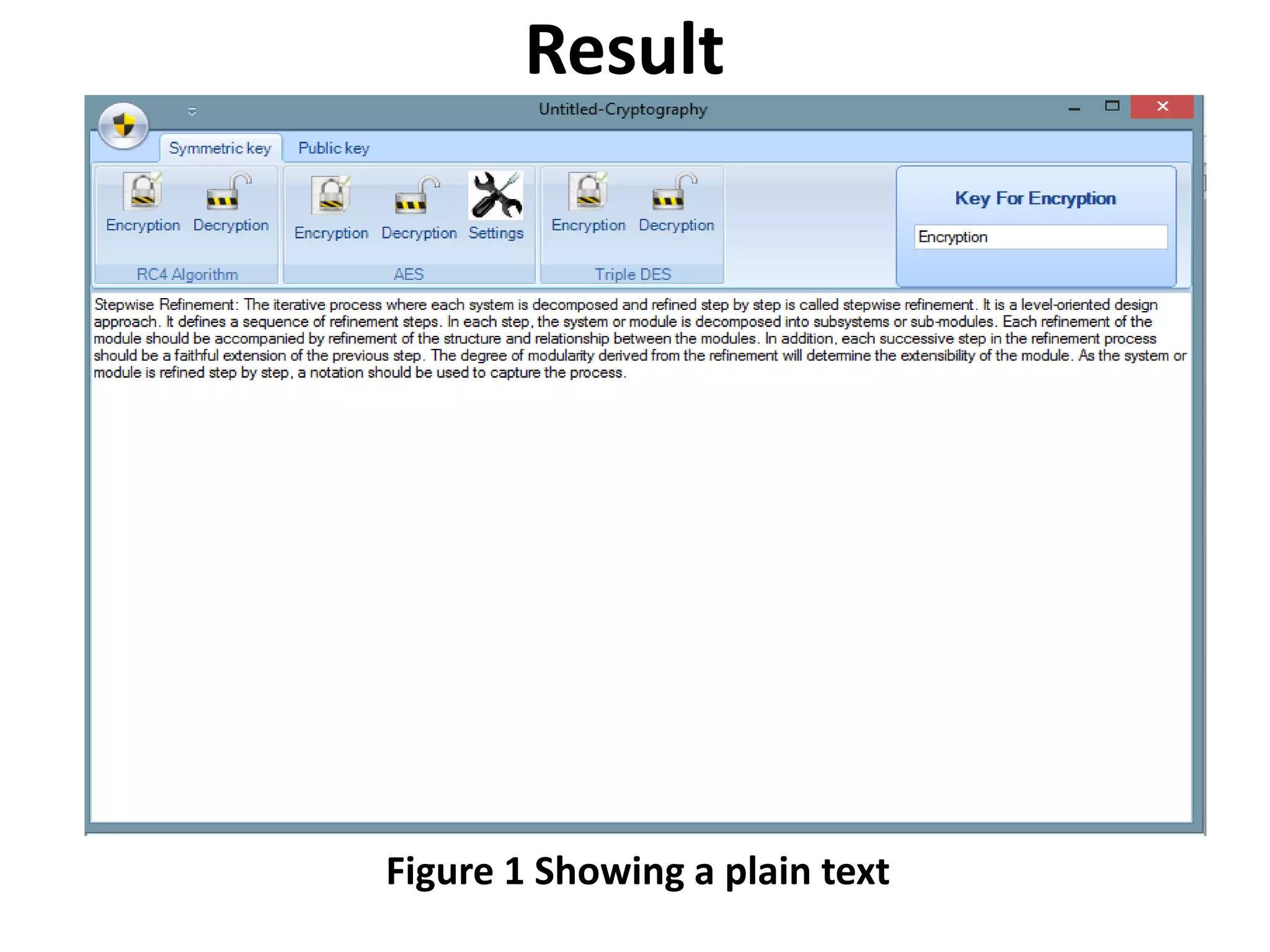
Figure 1 Showing a plain text
Result
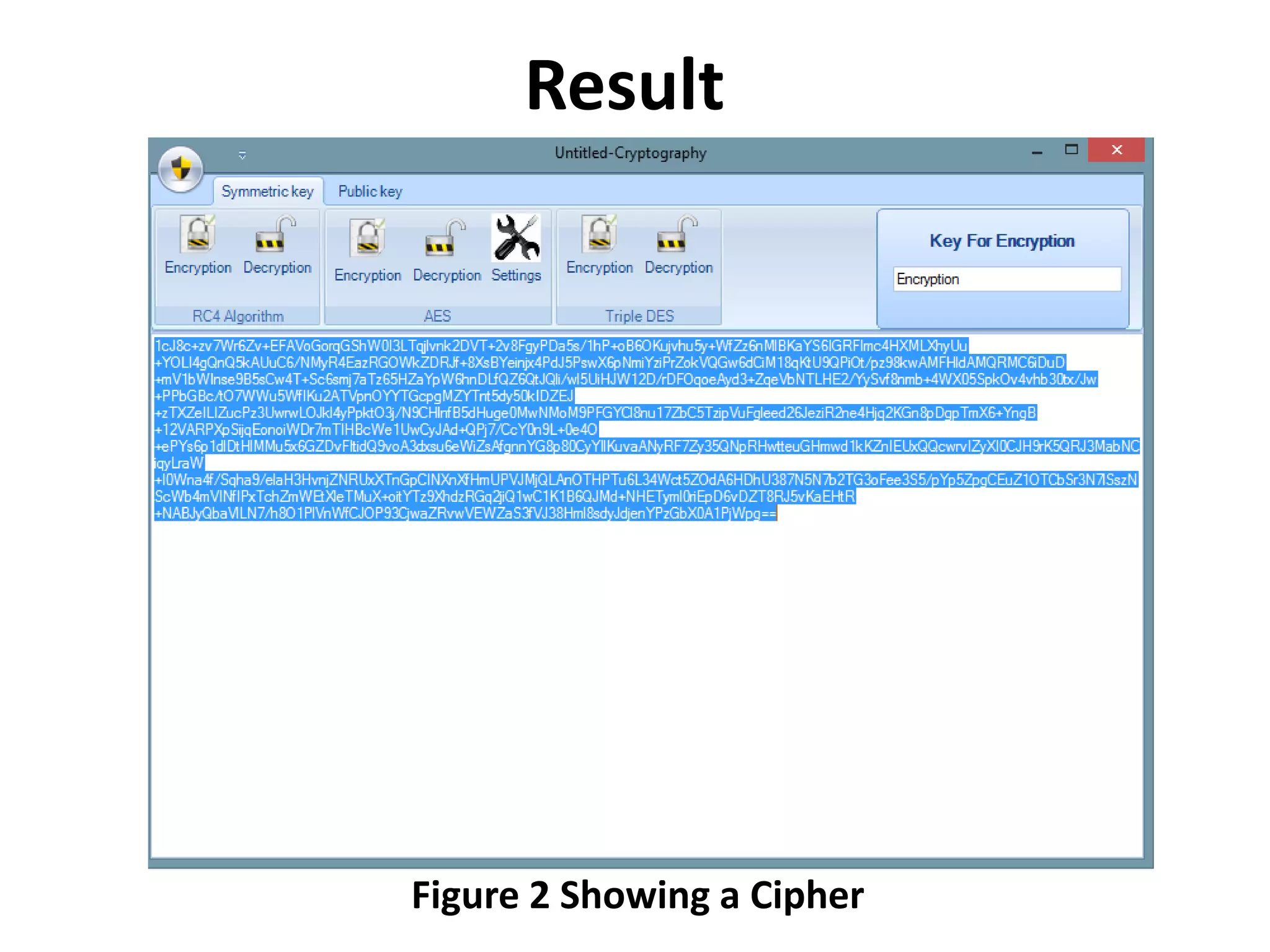
Figure 2 Showing a Cipher
Conclusion
• It has presented a new comparative analysis in
this study between Data Encryption Algorithm
of the Data Encryption Standard, and Rijndael
algorithm of the new Advanced Encryption
Standard (AES) in factors. These factors are
Rijndael is more efficient than DEA and is yet
to be rendered “broken”.
Conclusion
• The program can be incorporated in a
networked system which will have a central
database e.g. SQL Server or Oracle Server. This
program will help to retrieval files especially
text with secret key before and after access.
FUTURE WORK
• It is hereby recommended that a further
research for comparative analysis is fostered
in order to benchmark performance
evaluations other techniques using media
data such videos, audio etc. Rijndael is
suitable and economical for cryptal-analysis, it
is utmost necessary a continuous research
spans across its (Rijndael) applicability.
THANK YOU
QUESTIONS??

DESIGN AND IMPLEMENTATION OF DATA ENCRYPTION SOFTWARE

  • 1.
    DESIGN AND IMPLEMENTATIONOF DATA ENCRYPTION SOFTWARE Presented By AYANDA DEMILADE ISAAC B.Sc.inComputerScience Supervisor: Mrs T.TSalau
  • 2.
    Background of Study •Data has historically been used primarily to protect mission critical data, government records and has been used increasingly over many years by financial industry to protect money transfers; by business to protect credit card information for electronic commerce, and by corporation to secure sensitive transmission of proprietary information. (Oaks, 2000) • Also, the use of encryption/decryption is as old as the art of communication.
  • 3.
    • In wartime,a cipher, often incorrectly called a "code," can be employed to keep the enemy from obtaining the contents of transmissions. (Technically, a code is a means of representing a signal without the intent of keeping it secret; examples are Morse code and ASCII.) Simple ciphers include the substitution of letters for numbers, the rotation of letters in the alphabet, and the "scrambling" of voice signals by inverting the sideband frequencies. (Java Security, 2001)
  • 4.
    Statement of Problem •There is need for protection and security which include system protection against hardware or software malfunction (or crashes) and security protection against unauthorized or malicious access. This requires some data not available to other user. However, the structure of data files is embedded in the application programs, so any changes to the structure of a file may require changing all programs that access that file.
  • 5.
    Aims & Objectives Theaim of this dissertation is to compare three encryption techniques which are Data Encryption Standard (DES),. and Rijndael and see which is more efficient. The objectives are: • To consider their similarity functions and differences. • To provide a system based on the Rijndael Algorithm.
  • 6.
    Literature Review Author WorksLimitations AES (Uli Kretzschmar., 2009) The elegance and efficiency of the system makes it suitable for either hardware or software systems. Not safe because of its short key with a length of only 56 bits. IBM The algorithm encrypts a 64-bit plaintext using a 56- bit key. It has now become increasingly feasible to break a DES-encrypted ciphertext. Rijndael RSA (Ronald Rivest, Adi Shamir and Leonard Adleman) Data is encrypted one block at a time and is decrypted with a different key. RSA is embedded in many popular software products E.g Windows, Netscape, Navigator. RSA is much slower than RC4 and RC2
  • 7.
    Literature Review Author WorksLimitation Data Encryption Standard (DES) in 1972 NBS (National Bureau of Standards) Encrypting unclassified and sensitive information. A shortened key length & were much more resistant to the attack and slow operation TDES (TripleDES) by Shantanu Bhadoria It implemented to store data in addition to the initial use of encrypting data in transit. Run 3 times slower than DES Blowfish Ciper (Bruce Schneier 1993) It provides a good encryption rate in software. Key limited to 256 bits
  • 8.
    Research Methodology • Acomparative analysis is staged by critically observing the responsive technique between the RC4, Triple DES technique and AES using Rijndael as the Secret-Key encryption system. • The following factors are considered to benchmark the performance of each techniques based on vulnerabilities and reconnaissance i.e. loopholes and fast hash-key: • Structure • Key length
  • 9.
    Research Methodology • Blocklength • Operations • Security • Implementation • Similarity • Cipher type • Cryptanalysis resistance and possible keys.
  • 10.
  • 11.
  • 12.
    Conclusion • It haspresented a new comparative analysis in this study between Data Encryption Algorithm of the Data Encryption Standard, and Rijndael algorithm of the new Advanced Encryption Standard (AES) in factors. These factors are Rijndael is more efficient than DEA and is yet to be rendered “broken”.
  • 13.
    Conclusion • The programcan be incorporated in a networked system which will have a central database e.g. SQL Server or Oracle Server. This program will help to retrieval files especially text with secret key before and after access.
  • 14.
    FUTURE WORK • Itis hereby recommended that a further research for comparative analysis is fostered in order to benchmark performance evaluations other techniques using media data such videos, audio etc. Rijndael is suitable and economical for cryptal-analysis, it is utmost necessary a continuous research spans across its (Rijndael) applicability.
  • 15.
  • 16.