Descriptive Epidemiology
KINE 3352
REVIEW!
1) What are the two major types of
epidemiology?
2) Which one is concerned with
causation?
3) Which allows us to test
hypotheses?
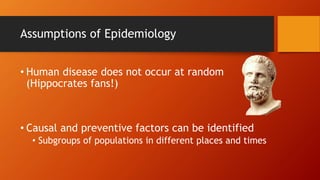
Assumptions of Epidemiology
• Human disease does not occur at random
(Hippocrates fans!)
• Causal and preventive factors can be identified
• Subgroups of populations in different places and times
Descriptive Epidemiology
•How is descriptive epidemiology used to
help accomplish this?
Descriptive Epidmiology
• Describes the existing distribution of variables without
considering causation
• Measure prevalence, incidence of disease
• Generates hypotheses for analytic studies
Descriptive Epi
•What are the three tenets of descriptive
epidemiology?
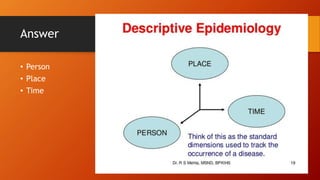
Answer
• Person
• Place
• Time
What are examples of each?
•Person:
•Place:
•Time:
Examples
• Person: age, sex, race/ethnicity, SES,
occupation, lifestyle
• Place: neighborhood, state, country, environment
• Time: date of exposure, date of diagnosis, etc.
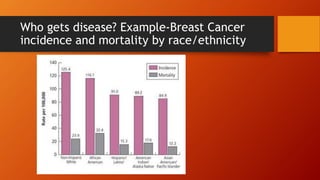
Who gets disease? Example-Breast Cancer
incidence and mortality by race/ethnicity
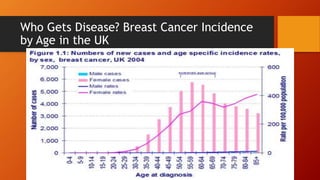
Who Gets Disease? Breast Cancer Incidence
by Age in the UK
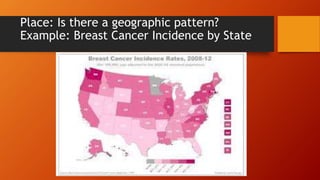
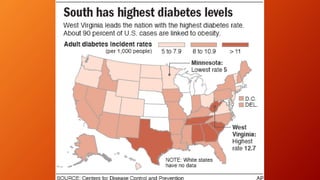
Place: Is there a geographic pattern?
Example: Breast Cancer Incidence by State
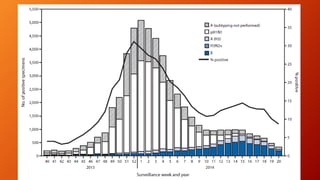
Time: When is the disease occurring?
• Short-term fluctuations
• Example?
• Cyclic patterns
• Example?
• Secular trend- Wait! What is this?
• Example?
What is a “secular trend”?
“A trend associated with some characteristic or
phenomenon that is not cyclical or seasonal but exists
over a relatively long period.”
Make sense? Ok, back to our regularly scheduled
programming…
…So, what is an example of a “secular trend” in
diseases we study?
Time: When is the disease occurring?
• Short-term fluctuations
• Food borne outbreak
• Cyclic patterns
• Annual increases in influenza in cold months
• Secular trends
• Long term changes over decades of heart disease,
cancer
Examples of secular trends
• Diagnostic/detection bias
• Management of disease after diagnosis
• Long-term food production or consumption
• Tobacco popularity
Types of descriptive studies
• Case reports
• Cross-sectional surveys
“Your Health Depends on Where you Live”:
real-life examples of descriptive epi
Environmental Factors:
• https://www.ted.com/talks/bill_davenhall_your_health_depends_on_where_yo
u_live
(through 6 min.)
Social Factors:
• https://www.pbs.org/wgbh/frontline/film/doctor-hotspot/
As you watch, notice examples of person, place and time
https://www.youtube.com/watch?v=dJEwC4wCM70&list=PLOGi5-
fAu8bEOV9XSktM8EJwK2Hx1Qdf5 (Rishi Manchanda TED Talk)
How do these examples of “upstream factors” in individual patients be
extrapolated to the larger population and descriptive data collection

Descriptive Epidemiology.pptx

  • 1.
  • 2.
    REVIEW! 1) What arethe two major types of epidemiology? 2) Which one is concerned with causation? 3) Which allows us to test hypotheses?
  • 3.
    Assumptions of Epidemiology •Human disease does not occur at random (Hippocrates fans!) • Causal and preventive factors can be identified • Subgroups of populations in different places and times
  • 4.
    Descriptive Epidemiology •How isdescriptive epidemiology used to help accomplish this?
  • 5.
    Descriptive Epidmiology • Describesthe existing distribution of variables without considering causation • Measure prevalence, incidence of disease • Generates hypotheses for analytic studies
  • 6.
    Descriptive Epi •What arethe three tenets of descriptive epidemiology?
  • 7.
  • 8.
    What are examplesof each? •Person: •Place: •Time:
  • 9.
    Examples • Person: age,sex, race/ethnicity, SES, occupation, lifestyle • Place: neighborhood, state, country, environment • Time: date of exposure, date of diagnosis, etc.
  • 10.
    Who gets disease?Example-Breast Cancer incidence and mortality by race/ethnicity
  • 11.
    Who Gets Disease?Breast Cancer Incidence by Age in the UK
  • 12.
    Place: Is therea geographic pattern? Example: Breast Cancer Incidence by State
  • 15.
    Time: When isthe disease occurring? • Short-term fluctuations • Example? • Cyclic patterns • Example? • Secular trend- Wait! What is this? • Example?
  • 16.
    What is a“secular trend”? “A trend associated with some characteristic or phenomenon that is not cyclical or seasonal but exists over a relatively long period.” Make sense? Ok, back to our regularly scheduled programming… …So, what is an example of a “secular trend” in diseases we study?
  • 17.
    Time: When isthe disease occurring? • Short-term fluctuations • Food borne outbreak • Cyclic patterns • Annual increases in influenza in cold months • Secular trends • Long term changes over decades of heart disease, cancer
  • 19.
    Examples of seculartrends • Diagnostic/detection bias • Management of disease after diagnosis • Long-term food production or consumption • Tobacco popularity
  • 20.
    Types of descriptivestudies • Case reports • Cross-sectional surveys
  • 21.
    “Your Health Dependson Where you Live”: real-life examples of descriptive epi Environmental Factors: • https://www.ted.com/talks/bill_davenhall_your_health_depends_on_where_yo u_live (through 6 min.) Social Factors: • https://www.pbs.org/wgbh/frontline/film/doctor-hotspot/ As you watch, notice examples of person, place and time https://www.youtube.com/watch?v=dJEwC4wCM70&list=PLOGi5- fAu8bEOV9XSktM8EJwK2Hx1Qdf5 (Rishi Manchanda TED Talk) How do these examples of “upstream factors” in individual patients be extrapolated to the larger population and descriptive data collection