F011032 Banking and Financial Services
MBA III Sem
Dr Pravin Kumar Agrawal
Assistant Professor
Ph.D. Finance
MNNIT Allahabad
1
Course outcomes
• The objective of this course is to familiarize students with the
conceptual understanding of the various types of Banking and
financial services available and an exposure to the regulatory
environment in which these operate. The course covers the
spectrum of financial intermediation and banking services
which are indispensable for smooth functioning of business
activities.
2
Unit I
Introduction
• Banking and Financial Services – An overview. Role of banks in
financial system. Sources and application of bank funds,
Credit creation and different types of lending. Legal aspects of
lending - Secured and unsecured loans. Negotiable
Instruments, Retail and Corporate banking, Trade Finance –
Letters of credit, E-payment systems and electronic banking.
Universal Banking – Commercialand Investment Banking.
Innovation and diversification in Banking services.
3
Unit II
Financial Institutions
• Merchant Banking: services by merchant bankers, code of
conduct and general obligations of merchant bankers,
merchant bankers as lead managers, SEBI guidelines for
merchant bankers, Issue management and Underwriting –
Process of issue management, role of merchant banker in
underwriting of an issue, buyback of equity shares, role of
merchant bankers in mergers & acquisitions, delisting of
securities, ESOPs and disinvestment.
4
UNIT III
Financial Markets
• Hire Purchase: Features of hire purchase agreement, rights of
hirer, hire purchase and credit sale, hire purchase and
instalment system, accounting for hire purchase. Leasing -
Concept, importance, process of leasing, types of lease
agreements, hire purchase vs leasing, legal aspects of leasing,
taxation aspect of leasing, accounting treatment of leasing,
contents of lease agreements, rights and obligation of leasing
parties, technique of ascertaining the lease rentals, limitations
of lease financing.
5
UNIT IV
Microfinance Development
• Venture Capital: Genesis, meaning, features, scope, significance,
method of valuation, stages of venture capital financing, analyzing
venture capital proposals, Venture capital funds in India –
Organization structure, registration of VCF, Buyouts, Investment
nurturing. Factoring – Meaning, definitions, modus operandi, parties
to factoring, types of factoring, legal aspects of factoring, factoring
cost, factoring vs bill discounting. Forfaiting, Introduction,
mechanism of forfaiting, Credit Rating agencies and scope of their
functions. Securitization- Process and advantage
6
Suggested Readings
1. Financial Services, R. Shanmugham, Wiley.
2. Financial Services, Gurusamy, McGraw Hill
3. Management of Financial services, C Rama Gopal, Vikas Publication
4. Financial services, M Y Khan , Tata McGraw Hill
5. Merchant Banking, Machiraju H.R., New Age publication
6. Handbook of Merchant banking and Financial services, J.C Verma,Bharat Law House
7. Financial Markets and Services, Gordon & Natarajan, Himalaya Publication
8. Management of Banking and Financial Services, Padmalatha Suresh and Justin Paul,
Pearson
7
Text Book
1. Bhole, L M ; Financial Institutions and Markets; McGraw-Hill
Education
2. Kohn M, Financial Institutions and Markets
3. Pathak, Bharti V.; Indian Financial System; Pearson Education
4. Khan, M.Y.; Indian Financial System; McGraw-Hill Education
5. Varshney ,P.N ; Banking law and practice ; Sultan Chand and
Sons
8
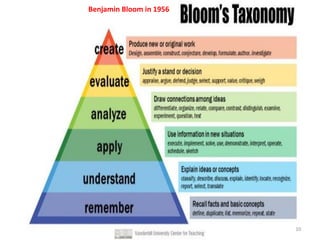
Bloom’s Taxonomy
• Bloom’s Taxonomy is a classification of the different
objectives and skills that educators set for their students
• The taxonomy was proposed in 1956 by Benjamin Bloom, an
educational psychologist at the University of Chicago.
• The terminology has been recently updated to include the
following six levels of learning.
• These 6 levels can be used to structure the learning
objectives, lessons, and assessments of your course. :
9
Benjamin Bloom in 1956
10
How Bloom’s can aid in course design
• Before you can understand a concept, you
must remember it.
• To apply a concept you must first understand it.
• In order to evaluate a process, you must
have analyzed it.
• To create an accurate conclusion, you must have
completed a thorough evaluation.
11
Level of Bloom’s Taxonomy
1. Remember
Memorize a poem, Recall state capitals, Remember math formulas
2. Understand
Illustrate the difference between a rectangle and square
3. Apply.
Use a formula to solve a problem
4. Analyze.
identify why a machine is not working, Reliance V/s Infosys
5. Evaluate.
NPS/ELSS/ PPF/ , Ph.D./Job
6. Create.
Design a new solution to an ‘old’ problem that honors/acknowledges the
previous failures, create a poem based on a given theme and tone
12
COURSE OBJECTIVES
❑ To impart knowledge of the financial system of India, the role
of important financial institutions, financial markets and
financial instruments.
❑ Familiarizing the students with the mechanism of commercial
banking, its operations, instruments regulations etc.
❑ Helping students in acquiring analytical skills in the money
and capital market in the context of raising medium and long
term funds
❑ Familiarizing the students with the microfinance as a growing
source of financial mechanism
❑ Developing an appreciation among the students for the
Banking services and products.
13
Indian Financial System
An Overview
A Financial System of any country refers to a system that
provides smooth and efficient relationship between the
borrowers and the lenders.
This system aims at establishing effective medium for generating
funds from various sources.
A financial system may be defined as a set of institutions,
instruments and markets which fosters savings and channels
them to their most efficient use .
14
Indian Financial System
An Overview …
• Financial System includes various aspects such as financial
markets, financial institutions, banking firms, financial
services, financial intermediaries, financial assets and
instruments, etc.
15
Indian Financial System
An Overview …
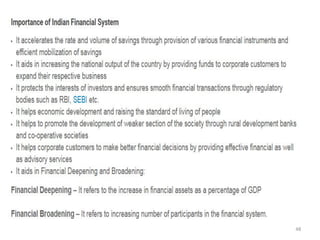
• An efficient and innovative financial system is very essential
for fast and continuous growth of the economy.
• Financial system provides a useful link between investors and
depositors.
• It encourages both rates of savings as well as investments.
overall economic activities are highly benefited by the
development of financial system.
• This is because efficient financial markets help to mobilize
hard earned savings and allocate those savings among the
competing users.
16
Indian Financial System
An Overview …
• An efficient financial system influences the quality as well as
rate of economic growth and development.
• A well developed and properly regulated financial system
ensures transfer of limited financial resources from different
sections of the society.
• It plays a very important role in overall functioning of whole
economy.
• Dynamic and flexible financial markets are essential for
creating balance and successful growth in financial system in
a country. 17
Indian Financial System
An Overview …
• India has an extensive financial infrastructure consisting of a
vast network of institutions deploying varied instruments in
the task of financial intermediation for overall economic
development.
18
Indian Financial System
An Overview …
• These institutions in the organized sector consist of
– The Reserve Bank of India (RBI),
– The commercial banks,
– The Regional Rural Banks (sponsored by public sector commercial
banks exclusively for rural development) and
– The cooperative banks,
– The all-India and State-level Development Financial Institutions (DFIs),
(IFCI, IDBI, NABARD), (Tamil Nadu Industrial Investment Corporation Limited (TIIC),
Tamil Nadu Industrial Investment Corporation Limited (TIIC), Tamil Nadu Industrial
Investment Corporation Limited (TIIC))
– Non-banking financial institutions (including insurance companies),
– The money market and other mutual funds,
– and the stock market.
19
Indian Financial System
An Overview …
• A distinct aspect of the Indian financial system is the
dominance of the public sector, which, however, is waning,
particularly since 1991, when the financial sector reform
measures were initiated.
• Within this broad framework, the financial infrastructure in
the country in general has witnessed rapid growth,
innovation, diversification and institutional development.
20
Indian Financial System
An Overview …
• The Reserve Bank, with its traditional functions as a central bank
and promotional and developmental roles, has been continuously
playing an active role in developing and strengthening the
financial system.
• There is a functionally varied and geographically widespread
system of commercial and cooperative banks.
• These commercial and cooperative banks hold a substantial chunk
of total assets of the financial system.
• Traditionally, the primary task of these banks has been to mobilize
savings and provide working capital to producing units in different
segments of the economy.
21
Indian Financial System
An Overview …
• The rendering of medium- and long-term assistance was
traditionally being done by a variety of all-India and
State-level DFIs for five broad economic sectors: industry,
agriculture, exports, tourist resorts and hotels, and housing.
• However, their functions have undergone metamorphosis,
and they have started short-term lending too, once the
exclusive area of banks.
• Invasion of banks into term lending on one hand and that of
DFIs into short-term lending on the other have brought to
sharp focus the need for adopting universal banking in the
country, an issue which is being intensely debated.
22
Indian Financial System
An Overview …
• Mobilization of savings is the prime activity, while others aim
at rendering financial assistance.
• While some commercial banks have been providing merchant
banking services and housing finance for quite some time,
some commercial banks have diversified and expanded their
activities into related areas, such as, leasing, mutual funds,
venture capital and miscellaneous financial services (in
addition to housing finance and merchant banking) by
establishing non-banking subsidiaries for the purpose.
23
Indian Financial System
An Overview …
• A major component of the organized financial system is the
capital market, which facilitates the raising of primary capital
and provides scope for promoting secondary market in
private corporate and government securities.
24
Indian Financial System
An Overview …
• Post Office Savings Bank, Provident Funds, other
small savings and certain special bonds constitute
important avenues for financial savings by
households, as also important sources of finance for
the Central and State Governments.
25
Indian Financial System
An Overview …
• Apart from the organized financial system, moneylenders and
indigenous bankers, trading, leasing, hire purchases,
investment loans and mutual benefit companies and chit
funds continue to play a role in the unorganized financial
sector.
26
Financial System
“Financial System consists of a variety of
institutions, markets, and instruments related in a
systematic manner and provide the principal means by
which savings are transformed into
investments”.
27
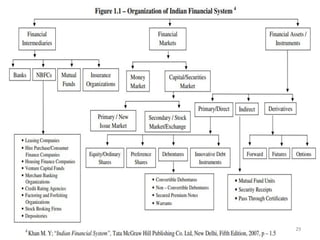
Components/Structure of Indian financial
system
• Divided into three components
– Financial Institutions/Intermediaries
– Financial Markets
– Financial Instruments/Assets
28
29
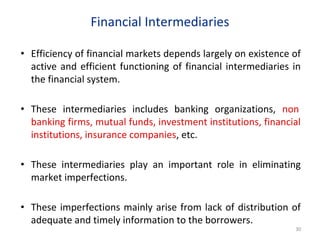
Financial Intermediaries
• Efficiency of financial markets depends largely on existence of
active and efficient functioning of financial intermediaries in
the financial system.
• These intermediaries includes banking organizations, non
banking firms, mutual funds, investment institutions, financial
institutions, insurance companies, etc.
• These intermediaries play an important role in eliminating
market imperfections.
• These imperfections mainly arise from lack of distribution of
adequate and timely information to the borrowers.
30
Financial Institutions
• The Financial Institutions act as a mediator between
the investor and the borrower.
• The investor’s savings are mobilized either directly or
indirectly via the Financial Markets.
31
Financial Institutions
• The financial institutions can further be divided into two
types:
• Banking Institutions – This includes banks which collect
money from the public against interest provided on the
deposits made and lend that money to the ones in need.
• Non Banking Institutions– Insurance, mutual funds and
brokerage companies fall under this category. They cannot
ask for monetary deposits (demand) but sell financial
products to their customers.
32
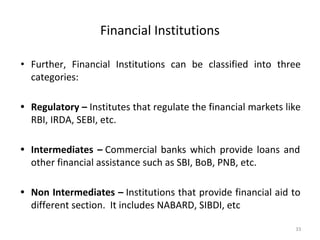
Financial Institutions
• Further, Financial Institutions can be classified into three
categories:
• Regulatory – Institutes that regulate the financial markets like
RBI, IRDA, SEBI, etc.
• Intermediates – Commercial banks which provide loans and
other financial assistance such as SBI, BoB, PNB, etc.
• Non Intermediates – Institutions that provide financial aid to
different section. It includes NABARD, SIBDI, etc
33
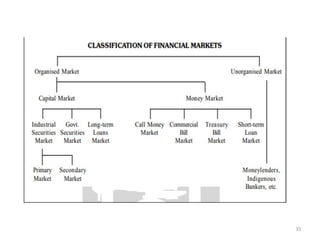
Financial Markets
• The marketplace where buyers and sellers interact with each
other and participate in trading of money, bonds, shares and
other assets is called a financial market.
34
35
Financial Markets
• Capital Market – Designed to finance the long term
investment need of the organization, the Capital market deals
with transactions which are taking place in the market for
over an year.
36
Financial Markets
• Money Market – Mostly dominated by Government, Banks
and other Large Institutions, the type of market is authorized
for small term investments only. It is a wholesale debt market
which works on low-risk and highly liquid instruments.
The money market can further be divided into two types:
(a) Organised Money Market
(b) Unorganised Money Market
37
Financial Markets
• Foreign exchange Market – One of the most developed
markets across the world, the Foreign exchange market, deals
with the requirements related to multi currency. The transfer
of funds in this market takes place based on the foreign
currency rate.
38
Financial Assets
• The products which are traded in the Financial Markets are
called the Financial Assets.

• Based on the different requirements and needs of the credit
seeker, the securities in the market also differ from each
other.
39
Financial Assets
• Financial assets can be classified differently under different
circumstances. One such classification is:
• (i) Marketable assets
• (ii) Non-marketable assets
40
Marketable Assets
• Marketable assets are those which can be easily transferred
from one person to another without much hindrance.
Examples: Shares of Listed Companies, Government
Securities, Bonds of Public Sector Undertakings, etc.
41
Non-marketable Assets
• On the other hand, if the assets cannot be transferred easily,
they come under this category. Examples: Bank Deposits,
Provident Funds, Pension Funds, National Savings Certificates,
Insurance Policies, etc.
42
Financial Services
The financial services in India include:
• Banking Services – Any small or big service provided by banks
like granting loan, depositing money, issuing debit/credit
cards, opening accounts, etc.
• Insurance Services – Services like issuing of insurance, selling
policies, insurance undertaking and brokerages, etc. are all a
part of the Insurance services
• Investment Services – It mostly includes asset management
• Foreign Exchange Services – Exchange of currency, foreign
exchange, etc. are a part of the Foreign exchange services
• The main aim of the financial services is to assist a person
with selling, borrowing or purchasing securities, allowing
payments and settlements and lending and investing.
43
Features of the Indian Financial system
• It plays a vital role in the economic development of
the country as it encourages both savings and
investment
• It helps in mobilizing and allocating one’s savings
• It facilitates the expansion of financial institutions
and markets
• Plays a key role in capital formation
• It helps forms a link between the investor and saver
44
Objectives of Financial System
• Accelerating the growth of Economic Development
• Mobilize the resources and channelize the same for various
economic activities so as to achieve the objectives of economic
and social upliftment
• Encouraging rapid industrialization
• To serve as an agent of Socio Economic Development for various
sectors of the economy (industry, agricultural sector, Government
etc)
45
Objectives of Financial System
• Providing financial and advisory services
• Developing financial markets
• Facilitating the financial transactions
• Provision of legal financial framework
46
Objectives of Financial System
• Accelerating rural development
• Providing necessary financial support to industry
• Financing housing and small scale industries
• Development of backward areas, infrastructure and
livelihood.
47
48
Functions of Financial Systems
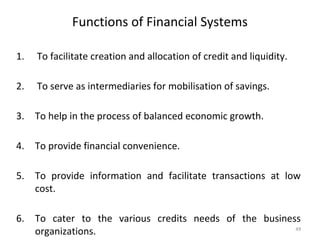
1. To facilitate creation and allocation of credit and liquidity.
2. To serve as intermediaries for mobilisation of savings.
3. To help in the process of balanced economic growth.
4. To provide financial convenience.
5. To provide information and facilitate transactions at low
cost.
6. To cater to the various credits needs of the business
organizations. 49
Advantages of Financial system
• Provides Payment System: The financial system provides a
payment mechanism for the smooth flow of funds among
peoples in an economy. Buyers and sellers of goods or
services are able to perform transactions with each other due
to the presence of a financial system.
• Links Savers and Investors: The financial system serves as a
means of bridging the gap between savings and investment. It
acquires money from those with whom it is lying idle and
transfers it to those who need it for investing in productive
ventures.
50
Advantages of Financial system
• Minimizes Risk: It aims at reducing the risk by diversifying it
among a large number of individuals. The financial system
distributes funds among a large number of peoples due to
which risk is shared by many peoples.
• Helps in Capital Formation: The financial system has an
efficient role in capital formation of the country. It enables big
corporates and industries to acquire the required funds for
performing or expanding their operations thereby leading to
capital formation in the nation.
51
Advantages of Financial system
• Raises Standard of living: It raises the standard of living of peoples by
promoting regional and rural development of the country. The financial
system promotes the development of weaker sections of society through
cooperative societies and rural development banks.
• Enhance liquidity: Maintaining optimum liquidity in an economy is
another important role played by the financial system. It facilities free
movement of funds from households (savers) to corporate (investors)
which ensures sufficient availability of funds in the economy.
• Promotes Economic Development: The financial system influence the
pace of economic growth or development of an economy. It aims at
optimum utilization of all financial resources by investing all idle lying
resources into useful means which leads to the creation of wealth.
52
Limitations of Indian Financial System
• The Indian Financial system has failed to meet the financial
needs of small scale Industries. It has rather patronage the big
industrial houses who are already well off.
• In many cases, It could not impose adequate control towards
financial irregularities and frauds. Often influenced by
politically and economically organized pressure groups.
– Chanda Kocchar, Vijay Malya, Neerav Modi
53
Limitation of Indian Financial System
• It fails to motivate economically marginal or small
entrepreneur, Small and Medium Enterprises.
54
Theories of the Impact of financial development
and savings
• Five theories propounded by economists and financial experts
about the impact of financial development on the savings and
investment in an economy:
1.Prior Savings Theory
2.Credit Creation Theory
3.Theory of Forced Savings
4.Financial Regulation Theory
5.Financial Liberation Theory
55
Credit Creation Theory
Michal Kalecki and Joseph Schumpeter
.
• The Credit Creation Theory, also known as the Money Multiplier Theory, is an
economic concept that explains how commercial banks can create money through the
process of lending.
• It forms the basis of the fractional reserve banking system that most modern
economies operate under.
• The theory helps us understand how an initial deposit in a bank can result in multiple
rounds of lending and deposit creation, leading to the expansion of the money supply.
56
Credit Creation Theory
• Fractional Reserve Banking: Commercial banks are required to keep only a
fraction of their customers' deposits as reserves (cash or deposits with the
central bank). The rest of the deposits can be lent out to borrowers.
• Reserve Ratio: The reserve ratio is the percentage of deposits that a bank
must keep as reserves. For example, if the reserve ratio is 10%, it means the
bank must hold 10% of its total deposits as reserves and can lend out the
remaining 90%.
• Deposit and Lending Process:
• a. Initial Deposit: Let's say you deposit Rs. 1,000 in Bank A.
• b. Reserve Requirement: If the reserve ratio is 10%, Bank A must keep Rs. 100
(10% of Rs. 1,000) as reserves and can lend out the remaining Rs. 900.
57
Credit Creation Theory
• Money Creation: The borrower who receives the Rs. 900 loan
from Bank A might use it to make a purchase. Let's say they
buy a computer for Rs.900 from someone who banks at Bank
B. The seller, who receives the Rs. 900, deposits it in Bank B.
• Repeated Process: Now, Bank B keeps 10% (Rs. 90) as
reserves and lends out the remaining Rs. 810. This process
can continue with multiple rounds of lending and deposits,
each time creating new money in the system.
58
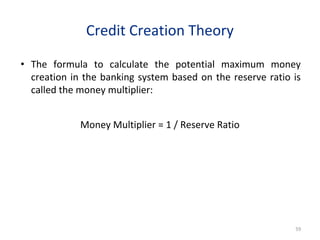
Credit Creation Theory
• The formula to calculate the potential maximum money
creation in the banking system based on the reserve ratio is
called the money multiplier:
Money Multiplier = 1 / Reserve Ratio
59
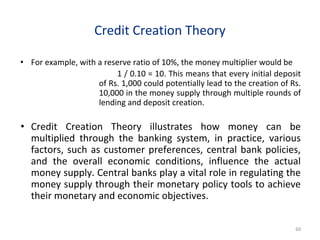
Credit Creation Theory
• For example, with a reserve ratio of 10%, the money multiplier would be
1 / 0.10 = 10. This means that every initial deposit
of Rs. 1,000 could potentially lead to the creation of Rs.
10,000 in the money supply through multiple rounds of
lending and deposit creation.
• Credit Creation Theory illustrates how money can be
multiplied through the banking system, in practice, various
factors, such as customer preferences, central bank policies,
and the overall economic conditions, influence the actual
money supply. Central banks play a vital role in regulating the
money supply through their monetary policy tools to achieve
their monetary and economic objectives.
60
Credit Creation Theory…
• Creation of credit is one of the most important functions of a
modern bank and this in turn leads to appropriate investment
for economic development.
•
61
Credit Creation Theory…
62
Legal aspects of lending
• Lending in India is subject to various legal aspects and
regulations to ensure fair practices, consumer protection, and
financial stability in the banking and financial sector. Some
key legal aspects of lending in India include:
63
Legal aspects of lending
1. Reserve Bank of India (RBI) Regulations: The Reserve Bank of India
is the central banking institution of India and plays a crucial role in
regulating and supervising the banking sector. It issues guidelines and
regulations related to lending practices, interest rates, capital
adequacy requirements, and risk management for banks and other
financial institutions.
2. Banking Regulation Act, 1949: This act empowers the RBI to
regulate and supervise the functioning of banks in India. It governs
the licensing, management, and operations of banks and sets out
various provisions related to lending activities, including restrictions
on certain types of lending.
64
Legal aspects of lending
3. Interest Rates: The RBI regulates the interest rates charged by banks for
different types of loans. It sets benchmark rates like the Repo Rate and the
Reverse Repo Rate, which influence the interest rates on loans and deposits.
4. Priority Sector Lending: The RBI mandates that banks allocate a specific
percentage of their lending to certain priority sectors, such as agriculture, micro,
small and medium enterprises (MSMEs), education, and housing for the
economically weaker sections. This ensures that credit reaches undeserved and
vulnerable segments of the population.
65
Legal aspects of lending
5. Fair Practices Code: Banks are required to adhere to the Fair
Practices Code (FPC) issued by the RBI, which outlines guidelines for
fair and transparent lending practices. The FPC includes aspects like
disclosure of loan terms, non-discrimination, and grievance redressal
mechanisms for borrowers.
6. Credit Information Companies (CICs): CICs are entities authorized
by the RBI to collect and maintain credit information of individuals
and businesses. Banks are required to share borrowers' credit
information with CICs, and access to this data helps lenders assess
the creditworthiness of potential borrowers.
66
Legal aspects of lending
7. Consumer Protection: The RBI and other authorities ensure
that lending practices are in compliance with consumer
protection laws. The Consumer Protection Act and other
relevant regulations safeguard borrowers' rights and interests.
67
Legal aspects of lending
8. Securitization and Reconstruction of Financial Assets and Enforcement of
Security Interest (SARFAESI) Act, 2002: This act provides a framework for
banks to enforce security interests and recover dues from defaulting
borrowers. It enables banks to take possession of collateral and sell it without
court intervention in case of loan defaults.
68
Legal aspects of lending
9. Prevention of Money Laundering Act (PMLA): The PMLA
imposes obligations on banks to carry out customer due
diligence and report suspicious transactions to the appropriate
authorities. Lenders are required to follow anti-money
laundering and counter-terrorism financing measures.
69
Legal aspects of lending
These legal aspects ensure that lending activities in India are carried out
responsibly, transparently, and in the best interest of both lenders and
borrowers. Lenders are expected to comply with these regulations to
maintain financial stability and protect the interests of all stakeholders
involved in the lending process.
70
Difference between secured and unsecured
loans
• The main difference between secured and unsecured loans is collateral. A
secured loan requires collateral, while an unsecured loan does not.
Unsecured loans are the more common of the two types of personal
loans, but interest rates can be higher since they’re backed only by your
creditworthiness.
• A secured loan is a loan where the lender gives you a loan in exchange for
collateral or security. It could be a physical asset like gold, a house or
vehicle or a financial asset like equity shares, fixed deposits , mutual funds,
life insurance policies, etc. The lender keeps the security either physically
or in terms of a lien on the title until the loan is repaid. If you cannot repay
the loan, the lender might sell your collateral to recover their money.
71
Difference between secured and unsecured
loans
• An unsecured loan is a loan without the need for you to
pledge any collateral. These loans are given solely on your
credit history and credit score. Lenders look at your previous
repayment history, a steady source of income, payslips for six
months or income tax returns, among other factors while
sanctioning the loan.
72
Retail Banking
• Retail banking, also known as consumer banking or personal
banking, focuses on providing financial services directly to
individual consumers and small businesses. The primary
target customers of retail banks are everyday consumers who
need banking services for personal use and small businesses
that require basic financial solutions. Retail banking services
are usually more standardized and accessible to a broad
customer base.
73
Key Features Retail Banking
Deposit Accounts: Retail banks offer various deposit accounts, such as savings
accounts, checking accounts, certificates of deposit (CDs), and money market
accounts, where individuals can store their money and earn interest.
Consumer Loans: Retail banks provide personal loans, auto loans, mortgages, and
credit cards to help individuals and families with their financing needs.
Payment Services: Retail banks facilitate payment services, such as issuing debit and
credit cards, processing electronic fund transfers, and offering mobile payment
solutions.
Financial Advisory: Some retail banks offer basic financial advisory services to help
customers with their financial planning and investment decisions.
ATM and Branch Network: Retail banks typically have a widespread network of ATMs
and physical branches for customers to access their accounts and conduct banking
transactions.
74
Corporate Banking
• Corporate banking, also referred to as business banking or
commercial banking, caters to larger businesses,
corporations, and institutional clients. Unlike retail banking,
corporate banking focuses on providing specialized financial
products and services tailored to the unique needs of
businesses and corporations.
75
Corporate Banking
Business Loans and Credit Facilities: Corporate banks offer various financing options to support
the working capital and expansion needs of businesses. These include business loans, lines of
credit, and trade finance solutions.
Cash Management Services: Corporate banking provides cash management solutions, including
payroll processing, receivables and payables management, and liquidity management, to
optimize a company's cash flow.
Trade Finance: Corporate banks facilitate international trade by offering services like letters of
credit, export and import financing, and trade documentation assistance.
Treasury and Foreign Exchange Services: Corporate banks assist businesses in managing their
foreign exchange risks and provide treasury services, including hedging strategies and investment
advice.
Corporate Advisory: Some corporate banks offer financial advisory services to assist businesses
with mergers and acquisitions, capital raising, and other strategic financial decisions.
76
Corporate Banking
• Overall, retail banking focuses on serving individual
consumers and small businesses with standard banking
services, while corporate banking caters to larger businesses
and corporations, offering more specialized financial solutions
to support their complex needs. Both segments are essential
components of the banking industry and play a significant role
in supporting the economy.
77
Letter of Credit
• Letters of Credit (LC) are financial instruments used in
international trade to provide a secure method of payment
for transactions between a buyer and a seller. They are widely
used to minimize the risks involved in cross-border trade by
ensuring that the seller receives payment and the buyer
receives the goods as per the agreed terms and conditions.
78
Letter of Credit
1. Buyer (Applicant): The buyer is the party who initiates the letter
of credit and applies to their bank (the issuing bank) to issue the
LC in favor of the seller.
2. Seller (Beneficiary): The seller is the party who will receive
payment under the letter of credit upon complying with the
specified conditions, usually by presenting the required
documents.
3. Issuing Bank: The issuing bank is the buyer's bank, which issues
the letter of credit on behalf of the buyer. The issuing bank is
obligated to make payment to the seller if the required
documents are presented correctly.
79
Letter of Credit
• Advising Bank: The advising bank is the bank in the seller's
country that receives the letter of credit from the issuing bank
and advises the seller about the terms and conditions of the
LC.
• Confirming Bank (Optional): In some cases, when there is a
lack of trust in the issuing bank or the country's economic or
political situation, the advising bank may add its confirmation
to the letter of credit. This means that the confirming bank
takes responsibility for making the payment to the seller if the
issuing bank fails to do so.
80
Process
81
Process
Step 1 - The buyer and seller enter into a contract stating that payment be
made on the basis of Letter of Credit
Step 2 - Buyer approaches ICICI Bank to issue Letter of Credit in favour of the
seller
Step 3 - ICICI Bank issues Letter of Credit which is advised through its branch
or correspondent bank in the seller’s country
Step 4 - Advising bank advises Letter of Credit to the seller
Step 5 - Upon receipt of the Letter of Credit, the seller prepares shipment and
delivers documents to seller's bank bank
Step 6 - Presenting bank dispatches documents to ICICI for payment
Step 7 - Buyer pays the document amount to ICICI Bank. In return, ICICI Bank
forwards the documents to the buyer, who can now use them to obtain the
goods.
82
https://www.icicibank.com/business-banking/trade-service/domestic-inland-letter-of-credit
Assignment
• Types of Letter of Credit
• E Banking
• Difference between Commercial Bank
Investment Bank
83
https://groww.in/blog/how-does-investment-bank-work
Investment Banking
• Investment banking is a special segment of banking operation that helps
individuals or organisations raise capital and provide financial consultancy
services to them.
• They act as intermediaries between security issuers and investors and help
new firms to go public. They either buy all the available shares at a price
estimated by their experts and resell them to public or sell shares on behalf
of the issuer and take commission on each share.
• Bank of America, Barclays Capital, Citigroup Investment Banking, Deutsche
Bank, and JP Morgan are some of the largest investment banks in India.
• Avendus Capital, IDBI Capital, Edelweiss Financial Services Limited, JM
Financial Institutions Securities, and MAPE Capital Advisors.
84
Investment Banking
• Investment banking is the division of financial
services that works to raise money for
individual investors, large corporations, and
governments. Investment banks provide
underwriting services to help clients raise
capital and complete mergers and acquisitions
(M&As).
85
Investment Banking
• Assisting in mergers and acquisitions (M&As) between companies
• Underwriting or raising money for their clients through the sale of
debt or other tradable assets, like stocks or bonds
• Providing investment management and advice to clients ranging
from individuals to government institutions
• Facilitating initial public offerings (IPOs), wherein a privately
owned company wants to become publicly traded
• Market research and analysis to inform investing decisions for the
bank and its clients
• Risk assessment and management to ensure the bank is making
safe financial decisions and to help clients understand the risks
they may face in certain economic decisions
86
Universal Banking
• Universal banking is a banking model in which financial institutions offer a
wide range of financial services and products beyond traditional banking
activities.
• These institutions integrate commercial banking, investment banking, and
other financial services under a single roof, providing customers with
comprehensive and diverse financial solutions.
• Universal banks can serve individuals, businesses, and governments,
offering services such as retail banking, corporate banking, asset
management, securities underwriting, and more.
87
ICICI BANK
• Retail Banking: Providing traditional banking services to
individuals, such as savings accounts, personal loans, mortgages,
credit cards etc.
• Corporate Banking: Offering a wide range of financial solutions to
businesses, including business loans, trade finance, cash
management etc.
• Investment Banking: Engaging in various investment banking
activities, including mergers and acquisitions, capital raising
through initial public offerings (IPOs), corporate advisory, and
securities trading.
88
ICICI BANK
• Asset Management: Managing investment portfolios for individual
and institutional clients, including mutual funds, hedge funds, and
other investment products.
• Wealth Management: Catering to high-net-worth individuals and
providing specialized financial planning, investment advisory, and
estate planning services.
• Securities Services: Offering custodial and securities clearing
services to institutional clients and other financial intermediaries.
89
Innovation and diversification in Banking
services.
• Innovation and diversification in banking services are crucial
elements for the growth and competitiveness of financial
institutions.
• As the banking industry evolves and customer demands change,
banks need to adapt by introducing new and improved services that
cater to the needs of their clients.
• Here are some key areas of innovation and diversification in banking
services:
90
Digital Banking and Fintech Integration
• One of the most significant innovations in banking has been
the adoption of digital banking channels. Banks now offer
online banking, mobile apps, and internet-based services that
allow customers to access their accounts, transfer funds, pay
bills, and even apply for loans or credit cards from the
convenience of their devices.
• Additionally, banks may collaborate or integrate with fintech
companies to offer innovative solutions such as peer-to-peer
payments, robo-advisory services, and digital wallets.
91
Digital Banking and Fintech Integration
• Fintech is a made up of the words "financial" and
"technology," and it refers to the use of technology
to deliver innovative financial products and services.
• Fintech companies leverage advancements in
technology, data analytics, and artificial intelligence
to disrupt traditional financial services and provide
more efficient, accessible, and user-friendly solutions
to consumers and businesses.
92
Innovation and diversification in Banking
services.
• Personalized Customer Experience: Banks are leveraging data analytics
and artificial intelligence to provide personalized banking experiences.
Through customer data, banks can offer tailored product
recommendations, targeted marketing, and customized financial advice,
enhancing customer satisfaction and loyalty.
93
Innovation and diversification in Banking services.
• Blockchain and Distributed Ledger Technology (DLT):
Blockchain and DLT are being explored by banks for various
use cases, such as improving cross-border payments,
enhancing security and transparency in transactions, and
streamlining the Know Your Customer (KYC) process.
94
Applications of Blockchain
• Cryptocurrencies: Blockchain technology first gained
widespread attention with the advent of Bitcoin, which uses
blockchain to enable peer-to-peer digital transactions without
the need for a central authority.
• Supply Chain Management: Blockchain can enhance
transparency and traceability in supply chains by recording
every step of the process from production to delivery,
reducing fraud and ensuring authenticity.
• Healthcare: Blockchain can securely store patients' medical
records, allowing authorized healthcare providers access to
real-time and accurate health data. 95
Applications of Blockchain
• Identity Management: Blockchain can provide a secure and
decentralized way of managing digital identities, reducing the
risks of identity theft and data breaches.
• Voting Systems: Blockchain-based voting systems can
enhance the security, transparency, and integrity of elections.
• Financial Services: Blockchain is being explored in various
financial applications, including cross-border payments, trade
finance, and asset tokenization.
96
Innovation and diversification in Banking
services.
• Sustainable and Impact Investing: Banks are diversifying their
services to include sustainable and impact investment
products. Customers are increasingly interested in investing in
environmentally and socially responsible projects, and banks
are offering green bonds other sustainable investment
options to meet this demand.
97
Innovation and diversification in Banking
services.
• Wealth Management and Advisory Services: Banks are expanding
their wealth management divisions to offer more comprehensive
financial planning and advisory services. High-net-worth
individuals and businesses often require personalized wealth
management solutions, including estate planning, tax
optimization, and risk management.
• Non-Banking Financial Services: Many banks are diversifying into
non-banking financial services, such as insurance, brokerage, and
mutual funds. This diversification helps banks generate additional
revenue streams and strengthens their position in the financial
market.
98
Innovation and diversification in Banking services.
• Contactless Payments and Biometric Authentication: To
improve security and convenience, banks are introducing
contactless payment options, including mobile payments and
contactless cards. Biometric authentication methods, such as
fingerprint or facial recognition, are also being implemented
to enhance the security of transactions.
99
Innovation and diversification in Banking services
• Contactless Payments and Biometric Authentication: To
improve security and convenience, banks are introducing
contactless payment options, including mobile payments and
contactless cards. Biometric authentication methods, such as
fingerprint or facial recognition, are also being implemented
to enhance the security of transactions.
100
Relationship between Financial System and
Economic Development
101
Relationship between Financial System and Economic
Development
• The development of any country depends on the economic growth, the
country achieves over a period of time.
• Economic growth deals about investment and production and also the
extent of Gross Domestic Product in a country.
• Only when this grows, the people will experience growth in the form of
improved standard of living, namely economic development.
• Economic Development is an improvement in factors such as health,
education, literacy rates, and a decline in poverty levels.
102
Relationship between Financial System and Economic
Development..
• The following are the roles of financial system in the
economic development of a country
103
Relationship between Financial System and Economic
Development…
✔Savings-Investment Relationship
✔Financial systems help in growth of Capital Market
✔Government Securities Market
✔Financial system helps in Infrastructure and Growth
✔Financial system helps in development of Trade
✔Venture Capital
✔Financial system helps in fiscal discipline and
control of economy
Savings-Investment Relationship
To attain economic development, a country needs more
investment and production. This can happen only when there
is a facility for savings.
• As, such savings are channelized to productive resources in
the form of investment. Here, the role of financial institutions
is important, since they induce the public to save by offering
attractive interest rates.
• These savings are channelized by lending to various business
concerns which are involved in production and distribution.
105
Financial systems help in growth of capital
market
• Any business requires two types of capital namely, fixed
capital and working capital. Fixed capital is used for
investment in fixed assets, like plant and machinery. While
working capital is used for the day-to-day running of business.
It is also used for purchase of raw materials and converting
them into finished products
106
Financial systems help in growth of capital market
• Fixed capital is raised through capital market by the issue of
debentures and shares. Public and other financial institutions
invest in them in order to get a good return with minimized
risks.
• For working capital, we have money market, where
short-term loans could be raised by the businessmen through
the issue of various credit instruments such as bills,
promissory notes, etc
107
Government Securities market
• Financial system enables the state and central governments
to raise both short-term and long term funds through the
issue of bills and bonds which carry attractive rates of interest
along with tax concessions.
• Thus, the capital market, money market along with foreign
exchange market and government securities market enable
businessmen, industrialists as well as governments to meet
their credit requirements.
• In this way, the development of the economy is ensured by
the financial system
108
Financial system helps in Infrastructure and Growth
• Economic development of any country depends on the
infrastructure facility available in the country.
• In the absence of key industries like coal, power and oil,
development of other industries will be hampered.
• Financial Services plays a crucial role by providing funds for
the growth of infrastructure industries.
• Private sector will find it difficult to raise the huge capital
needed for setting up infrastructure industries.
109
Financial system helps in Infrastructure and Growth
• For a long time, infrastructure industries were started only by
the government in India. But now, with the policy of
economic liberalization, more private sector industries have
come forward to start infrastructure industry.
• The Development Banks helps in raising capital for these
industries.
110
Relationship between financial system and economic
development…
• There are various reasons for lack of growth of venture capital
companies in India.
• The economic development of a country will be rapid when
more ventures are promoted which require modern
technology and venture capital.
• Venture capital cannot be provided by individual companies
as it involves more risks.
• It is only through financial system, more financial institutions
will contribute a part of their investable funds for the
promotion of new ventures. Thus, financial system enables
the creation of venture capital.
111
Financial system helps in development of Trade
• Helps in the promotion of both domestic and foreign trade.
• The financial institutions finance traders and the financial
market helps in discounting financial instruments such as bills.
• Foreign trade is promoted due to pre-shipment and
post-shipment finance by commercial banks. They also issue
Letter of Credit in favor of the importer.
• Thus, the precious foreign exchange is earned by the country
because of the presence of financial system.
112
Financial system helps in development of Trade
• The best part of the financial system is that the seller or the
buyer do not meet each other and the documents are
negotiated through the bank. In this manner, the financial
system not only helps the traders but also various financial
institutions.
• Some of the capital goods are sold through hire purchase and
installment system, both in the domestic and foreign trade.
As a result of all these, the growth of the country is speeded
up.
113
Employment Growth is boosted by financial system
• The presence of financial system will generate more
employment opportunities in the country. The money market
which is a part of financial system, provides working capital to
the businessmen and manufacturers due to which production
increases, resulting in generating more employment
opportunities.
• With competition picking up in various sectors, the service
sector such as sales, marketing, advertisement, etc., also pick
up, leading to more employment opportunities.
114
Employment Growth is boosted by financial system
• Various financial services such as leasing, factoring, merchant
banking, etc., will also generate more employment. The
growth of trade in the country also induces employment
opportunities.
• Financing by Venture capital provides additional opportunities
for techno-based industries and employment.
115
Financial system ensures Balanced growth
• Economic development requires a balanced growth which means
growth in all the sectors simultaneously.
• Primary sector (agriculture, forestry and fishing, mining, and
extraction of oil and gas) , secondary sector (food manufacturing,
textile manufacturing and industry) and tertiary sector require
adequate funds for their growth.
• The financial system in the country will be geared up by the
authorities in such a way that the available funds will be
distributed to all the sectors in such a manner, that there will be a
balanced growth in industries, agriculture and service sectors.
116
Financial system helps in fiscal discipline and control of
economy
• It is through the financial system, that the government can
create a congenial business atmosphere so that neither too
much of inflation nor depression is experienced.
• The industries should be given suitable protection through
the financial system so that their credit requirements will be
met even during the difficult period.
• The government can raise adequate resources to meet its
financial commitments so that economic development is not
hampered.
117
Financial system helps in fiscal discipline and control of
economy
• The government can also regulate the financial system
through suitable legislation so that unwanted or speculative
transactions could be avoided.
• The growth of black money could also be minimized.
118

Banking financial management services MBA

  • 1.
    F011032 Banking andFinancial Services MBA III Sem Dr Pravin Kumar Agrawal Assistant Professor Ph.D. Finance MNNIT Allahabad 1
  • 2.
    Course outcomes • Theobjective of this course is to familiarize students with the conceptual understanding of the various types of Banking and financial services available and an exposure to the regulatory environment in which these operate. The course covers the spectrum of financial intermediation and banking services which are indispensable for smooth functioning of business activities. 2
  • 3.
    Unit I Introduction • Bankingand Financial Services – An overview. Role of banks in financial system. Sources and application of bank funds, Credit creation and different types of lending. Legal aspects of lending - Secured and unsecured loans. Negotiable Instruments, Retail and Corporate banking, Trade Finance – Letters of credit, E-payment systems and electronic banking. Universal Banking – Commercialand Investment Banking. Innovation and diversification in Banking services. 3
  • 4.
    Unit II Financial Institutions •Merchant Banking: services by merchant bankers, code of conduct and general obligations of merchant bankers, merchant bankers as lead managers, SEBI guidelines for merchant bankers, Issue management and Underwriting – Process of issue management, role of merchant banker in underwriting of an issue, buyback of equity shares, role of merchant bankers in mergers & acquisitions, delisting of securities, ESOPs and disinvestment. 4
  • 5.
    UNIT III Financial Markets •Hire Purchase: Features of hire purchase agreement, rights of hirer, hire purchase and credit sale, hire purchase and instalment system, accounting for hire purchase. Leasing - Concept, importance, process of leasing, types of lease agreements, hire purchase vs leasing, legal aspects of leasing, taxation aspect of leasing, accounting treatment of leasing, contents of lease agreements, rights and obligation of leasing parties, technique of ascertaining the lease rentals, limitations of lease financing. 5
  • 6.
    UNIT IV Microfinance Development •Venture Capital: Genesis, meaning, features, scope, significance, method of valuation, stages of venture capital financing, analyzing venture capital proposals, Venture capital funds in India – Organization structure, registration of VCF, Buyouts, Investment nurturing. Factoring – Meaning, definitions, modus operandi, parties to factoring, types of factoring, legal aspects of factoring, factoring cost, factoring vs bill discounting. Forfaiting, Introduction, mechanism of forfaiting, Credit Rating agencies and scope of their functions. Securitization- Process and advantage 6
  • 7.
    Suggested Readings 1. FinancialServices, R. Shanmugham, Wiley. 2. Financial Services, Gurusamy, McGraw Hill 3. Management of Financial services, C Rama Gopal, Vikas Publication 4. Financial services, M Y Khan , Tata McGraw Hill 5. Merchant Banking, Machiraju H.R., New Age publication 6. Handbook of Merchant banking and Financial services, J.C Verma,Bharat Law House 7. Financial Markets and Services, Gordon & Natarajan, Himalaya Publication 8. Management of Banking and Financial Services, Padmalatha Suresh and Justin Paul, Pearson 7
  • 8.
    Text Book 1. Bhole,L M ; Financial Institutions and Markets; McGraw-Hill Education 2. Kohn M, Financial Institutions and Markets 3. Pathak, Bharti V.; Indian Financial System; Pearson Education 4. Khan, M.Y.; Indian Financial System; McGraw-Hill Education 5. Varshney ,P.N ; Banking law and practice ; Sultan Chand and Sons 8
  • 9.
    Bloom’s Taxonomy • Bloom’sTaxonomy is a classification of the different objectives and skills that educators set for their students • The taxonomy was proposed in 1956 by Benjamin Bloom, an educational psychologist at the University of Chicago. • The terminology has been recently updated to include the following six levels of learning. • These 6 levels can be used to structure the learning objectives, lessons, and assessments of your course. : 9
  • 10.
  • 11.
    How Bloom’s canaid in course design • Before you can understand a concept, you must remember it. • To apply a concept you must first understand it. • In order to evaluate a process, you must have analyzed it. • To create an accurate conclusion, you must have completed a thorough evaluation. 11
  • 12.
    Level of Bloom’sTaxonomy 1. Remember Memorize a poem, Recall state capitals, Remember math formulas 2. Understand Illustrate the difference between a rectangle and square 3. Apply. Use a formula to solve a problem 4. Analyze. identify why a machine is not working, Reliance V/s Infosys 5. Evaluate. NPS/ELSS/ PPF/ , Ph.D./Job 6. Create. Design a new solution to an ‘old’ problem that honors/acknowledges the previous failures, create a poem based on a given theme and tone 12
  • 13.
    COURSE OBJECTIVES ❑ Toimpart knowledge of the financial system of India, the role of important financial institutions, financial markets and financial instruments. ❑ Familiarizing the students with the mechanism of commercial banking, its operations, instruments regulations etc. ❑ Helping students in acquiring analytical skills in the money and capital market in the context of raising medium and long term funds ❑ Familiarizing the students with the microfinance as a growing source of financial mechanism ❑ Developing an appreciation among the students for the Banking services and products. 13
  • 14.
    Indian Financial System AnOverview A Financial System of any country refers to a system that provides smooth and efficient relationship between the borrowers and the lenders. This system aims at establishing effective medium for generating funds from various sources. A financial system may be defined as a set of institutions, instruments and markets which fosters savings and channels them to their most efficient use . 14
  • 15.
    Indian Financial System AnOverview … • Financial System includes various aspects such as financial markets, financial institutions, banking firms, financial services, financial intermediaries, financial assets and instruments, etc. 15
  • 16.
    Indian Financial System AnOverview … • An efficient and innovative financial system is very essential for fast and continuous growth of the economy. • Financial system provides a useful link between investors and depositors. • It encourages both rates of savings as well as investments. overall economic activities are highly benefited by the development of financial system. • This is because efficient financial markets help to mobilize hard earned savings and allocate those savings among the competing users. 16
  • 17.
    Indian Financial System AnOverview … • An efficient financial system influences the quality as well as rate of economic growth and development. • A well developed and properly regulated financial system ensures transfer of limited financial resources from different sections of the society. • It plays a very important role in overall functioning of whole economy. • Dynamic and flexible financial markets are essential for creating balance and successful growth in financial system in a country. 17
  • 18.
    Indian Financial System AnOverview … • India has an extensive financial infrastructure consisting of a vast network of institutions deploying varied instruments in the task of financial intermediation for overall economic development. 18
  • 19.
    Indian Financial System AnOverview … • These institutions in the organized sector consist of – The Reserve Bank of India (RBI), – The commercial banks, – The Regional Rural Banks (sponsored by public sector commercial banks exclusively for rural development) and – The cooperative banks, – The all-India and State-level Development Financial Institutions (DFIs), (IFCI, IDBI, NABARD), (Tamil Nadu Industrial Investment Corporation Limited (TIIC), Tamil Nadu Industrial Investment Corporation Limited (TIIC), Tamil Nadu Industrial Investment Corporation Limited (TIIC)) – Non-banking financial institutions (including insurance companies), – The money market and other mutual funds, – and the stock market. 19
  • 20.
    Indian Financial System AnOverview … • A distinct aspect of the Indian financial system is the dominance of the public sector, which, however, is waning, particularly since 1991, when the financial sector reform measures were initiated. • Within this broad framework, the financial infrastructure in the country in general has witnessed rapid growth, innovation, diversification and institutional development. 20
  • 21.
    Indian Financial System AnOverview … • The Reserve Bank, with its traditional functions as a central bank and promotional and developmental roles, has been continuously playing an active role in developing and strengthening the financial system. • There is a functionally varied and geographically widespread system of commercial and cooperative banks. • These commercial and cooperative banks hold a substantial chunk of total assets of the financial system. • Traditionally, the primary task of these banks has been to mobilize savings and provide working capital to producing units in different segments of the economy. 21
  • 22.
    Indian Financial System AnOverview … • The rendering of medium- and long-term assistance was traditionally being done by a variety of all-India and State-level DFIs for five broad economic sectors: industry, agriculture, exports, tourist resorts and hotels, and housing. • However, their functions have undergone metamorphosis, and they have started short-term lending too, once the exclusive area of banks. • Invasion of banks into term lending on one hand and that of DFIs into short-term lending on the other have brought to sharp focus the need for adopting universal banking in the country, an issue which is being intensely debated. 22
  • 23.
    Indian Financial System AnOverview … • Mobilization of savings is the prime activity, while others aim at rendering financial assistance. • While some commercial banks have been providing merchant banking services and housing finance for quite some time, some commercial banks have diversified and expanded their activities into related areas, such as, leasing, mutual funds, venture capital and miscellaneous financial services (in addition to housing finance and merchant banking) by establishing non-banking subsidiaries for the purpose. 23
  • 24.
    Indian Financial System AnOverview … • A major component of the organized financial system is the capital market, which facilitates the raising of primary capital and provides scope for promoting secondary market in private corporate and government securities. 24
  • 25.
    Indian Financial System AnOverview … • Post Office Savings Bank, Provident Funds, other small savings and certain special bonds constitute important avenues for financial savings by households, as also important sources of finance for the Central and State Governments. 25
  • 26.
    Indian Financial System AnOverview … • Apart from the organized financial system, moneylenders and indigenous bankers, trading, leasing, hire purchases, investment loans and mutual benefit companies and chit funds continue to play a role in the unorganized financial sector. 26
  • 27.
    Financial System “Financial Systemconsists of a variety of institutions, markets, and instruments related in a systematic manner and provide the principal means by which savings are transformed into investments”. 27
  • 28.
    Components/Structure of Indianfinancial system • Divided into three components – Financial Institutions/Intermediaries – Financial Markets – Financial Instruments/Assets 28
  • 29.
  • 30.
    Financial Intermediaries • Efficiencyof financial markets depends largely on existence of active and efficient functioning of financial intermediaries in the financial system. • These intermediaries includes banking organizations, non banking firms, mutual funds, investment institutions, financial institutions, insurance companies, etc. • These intermediaries play an important role in eliminating market imperfections. • These imperfections mainly arise from lack of distribution of adequate and timely information to the borrowers. 30
  • 31.
    Financial Institutions • TheFinancial Institutions act as a mediator between the investor and the borrower. • The investor’s savings are mobilized either directly or indirectly via the Financial Markets. 31
  • 32.
    Financial Institutions • Thefinancial institutions can further be divided into two types: • Banking Institutions – This includes banks which collect money from the public against interest provided on the deposits made and lend that money to the ones in need. • Non Banking Institutions– Insurance, mutual funds and brokerage companies fall under this category. They cannot ask for monetary deposits (demand) but sell financial products to their customers. 32
  • 33.
    Financial Institutions • Further,Financial Institutions can be classified into three categories: • Regulatory – Institutes that regulate the financial markets like RBI, IRDA, SEBI, etc. • Intermediates – Commercial banks which provide loans and other financial assistance such as SBI, BoB, PNB, etc. • Non Intermediates – Institutions that provide financial aid to different section. It includes NABARD, SIBDI, etc 33
  • 34.
    Financial Markets • Themarketplace where buyers and sellers interact with each other and participate in trading of money, bonds, shares and other assets is called a financial market. 34
  • 35.
  • 36.
    Financial Markets • CapitalMarket – Designed to finance the long term investment need of the organization, the Capital market deals with transactions which are taking place in the market for over an year. 36
  • 37.
    Financial Markets • MoneyMarket – Mostly dominated by Government, Banks and other Large Institutions, the type of market is authorized for small term investments only. It is a wholesale debt market which works on low-risk and highly liquid instruments. The money market can further be divided into two types: (a) Organised Money Market (b) Unorganised Money Market 37
  • 38.
    Financial Markets • Foreignexchange Market – One of the most developed markets across the world, the Foreign exchange market, deals with the requirements related to multi currency. The transfer of funds in this market takes place based on the foreign currency rate. 38
  • 39.
    Financial Assets • Theproducts which are traded in the Financial Markets are called the Financial Assets. • Based on the different requirements and needs of the credit seeker, the securities in the market also differ from each other. 39
  • 40.
    Financial Assets • Financialassets can be classified differently under different circumstances. One such classification is: • (i) Marketable assets • (ii) Non-marketable assets 40
  • 41.
    Marketable Assets • Marketableassets are those which can be easily transferred from one person to another without much hindrance. Examples: Shares of Listed Companies, Government Securities, Bonds of Public Sector Undertakings, etc. 41
  • 42.
    Non-marketable Assets • Onthe other hand, if the assets cannot be transferred easily, they come under this category. Examples: Bank Deposits, Provident Funds, Pension Funds, National Savings Certificates, Insurance Policies, etc. 42
  • 43.
    Financial Services The financialservices in India include: • Banking Services – Any small or big service provided by banks like granting loan, depositing money, issuing debit/credit cards, opening accounts, etc. • Insurance Services – Services like issuing of insurance, selling policies, insurance undertaking and brokerages, etc. are all a part of the Insurance services • Investment Services – It mostly includes asset management • Foreign Exchange Services – Exchange of currency, foreign exchange, etc. are a part of the Foreign exchange services • The main aim of the financial services is to assist a person with selling, borrowing or purchasing securities, allowing payments and settlements and lending and investing. 43
  • 44.
    Features of theIndian Financial system • It plays a vital role in the economic development of the country as it encourages both savings and investment • It helps in mobilizing and allocating one’s savings • It facilitates the expansion of financial institutions and markets • Plays a key role in capital formation • It helps forms a link between the investor and saver 44
  • 45.
    Objectives of FinancialSystem • Accelerating the growth of Economic Development • Mobilize the resources and channelize the same for various economic activities so as to achieve the objectives of economic and social upliftment • Encouraging rapid industrialization • To serve as an agent of Socio Economic Development for various sectors of the economy (industry, agricultural sector, Government etc) 45
  • 46.
    Objectives of FinancialSystem • Providing financial and advisory services • Developing financial markets • Facilitating the financial transactions • Provision of legal financial framework 46
  • 47.
    Objectives of FinancialSystem • Accelerating rural development • Providing necessary financial support to industry • Financing housing and small scale industries • Development of backward areas, infrastructure and livelihood. 47
  • 48.
  • 49.
    Functions of FinancialSystems 1. To facilitate creation and allocation of credit and liquidity. 2. To serve as intermediaries for mobilisation of savings. 3. To help in the process of balanced economic growth. 4. To provide financial convenience. 5. To provide information and facilitate transactions at low cost. 6. To cater to the various credits needs of the business organizations. 49
  • 50.
    Advantages of Financialsystem • Provides Payment System: The financial system provides a payment mechanism for the smooth flow of funds among peoples in an economy. Buyers and sellers of goods or services are able to perform transactions with each other due to the presence of a financial system. • Links Savers and Investors: The financial system serves as a means of bridging the gap between savings and investment. It acquires money from those with whom it is lying idle and transfers it to those who need it for investing in productive ventures. 50
  • 51.
    Advantages of Financialsystem • Minimizes Risk: It aims at reducing the risk by diversifying it among a large number of individuals. The financial system distributes funds among a large number of peoples due to which risk is shared by many peoples. • Helps in Capital Formation: The financial system has an efficient role in capital formation of the country. It enables big corporates and industries to acquire the required funds for performing or expanding their operations thereby leading to capital formation in the nation. 51
  • 52.
    Advantages of Financialsystem • Raises Standard of living: It raises the standard of living of peoples by promoting regional and rural development of the country. The financial system promotes the development of weaker sections of society through cooperative societies and rural development banks. • Enhance liquidity: Maintaining optimum liquidity in an economy is another important role played by the financial system. It facilities free movement of funds from households (savers) to corporate (investors) which ensures sufficient availability of funds in the economy. • Promotes Economic Development: The financial system influence the pace of economic growth or development of an economy. It aims at optimum utilization of all financial resources by investing all idle lying resources into useful means which leads to the creation of wealth. 52
  • 53.
    Limitations of IndianFinancial System • The Indian Financial system has failed to meet the financial needs of small scale Industries. It has rather patronage the big industrial houses who are already well off. • In many cases, It could not impose adequate control towards financial irregularities and frauds. Often influenced by politically and economically organized pressure groups. – Chanda Kocchar, Vijay Malya, Neerav Modi 53
  • 54.
    Limitation of IndianFinancial System • It fails to motivate economically marginal or small entrepreneur, Small and Medium Enterprises. 54
  • 55.
    Theories of theImpact of financial development and savings • Five theories propounded by economists and financial experts about the impact of financial development on the savings and investment in an economy: 1.Prior Savings Theory 2.Credit Creation Theory 3.Theory of Forced Savings 4.Financial Regulation Theory 5.Financial Liberation Theory 55
  • 56.
    Credit Creation Theory MichalKalecki and Joseph Schumpeter . • The Credit Creation Theory, also known as the Money Multiplier Theory, is an economic concept that explains how commercial banks can create money through the process of lending. • It forms the basis of the fractional reserve banking system that most modern economies operate under. • The theory helps us understand how an initial deposit in a bank can result in multiple rounds of lending and deposit creation, leading to the expansion of the money supply. 56
  • 57.
    Credit Creation Theory •Fractional Reserve Banking: Commercial banks are required to keep only a fraction of their customers' deposits as reserves (cash or deposits with the central bank). The rest of the deposits can be lent out to borrowers. • Reserve Ratio: The reserve ratio is the percentage of deposits that a bank must keep as reserves. For example, if the reserve ratio is 10%, it means the bank must hold 10% of its total deposits as reserves and can lend out the remaining 90%. • Deposit and Lending Process: • a. Initial Deposit: Let's say you deposit Rs. 1,000 in Bank A. • b. Reserve Requirement: If the reserve ratio is 10%, Bank A must keep Rs. 100 (10% of Rs. 1,000) as reserves and can lend out the remaining Rs. 900. 57
  • 58.
    Credit Creation Theory •Money Creation: The borrower who receives the Rs. 900 loan from Bank A might use it to make a purchase. Let's say they buy a computer for Rs.900 from someone who banks at Bank B. The seller, who receives the Rs. 900, deposits it in Bank B. • Repeated Process: Now, Bank B keeps 10% (Rs. 90) as reserves and lends out the remaining Rs. 810. This process can continue with multiple rounds of lending and deposits, each time creating new money in the system. 58
  • 59.
    Credit Creation Theory •The formula to calculate the potential maximum money creation in the banking system based on the reserve ratio is called the money multiplier: Money Multiplier = 1 / Reserve Ratio 59
  • 60.
    Credit Creation Theory •For example, with a reserve ratio of 10%, the money multiplier would be 1 / 0.10 = 10. This means that every initial deposit of Rs. 1,000 could potentially lead to the creation of Rs. 10,000 in the money supply through multiple rounds of lending and deposit creation. • Credit Creation Theory illustrates how money can be multiplied through the banking system, in practice, various factors, such as customer preferences, central bank policies, and the overall economic conditions, influence the actual money supply. Central banks play a vital role in regulating the money supply through their monetary policy tools to achieve their monetary and economic objectives. 60
  • 61.
    Credit Creation Theory… •Creation of credit is one of the most important functions of a modern bank and this in turn leads to appropriate investment for economic development. • 61
  • 62.
  • 63.
    Legal aspects oflending • Lending in India is subject to various legal aspects and regulations to ensure fair practices, consumer protection, and financial stability in the banking and financial sector. Some key legal aspects of lending in India include: 63
  • 64.
    Legal aspects oflending 1. Reserve Bank of India (RBI) Regulations: The Reserve Bank of India is the central banking institution of India and plays a crucial role in regulating and supervising the banking sector. It issues guidelines and regulations related to lending practices, interest rates, capital adequacy requirements, and risk management for banks and other financial institutions. 2. Banking Regulation Act, 1949: This act empowers the RBI to regulate and supervise the functioning of banks in India. It governs the licensing, management, and operations of banks and sets out various provisions related to lending activities, including restrictions on certain types of lending. 64
  • 65.
    Legal aspects oflending 3. Interest Rates: The RBI regulates the interest rates charged by banks for different types of loans. It sets benchmark rates like the Repo Rate and the Reverse Repo Rate, which influence the interest rates on loans and deposits. 4. Priority Sector Lending: The RBI mandates that banks allocate a specific percentage of their lending to certain priority sectors, such as agriculture, micro, small and medium enterprises (MSMEs), education, and housing for the economically weaker sections. This ensures that credit reaches undeserved and vulnerable segments of the population. 65
  • 66.
    Legal aspects oflending 5. Fair Practices Code: Banks are required to adhere to the Fair Practices Code (FPC) issued by the RBI, which outlines guidelines for fair and transparent lending practices. The FPC includes aspects like disclosure of loan terms, non-discrimination, and grievance redressal mechanisms for borrowers. 6. Credit Information Companies (CICs): CICs are entities authorized by the RBI to collect and maintain credit information of individuals and businesses. Banks are required to share borrowers' credit information with CICs, and access to this data helps lenders assess the creditworthiness of potential borrowers. 66
  • 67.
    Legal aspects oflending 7. Consumer Protection: The RBI and other authorities ensure that lending practices are in compliance with consumer protection laws. The Consumer Protection Act and other relevant regulations safeguard borrowers' rights and interests. 67
  • 68.
    Legal aspects oflending 8. Securitization and Reconstruction of Financial Assets and Enforcement of Security Interest (SARFAESI) Act, 2002: This act provides a framework for banks to enforce security interests and recover dues from defaulting borrowers. It enables banks to take possession of collateral and sell it without court intervention in case of loan defaults. 68
  • 69.
    Legal aspects oflending 9. Prevention of Money Laundering Act (PMLA): The PMLA imposes obligations on banks to carry out customer due diligence and report suspicious transactions to the appropriate authorities. Lenders are required to follow anti-money laundering and counter-terrorism financing measures. 69
  • 70.
    Legal aspects oflending These legal aspects ensure that lending activities in India are carried out responsibly, transparently, and in the best interest of both lenders and borrowers. Lenders are expected to comply with these regulations to maintain financial stability and protect the interests of all stakeholders involved in the lending process. 70
  • 71.
    Difference between securedand unsecured loans • The main difference between secured and unsecured loans is collateral. A secured loan requires collateral, while an unsecured loan does not. Unsecured loans are the more common of the two types of personal loans, but interest rates can be higher since they’re backed only by your creditworthiness. • A secured loan is a loan where the lender gives you a loan in exchange for collateral or security. It could be a physical asset like gold, a house or vehicle or a financial asset like equity shares, fixed deposits , mutual funds, life insurance policies, etc. The lender keeps the security either physically or in terms of a lien on the title until the loan is repaid. If you cannot repay the loan, the lender might sell your collateral to recover their money. 71
  • 72.
    Difference between securedand unsecured loans • An unsecured loan is a loan without the need for you to pledge any collateral. These loans are given solely on your credit history and credit score. Lenders look at your previous repayment history, a steady source of income, payslips for six months or income tax returns, among other factors while sanctioning the loan. 72
  • 73.
    Retail Banking • Retailbanking, also known as consumer banking or personal banking, focuses on providing financial services directly to individual consumers and small businesses. The primary target customers of retail banks are everyday consumers who need banking services for personal use and small businesses that require basic financial solutions. Retail banking services are usually more standardized and accessible to a broad customer base. 73
  • 74.
    Key Features RetailBanking Deposit Accounts: Retail banks offer various deposit accounts, such as savings accounts, checking accounts, certificates of deposit (CDs), and money market accounts, where individuals can store their money and earn interest. Consumer Loans: Retail banks provide personal loans, auto loans, mortgages, and credit cards to help individuals and families with their financing needs. Payment Services: Retail banks facilitate payment services, such as issuing debit and credit cards, processing electronic fund transfers, and offering mobile payment solutions. Financial Advisory: Some retail banks offer basic financial advisory services to help customers with their financial planning and investment decisions. ATM and Branch Network: Retail banks typically have a widespread network of ATMs and physical branches for customers to access their accounts and conduct banking transactions. 74
  • 75.
    Corporate Banking • Corporatebanking, also referred to as business banking or commercial banking, caters to larger businesses, corporations, and institutional clients. Unlike retail banking, corporate banking focuses on providing specialized financial products and services tailored to the unique needs of businesses and corporations. 75
  • 76.
    Corporate Banking Business Loansand Credit Facilities: Corporate banks offer various financing options to support the working capital and expansion needs of businesses. These include business loans, lines of credit, and trade finance solutions. Cash Management Services: Corporate banking provides cash management solutions, including payroll processing, receivables and payables management, and liquidity management, to optimize a company's cash flow. Trade Finance: Corporate banks facilitate international trade by offering services like letters of credit, export and import financing, and trade documentation assistance. Treasury and Foreign Exchange Services: Corporate banks assist businesses in managing their foreign exchange risks and provide treasury services, including hedging strategies and investment advice. Corporate Advisory: Some corporate banks offer financial advisory services to assist businesses with mergers and acquisitions, capital raising, and other strategic financial decisions. 76
  • 77.
    Corporate Banking • Overall,retail banking focuses on serving individual consumers and small businesses with standard banking services, while corporate banking caters to larger businesses and corporations, offering more specialized financial solutions to support their complex needs. Both segments are essential components of the banking industry and play a significant role in supporting the economy. 77
  • 78.
    Letter of Credit •Letters of Credit (LC) are financial instruments used in international trade to provide a secure method of payment for transactions between a buyer and a seller. They are widely used to minimize the risks involved in cross-border trade by ensuring that the seller receives payment and the buyer receives the goods as per the agreed terms and conditions. 78
  • 79.
    Letter of Credit 1.Buyer (Applicant): The buyer is the party who initiates the letter of credit and applies to their bank (the issuing bank) to issue the LC in favor of the seller. 2. Seller (Beneficiary): The seller is the party who will receive payment under the letter of credit upon complying with the specified conditions, usually by presenting the required documents. 3. Issuing Bank: The issuing bank is the buyer's bank, which issues the letter of credit on behalf of the buyer. The issuing bank is obligated to make payment to the seller if the required documents are presented correctly. 79
  • 80.
    Letter of Credit •Advising Bank: The advising bank is the bank in the seller's country that receives the letter of credit from the issuing bank and advises the seller about the terms and conditions of the LC. • Confirming Bank (Optional): In some cases, when there is a lack of trust in the issuing bank or the country's economic or political situation, the advising bank may add its confirmation to the letter of credit. This means that the confirming bank takes responsibility for making the payment to the seller if the issuing bank fails to do so. 80
  • 81.
  • 82.
    Process Step 1 -The buyer and seller enter into a contract stating that payment be made on the basis of Letter of Credit Step 2 - Buyer approaches ICICI Bank to issue Letter of Credit in favour of the seller Step 3 - ICICI Bank issues Letter of Credit which is advised through its branch or correspondent bank in the seller’s country Step 4 - Advising bank advises Letter of Credit to the seller Step 5 - Upon receipt of the Letter of Credit, the seller prepares shipment and delivers documents to seller's bank bank Step 6 - Presenting bank dispatches documents to ICICI for payment Step 7 - Buyer pays the document amount to ICICI Bank. In return, ICICI Bank forwards the documents to the buyer, who can now use them to obtain the goods. 82 https://www.icicibank.com/business-banking/trade-service/domestic-inland-letter-of-credit
  • 83.
    Assignment • Types ofLetter of Credit • E Banking • Difference between Commercial Bank Investment Bank 83 https://groww.in/blog/how-does-investment-bank-work
  • 84.
    Investment Banking • Investmentbanking is a special segment of banking operation that helps individuals or organisations raise capital and provide financial consultancy services to them. • They act as intermediaries between security issuers and investors and help new firms to go public. They either buy all the available shares at a price estimated by their experts and resell them to public or sell shares on behalf of the issuer and take commission on each share. • Bank of America, Barclays Capital, Citigroup Investment Banking, Deutsche Bank, and JP Morgan are some of the largest investment banks in India. • Avendus Capital, IDBI Capital, Edelweiss Financial Services Limited, JM Financial Institutions Securities, and MAPE Capital Advisors. 84
  • 85.
    Investment Banking • Investmentbanking is the division of financial services that works to raise money for individual investors, large corporations, and governments. Investment banks provide underwriting services to help clients raise capital and complete mergers and acquisitions (M&As). 85
  • 86.
    Investment Banking • Assistingin mergers and acquisitions (M&As) between companies • Underwriting or raising money for their clients through the sale of debt or other tradable assets, like stocks or bonds • Providing investment management and advice to clients ranging from individuals to government institutions • Facilitating initial public offerings (IPOs), wherein a privately owned company wants to become publicly traded • Market research and analysis to inform investing decisions for the bank and its clients • Risk assessment and management to ensure the bank is making safe financial decisions and to help clients understand the risks they may face in certain economic decisions 86
  • 87.
    Universal Banking • Universalbanking is a banking model in which financial institutions offer a wide range of financial services and products beyond traditional banking activities. • These institutions integrate commercial banking, investment banking, and other financial services under a single roof, providing customers with comprehensive and diverse financial solutions. • Universal banks can serve individuals, businesses, and governments, offering services such as retail banking, corporate banking, asset management, securities underwriting, and more. 87
  • 88.
    ICICI BANK • RetailBanking: Providing traditional banking services to individuals, such as savings accounts, personal loans, mortgages, credit cards etc. • Corporate Banking: Offering a wide range of financial solutions to businesses, including business loans, trade finance, cash management etc. • Investment Banking: Engaging in various investment banking activities, including mergers and acquisitions, capital raising through initial public offerings (IPOs), corporate advisory, and securities trading. 88
  • 89.
    ICICI BANK • AssetManagement: Managing investment portfolios for individual and institutional clients, including mutual funds, hedge funds, and other investment products. • Wealth Management: Catering to high-net-worth individuals and providing specialized financial planning, investment advisory, and estate planning services. • Securities Services: Offering custodial and securities clearing services to institutional clients and other financial intermediaries. 89
  • 90.
    Innovation and diversificationin Banking services. • Innovation and diversification in banking services are crucial elements for the growth and competitiveness of financial institutions. • As the banking industry evolves and customer demands change, banks need to adapt by introducing new and improved services that cater to the needs of their clients. • Here are some key areas of innovation and diversification in banking services: 90
  • 91.
    Digital Banking andFintech Integration • One of the most significant innovations in banking has been the adoption of digital banking channels. Banks now offer online banking, mobile apps, and internet-based services that allow customers to access their accounts, transfer funds, pay bills, and even apply for loans or credit cards from the convenience of their devices. • Additionally, banks may collaborate or integrate with fintech companies to offer innovative solutions such as peer-to-peer payments, robo-advisory services, and digital wallets. 91
  • 92.
    Digital Banking andFintech Integration • Fintech is a made up of the words "financial" and "technology," and it refers to the use of technology to deliver innovative financial products and services. • Fintech companies leverage advancements in technology, data analytics, and artificial intelligence to disrupt traditional financial services and provide more efficient, accessible, and user-friendly solutions to consumers and businesses. 92
  • 93.
    Innovation and diversificationin Banking services. • Personalized Customer Experience: Banks are leveraging data analytics and artificial intelligence to provide personalized banking experiences. Through customer data, banks can offer tailored product recommendations, targeted marketing, and customized financial advice, enhancing customer satisfaction and loyalty. 93
  • 94.
    Innovation and diversificationin Banking services. • Blockchain and Distributed Ledger Technology (DLT): Blockchain and DLT are being explored by banks for various use cases, such as improving cross-border payments, enhancing security and transparency in transactions, and streamlining the Know Your Customer (KYC) process. 94
  • 95.
    Applications of Blockchain •Cryptocurrencies: Blockchain technology first gained widespread attention with the advent of Bitcoin, which uses blockchain to enable peer-to-peer digital transactions without the need for a central authority. • Supply Chain Management: Blockchain can enhance transparency and traceability in supply chains by recording every step of the process from production to delivery, reducing fraud and ensuring authenticity. • Healthcare: Blockchain can securely store patients' medical records, allowing authorized healthcare providers access to real-time and accurate health data. 95
  • 96.
    Applications of Blockchain •Identity Management: Blockchain can provide a secure and decentralized way of managing digital identities, reducing the risks of identity theft and data breaches. • Voting Systems: Blockchain-based voting systems can enhance the security, transparency, and integrity of elections. • Financial Services: Blockchain is being explored in various financial applications, including cross-border payments, trade finance, and asset tokenization. 96
  • 97.
    Innovation and diversificationin Banking services. • Sustainable and Impact Investing: Banks are diversifying their services to include sustainable and impact investment products. Customers are increasingly interested in investing in environmentally and socially responsible projects, and banks are offering green bonds other sustainable investment options to meet this demand. 97
  • 98.
    Innovation and diversificationin Banking services. • Wealth Management and Advisory Services: Banks are expanding their wealth management divisions to offer more comprehensive financial planning and advisory services. High-net-worth individuals and businesses often require personalized wealth management solutions, including estate planning, tax optimization, and risk management. • Non-Banking Financial Services: Many banks are diversifying into non-banking financial services, such as insurance, brokerage, and mutual funds. This diversification helps banks generate additional revenue streams and strengthens their position in the financial market. 98
  • 99.
    Innovation and diversificationin Banking services. • Contactless Payments and Biometric Authentication: To improve security and convenience, banks are introducing contactless payment options, including mobile payments and contactless cards. Biometric authentication methods, such as fingerprint or facial recognition, are also being implemented to enhance the security of transactions. 99
  • 100.
    Innovation and diversificationin Banking services • Contactless Payments and Biometric Authentication: To improve security and convenience, banks are introducing contactless payment options, including mobile payments and contactless cards. Biometric authentication methods, such as fingerprint or facial recognition, are also being implemented to enhance the security of transactions. 100
  • 101.
    Relationship between FinancialSystem and Economic Development 101
  • 102.
    Relationship between FinancialSystem and Economic Development • The development of any country depends on the economic growth, the country achieves over a period of time. • Economic growth deals about investment and production and also the extent of Gross Domestic Product in a country. • Only when this grows, the people will experience growth in the form of improved standard of living, namely economic development. • Economic Development is an improvement in factors such as health, education, literacy rates, and a decline in poverty levels. 102
  • 103.
    Relationship between FinancialSystem and Economic Development.. • The following are the roles of financial system in the economic development of a country 103
  • 104.
    Relationship between FinancialSystem and Economic Development… ✔Savings-Investment Relationship ✔Financial systems help in growth of Capital Market ✔Government Securities Market ✔Financial system helps in Infrastructure and Growth ✔Financial system helps in development of Trade ✔Venture Capital ✔Financial system helps in fiscal discipline and control of economy
  • 105.
    Savings-Investment Relationship To attaineconomic development, a country needs more investment and production. This can happen only when there is a facility for savings. • As, such savings are channelized to productive resources in the form of investment. Here, the role of financial institutions is important, since they induce the public to save by offering attractive interest rates. • These savings are channelized by lending to various business concerns which are involved in production and distribution. 105
  • 106.
    Financial systems helpin growth of capital market • Any business requires two types of capital namely, fixed capital and working capital. Fixed capital is used for investment in fixed assets, like plant and machinery. While working capital is used for the day-to-day running of business. It is also used for purchase of raw materials and converting them into finished products 106
  • 107.
    Financial systems helpin growth of capital market • Fixed capital is raised through capital market by the issue of debentures and shares. Public and other financial institutions invest in them in order to get a good return with minimized risks. • For working capital, we have money market, where short-term loans could be raised by the businessmen through the issue of various credit instruments such as bills, promissory notes, etc 107
  • 108.
    Government Securities market •Financial system enables the state and central governments to raise both short-term and long term funds through the issue of bills and bonds which carry attractive rates of interest along with tax concessions. • Thus, the capital market, money market along with foreign exchange market and government securities market enable businessmen, industrialists as well as governments to meet their credit requirements. • In this way, the development of the economy is ensured by the financial system 108
  • 109.
    Financial system helpsin Infrastructure and Growth • Economic development of any country depends on the infrastructure facility available in the country. • In the absence of key industries like coal, power and oil, development of other industries will be hampered. • Financial Services plays a crucial role by providing funds for the growth of infrastructure industries. • Private sector will find it difficult to raise the huge capital needed for setting up infrastructure industries. 109
  • 110.
    Financial system helpsin Infrastructure and Growth • For a long time, infrastructure industries were started only by the government in India. But now, with the policy of economic liberalization, more private sector industries have come forward to start infrastructure industry. • The Development Banks helps in raising capital for these industries. 110
  • 111.
    Relationship between financialsystem and economic development… • There are various reasons for lack of growth of venture capital companies in India. • The economic development of a country will be rapid when more ventures are promoted which require modern technology and venture capital. • Venture capital cannot be provided by individual companies as it involves more risks. • It is only through financial system, more financial institutions will contribute a part of their investable funds for the promotion of new ventures. Thus, financial system enables the creation of venture capital. 111
  • 112.
    Financial system helpsin development of Trade • Helps in the promotion of both domestic and foreign trade. • The financial institutions finance traders and the financial market helps in discounting financial instruments such as bills. • Foreign trade is promoted due to pre-shipment and post-shipment finance by commercial banks. They also issue Letter of Credit in favor of the importer. • Thus, the precious foreign exchange is earned by the country because of the presence of financial system. 112
  • 113.
    Financial system helpsin development of Trade • The best part of the financial system is that the seller or the buyer do not meet each other and the documents are negotiated through the bank. In this manner, the financial system not only helps the traders but also various financial institutions. • Some of the capital goods are sold through hire purchase and installment system, both in the domestic and foreign trade. As a result of all these, the growth of the country is speeded up. 113
  • 114.
    Employment Growth isboosted by financial system • The presence of financial system will generate more employment opportunities in the country. The money market which is a part of financial system, provides working capital to the businessmen and manufacturers due to which production increases, resulting in generating more employment opportunities. • With competition picking up in various sectors, the service sector such as sales, marketing, advertisement, etc., also pick up, leading to more employment opportunities. 114
  • 115.
    Employment Growth isboosted by financial system • Various financial services such as leasing, factoring, merchant banking, etc., will also generate more employment. The growth of trade in the country also induces employment opportunities. • Financing by Venture capital provides additional opportunities for techno-based industries and employment. 115
  • 116.
    Financial system ensuresBalanced growth • Economic development requires a balanced growth which means growth in all the sectors simultaneously. • Primary sector (agriculture, forestry and fishing, mining, and extraction of oil and gas) , secondary sector (food manufacturing, textile manufacturing and industry) and tertiary sector require adequate funds for their growth. • The financial system in the country will be geared up by the authorities in such a way that the available funds will be distributed to all the sectors in such a manner, that there will be a balanced growth in industries, agriculture and service sectors. 116
  • 117.
    Financial system helpsin fiscal discipline and control of economy • It is through the financial system, that the government can create a congenial business atmosphere so that neither too much of inflation nor depression is experienced. • The industries should be given suitable protection through the financial system so that their credit requirements will be met even during the difficult period. • The government can raise adequate resources to meet its financial commitments so that economic development is not hampered. 117
  • 118.
    Financial system helpsin fiscal discipline and control of economy • The government can also regulate the financial system through suitable legislation so that unwanted or speculative transactions could be avoided. • The growth of black money could also be minimized. 118