DERIVATIVES
By Ruchika Khandelwal
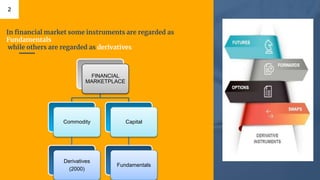
In financial market some instruments are regarded as
Fundamentals
while others are regarded as derivatives
2
FINANCIAL
MARKETPLACE
Commodity
Derivatives
(2000)
Capital
Fundamentals
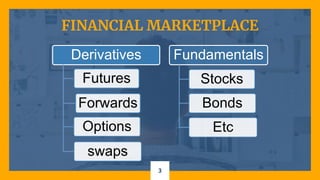
FINANCIAL MARKETPLACE
3
Derivatives
Futures
Forwards
Options
swaps
Fundamentals
Stocks
Bonds
Etc
WHAT IS
FINANCIAL
DERIVATIVE?
Let’s start with the first set of slides
4
“
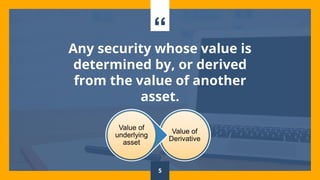
Any security whose value is
determined by, or derived
from the value of another
asset.
5
Value of
Derivative
Value of
underlying
asset
6
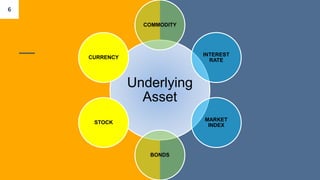
Underlying
Asset
COMMODITY
INTEREST
RATE
MARKET
INDEX
BONDS
STOCK
CURRENCY
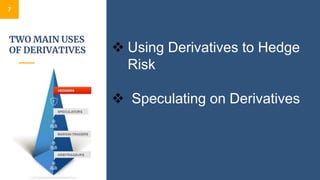
TWO MAIN USES
OF DERIVATIVES
7
 Using Derivatives to Hedge
Risk
 Speculating on Derivatives
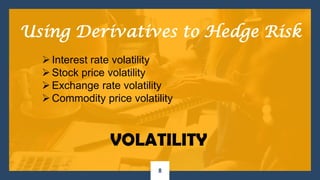
Using Derivatives to Hedge Risk
8
Interest rate volatility
Stock price volatility
Exchange rate volatility
Commodity price volatility
VOLATILITY
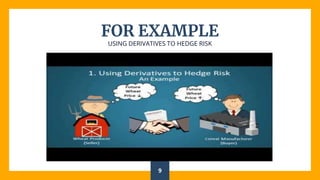
FOR EXAMPLE
USING DERIVATIVES TO HEDGE RISK
9
10
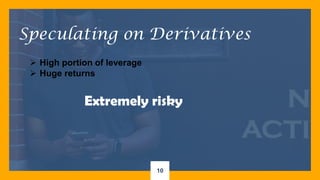
Speculating on Derivatives
 High portion of leverage
 Huge returns
Extremely risky
A picture is worth a thousand words
A complex idea can be conveyed
with just a single still image,
namely making it possible to
absorb large amounts of data
quickly.
11
Types of
Derivatives
12
Types of Derivatives
FORWARD
A customized contract between 2 parties to buy or sell an asset at a specified price at a specified future
date.
Over the counter exchange.
Settled at the end of the period.
FUTURES
Like forwards, but are standardized and regulated.
Traded on future exchange.
Daily settled.
OPTIONS
A contract that gives the right but not the obligation to buy (call) or sell (put) a security or other financial
asset.
SWAPS
The exchange of one security for another, based on different factors.
13
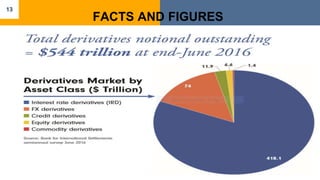
FACTS AND FIGURES
14
Conclusion
15
Largely, retail investor are found to be using
the derivatives products for the purpose of
hedging and speculation. Derivatives are
most commonly used tools for hedging risk
in the market but they cannot completely
eliminate the risk of the firms they can only
minimize the risk included in the trade.
16

Derivatives