Imperative
Mood
(Modo
Imperativo)
Discussants:
BARRIOS, Marygrace
BEATO, Jambay
BERMUNDO, Mathel
Table of Contents:
Imperative Mood
Imperativo Positvo y Negativo
Explaining One’s
Preferences
(Affirmative and Negative)
01
02
03
What is
Imperative
Mood?
01
The Imperative Mood is used to give
commands or orders in Spanish. It is a
very direct way to give an order.
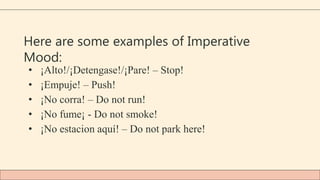
Here are some examples of Imperative
Mood:
• ¡Alto!/¡Detengase!/¡Pare! – Stop!
• ¡Empuje! – Push!
• ¡No corra! – Do not run!
• ¡No fume¡ - Do not smoke!
• ¡No estacion aquí! – Do not park here!
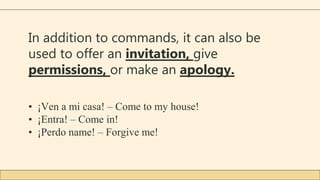
In addition to commands, it can also be
used to offer an invitation, give
permissions, or make an apology.
• ¡Ven a mi casa! – Come to my house!
• ¡Entra! – Come in!
• ¡Perdo name! – Forgive me!
Imperativo
Positvo y
Negativo
02
2 different types of Spanish imperative
verbs
- Imperativo Positivo
- Imperativo Negativo
Imperative Positive is a Spanish verb,
command, or order that tells someone to
complete an action or do something.
Imperativo Postivo
(Imperative + )
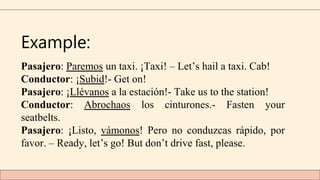
Pasajero: Paremos un taxi. ¡Taxi! – Let’s hail a taxi. Cab!
Conductor: ¡Subid!- Get on!
Pasajero: ¡Llévanos a la estación!- Take us to the station!
Conductor: Abrochaos los cinturones.- Fasten your
seatbelts.

Pasajero: ¡Listo, vámonos! Pero no conduzcas rápido, por
favor. – Ready, let’s go! But don’t drive fast, please.
Example:
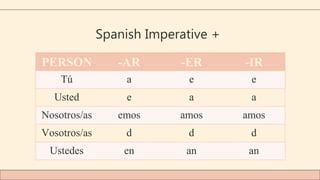
Spanish Imperative +
PERSON -AR -ER -IR
Tú a e e
Usted e a a
Nosotros/as emos amos amos
Vosotros/as d d d
Ustedes en an an
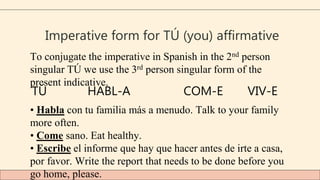
Imperative form for TÚ (you) affirmative
To conjugate the imperative in Spanish in the 2nd person
singular TÚ we use the 3rd person singular form of the
present indicative.
TÚ HABL-A COM-E VIV-E
• Habla con tu familia más a menudo. Talk to your family
more often.
• Come sano. Eat healthy.
• Escribe el informe que hay que hacer antes de irte a casa,
por favor. Write the report that needs to be done before you
go home, please.
Imperative form for Usted (you formal)
affirmative
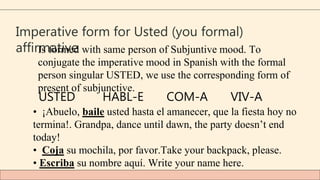
Is formed with same person of Subjuntive mood. To
conjugate the imperative mood in Spanish with the formal
person singular USTED, we use the corresponding form of
present of subjunctive.
USTED HABL-E COM-A VIV-A
• ¡Abuelo, baile usted hasta el amanecer, que la fiesta hoy no
termina!. Grandpa, dance until dawn, the party doesn’t end
today!
• Coja su mochila, por favor.Take your backpack, please.
• Escriba su nombre aquí. Write your name here.
Imperative form for VOSOTROS (you all)
affirmative
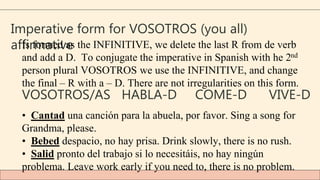
Is formed as the INFINITIVE, we delete the last R from de verb
and add a D. To conjugate the imperative in Spanish with he 2nd
person plural VOSOTROS we use the INFINITIVE, and change
the final – R with a – D. There are not irregularities on this form.
VOSOTROS/AS HABLA-D COME-D VIVE-D
• Cantad una canción para la abuela, por favor. Sing a song for
Grandma, please.
• Bebed despacio, no hay prisa. Drink slowly, there is no rush.
• Salid pronto del trabajo si lo necesitáis, no hay ningún
problema. Leave work early if you need to, there is no problem.
Imperative form for Ustedes (you all formal)
affirmative
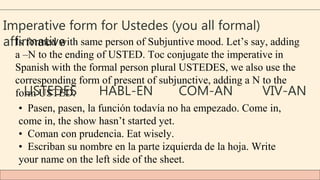
Is formed with same person of Subjuntive mood. Let’s say, adding
a –N to the ending of USTED. Toc conjugate the imperative in
Spanish with the formal person plural USTEDES, we also use the
corresponding form of present of subjunctive, adding a N to the
form USTED.
USTEDES HABL-EN COM-AN VIV-AN
• Pasen, pasen, la función todavía no ha empezado. Come in,
come in, the show hasn’t started yet.
• Coman con prudencia. Eat wisely.
• Escriban su nombre en la parte izquierda de la hoja. Write
your name on the left side of the sheet.
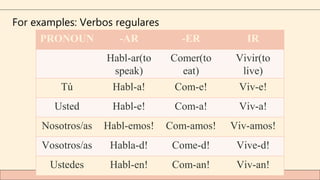
PRONOUN -AR -ER IR
Habl-ar(to
speak)
Comer(to
eat)
Vivir(to
live)
Tú Habl-a! Com-e! Viv-e!
Usted Habl-e! Com-a! Viv-a!
Nosotros/as Habl-emos! Com-amos! Viv-amos!
Vosotros/as Habla-d! Come-d! Vive-d!
Ustedes Habl-en! Com-an! Viv-an!
For examples: Verbos regulares
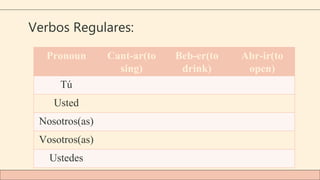
Verbos Regulares:
Pronoun Cant-ar(to
sing)
Beb-er(to
drink)
Abr-ir(to
open)
Tú
Usted
Nosotros(as)
Vosotros(as)
Ustedes
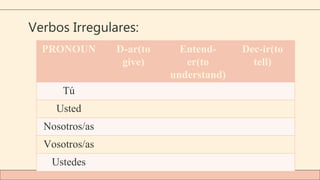
Verbos Irregulares:
PRONOUN D-ar(to
give)
Entend-
er(to
understand)
Dec-ir(to
tell)
Tú
Usted
Nosotros/as
Vosotros/as
Ustedes
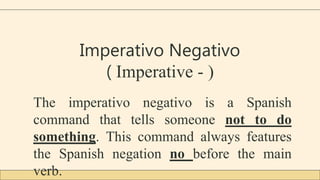
Imperativo Negativo
( Imperative - )
The imperativo negativo is a Spanish
command that tells someone not to do
something. This command always features
the Spanish negation no before the main
verb.
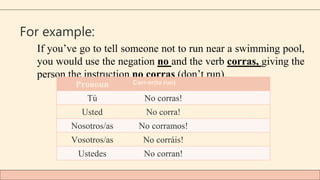
For example:
If you’ve go to tell someone not to run near a swimming pool,
you would use the negation no and the verb corras, giving the
person the instruction no corras (don’t run).
Pronoun Corr-er(to run)
Tú No corras!
Usted No corra!
Nosotros/as No corramos!
Vosotros/as No corráis!
Ustedes No corran!
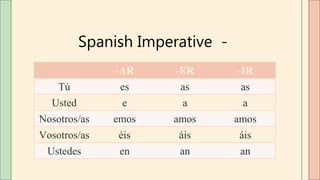
Spanish Imperative -
-AR -ER -IR
Tú es as as
Usted e a a
Nosotros/as emos amos amos
Vosotros/as éis áis áis
Ustedes en an an
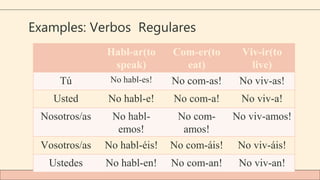
Examples: Verbos Regulares
Habl-ar(to
speak)
Com-er(to
eat)
Viv-ir(to
live)
Tú No habl-es! No com-as! No viv-as!
Usted No habl-e! No com-a! No viv-a!
Nosotros/as No habl-
emos!
No com-
amos!
No viv-amos!
Vosotros/as No habl-éis! No com-áis! No viv-áis!
Ustedes No habl-en! No com-an! No viv-an!
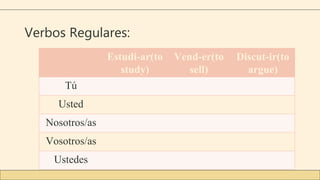
Verbos Regulares:
Estudi-ar(to
study)
Vend-er(to
sell)
Discut-ir(to
argue)
Tú
Usted
Nosotros/as
Vosotros/as
Ustedes
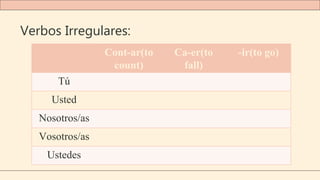
Verbos Irregulares:
Cont-ar(to
count)
Ca-er(to
fall)
-ir(to go)
Tú
Usted
Nosotros/as
Vosotros/as
Ustedes
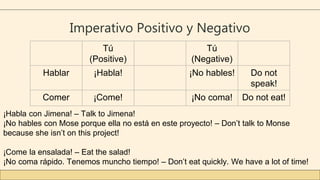
Imperativo Positivo y Negativo
Tú
(Positive)
Tú
(Negative)
Hablar ¡Habla! ¡No hables! Do not
speak!
Comer ¡Come! ¡No coma! Do not eat!
¡Habla con Jimena! – Talk to Jimena!
¡No hables con Mose porque ella no está en este proyecto! – Don’t talk to Monse
because she isn’t on this project!
¡Come la ensalada! – Eat the salad!
¡No coma rápido. Tenemos muncho tiempo! – Don’t eat quickly. We have a lot of time!
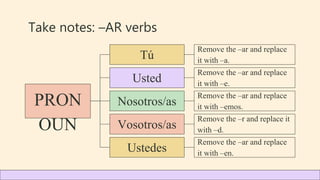
Take notes: –AR verbs
Remove the –ar and replace
it with –a.
PRON
OUN
Tú
Usted
Nosotros/as
Vosotros/as
Ustedes
Remove the –ar and replace
it with –e.
Remove the –ar and replace
it with –emos.
Remove the –r and replace it
with –d.
Remove the –ar and replace
it with –en.
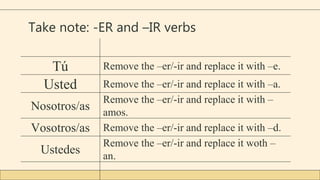
Take note: -ER and –IR verbs
Tú Remove the –er/-ir and replace it with –e.
Usted Remove the –er/-ir and replace it with –a.
Nosotros/as
Remove the –er/-ir and replace it with –
amos.
Vosotros/as Remove the –er/-ir and replace it with –d.
Ustedes
Remove the –er/-ir and replace it woth –
an.
Explaining One’s Preferences
(Affirmative and Negative)
03
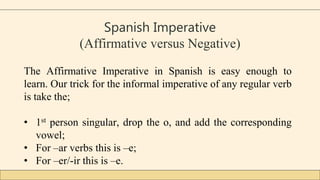
Spanish Imperative
(Affirmative versus Negative)
The Affirmative Imperative in Spanish is easy enough to
learn. Our trick for the informal imperative of any regular verb
is take the;
• 1st person singular, drop the o, and add the corresponding
vowel;
• For –ar verbs this is –e;
• For –er/-ir this is –e.
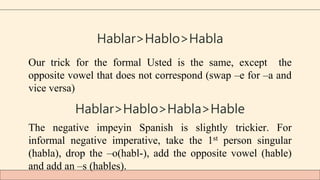
Hablar>Hablo>Habla
Our trick for the formal Usted is the same, except the
opposite vowel that does not correspond (swap –e for –a and
vice versa)
Hablar>Hablo>Habla>Hable
The negative impeyin Spanish is slightly trickier. For
informal negative imperative, take the 1st person singular
(habla), drop the –o(habl-), add the opposite vowel (hable)
and add an –s (hables).
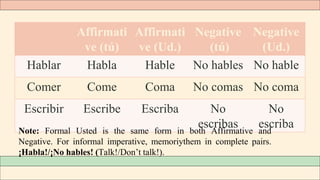
Affirmati
ve (tú)
Affirmati
ve (Ud.)
Negative
(tú)
Negative
(Ud.)
Hablar Habla Hable No hables No hable
Comer Come Coma No comas No coma
Escribir Escribe Escriba No
escribas
No
escriba
Note: Formal Usted is the same form in both Affirmative and
Negative. For informal imperative, memoriythem in complete pairs.
¡Habla!/¡No hables! (Talk!/Don’t talk!).
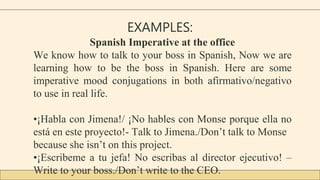
EXAMPLES:
Spanish Imperative at the office
We know how to talk to your boss in Spanish, Now we are
learning how to be the boss in Spanish. Here are some
imperative mood conjugations in both afirmativo/negativo
to use in real life.
•¡Habla con Jimena!/ ¡No hables con Monse porque ella no
está en este proyecto!- Talk to Jimena./Don’t talk to Monse
because she isn’t on this project.
•¡Escribeme a tu jefa! No escribas al director ejecutivo! –
Write to your boss./Don’t write to the CEO.
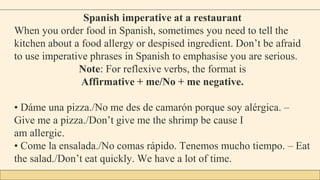
Spanish imperative at a restaurant
When you order food in Spanish, sometimes you need to tell the
kitchen about a food allergy or despised ingredient. Don’t be afraid
to use imperative phrases in Spanish to emphasise you are serious.
Note: For reflexive verbs, the format is
Affirmative + me/No + me negative.
• Dáme una pizza./No me des de camarón porque soy alérgica. –
Give me a pizza./Don’t give me the shrimp be cause I
am allergic.
• Come la ensalada./No comas rápido. Tenemos mucho tiempo. – Eat
the salad./Don’t eat quickly. We have a lot of time.
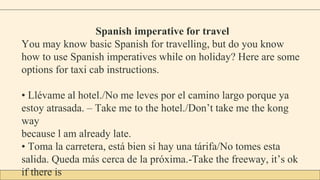
Spanish imperative for travel
You may know basic Spanish for travelling, but do you know
how to use Spanish imperatives while on holiday? Here are some
options for taxi cab instructions.
• Llévame al hotel./No me leves por el camino largo porque ya
estoy atrasada. – Take me to the hotel./Don’t take me the kong
way
because l am already late.
• Toma la carretera, está bien si hay una tárifa/No tomes esta
salida. Queda más cerca de la próxima.-Take the freeway, it’s ok
if there is
FIN.
QUIZ
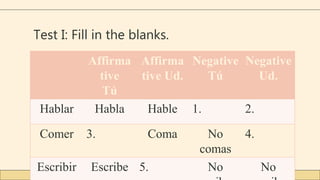
Test I: Fill in the blanks.
Affirma
tive
Tú
Affirma
tive Ud.
Negative
Tú
Negative
Ud.
Hablar Habla Hable 1. 2.
Comer 3. Coma No
comas
4.
Escribir Escribe 5. No No
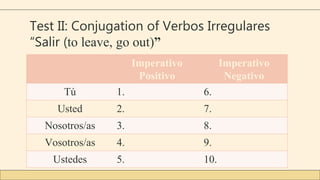
Test II: Conjugation of Verbos Irregulares
“Salir (to leave, go out)”
Imperativo
Positivo
Imperativo
Negativo
Tú 1. 6.
Usted 2. 7.
Nosotros/as 3. 8.
Vosotros/as 4. 9.
Ustedes 5. 10.
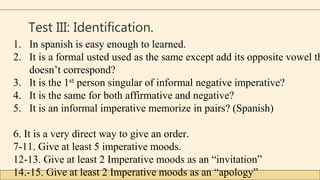
Test III: Identification.
1. In spanish is easy enough to learned.
2. It is a formal usted used as the same except add its opposite vowel th
doesn’t correspond?
3. It is the 1st person singular of informal negative imperative?
4. It is the same for both affirmative and negative?
5. It is an informal imperative memorize in pairs? (Spanish)
6. It is a very direct way to give an order.
7-11. Give at least 5 imperative moods.
12-13. Give at least 2 Imperative moods as an “invitation”
14.-15. Give at least 2 Imperative moods as an “apology”
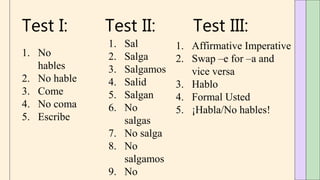
Test I:
1. No
hables
2. No hable
3. Come
4. No coma
5. Escribe
Test II:
1. Sal
2. Salga
3. Salgamos
4. Salid
5. Salgan
6. No
salgas
7. No salga
8. No
salgamos
9. No
Test III:
1. Affirmative Imperative
2. Swap –e for –a and
vice versa
3. Hablo
4. Formal Usted
5. ¡Habla/No hables!

G4-IMPERATIVE.pptx

  • 1.
  • 2.
  • 3.
    Table of Contents: ImperativeMood Imperativo Positvo y Negativo Explaining One’s Preferences (Affirmative and Negative) 01 02 03
  • 4.
  • 5.
    The Imperative Moodis used to give commands or orders in Spanish. It is a very direct way to give an order.
  • 6.
    Here are someexamples of Imperative Mood: • ¡Alto!/¡Detengase!/¡Pare! – Stop! • ¡Empuje! – Push! • ¡No corra! – Do not run! • ¡No fume¡ - Do not smoke! • ¡No estacion aquí! – Do not park here!
  • 7.
    In addition tocommands, it can also be used to offer an invitation, give permissions, or make an apology. • ¡Ven a mi casa! – Come to my house! • ¡Entra! – Come in! • ¡Perdo name! – Forgive me!
  • 8.
  • 9.
    2 different typesof Spanish imperative verbs - Imperativo Positivo - Imperativo Negativo
  • 10.
    Imperative Positive isa Spanish verb, command, or order that tells someone to complete an action or do something. Imperativo Postivo (Imperative + )
  • 11.
    Pasajero: Paremos untaxi. ¡Taxi! – Let’s hail a taxi. Cab! Conductor: ¡Subid!- Get on! Pasajero: ¡Llévanos a la estación!- Take us to the station! Conductor: Abrochaos los cinturones.- Fasten your seatbelts. Pasajero: ¡Listo, vámonos! Pero no conduzcas rápido, por favor. – Ready, let’s go! But don’t drive fast, please. Example:
  • 12.
    Spanish Imperative + PERSON-AR -ER -IR Tú a e e Usted e a a Nosotros/as emos amos amos Vosotros/as d d d Ustedes en an an
  • 13.
    Imperative form forTÚ (you) affirmative To conjugate the imperative in Spanish in the 2nd person singular TÚ we use the 3rd person singular form of the present indicative. TÚ HABL-A COM-E VIV-E • Habla con tu familia más a menudo. Talk to your family more often. • Come sano. Eat healthy. • Escribe el informe que hay que hacer antes de irte a casa, por favor. Write the report that needs to be done before you go home, please.
  • 14.
    Imperative form forUsted (you formal) affirmative Is formed with same person of Subjuntive mood. To conjugate the imperative mood in Spanish with the formal person singular USTED, we use the corresponding form of present of subjunctive. USTED HABL-E COM-A VIV-A • ¡Abuelo, baile usted hasta el amanecer, que la fiesta hoy no termina!. Grandpa, dance until dawn, the party doesn’t end today! • Coja su mochila, por favor.Take your backpack, please. • Escriba su nombre aquí. Write your name here.
  • 15.
    Imperative form forVOSOTROS (you all) affirmative Is formed as the INFINITIVE, we delete the last R from de verb and add a D. To conjugate the imperative in Spanish with he 2nd person plural VOSOTROS we use the INFINITIVE, and change the final – R with a – D. There are not irregularities on this form. VOSOTROS/AS HABLA-D COME-D VIVE-D • Cantad una canción para la abuela, por favor. Sing a song for Grandma, please. • Bebed despacio, no hay prisa. Drink slowly, there is no rush. • Salid pronto del trabajo si lo necesitáis, no hay ningún problema. Leave work early if you need to, there is no problem.
  • 16.
    Imperative form forUstedes (you all formal) affirmative Is formed with same person of Subjuntive mood. Let’s say, adding a –N to the ending of USTED. Toc conjugate the imperative in Spanish with the formal person plural USTEDES, we also use the corresponding form of present of subjunctive, adding a N to the form USTED. USTEDES HABL-EN COM-AN VIV-AN • Pasen, pasen, la función todavía no ha empezado. Come in, come in, the show hasn’t started yet. • Coman con prudencia. Eat wisely. • Escriban su nombre en la parte izquierda de la hoja. Write your name on the left side of the sheet.
  • 17.
    PRONOUN -AR -ERIR Habl-ar(to speak) Comer(to eat) Vivir(to live) Tú Habl-a! Com-e! Viv-e! Usted Habl-e! Com-a! Viv-a! Nosotros/as Habl-emos! Com-amos! Viv-amos! Vosotros/as Habla-d! Come-d! Vive-d! Ustedes Habl-en! Com-an! Viv-an! For examples: Verbos regulares
  • 18.
  • 19.
  • 20.
    Imperativo Negativo ( Imperative- ) The imperativo negativo is a Spanish command that tells someone not to do something. This command always features the Spanish negation no before the main verb.
  • 21.
    For example: If you’vego to tell someone not to run near a swimming pool, you would use the negation no and the verb corras, giving the person the instruction no corras (don’t run). Pronoun Corr-er(to run) Tú No corras! Usted No corra! Nosotros/as No corramos! Vosotros/as No corráis! Ustedes No corran!
  • 22.
    Spanish Imperative - -AR-ER -IR Tú es as as Usted e a a Nosotros/as emos amos amos Vosotros/as éis áis áis Ustedes en an an
  • 23.
    Examples: Verbos Regulares Habl-ar(to speak) Com-er(to eat) Viv-ir(to live) TúNo habl-es! No com-as! No viv-as! Usted No habl-e! No com-a! No viv-a! Nosotros/as No habl- emos! No com- amos! No viv-amos! Vosotros/as No habl-éis! No com-áis! No viv-áis! Ustedes No habl-en! No com-an! No viv-an!
  • 24.
  • 25.
  • 26.
    Imperativo Positivo yNegativo Tú (Positive) Tú (Negative) Hablar ¡Habla! ¡No hables! Do not speak! Comer ¡Come! ¡No coma! Do not eat! ¡Habla con Jimena! – Talk to Jimena! ¡No hables con Mose porque ella no está en este proyecto! – Don’t talk to Monse because she isn’t on this project! ¡Come la ensalada! – Eat the salad! ¡No coma rápido. Tenemos muncho tiempo! – Don’t eat quickly. We have a lot of time!
  • 27.
    Take notes: –ARverbs Remove the –ar and replace it with –a. PRON OUN Tú Usted Nosotros/as Vosotros/as Ustedes Remove the –ar and replace it with –e. Remove the –ar and replace it with –emos. Remove the –r and replace it with –d. Remove the –ar and replace it with –en.
  • 28.
    Take note: -ERand –IR verbs Tú Remove the –er/-ir and replace it with –e. Usted Remove the –er/-ir and replace it with –a. Nosotros/as Remove the –er/-ir and replace it with – amos. Vosotros/as Remove the –er/-ir and replace it with –d. Ustedes Remove the –er/-ir and replace it woth – an.
  • 29.
  • 30.
    Spanish Imperative (Affirmative versusNegative) The Affirmative Imperative in Spanish is easy enough to learn. Our trick for the informal imperative of any regular verb is take the; • 1st person singular, drop the o, and add the corresponding vowel; • For –ar verbs this is –e; • For –er/-ir this is –e.
  • 31.
    Hablar>Hablo>Habla Our trick forthe formal Usted is the same, except the opposite vowel that does not correspond (swap –e for –a and vice versa) Hablar>Hablo>Habla>Hable The negative impeyin Spanish is slightly trickier. For informal negative imperative, take the 1st person singular (habla), drop the –o(habl-), add the opposite vowel (hable) and add an –s (hables).
  • 32.
    Affirmati ve (tú) Affirmati ve (Ud.) Negative (tú) Negative (Ud.) HablarHabla Hable No hables No hable Comer Come Coma No comas No coma Escribir Escribe Escriba No escribas No escriba Note: Formal Usted is the same form in both Affirmative and Negative. For informal imperative, memoriythem in complete pairs. ¡Habla!/¡No hables! (Talk!/Don’t talk!).
  • 33.
    EXAMPLES: Spanish Imperative atthe office We know how to talk to your boss in Spanish, Now we are learning how to be the boss in Spanish. Here are some imperative mood conjugations in both afirmativo/negativo to use in real life. •¡Habla con Jimena!/ ¡No hables con Monse porque ella no está en este proyecto!- Talk to Jimena./Don’t talk to Monse because she isn’t on this project. •¡Escribeme a tu jefa! No escribas al director ejecutivo! – Write to your boss./Don’t write to the CEO.
  • 34.
    Spanish imperative ata restaurant When you order food in Spanish, sometimes you need to tell the kitchen about a food allergy or despised ingredient. Don’t be afraid to use imperative phrases in Spanish to emphasise you are serious. Note: For reflexive verbs, the format is Affirmative + me/No + me negative. • Dáme una pizza./No me des de camarón porque soy alérgica. – Give me a pizza./Don’t give me the shrimp be cause I am allergic. • Come la ensalada./No comas rápido. Tenemos mucho tiempo. – Eat the salad./Don’t eat quickly. We have a lot of time.
  • 35.
    Spanish imperative fortravel You may know basic Spanish for travelling, but do you know how to use Spanish imperatives while on holiday? Here are some options for taxi cab instructions. • Llévame al hotel./No me leves por el camino largo porque ya estoy atrasada. – Take me to the hotel./Don’t take me the kong way because l am already late. • Toma la carretera, está bien si hay una tárifa/No tomes esta salida. Queda más cerca de la próxima.-Take the freeway, it’s ok if there is
  • 36.
  • 38.
  • 39.
    Test I: Fillin the blanks. Affirma tive Tú Affirma tive Ud. Negative Tú Negative Ud. Hablar Habla Hable 1. 2. Comer 3. Coma No comas 4. Escribir Escribe 5. No No
  • 40.
    Test II: Conjugationof Verbos Irregulares “Salir (to leave, go out)” Imperativo Positivo Imperativo Negativo Tú 1. 6. Usted 2. 7. Nosotros/as 3. 8. Vosotros/as 4. 9. Ustedes 5. 10.
  • 41.
    Test III: Identification. 1.In spanish is easy enough to learned. 2. It is a formal usted used as the same except add its opposite vowel th doesn’t correspond? 3. It is the 1st person singular of informal negative imperative? 4. It is the same for both affirmative and negative? 5. It is an informal imperative memorize in pairs? (Spanish) 6. It is a very direct way to give an order. 7-11. Give at least 5 imperative moods. 12-13. Give at least 2 Imperative moods as an “invitation” 14.-15. Give at least 2 Imperative moods as an “apology”
  • 43.
    Test I: 1. No hables 2.No hable 3. Come 4. No coma 5. Escribe Test II: 1. Sal 2. Salga 3. Salgamos 4. Salid 5. Salgan 6. No salgas 7. No salga 8. No salgamos 9. No Test III: 1. Affirmative Imperative 2. Swap –e for –a and vice versa 3. Hablo 4. Formal Usted 5. ¡Habla/No hables!