© 2021 Luxonis
DepthAI: Embedded,
Performant Spatial AI and CV
Brandon Gilles
Luxonis
© 2021 Luxonis
Start with the Why
• Pressing health/safety problem
• Combination 3 available technologies solve the problem:
• Spatial sensing (disparity depth, Lidar)
• AI (neural inference)
• CV (feature extraction tracking, platform pose/motion estimation, etc.)
• But only tractable if on an embedded system (low size, weight, power, and cost) and
performant
• No platform existed that had all 5 of these:
• Embedded, Performant, Spatial, AI and CV
2
© 2021 Luxonis
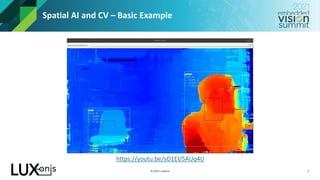
What is Spatial AI and CV?
• The capability to get neural inference results (e.g. semantic segmentation) in physical
space.
• E.g.: XYZ locations of all the ripe strawberries in real-time.
• Tight fusion of
• AI (object detection, semantic segmentation, etc.)
• with CV (platform motion/pose, object tracking)
• and Depth (disparity)
• to give 3D position in world coordinates of detected objects, features, or semantic
labels (at the pixel level).
3
© 2021 Luxonis
Spatial AI and CV – Basic Example
https://youtu.be/sO1EU5AUq4U
4
© 2021 Luxonis
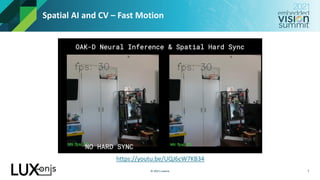
Spatial AI and CV – Fast Motion
https://youtu.be/UQJ6cW7KB34
5
© 2021 Luxonis
New Era of Performance on Embedded Systems
• Traditionally, the capability to handle any of the following necessitated a full-fledged
operating system-capable computer:
• High resolution image sensors
• High frame rates
• Multiple image sensors
• Complex AI + CV pipelines
• Spatial sensing
• This is now all doable on an embedded system
• And this opens up all sorts of applications which were previously intractable
6
© 2021 Luxonis
Example: AI-Guided Lossless Zoom
https://youtu.be/H-FjrbWsaKg
7
© 2021 Luxonis
Example: AI-Guided Lossless Zoom
https://youtu.be/uylZgG3yLiU
8
© 2021 Luxonis
Asymmetric Multi-Processor Embedded System
• Network on Chip (NoC) architecture allows tying together AI/CV/Spatial hardware:
• 16 Vector processors (think GPU, but architected for computer vision)
• ~20 fixed-function CV processors (Harris, Canny, warp/dewarp, motion estimation)
• 2 AI processors
• 1 semi-global-matching disparity-depth hardware block
• The network on chip is prioritizable, so that it’s selectable which functions drink from
the fire-hose of the high-resolution sensor(s)
• Our DepthAI Pipeline Builder allows quick/easy configuration for your application
9
© 2021 Luxonis
DepthAI Pipeline Builder (Gen2)
10
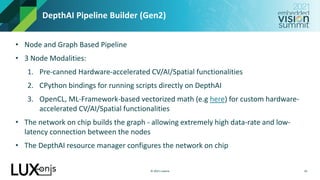
• Node and Graph Based Pipeline
• 3 Node Modalities:
1. Pre-canned Hardware-accelerated CV/AI/Spatial functionalities
2. CPython bindings for running scripts directly on DepthAI
3. OpenCL, ML-Framework-based vectorized math (e.g here) for custom hardware-
accelerated CV/AI/Spatial functionalities
• The network on chip builds the graph - allowing extremely high data-rate and low-
latency connection between the nodes
• The DepthAI resource manager configures the network on chip
© 2021 Luxonis
Gen2 Pipeline Builder Pre-Canned Nodes
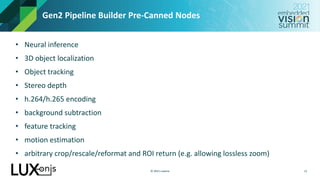
• Neural inference
• 3D object localization
• Object tracking
• Stereo depth
• h.264/h.265 encoding
• background subtraction
• feature tracking
• motion estimation
• arbitrary crop/rescale/reformat and ROI return (e.g. allowing lossless zoom)
11
© 2021 Luxonis
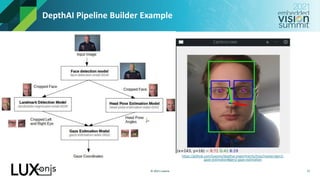
DepthAI Pipeline Builder Example
https://github.com/luxonis/depthai-experiments/tree/master/gen2-
gaze-estimation#gen2-gaze-estimation
12
© 2021 Luxonis
Built for Products – Open-Source, MIT-Licensed
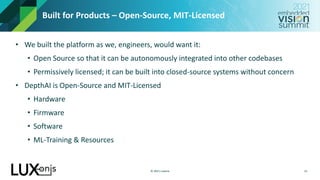
• We built the platform as we, engineers, would want it:
• Open Source so that it can be autonomously integrated into other codebases
• Permissively licensed; it can be built into closed-source systems without concern
• DepthAI is Open-Source and MIT-Licensed
• Hardware
• Firmware
• Software
• ML-Training & Resources
13
© 2021 Luxonis
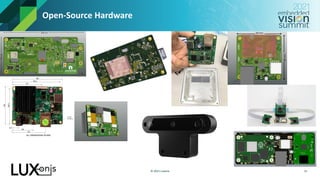
Open-Source Hardware – That You Can Buy
• Can buy all of these directly and us as supported products
• They are also all open-source reference designs, with full Altium Designer source files
14
© 2021 Luxonis
Open-Source Hardware
15
© 2021 Luxonis
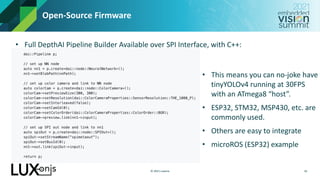
Open-Source Firmware
• Full DepthAI Pipeline Builder Available over SPI Interface, with C++:
16
• This means you can no-joke have
tinyYOLOv4 running at 30FPS
with an ATmega8 “host”.
• ESP32, STM32, MSP430, etc. are
commonly used.
• Others are easy to integrate
• microROS (ESP32) example
© 2021 Luxonis
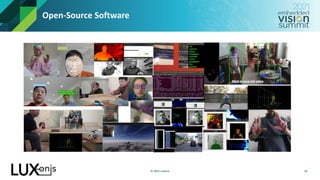
Open-Source Software
• Permissively (MIT-) Licensed so that closed-source products can be built royalty-free.
• We built this how we would want it.
• Python and C++ API parity
• ROS1 and ROS2 Integration
• Unity Plugin
• Wealth of reference pipelines
17
© 2021 Luxonis
Open-Source Software
18
© 2021 Luxonis
DepthAI Resources
19
2021 Embedded Vision Summit
Luxonis Demos:
• From-Behind Collision Detection for
People Who Ride Bikes
• Neural-Inference-Controlled
Crop/Zoom and H.265 Encode
• Spatial AI and CV for Human Machine
Safety
DepthAI Resources
DepthAI Documentation
https://docs.luxonis.com/en/latest/
DepthAI Community Discord
https://discord.gg/EPsZHkg9Nx
Where to buy DepthAI:
• Mouser
• Sparkfun
• OpenCV

“DepthAI: Embedded, Performant Spatial AI and Computer Vision,” a Presentation from Luxonis

  • 1.
    © 2021 Luxonis DepthAI:Embedded, Performant Spatial AI and CV Brandon Gilles Luxonis
  • 2.
    © 2021 Luxonis Startwith the Why • Pressing health/safety problem • Combination 3 available technologies solve the problem: • Spatial sensing (disparity depth, Lidar) • AI (neural inference) • CV (feature extraction tracking, platform pose/motion estimation, etc.) • But only tractable if on an embedded system (low size, weight, power, and cost) and performant • No platform existed that had all 5 of these: • Embedded, Performant, Spatial, AI and CV 2
  • 3.
    © 2021 Luxonis Whatis Spatial AI and CV? • The capability to get neural inference results (e.g. semantic segmentation) in physical space. • E.g.: XYZ locations of all the ripe strawberries in real-time. • Tight fusion of • AI (object detection, semantic segmentation, etc.) • with CV (platform motion/pose, object tracking) • and Depth (disparity) • to give 3D position in world coordinates of detected objects, features, or semantic labels (at the pixel level). 3
  • 4.
    © 2021 Luxonis SpatialAI and CV – Basic Example https://youtu.be/sO1EU5AUq4U 4
  • 5.
    © 2021 Luxonis SpatialAI and CV – Fast Motion https://youtu.be/UQJ6cW7KB34 5
  • 6.
    © 2021 Luxonis NewEra of Performance on Embedded Systems • Traditionally, the capability to handle any of the following necessitated a full-fledged operating system-capable computer: • High resolution image sensors • High frame rates • Multiple image sensors • Complex AI + CV pipelines • Spatial sensing • This is now all doable on an embedded system • And this opens up all sorts of applications which were previously intractable 6
  • 7.
    © 2021 Luxonis Example:AI-Guided Lossless Zoom https://youtu.be/H-FjrbWsaKg 7
  • 8.
    © 2021 Luxonis Example:AI-Guided Lossless Zoom https://youtu.be/uylZgG3yLiU 8
  • 9.
    © 2021 Luxonis AsymmetricMulti-Processor Embedded System • Network on Chip (NoC) architecture allows tying together AI/CV/Spatial hardware: • 16 Vector processors (think GPU, but architected for computer vision) • ~20 fixed-function CV processors (Harris, Canny, warp/dewarp, motion estimation) • 2 AI processors • 1 semi-global-matching disparity-depth hardware block • The network on chip is prioritizable, so that it’s selectable which functions drink from the fire-hose of the high-resolution sensor(s) • Our DepthAI Pipeline Builder allows quick/easy configuration for your application 9
  • 10.
    © 2021 Luxonis DepthAIPipeline Builder (Gen2) 10 • Node and Graph Based Pipeline • 3 Node Modalities: 1. Pre-canned Hardware-accelerated CV/AI/Spatial functionalities 2. CPython bindings for running scripts directly on DepthAI 3. OpenCL, ML-Framework-based vectorized math (e.g here) for custom hardware- accelerated CV/AI/Spatial functionalities • The network on chip builds the graph - allowing extremely high data-rate and low- latency connection between the nodes • The DepthAI resource manager configures the network on chip
  • 11.
    © 2021 Luxonis Gen2Pipeline Builder Pre-Canned Nodes • Neural inference • 3D object localization • Object tracking • Stereo depth • h.264/h.265 encoding • background subtraction • feature tracking • motion estimation • arbitrary crop/rescale/reformat and ROI return (e.g. allowing lossless zoom) 11
  • 12.
    © 2021 Luxonis DepthAIPipeline Builder Example https://github.com/luxonis/depthai-experiments/tree/master/gen2- gaze-estimation#gen2-gaze-estimation 12
  • 13.
    © 2021 Luxonis Builtfor Products – Open-Source, MIT-Licensed • We built the platform as we, engineers, would want it: • Open Source so that it can be autonomously integrated into other codebases • Permissively licensed; it can be built into closed-source systems without concern • DepthAI is Open-Source and MIT-Licensed • Hardware • Firmware • Software • ML-Training & Resources 13
  • 14.
    © 2021 Luxonis Open-SourceHardware – That You Can Buy • Can buy all of these directly and us as supported products • They are also all open-source reference designs, with full Altium Designer source files 14
  • 15.
  • 16.
    © 2021 Luxonis Open-SourceFirmware • Full DepthAI Pipeline Builder Available over SPI Interface, with C++: 16 • This means you can no-joke have tinyYOLOv4 running at 30FPS with an ATmega8 “host”. • ESP32, STM32, MSP430, etc. are commonly used. • Others are easy to integrate • microROS (ESP32) example
  • 17.
    © 2021 Luxonis Open-SourceSoftware • Permissively (MIT-) Licensed so that closed-source products can be built royalty-free. • We built this how we would want it. • Python and C++ API parity • ROS1 and ROS2 Integration • Unity Plugin • Wealth of reference pipelines 17
  • 18.
  • 19.
    © 2021 Luxonis DepthAIResources 19 2021 Embedded Vision Summit Luxonis Demos: • From-Behind Collision Detection for People Who Ride Bikes • Neural-Inference-Controlled Crop/Zoom and H.265 Encode • Spatial AI and CV for Human Machine Safety DepthAI Resources DepthAI Documentation https://docs.luxonis.com/en/latest/ DepthAI Community Discord https://discord.gg/EPsZHkg9Nx Where to buy DepthAI: • Mouser • Sparkfun • OpenCV