OpenLink Virtuoso – Linked Data Deploying Linked Data © 2009 OpenLink Software, All rights reserved
Linked Data “ Linked Data” – Title of a  Web Design Issues Note  by Tim Berners-Lee An effort to evolve current  “Web of Documents” into a “Web of Linked Data” Describes recommended best practice for injecting data into the Web Use the RDF data model Name real or abstract things (resources) in your ‘universe of discourse’ (Data Spaces), using URIs as unique IDs Make URIs accessible via HTTP so people can discover and explore your data via the Web Expose useful information via your URIs  Enhance your URIs by adding links to other data on the Web using their URIs, enhancing the link density and richness of the Web © 2009 OpenLink Software, All rights reserved
Common Web & Different Nature of URIs ‘ Linked Data Web ’ and the ‘ Document Web ’:  - two dimensions of the Web separated by a  common element   - the  Uniform Resource Identifier (URI) Document Web URIs T hese always point to “physical” Web documents (aka information resources)  URI = a URL when it specifies a location URI = a URN when it specifies a name (i.e. when not location bound) Linked Data Web URIs identify physical or   abstract  resources © 2009 OpenLink Software, All rights reserved
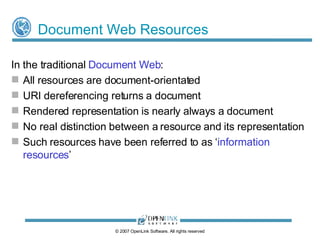
What are Resources? Web parlance for a Data Object or Entity that may be physical or abstract Document Web Resources are physical units of information (containers of contextualized data)  Linked Data Web Resources are generic real-world data objects or entities that include: People, Places, and other Things Abstract concepts (e.g. Emotion) Subject Matter (e.g. Science, Geography, Economics etc.) © 2009 OpenLink Software, All rights reserved
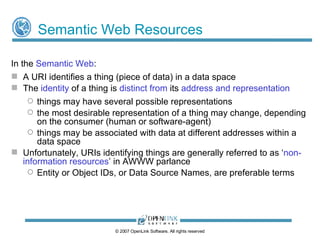
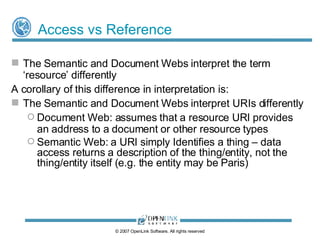
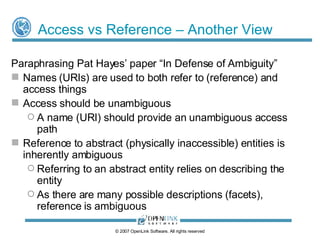
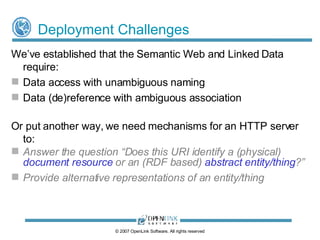
Resource Identity, Representation, and Access Identity (URI) of an Object or Entity should be unambiguous and globally unique On the Web a URI should provide an unambiguous data access path Reference to abstract (physically inaccessible) Objects or Entities is only achievable via conduit documents that carry representations of entity descriptions (which at best are facets of an entire description) The descriptive representations of an Object or Entity must be distinct from their URIs Data Access mechanisms must be independent and facilitate negotiation of representation. ©  2009  OpenLink Software, All rights reserved
Linked Data Deployment Requirements To establish real-world object URIs in the Linked Data Web realm, a Linked Data Server needs to honour the following requirements: Unique Global Identity for Resources using HTTP-based URIs Deployment platform needs ability to generate proxy Web resources to convey descriptions of real-world (possibly abstract) resources Challenges: Separation of  Identity  and  Representation  within the context of HTTP protocol mechanics Negotiable representation of resource descriptions through Transparent Content Negotiation and client-side or server-side QoS algorithms URL rewriting and query association © 2009 OpenLink Software, All rights reserved
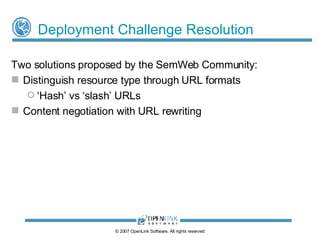
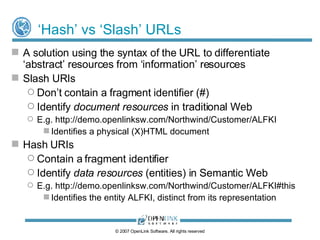
Real-World Object Naming - URI Schemes Linked Data Web URIs can take two forms: ‘ Slash’ URIs  - don’t contain a fragment identifier (#) ‏   http://demo.openlinksw.com/Northwind/Customer/ALFKI/id http://demo.openlinksw.com/Northwind/Customer/ALFKI/page http://demo.openlinksw.com/Northwind/Customer/ALFKI/data Identify an entity, it’s HTML representation (document), and it’s RDF representation (document) respectively ‘ Hash’ URIs  - contain a fragment identifier http://demo.openlinksw.com/Northwind/Customer/ALFKI#this Identifies the entity ALFKI, distinct from its representation  ( http://demo.openlinksw.com/Northwind/Customer/ALFKI ) © 2009 OpenLink Software, All rights reserved
Slash URI Semantics Separating identification and naming from representation using Slash URIs
Hash URI Semantics Separating identification and naming from representation using Hash URIs
Handling Identity with ‘Slash’ URIs For this URI scheme HTTP redirection (30X response) is required in order for resource “Identity” to be separated from “representation”. Examples: http://demo.openlinksw.com/Northwind/Customer/ALFKI/id   - URI of an Organization Entity http://demo.openlinksw.com/Northwind/Customer/ALFKI/ page   - HTML representation of Entity description http://demo.openlinksw.com/Northwind/Customer/ALFKI/data   - RDF representation that describes the Entity which could be: Turtle, N3, RDF/XML etc. based data serialization © 2009 OpenLink Software, All rights reserved
Handling Identity with ‘Hash’ URIs For this URI scheme HTTP redirection isn’t required in order for resource “Identity” to be separated from “representation”. Examples: http://demo.openlinksw.com/Northwind/Customer/ALFKI#this   - URI of an Organization Entity http://demo.openlinksw.com/Northwind/Customer/ALFKI  - a document (HTML, Turtle, N3, RDF/XML) representation of Entity description © 2009 OpenLink Software, All rights reserved
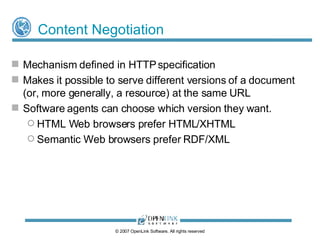
Negotiable Representation of Resource Descriptions Use HTTP’s in-built Content Negotiation mechanism to: Serve different format variants of the same resource description from one location Enable user agent (client-side) specification of preferred description representations by order of preference Enable server-side specification of preferred description representations by order of preference © 2009 OpenLink Software, All rights reserved
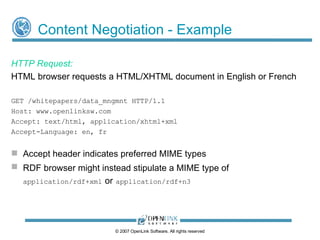
Content Negotiation - Example HTTP Request: HTML browser requests a HTML/XHTML document in English or French GET /whitepapers/data_mngmnt HTTP/1.1 Host: www.openlinksw.com Accept: text/html, application/xhtml+xml Accept-Language: en, fr Accept header indicates preferred MIME types RDF browser might instead stipulate a MIME type of   application/rdf+xml   or   application/rdf+n3 © 2009 OpenLink Software, All rights reserved
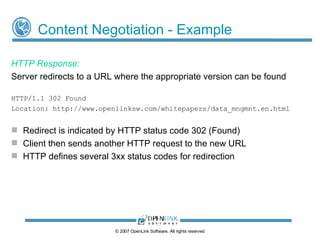
Content Negotiation - Example HTTP Response: Server redirects to a URL where the appropriate version can be found HTTP/1.1 302 Found Location: http://www.openlinksw.com/whitepapers/data_mngmnt.en.html Redirect is indicated by HTTP status code 302 (Found) ‏ Client then sends another HTTP request to the new URL HTTP defines several 3xx status codes for redirection © 2009 OpenLink Software, All rights reserved
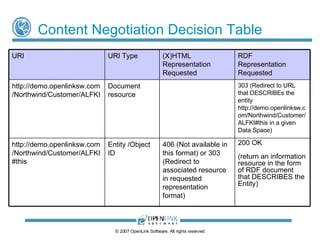
Content Negotiation Decision Table © 2009 OpenLink Software, All rights reserved 200 (OK) – return RDF based information resource < http://…/ALFKI>  that describes the entity < http://…/ ALFKI#this> using N3, Turtle, RDF/XML etc. 303 (Redirect) to (X)HTML document describing entity <http://…/ALFKI#this>, or 404 or 406 (Not available) if one doesn’t exist Hash based URI (identifies an entity / object ID) <http://demo.openlinksw.com/Northwind/Customer/ALFKI#this> 200 (OK) – if an RDF information resource exists on the server 200 OK Web Resource URL <http://demo.openlinksw.com/Northwind/Customer/ALFKI> RDF Representation Requested (X)HTML Representation Requested URI Type URI 200 (OK) if an (X)HTML information resource (document) exists, or 404 or 406 (Not available) if one doesn’t exist For static descriptions of a Data Object: Assumes there are static HTML and RDF documents available to provide HTML and RDF representations of the customer entity ALFKI
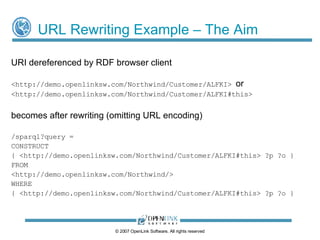
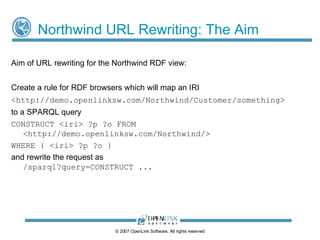
Dynamic RDF Renderings If entity descriptions are held in an RDF quad store: To provide a dynamic RDF rendering of the entity being dereferenced by the client: Use SPARQL DESCRIBE or CONSTRUCT DESCRIBE <entity-uri> FROM <graph-uri> ‘ Unconstrained’ – DESCRIBE output not prescribed by SPARQL specification Virtuoso supports custom procedures for generating output through SPARQL define sql:describe-mode CONSTRUCT { <entity-uri> ?p ?o } FROM <graph-uri> WHERE { <entity-uri> ?p ?o } © 2009 OpenLink Software, All rights reserved
Content Negotiation Decision Table © 2009 OpenLink Software, All rights reserved 200 (OK) – return RDF based information resource < http://…/ALFKI>  that describes the entity < http://…/ ALFKI#this> (N3, RDF/XML etc.) You can use SPARQL DESCRIBE to deliver RDF based description 303 (Redirect) to (X)HTML document describing entity <http://…/ALFKI#this>, or 404 or 406 (Not available) if one doesn’t exist Hash based URI (identifies an entity / object ID) <http://demo.openlinksw.com/Northwind/Customer/ALFKI#this> 200 (OK) – if an RDF information resource exists on the server 200 OK Web Resource URL <http://demo.openlinksw.com/Northwind/Customer/ALFKI> RDF Representation Requested (X)HTML Representation Requested URI Type URI 200 (OK) if an (X)HTML information resource (document) exists, or 404 or 406 (Not available) if one doesn’t exist For dynamically derived descriptions of a Data Object using SPARQL DESCRIBE:
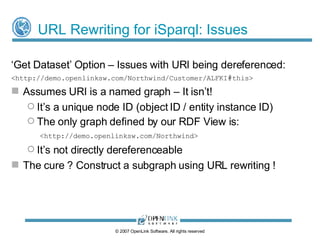
URL Rewriting Is the act of modifying a URL prior to final processing by a Web server Provides a means to build a URL ‘on the fly’ identifying the resource in the required representation format referred to by a 303 redirection Ideal solution is a rules-based URL rewriting processing pipeline using regular expression or sprintf substitutions © 2009 OpenLink Software, All rights reserved
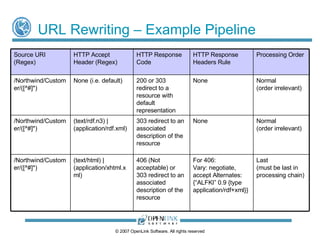
URL Rewriting – Example Pipeline © 2009 OpenLink Software, All rights reserved Last (must be last in processing chain)‏ For 406: Vary: negotiate, accept Alternates: {“ALFKI” 0.9 {type application/rdf+xml}} 200 (OK), or 406 (Not acceptable), or  303 redirect to a URL which can render the requested representation (text/html) | (*/*)‏ /Northwind/Customer/([^#]*)‏ Normal (order irrelevant)‏ None 303 redirect to a URL which DESCRIBEs the entity identified by the URI (text/rdf.n3) | (application/rdf.xml)‏ /Northwind/Customer/([^#]*)‏ Normal (order irrelevant)‏ None 200 or 303 depending on  QoS rules configured for TCN None (i.e. default)‏ /Northwind/Customer/([^#]*)‏ Rule Processing Order HTTP Response Headers Rule HTTP Response Code HTTP Accept Header (Regex)‏ Source URI (Regex)‏
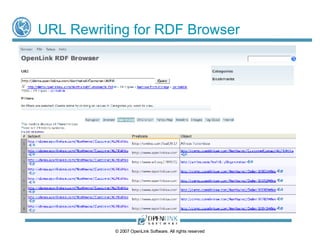
Content negotiation for RDF representation © 2009 OpenLink Software, All rights reserved
Deploying Linked Data Using Virtuoso Virtuoso’s approach is to implement the generic solution outlined so far, using Content negotiation URL rewriting Virtuoso includes a  Rules-based URL Rewriter Can be used to inject Linked Data into the Document Web © 2009 OpenLink Software, All rights reserved
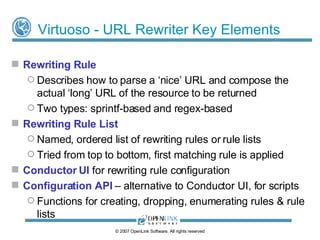
Virtuoso - URL Rewriter Key Elements Rewriting Rule Describes how to parse a source URL and compose the URL of the resource returned in “Location:” response headers Two types: sprintf-based and regex-based Rewriting Rule List Named, ordered list of rewriting rules or rule lists Tried from top to bottom, first matching rule is applied Conductor UI  for rewriting rule configuration Configuration API  – alternative to Conductor UI, for scripts Functions for creating, dropping, enumerating rules & rule lists © 2009 OpenLink Software, All rights reserved
Conductor UI for URL Rewriter ©  2009  OpenLink Software, All rights reserved RDF view for Northwind sample database: Rewriting rule for HTML requests
Conductor UI for URL Rewriter ©  2009  OpenLink Software, All rights reserved RDF view for Northwind sample database: Rewriting rule for RDF/XML or N3 based resource description requests
Conductor UI for URL Rewriter ©  2009  OpenLink Software, All rights reserved Defining the SPARQL query underpinning the ‘Destination Path Format’ of the RDF/XML / N3 rewriting rule – Automatically URL encoded when saved
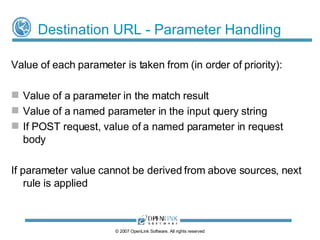
Rewrite Rule Components in Conductor UI Request Path Pattern e.g. (/[^#]*) a regular expression matched against the input path Substitution parameters Each successive pair of parentheses in the regex denotes a parameter referred to elsewhere in the rewrite rule as $U1, $U2, $U3 … or $s1, $s2, $s3 … Can be used to substitute the part of the input path that was matched into the new URL being composed $accept parameter substitutes matched content types specified in Accept header ‘ U’ format specifier – URL encodes inserted text ‘ s’ format specifier – inserts matched text ‘as is’ ©  2009  OpenLink Software, All rights reserved
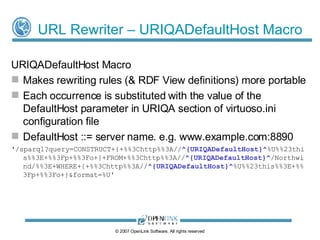
URL Rewriter – URIQADefaultHost Macro URIQADefaultHost Macro Makes rewriting rules (& RDF View definitions) more portable Each occurrence is substituted with the value of the DefaultHost parameter in URIQA section of virtuoso.ini configuration file DefaultHost ::= server name. e.g. www.example.com:8890 DESCRIBE <http:///^{URIQADefaultHost}^$U1#this>  FROM <http://^{URIQADefaultHost}^/Northwind> ©  2009  OpenLink Software, All rights reserved
URL Rewriting Process for RDF Requests ©  2009  OpenLink Software, All rights reserved
URL Rewriting Process for HTML Requests ©  2009  OpenLink Software, All rights reserved HTML requests are redirected via proxy /about/html to a rendering template -  description.vsp description.vsp rendering of Customer entity <http://demo.openlinksw.com/Northwind/Customer/ALFKI#this>
description.vsp – Rendering RDF as HTML Destination path in rewrite rule for HTML requests: /about/html/http://^{URIQADefaultHost}^$s1 Redirects client to the  Virtuoso  ‘Page Description Service’  via proxy interface /about/html Page description services invokes description.vsp which in turn invokes the Virtuoso Sponger Sponger: a customizable RDFizer with pluggable cartridges Extracts RDF from the target URL Native RDF sources: RDF is returned ‘as is’ Non-RDF sources: Meta-data is extracted and converted to RDF using ontology mapping and XSLT description.vsp renders the extracted RDF as HTML Substitutes RDF ‘hyperdata’ links with HTML hyperlinks ©  2009  OpenLink Software, All rights reserved
Exporting URL Rewriting Rules from Conductor Rewrite rules configured in Conductor can be exported as Virtuoso PL for backup, use on another system etc. Exported script recreates rules using Virtuoso’s  URL Rewriting Configuration API ©  2009  OpenLink Software, All rights reserved
Example Exported Rule Definitions ©  2009  OpenLink Software, All rights reserved DB.DBA.VHOST_DEFINE  ( lhost=>'*ini*', vhost=>'*ini*', lpath=>'/Northwind',ppath=>'/DAV/home/demo/', is_dav=>1, vsp_user=>'dba', ses_vars=>0, opts=>vector ('url_rewrite', 'demo_nw_rule_list1'), is_default_host=>0); DB.DBA.URLREWRITE_CREATE_RULELIST  ( 'demo_nw_rule_list1', 1, vector ('demo_nw_rule1', 'demo_nw_rule2')); DB.DBA.URLREWRITE_CREATE_REGEX_RULE  ( 'demo_nw_rule1', 1, '(/[^#]*)',vector ('path'), 1, '/about/html/http://^{URIQADefaultHost}^%s',  vector ('path'),  NULL, '(text/html)|(\\*/\\*)', 0, 303, NULL); DB.DBA.URLREWRITE_CREATE_REGEX_RULE  (  'demo_nw_rule2', 1, '(/[^#]*)', vector ('path'), 1, '/sparql?query=DESCRIBE+%%3Chttp%%3A//^{URIQADefaultHost}^%U%%23this%%3E+%%3Chttp%%3A//^{URIQADefaultHost}^%U%%3E+FROM+%%3Chttp%%3A//^{URIQADefaultHost}^/Northwind%%3E&format=%U', vector ('path', 'path', '*accept*'), NULL, '(text/rdf.n3)|(application/rdf.xml)', 0, NULL, NULL);
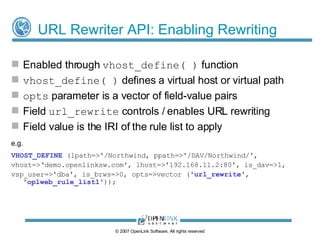
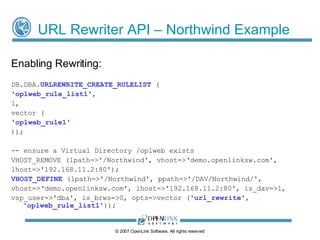
URL Rewriter API: Enabling Rewriting Enabled through  vhost_define( )  function vhost_define( )  defines a virtual host or virtual path opts  parameter is a vector of field-value pairs Field  url_rewrite  controls / enables URL rewriting Field value is the IRI of the rule list to apply e.g.   DB.DBA.VHOST_DEFINE  ( lhost=>'*ini*', vhost=>'*ini*', lpath=>'/Northwind',ppath=>'/DAV/home/demo/', is_dav=>1, vsp_user=>'dba', ses_vars=>0, opts=>vector ('url_rewrite', 'demo_nw_rule_list1'), is_default_host=>0); ©  2009  OpenLink Software, All rights reserved
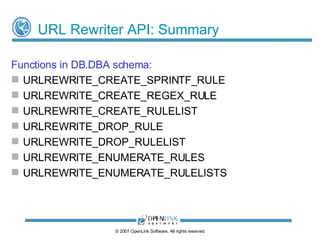
URL Rewriter API: Summary Functions in DB.DBA schema: URLREWRITE_CREATE_SPRINTF_RULE URLREWRITE_CREATE_REGEX_RULE URLREWRITE_CREATE_RULELIST URLREWRITE_DROP_RULE URLREWRITE_DROP_RULELIST URLREWRITE_ENUMERATE_RULES URLREWRITE_ENUMERATE_RULELISTS ©  2009  OpenLink Software, All rights reserved
‘ Nice’ URLs vs ‘Long’ URLs Rewriter developed with broader objectives than Linked Data – consequently influenced terminology Rewriter takes a ‘nice’ URL and rewrites it as a ‘long’ URL ‘ Nice’ URL Free from parameters, typically short ‘ Long’ URL Typically contains query string with named parameters Often ignored by web crawlers (viewed as highly dynamic) => low page ranking ©  2009  OpenLink Software, All rights reserved
Sprintf Rules vs Regex Rules Rewrite rules take two forms: sprintf-based & regex-based: For ‘nice’ to ‘long’ URL conversion Functionally equivalent Only difference is syntax of match pattern definition For ‘long’ to ‘nice’ URL conversion Only works for sprintf-based rules Regex-based rules are unidirectional ©  2009  OpenLink Software, All rights reserved
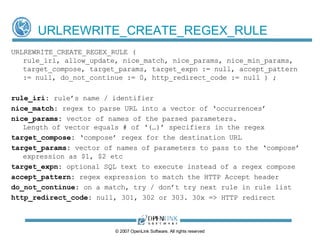
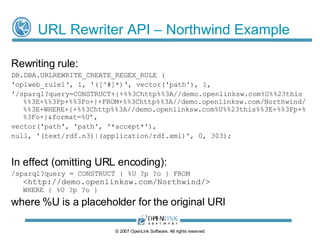
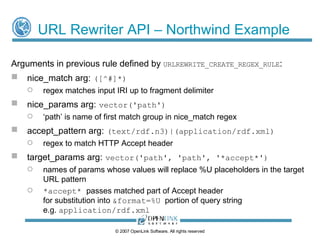
URLREWRITE_CREATE_REGEX_RULE URLREWRITE_CREATE_REGEX_RULE  ( rule_iri, allow_update, nice_match, nice_params, nice_min_params, target_compose, target_params, target_expn := null,  accept_pattern := null, do_not_continue := 0,  http_redirect_code := null, http_headers := null) ; rule_iri:  rule’s name / identifier nice_match:  regex to parse URL into a vector of ‘occurrences’ nice_params:  vector of names of the parsed parameters. Length of vector equals # of ‘(…)’ specifiers in the regex target_compose:  ‘compose’ regex for the destination URL target_params:  vector of names of parameters to pass to the ‘compose’ expression as $1, $2 etc target_expn:  optional SQL text to execute instead of a regex compose accept_pattern:  regex expression to match the HTTP Accept header do_not_continue:  on a match, try / don’t try next rule in rule list http_redirect_code:  null, 301, 302 or 303. 30x => HTTP redirect http_headers:  HTTP headers to supply with the rewritten request ©  2009  OpenLink Software, All rights reserved
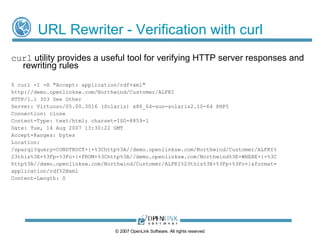
URL Rewriter - Verification with curl curl  utility provides a useful tool for verifying HTTP server responses and rewriting rules $ curl -I -H &quot;Accept: application/rdf+xml&quot; http://demo.openlinksw.com/Northwind/ Customer/ALFKI HTTP/1.1 303 See Other Server: Virtuoso/05.09.3037 (Solaris) x86_64-sun-solaris2.10-64 VDB Connection: close Content-Type: text/html; charset=ISO-8859-1 Date: Thu, 12 Feb 2009 11:23:31 GMT Accept-Ranges: bytes Location: http://demo.openlinksw.com/sparql?query=DESCRIBE+%3Chttp %3A//demo.openlinksw.com%2FNorthwind%2FCustomer%2FALFKI%23this%3E+%3Chttp %3A//demo.openlinksw.com%2FNorthwind%2FCustomer%2FALFKI%3E+FROM+%3Chttp %3A//demo.openlinksw.com/Northwind%3E&format=application%2Frdf%2Bxml Content-Length: 0 Note:  default rule for RDF requests changed to return HTTP response 303, rather than use an internal redirect, to allow the generated SPARQL query to be viewed and checked with curl ©  2009  OpenLink Software, All rights reserved
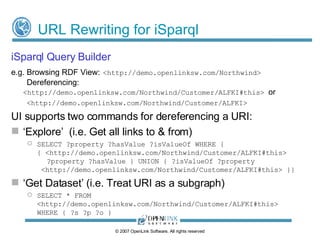
Browsing & Exploring Linked Data OpenLink Data Explorer (ODE) Browser extension (Firefox, support for others to follow) See  http://ode.openlinksw.com RDF and HTML views of Linked Data RDF view incorporates ‘hyperdata’ links between entities HTML view substitutes hyperlinks Also available as a hosted service E.g. http://demo.openlinksw.com/ode iSparql Query Tool Interactive SPARQL Query Builder E.g.  http://demo.openlinksw.com/isparql See  http://wikis.openlinksw.com/dataspace/owiki/wiki/OATWikiWeb/InteractiveSparqlQueryBuilder   ©  2009  OpenLink Software, All rights reserved
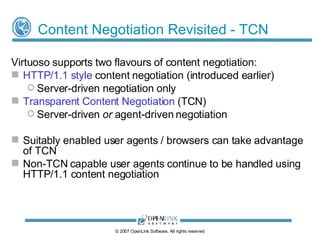
Content Negotiation Revisited - TCN Virtuoso supports two flavours of content negotiation: HTTP/1.1 style  content negotiation (introduced earlier) Server-driven negotiation only Transparent Content Negotiation  (TCN) Server-driven  or  agent-driven negotiation Suitably enabled user agents / browsers can take advantage of TCN Non-TCN capable user agents continue to be handled using HTTP/1.1 content negotiation ©  2009  OpenLink Software, All rights reserved
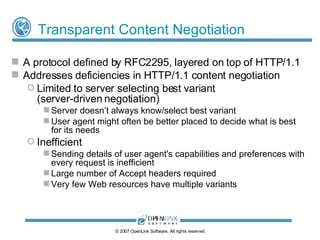
Transparent Content Negotiation A protocol defined by RFC2295, layered on top of HTTP/1.1 Addresses deficiencies in HTTP/1.1 content negotiation Limited to server selecting best variant  (server-driven negotiation) Server doesn’t always know/select best variant User agent might often be better placed to decide what is best for its needs Inefficient Sending details of user agent's capabilities and preferences with every request is inefficient Large number of Accept headers required Very few Web resources have multiple variants ©  2009  OpenLink Software, All rights reserved
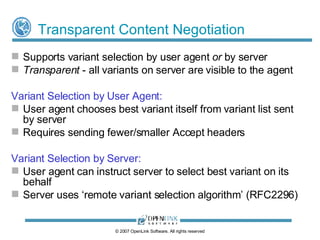
Transparent Content Negotiation Supports variant selection by user agent  or  by server Transparent  - all variants on server are visible to the agent Variant Selection by User Agent: User agent chooses best variant itself from variant list sent by server Requires sending fewer/smaller ‘Accept’ headers Variant Selection by Server: User agent can instruct server to select best variant on its behalf Server uses ‘remote variant selection algorithm’ (RFC2296) ©  2009  OpenLink Software, All rights reserved
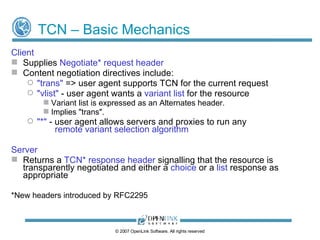
TCN – Basic Mechanics Client   Supplies  Negotiate* request   header Content negotiation directives include: &quot;trans&quot;  => user agent supports TCN for the current request &quot;vlist&quot;  - user agent wants a  variant list  for the resource Variant list is expressed as an Alternates header.  Implies &quot;trans&quot;. &quot;*&quot;  - user agent allows servers and proxies to run any    remote variant selection algorithm Server Returns a  TCN* response header  signalling that the resource is transparently negotiated and either a  choice  or a  list  response as appropriate *New headers introduced by RFC2295 ©  2009  OpenLink Software, All rights reserved
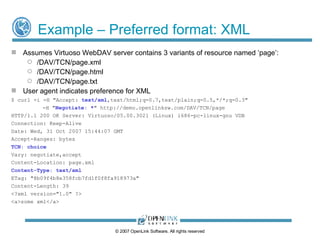
Example – Preferred format: XML Assumes Virtuoso WebDAV server contains 3 variants of resource named ‘page’: /DAV/TCN/page.xml /DAV/TCN/page.html /DAV/TCN/page.txt User agent indicates preference for XML $ curl -i -H &quot;Accept:  text/xml ,text/html;q=0.7,text/plain;q=0.5,*/*;q=0.3&quot; -H &quot; Negotiate: * &quot; http://demo.openlinksw.com/DAV/TCN/page HTTP/1.1 200 OK Server: Virtuoso/05.00.3021 (Linux) i686-pc-linux-gnu VDB Connection: Keep-Alive Date: Wed, 31 Oct  2009  15:44:07 GMT Accept-Ranges: bytes TCN: choice Vary: negotiate,accept Content-Location: page.xml Content-Type: text/xml ETag: &quot;8b09f4b8e358fcb7fd1f0f8fa918973a&quot; Content-Length: 39 <?xml version=&quot;1.0&quot; ?> <a>some xml</a> ©  2009  OpenLink Software, All rights reserved
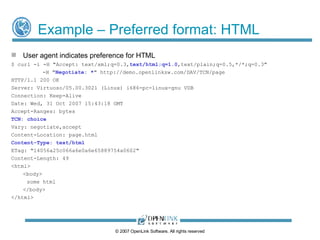
Example – Preferred format: HTML User agent indicates preference for HTML $ curl -i -H &quot;Accept: text/xml;q=0.3, text/html;q=1.0 ,text/plain;q=0.5,*/*;q=0.3&quot; -H &quot; Negotiate: * &quot; http://demo.openlinksw.com/DAV/TCN/page HTTP/1.1 200 OK Server: Virtuoso/05.00.3021 (Linux) i686-pc-linux-gnu VDB Connection: Keep-Alive Date: Wed, 31 Oct  2009  15:43:18 GMT Accept-Ranges: bytes TCN: choice Vary: negotiate,accept Content-Location: page.html Content-Type: text/html ETag: &quot;14056a25c066a6e0a6e65889754a0602&quot; Content-Length: 49 <html> <body> some html </body> </html> ©  2009  OpenLink Software, All rights reserved
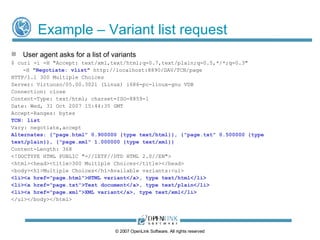
Example – Variant list request User agent asks for a list of variants $ curl -i -H &quot;Accept: text/xml,text/html;q=0.7,text/plain;q=0.5,*/*;q=0.3&quot; -H &quot; Negotiate: vlist &quot; http://localhost:8890/DAV/TCN/page HTTP/1.1 300 Multiple Choices Server: Virtuoso/05.00.3021 (Linux) i686-pc-linux-gnu VDB Connection: close Content-Type: text/html; charset=ISO-8859-1 Date: Wed, 31 Oct  2009  15:44:35 GMT Accept-Ranges: bytes TCN: list Vary: negotiate,accept Alternates: {&quot;page.html&quot; 0.900000 {type text/html}}, {&quot;page.txt&quot; 0.500000 {type text/plain}}, {&quot;page.xml&quot; 1.000000 {type text/xml}} Content-Length: 368 <!DOCTYPE HTML PUBLIC &quot;-//IETF//DTD HTML 2.0//EN&quot;> <html><head><title>300 Multiple Choices</title></head> <body><h1>Multiple Choices</h1>Available variants:<ul> <li><a href=&quot;page.html&quot;>HTML variant</a>, type text/html</li> <li><a href=&quot;page.txt&quot;>Text document</a>, type text/plain</li> <li><a href=&quot;page.xml&quot;>XML variant</a>, type text/xml</li> </ul></body></html> ©  2009  OpenLink Software, All rights reserved
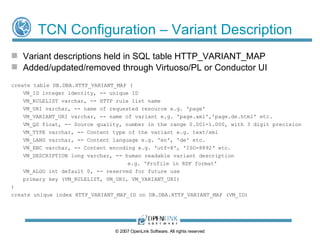
TCN Configuration – Variant Description Variant descriptions held in SQL table HTTP_VARIANT_MAP Added/updated/removed through Virtuoso/PL or Conductor UI create table DB.DBA.HTTP_VARIANT_MAP ( VM_ID integer identity, -- unique ID VM_RULELIST varchar, -- HTTP rule list name VM_URI varchar, -- name of requested resource e.g. 'page' VM_VARIANT_URI varchar, -- name of variant e.g. 'page.xml','page.de.html' etc. VM_QS float, -- Source quality, number in the range 0.001-1.000, with 3 digit precision VM_TYPE varchar, -- Content type of the variant e.g. text/xml VM_LANG varchar, -- Content language e.g. 'en', 'de' etc. VM_ENC varchar, -- Content encoding e.g. 'utf-8', 'ISO-8892‘ etc. VM_DESCRIPTION long varchar, -- human readable variant description   e.g. 'Profile in RDF format' VM_ALGO int default 0, -- reserved for future use primary key (VM_RULELIST, VM_URI, VM_VARIANT_URI) ) create unique index HTTP_VARIANT_MAP_ID on DB.DBA.HTTP_VARIANT_MAP (VM_ID) ©  2009  OpenLink Software, All rights reserved
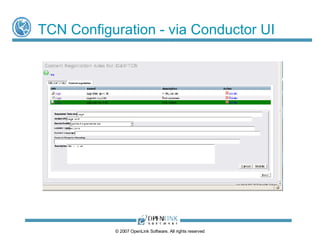
TCN Configuration - via Conductor UI ©  2009  OpenLink Software, All rights reserved    
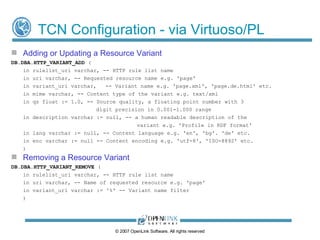
TCN Configuration - via Virtuoso/PL Adding or Updating a Resource Variant DB.DBA.HTTP_VARIANT_ADD  ( in rulelist_uri varchar, -- HTTP rule list name in uri varchar, -- Requested resource name e.g. 'page' in variant_uri varchar,  -- Variant name e.g. 'page.xml', 'page.de.html' etc. in mime varchar, -- Content type of the variant e.g. text/xml in qs float := 1.0, -- Source quality, a floating point number with 3   digit precision in 0.001-1.000 range in description varchar := null, -- a human readable description of the variant e.g. 'Profile in RDF format' in lang varchar := null, -- Content language e.g. 'en', 'bg'. 'de' etc. in enc varchar := null -- Content encoding e.g. 'utf-8', 'ISO-8892' etc. ) Removing a Resource Variant DB.DBA.HTTP_VARIANT_REMOVE  ( in rulelist_uri varchar, -- HTTP rule list name in uri varchar, -- Name of requested resource e.g. 'page' in variant_uri varchar := '%' -- Variant name filter ) ©  2009  OpenLink Software, All rights reserved
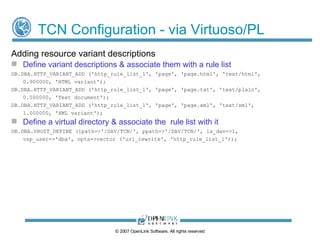
TCN Configuration - via Virtuoso/PL Adding resource variant descriptions Define variant descriptions & associate them with a rule list DB.DBA.HTTP_VARIANT_ADD ('http_rule_list_1', 'page', 'page.html', 'text/html', 0.900000, 'HTML variant'); DB.DBA.HTTP_VARIANT_ADD ('http_rule_list_1', 'page', 'page.txt', 'text/plain', 0.500000, 'Text document'); DB.DBA.HTTP_VARIANT_ADD ('http_rule_list_1', 'page', 'page.xml', 'text/xml', 1.000000, 'XML variant'); Define a virtual directory & associate the  rule list with it DB.DBA.VHOST_DEFINE (lpath=>'/DAV/TCN/', ppath=>'/DAV/TCN/', is_dav=>1, vsp_user=>'dba', opts=>vector ('url_rewrite', 'http_rule_list_1')); ©  2009  OpenLink Software, All rights reserved

Deploying RDF Linked Data via Virtuoso Universal Server

  • 1.
    OpenLink Virtuoso –Linked Data Deploying Linked Data © 2009 OpenLink Software, All rights reserved
  • 2.
    Linked Data “Linked Data” – Title of a Web Design Issues Note by Tim Berners-Lee An effort to evolve current “Web of Documents” into a “Web of Linked Data” Describes recommended best practice for injecting data into the Web Use the RDF data model Name real or abstract things (resources) in your ‘universe of discourse’ (Data Spaces), using URIs as unique IDs Make URIs accessible via HTTP so people can discover and explore your data via the Web Expose useful information via your URIs Enhance your URIs by adding links to other data on the Web using their URIs, enhancing the link density and richness of the Web © 2009 OpenLink Software, All rights reserved
  • 3.
    Common Web &Different Nature of URIs ‘ Linked Data Web ’ and the ‘ Document Web ’: - two dimensions of the Web separated by a common element - the Uniform Resource Identifier (URI) Document Web URIs T hese always point to “physical” Web documents (aka information resources) URI = a URL when it specifies a location URI = a URN when it specifies a name (i.e. when not location bound) Linked Data Web URIs identify physical or abstract resources © 2009 OpenLink Software, All rights reserved
  • 4.
    What are Resources?Web parlance for a Data Object or Entity that may be physical or abstract Document Web Resources are physical units of information (containers of contextualized data) Linked Data Web Resources are generic real-world data objects or entities that include: People, Places, and other Things Abstract concepts (e.g. Emotion) Subject Matter (e.g. Science, Geography, Economics etc.) © 2009 OpenLink Software, All rights reserved
  • 5.
    Resource Identity, Representation,and Access Identity (URI) of an Object or Entity should be unambiguous and globally unique On the Web a URI should provide an unambiguous data access path Reference to abstract (physically inaccessible) Objects or Entities is only achievable via conduit documents that carry representations of entity descriptions (which at best are facets of an entire description) The descriptive representations of an Object or Entity must be distinct from their URIs Data Access mechanisms must be independent and facilitate negotiation of representation. © 2009 OpenLink Software, All rights reserved
  • 6.
    Linked Data DeploymentRequirements To establish real-world object URIs in the Linked Data Web realm, a Linked Data Server needs to honour the following requirements: Unique Global Identity for Resources using HTTP-based URIs Deployment platform needs ability to generate proxy Web resources to convey descriptions of real-world (possibly abstract) resources Challenges: Separation of Identity and Representation within the context of HTTP protocol mechanics Negotiable representation of resource descriptions through Transparent Content Negotiation and client-side or server-side QoS algorithms URL rewriting and query association © 2009 OpenLink Software, All rights reserved
  • 7.
    Real-World Object Naming- URI Schemes Linked Data Web URIs can take two forms: ‘ Slash’ URIs - don’t contain a fragment identifier (#) ‏ http://demo.openlinksw.com/Northwind/Customer/ALFKI/id http://demo.openlinksw.com/Northwind/Customer/ALFKI/page http://demo.openlinksw.com/Northwind/Customer/ALFKI/data Identify an entity, it’s HTML representation (document), and it’s RDF representation (document) respectively ‘ Hash’ URIs - contain a fragment identifier http://demo.openlinksw.com/Northwind/Customer/ALFKI#this Identifies the entity ALFKI, distinct from its representation ( http://demo.openlinksw.com/Northwind/Customer/ALFKI ) © 2009 OpenLink Software, All rights reserved
  • 8.
    Slash URI SemanticsSeparating identification and naming from representation using Slash URIs
  • 9.
    Hash URI SemanticsSeparating identification and naming from representation using Hash URIs
  • 10.
    Handling Identity with‘Slash’ URIs For this URI scheme HTTP redirection (30X response) is required in order for resource “Identity” to be separated from “representation”. Examples: http://demo.openlinksw.com/Northwind/Customer/ALFKI/id - URI of an Organization Entity http://demo.openlinksw.com/Northwind/Customer/ALFKI/ page - HTML representation of Entity description http://demo.openlinksw.com/Northwind/Customer/ALFKI/data - RDF representation that describes the Entity which could be: Turtle, N3, RDF/XML etc. based data serialization © 2009 OpenLink Software, All rights reserved
  • 11.
    Handling Identity with‘Hash’ URIs For this URI scheme HTTP redirection isn’t required in order for resource “Identity” to be separated from “representation”. Examples: http://demo.openlinksw.com/Northwind/Customer/ALFKI#this - URI of an Organization Entity http://demo.openlinksw.com/Northwind/Customer/ALFKI - a document (HTML, Turtle, N3, RDF/XML) representation of Entity description © 2009 OpenLink Software, All rights reserved
  • 12.
    Negotiable Representation ofResource Descriptions Use HTTP’s in-built Content Negotiation mechanism to: Serve different format variants of the same resource description from one location Enable user agent (client-side) specification of preferred description representations by order of preference Enable server-side specification of preferred description representations by order of preference © 2009 OpenLink Software, All rights reserved
  • 13.
    Content Negotiation -Example HTTP Request: HTML browser requests a HTML/XHTML document in English or French GET /whitepapers/data_mngmnt HTTP/1.1 Host: www.openlinksw.com Accept: text/html, application/xhtml+xml Accept-Language: en, fr Accept header indicates preferred MIME types RDF browser might instead stipulate a MIME type of application/rdf+xml or application/rdf+n3 © 2009 OpenLink Software, All rights reserved
  • 14.
    Content Negotiation -Example HTTP Response: Server redirects to a URL where the appropriate version can be found HTTP/1.1 302 Found Location: http://www.openlinksw.com/whitepapers/data_mngmnt.en.html Redirect is indicated by HTTP status code 302 (Found) ‏ Client then sends another HTTP request to the new URL HTTP defines several 3xx status codes for redirection © 2009 OpenLink Software, All rights reserved
  • 15.
    Content Negotiation DecisionTable © 2009 OpenLink Software, All rights reserved 200 (OK) – return RDF based information resource < http://…/ALFKI> that describes the entity < http://…/ ALFKI#this> using N3, Turtle, RDF/XML etc. 303 (Redirect) to (X)HTML document describing entity <http://…/ALFKI#this>, or 404 or 406 (Not available) if one doesn’t exist Hash based URI (identifies an entity / object ID) <http://demo.openlinksw.com/Northwind/Customer/ALFKI#this> 200 (OK) – if an RDF information resource exists on the server 200 OK Web Resource URL <http://demo.openlinksw.com/Northwind/Customer/ALFKI> RDF Representation Requested (X)HTML Representation Requested URI Type URI 200 (OK) if an (X)HTML information resource (document) exists, or 404 or 406 (Not available) if one doesn’t exist For static descriptions of a Data Object: Assumes there are static HTML and RDF documents available to provide HTML and RDF representations of the customer entity ALFKI
  • 16.
    Dynamic RDF RenderingsIf entity descriptions are held in an RDF quad store: To provide a dynamic RDF rendering of the entity being dereferenced by the client: Use SPARQL DESCRIBE or CONSTRUCT DESCRIBE <entity-uri> FROM <graph-uri> ‘ Unconstrained’ – DESCRIBE output not prescribed by SPARQL specification Virtuoso supports custom procedures for generating output through SPARQL define sql:describe-mode CONSTRUCT { <entity-uri> ?p ?o } FROM <graph-uri> WHERE { <entity-uri> ?p ?o } © 2009 OpenLink Software, All rights reserved
  • 17.
    Content Negotiation DecisionTable © 2009 OpenLink Software, All rights reserved 200 (OK) – return RDF based information resource < http://…/ALFKI> that describes the entity < http://…/ ALFKI#this> (N3, RDF/XML etc.) You can use SPARQL DESCRIBE to deliver RDF based description 303 (Redirect) to (X)HTML document describing entity <http://…/ALFKI#this>, or 404 or 406 (Not available) if one doesn’t exist Hash based URI (identifies an entity / object ID) <http://demo.openlinksw.com/Northwind/Customer/ALFKI#this> 200 (OK) – if an RDF information resource exists on the server 200 OK Web Resource URL <http://demo.openlinksw.com/Northwind/Customer/ALFKI> RDF Representation Requested (X)HTML Representation Requested URI Type URI 200 (OK) if an (X)HTML information resource (document) exists, or 404 or 406 (Not available) if one doesn’t exist For dynamically derived descriptions of a Data Object using SPARQL DESCRIBE:
  • 18.
    URL Rewriting Isthe act of modifying a URL prior to final processing by a Web server Provides a means to build a URL ‘on the fly’ identifying the resource in the required representation format referred to by a 303 redirection Ideal solution is a rules-based URL rewriting processing pipeline using regular expression or sprintf substitutions © 2009 OpenLink Software, All rights reserved
  • 19.
    URL Rewriting –Example Pipeline © 2009 OpenLink Software, All rights reserved Last (must be last in processing chain)‏ For 406: Vary: negotiate, accept Alternates: {“ALFKI” 0.9 {type application/rdf+xml}} 200 (OK), or 406 (Not acceptable), or 303 redirect to a URL which can render the requested representation (text/html) | (*/*)‏ /Northwind/Customer/([^#]*)‏ Normal (order irrelevant)‏ None 303 redirect to a URL which DESCRIBEs the entity identified by the URI (text/rdf.n3) | (application/rdf.xml)‏ /Northwind/Customer/([^#]*)‏ Normal (order irrelevant)‏ None 200 or 303 depending on QoS rules configured for TCN None (i.e. default)‏ /Northwind/Customer/([^#]*)‏ Rule Processing Order HTTP Response Headers Rule HTTP Response Code HTTP Accept Header (Regex)‏ Source URI (Regex)‏
  • 20.
    Content negotiation forRDF representation © 2009 OpenLink Software, All rights reserved
  • 21.
    Deploying Linked DataUsing Virtuoso Virtuoso’s approach is to implement the generic solution outlined so far, using Content negotiation URL rewriting Virtuoso includes a Rules-based URL Rewriter Can be used to inject Linked Data into the Document Web © 2009 OpenLink Software, All rights reserved
  • 22.
    Virtuoso - URLRewriter Key Elements Rewriting Rule Describes how to parse a source URL and compose the URL of the resource returned in “Location:” response headers Two types: sprintf-based and regex-based Rewriting Rule List Named, ordered list of rewriting rules or rule lists Tried from top to bottom, first matching rule is applied Conductor UI for rewriting rule configuration Configuration API – alternative to Conductor UI, for scripts Functions for creating, dropping, enumerating rules & rule lists © 2009 OpenLink Software, All rights reserved
  • 23.
    Conductor UI forURL Rewriter © 2009 OpenLink Software, All rights reserved RDF view for Northwind sample database: Rewriting rule for HTML requests
  • 24.
    Conductor UI forURL Rewriter © 2009 OpenLink Software, All rights reserved RDF view for Northwind sample database: Rewriting rule for RDF/XML or N3 based resource description requests
  • 25.
    Conductor UI forURL Rewriter © 2009 OpenLink Software, All rights reserved Defining the SPARQL query underpinning the ‘Destination Path Format’ of the RDF/XML / N3 rewriting rule – Automatically URL encoded when saved
  • 26.
    Rewrite Rule Componentsin Conductor UI Request Path Pattern e.g. (/[^#]*) a regular expression matched against the input path Substitution parameters Each successive pair of parentheses in the regex denotes a parameter referred to elsewhere in the rewrite rule as $U1, $U2, $U3 … or $s1, $s2, $s3 … Can be used to substitute the part of the input path that was matched into the new URL being composed $accept parameter substitutes matched content types specified in Accept header ‘ U’ format specifier – URL encodes inserted text ‘ s’ format specifier – inserts matched text ‘as is’ © 2009 OpenLink Software, All rights reserved
  • 27.
    URL Rewriter –URIQADefaultHost Macro URIQADefaultHost Macro Makes rewriting rules (& RDF View definitions) more portable Each occurrence is substituted with the value of the DefaultHost parameter in URIQA section of virtuoso.ini configuration file DefaultHost ::= server name. e.g. www.example.com:8890 DESCRIBE <http:///^{URIQADefaultHost}^$U1#this> FROM <http://^{URIQADefaultHost}^/Northwind> © 2009 OpenLink Software, All rights reserved
  • 28.
    URL Rewriting Processfor RDF Requests © 2009 OpenLink Software, All rights reserved
  • 29.
    URL Rewriting Processfor HTML Requests © 2009 OpenLink Software, All rights reserved HTML requests are redirected via proxy /about/html to a rendering template - description.vsp description.vsp rendering of Customer entity <http://demo.openlinksw.com/Northwind/Customer/ALFKI#this>
  • 30.
    description.vsp – RenderingRDF as HTML Destination path in rewrite rule for HTML requests: /about/html/http://^{URIQADefaultHost}^$s1 Redirects client to the Virtuoso ‘Page Description Service’ via proxy interface /about/html Page description services invokes description.vsp which in turn invokes the Virtuoso Sponger Sponger: a customizable RDFizer with pluggable cartridges Extracts RDF from the target URL Native RDF sources: RDF is returned ‘as is’ Non-RDF sources: Meta-data is extracted and converted to RDF using ontology mapping and XSLT description.vsp renders the extracted RDF as HTML Substitutes RDF ‘hyperdata’ links with HTML hyperlinks © 2009 OpenLink Software, All rights reserved
  • 31.
    Exporting URL RewritingRules from Conductor Rewrite rules configured in Conductor can be exported as Virtuoso PL for backup, use on another system etc. Exported script recreates rules using Virtuoso’s URL Rewriting Configuration API © 2009 OpenLink Software, All rights reserved
  • 32.
    Example Exported RuleDefinitions © 2009 OpenLink Software, All rights reserved DB.DBA.VHOST_DEFINE ( lhost=>'*ini*', vhost=>'*ini*', lpath=>'/Northwind',ppath=>'/DAV/home/demo/', is_dav=>1, vsp_user=>'dba', ses_vars=>0, opts=>vector ('url_rewrite', 'demo_nw_rule_list1'), is_default_host=>0); DB.DBA.URLREWRITE_CREATE_RULELIST ( 'demo_nw_rule_list1', 1, vector ('demo_nw_rule1', 'demo_nw_rule2')); DB.DBA.URLREWRITE_CREATE_REGEX_RULE ( 'demo_nw_rule1', 1, '(/[^#]*)',vector ('path'), 1, '/about/html/http://^{URIQADefaultHost}^%s', vector ('path'), NULL, '(text/html)|(\\*/\\*)', 0, 303, NULL); DB.DBA.URLREWRITE_CREATE_REGEX_RULE ( 'demo_nw_rule2', 1, '(/[^#]*)', vector ('path'), 1, '/sparql?query=DESCRIBE+%%3Chttp%%3A//^{URIQADefaultHost}^%U%%23this%%3E+%%3Chttp%%3A//^{URIQADefaultHost}^%U%%3E+FROM+%%3Chttp%%3A//^{URIQADefaultHost}^/Northwind%%3E&format=%U', vector ('path', 'path', '*accept*'), NULL, '(text/rdf.n3)|(application/rdf.xml)', 0, NULL, NULL);
  • 33.
    URL Rewriter API:Enabling Rewriting Enabled through vhost_define( ) function vhost_define( ) defines a virtual host or virtual path opts parameter is a vector of field-value pairs Field url_rewrite controls / enables URL rewriting Field value is the IRI of the rule list to apply e.g. DB.DBA.VHOST_DEFINE ( lhost=>'*ini*', vhost=>'*ini*', lpath=>'/Northwind',ppath=>'/DAV/home/demo/', is_dav=>1, vsp_user=>'dba', ses_vars=>0, opts=>vector ('url_rewrite', 'demo_nw_rule_list1'), is_default_host=>0); © 2009 OpenLink Software, All rights reserved
  • 34.
    URL Rewriter API:Summary Functions in DB.DBA schema: URLREWRITE_CREATE_SPRINTF_RULE URLREWRITE_CREATE_REGEX_RULE URLREWRITE_CREATE_RULELIST URLREWRITE_DROP_RULE URLREWRITE_DROP_RULELIST URLREWRITE_ENUMERATE_RULES URLREWRITE_ENUMERATE_RULELISTS © 2009 OpenLink Software, All rights reserved
  • 35.
    ‘ Nice’ URLsvs ‘Long’ URLs Rewriter developed with broader objectives than Linked Data – consequently influenced terminology Rewriter takes a ‘nice’ URL and rewrites it as a ‘long’ URL ‘ Nice’ URL Free from parameters, typically short ‘ Long’ URL Typically contains query string with named parameters Often ignored by web crawlers (viewed as highly dynamic) => low page ranking © 2009 OpenLink Software, All rights reserved
  • 36.
    Sprintf Rules vsRegex Rules Rewrite rules take two forms: sprintf-based & regex-based: For ‘nice’ to ‘long’ URL conversion Functionally equivalent Only difference is syntax of match pattern definition For ‘long’ to ‘nice’ URL conversion Only works for sprintf-based rules Regex-based rules are unidirectional © 2009 OpenLink Software, All rights reserved
  • 37.
    URLREWRITE_CREATE_REGEX_RULE URLREWRITE_CREATE_REGEX_RULE ( rule_iri, allow_update, nice_match, nice_params, nice_min_params, target_compose, target_params, target_expn := null, accept_pattern := null, do_not_continue := 0, http_redirect_code := null, http_headers := null) ; rule_iri: rule’s name / identifier nice_match: regex to parse URL into a vector of ‘occurrences’ nice_params: vector of names of the parsed parameters. Length of vector equals # of ‘(…)’ specifiers in the regex target_compose: ‘compose’ regex for the destination URL target_params: vector of names of parameters to pass to the ‘compose’ expression as $1, $2 etc target_expn: optional SQL text to execute instead of a regex compose accept_pattern: regex expression to match the HTTP Accept header do_not_continue: on a match, try / don’t try next rule in rule list http_redirect_code: null, 301, 302 or 303. 30x => HTTP redirect http_headers: HTTP headers to supply with the rewritten request © 2009 OpenLink Software, All rights reserved
  • 38.
    URL Rewriter -Verification with curl curl utility provides a useful tool for verifying HTTP server responses and rewriting rules $ curl -I -H &quot;Accept: application/rdf+xml&quot; http://demo.openlinksw.com/Northwind/ Customer/ALFKI HTTP/1.1 303 See Other Server: Virtuoso/05.09.3037 (Solaris) x86_64-sun-solaris2.10-64 VDB Connection: close Content-Type: text/html; charset=ISO-8859-1 Date: Thu, 12 Feb 2009 11:23:31 GMT Accept-Ranges: bytes Location: http://demo.openlinksw.com/sparql?query=DESCRIBE+%3Chttp %3A//demo.openlinksw.com%2FNorthwind%2FCustomer%2FALFKI%23this%3E+%3Chttp %3A//demo.openlinksw.com%2FNorthwind%2FCustomer%2FALFKI%3E+FROM+%3Chttp %3A//demo.openlinksw.com/Northwind%3E&format=application%2Frdf%2Bxml Content-Length: 0 Note: default rule for RDF requests changed to return HTTP response 303, rather than use an internal redirect, to allow the generated SPARQL query to be viewed and checked with curl © 2009 OpenLink Software, All rights reserved
  • 39.
    Browsing & ExploringLinked Data OpenLink Data Explorer (ODE) Browser extension (Firefox, support for others to follow) See http://ode.openlinksw.com RDF and HTML views of Linked Data RDF view incorporates ‘hyperdata’ links between entities HTML view substitutes hyperlinks Also available as a hosted service E.g. http://demo.openlinksw.com/ode iSparql Query Tool Interactive SPARQL Query Builder E.g. http://demo.openlinksw.com/isparql See http://wikis.openlinksw.com/dataspace/owiki/wiki/OATWikiWeb/InteractiveSparqlQueryBuilder © 2009 OpenLink Software, All rights reserved
  • 40.
    Content Negotiation Revisited- TCN Virtuoso supports two flavours of content negotiation: HTTP/1.1 style content negotiation (introduced earlier) Server-driven negotiation only Transparent Content Negotiation (TCN) Server-driven or agent-driven negotiation Suitably enabled user agents / browsers can take advantage of TCN Non-TCN capable user agents continue to be handled using HTTP/1.1 content negotiation © 2009 OpenLink Software, All rights reserved
  • 41.
    Transparent Content NegotiationA protocol defined by RFC2295, layered on top of HTTP/1.1 Addresses deficiencies in HTTP/1.1 content negotiation Limited to server selecting best variant (server-driven negotiation) Server doesn’t always know/select best variant User agent might often be better placed to decide what is best for its needs Inefficient Sending details of user agent's capabilities and preferences with every request is inefficient Large number of Accept headers required Very few Web resources have multiple variants © 2009 OpenLink Software, All rights reserved
  • 42.
    Transparent Content NegotiationSupports variant selection by user agent or by server Transparent - all variants on server are visible to the agent Variant Selection by User Agent: User agent chooses best variant itself from variant list sent by server Requires sending fewer/smaller ‘Accept’ headers Variant Selection by Server: User agent can instruct server to select best variant on its behalf Server uses ‘remote variant selection algorithm’ (RFC2296) © 2009 OpenLink Software, All rights reserved
  • 43.
    TCN – BasicMechanics Client Supplies Negotiate* request header Content negotiation directives include: &quot;trans&quot; => user agent supports TCN for the current request &quot;vlist&quot; - user agent wants a variant list for the resource Variant list is expressed as an Alternates header. Implies &quot;trans&quot;. &quot;*&quot; - user agent allows servers and proxies to run any remote variant selection algorithm Server Returns a TCN* response header signalling that the resource is transparently negotiated and either a choice or a list response as appropriate *New headers introduced by RFC2295 © 2009 OpenLink Software, All rights reserved
  • 44.
    Example – Preferredformat: XML Assumes Virtuoso WebDAV server contains 3 variants of resource named ‘page’: /DAV/TCN/page.xml /DAV/TCN/page.html /DAV/TCN/page.txt User agent indicates preference for XML $ curl -i -H &quot;Accept: text/xml ,text/html;q=0.7,text/plain;q=0.5,*/*;q=0.3&quot; -H &quot; Negotiate: * &quot; http://demo.openlinksw.com/DAV/TCN/page HTTP/1.1 200 OK Server: Virtuoso/05.00.3021 (Linux) i686-pc-linux-gnu VDB Connection: Keep-Alive Date: Wed, 31 Oct 2009 15:44:07 GMT Accept-Ranges: bytes TCN: choice Vary: negotiate,accept Content-Location: page.xml Content-Type: text/xml ETag: &quot;8b09f4b8e358fcb7fd1f0f8fa918973a&quot; Content-Length: 39 <?xml version=&quot;1.0&quot; ?> <a>some xml</a> © 2009 OpenLink Software, All rights reserved
  • 45.
    Example – Preferredformat: HTML User agent indicates preference for HTML $ curl -i -H &quot;Accept: text/xml;q=0.3, text/html;q=1.0 ,text/plain;q=0.5,*/*;q=0.3&quot; -H &quot; Negotiate: * &quot; http://demo.openlinksw.com/DAV/TCN/page HTTP/1.1 200 OK Server: Virtuoso/05.00.3021 (Linux) i686-pc-linux-gnu VDB Connection: Keep-Alive Date: Wed, 31 Oct 2009 15:43:18 GMT Accept-Ranges: bytes TCN: choice Vary: negotiate,accept Content-Location: page.html Content-Type: text/html ETag: &quot;14056a25c066a6e0a6e65889754a0602&quot; Content-Length: 49 <html> <body> some html </body> </html> © 2009 OpenLink Software, All rights reserved
  • 46.
    Example – Variantlist request User agent asks for a list of variants $ curl -i -H &quot;Accept: text/xml,text/html;q=0.7,text/plain;q=0.5,*/*;q=0.3&quot; -H &quot; Negotiate: vlist &quot; http://localhost:8890/DAV/TCN/page HTTP/1.1 300 Multiple Choices Server: Virtuoso/05.00.3021 (Linux) i686-pc-linux-gnu VDB Connection: close Content-Type: text/html; charset=ISO-8859-1 Date: Wed, 31 Oct 2009 15:44:35 GMT Accept-Ranges: bytes TCN: list Vary: negotiate,accept Alternates: {&quot;page.html&quot; 0.900000 {type text/html}}, {&quot;page.txt&quot; 0.500000 {type text/plain}}, {&quot;page.xml&quot; 1.000000 {type text/xml}} Content-Length: 368 <!DOCTYPE HTML PUBLIC &quot;-//IETF//DTD HTML 2.0//EN&quot;> <html><head><title>300 Multiple Choices</title></head> <body><h1>Multiple Choices</h1>Available variants:<ul> <li><a href=&quot;page.html&quot;>HTML variant</a>, type text/html</li> <li><a href=&quot;page.txt&quot;>Text document</a>, type text/plain</li> <li><a href=&quot;page.xml&quot;>XML variant</a>, type text/xml</li> </ul></body></html> © 2009 OpenLink Software, All rights reserved
  • 47.
    TCN Configuration –Variant Description Variant descriptions held in SQL table HTTP_VARIANT_MAP Added/updated/removed through Virtuoso/PL or Conductor UI create table DB.DBA.HTTP_VARIANT_MAP ( VM_ID integer identity, -- unique ID VM_RULELIST varchar, -- HTTP rule list name VM_URI varchar, -- name of requested resource e.g. 'page' VM_VARIANT_URI varchar, -- name of variant e.g. 'page.xml','page.de.html' etc. VM_QS float, -- Source quality, number in the range 0.001-1.000, with 3 digit precision VM_TYPE varchar, -- Content type of the variant e.g. text/xml VM_LANG varchar, -- Content language e.g. 'en', 'de' etc. VM_ENC varchar, -- Content encoding e.g. 'utf-8', 'ISO-8892‘ etc. VM_DESCRIPTION long varchar, -- human readable variant description e.g. 'Profile in RDF format' VM_ALGO int default 0, -- reserved for future use primary key (VM_RULELIST, VM_URI, VM_VARIANT_URI) ) create unique index HTTP_VARIANT_MAP_ID on DB.DBA.HTTP_VARIANT_MAP (VM_ID) © 2009 OpenLink Software, All rights reserved
  • 48.
    TCN Configuration -via Conductor UI © 2009 OpenLink Software, All rights reserved    
  • 49.
    TCN Configuration -via Virtuoso/PL Adding or Updating a Resource Variant DB.DBA.HTTP_VARIANT_ADD ( in rulelist_uri varchar, -- HTTP rule list name in uri varchar, -- Requested resource name e.g. 'page' in variant_uri varchar, -- Variant name e.g. 'page.xml', 'page.de.html' etc. in mime varchar, -- Content type of the variant e.g. text/xml in qs float := 1.0, -- Source quality, a floating point number with 3 digit precision in 0.001-1.000 range in description varchar := null, -- a human readable description of the variant e.g. 'Profile in RDF format' in lang varchar := null, -- Content language e.g. 'en', 'bg'. 'de' etc. in enc varchar := null -- Content encoding e.g. 'utf-8', 'ISO-8892' etc. ) Removing a Resource Variant DB.DBA.HTTP_VARIANT_REMOVE ( in rulelist_uri varchar, -- HTTP rule list name in uri varchar, -- Name of requested resource e.g. 'page' in variant_uri varchar := '%' -- Variant name filter ) © 2009 OpenLink Software, All rights reserved
  • 50.
    TCN Configuration -via Virtuoso/PL Adding resource variant descriptions Define variant descriptions & associate them with a rule list DB.DBA.HTTP_VARIANT_ADD ('http_rule_list_1', 'page', 'page.html', 'text/html', 0.900000, 'HTML variant'); DB.DBA.HTTP_VARIANT_ADD ('http_rule_list_1', 'page', 'page.txt', 'text/plain', 0.500000, 'Text document'); DB.DBA.HTTP_VARIANT_ADD ('http_rule_list_1', 'page', 'page.xml', 'text/xml', 1.000000, 'XML variant'); Define a virtual directory & associate the rule list with it DB.DBA.VHOST_DEFINE (lpath=>'/DAV/TCN/', ppath=>'/DAV/TCN/', is_dav=>1, vsp_user=>'dba', opts=>vector ('url_rewrite', 'http_rule_list_1')); © 2009 OpenLink Software, All rights reserved