GlassFish Server 3.1
Deploying your Java EE 6 Applications in Cluster


Arun Gupta, Java EE & GlassFish Guy
blogs.oracle.com/arungupta, @arungupta


                                                   1
The following is intended to outline our general
product direction. It is intended for information
purposes only, and may not be incorporated into
any contract. It is not a commitment to deliver any
material, code, or functionality, and should not be
relied upon in making purchasing decisions.


The development, release, and timing of any
features or functionality described for Oracle's
products remains at the sole discretion of Oracle.
Java EE 6 and GlassFish Server 3
    shipped final releases on
       December 10th 2009
World's First Java EE 6 Compatible
          App Server with
 Clustering & High Availability
     Shipped Feb 28th 2011
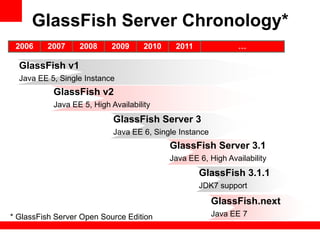
GlassFish Server Chronology*
 2006    2007     2008     2009      2010    2011              …

  GlassFish v1
  Java EE 5, Single Instance
           GlassFish v2
           Java EE 5, High Availability
                            GlassFish Server 3
                            Java EE 6, Single Instance
                                            GlassFish Server 3.1
                                            Java EE 6, High Availability
                                                    GlassFish 3.1.1
                                                    JDK7 support

                                                         GlassFish.next
* GlassFish Server Open Source Edition                   Java EE 7
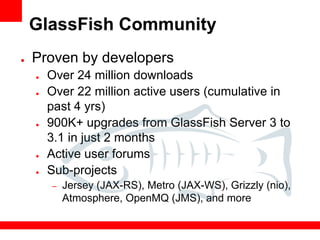
GlassFish Community
●   Proven by developers
    ●   Over 24 million downloads
    ●   Over 22 million active users (cumulative in
        past 4 yrs)
    ●   900K+ upgrades from GlassFish Server 3 to
        3.1 in just 2 months
    ●   Active user forums
    ●   Sub-projects
        –   Jersey (JAX-RS), Metro (JAX-WS), Grizzly (nio),
            Atmosphere, OpenMQ (JMS), and more
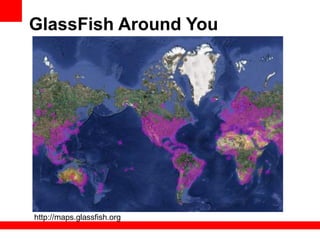
GlassFish Around You


http://maps.glassfish.org
Deliverables
●   Application Server
    ●   Open Source and high-quality runtime
    ●   Java EE 5 / 6 Reference Implementation, early
        access to latest standards
    ●   Clustering and High Availability
    ●   Full Commercial Support from Oracle

●   Continued Investment in Open Source
    ●    Open Source license, governance, participation,
        transparency, ...
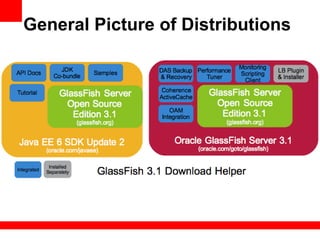
General Picture of Distributions
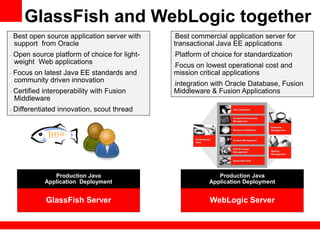
GlassFish and WebLogic together
•   Best open source application server with    •Best commercial application server for
    support from Oracle                         transactional Java EE applications
•   Open source platform of choice for light-   •   Platform of choice for standardization
    weight Web applications
                                                Focus on lowest operational cost and
                                                •

•   Focus on latest Java EE standards and       mission critical applications
    community driven innovation
                                                integration with Oracle Database, Fusion
                                                •

•   Certified interoperability with Fusion      Middleware & Fusion Applications
    Middleware
•   Differentiated innovation, scout thread


                 Production Java                                  Production Java
              Application Deployment                           Application Deployment


               GlassFish Server                                WebLogic Server
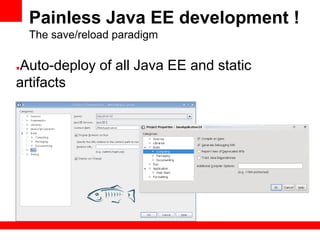
Painless Java EE development !
    The save/reload paradigm

Auto-deploy of all Java EE and static
●

artifacts
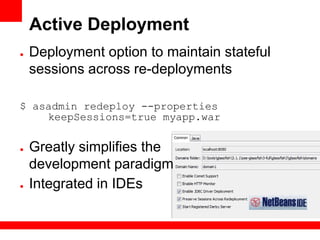
Active Deployment
●   Deployment option to maintain stateful
    sessions across re-deployments

$ asadmin redeploy --properties
    keepSessions=true myapp.war

●   Greatly simplifies the
    development paradigm
●   Integrated in IDEs
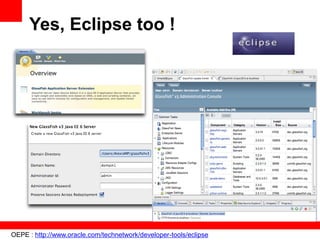
Yes, Eclipse too !


OEPE : http://www.oracle.com/technetwork/developer-tools/eclipse
Introducing GlassFish Server 3
3.1 Overview

●   Built on GlassFish 3
●   Modular and Extensible HK2 Kernel
    ●   ~260+ modules
●   Clustering and High Availability
    ●   HTTP, EJB, IIOP, SSO, Metro
●   Dynamic Invocation of Services
●   End-to-end extensibility
Fast and Furious ...

   ●   29% better startup/deploy/re-deploy cycle
       over 3.0.1
   ●   33% better HA performance over 2.1.1
         ●   Scalable Grizzly Adapter based on Java NIO
         ●   Full-session and Modified-attribute* scope
   ●   Multiple Standalone instances and Clusters
       per domain

http://weblogs.java.net/blog/sdo/archive/2011/03/01/whats-new-glassfish-v31-performance
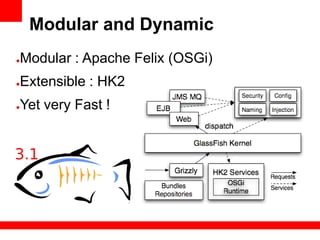
Modular and Dynamic
●   Modular : Apache Felix (OSGi)
●   Extensible : HK2
●   Yet very Fast !
More Painless Development
●   Fast auto-deploy of all Java EE and static artifacts
●   Application runner
    ● java -jar glassfish.jar toto.war
●   Maven integration
    ● mvn gf:run, gf:start, gf:deploy,
      ...
●   Containers added dynamically and transparently
●   Excellent Tools support
Embedded uses
●   Testing
    ●   EJBContainer API (EJB 3.1)
    ●   Simple testing using Java SE (JUnit, Maven, ...)
        using EJB container
●   Packaging / Bundling
    ●   Beyond the specification: control all of GlassFish
        Server with an API = GlassFish Embedded
    ●   Integration testing & ship the server inside the
        app
What's the deal with OSGi?
●   GlassFish Server runs on top of OSGi (Felix)
    ●   Also runs unmodified on Equinox (and Knopflerfish)
    ●   GlassFish ships as 260+ bundles
    ●   Can run without OSGi (Static mode)
    ●   Can use OSGi management tools (CLI or Web)
    ●   Can be installed on top of existing OSGi runtime

●   Any OSGi bundle will run in GlassFish Server
    ●   Drop it in glassfish/modules{/autostart}
    ●   Can also asadmin deploy it using --type osgi
    ●   GlassFish OSGi admin console
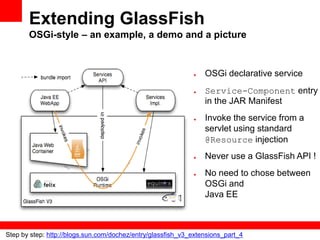
Extending GlassFish
       OSGi-style – an example, a demo and a picture


                                                             ●   OSGi declarative service
                                                             ●   Service-Component entry
                                                                 in the JAR Manifest
                                                             ●   Invoke the service from a
                                                                 servlet using standard
                                                                 @Resource injection
                                                             ●   Never use a GlassFish API !
                                                             ●   No need to chose between
                                                                 OSGi and
                                                                 Java EE


Step by step: http://blogs.sun.com/dochez/entry/glassfish_v3_extensions_part_4
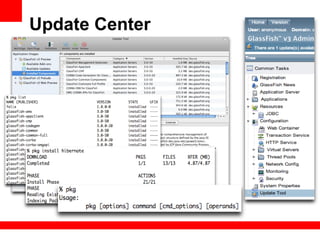
Update Center
Monitoring and Management
    Beyond web console and asadmin
●   Dynamic and non-intrusive monitoring
    ●   BTrace integration
         –   Portable, dynamic and safe tracing tool for Java
         –   Btrace annotations and API to write scripts
    ●   Java-defined Probe Providers
    ●   RESTful interface
    ●   DTrace for end-to-end
●   JavaScript Monitoring tool (add-on)
●   Still exposed via JMX
    ●   jconsole and visualvm as natural clients
RESTful Administration
●   Jersey + Grizzly to provide REST interfaces
    ●   Configure runtime (via GET, POST, DELETE)
    ●   Invoke commands (restart, stop, deploy, etc..)
    ●   Monitoring (GET only)
●   Available from
    ●   http://localhost:4848/management/domain
    ●   http://localhost:4848/monitoring/domain
●   Use REST clients as Admin GUI substitute
    ●   Use your favorite glue/scripting language or tool
●   Data offered as either XML, HTML or JSON
●   Extensible
More GlassFish Server 3.x
●   Developer performance
●   Embedded API
●   RESTful API
●   Update Center
●   Metro 2.0
●   OpenMQ 4.x
●   Admin console
●   Btrace monitoring
●   ...
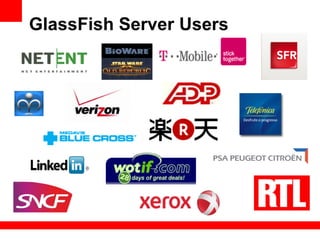
GlassFish Server Users
Customers Around the Globe
Depend on WebLogic
In government…


On the phone …


In the wallet …


With health …


In education and
research …

In travel &
transport …
GlassFish Server 3.1
    Developer Highlights

●   Developer Productivity
     –Improved    embedded API support
     –Updated    NetBeans and Eclipse plugin


●   Updated Technologies
     –Grizzly   WebSocket support
     –Improved    CDI, JSON, hypermedia support in Jersey
     –Technology refresh – JSF, CDI, Grizzly, OSGi, JPA,
     Jersey, Bean Validation, Metro, UC, etc.
     –Implementation   of various Enterprise OSGi Specs
GlassFish Server 3.1
    Clustering Highlights

●   HTTP, EJB, IIOP, SSO, Metro
     –New   - RM Sequence, Secure Conversations

●   Session-based replication using Shoal
     –Distributes   session state uniformly & consistently among instances

●Shoal OSGi module, loaded when HA-
enabled apps are deployed
●Support for conventional clustering of MQs

brokers in embedded mode
GlassFish Server 3.1
    Manageability Highlights

●SSH based remote management and
provisioning
●Application versioning support


●Application scoped resources


●Statement leak detection and reclaim


●Improved monitoring


●Console based on RESTful API
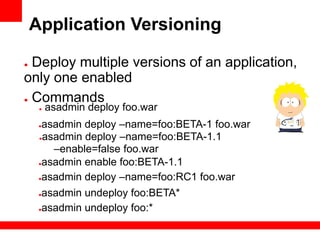
Application Versioning

● Deploy multiple versions of an application,
only one enabled
● Commands
     ●   asadmin deploy foo.war
     ●asadmin deploy –name=foo:BETA-1 foo.war
     ●asadmin deploy –name=foo:BETA-1.1

        –enable=false foo.war
     ●asadmin enable foo:BETA-1.1


     ●asadmin deploy –name=foo:RC1 foo.war


     ●asadmin undeploy foo:BETA*
     ●asadmin undeploy foo:*
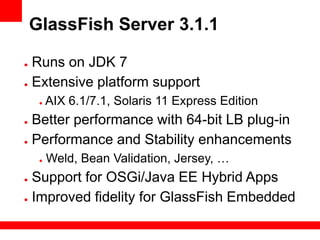
GlassFish Server 3.1.1

● Runs on JDK 7
● Extensive platform support

     ●   AIX 6.1/7.1, Solaris 11 Express Edition
● Better performance with 64-bit LB plug-in
● Performance and Stability enhancements

     ●   Weld, Bean Validation, Jersey, …
● Support for OSGi/Java EE Hybrid Apps
● Improved fidelity for GlassFish Embedded
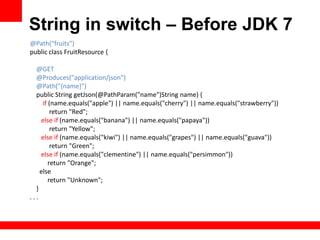
String in switch – Before JDK 7
@Path("fruits")
public class FruitResource {

  @GET
  @Produces("application/json")
  @Path("{name}")
  public String getJson(@PathParam("name")String name) {
     if (name.equals("apple") || name.equals("cherry") || name.equals("strawberry"))
         return "Red";
    else if (name.equals("banana") || name.equals("papaya"))
         return "Yellow";
    else if (name.equals("kiwi") || name.equals("grapes") || name.equals("guava"))
         return "Green";
    else if (name.equals("clementine") || name.equals("persimmon"))
        return "Orange";
    else
        return "Unknown";
  }
...
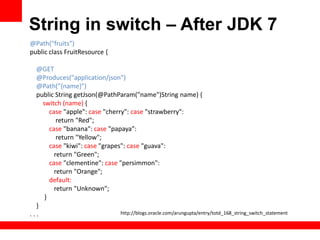
String in switch – After JDK 7
@Path("fruits")
public class FruitResource {

  @GET
  @Produces("application/json")
  @Path("{name}")
  public String getJson(@PathParam("name")String name) {
    switch (name) {
       case "apple": case "cherry": case "strawberry":
          return "Red";
       case "banana": case "papaya":
          return "Yellow";
       case "kiwi": case "grapes": case "guava":
         return "Green";
       case "clementine": case "persimmon":
         return "Orange";
       default:
         return "Unknown";
     }
  }
...                             http://blogs.oracle.com/arungupta/entry/totd_168_string_switch_statement
Automatic Resource
Management – Before JDK 7
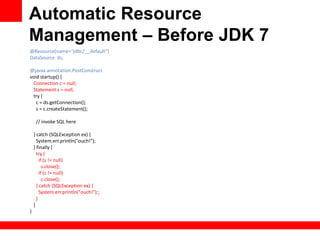
@Resource(name=“jdbc/__default”)
DataSource ds;

@javax.annotation.PostConstruct
void startup() {
 Connection c = null;
 Statement s = null;
 try {
   c = ds.getConnection();
   s = c.createStatement();

     // invoke SQL here

    } catch (SQLException ex) {
      System.err.println("ouch!");
    } finally {
      try {
        if (s != null)
          s.close();
        if (c != null)
          c.close();
      } catch (SQLException ex) {
        System.err.println("ouch!");;
      }
    }
}
Automatic Resource
Management – After JDK 7
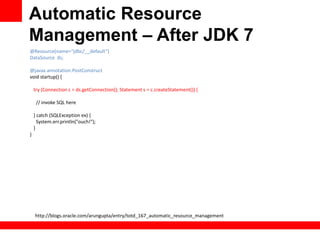
@Resource(name=“jdbc/__default”)
DataSource ds;

@javax.annotation.PostConstruct
void startup() {

    try (Connection c = ds.getConnection(); Statement s = c.createStatement()) {

     // invoke SQL here

    } catch (SQLException ex) {
      System.err.println("ouch!");
    }
}


    http://blogs.oracle.com/arungupta/entry/totd_167_automatic_resource_management
Multi-catch – Before JDK 7
protected void doPost(HttpServletRequest request, HttpServletResponse response){
  PrintWriter out = null;
  try {
    response.setContentType("text/html;charset=UTF-8");
    out = response.getWriter();
    out.println("<html><head><title>Servlet TestServlet</title></head>");
    out.println("<body>");
    out.println("<h1>Sending email from " + request.getContextPath () + "</h1>");

    for (Part p : request.getParts()) {
      // save the parts locally
      System.out.println(p.getName() + " saved");
    }

   Message message = new MimeMessage(session);
   message.setFrom(new InternetAddress(from));
   InternetAddress[] address = {new InternetAddress(to)};
    message.setRecipients(Message.RecipientType.TO, address);
    message.setSubject("File upload successful.");
    message.setSentDate(new Date());
    message.setText("File has been successfully saved.");
    Transport.send(message);

     out.println("</body>");
     out.println("</html>");
  } catch (ServletException ex) {
     Logger.getLogger(TestServlet.class.getName()).log(Level.SEVERE, null, ex);
  } catch (MessagingException ex) {
     Logger.getLogger(TestServlet.class.getName()).log(Level.SEVERE, null, ex);
  } catch (IOException ex) {
     Logger.getLogger(TestServlet.class.getName()).log(Level.SEVERE, null, ex);
  } finally {
     out.close();
  }
Multi-catch – After JDK 7

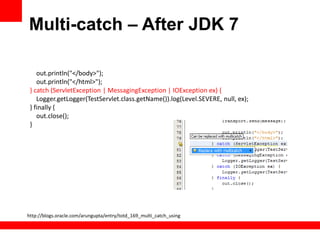
    out.println("</body>");
    out.println("</html>");
 } catch (ServletException | MessagingException | IOException ex) {
    Logger.getLogger(TestServlet.class.getName()).log(Level.SEVERE, null, ex);
 } finally {
    out.close();
 }


http://blogs.oracle.com/arungupta/entry/totd_169_multi_catch_using
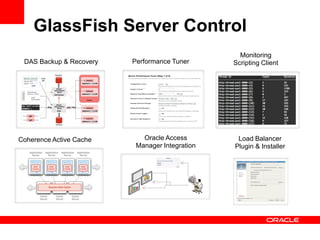
GlassFish Server Control
                                                  Monitoring
 DAS Backup & Recovery   Performance Tuner      Scripting Client


Coherence Active Cache      Oracle Access        Load Balancer
                          Manager Integration   Plugin & Installer
Strategy for continued success

●   Continue to deliver outstanding performance
●   Continue to improve developer productivity
●   Continue product execution
    ●   Deliver Java EE 7 first
    ●   Deliver on product roadmap
●   Continue to innovate
    ●   Improve manageability
    ●   Hybrid OSGi / Java EE applications
Why Attend JavaOne
Because Duke says:
• “Find out what's new with Java Technology.”
• “Hear from and network with visionary speakers and
  recognized community luminaries.”
• “Get in-depth technical content and hands-on learning
  opportunities that cover today's most important Java
  development topics.” (400+ sessions/BoFs/HOLs)
• “Walk away with improved working knowledge and
  coding expertise you can apply immediately to your
  own projects and initiatives.”


                 http://oracle.com/javaone
References

●   oracle.com/javaee
●   glassfish.org
●   oracle.com/goto/glassfish
●   blogs.oracle.com/theaquarium
●   youtube.com/GlassFishVideos
●   Follow @glassfish
GlassFish Server 3.1
Deploying your Java EE 6 Applications in Cluster


Arun Gupta, Java EE & GlassFish Guy
blogs.oracle.com/arungupta, @arungupta


                                                   44

Deploying Java EE 6 Apps in a Cluster: GlassFish 3.1 at Dallas Tech Fest 2011

  • 1.
    GlassFish Server 3.1 Deployingyour Java EE 6 Applications in Cluster Arun Gupta, Java EE & GlassFish Guy blogs.oracle.com/arungupta, @arungupta 1
  • 2.
    The following isintended to outline our general product direction. It is intended for information purposes only, and may not be incorporated into any contract. It is not a commitment to deliver any material, code, or functionality, and should not be relied upon in making purchasing decisions. The development, release, and timing of any features or functionality described for Oracle's products remains at the sole discretion of Oracle.
  • 3.
    Java EE 6and GlassFish Server 3 shipped final releases on December 10th 2009
  • 4.
    World's First JavaEE 6 Compatible App Server with Clustering & High Availability Shipped Feb 28th 2011
  • 5.
    GlassFish Server Chronology* 2006 2007 2008 2009 2010 2011 … GlassFish v1 Java EE 5, Single Instance GlassFish v2 Java EE 5, High Availability GlassFish Server 3 Java EE 6, Single Instance GlassFish Server 3.1 Java EE 6, High Availability GlassFish 3.1.1 JDK7 support GlassFish.next * GlassFish Server Open Source Edition Java EE 7
  • 6.
    GlassFish Community ● Proven by developers ● Over 24 million downloads ● Over 22 million active users (cumulative in past 4 yrs) ● 900K+ upgrades from GlassFish Server 3 to 3.1 in just 2 months ● Active user forums ● Sub-projects – Jersey (JAX-RS), Metro (JAX-WS), Grizzly (nio), Atmosphere, OpenMQ (JMS), and more
  • 7.
  • 8.
    Deliverables ● Application Server ● Open Source and high-quality runtime ● Java EE 5 / 6 Reference Implementation, early access to latest standards ● Clustering and High Availability ● Full Commercial Support from Oracle ● Continued Investment in Open Source ● Open Source license, governance, participation, transparency, ...
  • 9.
    General Picture ofDistributions
  • 10.
    GlassFish and WebLogictogether • Best open source application server with •Best commercial application server for support from Oracle transactional Java EE applications • Open source platform of choice for light- • Platform of choice for standardization weight Web applications Focus on lowest operational cost and • • Focus on latest Java EE standards and mission critical applications community driven innovation integration with Oracle Database, Fusion • • Certified interoperability with Fusion Middleware & Fusion Applications Middleware • Differentiated innovation, scout thread Production Java Production Java Application Deployment Application Deployment GlassFish Server WebLogic Server
  • 11.
    Painless Java EEdevelopment ! The save/reload paradigm Auto-deploy of all Java EE and static ● artifacts
  • 12.
    Active Deployment ● Deployment option to maintain stateful sessions across re-deployments $ asadmin redeploy --properties keepSessions=true myapp.war ● Greatly simplifies the development paradigm ● Integrated in IDEs
  • 13.
    Yes, Eclipse too! OEPE : http://www.oracle.com/technetwork/developer-tools/eclipse
  • 14.
  • 15.
    3.1 Overview ● Built on GlassFish 3 ● Modular and Extensible HK2 Kernel ● ~260+ modules ● Clustering and High Availability ● HTTP, EJB, IIOP, SSO, Metro ● Dynamic Invocation of Services ● End-to-end extensibility
  • 16.
    Fast and Furious... ● 29% better startup/deploy/re-deploy cycle over 3.0.1 ● 33% better HA performance over 2.1.1 ● Scalable Grizzly Adapter based on Java NIO ● Full-session and Modified-attribute* scope ● Multiple Standalone instances and Clusters per domain http://weblogs.java.net/blog/sdo/archive/2011/03/01/whats-new-glassfish-v31-performance
  • 17.
    Modular and Dynamic ● Modular : Apache Felix (OSGi) ● Extensible : HK2 ● Yet very Fast !
  • 19.
    More Painless Development ● Fast auto-deploy of all Java EE and static artifacts ● Application runner ● java -jar glassfish.jar toto.war ● Maven integration ● mvn gf:run, gf:start, gf:deploy, ... ● Containers added dynamically and transparently ● Excellent Tools support
  • 20.
    Embedded uses ● Testing ● EJBContainer API (EJB 3.1) ● Simple testing using Java SE (JUnit, Maven, ...) using EJB container ● Packaging / Bundling ● Beyond the specification: control all of GlassFish Server with an API = GlassFish Embedded ● Integration testing & ship the server inside the app
  • 21.
    What's the dealwith OSGi? ● GlassFish Server runs on top of OSGi (Felix) ● Also runs unmodified on Equinox (and Knopflerfish) ● GlassFish ships as 260+ bundles ● Can run without OSGi (Static mode) ● Can use OSGi management tools (CLI or Web) ● Can be installed on top of existing OSGi runtime ● Any OSGi bundle will run in GlassFish Server ● Drop it in glassfish/modules{/autostart} ● Can also asadmin deploy it using --type osgi ● GlassFish OSGi admin console
  • 22.
    Extending GlassFish OSGi-style – an example, a demo and a picture ● OSGi declarative service ● Service-Component entry in the JAR Manifest ● Invoke the service from a servlet using standard @Resource injection ● Never use a GlassFish API ! ● No need to chose between OSGi and Java EE Step by step: http://blogs.sun.com/dochez/entry/glassfish_v3_extensions_part_4
  • 23.
  • 24.
    Monitoring and Management Beyond web console and asadmin ● Dynamic and non-intrusive monitoring ● BTrace integration – Portable, dynamic and safe tracing tool for Java – Btrace annotations and API to write scripts ● Java-defined Probe Providers ● RESTful interface ● DTrace for end-to-end ● JavaScript Monitoring tool (add-on) ● Still exposed via JMX ● jconsole and visualvm as natural clients
  • 25.
    RESTful Administration ● Jersey + Grizzly to provide REST interfaces ● Configure runtime (via GET, POST, DELETE) ● Invoke commands (restart, stop, deploy, etc..) ● Monitoring (GET only) ● Available from ● http://localhost:4848/management/domain ● http://localhost:4848/monitoring/domain ● Use REST clients as Admin GUI substitute ● Use your favorite glue/scripting language or tool ● Data offered as either XML, HTML or JSON ● Extensible
  • 26.
    More GlassFish Server3.x ● Developer performance ● Embedded API ● RESTful API ● Update Center ● Metro 2.0 ● OpenMQ 4.x ● Admin console ● Btrace monitoring ● ...
  • 27.
  • 28.
    Customers Around theGlobe Depend on WebLogic In government… On the phone … In the wallet … With health … In education and research … In travel & transport …
  • 29.
    GlassFish Server 3.1 Developer Highlights ● Developer Productivity –Improved embedded API support –Updated NetBeans and Eclipse plugin ● Updated Technologies –Grizzly WebSocket support –Improved CDI, JSON, hypermedia support in Jersey –Technology refresh – JSF, CDI, Grizzly, OSGi, JPA, Jersey, Bean Validation, Metro, UC, etc. –Implementation of various Enterprise OSGi Specs
  • 30.
    GlassFish Server 3.1 Clustering Highlights ● HTTP, EJB, IIOP, SSO, Metro –New - RM Sequence, Secure Conversations ● Session-based replication using Shoal –Distributes session state uniformly & consistently among instances ●Shoal OSGi module, loaded when HA- enabled apps are deployed ●Support for conventional clustering of MQs brokers in embedded mode
  • 31.
    GlassFish Server 3.1 Manageability Highlights ●SSH based remote management and provisioning ●Application versioning support ●Application scoped resources ●Statement leak detection and reclaim ●Improved monitoring ●Console based on RESTful API
  • 32.
    Application Versioning ● Deploymultiple versions of an application, only one enabled ● Commands ● asadmin deploy foo.war ●asadmin deploy –name=foo:BETA-1 foo.war ●asadmin deploy –name=foo:BETA-1.1 –enable=false foo.war ●asadmin enable foo:BETA-1.1 ●asadmin deploy –name=foo:RC1 foo.war ●asadmin undeploy foo:BETA* ●asadmin undeploy foo:*
  • 33.
    GlassFish Server 3.1.1 ●Runs on JDK 7 ● Extensive platform support ● AIX 6.1/7.1, Solaris 11 Express Edition ● Better performance with 64-bit LB plug-in ● Performance and Stability enhancements ● Weld, Bean Validation, Jersey, … ● Support for OSGi/Java EE Hybrid Apps ● Improved fidelity for GlassFish Embedded
  • 34.
    String in switch– Before JDK 7 @Path("fruits") public class FruitResource { @GET @Produces("application/json") @Path("{name}") public String getJson(@PathParam("name")String name) { if (name.equals("apple") || name.equals("cherry") || name.equals("strawberry")) return "Red"; else if (name.equals("banana") || name.equals("papaya")) return "Yellow"; else if (name.equals("kiwi") || name.equals("grapes") || name.equals("guava")) return "Green"; else if (name.equals("clementine") || name.equals("persimmon")) return "Orange"; else return "Unknown"; } ...
  • 35.
    String in switch– After JDK 7 @Path("fruits") public class FruitResource { @GET @Produces("application/json") @Path("{name}") public String getJson(@PathParam("name")String name) { switch (name) { case "apple": case "cherry": case "strawberry": return "Red"; case "banana": case "papaya": return "Yellow"; case "kiwi": case "grapes": case "guava": return "Green"; case "clementine": case "persimmon": return "Orange"; default: return "Unknown"; } } ... http://blogs.oracle.com/arungupta/entry/totd_168_string_switch_statement
  • 36.
    Automatic Resource Management –Before JDK 7 @Resource(name=“jdbc/__default”) DataSource ds; @javax.annotation.PostConstruct void startup() { Connection c = null; Statement s = null; try { c = ds.getConnection(); s = c.createStatement(); // invoke SQL here } catch (SQLException ex) { System.err.println("ouch!"); } finally { try { if (s != null) s.close(); if (c != null) c.close(); } catch (SQLException ex) { System.err.println("ouch!");; } } }
  • 37.
    Automatic Resource Management –After JDK 7 @Resource(name=“jdbc/__default”) DataSource ds; @javax.annotation.PostConstruct void startup() { try (Connection c = ds.getConnection(); Statement s = c.createStatement()) { // invoke SQL here } catch (SQLException ex) { System.err.println("ouch!"); } } http://blogs.oracle.com/arungupta/entry/totd_167_automatic_resource_management
  • 38.
    Multi-catch – BeforeJDK 7 protected void doPost(HttpServletRequest request, HttpServletResponse response){ PrintWriter out = null; try { response.setContentType("text/html;charset=UTF-8"); out = response.getWriter(); out.println("<html><head><title>Servlet TestServlet</title></head>"); out.println("<body>"); out.println("<h1>Sending email from " + request.getContextPath () + "</h1>"); for (Part p : request.getParts()) { // save the parts locally System.out.println(p.getName() + " saved"); } Message message = new MimeMessage(session); message.setFrom(new InternetAddress(from)); InternetAddress[] address = {new InternetAddress(to)}; message.setRecipients(Message.RecipientType.TO, address); message.setSubject("File upload successful."); message.setSentDate(new Date()); message.setText("File has been successfully saved."); Transport.send(message); out.println("</body>"); out.println("</html>"); } catch (ServletException ex) { Logger.getLogger(TestServlet.class.getName()).log(Level.SEVERE, null, ex); } catch (MessagingException ex) { Logger.getLogger(TestServlet.class.getName()).log(Level.SEVERE, null, ex); } catch (IOException ex) { Logger.getLogger(TestServlet.class.getName()).log(Level.SEVERE, null, ex); } finally { out.close(); }
  • 39.
    Multi-catch – AfterJDK 7 out.println("</body>"); out.println("</html>"); } catch (ServletException | MessagingException | IOException ex) { Logger.getLogger(TestServlet.class.getName()).log(Level.SEVERE, null, ex); } finally { out.close(); } http://blogs.oracle.com/arungupta/entry/totd_169_multi_catch_using
  • 40.
    GlassFish Server Control Monitoring DAS Backup & Recovery Performance Tuner Scripting Client Coherence Active Cache Oracle Access Load Balancer Manager Integration Plugin & Installer
  • 41.
    Strategy for continuedsuccess ● Continue to deliver outstanding performance ● Continue to improve developer productivity ● Continue product execution ● Deliver Java EE 7 first ● Deliver on product roadmap ● Continue to innovate ● Improve manageability ● Hybrid OSGi / Java EE applications
  • 42.
    Why Attend JavaOne BecauseDuke says: • “Find out what's new with Java Technology.” • “Hear from and network with visionary speakers and recognized community luminaries.” • “Get in-depth technical content and hands-on learning opportunities that cover today's most important Java development topics.” (400+ sessions/BoFs/HOLs) • “Walk away with improved working knowledge and coding expertise you can apply immediately to your own projects and initiatives.” http://oracle.com/javaone
  • 43.
    References ● oracle.com/javaee ● glassfish.org ● oracle.com/goto/glassfish ● blogs.oracle.com/theaquarium ● youtube.com/GlassFishVideos ● Follow @glassfish
  • 44.
    GlassFish Server 3.1 Deployingyour Java EE 6 Applications in Cluster Arun Gupta, Java EE & GlassFish Guy blogs.oracle.com/arungupta, @arungupta 44