Dependency	Down,	Flexibility	Up

The	benefits	of	API-first	development
Ankit Sobti
Co-Founder & CTO, Postman
PRESENTED BY
May 10, 2019
May 10, 2019
About Me
Founder of
Postman
A Builder
Since 2012
Passionate
about APIs
API
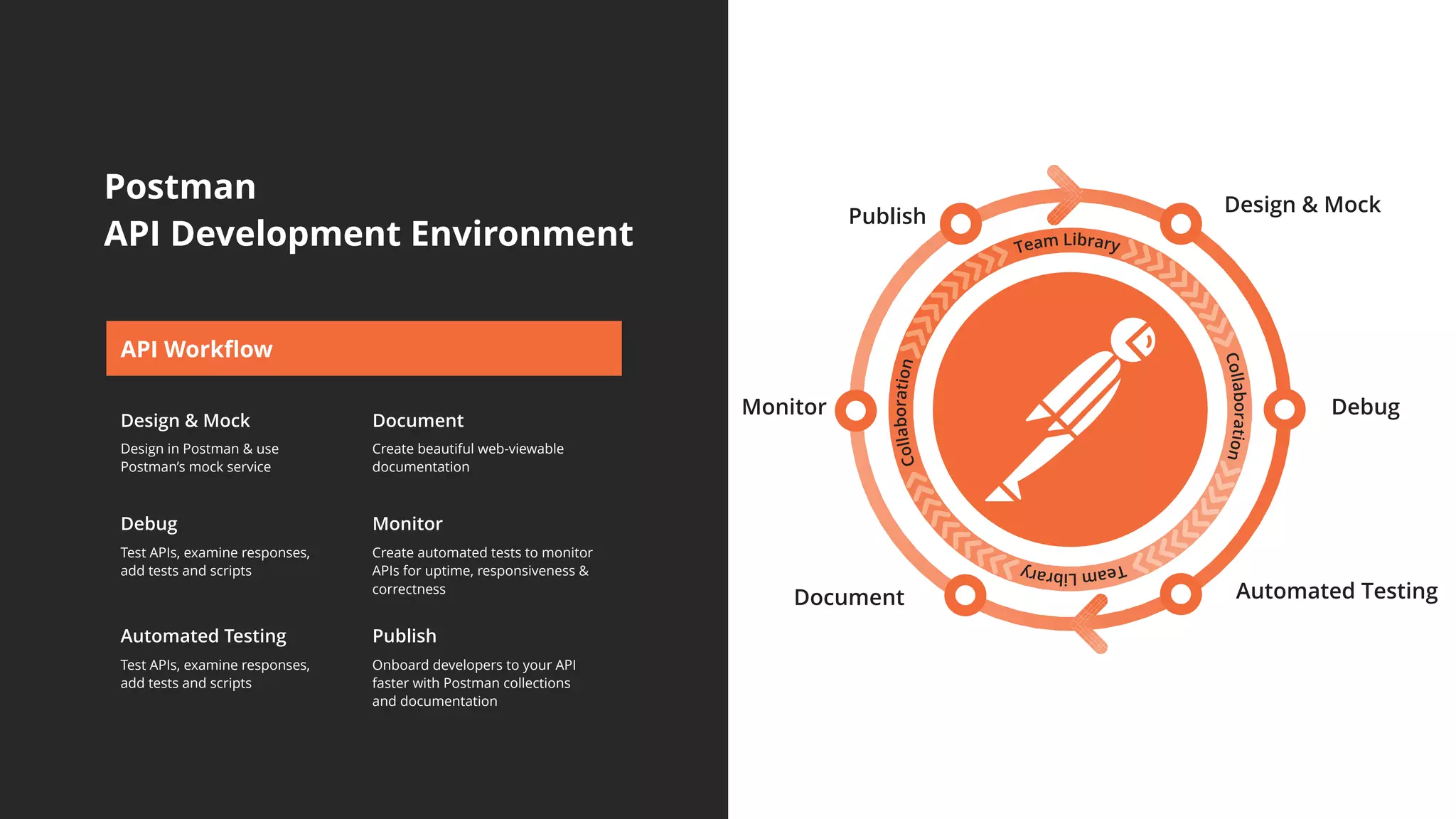
Postman
API Development Environment
API Workflow
Design & Mock
Design in Postman & use
Postman’s mock service
Debug
Test APIs, examine responses,
add tests and scripts
Automated Testing
Test APIs, examine responses,
add tests and scripts
Document
Create beautiful web-viewable
documentation
Monitor
Create automated tests to monitor
APIs for uptime, responsiveness &
correctness
Publish
Onboard developers to your API
faster with Postman collections
and documentation
Team Library
Collaboration
TeamLibrary
Collaboration
Monitor
Publish
Document
Design & Mock
Debug
Automated Testing
May 10, 2019
Bezos Mandate
1. All teams will henceforth expose their data and functionality through service interfaces.
2. Teams must communicate with each other through these interfaces.
3. There will be no other form of interprocess communication allowed: no direct linking, no direct reads of
another team's data store, no shared-memory model, no back-doors whatsoever. The only communication
allowed is via service interface calls over the network.
4. It doesn't matter what technology they use. HTTP, Corba, Pubsub, custom protocols -- doesn't matter.
5. All service interfaces, without exception, must be designed from the ground up to be “externalizable”. That is to
say, the team must plan and design to be able to expose the interface to developers in the outside world. No
exceptions.
6. Anyone who doesn't do this will be fired.
May 10, 2019
In other words…
• APIs are the only way to get things done
• Teams collaborate through APIs
• “APIs must be externalizable”
• Key constraint - how APIs are designed, built, and managed
May 10, 2019
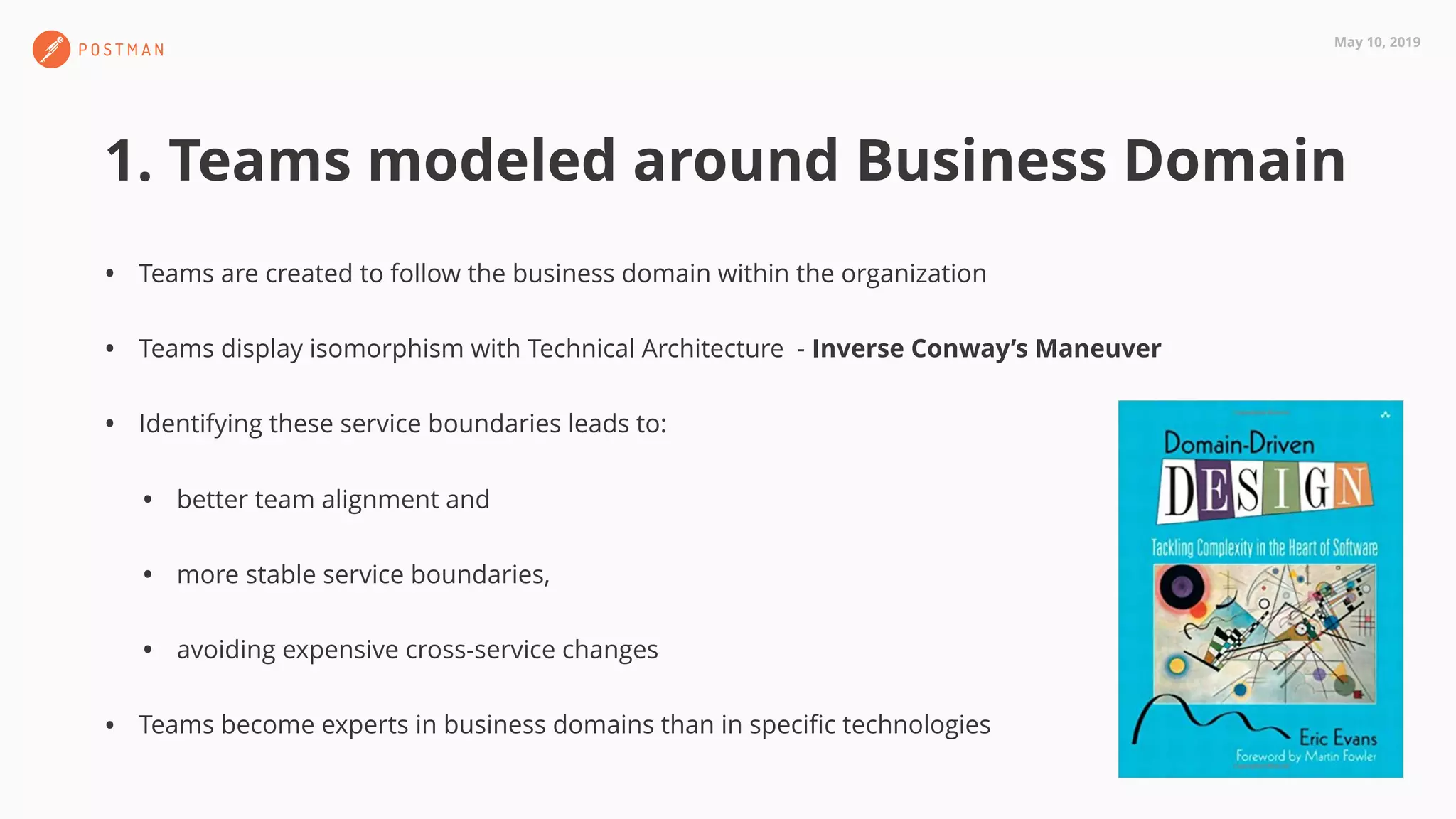
1. Teams modeled around Business Domain
• Teams are created to follow the business domain within the organization
• Teams display isomorphism with Technical Architecture - Inverse Conway’s Maneuver
• Identifying these service boundaries leads to:
• better team alignment and
• more stable service boundaries,
• avoiding expensive cross-service changes
• Teams become experts in business domains than in specific technologies
May 10, 2019
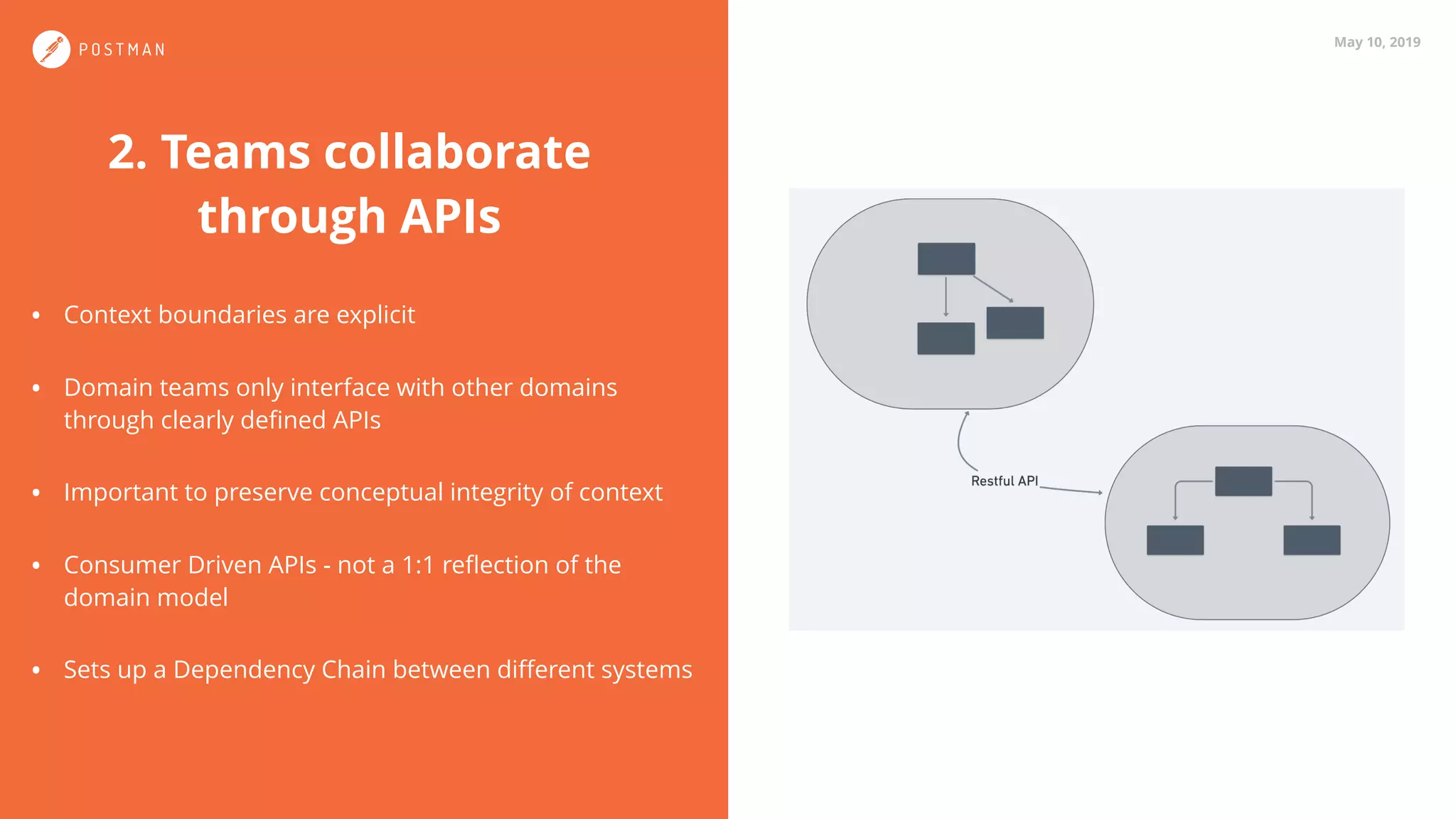
2. Teams collaborate
through APIs
• Context boundaries are explicit
• Domain teams only interface with other domains
through clearly defined APIs
• Important to preserve conceptual integrity of context
• Consumer Driven APIs - not a 1:1 reflection of the
domain model
• Sets up a Dependency Chain between different systems
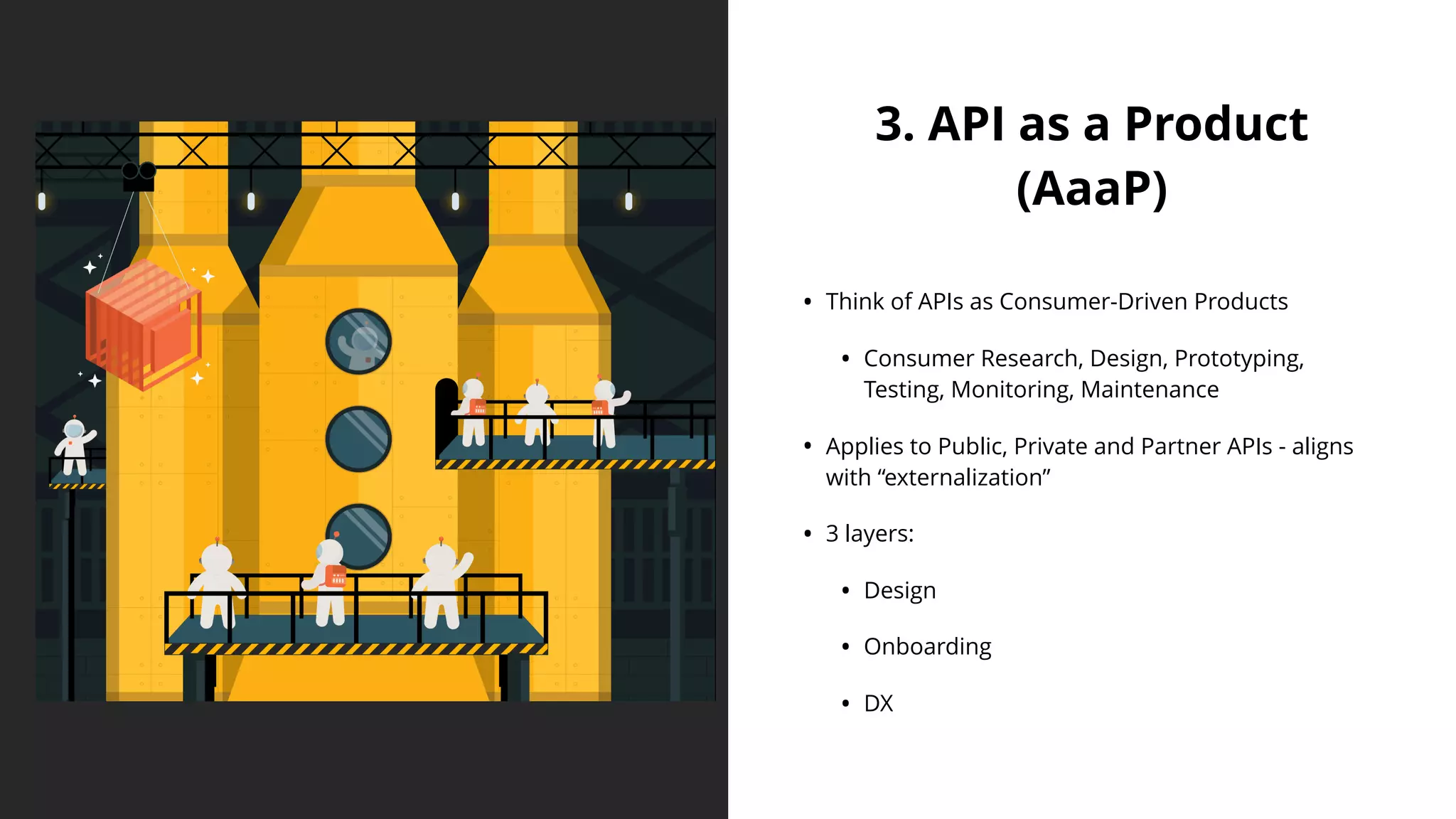
3. API as a Product
(AaaP)
• Think of APIs as Consumer-Driven Products
• Consumer Research, Design, Prototyping,
Testing, Monitoring, Maintenance
• Applies to Public, Private and Partner APIs - aligns
with “externalization”
• 3 layers:
• Design
• Onboarding
• DX
May 10, 2019
Design
• Jobs To be Done - Clayton Christensen
• Why are you building this API?
• What problems are you solving and
how do you prioritize them?
• Who are you solving this problem for?
• Mission Statement for Domain Teams
May 10, 2019
Design
• API Interface Model - describes the behavior
of an API from a consumer perspective
• Includes details about communication
protocol, messages, vocabularies
• Acts as a tool for Collaboration - feedback,
review
• Can be expressed using API Description
Formats:
• HTTP - OpenAPI, SOAP - WADL, gRPC -
Protocol Buffers
• Ecosystem advantage - tooling
May 10, 2019
• API Design precedes Code
• Explicit process - how heavily to invest time &
resources is a strategic decision
• An Example:
• Create a prototype for the interface - Open
API Spec, Postman Collection
• Share the prototype with the target
consumers - (mock servers)
• Collect feedback, make and validate
changes - (consumer driven contracts)
• Iterate as necessary
Design
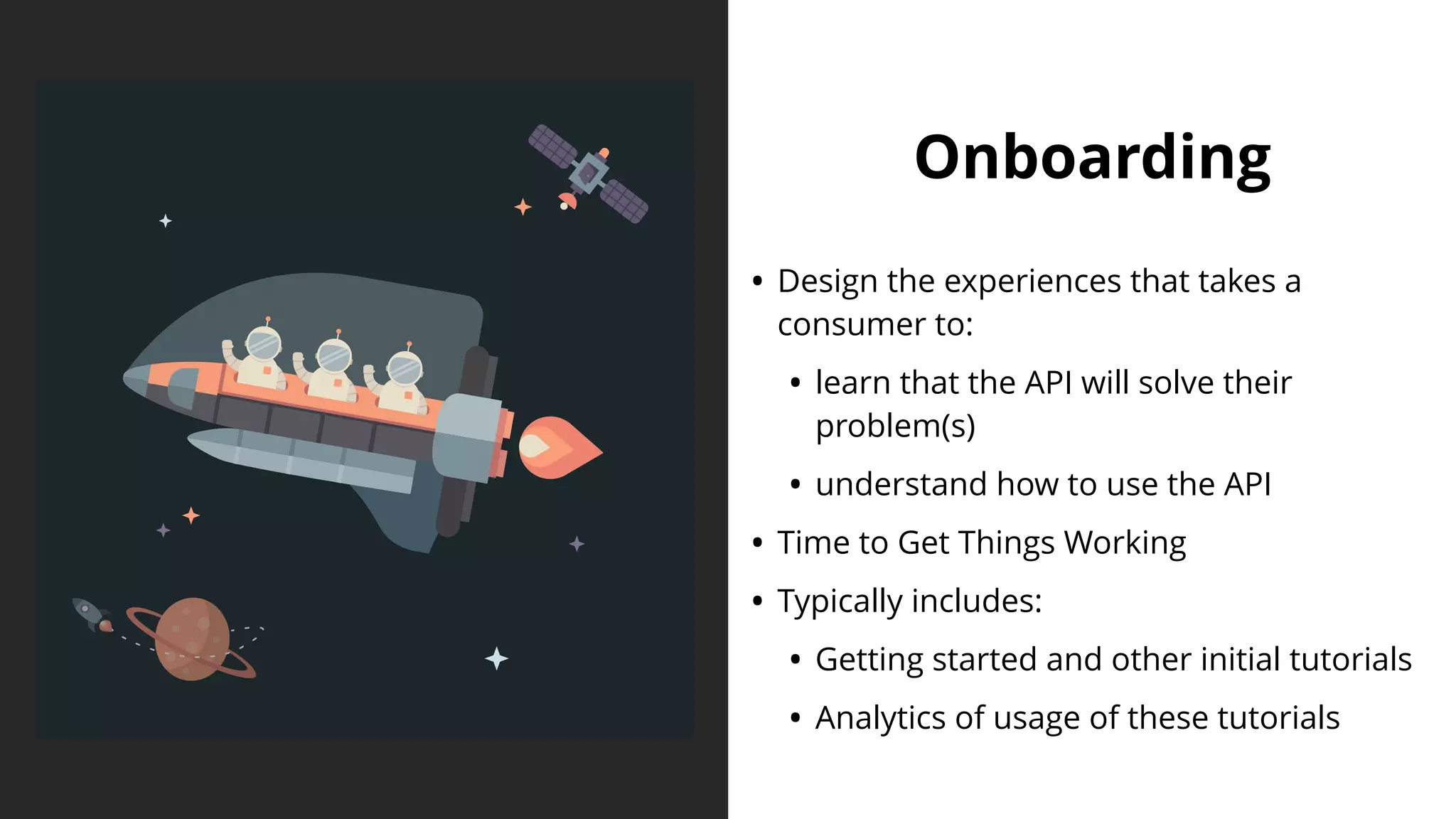
Onboarding
• Design the experiences that takes a
consumer to:
• learn that the API will solve their
problem(s)
• understand how to use the API
• Time to Get Things Working
• Typically includes:
• Getting started and other initial tutorials
• Analytics of usage of these tutorials
API Documentation
• Tool to Teach and Learn about the API
• Ways to Deliver:
• Reference Guide
• highly factual
• better suited for experienced users
• can be generated from API Description
Languages
• Design a Learning Experience
• examples, tutorials, sample applications
• suited for new users, reduce time to get
things working
• Important to keep it in sync with implementation
and instance changes
May 10, 2019
Developer Experience
• User Experience for Developers
• acknowledges a continuing, long-term
relationship
• continuous small improvements by
studying consumer behavior and evolving
needs
• measure of how happy your consumers
are
• How are your APIs being used/not used
• Interface Design, Discovery, Documentation,
Support, Marketing - all contribute to DX
May 10, 2019
Developer Experience
• Things to Design for:
• Consistency
• Ease & Safety of Use
• Error Reporting & Failure States
• Monitor Usage
May 10, 2019
Tools to stay agile in an
API-First World
May 10, 2019
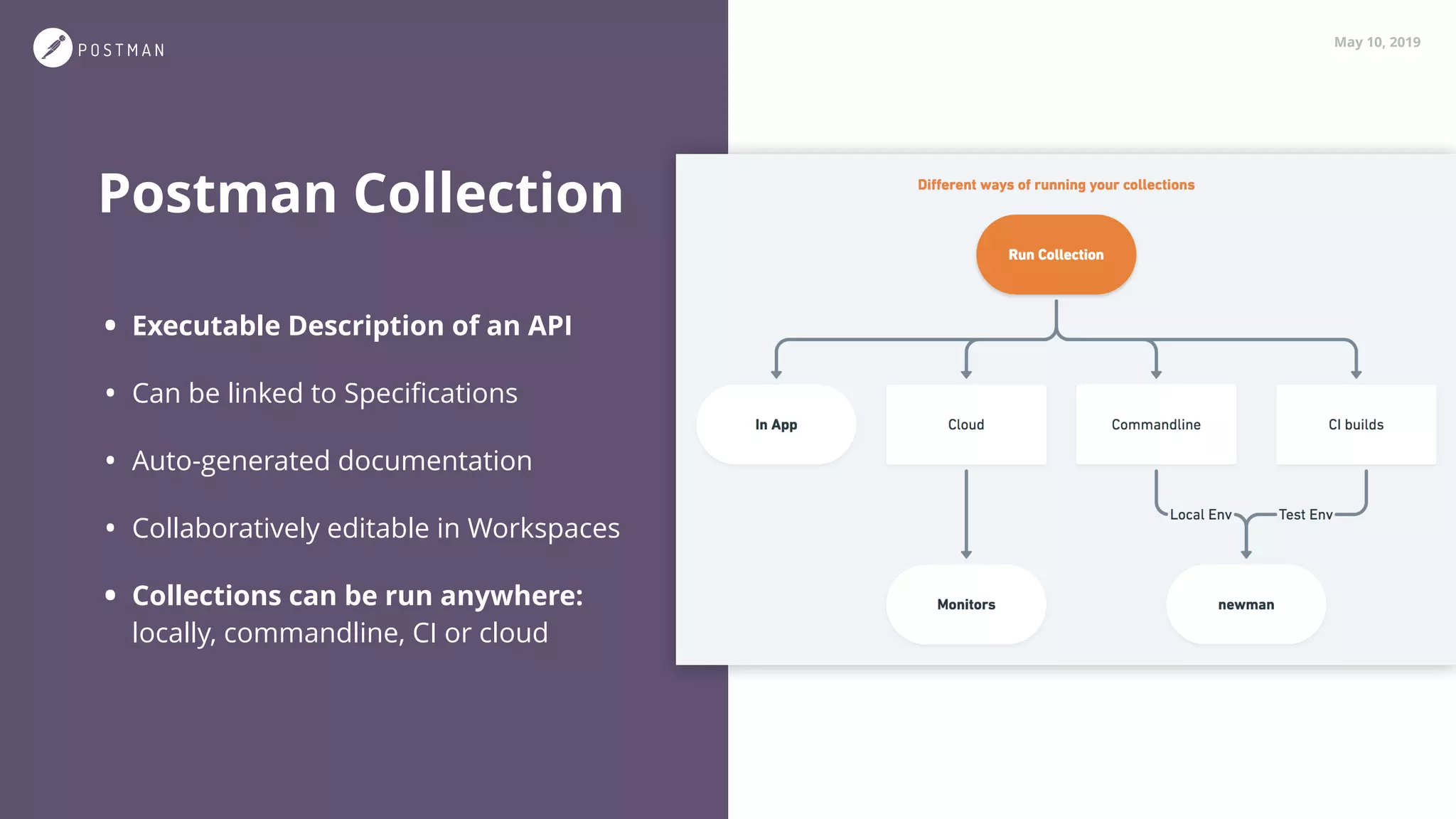
Postman Collection
• Executable Description of an API
• Can be linked to Specifications
• Auto-generated documentation
• Collaboratively editable in Workspaces
• Collections can be run anywhere:

locally, commandline, CI or cloud
May 10, 2019
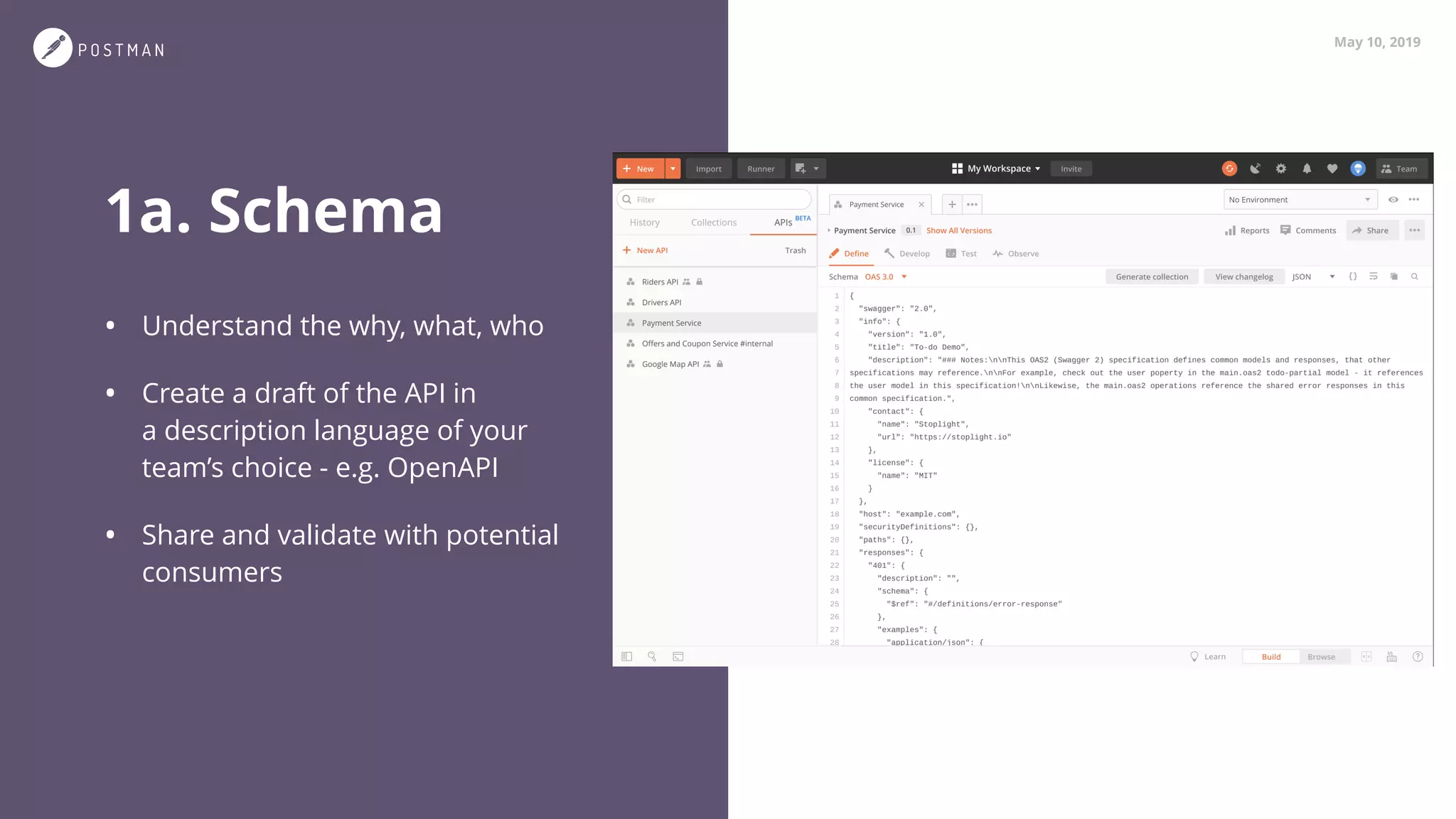
1a. Schema
• Understand the why, what, who
• Create a draft of the API in 

a description language of your 

team’s choice - e.g. OpenAPI
• Share and validate with potential 

consumers
May 10, 2019
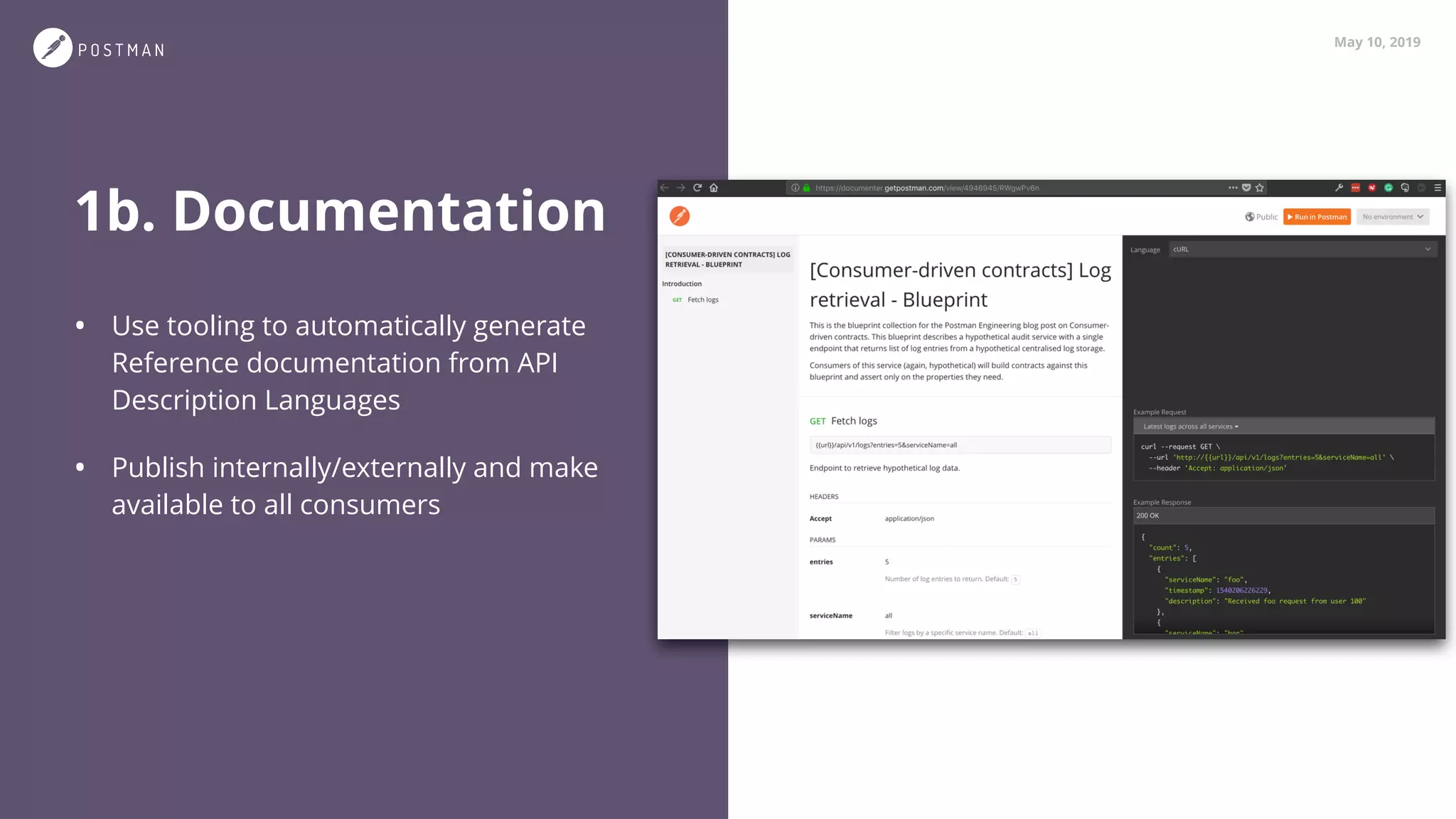
1b. Documentation
• Use tooling to automatically generate
Reference documentation from API
Description Languages
• Publish internally/externally and make
available to all consumers
May 10, 2019
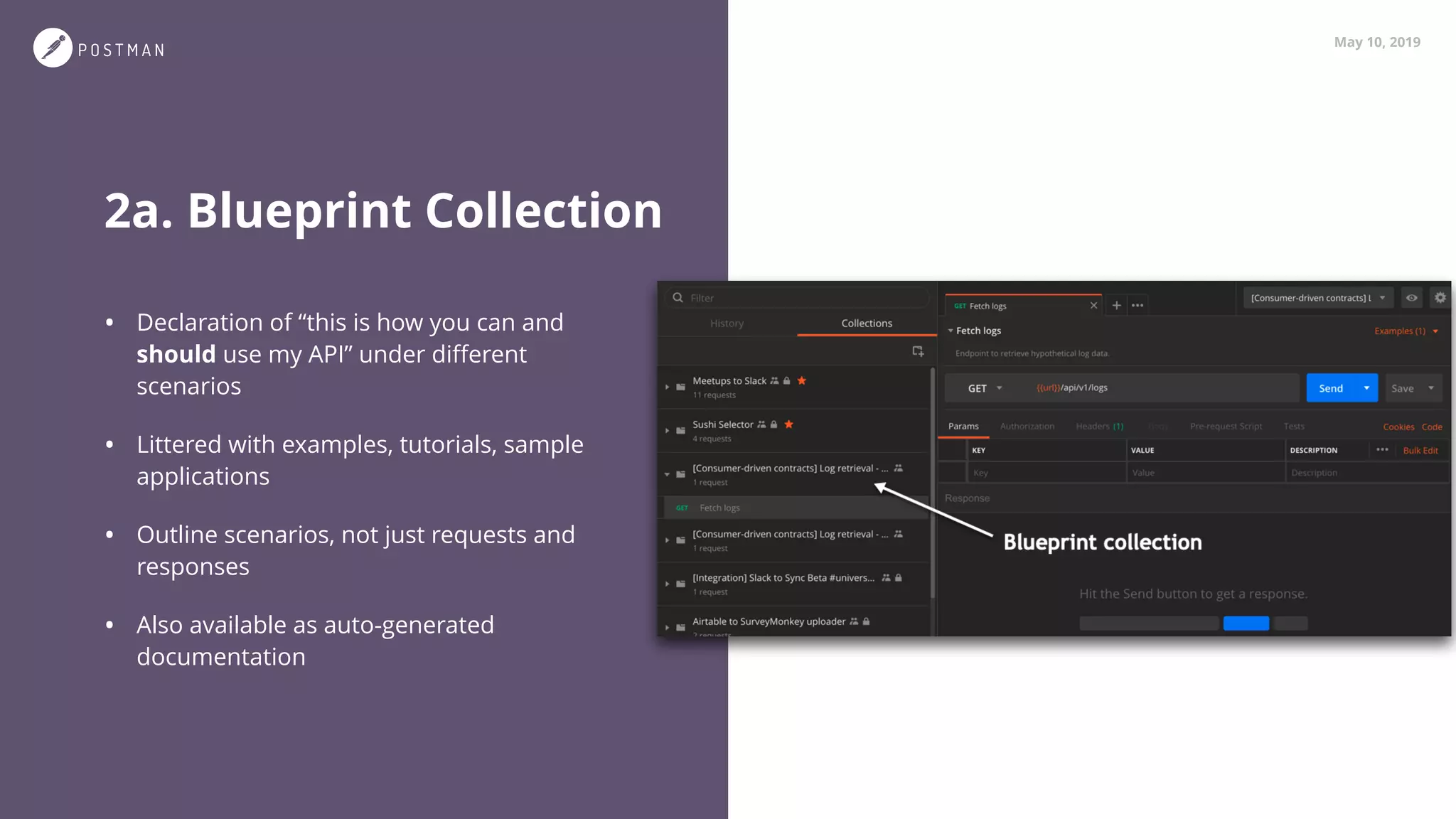
2a. Blueprint Collection
• Declaration of “this is how you can and
should use my API” under different
scenarios
• Littered with examples, tutorials, sample
applications
• Outline scenarios, not just requests and
responses
• Also available as auto-generated 

documentation
May 10, 2019
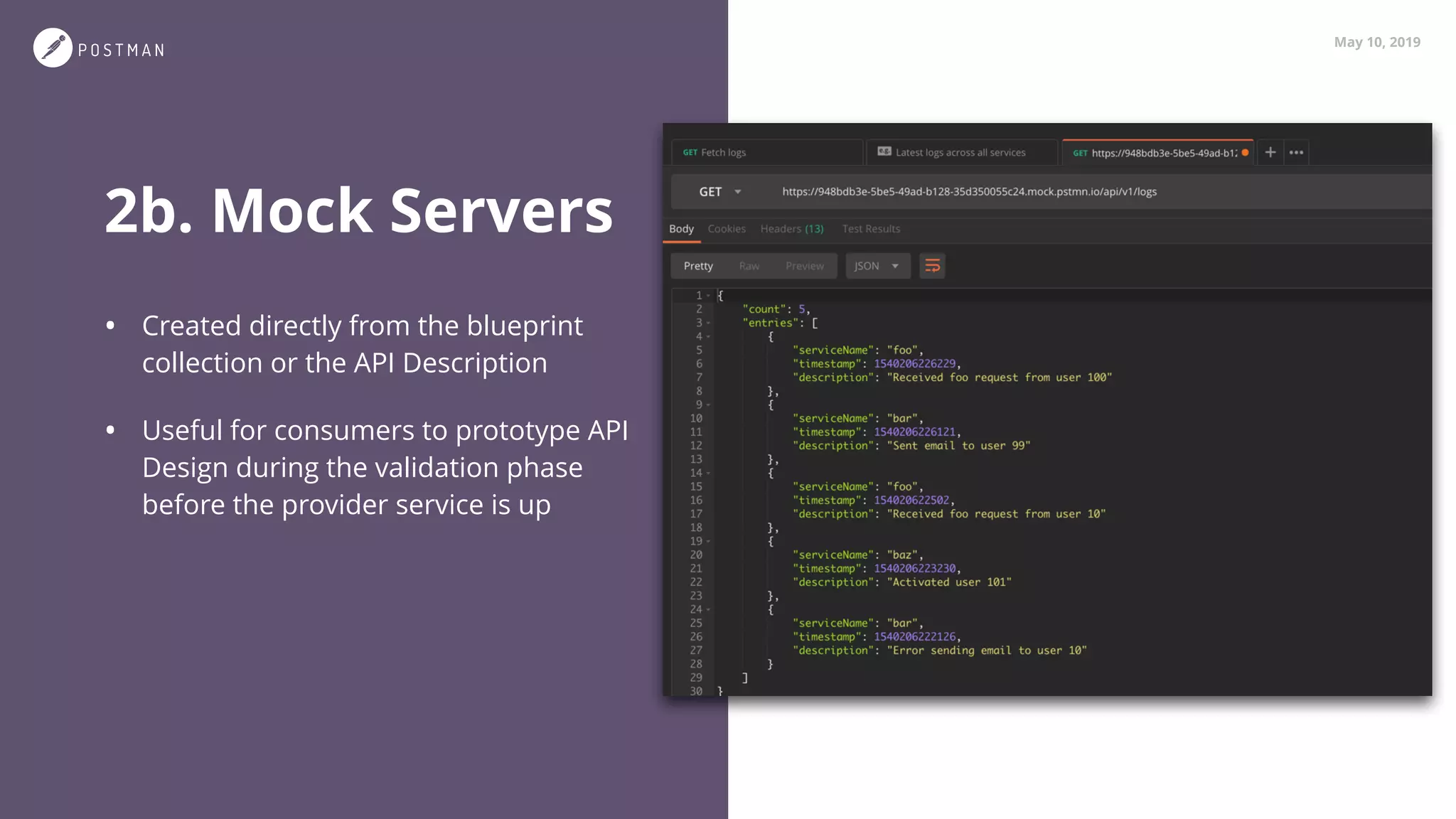
2b. Mock Servers
• Created directly from the blueprint
collection or the API Description
• Useful for consumers to prototype API
Design during the validation phase

before the provider service is up
May 10, 2019
2c. Run in Postman
• Embeddable anywhere on the web
• Make developers instantly actionable
with your APIs - pass signed in context
• Embed examples and scenarios
May 10, 2019
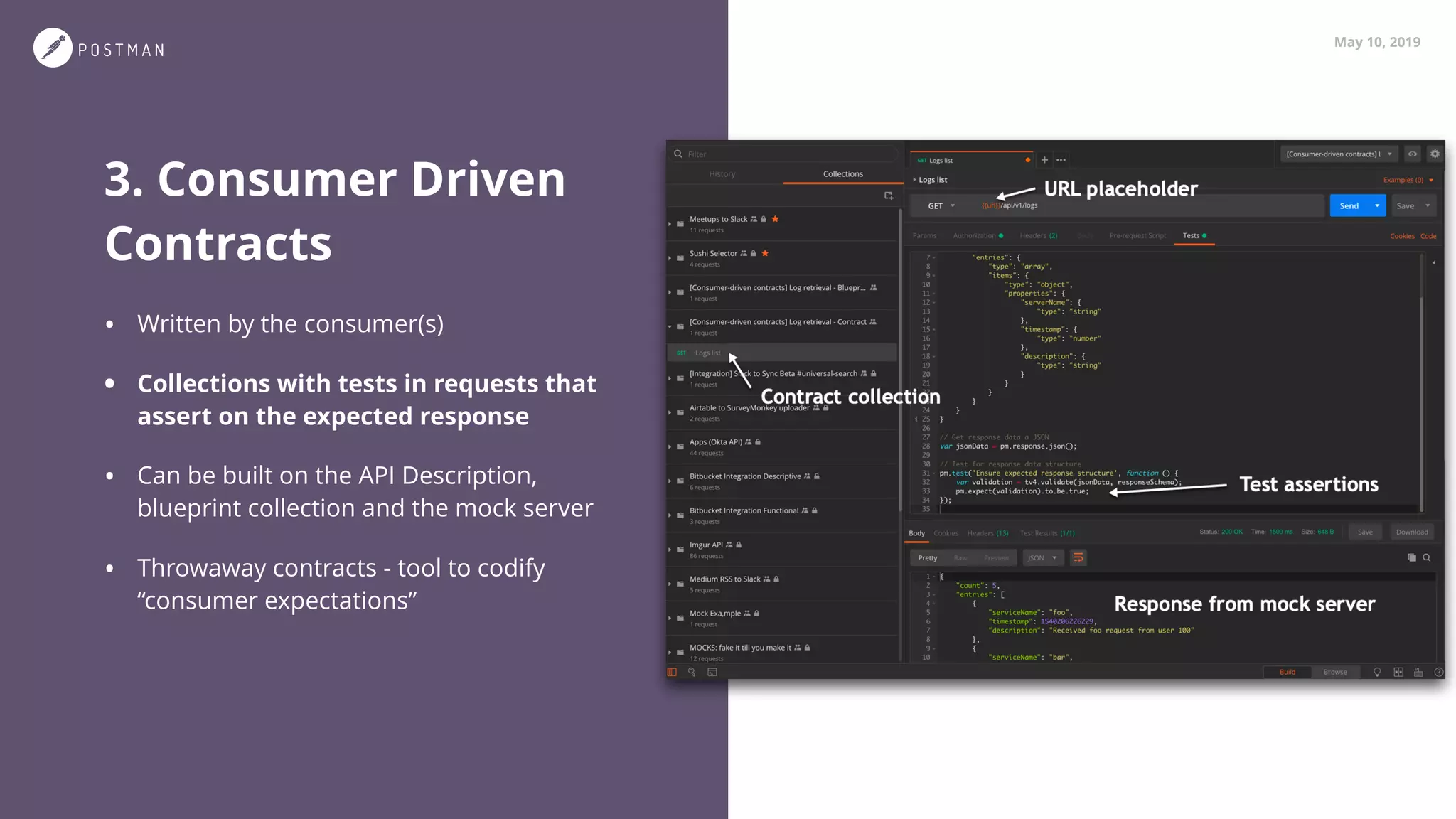
3. Consumer Driven
Contracts
• Written by the consumer(s)
• Collections with tests in requests that
assert on the expected response
• Can be built on the API Description,
blueprint collection and the mock server
• Throwaway contracts - tool to codify
“consumer expectations”
May 10, 2019
API Versioning
• Sometimes you’ve to break contracts. How do you do that without impacting consumers?
• API Versioning
• Co-existing endpoints and co-existing services
• Should be clearly communicated to the consumers
May 10, 2019
Summary
• API First means more than just APIs before code
• Start with clearly defined domain boundaries aligned
along business objectives
• AaaP approach encourages teams to apply Product
and Design thinking to APIs - understand your
consumers and their problems, design iteratively and
constantly seek and incorporate feedback
• Design great onboarding and developer experiences to
make consumers instantly and consistently actionable
• SaaS tools formalize processes into products. Use
them.
Thank You!

Dependency Down, Flexibility Up – The Benefits of API-First Development

  • 1.
  • 2.
    May 10, 2019 AboutMe Founder of Postman A Builder Since 2012 Passionate about APIs API
  • 3.
    Postman API Development Environment APIWorkflow Design & Mock Design in Postman & use Postman’s mock service Debug Test APIs, examine responses, add tests and scripts Automated Testing Test APIs, examine responses, add tests and scripts Document Create beautiful web-viewable documentation Monitor Create automated tests to monitor APIs for uptime, responsiveness & correctness Publish Onboard developers to your API faster with Postman collections and documentation Team Library Collaboration TeamLibrary Collaboration Monitor Publish Document Design & Mock Debug Automated Testing
  • 4.
    May 10, 2019 BezosMandate 1. All teams will henceforth expose their data and functionality through service interfaces. 2. Teams must communicate with each other through these interfaces. 3. There will be no other form of interprocess communication allowed: no direct linking, no direct reads of another team's data store, no shared-memory model, no back-doors whatsoever. The only communication allowed is via service interface calls over the network. 4. It doesn't matter what technology they use. HTTP, Corba, Pubsub, custom protocols -- doesn't matter. 5. All service interfaces, without exception, must be designed from the ground up to be “externalizable”. That is to say, the team must plan and design to be able to expose the interface to developers in the outside world. No exceptions. 6. Anyone who doesn't do this will be fired.
  • 5.
    May 10, 2019 Inother words… • APIs are the only way to get things done • Teams collaborate through APIs • “APIs must be externalizable” • Key constraint - how APIs are designed, built, and managed
  • 6.
    May 10, 2019 1.Teams modeled around Business Domain • Teams are created to follow the business domain within the organization • Teams display isomorphism with Technical Architecture - Inverse Conway’s Maneuver • Identifying these service boundaries leads to: • better team alignment and • more stable service boundaries, • avoiding expensive cross-service changes • Teams become experts in business domains than in specific technologies
  • 7.
    May 10, 2019 2.Teams collaborate through APIs • Context boundaries are explicit • Domain teams only interface with other domains through clearly defined APIs • Important to preserve conceptual integrity of context • Consumer Driven APIs - not a 1:1 reflection of the domain model • Sets up a Dependency Chain between different systems
  • 8.
    3. API asa Product (AaaP) • Think of APIs as Consumer-Driven Products • Consumer Research, Design, Prototyping, Testing, Monitoring, Maintenance • Applies to Public, Private and Partner APIs - aligns with “externalization” • 3 layers: • Design • Onboarding • DX
  • 9.
    May 10, 2019 Design •Jobs To be Done - Clayton Christensen • Why are you building this API? • What problems are you solving and how do you prioritize them? • Who are you solving this problem for? • Mission Statement for Domain Teams
  • 10.
    May 10, 2019 Design •API Interface Model - describes the behavior of an API from a consumer perspective • Includes details about communication protocol, messages, vocabularies • Acts as a tool for Collaboration - feedback, review • Can be expressed using API Description Formats: • HTTP - OpenAPI, SOAP - WADL, gRPC - Protocol Buffers • Ecosystem advantage - tooling
  • 11.
    May 10, 2019 •API Design precedes Code • Explicit process - how heavily to invest time & resources is a strategic decision • An Example: • Create a prototype for the interface - Open API Spec, Postman Collection • Share the prototype with the target consumers - (mock servers) • Collect feedback, make and validate changes - (consumer driven contracts) • Iterate as necessary Design
  • 12.
    Onboarding • Design theexperiences that takes a consumer to: • learn that the API will solve their problem(s) • understand how to use the API • Time to Get Things Working • Typically includes: • Getting started and other initial tutorials • Analytics of usage of these tutorials
  • 13.
    API Documentation • Toolto Teach and Learn about the API • Ways to Deliver: • Reference Guide • highly factual • better suited for experienced users • can be generated from API Description Languages • Design a Learning Experience • examples, tutorials, sample applications • suited for new users, reduce time to get things working • Important to keep it in sync with implementation and instance changes
  • 14.
    May 10, 2019 DeveloperExperience • User Experience for Developers • acknowledges a continuing, long-term relationship • continuous small improvements by studying consumer behavior and evolving needs • measure of how happy your consumers are • How are your APIs being used/not used • Interface Design, Discovery, Documentation, Support, Marketing - all contribute to DX
  • 15.
    May 10, 2019 DeveloperExperience • Things to Design for: • Consistency • Ease & Safety of Use • Error Reporting & Failure States • Monitor Usage
  • 16.
    May 10, 2019 Toolsto stay agile in an API-First World
  • 17.
    May 10, 2019 PostmanCollection • Executable Description of an API • Can be linked to Specifications • Auto-generated documentation • Collaboratively editable in Workspaces • Collections can be run anywhere:
 locally, commandline, CI or cloud
  • 18.
    May 10, 2019 1a.Schema • Understand the why, what, who • Create a draft of the API in 
 a description language of your 
 team’s choice - e.g. OpenAPI • Share and validate with potential 
 consumers
  • 19.
    May 10, 2019 1b.Documentation • Use tooling to automatically generate Reference documentation from API Description Languages • Publish internally/externally and make available to all consumers
  • 20.
    May 10, 2019 2a.Blueprint Collection • Declaration of “this is how you can and should use my API” under different scenarios • Littered with examples, tutorials, sample applications • Outline scenarios, not just requests and responses • Also available as auto-generated 
 documentation
  • 21.
    May 10, 2019 2b.Mock Servers • Created directly from the blueprint collection or the API Description • Useful for consumers to prototype API Design during the validation phase
 before the provider service is up
  • 22.
    May 10, 2019 2c.Run in Postman • Embeddable anywhere on the web • Make developers instantly actionable with your APIs - pass signed in context • Embed examples and scenarios
  • 23.
    May 10, 2019 3.Consumer Driven Contracts • Written by the consumer(s) • Collections with tests in requests that assert on the expected response • Can be built on the API Description, blueprint collection and the mock server • Throwaway contracts - tool to codify “consumer expectations”
  • 24.
    May 10, 2019 APIVersioning • Sometimes you’ve to break contracts. How do you do that without impacting consumers? • API Versioning • Co-existing endpoints and co-existing services • Should be clearly communicated to the consumers
  • 25.
    May 10, 2019 Summary •API First means more than just APIs before code • Start with clearly defined domain boundaries aligned along business objectives • AaaP approach encourages teams to apply Product and Design thinking to APIs - understand your consumers and their problems, design iteratively and constantly seek and incorporate feedback • Design great onboarding and developer experiences to make consumers instantly and consistently actionable • SaaS tools formalize processes into products. Use them.
  • 26.