Organising
XII Business Studies
Divisional Structure
Session : 5 Vikash Residential School
Prepared by Pratap Naik
Divisional Structure
Learning Objectives
 Concept
 Suitability
 Advantages
 Product Specialisation
 Helps In Fixation of Responsibility
 Promotes Flexibility and Initiative
 Facilitates Expansion and Growth
 Disadvantages
 Conflicts among Different Divisions
 Duplicity of Functions
 Manager may Ignore Organisational Interests
 Comparative View: Functional Structure and Divisional Structure
Prepared by Pratap Naik
Divisional Structure
What is Divisional Structure?
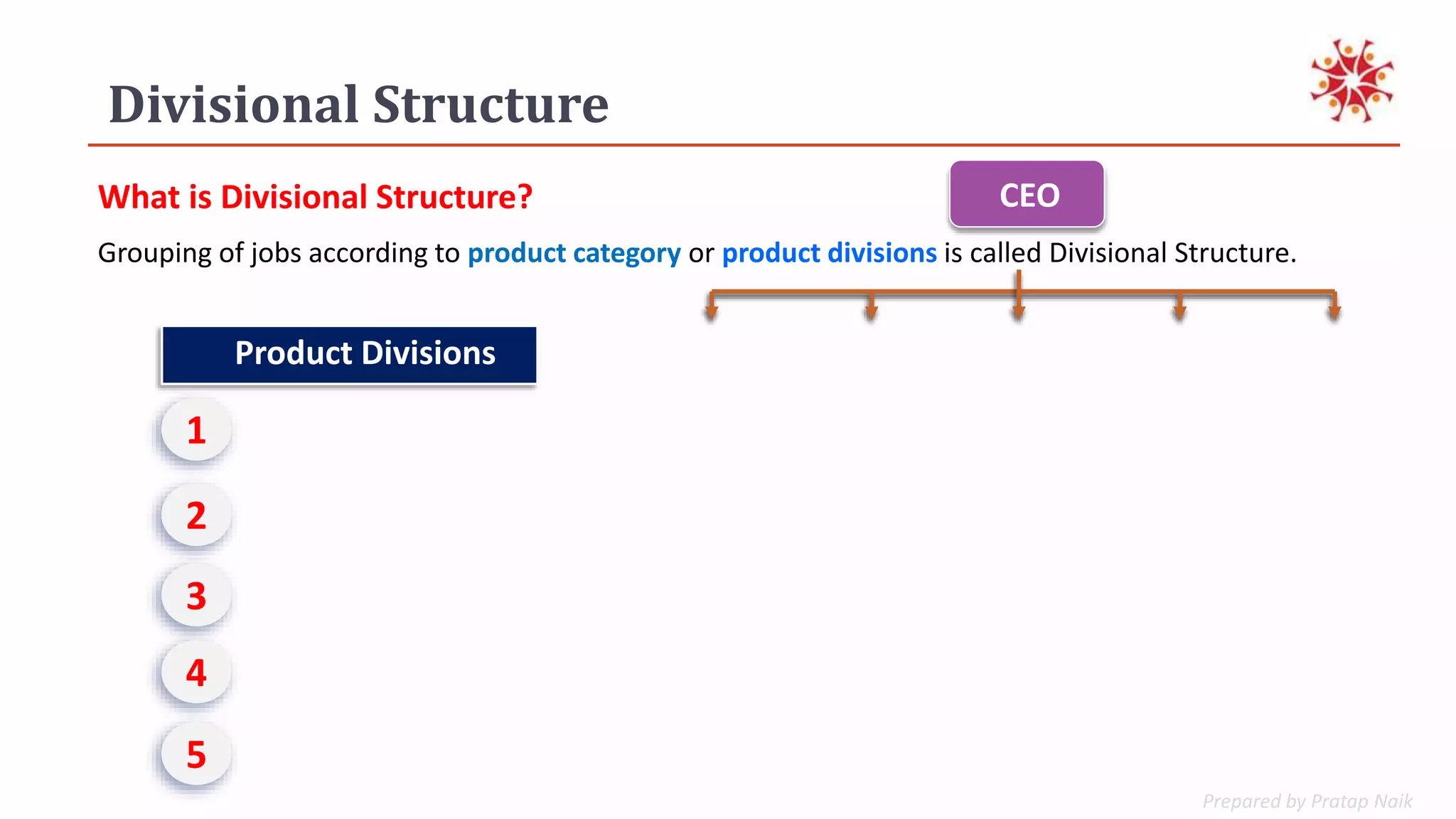
Grouping of jobs according to product category or product divisions is called Divisional Structure.
1
2
3
4
5
Product Divisions
CEO
Prepared by Pratap Naik
Divisional Structure
What is Divisional Structure?
Grouping of jobs according to product category or product divisions is called Divisional Structure.
 Each unit has a divisional head responsible for performance and has complete authority over the unit.
 Each division works as a profit center
 The divisional head is responsible for the profit or loss of his division.
 Each division is a multifunctional structure.
 Because within each division functions like production, marketing, finance, purchase etc, are performed
together to achieve a common goal.
• Production
• MarketingCosmetic
• Production
• MarketingTextile
• Finance
• Human Resources
• Finance
• Human Resources
Prepared by Pratap Naik
Divisional Structure
What is Divisional Structure?
Grouping of jobs according to product category or product divisions is called Divisional Structure.
 Each unit has a divisional head responsible for performance and has complete authority over the unit.
 Each division works as a profit center
 The divisional head is responsible for the profit or loss of his division.
 Each division is a multifunctional structure.
 Because within each division functions like production, marketing, finance, purchase etc, are performed
together to achieve a common goal.
Example
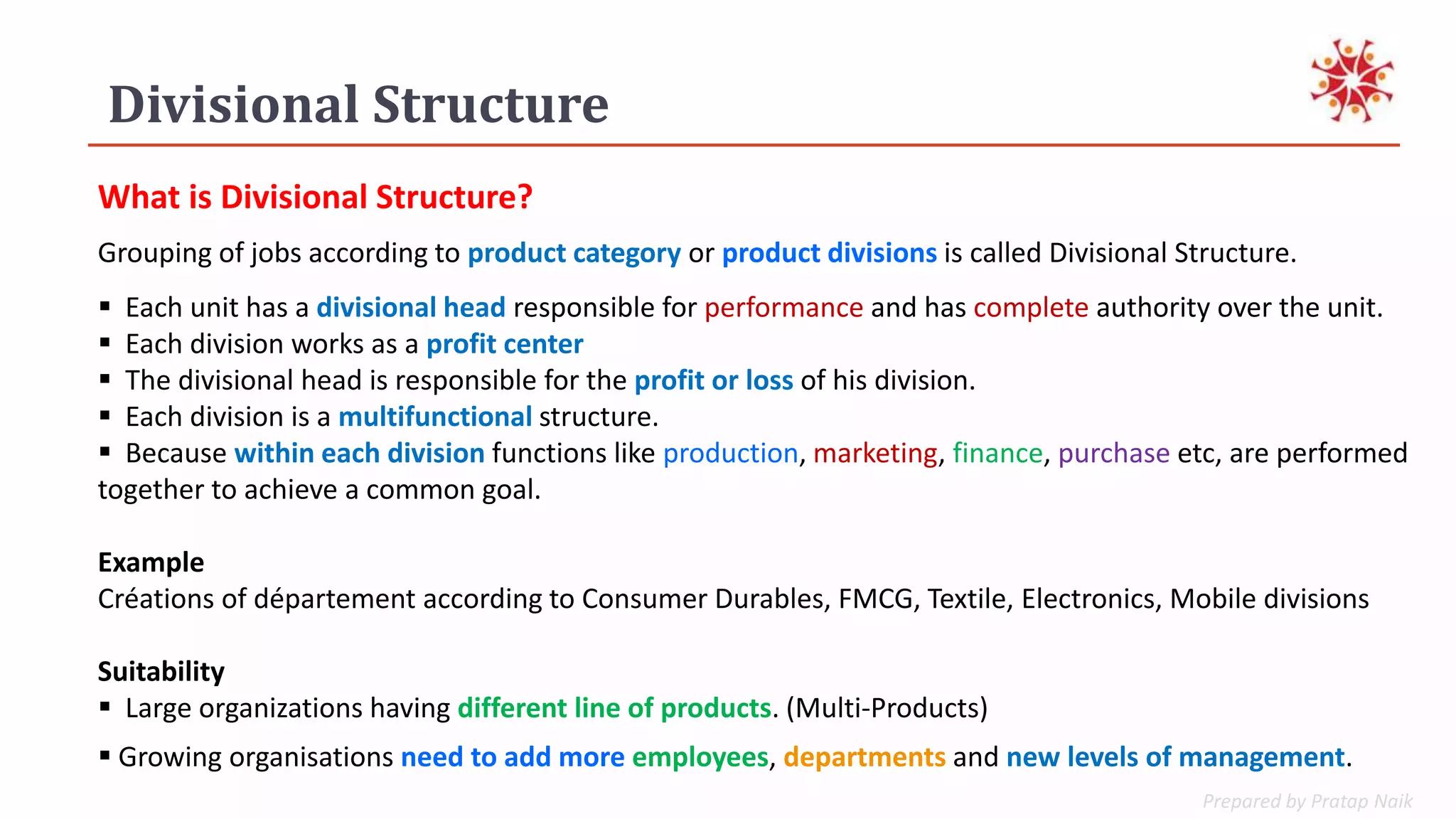
Créations of département according to Consumer Durables, FMCG, Textile, Electronics, Mobile divisions
Suitability
 Large organizations having different line of products. (Multi-Products)
 Growing organisations need to add more employees, departments and new levels of management.
Prepared by Pratap Naik
Advantages
1. Product Specialisation
 The manager in divisional structure gains experience in all functions related to a particular product,
 Thus it leads to product specialisation.
 This prepares him for higher position as the manager exposed to varied skill.
2. Helps In Fixation of Responsibility
 Each division treated as different profit center.
 The divisional heads are accountable for profits or loss.
 This provides a proper basis for performance measurement.
 Also helps in fixation of responsibility in cases of poor performance.
Divisional Structure
Prepared by Pratap Naik
Advantages
3. Promotes Flexibility and Initiative
 Each division functions as an autonomous unit
 This leads to faster decision making.
 Thus divisional structure promotes flexibility and initiative.
4. Facilitates Expansion and Growth
 New divisions can be added without interrupting the existing operations.
 This can be done by just by adding another divisional head and staff for the new product line.
 Thus divisional structure facilitates expansion and growth.
Divisional Structure
Prepared by Pratap Naik
Disadvantages
1. Conflicts among Different Divisions
 Inter-department conflict may arise with reference to allocation of funds and other resources.
 A particular division may seek to maximise its profits at the cost of other divisions.
2. Duplicity of Functions
 In divisional structure each division is multifunctional and has separate set of similar functions.
 It may leads to duplication of activities across products and increased in costs.
3. Manager may Ignore Organisational Interests
 Sometimes the autonomy and independency of a particular division over emphasized.
 Such situation may hamper organisational interest.
 This happens because, in the process of supervise all activities related to a particular division, a
manager may gain maximum authority.
Divisional Structure
Prepared by Pratap Naik
Comparative View:
Functional and Divisional Structure
Basis Functional Structure Divisional Structure
Formation Formation is based on functions
Formation is based on product lines and is
supported by functions.
Specialisation Functional specialisation. Product specialisation.
Responsibility Difficult to fix on a department. Easy to fix responsibility for performance.
Managerial
Development
Difficult, as each functional manager has to
report to the top management.
Easier, autonomy as well as the chance to
perform multiple functions helps in
managerial development.
Cost
Functions are not duplicated hence
economical.
Duplication of resources in various
departments, hence costly.
Coordination Difficult for a multi-product company.
Easy, because all functions related to a
particular product are integrated in one
department.
Prepared by Pratap Naik
Divisional Structure
 Suitability
 Advantages
 Product Specialisation
 Helps In Fixation of Responsibility
 Promotes Flexibility and Initiative
 Facilitates Expansion and Growth
 Comparative View:
Functional and Divisional Structure
 Disadvantages
 Conflicts among Different Divisions
 Duplicity of Functions
 Manager may Ignore Organisational Interests
Recap
*No plagiarism please. Reproduction and re-use of this presentation is prohibited.
This presentation is the property of the author.
Thank you !!!
Session Complete Vikash Residential School
XII Business Studies

5.5 Divisional Structure : XII Business Studies

  • 1.
    Organising XII Business Studies DivisionalStructure Session : 5 Vikash Residential School
  • 2.
    Prepared by PratapNaik Divisional Structure Learning Objectives  Concept  Suitability  Advantages  Product Specialisation  Helps In Fixation of Responsibility  Promotes Flexibility and Initiative  Facilitates Expansion and Growth  Disadvantages  Conflicts among Different Divisions  Duplicity of Functions  Manager may Ignore Organisational Interests  Comparative View: Functional Structure and Divisional Structure
  • 3.
    Prepared by PratapNaik Divisional Structure What is Divisional Structure? Grouping of jobs according to product category or product divisions is called Divisional Structure. 1 2 3 4 5 Product Divisions CEO
  • 4.
    Prepared by PratapNaik Divisional Structure What is Divisional Structure? Grouping of jobs according to product category or product divisions is called Divisional Structure.  Each unit has a divisional head responsible for performance and has complete authority over the unit.  Each division works as a profit center  The divisional head is responsible for the profit or loss of his division.  Each division is a multifunctional structure.  Because within each division functions like production, marketing, finance, purchase etc, are performed together to achieve a common goal. • Production • MarketingCosmetic • Production • MarketingTextile • Finance • Human Resources • Finance • Human Resources
  • 5.
    Prepared by PratapNaik Divisional Structure What is Divisional Structure? Grouping of jobs according to product category or product divisions is called Divisional Structure.  Each unit has a divisional head responsible for performance and has complete authority over the unit.  Each division works as a profit center  The divisional head is responsible for the profit or loss of his division.  Each division is a multifunctional structure.  Because within each division functions like production, marketing, finance, purchase etc, are performed together to achieve a common goal. Example Créations of département according to Consumer Durables, FMCG, Textile, Electronics, Mobile divisions Suitability  Large organizations having different line of products. (Multi-Products)  Growing organisations need to add more employees, departments and new levels of management.
  • 6.
    Prepared by PratapNaik Advantages 1. Product Specialisation  The manager in divisional structure gains experience in all functions related to a particular product,  Thus it leads to product specialisation.  This prepares him for higher position as the manager exposed to varied skill. 2. Helps In Fixation of Responsibility  Each division treated as different profit center.  The divisional heads are accountable for profits or loss.  This provides a proper basis for performance measurement.  Also helps in fixation of responsibility in cases of poor performance. Divisional Structure
  • 7.
    Prepared by PratapNaik Advantages 3. Promotes Flexibility and Initiative  Each division functions as an autonomous unit  This leads to faster decision making.  Thus divisional structure promotes flexibility and initiative. 4. Facilitates Expansion and Growth  New divisions can be added without interrupting the existing operations.  This can be done by just by adding another divisional head and staff for the new product line.  Thus divisional structure facilitates expansion and growth. Divisional Structure
  • 8.
    Prepared by PratapNaik Disadvantages 1. Conflicts among Different Divisions  Inter-department conflict may arise with reference to allocation of funds and other resources.  A particular division may seek to maximise its profits at the cost of other divisions. 2. Duplicity of Functions  In divisional structure each division is multifunctional and has separate set of similar functions.  It may leads to duplication of activities across products and increased in costs. 3. Manager may Ignore Organisational Interests  Sometimes the autonomy and independency of a particular division over emphasized.  Such situation may hamper organisational interest.  This happens because, in the process of supervise all activities related to a particular division, a manager may gain maximum authority. Divisional Structure
  • 9.
    Prepared by PratapNaik Comparative View: Functional and Divisional Structure Basis Functional Structure Divisional Structure Formation Formation is based on functions Formation is based on product lines and is supported by functions. Specialisation Functional specialisation. Product specialisation. Responsibility Difficult to fix on a department. Easy to fix responsibility for performance. Managerial Development Difficult, as each functional manager has to report to the top management. Easier, autonomy as well as the chance to perform multiple functions helps in managerial development. Cost Functions are not duplicated hence economical. Duplication of resources in various departments, hence costly. Coordination Difficult for a multi-product company. Easy, because all functions related to a particular product are integrated in one department.
  • 10.
    Prepared by PratapNaik Divisional Structure  Suitability  Advantages  Product Specialisation  Helps In Fixation of Responsibility  Promotes Flexibility and Initiative  Facilitates Expansion and Growth  Comparative View: Functional and Divisional Structure  Disadvantages  Conflicts among Different Divisions  Duplicity of Functions  Manager may Ignore Organisational Interests Recap
  • 11.
    *No plagiarism please.Reproduction and re-use of this presentation is prohibited. This presentation is the property of the author. Thank you !!! Session Complete Vikash Residential School XII Business Studies

Editor's Notes

  • #7 Setting Objectives It could mean an increase in sales by 20% which could be objective of the entire organisation. While developing objective unit and employees at all levels should be involved They must also understand how their actions contribute to achieving objectives 2. Developing premises Forecasts can be made about the demand for a particular product, policy change, interest rates, prices of capital goods, tax rates etc. Accurate forecasts, therefore become essential for successful plans.
  • #8 Setting Objectives It could mean an increase in sales by 20% which could be objective of the entire organisation. While developing objective unit and employees at all levels should be involved They must also understand how their actions contribute to achieving objectives 2. Developing premises Forecasts can be made about the demand for a particular product, policy change, interest rates, prices of capital goods, tax rates etc. Accurate forecasts, therefore become essential for successful plans.
  • #9 Setting Objectives It could mean an increase in sales by 20% which could be objective of the entire organisation. While developing objective unit and employees at all levels should be involved They must also understand how their actions contribute to achieving objectives 2. Developing premises Forecasts can be made about the demand for a particular product, policy change, interest rates, prices of capital goods, tax rates etc. Accurate forecasts, therefore become essential for successful plans.