DENGUE FEVER & DHF
MODERATOR
DR.PRANJALI SAXENA
DEPARTMENT OF
PEDIATRICS
BY :-
DR.RAJAT AGRAWAL
Department of Pediatrics
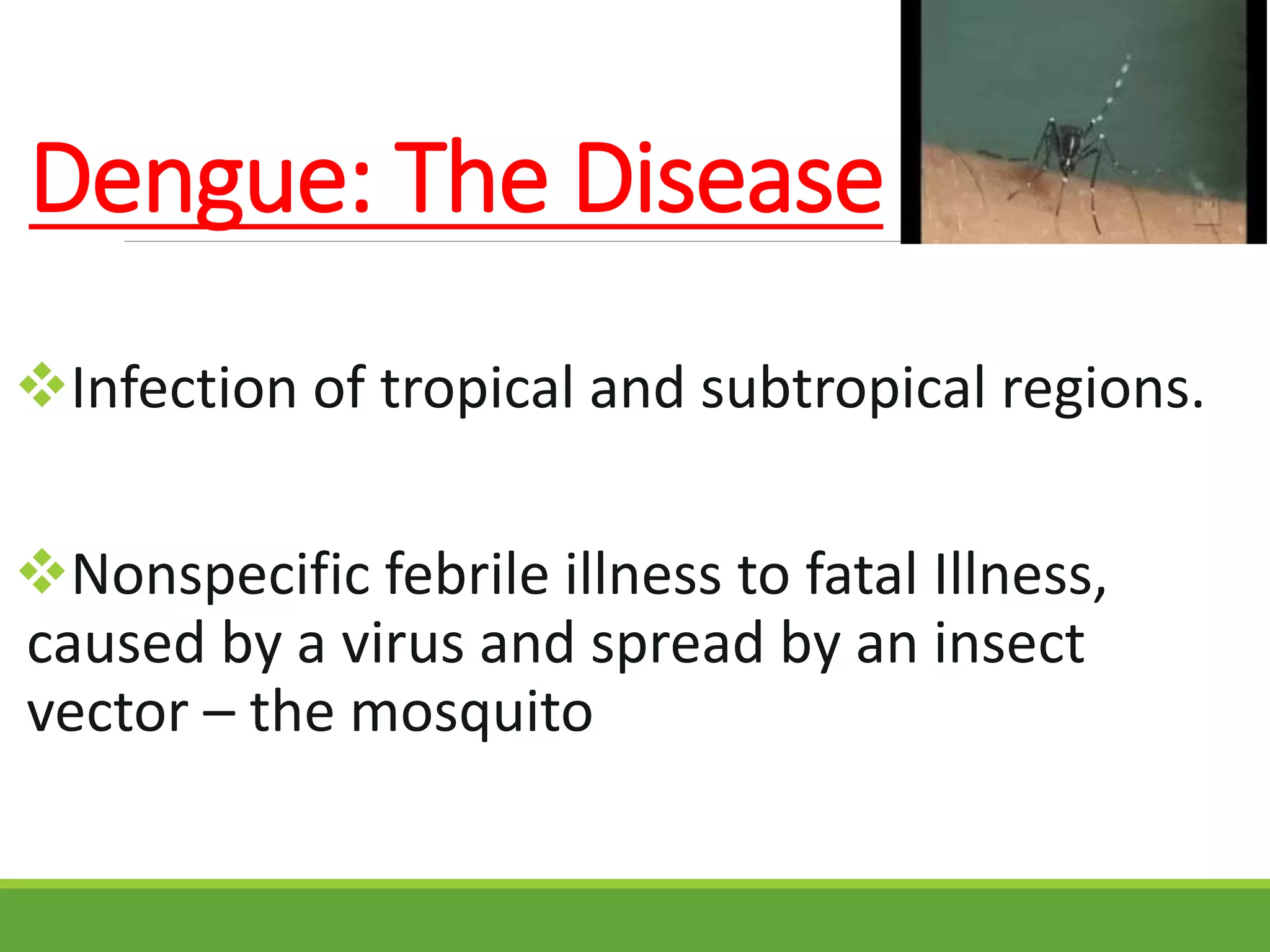
Dengue: The Disease
Infection of tropical and subtropical regions.
Nonspecific febrile illness to fatal Illness,
caused by a virus and spread by an insect
vector – the mosquito
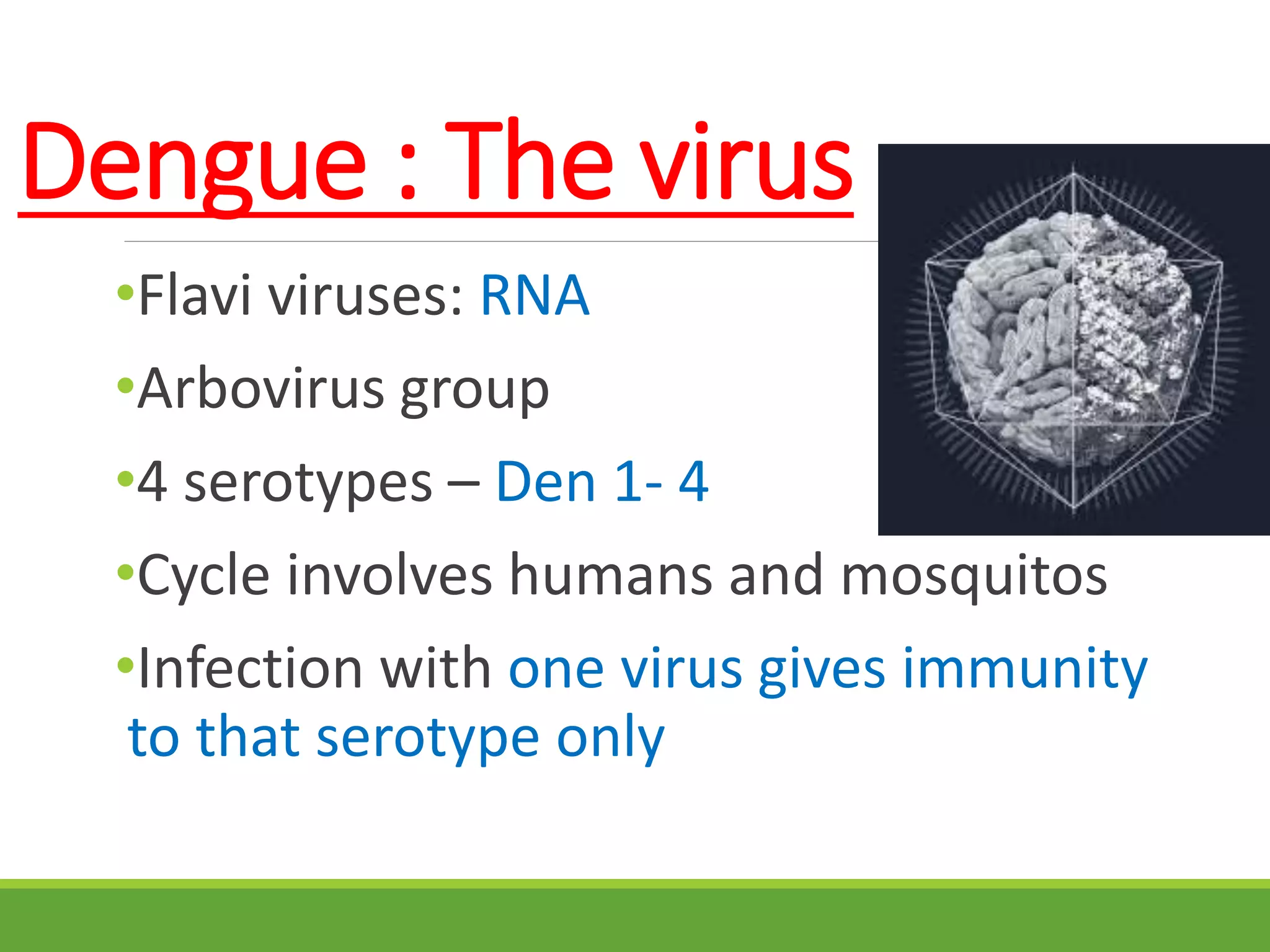
Dengue : The virus
•Flavi viruses: RNA
•Arbovirus group
•4 serotypes – Den 1- 4
•Cycle involves humans and mosquitos
•Infection with one virus gives immunity
to that serotype only
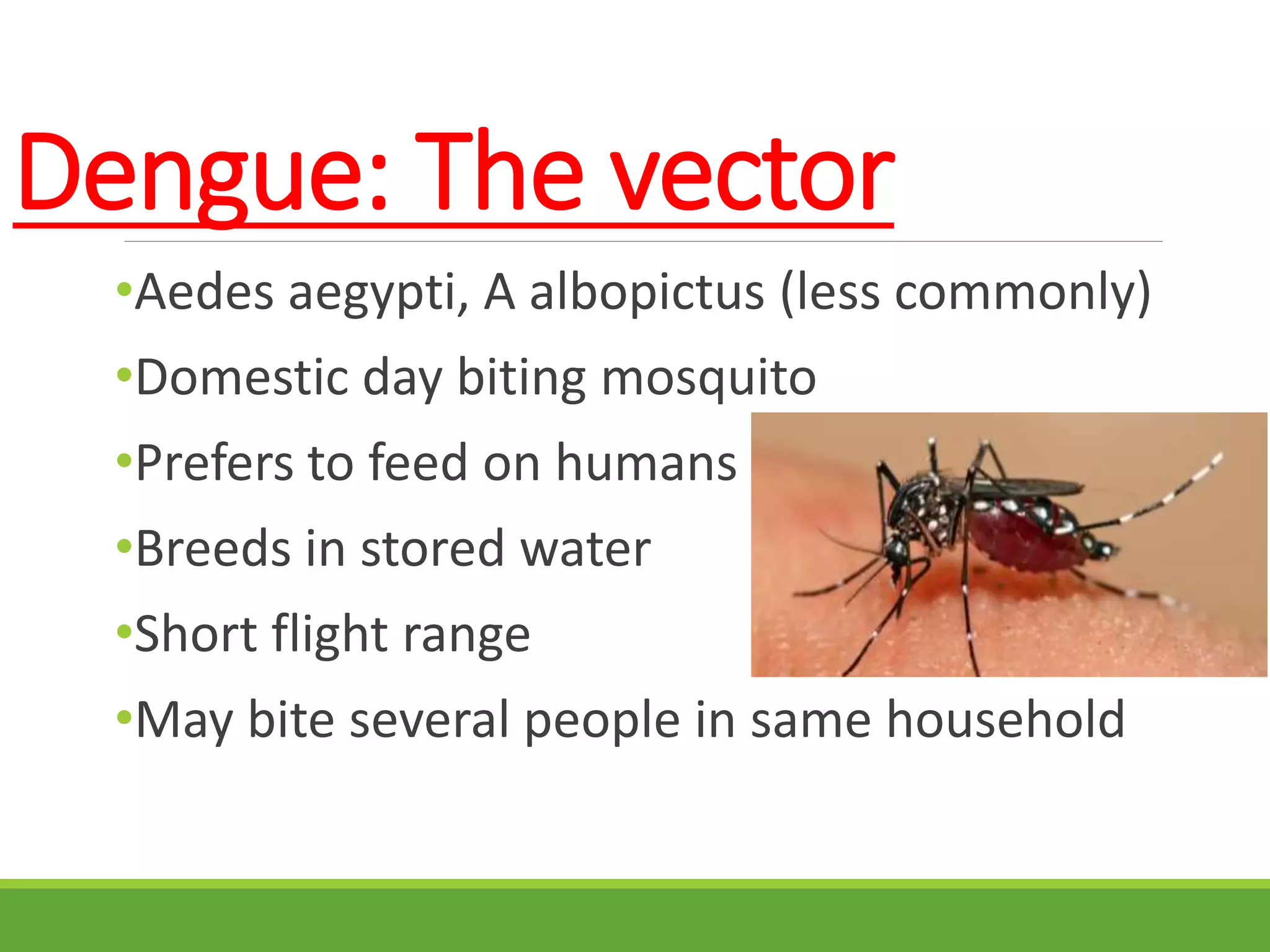
Dengue: The vector
•Aedes aegypti, A albopictus (less commonly)
•Domestic day biting mosquito
•Prefers to feed on humans
•Breeds in stored water
•Short flight range
•May bite several people in same household
Dengue Fever : Clinical Features
Sudden fever 40-41C
Incubation period 2-7 days
Nonspecific constitutional symptoms
Severe muscle aches, retro-orbital pain
Hepatomegaly
Rash
Facial flush
Fever subsides in 2-7 days, may be biphasic
WHO case definition for DF:
Acute Febrile illness with 2 or > of the following:
•Headache
•Retro-orbital pain
•Myalgia
•Arthralgia
•Rash
•Hemorrhagic manifestations
•Leukopenia
•Hepatomegaly common
DHF: Pathogenesis
Secondary infection with another serotype leads to
‘antibody mediated enhancement’
Heterotypic antibodies are non protective and fail to
neutralise the virus
Virus-antibody complexes taken up by monocytes
Virion multiplication in human monocytes is promoted
Activation of CD4+ and CD8+ lymphocytes  release of
cytokines
Complement system activated with depression of C3 &
C5
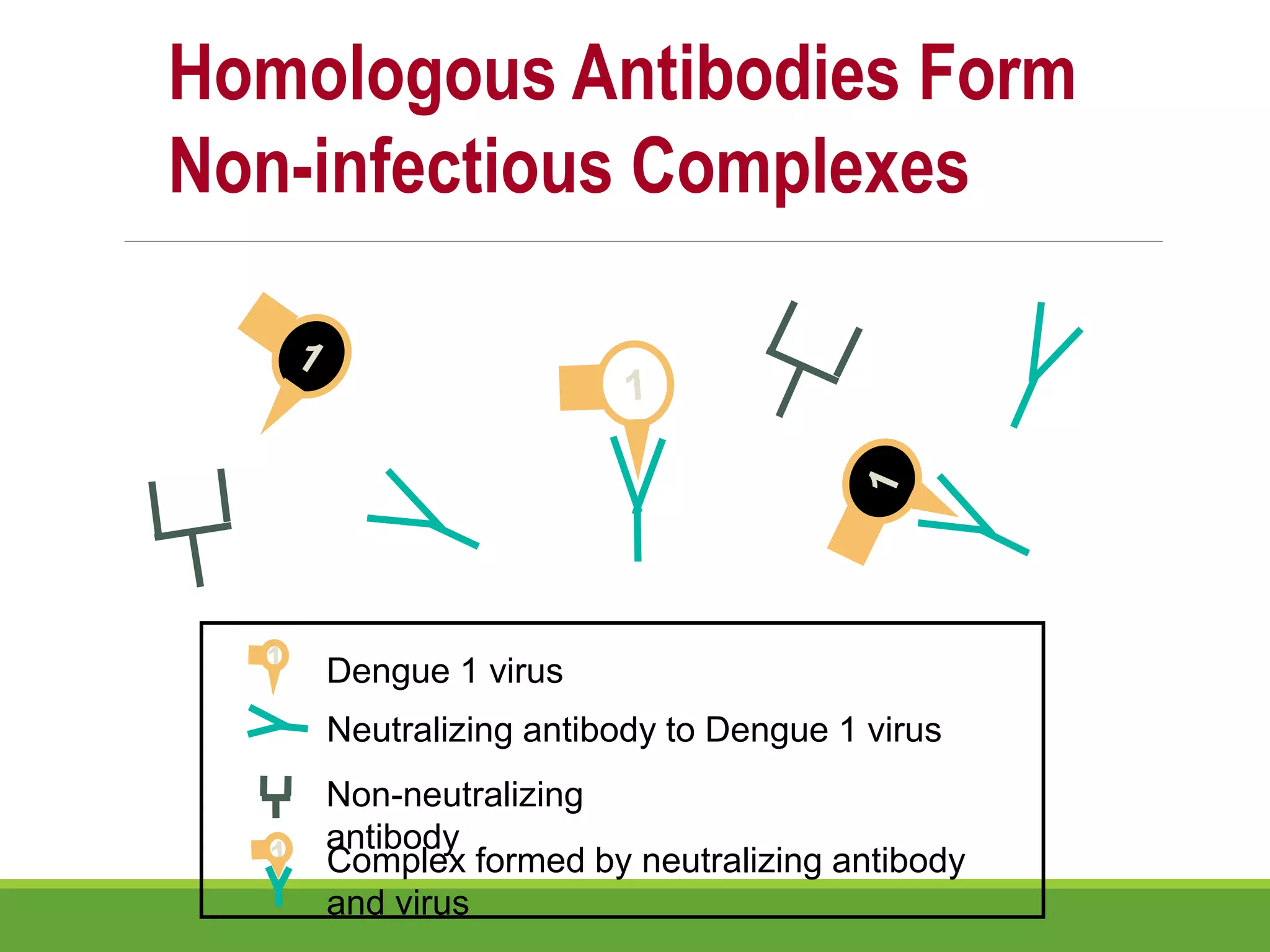
Neutralizing antibody to Dengue 1 virus
Dengue 1 virus
Homologous Antibodies Form
Non-infectious Complexes
Non-neutralizing
antibody
Complex formed by neutralizing antibody
and virus
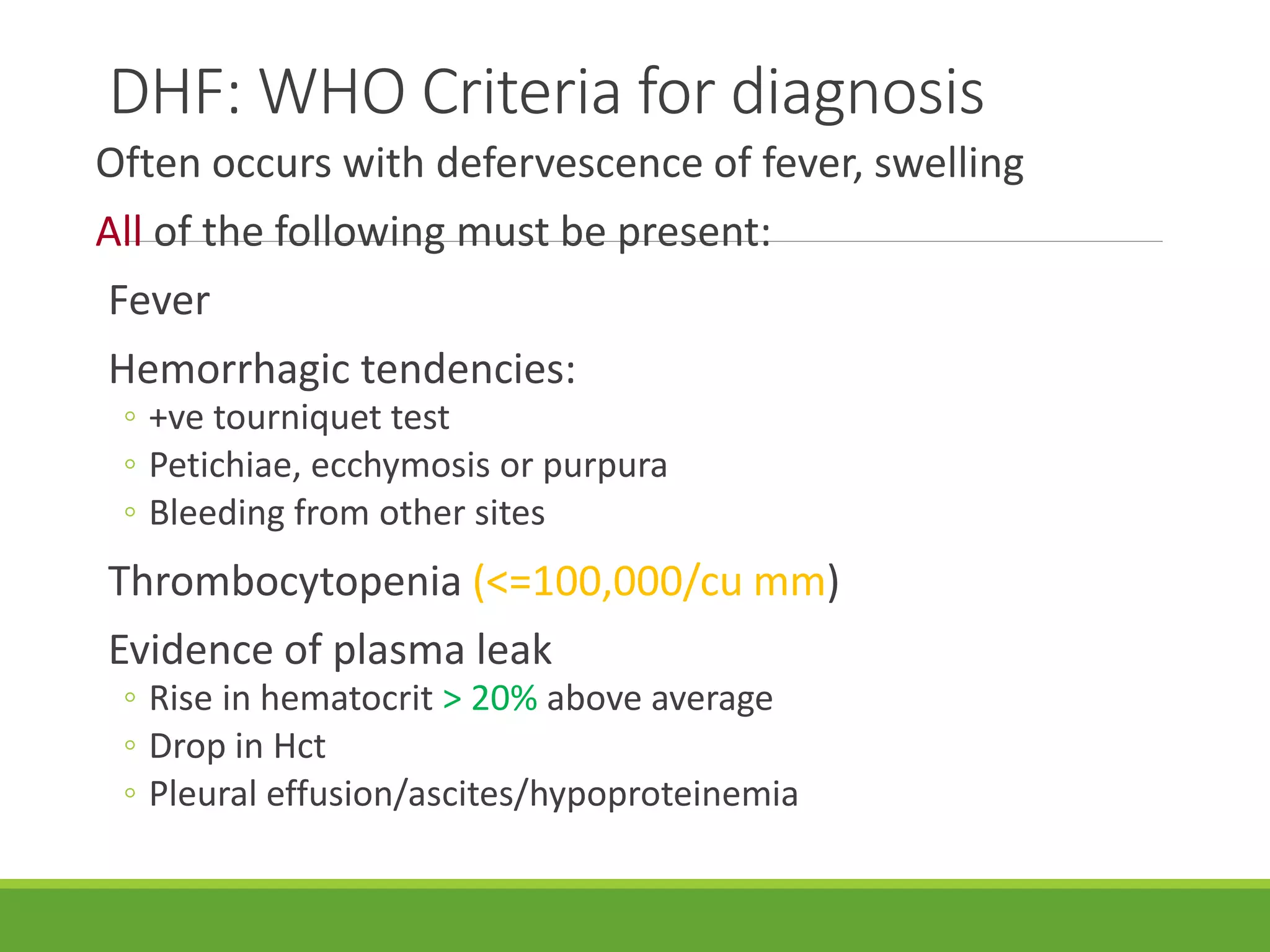
DHF: WHO Criteria for diagnosis
Often occurs with defervescence of fever, swelling
All of the following must be present:
Fever
Hemorrhagic tendencies:
◦ +ve tourniquet test
◦ Petichiae, ecchymosis or purpura
◦ Bleeding from other sites
Thrombocytopenia (<=100,000/cu mm)
Evidence of plasma leak
◦ Rise in hematocrit > 20% above average
◦ Drop in Hct
◦ Pleural effusion/ascites/hypoproteinemia
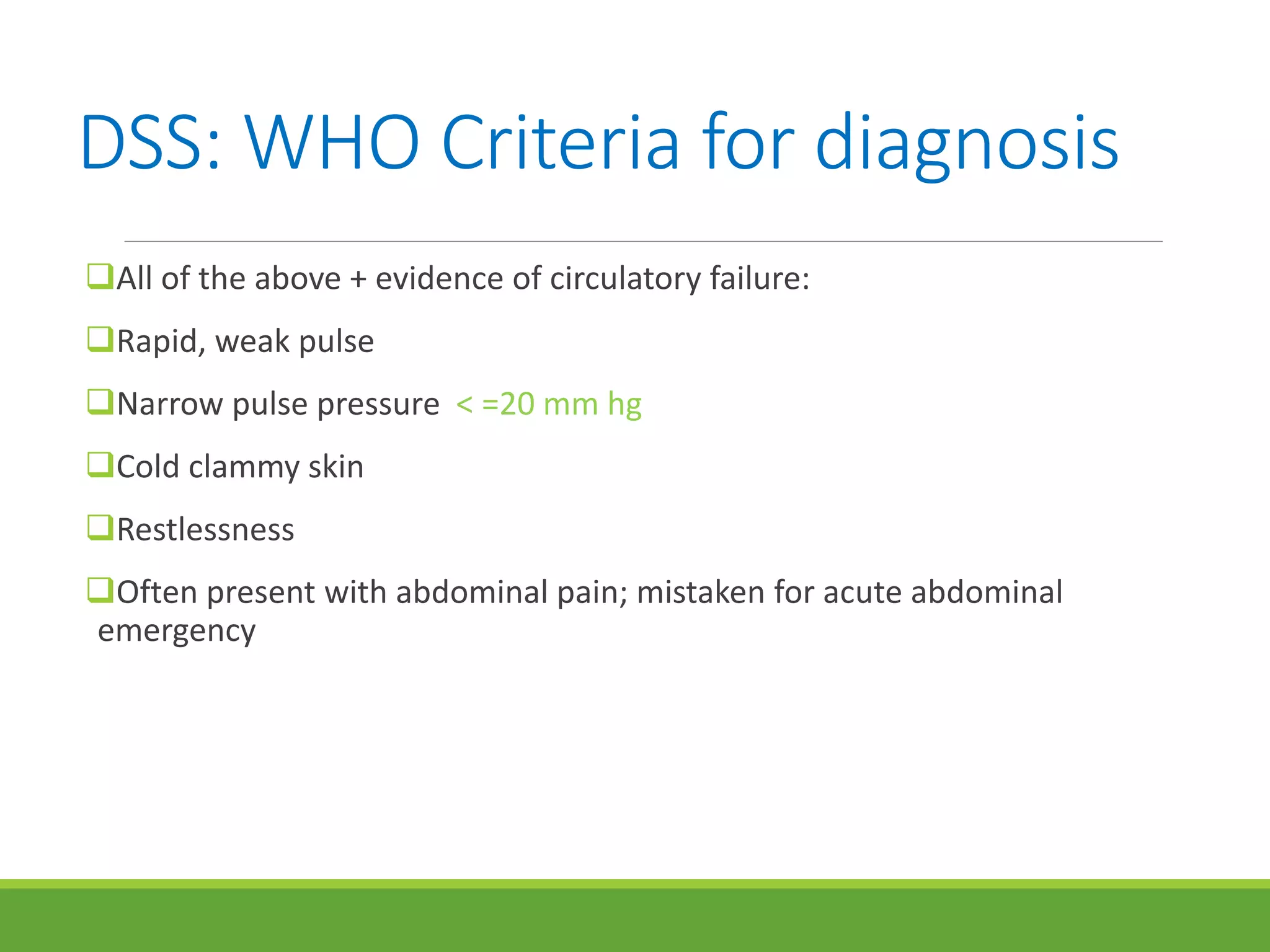
DSS: WHO Criteria for diagnosis
All of the above + evidence of circulatory failure:
Rapid, weak pulse
Narrow pulse pressure < =20 mm hg
Cold clammy skin
Restlessness
Often present with abdominal pain; mistaken for acute abdominal
emergency
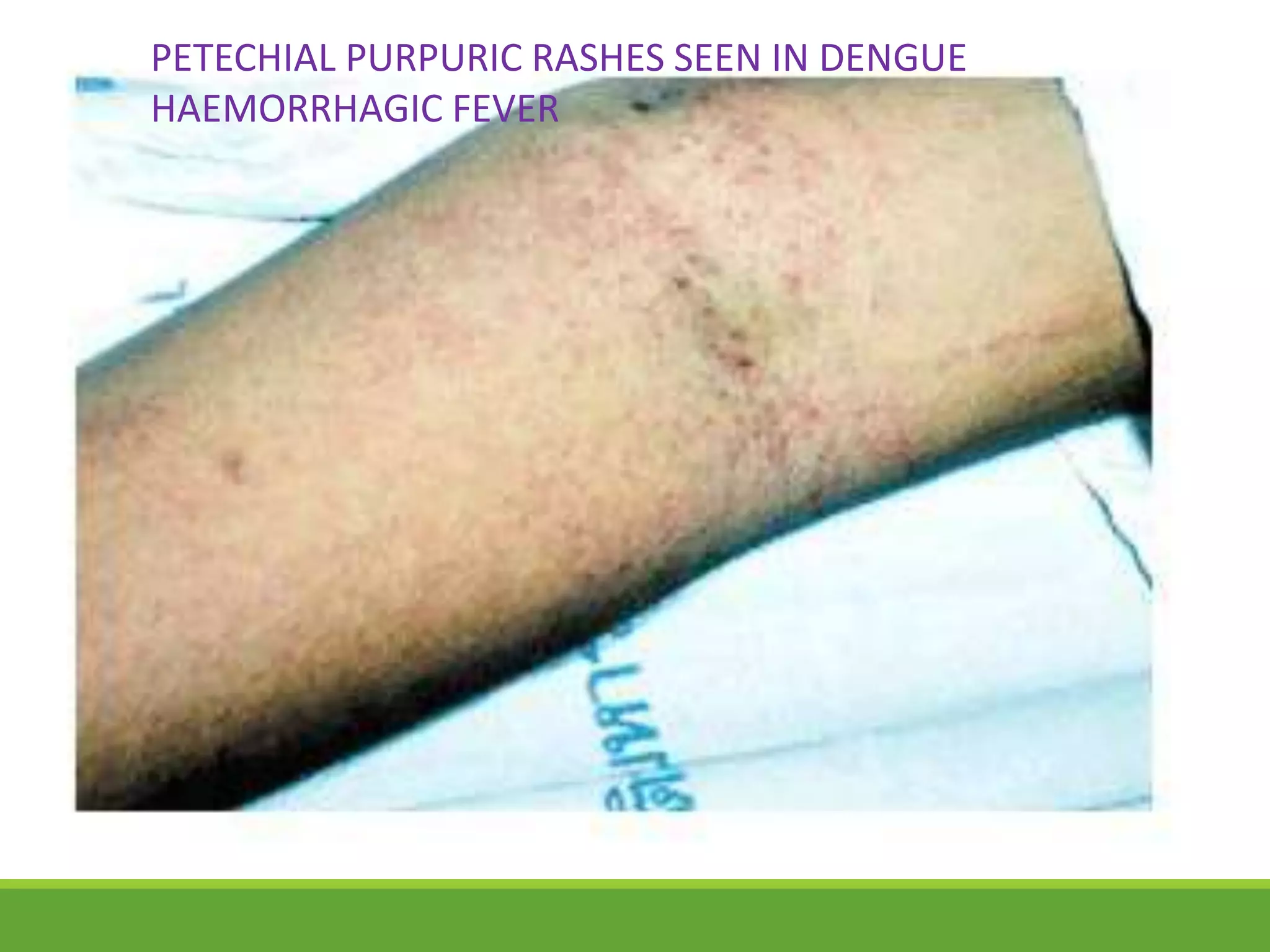
PETECHIAL PURPURIC RASHES SEEN IN DENGUE
HAEMORRHAGIC FEVER
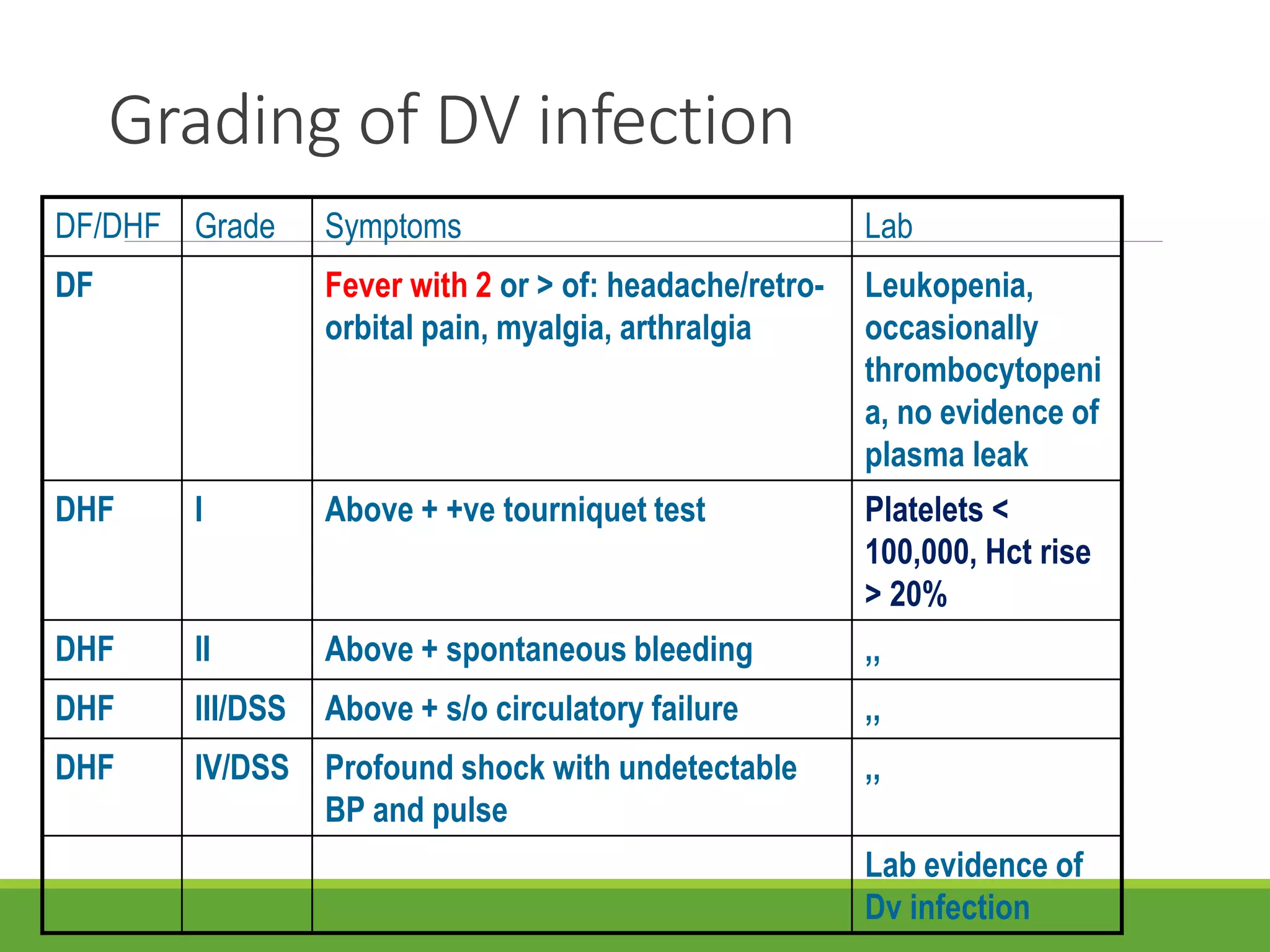
Grading of DV infection
DF/DHF Grade Symptoms Lab
DF Fever with 2 or > of: headache/retro-
orbital pain, myalgia, arthralgia
Leukopenia,
occasionally
thrombocytopeni
a, no evidence of
plasma leak
DHF I Above + +ve tourniquet test Platelets <
100,000, Hct rise
> 20%
DHF II Above + spontaneous bleeding ,,
DHF III/DSS Above + s/o circulatory failure ,,
DHF IV/DSS Profound shock with undetectable
BP and pulse
,,
Lab evidence of
Dv infection
Immune response to Dengue
infections
Primary Infection: IgM antibody in late acute/
convalescent stage; later IgG which lasts for several
decades
Secondary infection: High IgG level, small rise in
IgM
Cross reactions with other flaviviruses
Infection with one serotype does not protect
against other serotypes
Lab Diagnosis of Dengue infection:
Dengue HI test in paired sera showing 4 fold rise or fall: cross reactivity
IgM type antibodies in late acute/convalescent sera in primary infection
IgG type antibodies in high titre in secondary infection
Viral isolation: sensitivity < 50%
RT- PCR: sensitivity > 90%
WHO Lab Criteria for Dengue
infection:
Probable Case:
CF + Supportive Serology: Acute HI titre > 1280, comparable
IgG ELISA or +ve IgM
or occurrence at same location & time as other confirmed
cases
Confirmed case:
isolation of virus from serum/ autopsy specimen
Demonstration of dengue virus antigen in serum/ CSF/
Autopsy tissue
Detection of dengue virus genome by PCR
Management: DF
No specific Tt
Analgesics/antipyretics
Avoid agents which may impair platelet
function eg aspirin
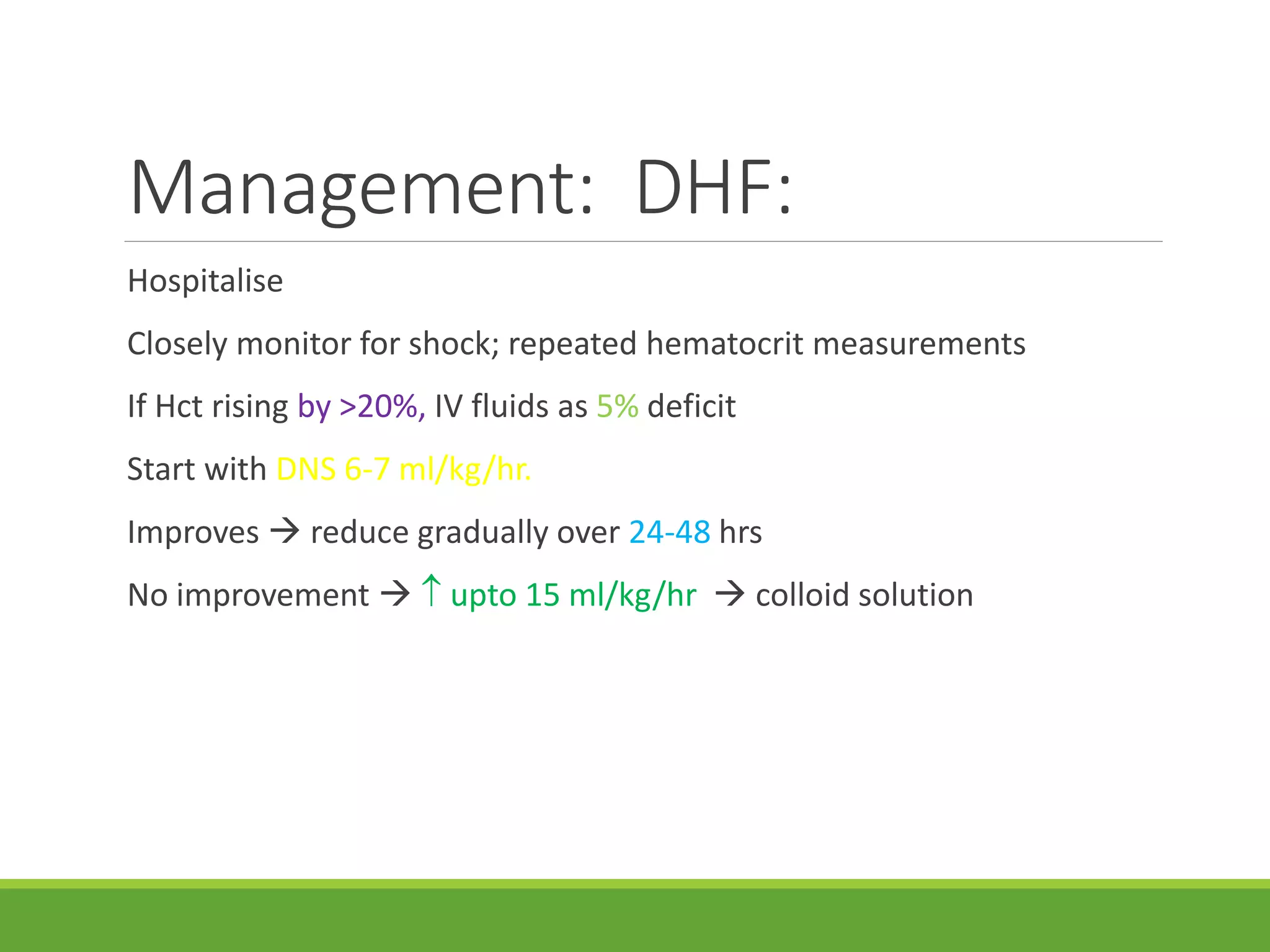
Management: DHF:
Hospitalise
Closely monitor for shock; repeated hematocrit measurements
If Hct rising by >20%, IV fluids as 5% deficit
Start with DNS 6-7 ml/kg/hr.
Improves  reduce gradually over 24-48 hrs
No improvement   upto 15 ml/kg/hr  colloid solution
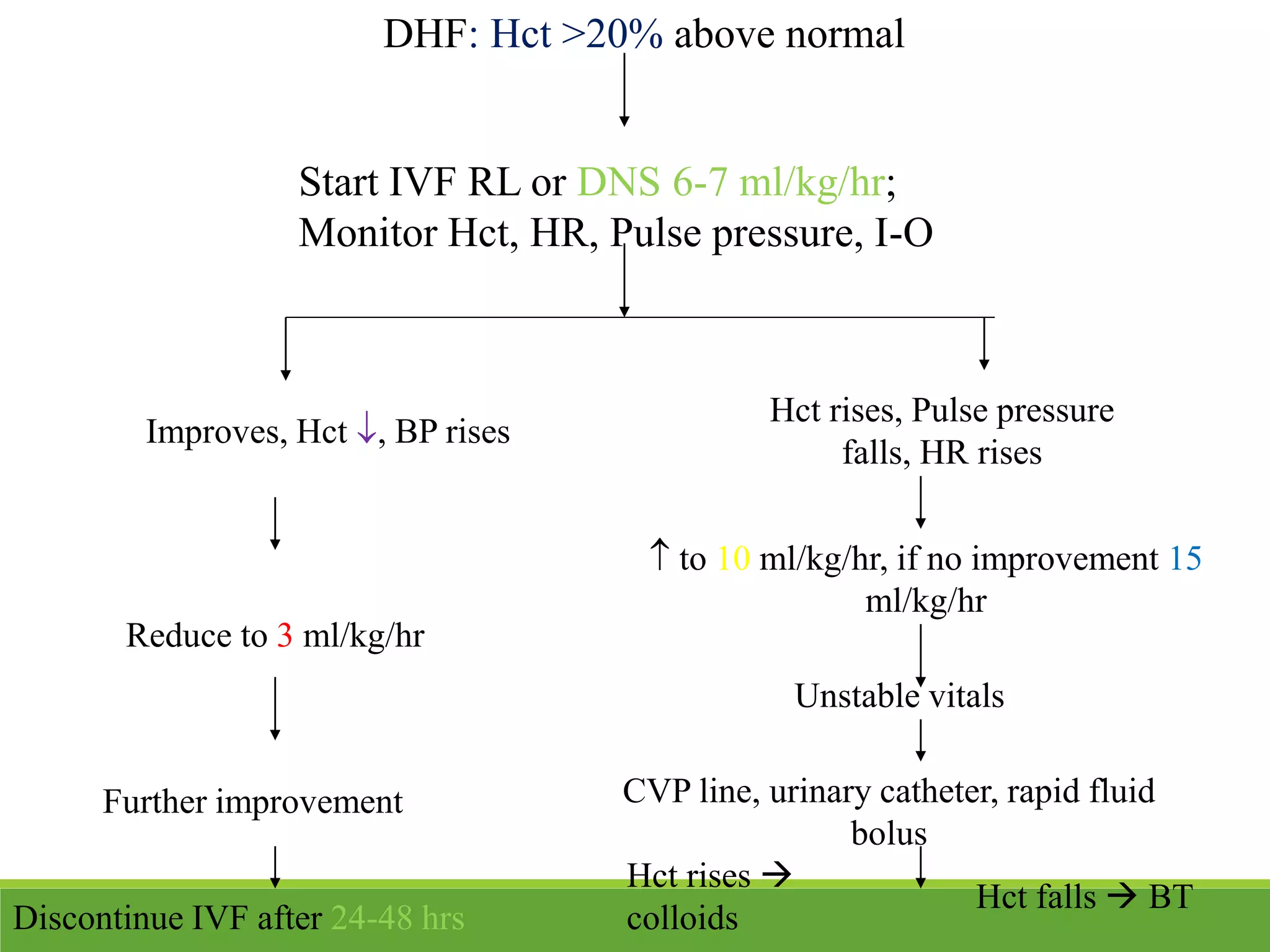
DHF: Hct >20% above normal
Start IVF RL or DNS 6-7 ml/kg/hr;
Monitor Hct, HR, Pulse pressure, I-O
Improves, Hct , BP rises
Reduce to 3 ml/kg/hr
Hct rises, Pulse pressure
falls, HR rises
 to 10 ml/kg/hr, if no improvement 15
ml/kg/hr
Further improvement
Discontinue IVF after 24-48 hrs
CVP line, urinary catheter, rapid fluid
bolus
Hct rises 
colloids
Unstable vitals
Hct falls  BT
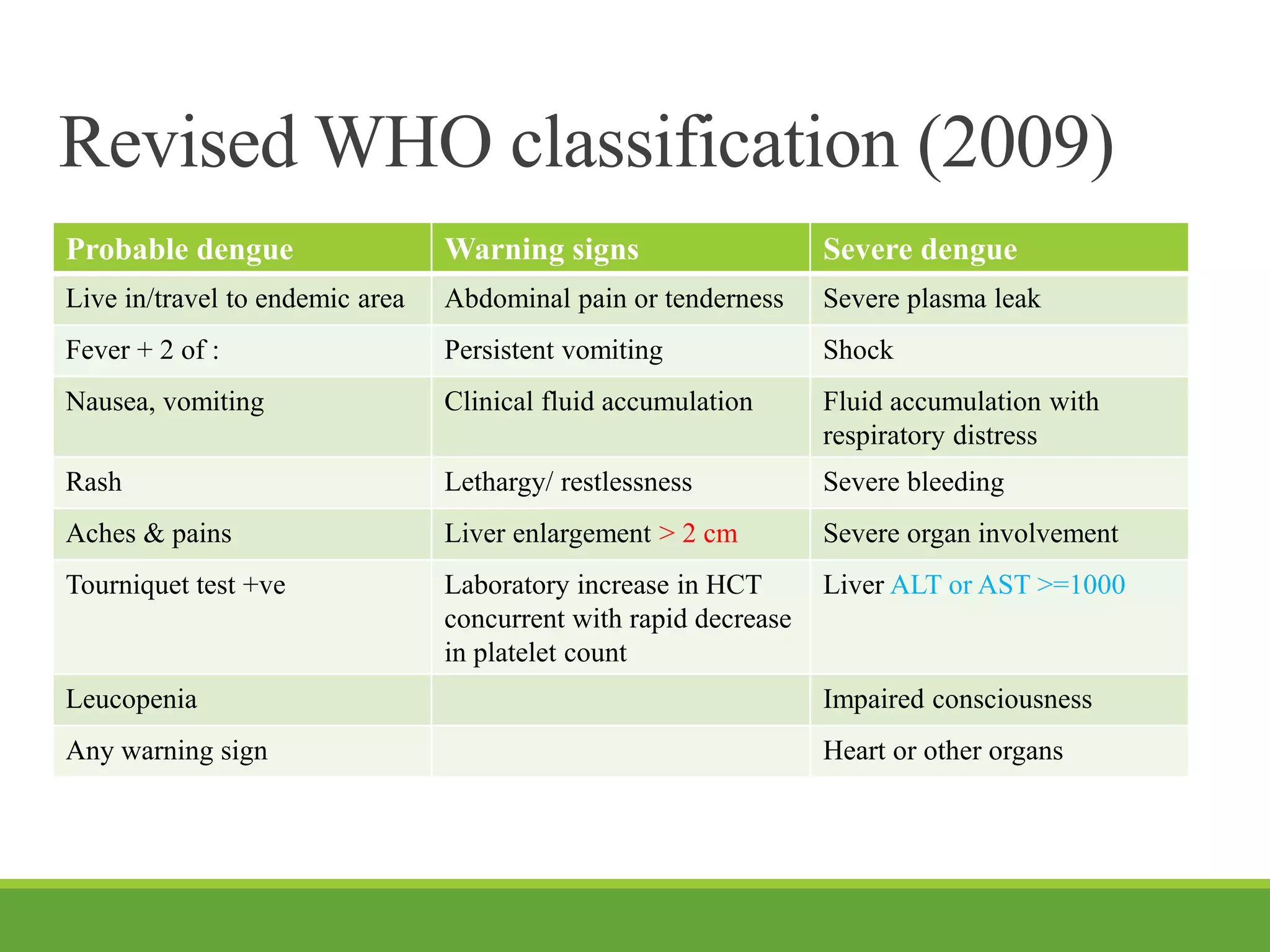
Revised WHO classification (2009)
Probable dengue Warning signs Severe dengue
Live in/travel to endemic area Abdominal pain or tenderness Severe plasma leak
Fever + 2 of : Persistent vomiting Shock
Nausea, vomiting Clinical fluid accumulation Fluid accumulation with
respiratory distress
Rash Lethargy/ restlessness Severe bleeding
Aches & pains Liver enlargement > 2 cm Severe organ involvement
Tourniquet test +ve Laboratory increase in HCT
concurrent with rapid decrease
in platelet count
Liver ALT or AST >=1000
Leucopenia Impaired consciousness
Any warning sign Heart or other organs
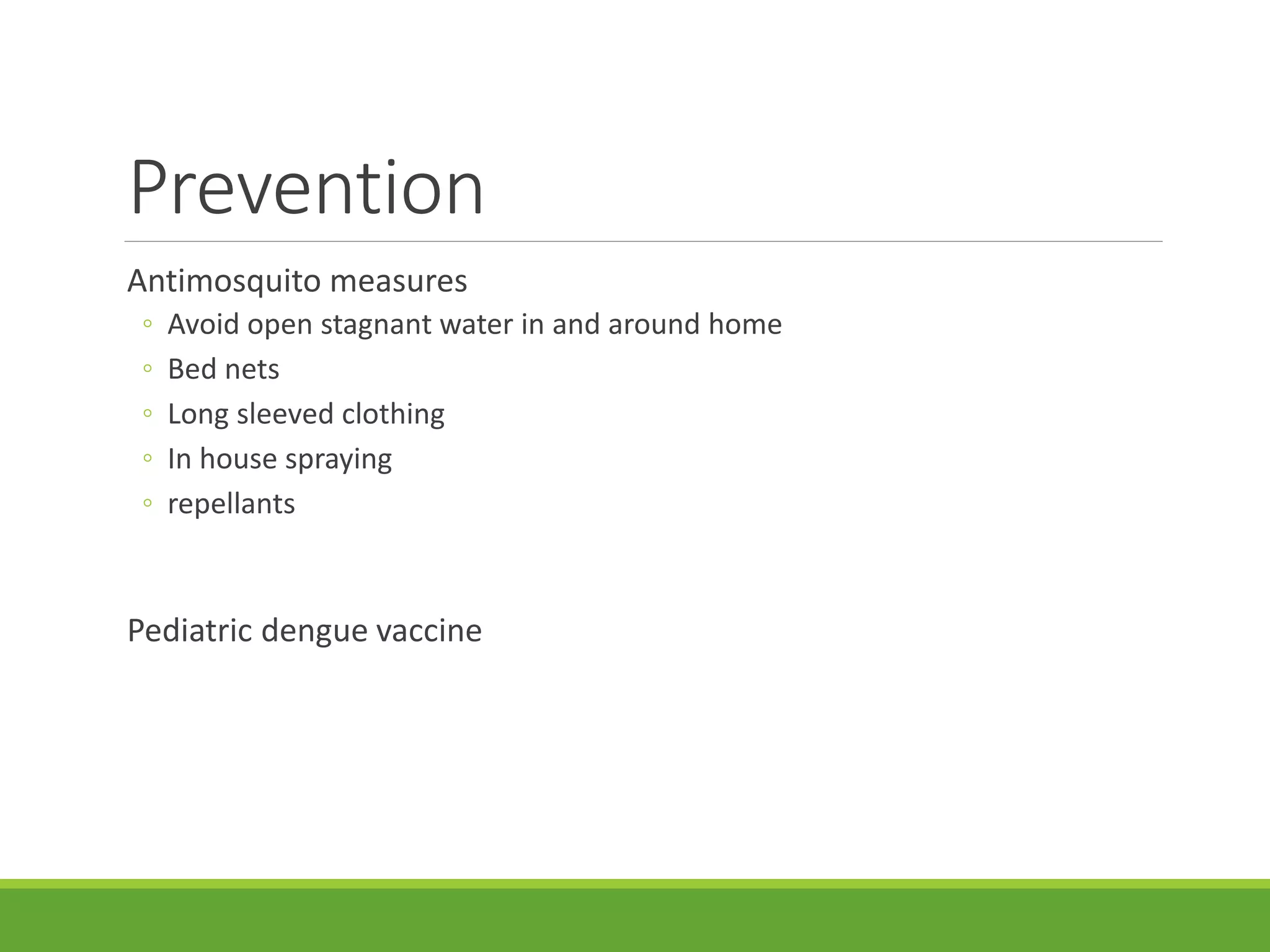
Prevention
Antimosquito measures
◦ Avoid open stagnant water in and around home
◦ Bed nets
◦ Long sleeved clothing
◦ In house spraying
◦ repellants
Pediatric dengue vaccine
dengue rajjo presentation.ppt

dengue rajjo presentation.ppt

  • 1.
    DENGUE FEVER &DHF MODERATOR DR.PRANJALI SAXENA DEPARTMENT OF PEDIATRICS BY :- DR.RAJAT AGRAWAL Department of Pediatrics
  • 2.
    Dengue: The Disease Infectionof tropical and subtropical regions. Nonspecific febrile illness to fatal Illness, caused by a virus and spread by an insect vector – the mosquito
  • 3.
    Dengue : Thevirus •Flavi viruses: RNA •Arbovirus group •4 serotypes – Den 1- 4 •Cycle involves humans and mosquitos •Infection with one virus gives immunity to that serotype only
  • 4.
    Dengue: The vector •Aedesaegypti, A albopictus (less commonly) •Domestic day biting mosquito •Prefers to feed on humans •Breeds in stored water •Short flight range •May bite several people in same household
  • 5.
    Dengue Fever :Clinical Features Sudden fever 40-41C Incubation period 2-7 days Nonspecific constitutional symptoms Severe muscle aches, retro-orbital pain Hepatomegaly Rash Facial flush Fever subsides in 2-7 days, may be biphasic
  • 6.
    WHO case definitionfor DF: Acute Febrile illness with 2 or > of the following: •Headache •Retro-orbital pain •Myalgia •Arthralgia •Rash •Hemorrhagic manifestations •Leukopenia •Hepatomegaly common
  • 7.
    DHF: Pathogenesis Secondary infectionwith another serotype leads to ‘antibody mediated enhancement’ Heterotypic antibodies are non protective and fail to neutralise the virus Virus-antibody complexes taken up by monocytes Virion multiplication in human monocytes is promoted Activation of CD4+ and CD8+ lymphocytes  release of cytokines Complement system activated with depression of C3 & C5
  • 8.
    Neutralizing antibody toDengue 1 virus Dengue 1 virus Homologous Antibodies Form Non-infectious Complexes Non-neutralizing antibody Complex formed by neutralizing antibody and virus
  • 9.
    DHF: WHO Criteriafor diagnosis Often occurs with defervescence of fever, swelling All of the following must be present: Fever Hemorrhagic tendencies: ◦ +ve tourniquet test ◦ Petichiae, ecchymosis or purpura ◦ Bleeding from other sites Thrombocytopenia (<=100,000/cu mm) Evidence of plasma leak ◦ Rise in hematocrit > 20% above average ◦ Drop in Hct ◦ Pleural effusion/ascites/hypoproteinemia
  • 10.
    DSS: WHO Criteriafor diagnosis All of the above + evidence of circulatory failure: Rapid, weak pulse Narrow pulse pressure < =20 mm hg Cold clammy skin Restlessness Often present with abdominal pain; mistaken for acute abdominal emergency
  • 11.
    PETECHIAL PURPURIC RASHESSEEN IN DENGUE HAEMORRHAGIC FEVER
  • 12.
    Grading of DVinfection DF/DHF Grade Symptoms Lab DF Fever with 2 or > of: headache/retro- orbital pain, myalgia, arthralgia Leukopenia, occasionally thrombocytopeni a, no evidence of plasma leak DHF I Above + +ve tourniquet test Platelets < 100,000, Hct rise > 20% DHF II Above + spontaneous bleeding ,, DHF III/DSS Above + s/o circulatory failure ,, DHF IV/DSS Profound shock with undetectable BP and pulse ,, Lab evidence of Dv infection
  • 13.
    Immune response toDengue infections Primary Infection: IgM antibody in late acute/ convalescent stage; later IgG which lasts for several decades Secondary infection: High IgG level, small rise in IgM Cross reactions with other flaviviruses Infection with one serotype does not protect against other serotypes
  • 14.
    Lab Diagnosis ofDengue infection: Dengue HI test in paired sera showing 4 fold rise or fall: cross reactivity IgM type antibodies in late acute/convalescent sera in primary infection IgG type antibodies in high titre in secondary infection Viral isolation: sensitivity < 50% RT- PCR: sensitivity > 90%
  • 15.
    WHO Lab Criteriafor Dengue infection: Probable Case: CF + Supportive Serology: Acute HI titre > 1280, comparable IgG ELISA or +ve IgM or occurrence at same location & time as other confirmed cases Confirmed case: isolation of virus from serum/ autopsy specimen Demonstration of dengue virus antigen in serum/ CSF/ Autopsy tissue Detection of dengue virus genome by PCR
  • 16.
    Management: DF No specificTt Analgesics/antipyretics Avoid agents which may impair platelet function eg aspirin
  • 17.
    Management: DHF: Hospitalise Closely monitorfor shock; repeated hematocrit measurements If Hct rising by >20%, IV fluids as 5% deficit Start with DNS 6-7 ml/kg/hr. Improves  reduce gradually over 24-48 hrs No improvement   upto 15 ml/kg/hr  colloid solution
  • 18.
    DHF: Hct >20%above normal Start IVF RL or DNS 6-7 ml/kg/hr; Monitor Hct, HR, Pulse pressure, I-O Improves, Hct , BP rises Reduce to 3 ml/kg/hr Hct rises, Pulse pressure falls, HR rises  to 10 ml/kg/hr, if no improvement 15 ml/kg/hr Further improvement Discontinue IVF after 24-48 hrs CVP line, urinary catheter, rapid fluid bolus Hct rises  colloids Unstable vitals Hct falls  BT
  • 19.
    Revised WHO classification(2009) Probable dengue Warning signs Severe dengue Live in/travel to endemic area Abdominal pain or tenderness Severe plasma leak Fever + 2 of : Persistent vomiting Shock Nausea, vomiting Clinical fluid accumulation Fluid accumulation with respiratory distress Rash Lethargy/ restlessness Severe bleeding Aches & pains Liver enlargement > 2 cm Severe organ involvement Tourniquet test +ve Laboratory increase in HCT concurrent with rapid decrease in platelet count Liver ALT or AST >=1000 Leucopenia Impaired consciousness Any warning sign Heart or other organs
  • 20.
    Prevention Antimosquito measures ◦ Avoidopen stagnant water in and around home ◦ Bed nets ◦ Long sleeved clothing ◦ In house spraying ◦ repellants Pediatric dengue vaccine