Safe Blood;  Facts, Challenges and Future Directions Dr. Saba Jamal   Ziauddin University Hospital
Facts Advances in infectious disease testing continue to improve the safety of blood supply However viral, bacterial & parasitic disease can still be transmitted by transfusions Novel infectious agents may also appear at any time eg. HIV in the 1980’s
  International Standards For  Screening of Blood
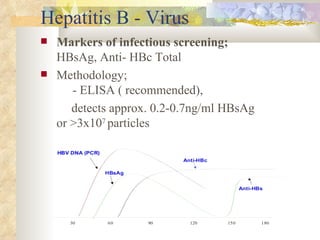
Hepatitis B - Virus Markers of infectious screening; HBsAg, Anti- HBc Total Methodology; - ELISA ( recommended),  detects approx. 0.2-0.7ng/ml HBsAg     or >3x10 7  particles
Rationale for Anti-HBc Testing Early convalescent phase acute HBV infection Low level chronic HBV/tail-end infection Mutants Will not detect pre-seroconversion window period
Hepatitis C - Virus Markers of infection ; Anti-HCV, HCV RNA Window Periods ; - Anti – HCV by Third Generation ELISA/EIA;      70 – 80 days - NAT; 10 – 30 days
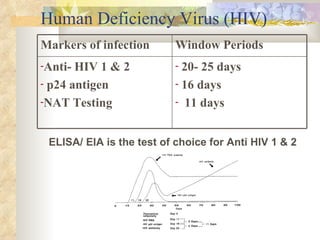
Human Deficiency Virus (HIV) ELISA/ EIA is the test of choice for Anti HIV 1 & 2 20- 25 days 16 days 11 days Anti- HIV 1 & 2 p24 antigen NAT Testing Window Periods Markers of infection
SYPHILIS Phase of spirochetemia is brief & organisms survive only 4 days at 4 o C Performance of serologic test for syphilis is still a requirement
Malaria Asymptomatic carriers with very low parasite load are generally the source of transfusion - transmitted malaria Tests available; - Screening by smears - Serologic Testing for malaria antigen    or LDH - PCR
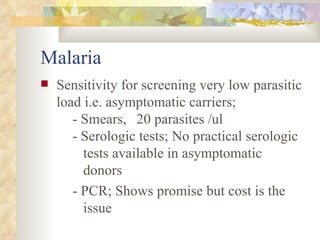
Malaria Sensitivity for screening very low parasitic load i.e. asymptomatic carriers; - Smears, 20 parasites /ul - Serologic tests; No practical serologic    tests available in asymptomatic      donors - PCR; Shows promise but cost is the      issue
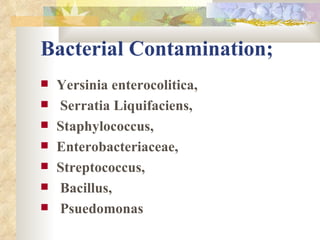
Bacterial Contamination; Yersinia enterocolitica, Serratia Liquifaciens,  Staphylococcus,  Enterobacteriaceae,  Streptococcus, Bacillus, Psuedomonas
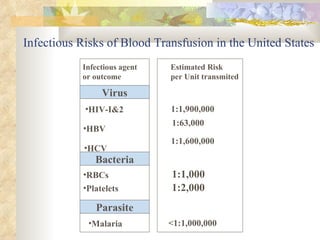
Infectious Risks of Blood Transfusion in the United States HBV HCV 1:1,900,000  1:63,000 1:1,600,000 RBCs Platelets 1:1,000 1:2,000 Malaria <1:1,000,000 Infectious agent or outcome Estimated Risk  per Unit transmited HIV-I&2 Virus Bacteria Parasite
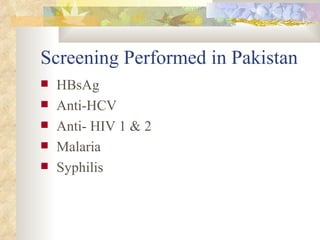
Screening Performed in Pakistan HBsAg  Anti-HCV Anti- HIV 1 & 2 Malaria Syphilis
Challenges in Pakistan Absence of screening in certain centers Substandard  Methods of screening eg. Latex based, sub-standard ELISA Pooling of Donor Sera; - Increases the risk of transmission.     Bigger the pool, higher the risk Anti-HBc Total Antibody & NAT testing for HCV & HIV ; NOT PERFORMED
Future Directions Across the board implementation of infectious disease screening by Standard  ELISA methods Minimize residual risk of transfusion-transmitted viral infections  Motivate young healthy volunteer donors Awareness of  Physicians as well as the patients in risks of transfusion transmitted diseases
Thank You

Safe Blood

  • 1.
    Safe Blood; Facts, Challenges and Future Directions Dr. Saba Jamal Ziauddin University Hospital
  • 2.
    Facts Advances ininfectious disease testing continue to improve the safety of blood supply However viral, bacterial & parasitic disease can still be transmitted by transfusions Novel infectious agents may also appear at any time eg. HIV in the 1980’s
  • 3.
    InternationalStandards For Screening of Blood
  • 4.
    Hepatitis B -Virus Markers of infectious screening; HBsAg, Anti- HBc Total Methodology; - ELISA ( recommended), detects approx. 0.2-0.7ng/ml HBsAg or >3x10 7 particles
  • 5.
    Rationale for Anti-HBcTesting Early convalescent phase acute HBV infection Low level chronic HBV/tail-end infection Mutants Will not detect pre-seroconversion window period
  • 6.
    Hepatitis C -Virus Markers of infection ; Anti-HCV, HCV RNA Window Periods ; - Anti – HCV by Third Generation ELISA/EIA; 70 – 80 days - NAT; 10 – 30 days
  • 7.
    Human Deficiency Virus(HIV) ELISA/ EIA is the test of choice for Anti HIV 1 & 2 20- 25 days 16 days 11 days Anti- HIV 1 & 2 p24 antigen NAT Testing Window Periods Markers of infection
  • 8.
    SYPHILIS Phase ofspirochetemia is brief & organisms survive only 4 days at 4 o C Performance of serologic test for syphilis is still a requirement
  • 9.
    Malaria Asymptomatic carrierswith very low parasite load are generally the source of transfusion - transmitted malaria Tests available; - Screening by smears - Serologic Testing for malaria antigen or LDH - PCR
  • 10.
    Malaria Sensitivity forscreening very low parasitic load i.e. asymptomatic carriers; - Smears, 20 parasites /ul - Serologic tests; No practical serologic tests available in asymptomatic donors - PCR; Shows promise but cost is the issue
  • 11.
    Bacterial Contamination; Yersiniaenterocolitica, Serratia Liquifaciens, Staphylococcus, Enterobacteriaceae, Streptococcus, Bacillus, Psuedomonas
  • 12.
    Infectious Risks ofBlood Transfusion in the United States HBV HCV 1:1,900,000 1:63,000 1:1,600,000 RBCs Platelets 1:1,000 1:2,000 Malaria <1:1,000,000 Infectious agent or outcome Estimated Risk per Unit transmited HIV-I&2 Virus Bacteria Parasite
  • 13.
    Screening Performed inPakistan HBsAg Anti-HCV Anti- HIV 1 & 2 Malaria Syphilis
  • 14.
    Challenges in PakistanAbsence of screening in certain centers Substandard Methods of screening eg. Latex based, sub-standard ELISA Pooling of Donor Sera; - Increases the risk of transmission. Bigger the pool, higher the risk Anti-HBc Total Antibody & NAT testing for HCV & HIV ; NOT PERFORMED
  • 15.
    Future Directions Acrossthe board implementation of infectious disease screening by Standard ELISA methods Minimize residual risk of transfusion-transmitted viral infections Motivate young healthy volunteer donors Awareness of Physicians as well as the patients in risks of transfusion transmitted diseases
  • 16.