





Demystifying
Network Function Virtualization (NFV)
Service Assurance
Session Agenda
• NFV Technology Overview
• NFV Assurance Use Cases
 Branch Office
 SDN
 NFVI
• Telco NFV Case Study
• Summary
2
3
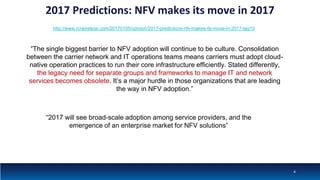
2017 Predictions: NFV makes its move in 2017
http://www.rcrwireless.com/20170105/opinion/2017-predictions-nfv-makes-its-move-in-2017-tag10
“The single biggest barrier to NFV adoption will continue to be culture. Consolidation
between the carrier network and IT operations teams means carriers must adopt cloud-
native operation practices to run their core infrastructure efficiently. Stated differently,
the legacy need for separate groups and frameworks to manage IT and network
services becomes obsolete. It’s a major hurdle in those organizations that are leading
the way in NFV adoption.”
“2017 will see broad-scale adoption among service providers, and the
emergence of an enterprise market for NFV solutions”
4
5
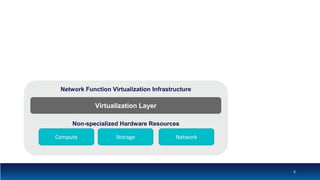
Network Function Virtualization Infrastructure
6
Non-specialized Hardware Resources
Compute Storage Network
Virtualization Layer
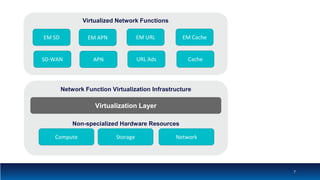
Network Function Virtualization Infrastructure
Non-specialized Hardware Resources
7
Compute Storage Network
Virtualization Layer
Virtualized Network Functions
SD-WAN APN CacheURL Ads
EM SD EM APN EM CacheEM URL
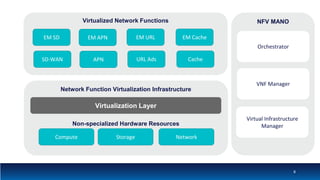
Network Function Virtualization Infrastructure
Non-specialized Hardware Resources
8
Compute Storage Network
Virtualization Layer
Virtualized Network Functions
SD-WAN APN CacheURL Ads
EM SD EM APN EM CacheEM URL
NFV MANO
Orchestrator
VNF Manager
Virtual Infrastructure
Manager
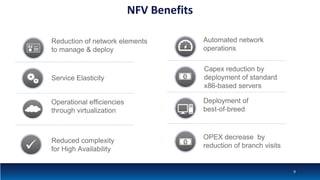
NFV Benefits
Reduction of network elements
to manage & deploy
Operational efficiencies
through virtualization
Service Elasticity
Reduced complexity
for High Availability
Automated network
operations
Deployment of
best-of-breed
OPEX decrease by
reduction of branch visits
Capex reduction by
deployment of standard
x86-based servers
9
NFV Assurance Use Cases
Zenoss NFV Experience
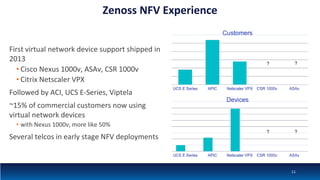
First virtual network device support shipped in
2013
• Cisco Nexus 1000v, ASAv, CSR 1000v
• Citrix Netscaler VPX
Followed by ACI, UCS E-Series, Viptela
~15% of commercial customers now using
virtual network devices
• with Nexus 1000v, more like 50%
Several telcos in early stage NFV deployments
? ?
? ?
11
Branch Office Virtualization
vBranch / vCPE: Location Scenarios
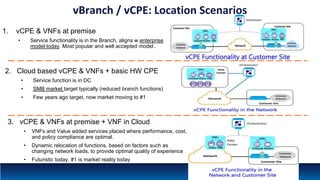
1. vCPE & VNFs at premise
• Service functionality is in the Branch, aligns w enterprise
model today. Most popular and well accepted model..
2. Cloud based vCPE & VNFs + basic HW CPE
• Service function is in DC
• SMB market target typically (reduced branch functions)
• Few years ago target, now market moving to #1
3. vCPE & VNFs at premise + VNF in Cloud
• VNFs and Value added services placed where performance, cost,
and policy compliance are optimal.
• Dynamic relocation of functions, based on factors such as
changing network loads, to provide optimal quality of experience
• Futuristic today, #1 is market reality today
13
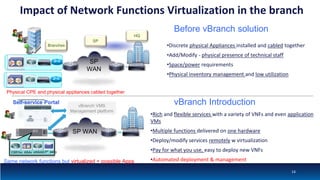
Impact of Network Functions Virtualization in the branch
•Discrete physical Appliances installed and cabled together
•Add/Modify - physical presence of technical staff
•Space/power requirements
•Physical inventory management and low utilization
•Rich and flexible services with a variety of VNFs and even application
VMs
•Multiple functions delivered on one hardware
•Deploy/modify services remotely w virtualization
•Pay for what you use, easy to deploy new VNFs
•Automated deployment & management
Before vBranch solution
SP
WAN
Physical CPE and physical appliances cabled together
Branches
HQ
SP
vBranch Introduction
SP WAN
Same network functions but virtualized + possible Apps
CSR1kv ASAv vWAAS3rd party
Self-service Portal
vBranch VMS
Management platform
14
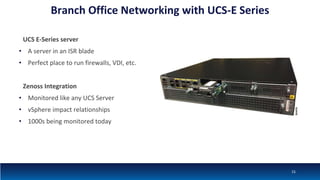
Branch Office Networking with UCS-E Series
UCS E-Series server
• A server in an ISR blade
• Perfect place to run firewalls, VDI, etc.
Zenoss Integration
• Monitored like any UCS Server
• vSphere impact relationships
• 1000s being monitored today
15
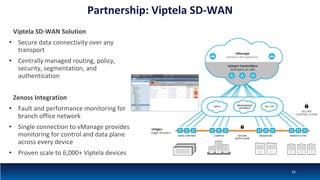
Partnership: Viptela SD-WAN
Viptela SD-WAN Solution
• Secure data connectivity over any
transport
• Centrally managed routing, policy,
security, segmentation, and
authentication
Zenoss Integration
• Fault and performance monitoring for
branch office network
• Single connection to vManage provides
monitoring for control and data plane
across every device
• Proven scale to 6,000+ Viptela devices
16
Datacenter ACI and Virtual Networking
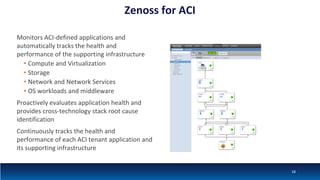
Zenoss for ACI
Monitors ACI-defined applications and
automatically tracks the health and
performance of the supporting infrastructure
• Compute and Virtualization
• Storage
• Network and Network Services
• OS workloads and middleware
Proactively evaluates application health and
provides cross-technology stack root cause
identification
Continuously tracks the health and
performance of each ACI tenant application and
its supporting infrastructure
18
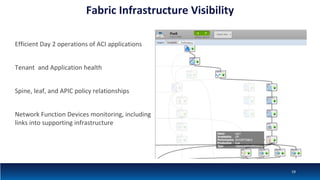
Fabric Infrastructure Visibility
Efficient Day 2 operations of ACI applications
Tenant and Application health
Spine, leaf, and APIC policy relationships
Network Function Devices monitoring, including
links into supporting infrastructure
19
Cisco NFV Infrastructure
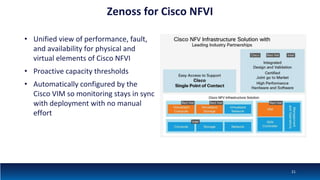
Zenoss for Cisco NFVI
• Unified view of performance, fault,
and availability for physical and
virtual elements of Cisco NFVI
• Proactive capacity thresholds
• Automatically configured by the
Cisco VIM so monitoring stays in sync
with deployment with no manual
effort
21
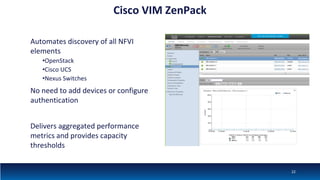
Cisco VIM ZenPack
Automates discovery of all NFVI
elements
•OpenStack
•Cisco UCS
•Nexus Switches
No need to add devices or configure
authentication
Delivers aggregated performance
metrics and provides capacity
thresholds
22
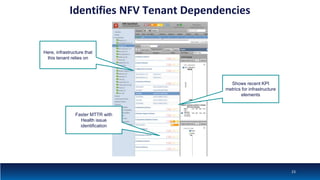
Identifies NFV Tenant Dependencies
Here, infrastructure that
this tenant relies on
Shows recent KPI
metrics for infrastructure
elements
Faster MTTR with
Health issue
identification
23
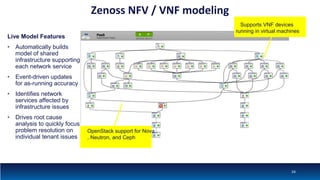
Zenoss NFV / VNF modeling
Live Model Features
• Automatically builds
model of shared
infrastructure supporting
each network service
• Event-driven updates
for as-running accuracy
• Identifies network
services affected by
infrastructure issues
• Drives root cause
analysis to quickly focus
problem resolution on
individual tenant issues
Supports VNF devices
running in virtual machines
OpenStack support for Nova
, Neutron, and Ceph
24
Telco NFV
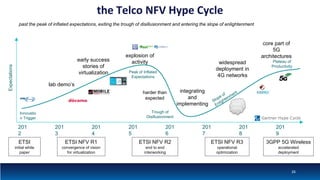
the Telco NFV Hype Cycle
past the peak of inflated expectations, exiting the trough of disillusionment and entering the slope of enlightenment
Expectations
201
2
201
3
201
4
201
5
201
6
201
7
201
8
201
9
Innovatio
n Trigger
Peak of Inflated
Expectations
Plateau of
Productivity
Trough of
Disillusionment Gartner Hype Cycle
ETSI
initial white
paper
ETSI NFV R1
convergence of vision
for virtualization
ETSI NFV R2
end to end
interworking
ETSI NFV R3
operational
optimization
3GPP 5G Wireless
accelerated
deployment
explosion of
activityearly success
stories of
virtualization
integrating
and
implementing
lab demo’s
harder than
expected
widespread
deployment in
4G networks
core part of
5G
architectures
cloud
native
26
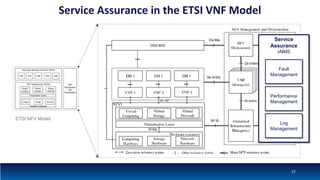
Service Assurance in the ETSI VNF Model
ETSI NFV Model
Service
Assurance
vNMS
Fault
Management
Performance
Management
Log
Management
27
28
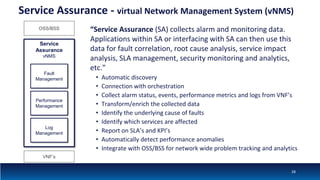
Service Assurance - virtual Network Management System (vNMS)
“Service Assurance (SA) collects alarm and monitoring data.
Applications within SA or interfacing with SA can then use this
data for fault correlation, root cause analysis, service impact
analysis, SLA management, security monitoring and analytics,
etc.”
• Automatic discovery
• Connection with orchestration
• Collect alarm status, events, performance metrics and logs from VNF’s
• Transform/enrich the collected data
• Identify the underlying cause of faults
• Identify which services are affected
• Report on SLA’s and KPI’s
• Automatically detect performance anomalies
• Integrate with OSS/BSS for network wide problem tracking and analytics
Service
Assurance
vNMS
Fault
Management
Performance
Management
Log
Management
OSS/BSS
VNF’s
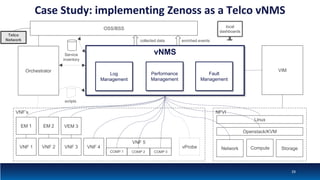
Case Study: implementing Zenoss as a Telco vNMS
vNMS
Fault
Management
Performance
Management
Log
Management
OSS/BSS
VIM
Compute StorageNetwork
Openstack/KVM
NFVI
VNF 1
EM 1
VNF 2
EM 2
VNF 3 VNF 4
VNF’s
vProbe
Orchestrator
Linux
VEM 3
VNF 5
COMP 1 COMP 2 COMP 3
local
dashboards
collected data enriched events
Service
inventory
scripts
Telco
Network
29
30
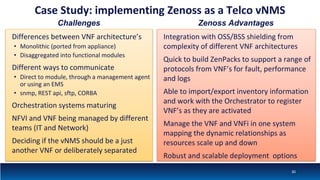
Case Study: implementing Zenoss as a Telco vNMS
Differences between VNF architecture’s
• Monolithic (ported from appliance)
• Disaggregated into functional modules
Different ways to communicate
• Direct to module, through a management agent
or using an EMS
• snmp, REST api, sftp, CORBA
Orchestration systems maturing
NFVI and VNF being managed by different
teams (IT and Network)
Deciding if the vNMS should be a just
another VNF or deliberately separated
Challenges Zenoss Advantages
Integration with OSS/BSS shielding from
complexity of different VNF architectures
Quick to build ZenPacks to support a range of
protocols from VNF’s for fault, performance
and logs
Able to import/export inventory information
and work with the Orchestrator to register
VNF’s as they are activated
Manage the VNF and VNFi in one system
mapping the dynamic relationships as
resources scale up and down
Robust and scalable deployment options
Summary
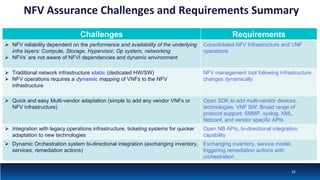
NFV Assurance Challenges and Requirements Summary
Challenges Requirements
 NFV reliability dependent on the performance and availability of the underlying
infra layers: Compute, Storage, Hypervisor, Op system, networking
 NFVs’ are not aware of NFVI dependencies and dynamic environment
Consolidated NFV Infrastructure and VNF
operations
 Traditional network infrastructure static (dedicated HW/SW)
 NFV operations requires a dynamic mapping of VNFs to the NFV
infrastructure
NFV management tool following infrastructure
changes dynamically
 Quick and easy Multi-vendor adaptation (simple to add any vendor VNFs or
NFV infrastructure)
Open SDK to add multi-vendor devices,
technologies, VNF SW. Broad range of
protocol support: SNMP, syslog, XML,
Netconf, and vendor specific APIs
 Integration with legacy operations infrastructure, ticketing systems for quicker
adaptation to new technologies
Open NB APIs, bi-directional integration
capability
 Dynamic Orchestration system bi-directional integration (exchanging inventory,
services, remediation actions)
Exchanging inventory, service model,
triggering remediation actions with
orchestration
32
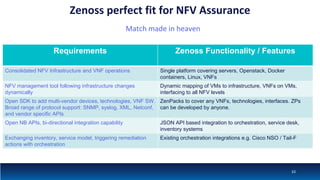
Zenoss perfect fit for NFV Assurance
Match made in heaven
Requirements Zenoss Functionality / Features
Consolidated NFV Infrastructure and VNF operations Single platform covering servers, Openstack, Docker
containers, Linux, VNFs
NFV management tool following infrastructure changes
dynamically
Dynamic mapping of VMs to infrastructure, VNFs on VMs,
interfacing to all NFV levels
Open SDK to add multi-vendor devices, technologies, VNF SW.
Broad range of protocol support: SNMP, syslog, XML, Netconf,
and vendor specific APIs
ZenPacks to cover any VNFs, technologies, interfaces. ZPs
can be developed by anyone.
Open NB APIs, bi-directional integration capability JSON API based integration to orchestration, service desk,
inventory systems
Exchanging inventory, service model, triggering remediation
actions with orchestration
Existing orchestration integrations e.g. Cisco NSO / Tail-F
33
Questions ?
34
Culture of Champions
35

Demystifying Network Function Virtualization (NFV) Service Assurance

  • 1.
  • 2.
    Session Agenda • NFVTechnology Overview • NFV Assurance Use Cases  Branch Office  SDN  NFVI • Telco NFV Case Study • Summary 2
  • 3.
  • 4.
    2017 Predictions: NFVmakes its move in 2017 http://www.rcrwireless.com/20170105/opinion/2017-predictions-nfv-makes-its-move-in-2017-tag10 “The single biggest barrier to NFV adoption will continue to be culture. Consolidation between the carrier network and IT operations teams means carriers must adopt cloud- native operation practices to run their core infrastructure efficiently. Stated differently, the legacy need for separate groups and frameworks to manage IT and network services becomes obsolete. It’s a major hurdle in those organizations that are leading the way in NFV adoption.” “2017 will see broad-scale adoption among service providers, and the emergence of an enterprise market for NFV solutions” 4
  • 5.
  • 6.
    Network Function VirtualizationInfrastructure 6 Non-specialized Hardware Resources Compute Storage Network Virtualization Layer
  • 7.
    Network Function VirtualizationInfrastructure Non-specialized Hardware Resources 7 Compute Storage Network Virtualization Layer Virtualized Network Functions SD-WAN APN CacheURL Ads EM SD EM APN EM CacheEM URL
  • 8.
    Network Function VirtualizationInfrastructure Non-specialized Hardware Resources 8 Compute Storage Network Virtualization Layer Virtualized Network Functions SD-WAN APN CacheURL Ads EM SD EM APN EM CacheEM URL NFV MANO Orchestrator VNF Manager Virtual Infrastructure Manager
  • 9.
    NFV Benefits Reduction ofnetwork elements to manage & deploy Operational efficiencies through virtualization Service Elasticity Reduced complexity for High Availability Automated network operations Deployment of best-of-breed OPEX decrease by reduction of branch visits Capex reduction by deployment of standard x86-based servers 9
  • 10.
  • 11.
    Zenoss NFV Experience Firstvirtual network device support shipped in 2013 • Cisco Nexus 1000v, ASAv, CSR 1000v • Citrix Netscaler VPX Followed by ACI, UCS E-Series, Viptela ~15% of commercial customers now using virtual network devices • with Nexus 1000v, more like 50% Several telcos in early stage NFV deployments ? ? ? ? 11
  • 12.
  • 13.
    vBranch / vCPE:Location Scenarios 1. vCPE & VNFs at premise • Service functionality is in the Branch, aligns w enterprise model today. Most popular and well accepted model.. 2. Cloud based vCPE & VNFs + basic HW CPE • Service function is in DC • SMB market target typically (reduced branch functions) • Few years ago target, now market moving to #1 3. vCPE & VNFs at premise + VNF in Cloud • VNFs and Value added services placed where performance, cost, and policy compliance are optimal. • Dynamic relocation of functions, based on factors such as changing network loads, to provide optimal quality of experience • Futuristic today, #1 is market reality today 13
  • 14.
    Impact of NetworkFunctions Virtualization in the branch •Discrete physical Appliances installed and cabled together •Add/Modify - physical presence of technical staff •Space/power requirements •Physical inventory management and low utilization •Rich and flexible services with a variety of VNFs and even application VMs •Multiple functions delivered on one hardware •Deploy/modify services remotely w virtualization •Pay for what you use, easy to deploy new VNFs •Automated deployment & management Before vBranch solution SP WAN Physical CPE and physical appliances cabled together Branches HQ SP vBranch Introduction SP WAN Same network functions but virtualized + possible Apps CSR1kv ASAv vWAAS3rd party Self-service Portal vBranch VMS Management platform 14
  • 15.
    Branch Office Networkingwith UCS-E Series UCS E-Series server • A server in an ISR blade • Perfect place to run firewalls, VDI, etc. Zenoss Integration • Monitored like any UCS Server • vSphere impact relationships • 1000s being monitored today 15
  • 16.
    Partnership: Viptela SD-WAN ViptelaSD-WAN Solution • Secure data connectivity over any transport • Centrally managed routing, policy, security, segmentation, and authentication Zenoss Integration • Fault and performance monitoring for branch office network • Single connection to vManage provides monitoring for control and data plane across every device • Proven scale to 6,000+ Viptela devices 16
  • 17.
    Datacenter ACI andVirtual Networking
  • 18.
    Zenoss for ACI MonitorsACI-defined applications and automatically tracks the health and performance of the supporting infrastructure • Compute and Virtualization • Storage • Network and Network Services • OS workloads and middleware Proactively evaluates application health and provides cross-technology stack root cause identification Continuously tracks the health and performance of each ACI tenant application and its supporting infrastructure 18
  • 19.
    Fabric Infrastructure Visibility EfficientDay 2 operations of ACI applications Tenant and Application health Spine, leaf, and APIC policy relationships Network Function Devices monitoring, including links into supporting infrastructure 19
  • 20.
  • 21.
    Zenoss for CiscoNFVI • Unified view of performance, fault, and availability for physical and virtual elements of Cisco NFVI • Proactive capacity thresholds • Automatically configured by the Cisco VIM so monitoring stays in sync with deployment with no manual effort 21
  • 22.
    Cisco VIM ZenPack Automatesdiscovery of all NFVI elements •OpenStack •Cisco UCS •Nexus Switches No need to add devices or configure authentication Delivers aggregated performance metrics and provides capacity thresholds 22
  • 23.
    Identifies NFV TenantDependencies Here, infrastructure that this tenant relies on Shows recent KPI metrics for infrastructure elements Faster MTTR with Health issue identification 23
  • 24.
    Zenoss NFV /VNF modeling Live Model Features • Automatically builds model of shared infrastructure supporting each network service • Event-driven updates for as-running accuracy • Identifies network services affected by infrastructure issues • Drives root cause analysis to quickly focus problem resolution on individual tenant issues Supports VNF devices running in virtual machines OpenStack support for Nova , Neutron, and Ceph 24
  • 25.
  • 26.
    the Telco NFVHype Cycle past the peak of inflated expectations, exiting the trough of disillusionment and entering the slope of enlightenment Expectations 201 2 201 3 201 4 201 5 201 6 201 7 201 8 201 9 Innovatio n Trigger Peak of Inflated Expectations Plateau of Productivity Trough of Disillusionment Gartner Hype Cycle ETSI initial white paper ETSI NFV R1 convergence of vision for virtualization ETSI NFV R2 end to end interworking ETSI NFV R3 operational optimization 3GPP 5G Wireless accelerated deployment explosion of activityearly success stories of virtualization integrating and implementing lab demo’s harder than expected widespread deployment in 4G networks core part of 5G architectures cloud native 26
  • 27.
    Service Assurance inthe ETSI VNF Model ETSI NFV Model Service Assurance vNMS Fault Management Performance Management Log Management 27
  • 28.
    28 Service Assurance -virtual Network Management System (vNMS) “Service Assurance (SA) collects alarm and monitoring data. Applications within SA or interfacing with SA can then use this data for fault correlation, root cause analysis, service impact analysis, SLA management, security monitoring and analytics, etc.” • Automatic discovery • Connection with orchestration • Collect alarm status, events, performance metrics and logs from VNF’s • Transform/enrich the collected data • Identify the underlying cause of faults • Identify which services are affected • Report on SLA’s and KPI’s • Automatically detect performance anomalies • Integrate with OSS/BSS for network wide problem tracking and analytics Service Assurance vNMS Fault Management Performance Management Log Management OSS/BSS VNF’s
  • 29.
    Case Study: implementingZenoss as a Telco vNMS vNMS Fault Management Performance Management Log Management OSS/BSS VIM Compute StorageNetwork Openstack/KVM NFVI VNF 1 EM 1 VNF 2 EM 2 VNF 3 VNF 4 VNF’s vProbe Orchestrator Linux VEM 3 VNF 5 COMP 1 COMP 2 COMP 3 local dashboards collected data enriched events Service inventory scripts Telco Network 29
  • 30.
    30 Case Study: implementingZenoss as a Telco vNMS Differences between VNF architecture’s • Monolithic (ported from appliance) • Disaggregated into functional modules Different ways to communicate • Direct to module, through a management agent or using an EMS • snmp, REST api, sftp, CORBA Orchestration systems maturing NFVI and VNF being managed by different teams (IT and Network) Deciding if the vNMS should be a just another VNF or deliberately separated Challenges Zenoss Advantages Integration with OSS/BSS shielding from complexity of different VNF architectures Quick to build ZenPacks to support a range of protocols from VNF’s for fault, performance and logs Able to import/export inventory information and work with the Orchestrator to register VNF’s as they are activated Manage the VNF and VNFi in one system mapping the dynamic relationships as resources scale up and down Robust and scalable deployment options
  • 31.
  • 32.
    NFV Assurance Challengesand Requirements Summary Challenges Requirements  NFV reliability dependent on the performance and availability of the underlying infra layers: Compute, Storage, Hypervisor, Op system, networking  NFVs’ are not aware of NFVI dependencies and dynamic environment Consolidated NFV Infrastructure and VNF operations  Traditional network infrastructure static (dedicated HW/SW)  NFV operations requires a dynamic mapping of VNFs to the NFV infrastructure NFV management tool following infrastructure changes dynamically  Quick and easy Multi-vendor adaptation (simple to add any vendor VNFs or NFV infrastructure) Open SDK to add multi-vendor devices, technologies, VNF SW. Broad range of protocol support: SNMP, syslog, XML, Netconf, and vendor specific APIs  Integration with legacy operations infrastructure, ticketing systems for quicker adaptation to new technologies Open NB APIs, bi-directional integration capability  Dynamic Orchestration system bi-directional integration (exchanging inventory, services, remediation actions) Exchanging inventory, service model, triggering remediation actions with orchestration 32
  • 33.
    Zenoss perfect fitfor NFV Assurance Match made in heaven Requirements Zenoss Functionality / Features Consolidated NFV Infrastructure and VNF operations Single platform covering servers, Openstack, Docker containers, Linux, VNFs NFV management tool following infrastructure changes dynamically Dynamic mapping of VMs to infrastructure, VNFs on VMs, interfacing to all NFV levels Open SDK to add multi-vendor devices, technologies, VNF SW. Broad range of protocol support: SNMP, syslog, XML, Netconf, and vendor specific APIs ZenPacks to cover any VNFs, technologies, interfaces. ZPs can be developed by anyone. Open NB APIs, bi-directional integration capability JSON API based integration to orchestration, service desk, inventory systems Exchanging inventory, service model, triggering remediation actions with orchestration Existing orchestration integrations e.g. Cisco NSO / Tail-F 33
  • 34.
  • 35.