Understanding Software Defined Wide Area Network
www.NetworkWIZ.net
Learn – Secure - Advance
▪ The 70s: An era when a 9.6 Kbps line, which ran over copper, was considered to be
part of a high-speed network
▪ The 80s: Improving on leased lines, and 45Mbps T3/DS3 links. (X25 and Frame
Relay)
▪ The 90s: Fiber-Optic revolution connecting site at higher speeds.
▪ Y2K Millenia: WAN optimization with ATM & MPLS with QoS
▪ The Future: Emergence of cloud apps, software defined WAN, self healing
network, security and application visibility.
Copyright 2020 © NetworkWiz
• Software Defined Wide Area Network (SD-WAN) is a
visualized network (overlay) that abstracts form its hardware.
• Much like virtual machine that abstracts an operating system
from underlaying hardware.
• Think of it as IPSec over GRE tunnels on steroids, with ability
to do policy based routing, dynamic path selection and QoS
combined with application visibility.
Copyright 2020 © NetworkWiz
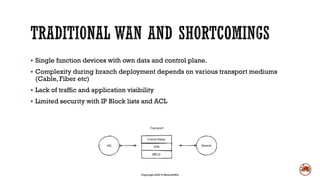
▪ Single function devices with own data and control plane.
▪ Complexity during branch deployment depends on various transport mediums
(Cable, Fiber etc)
▪ Lack of traffic and application visibility
▪ Limited security with IP Block lists and ACL
Copyright 2020 © NetworkWiz
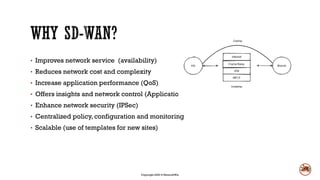
• Improves network service (availability)
• Reduces network cost and complexity
• Increase application performance (QoS)
• Offers insights and network control (Application visibility)
• Enhance network security (IPSec)
• Centralized policy, configuration and monitoring
• Scalable (use of templates for new sites)
Copyright 2020 © NetworkWiz
• Edge connectivity abstraction
• WAN virtualization
• Centralized management
• Elastic traffic management
Copyright 2020 © NetworkWiz
▪ Geographic expansion
▪ Making better use of WAN capacity
▪ Improving WAN resilience
▪ Cloud migration
Copyright 2020 © NetworkWiz
▪ High upfront hardware cost.
▪ Licensing cost / mostly subscription based
▪ More prune to software bugs
▪ Less control for troubleshooting (limited or no CLI)
▪ Latency of internet
▪ NOT an MPLS killer
Copyright 2020 © NetworkWiz
▪ If you have any questions email at learn@networkwiz.net

SD-WAN overview slides

  • 1.
    Understanding Software DefinedWide Area Network www.NetworkWIZ.net Learn – Secure - Advance
  • 2.
    ▪ The 70s:An era when a 9.6 Kbps line, which ran over copper, was considered to be part of a high-speed network ▪ The 80s: Improving on leased lines, and 45Mbps T3/DS3 links. (X25 and Frame Relay) ▪ The 90s: Fiber-Optic revolution connecting site at higher speeds. ▪ Y2K Millenia: WAN optimization with ATM & MPLS with QoS ▪ The Future: Emergence of cloud apps, software defined WAN, self healing network, security and application visibility. Copyright 2020 © NetworkWiz
  • 3.
    • Software DefinedWide Area Network (SD-WAN) is a visualized network (overlay) that abstracts form its hardware. • Much like virtual machine that abstracts an operating system from underlaying hardware. • Think of it as IPSec over GRE tunnels on steroids, with ability to do policy based routing, dynamic path selection and QoS combined with application visibility. Copyright 2020 © NetworkWiz
  • 4.
    ▪ Single functiondevices with own data and control plane. ▪ Complexity during branch deployment depends on various transport mediums (Cable, Fiber etc) ▪ Lack of traffic and application visibility ▪ Limited security with IP Block lists and ACL Copyright 2020 © NetworkWiz
  • 5.
    • Improves networkservice (availability) • Reduces network cost and complexity • Increase application performance (QoS) • Offers insights and network control (Application visibility) • Enhance network security (IPSec) • Centralized policy, configuration and monitoring • Scalable (use of templates for new sites) Copyright 2020 © NetworkWiz
  • 6.
    • Edge connectivityabstraction • WAN virtualization • Centralized management • Elastic traffic management Copyright 2020 © NetworkWiz
  • 7.
    ▪ Geographic expansion ▪Making better use of WAN capacity ▪ Improving WAN resilience ▪ Cloud migration Copyright 2020 © NetworkWiz
  • 8.
  • 9.
    ▪ High upfronthardware cost. ▪ Licensing cost / mostly subscription based ▪ More prune to software bugs ▪ Less control for troubleshooting (limited or no CLI) ▪ Latency of internet ▪ NOT an MPLS killer Copyright 2020 © NetworkWiz
  • 10.
    ▪ If youhave any questions email at learn@networkwiz.net