FRANCIS REY G. NERI
DEMONSTRATOR
BIOLOGY 1
Grade 11/12
PREPARATORY ACTIVITY
- Prayer
- Checking of attendance
Setting of rules
Mobile phones should be in silent mode
Nobody is allowed to go out during class
Raise your hand if you have questions or to
answer a question
Participation is highly appreciated
Avoid unnecessary noise during class discussion
Overview of the lesson
CELL
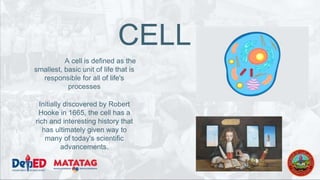
A cell is defined as the
smallest, basic unit of life that is
responsible for all of life's
processes
Initially discovered by Robert
Hooke in 1665, the cell has a
rich and interesting history that
has ultimately given way to
many of today's scientific
advancements.
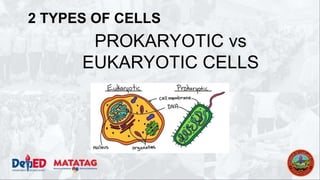
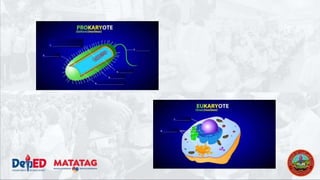
PROKARYOTIC vs
EUKARYOTIC CELLS
2 TYPES OF CELLS
What can you say about the video presented?
GROUP ACTIVITY
JUMBLED
LETTERS
POAIRRKOYTC
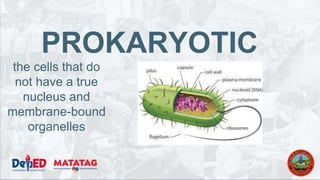
PROKARYOTIC
the cells that do
not have a true
nucleus and
membrane-bound
organelles
EKYIRUOTAC
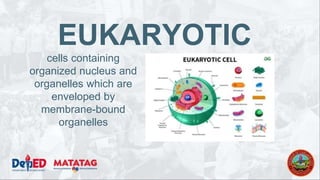
EUKARYOTIC
cells containing
organized nucleus and
organelles which are
enveloped by
membrane-bound
organelles
OEANRELGLS
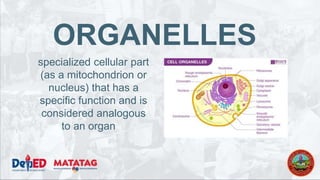
ORGANELLES
specialized cellular part
(as a mitochondrion or
nucleus) that has a
specific function and is
considered analogous
to an organ
HUMAN CELL
Human cells are found throughout the
human body, organized into tissues,
organs, and organ systems. The human
body is composed of trillions of cells with
various functions and specialized roles.
GROUP GAME
PASS THE
OBJECT
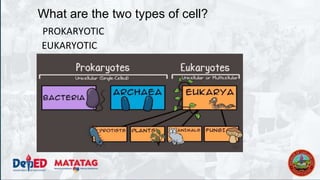
What are the two types of cell?
PROKARYOTIC
EUKARYOTIC
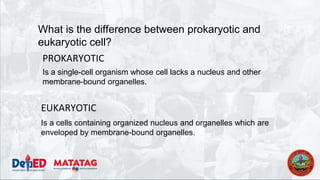
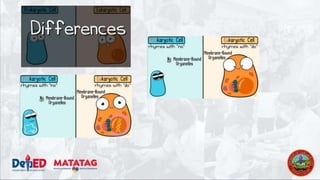
What is the difference between prokaryotic and
eukaryotic cell?
PROKARYOTIC
EUKARYOTIC
Is a single-cell organism whose cell lacks a nucleus and other
membrane-bound organelles.
Is a cells containing organized nucleus and organelles which are
enveloped by membrane-bound organelles.
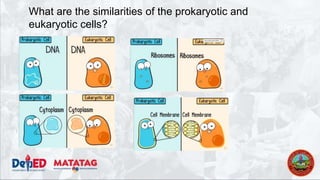
What are the similarities of the prokaryotic and
eukaryotic cells?
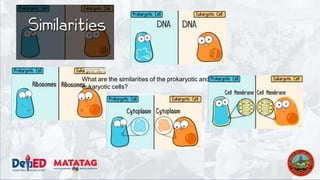
What are the similarities of the prokaryotic and
eukaryotic cells?
Are human beings prokaryotic
or eukaryotic
Humans are eukaryotes. They are
multicellular organisms, the cells contain
a membrane-bound nucleus and other
organelles (mitochondria, Golgi bodies,
lysosomes, endoplasmic reticulum).
What is the importance of
cell?
They provide structure for the body, take in nutrients from
food and convert those nutrients into energy and carry out
specialized functions. Cells also contain the body’s
hereditary material and can make copies of themselves.
QUIZ!!!
ASSIGNMENT
Demonstrattion Powerpoint for class demonstration

Demonstrattion Powerpoint for class demonstration