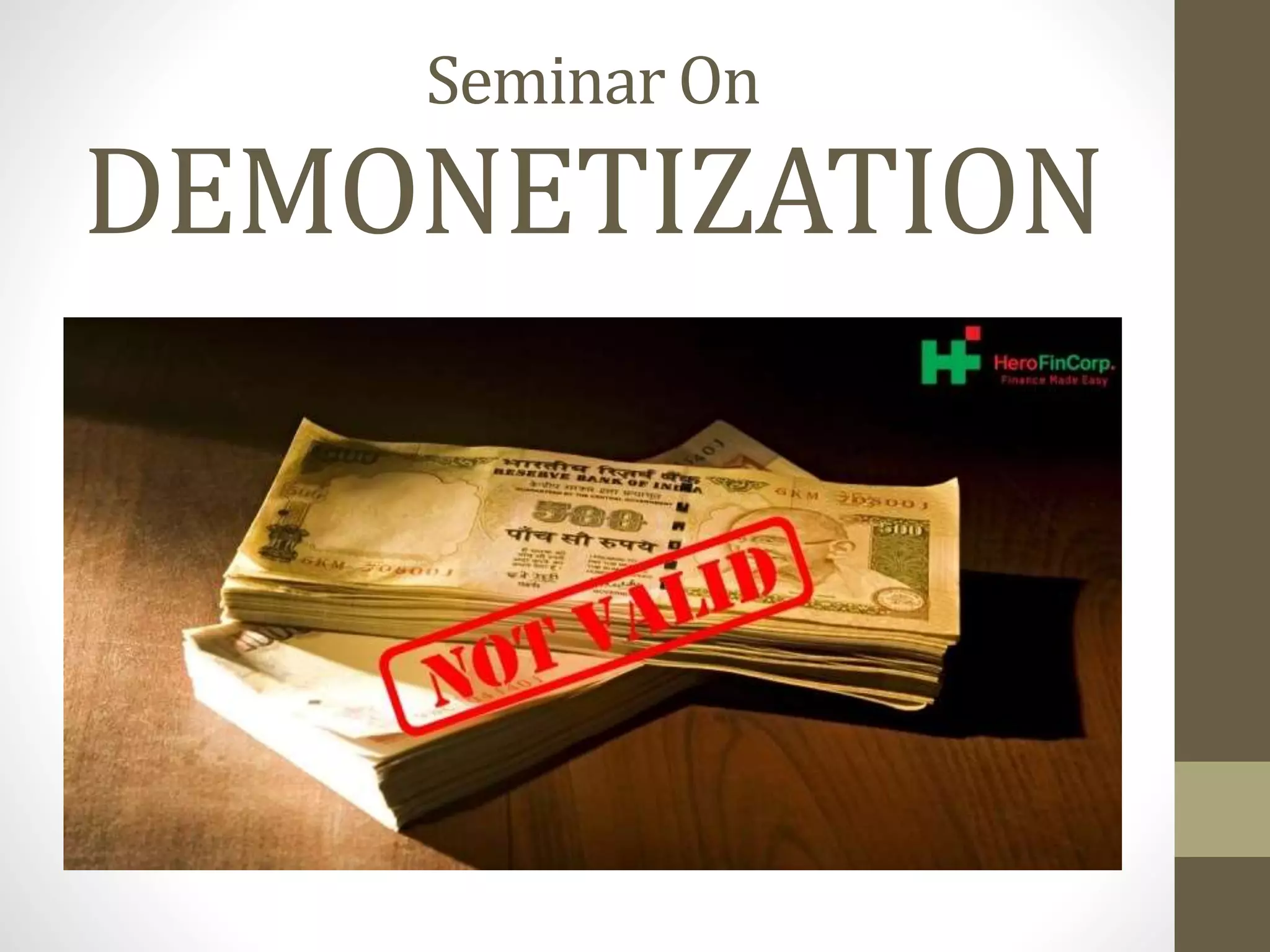
Seminar On
DEMONETIZATION
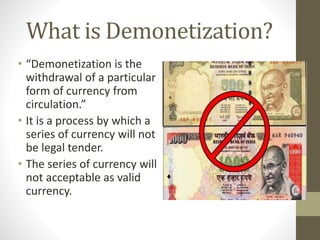
What is Demonetization?
• “Demonetization is the
withdrawal of a particular
form of currency from
circulation.”
• It is a process by which a
series of currency will not
be legal tender.
• The series of currency will
not acceptable as valid
currency.
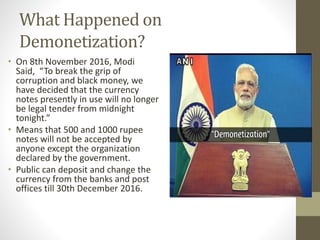
What Happened on
Demonetization?
• On 8th November 2016, Modi
Said, “To break the grip of
corruption and black money, we
have decided that the currency
notes presently in use will no longer
be legal tender from midnight
tonight.”
• Means that 500 and 1000 rupee
notes will not be accepted by
anyone except the organization
declared by the government.
• Public can deposit and change the
currency from the banks and post
offices till 30th December 2016.
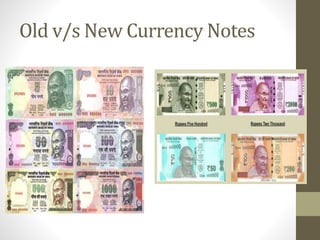
Old v/s New Currency Notes
Background In India
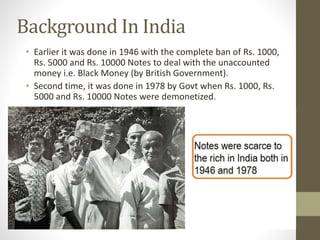
• Earlier it was done in 1946 with the complete ban of Rs. 1000,
Rs. 5000 and Rs. 10000 Notes to deal with the unaccounted
money i.e. Black Money (by British Government).
• Second time, it was done in 1978 by Govt when Rs. 1000, Rs.
5000 and Rs. 10000 Notes were demonetized.
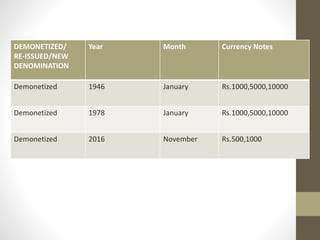
DEMONETIZED/
RE-ISSUED/NEW
DENOMINATION
Year Month Currency Notes
Demonetized 1946 January Rs.1000,5000,10000
Demonetized 1978 January Rs.1000,5000,10000
Demonetized 2016 November Rs.500,1000
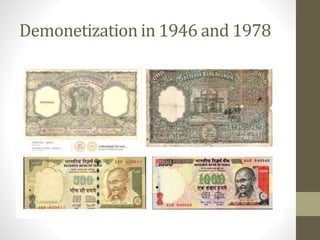
Demonetization in 1946 and 1978
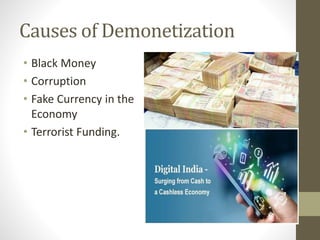
Causes of Demonetization
• Black Money
• Corruption
• Fake Currency in the
Economy
• Terrorist Funding.
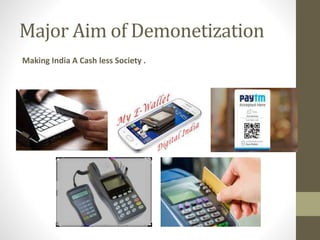
Major Aim of Demonetization
Making India A Cash less Society .
Benefits of Cashless Economy
• Reduction of Tax Avoidance.
• Helps to Control Generation of
Black Money.
• In financial year 2015, RBI spent
Rs. 27 billion on just the activity
of currency issuance and
management. This could be
avoided.
• 1 in 7 notes is fake.
Steps Taken by Government to
Promote Cashless Transactions
• Government has been
announcing new
schemes, technology and
policy moves on cashless
methods.
• New bank accounts
opened have enabled
99% of households to
have a bank account.
• A variety of new
payment methods have
come up now - RuPay,
BBPS, Paytm and AePS.
Effect on Online Transactions
Alternative Modes of Payment
• With cash transactions facing a reduction, alternative forms of
payment will see a sudden increase in demand.
• Digital transaction systems, E-wallets and apps, online
transactions using E banking, usage of Plastic money (Debit
and Credit Cards), etc. will definitely see substantial increase
in demand
• This Will Bring More transparency In System And You can
Easily track Online Money transactions.
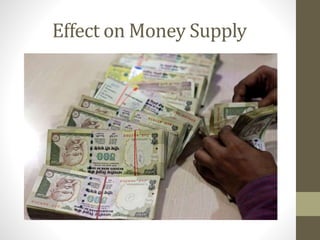
Effect on Money Supply
Effect on Demand
Real Estate and
Property
Gold and luxury
goods
Consumer goods
Automobiles (only to
a certain limit)
All these mentioned
sectors involved Cash
transaction.
Effect on Prices
• Price level is expected to be lowered due to decrease in
demand from consumer side. This demand driven fall in prices
could be understood as follows:
• Consumer goods: Prices are expected to fall only marginally
due to moderation in demand as use of cards and cheques
would compensate for some purchases.
• Real Estate and Property: Prices in this sector are largely
expected to fall, especially for sales of properties where major
part of the transaction is cash based, rather than based on
banks transfer or cheque transactions.
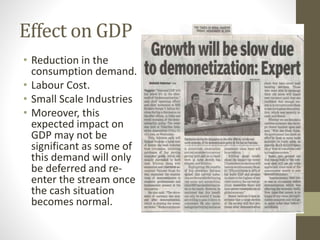
Effect on GDP
• Reduction in the
consumption demand.
• Labour Cost.
• Small Scale Industries
• Moreover, this
expected impact on
GDP may not be
significant as some of
this demand will only
be deferred and re-
enter the stream once
the cash situation
becomes normal.
Towards A Cashless Economy
• While it is practically impossible to have a 100% cashless
economy , the proportion of hard cash in the economy will
decrease and our economy will get more digitized .
• This will result in greater transparency .
• Now government has put Some limitation for Cash Withdraw
from bank Accounts. People Will go for online payments.
• They Will use PayTM Or other online payment to companies
for Buying goods or Making payments.
• More Use of Debit and Credit Card
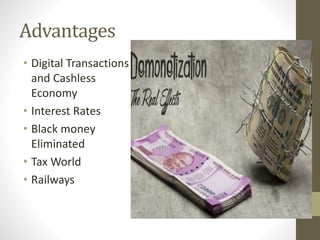
Advantages
• Digital Transactions
and Cashless
Economy
• Interest Rates
• Black money
Eliminated
• Tax World
• Railways
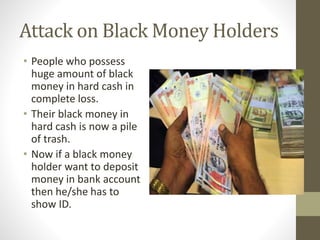
Attack on Black Money Holders
• People who possess
huge amount of black
money in hard cash in
complete loss.
• Their black money in
hard cash is now a pile
of trash.
• Now if a black money
holder want to deposit
money in bank account
then he/she has to
show ID.
Alternatives Used By Black
Money Holders
• Railway Tickets
• Purchase of Gold
• Claim as Agricultural
Income
• Using Employees
Accounts
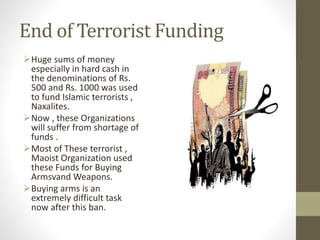
End of Terrorist Funding
Huge sums of money
especially in hard cash in
the denominations of Rs.
500 and Rs. 1000 was used
to fund Islamic terrorists ,
Naxalites.
Now , these Organizations
will suffer from shortage of
funds .
Most of These terrorist ,
Maoist Organization used
these Funds for Buying
Armsvand Weapons.
Buying arms is an
extremely difficult task
now after this ban.
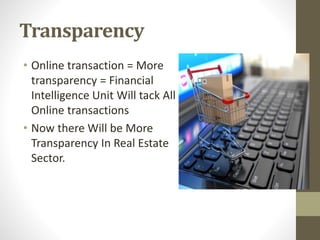
Transparency
• Online transaction = More
transparency = Financial
Intelligence Unit Will tack All
Online transactions
• Now there Will be More
Transparency In Real Estate
Sector.
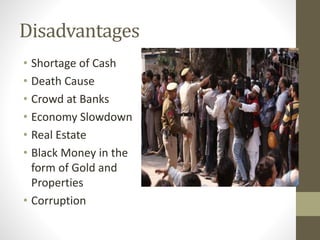
Disadvantages
• Shortage of Cash
• Death Cause
• Crowd at Banks
• Economy Slowdown
• Real Estate
• Black Money in the
form of Gold and
Properties
• Corruption
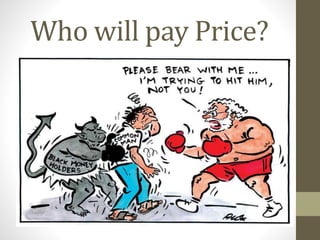
Who will pay Price?
Conclusion
• Due to poorly executed
plan by government,
people are suffered.
There has been reports
of BJP members
admitting that business
leaders of India were
able to away with this
demonetization situation
as they had information
about this action well in
advance.
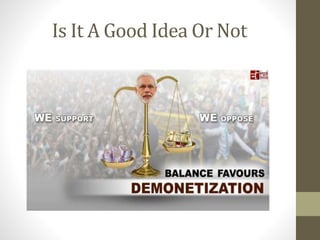
Is It A Good Idea Or Not
Open House
•Any Question/Doubt/Comments
thanks
• Presented By:
Harpreet Paul
B.Com(4th Sem)

Demonetization

  • 1.
  • 2.
    What is Demonetization? •“Demonetization is the withdrawal of a particular form of currency from circulation.” • It is a process by which a series of currency will not be legal tender. • The series of currency will not acceptable as valid currency.
  • 3.
    What Happened on Demonetization? •On 8th November 2016, Modi Said, “To break the grip of corruption and black money, we have decided that the currency notes presently in use will no longer be legal tender from midnight tonight.” • Means that 500 and 1000 rupee notes will not be accepted by anyone except the organization declared by the government. • Public can deposit and change the currency from the banks and post offices till 30th December 2016.
  • 4.
    Old v/s NewCurrency Notes
  • 5.
    Background In India •Earlier it was done in 1946 with the complete ban of Rs. 1000, Rs. 5000 and Rs. 10000 Notes to deal with the unaccounted money i.e. Black Money (by British Government). • Second time, it was done in 1978 by Govt when Rs. 1000, Rs. 5000 and Rs. 10000 Notes were demonetized.
  • 6.
    DEMONETIZED/ RE-ISSUED/NEW DENOMINATION Year Month CurrencyNotes Demonetized 1946 January Rs.1000,5000,10000 Demonetized 1978 January Rs.1000,5000,10000 Demonetized 2016 November Rs.500,1000
  • 7.
  • 8.
    Causes of Demonetization •Black Money • Corruption • Fake Currency in the Economy • Terrorist Funding.
  • 9.
    Major Aim ofDemonetization Making India A Cash less Society .
  • 10.
    Benefits of CashlessEconomy • Reduction of Tax Avoidance. • Helps to Control Generation of Black Money. • In financial year 2015, RBI spent Rs. 27 billion on just the activity of currency issuance and management. This could be avoided. • 1 in 7 notes is fake.
  • 11.
    Steps Taken byGovernment to Promote Cashless Transactions • Government has been announcing new schemes, technology and policy moves on cashless methods. • New bank accounts opened have enabled 99% of households to have a bank account. • A variety of new payment methods have come up now - RuPay, BBPS, Paytm and AePS.
  • 12.
    Effect on OnlineTransactions Alternative Modes of Payment • With cash transactions facing a reduction, alternative forms of payment will see a sudden increase in demand. • Digital transaction systems, E-wallets and apps, online transactions using E banking, usage of Plastic money (Debit and Credit Cards), etc. will definitely see substantial increase in demand • This Will Bring More transparency In System And You can Easily track Online Money transactions.
  • 13.
  • 14.
    Effect on Demand RealEstate and Property Gold and luxury goods Consumer goods Automobiles (only to a certain limit) All these mentioned sectors involved Cash transaction.
  • 15.
    Effect on Prices •Price level is expected to be lowered due to decrease in demand from consumer side. This demand driven fall in prices could be understood as follows: • Consumer goods: Prices are expected to fall only marginally due to moderation in demand as use of cards and cheques would compensate for some purchases. • Real Estate and Property: Prices in this sector are largely expected to fall, especially for sales of properties where major part of the transaction is cash based, rather than based on banks transfer or cheque transactions.
  • 16.
    Effect on GDP •Reduction in the consumption demand. • Labour Cost. • Small Scale Industries • Moreover, this expected impact on GDP may not be significant as some of this demand will only be deferred and re- enter the stream once the cash situation becomes normal.
  • 17.
    Towards A CashlessEconomy • While it is practically impossible to have a 100% cashless economy , the proportion of hard cash in the economy will decrease and our economy will get more digitized . • This will result in greater transparency . • Now government has put Some limitation for Cash Withdraw from bank Accounts. People Will go for online payments. • They Will use PayTM Or other online payment to companies for Buying goods or Making payments. • More Use of Debit and Credit Card
  • 18.
    Advantages • Digital Transactions andCashless Economy • Interest Rates • Black money Eliminated • Tax World • Railways
  • 19.
    Attack on BlackMoney Holders • People who possess huge amount of black money in hard cash in complete loss. • Their black money in hard cash is now a pile of trash. • Now if a black money holder want to deposit money in bank account then he/she has to show ID.
  • 20.
    Alternatives Used ByBlack Money Holders • Railway Tickets • Purchase of Gold • Claim as Agricultural Income • Using Employees Accounts
  • 21.
    End of TerroristFunding Huge sums of money especially in hard cash in the denominations of Rs. 500 and Rs. 1000 was used to fund Islamic terrorists , Naxalites. Now , these Organizations will suffer from shortage of funds . Most of These terrorist , Maoist Organization used these Funds for Buying Armsvand Weapons. Buying arms is an extremely difficult task now after this ban.
  • 22.
    Transparency • Online transaction= More transparency = Financial Intelligence Unit Will tack All Online transactions • Now there Will be More Transparency In Real Estate Sector.
  • 23.
    Disadvantages • Shortage ofCash • Death Cause • Crowd at Banks • Economy Slowdown • Real Estate • Black Money in the form of Gold and Properties • Corruption
  • 24.
  • 25.
    Conclusion • Due topoorly executed plan by government, people are suffered. There has been reports of BJP members admitting that business leaders of India were able to away with this demonetization situation as they had information about this action well in advance.
  • 26.
    Is It AGood Idea Or Not
  • 27.
  • 28.