PRESENTATION
ON
IMPACT OF
DEMONETIZATION ON
RETAILERS
SUBMITTED BY:-
 ANSHUL JAIN
 MAYANK GUPTA
 RISHABH JHAWAR
 VIDIT DOSHI
Demonetization is the act of stripping
a currency unit of its status as legal
tender. Demonetization is necessary
whenever there is a change
of national currency. The old unit of
currency must be retired and
replaced with a new currency unit.
Sinha's Presentation
In an important move, the Government of India declared on 8th
November 2016 that the five hundred and one thousand rupee notes
will no longer be legal tender from midnight today.
The RBI will issue Two thousand rupee notes and new notes of Five
hundred rupees which will be placed in circulation from 10th
November 2016.
Notes of one hundred, fifty, twenty, ten, five, two and one rupee will
remain legal tender and will remain unaffected by this decision.
This measure has been taken by the PM in an attempt to address the
resolve against corruption, black money and fake notes. This move is
expected to cleanse the formal economic system and discard black
money from the same.
REASONS FOR DEMONETIZATION
• We knew terrorism is a frightening threat, but who funds
these terrorists? Our enemies they use the fake currency to
sponsor terror-this was proven many a times. And to tackle
black money in the economy its around (5 lakh crore).
• Corruption and black money are the major obstacles in our
country. It is weakening the efforts to remove poverty. Our
country is rapidly increasing in terms of growth and we are
in No.1 position in terms of growth but we are ranked 76 in
Global Corruption Perception ranking. It clearly shows
how corruption and black money have spread their
tentacles.
IMPACT OF DEMONETIZATION ON RETAILERS
 Offline Retail: Given the high propensity of Indians to deal in
cash, the immediate aftermath of PM Modi's demonetization
announcement has caused considerable inconvenience among
retailers and their customers.
 Small traders and vendors have been affected the most as they
are facing a huge slump in sale.
 Many of these small retailers are not equipped enough to
make provisions of digital payments for their customers , and
for this reason are having to go through a lot of hardships.
 Organized, large retailers and malls too are facing a drop in sales
and decreasing amount of store footfalls, but in the long run
can expect normalcy to be restored as customers increasingly
adopt to making payments digitally.
 Online Retail: Online Retail sales has also taken a beating in
the month of November, immediately after the
demonetization announcement.
 According to the data from ETRetail.com, the monthly
gross sales (November) is expected to take a 50% hit in
comparison to the month of October.
 During the 8th-13th November week, the cash on delivery
(CoD) volumes were down by 60% than usual. Flipkart
claims that they experenced a dip in sales by 25-30% after
the announcement.
 Generally, the leading e-commerce companies register
returns of about 13-15%, but has doubled up ever since
demonetization took effect, with most cancellations arising
out of cash on delivery orders due to the growing
reluctance of customers to give out cash.
YOUR MONEY WILL BE YOURS
 It is a transformational decision taken by the government to ban
Rs.500 and Rs.1000 notes from circulation in the market.
 The decision was taken to minimize the black money and
corruption. The RBI is issuing Rs.500 and Rs.2000 notes.
 They have released a statement by saying that all the Rs.500
and Rs.1000 notes are to be deposited at nearby banks or post-
offices. This will be a regular currency circulation all throughout
India.
 All those people who are panicked with this move by the
government need not worry at all as the government has
assured that ‘Your money will be yours’. You will not lose
anything so there is no point in being scared.
 There will be no restrictions on non-cash payments by cheques,
demand draft’s, and electronic fund transfer.
Effect on Parallel Economy
The removal of these 500 and 1000 notes and
replacement of the same with new 500 and 2000
Rupee Notes is expected to
- remove black money from the economy as
they will be blocked since the owners will not be in
a position to deposit the same in the banks,
- Temporarily stall the circulation of large
volume of counterfeit currency and
- curb the funding for anti-social elements like
smuggling, terrorism, espionage, etc.
Effect on Money Supply
With the older 500 and 1000 Rupees notes being
scrapped, until the new 500 and 2000 Rupees notes get
widely circulated in the market, money supply is
expected to reduce in the short run.
To the extent that black money (which is not
counterfeit) does not re-enter the system, reserve
money and hence money supply will decrease
permanently.
However gradually as the new notes get circulated
in the market and the mismatch gets corrected, money
supply will pick up.
Effect on Demand
The overall demand is expected to be affected to an extent.
The demand in following areas is to be impacted particularly:
Consumer goods
Real Estate and Property
Gold and luxury goods
Automobiles (only to a certain limit)
All these mentioned sectors are expected to face certain
moderation in demand from the consumer side, owing to the
significant amount of cash transactions involved in these
sectors.
Effect on Prices
Effect on Prices Price level is expected to be lowered due to
moderation from demand side. This demand driven fall in prices could be
understood as follows:
Consumer goods: Prices are expected to fall only marginally due to
moderation in demand as use of cards and cheques would compensate for
some purchases.
Real Estate and Property: Prices in this sector are largely expected to
fall, especially for sales of properties where major part of the transaction
is cash based, rather than based on banks transfer or cheque transactions.
In the medium term, however the prices in this sector could regain
some levels as developers rebalance their prices (probably charging more
on cheque payment).
Effect on various economic entities
With cash transaction lowering in the short run, until the new notes are spread widely into
circulation, certain sections of the society could face short term disruptions in facilitation of their
transactions. These sections are:
1. Agriculture and related sector
2. Small traders
3. SME
4. Services Sector
5. Households
6. Political Parties
7. Professionals like doctor, carpenter, utility service providers, etc.
8. Retail outlets
The nature, frequency and amounts of the commercial transactions involved with these sections
of the economy necessitate cash transactions on more frequent basis. Thus, these segments are
expected to have the most significant impact post this demonetization process and the
introduction of new notes in circulation.
Effect on Banks
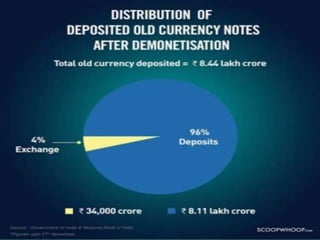
As directed by the Government, the 500 and 1000 Rupee notes
which now cease to be legal tender are to be deposited or
exchanged in banks (subject to certain limits).
This will automatically lead to more amounts being deposited in
Savings and Current Account of commercial banks.
This in turn will enhance the liquidity position of the banks,
which can be utilized further for lending purposes.
However, to the extent that households have held on to these
funds for emergency purposes, there would be withdrawals at the
second stage.
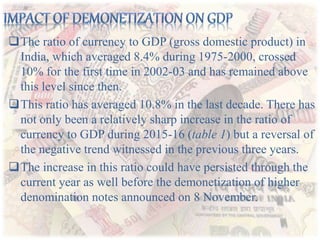
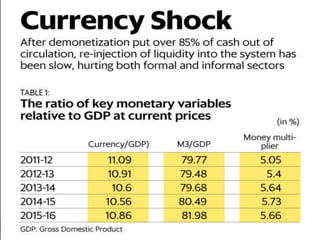
The ratio of currency to GDP (gross domestic product) in
India, which averaged 8.4% during 1975-2000, crossed
10% for the first time in 2002-03 and has remained above
this level since then.
This ratio has averaged 10.8% in the last decade. There has
not only been a relatively sharp increase in the ratio of
currency to GDP during 2015-16 (table 1) but a reversal of
the negative trend witnessed in the previous three years.
The increase in this ratio could have persisted through the
current year as well before the demonetization of higher
denomination notes announced on 8 November.
CONCLUSION
The demonetization is definitely a good step, however, the
planning and execution of the exercise is seriously flawed.
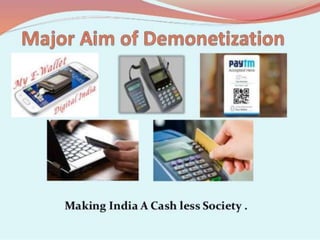
So the presentation shows that initially the demonetization
effects on market were painful but this also instigate the
shopkeepers and consumers to adopt cashless means such as
paytm, debit card use, internet banking to buy goods.
 By adopting the cashless means economy will be sound in
coming time and Indian Economy will get benefits of early
and hassle free transactions.
 Demonetization effect will be positive in coming time for
Indian Economy. Indian consumers will strives ToL learn new
ways of cashless transactions. By adopting the cashless means
certainly there will be a checkon black money.
Video on demonetization

Demonetization

  • 1.
  • 2.
    SUBMITTED BY:-  ANSHULJAIN  MAYANK GUPTA  RISHABH JHAWAR  VIDIT DOSHI
  • 3.
    Demonetization is theact of stripping a currency unit of its status as legal tender. Demonetization is necessary whenever there is a change of national currency. The old unit of currency must be retired and replaced with a new currency unit. Sinha's Presentation
  • 4.
    In an importantmove, the Government of India declared on 8th November 2016 that the five hundred and one thousand rupee notes will no longer be legal tender from midnight today. The RBI will issue Two thousand rupee notes and new notes of Five hundred rupees which will be placed in circulation from 10th November 2016. Notes of one hundred, fifty, twenty, ten, five, two and one rupee will remain legal tender and will remain unaffected by this decision. This measure has been taken by the PM in an attempt to address the resolve against corruption, black money and fake notes. This move is expected to cleanse the formal economic system and discard black money from the same.
  • 5.
    REASONS FOR DEMONETIZATION •We knew terrorism is a frightening threat, but who funds these terrorists? Our enemies they use the fake currency to sponsor terror-this was proven many a times. And to tackle black money in the economy its around (5 lakh crore). • Corruption and black money are the major obstacles in our country. It is weakening the efforts to remove poverty. Our country is rapidly increasing in terms of growth and we are in No.1 position in terms of growth but we are ranked 76 in Global Corruption Perception ranking. It clearly shows how corruption and black money have spread their tentacles.
  • 7.
    IMPACT OF DEMONETIZATIONON RETAILERS  Offline Retail: Given the high propensity of Indians to deal in cash, the immediate aftermath of PM Modi's demonetization announcement has caused considerable inconvenience among retailers and their customers.  Small traders and vendors have been affected the most as they are facing a huge slump in sale.  Many of these small retailers are not equipped enough to make provisions of digital payments for their customers , and for this reason are having to go through a lot of hardships.  Organized, large retailers and malls too are facing a drop in sales and decreasing amount of store footfalls, but in the long run can expect normalcy to be restored as customers increasingly adopt to making payments digitally.
  • 8.
     Online Retail:Online Retail sales has also taken a beating in the month of November, immediately after the demonetization announcement.  According to the data from ETRetail.com, the monthly gross sales (November) is expected to take a 50% hit in comparison to the month of October.  During the 8th-13th November week, the cash on delivery (CoD) volumes were down by 60% than usual. Flipkart claims that they experenced a dip in sales by 25-30% after the announcement.  Generally, the leading e-commerce companies register returns of about 13-15%, but has doubled up ever since demonetization took effect, with most cancellations arising out of cash on delivery orders due to the growing reluctance of customers to give out cash.
  • 10.
    YOUR MONEY WILLBE YOURS  It is a transformational decision taken by the government to ban Rs.500 and Rs.1000 notes from circulation in the market.  The decision was taken to minimize the black money and corruption. The RBI is issuing Rs.500 and Rs.2000 notes.  They have released a statement by saying that all the Rs.500 and Rs.1000 notes are to be deposited at nearby banks or post- offices. This will be a regular currency circulation all throughout India.  All those people who are panicked with this move by the government need not worry at all as the government has assured that ‘Your money will be yours’. You will not lose anything so there is no point in being scared.  There will be no restrictions on non-cash payments by cheques, demand draft’s, and electronic fund transfer.
  • 11.
    Effect on ParallelEconomy The removal of these 500 and 1000 notes and replacement of the same with new 500 and 2000 Rupee Notes is expected to - remove black money from the economy as they will be blocked since the owners will not be in a position to deposit the same in the banks, - Temporarily stall the circulation of large volume of counterfeit currency and - curb the funding for anti-social elements like smuggling, terrorism, espionage, etc.
  • 12.
    Effect on MoneySupply With the older 500 and 1000 Rupees notes being scrapped, until the new 500 and 2000 Rupees notes get widely circulated in the market, money supply is expected to reduce in the short run. To the extent that black money (which is not counterfeit) does not re-enter the system, reserve money and hence money supply will decrease permanently. However gradually as the new notes get circulated in the market and the mismatch gets corrected, money supply will pick up.
  • 13.
    Effect on Demand Theoverall demand is expected to be affected to an extent. The demand in following areas is to be impacted particularly: Consumer goods Real Estate and Property Gold and luxury goods Automobiles (only to a certain limit) All these mentioned sectors are expected to face certain moderation in demand from the consumer side, owing to the significant amount of cash transactions involved in these sectors.
  • 14.
    Effect on Prices Effecton Prices Price level is expected to be lowered due to moderation from demand side. This demand driven fall in prices could be understood as follows: Consumer goods: Prices are expected to fall only marginally due to moderation in demand as use of cards and cheques would compensate for some purchases. Real Estate and Property: Prices in this sector are largely expected to fall, especially for sales of properties where major part of the transaction is cash based, rather than based on banks transfer or cheque transactions. In the medium term, however the prices in this sector could regain some levels as developers rebalance their prices (probably charging more on cheque payment).
  • 15.
    Effect on variouseconomic entities With cash transaction lowering in the short run, until the new notes are spread widely into circulation, certain sections of the society could face short term disruptions in facilitation of their transactions. These sections are: 1. Agriculture and related sector 2. Small traders 3. SME 4. Services Sector 5. Households 6. Political Parties 7. Professionals like doctor, carpenter, utility service providers, etc. 8. Retail outlets The nature, frequency and amounts of the commercial transactions involved with these sections of the economy necessitate cash transactions on more frequent basis. Thus, these segments are expected to have the most significant impact post this demonetization process and the introduction of new notes in circulation.
  • 16.
    Effect on Banks Asdirected by the Government, the 500 and 1000 Rupee notes which now cease to be legal tender are to be deposited or exchanged in banks (subject to certain limits). This will automatically lead to more amounts being deposited in Savings and Current Account of commercial banks. This in turn will enhance the liquidity position of the banks, which can be utilized further for lending purposes. However, to the extent that households have held on to these funds for emergency purposes, there would be withdrawals at the second stage.
  • 17.
    The ratio ofcurrency to GDP (gross domestic product) in India, which averaged 8.4% during 1975-2000, crossed 10% for the first time in 2002-03 and has remained above this level since then. This ratio has averaged 10.8% in the last decade. There has not only been a relatively sharp increase in the ratio of currency to GDP during 2015-16 (table 1) but a reversal of the negative trend witnessed in the previous three years. The increase in this ratio could have persisted through the current year as well before the demonetization of higher denomination notes announced on 8 November.
  • 20.
    CONCLUSION The demonetization isdefinitely a good step, however, the planning and execution of the exercise is seriously flawed. So the presentation shows that initially the demonetization effects on market were painful but this also instigate the shopkeepers and consumers to adopt cashless means such as paytm, debit card use, internet banking to buy goods.  By adopting the cashless means economy will be sound in coming time and Indian Economy will get benefits of early and hassle free transactions.  Demonetization effect will be positive in coming time for Indian Economy. Indian consumers will strives ToL learn new ways of cashless transactions. By adopting the cashless means certainly there will be a checkon black money.
  • 21.