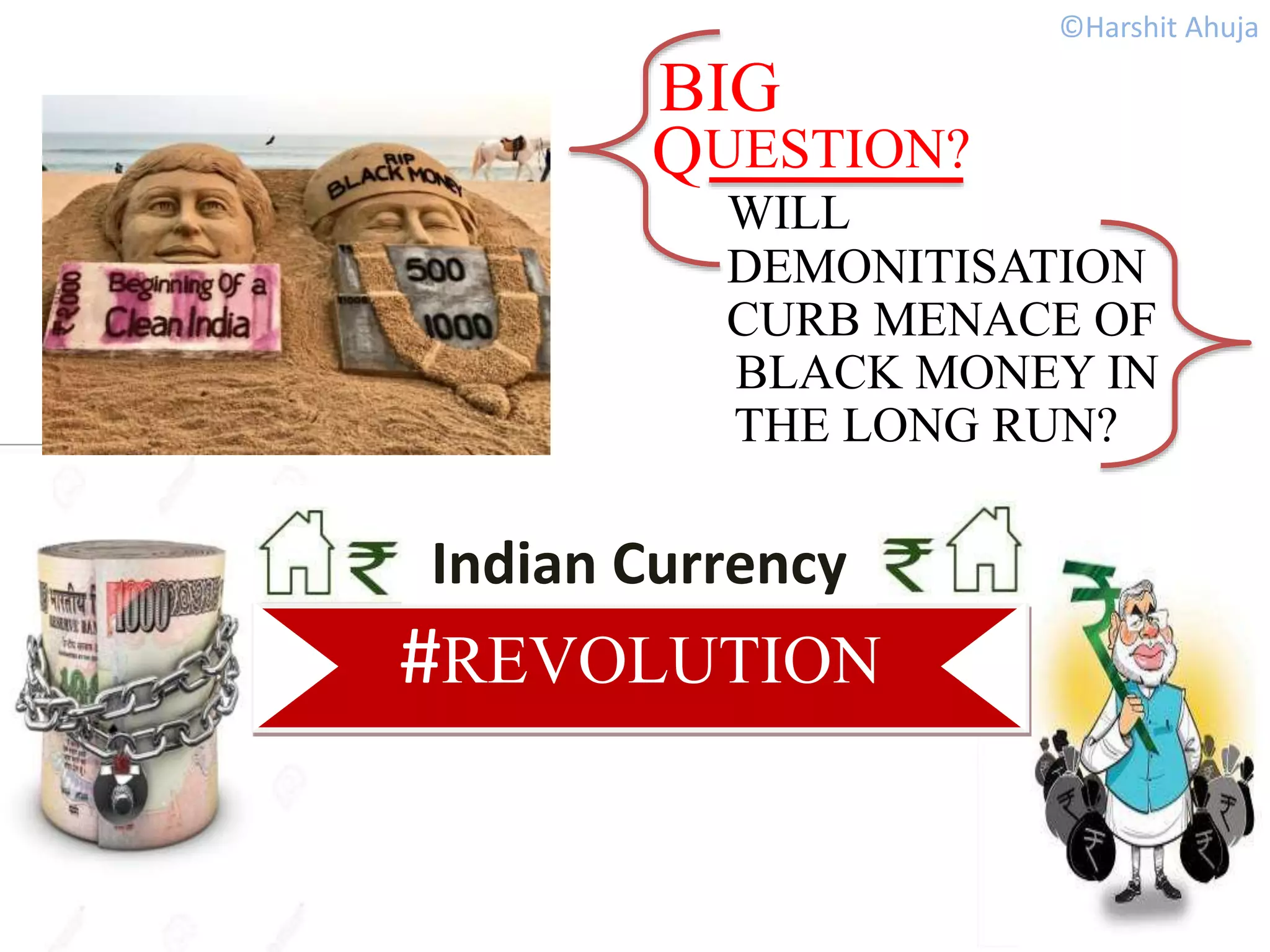
THE LONG RUN?
BLACK MONEY IN
CURB MENACE OF
DEMONITISATION
WILL
UESTION?
BIG
#REVOLUTION
Indian Currency
Q
©Harshit Ahuja
• Demonetization : The Real Effects
• Flashback #DeMo 2016
• Reasons for Demonetization
• Percentage share of denominations before Demonetization
• Purpose/Need for Demonetization
• Pros & Cons of Demonetization
• Benefits of Demonetization (Direct & Indirect)
• Impact of Demonetization (Short & Long Term)
• Effect of Demonetization on Indian Economy
• Hidden Facts
• Reaction on Social Media
• Survey @ Local Circle
• Impact on Economy – Sector wise
• Through the Glasses of Pessimism
• Reality Check (example of effect of demonetization)
• Conclusion
Overview
©Harshit Ahuja
©Harshit Ahuja
• November 8, 2016 a day when the Indian Government launched a “surprise attack”
/ “Surgical strike”/ “Surgery” against black money in the economy.
• The Hon’ble Prime Minister of India, in an unscheduled live televised address to the nation on
November 8, 2016 at 20:15 Indian Standard Time (IST) declared circulation of all INR 500
and INR 1000 banknotes of the Mahatma Gandhi Series as invalid with immediate effect.
• Issuance of new INR 500 and INR 2000 banknotes of the Mahatma Gandhi New
Series in exchange for the old banknotes was announced.
• With the exchange of new denomination notes of INR 2000 and not INR 1000, the
conversion of black money would be curbed.
• Demonetization has been done in an effort to:
• – stop counterfeiting of the current banknotes allegedly used for funding terrorism
• – crack down on black money in the country.
FlashBack #DeMO 2016
©Harshit Ahuja
Background
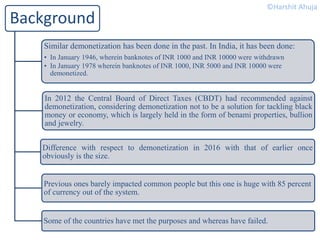
Similar demonetization has been done in the past. In India, it has been done:
• In January 1946, wherein banknotes of INR 1000 and INR 10000 were withdrawn
• In January 1978 wherein banknotes of INR 1000, INR 5000 and INR 10000 were
demonetized.
In 2012 the Central Board of Direct Taxes (CBDT) had recommended against
demonetization, considering demonetization not to be a solution for tackling black
money or economy, which is largely held in the form of benami properties, bullion
and jewelry.
Difference with respect to demonetization in 2016 with that of earlier once
obviously is the size.
Previous ones barely impacted common people but this one is huge with 85 percent
of currency out of the system.
Some of the countries have met the purposes and whereas have failed.
©Harshit Ahuja
Background
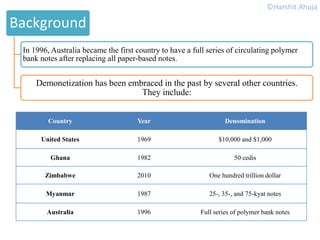
In 1996, Australia became the first country to have a full series of circulating polymer
bank notes after replacing all paper-based notes.
Demonetization has been embraced in the past by several other countries.
They include:
Country Year Denomination
United States 1969 $10,000 and $1,000
Ghana 1982 50 cedis
Zimbabwe 2010 One hundred trillion dollar
Myanmar 1987 25-, 35-, and 75-kyat notes
Australia 1996 Full series of polymer bank notes
©Harshit Ahuja
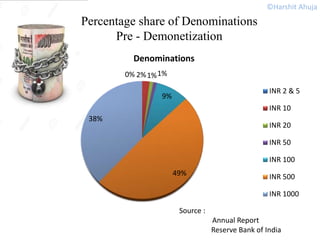
Percentage share of Denominations
Pre - Demonetization
0% 2%1%1%
9%
49%
38%
Denominations
INR 2 & 5
INR 10
INR 20
INR 50
INR 100
INR 500
INR 1000
Source :
Annual Report
Reserve Bank of India
©Harshit Ahuja
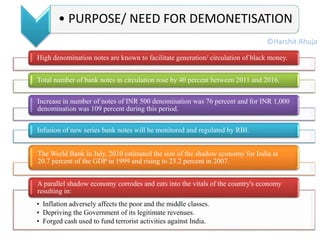
High denomination notes are known to facilitate generation/ circulation of black money.
Total number of bank notes in circulation rose by 40 percent between 2011 and 2016.
Increase in number of notes of INR 500 denomination was 76 percent and for INR 1,000
denomination was 109 percent during this period.
Infusion of new series bank notes will be monitored and regulated by RBI.
The World Bank in July, 2010 estimated the size of the shadow economy for India at
20.7 percent of the GDP in 1999 and rising to 23.2 percent in 2007.
• Inflation adversely affects the poor and the middle classes.
• Depriving the Government of its legitimate revenues.
• Forged cash used to fund terrorist activities against India.
A parallel shadow economy corrodes and eats into the vitals of the country's economy
resulting in:
• PURPOSE/ NEED FOR DEMONETISATION
©Harshit Ahuja
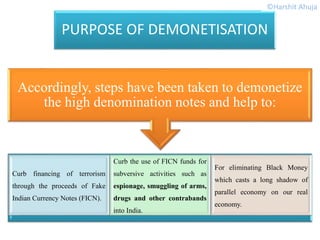
Curb financing of terrorism
through the proceeds of Fake
Indian Currency Notes (FICN).
Curb the use of FICN funds for
subversive activities such as
espionage, smuggling of arms,
drugs and other contrabands
into India.
For eliminating Black Money
which casts a long shadow of
parallel economy on our real
economy.
Accordingly, steps have been taken to demonetize
the high denomination notes and help to:
PURPOSE OF DEMONETISATION
©Harshit Ahuja
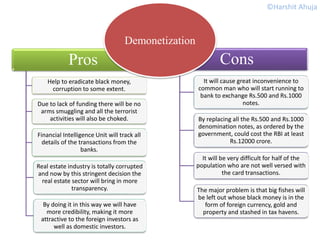
Pros
Help to eradicate black money,
corruption to some extent.
Due to lack of funding there will be no
arms smuggling and all the terrorist
activities will also be choked.
Financial Intelligence Unit will track all
details of the transactions from the
banks.
Real estate industry is totally corrupted
and now by this stringent decision the
real estate sector will bring in more
transparency.
By doing it in this way we will have
more credibility, making it more
attractive to the foreign investors as
well as domestic investors.
Cons
It will cause great inconvenience to
common man who will start running to
bank to exchange Rs.500 and Rs.1000
notes.
By replacing all the Rs.500 and Rs.1000
denomination notes, as ordered by the
government, could cost the RBI at least
Rs.12000 crore.
It will be very difficult for half of the
population who are not well versed with
the card transactions.
The major problem is that big fishes will
be left out whose black money is in the
form of foreign currency, gold and
property and stashed in tax havens.
Demonetization
©Harshit Ahuja
DirectImpact
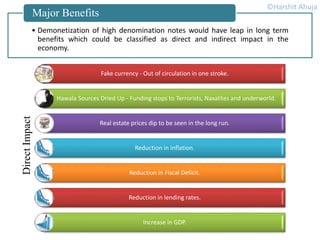
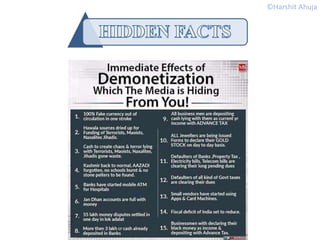
Fake currency - Out of circulation in one stroke.
Hawala Sources Dried Up - Funding stops to Terrorists, Naxalites and underworld.
Real estate prices dip to be seen in the long run.
Reduction in inflation.
Reduction in Fiscal Deficit.
Reduction in lending rates.
Increase in GDP.
• Demonetization of high denomination notes would have leap in long term
benefits which could be classified as direct and indirect impact in the
economy.
Major Benefits
©Harshit Ahuja
• Direct Impact
Major Benefits
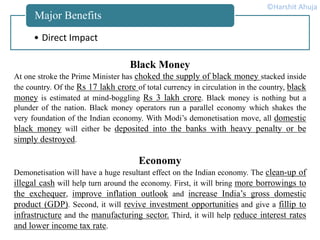
Black Money
At one stroke the Prime Minister has choked the supply of black money stacked inside
the country. Of the Rs 17 lakh crore of total currency in circulation in the country, black
money is estimated at mind-boggling Rs 3 lakh crore. Black money is nothing but a
plunder of the nation. Black money operators run a parallel economy which shakes the
very foundation of the Indian economy. With Modi’s demonetisation move, all domestic
black money will either be deposited into the banks with heavy penalty or be
simply destroyed.
Economy
Demonetisation will have a huge resultant effect on the Indian economy. The clean-up of
illegal cash will help turn around the economy. First, it will bring more borrowings to
the exchequer, improve inflation outlook and increase India’s gross domestic
product (GDP). Second, it will revive investment opportunities and give a fillip to
infrastructure and the manufacturing sector. Third, it will help reduce interest rates
and lower income tax rate.
©Harshit Ahuja
• Direct Impact
Major Benefits
Note Bank Politics
In the run up to the crucial assembly elections in Uttar Pradesh, Punjab, Goa and
Uttarakhand, Prime Minister Modi’s demonetisation announcement has come as a shock
and awe for the political parties and politicians for whom black money is a lifeline.
The pulling out of the old Rs 500 and Rs 1,000 currency notes will help make the
election process clean and transparent. But it has brought tough times for the
political parties and politicians who believe in the idea of purchasing votes in
exchange for notes.
Easy Loans
Loans will become easier and interest rates may come down. As banks will have more
money so more loans will be given out which will increase the money supply in the market
and it will create inflation.
©Harshit Ahuja
• Direct Impact
Major Benefits
Real Estate Cleansing
It is said that real estate is an industry built on black money. The extent of black
money floating around in the sector is huge. According to an estimate at least 40 per
cent of real estate transactions in Delhi-NCR are in black. Modi’s demonetisation
move will curtail the flow of black money into the real estate sector. This will help in
making the much needed correction in the sector.
The impact: An unexpected dip in land and property prices.
Hawala Transactions
Demonetisation has crippled the hawala rackets. Hawala is a method of transferring
money without any actual money movement. Hawala route is used as a means to
facilitate money laundering and terror financing. Hawala rackets run again on black
money. With black money suddenly being wiped out of the market, thanks to
demonetisation, hawala operations have come to a grinding halt. According to an
India Today report, one of the hawala operators in Mumbai has destroyed currency
notes worth about Rs 500 crores.
©Harshit Ahuja
• Direct Impact
Major Benefits
Counterfeit Currency
Demonetisation has dealt a death blow to the counterfeit Indian currency syndicate
operating both inside and outside the country. Counterfeit currency seriously devalues
the real worth of Indian currency. A study conducted by Indian Statistical Institute,
Kolkata on behalf of the National Investigation Agency (NIA) suggests that fake
Indian currency notes (FICN) amounting to Rs 400 crore are in circulation in the
country at any given point of time and around Rs 70 crore fake notes are pumped
into Indian economy every year.
This is an open secret that Pakistan has been printing fake Indian currency at its
government printing press in Quetta and its security press in Karachi.
The enemy nation funnels the counterfeit currency through the frontier at Jammu &
Kashmir and via India’s porous border with Bangladesh and Nepal. Experts say the new
currency notes have come with advanced security features which are almost
impossible to replicate. So Pakistan has no option but to shut shops of its fake Indian
currency.
©Harshit Ahuja
• Direct Impact
Major Benefits
Terror Financing
Terror financing is sourced through counterfeit currency and hawala transactions.
This is how terror financing works. Fake currency circulation is routed through a multi-
layered network of hawala operators which are closely linked to satta (gambling)
and smuggling of drugs, opium and arms. Indirectly, they all end up financing
terrorism.
With the circulation of counterfeit Indian currency completely stalled and hawala
transactions stopped, all windows for terror financing are closed.
Inflation
It will cause deflation in the market as people who have earned money through illegal
ways would be afraid to declare the money as they may be prosecuted by the Income tax
department on the legitimacy of their income.
Cash Deposits in Banks
A lot of cash which are legally earned will be deposited in the banks and now the banks
with more deposits will be able to do more lending.
©Harshit Ahuja
• Direct Impact
Major Benefits
Maoism
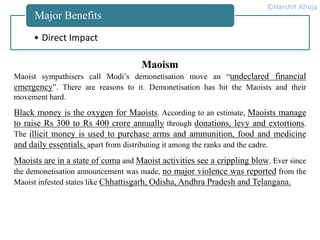
Maoist sympathisers call Modi’s demonetisation move an “undeclared financial
emergency”. There are reasons to it. Demonetisation has hit the Maoists and their
movement hard.
Black money is the oxygen for Maoists. According to an estimate, Maoists manage
to raise Rs 300 to Rs 400 crore annually through donations, levy and extortions.
The illicit money is used to purchase arms and ammunition, food and medicine
and daily essentials, apart from distributing it among the ranks and the cadre.
Maoists are in a state of coma and Maoist activities see a crippling blow. Ever since
the demonetisation announcement was made, no major violence was reported from the
Maoist infested states like Chhattisgarh, Odisha, Andhra Pradesh and Telangana.
©Harshit Ahuja
• Direct Impact
Major Benefits
Reduction in Monetary Circulation
This will lead to reduction of money circulation in the economy leading to deflation.
Value of money will be increasing which we have because the total money supply
will be going down but the commodities and things available in the market have not
gone down. It will lead to inflation slowly but not overnight.
©Harshit Ahuja
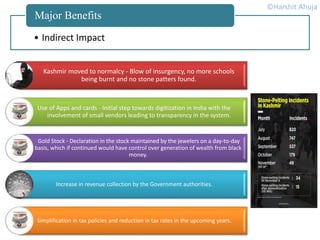
Kashmir moved to normalcy - Blow of insurgency, no more schools
being burnt and no stone patters found.
Use of Apps and cards - Initial step towards digitization in India with the
involvement of small vendors leading to transparency in the system.
Gold Stock - Declaration in the stock maintained by the jewelers on a day-to-day
basis, which if continued would have control over generation of wealth from black
money.
Increase in revenue collection by the Government authorities.
Simplification in tax policies and reduction in tax rates in the upcoming years.
• Indirect Impact
Major Benefits
©Harshit Ahuja
Scarcity of cash due to demonetization.
Sporadic violence wherein people attacked bank premises and ATMs with no major injuries.
Large chunk of the population, especially at the bottom of the pyramid and rural population highly
impacted due to poor banking facilities and extremely higher dependence on hard currency.
Various tribal areas living in isolation and illiteracy have been impacted adversely in the short run.
Certain sectors necessitating frequent use of cash on a daily basis including hospitals, households, roadside
vendors, domestic workers, cab drivers, doctors, transporters likely to face interim disruptions.
Farmers may face financial difficulties to pay daily wages to laborers in smaller denominations and manage
other farming expenses.
Slowdown in consumer spending due to limited availability of cash
IMPACT ANALYSIS
Short Term
©Harshit Ahuja
IMPACT ANALYSIS
Long Term
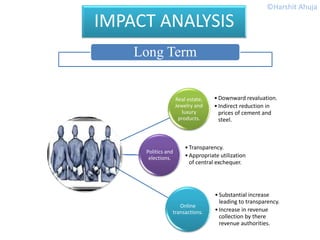
Real estate,
Jewelry and
luxury
products.
•Downward revaluation.
•Indirect reduction in
prices of cement and
steel.
Politics and
elections.
•Transparency.
•Appropriate utilization
of central exchequer.
Online
transactions.
•Substantial increase
leading to transparency.
•Increase in revenue
collection by there
revenue authorities.
©Harshit Ahuja
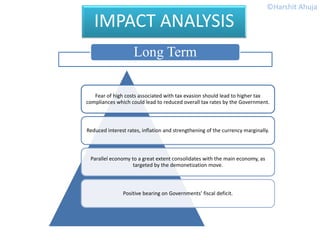
Fear of high costs associated with tax evasion should lead to higher tax
compliances which could lead to reduced overall tax rates by the Government.
Reduced interest rates, inflation and strengthening of the currency marginally.
Parallel economy to a great extent consolidates with the main economy, as
targeted by the demonetization move.
Positive bearing on Governments’ fiscal deficit.
IMPACT ANALYSIS
Long Term
©Harshit Ahuja
©Harshit Ahuja
©Harshit Ahuja
©Harshit Ahuja
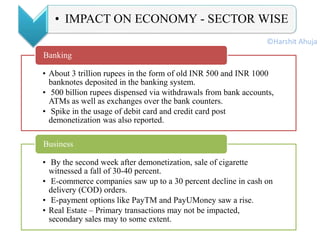
• About 3 trillion rupees in the form of old INR 500 and INR 1000
banknotes deposited in the banking system.
• 500 billion rupees dispensed via withdrawals from bank accounts,
ATMs as well as exchanges over the bank counters.
• Spike in the usage of debit card and credit card post
demonetization was also reported.
Banking
• By the second week after demonetization, sale of cigarette
witnessed a fall of 30-40 percent.
• E-commerce companies saw up to a 30 percent decline in cash on
delivery (COD) orders.
• E-payment options like PayTM and PayUMoney saw a rise.
• Real Estate – Primary transactions may not be impacted,
secondary sales may to some extent.
Business
• IMPACT ON ECONOMY - SECTOR WISE
©Harshit Ahuja
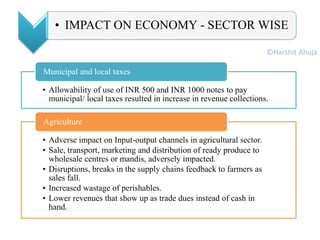
• Allowability of use of INR 500 and INR 1000 notes to pay
municipal/ local taxes resulted in increase in revenue collections.
Municipal and local taxes
• Adverse impact on Input-output channels in agricultural sector.
• Sale, transport, marketing and distribution of ready produce to
wholesale centres or mandis, adversely impacted.
• Disruptions, breaks in the supply chains feedback to farmers as
sales fall.
• Increased wastage of perishables.
• Lower revenues that show up as trade dues instead of cash in
hand.
Agriculture
• IMPACT ON ECONOMY - SECTOR WISE
©Harshit Ahuja
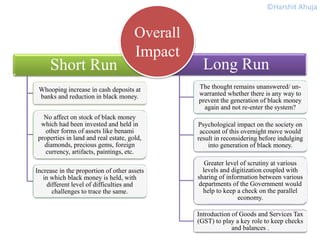
Short Run
Whooping increase in cash deposits at
banks and reduction in black money.
No affect on stock of black money
which had been invested and held in
other forms of assets like benami
properties in land and real estate, gold,
diamonds, precious gems, foreign
currency, artifacts, paintings, etc.
Increase in the proportion of other assets
in which black money is held, with
different level of difficulties and
challenges to trace the same.
Long Run
The thought remains unanswered/ un-
warranted whether there is any way to
prevent the generation of black money
again and not re-enter the system?
Psychological impact on the society on
account of this overnight move would
result in reconsidering before indulging
into generation of black money.
Greater level of scrutiny at various
levels and digitization coupled with
sharing of information between various
departments of the Government would
help to keep a check on the parallel
economy.
Introduction of Goods and Services Tax
(GST) to play a key role to keep checks
and balances .
Overall
Impact
©Harshit Ahuja
• The government says that demonetization is a short term pain and long
term gain. Short term pain refers to negative effects which are
visible and being felt at present:
• RBI in its statement on 13 December has estimated 0.5%
downward trend in GDP from 7.6 % to 7.1%. Our GDP is Rs. 125
lakh crore. In quantitative terms there will be reduction of Rs.
62500 crore at 0.5%.
• Joblessness has been reported in various sectors of economy such
as agriculture, small and medium manufacturing units,
unorganized sectors such retail trade, construction, etc.
• Loss of revenue in the form of indirect taxes such as excise duty
and VAT/CST to the state and central governments following
recession in demand.
• More than 100 deaths owing to notes ban are a human and social
loss.
• Loss of productive man hours caused by long lines at banks and
ATMs.
• If cash crunch and demand recession continue after 30 December,
social unrest is likely to begin. Even BJP MPs are worried.
THROUGH THE GLASSES OF PESSIMISM
©Harshit Ahuja
Note ban hits Andhra hard as revenues down 30%
Demonetization has led to a 30 per cent drop in revenues for Andhra Pradesh, Finance
Minister Yanamala Ramakrishnudu said, December 21, 2016, but hoped implementation of Goods
and Services Tax (GST) might help increase the Government income.
Addressing a two-day conference of district Collectors here, Yanamala said people were suffering
as they did not have money in hand following the note ban.
"People are facing problems. This is a critical period for the Government. Our revenues
are affected and are down by 30 per cent. The Central revenues, too, have dropped and
consequently it will lead to decrease in devolution of revenue to the State," he elaborated.
"We have to take care to sustain the revenues and also growth by ensuring the economic
activity is not down.“ said Mr. Yanamala Ramakrishnudu, Finance Minister, Andhra Pradesh.
©Harshit Ahuja
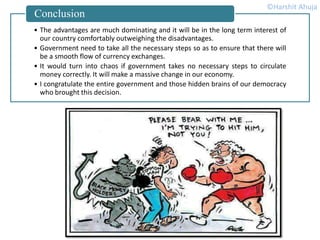
• The advantages are much dominating and it will be in the long term interest of
our country comfortably outweighing the disadvantages.
• Government need to take all the necessary steps so as to ensure that there will
be a smooth flow of currency exchanges.
• It would turn into chaos if government takes no necessary steps to circulate
money correctly. It will make a massive change in our economy.
• I congratulate the entire government and those hidden brains of our democracy
who brought this decision.
Conclusion
©Harshit Ahuja

Demonitizaion 2016

  • 1.
    THE LONG RUN? BLACKMONEY IN CURB MENACE OF DEMONITISATION WILL UESTION? BIG #REVOLUTION Indian Currency Q ©Harshit Ahuja
  • 2.
    • Demonetization :The Real Effects • Flashback #DeMo 2016 • Reasons for Demonetization • Percentage share of denominations before Demonetization • Purpose/Need for Demonetization • Pros & Cons of Demonetization • Benefits of Demonetization (Direct & Indirect) • Impact of Demonetization (Short & Long Term) • Effect of Demonetization on Indian Economy • Hidden Facts • Reaction on Social Media • Survey @ Local Circle • Impact on Economy – Sector wise • Through the Glasses of Pessimism • Reality Check (example of effect of demonetization) • Conclusion Overview ©Harshit Ahuja
  • 3.
  • 4.
    • November 8,2016 a day when the Indian Government launched a “surprise attack” / “Surgical strike”/ “Surgery” against black money in the economy. • The Hon’ble Prime Minister of India, in an unscheduled live televised address to the nation on November 8, 2016 at 20:15 Indian Standard Time (IST) declared circulation of all INR 500 and INR 1000 banknotes of the Mahatma Gandhi Series as invalid with immediate effect. • Issuance of new INR 500 and INR 2000 banknotes of the Mahatma Gandhi New Series in exchange for the old banknotes was announced. • With the exchange of new denomination notes of INR 2000 and not INR 1000, the conversion of black money would be curbed. • Demonetization has been done in an effort to: • – stop counterfeiting of the current banknotes allegedly used for funding terrorism • – crack down on black money in the country. FlashBack #DeMO 2016 ©Harshit Ahuja
  • 5.
    Background Similar demonetization hasbeen done in the past. In India, it has been done: • In January 1946, wherein banknotes of INR 1000 and INR 10000 were withdrawn • In January 1978 wherein banknotes of INR 1000, INR 5000 and INR 10000 were demonetized. In 2012 the Central Board of Direct Taxes (CBDT) had recommended against demonetization, considering demonetization not to be a solution for tackling black money or economy, which is largely held in the form of benami properties, bullion and jewelry. Difference with respect to demonetization in 2016 with that of earlier once obviously is the size. Previous ones barely impacted common people but this one is huge with 85 percent of currency out of the system. Some of the countries have met the purposes and whereas have failed. ©Harshit Ahuja
  • 6.
    Background In 1996, Australiabecame the first country to have a full series of circulating polymer bank notes after replacing all paper-based notes. Demonetization has been embraced in the past by several other countries. They include: Country Year Denomination United States 1969 $10,000 and $1,000 Ghana 1982 50 cedis Zimbabwe 2010 One hundred trillion dollar Myanmar 1987 25-, 35-, and 75-kyat notes Australia 1996 Full series of polymer bank notes ©Harshit Ahuja
  • 7.
    Percentage share ofDenominations Pre - Demonetization 0% 2%1%1% 9% 49% 38% Denominations INR 2 & 5 INR 10 INR 20 INR 50 INR 100 INR 500 INR 1000 Source : Annual Report Reserve Bank of India ©Harshit Ahuja
  • 8.
    High denomination notesare known to facilitate generation/ circulation of black money. Total number of bank notes in circulation rose by 40 percent between 2011 and 2016. Increase in number of notes of INR 500 denomination was 76 percent and for INR 1,000 denomination was 109 percent during this period. Infusion of new series bank notes will be monitored and regulated by RBI. The World Bank in July, 2010 estimated the size of the shadow economy for India at 20.7 percent of the GDP in 1999 and rising to 23.2 percent in 2007. • Inflation adversely affects the poor and the middle classes. • Depriving the Government of its legitimate revenues. • Forged cash used to fund terrorist activities against India. A parallel shadow economy corrodes and eats into the vitals of the country's economy resulting in: • PURPOSE/ NEED FOR DEMONETISATION ©Harshit Ahuja
  • 9.
    Curb financing ofterrorism through the proceeds of Fake Indian Currency Notes (FICN). Curb the use of FICN funds for subversive activities such as espionage, smuggling of arms, drugs and other contrabands into India. For eliminating Black Money which casts a long shadow of parallel economy on our real economy. Accordingly, steps have been taken to demonetize the high denomination notes and help to: PURPOSE OF DEMONETISATION ©Harshit Ahuja
  • 10.
    Pros Help to eradicateblack money, corruption to some extent. Due to lack of funding there will be no arms smuggling and all the terrorist activities will also be choked. Financial Intelligence Unit will track all details of the transactions from the banks. Real estate industry is totally corrupted and now by this stringent decision the real estate sector will bring in more transparency. By doing it in this way we will have more credibility, making it more attractive to the foreign investors as well as domestic investors. Cons It will cause great inconvenience to common man who will start running to bank to exchange Rs.500 and Rs.1000 notes. By replacing all the Rs.500 and Rs.1000 denomination notes, as ordered by the government, could cost the RBI at least Rs.12000 crore. It will be very difficult for half of the population who are not well versed with the card transactions. The major problem is that big fishes will be left out whose black money is in the form of foreign currency, gold and property and stashed in tax havens. Demonetization ©Harshit Ahuja
  • 11.
    DirectImpact Fake currency -Out of circulation in one stroke. Hawala Sources Dried Up - Funding stops to Terrorists, Naxalites and underworld. Real estate prices dip to be seen in the long run. Reduction in inflation. Reduction in Fiscal Deficit. Reduction in lending rates. Increase in GDP. • Demonetization of high denomination notes would have leap in long term benefits which could be classified as direct and indirect impact in the economy. Major Benefits ©Harshit Ahuja
  • 12.
    • Direct Impact MajorBenefits Black Money At one stroke the Prime Minister has choked the supply of black money stacked inside the country. Of the Rs 17 lakh crore of total currency in circulation in the country, black money is estimated at mind-boggling Rs 3 lakh crore. Black money is nothing but a plunder of the nation. Black money operators run a parallel economy which shakes the very foundation of the Indian economy. With Modi’s demonetisation move, all domestic black money will either be deposited into the banks with heavy penalty or be simply destroyed. Economy Demonetisation will have a huge resultant effect on the Indian economy. The clean-up of illegal cash will help turn around the economy. First, it will bring more borrowings to the exchequer, improve inflation outlook and increase India’s gross domestic product (GDP). Second, it will revive investment opportunities and give a fillip to infrastructure and the manufacturing sector. Third, it will help reduce interest rates and lower income tax rate. ©Harshit Ahuja
  • 13.
    • Direct Impact MajorBenefits Note Bank Politics In the run up to the crucial assembly elections in Uttar Pradesh, Punjab, Goa and Uttarakhand, Prime Minister Modi’s demonetisation announcement has come as a shock and awe for the political parties and politicians for whom black money is a lifeline. The pulling out of the old Rs 500 and Rs 1,000 currency notes will help make the election process clean and transparent. But it has brought tough times for the political parties and politicians who believe in the idea of purchasing votes in exchange for notes. Easy Loans Loans will become easier and interest rates may come down. As banks will have more money so more loans will be given out which will increase the money supply in the market and it will create inflation. ©Harshit Ahuja
  • 14.
    • Direct Impact MajorBenefits Real Estate Cleansing It is said that real estate is an industry built on black money. The extent of black money floating around in the sector is huge. According to an estimate at least 40 per cent of real estate transactions in Delhi-NCR are in black. Modi’s demonetisation move will curtail the flow of black money into the real estate sector. This will help in making the much needed correction in the sector. The impact: An unexpected dip in land and property prices. Hawala Transactions Demonetisation has crippled the hawala rackets. Hawala is a method of transferring money without any actual money movement. Hawala route is used as a means to facilitate money laundering and terror financing. Hawala rackets run again on black money. With black money suddenly being wiped out of the market, thanks to demonetisation, hawala operations have come to a grinding halt. According to an India Today report, one of the hawala operators in Mumbai has destroyed currency notes worth about Rs 500 crores. ©Harshit Ahuja
  • 15.
    • Direct Impact MajorBenefits Counterfeit Currency Demonetisation has dealt a death blow to the counterfeit Indian currency syndicate operating both inside and outside the country. Counterfeit currency seriously devalues the real worth of Indian currency. A study conducted by Indian Statistical Institute, Kolkata on behalf of the National Investigation Agency (NIA) suggests that fake Indian currency notes (FICN) amounting to Rs 400 crore are in circulation in the country at any given point of time and around Rs 70 crore fake notes are pumped into Indian economy every year. This is an open secret that Pakistan has been printing fake Indian currency at its government printing press in Quetta and its security press in Karachi. The enemy nation funnels the counterfeit currency through the frontier at Jammu & Kashmir and via India’s porous border with Bangladesh and Nepal. Experts say the new currency notes have come with advanced security features which are almost impossible to replicate. So Pakistan has no option but to shut shops of its fake Indian currency. ©Harshit Ahuja
  • 16.
    • Direct Impact MajorBenefits Terror Financing Terror financing is sourced through counterfeit currency and hawala transactions. This is how terror financing works. Fake currency circulation is routed through a multi- layered network of hawala operators which are closely linked to satta (gambling) and smuggling of drugs, opium and arms. Indirectly, they all end up financing terrorism. With the circulation of counterfeit Indian currency completely stalled and hawala transactions stopped, all windows for terror financing are closed. Inflation It will cause deflation in the market as people who have earned money through illegal ways would be afraid to declare the money as they may be prosecuted by the Income tax department on the legitimacy of their income. Cash Deposits in Banks A lot of cash which are legally earned will be deposited in the banks and now the banks with more deposits will be able to do more lending. ©Harshit Ahuja
  • 17.
    • Direct Impact MajorBenefits Maoism Maoist sympathisers call Modi’s demonetisation move an “undeclared financial emergency”. There are reasons to it. Demonetisation has hit the Maoists and their movement hard. Black money is the oxygen for Maoists. According to an estimate, Maoists manage to raise Rs 300 to Rs 400 crore annually through donations, levy and extortions. The illicit money is used to purchase arms and ammunition, food and medicine and daily essentials, apart from distributing it among the ranks and the cadre. Maoists are in a state of coma and Maoist activities see a crippling blow. Ever since the demonetisation announcement was made, no major violence was reported from the Maoist infested states like Chhattisgarh, Odisha, Andhra Pradesh and Telangana. ©Harshit Ahuja
  • 18.
    • Direct Impact MajorBenefits Reduction in Monetary Circulation This will lead to reduction of money circulation in the economy leading to deflation. Value of money will be increasing which we have because the total money supply will be going down but the commodities and things available in the market have not gone down. It will lead to inflation slowly but not overnight. ©Harshit Ahuja
  • 19.
    Kashmir moved tonormalcy - Blow of insurgency, no more schools being burnt and no stone patters found. Use of Apps and cards - Initial step towards digitization in India with the involvement of small vendors leading to transparency in the system. Gold Stock - Declaration in the stock maintained by the jewelers on a day-to-day basis, which if continued would have control over generation of wealth from black money. Increase in revenue collection by the Government authorities. Simplification in tax policies and reduction in tax rates in the upcoming years. • Indirect Impact Major Benefits ©Harshit Ahuja
  • 20.
    Scarcity of cashdue to demonetization. Sporadic violence wherein people attacked bank premises and ATMs with no major injuries. Large chunk of the population, especially at the bottom of the pyramid and rural population highly impacted due to poor banking facilities and extremely higher dependence on hard currency. Various tribal areas living in isolation and illiteracy have been impacted adversely in the short run. Certain sectors necessitating frequent use of cash on a daily basis including hospitals, households, roadside vendors, domestic workers, cab drivers, doctors, transporters likely to face interim disruptions. Farmers may face financial difficulties to pay daily wages to laborers in smaller denominations and manage other farming expenses. Slowdown in consumer spending due to limited availability of cash IMPACT ANALYSIS Short Term ©Harshit Ahuja
  • 21.
    IMPACT ANALYSIS Long Term Realestate, Jewelry and luxury products. •Downward revaluation. •Indirect reduction in prices of cement and steel. Politics and elections. •Transparency. •Appropriate utilization of central exchequer. Online transactions. •Substantial increase leading to transparency. •Increase in revenue collection by there revenue authorities. ©Harshit Ahuja
  • 22.
    Fear of highcosts associated with tax evasion should lead to higher tax compliances which could lead to reduced overall tax rates by the Government. Reduced interest rates, inflation and strengthening of the currency marginally. Parallel economy to a great extent consolidates with the main economy, as targeted by the demonetization move. Positive bearing on Governments’ fiscal deficit. IMPACT ANALYSIS Long Term ©Harshit Ahuja
  • 23.
  • 24.
  • 25.
  • 26.
    • About 3trillion rupees in the form of old INR 500 and INR 1000 banknotes deposited in the banking system. • 500 billion rupees dispensed via withdrawals from bank accounts, ATMs as well as exchanges over the bank counters. • Spike in the usage of debit card and credit card post demonetization was also reported. Banking • By the second week after demonetization, sale of cigarette witnessed a fall of 30-40 percent. • E-commerce companies saw up to a 30 percent decline in cash on delivery (COD) orders. • E-payment options like PayTM and PayUMoney saw a rise. • Real Estate – Primary transactions may not be impacted, secondary sales may to some extent. Business • IMPACT ON ECONOMY - SECTOR WISE ©Harshit Ahuja
  • 27.
    • Allowability ofuse of INR 500 and INR 1000 notes to pay municipal/ local taxes resulted in increase in revenue collections. Municipal and local taxes • Adverse impact on Input-output channels in agricultural sector. • Sale, transport, marketing and distribution of ready produce to wholesale centres or mandis, adversely impacted. • Disruptions, breaks in the supply chains feedback to farmers as sales fall. • Increased wastage of perishables. • Lower revenues that show up as trade dues instead of cash in hand. Agriculture • IMPACT ON ECONOMY - SECTOR WISE ©Harshit Ahuja
  • 28.
    Short Run Whooping increasein cash deposits at banks and reduction in black money. No affect on stock of black money which had been invested and held in other forms of assets like benami properties in land and real estate, gold, diamonds, precious gems, foreign currency, artifacts, paintings, etc. Increase in the proportion of other assets in which black money is held, with different level of difficulties and challenges to trace the same. Long Run The thought remains unanswered/ un- warranted whether there is any way to prevent the generation of black money again and not re-enter the system? Psychological impact on the society on account of this overnight move would result in reconsidering before indulging into generation of black money. Greater level of scrutiny at various levels and digitization coupled with sharing of information between various departments of the Government would help to keep a check on the parallel economy. Introduction of Goods and Services Tax (GST) to play a key role to keep checks and balances . Overall Impact ©Harshit Ahuja
  • 29.
    • The governmentsays that demonetization is a short term pain and long term gain. Short term pain refers to negative effects which are visible and being felt at present: • RBI in its statement on 13 December has estimated 0.5% downward trend in GDP from 7.6 % to 7.1%. Our GDP is Rs. 125 lakh crore. In quantitative terms there will be reduction of Rs. 62500 crore at 0.5%. • Joblessness has been reported in various sectors of economy such as agriculture, small and medium manufacturing units, unorganized sectors such retail trade, construction, etc. • Loss of revenue in the form of indirect taxes such as excise duty and VAT/CST to the state and central governments following recession in demand. • More than 100 deaths owing to notes ban are a human and social loss. • Loss of productive man hours caused by long lines at banks and ATMs. • If cash crunch and demand recession continue after 30 December, social unrest is likely to begin. Even BJP MPs are worried. THROUGH THE GLASSES OF PESSIMISM ©Harshit Ahuja
  • 30.
    Note ban hitsAndhra hard as revenues down 30% Demonetization has led to a 30 per cent drop in revenues for Andhra Pradesh, Finance Minister Yanamala Ramakrishnudu said, December 21, 2016, but hoped implementation of Goods and Services Tax (GST) might help increase the Government income. Addressing a two-day conference of district Collectors here, Yanamala said people were suffering as they did not have money in hand following the note ban. "People are facing problems. This is a critical period for the Government. Our revenues are affected and are down by 30 per cent. The Central revenues, too, have dropped and consequently it will lead to decrease in devolution of revenue to the State," he elaborated. "We have to take care to sustain the revenues and also growth by ensuring the economic activity is not down.“ said Mr. Yanamala Ramakrishnudu, Finance Minister, Andhra Pradesh. ©Harshit Ahuja
  • 31.
    • The advantagesare much dominating and it will be in the long term interest of our country comfortably outweighing the disadvantages. • Government need to take all the necessary steps so as to ensure that there will be a smooth flow of currency exchanges. • It would turn into chaos if government takes no necessary steps to circulate money correctly. It will make a massive change in our economy. • I congratulate the entire government and those hidden brains of our democracy who brought this decision. Conclusion ©Harshit Ahuja