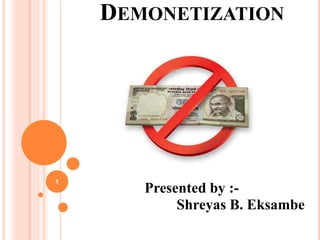
DEMONETIZATION
Presented by :-
Shreyas B. Eksambe
1
INDEX
1. Introduction
2. Definition
3. History
4. Currency Change
5. Major Aim of Demonetization
6. Need for Demonetization
7. Procedure
8. Facts & Figures
9. Gross Domestic Products (GDP)
10. Effects on GDP
11. Reasons Behind the Demonetization
12. Benefits
13. Effects
14. Conclusion
2
INTRODUCTION
 In 2016, the Indian government decided to demonetize
the 500/- and 1000/- rupee notes, the two biggest
denominations in its currency system.
 India's Prime Minister Narendra Modi announced to the
citizenry on 8 November 2016 that those notes were
worthless, effective immediately.
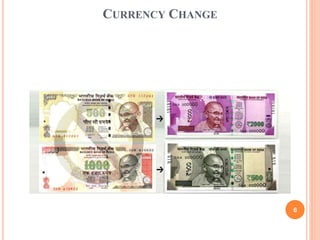
 They had until the end of the year to deposit or exchange
them for newly introduced 2000 rupee and 500 rupee.
3
DEFINITION OF DEMONETIZATION
 Demonetization is the act of stripping a currency unit of
its status as legal tender. It occurs whenever there is a
change of national currency.
 The current forms of money is pulled from circulation
and retired, often to be replaced with new notes or coins.
 Sometimes, a country completely replaces the old
currency with new currency.
4
HISTORY
 1946 -Rs.1000 and Rs. 10,000 notes are banned
i.e. Black Money
 1978-Under the Government headed by “Morarji
Desai” Rs. 1000,Rs. 5000 and Rs.10,000 notes
were demonetized.
5
CURRENCY CHANGE
6
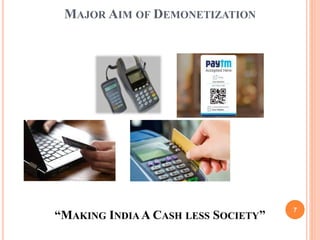
MAJOR AIM OF DEMONETIZATION
7
“MAKING INDIA A CASH LESS SOCIETY”
NEED FOR DEMONETIZATION
 There are multiple reasons why nations demonetize their
local units of currency.
 Some reasons include to combat inflation, to combat
corruption, and to discourage a cash system.
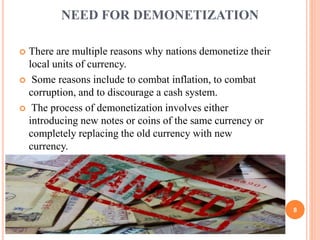
 The process of demonetization involves either
introducing new notes or coins of the same currency or
completely replacing the old currency with new
currency.
8
PROCEDURE
 Televised address
On 8 November 2016, Prime Minister of
India Narendra Modi announced the demonetization in an
unscheduled live televised address to the nation at
20:15 IST.
 Government Ordinance
The Specified Bank Notes Ordinance, 2016 was
issued by the Government of India on 28 December 2016
ceasing the liability of the government for the banned bank
notes.
They also imposing a fine up to 10,000 or five times
the amount of the face value of the bank notes, whichever
is higher, for people transacting with them after 8
November 2016.
9
CONTINUE..
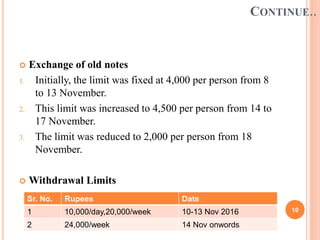
 Exchange of old notes
1. Initially, the limit was fixed at 4,000 per person from 8
to 13 November.
2. This limit was increased to 4,500 per person from 14 to
17 November.
3. The limit was reduced to 2,000 per person from 18
November.
 Withdrawal Limits
10
Sr. No. Rupees Date
1 10,000/day,20,000/week 10-13 Nov 2016
2 24,000/week 14 Nov onwords
FACTS AND FIGURES
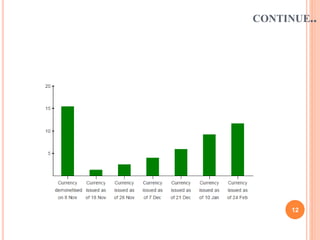
 Total 15.4 Trillion
 Received 14.97 Trillion ($220 Billion)
 9.2 Trillion in the form of 500 and 2000 bank notes of
the Mahatma Gandhi New Series has been recirculated.
 3 Trillion would not return to the banking system.
11
CONTINUE..
12
GROSS DOMESTIC PRODUCT (GDP)
It is a monetary measure of the market value of all
final goods and services produced in a period.
Used to :-
1. Determine the economic performance of a whole
country or region
2. To make international comparisons.
13
EFFECTS ON GDP
 The GDP formation could be impacted by this measure,
with reduction in the consumption demand. 14
CONTINUE..
 However with the recent rise in festival demand is
expected to offset this fall in overall impact.
 Moreover, this expected impact on GDP may not be
significant as some of this demand will only be deferred
and re-enter the stream once the cash situation becomes
normal.
15
REASONS BEHIND THE DEMONETIZATION
 Boost deposit base and savings
 Improve monetary transmission and reduce lending rates
 Create room for further monetary accommodation
 Jan Dhan Yojana
 Support government finances
 Rise in GDP growth potential 16
BENEFITS
o Government track black money.
o A big part of black money was being used for funding terrorism
that are now been stopped.
o A tax revenue used towards the betterment of society
o 100% fake currency out of circulation.
o Many businesses men are declaring black money and paying
their taxes.
o It support government finances.
o Direct boost to the “Jan Dhan Yogna”
17
EFFECTS
o Banking
o Human trafficking
o Cash shortage
o Deaths
o Stock market crash
o Transportation disruption
o Digital transactions 18
THE ANNOUNCEMENT IMMEDIATELY TRIGGERED A MAD
SCRAMBLE
19
CONCLUSION
Government need to take all the necessary steps so as
to ensure that there will be a smooth flow of currency
exchanges.
It will make a massive change in our economy.
We congratulate the entire government and those
hidden brains of our democracy who brought this decision.
20
THANK YOU..!
21

Demonetization

  • 1.
  • 2.
    INDEX 1. Introduction 2. Definition 3.History 4. Currency Change 5. Major Aim of Demonetization 6. Need for Demonetization 7. Procedure 8. Facts & Figures 9. Gross Domestic Products (GDP) 10. Effects on GDP 11. Reasons Behind the Demonetization 12. Benefits 13. Effects 14. Conclusion 2
  • 3.
    INTRODUCTION  In 2016,the Indian government decided to demonetize the 500/- and 1000/- rupee notes, the two biggest denominations in its currency system.  India's Prime Minister Narendra Modi announced to the citizenry on 8 November 2016 that those notes were worthless, effective immediately.  They had until the end of the year to deposit or exchange them for newly introduced 2000 rupee and 500 rupee. 3
  • 4.
    DEFINITION OF DEMONETIZATION Demonetization is the act of stripping a currency unit of its status as legal tender. It occurs whenever there is a change of national currency.  The current forms of money is pulled from circulation and retired, often to be replaced with new notes or coins.  Sometimes, a country completely replaces the old currency with new currency. 4
  • 5.
    HISTORY  1946 -Rs.1000and Rs. 10,000 notes are banned i.e. Black Money  1978-Under the Government headed by “Morarji Desai” Rs. 1000,Rs. 5000 and Rs.10,000 notes were demonetized. 5
  • 6.
  • 7.
    MAJOR AIM OFDEMONETIZATION 7 “MAKING INDIA A CASH LESS SOCIETY”
  • 8.
    NEED FOR DEMONETIZATION There are multiple reasons why nations demonetize their local units of currency.  Some reasons include to combat inflation, to combat corruption, and to discourage a cash system.  The process of demonetization involves either introducing new notes or coins of the same currency or completely replacing the old currency with new currency. 8
  • 9.
    PROCEDURE  Televised address On8 November 2016, Prime Minister of India Narendra Modi announced the demonetization in an unscheduled live televised address to the nation at 20:15 IST.  Government Ordinance The Specified Bank Notes Ordinance, 2016 was issued by the Government of India on 28 December 2016 ceasing the liability of the government for the banned bank notes. They also imposing a fine up to 10,000 or five times the amount of the face value of the bank notes, whichever is higher, for people transacting with them after 8 November 2016. 9
  • 10.
    CONTINUE..  Exchange ofold notes 1. Initially, the limit was fixed at 4,000 per person from 8 to 13 November. 2. This limit was increased to 4,500 per person from 14 to 17 November. 3. The limit was reduced to 2,000 per person from 18 November.  Withdrawal Limits 10 Sr. No. Rupees Date 1 10,000/day,20,000/week 10-13 Nov 2016 2 24,000/week 14 Nov onwords
  • 11.
    FACTS AND FIGURES Total 15.4 Trillion  Received 14.97 Trillion ($220 Billion)  9.2 Trillion in the form of 500 and 2000 bank notes of the Mahatma Gandhi New Series has been recirculated.  3 Trillion would not return to the banking system. 11
  • 12.
  • 13.
    GROSS DOMESTIC PRODUCT(GDP) It is a monetary measure of the market value of all final goods and services produced in a period. Used to :- 1. Determine the economic performance of a whole country or region 2. To make international comparisons. 13
  • 14.
    EFFECTS ON GDP The GDP formation could be impacted by this measure, with reduction in the consumption demand. 14
  • 15.
    CONTINUE..  However withthe recent rise in festival demand is expected to offset this fall in overall impact.  Moreover, this expected impact on GDP may not be significant as some of this demand will only be deferred and re-enter the stream once the cash situation becomes normal. 15
  • 16.
    REASONS BEHIND THEDEMONETIZATION  Boost deposit base and savings  Improve monetary transmission and reduce lending rates  Create room for further monetary accommodation  Jan Dhan Yojana  Support government finances  Rise in GDP growth potential 16
  • 17.
    BENEFITS o Government trackblack money. o A big part of black money was being used for funding terrorism that are now been stopped. o A tax revenue used towards the betterment of society o 100% fake currency out of circulation. o Many businesses men are declaring black money and paying their taxes. o It support government finances. o Direct boost to the “Jan Dhan Yogna” 17
  • 18.
    EFFECTS o Banking o Humantrafficking o Cash shortage o Deaths o Stock market crash o Transportation disruption o Digital transactions 18
  • 19.
    THE ANNOUNCEMENT IMMEDIATELYTRIGGERED A MAD SCRAMBLE 19
  • 20.
    CONCLUSION Government need totake all the necessary steps so as to ensure that there will be a smooth flow of currency exchanges. It will make a massive change in our economy. We congratulate the entire government and those hidden brains of our democracy who brought this decision. 20
  • 21.