DEMONETIZATION
IN INDIA
BY KOMAL HAMBIR
RUCHIRA MOHITE
NIKITA JAIN
MALVIKA RAO
Demonetization is the act of
stripping a currency unit of
its status as legal tender. It
occurs whenever there is a
change of national currency:
The current form or forms of
money is pulled from
circulation and retired, often
to be replaced with new
notes or coins. Sometimes,
a country completely
replaces the old currency
with new currency.
A master stroke by Mr Modi.
A brilliant move that needs
to be supported by every
Indian citizen. It targets to
hit corruption, bribery, cross-
border funded terrorism,
dowry, hoarding money, tax
evasion etc. The main idea
is to provide new currency.
DEMONETIZATION
INTRODUCTION TO
DEMONETIZATION
De
(degrading)
Money (salary
importance)
ti (in the)
zation
(nation).
The vocabulary spirit of DEMONETIZE
is “To rob (a ingot) of its capability as a
financial specification” or “To withdraw
from use as currency”
Demonetization means bring to
terminate the predominance of certain
currencies of an economy whereas
demonetization i.e. replaces currency
with newly designed currencies is done.
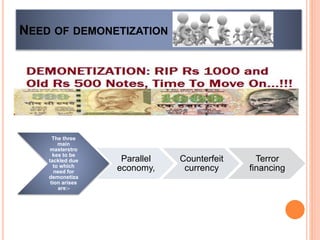
NEED OF DEMONETIZATION
The three
main
masterstro
kes to be
tackled due
to which
need for
demonetiza
tion arises
are:-
Parallel
economy,
Counterfeit
currency
Terror
financing
NEEDS
1) To eradicate all the parallel economy.
2) To lower the cash flow in the country, this is directly related to bribing in our country.
3) To eradicate all the counterfeit currency and doubtful funds which have been used by
trepidation parties to account terrorism in India.
4) To prevent the money laundering activities used to finance terrorist organizations.
TOP 10 BENEFITS OF DEMONETIZATION
1.Loans & Borrowing from Banks and Financial Institutions will become economic.
2. Houses will be reasonably priced and affordable to common man.
3. In Asset Markets
4.Bonds prices to increase in the near future.
5.Real estates and Gold prices are being descending.
6.with drop initially, Equity markets to gain in next six to 12 months.
7.FDI to sky rocket.
8.Fiscal deficit
9.Currency is likely to become stronger, other things being equal.
10. Inflation will move downwards.
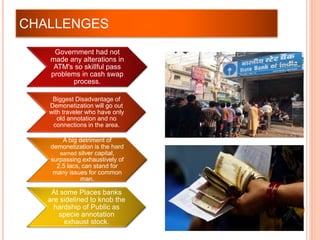
CHALLENGES
Government had not
made any alterations in
ATM's so skillful pass
problems in cash swap
process.
Biggest Disadvantage of
Demonetization will go out
with traveler who have only
old annotation and no
connections in the area.
A big detriment of
demonetization is the hard
earned silver capital,
surpassing exhaustively of
2.5 lacs, can stand for
many issues for common
man.
At some Places banks
are sidelined to knob the
hardship of Public as
specie annotation
exhaust stock.
HISTORY OF DEMONETIZATION
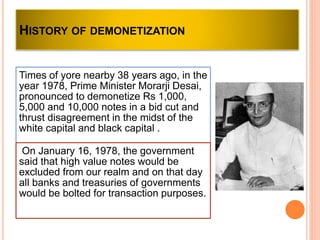
Times of yore nearby 38 years ago, in the
year 1978, Prime Minister Morarji Desai,
pronounced to demonetize Rs 1,000,
5,000 and 10,000 notes in a bid cut and
thrust disagreement in the midst of the
white capital and black capital .
On January 16, 1978, the government
said that high value notes would be
excluded from our realm and on that day
all banks and treasuries of governments
would be bolted for transaction purposes.
The Demonetization Act, 1978,pierced in , which elicited
the high valued currency and revolutionalized the Indian
economy chapter.
This law made that any infringement such as false
statement by investors and others would be indictably
punished — with a one or a three year prison term.
It was also specified that people coming to invest notes in
banks require to fill up forms, and if spotted with large
amount of money, the bank would inform the Information
Technology Department.
Furthermore if the people could not clarify their source of
income, the Information Technology Department would
charge taxes as high as 90 percent.
HISTORY OF DEMONETIZATION
OBJECTIVES OF DEMONETIZATION
1)Removing Black
Money From
Country:
As People Who Are
Having Black Money
Will Now Be Left
With Nothing
Particularly. All The
Cash Which Resides
Below The Pillow,
Will Now Be
useless.
2) Stopping Of
Corruption: By
Removing The
Currency Notes
From Circulation, It
Will Have A Direct
Impact On
Corruption.
3) Stopping Terror
Funds: Because Of
Demonetisation, The
People Or
Organisations Who
Used To Fund Terror
Groups Will Be Now
Sitting Without Any
Works.
5)To Send A Clear Message That This Government Is Well Inclined Towards
Working For The Development Of Nation: -
Because Of His Bold Step, It Will Send A Clear Message That This Government Is Well
Inclined Towards Development Of Nation.
It Will Also Send A Message To The International Community, That The Government Is
Doing Constant Efforts To Make India A Better Place To Invest And A Better Place To Do
Business.
6)Storage of Unaccounted wealth:-
High denomination bank notes were used for storage of unaccounted wealth as
obvious from the large cash retrieval made by law enforcement interventions.
OBJECTIVES OF DEMONETIZATION
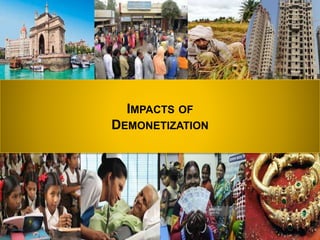
IMPACTS OF
DEMONETIZATION
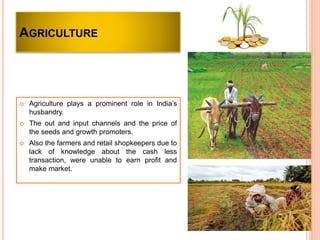
AGRICULTURE
 Agriculture plays a prominent role in India’s
husbandry.
 The out and input channels and the price of
the seeds and growth promoters.
 Also the farmers and retail shopkeepers due to
lack of knowledge about the cash less
transaction, were unable to earn profit and
make market.
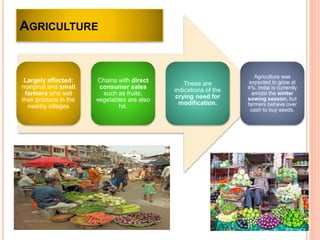
AGRICULTURE
Largely affected:
marginal and small
farmers who sell
their produce in the
nearby villages
Chains with direct
consumer sales
such as fruits,
vegetables are also
hit.
These are
indications of the
crying need for
modification.
Agriculture was
expected to grow at
4%, India is currently
amidst the winter
sowing season, but
farmers behave over
cash to buy seeds.
BANKING
As a large part of cash is moving towards the banking
channels, the banking sector is likely to be flush with the funds
in the coming time which would help them to reduce cost of
finance for such period.
With cash transactions brunt by a reduce in liquidity,
supplementary payment methods, such as e-wallets, online
transactions using E-banking, debit and credit card usage have
enlarged significantly
BANKING
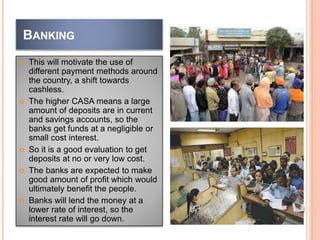
 This will motivate the use of
different payment methods around
the country, a shift towards
cashless.
 The higher CASA means a large
amount of deposits are in current
and savings accounts, so the
banks get funds at a negligible or
small cost interest.
 So it is a good evaluation to get
deposits at no or very low cost.
 The banks are expected to make
good amount of profit which would
ultimately benefit the people.
 Banks will lend the money at a
lower rate of interest, so the
interest rate will go down.
REAL ESTATE
Unofficial funding in
the form of cash
transaction: the land
zone(Land for sale) be
right to be adversely
affected
Reduction in cash
transactions in real
estate.
This is likely to reduce
to real estate prices.
Effects on
infrastructure and
construction sectors,
such as the steel and
cement industries.
Luxury property rates
are therefore predicted
to fall off as a result of
fewer purchasers with
substantial liquidity.
TOURISM
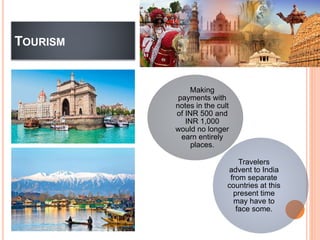
Travelers
advent to India
from separate
countries at this
present time
may have to
face some.
Making
payments with
notes in the cult
of INR 500 and
INR 1,000
would no longer
earn entirely
places.
TOURISM
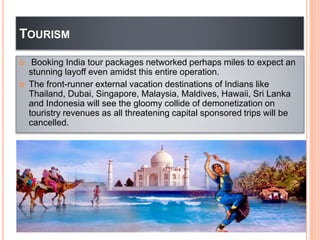
 Booking India tour packages networked perhaps miles to expect an
stunning layoff even amidst this entire operation.
 The front-runner external vacation destinations of Indians like
Thailand, Dubai, Singapore, Malaysia, Maldives, Hawaii, Sri Lanka
and Indonesia will see the gloomy collide of demonetization on
touristry revenues as all threatening capital sponsored trips will be
cancelled.
EDUCATION AND TRAINING
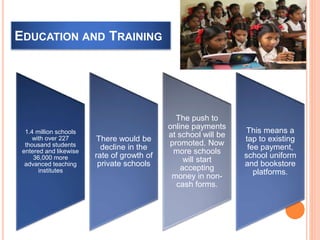
1.4 million schools
with over 227
thousand students
entered and likewise
36,000 more
advanced teaching
institutes
There would be
decline in the
rate of growth of
private schools
The push to
online payments
at school will be
promoted. Now
more schools
will start
accepting
money in non-
cash forms.
This means a
tap to existing
fee payment,
school uniform
and bookstore
platforms.
EDUCATION AND TRAINING
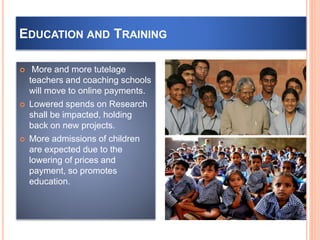
 More and more tutelage
teachers and coaching schools
will move to online payments.
 Lowered spends on Research
shall be impacted, holding
back on new projects.
 More admissions of children
are expected due to the
lowering of prices and
payment, so promotes
education.
HEALTHCARE
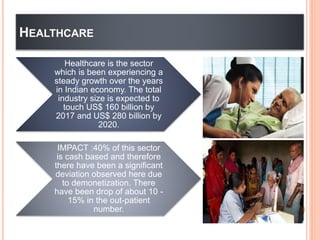
Healthcare is the sector
which is been experiencing a
steady growth over the years
in Indian economy. The total
industry size is expected to
touch US$ 160 billion by
2017 and US$ 280 billion by
2020.
IMPACT :40% of this sector
is cash based and therefore
there have been a significant
deviation observed here due
to demonetization. There
have been drop of about 10 -
15% in the out-patient
number.
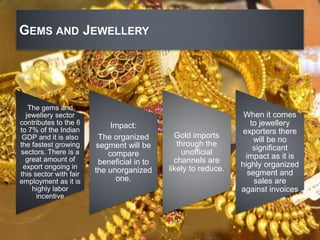
The gems and
jewellery sector
contributes to the 6
to 7% of the Indian
GDP and it is also
the fastest growing
sectors. There is a
great amount of
export ongoing in
this sector with fair
employment as it is
highly labor
incentive
Impact:
The organized
segment will be
compare
beneficial in to
the unorganized
one.
Gold imports
through the
unofficial
channels are
likely to reduce.
When it comes
to jewellery
exporters there
will be no
significant
impact as it is
highly organized
segment and
sales are
against invoices
GEMS AND JEWELLERY
AUTOMOBILE
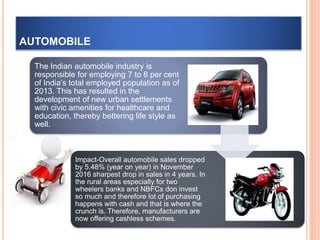
The Indian automobile industry is
responsible for employing 7 to 8 per cent
of India’s total employed population as of
2013. This has resulted in the
development of new urban settlements
with civic amenities for healthcare and
education, thereby bettering life style as
well.
Impact-Overall automobile sales dropped
by 5.48% (year on year) in November
2016 sharpest drop in sales in 4 years. In
the rural areas especially for two
wheelers banks and NBFCs don invest
so much and therefore lot of purchasing
happens with cash and that is where the
crunch is. Therefore, manufacturers are
now offering cashless schemes.
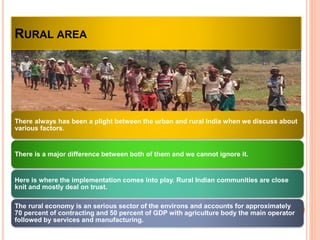
RURAL AREA
There always has been a plight between the urban and rural India when we discuss about
various factors.
There is a major difference between both of them and we cannot ignore it.
Here is where the implementation comes into play. Rural Indian communities are close
knit and mostly deal on trust.
The rural economy is an serious sector of the environs and accounts for approximately
70 percent of contracting and 50 percent of GDP with agriculture body the main operator
followed by services and manufacturing.
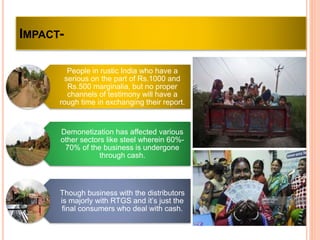
IMPACT-
People in rustic India who have a
serious on the part of Rs.1000 and
Rs.500 marginalia, but no proper
channels of testimony will have a
rough time in exchanging their report.
Demonetization has affected various
other sectors like steel wherein 60%-
70% of the business is undergone
through cash.
Though business with the distributors
is majorly with RTGS and it’s just the
final consumers who deal with cash.
THANK YOU.

Demonetization in India

  • 1.
    DEMONETIZATION IN INDIA BY KOMALHAMBIR RUCHIRA MOHITE NIKITA JAIN MALVIKA RAO
  • 2.
    Demonetization is theact of stripping a currency unit of its status as legal tender. It occurs whenever there is a change of national currency: The current form or forms of money is pulled from circulation and retired, often to be replaced with new notes or coins. Sometimes, a country completely replaces the old currency with new currency. A master stroke by Mr Modi. A brilliant move that needs to be supported by every Indian citizen. It targets to hit corruption, bribery, cross- border funded terrorism, dowry, hoarding money, tax evasion etc. The main idea is to provide new currency. DEMONETIZATION
  • 3.
    INTRODUCTION TO DEMONETIZATION De (degrading) Money (salary importance) ti(in the) zation (nation). The vocabulary spirit of DEMONETIZE is “To rob (a ingot) of its capability as a financial specification” or “To withdraw from use as currency” Demonetization means bring to terminate the predominance of certain currencies of an economy whereas demonetization i.e. replaces currency with newly designed currencies is done.
  • 4.
    NEED OF DEMONETIZATION Thethree main masterstro kes to be tackled due to which need for demonetiza tion arises are:- Parallel economy, Counterfeit currency Terror financing
  • 5.
    NEEDS 1) To eradicateall the parallel economy. 2) To lower the cash flow in the country, this is directly related to bribing in our country. 3) To eradicate all the counterfeit currency and doubtful funds which have been used by trepidation parties to account terrorism in India. 4) To prevent the money laundering activities used to finance terrorist organizations.
  • 6.
    TOP 10 BENEFITSOF DEMONETIZATION 1.Loans & Borrowing from Banks and Financial Institutions will become economic. 2. Houses will be reasonably priced and affordable to common man. 3. In Asset Markets 4.Bonds prices to increase in the near future. 5.Real estates and Gold prices are being descending. 6.with drop initially, Equity markets to gain in next six to 12 months. 7.FDI to sky rocket. 8.Fiscal deficit 9.Currency is likely to become stronger, other things being equal. 10. Inflation will move downwards.
  • 7.
    CHALLENGES Government had not madeany alterations in ATM's so skillful pass problems in cash swap process. Biggest Disadvantage of Demonetization will go out with traveler who have only old annotation and no connections in the area. A big detriment of demonetization is the hard earned silver capital, surpassing exhaustively of 2.5 lacs, can stand for many issues for common man. At some Places banks are sidelined to knob the hardship of Public as specie annotation exhaust stock.
  • 8.
    HISTORY OF DEMONETIZATION Timesof yore nearby 38 years ago, in the year 1978, Prime Minister Morarji Desai, pronounced to demonetize Rs 1,000, 5,000 and 10,000 notes in a bid cut and thrust disagreement in the midst of the white capital and black capital . On January 16, 1978, the government said that high value notes would be excluded from our realm and on that day all banks and treasuries of governments would be bolted for transaction purposes.
  • 9.
    The Demonetization Act,1978,pierced in , which elicited the high valued currency and revolutionalized the Indian economy chapter. This law made that any infringement such as false statement by investors and others would be indictably punished — with a one or a three year prison term. It was also specified that people coming to invest notes in banks require to fill up forms, and if spotted with large amount of money, the bank would inform the Information Technology Department. Furthermore if the people could not clarify their source of income, the Information Technology Department would charge taxes as high as 90 percent. HISTORY OF DEMONETIZATION
  • 10.
    OBJECTIVES OF DEMONETIZATION 1)RemovingBlack Money From Country: As People Who Are Having Black Money Will Now Be Left With Nothing Particularly. All The Cash Which Resides Below The Pillow, Will Now Be useless. 2) Stopping Of Corruption: By Removing The Currency Notes From Circulation, It Will Have A Direct Impact On Corruption. 3) Stopping Terror Funds: Because Of Demonetisation, The People Or Organisations Who Used To Fund Terror Groups Will Be Now Sitting Without Any Works.
  • 11.
    5)To Send AClear Message That This Government Is Well Inclined Towards Working For The Development Of Nation: - Because Of His Bold Step, It Will Send A Clear Message That This Government Is Well Inclined Towards Development Of Nation. It Will Also Send A Message To The International Community, That The Government Is Doing Constant Efforts To Make India A Better Place To Invest And A Better Place To Do Business. 6)Storage of Unaccounted wealth:- High denomination bank notes were used for storage of unaccounted wealth as obvious from the large cash retrieval made by law enforcement interventions. OBJECTIVES OF DEMONETIZATION
  • 12.
  • 13.
    AGRICULTURE  Agriculture playsa prominent role in India’s husbandry.  The out and input channels and the price of the seeds and growth promoters.  Also the farmers and retail shopkeepers due to lack of knowledge about the cash less transaction, were unable to earn profit and make market.
  • 14.
    AGRICULTURE Largely affected: marginal andsmall farmers who sell their produce in the nearby villages Chains with direct consumer sales such as fruits, vegetables are also hit. These are indications of the crying need for modification. Agriculture was expected to grow at 4%, India is currently amidst the winter sowing season, but farmers behave over cash to buy seeds.
  • 15.
    BANKING As a largepart of cash is moving towards the banking channels, the banking sector is likely to be flush with the funds in the coming time which would help them to reduce cost of finance for such period. With cash transactions brunt by a reduce in liquidity, supplementary payment methods, such as e-wallets, online transactions using E-banking, debit and credit card usage have enlarged significantly
  • 16.
    BANKING  This willmotivate the use of different payment methods around the country, a shift towards cashless.  The higher CASA means a large amount of deposits are in current and savings accounts, so the banks get funds at a negligible or small cost interest.  So it is a good evaluation to get deposits at no or very low cost.  The banks are expected to make good amount of profit which would ultimately benefit the people.  Banks will lend the money at a lower rate of interest, so the interest rate will go down.
  • 17.
    REAL ESTATE Unofficial fundingin the form of cash transaction: the land zone(Land for sale) be right to be adversely affected Reduction in cash transactions in real estate. This is likely to reduce to real estate prices. Effects on infrastructure and construction sectors, such as the steel and cement industries. Luxury property rates are therefore predicted to fall off as a result of fewer purchasers with substantial liquidity.
  • 18.
    TOURISM Travelers advent to India fromseparate countries at this present time may have to face some. Making payments with notes in the cult of INR 500 and INR 1,000 would no longer earn entirely places.
  • 19.
    TOURISM  Booking Indiatour packages networked perhaps miles to expect an stunning layoff even amidst this entire operation.  The front-runner external vacation destinations of Indians like Thailand, Dubai, Singapore, Malaysia, Maldives, Hawaii, Sri Lanka and Indonesia will see the gloomy collide of demonetization on touristry revenues as all threatening capital sponsored trips will be cancelled.
  • 20.
    EDUCATION AND TRAINING 1.4million schools with over 227 thousand students entered and likewise 36,000 more advanced teaching institutes There would be decline in the rate of growth of private schools The push to online payments at school will be promoted. Now more schools will start accepting money in non- cash forms. This means a tap to existing fee payment, school uniform and bookstore platforms.
  • 21.
    EDUCATION AND TRAINING More and more tutelage teachers and coaching schools will move to online payments.  Lowered spends on Research shall be impacted, holding back on new projects.  More admissions of children are expected due to the lowering of prices and payment, so promotes education.
  • 22.
    HEALTHCARE Healthcare is thesector which is been experiencing a steady growth over the years in Indian economy. The total industry size is expected to touch US$ 160 billion by 2017 and US$ 280 billion by 2020. IMPACT :40% of this sector is cash based and therefore there have been a significant deviation observed here due to demonetization. There have been drop of about 10 - 15% in the out-patient number.
  • 23.
    The gems and jewellerysector contributes to the 6 to 7% of the Indian GDP and it is also the fastest growing sectors. There is a great amount of export ongoing in this sector with fair employment as it is highly labor incentive Impact: The organized segment will be compare beneficial in to the unorganized one. Gold imports through the unofficial channels are likely to reduce. When it comes to jewellery exporters there will be no significant impact as it is highly organized segment and sales are against invoices GEMS AND JEWELLERY
  • 24.
    AUTOMOBILE The Indian automobileindustry is responsible for employing 7 to 8 per cent of India’s total employed population as of 2013. This has resulted in the development of new urban settlements with civic amenities for healthcare and education, thereby bettering life style as well. Impact-Overall automobile sales dropped by 5.48% (year on year) in November 2016 sharpest drop in sales in 4 years. In the rural areas especially for two wheelers banks and NBFCs don invest so much and therefore lot of purchasing happens with cash and that is where the crunch is. Therefore, manufacturers are now offering cashless schemes.
  • 25.
    RURAL AREA There alwayshas been a plight between the urban and rural India when we discuss about various factors. There is a major difference between both of them and we cannot ignore it. Here is where the implementation comes into play. Rural Indian communities are close knit and mostly deal on trust. The rural economy is an serious sector of the environs and accounts for approximately 70 percent of contracting and 50 percent of GDP with agriculture body the main operator followed by services and manufacturing.
  • 26.
    IMPACT- People in rusticIndia who have a serious on the part of Rs.1000 and Rs.500 marginalia, but no proper channels of testimony will have a rough time in exchanging their report. Demonetization has affected various other sectors like steel wherein 60%- 70% of the business is undergone through cash. Though business with the distributors is majorly with RTGS and it’s just the final consumers who deal with cash.
  • 27.