Jawad ullah UET-12ME-10 SCET, WAH CANTT
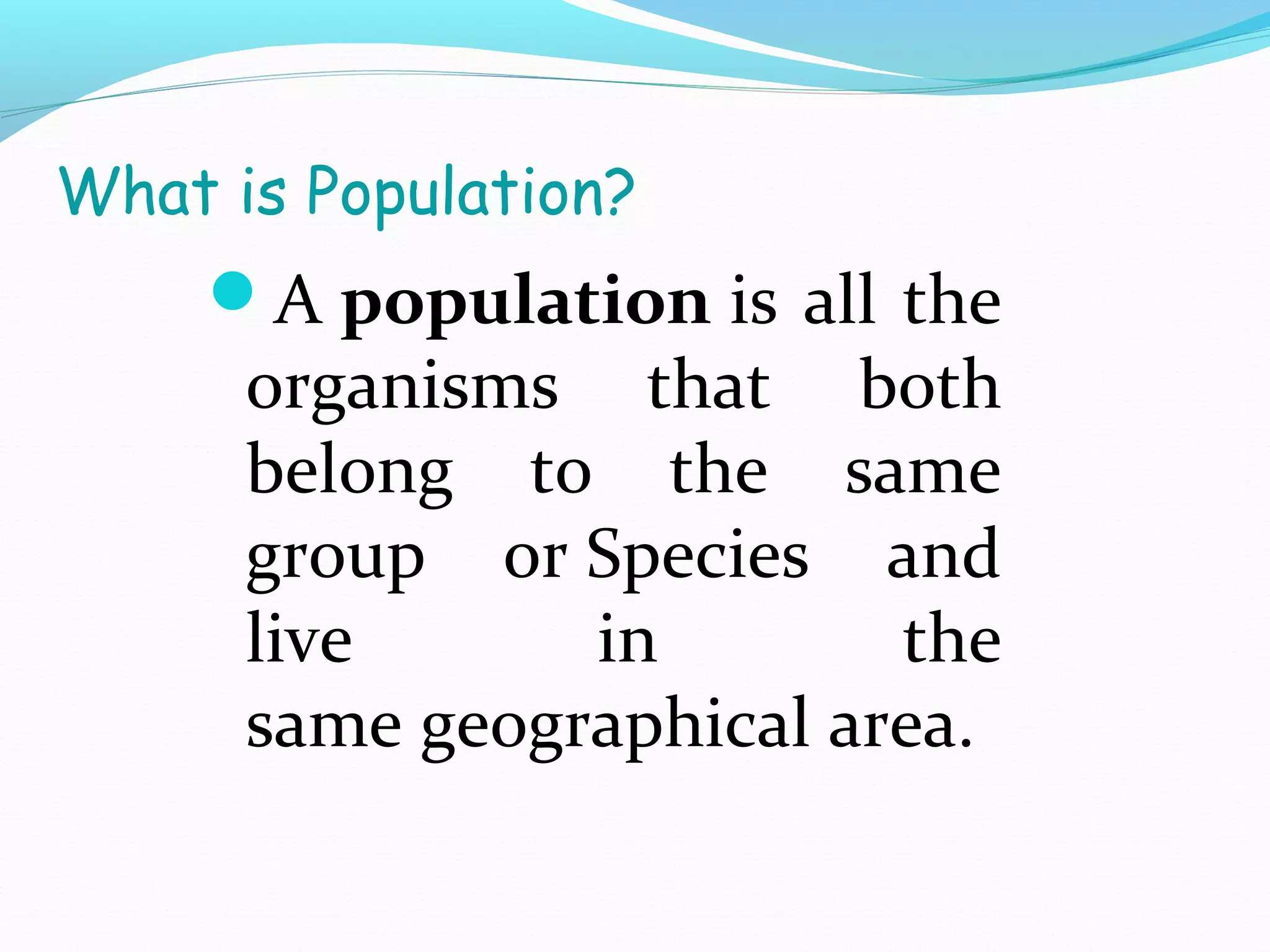
What is Population?
A population is all the
organisms that both
belong to the same
group or Species and
live in the
same geographical area.
What is Demography?
Demography is the study of human
populations (their size, composition and
distribution across place, and the process
through which populations change.
Births, deaths and migration are the ‘big
three’ of demography, jointly producing
population stability or change
Population Of Pakistan
The Population in Pakistan was reported at
184.89 billions person in 2014, according to the
International Monetary Fund (IMF)
During 2015 Pakistan population is estimated to
be increased by 2.982 billions people and
became to 187.831 billions according to
POPULATION CENSUS ORGANIZATION.
In beginning of 2016, Pakistan Population is
expected to be 190.814 billions person.
Population of Pakistan (cont’d)
In general, it has also been found that
where there is rapid population growth
and high fertility rates, poverty incidence
is also highest.
Population dynamics in 2015
According to our estimations, daily change rates of
Pakistan population in 2015 will be the following:
12 767 live births average per day (531.97 in a hour)
3 561 deaths average per day (148.38 in a hour)
-1 034 emigrants average per day (-43.10 in a hour)
Population Causes Over Population
Obstacles
Population Causes Over Population
Obstacles (cont’d)
Dangerous for economic development
Lower per capital income.
Low rate of savings.
Problems for education sector.
Housing problems.
Food shortage
Population and capital formation.
Unemployment.
Population and environment.
Demography Of Pakistan
Nationality
Pakistani
Ethnic groups
Punjabi 44.68%, Pashtun (Pathan) 15.42%, Sindhi
14.1%, Sariaki 8.38%, Muhajirs 7.57%, Balochi
3.57%, other 6.28%
Religions
Muslim 96.4% (Sunni 85-90%, Shia 10-15%), other
(includes Christian and Hindu) 3.6%.
Demography Of Pakistan (cont’d)
 Age structure
• 0-14 years: 33.3% (male 33.59 billions/female 31.79
billions) 
• 15-24 years: 21.5% (male 21.80 billions/female
20.46 billions) 
• 25-54 years: 35.7% (male 36.39 billions/female
33.63 billions) 
• 55-64 years: 5.1% (male 5.008 billions/female 5.04
billions) 
• 65 years and over: 4.3% (male 3.95 billions/female
4.49 billions)
Demography Of Pakistan (cont’d)
Languages
Punjabi 48%,
Sindhi 12%,
Saraiki (a Punjabi variant) 10%,
Pashtu 8%,
Urdu (official) 8%,
Balochi 3%,
Hindko 2%,
Brahui 1%,
English (official), Burushaski, and other 8%
Demography Of Pakistan (cont’d)
Literacy ( the ability to read and write)
definition: age 15 and over can read and write 
total population: 54.9% 
male: 68.6% 
female: 40.3%
Education expenditures
2.7% of GDP (Gross Domestic Product) (2009)
Demography Of Pakistan (cont’d)
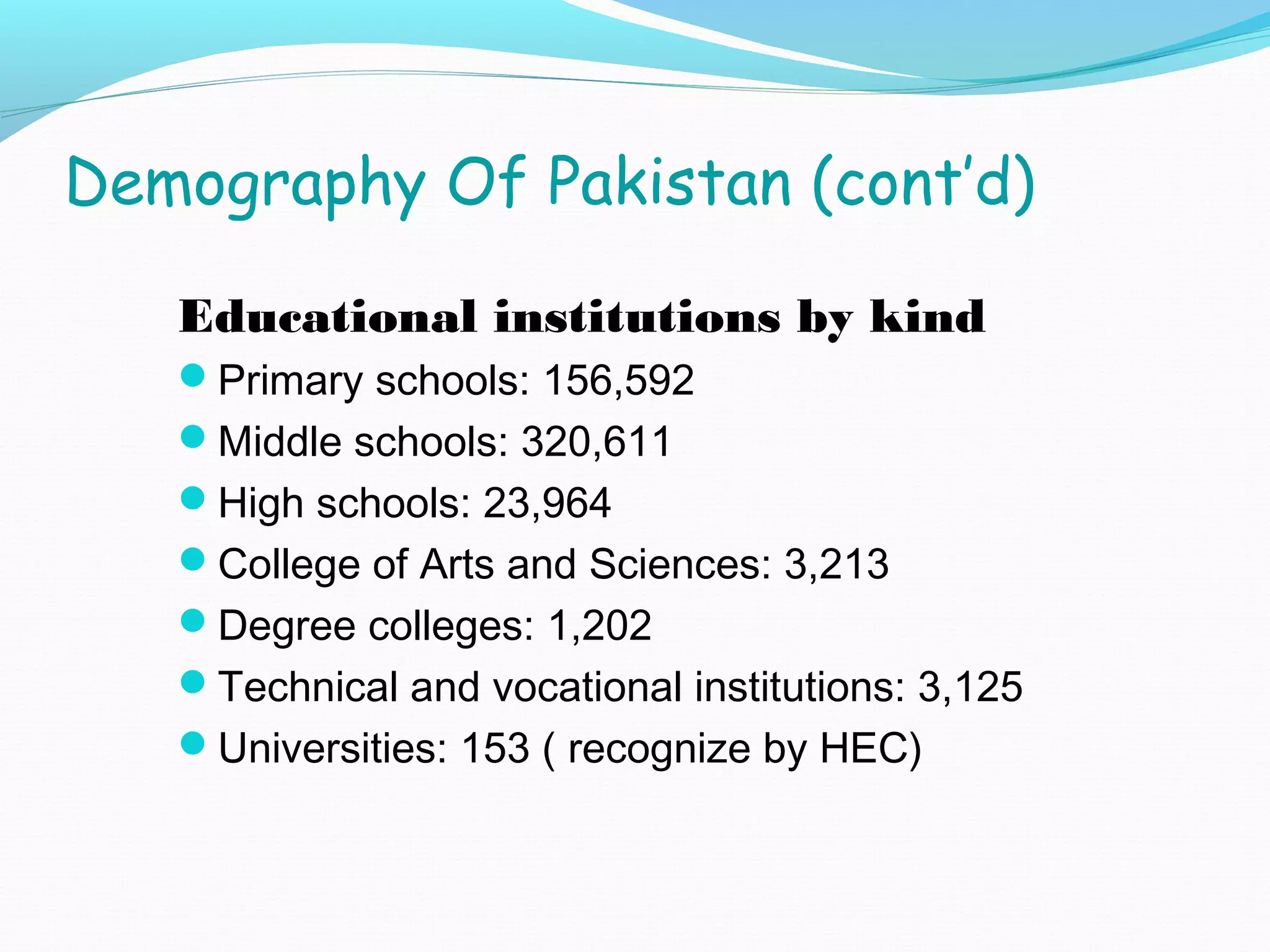
Educational institutions by kind
Primary schools: 156,592
Middle schools: 320,611
High schools: 23,964
College of Arts and Sciences: 3,213
Degree colleges: 1,202
Technical and vocational institutions: 3,125
Universities: 153 ( recognize by HEC)
Demography Of Pakistan (cont’d)
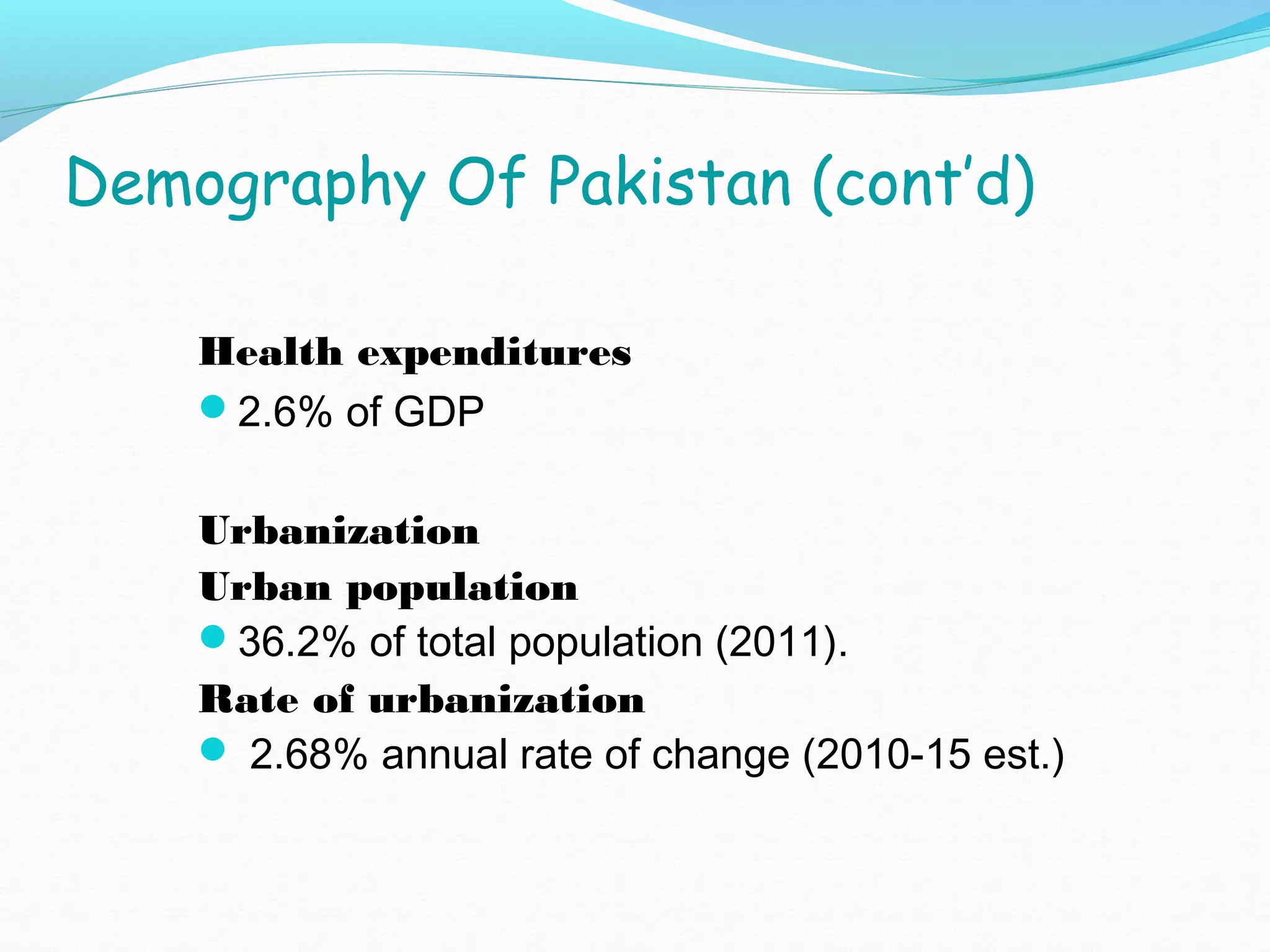
Health expenditures
2.6% of GDP
Urbanization
Urban population
36.2% of total population (2011).
Rate of urbanization
 2.68% annual rate of change (2010-15 est.)
Thank You

Demography &Population of pakistan

  • 2.
    Jawad ullah UET-12ME-10SCET, WAH CANTT
  • 3.
    What is Population? Apopulation is all the organisms that both belong to the same group or Species and live in the same geographical area.
  • 4.
    What is Demography? Demographyis the study of human populations (their size, composition and distribution across place, and the process through which populations change. Births, deaths and migration are the ‘big three’ of demography, jointly producing population stability or change
  • 5.
    Population Of Pakistan ThePopulation in Pakistan was reported at 184.89 billions person in 2014, according to the International Monetary Fund (IMF) During 2015 Pakistan population is estimated to be increased by 2.982 billions people and became to 187.831 billions according to POPULATION CENSUS ORGANIZATION. In beginning of 2016, Pakistan Population is expected to be 190.814 billions person.
  • 6.
    Population of Pakistan(cont’d) In general, it has also been found that where there is rapid population growth and high fertility rates, poverty incidence is also highest.
  • 7.
    Population dynamics in2015 According to our estimations, daily change rates of Pakistan population in 2015 will be the following: 12 767 live births average per day (531.97 in a hour) 3 561 deaths average per day (148.38 in a hour) -1 034 emigrants average per day (-43.10 in a hour)
  • 8.
    Population Causes OverPopulation Obstacles
  • 9.
    Population Causes OverPopulation Obstacles (cont’d) Dangerous for economic development Lower per capital income. Low rate of savings. Problems for education sector. Housing problems. Food shortage Population and capital formation. Unemployment. Population and environment.
  • 10.
    Demography Of Pakistan Nationality Pakistani Ethnicgroups Punjabi 44.68%, Pashtun (Pathan) 15.42%, Sindhi 14.1%, Sariaki 8.38%, Muhajirs 7.57%, Balochi 3.57%, other 6.28% Religions Muslim 96.4% (Sunni 85-90%, Shia 10-15%), other (includes Christian and Hindu) 3.6%.
  • 11.
    Demography Of Pakistan(cont’d)  Age structure • 0-14 years: 33.3% (male 33.59 billions/female 31.79 billions)  • 15-24 years: 21.5% (male 21.80 billions/female 20.46 billions)  • 25-54 years: 35.7% (male 36.39 billions/female 33.63 billions)  • 55-64 years: 5.1% (male 5.008 billions/female 5.04 billions)  • 65 years and over: 4.3% (male 3.95 billions/female 4.49 billions)
  • 12.
    Demography Of Pakistan(cont’d) Languages Punjabi 48%, Sindhi 12%, Saraiki (a Punjabi variant) 10%, Pashtu 8%, Urdu (official) 8%, Balochi 3%, Hindko 2%, Brahui 1%, English (official), Burushaski, and other 8%
  • 13.
    Demography Of Pakistan(cont’d) Literacy ( the ability to read and write) definition: age 15 and over can read and write  total population: 54.9%  male: 68.6%  female: 40.3% Education expenditures 2.7% of GDP (Gross Domestic Product) (2009)
  • 14.
    Demography Of Pakistan(cont’d) Educational institutions by kind Primary schools: 156,592 Middle schools: 320,611 High schools: 23,964 College of Arts and Sciences: 3,213 Degree colleges: 1,202 Technical and vocational institutions: 3,125 Universities: 153 ( recognize by HEC)
  • 15.
    Demography Of Pakistan(cont’d) Health expenditures 2.6% of GDP Urbanization Urban population 36.2% of total population (2011). Rate of urbanization  2.68% annual rate of change (2010-15 est.)
  • 16.