Population and Demography
Irfan Ullah Khattak
Assistant Professor INS-SUIT
Objectives
At the end of this presentation the student will
be able to :
Describe the Demography - study the
population of Pakistan.
 Discuss the Population pyramid
 Analyze the phenomena of Urbanization and
migration
Population
• A population is all the organisms that both
belong to the same group or Species and live
in the same geographical area.
Demography
• Demography is the study of human populations (their size,
composition and distribution across place, and the process
through which populations change.
• Births, deaths and migration are the ‘big three’ dimensions of
demography, jointly producing population stability or change
Population Size and Growth
• Pakistan is the world's fifth-most populous country, with a
population exceeding 240 million as of 2023.
• The country has a high population growth rate of around 2%,
contributing to its large population base.
• The population density is approximately 287 people per
square kilometer, with significant variations between urban
and rural areas.
Characteristics of Demographics
• Age Structure: Pakistan has a young population, with about
60% of the population under the age of 30. The median age is
approximately 22.8 years, indicating a youthful demographic.
• Gender Ratio: The gender ratio is relatively balanced, with
slightly more males than females, around 105 males for every
100 females.
• Fertility Rate: The total fertility rate (TFR) is approximately 3.6
children per woman, though this rate has been gradually
declining.
• Life Expectancy: Life expectancy at birth is about 67 years for
males and 71 years for females.
Characteristics of Demographics
• Ethnic Composition: Pakistan is ethnically diverse, with major
groups including Punjabis, Pashtuns, Sindhis, Saraikis,
Muhajirs, and Baloch. There are also numerous smaller ethnic
groups and communities.
• Religious Composition: Islam is the predominant religion,
practiced by around 96% of the population, with the majority
being Sunni Muslims. Minority religions include Hinduism,
Christianity, and others.
Types of Population Pyramid
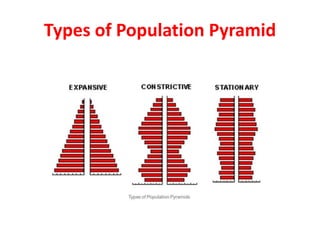
1. Expansive Pyramid
Shape: Broad base and narrow top.
Characteristics:
• High birth rates and high death rates.
• Large proportion of young people (broad base).
• Smaller elderly population (narrow top).
• Typical of developing countries.
Implications:
• High dependency ratio (many dependents relative to the working-age
population).
• Significant need for resources in healthcare, education, and child services.
• Rapid population growth.
Example: Many Sub-Saharan African countries, such as Nigeria.
Type of Population Pyramid
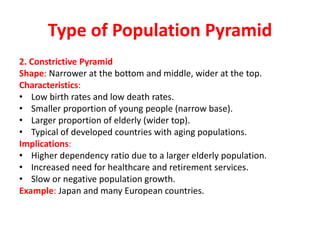
2. Constrictive Pyramid
Shape: Narrower at the bottom and middle, wider at the top.
Characteristics:
• Low birth rates and low death rates.
• Smaller proportion of young people (narrow base).
• Larger proportion of elderly (wider top).
• Typical of developed countries with aging populations.
Implications:
• Higher dependency ratio due to a larger elderly population.
• Increased need for healthcare and retirement services.
• Slow or negative population growth.
Example: Japan and many European countries.
Types of Population Pyramid
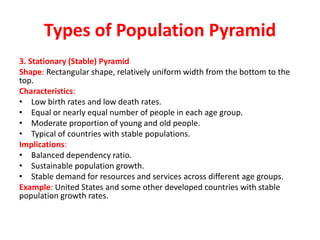
3. Stationary (Stable) Pyramid
Shape: Rectangular shape, relatively uniform width from the bottom to the
top.
Characteristics:
• Low birth rates and low death rates.
• Equal or nearly equal number of people in each age group.
• Moderate proportion of young and old people.
• Typical of countries with stable populations.
Implications:
• Balanced dependency ratio.
• Sustainable population growth.
• Stable demand for resources and services across different age groups.
Example: United States and some other developed countries with stable
population growth rates.
Types of Population Pyramid
Population Pyramid of Pakistan
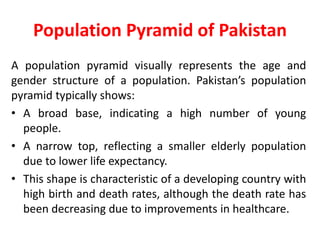
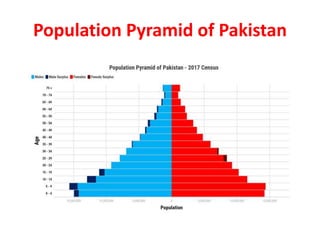
A population pyramid visually represents the age and
gender structure of a population. Pakistan’s population
pyramid typically shows:
• A broad base, indicating a high number of young
people.
• A narrow top, reflecting a smaller elderly population
due to lower life expectancy.
• This shape is characteristic of a developing country with
high birth and death rates, although the death rate has
been decreasing due to improvements in healthcare.
Population Pyramid of Pakistan
• Population pyramids are graphical representations
that show the age and gender distribution of a
population. They are shaped by the birth rates, death
rates, and life expectancy of the population.
• There are three main types of population pyramids,
each reflecting different demographic trends and
stages of development.
Population Pyramid of Pakistan
Demography of Pakistan
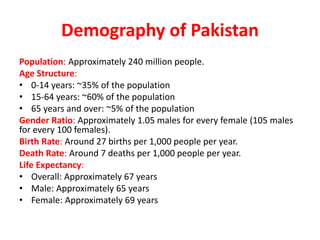
Population: Approximately 240 million people.
Age Structure:
• 0-14 years: ~35% of the population
• 15-64 years: ~60% of the population
• 65 years and over: ~5% of the population
Gender Ratio: Approximately 1.05 males for every female (105 males
for every 100 females).
Birth Rate: Around 27 births per 1,000 people per year.
Death Rate: Around 7 deaths per 1,000 people per year.
Life Expectancy:
• Overall: Approximately 67 years
• Male: Approximately 65 years
• Female: Approximately 69 years
Demography of Pakistan
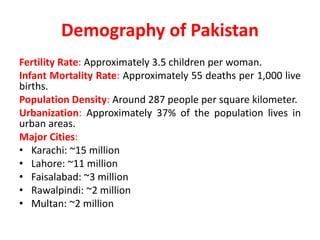
Fertility Rate: Approximately 3.5 children per woman.
Infant Mortality Rate: Approximately 55 deaths per 1,000 live
births.
Population Density: Around 287 people per square kilometer.
Urbanization: Approximately 37% of the population lives in
urban areas.
Major Cities:
• Karachi: ~15 million
• Lahore: ~11 million
• Faisalabad: ~3 million
• Rawalpindi: ~2 million
• Multan: ~2 million
Demography of Pakistan
Ethnic Composition:
• Punjabi: ~44%
• Pashtun (Pathan): ~15%
• Sindhi: ~14%
• Sariaki: ~8%
• Muhajirs: ~7%
• Baloch: ~4%
• Others: ~8%
Religious Composition:
• Muslim: ~96% (Sunni majority, with Shia minority)
• Christian and Hindu: ~4%
Literacy Rate:
• Overall: ~60%
• Male: ~70%
• Female: ~50%
Urbanization and Migration
Urbanization:
• Urbanization refers to the process by which an increasing
percentage of a population lives in cities and urban areas.
Migration:
• Migration is the movement of people from one place to
another, which can be categorized into different types based
on the reasons for moving and the distances.
Urbanization and Migration in
Pakistan
• Pakistan is experiencing rapid urbanization, with urban areas
growing at a faster rate than rural areas.
• As of 2023, about 38% of the population lives in urban areas,
with projections indicating this percentage will increase.
• Major urban centers include Karachi, Lahore, Faisalabad,
Rawalpindi, and Islamabad.
Factors Driving Urbanization
• Economic opportunities in cities: Many people migrate to
urban areas in search of better employment, education, and
healthcare.
• Rural-urban migration: This is a significant contributor to
urban population growth.
• Natural population growth in cities.
Challenges of Urbanization
• Overcrowding: Major cities face issues of congestion and
insufficient infrastructure.
• Housing shortages: There is a lack of affordable housing,
leading to the proliferation of informal settlements or slums.
• Environmental degradation: Urbanization often leads to
pollution and strain on natural resources.
• Infrastructure and service delivery: Cities struggle to provide
adequate water, sanitation, transportation, and health
services to their growing populations.
Migration
• Internal Migration: This includes rural to urban migration and
inter-provincial migration, driven by economic opportunities,
education, and security.
• International Migration: Many Pakistanis migrate abroad for
better economic prospects. Popular destinations include the
Middle East, North America, and Europe.
• Remittances: Overseas Pakistani workers send back significant
remittances, which are crucial for the country's economy.
• Refugees and Displaced Persons: Pakistan has also hosted a
significant number of refugees, particularly from Afghanistan.
Impact of Migration
• Economic Impact: Remittances contribute significantly to
Pakistan’s GDP.
• Social Impact: Migration affects family structures and social
dynamics, with many families depending on remittances from
abroad.
• Demographic Impact: Migration patterns influence the age
and gender distribution in both urban and rural areas.
Thanks

Unit 6. Population and Demographfffy.pptx

  • 1.
    Population and Demography IrfanUllah Khattak Assistant Professor INS-SUIT
  • 2.
    Objectives At the endof this presentation the student will be able to : Describe the Demography - study the population of Pakistan.  Discuss the Population pyramid  Analyze the phenomena of Urbanization and migration
  • 3.
    Population • A populationis all the organisms that both belong to the same group or Species and live in the same geographical area.
  • 4.
    Demography • Demography isthe study of human populations (their size, composition and distribution across place, and the process through which populations change. • Births, deaths and migration are the ‘big three’ dimensions of demography, jointly producing population stability or change
  • 5.
    Population Size andGrowth • Pakistan is the world's fifth-most populous country, with a population exceeding 240 million as of 2023. • The country has a high population growth rate of around 2%, contributing to its large population base. • The population density is approximately 287 people per square kilometer, with significant variations between urban and rural areas.
  • 6.
    Characteristics of Demographics •Age Structure: Pakistan has a young population, with about 60% of the population under the age of 30. The median age is approximately 22.8 years, indicating a youthful demographic. • Gender Ratio: The gender ratio is relatively balanced, with slightly more males than females, around 105 males for every 100 females. • Fertility Rate: The total fertility rate (TFR) is approximately 3.6 children per woman, though this rate has been gradually declining. • Life Expectancy: Life expectancy at birth is about 67 years for males and 71 years for females.
  • 7.
    Characteristics of Demographics •Ethnic Composition: Pakistan is ethnically diverse, with major groups including Punjabis, Pashtuns, Sindhis, Saraikis, Muhajirs, and Baloch. There are also numerous smaller ethnic groups and communities. • Religious Composition: Islam is the predominant religion, practiced by around 96% of the population, with the majority being Sunni Muslims. Minority religions include Hinduism, Christianity, and others.
  • 8.
    Types of PopulationPyramid 1. Expansive Pyramid Shape: Broad base and narrow top. Characteristics: • High birth rates and high death rates. • Large proportion of young people (broad base). • Smaller elderly population (narrow top). • Typical of developing countries. Implications: • High dependency ratio (many dependents relative to the working-age population). • Significant need for resources in healthcare, education, and child services. • Rapid population growth. Example: Many Sub-Saharan African countries, such as Nigeria.
  • 9.
    Type of PopulationPyramid 2. Constrictive Pyramid Shape: Narrower at the bottom and middle, wider at the top. Characteristics: • Low birth rates and low death rates. • Smaller proportion of young people (narrow base). • Larger proportion of elderly (wider top). • Typical of developed countries with aging populations. Implications: • Higher dependency ratio due to a larger elderly population. • Increased need for healthcare and retirement services. • Slow or negative population growth. Example: Japan and many European countries.
  • 10.
    Types of PopulationPyramid 3. Stationary (Stable) Pyramid Shape: Rectangular shape, relatively uniform width from the bottom to the top. Characteristics: • Low birth rates and low death rates. • Equal or nearly equal number of people in each age group. • Moderate proportion of young and old people. • Typical of countries with stable populations. Implications: • Balanced dependency ratio. • Sustainable population growth. • Stable demand for resources and services across different age groups. Example: United States and some other developed countries with stable population growth rates.
  • 11.
  • 12.
    Population Pyramid ofPakistan A population pyramid visually represents the age and gender structure of a population. Pakistan’s population pyramid typically shows: • A broad base, indicating a high number of young people. • A narrow top, reflecting a smaller elderly population due to lower life expectancy. • This shape is characteristic of a developing country with high birth and death rates, although the death rate has been decreasing due to improvements in healthcare.
  • 13.
    Population Pyramid ofPakistan • Population pyramids are graphical representations that show the age and gender distribution of a population. They are shaped by the birth rates, death rates, and life expectancy of the population. • There are three main types of population pyramids, each reflecting different demographic trends and stages of development.
  • 14.
  • 15.
    Demography of Pakistan Population:Approximately 240 million people. Age Structure: • 0-14 years: ~35% of the population • 15-64 years: ~60% of the population • 65 years and over: ~5% of the population Gender Ratio: Approximately 1.05 males for every female (105 males for every 100 females). Birth Rate: Around 27 births per 1,000 people per year. Death Rate: Around 7 deaths per 1,000 people per year. Life Expectancy: • Overall: Approximately 67 years • Male: Approximately 65 years • Female: Approximately 69 years
  • 16.
    Demography of Pakistan FertilityRate: Approximately 3.5 children per woman. Infant Mortality Rate: Approximately 55 deaths per 1,000 live births. Population Density: Around 287 people per square kilometer. Urbanization: Approximately 37% of the population lives in urban areas. Major Cities: • Karachi: ~15 million • Lahore: ~11 million • Faisalabad: ~3 million • Rawalpindi: ~2 million • Multan: ~2 million
  • 17.
    Demography of Pakistan EthnicComposition: • Punjabi: ~44% • Pashtun (Pathan): ~15% • Sindhi: ~14% • Sariaki: ~8% • Muhajirs: ~7% • Baloch: ~4% • Others: ~8% Religious Composition: • Muslim: ~96% (Sunni majority, with Shia minority) • Christian and Hindu: ~4% Literacy Rate: • Overall: ~60% • Male: ~70% • Female: ~50%
  • 18.
    Urbanization and Migration Urbanization: •Urbanization refers to the process by which an increasing percentage of a population lives in cities and urban areas. Migration: • Migration is the movement of people from one place to another, which can be categorized into different types based on the reasons for moving and the distances.
  • 19.
    Urbanization and Migrationin Pakistan • Pakistan is experiencing rapid urbanization, with urban areas growing at a faster rate than rural areas. • As of 2023, about 38% of the population lives in urban areas, with projections indicating this percentage will increase. • Major urban centers include Karachi, Lahore, Faisalabad, Rawalpindi, and Islamabad.
  • 20.
    Factors Driving Urbanization •Economic opportunities in cities: Many people migrate to urban areas in search of better employment, education, and healthcare. • Rural-urban migration: This is a significant contributor to urban population growth. • Natural population growth in cities.
  • 21.
    Challenges of Urbanization •Overcrowding: Major cities face issues of congestion and insufficient infrastructure. • Housing shortages: There is a lack of affordable housing, leading to the proliferation of informal settlements or slums. • Environmental degradation: Urbanization often leads to pollution and strain on natural resources. • Infrastructure and service delivery: Cities struggle to provide adequate water, sanitation, transportation, and health services to their growing populations.
  • 22.
    Migration • Internal Migration:This includes rural to urban migration and inter-provincial migration, driven by economic opportunities, education, and security. • International Migration: Many Pakistanis migrate abroad for better economic prospects. Popular destinations include the Middle East, North America, and Europe. • Remittances: Overseas Pakistani workers send back significant remittances, which are crucial for the country's economy. • Refugees and Displaced Persons: Pakistan has also hosted a significant number of refugees, particularly from Afghanistan.
  • 23.
    Impact of Migration •Economic Impact: Remittances contribute significantly to Pakistan’s GDP. • Social Impact: Migration affects family structures and social dynamics, with many families depending on remittances from abroad. • Demographic Impact: Migration patterns influence the age and gender distribution in both urban and rural areas.
  • 24.