

Democratizing Data
to transform government, business & daily life

Tableau Customer Conference
Seattle


W. David Stephenson
Stephenson Strategies
July 23, 2009


             Christian began the conference by giving you a vision of the future, and I want to send you off with a variation on the same theme, with a preview of the
 book I’m writing, “Democratizing Data to transform government, workplaces, and our lives.”
     Originally I was to co-author the book with Vivek Kundra, Chief Technical Officer of the District of Columbia, and a true trailblazer in this field. However,
fortunately for the US, unfortunately for me, President Obama has chosen Vivek to become the US’s first CIO. You have already seen, in the few months he’s been
on the job, how revolutionary the Obama Administration will be for transparency and access to data, which, I believe, will unleash a global explosion of data access
that will in turn unleash a transformation in every aspect of our lives.
I’m convinced I was chosen by to write this book through some sort of cosmic joke, because I’m the least-likely person to write a book on data. You see, I
suspect that most of you are left-brained, analytical types, while I’m right-brained and intuitive. For me, data used to be good for one thing, and one thing only:
figuring the Red Sox’ batting averages.
     But in reality, that makes me ideally suited to write this book, because it’s time that people like me no longer be disenfranchised when it comes to data.
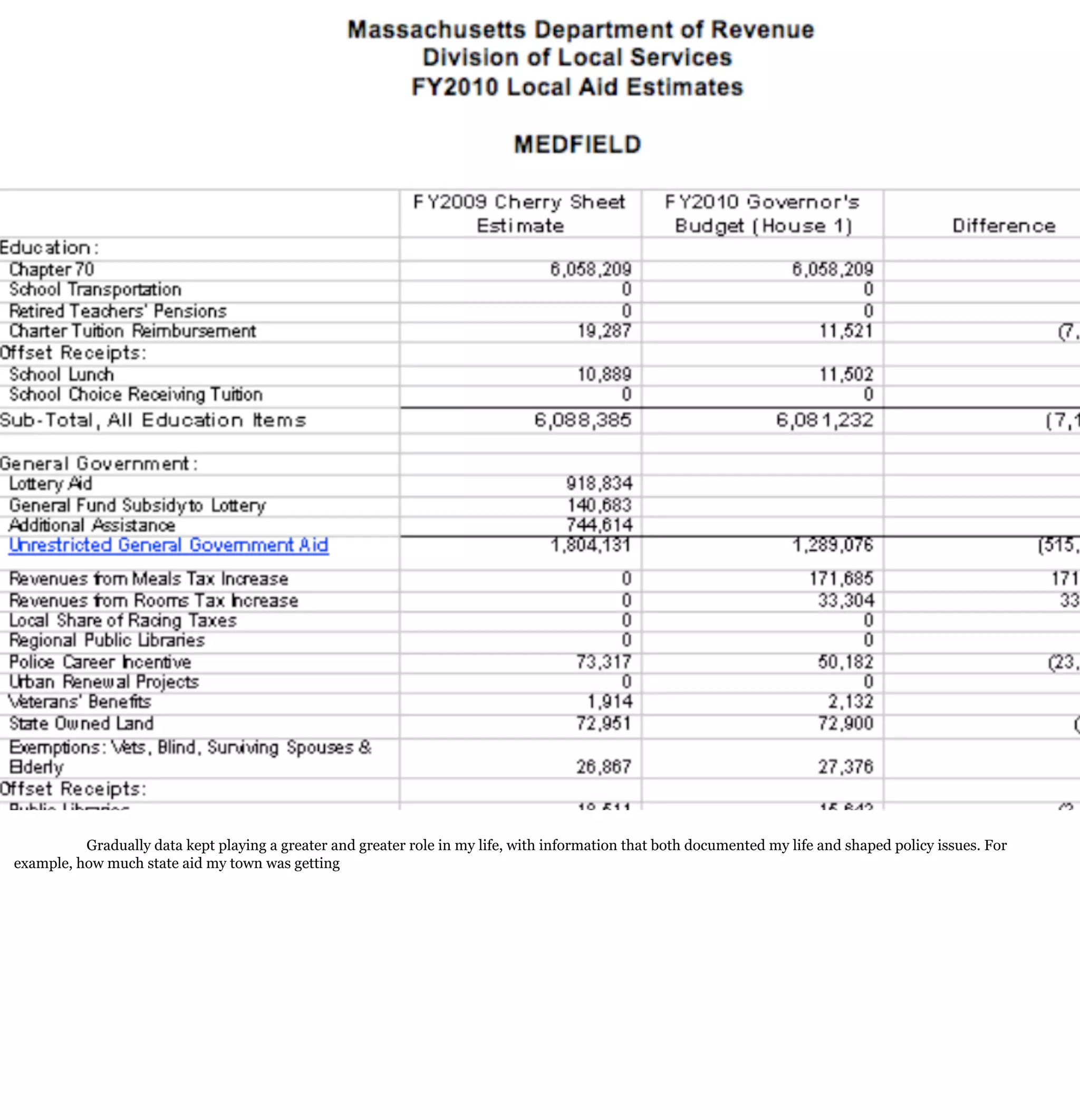
Gradually data kept playing a greater and greater role in my life, with information that both documented my life and shaped policy issues. For
example, how much state aid my town was getting
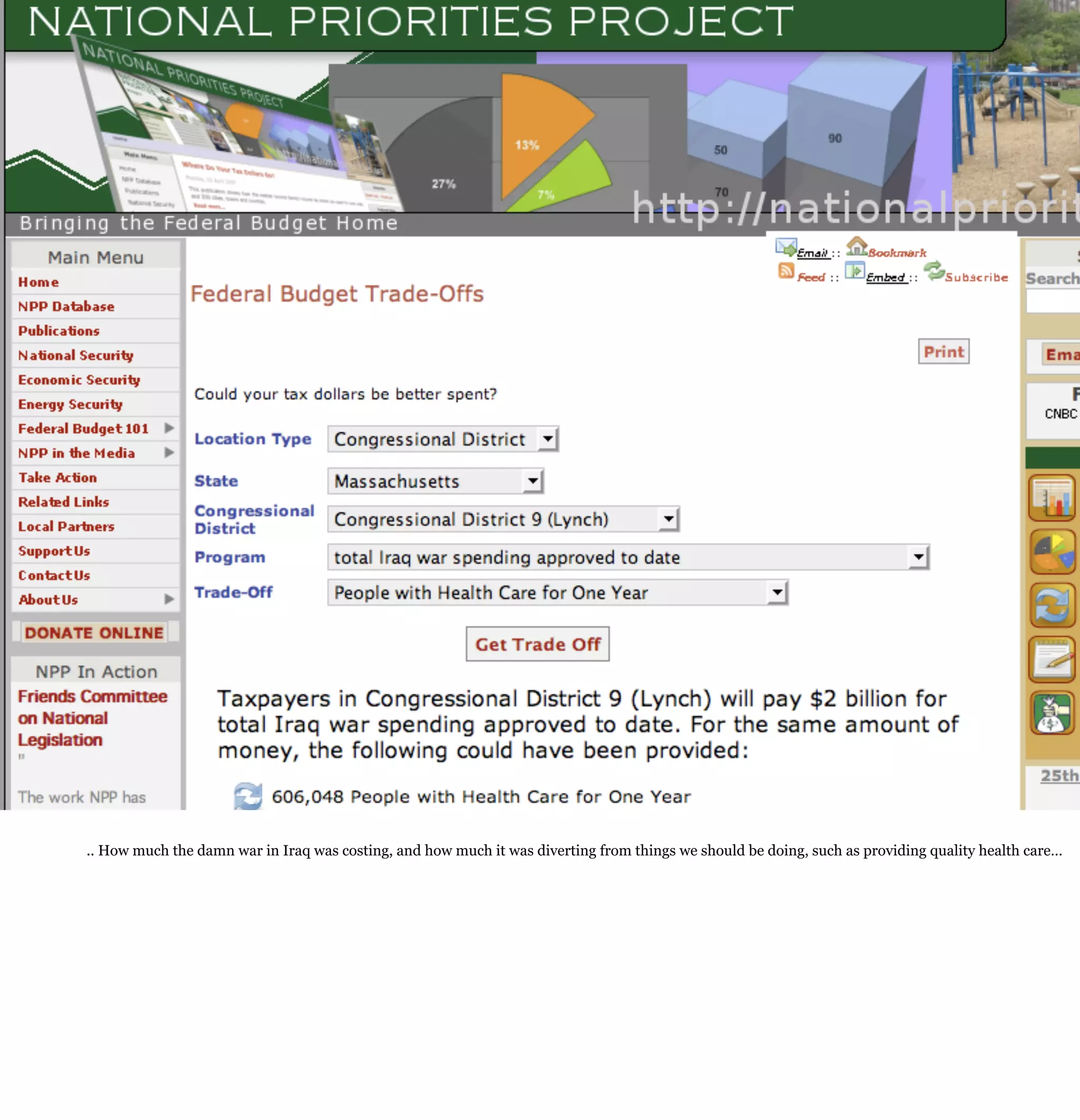
.. How much the damn war in Iraq was costing, and how much it was diverting from things we should be doing, such as providing quality health care…
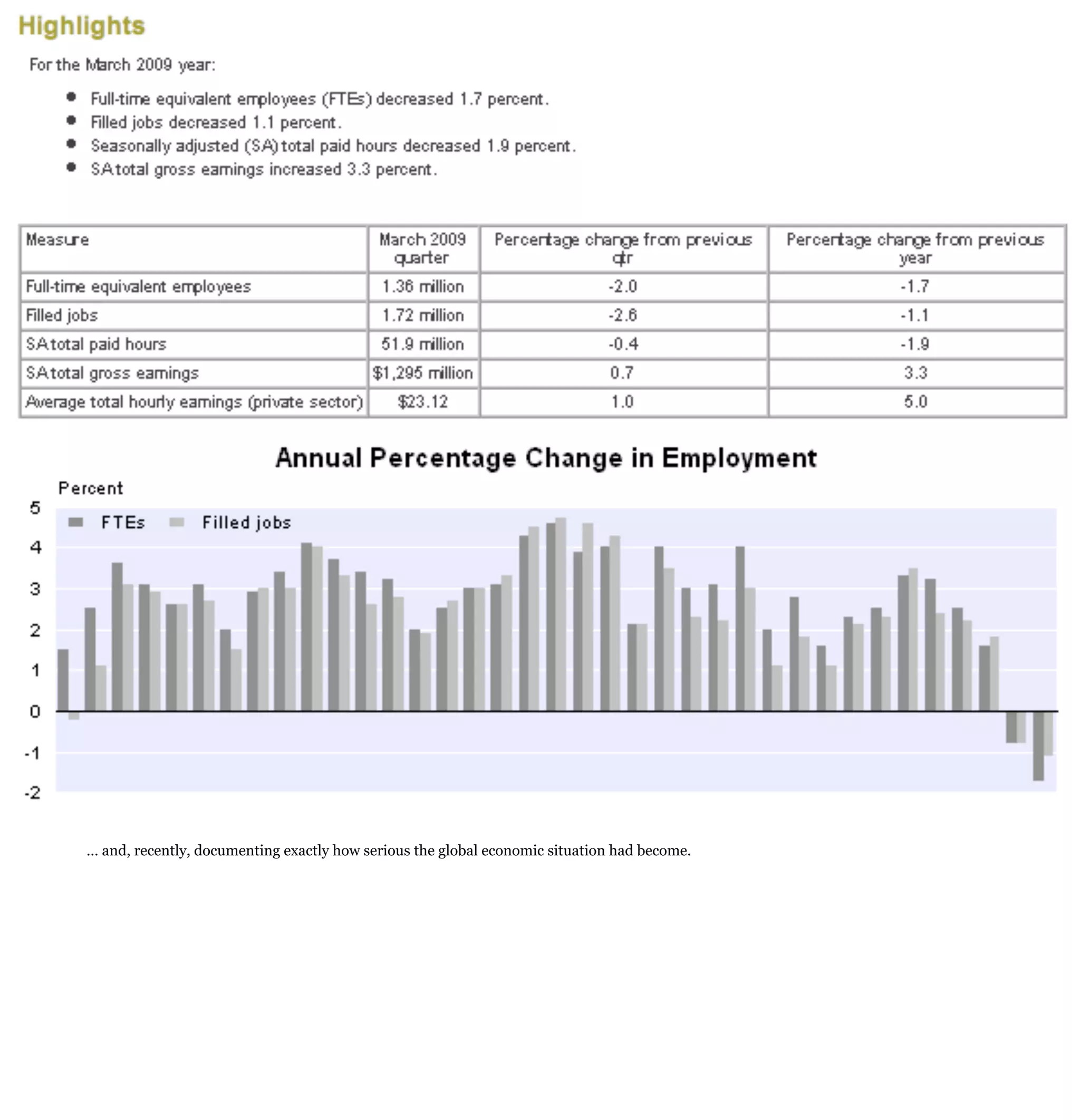
… and, recently, documenting exactly how serious the global economic situation had become.
Democratizing Data:
  How free access will transform our lives

  Ignite Boston
  Feb. 12, 2009

  W. David Stephenson
  Stephenson Strategies


            But when I got interested in data, I found it was pretty hard to get at.
            We pay taxes so government can collect data, and you can bet companies know all about our shopping habits. Our activities and lives are data’s raw
material.
            But once they’re collected, most citizens -- and a lot of employees for that matter -- don’t have a clue where data are stored or how they’re used.
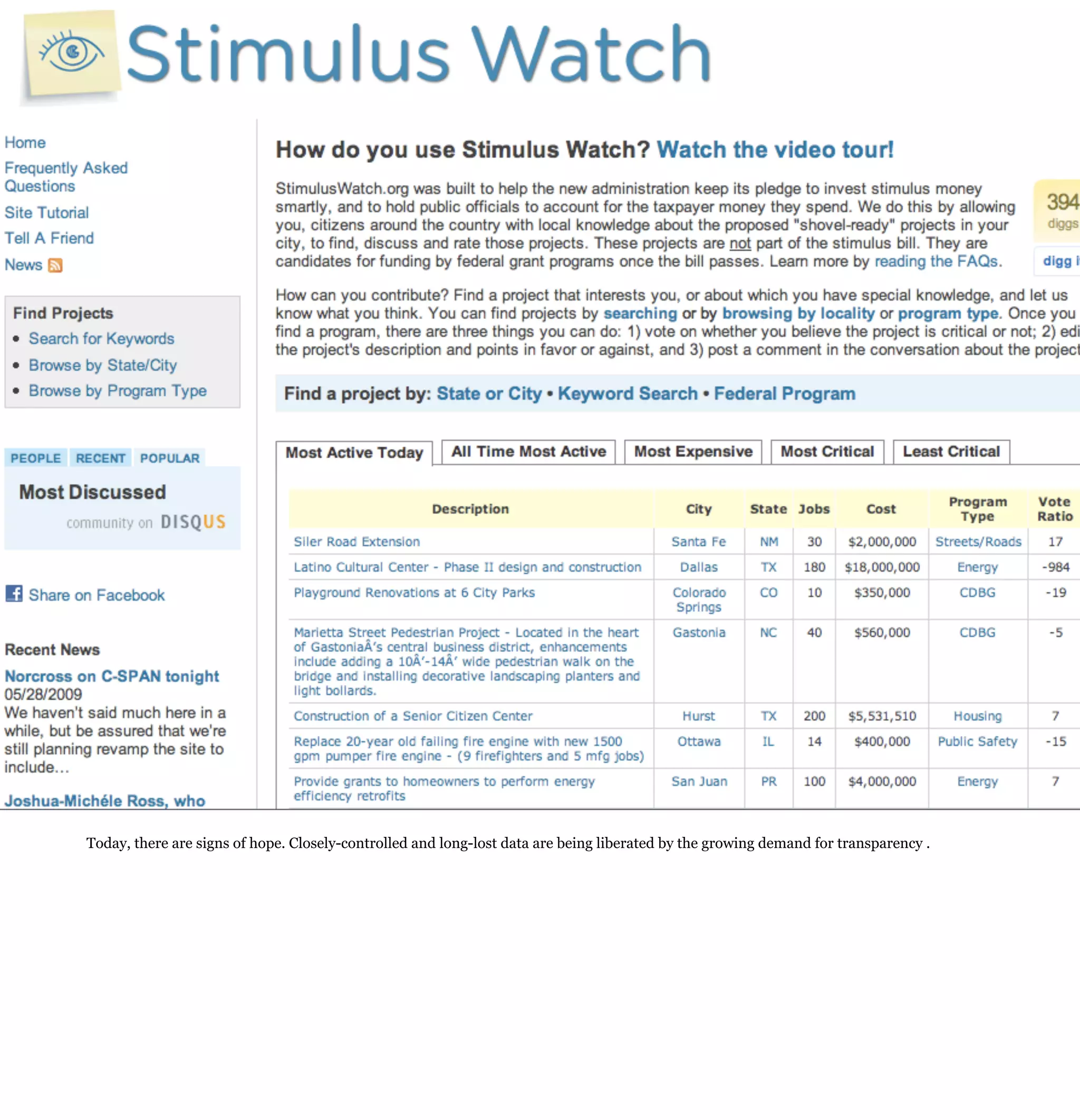
Today, there are signs of hope. Closely-controlled and long-lost data are being liberated by the growing demand for transparency .
Critical for today’s challenges
              •give workforce real-time information
              •automate processes
              •improve government regulation
              •reduce companies’ reporting costs
              •restore public confidence through
              transparency
              •empower the public as full partners

           The time has come to democratize data – making it available, when and where people need it to do their jobs or to improve their lives.
The result will be change and benefits in every aspect of our lives, changes that are particularly critical given the current global challenges and that will improve
our lives:
•give workforces real-time information
•automate previously manual processes, saving time & increasing efficiency
•improve government regulatory processes by making access to reports instantaneous and shareable by all agencies
•reduce corporate regulatory costs
•restore public confidence through transparency
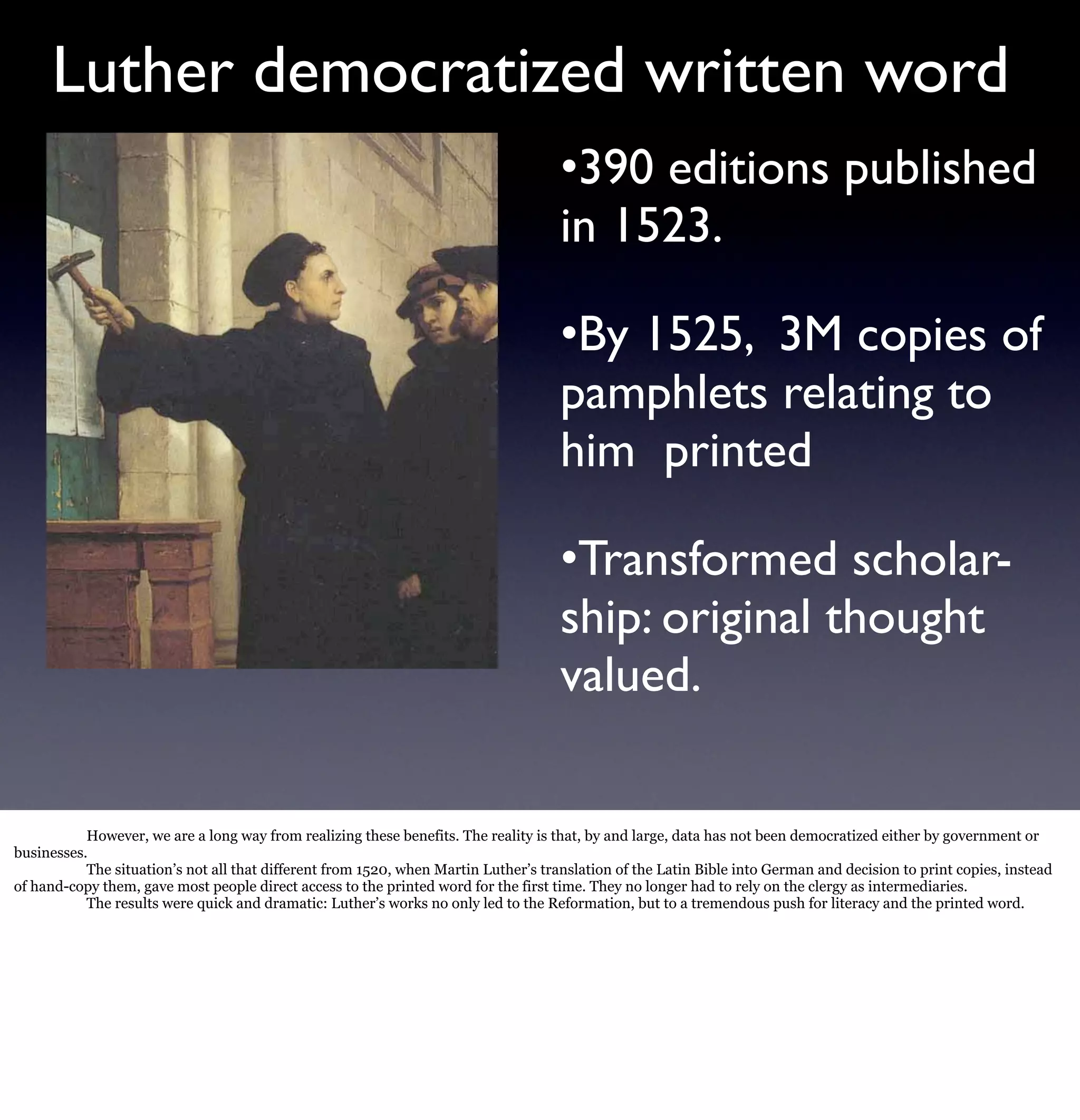
Luther democratized written word
                                                                                     •390 editions published
                                                                                     in 1523.

                                                                                     •By 1525, 3M copies of
                                                                                     pamphlets relating to
                                                                                     him printed

                                                                                     •Transformed scholar-
                                                                                     ship: original thought
                                                                                     valued.

           However, we are a long way from realizing these benefits. The reality is that, by and large, data has not been democratized either by government or
businesses.
           The situation’s not all that different from 1520, when Martin Luther’s translation of the Latin Bible into German and decision to print copies, instead
of hand-copy them, gave most people direct access to the printed word for the first time. They no longer had to rely on the clergy as intermediaries.
           The results were quick and dramatic: Luther’s works no only led to the Reformation, but to a tremendous push for literacy and the printed word.
As the printing press transformed learning and people’s access to the word, so too the Internet, and handful of new web-based tools, none of them radically
innovative by themselves but revolutionary when combined, is making it possible, in many cases for the first time, for workers and the general public to have direct
access to actionable, valuable data. I believe the benefits and revolution will be equally dramatic as what Luther set in motion.
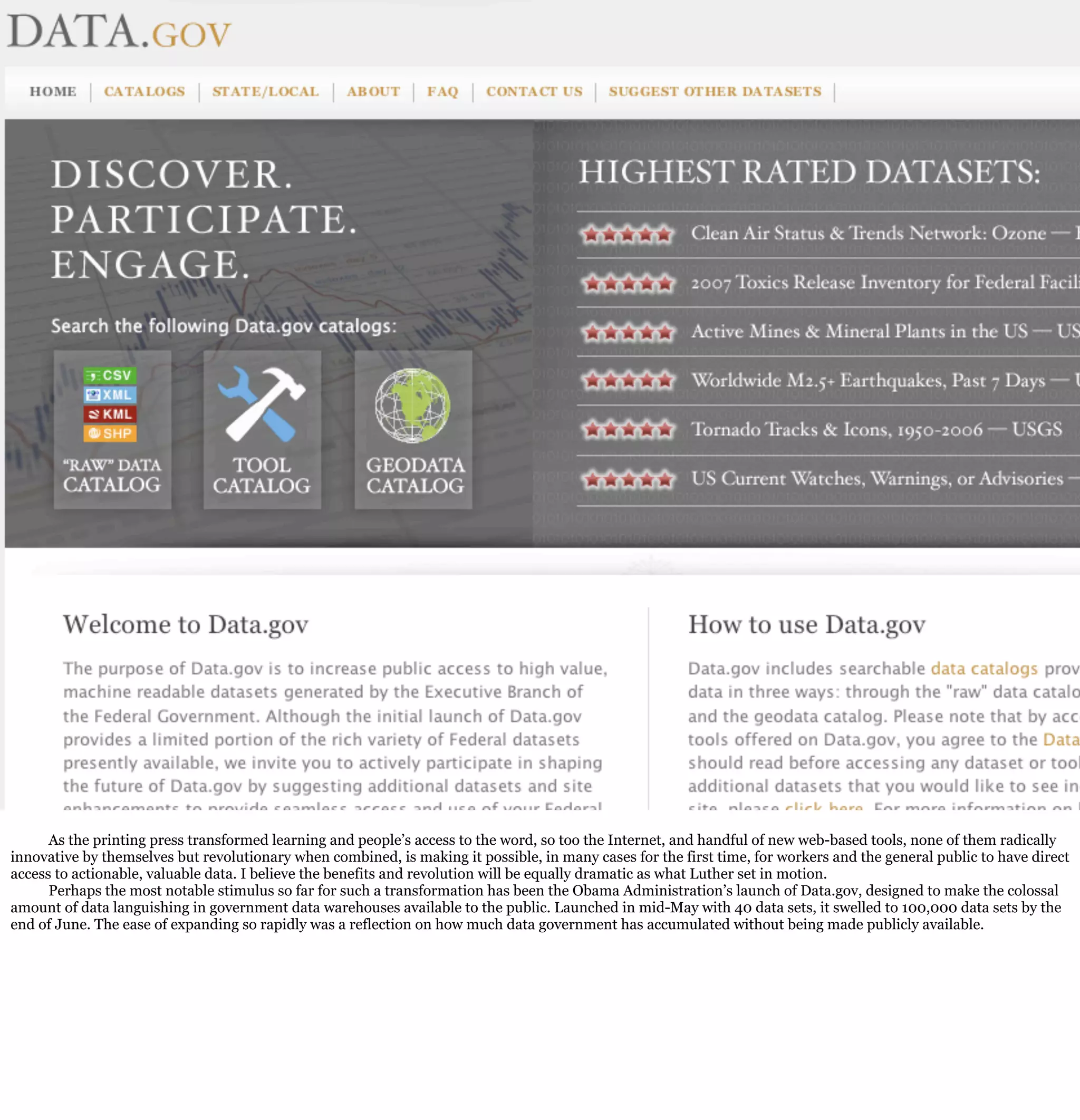
      Perhaps the most notable stimulus so far for such a transformation has been the Obama Administration’s launch of Data.gov, designed to make the colossal
amount of data languishing in government data warehouses available to the public. Launched in mid-May with 40 data sets, it swelled to 100,000 data sets by the
end of June. The ease of expanding so rapidly was a reflection on how much data government has accumulated without being made publicly available.
Democratize data!
             "Democratizing data makes it automatically
         available to those who need it (based on their roles
         and responsibilities), when and where they need it,
          in forms they can use, and with freedom to use as
            they choose -- while simultaneously protecting
                        security and privacy."


           The result of releasing this data will be to democratize it: "Democratizing data makes it automatically available to those who need it (based on their
roles and responsibilities), when and where they need it, in forms they can use, and with freedom to use as they choose -- while simultaneously protecting security
and privacy.": "Democratizing data makes it automatically available to those who need it (based on their roles and responsibilities), when and where they need it,
in forms they can use, and with freedom to use as they choose -- while simultaneously protecting security and privacy."
Data-centric organization
                                                                                                                              Data-centric
                                                                                                                              organization


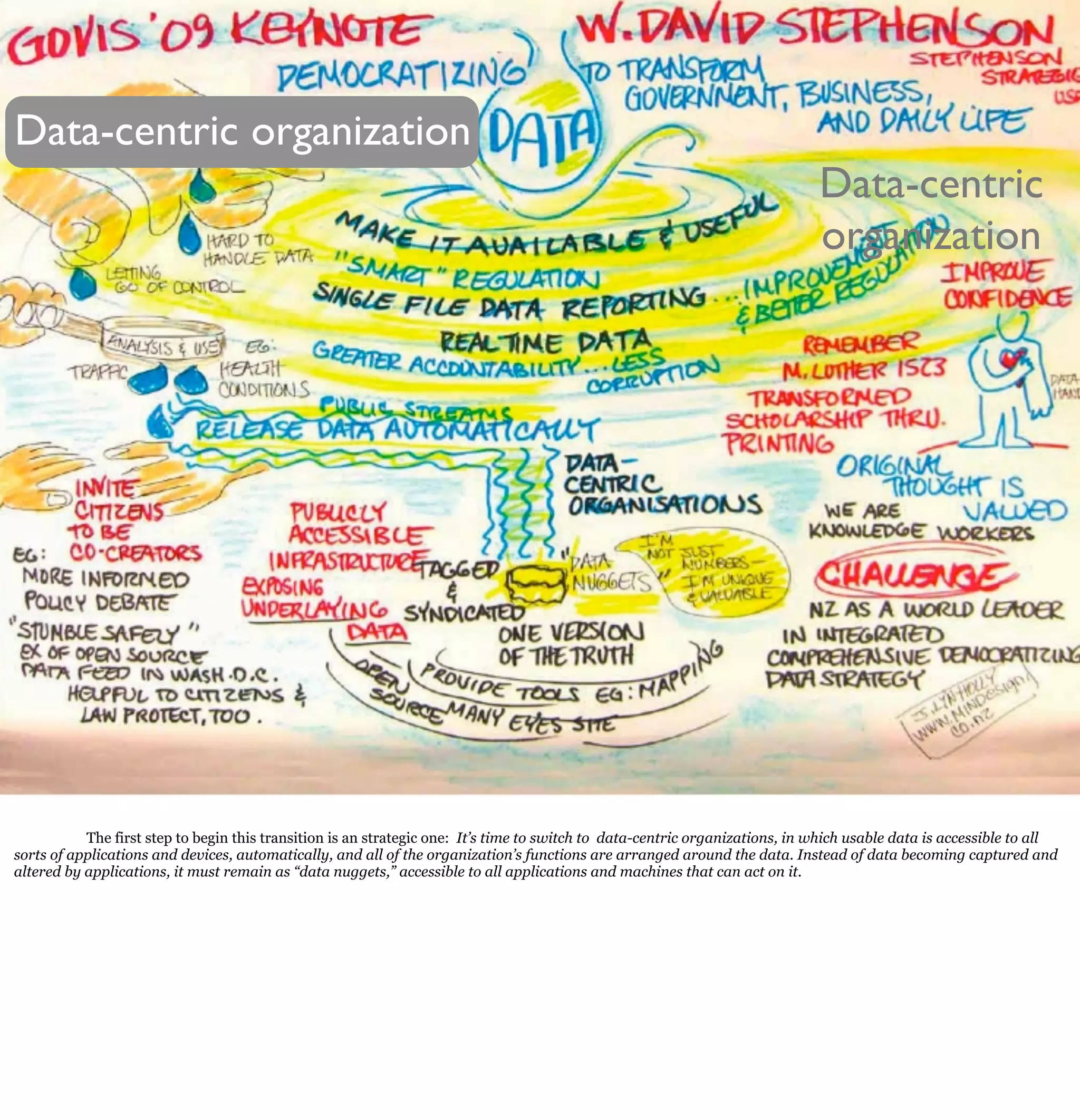
           The first step to begin this transition is an strategic one: It’s time to switch to data-centric organizations, in which usable data is accessible to all
sorts of applications and devices, automatically, and all of the organization’s functions are arranged around the data. Instead of data becoming captured and
altered by applications, it must remain as “data nuggets,” accessible to all applications and machines that can act on it.
tag & syndicate data


   <us-gaap:NetIncomeLoss contextRef="eol_PE11373---0910-
   Q0004_STD_p3m_20080629_0" unitRef="USD"
   decimals="-6">882000000</us-gaap:NetIncomeLoss>


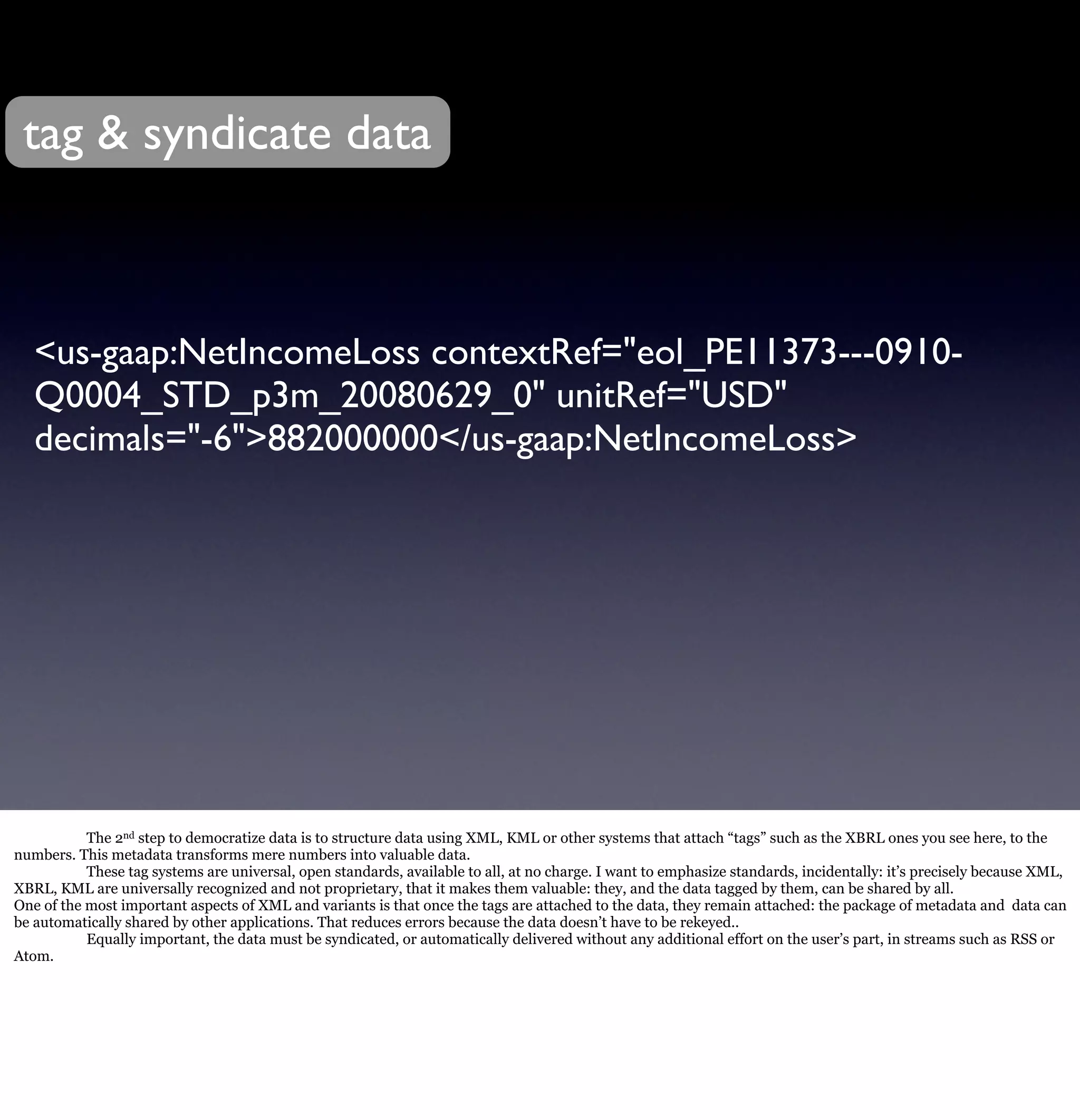
           The 2nd step to democratize data is to structure data using XML, KML or other systems that attach “tags” such as the XBRL ones you see here, to the
numbers. This metadata transforms mere numbers into valuable data.
           These tag systems are universal, open standards, available to all, at no charge. I want to emphasize standards, incidentally: it’s precisely because XML,
XBRL, KML are universally recognized and not proprietary, that it makes them valuable: they, and the data tagged by them, can be shared by all.
One of the most important aspects of XML and variants is that once the tags are attached to the data, they remain attached: the package of metadata and data can
be automatically shared by other applications. That reduces errors because the data doesn’t have to be rekeyed..
           Equally important, the data must be syndicated, or automatically delivered without any additional effort on the user’s part, in streams such as RSS or
Atom.
provide tools


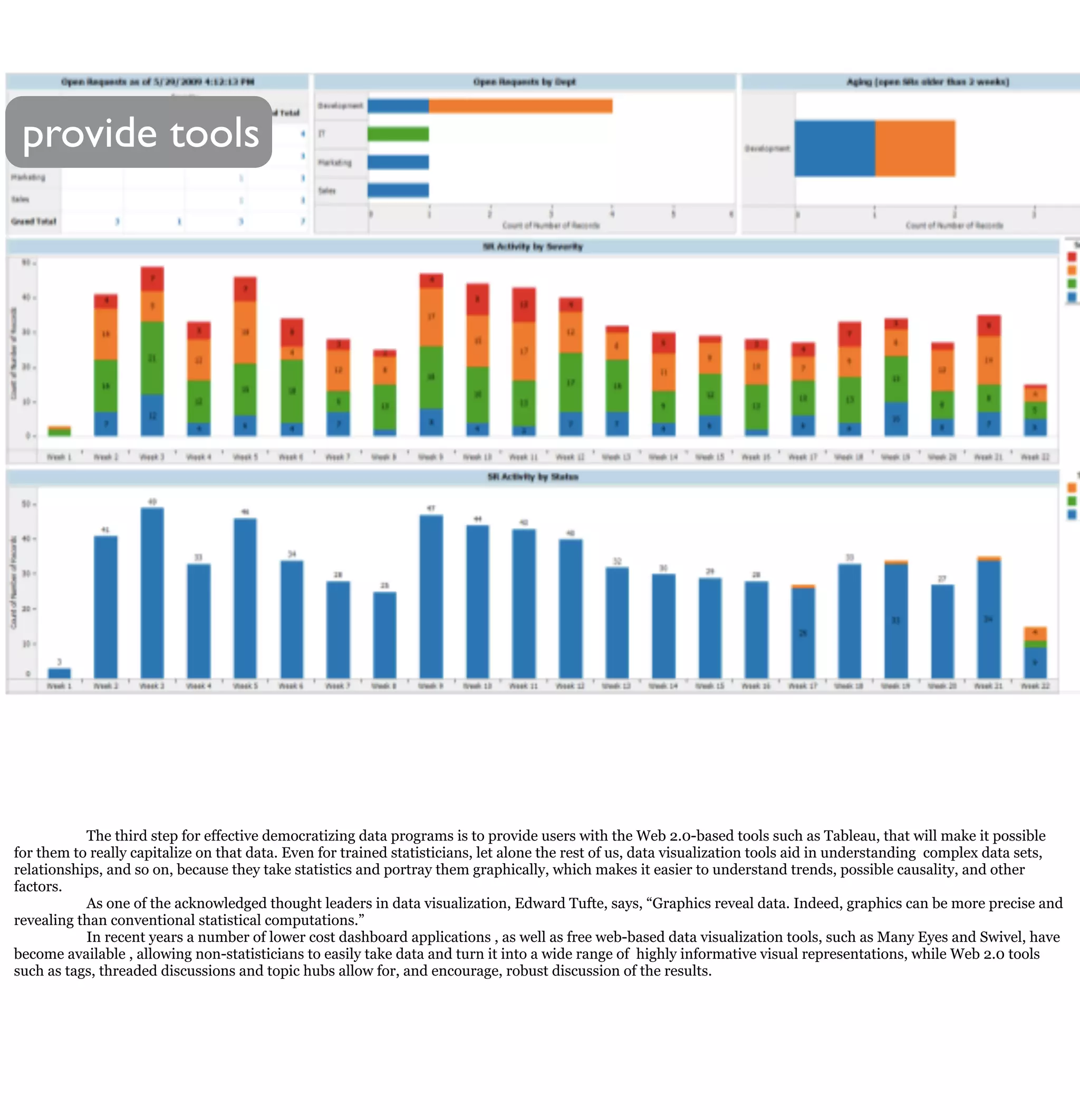
           The third step for effective democratizing data programs is to provide users with the Web 2.0-based tools such as Tableau, that will make it possible
for them to really capitalize on that data. Even for trained statisticians, let alone the rest of us, data visualization tools aid in understanding complex data sets,
relationships, and so on, because they take statistics and portray them graphically, which makes it easier to understand trends, possible causality, and other
factors.
           As one of the acknowledged thought leaders in data visualization, Edward Tufte, says, “Graphics reveal data. Indeed, graphics can be more precise and
revealing than conventional statistical computations.”
           In recent years a number of lower cost dashboard applications , as well as free web-based data visualization tools, such as Many Eyes and Swivel, have
become available , allowing non-statisticians to easily take data and turn it into a wide range of highly informative visual representations, while Web 2.0 tools
such as tags, threaded discussions and topic hubs allow for, and encourage, robust discussion of the results.
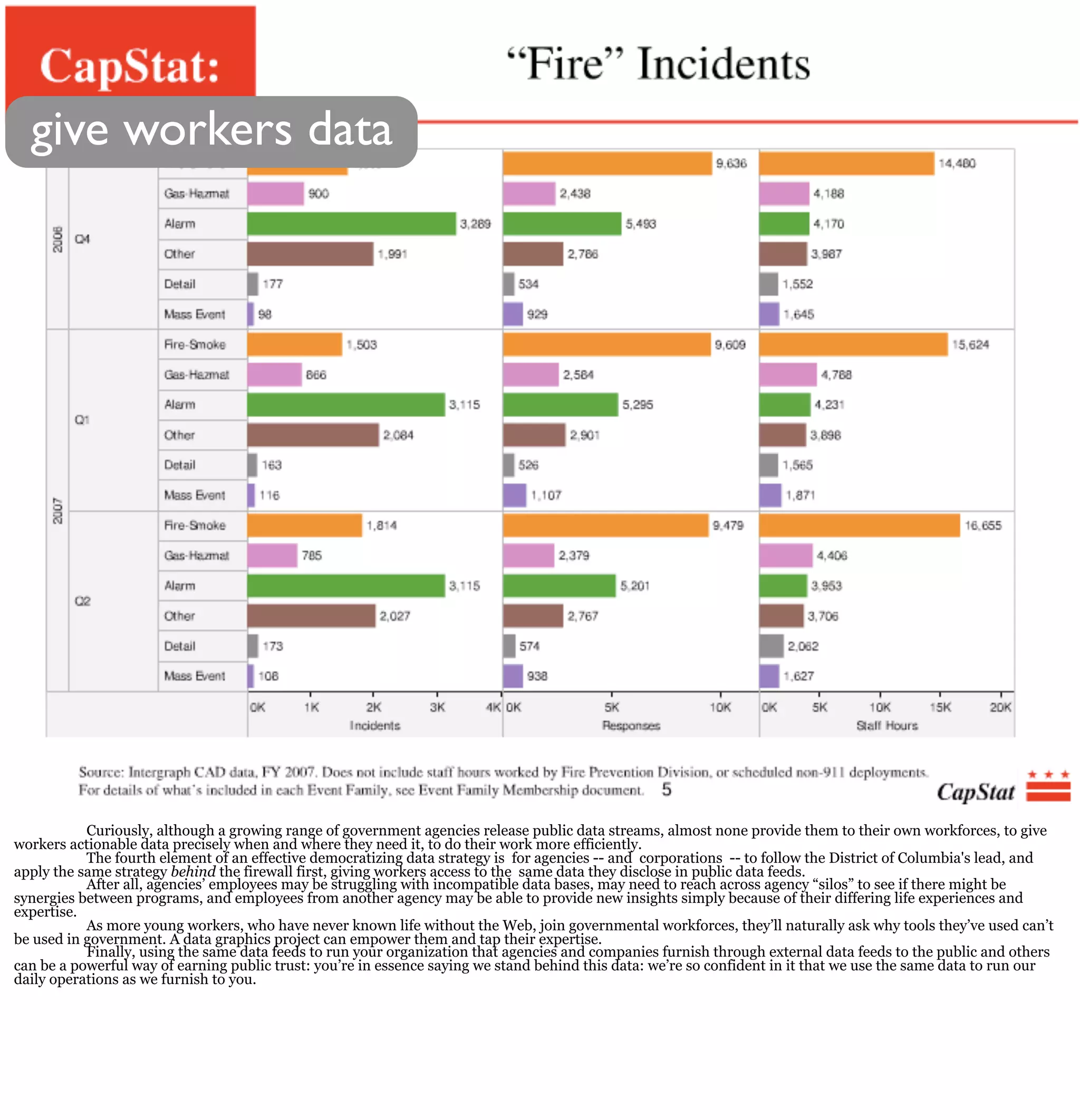
give workers data


           Curiously, although a growing range of government agencies release public data streams, almost none provide them to their own workforces, to give
workers actionable data precisely when and where they need it, to do their work more efficiently.
           The fourth element of an effective democratizing data strategy is for agencies -- and corporations -- to follow the District of Columbia's lead, and
apply the same strategy behind the firewall first, giving workers access to the same data they disclose in public data feeds.
           After all, agencies’ employees may be struggling with incompatible data bases, may need to reach across agency “silos” to see if there might be
synergies between programs, and employees from another agency may be able to provide new insights simply because of their differing life experiences and
expertise.
           As more young workers, who have never known life without the Web, join governmental workforces, they’ll naturally ask why tools they’ve used can’t
be used in government. A data graphics project can empower them and tap their expertise.
           Finally, using the same data feeds to run your organization that agencies and companies furnish through external data feeds to the public and others
can be a powerful way of earning public trust: you’re in essence saying we stand behind this data: we’re so confident in it that we use the same data to run our
daily operations as we furnish to you.
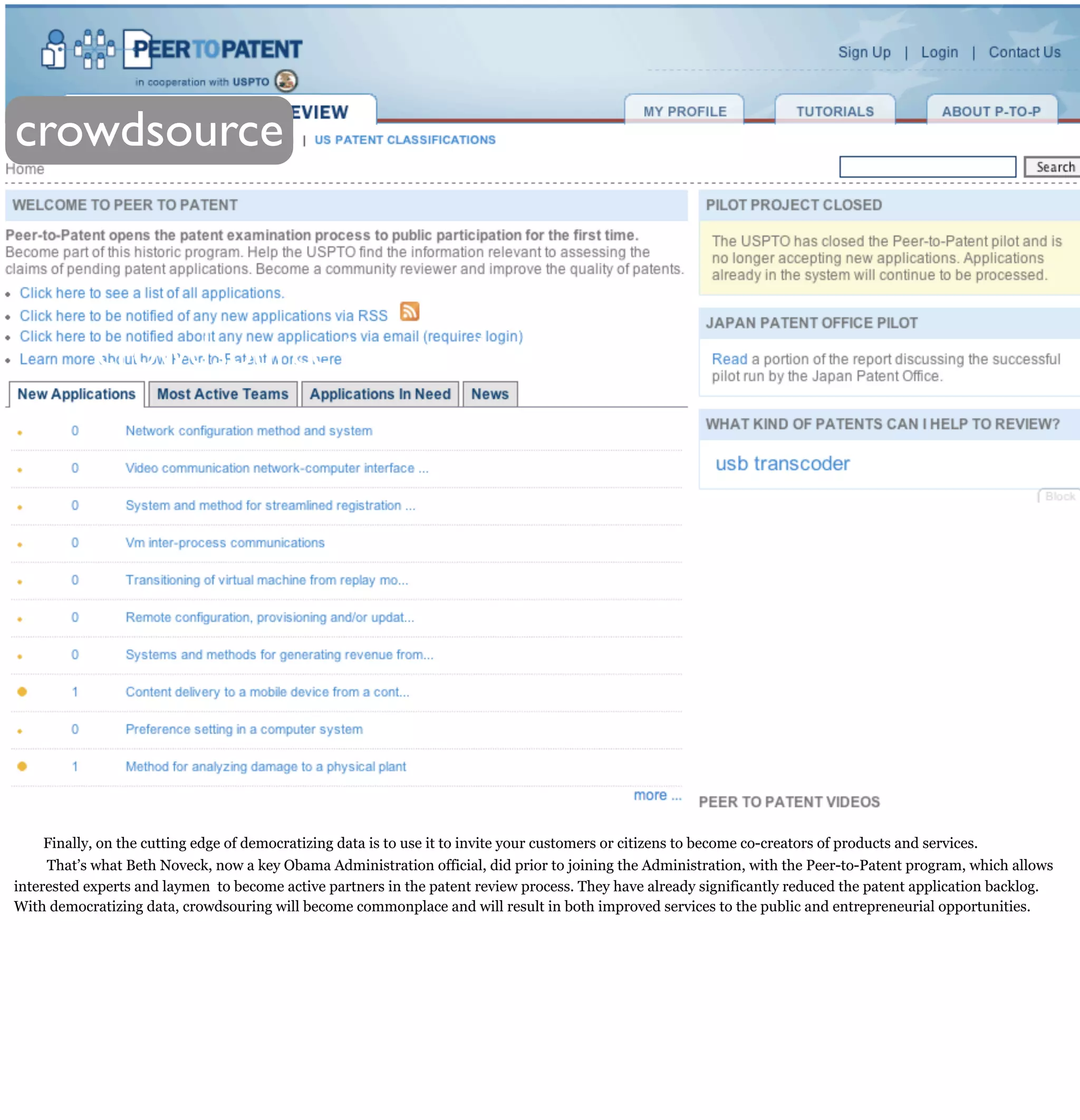
crowdsource


            crowdsource innovation


     Finally, on the cutting edge of democratizing data is to use it to invite your customers or citizens to become co-creators of products and services.
     That’s what Beth Noveck, now a key Obama Administration official, did prior to joining the Administration, with the Peer-to-Patent program, which allows
interested experts and laymen to become active partners in the patent review process. They have already significantly reduced the patent application backlog.
With democratizing data, crowdsouring will become commonplace and will result in both improved services to the public and entrepreneurial opportunities.
Benefits:
                  •Empower all employees
                  •Build consensus
                  •Collaborate on data analysis
                  •Build transparency
                  •Increase efficiency
                  •Reduce costs
                  •Co-create / crowdsource


    The potential benefits of democratizing data are many, and varied:
•   empowering all employees
•   building concensus
•   collaborating on data analysis
•   building transparency
•   increasing efficiency
•   reducing costs
•   crowdsourcing


    Who would have believed that dry data -- with a healthy dose of Web 2.0 magic -- could become the engine to empower your entire
workforce, improve operations and cut costs, and unleash creativity!
To learn more about democratizing data, contact:

                                                                          W. David Stephenson
                                                                                        Stephenson Strategies

                                                     335 Main Street, Medfield, MA 02052 USA

                                                                                                              508 740-8918

                                                     D.Stephenson@stephensonstrategies.com


              .. and watch for “Democratizing Data to transform
                                government, business & daily life”


Thank you.

To learn more about democratizing data and how to create the processes and policies to make it a reality, contact:
Stephenson Strategies 335 Main Street, Medfield, MA 02052 (617) 314-7858 D.Stephenson@stephensonstrategies.com

Democratizing Data to transform gov., business & daily life

  • 1.
    Democratizing Data to transformgovernment, business & daily life Tableau Customer Conference Seattle W. David Stephenson Stephenson Strategies July 23, 2009 Christian began the conference by giving you a vision of the future, and I want to send you off with a variation on the same theme, with a preview of the book I’m writing, “Democratizing Data to transform government, workplaces, and our lives.” Originally I was to co-author the book with Vivek Kundra, Chief Technical Officer of the District of Columbia, and a true trailblazer in this field. However, fortunately for the US, unfortunately for me, President Obama has chosen Vivek to become the US’s first CIO. You have already seen, in the few months he’s been on the job, how revolutionary the Obama Administration will be for transparency and access to data, which, I believe, will unleash a global explosion of data access that will in turn unleash a transformation in every aspect of our lives.
  • 2.
    I’m convinced Iwas chosen by to write this book through some sort of cosmic joke, because I’m the least-likely person to write a book on data. You see, I suspect that most of you are left-brained, analytical types, while I’m right-brained and intuitive. For me, data used to be good for one thing, and one thing only: figuring the Red Sox’ batting averages. But in reality, that makes me ideally suited to write this book, because it’s time that people like me no longer be disenfranchised when it comes to data.
  • 3.
    Gradually data keptplaying a greater and greater role in my life, with information that both documented my life and shaped policy issues. For example, how much state aid my town was getting
  • 4.
    .. How muchthe damn war in Iraq was costing, and how much it was diverting from things we should be doing, such as providing quality health care…
  • 5.
    … and, recently,documenting exactly how serious the global economic situation had become.
  • 6.
    Democratizing Data: How free access will transform our lives Ignite Boston Feb. 12, 2009 W. David Stephenson Stephenson Strategies But when I got interested in data, I found it was pretty hard to get at. We pay taxes so government can collect data, and you can bet companies know all about our shopping habits. Our activities and lives are data’s raw material. But once they’re collected, most citizens -- and a lot of employees for that matter -- don’t have a clue where data are stored or how they’re used.
  • 7.
    Today, there aresigns of hope. Closely-controlled and long-lost data are being liberated by the growing demand for transparency .
  • 8.
    Critical for today’schallenges •give workforce real-time information •automate processes •improve government regulation •reduce companies’ reporting costs •restore public confidence through transparency •empower the public as full partners The time has come to democratize data – making it available, when and where people need it to do their jobs or to improve their lives. The result will be change and benefits in every aspect of our lives, changes that are particularly critical given the current global challenges and that will improve our lives: •give workforces real-time information •automate previously manual processes, saving time & increasing efficiency •improve government regulatory processes by making access to reports instantaneous and shareable by all agencies •reduce corporate regulatory costs •restore public confidence through transparency
  • 9.
    Luther democratized writtenword •390 editions published in 1523. •By 1525, 3M copies of pamphlets relating to him printed •Transformed scholar- ship: original thought valued. However, we are a long way from realizing these benefits. The reality is that, by and large, data has not been democratized either by government or businesses. The situation’s not all that different from 1520, when Martin Luther’s translation of the Latin Bible into German and decision to print copies, instead of hand-copy them, gave most people direct access to the printed word for the first time. They no longer had to rely on the clergy as intermediaries. The results were quick and dramatic: Luther’s works no only led to the Reformation, but to a tremendous push for literacy and the printed word.
  • 10.
    As the printingpress transformed learning and people’s access to the word, so too the Internet, and handful of new web-based tools, none of them radically innovative by themselves but revolutionary when combined, is making it possible, in many cases for the first time, for workers and the general public to have direct access to actionable, valuable data. I believe the benefits and revolution will be equally dramatic as what Luther set in motion. Perhaps the most notable stimulus so far for such a transformation has been the Obama Administration’s launch of Data.gov, designed to make the colossal amount of data languishing in government data warehouses available to the public. Launched in mid-May with 40 data sets, it swelled to 100,000 data sets by the end of June. The ease of expanding so rapidly was a reflection on how much data government has accumulated without being made publicly available.
  • 11.
    Democratize data! "Democratizing data makes it automatically available to those who need it (based on their roles and responsibilities), when and where they need it, in forms they can use, and with freedom to use as they choose -- while simultaneously protecting security and privacy." The result of releasing this data will be to democratize it: "Democratizing data makes it automatically available to those who need it (based on their roles and responsibilities), when and where they need it, in forms they can use, and with freedom to use as they choose -- while simultaneously protecting security and privacy.": "Democratizing data makes it automatically available to those who need it (based on their roles and responsibilities), when and where they need it, in forms they can use, and with freedom to use as they choose -- while simultaneously protecting security and privacy."
  • 12.
    Data-centric organization Data-centric organization The first step to begin this transition is an strategic one: It’s time to switch to data-centric organizations, in which usable data is accessible to all sorts of applications and devices, automatically, and all of the organization’s functions are arranged around the data. Instead of data becoming captured and altered by applications, it must remain as “data nuggets,” accessible to all applications and machines that can act on it.
  • 13.
    tag & syndicatedata <us-gaap:NetIncomeLoss contextRef="eol_PE11373---0910- Q0004_STD_p3m_20080629_0" unitRef="USD" decimals="-6">882000000</us-gaap:NetIncomeLoss> The 2nd step to democratize data is to structure data using XML, KML or other systems that attach “tags” such as the XBRL ones you see here, to the numbers. This metadata transforms mere numbers into valuable data. These tag systems are universal, open standards, available to all, at no charge. I want to emphasize standards, incidentally: it’s precisely because XML, XBRL, KML are universally recognized and not proprietary, that it makes them valuable: they, and the data tagged by them, can be shared by all. One of the most important aspects of XML and variants is that once the tags are attached to the data, they remain attached: the package of metadata and data can be automatically shared by other applications. That reduces errors because the data doesn’t have to be rekeyed.. Equally important, the data must be syndicated, or automatically delivered without any additional effort on the user’s part, in streams such as RSS or Atom.
  • 14.
    provide tools The third step for effective democratizing data programs is to provide users with the Web 2.0-based tools such as Tableau, that will make it possible for them to really capitalize on that data. Even for trained statisticians, let alone the rest of us, data visualization tools aid in understanding complex data sets, relationships, and so on, because they take statistics and portray them graphically, which makes it easier to understand trends, possible causality, and other factors. As one of the acknowledged thought leaders in data visualization, Edward Tufte, says, “Graphics reveal data. Indeed, graphics can be more precise and revealing than conventional statistical computations.” In recent years a number of lower cost dashboard applications , as well as free web-based data visualization tools, such as Many Eyes and Swivel, have become available , allowing non-statisticians to easily take data and turn it into a wide range of highly informative visual representations, while Web 2.0 tools such as tags, threaded discussions and topic hubs allow for, and encourage, robust discussion of the results.
  • 15.
    give workers data Curiously, although a growing range of government agencies release public data streams, almost none provide them to their own workforces, to give workers actionable data precisely when and where they need it, to do their work more efficiently. The fourth element of an effective democratizing data strategy is for agencies -- and corporations -- to follow the District of Columbia's lead, and apply the same strategy behind the firewall first, giving workers access to the same data they disclose in public data feeds. After all, agencies’ employees may be struggling with incompatible data bases, may need to reach across agency “silos” to see if there might be synergies between programs, and employees from another agency may be able to provide new insights simply because of their differing life experiences and expertise. As more young workers, who have never known life without the Web, join governmental workforces, they’ll naturally ask why tools they’ve used can’t be used in government. A data graphics project can empower them and tap their expertise. Finally, using the same data feeds to run your organization that agencies and companies furnish through external data feeds to the public and others can be a powerful way of earning public trust: you’re in essence saying we stand behind this data: we’re so confident in it that we use the same data to run our daily operations as we furnish to you.
  • 16.
    crowdsource crowdsource innovation Finally, on the cutting edge of democratizing data is to use it to invite your customers or citizens to become co-creators of products and services. That’s what Beth Noveck, now a key Obama Administration official, did prior to joining the Administration, with the Peer-to-Patent program, which allows interested experts and laymen to become active partners in the patent review process. They have already significantly reduced the patent application backlog. With democratizing data, crowdsouring will become commonplace and will result in both improved services to the public and entrepreneurial opportunities.
  • 17.
    Benefits: •Empower all employees •Build consensus •Collaborate on data analysis •Build transparency •Increase efficiency •Reduce costs •Co-create / crowdsource The potential benefits of democratizing data are many, and varied: • empowering all employees • building concensus • collaborating on data analysis • building transparency • increasing efficiency • reducing costs • crowdsourcing Who would have believed that dry data -- with a healthy dose of Web 2.0 magic -- could become the engine to empower your entire workforce, improve operations and cut costs, and unleash creativity!
  • 18.
    To learn moreabout democratizing data, contact: W. David Stephenson Stephenson Strategies 335 Main Street, Medfield, MA 02052 USA 508 740-8918 D.Stephenson@stephensonstrategies.com .. and watch for “Democratizing Data to transform government, business & daily life” Thank you. To learn more about democratizing data and how to create the processes and policies to make it a reality, contact: Stephenson Strategies 335 Main Street, Medfield, MA 02052 (617) 314-7858 D.Stephenson@stephensonstrategies.com