Commitment to Excellence
Pannasastra University of
Cambodia
CH3: Democratic Change and
Persistence
12/8/161
Outline
I. Introduction
II. Transitions towards democracy
III.The limits of democratization
IV.Embedded, partial and defective democracies
V. Theories of democratic change and persistence
VI.Conclusion
2
Introduction
•Democratization
•3 waves
3
The rise of
nation states
(mid-19th Century
to 1920).
The Result of
decolonization
(1960s).
The spread of
Democracy
(1975-the end of
20th Century).
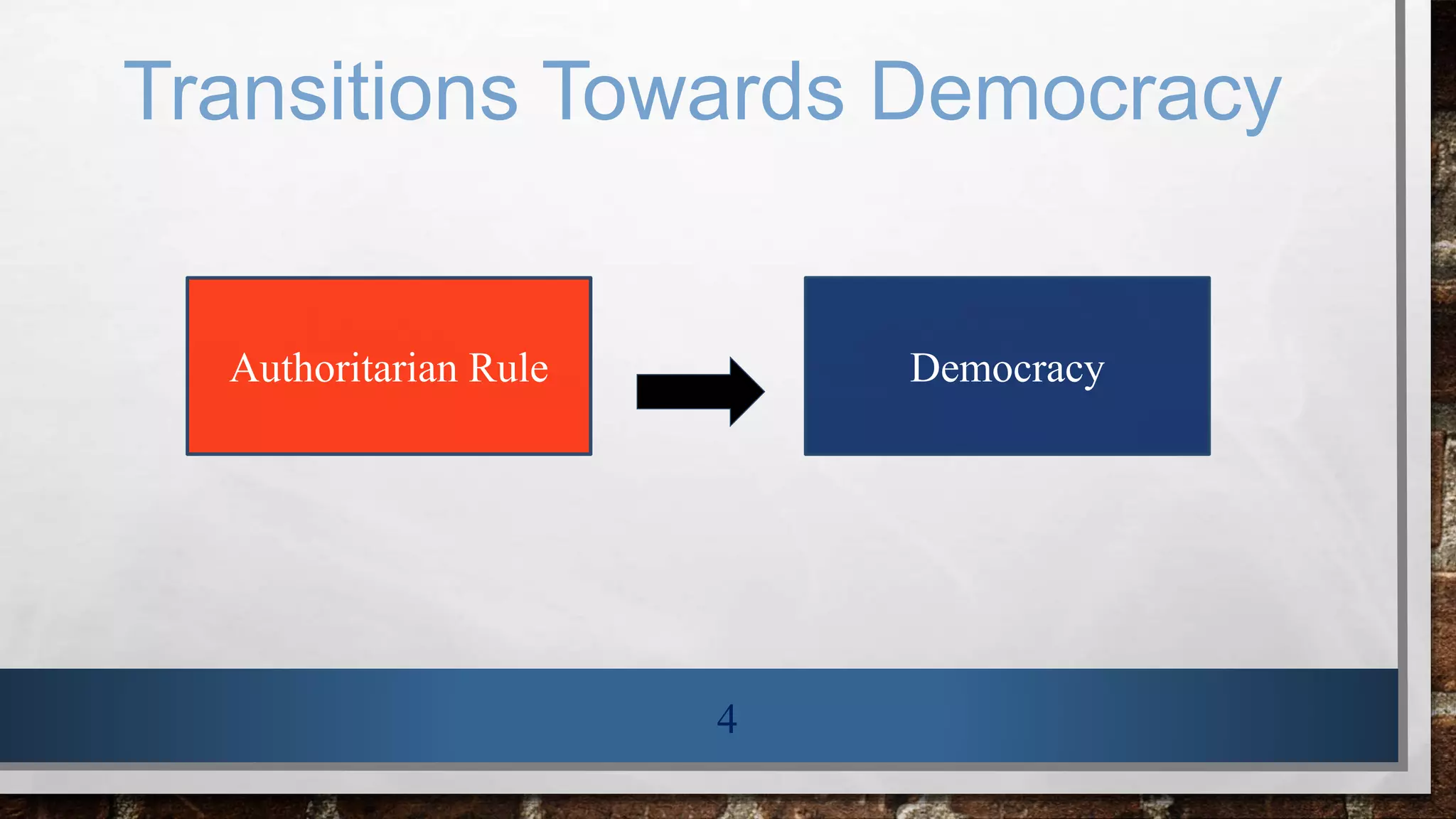
Transitions Towards Democracy
4
Authoritarian Rule Democracy
The Limits of Democratization
Phases in Democratic Consolidation
•Initial phase: Opposition towards the ruling elite and undemocratic
arrangements are mobilized; demands for more liberty are broadly
accepted and generally seen as the main goal of political reform.
•Emerging phase: The old undemocratic arrangements no longer function
and new ones are set up; liberty is still the main common concern; a new
constitution is declared and general elections are introduced for the first
time; return to the old system is no longer easily feasible.
5
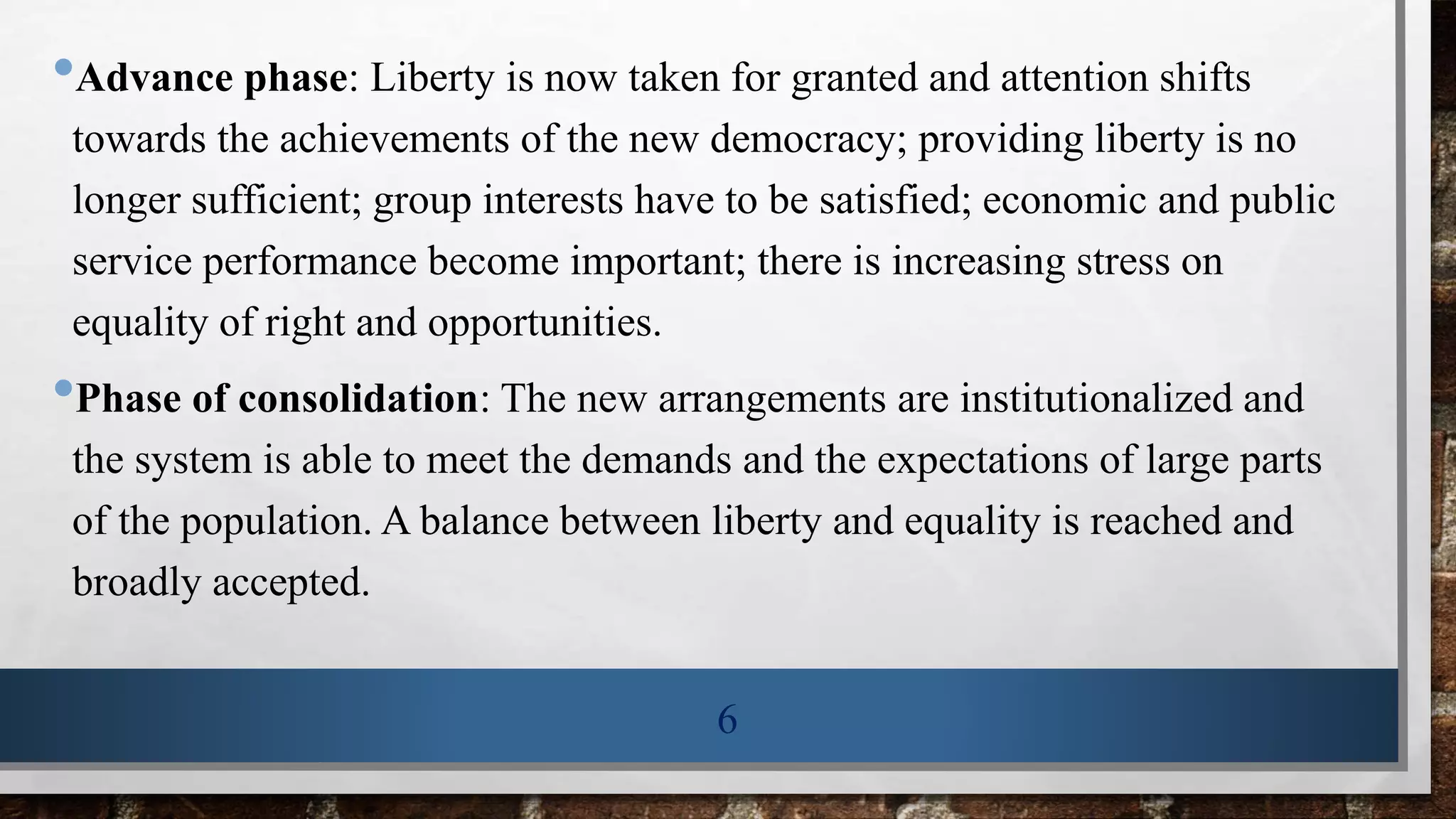
•Advance phase: Liberty is now taken for granted and attention shifts
towards the achievements of the new democracy; providing liberty is no
longer sufficient; group interests have to be satisfied; economic and public
service performance become important; there is increasing stress on
equality of right and opportunities.
•Phase of consolidation: The new arrangements are institutionalized and
the system is able to meet the demands and the expectations of large parts
of the population. A balance between liberty and equality is reached and
broadly accepted.
6
Embedded, Partial and Defective
Democracies
7
Theories of Democratic Change and
Persistence
Democratic transformation and consolidation are
complexed.
•Modernization Theory
•Cultural Theories
•Institutional Theories
8
Conclusion
This chapter talk about the transition and consolidation of democracy.
This chapter show that :
•To understand democracy, it requires a careful consideration of the
circumstance in which it takes root or fails in different country.
•Some theories regarded democracy sharp a distinction between
consolidated, established or embedded democracy at different stage
of development and defective , limited or partial democracies.
•Some theories of democratization stress on the importance of
political culture and of citizens 'attitude behavior, others stress on the
important of institutions and structures that encourage certain ways
of thinking and behaving. 9
References
 Theories of Democracy Power Point Slide by SUMERA BABI
 Foundation of Comparative Politics. (2010). KENNETH NEWTON
and JAN W.VAN DETH, P 53-67
10
Democratic change

Democratic change

  • 1.
    Commitment to Excellence PannasastraUniversity of Cambodia CH3: Democratic Change and Persistence 12/8/161
  • 2.
    Outline I. Introduction II. Transitionstowards democracy III.The limits of democratization IV.Embedded, partial and defective democracies V. Theories of democratic change and persistence VI.Conclusion 2
  • 3.
    Introduction •Democratization •3 waves 3 The riseof nation states (mid-19th Century to 1920). The Result of decolonization (1960s). The spread of Democracy (1975-the end of 20th Century).
  • 4.
  • 5.
    The Limits ofDemocratization Phases in Democratic Consolidation •Initial phase: Opposition towards the ruling elite and undemocratic arrangements are mobilized; demands for more liberty are broadly accepted and generally seen as the main goal of political reform. •Emerging phase: The old undemocratic arrangements no longer function and new ones are set up; liberty is still the main common concern; a new constitution is declared and general elections are introduced for the first time; return to the old system is no longer easily feasible. 5
  • 6.
    •Advance phase: Libertyis now taken for granted and attention shifts towards the achievements of the new democracy; providing liberty is no longer sufficient; group interests have to be satisfied; economic and public service performance become important; there is increasing stress on equality of right and opportunities. •Phase of consolidation: The new arrangements are institutionalized and the system is able to meet the demands and the expectations of large parts of the population. A balance between liberty and equality is reached and broadly accepted. 6
  • 7.
    Embedded, Partial andDefective Democracies 7
  • 8.
    Theories of DemocraticChange and Persistence Democratic transformation and consolidation are complexed. •Modernization Theory •Cultural Theories •Institutional Theories 8
  • 9.
    Conclusion This chapter talkabout the transition and consolidation of democracy. This chapter show that : •To understand democracy, it requires a careful consideration of the circumstance in which it takes root or fails in different country. •Some theories regarded democracy sharp a distinction between consolidated, established or embedded democracy at different stage of development and defective , limited or partial democracies. •Some theories of democratization stress on the importance of political culture and of citizens 'attitude behavior, others stress on the important of institutions and structures that encourage certain ways of thinking and behaving. 9
  • 10.
    References  Theories ofDemocracy Power Point Slide by SUMERA BABI  Foundation of Comparative Politics. (2010). KENNETH NEWTON and JAN W.VAN DETH, P 53-67 10

Editor's Notes

  • #5 4th Wave: At the end of the 1980s, the wave swept through Eastern Europe, with the Hungarian transition to semi-democratic system beginning in 1988. In 1990, Hungary moved to democracy In 1989, Poland became democratic after elections for a national parliament and a president. In 1990 saw widespread, rapid collapse of nondemocratizatic regime in Africa, and more than a dozen democracies emerged. This recent democratization wave was not only more global and effected more countries than earlier waves, there were also relatively fewer regression to nondemocratic regimes than in the past. During the fourth wave of democratization, there were forty-seven transitions to democracy and only eighteen transitions back to nondemocratic regimes.
  • #6 Democratization is a process that need sometime. To establish the new form of government is not that easy to achieve by just one single step. To breakdown the old system and consolidate of the new one, we need to think of several phases. Initial phase: Opposition towards the ruling elite and undemocratic arrangements are mobilized; demands for more liberty are broadly accepted and generally seen as the main goal of political reform. Emerging phase: The old undemocratic arrangements no longer function and new ones are set up; liberty is still the main common concern; a new constitution is declared and general elections are introduced for the first time; return to the old system is no longer easily feasible. Advance phase: Liberty is now taken for granted and attention shifts towards the achievements of the new democracy; providing liberty is no longer sufficient; group interests have to be satisfied; economic and public service performance become important; there is increasing stress on equality of right and opportunities. Phase of consolidation: The new arrangements are institutionalized and the system is able to meet the demands and the expectations of large parts of the population. A balance between liberty and equality is reached and broadly accepted.
  • #7 Democratization is a process that need sometime. To establish the new form of government is not that easy to achieve by just one single step. To breakdown the old system and consolidate of the new one, we need to think of several phases. Initial phase: Opposition towards the ruling elite and undemocratic arrangements are mobilized; demands for more liberty are broadly accepted and generally seen as the main goal of political reform. Emerging phase: The old undemocratic arrangements no longer function and new ones are set up; liberty is still the main common concern; a new constitution is declared and general elections are introduced for the first time; return to the old system is no longer easily feasible. Advance phase: Liberty is now taken for granted and attention shifts towards the achievements of the new democracy; providing liberty is no longer sufficient; group interests have to be satisfied; economic and public service performance become important; there is increasing stress on equality of right and opportunities. Phase of consolidation: The new arrangements are institutionalized and the system is able to meet the demands and the expectations of large parts of the population. A balance between liberty and equality is reached and broadly accepted.