Demand Driven MRP Case
Studies
Erik Bush
CEO, Demand Driven Technologies
Objective of this presentation
• Provide an inside look at 3 successful
Demand Driven MRP implementations
• Highlight how specific attributes of
DDMRP are used to address a wide range
of user environments
Agenda
• Amore Pacific
• Satuerca
• StemCell
Amore Pacific
Together We Can
AMORE PACIFIC
6
Index
Part 1 : About AMORE PACIFIC
Part 2 : SCM History of AMORE PACIFIC
Part 3 : Lunching DDMRP
Part 4 : Results & Lessons Learned
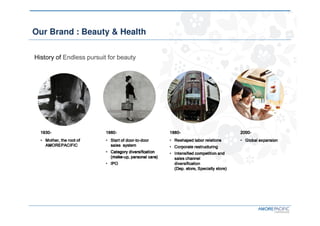
Our Brand : Beauty & Health
History of Endless pursuit for beauty
1930193019301930----
• Mother, the root ofMother, the root ofMother, the root ofMother, the root of
AMOREPACIFICAMOREPACIFICAMOREPACIFICAMOREPACIFIC
1960196019601960----
• Start of doorStart of doorStart of doorStart of door----totototo----doordoordoordoor
sales systemsales systemsales systemsales system
• Category diversificationCategory diversificationCategory diversificationCategory diversification
(make(make(make(make----up, personal care)up, personal care)up, personal care)up, personal care)
• IPOIPOIPOIPO
1980198019801980----
• Reshaped labor relationsReshaped labor relationsReshaped labor relationsReshaped labor relations
• Corporate restructuringCorporate restructuringCorporate restructuringCorporate restructuring
• Intensified competition andIntensified competition andIntensified competition andIntensified competition and
sales channelsales channelsales channelsales channel
diversificationdiversificationdiversificationdiversification
(Dep. store, Specialty store)(Dep. store, Specialty store)(Dep. store, Specialty store)(Dep. store, Specialty store)
2000200020002000----
• Global expansionGlobal expansionGlobal expansionGlobal expansion
8
29 Brands : across all categories in Beauty & Health
Skin Care, Make-up, Fragrance, Hair Care, Body Care, Oral Care, Green Tea, Beauty Food
9
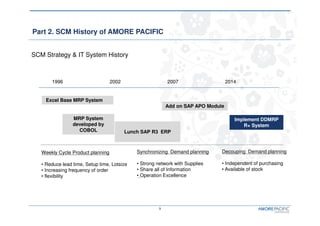
Part 2. SCM History of AMORE PACIFIC
SCM Strategy & IT System History
1996 2002 2007 2014
Excel Base MRP System
MRP System
developed by
COBOL Lunch SAP R3 ERP
Add on SAP APO Module
Implement DDMRP
R+ System
Weekly Cycle Product planning
• Reduce lead time, Setup time, Lotsize
• Increasing frequency of order
• flexibility
Synchronizing Demand planning
• Strong network with Supplies
• Share all of Information
• Operation Excellence
Decouping Demand planning
• Independent of purchasing
• Available of stock
Good forecasting?
• Sales Forecast : The accuracy of M+3 forecast is less than 10%.
Purchasing team could not depend on the sales forecast,
used only as a reference.
• Best policy of purchasing department : Try to reduce the lead time
because the accuracy of short term forecast is high.
[ Accuracy of Sales Forecast]
11
Part 3. Lunching DDMRP [ 30분분분분 ]
The Five Components of DDMRP
Demand Driven Material Requirements Planning
Strategic
Inventory
Positioning
1
Buffer Profiles
and Levels
2
Dynamic
Adjustments
3
Demand
Driven
Planning
4
Visible and
Collaborative
Execution
5
Modeling/Re-modeling the Environment Plan Execute
12
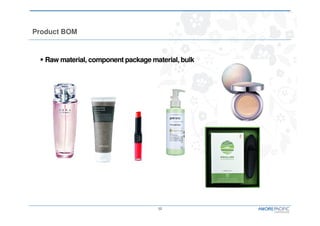
Product BOM
Raw material, component package material, bulk
HubPack
BulkWeig
htingRaw
C.P
Supplier's Amore pacific
Injecti
on
W/H
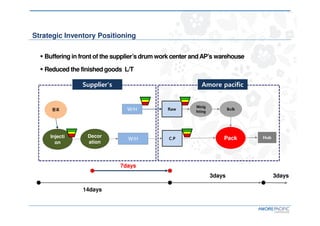
Buffering in front of the supplier’s drum work center andAP’s warehouse
Reduced the finished goods L/T
원료
Strategic Inventory Positioning
W/H
Decor
ation
3days3days
14days
7days
All parts
Stocked 비축(備蓄) Non-Stocked 불비축(不備蓄)
Replenished Replenished
Over-ride Min-max Non-buffered
Lead Time
Managed
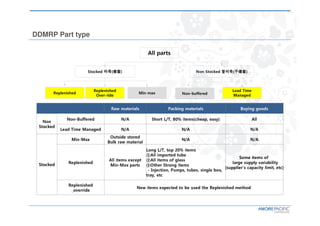
DDMRP Part type
Raw materials Packing materials Buying goods
Non
Stocked
Non-Buffered N/A Short L/T, 80% items(cheap, easy) All
Lead Time Managed N/A N/A N/A
Stocked
Min-Max Outside stored
Bulk raw material N/A N/A
Replenished All items except
Min-Max parts
Long L/T, top 20% items
①All imported tube
②All items of glass
③Other Strong items
- Injection, Pumps, tubes, single box,
tray, etc
Some items of
large supply variability
(supplier’s capacity limit, etc)
Replenished
_override New items expected to be used the Replenished method
Red Zone Base
Red Zone Safety
Yellow
Green
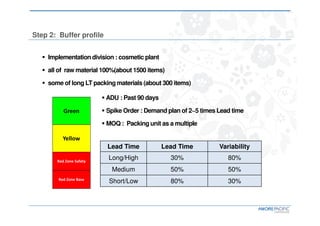
Step 2: Buffer profile
Implementation division : cosmetic plant
all of raw material 100%(about 1500 items)
some of long LT packing materials (about 300 items)
Lead Time Lead Time Variability
Long/High 30% 80%
Medium 50% 50%
Short/Low 80% 30%
ADU : Past 90 days
Spike Order : Demand plan of 2~5 times Lead time
MOQ : Packing unit as a multiple
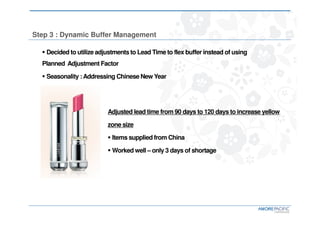
Step 3 : Dynamic Buffer Management
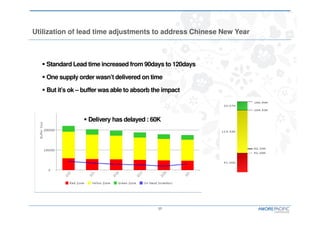
Decided to utilize adjustments to Lead Time to flex buffer instead of using
Planned Adjustment Factor
Seasonality :Addressing Chinese New Year
Adjusted lead time from 90 days to 120 days to increase yellow
zone size
Items supplied from China
Worked well – only 3 days of shortage
17
Utilization of lead time adjustments to address Chinese New Year
Delivery has delayed : 60K
Standard Lead time increased from 90days to 120days
One supply order wasn’t delivered on time
But it’s ok – buffer was able to absorb the impact
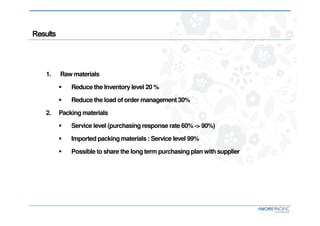
ResultsResultsResultsResults
1. Raw materials
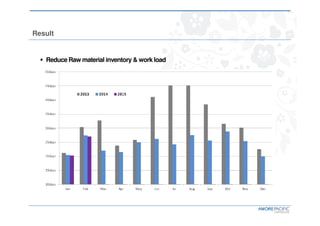
Reduce the Inventory level 20 %
Reduce the load of order management 30%
2. Packing materials
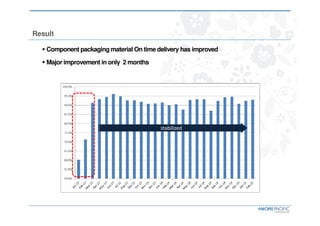
Service level (purchasing response rate 60% -> 90%)
Imported packing materials : Service level 99%
Possible to share the long term purchasing plan with supplier
Result
Reduce Raw material inventory & work load
Result
Component packaging material On time delivery has improved
Major improvement in only 2 months
stabilized
21
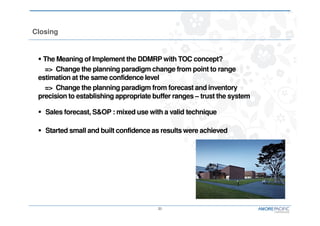
Closing
The Meaning of Implement the DDMRP with TOC concept?
=> Change the planning paradigm change from point to range
estimation at the same confidence level
=> Change the planning paradigm from forecast and inventory
precision to establishing appropriate buffer ranges – trust the system
Sales forecast, S&OP : mixed use with a valid technique
Started small and built confidence as results were achieved
Satuerca
March 27th, 2015
Presented at the Demand Driven World Conference
Houston, TX
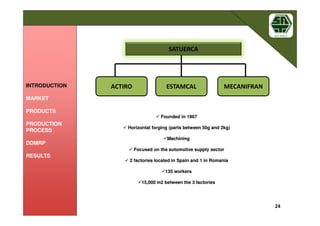
SATUERCA
ACTIRO ESTAMCAL MECANIFRAN
24
INTRODUCTION
MARKET
PRODUCTS
PRODUCTION
PROCESS
DDMRP
RESULTS
Founded in 1967
Horizontal forging (parts between 50g and 2kg)
Machining
Focused on the automotive supply sector
2 factories located in Spain and 1 in Romania
135 workers
15,000 m2 between the 3 factories
Founded in 1967
Horizontal forging (parts between 50g and 2kg)
Machining
Focused on the automotive supply sector
2 factories located in Spain and 1 in Romania
135 workers
15,000 m2 between the 3 factories
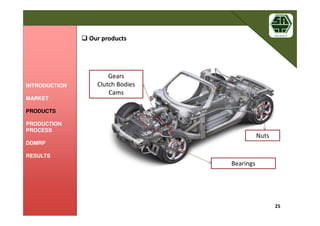
Our productsOur products
25
Gears
Clutch Bodies
Cams
Bearings
Nuts
INTRODUCTION
MARKET
PRODUCTS
PRODUCTION
PROCESS
DDMRP
RESULTS
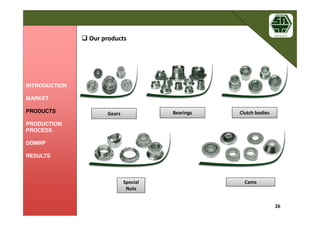
Special
Nuts
Cams
26
Our productsOur products
Gears Bearings Clutch bodies
INTRODUCTION
MARKET
PRODUCTS
PRODUCTION
PROCESS
DDMRP
RESULTS
27
Why DDMRP?Why DDMRP?
PLANNING Critical process
Situation description
• Customer forecast/orders varying even on due date
• Delays of raw material deliveries
• Daily consumption from consignment stocks
Planning history
• Until 2012, planning was dependant on a single person’s analysis
• From 2012 to 2013 use of Excel
• September 2013 until present day: DDMRP Methodology applied
Necessities
• Methodology to manage this information on a daily basis:
• Stock levels
• Detection of new Work Orders (WO) requirements
• New raw material purchase requirements
• Which raw material Open Supply orders need to be
controlled
• In Process WO that need to be expedited
INTRODUCTION
MARKET
PRODUCTS
PRODUCTION
PROCESS
DDMRP
RESULTS
28
Changing to DDMRPChanging to DDMRP
1st- Strategic Inventory Positioning
2nd- Buffer profiles and Level Determination
3rd- Dynamic Buffers
4th- Demand-Driven Planning
5th- Execution
DEMAND ANALYSIS
Change in the way DEMAND is understood
Forecast/Orders beyond a reliable horizon are no longer taken into
account ☺
Only committed orders (date and quantity) are considered DEMAND
INTRODUCTION
MARKET
PRODUCTS
PRODUCTION
PROCESS
DDMRP
RESULTS
29
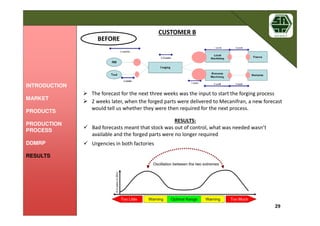
CUSTOMER B
RESULTS:
Bad forecasts meant that stock was out of control, what was needed wasn’t
available and the forged parts were no longer required
Urgencies in both factories
The forecast for the next three weeks was the input to start the forging process
2 weeks later, when the forged parts were delivered to Mecanifran, a new forecast
would tell us whether they were then required for the next process.
INTRODUCTION
MARKET
PRODUCTS
PRODUCTION
PROCESS
DDMRP
RESULTS
BEFORE
NOW
30
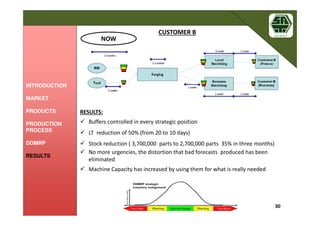
RESULTS:
Buffers controlled in every strategic position
LT reduction of 50% (from 20 to 10 days)
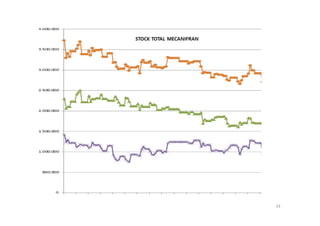
Stock reduction ( 3,700,000 parts to 2,700,000 parts 35% in three months)
No more urgencies, the distortion that bad forecasts produced has been
eliminated
Machine Capacity has increased by using them for what is really needed
INTRODUCTION
MARKET
PRODUCTS
PRODUCTION
PROCESS
DDMRP
RESULTS
CUSTOMER B
31
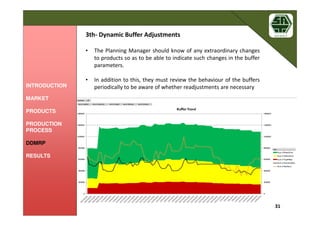
3th- Dynamic Buffer Adjustments
• The Planning Manager should know of any extraordinary changes
to products so as to be able to indicate such changes in the buffer
parameters.
• In addition to this, they must review the behaviour of the buffers
periodically to be aware of whether readjustments are necessaryINTRODUCTION
MARKET
PRODUCTS
PRODUCTION
PROCESS
DDMRP
RESULTS
32
RESULTS
Reduction in production planning changes Machine
capacity improved
Production for one week is planned
Daily information updated vs Weekly information updated
Improved reaction to changes
Facilities are used more efficiently maintaining same
service levels (98+%)
Regulation of the stock levels - stock is available for all
production requirements
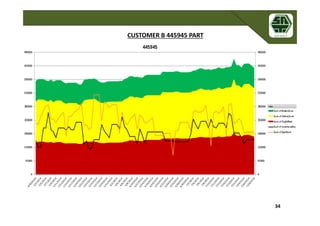
Customer B is the best example
INITIAL REQUIREMENTS
• Part and Inventory data must be correct and updated
• DEMAND has to be filtered
INTRODUCTION
MARKET
PRODUCTS
PRODUCTION
PROCESS
DDMRP
RESULTS
33
34
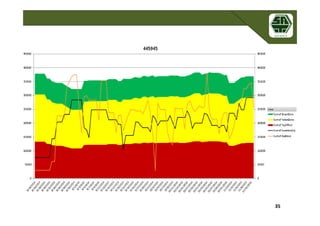
CUSTOMER B 445945 PART
35
36
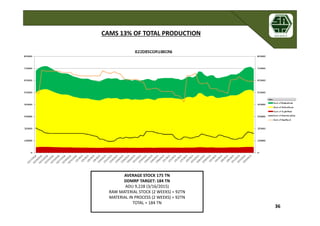
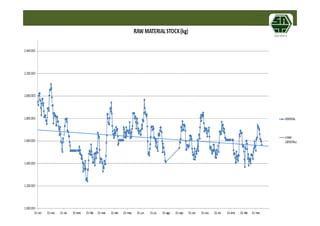
AVERAGE STOCK 175 TN
DDMRP TARGET: 184 TN
ADU 9,228 (3/16/2015)
RAW MATERIAL STOCK (2 WEEKS) = 92TN
MATERIAL IN PROCESS (2 WEEKS) = 92TN
TOTAL = 184 TN
CAMS 13% OF TOTAL PRODUCTION
37
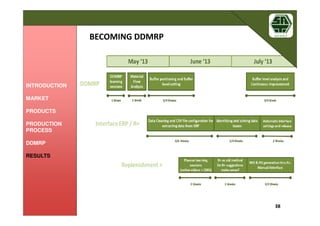
BECOMING DDMRP
38
INTRODUCTION
MARKET
PRODUCTS
PRODUCTION
PROCESS
DDMRP
RESULTS
StemCell
STEMCELL Technologies
Experiences from our Demand Driven journey
March 2015 - Juan Abbud, Aida Mujkanovic
CONFIDENTIAL AND PROPRIETARY
Any use of this material without specific permission of StemCell Technologies is strictly prohibited
Dr. Allen Eaves – Founder, President & CEO
A Family Owned Company
• We can move quickly in a fast moving market
• We listen to our employees & customers
• Growth over 20 years dependent on sales revenue
– a great discipline!
• Sales are largely dependent on the new products
that we develop
• New products are developed by our outstanding
R&D scientists - who are essential to STEMCELL’s
success!
• Planning and prioritization of new product
development is done carefully and confidentially
• Leadership & decisions are focused on long-term
growth and stability
The promise of stem cell research
Cells for transplantation
Adult Tissue
Specific Stem Cells
Bone marrow for
leukemia
Nerve cells for
Parkinson's &
Alzheimer's
disease
Heart muscle cells
for heart disease
Pancreatic islet
cells for diabetes
Cultured Cells
Drug screening
and potential
therapeutics
Toxicity testing
Study cell
differentiation
Understand
prevention &
treatment of
cancer/disease
Pluripotent Stem Cells
STEMCELL’s Planning Considerations
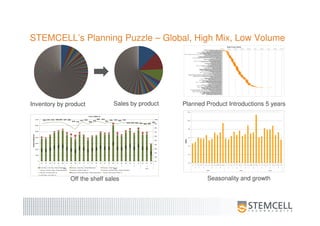
STEMCELL’s Planning Puzzle – Global, High Mix, Low Volume
Sales by productInventory by product Planned Product Introductions 5 years
Seasonality and growthOff the shelf sales
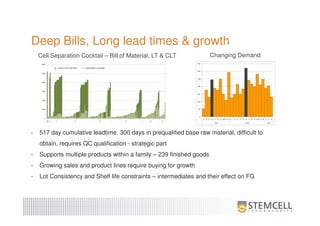
Deep Bills, Long lead times & growth
Cell Separation Cocktail – Bill of Material, LT & CLT Changing Demand
- 517 day cumulative leadtime, 300 days in prequalified base raw material, difficult to
obtain, requires QC qualification - strategic part
- Supports multiple products within a family – 239 finished goods
- Growing sales and product lines require buying for growth
- Lot Consistency and Shelf life constraints – intermediates and their effect on FG
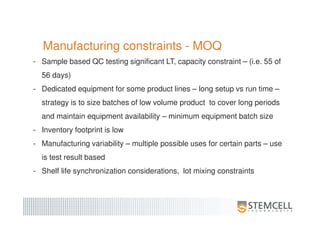
Manufacturing constraints - MOQ
- Sample based QC testing significant LT, capacity constraint – (i.e. 55 of
56 days)
- Dedicated equipment for some product lines – long setup vs run time –
strategy is to size batches of low volume product to cover long periods
and maintain equipment availability – minimum equipment batch size
- Inventory footprint is low
- Manufacturing variability – multiple possible uses for certain parts – use
is test result based
- Shelf life synchronization considerations, lot mixing constraints
Keeping up with growth
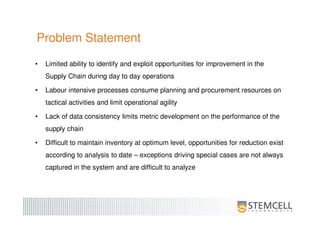
Problem Statement
• Limited ability to identify and exploit opportunities for improvement in the
Supply Chain during day to day operations
• Labour intensive processes consume planning and procurement resources on
tactical activities and limit operational agility
• Lack of data consistency limits metric development on the performance of the
supply chain
• Difficult to maintain inventory at optimum level, opportunities for reduction exist
according to analysis to date – exceptions driving special cases are not always
captured in the system and are difficult to analyze
Operational objective – Improve Plan to Produce
• Improve service levels while maintaining the optimum inventory
level – establish and maintain optimum inventory, control oscillation
• Establish process efficiencies in the Plan to Produce process by
optimizing the use of the ERP and supporting systems
• Develop and establish the required datasets to support the Plan to
Produce process and its continuous improvement
Adopting DDMRP
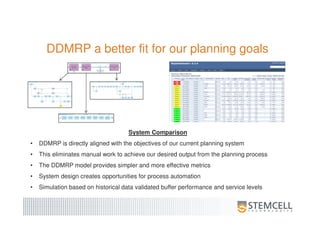
DDMRP a better fit for our planning goals
System Comparison
• DDMRP is directly aligned with the objectives of our current planning system
• This eliminates manual work to achieve our desired output from the planning process
• The DDMRP model provides simpler and more effective metrics
• System design creates opportunities for process automation
• Simulation based on historical data validated buffer performance and service levels
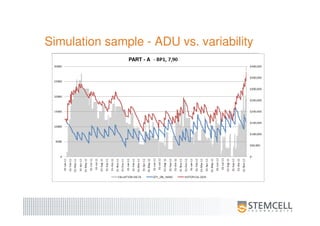
Simulation sample - ADU vs. variability
PART - A
Solution Proposal
• Adopt DDMRP as planning methodology
• Update BOM configurations to support strategic inventory positioning
• Capture complete demand and supply pipeline on ERP system –
(some information for special cases on other systems)
• Certify Planning and Procurement teams - CDDP
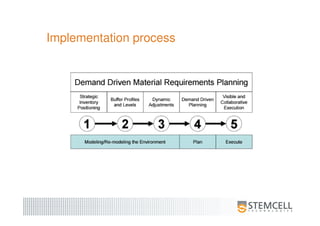
Implementation process
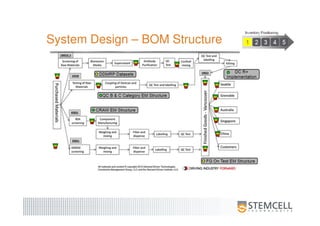
System Design – BOM Structure
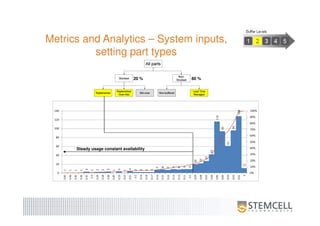
Steady usage constant availability
Metrics and Analytics – System inputs,
setting part types
20 % 80 %
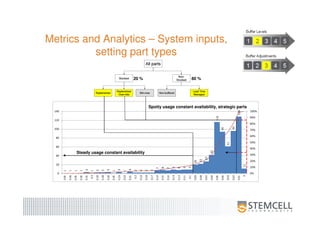
Spotty usage constant availability, strategic parts
Steady usage constant availability
Metrics and Analytics – System inputs,
setting part types
20 % 80 %
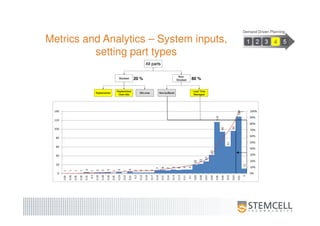
Metrics and Analytics – System inputs,
setting part types
Demand Driven Planning
20 % 80 %
Measuring System Inputs and Performance
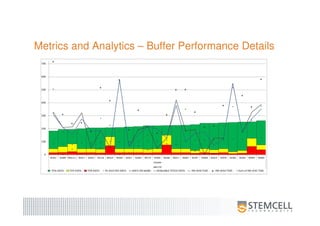
Metrics and Analytics – Buffer Performance Details
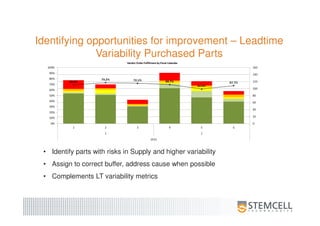
• Identify parts with risks in Supply and higher variability
• Assign to correct buffer, address cause when possible
• Complements LT variability metrics
Identifying opportunities for improvement – Leadtime
Variability Purchased Parts
Future Considerations – what is next for us?
• Deploy metrics and link them to execution, periodical metric reviews –
buffer status meetings
• Dynamic adjustment model for applicable RO and MM parts
• Continue monitoring and adjusting parts attributes
• Rollout DDRMP for pilot product end to end (Raw – FG)
• Build BOM dataset – strategic buffer analysis
• Explore opportunities for improvement – MOQ, Leadtime and Variability
– invest to redefine constraints as appropriate
Key implementation factors at STEMCELL
• Secure executive sponsorship by demonstrating value – Simulation with your
data helps
• Understand the scope of applicability and expected benefits – fit to business
• An implementation partner that knows your system is highly valuable
• Train everyone!
• Make sure the BOM definition in your system is correct
• Strong data team – ability to run trending calculations and validate settings is
invaluable – focus on data quality
• Plan for the transition – support users by providing them context to understand
the new ordering patterns
• Plan the integration of the planning system into all related processes
Questions?

Demand Driven MRP

  • 1.
    Demand Driven MRPCase Studies Erik Bush CEO, Demand Driven Technologies
  • 2.
    Objective of thispresentation • Provide an inside look at 3 successful Demand Driven MRP implementations • Highlight how specific attributes of DDMRP are used to address a wide range of user environments
  • 3.
    Agenda • Amore Pacific •Satuerca • StemCell
  • 4.
  • 5.
  • 6.
    6 Index Part 1 :About AMORE PACIFIC Part 2 : SCM History of AMORE PACIFIC Part 3 : Lunching DDMRP Part 4 : Results & Lessons Learned
  • 7.
    Our Brand :Beauty & Health History of Endless pursuit for beauty 1930193019301930---- • Mother, the root ofMother, the root ofMother, the root ofMother, the root of AMOREPACIFICAMOREPACIFICAMOREPACIFICAMOREPACIFIC 1960196019601960---- • Start of doorStart of doorStart of doorStart of door----totototo----doordoordoordoor sales systemsales systemsales systemsales system • Category diversificationCategory diversificationCategory diversificationCategory diversification (make(make(make(make----up, personal care)up, personal care)up, personal care)up, personal care) • IPOIPOIPOIPO 1980198019801980---- • Reshaped labor relationsReshaped labor relationsReshaped labor relationsReshaped labor relations • Corporate restructuringCorporate restructuringCorporate restructuringCorporate restructuring • Intensified competition andIntensified competition andIntensified competition andIntensified competition and sales channelsales channelsales channelsales channel diversificationdiversificationdiversificationdiversification (Dep. store, Specialty store)(Dep. store, Specialty store)(Dep. store, Specialty store)(Dep. store, Specialty store) 2000200020002000---- • Global expansionGlobal expansionGlobal expansionGlobal expansion
  • 8.
    8 29 Brands :across all categories in Beauty & Health Skin Care, Make-up, Fragrance, Hair Care, Body Care, Oral Care, Green Tea, Beauty Food
  • 9.
    9 Part 2. SCMHistory of AMORE PACIFIC SCM Strategy & IT System History 1996 2002 2007 2014 Excel Base MRP System MRP System developed by COBOL Lunch SAP R3 ERP Add on SAP APO Module Implement DDMRP R+ System Weekly Cycle Product planning • Reduce lead time, Setup time, Lotsize • Increasing frequency of order • flexibility Synchronizing Demand planning • Strong network with Supplies • Share all of Information • Operation Excellence Decouping Demand planning • Independent of purchasing • Available of stock
  • 10.
    Good forecasting? • SalesForecast : The accuracy of M+3 forecast is less than 10%. Purchasing team could not depend on the sales forecast, used only as a reference. • Best policy of purchasing department : Try to reduce the lead time because the accuracy of short term forecast is high. [ Accuracy of Sales Forecast]
  • 11.
    11 Part 3. LunchingDDMRP [ 30분분분분 ] The Five Components of DDMRP Demand Driven Material Requirements Planning Strategic Inventory Positioning 1 Buffer Profiles and Levels 2 Dynamic Adjustments 3 Demand Driven Planning 4 Visible and Collaborative Execution 5 Modeling/Re-modeling the Environment Plan Execute
  • 12.
    12 Product BOM Raw material,component package material, bulk
  • 13.
    HubPack BulkWeig htingRaw C.P Supplier's Amore pacific Injecti on W/H Bufferingin front of the supplier’s drum work center andAP’s warehouse Reduced the finished goods L/T 원료 Strategic Inventory Positioning W/H Decor ation 3days3days 14days 7days
  • 14.
    All parts Stocked 비축(備蓄)Non-Stocked 불비축(不備蓄) Replenished Replenished Over-ride Min-max Non-buffered Lead Time Managed DDMRP Part type Raw materials Packing materials Buying goods Non Stocked Non-Buffered N/A Short L/T, 80% items(cheap, easy) All Lead Time Managed N/A N/A N/A Stocked Min-Max Outside stored Bulk raw material N/A N/A Replenished All items except Min-Max parts Long L/T, top 20% items ①All imported tube ②All items of glass ③Other Strong items - Injection, Pumps, tubes, single box, tray, etc Some items of large supply variability (supplier’s capacity limit, etc) Replenished _override New items expected to be used the Replenished method
  • 15.
    Red Zone Base RedZone Safety Yellow Green Step 2: Buffer profile Implementation division : cosmetic plant all of raw material 100%(about 1500 items) some of long LT packing materials (about 300 items) Lead Time Lead Time Variability Long/High 30% 80% Medium 50% 50% Short/Low 80% 30% ADU : Past 90 days Spike Order : Demand plan of 2~5 times Lead time MOQ : Packing unit as a multiple
  • 16.
    Step 3 :Dynamic Buffer Management Decided to utilize adjustments to Lead Time to flex buffer instead of using Planned Adjustment Factor Seasonality :Addressing Chinese New Year Adjusted lead time from 90 days to 120 days to increase yellow zone size Items supplied from China Worked well – only 3 days of shortage
  • 17.
    17 Utilization of leadtime adjustments to address Chinese New Year Delivery has delayed : 60K Standard Lead time increased from 90days to 120days One supply order wasn’t delivered on time But it’s ok – buffer was able to absorb the impact
  • 18.
    ResultsResultsResultsResults 1. Raw materials Reducethe Inventory level 20 % Reduce the load of order management 30% 2. Packing materials Service level (purchasing response rate 60% -> 90%) Imported packing materials : Service level 99% Possible to share the long term purchasing plan with supplier
  • 19.
    Result Reduce Raw materialinventory & work load
  • 20.
    Result Component packaging materialOn time delivery has improved Major improvement in only 2 months stabilized
  • 21.
    21 Closing The Meaning ofImplement the DDMRP with TOC concept? => Change the planning paradigm change from point to range estimation at the same confidence level => Change the planning paradigm from forecast and inventory precision to establishing appropriate buffer ranges – trust the system Sales forecast, S&OP : mixed use with a valid technique Started small and built confidence as results were achieved
  • 22.
  • 23.
    March 27th, 2015 Presentedat the Demand Driven World Conference Houston, TX
  • 24.
    SATUERCA ACTIRO ESTAMCAL MECANIFRAN 24 INTRODUCTION MARKET PRODUCTS PRODUCTION PROCESS DDMRP RESULTS Foundedin 1967 Horizontal forging (parts between 50g and 2kg) Machining Focused on the automotive supply sector 2 factories located in Spain and 1 in Romania 135 workers 15,000 m2 between the 3 factories Founded in 1967 Horizontal forging (parts between 50g and 2kg) Machining Focused on the automotive supply sector 2 factories located in Spain and 1 in Romania 135 workers 15,000 m2 between the 3 factories
  • 25.
    Our productsOur products 25 Gears ClutchBodies Cams Bearings Nuts INTRODUCTION MARKET PRODUCTS PRODUCTION PROCESS DDMRP RESULTS
  • 26.
    Special Nuts Cams 26 Our productsOur products GearsBearings Clutch bodies INTRODUCTION MARKET PRODUCTS PRODUCTION PROCESS DDMRP RESULTS
  • 27.
    27 Why DDMRP?Why DDMRP? PLANNINGCritical process Situation description • Customer forecast/orders varying even on due date • Delays of raw material deliveries • Daily consumption from consignment stocks Planning history • Until 2012, planning was dependant on a single person’s analysis • From 2012 to 2013 use of Excel • September 2013 until present day: DDMRP Methodology applied Necessities • Methodology to manage this information on a daily basis: • Stock levels • Detection of new Work Orders (WO) requirements • New raw material purchase requirements • Which raw material Open Supply orders need to be controlled • In Process WO that need to be expedited INTRODUCTION MARKET PRODUCTS PRODUCTION PROCESS DDMRP RESULTS
  • 28.
    28 Changing to DDMRPChangingto DDMRP 1st- Strategic Inventory Positioning 2nd- Buffer profiles and Level Determination 3rd- Dynamic Buffers 4th- Demand-Driven Planning 5th- Execution DEMAND ANALYSIS Change in the way DEMAND is understood Forecast/Orders beyond a reliable horizon are no longer taken into account ☺ Only committed orders (date and quantity) are considered DEMAND INTRODUCTION MARKET PRODUCTS PRODUCTION PROCESS DDMRP RESULTS
  • 29.
    29 CUSTOMER B RESULTS: Bad forecastsmeant that stock was out of control, what was needed wasn’t available and the forged parts were no longer required Urgencies in both factories The forecast for the next three weeks was the input to start the forging process 2 weeks later, when the forged parts were delivered to Mecanifran, a new forecast would tell us whether they were then required for the next process. INTRODUCTION MARKET PRODUCTS PRODUCTION PROCESS DDMRP RESULTS BEFORE
  • 30.
    NOW 30 RESULTS: Buffers controlled inevery strategic position LT reduction of 50% (from 20 to 10 days) Stock reduction ( 3,700,000 parts to 2,700,000 parts 35% in three months) No more urgencies, the distortion that bad forecasts produced has been eliminated Machine Capacity has increased by using them for what is really needed INTRODUCTION MARKET PRODUCTS PRODUCTION PROCESS DDMRP RESULTS CUSTOMER B
  • 31.
    31 3th- Dynamic BufferAdjustments • The Planning Manager should know of any extraordinary changes to products so as to be able to indicate such changes in the buffer parameters. • In addition to this, they must review the behaviour of the buffers periodically to be aware of whether readjustments are necessaryINTRODUCTION MARKET PRODUCTS PRODUCTION PROCESS DDMRP RESULTS
  • 32.
    32 RESULTS Reduction in productionplanning changes Machine capacity improved Production for one week is planned Daily information updated vs Weekly information updated Improved reaction to changes Facilities are used more efficiently maintaining same service levels (98+%) Regulation of the stock levels - stock is available for all production requirements Customer B is the best example INITIAL REQUIREMENTS • Part and Inventory data must be correct and updated • DEMAND has to be filtered INTRODUCTION MARKET PRODUCTS PRODUCTION PROCESS DDMRP RESULTS
  • 33.
  • 34.
  • 35.
  • 36.
    36 AVERAGE STOCK 175TN DDMRP TARGET: 184 TN ADU 9,228 (3/16/2015) RAW MATERIAL STOCK (2 WEEKS) = 92TN MATERIAL IN PROCESS (2 WEEKS) = 92TN TOTAL = 184 TN CAMS 13% OF TOTAL PRODUCTION
  • 37.
  • 38.
  • 39.
  • 40.
    STEMCELL Technologies Experiences fromour Demand Driven journey March 2015 - Juan Abbud, Aida Mujkanovic CONFIDENTIAL AND PROPRIETARY Any use of this material without specific permission of StemCell Technologies is strictly prohibited
  • 41.
    Dr. Allen Eaves– Founder, President & CEO A Family Owned Company • We can move quickly in a fast moving market • We listen to our employees & customers • Growth over 20 years dependent on sales revenue – a great discipline! • Sales are largely dependent on the new products that we develop • New products are developed by our outstanding R&D scientists - who are essential to STEMCELL’s success! • Planning and prioritization of new product development is done carefully and confidentially • Leadership & decisions are focused on long-term growth and stability
  • 42.
    The promise ofstem cell research Cells for transplantation Adult Tissue Specific Stem Cells Bone marrow for leukemia Nerve cells for Parkinson's & Alzheimer's disease Heart muscle cells for heart disease Pancreatic islet cells for diabetes Cultured Cells Drug screening and potential therapeutics Toxicity testing Study cell differentiation Understand prevention & treatment of cancer/disease Pluripotent Stem Cells
  • 43.
  • 44.
    STEMCELL’s Planning Puzzle– Global, High Mix, Low Volume Sales by productInventory by product Planned Product Introductions 5 years Seasonality and growthOff the shelf sales
  • 45.
    Deep Bills, Longlead times & growth Cell Separation Cocktail – Bill of Material, LT & CLT Changing Demand - 517 day cumulative leadtime, 300 days in prequalified base raw material, difficult to obtain, requires QC qualification - strategic part - Supports multiple products within a family – 239 finished goods - Growing sales and product lines require buying for growth - Lot Consistency and Shelf life constraints – intermediates and their effect on FG
  • 46.
    Manufacturing constraints -MOQ - Sample based QC testing significant LT, capacity constraint – (i.e. 55 of 56 days) - Dedicated equipment for some product lines – long setup vs run time – strategy is to size batches of low volume product to cover long periods and maintain equipment availability – minimum equipment batch size - Inventory footprint is low - Manufacturing variability – multiple possible uses for certain parts – use is test result based - Shelf life synchronization considerations, lot mixing constraints
  • 47.
  • 48.
    Problem Statement • Limitedability to identify and exploit opportunities for improvement in the Supply Chain during day to day operations • Labour intensive processes consume planning and procurement resources on tactical activities and limit operational agility • Lack of data consistency limits metric development on the performance of the supply chain • Difficult to maintain inventory at optimum level, opportunities for reduction exist according to analysis to date – exceptions driving special cases are not always captured in the system and are difficult to analyze
  • 49.
    Operational objective –Improve Plan to Produce • Improve service levels while maintaining the optimum inventory level – establish and maintain optimum inventory, control oscillation • Establish process efficiencies in the Plan to Produce process by optimizing the use of the ERP and supporting systems • Develop and establish the required datasets to support the Plan to Produce process and its continuous improvement
  • 50.
  • 51.
    DDMRP a betterfit for our planning goals System Comparison • DDMRP is directly aligned with the objectives of our current planning system • This eliminates manual work to achieve our desired output from the planning process • The DDMRP model provides simpler and more effective metrics • System design creates opportunities for process automation • Simulation based on historical data validated buffer performance and service levels
  • 52.
    Simulation sample -ADU vs. variability PART - A
  • 53.
    Solution Proposal • AdoptDDMRP as planning methodology • Update BOM configurations to support strategic inventory positioning • Capture complete demand and supply pipeline on ERP system – (some information for special cases on other systems) • Certify Planning and Procurement teams - CDDP
  • 54.
  • 55.
    System Design –BOM Structure
  • 56.
    Steady usage constantavailability Metrics and Analytics – System inputs, setting part types 20 % 80 %
  • 57.
    Spotty usage constantavailability, strategic parts Steady usage constant availability Metrics and Analytics – System inputs, setting part types 20 % 80 %
  • 58.
    Metrics and Analytics– System inputs, setting part types Demand Driven Planning 20 % 80 %
  • 59.
    Measuring System Inputsand Performance
  • 60.
    Metrics and Analytics– Buffer Performance Details
  • 61.
    • Identify partswith risks in Supply and higher variability • Assign to correct buffer, address cause when possible • Complements LT variability metrics Identifying opportunities for improvement – Leadtime Variability Purchased Parts
  • 62.
    Future Considerations –what is next for us? • Deploy metrics and link them to execution, periodical metric reviews – buffer status meetings • Dynamic adjustment model for applicable RO and MM parts • Continue monitoring and adjusting parts attributes • Rollout DDRMP for pilot product end to end (Raw – FG) • Build BOM dataset – strategic buffer analysis • Explore opportunities for improvement – MOQ, Leadtime and Variability – invest to redefine constraints as appropriate
  • 63.
    Key implementation factorsat STEMCELL • Secure executive sponsorship by demonstrating value – Simulation with your data helps • Understand the scope of applicability and expected benefits – fit to business • An implementation partner that knows your system is highly valuable • Train everyone! • Make sure the BOM definition in your system is correct • Strong data team – ability to run trending calculations and validate settings is invaluable – focus on data quality • Plan for the transition – support users by providing them context to understand the new ordering patterns • Plan the integration of the planning system into all related processes
  • 64.