Voice and tone
A presentation to the Brisbane Content Strategy meetup
Prepared by Sally Bagshaw, Content Strategist, July 2017
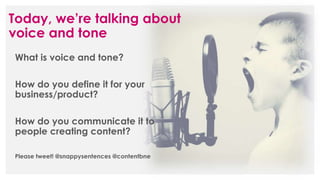
Today, we’re talking about
voice and tone
What is voice and tone?
How do you define it for your
business/product?
How do you communicate it to
people creating content?
Please tweet! @snappysentences @contentbne
• Have been working in the
digital content space
since 2001
• Previous clients include
Queensland Department
of Education, Bauer
Media and, most recently,
the University of Auckland.
• I help bridge the gap
between content,
technology and user
experience
A little bit about me
“You know your mum’s voice. Her
tone let’s you know if you’re in
trouble.”
The very wise Amanda Costello.
Voice helps define what sort of impression we want our customers to have of
our business
• How does our personality come through in conversations with our
customers?
Tone guides the choice of language for a particular situation
• How do we want our customers to feel when they are having a
conversation with us?
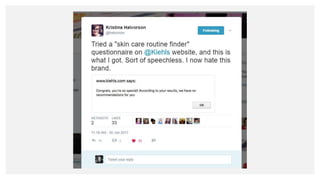
(Hint: Tone is often where brands come undone)
What is voice and tone?
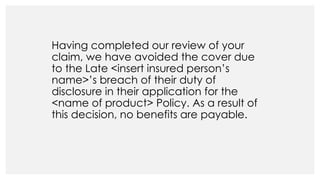
Having completed our review of your
claim, we have avoided the cover due
to the Late <insert insured person’s
name>’s breach of their duty of
disclosure in their application for the
<name of product> Policy. As a result of
this decision, no benefits are payable.
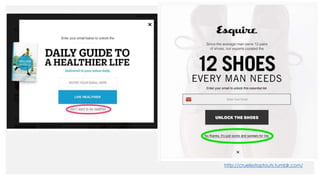
http://cruelestoptouts.tumblr.com/
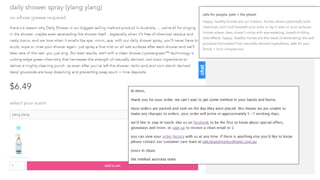
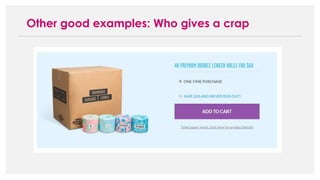
Other good examples: Who gives a crap
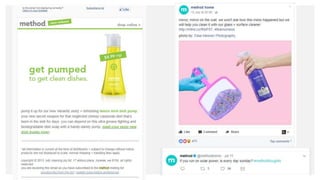
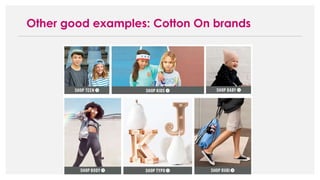
Other good examples: Cotton On brands
Consistent voice and appropriate
tone is about more than
marketing.
It builds trust, it creates
confidence, and it enhances the
customer experience.
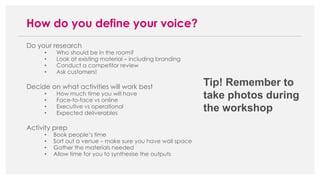
Do your research
• Who should be in the room?
• Look at existing material – including branding
• Conduct a competitor review
• Ask customers!
Decide on what activities will work best
• How much time you will have
• Face-to-face vs online
• Executive vs operational
• Expected deliverables
Activity prep
• Book people’s time
• Sort out a venue – make sure you have wall space
• Gather the materials needed
• Allow time for you to synthesise the outputs
How do you define your voice?
Tip! Remember to
take photos during
the workshop
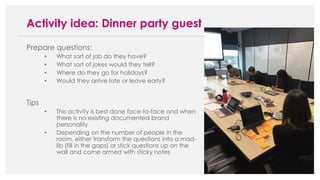
Prepare questions:
• What sort of job do they have?
• What sort of jokes would they tell?
• Where do they go for holidays?
• Would they arrive late or leave early?
Tips
• This activity is best done face-to-face and when
there is no existing documented brand
personality
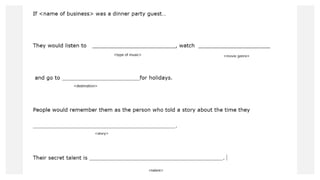
• Depending on the number of people in the
room, either transform the questions into a mad-
lib (fill in the gaps) or stick questions up on the
wall and come armed with sticky notes
Activity idea: Dinner party guest
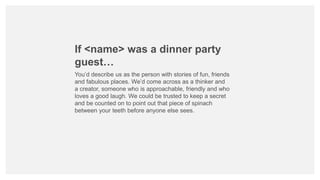
If <name> was a dinner party
guest…
You’d describe us as the person with stories of fun, friends
and fabulous places. We’d come across as a thinker and
a creator, someone who is approachable, friendly and who
loves a good laugh. We could be trusted to keep a secret
and be counted on to point out that piece of spinach
between your teeth before anyone else sees.
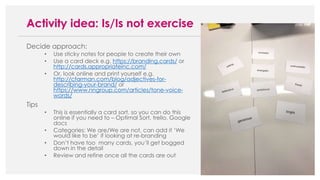
Decide approach:
• Use sticky notes for people to create their own
• Use a card deck e.g. https://branding.cards/ or
http://cards.appropriateinc.com/
• Or, look online and print yourself e.g.
http://cfarman.com/blog/adjectives-for-
describing-your-brand/ or
https://www.nngroup.com/articles/tone-voice-
words/
Tips
• This is essentially a card sort, so you can do this
online if you need to – Optimal Sort, trello, Google
docs
• Categories: We are/We are not, can add it ‘We
would like to be’ if looking at re-branding
• Don’t have too many cards, you’ll get bogged
down in the detail
• Review and refine once all the cards are out
Activity idea: Is/Is not exercise
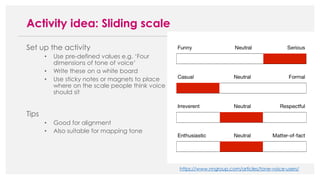
Set up the activity
• Use pre-defined values e.g. ‘Four
dimensions of tone of voice’
• Write these on a white board
• Use sticky notes or magnets to place
where on the scale people think voice
should sit
Tips
• Good for alignment
• Also suitable for mapping tone
Activity idea: Sliding scale
https://www.nngroup.com/articles/tone-voice-users/
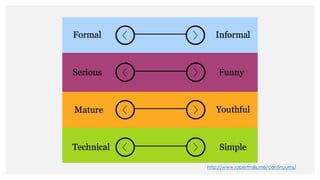
http://www.robertmills.me/continuums/
What are the touchpoints?
• Apps
• Chat bots
• Customer service
• Forms
• Email
• Social media
• Letters
• Brochures
• Microcopy/UI
Tips
• Not all will need separate guidelines
• Ask customers!
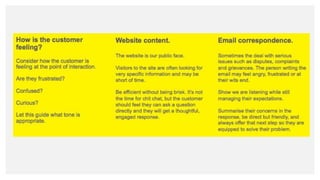
How do you define tone?
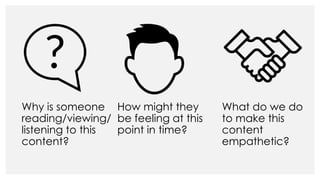
Why is someone
reading/viewing/
listening to this
content?
How might they
be feeling at this
point in time?
What do we do
to make this
content
empathetic?
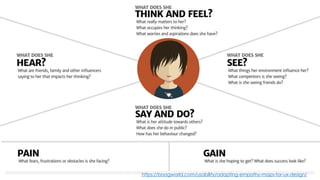
https://boagworld.com/usability/adapting-empathy-maps-for-ux-design/
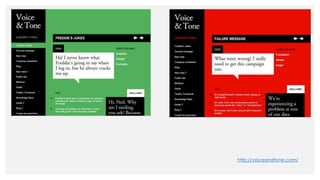
http://voiceandtone.com/
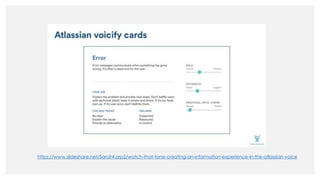
https://www.slideshare.net/SarahKarp2/watch-that-tone-creating-an-information-experience-in-the-atlassian-voice
Choose the best format:
• Online style guide
• Printed material (posters, cards, play books)
• CMS author tips
Provide examples of doing it right!
Don’t forget training
Communicating your voice and tone
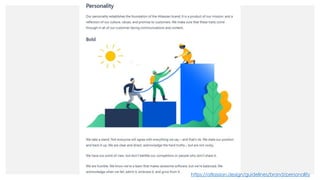
https://atlassian.design/guidelines/brand/personality
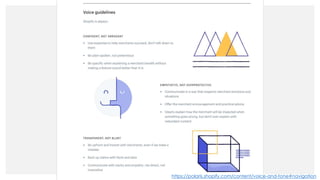
https://polaris.shopify.com/content/voice-and-tone#navigation
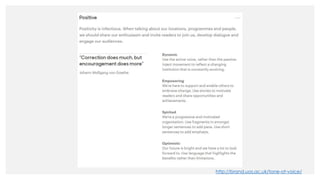
http://brand.uos.ac.uk/tone-of-voice/
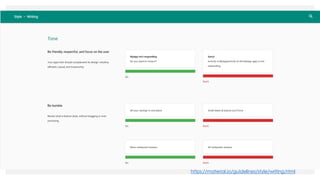
https://material.io/guidelines/style/writing.html
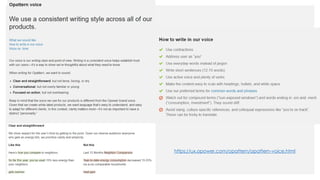
https://ux.opower.com/opattern/opattern-voice.html
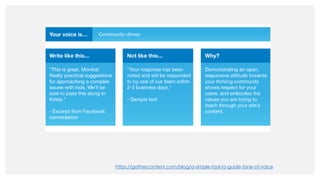
https://gathercontent.com/blog/a-simple-tool-to-guide-tone-of-voice
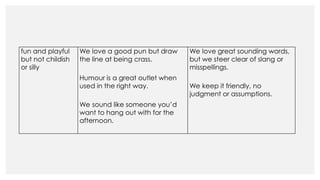
fun and playful
but not childish
or silly
We love a good pun but draw
the line at being crass.
Humour is a great outlet when
used in the right way.
We sound like someone you’d
want to hang out with for the
afternoon.
We love great sounding words,
but we steer clear of slang or
misspellings.
We keep it friendly, no
judgment or assumptions.
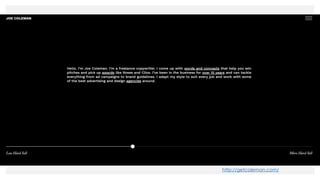
http://getcoleman.com/
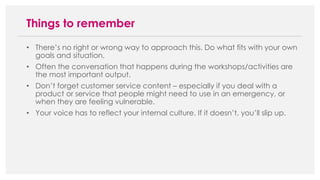
• There’s no right or wrong way to approach this. Do what fits with your own
goals and situation.
• Often the conversation that happens during the workshops/activities are
the most important output.
• Don’t forget customer service content – especially if you deal with a
product or service that people might need to use in an emergency, or
when they are feeling vulnerable.
• Your voice has to reflect your internal culture. If it doesn’t, you’ll slip up.
Things to remember
Questions?

Defining your brand's voice and tone

  • 1.
    Voice and tone Apresentation to the Brisbane Content Strategy meetup Prepared by Sally Bagshaw, Content Strategist, July 2017
  • 2.
    Today, we’re talkingabout voice and tone What is voice and tone? How do you define it for your business/product? How do you communicate it to people creating content? Please tweet! @snappysentences @contentbne
  • 3.
    • Have beenworking in the digital content space since 2001 • Previous clients include Queensland Department of Education, Bauer Media and, most recently, the University of Auckland. • I help bridge the gap between content, technology and user experience A little bit about me
  • 4.
    “You know yourmum’s voice. Her tone let’s you know if you’re in trouble.” The very wise Amanda Costello.
  • 5.
    Voice helps definewhat sort of impression we want our customers to have of our business • How does our personality come through in conversations with our customers? Tone guides the choice of language for a particular situation • How do we want our customers to feel when they are having a conversation with us? (Hint: Tone is often where brands come undone) What is voice and tone?
  • 13.
    Having completed ourreview of your claim, we have avoided the cover due to the Late <insert insured person’s name>’s breach of their duty of disclosure in their application for the <name of product> Policy. As a result of this decision, no benefits are payable.
  • 14.
  • 18.
    Other good examples:Who gives a crap
  • 19.
    Other good examples:Cotton On brands
  • 20.
    Consistent voice andappropriate tone is about more than marketing. It builds trust, it creates confidence, and it enhances the customer experience.
  • 21.
    Do your research •Who should be in the room? • Look at existing material – including branding • Conduct a competitor review • Ask customers! Decide on what activities will work best • How much time you will have • Face-to-face vs online • Executive vs operational • Expected deliverables Activity prep • Book people’s time • Sort out a venue – make sure you have wall space • Gather the materials needed • Allow time for you to synthesise the outputs How do you define your voice? Tip! Remember to take photos during the workshop
  • 22.
    Prepare questions: • Whatsort of job do they have? • What sort of jokes would they tell? • Where do they go for holidays? • Would they arrive late or leave early? Tips • This activity is best done face-to-face and when there is no existing documented brand personality • Depending on the number of people in the room, either transform the questions into a mad- lib (fill in the gaps) or stick questions up on the wall and come armed with sticky notes Activity idea: Dinner party guest
  • 24.
    If <name> wasa dinner party guest… You’d describe us as the person with stories of fun, friends and fabulous places. We’d come across as a thinker and a creator, someone who is approachable, friendly and who loves a good laugh. We could be trusted to keep a secret and be counted on to point out that piece of spinach between your teeth before anyone else sees.
  • 25.
    Decide approach: • Usesticky notes for people to create their own • Use a card deck e.g. https://branding.cards/ or http://cards.appropriateinc.com/ • Or, look online and print yourself e.g. http://cfarman.com/blog/adjectives-for- describing-your-brand/ or https://www.nngroup.com/articles/tone-voice- words/ Tips • This is essentially a card sort, so you can do this online if you need to – Optimal Sort, trello, Google docs • Categories: We are/We are not, can add it ‘We would like to be’ if looking at re-branding • Don’t have too many cards, you’ll get bogged down in the detail • Review and refine once all the cards are out Activity idea: Is/Is not exercise
  • 27.
    Set up theactivity • Use pre-defined values e.g. ‘Four dimensions of tone of voice’ • Write these on a white board • Use sticky notes or magnets to place where on the scale people think voice should sit Tips • Good for alignment • Also suitable for mapping tone Activity idea: Sliding scale https://www.nngroup.com/articles/tone-voice-users/
  • 28.
  • 29.
    What are thetouchpoints? • Apps • Chat bots • Customer service • Forms • Email • Social media • Letters • Brochures • Microcopy/UI Tips • Not all will need separate guidelines • Ask customers! How do you define tone?
  • 30.
    Why is someone reading/viewing/ listeningto this content? How might they be feeling at this point in time? What do we do to make this content empathetic?
  • 31.
  • 32.
  • 33.
  • 34.
    Choose the bestformat: • Online style guide • Printed material (posters, cards, play books) • CMS author tips Provide examples of doing it right! Don’t forget training Communicating your voice and tone
  • 35.
  • 36.
  • 37.
  • 38.
  • 39.
  • 40.
  • 41.
    fun and playful butnot childish or silly We love a good pun but draw the line at being crass. Humour is a great outlet when used in the right way. We sound like someone you’d want to hang out with for the afternoon. We love great sounding words, but we steer clear of slang or misspellings. We keep it friendly, no judgment or assumptions.
  • 43.
  • 44.
    • There’s noright or wrong way to approach this. Do what fits with your own goals and situation. • Often the conversation that happens during the workshops/activities are the most important output. • Don’t forget customer service content – especially if you deal with a product or service that people might need to use in an emergency, or when they are feeling vulnerable. • Your voice has to reflect your internal culture. If it doesn’t, you’ll slip up. Things to remember
  • 45.