Download to read offline

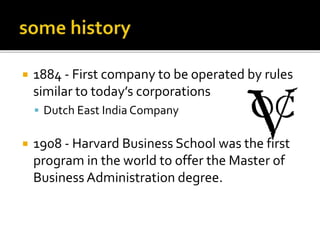

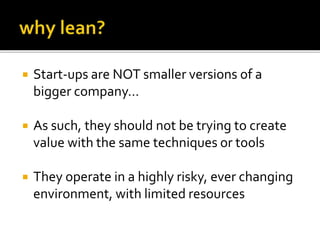

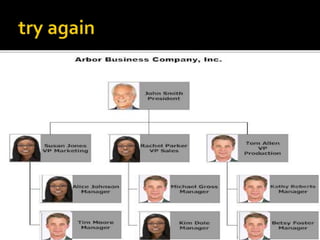
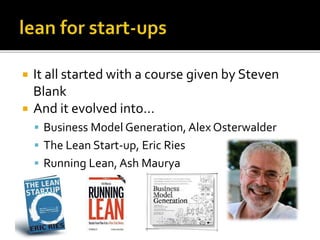
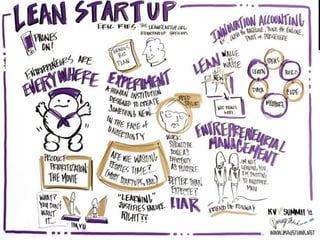
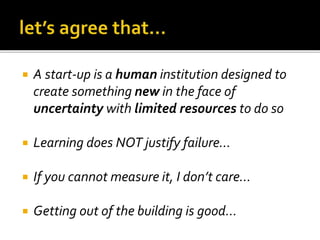
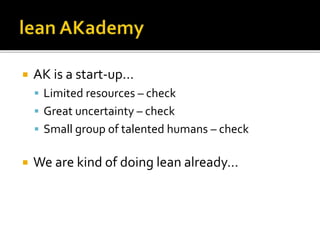
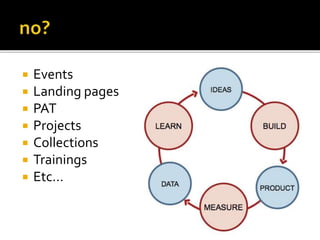
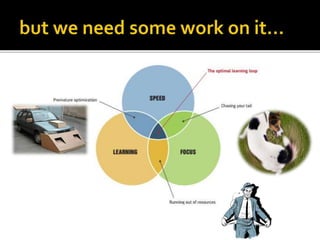

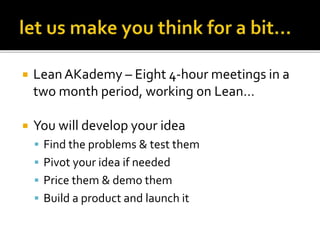


The document discusses the evolution of business education and the differences between managing large corporations versus startups. It notes that startups operate in risky environments with limited resources, so techniques used by large companies may not apply. The lean startup methodology emerged from courses on startups and books that focus on validating ideas and pivoting quickly. The document argues that the company discussed should take a lean startup approach, as it has the characteristics of a startup like uncertainty and limited resources. It proposes a LeanAKademy program to help develop and launch products using the lean methodology over two months.


![Αξιολόγηση Μαθησιακών Αντικειμένων και Σφραγίδες Ποιότητας [Εργαστήρια ΕΕΛ/ΛΑΚ]](https://cdn.slidesharecdn.com/ss_thumbnails/lori-badges-quality-eellak-181215-151218142440-thumbnail.jpg?width=640&height=640&fit=bounds)


![[Lean 101] Introduction to Lean - Preparing a Lean Canvas](https://cdn.slidesharecdn.com/ss_thumbnails/lean-101module100withbadge-151104125029-lva1-app6891-thumbnail.jpg?width=640&height=640&fit=bounds)


![[Lean 101] Bootstrapping & Getting Out of the Building](https://cdn.slidesharecdn.com/ss_thumbnails/lean-101module200withbadge-151104125427-lva1-app6892-thumbnail.jpg?width=640&height=640&fit=bounds)
![[Lean 101] Channels & Metrics - Reaching and Measuring](https://cdn.slidesharecdn.com/ss_thumbnails/lean-101module500withbadge-151104125932-lva1-app6891-thumbnail.jpg?width=640&height=640&fit=bounds)
![[Lean 101] Solution and Unique Value Proposition](https://cdn.slidesharecdn.com/ss_thumbnails/lean-101module600withbadge-151104125934-lva1-app6892-thumbnail.jpg?width=640&height=640&fit=bounds)

![[Lean 101] Costs & Revenues - Breaking even or Breaking bad???](https://cdn.slidesharecdn.com/ss_thumbnails/lean-101module400withbadge-151104125820-lva1-app6892-thumbnail.jpg?width=640&height=640&fit=bounds)
![[Lean 101] Learn, Adapt & Pivot](https://cdn.slidesharecdn.com/ss_thumbnails/lean-101module300withbadge-151104125558-lva1-app6892-thumbnail.jpg?width=640&height=640&fit=bounds)


