A publication of
Dr. Rajesh K Satpathy
Strategic
Product
Management
Competitors Present & Future
Objectives /PGDM/KIAMS/2021
Assessing Competitors Present
&
Future Objectives…
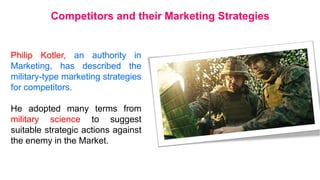
Philip Kotler, an authority in
Marketing, has described the
military-type marketing strategies
for competitors.
He adopted many terms from
military science to suggest
suitable strategic actions against
the enemy in the Market.
Competitors and their Marketing Strategies
1. Dominant:
The firm has control over other competitors. Naturally, it can enjoy more
freedom to select suitable strategic options.
2. Strong:
The firm doesn’t control behaviour of other competitors, but can take
independent actions without endangering its long-term position.
3. Favorable:
The firm is in position to exploit opportunities to improve its position. It has
to constantly adjust its strategies to continue enjoying the better-than-
average opportunities. It has to remain alert and struggle constantly.
Competitive Positions
4. Tenable (Average):
The firm has satisfactory performance, but has to suffer due to dominant
and strong competitors. It has less-than-average opportunities to improve
its position.
5. Weak:
The firm has unsatisfactory performance. However, there exists
opportunities to improve its position. It must change or adjust constantly to
exist.
6. Nonviable (non-survivable):
The firm has unsatisfactory performance and has no opportunity to
improve its performance and position.
Competitive Positions
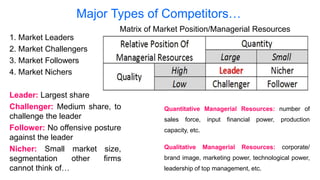
Major Types of Competitors…
1. Market Leaders
2. Market Challengers
3. Market Followers
4. Market Nichers
Leader: Largest share
Challenger: Medium share, to
challenge the leader
Follower: No offensive posture
against the leader
Nicher: Small market size,
segmentation other firms
cannot think of…
Matrix of Market Position/Managerial Resources
Quantitative Managerial Resources: number of
sales force, input financial power, production
capacity, etc.
Qualitative Managerial Resources: corporate/
brand image, marketing power, technological power,
leadership of top management, etc.
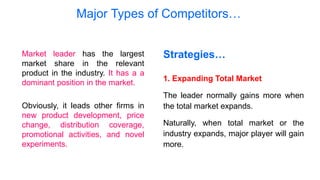
Major Types of Competitors…
Market leader has the largest
market share in the relevant
product in the industry. It has a a
dominant position in the market.
Obviously, it leads other firms in
new product development, price
change, distribution coverage,
promotional activities, and novel
experiments.
Strategies…
1. Expanding Total Market
The leader normally gains more when
the total market expands.
Naturally, when total market or the
industry expands, major player will gain
more.
Major Types of Competitors…
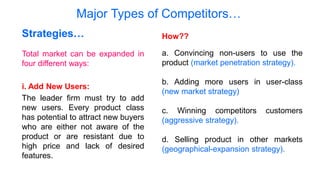
Total market can be expanded in
four different ways:
i. Add New Users:
The leader firm must try to add
new users. Every product class
has potential to attract new buyers
who are either not aware of the
product or are resistant due to
high price and lack of desired
features.
Strategies… How??
a. Convincing non-users to use the
product (market penetration strategy).
b. Adding more users in user-class
(new market strategy)
c. Winning competitors customers
(aggressive strategy).
d. Selling product in other markets
(geographical-expansion strategy).
Major Types of Competitors…
ii. Discover New Uses:
Another option to expand the total
market consists of discovering
and promoting new uses of the
existing products.
The strategy can be applied to
industrial products as well as
consumer products. A wise firm
can get idea regarding new uses
of product from customers
tactfully.
Strategies…
iii. More Usage per Occasion/Time:
The third strategy to expand the market
consists of convincing the present
users to use more of the product per
use occasion.
It is more applicable to edible-class
products. Similarly, it can be extended
to durable products, too. More usage
may be in forms of more quantity,
numbers, time, amount, intensity, and
so on.
Major Types of Competitors…
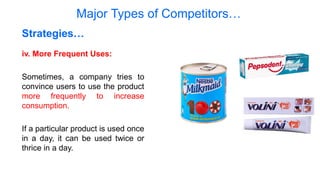
iv. More Frequent Uses:
Sometimes, a company tries to
convince users to use the product
more frequently to increase
consumption.
If a particular product is used once
in a day, it can be used twice or
thrice in a day.
Strategies…
Major Types of Competitors…
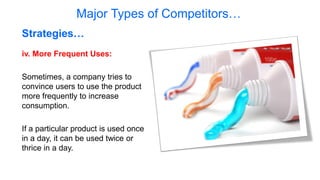
iv. More Frequent Uses:
Sometimes, a company tries to
convince users to use the product
more frequently to increase
consumption.
If a particular product is used once
in a day, it can be used twice or
thrice in a day.
Strategies…
Major Types of Competitors…
2. Defending Current Market Share:
This strategy is based on the theme:
‘Customer-retention is more profitable
than customer- creation.’
At any cost, the current market share
must not be endangered. While
expanding total market, a market
leader must continuously defend its
current market share against rivals’
attacks.
Strategies… There are six defense strategies:
i. Position Defense:
The most basic defense strategy is to
build an impregnable (indestructible,
unconquerable, or unbeatable)
fortification (protecting fort) around
one’s territory to keep the opponents
away.
It involves continuous innovation,
diversification, price-cuts, improving
distribution, and strengthening
promotional efforts.
Major Types of Competitors…
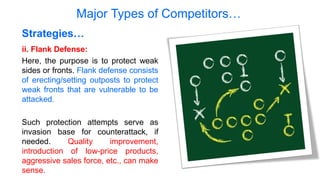
ii. Flank Defense:
Here, the purpose is to protect weak
sides or fronts. Flank defense consists
of erecting/setting outposts to protect
weak fronts that are vulnerable to be
attacked.
Such protection attempts serve as
invasion base for counterattack, if
needed. Quality improvement,
introduction of low-price products,
aggressive sales force, etc., can make
sense.
Strategies…
Major Types of Competitors…
Strategies…
iii. Preemptive or Preventive Defense:
The basic idea of preemptive defense is to launch the attack
before the enemy starts attacking.
It is like: To attack the enemy earlier to avoid enemy’s attack.
Playing the psychological games is very common to
discourage competitors’ maneuver (movement).
The company leaks the news by any of the media that it is
considering to cut price and/or planning to build another
plant. Such news intimidate (threaten) the competitors who
decide to cut price or enter the market with the existing or
new product.
Major Types of Competitors…
Strategies…
iv. Counteroffensive Defense:
Counteroffensive indicates responding
enemy’s attack with a counterattack.
The leader cannot remain passive
when competitor’s attacks in forms of
price-cut, product modification,
promotion blitz (bombardment), or any
time of invasion on its sales territories.
Leader firm has to undertake frontal,
i.e., head-on attack in case of rapid
erosion of market share.
v. Mobile Defense:
Mobile defense – also called shifting
defense – is much more than simply
protecting the territories.
The leader stretches or expands its
domain (area) over new territories that
can serve as the future centers for
offense as well as defense. A leader
will deploy its resources in such a way
to avoid the future invasion and create
an impression in mind of competitors
that leader is capable to safeguard its
territories.
Major Types of Competitors…
Strategies…
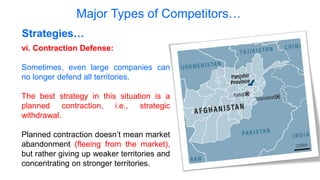
vi. Contraction Defense:
Sometimes, even large companies can
no longer defend all territories.
The best strategy in this situation is a
planned contraction, i.e., strategic
withdrawal.
Planned contraction doesn’t mean market
abandonment (fleeing from the market),
but rather giving up weaker territories and
concentrating on stronger territories.
Thank You !!

8A Strategic Product Management - Competitors Present & Future Objectives

  • 1.
    A publication of Dr.Rajesh K Satpathy Strategic Product Management Competitors Present & Future Objectives /PGDM/KIAMS/2021
  • 2.
  • 3.
    Philip Kotler, anauthority in Marketing, has described the military-type marketing strategies for competitors. He adopted many terms from military science to suggest suitable strategic actions against the enemy in the Market. Competitors and their Marketing Strategies
  • 4.
    1. Dominant: The firmhas control over other competitors. Naturally, it can enjoy more freedom to select suitable strategic options. 2. Strong: The firm doesn’t control behaviour of other competitors, but can take independent actions without endangering its long-term position. 3. Favorable: The firm is in position to exploit opportunities to improve its position. It has to constantly adjust its strategies to continue enjoying the better-than- average opportunities. It has to remain alert and struggle constantly. Competitive Positions
  • 5.
    4. Tenable (Average): Thefirm has satisfactory performance, but has to suffer due to dominant and strong competitors. It has less-than-average opportunities to improve its position. 5. Weak: The firm has unsatisfactory performance. However, there exists opportunities to improve its position. It must change or adjust constantly to exist. 6. Nonviable (non-survivable): The firm has unsatisfactory performance and has no opportunity to improve its performance and position. Competitive Positions
  • 6.
    Major Types ofCompetitors… 1. Market Leaders 2. Market Challengers 3. Market Followers 4. Market Nichers Leader: Largest share Challenger: Medium share, to challenge the leader Follower: No offensive posture against the leader Nicher: Small market size, segmentation other firms cannot think of… Matrix of Market Position/Managerial Resources Quantitative Managerial Resources: number of sales force, input financial power, production capacity, etc. Qualitative Managerial Resources: corporate/ brand image, marketing power, technological power, leadership of top management, etc.
  • 7.
    Major Types ofCompetitors… Market leader has the largest market share in the relevant product in the industry. It has a a dominant position in the market. Obviously, it leads other firms in new product development, price change, distribution coverage, promotional activities, and novel experiments. Strategies… 1. Expanding Total Market The leader normally gains more when the total market expands. Naturally, when total market or the industry expands, major player will gain more.
  • 8.
    Major Types ofCompetitors… Total market can be expanded in four different ways: i. Add New Users: The leader firm must try to add new users. Every product class has potential to attract new buyers who are either not aware of the product or are resistant due to high price and lack of desired features. Strategies… How?? a. Convincing non-users to use the product (market penetration strategy). b. Adding more users in user-class (new market strategy) c. Winning competitors customers (aggressive strategy). d. Selling product in other markets (geographical-expansion strategy).
  • 9.
    Major Types ofCompetitors… ii. Discover New Uses: Another option to expand the total market consists of discovering and promoting new uses of the existing products. The strategy can be applied to industrial products as well as consumer products. A wise firm can get idea regarding new uses of product from customers tactfully. Strategies… iii. More Usage per Occasion/Time: The third strategy to expand the market consists of convincing the present users to use more of the product per use occasion. It is more applicable to edible-class products. Similarly, it can be extended to durable products, too. More usage may be in forms of more quantity, numbers, time, amount, intensity, and so on.
  • 10.
    Major Types ofCompetitors… iv. More Frequent Uses: Sometimes, a company tries to convince users to use the product more frequently to increase consumption. If a particular product is used once in a day, it can be used twice or thrice in a day. Strategies…
  • 11.
    Major Types ofCompetitors… iv. More Frequent Uses: Sometimes, a company tries to convince users to use the product more frequently to increase consumption. If a particular product is used once in a day, it can be used twice or thrice in a day. Strategies…
  • 12.
    Major Types ofCompetitors… 2. Defending Current Market Share: This strategy is based on the theme: ‘Customer-retention is more profitable than customer- creation.’ At any cost, the current market share must not be endangered. While expanding total market, a market leader must continuously defend its current market share against rivals’ attacks. Strategies… There are six defense strategies: i. Position Defense: The most basic defense strategy is to build an impregnable (indestructible, unconquerable, or unbeatable) fortification (protecting fort) around one’s territory to keep the opponents away. It involves continuous innovation, diversification, price-cuts, improving distribution, and strengthening promotional efforts.
  • 13.
    Major Types ofCompetitors… ii. Flank Defense: Here, the purpose is to protect weak sides or fronts. Flank defense consists of erecting/setting outposts to protect weak fronts that are vulnerable to be attacked. Such protection attempts serve as invasion base for counterattack, if needed. Quality improvement, introduction of low-price products, aggressive sales force, etc., can make sense. Strategies…
  • 14.
    Major Types ofCompetitors… Strategies… iii. Preemptive or Preventive Defense: The basic idea of preemptive defense is to launch the attack before the enemy starts attacking. It is like: To attack the enemy earlier to avoid enemy’s attack. Playing the psychological games is very common to discourage competitors’ maneuver (movement). The company leaks the news by any of the media that it is considering to cut price and/or planning to build another plant. Such news intimidate (threaten) the competitors who decide to cut price or enter the market with the existing or new product.
  • 16.
    Major Types ofCompetitors… Strategies… iv. Counteroffensive Defense: Counteroffensive indicates responding enemy’s attack with a counterattack. The leader cannot remain passive when competitor’s attacks in forms of price-cut, product modification, promotion blitz (bombardment), or any time of invasion on its sales territories. Leader firm has to undertake frontal, i.e., head-on attack in case of rapid erosion of market share. v. Mobile Defense: Mobile defense – also called shifting defense – is much more than simply protecting the territories. The leader stretches or expands its domain (area) over new territories that can serve as the future centers for offense as well as defense. A leader will deploy its resources in such a way to avoid the future invasion and create an impression in mind of competitors that leader is capable to safeguard its territories.
  • 17.
    Major Types ofCompetitors… Strategies… vi. Contraction Defense: Sometimes, even large companies can no longer defend all territories. The best strategy in this situation is a planned contraction, i.e., strategic withdrawal. Planned contraction doesn’t mean market abandonment (fleeing from the market), but rather giving up weaker territories and concentrating on stronger territories.
  • 18.