Medicare college of nursing
multan
Submitted to:
Mam nuzhat sher
Submitted by:
Group 3
Anas razzaq
Rimsha hameed
M.saleem
Areeba yasin
Amoon abid
Defense coping mechanisms
History:
Freud began rudimentary investigations on Ego defense mechanisms in several of
his works.
The first comprehensive study of defense mechanisms was reported by Freud's
daughter Anna Freud in her landmark work, The Ego and the Mechanisms of
Defense (1937).
Anna Freud expanded her father's work by providing detailed descriptions of a
number of individual defense mechanisms.
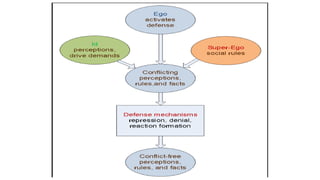
Id ego pic
Introduction:
Sigmund Freud in 1904 used this term "defence mechanism" to refer to the
unconscious process that defends or protects a person against anxiety, shame,
loss of self esteem, conflict or unacceptable feelings.
According to Freud, when Id is in serious conflict with ego and superego, the
individual suffer from tension or anxiety.
Defence mechanism enables a person to resolve conflict and reduce the stress
and anxiety.
Usually all defence mechanisms are operated unconscious level.
Most of defence mechanisms are self-deceptive in nature.
Definition:
“Defence mechanism is a pattern of adjustment through which an individual
relieves anxiety caused by an uncomfortable situation that threaten self-
esteem.”
When these defence mechanisms are used moderately are harmless but
excessive and persistent defence use is harmful.
Classification:
These defence mechanisms are classified according to its results-
Positive defence mechanism
Negative defence mechanism
POSITIVE DEFENCE MECHANISMS:-
1. Compensation
2. Substitution
3. Sublimation
4. Rationalization
5. Repression
6. Undoing
Cont….
7. Identification
& Transference
9. Intellectualization
10. Introjection
NEGATIVE DEFENCE MECHANISMS:-
1. Suppression
2. Displacement
3. Projection
4. Regression
5. Fixation
6. Fantasy
7. Reaction formation
8. Conversion
9. Dissociation
10. Denial
Compensation:
The term compensation refers to a type of defense mechanism in which
people overachieve in one area to compensate for failures in another.
Example:A student who fails in his studies may compensate by becoming the
college champion in atheletics
Substitution:
It is a mechanism by which tension and anxiety is reduced by replacing the
unachievable goal with achievable goal.
Eample:A student who has not been able to get admission MBBS course may
try to substitute it with a course of physiotherapy or nursing.
Sublimation:
Sublimation is a defense mechanism that involves channeling unwanted or
unacceptable urges into an admissible or productive outlet.
Example:
Rationalization:
Making up acceptable excues for unacceptable behavior.
Exaple:
Repression:
Repression occurs when a thought, memory, or feeling is too painful for an
individual, so the person unconsciously pushes the information out of
consciousness and becomes unaware of its existence.
Example:
Undoing:
Undoing is the attempt to take back an unconscious behavior or thought that is
unacceptable or hurtful.
Example:
Identification:
A conscious or unconscious attempt to model oneself after a respected
person.
Example:
Transference:
In transference, the image of one person is unconsciously identified with that of
another.
Example:
A patient who is fond of his daughter finds the nurse of the same age and height
as his daughter. So he transfer his positive emotions to the nurse as his daughter.
Intellectualization:
Intellectualization is an attempt to avoid expressing actual emotions associated
with a stressful situation by using the intellectual processes of logic, reasoning and
analysis.
Example:
Introjection:
In introjections the values and characteristics of significant persons are
incorporated in one's personality
Example:
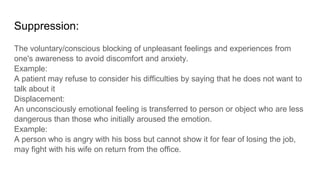
Suppression:
The voluntary/conscious blocking of unpleasant feelings and experiences from
one's awareness to avoid discomfort and anxiety.
Example:
A patient may refuse to consider his difficulties by saying that he does not want to
talk about it
Displacement:
An unconsciously emotional feeling is transferred to person or object who are less
dangerous than those who initially aroused the emotion.
Example:
A person who is angry with his boss but cannot show it for fear of losing the job,
may fight with his wife on return from the office.
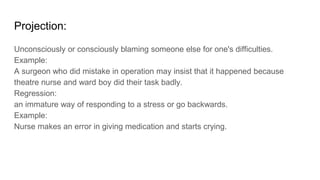
Projection:
Unconsciously or consciously blaming someone else for one's difficulties.
Example:
A surgeon who did mistake in operation may insist that it happened because
theatre nurse and ward boy did their task badly.
Regression:
an immature way of responding to a stress or go backwards.
Example:
Nurse makes an error in giving medication and starts crying.
Fixation:
Fixation refers to the point in the individual's development, at which certain
aspects of the emotional development do not advance.
Example:
Thumb sucking continuous till adult age
Fantasy:
Fantasy is used to gratify frustrated desires by imaginary achievements and
wishful thinking
Example:
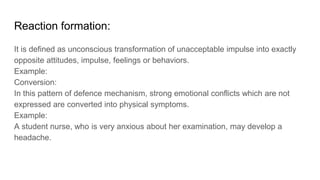
Reaction formation:
It is defined as unconscious transformation of unacceptable impulse into exactly
opposite attitudes, impulse, feelings or behaviors.
Example:
Conversion:
In this pattern of defence mechanism, strong emotional conflicts which are not
expressed are converted into physical symptoms.
Example:
A student nurse, who is very anxious about her examination, may develop a
headache.
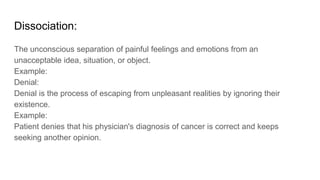
Dissociation:
The unconscious separation of painful feelings and emotions from an
unacceptable idea, situation, or object.
Example:
Denial:
Denial is the process of escaping from unpleasant realities by ignoring their
existence.
Example:
Patient denies that his physician's diagnosis of cancer is correct and keeps
seeking another opinion.

Defense coping mechanisms .pptx

  • 1.
    Medicare college ofnursing multan Submitted to: Mam nuzhat sher Submitted by: Group 3 Anas razzaq Rimsha hameed M.saleem Areeba yasin Amoon abid
  • 2.
  • 3.
    History: Freud began rudimentaryinvestigations on Ego defense mechanisms in several of his works. The first comprehensive study of defense mechanisms was reported by Freud's daughter Anna Freud in her landmark work, The Ego and the Mechanisms of Defense (1937). Anna Freud expanded her father's work by providing detailed descriptions of a number of individual defense mechanisms.
  • 4.
  • 5.
    Introduction: Sigmund Freud in1904 used this term "defence mechanism" to refer to the unconscious process that defends or protects a person against anxiety, shame, loss of self esteem, conflict or unacceptable feelings. According to Freud, when Id is in serious conflict with ego and superego, the individual suffer from tension or anxiety. Defence mechanism enables a person to resolve conflict and reduce the stress and anxiety. Usually all defence mechanisms are operated unconscious level. Most of defence mechanisms are self-deceptive in nature.
  • 7.
    Definition: “Defence mechanism isa pattern of adjustment through which an individual relieves anxiety caused by an uncomfortable situation that threaten self- esteem.” When these defence mechanisms are used moderately are harmless but excessive and persistent defence use is harmful.
  • 8.
    Classification: These defence mechanismsare classified according to its results- Positive defence mechanism Negative defence mechanism POSITIVE DEFENCE MECHANISMS:- 1. Compensation 2. Substitution 3. Sublimation 4. Rationalization 5. Repression 6. Undoing
  • 9.
    Cont…. 7. Identification & Transference 9.Intellectualization 10. Introjection NEGATIVE DEFENCE MECHANISMS:- 1. Suppression 2. Displacement 3. Projection 4. Regression 5. Fixation 6. Fantasy 7. Reaction formation 8. Conversion 9. Dissociation 10. Denial
  • 10.
    Compensation: The term compensationrefers to a type of defense mechanism in which people overachieve in one area to compensate for failures in another. Example:A student who fails in his studies may compensate by becoming the college champion in atheletics Substitution: It is a mechanism by which tension and anxiety is reduced by replacing the unachievable goal with achievable goal. Eample:A student who has not been able to get admission MBBS course may try to substitute it with a course of physiotherapy or nursing.
  • 11.
    Sublimation: Sublimation is adefense mechanism that involves channeling unwanted or unacceptable urges into an admissible or productive outlet. Example: Rationalization: Making up acceptable excues for unacceptable behavior. Exaple:
  • 12.
    Repression: Repression occurs whena thought, memory, or feeling is too painful for an individual, so the person unconsciously pushes the information out of consciousness and becomes unaware of its existence. Example: Undoing: Undoing is the attempt to take back an unconscious behavior or thought that is unacceptable or hurtful. Example:
  • 13.
    Identification: A conscious orunconscious attempt to model oneself after a respected person. Example: Transference: In transference, the image of one person is unconsciously identified with that of another. Example: A patient who is fond of his daughter finds the nurse of the same age and height as his daughter. So he transfer his positive emotions to the nurse as his daughter.
  • 14.
    Intellectualization: Intellectualization is anattempt to avoid expressing actual emotions associated with a stressful situation by using the intellectual processes of logic, reasoning and analysis. Example: Introjection: In introjections the values and characteristics of significant persons are incorporated in one's personality Example:
  • 15.
    Suppression: The voluntary/conscious blockingof unpleasant feelings and experiences from one's awareness to avoid discomfort and anxiety. Example: A patient may refuse to consider his difficulties by saying that he does not want to talk about it Displacement: An unconsciously emotional feeling is transferred to person or object who are less dangerous than those who initially aroused the emotion. Example: A person who is angry with his boss but cannot show it for fear of losing the job, may fight with his wife on return from the office.
  • 16.
    Projection: Unconsciously or consciouslyblaming someone else for one's difficulties. Example: A surgeon who did mistake in operation may insist that it happened because theatre nurse and ward boy did their task badly. Regression: an immature way of responding to a stress or go backwards. Example: Nurse makes an error in giving medication and starts crying.
  • 17.
    Fixation: Fixation refers tothe point in the individual's development, at which certain aspects of the emotional development do not advance. Example: Thumb sucking continuous till adult age Fantasy: Fantasy is used to gratify frustrated desires by imaginary achievements and wishful thinking Example:
  • 18.
    Reaction formation: It isdefined as unconscious transformation of unacceptable impulse into exactly opposite attitudes, impulse, feelings or behaviors. Example: Conversion: In this pattern of defence mechanism, strong emotional conflicts which are not expressed are converted into physical symptoms. Example: A student nurse, who is very anxious about her examination, may develop a headache.
  • 19.
    Dissociation: The unconscious separationof painful feelings and emotions from an unacceptable idea, situation, or object. Example: Denial: Denial is the process of escaping from unpleasant realities by ignoring their existence. Example: Patient denies that his physician's diagnosis of cancer is correct and keeps seeking another opinion.