



Deep Learning Using TensorFlow
Agenda
▪ Why Artificial Intelligence?
▪ What Is Artificial Intelligence?
▪ Subsets Of Artificial Intelligence
▪ What Is Machine Learning?
▪ Limitations Of Machine Learning
▪ What Is Deep Learning And How It Works?
▪ Single Layer Perceptron
▪ Limitations Of Single Layer Perceptron
▪ Multi Layer Perceptron
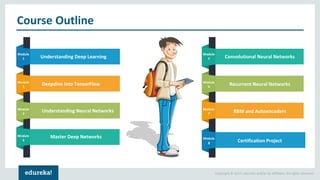
▪ Course Outline
Copyright © 2017, edureka and/or its affiliates. All rights reserved.
Why Artificial Intelligence?
Let’s first understand why we need Artificial Intelligence.
Copyright © 2017, edureka and/or its affiliates. All rights reserved.
Why Artificial Intelligence?
Let’s understand this with an example:
If a car exceeds the speed limit, then for a human to monitor and note down all the
numbers is not possible.
Copyright © 2017, edureka and/or its affiliates. All rights reserved.
Why Artificial Intelligence?
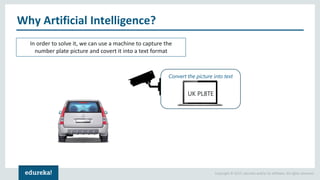
In order to solve it, we can use a machine to capture the
number plate picture and covert it into a text format
Convert the picture into text
UK PL8TE
Copyright © 2017, edureka and/or its affiliates. All rights reserved.
What Is Artificial Intelligence?
Now is the time to understand what exactly is Artificial Intelligence.
Copyright © 2017, edureka and/or its affiliates. All rights reserved.
What Is Artificial Intelligence?
Artificial Intelligence is the capability of a machine to imitate
intelligent human behavior.
AI is accomplished by studying how
human brain thinks, and how humans
learn, decide, and work while trying to
solve a problem
Outcomes of this study is used as a
basis of developing intelligent software
and systems.
Copyright © 2017, edureka and/or its affiliates. All rights reserved.
Subsets Of Artificial Intelligence
Copyright © 2017, edureka and/or its affiliates. All rights reserved.
Subsets Of Artificial Intelligence
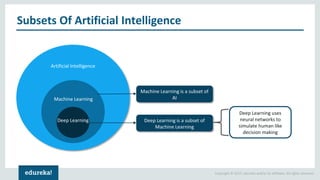
Artificial Intelligence
Machine Learning
Deep Learning Deep Learning is a subset of
Machine Learning
Machine Learning is a subset of
AI
Deep Learning uses
neural networks to
simulate human like
decision making
Copyright © 2017, edureka and/or its affiliates. All rights reserved.
Machine Learning
Let’s understand what is Machine Learning.
Copyright © 2017, edureka and/or its affiliates. All rights reserved.
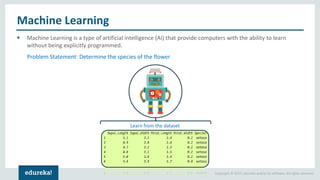
Machine Learning
▪ Machine Learning is a type of artificial intelligence (AI) that provide computers with the ability to learn
without being explicitly programmed.
Problem Statement: Determine the species of the flower
Learn from the dataset
Copyright © 2017, edureka and/or its affiliates. All rights reserved.
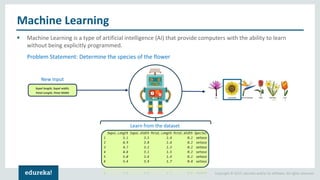
Machine Learning
▪ Machine Learning is a type of artificial intelligence (AI) that provide computers with the ability to learn
without being explicitly programmed.
Problem Statement: Determine the species of the flower
New Input
Sepal length, Sepal width,
Petal Length, Petal Width
Learn from the dataset
Copyright © 2017, edureka and/or its affiliates. All rights reserved.
Limitations Of Machine Learning
Let’s understand, even when Machine Learning is present why we need Deep Learning.
Copyright © 2017, edureka and/or its affiliates. All rights reserved.
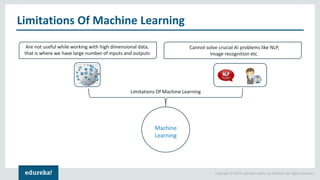
Limitations Of Machine Learning
Cannot solve crucial AI problems like NLP,
Image recognition etc.
Are not useful while working with high dimensional data,
that is where we have large number of inputs and outputs
Machine
Learning
Limitations Of Machine Learning
Copyright © 2017, edureka and/or its affiliates. All rights reserved.
Limitations Of Machine Learning
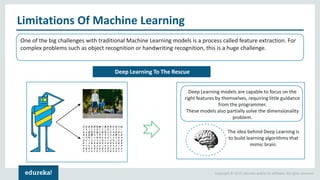
One of the big challenges with traditional Machine Learning models is a process called feature extraction. For
complex problems such as object recognition or handwriting recognition, this is a huge challenge.
Deep Learning To The Rescue
The idea behind Deep Learning is
to build learning algorithms that
mimic brain.
Deep Learning models are capable to focus on the
right features by themselves, requiring little guidance
from the programmer.
These models also partially solve the dimensionality
problem.
Copyright © 2017, edureka and/or its affiliates. All rights reserved.
Lets Take a Look at
Deep Learning Applications
Copyright © 2017, edureka and/or its affiliates. All rights reserved.
Applications of Deep Learning
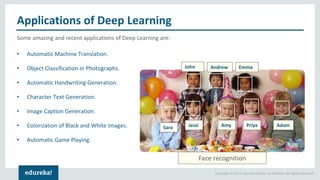
Some amazing and recent applications of Deep Learning are:
• Automatic Machine Translation.
• Object Classification in Photographs.
• Automatic Handwriting Generation.
• Character Text Generation.
• Image Caption Generation.
• Colorization of Black and White Images.
• Automatic Game Playing.
Face recognition
Sara Jessi Amy Priya Adam
EmmaAndrewJohn
Copyright © 2017, edureka and/or its affiliates. All rights reserved.
Applications of Deep Learning - Google Lens
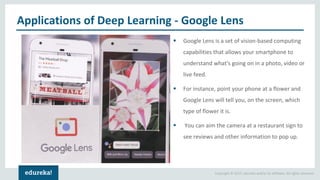
▪ Google Lens is a set of vision-based computing
capabilities that allows your smartphone to
understand what's going on in a photo, video or
live feed.
▪ For instance, point your phone at a flower and
Google Lens will tell you, on the screen, which
type of flower it is.
▪ You can aim the camera at a restaurant sign to
see reviews and other information to pop up.
Copyright © 2017, edureka and/or its affiliates. All rights reserved.
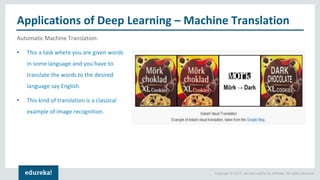
Applications of Deep Learning – Machine Translation
Automatic Machine Translation:
• This a task where you are given words
in some language and you have to
translate the words to the desired
language say English.
• This kind of translation is a classical
example of Image recognition.
Copyright © 2017, edureka and/or its affiliates. All rights reserved.
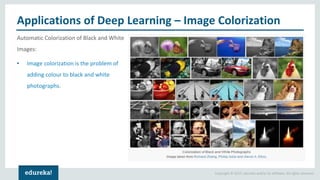
Applications of Deep Learning – Image Colorization
Automatic Colorization of Black and White
Images:
• Image colorization is the problem of
adding colour to black and white
photographs.
Copyright © 2017, edureka and/or its affiliates. All rights reserved.
How Deep Learning Works?
Copyright © 2017, edureka and/or its affiliates. All rights reserved.
How Deep Learning Works?
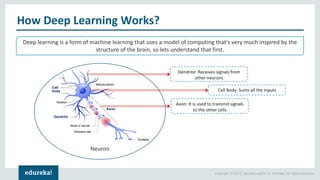
Deep learning is a form of machine learning that uses a model of computing that's very much inspired by the
structure of the brain, so lets understand that first.
Neuron
Dendrite: Receives signals from
other neurons
Cell Body: Sums all the inputs
Axon: It is used to transmit signals
to the other cells
Copyright © 2017, edureka and/or its affiliates. All rights reserved.
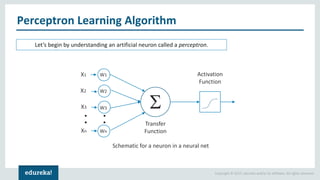
Perceptron Learning Algorithm
Let’s begin by understanding an artificial neuron called a perceptron.
X1
X2
X3
Xn
W1
W2
W3
Wn
Transfer
Function
Activation
Function
Schematic for a neuron in a neural net
Copyright © 2017, edureka and/or its affiliates. All rights reserved.
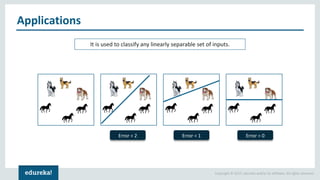
Applications
It is used to classify any linearly separable set of inputs.
Error = 2 Error = 1 Error = 0
Copyright © 2017, edureka and/or its affiliates. All rights reserved.
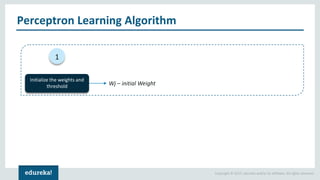
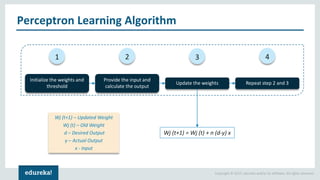
Perceptron Learning Algorithm
Initialize the weights and
threshold
1
Wj – initial Weight
Copyright © 2017, edureka and/or its affiliates. All rights reserved.
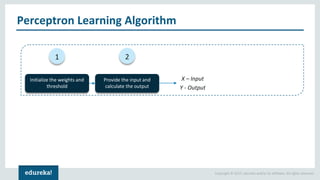
Perceptron Learning Algorithm
Provide the input and
calculate the output
Initialize the weights and
threshold
1 2
X – Input
Y - Output
Copyright © 2017, edureka and/or its affiliates. All rights reserved.
Perceptron Learning Algorithm
Provide the input and
calculate the output
Initialize the weights and
threshold
Update the weights Repeat step 2 and 3
1 2 3 4
Wj (t+1) = Wj (t) + n (d-y) x
Wj (t+1) – Updated Weight
Wj (t) – Old Weight
d – Desired Output
y – Actual Output
x - Input
Copyright © 2017, edureka and/or its affiliates. All rights reserved.
Example Of Perceptron
Copyright © 2017, edureka and/or its affiliates. All rights reserved.
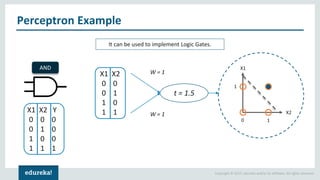
Perceptron Example
It can be used to implement Logic Gates.
AND
X1 X2 Y
0 0 0
0 1 0
1 0 0
1 1 1
t = 1.5
W = 1
W = 1
X1 X2
0 0
0 1
1 0
1 1
1
0 1
X1
X2
Copyright © 2017, edureka and/or its affiliates. All rights reserved.
Limitations Of Single Layer Perceptron
Copyright © 2017, edureka and/or its affiliates. All rights reserved.
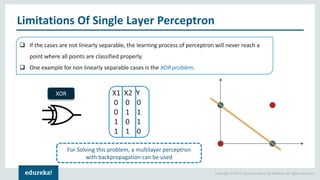
Limitations Of Single Layer Perceptron
XOR X1 X2 Y
0 0 0
0 1 1
1 0 1
1 1 0
 If the cases are not linearly separable, the learning process of perceptron will never reach a
point where all points are classified properly.
 One example for non linearly separable cases is the XOR problem.
For Solving this problem, a multilayer perceptron
with backpropagation can be used
Copyright © 2017, edureka and/or its affiliates. All rights reserved.
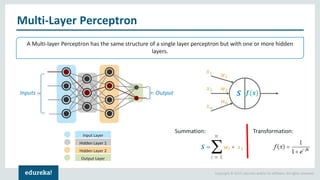
Multi-Layer Perceptron
A Multi-layer Perceptron has the same structure of a single layer perceptron but with one or more hidden
layers.
Summation:
𝑺 = 𝑤𝑖 ∗ 𝑥1
𝑖 = 1
𝑛
Transformation:
Input Layer
Hidden Layer 1
Hidden Layer 2
Output Layer
Inputs Output
Copyright © 2017, edureka and/or its affiliates. All rights reserved.
Multi Layer Perceptron Use-Case
Copyright © 2017, edureka and/or its affiliates. All rights reserved.
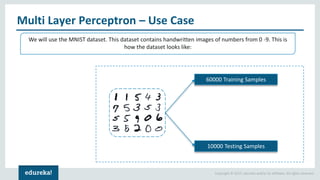
Multi Layer Perceptron – Use Case
We will use the MNIST dataset. This dataset contains handwritten images of numbers from 0 -9. This is
how the dataset looks like:
60000 Training Samples
10000 Testing Samples
Copyright © 2017, edureka and/or its affiliates. All rights reserved.
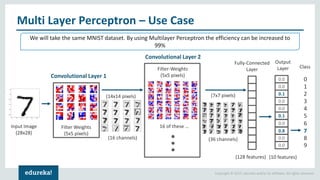
Multi Layer Perceptron – Use Case
Input Image
(28x28)
Filter Weights
(5x5 pixels)
(14x14 pixels)
(16 channels)
(7x7 pixels)
(36 channels)
Filter-Weights
(5x5 pixels)
16 of these …
0.0
0.0
0.1
0.0
0.0
0.1
0.0
0.8
0.0
0.0
0
1
2
3
4
5
6
7
8
9
Fully-Connected
Layer
Output
Layer Class
Convolutional Layer 1
Convolutional Layer 2
(128 features) (10 features)
We will take the same MNIST dataset. By using Multilayer Perceptron the efficiency can be increased to
99%
Copyright © 2017, edureka and/or its affiliates. All rights reserved.
Course Outline
Copyright © 2017, edureka and/or its affiliates. All rights reserved.
Module
1
Module
2
Module
3
Module
4
Module
5
Module
6
Module
7
Module
8
Course Outline
Understanding Deep Learning
Understanding Neural Networks
Master Deep Networks
Deepdive into TensorFlow
Convolutional Neural Networks
Recurrent Neural Networks
RBM and Autoencoders
Certification Project
Copyright © 2017, edureka and/or its affiliates. All rights reserved.
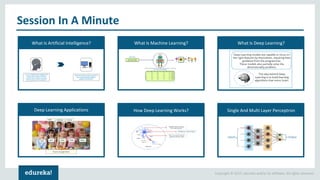
Session In A Minute
What Is Artificial Intelligence? What Is Machine Learning? What Is Deep Learning?
Deep Learning Applications How Deep Learning Works? Single And Multi Layer Perceptron
Copyright © 2017, edureka and/or its affiliates. All rights reserved.
AI & Deep Learning with TensorFlow
T e n s o r F l o w W I T H E D U R E K A
Go to www.edureka.co/ai-deep-learning-with-tensorflow
Copyright © 2017, edureka and/or its affiliates. All rights reserved.
Deep Learning Using TensorFlow | TensorFlow Tutorial | AI & Deep Learning Training | Edureka

Deep Learning Using TensorFlow | TensorFlow Tutorial | AI & Deep Learning Training | Edureka

  • 1.
  • 2.
    Agenda ▪ Why ArtificialIntelligence? ▪ What Is Artificial Intelligence? ▪ Subsets Of Artificial Intelligence ▪ What Is Machine Learning? ▪ Limitations Of Machine Learning ▪ What Is Deep Learning And How It Works? ▪ Single Layer Perceptron ▪ Limitations Of Single Layer Perceptron ▪ Multi Layer Perceptron ▪ Course Outline
  • 3.
    Copyright © 2017,edureka and/or its affiliates. All rights reserved. Why Artificial Intelligence? Let’s first understand why we need Artificial Intelligence.
  • 4.
    Copyright © 2017,edureka and/or its affiliates. All rights reserved. Why Artificial Intelligence? Let’s understand this with an example: If a car exceeds the speed limit, then for a human to monitor and note down all the numbers is not possible.
  • 5.
    Copyright © 2017,edureka and/or its affiliates. All rights reserved. Why Artificial Intelligence? In order to solve it, we can use a machine to capture the number plate picture and covert it into a text format Convert the picture into text UK PL8TE
  • 6.
    Copyright © 2017,edureka and/or its affiliates. All rights reserved. What Is Artificial Intelligence? Now is the time to understand what exactly is Artificial Intelligence.
  • 7.
    Copyright © 2017,edureka and/or its affiliates. All rights reserved. What Is Artificial Intelligence? Artificial Intelligence is the capability of a machine to imitate intelligent human behavior. AI is accomplished by studying how human brain thinks, and how humans learn, decide, and work while trying to solve a problem Outcomes of this study is used as a basis of developing intelligent software and systems.
  • 8.
    Copyright © 2017,edureka and/or its affiliates. All rights reserved. Subsets Of Artificial Intelligence
  • 9.
    Copyright © 2017,edureka and/or its affiliates. All rights reserved. Subsets Of Artificial Intelligence Artificial Intelligence Machine Learning Deep Learning Deep Learning is a subset of Machine Learning Machine Learning is a subset of AI Deep Learning uses neural networks to simulate human like decision making
  • 10.
    Copyright © 2017,edureka and/or its affiliates. All rights reserved. Machine Learning Let’s understand what is Machine Learning.
  • 11.
    Copyright © 2017,edureka and/or its affiliates. All rights reserved. Machine Learning ▪ Machine Learning is a type of artificial intelligence (AI) that provide computers with the ability to learn without being explicitly programmed. Problem Statement: Determine the species of the flower Learn from the dataset
  • 12.
    Copyright © 2017,edureka and/or its affiliates. All rights reserved. Machine Learning ▪ Machine Learning is a type of artificial intelligence (AI) that provide computers with the ability to learn without being explicitly programmed. Problem Statement: Determine the species of the flower New Input Sepal length, Sepal width, Petal Length, Petal Width Learn from the dataset
  • 13.
    Copyright © 2017,edureka and/or its affiliates. All rights reserved. Limitations Of Machine Learning Let’s understand, even when Machine Learning is present why we need Deep Learning.
  • 14.
    Copyright © 2017,edureka and/or its affiliates. All rights reserved. Limitations Of Machine Learning Cannot solve crucial AI problems like NLP, Image recognition etc. Are not useful while working with high dimensional data, that is where we have large number of inputs and outputs Machine Learning Limitations Of Machine Learning
  • 15.
    Copyright © 2017,edureka and/or its affiliates. All rights reserved. Limitations Of Machine Learning One of the big challenges with traditional Machine Learning models is a process called feature extraction. For complex problems such as object recognition or handwriting recognition, this is a huge challenge. Deep Learning To The Rescue The idea behind Deep Learning is to build learning algorithms that mimic brain. Deep Learning models are capable to focus on the right features by themselves, requiring little guidance from the programmer. These models also partially solve the dimensionality problem.
  • 16.
    Copyright © 2017,edureka and/or its affiliates. All rights reserved. Lets Take a Look at Deep Learning Applications
  • 17.
    Copyright © 2017,edureka and/or its affiliates. All rights reserved. Applications of Deep Learning Some amazing and recent applications of Deep Learning are: • Automatic Machine Translation. • Object Classification in Photographs. • Automatic Handwriting Generation. • Character Text Generation. • Image Caption Generation. • Colorization of Black and White Images. • Automatic Game Playing. Face recognition Sara Jessi Amy Priya Adam EmmaAndrewJohn
  • 18.
    Copyright © 2017,edureka and/or its affiliates. All rights reserved. Applications of Deep Learning - Google Lens ▪ Google Lens is a set of vision-based computing capabilities that allows your smartphone to understand what's going on in a photo, video or live feed. ▪ For instance, point your phone at a flower and Google Lens will tell you, on the screen, which type of flower it is. ▪ You can aim the camera at a restaurant sign to see reviews and other information to pop up.
  • 19.
    Copyright © 2017,edureka and/or its affiliates. All rights reserved. Applications of Deep Learning – Machine Translation Automatic Machine Translation: • This a task where you are given words in some language and you have to translate the words to the desired language say English. • This kind of translation is a classical example of Image recognition.
  • 20.
    Copyright © 2017,edureka and/or its affiliates. All rights reserved. Applications of Deep Learning – Image Colorization Automatic Colorization of Black and White Images: • Image colorization is the problem of adding colour to black and white photographs.
  • 21.
    Copyright © 2017,edureka and/or its affiliates. All rights reserved. How Deep Learning Works?
  • 22.
    Copyright © 2017,edureka and/or its affiliates. All rights reserved. How Deep Learning Works? Deep learning is a form of machine learning that uses a model of computing that's very much inspired by the structure of the brain, so lets understand that first. Neuron Dendrite: Receives signals from other neurons Cell Body: Sums all the inputs Axon: It is used to transmit signals to the other cells
  • 23.
    Copyright © 2017,edureka and/or its affiliates. All rights reserved. Perceptron Learning Algorithm Let’s begin by understanding an artificial neuron called a perceptron. X1 X2 X3 Xn W1 W2 W3 Wn Transfer Function Activation Function Schematic for a neuron in a neural net
  • 24.
    Copyright © 2017,edureka and/or its affiliates. All rights reserved. Applications It is used to classify any linearly separable set of inputs. Error = 2 Error = 1 Error = 0
  • 25.
    Copyright © 2017,edureka and/or its affiliates. All rights reserved. Perceptron Learning Algorithm Initialize the weights and threshold 1 Wj – initial Weight
  • 26.
    Copyright © 2017,edureka and/or its affiliates. All rights reserved. Perceptron Learning Algorithm Provide the input and calculate the output Initialize the weights and threshold 1 2 X – Input Y - Output
  • 27.
    Copyright © 2017,edureka and/or its affiliates. All rights reserved. Perceptron Learning Algorithm Provide the input and calculate the output Initialize the weights and threshold Update the weights Repeat step 2 and 3 1 2 3 4 Wj (t+1) = Wj (t) + n (d-y) x Wj (t+1) – Updated Weight Wj (t) – Old Weight d – Desired Output y – Actual Output x - Input
  • 28.
    Copyright © 2017,edureka and/or its affiliates. All rights reserved. Example Of Perceptron
  • 29.
    Copyright © 2017,edureka and/or its affiliates. All rights reserved. Perceptron Example It can be used to implement Logic Gates. AND X1 X2 Y 0 0 0 0 1 0 1 0 0 1 1 1 t = 1.5 W = 1 W = 1 X1 X2 0 0 0 1 1 0 1 1 1 0 1 X1 X2
  • 30.
    Copyright © 2017,edureka and/or its affiliates. All rights reserved. Limitations Of Single Layer Perceptron
  • 31.
    Copyright © 2017,edureka and/or its affiliates. All rights reserved. Limitations Of Single Layer Perceptron XOR X1 X2 Y 0 0 0 0 1 1 1 0 1 1 1 0  If the cases are not linearly separable, the learning process of perceptron will never reach a point where all points are classified properly.  One example for non linearly separable cases is the XOR problem. For Solving this problem, a multilayer perceptron with backpropagation can be used
  • 32.
    Copyright © 2017,edureka and/or its affiliates. All rights reserved. Multi-Layer Perceptron A Multi-layer Perceptron has the same structure of a single layer perceptron but with one or more hidden layers. Summation: 𝑺 = 𝑤𝑖 ∗ 𝑥1 𝑖 = 1 𝑛 Transformation: Input Layer Hidden Layer 1 Hidden Layer 2 Output Layer Inputs Output
  • 33.
    Copyright © 2017,edureka and/or its affiliates. All rights reserved. Multi Layer Perceptron Use-Case
  • 34.
    Copyright © 2017,edureka and/or its affiliates. All rights reserved. Multi Layer Perceptron – Use Case We will use the MNIST dataset. This dataset contains handwritten images of numbers from 0 -9. This is how the dataset looks like: 60000 Training Samples 10000 Testing Samples
  • 35.
    Copyright © 2017,edureka and/or its affiliates. All rights reserved. Multi Layer Perceptron – Use Case Input Image (28x28) Filter Weights (5x5 pixels) (14x14 pixels) (16 channels) (7x7 pixels) (36 channels) Filter-Weights (5x5 pixels) 16 of these … 0.0 0.0 0.1 0.0 0.0 0.1 0.0 0.8 0.0 0.0 0 1 2 3 4 5 6 7 8 9 Fully-Connected Layer Output Layer Class Convolutional Layer 1 Convolutional Layer 2 (128 features) (10 features) We will take the same MNIST dataset. By using Multilayer Perceptron the efficiency can be increased to 99%
  • 36.
    Copyright © 2017,edureka and/or its affiliates. All rights reserved. Course Outline
  • 37.
    Copyright © 2017,edureka and/or its affiliates. All rights reserved. Module 1 Module 2 Module 3 Module 4 Module 5 Module 6 Module 7 Module 8 Course Outline Understanding Deep Learning Understanding Neural Networks Master Deep Networks Deepdive into TensorFlow Convolutional Neural Networks Recurrent Neural Networks RBM and Autoencoders Certification Project
  • 38.
    Copyright © 2017,edureka and/or its affiliates. All rights reserved. Session In A Minute What Is Artificial Intelligence? What Is Machine Learning? What Is Deep Learning? Deep Learning Applications How Deep Learning Works? Single And Multi Layer Perceptron
  • 39.
    Copyright © 2017,edureka and/or its affiliates. All rights reserved. AI & Deep Learning with TensorFlow T e n s o r F l o w W I T H E D U R E K A Go to www.edureka.co/ai-deep-learning-with-tensorflow
  • 40.
    Copyright © 2017,edureka and/or its affiliates. All rights reserved.