About Me
Madhu Babu Sanjeevi,
Software Engineer,
Languages C, Java, Python
Technologies Machine Learning, Deep Learning,
NLP, Big data, Mobile dev.
Developments Android, Web, Rest API
Databases SQL, Mongo DB
Madhu Sanjeevi Madhu009 Madhu.ai
Agenda
•1.Introduction of Neural Networks
•2.Forward and Back propagation
algorithms
•3.Different types of Neural Networks
•4.Neural Networks Demo
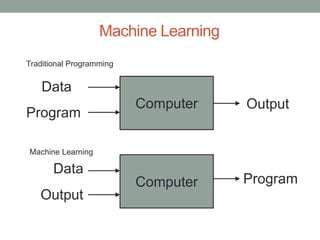
Machine Learning
Computer
Data
Program
Output
Computer
Data
Output
Program
Traditional Programming
Machine Learning
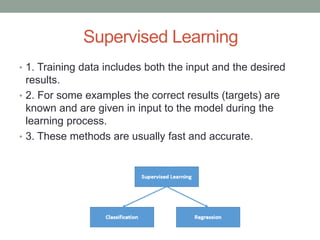
Supervised Learning
• 1. Training data includes both the input and the desired
results.
• 2. For some examples the correct results (targets) are
known and are given in input to the model during the
learning process.
• 3. These methods are usually fast and accurate.
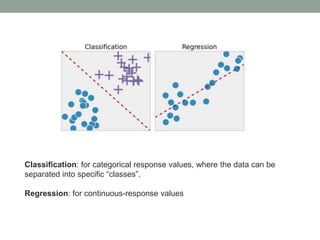
Classification: for categorical response values, where the data can be
separated into specific “classes”.
Regression: for continuous-response values
Neural Networks
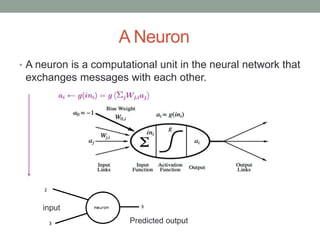
A Neuron
• A neuron is a computational unit in the neural network that
exchanges messages with each other.
input
Predicted output
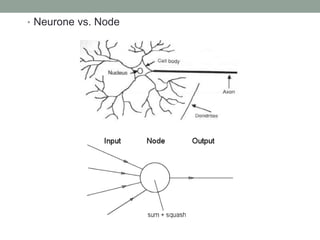
• Neurone vs. Node
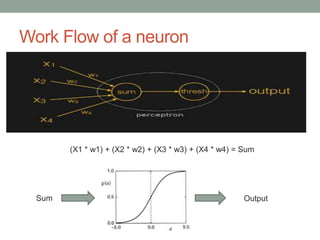
Work Flow of a neuron
(X1 * w1) + (X2 * w2) + (X3 * w3) + (X4 * w4) = Sum
Sum Output
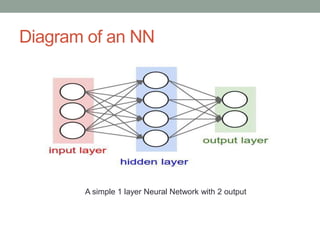
Diagram of an NN
A simple 1 layer Neural Network with 2 output
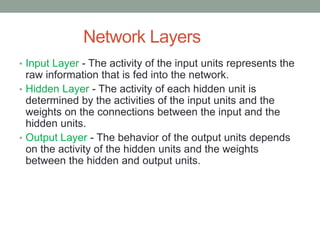
Network Layers
• Input Layer - The activity of the input units represents the
raw information that is fed into the network.
• Hidden Layer - The activity of each hidden unit is
determined by the activities of the input units and the
weights on the connections between the input and the
hidden units.
• Output Layer - The behavior of the output units depends
on the activity of the hidden units and the weights
between the hidden and output units.
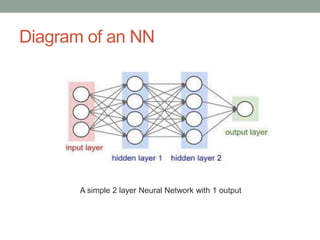
Diagram of an NN
A simple 2 layer Neural Network with 1 output
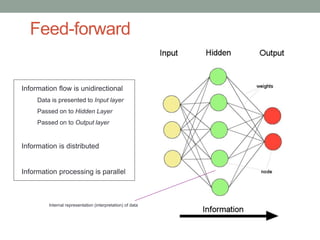
Feed-forward
Information flow is unidirectional
Data is presented to Input layer
Passed on to Hidden Layer
Passed on to Output layer
Information is distributed
Information processing is parallel
Internal representation (interpretation) of data
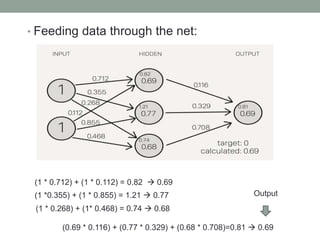
• Feeding data through the net:
(1 * 0.712) + (1 * 0.112) = 0.82  0.69
(1 *0.355) + (1 * 0.855) = 1.21  0.77
(1 * 0.268) + (1* 0.468) = 0.74  0.68
(0.69 * 0.116) + (0.77 * 0.329) + (0.68 * 0.708)=0.81  0.69
Output
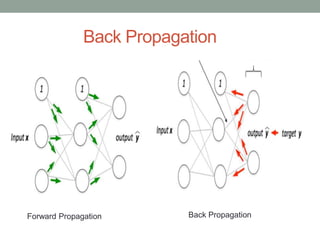
Back Propagation
Forward Propagation Back Propagation
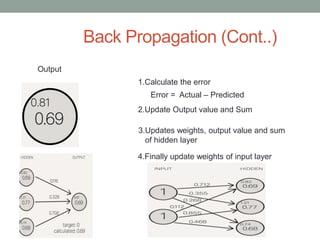
Back Propagation (Cont..)
Output
1.Calculate the error
Error = Actual – Predicted
2.Update Output value and Sum
3.Updates weights, output value and sum
of hidden layer
4.Finally update weights of input layer
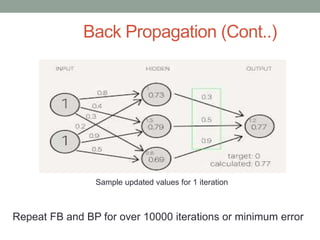
Sample updated values for 1 iteration
Back Propagation (Cont..)
Repeat FB and BP for over 10000 iterations or minimum error
Neural Networks-Types
1. Feed forward network:
SLP (Single Layer perceptron):
MLP (Multi Layer Perceptron):
2. RNN (Recurrent Neural Network):
3. CNN (Convolution neural Network):
4.TDNN (Time Delay Neural Network) or Shared Weights Neural
Networks:
5. Hopfield Networks
Where can we use NN’s
• Speech Recognition
• Computer Vision
• Natural Language Processing
• Used in all Domains
(Banking, Insurance, Healthcare, etc…)
20
Deep Learning Part 1 : Neural Networks

Deep Learning Part 1 : Neural Networks

  • 1.
    About Me Madhu BabuSanjeevi, Software Engineer, Languages C, Java, Python Technologies Machine Learning, Deep Learning, NLP, Big data, Mobile dev. Developments Android, Web, Rest API Databases SQL, Mongo DB Madhu Sanjeevi Madhu009 Madhu.ai
  • 2.
    Agenda •1.Introduction of NeuralNetworks •2.Forward and Back propagation algorithms •3.Different types of Neural Networks •4.Neural Networks Demo
  • 3.
  • 4.
    Supervised Learning • 1.Training data includes both the input and the desired results. • 2. For some examples the correct results (targets) are known and are given in input to the model during the learning process. • 3. These methods are usually fast and accurate.
  • 5.
    Classification: for categoricalresponse values, where the data can be separated into specific “classes”. Regression: for continuous-response values
  • 6.
  • 7.
    A Neuron • Aneuron is a computational unit in the neural network that exchanges messages with each other. input Predicted output
  • 8.
  • 9.
    Work Flow ofa neuron (X1 * w1) + (X2 * w2) + (X3 * w3) + (X4 * w4) = Sum Sum Output
  • 10.
    Diagram of anNN A simple 1 layer Neural Network with 2 output
  • 11.
    Network Layers • InputLayer - The activity of the input units represents the raw information that is fed into the network. • Hidden Layer - The activity of each hidden unit is determined by the activities of the input units and the weights on the connections between the input and the hidden units. • Output Layer - The behavior of the output units depends on the activity of the hidden units and the weights between the hidden and output units.
  • 12.
    Diagram of anNN A simple 2 layer Neural Network with 1 output
  • 13.
    Feed-forward Information flow isunidirectional Data is presented to Input layer Passed on to Hidden Layer Passed on to Output layer Information is distributed Information processing is parallel Internal representation (interpretation) of data
  • 14.
    • Feeding datathrough the net: (1 * 0.712) + (1 * 0.112) = 0.82  0.69 (1 *0.355) + (1 * 0.855) = 1.21  0.77 (1 * 0.268) + (1* 0.468) = 0.74  0.68 (0.69 * 0.116) + (0.77 * 0.329) + (0.68 * 0.708)=0.81  0.69 Output
  • 15.
  • 16.
    Back Propagation (Cont..) Output 1.Calculatethe error Error = Actual – Predicted 2.Update Output value and Sum 3.Updates weights, output value and sum of hidden layer 4.Finally update weights of input layer
  • 17.
    Sample updated valuesfor 1 iteration Back Propagation (Cont..) Repeat FB and BP for over 10000 iterations or minimum error
  • 19.
    Neural Networks-Types 1. Feedforward network: SLP (Single Layer perceptron): MLP (Multi Layer Perceptron): 2. RNN (Recurrent Neural Network): 3. CNN (Convolution neural Network): 4.TDNN (Time Delay Neural Network) or Shared Weights Neural Networks: 5. Hopfield Networks
  • 20.
    Where can weuse NN’s • Speech Recognition • Computer Vision • Natural Language Processing • Used in all Domains (Banking, Insurance, Healthcare, etc…) 20