GEO Publication No. 1/2023
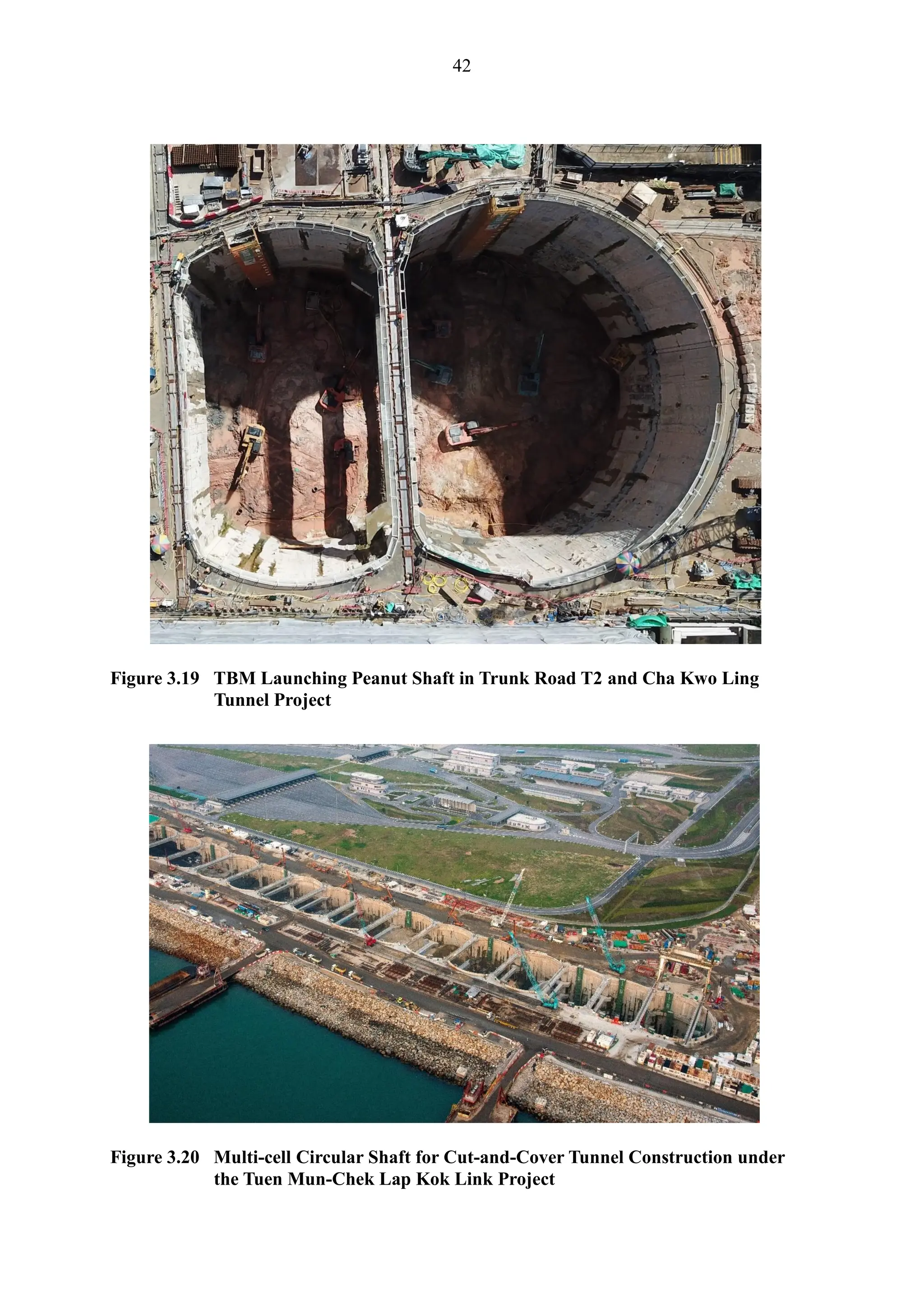
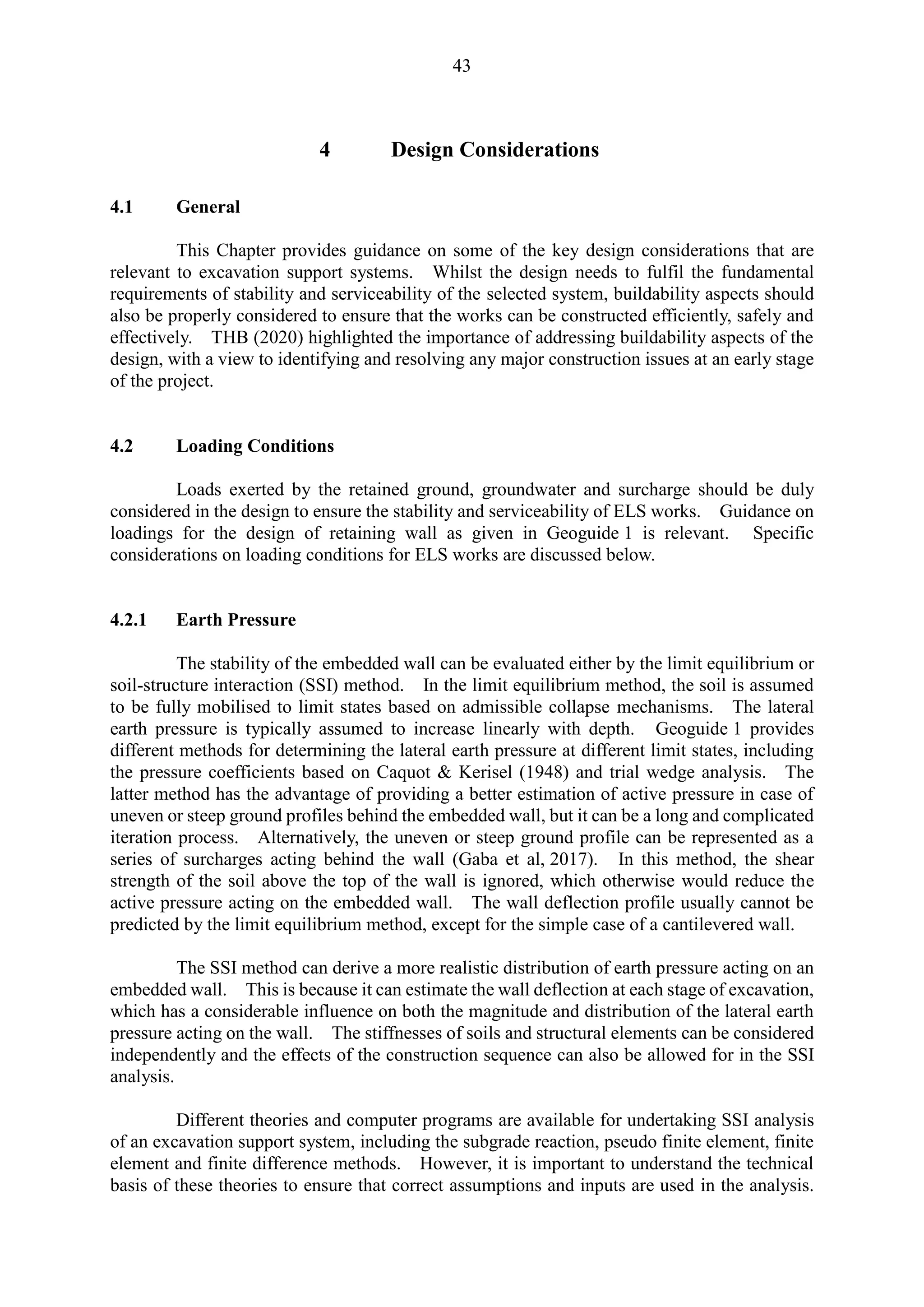
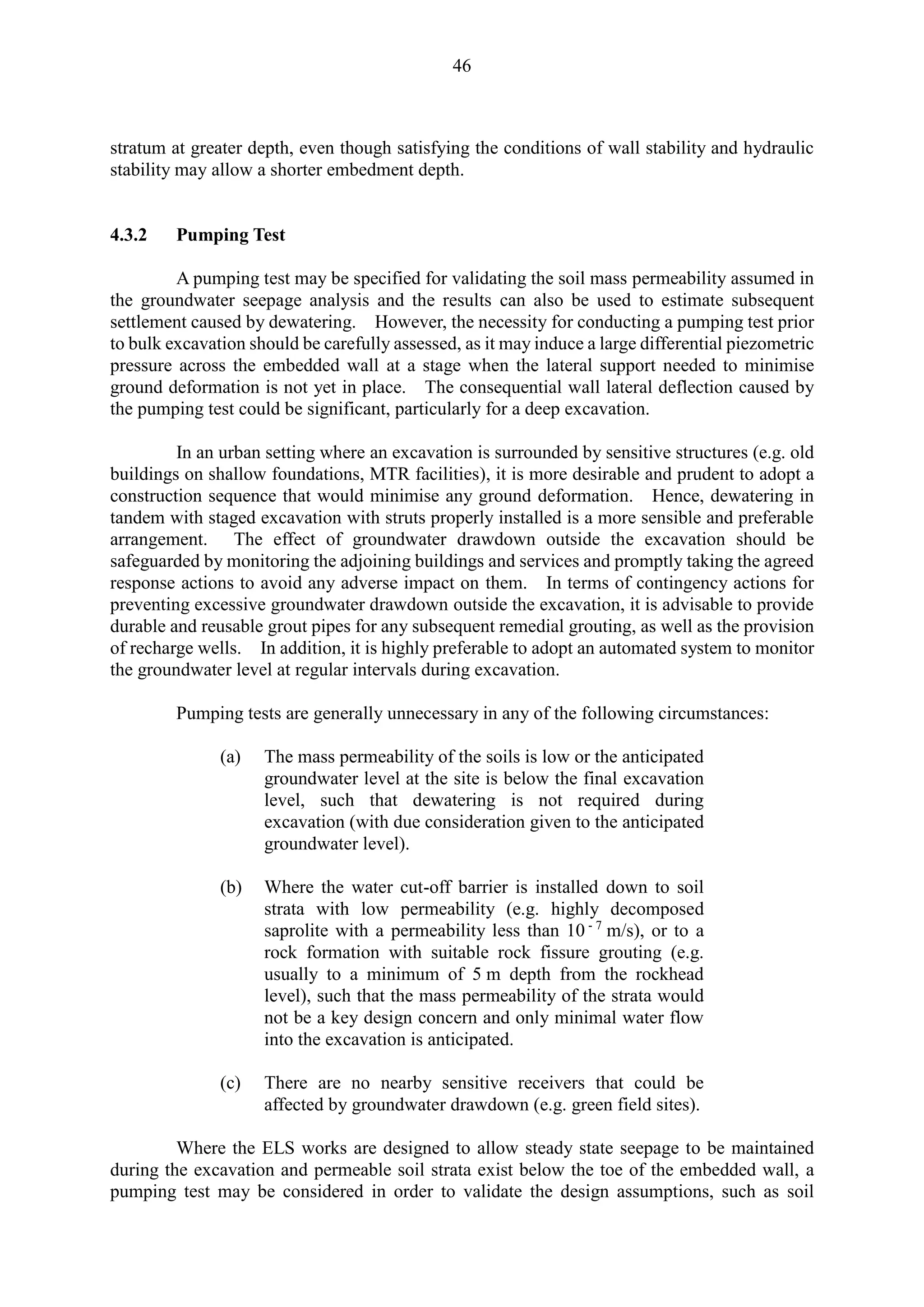
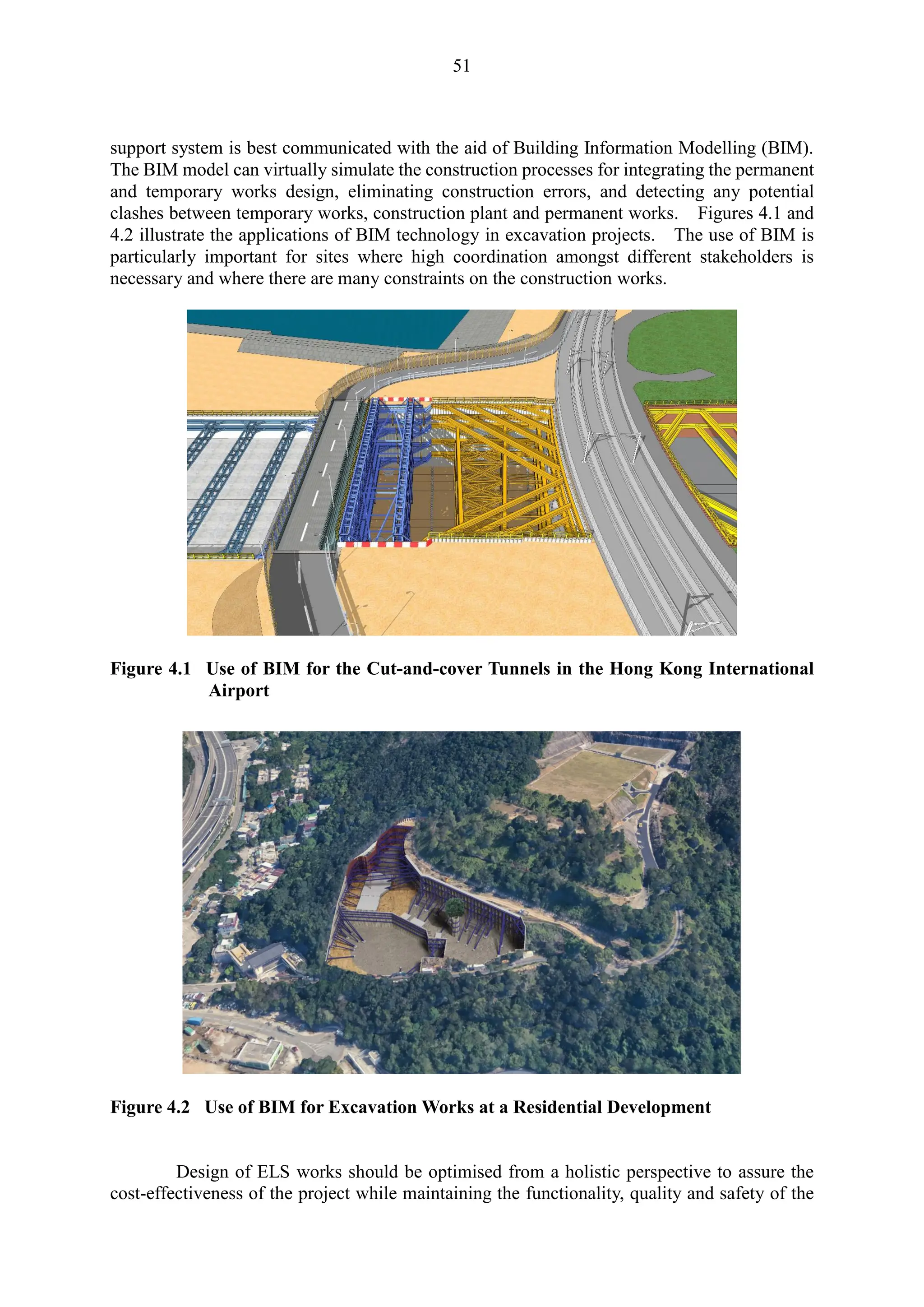
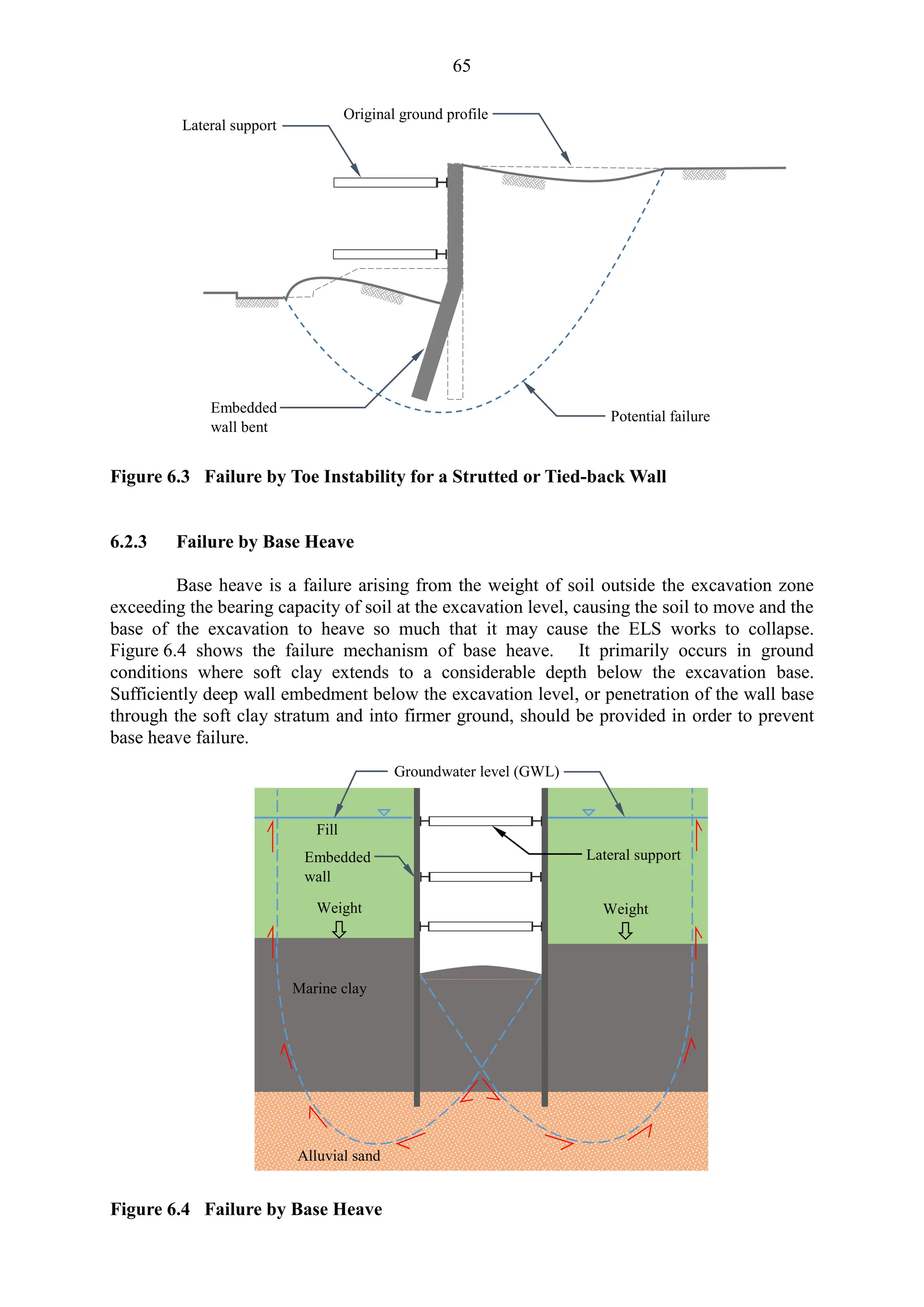
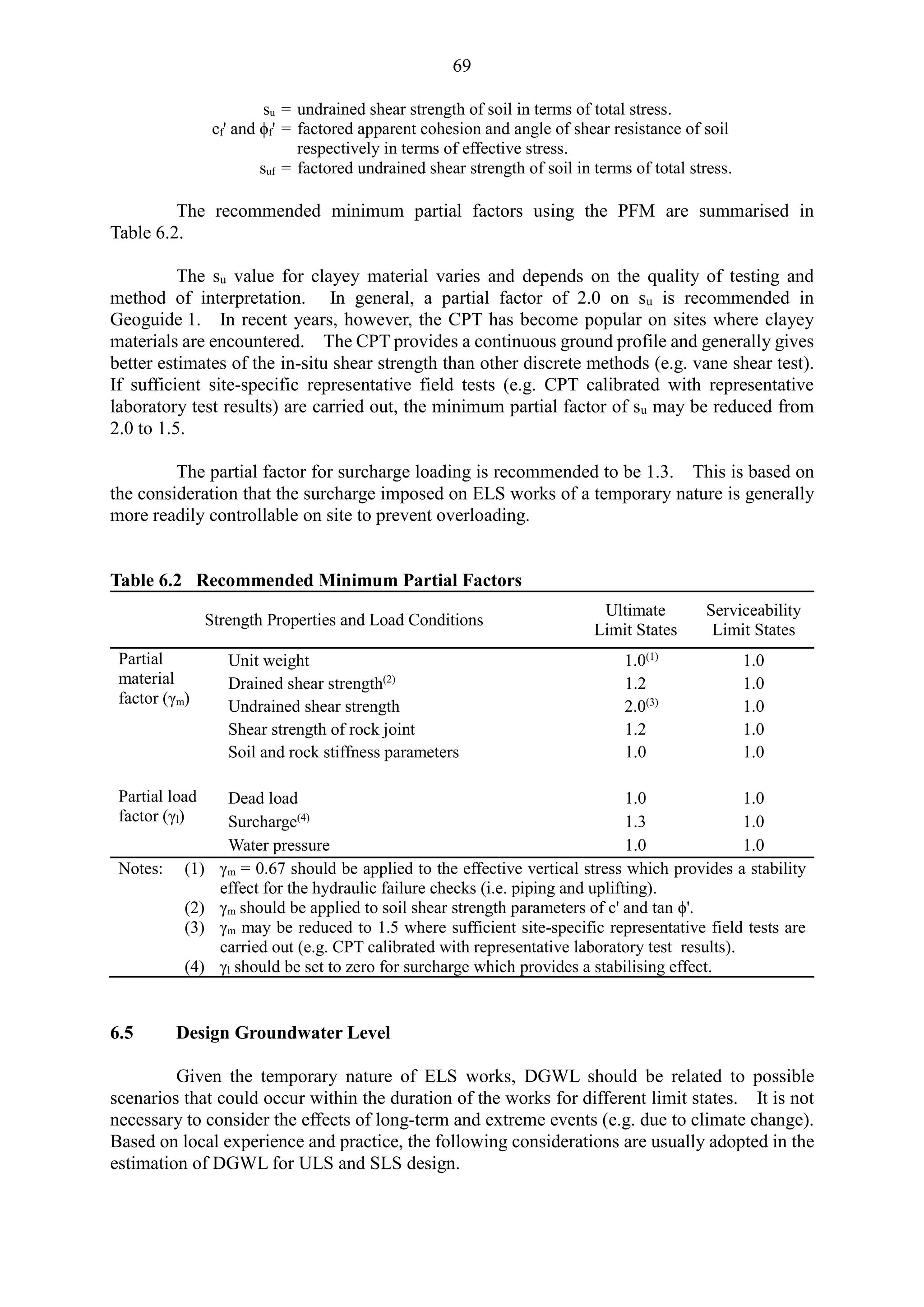
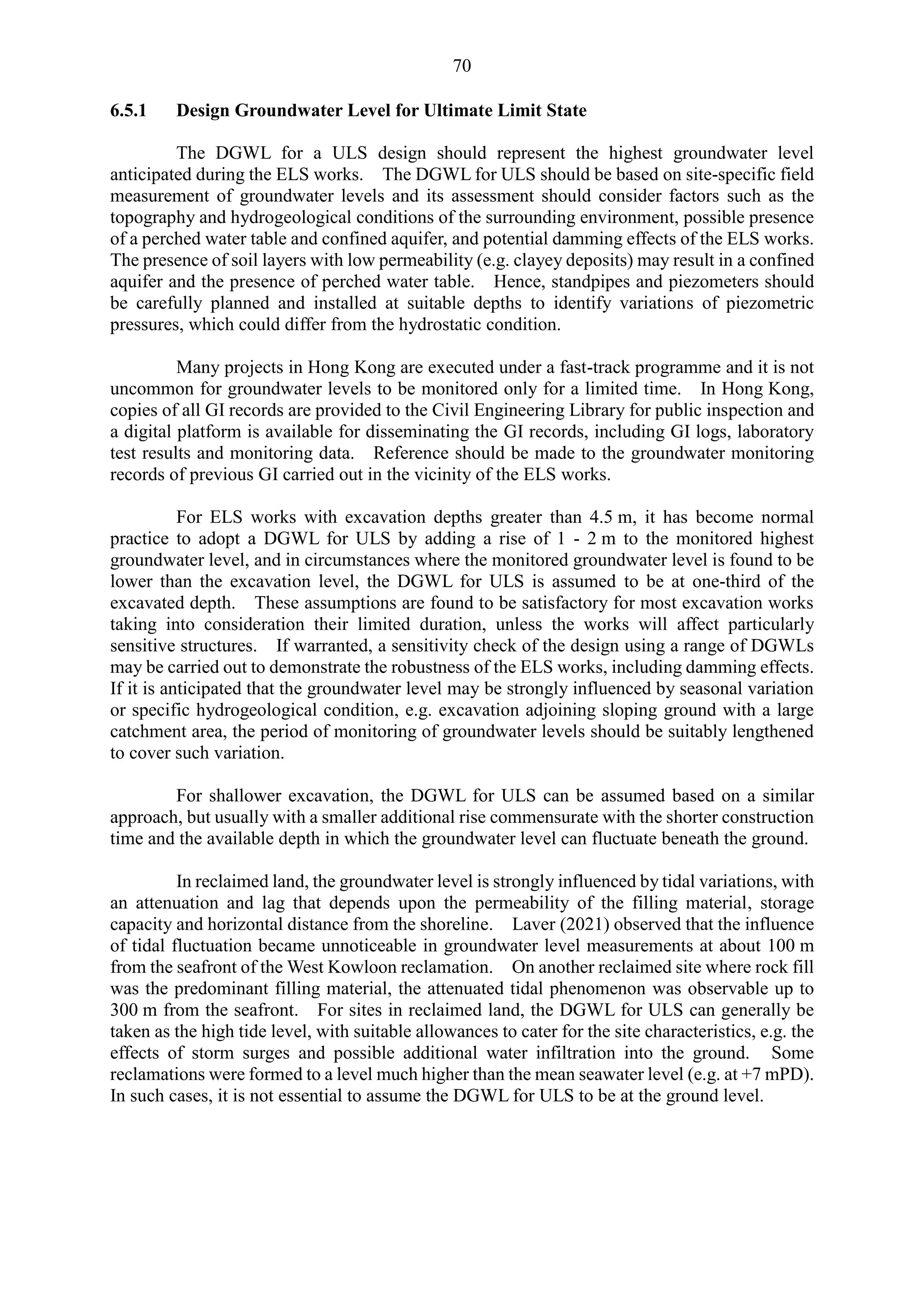
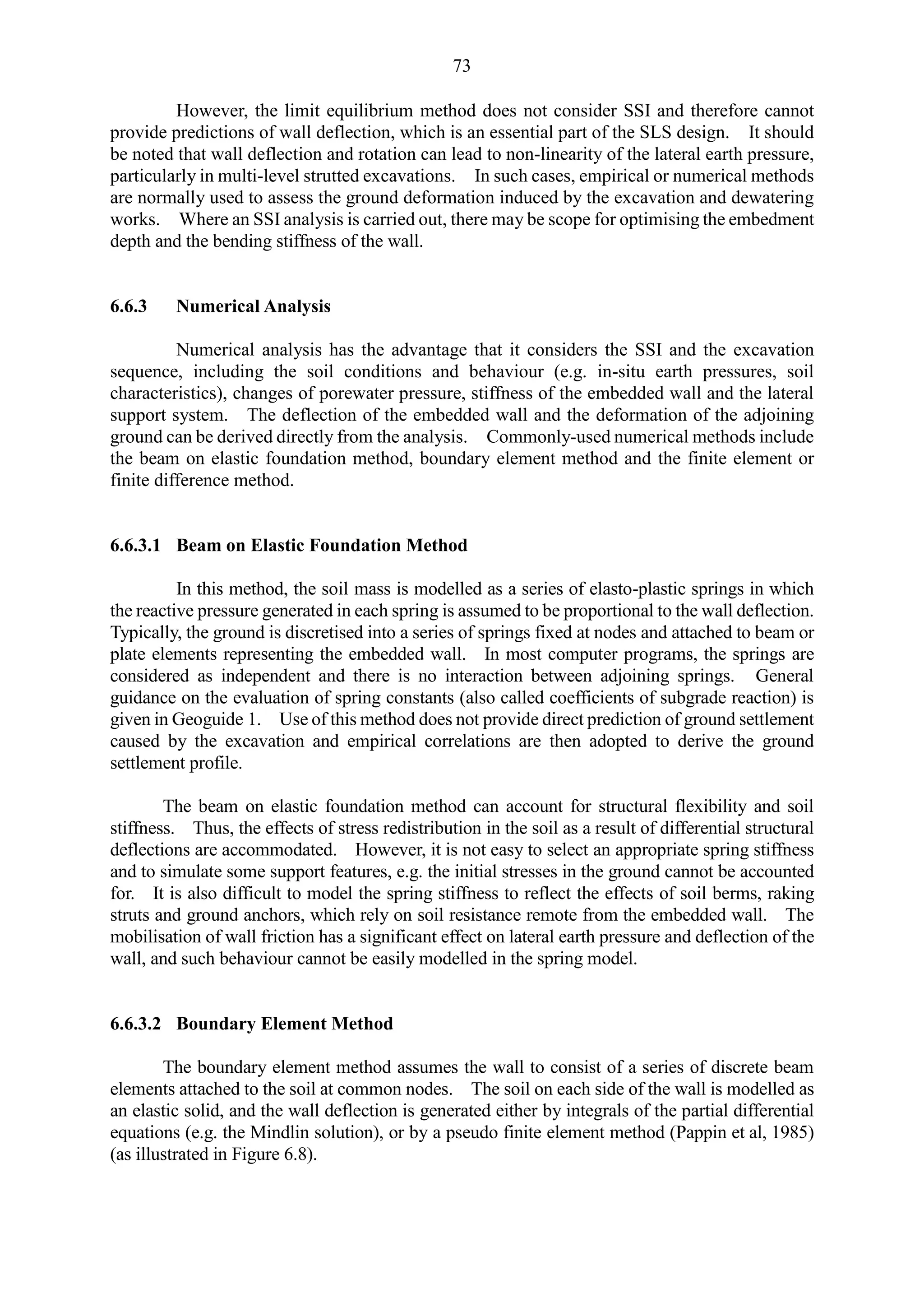
Deep Excavation Design and Construction
Geotechnical Engineering Office
Civil Engineering and Development Department
The Government of the Hong Kong
Special Administrative Region
GEO Publication No. 1/2023
Deep Excavation Design and Construction
Geotechnical Engineering Office
Civil Engineering and Development Department
The Government of the Hong Kong
Special Administrative Region
© The Government of the Hong Kong Special Administrative Region
First published, December 2023
Prepared by:
Geotechnical Engineering Office,
Civil Engineering and Development Department,
Civil Engineering and Development Building,
101 Princess Margaret Road,
Homantin, Kowloon,
Hong Kong.
Cover Photographs:
Top Left: Excavation using an Interlocking Pipe Pile Wall for the Central Kowloon
Route Project
Top Right: Excavation using a Tied-back Wall for a Residential Development Project at
Stubbs Road
Bottom Left: Excavation using a Diaphragm Wall for a Kai Tak Development Project
Bottom Right: Excavation using a Multi-cell Circular Shaft for the Cut-and-cover Tunnel
Construction under the Tuen Mun-Chek Lap Kok Link Project
4
Foreword
The GCO Publication No. 1/90 - Review of Design Methods for Excavations was
published in 1990. Although the review was written primarily as a reference document, upon
publication it immediately became the de facto standard of good practice for design of
excavation and lateral support (ELS) works in Hong Kong. Since then, practitioners have
accumulated much experience in the design and construction of deep excavations in Hong Kong.
There have also been many advances in design methods and modelling techniques, as well as
an increasing trend in international practice of using the partial factor method for limit state
design. On the other hand, the construction industry has introduced modern equipment and
invested heavily in digital construction in recent years.
In view of these developments, the GEO saw the need to revise Publication No. 1/90 to
consolidate the experience gained and the improvements made in the practice of ELS works.
The scope of the publication has also been expanded to its present form to cover the key aspects
relating to the construction of ELS works. Hence, a new publication title is used. The
recommendations given in this new publication aim to achieve significant gains for the
economic design of ELS works, savings in construction time and enhancements in ground
deformation monitoring and control.
This publication was prepared under the overall direction of a Working Group. The
membership of the Working Group, given on the next page, includes representatives from the
relevant government departments, the Hong Kong Institution of Engineers and the Piling
Contractors Committee of the Hong Kong Construction Association. In 2021, the
Geotechnical Division of the Hong Kong Institution of Engineers produced a technical review
report on the latest practice of geotechnical design and construction of ELS works, which
identified key technical areas deserving consideration in the drafting of this new publication.
Copies of draft version of this publication were circulated to local professional bodies,
consulting engineers, contractors, academics and government departments with experience in
the field of ELS works. Numerous individuals and organisations made useful comments,
many of which have been adopted in finalising this document. Their contributions are
gratefully acknowledged.
Given the variable nature of the geological and hydrogeological conditions in Hong
Kong, geotechnical design is always carried out under certain assumptions and simplifications.
It is therefore important to collect field data for verifying the assumptions made and to confirm
the performance of geotechnical works. For this reason, field monitoring data such as ground
settlement related to ELS works have been collected and presented in this publication.
Practitioners are encouraged to help expand this database by undertaking purposeful
instrumentation and monitoring of ELS works and providing us the relevant field data and
details of the works. This information can be provided to the Technical Secretary of the GEO.
Practitioners are encouraged to provide comments on the contents of the publication to
the GEO at any time, so that improvements can be made in future editions.
Raymond W M Cheung
Head, Geotechnical Engineering Office
December 2023
5
WORKING GROUP:
Architectural Services Department
Ir Dick K.P. Wan
Buildings Department
Ir Raymond C.Y. Wong
Civil Engineering and Development Department
Ir Sammy P.Y. Cheung (Chairman)
Ir Dr Raymond C.H. Koo
Ir Ivan Li
Ir J.C. Liu (Secretary)
Ir Frankie L.C. Lo (up to 12 April 2023)
Ir Lawrence K.W. Shum
Hong Kong Construction Association (Piling Contractors Committee)
Mr H.K. Ching
The Hong Kong Institution of Engineers (Geotechnical Division)
Ir Terence L.Y. Yau
6
Contents
Page No.
Title Page 3
Foreword 4
Working Group 5
Contents 6
List of Tables 11
List of Figures 12
1 Introduction 15
1.1 Purpose and Scope 15
1.2 Overview 15
1.3 General Guidance 16
2 Site Investigation and Geotechnical Parameters 17
2.1 Site Investigation 17
2.1.1 Ground Investigation 17
2.1.2 Groundwater Conditions 17
2.1.3 Soil Shear Strength and Stiffness 18
2.1.4 Adverse Rock Discontinuities 19
2.1.5 Condition Survey of Existing Ground Conditions 19
2.2 Selection of Geotechnical Parameters 20
2.2.1 Design for Drained and Undrained Conditions 21
2.2.2 Soil Shear Strength 21
2.2.3 Soil Stiffness 22
3 Excavation Support Systems 24
3.1 General 24
3.2 Types of Embedded Wall 24
3.2.1 Channel Planking Wall 24
3.2.2 Sheet Pile Wall 25
3.2.3 Soldier Pile Wall 27
3.2.4 Pipe Pile Wall 29
3.2.5 Bored Pile Wall 30
3.2.6 Diaphragm Wall 32
3.3 Forms of Excavation Support 34
3.3.1 Cantilevered Wall 34
3.3.2 Strutted Wall 34
7
Page No.
3.3.3 Tied-back Wall 38
3.3.4 Circular Shaft 40
4 Design Considerations 43
4.1 General 43
4.2 Loading Conditions 43
4.2.1 Earth Pressure 43
4.2.2 Surcharge 44
4.2.3 Water Pressure 44
4.2.4 Seismic Loads 45
4.3 Control of Groundwater 45
4.3.1 Water Cut-off Barrier 45
4.3.2 Pumping Test 46
4.4 Lateral Support 47
4.4.1 Strut Layout and Detailing 47
4.4.2 Soil Berm 49
4.4.3 Wall Friction 49
4.5 Buildability 50
5 Construction Considerations 53
5.1 General 53
5.2 Site Conditions Particularly Vulnerable to Ground Loss 53
5.3 Ground Loss Caused by Boring Operations 53
5.4 Slurry Trench Instability 57
5.5 Grout Curtain 58
5.6 Structural Support to Embedded Wall 60
5.7 Site Supervision 61
6 Limit State Design 63
6.1 General 63
6.2 Stability at Ultimate Limit State 63
6.2.1 Loss of Overall Stability 64
6.2.2 Failure by Overturning or Toe Instability 64
6.2.3 Failure by Base Heave 65
6.2.4 Hydraulic Failure 66
6.2.4.1 Failure by Piping 66
6.2.4.2 Failure by Uplifting 67
6.2.5 Structural Failure 67
6.3 Performance at Serviceability Limit State 67
8
Page No.
6.4 Methods of Applying Safety Factors 67
6.4.1 Global Factor Method 67
6.4.2 Partial Factor Method 68
6.5 Design Groundwater Level 69
6.5.1 Design Groundwater Level for Ultimate Limit State 70
6.5.2 Design Groundwater Level for Serviceability Limit State 71
6.6 Methods of Analysis for Limit State Design 72
6.6.1 Empirical Method 72
6.6.2 Limit Equilibrium Method 72
6.6.3 Numerical Analysis 73
6.6.3.1 Beam on Elastic Foundation Method 73
6.6.3.2 Boundary Element Method 73
6.6.3.3 Finite Element and Finite Difference Methods 74
7 Ultimate Limit State Design 76
7.1 General 76
7.2 Overall Stability 76
7.3 Overturning or Toe Instability 76
7.3.1 Cantilevered Wall 76
7.3.2 Single-level Strutted Wall 79
7.3.3 Multi-level Strutted Wall 80
7.3.4 Circular Shaft 82
7.3.5 Tied-back Wall 82
7.4 Base Heave 83
7.5 Hydraulic Failure 84
7.5.1 Piping 84
7.5.2 Uplifting 84
7.5.3 Seepage Analysis 88
7.5.3.1 Flow Net Construction 88
7.5.3.2 Simplified Method 90
7.5.3.3 Numerical Analysis 92
7.6 Structural Failure 92
7.6.1 Cantilevered Wall 93
7.6.2 Single-level Strutted or Tied-back Wall 94
7.6.3 Multi-level Strutted or Tied-back Wall 95
7.6.4 Circular Shaft 97
9
Page No.
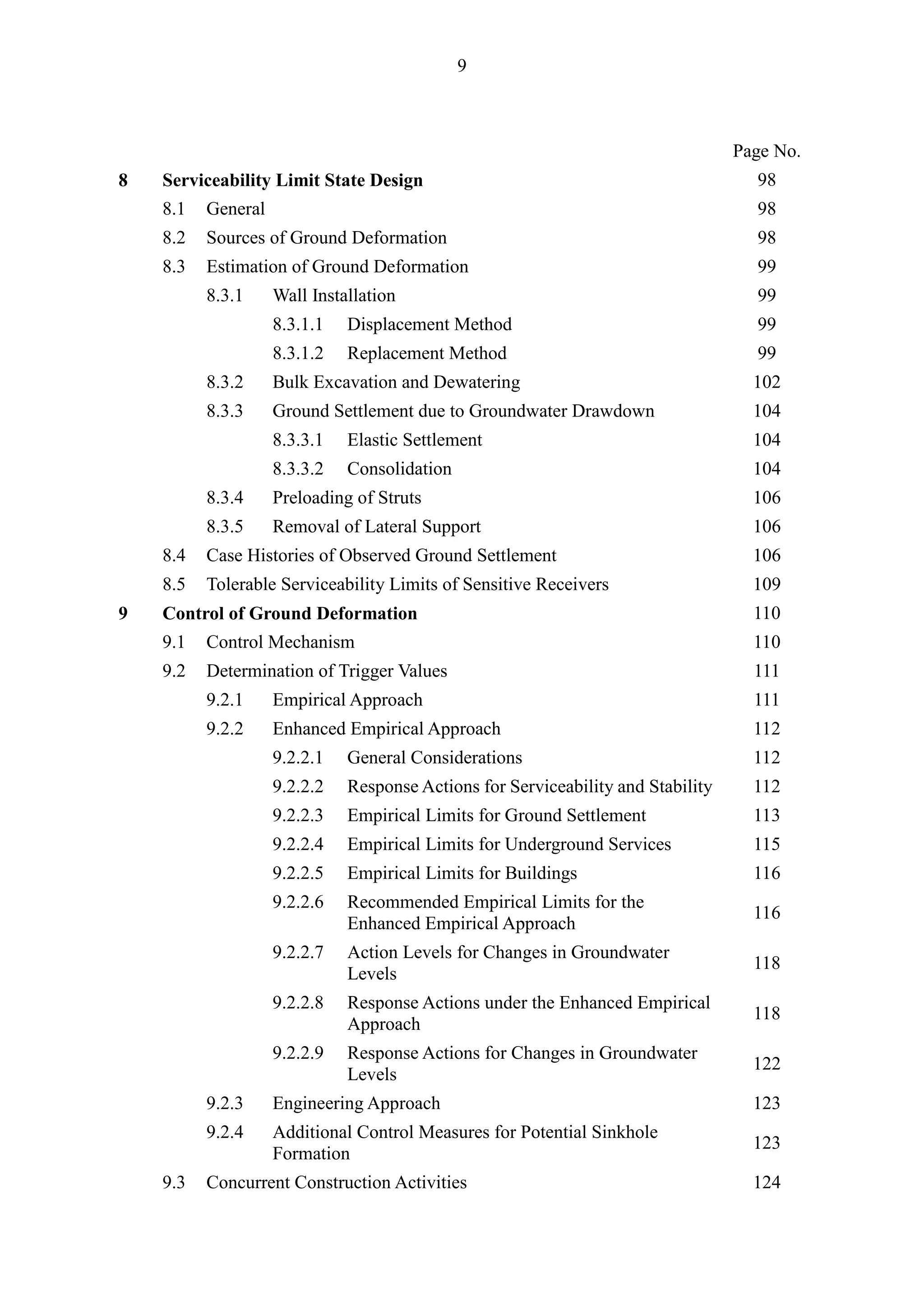
8 Serviceability Limit State Design 98
8.1 General 98
8.2 Sources of Ground Deformation 98
8.3 Estimation of Ground Deformation 99
8.3.1 Wall Installation 99
8.3.1.1 Displacement Method 99
8.3.1.2 Replacement Method 99
8.3.2 Bulk Excavation and Dewatering 102
8.3.3 Ground Settlement due to Groundwater Drawdown 104
8.3.3.1 Elastic Settlement 104
8.3.3.2 Consolidation 104
8.3.4 Preloading of Struts 106
8.3.5 Removal of Lateral Support 106
8.4 Case Histories of Observed Ground Settlement 106
8.5 Tolerable Serviceability Limits of Sensitive Receivers 109
9 Control of Ground Deformation 110
9.1 Control Mechanism 110
9.2 Determination of Trigger Values 111
9.2.1 Empirical Approach 111
9.2.2 Enhanced Empirical Approach 112
9.2.2.1 General Considerations 112
9.2.2.2 Response Actions for Serviceability and Stability 112
9.2.2.3 Empirical Limits for Ground Settlement 113
9.2.2.4 Empirical Limits for Underground Services 115
9.2.2.5 Empirical Limits for Buildings 116
9.2.2.6 Recommended Empirical Limits for the
Enhanced Empirical Approach
116
9.2.2.7 Action Levels for Changes in Groundwater
Levels
118
9.2.2.8 Response Actions under the Enhanced Empirical
Approach
118
9.2.2.9 Response Actions for Changes in Groundwater
Levels
122
9.2.3 Engineering Approach 123
9.2.4 Additional Control Measures for Potential Sinkhole
Formation
123
9.3 Concurrent Construction Activities 124
10
Page No.
10 Instrumentation, Monitoring and Novel Technology 126
10.1 General 126
10.2 Instrumentation and Monitoring Plan 126
10.2.1 General Requirements 126
10.2.2 Types of Instruments 127
10.2.3 Groundwater Monitoring 127
10.2.4 Horizontal Deformation Monitoring 127
10.3 Novel Technology 129
References 131
Appendix A Database of Ground Deformation and Wall Deflection Monitoring
Collected in Selected ELS Works
141
Acknowledgement 144
11
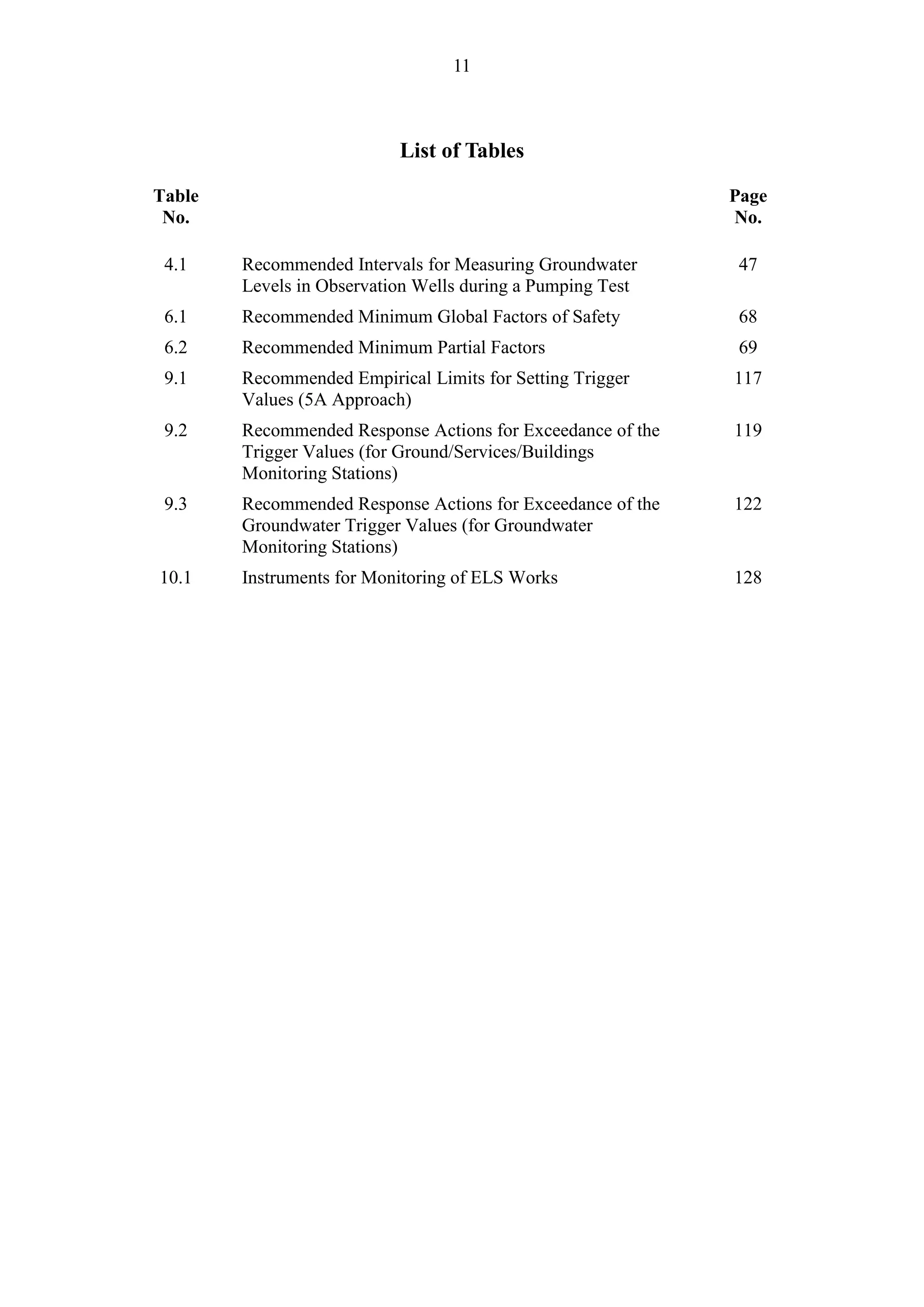
List of Tables
Table
No.
Page
No.
4.1 Recommended Intervals for Measuring Groundwater
Levels in Observation Wells during a Pumping Test
47
6.1 Recommended Minimum Global Factors of Safety 68
6.2 Recommended Minimum Partial Factors 69
9.1 Recommended Empirical Limits for Setting Trigger
Values (5A Approach)
117
9.2 Recommended Response Actions for Exceedance of the
Trigger Values (for Ground/Services/Buildings
Monitoring Stations)
119
9.3 Recommended Response Actions for Exceedance of the
Groundwater Trigger Values (for Groundwater
Monitoring Stations)
122
10.1 Instruments for Monitoring of ELS Works 128
12
List of Figures
Figure
No.
Page
No.
2.1 Variation of Groundwater Pressure in a Confined Aquifer 18
3.1 Typical Channel Planking Wall 25
3.2 Typical Type U Sheet Pile Wall 25
3.3 Typical Type Z Sheet Pile Wall 26
3.4 Typical Soldier Pile Wall with Steel Lagging 28
3.5 Typical Pipe Pile Wall with Grout Curtain 29
3.6 Typical Interlocking Pipe Pile Wall 30
3.7 Typical Contiguous Bored Pile Wall 31
3.8 Typical Secant Bored Pile Wall 31
3.9 Typical Diaphragm Wall 33
3.10 Strutting System with Raking Struts 35
3.11 Strutting System with Cross-lot 35
3.12 Strutting System with Diagonal Struts 36
3.13 Bottom-up Construction 37
3.14 Top-down Construction 37
3.15 Tied-back Wall Support System for the Excavation Works at
Stubbs Road
39
3.16 Tied-back Wall Support System Using Ground Anchors 39
3.17 Retractable Prestressed Ground Anchor Support System at
the Redevelopment of Grantham Hospital
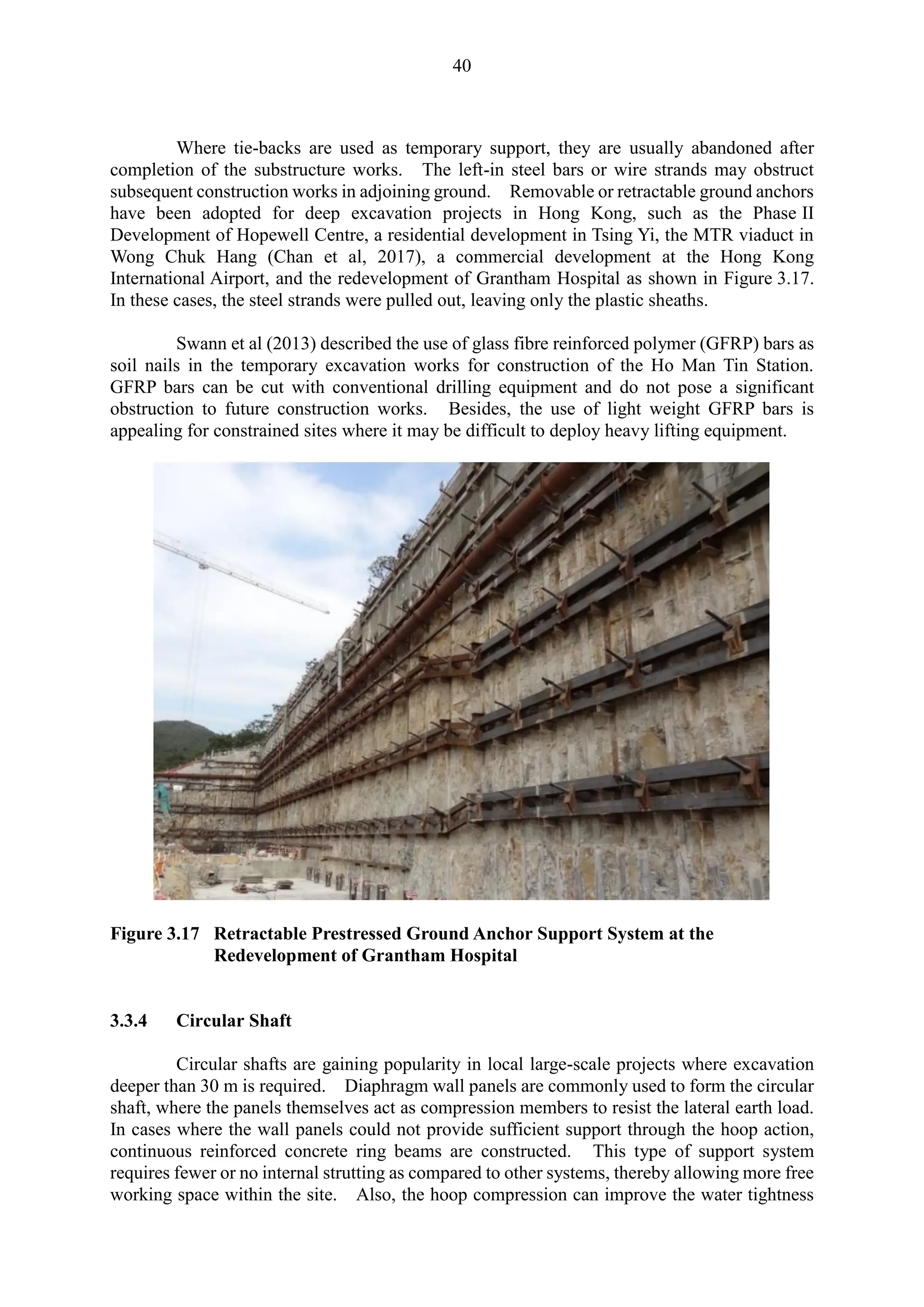
40
3.18 Circular Shaft for Basement Construction at International
Commerce Centre
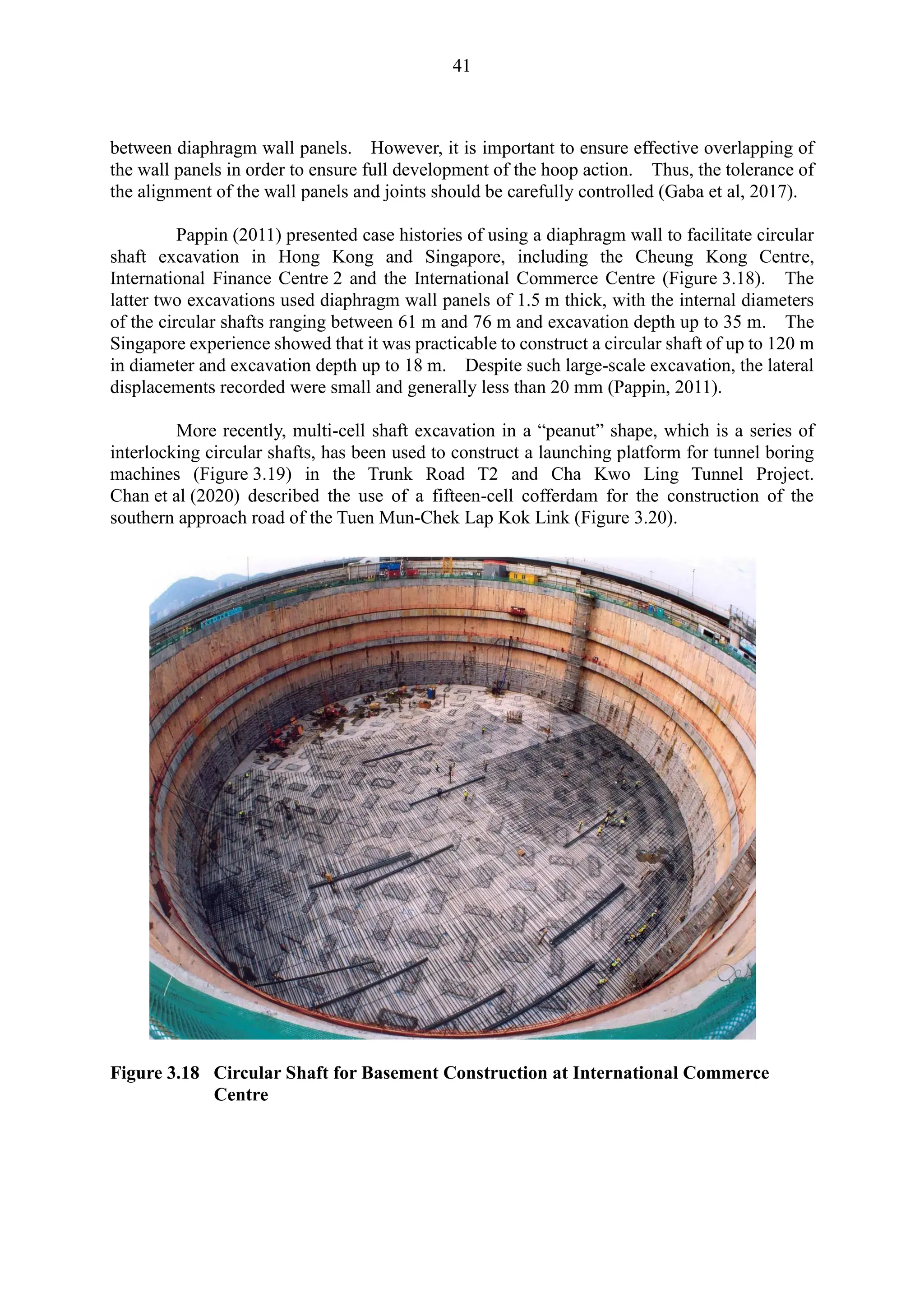
41
3.19 TBM Launching Peanut Shaft in Trunk Road T2 and Cha
Kwo Ling Tunnel Project
42
3.20 Multi-cell Circular Shaft for Cut-and-Cover Tunnel
Construction under the Tuen Mun-Chek Lap Kok Link
Project
42
4.1 Use of BIM for the Cut-and-cover Tunnels in the Hong Kong
International Airport
51
4.2 Use of BIM for Excavation Works at a Residential
Development
51
5.1 Key Components of a Concentric Drilling System with
Idealised Air Flow Path
54
13
Figure
No.
Page
No.
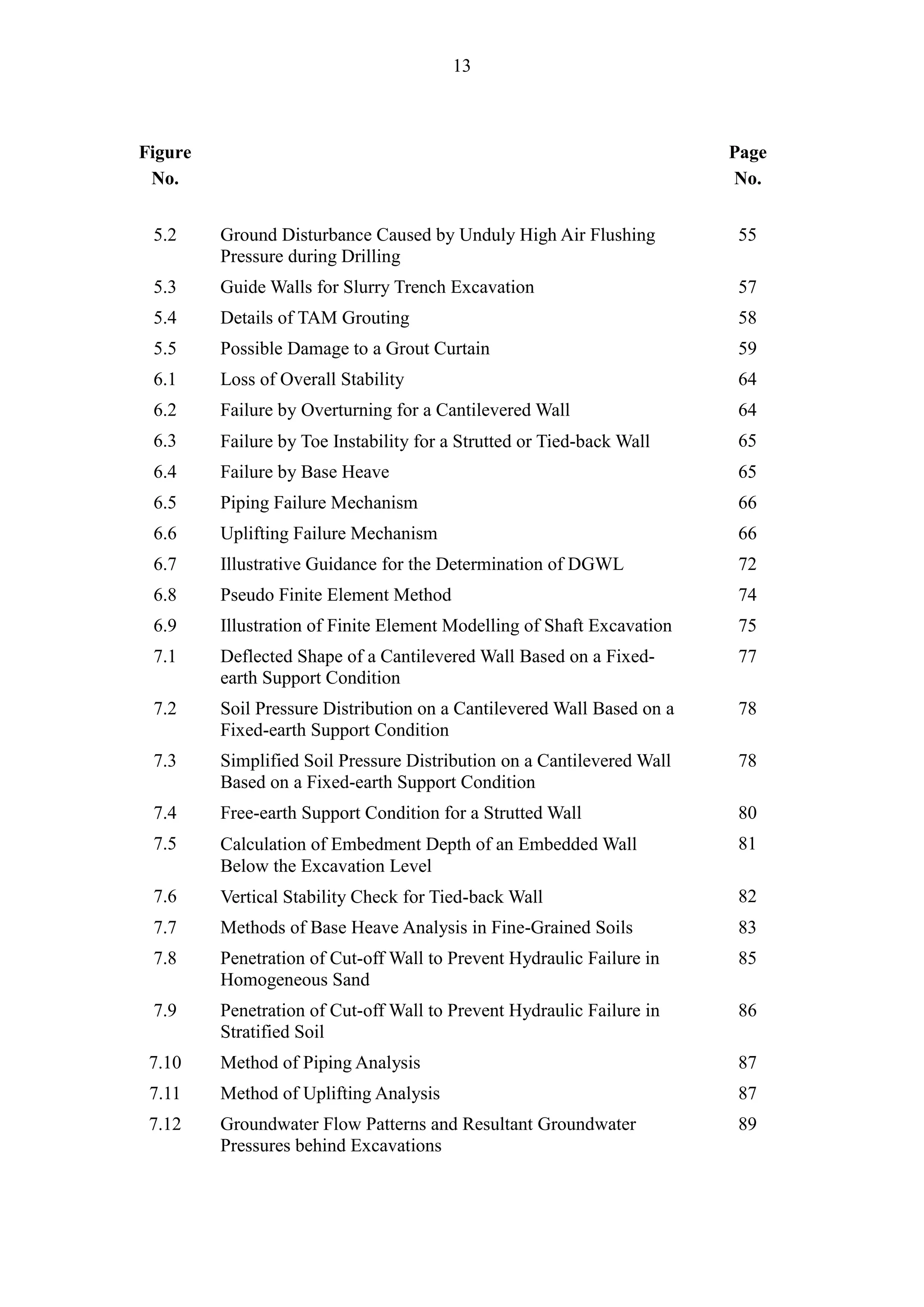
5.2 Ground Disturbance Caused by Unduly High Air Flushing
Pressure during Drilling
55
5.3 Guide Walls for Slurry Trench Excavation 57
5.4 Details of TAM Grouting 58
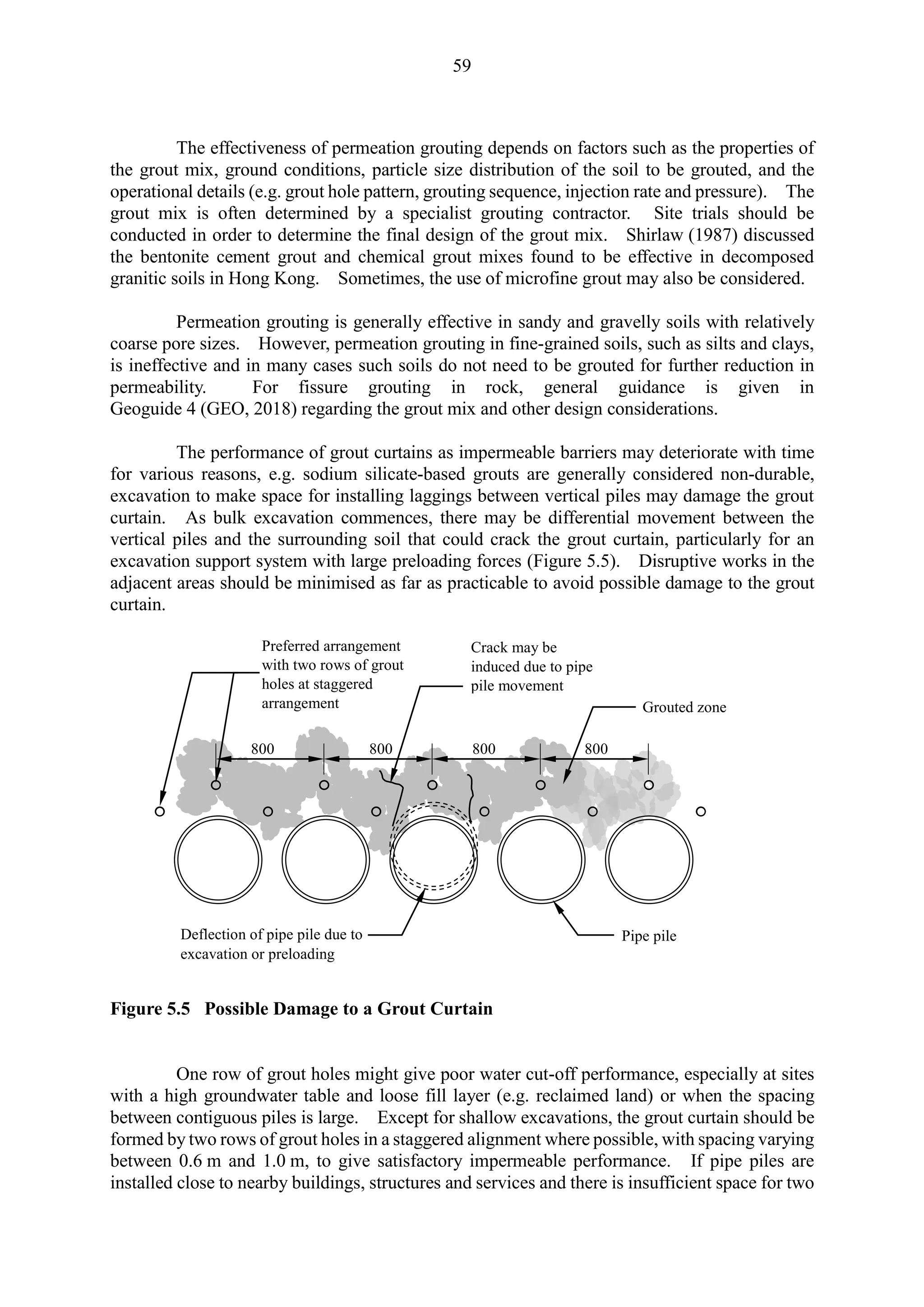
5.5 Possible Damage to a Grout Curtain 59
6.1 Loss of Overall Stability 64
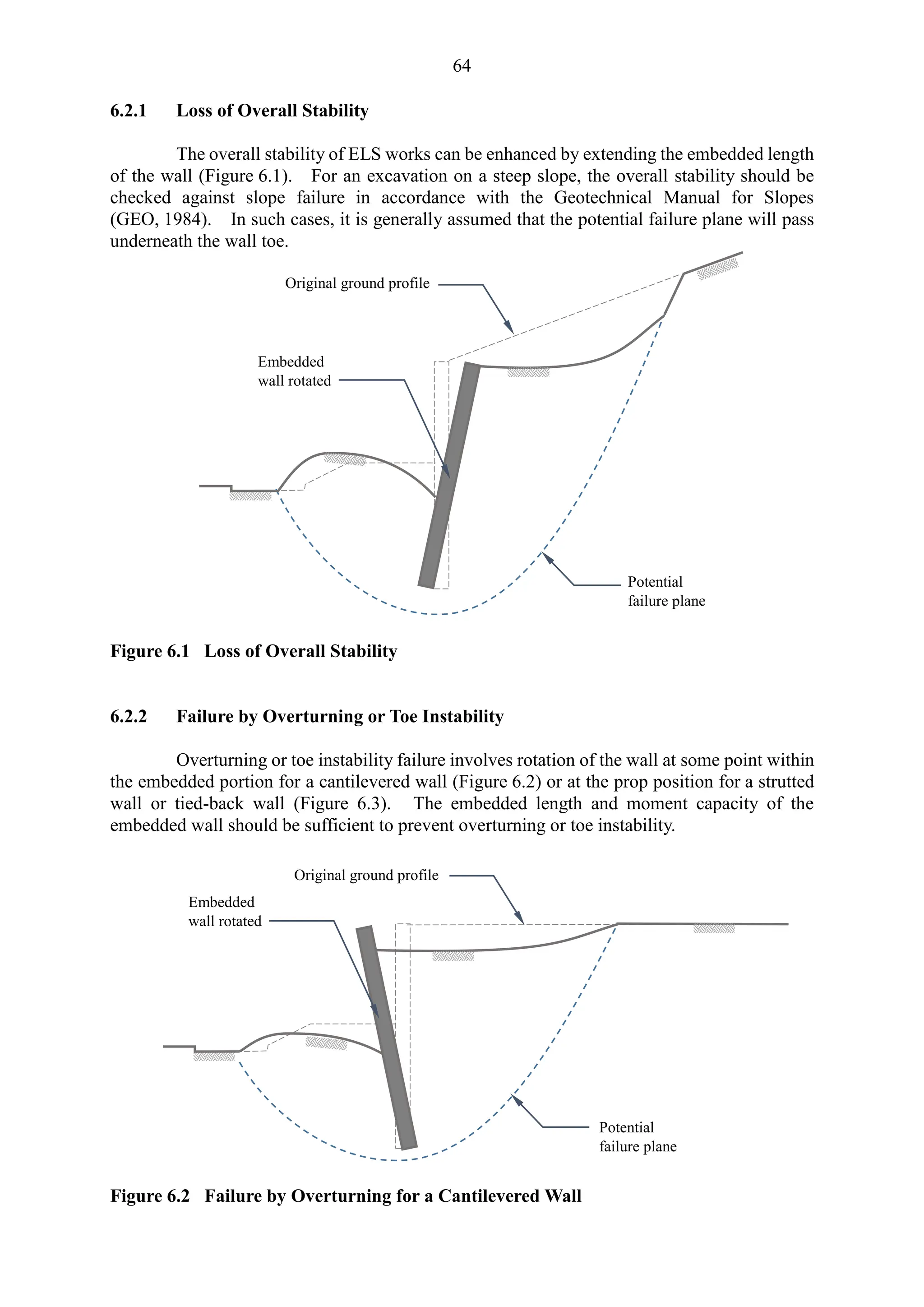
6.2 Failure by Overturning for a Cantilevered Wall 64
6.3 Failure by Toe Instability for a Strutted or Tied-back Wall 65
6.4 Failure by Base Heave 65
6.5 Piping Failure Mechanism 66
6.6 Uplifting Failure Mechanism 66
6.7 Illustrative Guidance for the Determination of DGWL 72
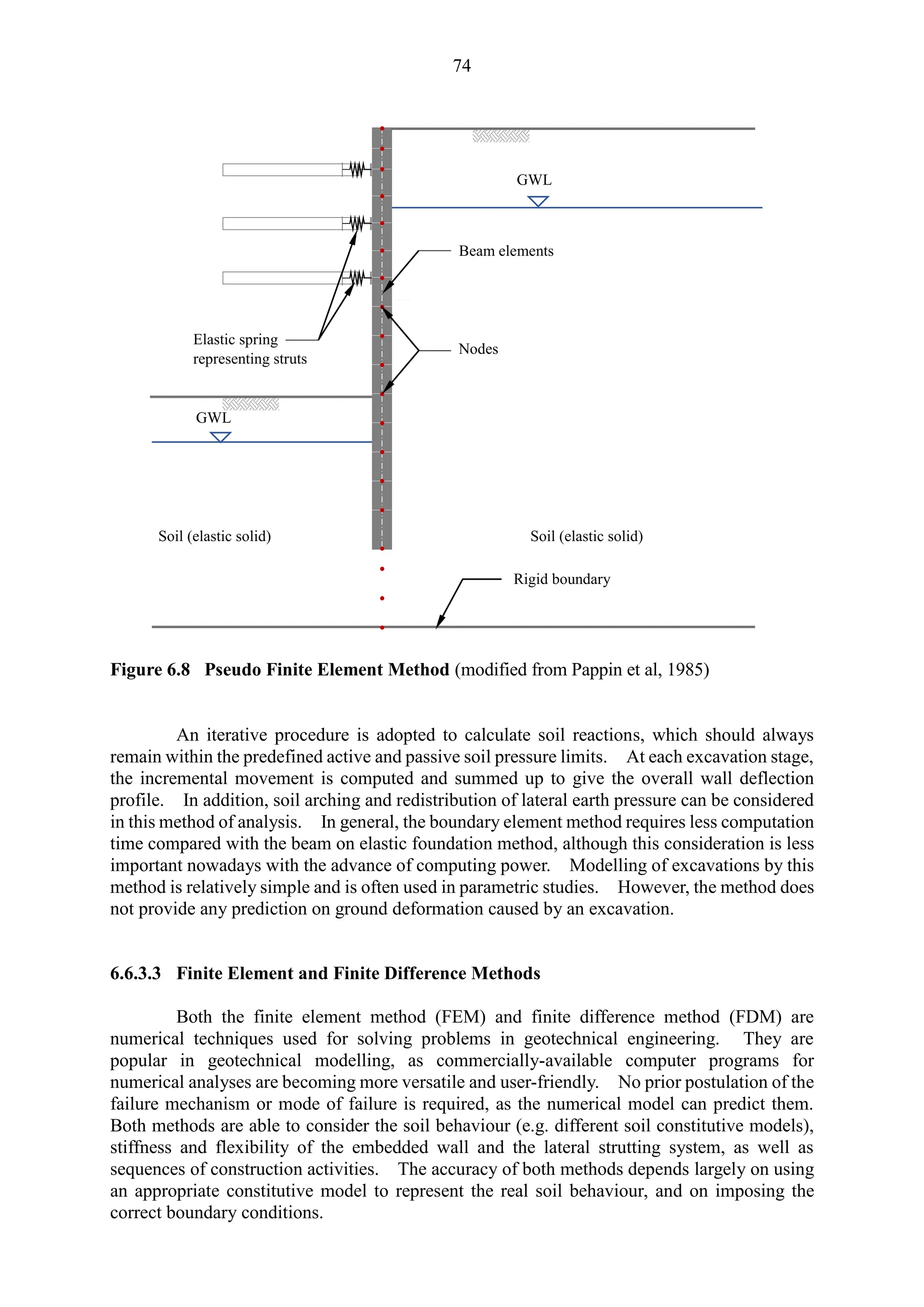
6.8 Pseudo Finite Element Method 74
6.9 Illustration of Finite Element Modelling of Shaft Excavation 75
7.1 Deflected Shape of a Cantilevered Wall Based on a Fixed-
earth Support Condition
77
7.2 Soil Pressure Distribution on a Cantilevered Wall Based on a
Fixed-earth Support Condition
78
7.3 Simplified Soil Pressure Distribution on a Cantilevered Wall
Based on a Fixed-earth Support Condition
78
7.4 Free-earth Support Condition for a Strutted Wall 80
7.5 Calculation of Embedment Depth of an Embedded Wall
Below the Excavation Level
81
7.6 Vertical Stability Check for Tied-back Wall 82
7.7 Methods of Base Heave Analysis in Fine-Grained Soils 83
7.8 Penetration of Cut-off Wall to Prevent Hydraulic Failure in
Homogeneous Sand
85
7.9 Penetration of Cut-off Wall to Prevent Hydraulic Failure in
Stratified Soil
86
7.10 Method of Piping Analysis 87
7.11 Method of Uplifting Analysis 87
7.12 Groundwater Flow Patterns and Resultant Groundwater
Pressures behind Excavations
89
14
Figure
No.
Page
No.
7.13 Flow Net and Pressure Distribution Across an Embedded
Wall under a Steady-state Seepage Condition
90
7.14 Simplified Groundwater Pressure Distribution Across an
Embedded Wall Under a Steady-state Seepage Condition
91
7.15 Typical Hydraulic Boundary Conditions 93
7.16 Assumed Linear Soil Pressure Distribution for a Cantilevered
Wall
94
7.17 Calculation of Maximum Bending Moment in a Cantilevered
Wall
94
7.18 Assumed Linear Soil Pressure Distribution for a Strutted or
Tied-back Wall
95
7.19 Calculation of Maximum Bending Moment in a Strutted or
Tied-back Wall
95
7.20 Apparent Pressure Diagrams for Computing Strut Loads in
Strutted Excavations
96
8.1 Measured Ground Settlement Caused by the Installation of
Diaphragm Wall
100
8.2 Measured Ground Settlement due to Diaphragm Wall
Installation from Case Study Data
101
8.3 Typical Profiles of Wall Deflection and Adjacent Ground
Deformation
103
8.4 Relationship between Ground Settlement and Lateral Wall
Deflection from Case Study Data
105
8.5 Ground Settlement due to Excavation in Coarse Grained
Soils
107
8.6 Total Ground Settlement against Maximum Excavation
Depth from Case Study Data for Projects in Hong Kong
108
10.1 Application of Handheld LiDAR Scanning in ELS Work 130
15
1 Introduction
1.1 Purpose and Scope
Deep excavations are common in the urban area of Hong Kong and often adopted for
construction of multi-level basements, railway and road tunnels. Excavation in such
environments invariably presents challenges to planners, engineers and contractors, as there are
always nearby buildings, structures and services to be protected. The consequences of any
excavation collapse could be serious and costly. For this reason, excavation in soil generally
requires sufficient lateral support to minimise any adverse effect on the surrounding
environment.
The GCO Publication No. 1/90 “Review of Design Methods for Excavations”
(GEO, 1990), published in 1990, gave the then state-of-the-art methods for the design of
excavation support systems, as well as the prediction of ground deformation around excavations.
The publication has been widely used by practitioners as a reference document for excavation
design in Hong Kong. Since then, there have been many advances in the knowledge,
technology and modern methods for designing and executing excavation and lateral support
(ELS) works. In view of these developments, a Working Group on Revision of GCO
Publication No. 1/90 was set up to update the publication. The purpose of this document is to
give guidance for the design and construction of ELS works in Hong Kong, taking cognizance
of latest advancements in pertinent subjects. This document also consolidates local practice
and experience in the construction of ELS works in Hong Kong and provides recommendations
for mitigating the geotechnical risks associated with excavations. The publication is intended
for use by readers who have some general knowledge of ELS works.
New permanent earth retaining walls are not covered by this document and readers
should refer to Geoguide 1: Guide to Retaining Wall (GEO, 2020) published by the GEO.
1.2 Overview
The content of this document is intended to cover the execution of temporary
excavation works on land using embedded wall that facilitates the construction of underground
structures. In this document, the term “excavation” is applied generally to cover all ELS
works, whereas the term “deep excavation” refers to excavations deeper than 4.5 m, in
conformity with the current distinction for the enhanced statutory control of ELS works under
the Buildings Ordinance (PNAP APP-57) (BD, 2012).
Good practice for site investigation and selection of geotechnical parameters that are
crucial for the design of ELS works and associated key considerations are presented in
Chapter 2.
Areview of common types of excavation support systems and technical considerations
for the design and construction of ELS works are discussed in Chapters 3, 4 and 5. In
particular, the discussions given in Chapter 5 highlight the construction aspects that should be
carefully assessed and considered in the execution of ELS works.
16
Chapter 6 discusses the limit state design of ELS works. It outlines relevant
requirements for checking the ultimate limit state (ULS) and serviceability limit state (SLS).
The application of global factor and partial factor methods in limit state design are also
discussed, along with recommended factors to be used in both methods. Methods for ULS
and SLS design are presented in Chapters 7 and 8, respectively.
Chapter 9 discusses mechanisms for the control of ground deformation due to ELS
works, including the recommended empirical and engineering approaches and the trigger values
for initiating response actions to minimise adverse impact on sensitive receivers.
Adequate instrumentation and monitoring (I&M) are essential for the safe execution
of ELS works. Chapter 10 sets out the considerations necessary to formulate an appropriate
I&M plan and introduces new technology that could promote further advancement in local
practices.
1.3 General Guidance
In this document, reference has been made to published codes, reference papers,
textbooks, and other relevant information. Readers are strongly advised to consult the original
publications for full details of any particular subject and to consider the appropriateness of using
such methods in the design and construction of ELS works.
The various stages of site investigation, design and construction of ELS works require
coordinated input from experienced designers and contractors. Continuous involvement of
the designer of the ELS works is essential for verifying both the validity of the assumed ground
conditions and the expected performance of the ELS works. The installation methods used to
construct the embedded wall may significantly affect the performance of the ELS works, and
the subsequent works that require strict adherence to agreed procedures. It is important that
competent specialist contractors are employed and their works should be adequately supervised
by suitably qualified and experienced engineers who are familiar with the design.
In common with all types of geotechnical works, professional judgement and
engineering common sense must be exercised when designing and executing ELS works.
17
2 Site Investigation and Geotechnical Parameters
2.1 Site Investigation
Adequate site investigation is essential to ensure safe and economic design and
construction of ELS works for civil engineering and building developments. The main
objectives of site investigation are to acquire knowledge of site characteristics that affect such
works and plan for their safe execution, with due consideration given to the nearby
buildings/structures/services. When planning ELS works, site investigation should normally
include a detailed desk study, site reconnaissance, topographic survey, ground investigation (GI)
for establishing a suitable ground model, collecting soil and rock samples, carrying out in-situ
tests for selecting design parameters and undertaking field monitoring to determine the
groundwater conditions. Geoguide 2: Guide to Site Investigation (GEO, 2017a) provides
guidance on the planning and execution of site investigation works. This Chapter discusses
additional considerations for planning the site investigation and selection of geotechnical
parameters that are pertinent to the design and construction of ELS works.
2.1.1 Ground Investigation
GI should be properly planned in order to develop a suitable ground model for the
design of ELS works, with due regard to the anticipated extent and depth of excavation. An
adequate number of boreholes should be extended to the competent soil stratum or bedrock
when determining the ground stratigraphy. In case the competent soil stratum is located at a
considerable depth below the excavation level, boreholes should be extended to a depth where
the passive resistance of the soil is anticipated to be mobilised. This is usually at least two to
three times the excavation depth. Besides the stability consideration of the embedded wall,
deeper boreholes may also be needed to determine the ground conditions at greater depth for
seepage analysis.
The number and spacing of boreholes should be determined with due consideration of
variability in the spatial distribution and thickness of each stratum, the materials to be excavated,
the materials in which the wall is embedded and the bearing materials for ELS works. As
recommended by Geoguide 2, borehole spacing of between 10 m and 30 m is considered
adequate in general. If specific geological features are encountered that are critical to the
design, such as the presence of corestones, weak or fault zones, clastic marble and highly
variable rockhead, the location and spacing of the boreholes should be specifically arranged to
investigate the effects of these features on ELS works.
2.1.2 Groundwater Conditions
Site-specific groundwater and drainage conditions should be ascertained within and in
the vicinity of the site, and their likely response to, for example, storms, seasonal rise, artesian
conditions or tidal action. Field tests normally yield more reliable parameters of the mass
permeability of the ground than laboratory tests. However, it is seldom necessary to carry out
pumping tests to establish the mass permeability of the ground in urban environments during
the GI stage, as the tests may cause possible adverse effects on the nearby
18
buildings/structures/services.
The measurement of groundwater levels in boreholes is usually carried out using
standpipes and piezometers. Sometimes, it may be necessary to install piezometers
strategically in order to measure the presence of any artesian and non-hydrostatic pressures,
particularly for confined aquifers that could result in unexpected changes in groundwater
pressure in underlying impermeable soil layers.
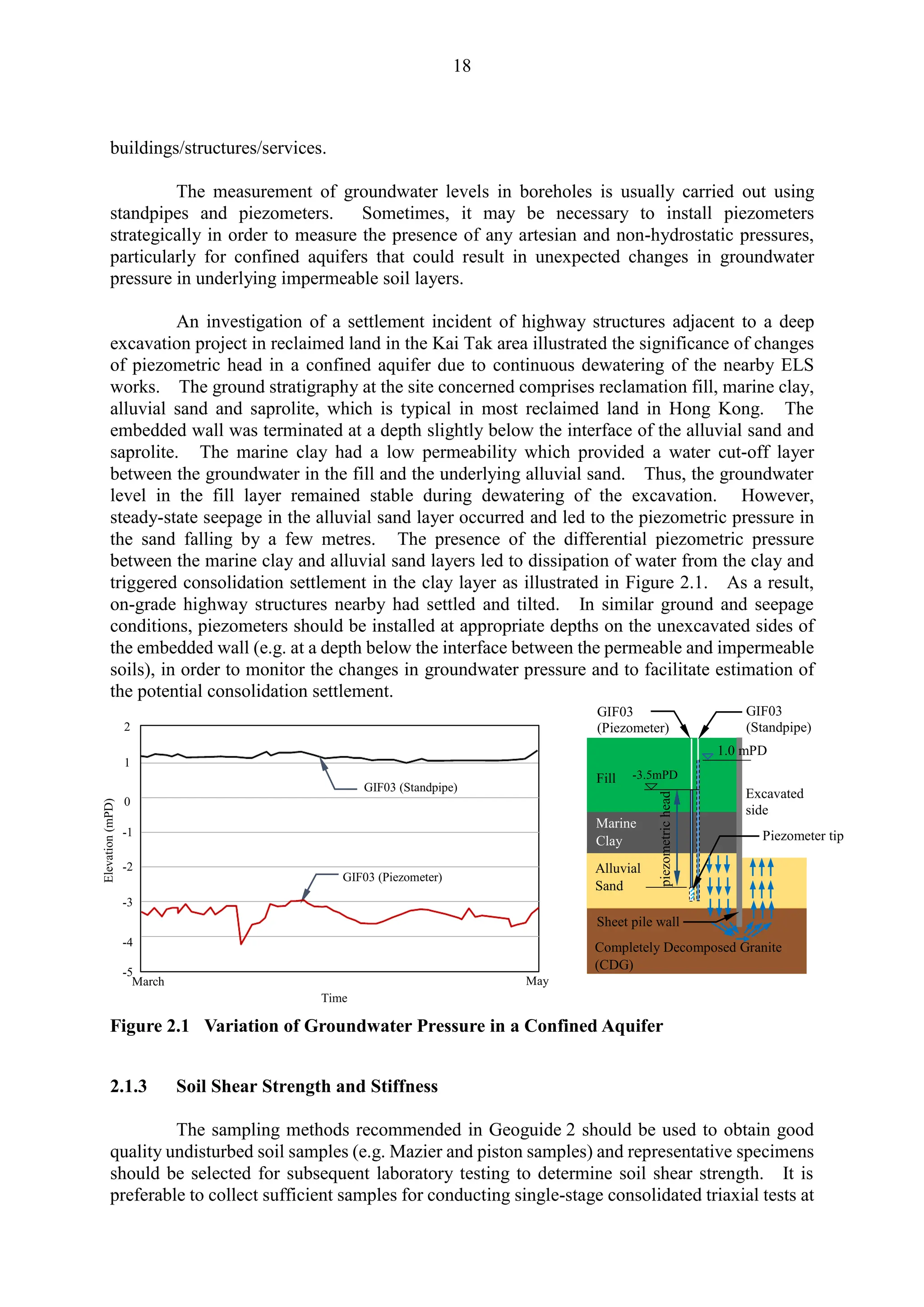
An investigation of a settlement incident of highway structures adjacent to a deep
excavation project in reclaimed land in the Kai Tak area illustrated the significance of changes
of piezometric head in a confined aquifer due to continuous dewatering of the nearby ELS
works. The ground stratigraphy at the site concerned comprises reclamation fill, marine clay,
alluvial sand and saprolite, which is typical in most reclaimed land in Hong Kong. The
embedded wall was terminated at a depth slightly below the interface of the alluvial sand and
saprolite. The marine clay had a low permeability which provided a water cut-off layer
between the groundwater in the fill and the underlying alluvial sand. Thus, the groundwater
level in the fill layer remained stable during dewatering of the excavation. However,
steady-state seepage in the alluvial sand layer occurred and led to the piezometric pressure in
the sand falling by a few metres. The presence of the differential piezometric pressure
between the marine clay and alluvial sand layers led to dissipation of water from the clay and
triggered consolidation settlement in the clay layer as illustrated in Figure 2.1. As a result,
on-grade highway structures nearby had settled and tilted. In similar ground and seepage
conditions, piezometers should be installed at appropriate depths on the unexcavated sides of
the embedded wall (e.g. at a depth below the interface between the permeable and impermeable
soils), in order to monitor the changes in groundwater pressure and to facilitate estimation of
the potential consolidation settlement.
2.1.3 Soil Shear Strength and Stiffness
The sampling methods recommended in Geoguide 2 should be used to obtain good
quality undisturbed soil samples (e.g. Mazier and piston samples) and representative specimens
should be selected for subsequent laboratory testing to determine soil shear strength. It is
preferable to collect sufficient samples for conducting single-stage consolidated triaxial tests at
2
1
0
-1
-2
-3
-4
-5
Time
GIF03 (Piezometer)
GIF03 (Standpipe)
Elevation
(mPD)
March May
Fill
Completely Decomposed Granite
(CDG)
Marine
Clay
GIF03
(Piezometer)
GIF03
(Standpipe)
-3.5mPD
piezometric
head
Sheet pile wall
Figure 2.1 Variation of Groundwater Pressure in a Confined Aquifer
Alluvial
Sand
1.0 mPD
Excavated
side
Piezometer tip
19
different confining pressures. Multi-stage consolidated triaxial tests may also be used in cases
where it is difficult to obtain a sufficient number of representative and suitable specimens.
Methods of determination of soil strength parameters from multi-stage triaxial test results using
the Mohr-Coulomb strength model are discussed by Wong (1978). Endicott (2020) discussed
the possible effects of alteration and disturbance of the soil fabric during multi-stage triaxial
tests.
A sufficient number of triaxial tests (e.g. at least five soil samples for each soil stratum)
should be conducted to provide representative results if practicable. Also, it is important that
the ground model and geotechnical parameters should be reviewed during construction,
especially for large-scale deep excavations with complex ground conditions and construction
sequences.
Apart from collecting samples during the GI for laboratory tests, it is often useful to
conduct field tests to obtain information to supplement the selection of design parameters.
The in-situ standard penetration test (SPT) is commonly adopted to determine the stiffness of
granular soils. In reclaimed land, the cone penetration test (CPT) and vane shear test are useful
for determining the undrained shear strength and soil stiffness of clayey materials. The CPT
provides a fast and continuous profiling of alluvial and marine deposits. However, pre-boring
may be required to penetrate fill layers with substantial gravel and cobble contents, before
conducting the CPT. In the determination of undrained shear strength, su, calibration between
the CPT and representative laboratory tests is required to derive the site-specific correlation
factor. Robertson & Cabal (2022) provided guidance on CPT interpretation to determine
different geotechnical properties and applications of CPT results. Where necessary,
dissipation tests can also be conducted as part of the CPT to determine the consolidation and
compressibility characteristics of fine-grained soils. Alternatively, the engineering properties
of clayey material can also be determined from one-dimensional consolidation tests (i.e.
oedometer test) on undisturbed samples.
2.1.4 Adverse Rock Discontinuities
Where it is anticipated that part of the embedded wall would be installed in rock, GI
should include a discontinuity survey using either the impression packer or borehole televiewer
method. Depending on the results of the discontinuity survey conducted in the initial
boreholes, additional boreholes and discontinuity survey may also be carried out to establish
the presence of any persistent adverse rock joints that could affect the design of rock sockets
and stability assessment of rock faces below the embedded wall. Adverse joint sets may be
identified from concentrations of the pole density of different discontinuities in a stereoplot.
Significant savings can be achieved if representative and realistic rock discontinuities are
identified using suitable GI methods, as opposed to assuming the presence of the most persistent
adverse discontinuities within the rock mass in the design (Cheung et al, 2023).
2.1.5 Condition Survey of Existing Ground Conditions
In urban areas, it is common to have many utilities laid within or adjacent to a
development site. The space for accommodating these underground utilities is usually
congested and frequent trench excavations and backfilling may result in the presence of loose
20
fill layers surrounding them. Where utilities include water-carrying services, it is plausible
that some leakage may have taken place over time and voids could occur when fine materials
are washed away by water seeping through the soil mass. Sinkholes are sometimes reported
in cases where soil arching over the void collapses. The excavation and associated installation
of the embedded wall could then aggravate the problem of sinkhole formation and excessive
settlement.
GEO (2023b) has concluded a review of these incidents associated with deep
excavation and documented the common contributory factors. In conducting the desk study
for the excavation works, the existing conditions of the underground water-carrying services
and buried drains should be established. Relevant government departments, including the
Water Supplies Department, Drainage Services Department and Highways Department, should
be approached for records of any reported pipe bursting or leakage incidents. Such records
may indicate the possible presence of voids in the fill layer. It is now common practice for a
Closed Circuit Television (CCTV) survey to be conducted as part of the precondition survey of
a site, so as to assess the condition of existing underground drains.
In addition to ascertaining the conditions of existing utilities, GI should also include
measures to identify the presence of any voids, especially if loose fill layers, a high groundwater
table and buried water-carrying services are present. Ground penetration radar (GPR) may be
used to detect the presence of voids at shallow depth. Lai et al (2018) reported a blind test
using GPR to detect predetermined underground voids. The investigation concluded that GPR
was effective in detecting voids given careful application of de-noise, signal filtering and
function gains by the commercial operators. However, GPR is less reliable in the detection of
water-filled voids, as the signals are blurred by the dielectric properties of the groundwater.
Alternatively, GCO probing may be used to detect the presence of pre-existing cavities in
shallow fill materials.
2.2 Selection of Geotechnical Parameters
Guidance on the determination and evaluation of relevant geotechnical parameters is
given in Geoguide 1. Nevertheless, it is of paramount importance that engineering judgement
and experience should always be exercised in the determination of the geotechnical parameters
for excavation design. The determination of selected values should take into account the
following major factors:
(a) Quality of GI works (e.g. quantity and quality of soil
samples and in-situ test data);
(b) Scale and duration of the excavation works (e.g. deep
excavation encountering highly variable rockhead and long
duration of dewatering works in association with
consolidation of clayey material); and
(c) Drainage conditions for the excavation (e.g. drained or
undrained conditions).
The selected values of geotechnical parameters for the design of ELS works should be
21
based on suitable estimates that best represent the deformation performance of the works. At
the construction stage, the performance of ELS works should be checked by measuring the
actual deformation and comparing it against the estimated deformation. An effective I&M
plan should be developed to initiate remedial and strengthening measures in cases when the
measured values approach the trigger limits and stakeholders should be consulted on the plan.
This provides the first line of safeguard for ELS works. More guidance on I&M is given in
Chapter 10.
2.2.1 Design for Drained and Undrained Conditions
The circumstances and considerations to determine whether drained or undrained
conditions applying in ELS design depend upon the speed with which the drained condition is
achieved (Gaba et al, 2017). Drained conditions should be considered to apply if the rate of
loading and unloading is sufficiently slow relative to soil permeability such that no significant
excess porewater pressures are generated. In Hong Kong, sandy deposits and saprolite are
generally permeable soils that behave as completely drained during excavation works. In
contrast, the undrained condition applies to soil strata predominately containing silty and clayey
soils (e.g. marine and alluvial clay) which has a much lower soil permeability.
Depending on the scale and complexity of the development project, ELS works can take
a few months to a few years. Therefore, the assessment of drained and undrained conditions
should consider the rate of dissipation of excess porewater pressure over the entire excavation
period, particularly for sites with a thick layer of silty or clayey materials and lengthy construction
programme. The assessment should also take into account factors that could affect the
hydrogeological conditions of the site, e.g. any ground improvement works completed in a
reclamation that may affect the groundwater conditions, such as installation of vertical band
drains and deep cement mixing columns, as well as the presence of perched or confined aquifers
between layers of transported soils and sources of water recharge. In practice, designs are
carried out assuming either the undrained or drained condition and it is seldom necessary to
consider the transient stage between these two conditions unless such a stage is critical.
2.2.2 Soil Shear Strength
In general, the Mohr-Coulomb strength model with effective stress parameters of
apparent cohesion, c' and shear resistance, ϕ' of soil is commonly adopted. Consolidated triaxial
compression tests are normally used to determine the shear strength parameters. Two types of
triaxial compression tests are commonly carried out, namely the consolidated undrained (CU) test
with porewater pressure measurement and the consolidated drained (CD) test with measurement
of volume change. In general, total stress parameters (including the undrained shear strength)
of the saturated specimen (at a given initial moisture content or void ratio), corresponding to a
known initial effective stress, and the porewater pressure changes during shearing can be obtained
in the CU test, from which the effective stress parameters can be determined. In a CD test, the
drained shear strength of the saturated specimen and the volume change characteristics during
shearing can be obtained. The testing time for both tests is also governed by the maximum
allowable rate of axial displacement and the soil permeability, as specified in Geospec 3
(GEO, 2017b).
22
In determining the Mohr-Coulomb shear strength parameters, consideration should be
given to the relevant design stress range where the parameters are obtained in both CU and CD
tests. The values of the parameters should also be assumed constant within the range of stresses
for which they have been evaluated. In the CD test, the maximum shear strength obtained
depends on the confining stress specified and the magnitude of confining stress will affect the
dilation angle of the shear strength parameters. The derived shear strength parameters obtained
in CU and CD tests could be different, but the difference is usually not significant for the design
of ELS works.
For undrained conditions, the shear strength of soil can be expressed in terms of total
stress by the undrained shear strength, su. Laboratory undrained triaxial compression (UU) tests
can be used to determine su values. However, the soil samples should be consolidated to the
appropriate confining stresses and in-situ stress state as recommended in Geoguide 1. The su of
clayey soils determined from UU tests may not be representative due to possible disturbance and
de-saturation of soil samples during sample collection and testing (GEO, 2017b). On the
contrary, in-situ field tests, such as the CPT and vane shear test (e.g. Robertson &
Campanella, 1983), may give a more reliable estimate of su values for clayey materials. General
guidance on performing CPT in Hong Kong is given in Geoguide 2.
Evans (1995) reported that most of the Holocene marine clays in Hong Kong are
normally consolidated and their empirical values of su/v' generally vary from 0.22 to 0.39, where
v' is the effective overburden stress. However, this range of values may not be applicable when
the degree of consolidation is less than 95%. In the absence of a detailed consolidation
assessment and past settlement records, the Code of Practice for Foundations 2017 (BD, 2017)
gives some practical and pragmatic recommendations for estimating the completion of
consolidation based on the age of reclamation in years and thickness of the clayey layers. In
addition, where sensitive clay is identified, the value of su could be significantly reduced from
peak values if the micro-structure of the clay is disturbed by site activities, such as the formation
of mud waves, piling operations and wall installation. In such cases, adoption of the peak value
of su may not be appropriate and the sensitivity of clay should be considered in design. For
over-consolidated clays (e.g. Pleistocene alluvial clays), site-specific representative field tests
calibrated with laboratory tests can be adopted to determine the empirical correlation of su/v'.
CIRIA C143 (Clayton, 1995) refers to other empirical correlations of su with in-situ
SPT ‘N’ values for soils with different plasticity. The selection of appropriate empirical
correlations should be based on reliable case histories with similar ground conditions.
2.2.3 Soil Stiffness
Soil stiffness is the key geotechnical parameter needed to estimate ground deformation
associated with ELS works. GEO (2020) discussed methods for obtaining soil stiffness
parameters and the factors that influence their selection. For example, relatively high soil
stiffness would be expected for sites with substantial overburden removed at the site formation
stage. The stress-strain behaviour of soil is generally non-linear. However, it is often
convenient in design to assume a linear or log-linear relationship between stress and strain for
soil behaviour within a limited range of stress and strain. Also, soil stiffness generally varies
with the strain level and therefore the depth of excavation.
23
The prevailing practice is generally to adopt a linear elastic-perfectly-plastic model for
soil, with the Young’s moduli at working strain level correlated with in-situ test results such as
SPT ‘N’ values:
E' = f × N ……………….………………….. (2.1)
where E' = Young’s modulus for the drained condition (in MPa)
N = SPT ‘N’ value
f = Correlation factor
The above correlation has been widely adopted in local practice and the correlation
factor (f) has been derived from back-analyses of well instrumented and reliable published case
histories of wall deflection (e.g. Lui & Yau, 1995; Chan, 2003; Wong, 2013). Based on local
practice and experience, f is generally in a range of 1.0 to 1.5 for fill and alluvium and 1.5 to 2
for completely and highly decomposed rock (e.g. saprolite). However, where loose soils or
soft soil with a high fines content is encountered, the correlation factor is usually taken as unity.
Apart from the correlations of soil stiffness with SPT ‘N’ value for drained conditions,
some other commonly-used empirical relationships to obtain Young’s modulus for the
undrained condition (Eu) by correlation with su, plasticity index (PI) and over-consolidation
ratio (OCR) can be found in Duncan & Buchignani (1976) and Jamiolkowski et al (1979) (e.g.
Eu/su varies from 300 to 600 for values of PI between 30% and 50% and OCR less than 2).
Alternatively, nonlinear stress-strain behaviour can be directly simulated using various
constitutive models. Special in-situ and laboratory tests, e.g. pressuremeter tests, field
geophysical tests and triaxial tests with local strain gauges attached directly to the sample
(Jardine et al, 1984), are often used to determine the soil parameters.
24
3 Excavation Support Systems
3.1 General
Excavations for building developments and civil engineering works often require ELS
works to support the adjoining ground and construct the substructures.
The following types of embedded wall are commonly used in Hong Kong to support
excavations:
(a) Channel planking wall;
(b) Sheet pile wall;
(c) Soldier pile wall;
(d) Pipe pile wall;
(e) Bored pile wall; and
(f) Diaphragm wall.
The types of excavation support systems can be divided into the following four major
categories according to the form of support provided:
(a) Cantilevered wall;
(b) Strutted wall;
(c) Tied-back wall; and
(d) Circular shaft.
3.2 Types of Embedded Wall
3.2.1 Channel Planking Wall
A channel planking wall comprises steel channel sections driven, pressed or vibrated
into loose to medium dense soils (e.g. SPT ‘N’values less than 30). The commonly used section
sizes range from 150 mm (depth) × 90 mm (width) to 300 mm (depth) × 100 mm (width). A
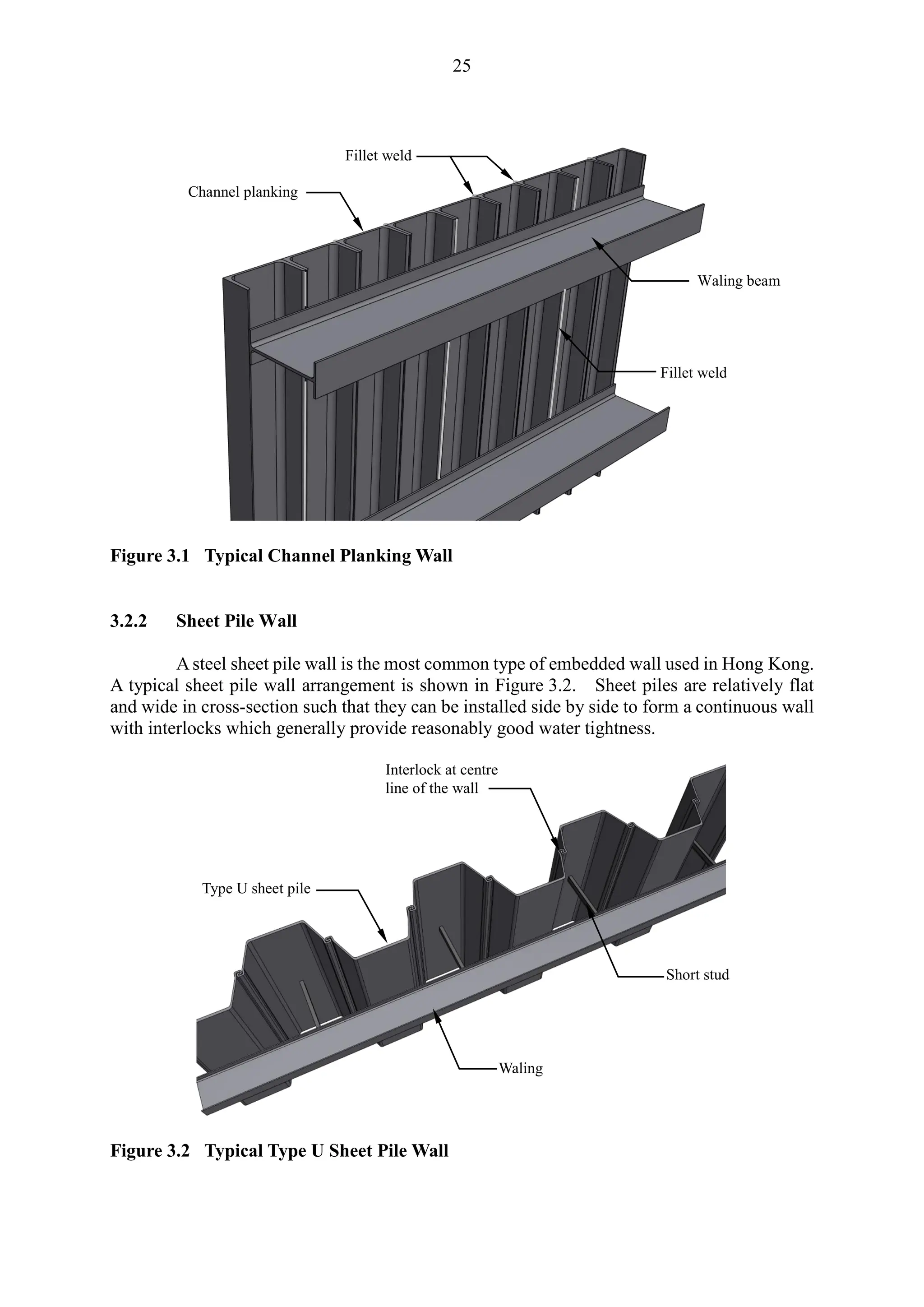
typical channel planking wall arrangement is shown in Figure 3.1. There is no interlocking
between the channel sections, and therefore this wall type does not provide water tightness for
the excavation. The steel channel sections are very often driven into the ground in a group of
welded sections. Site welding at joints would normally be carried out on the excavated side in
order to minimise water seepage for excavations in ground with a high groundwater table. The
stiffness and moment capacity of the channel sections are usually small, and therefore a channel
planking wall is suitable for shallow excavations of generally less than 4 m in depth.
25
Figure 3.1 Typical Channel Planking Wall
3.2.2 Sheet Pile Wall
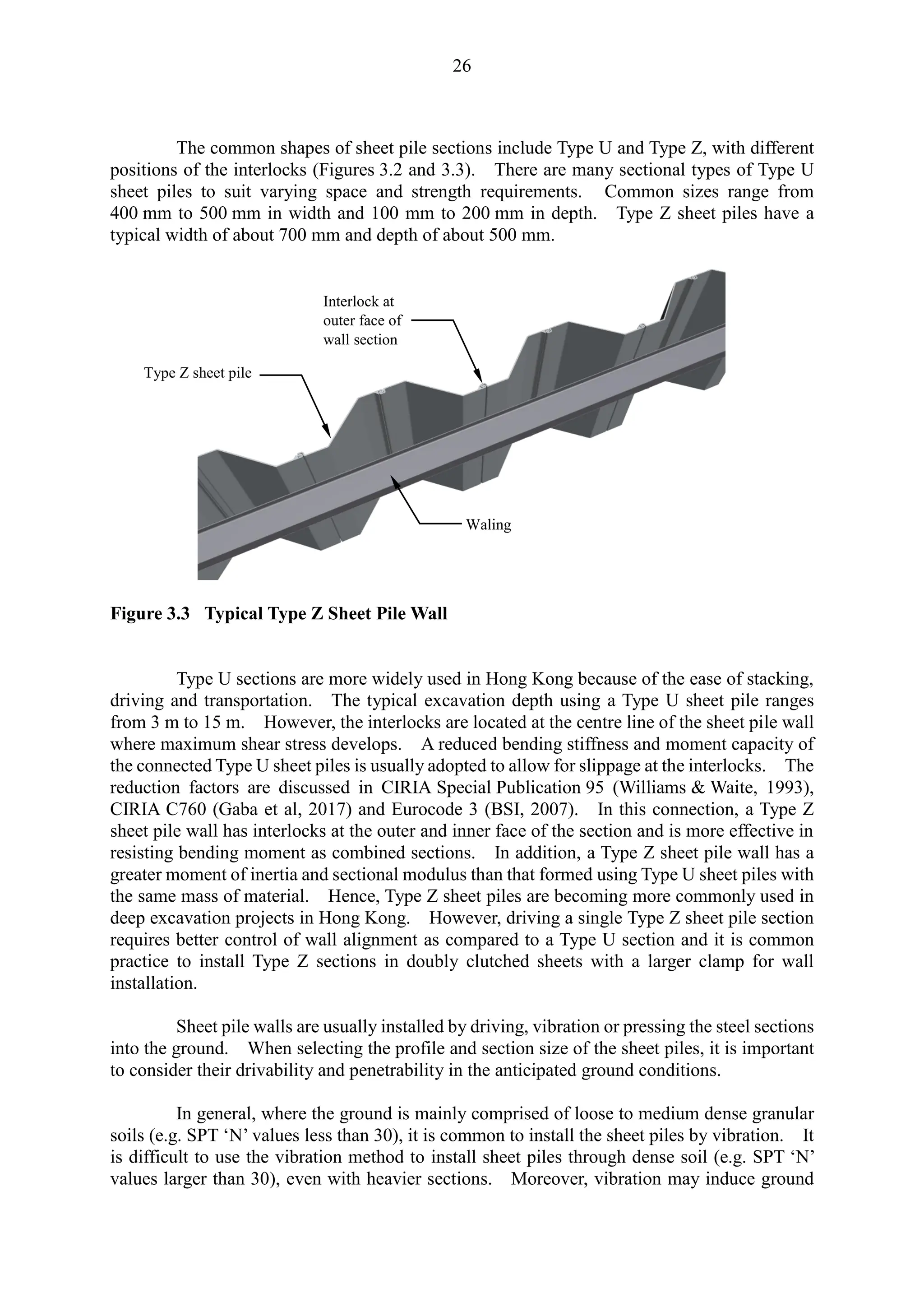
Asteel sheet pile wall is the most common type of embedded wall used in Hong Kong.
A typical sheet pile wall arrangement is shown in Figure 3.2. Sheet piles are relatively flat
and wide in cross-section such that they can be installed side by side to form a continuous wall
with interlocks which generally provide reasonably good water tightness.
Figure 3.2 Typical Type U Sheet Pile Wall
Channel planking
Waling beam
Fillet weld
Fillet weld
Type U sheet pile
Waling
Short stud
Interlock at centre
line of the wall
26
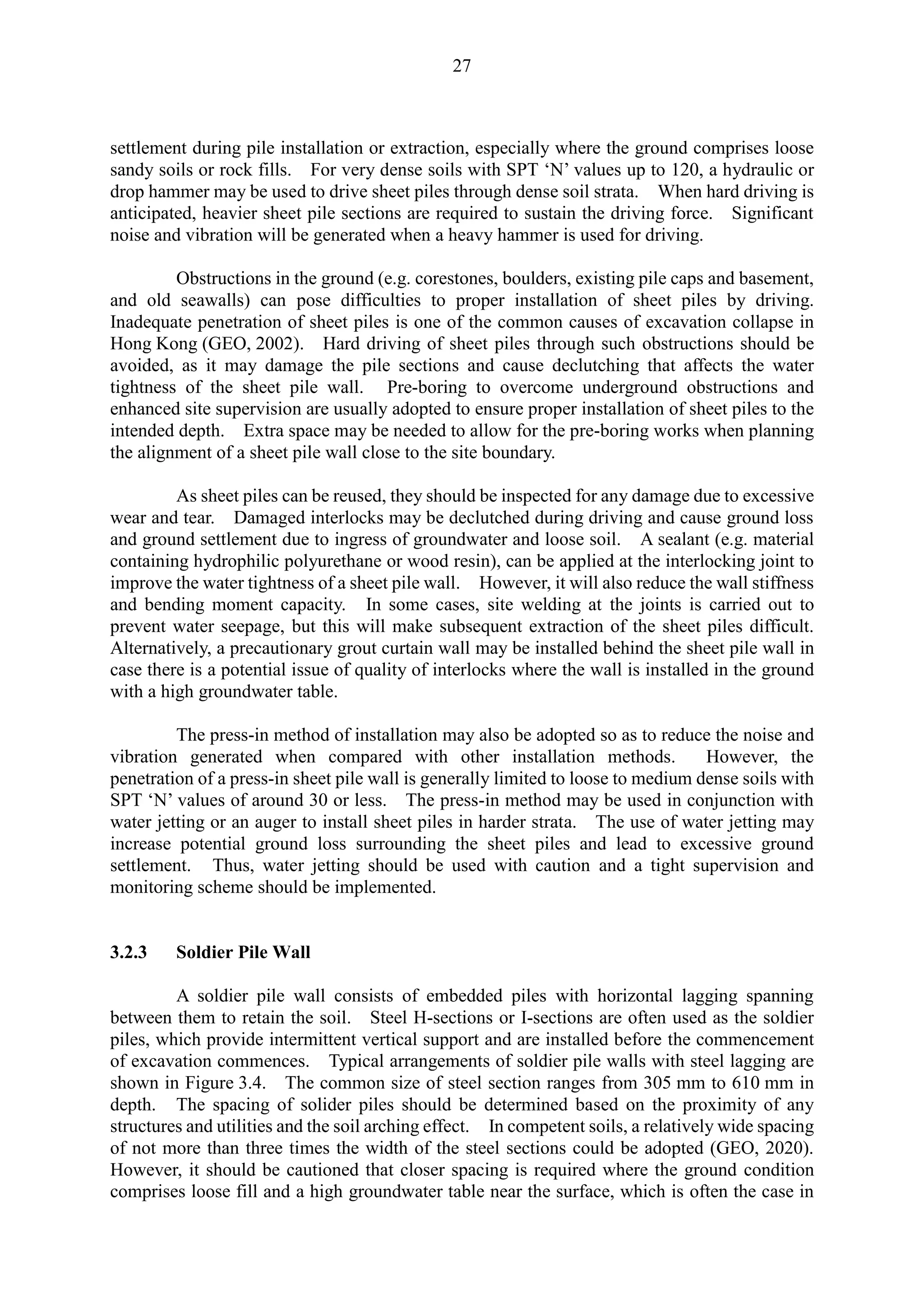
The common shapes of sheet pile sections include Type U and Type Z, with different
positions of the interlocks (Figures 3.2 and 3.3). There are many sectional types of Type U
sheet piles to suit varying space and strength requirements. Common sizes range from
400 mm to 500 mm in width and 100 mm to 200 mm in depth. Type Z sheet piles have a
typical width of about 700 mm and depth of about 500 mm.
Figure 3.3 Typical Type Z Sheet Pile Wall
Type U sections are more widely used in Hong Kong because of the ease of stacking,
driving and transportation. The typical excavation depth using a Type U sheet pile ranges
from 3 m to 15 m. However, the interlocks are located at the centre line of the sheet pile wall
where maximum shear stress develops. A reduced bending stiffness and moment capacity of
the connected Type U sheet piles is usually adopted to allow for slippage at the interlocks. The
reduction factors are discussed in CIRIA Special Publication 95 (Williams & Waite, 1993),
CIRIA C760 (Gaba et al, 2017) and Eurocode 3 (BSI, 2007). In this connection, a Type Z
sheet pile wall has interlocks at the outer and inner face of the section and is more effective in
resisting bending moment as combined sections. In addition, a Type Z sheet pile wall has a
greater moment of inertia and sectional modulus than that formed using Type U sheet piles with
the same mass of material. Hence, Type Z sheet piles are becoming more commonly used in
deep excavation projects in Hong Kong. However, driving a single Type Z sheet pile section
requires better control of wall alignment as compared to a Type U section and it is common
practice to install Type Z sections in doubly clutched sheets with a larger clamp for wall
installation.
Sheet pile walls are usually installed by driving, vibration or pressing the steel sections
into the ground. When selecting the profile and section size of the sheet piles, it is important
to consider their drivability and penetrability in the anticipated ground conditions.
In general, where the ground is mainly comprised of loose to medium dense granular
soils (e.g. SPT ‘N’ values less than 30), it is common to install the sheet piles by vibration. It
is difficult to use the vibration method to install sheet piles through dense soil (e.g. SPT ‘N’
values larger than 30), even with heavier sections. Moreover, vibration may induce ground
Type Z sheet pile
Waling
Interlock at
outer face of
wall section
27
settlement during pile installation or extraction, especially where the ground comprises loose
sandy soils or rock fills. For very dense soils with SPT ‘N’ values up to 120, a hydraulic or
drop hammer may be used to drive sheet piles through dense soil strata. When hard driving is
anticipated, heavier sheet pile sections are required to sustain the driving force. Significant
noise and vibration will be generated when a heavy hammer is used for driving.
Obstructions in the ground (e.g. corestones, boulders, existing pile caps and basement,
and old seawalls) can pose difficulties to proper installation of sheet piles by driving.
Inadequate penetration of sheet piles is one of the common causes of excavation collapse in
Hong Kong (GEO, 2002). Hard driving of sheet piles through such obstructions should be
avoided, as it may damage the pile sections and cause declutching that affects the water
tightness of the sheet pile wall. Pre-boring to overcome underground obstructions and
enhanced site supervision are usually adopted to ensure proper installation of sheet piles to the
intended depth. Extra space may be needed to allow for the pre-boring works when planning
the alignment of a sheet pile wall close to the site boundary.
As sheet piles can be reused, they should be inspected for any damage due to excessive
wear and tear. Damaged interlocks may be declutched during driving and cause ground loss
and ground settlement due to ingress of groundwater and loose soil. A sealant (e.g. material
containing hydrophilic polyurethane or wood resin), can be applied at the interlocking joint to
improve the water tightness of a sheet pile wall. However, it will also reduce the wall stiffness
and bending moment capacity. In some cases, site welding at the joints is carried out to
prevent water seepage, but this will make subsequent extraction of the sheet piles difficult.
Alternatively, a precautionary grout curtain wall may be installed behind the sheet pile wall in
case there is a potential issue of quality of interlocks where the wall is installed in the ground
with a high groundwater table.
The press-in method of installation may also be adopted so as to reduce the noise and
vibration generated when compared with other installation methods. However, the
penetration of a press-in sheet pile wall is generally limited to loose to medium dense soils with
SPT ‘N’ values of around 30 or less. The press-in method may be used in conjunction with
water jetting or an auger to install sheet piles in harder strata. The use of water jetting may
increase potential ground loss surrounding the sheet piles and lead to excessive ground
settlement. Thus, water jetting should be used with caution and a tight supervision and
monitoring scheme should be implemented.
3.2.3 Soldier Pile Wall
A soldier pile wall consists of embedded piles with horizontal lagging spanning
between them to retain the soil. Steel H-sections or I-sections are often used as the soldier
piles, which provide intermittent vertical support and are installed before the commencement
of excavation commences. Typical arrangements of soldier pile walls with steel lagging are
shown in Figure 3.4. The common size of steel section ranges from 305 mm to 610 mm in
depth. The spacing of solider piles should be determined based on the proximity of any
structures and utilities and the soil arching effect. In competent soils, a relatively wide spacing
of not more than three times the width of the steel sections could be adopted (GEO, 2020).
However, it should be cautioned that closer spacing is required where the ground condition
comprises loose fill and a high groundwater table near the surface, which is often the case in
28
urban sites.
Soldier piles are either driven or placed in pre-bored holes, which are backfilled with
grout or lean concrete, in deep excavations generally up to 20 m. Similar to sheet piles, soldier
piles can be driven into soil for faster installation. However, pre-boring is often required and
preferred to overcome underground obstructions, such as boulders or old seawall masonry
blocks, especially in urban areas, and to minimise the vibration and noise arising from pile
driving. In addition, driving of steel sections may cause heave and settlement of nearby
buildings/structures/services (D’Appolonia, 1971) which should be duly considered in selecting
the appropriate embedded wall system.
Figure 3.4 Typical Soldier Pile Wall with Steel Lagging
Gap filled with
cement mortar
Pre-bored hole
filled with cement
grout
Soldier pile
Full welding between steel
lagging and solider pile
Steel lagging
plates
Pre-bored hole
filled with cement
grout
Soldier pile
Full welding between steel
lagging and solider pile
Steel lagging plates
29
Steel plates or channel sections connected by welding to the soldier piles, or shotcrete
with wire mesh, are usually adopted as lagging to support the soil face and prevent progressive
deterioration of the soil arching effect between the piles. Lagging is often installed in lifts of
1.0 m to 1.5 m, depending on the strength of the retained soil and the groundwater conditions.
Soldier pile walls are well suited to competent ground, typically dense soils (e.g.
SPT ‘N’ values greater than 30), with a low groundwater table. When the base of the
excavation is below the groundwater level, a grout curtain wall is commonly provided to
minimise water seepage into the excavation. On the contrary, where there is a concern about
the build-up of groundwater pressure behind the lagging, drainage holes are provided at
appropriate levels to maintain the groundwater level, or to lower it if drawdown is permitted.
In such cases, filter materials such as synthetic fabrics may be used to prevent loss of soil behind
the wall.
3.2.4 Pipe Pile Wall
A pipe pile wall is similar to a solider pile wall, except that the steel casing used in the
pre-boring works is also used as the vertical element to the excavation. Sometimes, steel H
sections are inserted inside the casing to increase the bending stiffness and capacity of the
embedded wall. Pipe pile walls are commonly used for excavations more than 10 m deep,
with typical casing sizes in Hong Kong ranging from 219 mm to 813 mm in outer diameter.
The spacing of the pipe piles should be determined based on similar considerations as for a
solider pile wall. Steel lagging is installed between the pipe piles to retain the excavated soil
face and prevent progressive deterioration of the soil arching between the piles, especially under
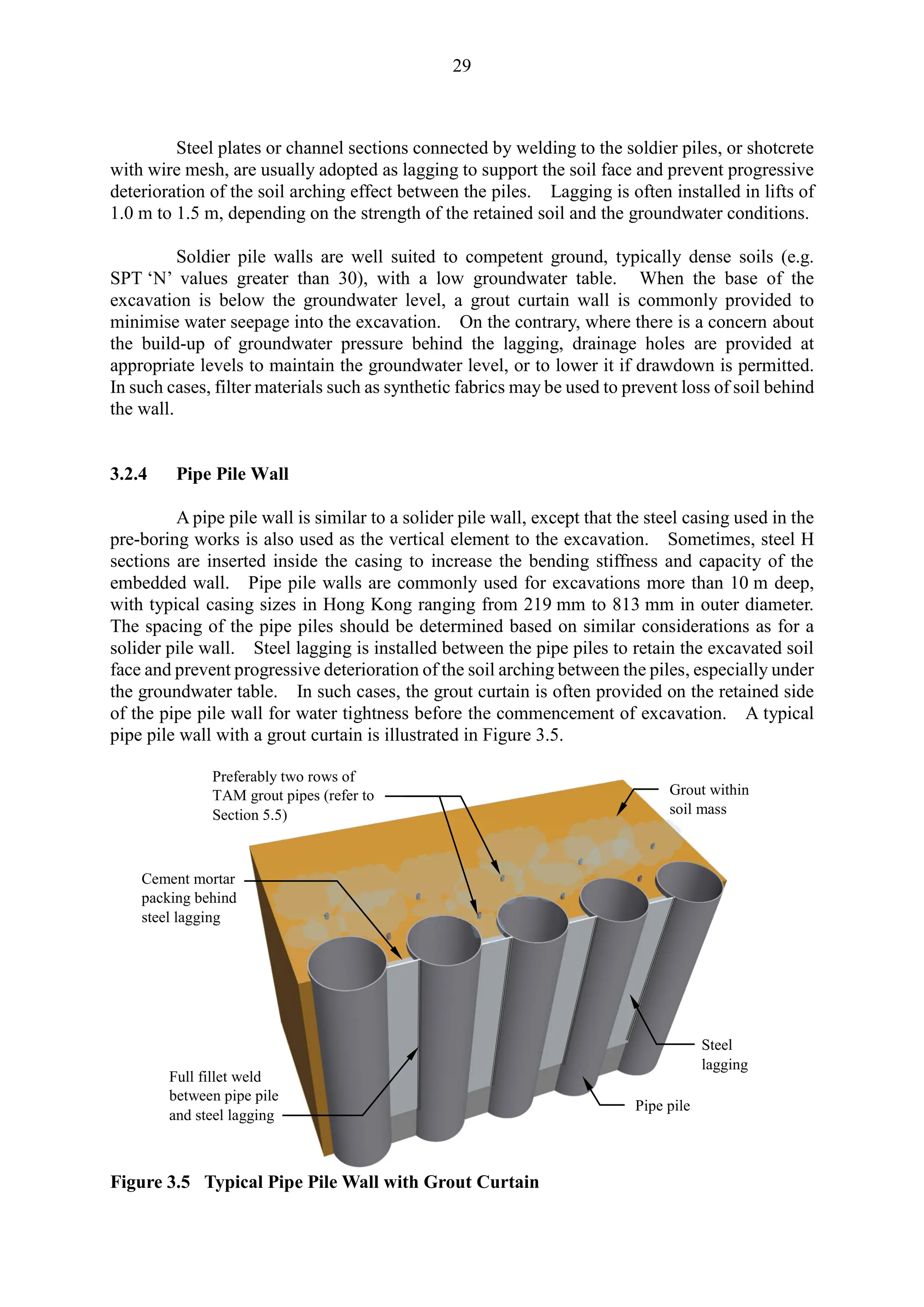
the groundwater table. In such cases, the grout curtain is often provided on the retained side
of the pipe pile wall for water tightness before the commencement of excavation. A typical
pipe pile wall with a grout curtain is illustrated in Figure 3.5.
Figure 3.5 Typical Pipe Pile Wall with Grout Curtain
Pipe pile
Steel
lagging
Preferably two rows of
TAM grout pipes (refer to
Section 5.5)
Grout within
soil mass
Full fillet weld
between pipe pile
and steel lagging
Cement mortar
packing behind
steel lagging
30
Interlocking pipe piles as shown in Figure 3.6 provide a reasonably good water cut-off
and are usually regarded as an impermeable embedded wall. The interlocking joints act as a
physical barrier against groundwater seepage, although minor seepage through the joints may
still occur if the difference in hydraulic head is significant. In such cases, sealant can be used
in the interlocking joints to further enhance water tightness (Li et al, 2018).
Due to their water tightness, interlocking pipe piles have been gaining popularity in
recent excavation projects in Hong Kong. A few ELS projects (e.g. the Central Kowloon
Route crossing Kowloon Bay, and the Lyric Theatre in Tsim Sha Tsui) using interlocking pipe
pile walls have been successfully executed and the walls proved to be effective in providing a
groundwater cut-off barrier. Interlocking pipe pile walls also have the advantage of readily
overcoming underground obstructions. However, particular attention is needed when
interlocking pipe piles are being advanced through mixed ground conditions (e.g. saprolite with
corestones), as even a small deviation of the wall alignment or installation tolerance could cause
interruption or clashing of the piles at depth. Retraction and reinstallation of the clashed pipe
piles may cause significant ground loss and hence induce undue ground deformation in the
vicinity. An oversize pre-bored hole is also required to accommodate the interlocks.
Figure 3.6 Typical Interlocking Pipe Pile Wall
3.2.5 Bored Pile Wall
Bored pile walls generally have a relatively large wall stiffness and are better in
limiting wall deflection during excavation as compared with the foregoing wall types. They
are usually used in excavations more than 15 m deep. A bored pile wall is formed by a row
of either contiguous bored piles or secant bored piles constructed along the periphery of the
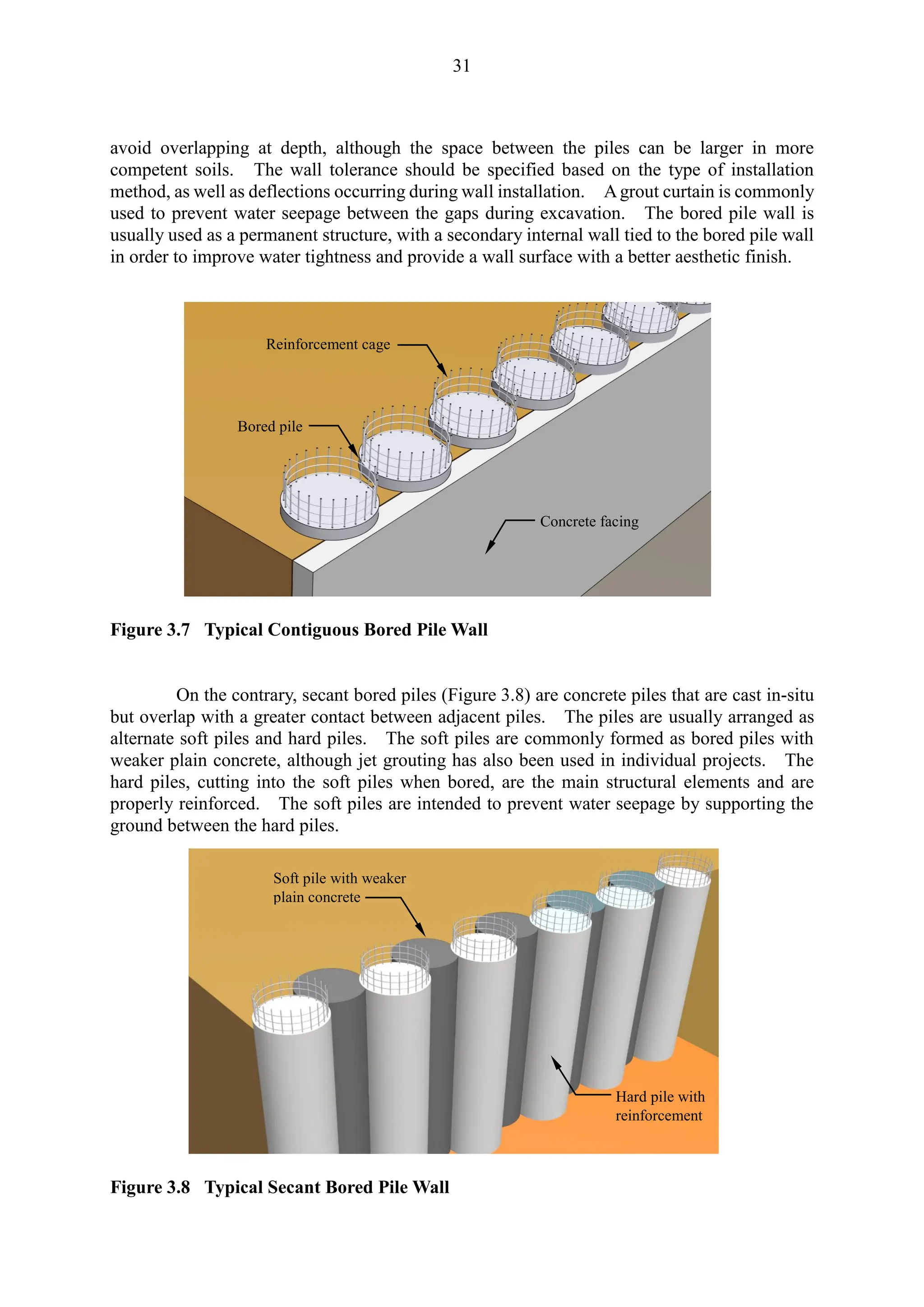
excavation. Contiguous piles (Figure 3.7) do not intersect with each other and the gaps
between piles are typically around 100 mm to 500 mm to allow for construction tolerance and
Interlocking joint
Slightly oversized pre-bored hole
31
avoid overlapping at depth, although the space between the piles can be larger in more
competent soils. The wall tolerance should be specified based on the type of installation
method, as well as deflections occurring during wall installation. Agrout curtain is commonly
used to prevent water seepage between the gaps during excavation. The bored pile wall is
usually used as a permanent structure, with a secondary internal wall tied to the bored pile wall
in order to improve water tightness and provide a wall surface with a better aesthetic finish.
Figure 3.7 Typical Contiguous Bored Pile Wall
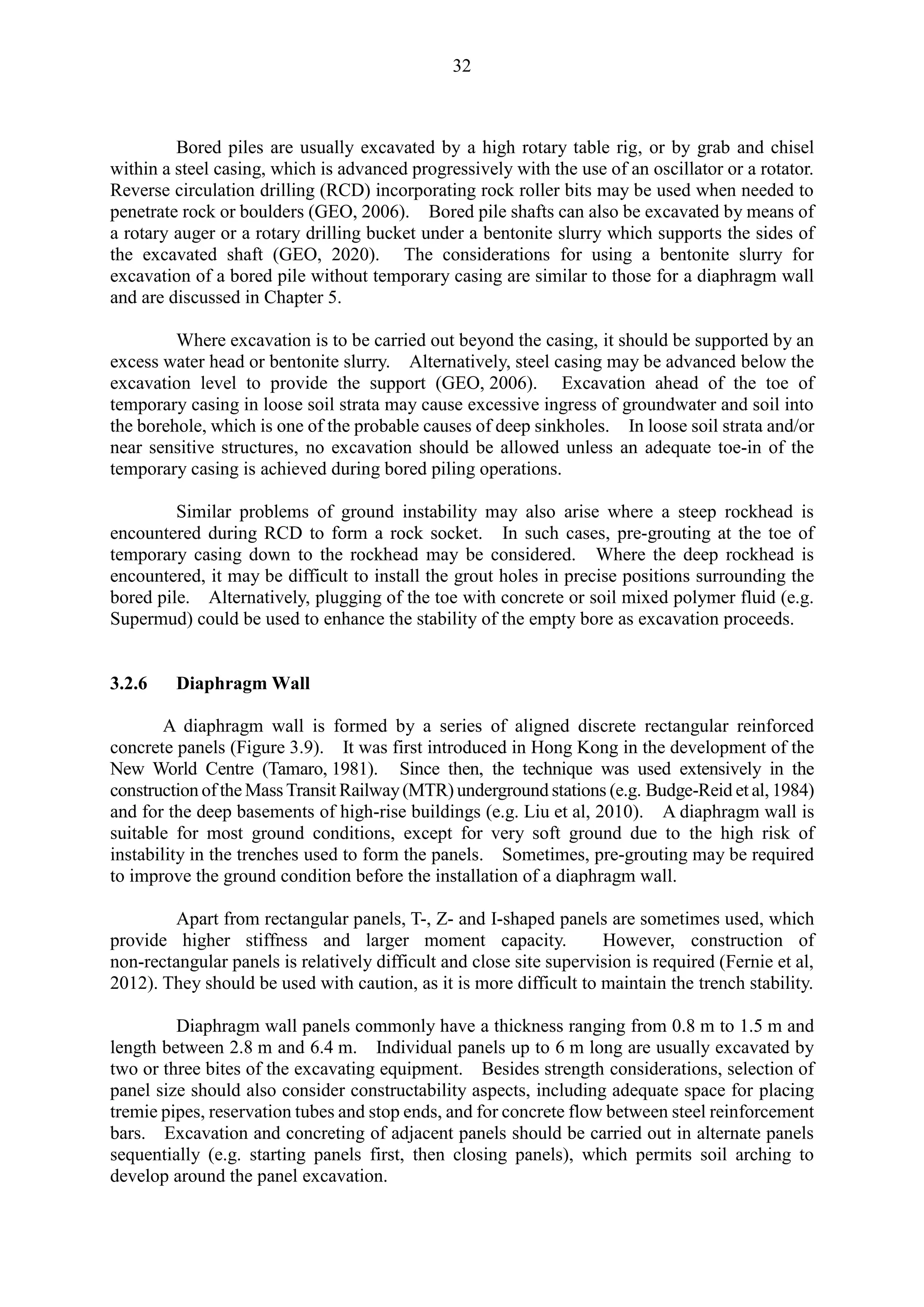
On the contrary, secant bored piles (Figure 3.8) are concrete piles that are cast in-situ
but overlap with a greater contact between adjacent piles. The piles are usually arranged as
alternate soft piles and hard piles. The soft piles are commonly formed as bored piles with
weaker plain concrete, although jet grouting has also been used in individual projects. The
hard piles, cutting into the soft piles when bored, are the main structural elements and are
properly reinforced. The soft piles are intended to prevent water seepage by supporting the
ground between the hard piles.
Figure 3.8 Typical Secant Bored Pile Wall
Concrete facing
Reinforcement cage
Bored pile
Hard pile with
reinforcement
Soft pile with weaker
plain concrete
32
Bored piles are usually excavated by a high rotary table rig, or by grab and chisel
within a steel casing, which is advanced progressively with the use of an oscillator or a rotator.
Reverse circulation drilling (RCD) incorporating rock roller bits may be used when needed to
penetrate rock or boulders (GEO, 2006). Bored pile shafts can also be excavated by means of
a rotary auger or a rotary drilling bucket under a bentonite slurry which supports the sides of
the excavated shaft (GEO, 2020). The considerations for using a bentonite slurry for
excavation of a bored pile without temporary casing are similar to those for a diaphragm wall
and are discussed in Chapter 5.
Where excavation is to be carried out beyond the casing, it should be supported by an
excess water head or bentonite slurry. Alternatively, steel casing may be advanced below the
excavation level to provide the support (GEO, 2006). Excavation ahead of the toe of
temporary casing in loose soil strata may cause excessive ingress of groundwater and soil into
the borehole, which is one of the probable causes of deep sinkholes. In loose soil strata and/or
near sensitive structures, no excavation should be allowed unless an adequate toe-in of the
temporary casing is achieved during bored piling operations.
Similar problems of ground instability may also arise where a steep rockhead is
encountered during RCD to form a rock socket. In such cases, pre-grouting at the toe of
temporary casing down to the rockhead may be considered. Where the deep rockhead is
encountered, it may be difficult to install the grout holes in precise positions surrounding the
bored pile. Alternatively, plugging of the toe with concrete or soil mixed polymer fluid (e.g.
Supermud) could be used to enhance the stability of the empty bore as excavation proceeds.
3.2.6 Diaphragm Wall
A diaphragm wall is formed by a series of aligned discrete rectangular reinforced
concrete panels (Figure 3.9). It was first introduced in Hong Kong in the development of the
New World Centre (Tamaro, 1981). Since then, the technique was used extensively in the
construction of the Mass Transit Railway(MTR) underground stations (e.g. Budge-Reid et al, 1984)
and for the deep basements of high-rise buildings (e.g. Liu et al, 2010). A diaphragm wall is
suitable for most ground conditions, except for very soft ground due to the high risk of
instability in the trenches used to form the panels. Sometimes, pre-grouting may be required
to improve the ground condition before the installation of a diaphragm wall.
Apart from rectangular panels, T-, Z- and I-shaped panels are sometimes used, which
provide higher stiffness and larger moment capacity. However, construction of
non-rectangular panels is relatively difficult and close site supervision is required (Fernie et al,
2012). They should be used with caution, as it is more difficult to maintain the trench stability.
Diaphragm wall panels commonly have a thickness ranging from 0.8 m to 1.5 m and
length between 2.8 m and 6.4 m. Individual panels up to 6 m long are usually excavated by
two or three bites of the excavating equipment. Besides strength considerations, selection of
panel size should also consider constructability aspects, including adequate space for placing
tremie pipes, reservation tubes and stop ends, and for concrete flow between steel reinforcement
bars. Excavation and concreting of adjacent panels should be carried out in alternate panels
sequentially (e.g. starting panels first, then closing panels), which permits soil arching to
develop around the panel excavation.
33
Figure 3.9 Typical Diaphragm Wall
Rectangular trenches are excavated with the use of grabs or hydromills (also called
trench cutters or hydrofraises). As compared to grabs, hydromills are generally more powerful,
efficient and versatile and can work continuously to lift the excavated material to the surface
(Endicott, 2020). The reinforced concrete panels are usually cast in-situ in Hong Kong.
Precast panels are seldom used due to construction difficulties in connecting the panels together
on site.
A diaphragm wall generally provides good water tightness between cast in-situ panels.
The commonly used joint systems in Hong Kong include vertically pulled and peel-off steel
systems, which enable a vertical water stop to be adopted. Accurate placing of stop-ends is
vital for the control of panel dimensions and water tightness at panel joints. Local experience
in successful placing and removing such stop-ends is limited to about 50 m depth. If the
adoption of stop-ends with a water stop is considered impractical, or the performance of a water
stop is ineffective, grouting should be applied at and around the construction joints between the
diaphragm wall panels.
Trench excavation of a diaphragm wall is usually supported by bentonite slurry. The
hydrostatic pressure of the slurry should be controlled so that it is always greater than the
combined water and earth pressures, with due allowance given for the soil arching effect
(GEO, 2020). Further details of the construction considerations for a diaphragm wall are
presented in Chapter 5.
A concrete capping beam is usually cast on top of the diaphragm wall panels, which
allows more even load distribution on the diaphragm wall and hence reduces the differential
wall deflection. For situations where part of a diaphragm wall is to be bored through or saw
cut to create a wall opening (e.g. Tunnel Boring Machine launching or retrieval), the capping
beam could also take up the self-weight of the hanging diaphragm wall panels above the wall
opening.
Diaphragm walls founded on rock are usually designed to have a shallow rock
Closing panel
Successive panel
Water stop
Reinforcement cage
Starting panel
34
embedment. Otherwise, larger power hydromills and a longer period of excavation will be
needed for deep penetration in rock. Where excavation is extended below rockhead, shear
pins are commonly installed and penetrated below the final excavation level in order to ensure
the toe stability of the diaphragm wall.
Rock fissure grouting is often carried out below the toe of a diaphragm wall where it
is necessary to control groundwater seepage along rock joints or other discontinuities into the
excavation. Sze & Young (2003) described the construction of a deep basement for Chater
House which involved the adoption of toe grouting in the form of chemical grout in soils and
fissure grouting in rock down to a depth of 5 m into Grade III or better rock, in order to ensure
the effectiveness of the water cut-off barrier and limit the drawdown of groundwater level
outside the site. Steel reservation tubes can be provided in the reinforcement cage for toe
grouting and installation of shear pins. In addition to lateral stability at the wall toe, vertical
stability also needs to be considered as diaphragm wall panels impose large surcharge loading
on vertical or inclined rock excavations. Field mapping of the exposed rock face and stability
assessment should be carried out for different types of potential rock slope failures (e.g. plane
mode, wedge mode and toppling mode), and appropriate stabilisation measures added if
necessary (e.g. rock bolts/anchors).
3.3 Forms of Excavation Support
3.3.1 Cantilevered Wall
A cantilevered wall is a wall driven or bored to a depth considerably greater than the
depth of excavation and derives its support from the resistance provided by the embedded
section of the wall. It has a simple construction sequence with no strutting and can provide a
large unobstructed area for construction of permanent structures within the excavation.
Nevertheless, in order to reduce wall deflection, a light waling is sometimes installed to even
out variations of ground pressures along the wall (Williams & Waite, 1993).
Cantilevered walls are generally limited to relatively shallow excavations. For deep
excavations, the wall section requires much higher stiffness and bending moment capacity (e.g.
as provided by a large diameter bored pile wall) in order to maintain the wall deflection and
ground deformation within tolerable limits. As such, cantilevered walls are economical only
for moderate retaining wall heights (usually less than 5 m), as the required stiffness and
structural capacity of the wall increases rapidly with increase in retained height.
3.3.2 Strutted Wall
A strutted wall is the most popular system for deep excavation in Hong Kong and its
layout should be planned with due consideration of ease of access for excavation plant, export
of excavated materials and configuration of the permanent works. Different strutting systems,
including the cross-lot and raking strut systems, are shown in Figures 3.10 and 3.11.
Pre-loading may be applied to struts to reduce wall deflection, and thereby the associated
ground settlement. However, wall deflection during preloading may affect the water tightness
of completed grout curtains. Strut removal can also give rise to additional wall deflection and
the construction sequence should be carefully planned. The space between the permanent
35
structure and the embedded wall should be properly backfilled and compacted.
Figure 3.10 Strutting System with Raking Struts
Figure 3.11 Strutting System with Cross-lot
The disadvantage of a cross-lot strutting system is that the working space can be severely
restricted. The diagonal strutting system as shown in Figure 3.12 is more suited to small and
Cross-lot
Contiguous
pipe pile wall
Waling
Raking strut
Structural
support on piles
Sloping ground
Sheet pile
wall
36
preferably square excavations, e.g. shafts. Diagonal strutting is also used near the corners of
wide excavations and serves to leave a relatively large portion of the excavation open. Raking
struts are commonly used for unbalanced excavations where the excavation depth and loading
are different on the opposite sides of an excavation, or where the excavation is particularly wide
and makes cross-lot strutting impracticable. A combination of cross-lot, raking and diagonal
struts is sometimes used to suit the specific site conditions.
Figure 3.12 Strutting System with Diagonal Struts
Two types of construction sequence (i.e. bottom-up and top-down) for strutted walls
are common in Hong Kong. Figure 3.13 illustrates the bottom-up sequence, in which the
excavation is first completed before the permanent structure is built from the bottom upwards.
The bottom-up sequence allows the permanent structure to be built from the base and
independent of the temporary works. Hence the permanent structure, if kept separate from the
temporary structures, will have no locked-in deformation and stresses due to sequential loading
during excavation (Endicott, 2020). However, cross-lot or raking struts used to facilitate the
bottom-up sequence can obstruct part of the excavation space and impede the construction of
permanent structures. Besides, steel decking is usually erected on top of the struts to provide
temporary platforms for site construction works.
The top-down construction sequence, as illustrated in Figure 3.14, uses the permanent
internal structure as part of the strutting to the embedded wall, with the top basement slabs cast
before further excavation down to lower-levels as the works progress. This sequence allows
the superstructure to be constructed simultaneously with the basement structure. This method
of construction is common for deep excavations in Hong Kong, particularly when it is planned
Contiguous
pipe pile wall
Diagonal strut
37
as part of an accelerated construction of the superstructure. The top basement slab enables
flexible usage of the ground (e.g. for road traffic) and provides cover to the site against adverse
weather. Nevertheless, a disadvantage of this construction method is that it limits the head
room for large construction plant to excavate materials underneath the constructed floor slabs.
Large openings in slabs, e.g. for the mucking out of excavated materials, can locally influence
the support stiffness to the wall.
Figure 3.13 Bottom-up Construction
Figure 3.14 Top-down Construction
Stanchion
supporting
structure
above
Ground floor
slab and
construction
above
Diaphragm
wall
Waling and
strut
supporting
the
diaphragm
wall as
excavation
proceeds
Opening for
mucking out
38
From programme and constructability perspectives, it is preferable to have lateral
support provided at relatively large intervals so as to minimise restrictions on the working
methods. Besides the strength and stiffness of the excavation support system, practical issues
related to the erection of large struts and waling sections should also be considered (Gaba, 2012).
The typical horizontal spacing between steel struts used in bottom-up construction in Hong
Kong is between 3 m and 9 m, while the typical vertical spacing is between 2 m and 4 m. In
the top-down construction method, a reinforced concrete slab can provide stiffer support than a
steel strutting system, thus a larger vertical spacing can be allowed, typically ranging from 3 m
to 6 m.
A diaphragm wall is commonly used as a permanent basement wall that is propped by
the structural floor slab. Buildability aspects should be considered in designing the structural
connection between the wall and basement slab. Starter bars can be cast in the diaphragm
wall, and later exposed and bent out when needed to be lapped with the slab reinforcement.
Proper and strong fixing is required to ensure the left-in starter bars are not damaged or
displaced during concreting of the diaphragm wall. The size of starter bars should be suitably
selected to avoid difficulty in bending out the bars. Sometimes, an additional row of starter
bars is provided to allow for any misalignment in the elevation of the bars.
Embedding couplers in diaphragm walls is an alternative technique that has been used
in some basement projects in Hong Kong. However, the quality of workmanship and site
supervision of the quality of coupler connections are essential to avoid defective connections
(e.g. improper connection and inadequate thread engagement), which may result in significant
structural remedial works and also affect durability of the permanent structures. Adequate
space for threading of reinforcement bars into embedded couplers should be provided.
Localised post drilling may be adopted as a remedial measure for rectifying missing or
misaligned couplers or starter bars. However, their installation may damage the wall
reinforcement and affect the water tightness of the diaphragm wall panel.
3.3.3 Tied-back Wall
Tied-back walls, in which the wall is anchored or tied back into unexcavated ground
outside the excavation, are less commonly used in Hong Kong, as it is not always possible to
install the tie-backs in adjoining ground, particularly where it would involve encroachment into
private land and properties. However, where encroachment into the adjoining ground is
acceptable, a tied-back wall has the advantage of providing an excavation area free of strutting
and facilitates construction of the permanent works. For excavations on sloping terrain, where
there is large unbalanced excavation across the site and lack of space for construction works, a
tied-back wall often provides a practical and feasible solution. Tied-back walls have been
successfully employed in a number of local projects as temporary support measures by using
ground anchors such as soil nails or prestressed anchors. Lam (2018) reported the application
of a tied-back wall for a hillside excavation project in Stubbs Road, Hong Kong, as shown in
Figure 3.15. Choi et al (2021) also reported the construction of the Lung Shan Tunnel portal
using a temporary tied-back wall to support a composite retaining wall.
In Hong Kong, prestressed ground anchors (Figure 3.16) are sometimes used in a
tied-back wall. The connecting elements are either tie rods or cable strands. These elements
are commonly made of high strength steel and therefore a relatively small sectional area of
39
anchor is required to provide a sufficient anchorage force to support the excavation.
Prestressed ground anchors are seldom used as permanent structural support to the retaining
wall, as this imposes a long-term monitoring commitment on the maintenance parties which
usually involves appreciable recurrent cost and, should deficiencies be found at a later time,
remedial works may be difficult and expensive. The monitoring requirements for soil nails
and prestressed ground anchors are given in Geoguide 7 (GEO, 2023a) and Geospec 1
(GEO, 1997) respectively.
Figure 3.15 Tied-back Wall Support System for the Excavation Works at Stubbs Road
Figure 3.16 Tied-back Wall Support System Using Ground Anchors
Ground
anchor
Embedded wall
Anchored
head
40
Where tie-backs are used as temporary support, they are usually abandoned after
completion of the substructure works. The left-in steel bars or wire strands may obstruct
subsequent construction works in adjoining ground. Removable or retractable ground anchors
have been adopted for deep excavation projects in Hong Kong, such as the Phase II
Development of Hopewell Centre, a residential development in Tsing Yi, the MTR viaduct in
Wong Chuk Hang (Chan et al, 2017), a commercial development at the Hong Kong
International Airport, and the redevelopment of Grantham Hospital as shown in Figure 3.17.
In these cases, the steel strands were pulled out, leaving only the plastic sheaths.
Swann et al (2013) described the use of glass fibre reinforced polymer (GFRP) bars as
soil nails in the temporary excavation works for construction of the Ho Man Tin Station.
GFRP bars can be cut with conventional drilling equipment and do not pose a significant
obstruction to future construction works. Besides, the use of light weight GFRP bars is
appealing for constrained sites where it may be difficult to deploy heavy lifting equipment.
Figure 3.17 Retractable Prestressed Ground Anchor Support System at the
Redevelopment of Grantham Hospital
3.3.4 Circular Shaft
Circular shafts are gaining popularity in local large-scale projects where excavation
deeper than 30 m is required. Diaphragm wall panels are commonly used to form the circular
shaft, where the panels themselves act as compression members to resist the lateral earth load.
In cases where the wall panels could not provide sufficient support through the hoop action,
continuous reinforced concrete ring beams are constructed. This type of support system
requires fewer or no internal strutting as compared to other systems, thereby allowing more free
working space within the site. Also, the hoop compression can improve the water tightness
41
between diaphragm wall panels. However, it is important to ensure effective overlapping of
the wall panels in order to ensure full development of the hoop action. Thus, the tolerance of
the alignment of the wall panels and joints should be carefully controlled (Gaba et al, 2017).
Pappin (2011) presented case histories of using a diaphragm wall to facilitate circular
shaft excavation in Hong Kong and Singapore, including the Cheung Kong Centre,
International Finance Centre 2 and the International Commerce Centre (Figure 3.18). The
latter two excavations used diaphragm wall panels of 1.5 m thick, with the internal diameters
of the circular shafts ranging between 61 m and 76 m and excavation depth up to 35 m. The
Singapore experience showed that it was practicable to construct a circular shaft of up to 120 m
in diameter and excavation depth up to 18 m. Despite such large-scale excavation, the lateral
displacements recorded were small and generally less than 20 mm (Pappin, 2011).
More recently, multi-cell shaft excavation in a “peanut” shape, which is a series of
interlocking circular shafts, has been used to construct a launching platform for tunnel boring
machines (Figure 3.19) in the Trunk Road T2 and Cha Kwo Ling Tunnel Project.
Chan et al (2020) described the use of a fifteen-cell cofferdam for the construction of the
southern approach road of the Tuen Mun-Chek Lap Kok Link (Figure 3.20).
Figure 3.18 Circular Shaft for Basement Construction at International Commerce
Centre
42
Figure 3.19 TBM Launching Peanut Shaft in Trunk Road T2 and Cha Kwo Ling
Tunnel Project
Figure 3.20 Multi-cell Circular Shaft for Cut-and-Cover Tunnel Construction under
the Tuen Mun-Chek Lap Kok Link Project
43
4 Design Considerations
4.1 General
This Chapter provides guidance on some of the key design considerations that are
relevant to excavation support systems. Whilst the design needs to fulfil the fundamental
requirements of stability and serviceability of the selected system, buildability aspects should
also be properly considered to ensure that the works can be constructed efficiently, safely and
effectively. THB (2020) highlighted the importance of addressing buildability aspects of the
design, with a view to identifying and resolving any major construction issues at an early stage
of the project.
4.2 Loading Conditions
Loads exerted by the retained ground, groundwater and surcharge should be duly
considered in the design to ensure the stability and serviceability of ELS works. Guidance on
loadings for the design of retaining wall as given in Geoguide 1 is relevant. Specific
considerations on loading conditions for ELS works are discussed below.
4.2.1 Earth Pressure
The stability of the embedded wall can be evaluated either by the limit equilibrium or
soil-structure interaction (SSI) method. In the limit equilibrium method, the soil is assumed
to be fully mobilised to limit states based on admissible collapse mechanisms. The lateral
earth pressure is typically assumed to increase linearly with depth. Geoguide 1 provides
different methods for determining the lateral earth pressure at different limit states, including
the pressure coefficients based on Caquot & Kerisel (1948) and trial wedge analysis. The
latter method has the advantage of providing a better estimation of active pressure in case of
uneven or steep ground profiles behind the embedded wall, but it can be a long and complicated
iteration process. Alternatively, the uneven or steep ground profile can be represented as a
series of surcharges acting behind the wall (Gaba et al, 2017). In this method, the shear
strength of the soil above the top of the wall is ignored, which otherwise would reduce the
active pressure acting on the embedded wall. The wall deflection profile usually cannot be
predicted by the limit equilibrium method, except for the simple case of a cantilevered wall.
The SSI method can derive a more realistic distribution of earth pressure acting on an
embedded wall. This is because it can estimate the wall deflection at each stage of excavation,
which has a considerable influence on both the magnitude and distribution of the lateral earth
pressure acting on the wall. The stiffnesses of soils and structural elements can be considered
independently and the effects of the construction sequence can also be allowed for in the SSI
analysis.
Different theories and computer programs are available for undertaking SSI analysis
of an excavation support system, including the subgrade reaction, pseudo finite element, finite
element and finite difference methods. However, it is important to understand the technical
basis of these theories to ensure that correct assumptions and inputs are used in the analysis.
44
In examining the results of an SSI analysis for a complicated case, it is always useful to compare
the results with those of a simplified limit equilibrium analysis of a similar problem in order to
understand the reasonableness of the lateral earth pressure developed, and the magnitude and
mode of deformation. Convergence in the SSI analysis is sometimes taken as achieving the
minimum embedment for the wall. However, the convergence also depends on the number of
iterations and magnitude of the tolerance specified in the computer program
(Dunnicliff et al, 2012). Therefore, it is important to understand the tolerance used and to
check whether excessive wall deflection occurs at each stage of the SSI analysis. Chapter 6
provides more discussion on analytical methods of SSI.
4.2.2 Surcharge
The design of an embedded wall should consider the surcharges applied to the ground,
which may arise from the foundations of adjoining buildings, roads, construction plant and
stockpiled materials. The guidance given in Geoguide 1 for the assessment of surcharges
behind a retaining wall is also applicable to the design of an embedded wall, with due
consideration given to the temporary and transient nature of the surcharges. Geoguide 1
provides methods for modelling the effects of uniformly and non-uniformly distributed loads
on an embedded wall, such as loading over a limited area, line loads and point loads, which will
give acceptable results in a limit equilibrium analysis. Methods that are developed from the
modified Boussinesq solutions are based on elastic theory and assume a rigid wall with no
deformation (GEO, 2020). Georgiadis & Anagnostopoulos (1998) showed that even a small
lateral deflection of an embedded wall would significantly reduce the lateral earth pressure
resulting from a surcharge to values smaller than those determined from elastic theories. In
this regard, an SSI analysis provides a better evaluation of earth pressure arising from surcharge
loading on an embedded wall.
4.2.3 Water Pressure
Retained groundwater has a marked effect on the force applied to an embedded wall.
Therefore, it is necessary to assess the groundwater pressure distribution acting along the
embedded wall, which depends on whether a hydrostatic condition or steady state seepage exists
during excavation. Where it is necessary to control seepage, the ELS works are usually
designed with a water cut-off barrier to minimise the groundwater flowing into the excavation.
This can be achieved by installing the embedded wall, together with a grout curtain if needed,
down to a relatively impermeable stratum. In these circumstances, hydrostatic water pressure
can be assumed to be acting on the embedded wall.
The groundwater level outside the excavation can be affected by various sources of
replenishing water, e.g. infiltration of rain on surrounding permeable ground surfaces, seawater
intrusion at waterfront sites and leakage of water-carrying services. Given that the ELS works
are usually in place for a few months or up to a couple of years, in most cases the design
groundwater level (DGWL) can be determined based on monitored groundwater levels during
the GI stage and provided with an added margin to allow for variations and fluctuations. For
excavation at sloping sites, an additional consideration is the potential damming effect of the
water cut-off barriers installed and its impact on the groundwater flow at depth. In such cases,
the magnitude of groundwater rises could be estimated using design charts given by Pope & Ho
45
(1982) or computer-based seepage analysis. Chapter 6 discusses the determination of DGWL.
In some site settings, it may not be practicable or economical to install the water cut-off
barrier to deeper and less permeable strata and the ELS works should be designed to allow for
groundwater flowing into the excavation. In this case, a flow net analysis is usually required
in order to establish the change of groundwater pressure under steady stage seepage. Site
investigation should be carried out to establish the site topography, ground stratigraphy,
permeability of the underlying soil and rock strata, and the presence of groundwater prior to
excavation. It should be noted that the piezometric pressure within a confined aquifer may be
different from the hydrostatic pressure. Suitable instrumentation, e.g. piezometers, should be
installed at appropriate soil strata in order to determine the groundwater pressure distribution
in different aquifers.
Water pressure distribution in a rock mass is often controlled by geological structures
such as faults and dykes, as was evident in the deep excavations carried out for the Harbour
Area Treatment Scheme (GEO, 2007). Where an embedded wall penetrates rock, the water
pressure distribution will usually depend on the presence of any rock joints or fissures, as well
as their permeability. Water pressure distribution in such situations may deviate from
hydrostatic and can be determined with the aid of seepage analysis. In the event that rock
fissure grouting has been carried out to seal a rock formation, it may be assumed that the rock
is in a dry condition and no water pressure in the rock needs to be allowed for.
4.2.4 Seismic Loads
Hong Kong is situated in a region of low to moderate seismicity (GEO, 2015) and
seismic loads are generally not critical for temporary works with a short design life.
Consideration of seismic loads in the design of temporary works for construction of an
excavation support system is usually not required.
4.3 Control of Groundwater
4.3.1 Water Cut-off Barrier
For excavation below groundwater level, it is preferable to install a water cut-off
barrier to a sufficient depth such that it can minimise the groundwater inflow in a controllable
manner and keep the excavation in reasonably dry condition. The cut-off barrier can be
formed by vertical piles such as interlocking pipe piles or sheet piles. Where contiguous piles
are used, the barrier is normally provided by a grout curtain formed between the vertical piles.
The grout curtain can also help to maintain temporary face stability of the unsupported vertical
cutting necessary for installation of the lagging wall.
Continuous seepage flow may cause gradual erosion and loss of fine particles from the
soil matrix. The erosion could induce adverse local effects such as a reduction in soil volume,
which over time may accumulate to cause cavities in the soil mass and excessive settlement at
the ground surface (GEO, 2023b). For deep excavations that could affect the nearby sensitive
buildings/structures/services with stringent tolerable movement limits, such a risk may be
mitigated by designing a water cut-off barrier down to a relatively impermeable soil or rock
46
stratum at greater depth, even though satisfying the conditions of wall stability and hydraulic
stability may allow a shorter embedment depth.
4.3.2 Pumping Test
A pumping test may be specified for validating the soil mass permeability assumed in
the groundwater seepage analysis and the results can also be used to estimate subsequent
settlement caused by dewatering. However, the necessity for conducting a pumping test prior
to bulk excavation should be carefully assessed, as it may induce a large differential piezometric
pressure across the embedded wall at a stage when the lateral support needed to minimise
ground deformation is not yet in place. The consequential wall lateral deflection caused by
the pumping test could be significant, particularly for a deep excavation.
In an urban setting where an excavation is surrounded by sensitive structures (e.g. old
buildings on shallow foundations, MTR facilities), it is more desirable and prudent to adopt a
construction sequence that would minimise any ground deformation. Hence, dewatering in
tandem with staged excavation with struts properly installed is a more sensible and preferable
arrangement. The effect of groundwater drawdown outside the excavation should be
safeguarded by monitoring the adjoining buildings and services and promptly taking the agreed
response actions to avoid any adverse impact on them. In terms of contingency actions for
preventing excessive groundwater drawdown outside the excavation, it is advisable to provide
durable and reusable grout pipes for any subsequent remedial grouting, as well as the provision
of recharge wells. In addition, it is highly preferable to adopt an automated system to monitor
the groundwater level at regular intervals during excavation.
Pumping tests are generally unnecessary in any of the following circumstances:
(a) The mass permeability of the soils is low or the anticipated
groundwater level at the site is below the final excavation
level, such that dewatering is not required during
excavation (with due consideration given to the anticipated
groundwater level).
(b) Where the water cut-off barrier is installed down to soil
strata with low permeability (e.g. highly decomposed
saprolite with a permeability less than 10 - 7
m/s), or to a
rock formation with suitable rock fissure grouting (e.g.
usually to a minimum of 5 m depth from the rockhead
level), such that the mass permeability of the strata would
not be a key design concern and only minimal water flow
into the excavation is anticipated.
(c) There are no nearby sensitive receivers that could be
affected by groundwater drawdown (e.g. green field sites).
Where the ELS works are designed to allow steady state seepage to be maintained
during the excavation and permeable soil strata exist below the toe of the embedded wall, a
pumping test may be considered in order to validate the design assumptions, such as soil
47
permeability, groundwater drawdown outside the site and sufficiency of the dewatering well.
However, it should be noted that successful completion of a pumping test does not necessarily
guarantee the water tightness of a grout curtain during the excavation stage. The performance
of a grout curtain may deteriorate with time or be disturbed during bulk excavation
(GEO, 2023b). Any local defect in the grout curtain identified during excavation should be
rectified by regrouting in the defected zone.
A suitable pumping test can be conducted based on the constant drawdown test as
given in BS ISO 14686:2003 (BSI, 2006). Local practice in conducting the test varies from
the BS procedures by continuing the dewatering for a further 72 hours after reaching the steady
state condition. Steady state seepage is considered to have been reached when the water level
within the dewatering wells is drawn down to the target level and the rate of change of water
level is less than 0.1 m per hour.
Cheung et al (2023) reported a review of the pumping tests conducted in recent deep
excavation projects in Hong Kong. All the tests indicated that whenever steady state
conditions were achieved, there was practically no change to the water level in the subsequent
72 hours period. Therefore, it is considered adequate to maintain the dewatering for a
minimum of 24 hours after achieving steady state seepage, before commencement of the
recovery stage. Table 4.1 shows the recommended intervals for measuring water levels during
a pumping test.
Table 4.1 Recommended Intervals for Measuring Groundwater Levels in Observation
Wells during a Pumping Test
Stage of Pumping Test Interval between Readings
Baseline monitoring 4 hours (usually for a period of 3 to 14 days)
Dewatering before steady state 30 mins
Steady state seepage 1 hour (usually for a period of 24 hours)
Recovery stage 4 hours
Note: Steady state is reached when the rate of pumping is constant and the groundwater level inside
the dewatering and observation wells varies by less than 0.1 m per hour.
4.4 Lateral Support
4.4.1 Strut Layout and Detailing
The load transfer mechanism between struts, walings and the embedded wall should
be properly examined when planning the layout of the lateral support system, particularly in
cases where the layout involves irregularly shaped excavations of large extent, unbalanced
loadings and asymmetric ground levels across the excavation. The layout and details of the
strutting should provide sufficient stability and robustness to the ELS system.
Inclined or diagonal corner struts induce in-plane axial load on the waling, which can
be substantial if the corner struts are supporting a wide excavation face. It is good practice to
arrange the strutting layout such that in-plane axial load on the waling does not rely solely on
the wall friction to provide the resisting force. Tight connections between the waling and the
48
embedded wall should be provided to ensure proper mobilisation of wall friction.
Davies (1990) discussed a case of inadequate consideration of in-plane axial load in the waling
arising from corner struts that related to the collapse of a strutted diaphragm wall in Hong Kong.
CIRIA C517 (Twine & Roscoe, 1999) also elaborates the considerations on the structural
requirements of the strutting system for deep excavations.
Where it is necessary to rely on wall friction to provide sufficient support to the
in-plane load, mobilisation of wall friction should take into account possible disturbance caused
by the installation of the wall. For an embedded wall in dense soil, the interface shear friction
angle, δs, could be taken as the shear friction angle of the soil at the critical state, cv'.
Geoguide 1 recommends using lower bound values of cv' of about 34° and 30° for Hong Kong
granitic and volcanic (tuff and rhyolite) soils respectively. Wall adhesion, cw, is usually
neglected.
The adhesion between soft clay and an embedded wall has not been well studied in
Hong Kong and it is common practice to use 10 kPa as a nominal value. Alternatively, the
adhesion could be computed based on total stress analysis, and cw is taken as a fraction of su.
cw =  su …………………..………………… (4.1)
where α is a reduction factor related to the soil strength, the construction method and roughness
of the wall surface.
Ou (2006) carried out back analysis of excavations in soft clay in Taipei, Singapore,
San Francisco and Chicago, and reported that cw is equal to 0.67su for a diaphragm wall and
0.5su for a sheet pile wall. The CIRIA C760 recommended taking α as 0.5 in stiff clay and
smaller values in soft clay. If an adhesion greater than 10 kPa is to be used, adequate field or
laboratory tests and analyses should be conducted.
For excavation in sloping ground with a large difference in ground levels, raking struts
are often used to prop across the site in order to provide the support. In some cases, the site
topography may prevent installation of struts across the whole site and local excavation is
necessary. Besides, the unbalanced earth pressures may induce large loads on the installed
wall at the lower side, which could cause downward movement and backward sway into the
retained soil of the lower level wall. In such circumstances, it may be more practical to
arrange for raking struts to be propped against intermediate support within the site, such as
partially constructed pile caps, basement structures or large concrete blocks. In this regard,
the effect of lateral load on partially completed pile caps or basement structures should be
considered, including the lateral stability and structural adequacy of the foundations, and the
potential for locked-in stresses on piles. Where warranted, assessment of the stiffness of the
lateral support should also allow for deflection of the foundation piles or concrete blocks. A
more attractive solution is to adopt temporary tie-backs to support the excavation, provided that
permission to install the temporary support outside the lot boundary is obtained from the
adjoining land owners. More specific details of a temporary support system and projects
adopting such a scheme are discussed in Chapter 3.
Preloading is sometimes used to reduce wall deflections and hence ground deformation.
However, excessive preloading should be avoided as it may be counter-productive by causing
damage to grout curtains, adjacent utilities and underground structures. Also, long and slender
49
steel strut members are more prone to buckling when jacking and wedging are carried out at
the strut end.
4.4.2 Soil Berm
Soil berms formed inside the excavation are often used to provide support at
intermediate stages. Besides providing lateral support to the embedded wall, they also act as a
surcharge to the soil below the formation level. For limit equilibrium and simple SSI analyses,
such as the ‘beam on elastic foundation’ approach, there are a few methods available to estimate
the effect of a soil berm on the earth pressure on the passive side of the wall. The CIRIA C760
reviewed three such methods for a cantilevered wall which are the multiple Coulomb wedge
method; the raised effective formation level method and the modified raised effective formation
level method. The multiple Coulomb wedge method (NFEC, 1986) is applicable to both total
stress and effective stress analyses (Daly & Powrie, 2001; Smethurst & Powrie, 2008). In this
method, a series of Coulomb wedges of potential failure planes along the wall are assumed in
order to obtain the lateral pressure distribution on the wall. It should be noted that the error due
to assuming a planar failure surface in Coulomb theory increases rapidly with increases in wall
friction δ (Morgenstern & Eisenstein, 1970). Therefore, as recommended in Geoguide 1, the
wall friction, δ should be limited to ϕ'/3 when using this method (Terzaghi, 1943). Further
guidance on the use of Coulomb theory in assessing the passive earth pressure is given in
Geoguide 1.
Another method for simulating the effect of soil berms in routine limit equilibrium or
simple SSI analyses is to represent the berm by a strip load distribution equivalent to its
self-weight, which provides a conservative estimate of the required wall embedment when
compared to the multiple Coulomb wedge method. The equivalent surcharge method neglects
the lateral pressure exerted by the soil berm on the wall and the shear resistance along any slip
surfaces passing through the berms. Where there is a need to better estimate the effect of soil
berms, finite element analysis could be carried out to model the soil berm directly.
The configuration and geometry of the soil berm normally depends on the construction
sequence and the space required for installation of the struts. The soil berm should remain
stable during the excavation stage and have an adequate safety factor in order to prevent any
failure that could affect the stability of the embedded wall and cause unacceptable risk to
adjoining properties, utilities and the public. On the other hand, for berms that are formed far
away from the excavation boundary, other factors may be considered when determining a
suitable factor of safety, such as the consequence of failure, the stand-up time of the berm and
the loading close to the berm crest. Pallet & Filip (2019) describes the site-specific factors
that are relevant to the design of temporary slopes in construction sites. Nevertheless, safety
remains a paramount consideration and no site personnel should be subject to unacceptable risk
while working in the vicinity of temporary slopes.
4.4.3 Wall Friction
δ is the angle of friction between the retained soil and the embedded wall and is often
expressed as a ratio of the shearing resistance of the soil, though it is not a
material property (GEO, 2020). The magnitude and direction of δ depends on the relative
50
movement between the soil and the wall (GEO, 2020). δ in the active state will only be
mobilised where the retained soil moves downwards relative to the soil/wall interface, while wall
friction in the passive state is mobilised where the soil in the passive zone moves upwards relative
to the soil/wall interface. If a vertical load-bearing wall or tied-back wall with prestressed
ground anchors is founded on compressible ground, upward shear stresses need to be mobilised
on the wall-soil interface in order to support the applied loads. In this case, it may be considered
that the wall and the soil at the retained side move downward together such that no net friction is
generated at the interface, therefore δ for active earth pressure should be assumed to be zero.
Similarly, if the soil in the passive zone may settle under external loads or the wall may move
upwards under raking strut forces, the δ for passive earth pressure should also be assumed to be
zero.
4.5 Buildability
Buildability should be duly considered as an integral part of the design of ELS works.
Temporary works are part of the process to construct the permanent structure and therefore it is
important to visualise and optimise the interaction between the permanent and temporary works
design and methodology, so that hazards and construction problems can be identified and
addressed at an early stage of the design. DevB (2016) introduced the concept of design for
safety in construction works and some of the guidance in that document on identifying risks
and hazards may also be relevant to the geotechnical design and execution of ELS works.
The strutting system should be designed such that the site operations are not adversely
constrained, e.g. the spacing between support members should allow sufficient clearance for
the works. In particular, in strutted excavations, the lifting of heavy temporary steel members
(e.g. struts, waling, brackets and other structural steel) and steel cages for permanent structures
may induce various risks such as collision, working at height and falling objects. The design
tolerances should be specified and should be based on feasible construction methods, as well
as any predicted wall deflection which may occur during excavation.
It is not unusual for existing utilities to run through the site of an excavation project.
When existing utilities or underground structures clash with the alignment of the embedded
wall, it is not always possible to divert the utilities prior to installation. Special design
provisions are needed to ensure that the excavation underneath the utilities and underground
structures is carried out safely.
Ground improvement works, such as grouting, may be carried out to strengthen the
soils underneath the utilities. Where excavation around the utilities is required, lagging panels
are often installed to span between the vertical wall on both sides of the utilities. The design
of the lagging panels should consider the space occupied by the utilities, the intersection angle
between the utilities and the wall, the vibration and any other adverse effect on the ground
during wall installation and the tolerance required for wall installation. Extra clearance should
be allowed for in the opening width when there is high uncertainty in the alignment of utilities
and when significant vibration or excessive settlement is anticipated to occur during wall
installation.
Digital construction techniques have become a prerequisite in many projects and are
also applicable in the temporary works design process. The buildability of the excavation
51
support system is best communicated with the aid of Building Information Modelling (BIM).
The BIM model can virtually simulate the construction processes for integrating the permanent
and temporary works design, eliminating construction errors, and detecting any potential
clashes between temporary works, construction plant and permanent works. Figures 4.1 and
4.2 illustrate the applications of BIM technology in excavation projects. The use of BIM is
particularly important for sites where high coordination amongst different stakeholders is
necessary and where there are many constraints on the construction works.
Figure 4.1 Use of BIM for the Cut-and-cover Tunnels in the Hong Kong International
Airport
Figure 4.2 Use of BIM for Excavation Works at a Residential Development
Design of ELS works should be optimised from a holistic perspective to assure the
cost-effectiveness of the project while maintaining the functionality, quality and safety of the
52
works. The design should take into consideration different aspects, such as choice of a
suitable type of embedded wall, an effective strutting layout and configuration, water cut-off
measure, and construction sequence.
In recent years, shoring systems adopting integrated modules and components, that are
manufactured and assembled in a controlled factory environment and delivered to site for
installation, have been gaining popularity. Where site conditions permit, the adoption of
modular construction could enhance productivity, quality and safety in the execution of ELS
works. The advantages of using modular shoring systems can be best leveraged through
advance planning in aspects such as the strategic selection and standardisation of member sizes
as well as maximising the reuse potential of the modular shoring components. Toh et al (2023)
discussed the concept of modularisation and its implementation in ELS works in Hong Kong.
Apart from the buildability aspect, adequate supervision is essential to avoid the
occurrence of site problems or irregularities, such as non-compliance with agreed construction
sequences, poor workmanship and defects in structural connections. More discussions on
construction considerations are presented in Chapter 5.
53
5 Construction Considerations
5.1 General
Construction uncertainties cannot be completely identified at the site investigation and
design stages. However, with well-planned construction procedures, provision of adequate
precautionary measures, close supervision and monitoring, and timely implementation of
remedial and contingency measures, it should be feasible to minimise construction problems
due to unforeseen site conditions. Whilst complete collapse of ELS systems has rarely
occurred in recent years, cases of excessive ground loss and sudden formation of sinkholes
caused by deep excavation works are not uncommon. Some incidents have caused injuries to
the public as well as damage to properties and facilities. This Chapter provides guidance on
suitable precautionary measures to minimise the risks associated with the common types of
construction problems encountered in ELS works.
5.2 Site Conditions Particularly Vulnerable to Ground Loss
The presence of loose fill renders a site more susceptible to excessive ground loss
during piling operations and bulk excavation, particularly where the groundwater table is near
the ground surface. This is commonly the case in reclaimed land where the fill was placed by
the hydraulic filling method. In urban sites, utilities and services are often laid in congested
spaces and the fill surrounding them is difficult to compact to a dense state. Leakage of water
from utilities and pressurised water-carrying services may aggravate the problem, as water
seepage may cause the fine soil particles to be washed out of the soil matrix for a substantial
period and lead to the formation of cavities. Where such site conditions are anticipated, GCO
probing and GPR surveys should be considered in order to identify the presence of any
underground cavities at an early stage of the excavation project. Chapter 2 provides
discussion on these GI techniques.
5.3 Ground Loss Caused by Boring Operations
Soldier pile or pipe pile walls are usually installed by boring, which is a suitable method
for penetrating ground where the presence of hard materials (e.g. boulders, dense soils) makes
percussive driving difficult. Eccentric drilling systems had been widely adopted previously, but
in 2008 there were incidents of ground collapse reported to be related to the use of such systems.
The possible cause of these incidents was excessive removal of soil by the compressed air passing
through the gap formed between the oversized reamer and the casing (Wong, 2014). As a result,
boring operations using an eccentric drilling system are not common nowadays, particularly for
sites in urban areas and those with adjoining old and sensitive buildings.
Since then, concentric drilling systems have gained popularity in boring operations.
Most concentric drilling systems comprise a pilot bit, a ring bit and a casing shoe. The casing
shoe allows the ring bit to rotate freely such that the steel casing does not rotate during boring.
All components are aligned concentrically and such a design allows a slightly oversized hole
to be formed for pulling down the casing. These boring systems commonly use compressed
air flushing to bring the soil and rock cuttings to the ground surface. The steel casing is
54
attached to the concentric ring bit and is pulled down together with the drill bit as it is advanced
by the percussive action of the down-the-hole hammer. Figure 5.1 illustrates the key
components of a concentric drilling system with idealised air flow paths that aim to return the
air and cuttings through the gap between the casing and the inner drill rod.
Figure 5.1 Key Components of a Concentric Drilling System with Idealised Air Flow
Path
Despite the improvements made in the drilling system, incidents of excessive ground
settlement and sudden formation of sinkholes are still reported occasionally. GEO (2023b)
documented a few such incidents that were related to excessive disturbance of the ground due to
boring operations used for installing piles. It should be noted that sinkholes ultimately formed
at the ground surface could be located some distance away from the boring position.
Most concentric drilling systems use compressed air as the flushing medium to remove
soil and rock cuttings. However, use of a high air pressure causes a high suction pressure in the
system that could also remove excessive soil particles from the soil matrix. Where underground
obstructions (e.g. old foundations, buried seawalls, boulders) or mixed soil and rock strata are
encountered, more time will be needed to penetrate the hard materials and this may significantly
Ring bit
Pilot bit (maximum
extension of 80 mm
from the ring bit)
Inner drill rod
Steel casing
Idealised air flow path
Casing shoe for
connecting ring bit
55
increase the risk of ground loss and excessive settlement. Figure 5.2 shows types of ground
disturbance that could result if an unduly high air flushing pressure is used. Excessive soil
particles could be extracted from the adjoining ground, leading to the formation of cavities both
adjacent to and below the drill bit. On the contrary, if the air flushing pressure is too low, the
resulting slow advancement of the drill bit and prolonged air flushing may also increase the risk
of ground loss and sinkhole formation.
In order to minimise disturbance to the adjacent ground due to the boring operation, the
pressure of the compressed air should be carefully assessed and monitored, especially for sites
with a high groundwater table and thick layers of loose fill, bouldery colluvium or rockfill. Trial
boring is usually conducted and should be aimed to determine site-specific minimum workable
air pressures that could achieve reasonable advancement of the pile in different ground conditions.
During trials, drilling should commence with a low air flushing pressure, which is then gradually
increased to obtain the minimum workable air pressure that could advance the drill bit. The
presence of boulders in fill or colluvium may significantly reduce the advancement rate and cause
excessive soil removal due to the prolonged drilling time. Any sudden change of drilling rate
should be handled with caution. The established minimum air pressure should be used to install
the working piles.
Figure 5.2 Ground Disturbance Caused by Unduly High Air Flushing Pressure during
Drilling
Overcutting caused by
uncontrolled flow of high
air pressure
Cavity formed when
drilling passed
through loose soil
stratum
Uncontrolled air
flow path
Steel casing
Space between inner
drill rod and casing
56
It should be cautioned that excessive soil loss and formation of cavities may not be
immediately noticeable at the ground surface or revealed from ground settlement monitoring
stations. Where the site conditions are particularly vulnerable to ground loss (e.g. loose fill
layer), probing tests (e.g. GCO probe or SPT discussed in Geoguide 2) should be conducted
before and after the trial boring. Probing tests can help identify the presence of any cavities at
depth that may have been formed by the boring operation.
The boring operation parameters, in particular, the applied air flushing pressure,
advancement rate and volume of materials removed from the boring, should be closely supervised
and monitored by qualified supervision personnel. It is important to properly set up the drilling
equipment to facilitate monitoring works. For example, the pressure measurement gauge and
the throttle for controlling the air pressure should be housed in the rig operator’s chamber, such
that the drilling operator can easily read and vary the applied air pressure. Where necessary, an
automatic recording system could be implemented to assist with the monitoring. As a minimum,
a video recording system should be assembled to record the pressure gauge readings and the
material removed from the boring. Such information should be reviewed by the supervision
personnel from time to time to ensure that boring operations are conducted according to the
site-specific drilling parameters obtained from test borings.
Cavities formed at depth during boring may be temporarily supported by soil arching.
Such arching is commonly in a metastable condition and may be easily destroyed due to
subsequent changes in soil stresses. It is not uncommon to see sinkholes formed months after
the installation of an embedded wall, during the later stage of bulk excavation. Deflection of
the embedded wall due to excavation, as well as pushing of the wall by any preloading action,
could cause the collapse of metastable soil cavities and subsequently lead to sudden formation of
a sinkhole at the ground surface. As such, it is prudent to conduct additional inspection,
including GPR survey and CCTV inspection of underground utilities, at critical stage of the works
(e.g. after completion of the installation of the embedded wall) and at regular intervals if
prolonged dewatering is necessary to facilitate the basement construction (e.g. every three
months). The inspection helps to detect any anomalies at an early stage that might be related to
cavities formed in association with the ELS works. If an anomaly is identified, probing tests
could follow to confirm the presence of any cavities and facilitate the carrying out of timely
remedial works.
Other precautionary measures, such as grouting or installation of sheet pile sections prior
to the boring operation, have been used in deep excavation projects to minimise the risk of ground
loss and damage to adjoining structures. As an alternative, drilling systems employing water as
the flushing medium have also been successfully used in Hong Kong for projects in reclaimed
land, but in such cases, due consideration should be given to its effect on the groundwater regime
and adjacent structures, utilities and facilities.
Any excavation ahead of the toe of temporary casing in bored piling operations may
cause excessive ingress of groundwater and soil into the bored hole and should not be allowed.
Also, a suitable excess water head should be maintained within the bored hole throughout the
installation of a bored pile.
Similar problems may also arise where steep rock head is encountered and it is necessary
to advance the bored pile into rock by using RCD. The RCD will grind a mixture of rock and
soil when it reaches the rockhead, and prolonged operation may cause excessive removal of the
57
soil. In such circumstances, localised grouting may be carried out at the toe of temporary casing
to form a grout plug when the boring has reached the rockhead surface, so as to minimise the soil
removed while the RCD is reaming the rock.
5.4 Slurry Trench Instability
Trenches excavated for installing diaphragm wall panels are usually supported by
bentonite slurry or a synthetic mud slurry. The stability of the slurry-filled trench is important,
as any failure could lead to severe damage to adjacent structures. Detailed discussions on the
use of drilling fluids for the support of trench excavation for diaphragm wall and bored piles are
given in GEO (2006). This guidance is also applicable to the construction of diaphragm wall
panels or bored piles as part of ELS works.
Stability of the slurry trench is maintained by keeping the slurry pressure head in excess
of the earth pressure within the trench. It is common to construct guide walls (Figure 5.3) along
the alignment of the diaphragm wall panels, which provide support to the trench at shallow depth
where the slurry pressure head alone is usually insufficient to support the ground. Guide walls
are made of reinforced concrete panels, typically 200 mm to 300 mm thick and embedded 1 m to
1.5 m into the ground. Where necessary, the guide walls can be extended above the ground
surface to allow the slurry to be maintained at a higher level inside the trench. The guide walls
also help to maintain the positional accuracy of the diaphragm wall panels. Trench stability can
also be improved by reducing the panel length.
Figure 5.3 Guide Walls for Slurry Trench Excavation
Guide wall
Guide wall
Bentonite
slurry
Groundwater level
Excess hydrostatic
head to maintain
stability of the
slurry trench
Width of diaphragm
wall panel
Slurry
pressure
58
5.5 Grout Curtain
For non-interlocking types of embedded wall (e.g. solider piles, pipe piles and
contiguous bored piles), gaps exist between the vertical piles. A grout curtain is usually
installed between the vertical piles when it is necessary to form an impermeable barrier for
keeping the excavation dry during construction. In Hong Kong, permeation grouting by the
Tube-A-Manchette (TAM) method is commonly adopted to form the grout curtain (Figure 5.4).
In this method, steel TAM pipes of about 50 mm in diameter are installed in 100 mm diameter
drill holes that have been formed to the required depth. The annular space between the pipe
and the drill hole is filled with a relatively weak sleeve grout that should harden within a few
days. The grout mix of the sleeve grout should be adjusted to avoid being too hard to be
cracked by subsequent grouting. The first phase of permeation grouting usually involves
injection of bentonite or a similar cement-based grout, which permeates coarse pores and fills
major relict fissures. This is then followed by silicate-based chemical grout, which sets as a
gel and further reduces soil permeability.
Figure 5.4 Details of TAM Grouting
Rubber sleeve
End cap
Nozzle
Inner view
Hole on steel TAM pipe
Inflatable packer
Rubber sleeve
Outer view
Steel TAM pipe
Inflatable packer
59
The effectiveness of permeation grouting depends on factors such as the properties of
the grout mix, ground conditions, particle size distribution of the soil to be grouted, and the
operational details (e.g. grout hole pattern, grouting sequence, injection rate and pressure). The
grout mix is often determined by a specialist grouting contractor. Site trials should be
conducted in order to determine the final design of the grout mix. Shirlaw (1987) discussed
the bentonite cement grout and chemical grout mixes found to be effective in decomposed
granitic soils in Hong Kong. Sometimes, the use of microfine grout may also be considered.
Permeation grouting is generally effective in sandy and gravelly soils with relatively
coarse pore sizes. However, permeation grouting in fine-grained soils, such as silts and clays,
is ineffective and in many cases such soils do not need to be grouted for further reduction in
permeability. For fissure grouting in rock, general guidance is given in
Geoguide 4 (GEO, 2018) regarding the grout mix and other design considerations.
The performance of grout curtains as impermeable barriers may deteriorate with time
for various reasons, e.g. sodium silicate-based grouts are generally considered non-durable,
excavation to make space for installing laggings between vertical piles may damage the grout
curtain. As bulk excavation commences, there may be differential movement between the
vertical piles and the surrounding soil that could crack the grout curtain, particularly for an
excavation support system with large preloading forces (Figure 5.5). Disruptive works in the
adjacent areas should be minimised as far as practicable to avoid possible damage to the grout
curtain.
Figure 5.5 Possible Damage to a Grout Curtain
One row of grout holes might give poor water cut-off performance, especially at sites
with a high groundwater table and loose fill layer (e.g. reclaimed land) or when the spacing
between contiguous piles is large. Except for shallow excavations, the grout curtain should be
formed by two rows of grout holes in a staggered alignment where possible, with spacing varying
between 0.6 m and 1.0 m, to give satisfactory impermeable performance. If pipe piles are
installed close to nearby buildings, structures and services and there is insufficient space for two
Preferred arrangement
with two rows of grout
holes at staggered
arrangement
800 800
800
800
Pipe pile
Grouted zone
Deflection of pipe pile due to
excavation or preloading
Crack may be
induced due to pipe
pile movement
60
rows of grout holes, interlocking pipe piles provide an alternative solution. In general,
pressurised grouting should not be applied in the top 2 m of the ground cover, so as to ensure a
sufficient confining pressure to prevent heaving of adjacent ground and grout spillage at the
surface, which may cause damage to adjacent underground utilities.
Leakage of a grout curtain during excavation is particularly problematic, especially
when the ground level inside the site has been excavated to a lower level. There may not be
adequate space for mobilising drilling rigs and equipment to carry out any remedial grouting.
Therefore, suitable precautionary measures should be considered as part of the grouting proposal
to facilitate re-grouting if found necessary. After completion of grouting works, grout holes or
TAM pipes should be thoroughly flushed so that they can be used for re-grouting if necessary.
TAM pipes should be of a durable type (e.g. steel tube) and care should be exercised to prevent
damaging the pipes during excavation or other site activities. A system of recharge wells may
be installed prior to the bulk excavation works. If there are particular concerns about possible
leakage due to defects of a grout curtain (e.g. excessive drawdown of groundwater level in the
unexcavated side, leakage of water between vertical piles), these measures should be activated
to minimise the risk of excessive ground settlement. GEO (2023b) reported incidents of
sudden collapse of the adjoining ground that might have been caused by grout curtain defects.
Grouting works should be carefully controlled (e.g. in relation to grout volumes,
injection pressure and rate). The grouting pressure should be limited to avoid ground
hydrofracture, in which the soil matrix is broken and grout flows away from the intended
treatment zone. The onset of hydrofacturing may be marked by a sudden drop of grouting
pressure whilst the inflow rate increases.
Grout is prone to be washed away if there is substantial groundwater seepage flow
beneath the site, e.g. due to a buried stream, or a fluctuating tidal current at the coastal front. In
such cases, accelerators and other additives could be used to reduce the set time and improve the
quality of the grout curtain. During grouting, underground utilities and manholes in the nearby
area should be inspected to detect any grout leaking from the treatment zone.
During excavation, the rate of groundwater inflow and the drawdown of groundwater
level outside the site should be closely monitored in order to verify the actual performance of the
water cut-off measure. Anomalies such as a sudden increase of groundwater inflow or
drawdown, ingress of a large amount of soil, and excessive removal of grouted soil may all
indicate a defective or damaged water cut-off measure. It is important to conduct site
inspections to identify any signs of ground loss or sinkhole formation at the ground surface (e.g.
deformed pavement), and carry out necessary measures (e.g. fence off the concerned area, carry
out GI to detect any underground voids, and undertake remedial works if required under a safe
condition). Re-grouting can also be carried out prior to or during excavation if any anomalies
are observed.
5.6 Structural Support to Embedded Wall
Connections between structural members should be constructed strictly according to the
designed details. Adequate stiffeners and steel studs should be provided, and properly welded,
as these are important to the entire load transfer mechanism of the ELS works. The collapse of
the Nicoll Highway in Singapore (COI, 2005) was triggered by the initial bending of flanges and
61
buckling of walings at strut-to-waling connections. Endicott (2020) discussed a few cases in
which the failures were caused by poor detailing in the structural connections. It is a good
practice to install vertical stiffeners at walings in order to provide adequate capacity against sway
buckling.
Li et al (2010) discussed some precautionary measures that were used in a deep
excavation project to prevent accidental damage to structural supports. Where possible, the
strutting layout should be so arranged such that a sufficiently large and unobstructed space is
allowed for the hoisting of materials by crane, so as to prevent installed struts from being
accidently hit by the hoist and lifted objects moved in or out of the excavation. All material
deliveries should be confined to such a designated area. Struts and walings immediately
adjacent to the designated area can be painted with signs to indicate their vulnerability and
installed with anti-collision steel frames. Also, it is common nowadays for excavators and other
machinery to be equipped with object avoidance detection sensors, such that operators are alerted
to any potential collisions with objects and site personnel. These are all good practice measures
that will improve overall safety of the excavation during construction.
The sequence of removal of structural support should be properly designed and well
planned for. The load transfer mechanism and the loading on individual members can vary
substantially when the struts and walings are removed. CIRIA C517 discussed the key
considerations in the removal of the structural supports for an excavation. It is important to note
that strain energy is stored in the struts and should be released in a safe and controlled manner.
The filling between the permanent structure and the embedded wall should be compacted
adequately. Any unbalanced loading across the excavation should be considered. It is
common to design the waling with struts acting as intermediate support. The effective length
and the bending moment induced on the waling will change when the struts are removed. It is
necessaryto check that the waling will not buckle and the connection at the waling will not deform
excessively, particularly when the waling is carrying substantial axial load.
5.7 Site Supervision
A proper supervision and monitoring system is needed to ensure that the excavation
support system is constructed in accordance with the design.
Site monitoring is essential to verify the design assumptions (e.g. ground and
groundwater conditions) and to evaluate the actual performance of the system as it is being
constructed. On the other hand, site supervisory staff should always be alert and take note of
any signs of possible ground loss and formation of sinkholes, which typically include the
following abnormalities:
(a) Larger than expected groundwater discharge seeping into the
excavation (e.g. the need to operate more submersible pumps
to maintain a dry condition);
(b) Significant increase in the amount of soil accumulated in
sump pits or sedimentation tanks;
(c) Sudden increase in the quantity of cuttings extracted during
62
boring operations (e.g. more truck loads are required to
remove the cuttings offsite); and
(d) Excessive movement of adjacent structures or facilities.
It is also important for the site supervisory staff to check and maintain the adequacy
and functionality of all monitoring instruments. There have been cases where some
monitoring stations, e.g. piezometers, were not properly installed and monitored or were
damaged without replacement, and the problems were not identified until severe consequences
occurred (e.g. sinkhole incident in 2014 caused by the ELS works at Jardine’s Bazaar in
Causeway Bay). Measurements at monitoring stations involving settlement of ground and
utilities should be periodically conducted and certified by a qualified land surveyor (e.g. at
monthly intervals). This will help to ensure the quality of the monitoring system and allow
early identification of anomalies on site. Guidance on I&M is given in Chapter 10.
A contingency plan should be carefully devised, with adequate provision for
prompt actions to deal with any signs of distress and observed ground loss and excessive
groundwater ingress. The contingency provisions should include emergency measures that
can be quickly mobilised if required, and the plant and equipment necessary for carrying out
emergency works should be maintained in a good and ready condition, e.g. grout pipes should
be kept unblocked in case they are needed for re-grouting.
63
6 Limit State Design
6.1 General
Limit state design is commonly adopted in the design of ELS works, which should
satisfy the fundamental requirements of stability and serviceability (i.e. ULS and SLS).
Safety factors against limit states can be applied either by the Global Factor Method
(GFM) or the Partial Factor Method (PFM). The GFM is more widely adopted in local
practice because it allows simple stability checks based on a single factor of safety to cater for
overall uncertainties. On the other hand, the PFM permits uncertainties to be considered for
individual loading and material characteristics and provides a more rational basis for design.
In ELS works, groundwater is a key governing factor that affects wall deflection and
ground deformation. Different groundwater levels are considered in assessing both ULS and
SLS conditions. Sometimes, a conservatively estimated groundwater level is used in both
ULS and SLS design. However, using the ULS groundwater level for SLS design may lead
to overestimation of predicted wall deflection and corresponding ground deformation. On the
other hand, such assumptions may result in the adoption of heavier struts and walings, or even
preloading, so as to control ground deformation to within the tolerable limits of nearby sensitive
receivers, which may be unnecessary and costly.
There are different methods of analysis for limit state design under the GFM or PFM.
Common methods include empirical, limit equilibrium and numerical analyses. Selection of
an appropriate method of analysis should consider the complexity and needs for the ELS works.
For example, an empirical method is often simple and adequately robust for a shallow trench
excavation. Numerical analysis is more suited to deep excavations and sites with complex
ground conditions, where there is a need for more accurate estimates of performance of the ELS
works.
This Chapter discusses the key design aspects of the GFM and PFM, the recommended
safety factors to be adopted, and the considerations pertaining to selection of the DGWL for
ULS and SLS design. Different methods of analyses for limit state design are also introduced.
6.2 Stability at Ultimate Limit State
The stability of ELS works should be assessed under the ULS design. Performance
of the system should not permit a state at which a failure mechanism can occur in the ground
or the ELS works (i.e. design requirement of ULS). The ULS design usually includes failure
modes involving loss of overall stability, overturning or toe instability, base heave (in clayey
soils), hydraulic failure (i.e. piping and uplifting), and structural failure.
Guidance on design of for ULS and SLS and ground deformation estimation are given
in Chapter 7 and Chapter 8, respectively.
64
6.2.1 Loss of Overall Stability
The overall stability of ELS works can be enhanced by extending the embedded length
of the wall (Figure 6.1). For an excavation on a steep slope, the overall stability should be
checked against slope failure in accordance with the Geotechnical Manual for Slopes
(GEO, 1984). In such cases, it is generally assumed that the potential failure plane will pass
underneath the wall toe.
Figure 6.1 Loss of Overall Stability
6.2.2 Failure by Overturning or Toe Instability
Overturning or toe instability failure involves rotation of the wall at some point within
the embedded portion for a cantilevered wall (Figure 6.2) or at the prop position for a strutted
wall or tied-back wall (Figure 6.3). The embedded length and moment capacity of the
embedded wall should be sufficient to prevent overturning or toe instability.
Figure 6.2 Failure by Overturning for a Cantilevered Wall
Original ground profile
Potential
failure plane
Embedded
wall rotated
Embedded
wall rotated
overturned
Potential
failure plane
Original ground profile
65
Figure 6.3 Failure by Toe Instability for a Strutted or Tied-back Wall
6.2.3 Failure by Base Heave
Base heave is a failure arising from the weight of soil outside the excavation zone
exceeding the bearing capacity of soil at the excavation level, causing the soil to move and the
base of the excavation to heave so much that it may cause the ELS works to collapse.
Figure 6.4 shows the failure mechanism of base heave. It primarily occurs in ground
conditions where soft clay extends to a considerable depth below the excavation base.
Sufficiently deep wall embedment below the excavation level, or penetration of the wall base
through the soft clay stratum and into firmer ground, should be provided in order to prevent
base heave failure.
Figure 6.4 Failure by Base Heave
Potential failure
plane
Embedded
wall bent
Original ground profile
Lateral support
Fill
Alluvial sand
Groundwater level (GWL)
Embedded
wall
Lateral support
Marine clay
Weight

Weight

66
6.2.4 Hydraulic Failure
6.2.4.1 Failure by Piping
Piping failure occurs when upward seepage forces caused by groundwater flow into
the base of an excavation reduce the effective stress in the soil to zero. Soil particles are then
washed away by the upward seepage flow and the excavation loses the support provided by the
passive soil resistance. Figure 6.5 illustrates the general mechanism of piping failure.
Piping is more likely to occur when the excavation encounters a loose sandy layer with a high
permeability. Where piping occurs, the resulting high seepage pressure may further erode soil
material and cause sinkholes. In such cases, deeper embedment of the retaining wall should
be provided to increase the length of the seepage flow path, so as to reduce the upward seepage
forces and prevent the piping phenomenon.
Figure 6.5 Piping Failure Mechanism
Figure 6.6 Uplifting Failure Mechanism
Fill
Alluvial sand
GWL
Embedded
wall
Lateral support
Uplift
groundwater
pressure
Marine
clay
GWL
Fill
Alluvial sand
GWL
Lateral support
Embedded
wall
Water flow vector
GWL
GWL
67
6.2.4.2 Failure by Uplifting
Failure by uplifting may occur when a layer of low permeability soil overlies a sandy
soil within the excavation and when the artesian groundwater pressure under the low
permeability layer exceeds the overburden pressure. The failure mechanism is illustrated in
Figure 6.6. Such ground conditions are common in reclaimed land where soft marine clay is
often underlain by alluvial sandy soils. Significant uplift forces may cause excessive upward
movement at the excavated level and failure of ELS works. In such cases, either dewatering
beneath the clay layer or forming pressure relief holes through the layer can be carried out to
prevent uplifting.
6.2.5 Structural Failure
Structural design of ELS works should be carried out in accordance with the
requirements of relevant structural codes and standards. The design of the strut layout and
detailing should be sufficiently robust against structural failure, especially when the excavation
involves irregular layouts and unbalanced loads.
6.3 Performance at Serviceability Limit State
The performance of ELS works should not permit a state at which ground deformation
induced by the ELS works will affect the serviceability of nearby sensitive receivers (i.e. design
requirement of SLS). Potential serviceability problems include unacceptable total and
differential movement and cracking. The serviceability requirements are specific to sensitive
receivers and should normally be agreed with relevant stakeholders.
6.4 Methods of Applying Safety Factors
The GFM has been used for many years due to its simplicity. On the other hand, the
PFM usually requires additional design effort and review. However, use of the PFM may
enable a more rational design (e.g. shorter wall embedment) to be prepared in some site settings
as compared to the GFM, especially for deep excavations.
6.4.1 Global Factor Method
In a ULS design, the GFM adopts a single factor of safety. In a SLS design under
GFM, a factor of unity is adopted to assess deflection of the embedded wall and associated
ground deformation, and their impact on nearby sensitive receivers. The GFM has been
widely adopted in Hong Kong and the recommended minimum global factors of safety are
summarised in Table 6.1.
68
Table 6.1 Recommended Minimum Global Factors of Safety
Limit States
Minimum Global Factors of
Safety
Ultimate Limit State
Overall instability
Refer to Geotechnical Manual for
Slopes (GEO, 1984)
Overturning(1)
/Toe instability(1) 1.5 for effective stress analysis
2.0 for total stress analysis
Base heave 1.5
Hydraulic failure
(i.e. piping and uplifting)
1.5
Structural failure 1.4
Serviceability Limit State 1.0
Note: (1) The factor of safety against loss of moment equilibrium of the embedded wall should
be applied on the passive earth pressure. Water pressure should not be factored.
6.4.2 Partial Factor Method
The PFM applies individual factors to loads and material properties commensurate
with different types of uncertainty in the design of ELS works. The recommended partial
factors are presented in the following sections, which are consistent with the recommendations
given in Geoguide 1 for the design of retaining walls.
Factored values of loading and soil shear strength parameters, as defined below, should
be used in design:
Ff = F · γl …….……….………………………. (6.1)
Xf =
X
γm
……………….…………………… (6.2)
where Ff and Xf = factored values of loading F and soil shear strength parameter
X, respectively.
γl and γm = the partial load factor and partial material factor, respectively.
For typical soil shear strength parameters in design, the above general equations
become:
tan ϕf' =
tan ϕ'
γm
……..…….………………… (6.3)
cf' =
c'
γm
……….…..…….…………………. (6.4)
suf =
su
γm
……….…….…..………………… (6.5)
where c' and ϕ' = apparent cohesion and angle of shear resistance of soil
respectively, in terms of effective stress.
69
su = undrained shear strength of soil in terms of total stress.
cf' and ϕf' = factored apparent cohesion and angle of shear resistance of soil
respectively in terms of effective stress.
suf = factored undrained shear strength of soil in terms of total stress.
The recommended minimum partial factors using the PFM are summarised in
Table 6.2.
The su value for clayey material varies and depends on the quality of testing and
method of interpretation. In general, a partial factor of 2.0 on su is recommended in
Geoguide 1. In recent years, however, the CPT has become popular on sites where clayey
materials are encountered. The CPT provides a continuous ground profile and generally gives
better estimates of the in-situ shear strength than other discrete methods (e.g. vane shear test).
If sufficient site-specific representative field tests (e.g. CPT calibrated with representative
laboratory test results) are carried out, the minimum partial factor of su may be reduced from
2.0 to 1.5.
The partial factor for surcharge loading is recommended to be 1.3. This is based on
the consideration that the surcharge imposed on ELS works of a temporary nature is generally
more readily controllable on site to prevent overloading.
Table 6.2 Recommended Minimum Partial Factors
Strength Properties and Load Conditions
Ultimate
Limit States
Serviceability
Limit States
Partial
material
factor (γm)
Unit weight 1.0(1)
1.0
Drained shear strength(2)
1.2 1.0
Undrained shear strength 2.0(3)
1.0
Shear strength of rock joint 1.2 1.0
Soil and rock stiffness parameters 1.0 1.0
Partial load
factor (γl)
Dead load 1.0 1.0
Surcharge(4)
1.3 1.0
Water pressure 1.0 1.0
Notes: (1) γm = 0.67 should be applied to the effective vertical stress which provides a stability
effect for the hydraulic failure checks (i.e. piping and uplifting).
(2) γm should be applied to soil shear strength parameters of c' and tan ϕ'.
(3) γm may be reduced to 1.5 where sufficient site-specific representative field tests are
carried out (e.g. CPT calibrated with representative laboratory test results).
(4) γl should be set to zero for surcharge which provides a stabilising effect.
6.5 Design Groundwater Level
Given the temporary nature of ELS works, DGWL should be related to possible
scenarios that could occur within the duration of the works for different limit states. It is not
necessary to consider the effects of long-term and extreme events (e.g. due to climate change).
Based on local experience and practice, the following considerations are usually adopted in the
estimation of DGWL for ULS and SLS design.
70
6.5.1 Design Groundwater Level for Ultimate Limit State
The DGWL for a ULS design should represent the highest groundwater level
anticipated during the ELS works. The DGWL for ULS should be based on site-specific field
measurement of groundwater levels and its assessment should consider factors such as the
topography and hydrogeological conditions of the surrounding environment, possible presence
of a perched water table and confined aquifer, and potential damming effects of the ELS works.
The presence of soil layers with low permeability (e.g. clayey deposits) may result in a confined
aquifer and the presence of perched water table. Hence, standpipes and piezometers should
be carefully planned and installed at suitable depths to identify variations of piezometric
pressures, which could differ from the hydrostatic condition.
Many projects in Hong Kong are executed under a fast-track programme and it is not
uncommon for groundwater levels to be monitored only for a limited time. In Hong Kong,
copies of all GI records are provided to the Civil Engineering Library for public inspection and
a digital platform is available for disseminating the GI records, including GI logs, laboratory
test results and monitoring data. Reference should be made to the groundwater monitoring
records of previous GI carried out in the vicinity of the ELS works.
For ELS works with excavation depths greater than 4.5 m, it has become normal
practice to adopt a DGWL for ULS by adding a rise of 1 - 2 m to the monitored highest
groundwater level, and in circumstances where the monitored groundwater level is found to be
lower than the excavation level, the DGWL for ULS is assumed to be at one-third of the
excavated depth. These assumptions are found to be satisfactory for most excavation works
taking into consideration their limited duration, unless the works will affect particularly
sensitive structures. If warranted, a sensitivity check of the design using a range of DGWLs
may be carried out to demonstrate the robustness of the ELS works, including damming effects.
If it is anticipated that the groundwater level may be strongly influenced by seasonal variation
or specific hydrogeological condition, e.g. excavation adjoining sloping ground with a large
catchment area, the period of monitoring of groundwater levels should be suitably lengthened
to cover such variation.
For shallower excavation, the DGWL for ULS can be assumed based on a similar
approach, but usually with a smaller additional rise commensurate with the shorter construction
time and the available depth in which the groundwater level can fluctuate beneath the ground.
In reclaimed land, the groundwater level is strongly influenced by tidal variations, with
an attenuation and lag that depends upon the permeability of the filling material, storage
capacity and horizontal distance from the shoreline. Laver (2021) observed that the influence
of tidal fluctuation became unnoticeable in groundwater level measurements at about 100 m
from the seafront of the West Kowloon reclamation. On another reclaimed site where rock fill
was the predominant filling material, the attenuated tidal phenomenon was observable up to
300 m from the seafront. For sites in reclaimed land, the DGWL for ULS can generally be
taken as the high tide level, with suitable allowances to cater for the site characteristics, e.g. the
effects of storm surges and possible additional water infiltration into the ground. Some
reclamations were formed to a level much higher than the mean seawater level (e.g. at +7 mPD).
In such cases, it is not essential to assume the DGWL for ULS to be at the ground level.
71
6.5.2 Design Groundwater Level for Serviceability Limit State
The DGWL for a SLS design should represent a realistic estimate of the groundwater
level under normal circumstances during the ELS works. The selected levels are usually based
on site-specific monitoring data. If there is no site-specific groundwater monitoring, the
DGWL may be based on recorded groundwater levels from available GI data in the vicinity, or
on design experience in similar ground conditions, with suitable adjustments to cater for
site-specific characteristics.
More than one DGWL should be considered in SLS design to cater for different
scenarios. The design high groundwater level (DHGWL) for SLS should be based on realistic
estimation of the highest groundwater level and used for assessing wall deflection caused by
the excavation.
On the contrary, the design low groundwater level (DLGWL) for SLS should be based
on the lowest recorded groundwater level. The lowest allowable groundwater level should be
determined in the design to assess the acceptable ground settlement caused by groundwater
level drawdown outside the excavation, which will exclude settlement that would have already
occurred due to natural variation of the groundwater level over time.
Illustrative guidance for the determination of DGWL for ULS and SLS designs is
shown in Figure 6.7. In addition, trigger values for response actions should be specified for
monitoring the assumed DGWL, e.g. a high trigger value at 0.5 m below the highest DGWL
for ULS, and a low trigger value at 0.5 m above the lowest DGWL for SLS as shown in
Figure 6.7. If groundwater reaches these trigger values, the cause and any adverse effect to
the nearby sensitive receivers should be investigated and a design review carried out with
remedial works proposals if necessary, such as grouting and recharging. More details of the
control mechanism for monitoring groundwater levels are presented in Chapter 9.
It should be cautioned that the DHGWL for SLS should not be overly conservative.
For excavation works that involve preloading of struts to control wall deflection, reaction to the
preloading force is provided by combined action of the soil and water on the retained side of
the excavation. Obviously, a lower-than-expected groundwater level in reality will affect the
wall deflection profile, particularly when preloading is taking place. The movement of struts
at higher levels may be reversed due to preloading of struts at a lower level. Such relative
movement should be properly allowed for in the design, including forces induced on the struts
as well as the connections between structural elements.
72
Figure 6.7 Illustrative Guidance for the Determination of DGWL
6.6 Methods of Analysis for Limit State Design
6.6.1 Empirical Method
Empirical methods for the design of ELS works are experience-based methods which
have been successfully applied in previous cases and have withstood the test of time. They
offer a quick and simple way to determine the adequacy of excavation support systems that can
satisfy the limit states. However, they should only be applied within their areas of applications
and known limitations such as scale of excavation, ground conditions and type of excavation
support provided.
6.6.2 Limit Equilibrium Method
The limit equilibrium method is based on the conditions at collapse when the soil
strength is fully mobilised in relation to a presumed failure mechanism. Design of the
embedded wall is typically based on lateral earth pressure profiles, usually assumed to increase
linearly with depth, and checks against moment and force equilibrium carried out for the
assumed failure mechanism. Constant active or passive earth pressure coefficients for each
soil stratum is usually applied and the design carried out either by hand calculations or a simple
computer program.
The limit equilibrium method is simple and straightforward, and the calculations are
often coded in computer spreadsheet programs. The input and output data are easy to check.
The method can be used with confidence to calculate depths of wall embedment and the ULS
effects where stress redistribution due to SSI is not significant. It can also provide an
approximate check on the results of SSI analyses for more complex situations (Gaba et al, 2017).
GWL
Allowable
drawdown
DGWL for ULS
0.5 m
Note: Tupper and Tlower : Groundwater trigger
values for response actions (Chapter 9)
DHGWL for SLS
(Observed highest groundwater level)
Lowest allowable GWL for SLS 0.5 m
Tupper
Tlower
DLGWL for SLS
(Observed lowest groundwater level)
73
However, the limit equilibrium method does not consider SSI and therefore cannot
provide predictions of wall deflection, which is an essential part of the SLS design. It should
be noted that wall deflection and rotation can lead to non-linearity of the lateral earth pressure,
particularly in multi-level strutted excavations. In such cases, empirical or numerical methods
are normally used to assess the ground deformation induced by the excavation and dewatering
works. Where an SSI analysis is carried out, there may be scope for optimising the embedment
depth and the bending stiffness of the wall.
6.6.3 Numerical Analysis
Numerical analysis has the advantage that it considers the SSI and the excavation
sequence, including the soil conditions and behaviour (e.g. in-situ earth pressures, soil
characteristics), changes of porewater pressure, stiffness of the embedded wall and the lateral
support system. The deflection of the embedded wall and the deformation of the adjoining
ground can be derived directly from the analysis. Commonly-used numerical methods include
the beam on elastic foundation method, boundary element method and the finite element or
finite difference method.
6.6.3.1 Beam on Elastic Foundation Method
In this method, the soil mass is modelled as a series of elasto-plastic springs in which
the reactive pressure generated in each spring is assumed to be proportional to the wall deflection.
Typically, the ground is discretised into a series of springs fixed at nodes and attached to beam or
plate elements representing the embedded wall. In most computer programs, the springs are
considered as independent and there is no interaction between adjoining springs. General
guidance on the evaluation of spring constants (also called coefficients of subgrade reaction) is
given in Geoguide 1. Use of this method does not provide direct prediction of ground settlement
caused by the excavation and empirical correlations are then adopted to derive the ground
settlement profile.
The beam on elastic foundation method can account for structural flexibility and soil
stiffness. Thus, the effects of stress redistribution in the soil as a result of differential structural
deflections are accommodated. However, it is not easy to select an appropriate spring stiffness
and to simulate some support features, e.g. the initial stresses in the ground cannot be accounted
for. It is also difficult to model the spring stiffness to reflect the effects of soil berms, raking
struts and ground anchors, which rely on soil resistance remote from the embedded wall. The
mobilisation of wall friction has a significant effect on lateral earth pressure and deflection of the
wall, and such behaviour cannot be easily modelled in the spring model.
6.6.3.2 Boundary Element Method
The boundary element method assumes the wall to consist of a series of discrete beam
elements attached to the soil at common nodes. The soil on each side of the wall is modelled as
an elastic solid, and the wall deflection is generated either by integrals of the partial differential
equations (e.g. the Mindlin solution), or by a pseudo finite element method (Pappin et al, 1985)
(as illustrated in Figure 6.8).
74
Figure 6.8 Pseudo Finite Element Method (modified from Pappin et al, 1985)
An iterative procedure is adopted to calculate soil reactions, which should always
remain within the predefined active and passive soil pressure limits. At each excavation stage,
the incremental movement is computed and summed up to give the overall wall deflection
profile. In addition, soil arching and redistribution of lateral earth pressure can be considered
in this method of analysis. In general, the boundary element method requires less computation
time compared with the beam on elastic foundation method, although this consideration is less
important nowadays with the advance of computing power. Modelling of excavations by this
method is relatively simple and is often used in parametric studies. However, the method does
not provide any prediction on ground deformation caused by an excavation.
6.6.3.3 Finite Element and Finite Difference Methods
Both the finite element method (FEM) and finite difference method (FDM) are
numerical techniques used for solving problems in geotechnical engineering. They are
popular in geotechnical modelling, as commercially-available computer programs for
numerical analyses are becoming more versatile and user-friendly. No prior postulation of the
failure mechanism or mode of failure is required, as the numerical model can predict them.
Both methods are able to consider the soil behaviour (e.g. different soil constitutive models),
stiffness and flexibility of the embedded wall and the lateral strutting system, as well as
sequences of construction activities. The accuracy of both methods depends largely on using
an appropriate constitutive model to represent the real soil behaviour, and on imposing the
correct boundary conditions.
GWL
GWL
Beam elements
Elastic spring
representing struts
Soil (elastic solid)
Rigid boundary
Nodes
75
If numerical analysis is anticipated at the design stage, planning of the GI and
laboratory tests should ensure that appropriate soil information is obtained, especially where
advanced soil constitutive models are likely to be proposed (e.g. strain hardening model,
small-strain stiffness model and high stiffness soil model).
The FEM is suitable for modelling complex geometries and boundary conditions. It
involves discretising the ground into a large number of smaller, interconnected elements in the
form of a continuum (Figure 6.9). The effects of loads and displacements are imposed on the
boundary conditions, which are then solved to derive the stress and strain variables at the nodes
of each element. The FEM is particularly well suited for solving problems involving
nonlinearity, such as deformation, plasticity and creep.
The FDM, on the other hand, divides the ground into a grid of cells and solves for the
unknown variables at the grid points. In terms of computing resources, the FDM is simpler
and faster than the FEM, but it is less flexible and has limitations in terms of the types of
problems it can solve.
Numerical modelling techniques, including modelling of compatibility, material
constitutive behaviour and boundary conditions, have been discussed by Potts & Zdravkovic
(1999; 2001), Lees (2016) and O’Brien & Higgins (2020). Shiu et al (1997) and Yau & Sum
(2010) presented some useful applications of the FEM and FDM in local large-scale excavation
projects. With the rapid advancement in computing power, the techniques have been extended
to 3D numerical analysis (e.g. Orazalin & Whittle, 2016) for the modelling of more complex
excavation and construction sequences. In any case, numerical analyses are often complex
and it is important that the results are carefully scrutinised and examined, especially regarding
the input parameters, and soil mechanics principles and assumptions that have been
incorporated in the particular computer program. Non-convergence of solutions may be
caused by errors in the element discretisation or numerical instability of the integration.
Details of the methods of analyses commonly used in current design practice are
presented in Chapter 7 and Chapter 8, for design of ULS and SLS respectively.
Figure 6.9 Illustration of Finite Element Modelling of Shaft Excavation (modified from
Les et al, 2016)
Loading
Axis of symmetry
Embedded
wall
Excavated
side
Retained
side
Discretised
interconnected
element
76
7 Ultimate Limit State Design
7.1 General
Limit equilibrium and numerical analyses are the most common methods used in ULS
design of ELS works. The use of empirical methods in ULS design is usually limited to the
checking of base heave and hydraulic failure. Empirical methods are also applied in simple
design of shoring support and drainages measures for trench excavations (e.g. UTLC, 2003).
This Chapter provides guidance on ULS design for various modes of failure and support
systems as described in Chapter 6.
7.2 Overall Stability
Limit equilibrium analysis using the method of slices is commonly used for the
checking of overall stability of ELS works. This method usually assumes a potential slip
surface which passes underneath the embedded wall toe. Loss of overall stability is likely to
occur in excavations near a steeply-sloping site with a high groundwater table, or where a weak
subsoil layer (e.g. loose sand or soft clay) is present below the embedded wall.
The methods of slices developed by Janbu (1972) and Morgenstern & Price (1965) are
the most common methods used to check overall stability. However, experience has shown
that for excavations involving abrupt changes in the ground profiles, the results of the analysis
could be very sensitive to assumptions concerning the lines of action of the interslice forces and
their inclinations to the horizontal. Therefore, the interslice force inclinations should be
chosen conservatively, especially in the passive zone of the trial failure surfaces. Detailed
guidance on the use of such methods is given in the Geotechnical Manual for Slopes. The
safety factors as presented in Chapter 6 should be applied in the overall stability check.
The stability of slopes above and below the embedded wall should be considered in
design if they are likely to be affected by the ELS works. Checking of slopes below the wall
is particularly important since any loss of slope stability can lead to instability of the excavation.
For a tied-back wall, interaction between the ground, wall and anchors should be considered as
a complete system in the assessment of overall stability. In addition, sliding failure involving
outward movement of the entire wall due to shearing along its base, or along a weak soil layer
underneath the base, should also be checked, especially for a cantilevered wall.
Numerical analysis is seldom adopted in local practice for overall stability assessment
due to the relatively large design effort required, unless more sophisticated soil constitutive
behaviour needs to be modelled in the design of ELS works.
7.3 Overturning or Toe Instability
7.3.1 Cantilevered Wall
Similar to the case of overall stability assessment, limit equilibrium analysis is usually
performed to calculate the factor of safety of a cantilevered wall against overturning or toe
instability along assumed potential slip surfaces. The deflected shape of a cantilevered wall
is illustrated in Figure 7.1, which shows the wall would typically rotate about a point O near its
base in order to satisfy the force and moment equilibrium. The theoretical pressure
77
distribution for this case is shown in Figure 7.2, when the wall is at a limiting condition. The
pressure distribution shown is considerably idealised, particularly at the point of rotation, O,
where it is assumed there is an instantaneous change from full passive pressure in front of the
wall to full passive pressure behind the wall. Calculation of the depth of embedment
corresponding to this pressure distribution involves equating the horizontal forces and taking
moments about O in order to obtain two equations with two unknown depths, d and z
(Figure 7.2), which are rather complicated, one being a quadratic and one a cubic expression in
both d and z. The solutions for d and z are usually obtained by a process of iteration.
In view of the considerable algebraic complexity of the full method, the simplification
illustrated in Figure 7.3 is widely used in local practice. It assumes that the difference between
the passive resistance at the back of the wall and the active pressure in front acts as a
concentrated force, R, at the toe. By taking moments about the toe (thereby eliminating R
from the equation), the depth of embedment in the simplified model, do, is easily found.
Because of this simplification, the value of do is slightly less than the value of d obtained from
the full method and is more likely to be nearer to d - z/2. To account for this, it is common
practice to increase do by up to 20%. Asimple check of force equilibrium is then usually made
to ensure that the additional embedment is sufficient to provide a force at least as large as the
assumed force, R. This can be achieved from a simple consideration of force equilibrium.
In most cases, a 20% increase in embedment (do) is applicable in common practice. This small
additional increase in the value of do is specifically to account for the simplification, rather than
to provide an additional factor of safety. Both the GFM and PFM as set out in Chapter 6
should still be applied in design.
Figure 7.1 Deflected Shape of a Cantilevered Wall Based on a Fixed-earth Support
Condition (modified from Padfield & Mair, 1984)
Point of rotation, O
Deflected profile of
embedded wall
78
where Ka = Active earth pressure
Kp = Passive earth pressure
Figure 7.2 Soil Pressure Distribution on a Cantilevered Wall Based on a Fixed-earth
Support Condition (modified from Padfield & Mair, 1984)
Figure 7.3 Simplified Soil Pressure Distribution on a Cantilevered Wall Based on a
Fixed-earth Support Condition (modified from Padfield & Mair, 1984)
Stability checking of a cantilevered wall is usually simple and therefore it is common
practice to perform limit equilibrium analysis in ULS design. Numerical analysis may be
employed if significant SSI is envisaged in the checking of overturning or toe instability.
For a cantilevered wall socketed into rock, overall stability depends on the lateral load
capacity of the rock socket. The method used to assess this load capacity was reviewed by
d
O
z Kp
Kp
Ka
Ka
do
Concentrated force, R
O
Ka
Kp
79
in the rock mass should be considered, in addition to the bearing capacity of the intact rock.
The latter is seldom the governing factor, unless the rock mass is highly fractured with closely
spaced joints. The design approach and considerations in using the PFM for a rock-socketed
cantilevered wall as given in Geoguide 1 are generally applicable. For the GFM, the
resistances at the top of the rock socket (i.e. bending moment, M and shear force, V), should be
sufficient to prevent overturning or toe instability under a ULS check. When applying the
GFM in the design of a rock socket against planar discontinuity-controlled failure, global
factors of safety against overturning and toe instability in Table 6.1 should be applied on the
reactions at the top and bottom portions of the rock socket. In any cases, the rock socket
should have a minimum embedment length of 1 m, so as to cater for the variation of rock head
profile and possible disturbance due to construction of rock socket.
Inspection personnel are now generally prohibited from descending into bored piles to
inspect rock mass conditions at the base. Therefore, when the use of a rock socket is
anticipated a rock discontinuity survey should be conducted during the GI stage. Sufficient
discontinuity surveys at different borehole locations should be carried out to establish the
presence of any adversely-oriented planar discontinuities, together with their persistence,
orientation and spacing. If there is no evidence of persistent adverse joint sets, the checking
of planar discontinuity-controlled failure for rock socket design is not warranted. Simply
assuming the presence of a planar discontinuity at the worst possible orientation, without
evidence and justification, will lead to excessively over-conservative design
(Cheung et al, 2023). The corresponding construction risk and associated movement caused
by installing the wall to a greater depth should also be considered.
7.3.2 Single-level Strutted Wall
The minimum wall penetration required to safeguard against the loss of moment
equilibrium of a single-level strutted wall, as for a cantilevered wall, is commonly assessed
using either limit equilibrium analysis or a numerical analysis such as SSI using the FEM.
For limit equilibrium analysis, there is a choice between adopting a free-earth or a
fixed-earth procedure for analysing the loss of moment equilibrium (Gaba et al, 2017). For a
strutted wall, consideration of loss of moment equilibrium about the prop position is only
applicable to free-earth support conditions, that is where there is insufficient embedment to
prevent rotation of the toe of the wall (Padfield & Mair, 1984). Where a fixed-earth support
condition applies, i.e. the embedment length is sufficiently long such that rotation of the wall
toe becomes negligible, and provided that the wall is adequately propped and designed to resist
the shear forces and bending moments, there is no failure mechanism relevant to a loss of
moment equilibrium (Padfield & Mair, 1984). A multi-level strutted wall designed on the
assumption of a fixed-earth condition is discussed in Section 7.3.3. For a free-earth support
condition with no fixity developed at the wall toe, the depth of embedment is usually determined
by taking moments about the position of the strut (Figure 7.4) to check the toe stability.
When using SSI analysis, the convergence of numerical analyses depends upon,
among other factors, the number of iterations specified and the magnitude of any convergence
tolerance specified in a particular numerical program. If excessive wall deflection has
occurred in order to reach convergence, it may be considered that the wall has actually failed,
despite the analysis reaching a point of convergence (Pickles, 2012). Therefore, caution
should be exercised when the analysis shows a significantly deflected shape, signalling the
system is on the verge of failure under the ULS condition. In practice, this often manifests as
an increasing lateral wall deflection towards the toe of the wall. Therefore, in using numerical
80
analysis for determining the required depth of wall embedment, the maximum lateral deflection
of the wall should be designed so as not to occur at the wall toe.
Figure 7.4 Free-earth Support Condition for a Strutted Wall (modified from Padfield &
Mair, 1984)
7.3.3 Multi-level Strutted Wall
The minimum required wall penetration of a multi-level strutted wall can be
determined either by limit equilibrium analysis or SSI analysis, similar to the checking for a
single-level strutted wall. In a limit equilibrium analysis, a check should be carried out by
considering the equilibrium of the free-ended span below the lowest strut, assuming fixity at
that strut (Point A in Figure 7.5). When using limit equilibrium analysis with the GFM to
determine the required embedment depth, the safety factor should be applied on the passive
resistance of the excavated side. This is called the gross pressure method, with details as
described by NAVFAC (1986b) and Ou (2006).
d
Deflected profile of
embedded wall
Lateral support
d
Kp
Ka
Lateral support
81
Notes: The penetration required is determined from the inequalities given in Equations 7.1 and 7.2, for the
GFM and PFM respectively, by considering the equilibrium of the free-ended span below Point A,
assuming fixity at A:
For the GFM in Equation 7.1, Fs is the global factor of safety against loss of moment equilibrium of the
wall in Table 6.1.
For the PFM in Equation 7.2, the factored resultant forces due to active earth pressure (Paf) and passive
earth pressure (Ppf) should be based on the recommended minimum partial factors in Table 6.2.
Pa la -
Pp
Fs
lp + Pwa lwa - Pwp lwp - Ms  0 ……….…………. (7.1)
Paf la - Ppf lp + Pwa lwa - Pwp lwp - Ms  0 ……….…………. (7.2)
where Pa = Resultant force (unfactored) due to active earth pressure below Point A
Paf = Resultant force (with partial factors) due to active earth pressure below Point A
Pp = Resultant force (unfactored) due to passive earth pressure
Ppf = Resultant force (with partial factors) due to passive earth pressure
la = Moment arm of resultant force Pa or Paf about Point A
lp = Moment arm of resultant force Pp or Ppf about Point A
Pwa = Resultant force due to groundwater pressure on the retained side below Point A
Pwp = Resultant force due to groundwater pressure on the excavated side
lwa = Moment arm of resultant force Pwa
lwp = Moment arm of resultant force Pwp
Ms = Allowable bending moment of the embedded wall
Figure 7.5 Calculation of Embedment Depth of an Embedded Wall Below the Excavation
Level (modified from NAVFAC, 1986b)
A
lwp
lp
Pwp
Pwa
la lwa
Pa
(GFM)
Paf
(PFM)
Pp
(GFM)
Ppf
(PFM)
Lowest lateral support level Ms
Surcharge, q
DGWL for ULS
82
Numerical analysis using a finite element or finite difference method is more
commonly adopted than limit equilibrium analysis for the ULS design of a multi-level strutted
wall. Numerical analysis enables modelling of the entire construction sequence including
installation and removal of lateral support at each stage. The bending moment profile of the
embedded wall can be also calculated directly from an SSI analysis for ULS design on
overturning failure and toe instability. Guidance on design considerations for the use of
numerical analysis is given in Section 6.6.3 of Chapter 6.
7.3.4 Circular Shaft
The stability of a circular shaft mainly relies on development of the hoop action in
compression acting between structural panels aligned in a circular profile, which is different to
the stability of a strutted or tied-back wall provided by lateral support. Overturning or toe
instability can only occur at individual panels within a circular shaft if they are not connected
or aligned properly, which are aspects that should normally be assured during construction.
The stability check is commonly carried out by numerical analysis to assess the tolerable
deflection of the panels forming the circular shaft. Sometimes, ring beams may be required
to minimise the panel deflection.
7.3.5 Tied-back Wall
The overturning stability of a tied-back wall supported by single level of tie-back is
often assessed using limit equilibrium analysis, similar to the case of a single-level strutted wall
as discussed in Section 7.3.2. For a wall supported by multiple tie-backs, numerical analysis
is normally used to consider the significant SSI. In the case of a wall tied back by soil nails,
design guidance is given in Geoguide 7. For the use of pre-stressed ground anchors,
Geospec 1 presents the technical design standard used in local practice.
A tied-back wall should be designed to adequately resist the vertical component of the
anchor forces induced by the inclined loads acting on the anchors (Figure 7.6). For a
multi-level anchored wall, the vertical anchor forces could be significant, and therefore vertical
stability of the wall becomes an important consideration. For this reason, it is common for a
multi-level anchored wall to be founded on a hard soil stratum or rock to avoid excessive
downward movement.
Figure 7.6 Vertical Stability Check for Tied-back Wall
Embedded wall
deflected and settled
Tie-back
Vertical force
83
7.4 Base Heave
Two types of empirical analyses (Clough et al, 1979) are commonly used to check
against base heave for the undrained condition, as shown in Figure 7.7. The method proposed
by Terzaghi (1943) is applicable to shallow or wide excavations, where the excavation width,
B, is larger than the excavation depth, H. For deep or narrow excavations where the
excavation depth exceeds the excavation width, Terzaghi’s method may not yield reasonable
results because it assumes that the failure surface extends up to the ground surface and that the
soil shear strength is fully mobilised all the way to the surface. Neither of these assumptions
are applicable to deep excavations, and thus the method of Bjerrum & Eide (1956) is more
suitable (Ou, 2006). However, a disadvantage of all these empirical methods is that the
internal friction between the soil and the embedded wall is ignored.
GFM: Factor of safety =
suNc
H + q
PFM: sufNc ≥ H + qf
(a) For Deep Excavations with
H

> 1 (Bjerrum & Eide, 1956)
GFM: Factor of safety =
suNc

su
D
)
GFM: Factor of safety =
suNc

su
0.7
)
PFM: sufNc ≥ H (
suf
D
) PFM: sufNc ≥ H ( 
suf
0.7
)
(b) For Shallow or Wide Excavations with
H

< 1 (Terzaghi, 1943)
where Nc = Bearing capcity factor
qf = Factored surcharge
Figure 7.7 Methods of Base Heave Analysis in Fine-Grained Soils (modified from Clough
et al, 1979)
H
B
L
Surcharge, q
Surcharge, q
 : Unit weight of
soil
10
8
6
4
Nc
H/B
Square
(B/L=1)
Strip (B/L=0)
B/L=0.5
0 1 2 3 4 5
H
B
0.7B
45°
0.7B
H
B
D
45° D
84
Deeper wall embedment with higher stiffness will enlarge the potential failure surface
and restrain base heave failures (Wong & Goh, 2002; Ou, 2006). The critical failure surface
of the above two methods has a radius of about 0.7B. When the depth of the wall is not larger
than 0.7B, these two methods can provide a reliable assessment of base heave stability.
Otherwise, the methods might underestimate the factor of safety and yield conservative results
if the part of wall beyond a depth of 0.7B is stiff enough to restrain wall lateral deflection.
In recent years, numerical analyses are more commonly used to assess base heave
stability and the factor of safety, as well as to estimate ground deformation with consideration
of SSI. Limit equilibrium analysis is less commonly used, as it does not consider the
beneficial effects of the wall and soil stiffness.
7.5 Hydraulic Failure
7.5.1 Piping
Empirical analysis using design charts is commonly adopted in local practice for
checking the likelihood of piping failure. The wall penetration required for various safety
factors against piping in homogeneous sands is given in Figure 7.8 (NAVFAC, 1986a). In the
case of stratified subsoils, design charts involving empirical and analytical methods are given in
Figure 7.9. The applicability of the charts in Figures 7.8 and 7.9 and the uncertainties related to
the seepage analysis results should be assessed with due consideration of the ground conditions
(e.g. soil layering and heterogeneous permeability), the site conditions and the geometry of the
excavation. Furthermore, some design manuals also suggest that the empirical seepage exit
gradient for a circular excavation, at the mid-section of the sides of a square excavation, and in
the corners of a square excavation, is 1.3, 1.3 and 1.7 times that for a strip excavation respectively
(e.g. Canadian Geotechnical Society, 2006). The shape effects of the seepage conditions
become more significant in deep excavations with a large hydrostatic water pressure.
Apart from the use of design charts, an analytical method can also be used to assess
the vertical equilibrium between the overburden and the hydraulic uplift force. An analytical
method for checking piping failure is given in Figure 7.10. The vertical seepage exit gradient
and the uplift force can also be assessed by performing seepage analysis using numerical tools.
Guidance on seepage analysis is given in Section 7.5.3.
7.5.2 Uplifting
An analytical method is commonly used to check the likelihood of uplifting failure.
However, in the absence of seepage analysis, the artesian pressure in the confined aquifer is
unknown. For this case a simplified analysis could be undertaken following condition (c) in
Figure 7.9 by conservatively assuming the groundwater pressure, which tends to lift the
impermeable layer, to be the same as the hydrostatic pressure prior to dewatering.
If the artesian pressure is determined using seepage analysis, the analytical method
given in Figure 7.11 may be followed to check against uplifting failure. Guidance on seepage
analysis is given in Section 7.5.3.
85
(a) Penetration Required for Cut-off Wall in Sands of Infinite Depth
(b) Penetration Required for Cut-off Wall in Dense Sands of Limited Depth
Figure 7.8 Penetration of Cut-off Wall to Prevent Hydraulic Failure in Homogeneous
Sand (modified from NAVFAC, 1986a)
H
86
(a) Coarse Sand Underlying Fine Sand
 Presence of coarse layer makes flow in the fine material nearly
vertical and generally increases seepage gradient in the fine
material compared to the homogeneous cross-sections of
Figure 7.8.
 If top of coarse layer is below toe of cut-off wall at a depth
greater than width of excavation, safety factors of Figure 7.8(a)
for infinite depth apply.
 If top of coarse layer is below toe of cut-off wall at a depth less
than width of excavation, then uplift pressures are greater than
that for the homogeneous cross-sections. If permeability of
coarse layer is more than ten times that of fine layer, failure head
(Hw) = thickness of fine layer (H2).
(b) Fine Sand Underlying Coarse Sand
 Presence of fine layer constricts flow beneath cut off wall and
generally decreases seepage gradients in the coarse layer. If
top of fine layer lies below toe of cut-off wall, safety factors are
intermediate between those derived from Figure 7.8 for the case
of an impermeable boundary at (i) the top of fine layer, and (ii)
the bottom of the fine layer assuming coarse sand above the
impermeable boundary throughout.
 If top of fine layer lies above toe of cut-off wall, safety factors
of Figure 7.8 are somewhat conservative for penetration
required.
(c) Very Fine Layer in Homogeneous Sand
 If top of very fine layer is below toe of cut-off wall at a depth
greater than width of excavation, safety factors of Figure 7.8
assuming impermeable boundary at top of fine layer apply.
 If top of very fine layer is below toe of cut-off wall at a depth
less than width of excavation, pressure relief is required so that
unbalanced head below fine layer does not exceed height of soil
above base of layer.
 To avoid bottom heave when toe of cut-off wall is in or through
the very fine layer, (γsH3 + γcH5) should be greater than γwH4.
γs = Saturated unit weight of the sand
γc = Saturated unit weight of the clay
γw = Unit weight of water
 If fine layer lies above subgrade of excavation, final condition
is safer than homogeneous case, but dangerous condition may
arise during excavation above fine layer and pressure relief is
required as in the preceding case.
Figure 7.9 Penetration of Cut-off Wall to Prevent Hydraulic Failure in Stratified Soil
(modified form NAVFAC, 1986a)
87
GFM:
hw + ( - w)z
u
≥ Required global factor of safety in Table 6.1
PFM: u  mhww) z]
where uo = Groundwater pressure in the absence of flow
ud = Design groundwater pressure in the presence of flow
u = Pressure difference
 = Bulk unit weight of soil
w = Unit weight of water
m = Partial material factor in Table 6.2
Figure 7.10 Method of Piping Analysis (modified from BSI, 2022)
GFM:
h1 + h2
ua
≥ Required global factor of safety in Table 6.1
PFM: ua  m (1h1 + 2h2)
where 1h1 + 2h2 = Total stress at the depth of (h1 + h2) on excavated side
ua = Groundwater pressure determined from seepage analysis
Figure 7.11 Method of Uplifting Analysis (modified from Ou, 2006)
h1
Impermeable layer
GWL
h2
Permeable layer
Permeable layer
ua
GWL
u
hw
ud
uo
z
ud
Dewatering level
GWL
GWL
88
7.5.3 Seepage Analysis
For seepage analysis, the groundwater pressure profile assessed in ULS should be used
in an effective stress analysis. In addition, the hydraulic gradient and inflow rate can be
assessed for checking against hydraulic failure and for the design of a dewatering proposal
within an excavation. Numerical seepage analysis is normally applied for these assessments.
A thorough understanding of the hydrogeological regime of the site, including groundwater
conditions, groundwater recharge sources and boundaries, in-situ soil mass permeabilities, and
the associated uncertainties is crucial when conducting a seepage analysis.
Seepage analysis may not be required if a hydrostatic water pressure distribution can
be assumed for a wall embedded in soil with very low permeability (e.g. highly or moderately
decomposed rock). Guidance on hydrostatic conditions relating to soil and rock
characteristics, types of embedded wall and provision of a cut-off system is given in Chapter 4.
While a simplified method is available for a wall embedded in homogenous soil, such
simplified groundwater pressure distribution may not be sufficiently accurate in other
conditions, and a proper flow net analysis should be carried out by using established techniques
described in treatises on groundwater flow (e.g. Cedergren, 1989).
7.5.3.1 Flow Net Construction
A flow net is a graphical representation of the continuity equation for steady-state
seepage and is constructed for estimating groundwater flow and evaluating pressure head in the
soil mass. The continuity equation in an isotropic medium is represented by two orthogonal
families of curves, i.e. the flow lines and the equipotential lines. A combination of a number
of flow lines and equipotential lines forms the flow net and are drawn in such a way that:
(a) the equipotential lines intersect the flow lines at right
angles; and
(b) the flow elements formed are approximate squares for soil
with isotropic permeability.
Following these rules, the head drop from the retained side to the excavated side can
be assessed, hence the groundwater pressure acting on the embedded wall and the seepage uplift
pressure within the excavation can be calculated. The inflow rate can also be estimated by
counting the numbers of potential drops and flow channels. The flow net can also be modified
to take into account anisotropic soil permeability and multiple soil layers with different
permeabilities. Further guidance on flow-net construction and the theory of groundwater flow
is given in Cedergren (1989).
Kaiser & Hewitt (1982) discussed the factors influencing the flow pattern, including
boundary conditions, anisotropy, relative permeabilities, impermeable layers, and the
groundwater flow pattern, and some of the resultant groundwater pressures are illustrated in
Figure 7.12. A flow-net around an embedded wall in homogeneous soil with a constant
phreatic surface under steady-state seepage condition is shown in Figure 7.12(a).
89
where Q = Water flow
W = Groundwater pressure
k = Permeability
Figure 7.12 Groundwater Flow Patterns and Resultant Groundwater Pressures behind
Excavations (modified from Kaiser & Hewitt, 1982)
(a) Open Water (b) Excavation below Groundwater Table
(c) High Permeability over
Low Permeability
(d) Anisotropy kh > kv
(e) Low Permeability Lens
k3 << k1, k3 << k2
(f) Discontinuous Lens of Low Permeability
Material
90
7.5.3.2 Simplified Method
For a homogeneous isotropic soil under steady-state groundwater seepage, the
simplified flow net shown in Figure 7.13 may be adopted for determining the groundwater
pressure across a wall for design purposes. This simplified distribution assumes that the
hydraulic head varies linearly along the flow path, i.e. down the back and up the front of the
wall, and is sometimes denoted as the linear seepage method. In routine designs, it is often
assumed there is no drawdown of the phreatic surface on the retained side of the excavation,
and therefore this method is not used for estimating ground settlement associated with
dewatering.
For sites with marked variation in soil hydraulic properties, the resultant groundwater
pressures can exceed those developed in the homogeneous isotropic soil condition. The
presence of pervious silt or sand partings within a clay stratum may also convey water at
hydrostatic pressure to the toe of the wall (Padfield & Mair, 1984). In such cases, the
simplified groundwater pressure distribution shown in Figure 7.14 may not be sufficiently
accurate.
This simplified method may underestimate groundwater pressures below narrow
excavations that have a width less than four times the differential head across the wall
(Gaba et al, 2017).
Figure 7.13 Flow Net and Pressure Distribution Across an Embedded Wall under a
Steady-state Seepage Condition (modified from Padfield & Mair, 1984)
GWL
GWL
i
j
91
where uf = Groundwater pressure at the toe of wall
uc = Net groundwater pressure
Figure 7.14 Simplified Groundwater Pressure Distribution Across an Embedded Wall
Under a Steady-state Seepage Condition (modified from Padfield & Mair,
1984)
w
(H + d - j)
uf
X1
GWL
H
d
i
j
w
(d - i)
uf
(H + d - j)(d - i)
d + H - i - j
uf
= w
GWL
uc
GWL
H
d
i
j
GWL
(H + i - j)(d - i)
d + H - i - j
uc
= w
Gross groundwater pressure
across wall with seepage
Net groundwater pressure
across wall with seepage
92
7.5.3.3 Numerical Analysis
Numerical methods are available for seepage analysis and offer the possibility to assess
groundwater flow and piezometric heads in more complex geological conditions that are
difficult to deal with using a flow net. The analysis requires selection of permeabilities for
various elements in the model space that will potentially affect the results, such as different
soil/rock types as well as the cut-off system.
Soil and rock mass permeabilities assessed through in-situ permeability tests usually
vary considerably. The choice of design permeabilities for the seepage analysis could be
different for predicting groundwater pressures acting on the wall, inflow rate and groundwater
drawdown. The hydraulic gradient across the excavation is also influenced by the ratio of
permeabilities across different soil layers. Sensitivity checks on how the variation of design
permeabilities affects the analytical results may be required.
The permeability of a grout curtain can vary with the ground conditions, grout mix and
workmanship. The possibility of water flow or seepage through an embedded wall (e.g. a pipe
pile wall with a grout curtain) should be considered, if only limited space is available for
forming the grout curtain. An equivalent permeability value may be adopted for the embedded
wall in the seepage analysis. Actual performance of the water cut-off ability of a grout curtain
can be verified by regular monitoring during the construction stage.
Apart from permeability, another key input parameter in seepage analysis is the
boundary distance, i.e. the distance from the excavation boundary where the groundwater
regime will not be influenced, also sometimes referred to as the distance of influence. The
site hydrogeological regime should be considered and engineering judgement should be
exercised when defining the boundary distance. For example, if there is a source of
groundwater recharge nearby, the distance of influence may be close to the embedded wall.
CIRIA C113 (Sommerville & Large, 1986) provides guidance on the estimation of the distance
of influence based on soil permeability, type of flow and water drawdown. However, it should
be recognised that the formulae in CIRIA C113 were derived for sites of open underground
pumping and the associated assumptions (e.g. homogenous soil condition) should be duly
considered for the design of ELS works.
Typical boundary conditions for a water cut-off wall are shown in Figure 7.15.
Where water inflow or seepage is possible through an embedded wall (e.g. a contiguous pile
wall without a grout curtain), appropriate boundary conditions (e.g. zero groundwater pressure
or a phreatic surface at the line of wall) should be assumed in the analysis (Gaba et al, 2017).
7.6 Structural Failure
Structural design of embedded walls, lateral support systems and details of
connections should be carried out in accordance with the requirements of the relevant codes of
practices on the use of structural concrete and steel. It should be noted that previous cases of
under-design of connections in the strutting system has led to catastrophic failures (e.g.
COI, 2005). For structural design of tied-back walls, reference should be made to Geospec 1
regarding the use of pre-stressed ground anchors. Guidance on structural design of soil nails
used as tie-backs is given in Geoguide 7.
93
Figure 7.15 Typical Hydraulic Boundary Conditions (modified form Lees, 2016)
7.6.1 Cantilevered Wall
When limit equilibrium analysis is applied for the structural design of a cantilevered
wall, the bending moment profile under working conditions can be simplified by using an
assumed linear lateral pressure distribution as shown in Figure 7.16. However, the
reinforcement should not be curtailed at the point where the calculated bending moment is zero
using this simplified method. The reinforcement bars should be provided down to the bottom
of the cantilevered wall, and on both faces, to allow for small reverse bending moments which
may occur near the toe as shown in Figure 7.17.
GWL
Open
GWL
Closed Open
with
prescribed
head
or
pressure
Open with
prescribed head or
pressure
Closed if line of
symmetry
Closed
Open with
prescribed head or
pressure
94
where Mmax = Maximum bending moment
Figure 7.16 Assumed Linear Soil Pressure Distribution for a Cantilevered Wall
(modified from Padfield & Mair, 1984)
Figure 7.17 Calculation of Maximum Bending Moment in a Cantilevered Wall
(modified from Padfield & Mair, 1984)
7.6.2 Single-level Strutted or Tied-back Wall
Similar to the case of a cantilevered wall, the assumed linear lateral pressure
distribution of a strutted or tied-back wall is shown in Figure 7.18. Similarly, bending moment
and shear force profiles for a single-level strutted wall can also be solved by simple limit
equilibrium analysis (Figure 7.19). However, if limit equilibrium analysis is used for the
structural design, the lateral force is usually increased by 25% to allow for the possibility of
arching and stress redistribution behind the wall (Padfield & Mair, 1984). Similarly, for a
O
Kp
Ka
Ka
Kp
Bending moment profile
Mmax
do
O
Mmax
Bending moment profile
Ka
Kp
Resultant, R
95
single-level tied-back wall, any load of tied-back should be also increased by 25% behind the
wall.
Figure 7.18 Assumed Linear Soil Pressure Distribution for a Strutted or Tied-back
Wall (modified from Padfield & Mair, 1984)
Figure 7.19 Calculation of Maximum Bending Moment in a Strutted or Tied-back Wall
(modified from Padfield & Mair, 1984)
7.6.3 Multi-level Strutted or Tied-back Wall
The loads resisted by the struts in a multi-level strutted or tied-back excavation depend
on two governing factors. The first factor is the magnitude of the total active earth pressure
exerted by the soil behind and beneath the wall, down to the depth where soil deformation
do
Mmax
Bending moment profile
Kp
Ka
Ka
Kp
Bending moment profile
Mmax
Kp
Ka
96
affecting the wall is no longer significant. This depends exclusively on the shear strength and
the unit weight of the soil behind the wall. The second factor is the distribution of the earth
pressure, which determines how much of the total active earth pressure will be carried by the
struts. This distribution depends on the amount of arching and is controlled by the magnitude
of deformations in the soil beneath the excavation relative to those of the struts.
A multi-level strutted wall performs differently at each stage of construction (e.g. wall
deflection profiles vary during installation and removal of struts). It is necessary to consider
each excavation stage in order to determine the maximum structural load. Also, the effect of
any unbalanced horizontal loading across the excavation should be considered. In this regard,
limit equilibrium analysis is not recommended for the structural design of a multi-level strutted
wall as it is statically indeterminate and the earth pressure distribution cannot be determined by
classical theories (e.g. Rankine and Coulomb theories). Numerical analysis (e.g. use of a
boundary element method or FEM with simulation of the staged construction sequence) is more
suitable as it considers both SSI and stress redistribution. It is also capable of evaluating the
cumulative effect of incremental changes in stresses and strains that occur during each stage of
construction.
For shallow excavations that do not affect sensitive utilities and buildings, a
semi-empirical method such as the apparent pressure method can also be used to estimate strut
loads. The method is derived from measured strut loads. Envelopes of maximum design
pressure have been developed for different soil types by distributing the measured strut loads
over a ‘tributary area’. Apparent earth pressures incorporate many factors, including soil type,
the support system used and the construction sequence (Canadian Geotechnical Society, 2006).
Semi-empirical envelopes were developed by Terzaghi & Peck (1967), which were later
summarised by Peck (1969) (Figure 7.20). Zhang & Liu (2021) also reported the use of the
apparent pressure method to provide conservative estimates of earth pressures and estimates of
the maximum strut loads for design purposes. For multi-level tied-back wall, prestressing
loads applied to tie-backs might be higher than the upper limit values designed for strut loads
by apparent pressure diagrams as reported by Clough (1975), and the diagrams as shown in
Figure 7.20 may not be applicable.
.
Ka = tan2
(45 -
'

) K = 1- m
su
H
m = 1.0 except where the excavation
is under-lain by deep soft normally
consolidated clay, then m = 0.4
(a) Sand (b) Soft to Medium Clay (c) Stiff-fissuerd Clay
where  = Bulk unit weight of soil
Figure 7.20 Apparent Pressure Diagrams for Computing Strut Loads in Strutted
Excavations (modified form Peck, 1969)
0.65 KaH
H
Struts
1.0 KH
0.25H
0.75H
0.25H
0.5H
0.25H
0.2 to 0.4 H
97
7.6.4 Circular Shaft
The stability of a circular shaft relies on the development of hoop stress or
circumferential stiffness to resist external earth and groundwater pressures. Documented case
histories of circular shafts in Hong Kong and overseas reported that the lateral displacements
were small, which might restrict the development of full active or passive earth pressure. In
the absence of a detailed assessment, the earth pressures should be assumed to be at the at-rest
state (Ko) for limit equilibrium analysis of a circular shaft. When available, numerical analysis
in 2D axi-symmetry or 3D is preferred for the design of circular shafts.
The bending moments and shear forces developed in the wall panels of a circular shaft
are generally small because the excavated side is continuously supported by the hoop stress.
However, it is necessary to carry out structural checking of the hoop stress against the
compressive strength of the wall material.
98
8 Serviceability Limit State Design
8.1 General
In SLS design, the ground deformation induced by ELS works is usually assessed by
either empirical correlations or numerical analyses. The assessment is aimed at demonstrating
that the estimated ground deformation is within tolerable limits with respect to nearby sensitive
receivers and that the excavation works could be safely executed.
Empirical correlations have been developed based on field observations from overseas
projects, supplemented with local experience over the years, and cover a wide range of support
systems and ground conditions. Some correlations give the ratio between the maximum
ground settlement and wall deflection that are applicable to ground deformation caused by
dewatering and bulk excavation. Numerical analyses are more commonly used nowadays,
especially for deep excavations, and provide estimates of both vertical and horizontal ground
deformation, taking into account the SSI and construction sequence of the ELS works.
Limit equilibrium analysis is seldom used in SLS design because it does not consider
the soil and wall stiffnesses, nor their interaction. Therefore, the induced ground deformation
cannot be estimated by using this method. This Chapter provides guidance on SLS design for
various support systems in the checking of serviceability limits.
8.2 Sources of Ground Deformation
The following are the common sources of ground deformations caused by ELS works
and should be considered in SLS design:
(a) Wall installation;
(b) Bulk excavation;
(c) Dewatering;
(d) Preloading of struts; and
(e) Removal of lateral support.
Other construction activities may also induce ground deformation, such as ground
improvement works (e.g. excessive grouting works) and removal of temporary sheet piles or
pipe pile wall, all of which should be considered in SLS design if their effects are judged to be
potentially significant in causing ground deformation. However, prescribed values based on
past experience, rather than an analytical approach, are usually adopted to allow for these
additional ground deformation.
Some local experiences have shown that although the design assumptions of ELS
works were justified at the design stage, the observed maximum ground deformation during
excavation works still sometimes exceeded the design estimations. These problems were
attributed to various construction issues, such as late installation of lateral support,
over-excavation, over-breaking during wall installation, ingress of soil or groundwater due to
excessive dewatering and inadequate penetration of wall embedment (e.g. Malone, 1982;
99
GEO,1992; Lee, 2019; Endicott, 2020). Design and construction aspects of control measures
to avoid the occurrence of these problems are discussed in Chapters 4 and 5 respectively.
8.3 Estimation of Ground Deformation
8.3.1 Wall Installation
Types of wall installation are broadly classified as either displacement or replacement
methods. Both methods induce ground settlements and the magnitude of settlement depends
on the ground conditions, construction plant adopted, construction duration and workmanship.
The induced ground settlement is usually assumed to be the same as the lateral ground
deformation caused by wall installation. The construction considerations for wall installation
methods and quality assurance measures are discussed in Chapter 5.
8.3.1.1 Displacement Method
It is rather difficult to simulate the installation process of a ground displacement
method (e.g. driving of sheet piles) with reasonable accuracy by numerical analysis, and there
is a general lack of empirical correlations between pile impacts and ground deformations.
Thus, a prescribed value is usually adopted based on monitoring records from local projects in
similar ground and groundwater conditions. Induced ground deformation by displacement
piling in competent ground conditions is usually minimal and localised. However, if the
ground conditions comprise a large extent of thick loose fill with a high groundwater table, the
induced ground deformation due to vibration associated with pile driving could be significant.
In such cases, the effect should be considered using a prescriptive approach and verified by site
trials prior to construction.
8.3.1.2 Replacement Method
Wall installation by a ground replacement method usually involves the removal of soil
by boring, with the empty bore supported by either slurry or casing. Inevitably, the
circumferential stress around the bored hole is reduced to some extent and causes lateral
deformation of the soil around the empty bore, hence inducing ground deformation.
Overburden drilling with casing is the method usually adopted for installing small diameter
replacement piles. The installation process should allow the casing to be advanced together
with the drill bit such that only a small section of unsupported bore is permitted ahead of the
casing. In such cases, the induced ground deformation is generally minimal and localised.
However, good workmanship and careful control of the air flushing pressure and advancement
rate are essential for successful pile installation with minimal ground disturbance. Chapter 5
gives a detailed account of the site control and supervision that should be implemented. Site
trials are necessary to observe and verify any ground disturbance caused by the boring works.
Large-diameter bored piles in urban setting are usually installed with temporary steel
casing provided down to the competent soil stratum or rock layer. Therefore, the induced
ground deformation is usually minimal. However, where slurry is used to support the
excavation of bored piles or diaphragm wall panels, significant ground settlements associated
with the wall installation were observed in some local cases. The magnitude of the induced
ground deformation depends on the ground conditions, geometry of the excavation, the time
elapsed between excavation and concreting, and the effective slurry pressure. Collapse of the
100
arching effect in slurry-filled trenches excavated for diaphragm wall panels have also
contributed to significant ground settlement in some cases.
There are many reports on the magnitude and extent of ground settlement associated
with diaphragm walls formed by slurry trench excavation. Davies & Henkel (1980) reported
that the measured ground settlements depend on the effective slurry pressure supporting the
trench, which is the difference between the slurry pressure inside the trench and the external
groundwater pressure. Clough & O’Rourke (1990) summarised the ground settlements
observed from the construction of diaphragm wall panels in different ground conditions. The
maximum ground settlement, δv, was about 0.15% of the excavation depth of the diaphragm
wall, Ht, as illustrated in Figure 8.1. However, most of these measurements were taken behind
the diaphragm wall and within the influence zone of the excavation. The average magnitude
is generally less than 0.05%Ht. It should also be noted that the case studies in Clough &
O’Rourke (1990) mainly included sites comprising clayey materials, except for the excavations
in Hong Kong which were predominately in granular soils.
Figure 8.1 Measured Ground Settlement Caused by the Installation of Diaphragm Wall
(modified from Clough & O’Rourke, 1990)
Pickles et al (2003) reported a local excavation project in reclaimed land where the
maximum ground settlements in the order of 10 mm to 50 mm were observed during
pre-trenching and installation of diaphragm wall panels with depths varying from 15 m to 45 m
down to bedrock. In this case, the ratio of the induced maximum settlement was about 0.1%Ht.
It was also observed that relatively larger settlements occurred when excavating in weak
saprolite with corestones and in a buried old seawall structure. As discussed in Chapter 3, the
installation of diaphragm wall panels should be closely monitored for quality control, and an
adequate slurry head should be always maintained during the trench excavation.
The maximum recorded ground settlements due to diaphragm wall installation in eight
local ELS projects in reclaimed land are presented in Figure 8.2 and key information about the
projects is summarised in Appendix A. Most of the induced maximum settlements are less
than 0.1%Ht, except for the projects at the Chater Station and the Tsuen Wan West Station. At
Chater Station, which was constructed in 1979, Davies & Henkel (1980) reasoned that the larger
Bell Common
London NPY
Studenterlunden
Hong Kong excavations
South Cove
0.0 0.5 1.0 1.5 2.0 2.5
0.0
0.1
0.2
d/Ht

v
/H
t
(%)
d
v
Ht
101
ground deformation was caused by a rise in the groundwater table as a result of the construction
of preceding wall panels, which reduced the effective slurry pressure supporting the subsequent
trench excavations. Pickles et al (2003) reported that the large ground settlement observed
during the diaphragm wall construction for the Tsuen Wan West Station was mainly associated
with the cobbles and boulders encountered in the buried old seawall structures. In a case
where ground improvement works were carried out prior to trenching at the roadworks at Kwun
Tong, the induced ground settlement was only 0.02%Ht, which was about 10 mm (Figure 8.2).
Figure 8.2 Measured Ground Settlement due to Diaphragm Wall Installation from Case
Study Data
It is recommended that for estimating the effects of diaphragm wall panel construction,
a minimum ground settlement of about 0.05%Ht should be allowed for when assessing the
impact on nearby sensitive receivers. However, where the trench excavation involves removal
of corestones in saprolite or buried man-made ground features, a higher prescribed value may
be more appropriate. In competent ground conditions (e.g. dense saprolite), or if ground
improvement works have been implemented prior to trenching, the induced ground settlement
due to diaphragm wall installation might be less than the nominal value of 0.05%Ht. On the
other hand, ground settlement can be also assessed using either an empirical approach (e.g. by
referring to previous projects with similar ground conditions and wall panel geometry) or by a
numerical method. Site-specific trials should be undertaken to confirm the design slurry
pressure and the induced ground deformation.
Advanced numerical models have been used by some researchers to estimate the
ground deformation caused by the installation of driven or bored piles. However, applications
of such models in practice are still limited because of the simplifications and assumptions that
0
0.05
0.1
0.15
0.2
0.25
0.3
20 25 30 35 40 45 50
Settlement
due
to
wall
installation,
δ
v
/H
t
(%)
Diaphragm wall depth, Ht (m)
Chater Station, HK [37m]
HSBC HQ [30m]
Tsuen Wan West Station (old reclamation) [22m]
Sheung Wan Crossover [43m]
Tsuen Wan West Station (new reclamation) [35m]
Development at Admiralty [39m]
Development at To Kwa Wan [42m]
Roadworks at Kwun Tong [49m]
10 mm
20 mm
30 mm
Note: Value in bracket represents Ht
102
have to be made and the absence of sufficient site verification for wider adoption. Apragmatic
approach using prescribed values and field verification is usually preferred in SLS design.
8.3.2 Bulk Excavation and Dewatering
At the bulk excavation stage, lateral deformation of an embedded wall is caused by the
release of horizontal stresses due to removal of soil and the resulting difference in soil and
groundwater pressure between the excavated and unexcavated side of the ELS works. The
magnitude of induced ground deformation is influenced by many factors, including the type of
wall, geological and hydrogeological conditions and the strutting system.
Clough & O’Rourke (1990) discussed typical profiles of wall deflection and the
adjacent ground deformation based on case histories (Figure 8.3). During the initial stage,
dewatering and soil excavation are carried out before installation of the first lateral support.
As such, the wall deflects as a cantilever element. The adjacent ground settles in a parabolic
shape where ground settlement decreases in inverse proportion to the distance from the edge of
the excavation (Figure 8.3(a)). When the excavation and dewatering advances to a greater
depth, the upper wall deflection is restrained by the installed struts, and deep inward movement
of the wall occurs (Figure 8.3(b)). The cumulative deflection of the wall and the ground is the
combination of the cantilever and deep inward components as shown in Figure 8.3(c).
Where a numerical method is used in the SLS design, it should be noted that the model
always requires simplification of the ground conditions and makes assumptions on the
constitutive behaviour of the material on both sides of the wall. The Mohr-Coulomb constitutive
soil model is commonly adopted in local practice. This model is simple to apply and gives
reasonable estimates of wall deflection, as concluded from back-analysis case studies reported by
Chan (2003). However, the simple model does not account for non-linearity of soil stress-strain
behaviour and soil stiffness under the unloading condition, and usually predicts ground heave at
the initial stage of soil excavation. More advanced soil constitutive models representing
non-linear stress-strain behaviour and small strain stiffness can better simulate the ground
response. Where the use of a more advanced soil model is anticipated, corresponding
site-specific field and laboratory tests should be conducted to obtain the required parameters for
setting up the model.
A tied-back wall offers an advantage in providing a larger working space within the
excavation when compared to a strutted excavation. Modelling of a tied-back bored pile wall
using a 2D FEM in a local project was reported by Lam (2018). In this case, it was considered
that the Mohr-Coulomb constitutive soil model might have overestimated the ground deformation
under the small-strain condition for a tied-back wall, and instead a hardening soil small strain
model was used and gave a better match with the actual field performance.
The layout of the excavation can affect the magnitude and distribution of ground
deformation around it. The corners of ELS works with diagonal struts often restrict wall
deflection. Ou et al (1996) reported that the measured maximum wall deflections at the corners
of ELS works could be less than 50% when compared with the results of 2D plane strain from
3D analysis. More sophisticated 3D numerical analysis may be adopted to examine such corner
effects, in case there are nearby highly sensitive buildings/structures/services that require careful
and more accurate assessment of ground deformation. Pappin et al (2005) presented a case
history of a Tsim Sha Tsui Station concourse extension excavation using a 3D finite difference
method. The predicted ground deformation based on the 3D model was found to be more
representative when compared with the results measured during construction.
103
(a) Embedded wall without lateral support
(b) Embedded wall with lateral support
(c) Incremental ground deformation
Figure 8.3 Typical Profiles of Wall Deflection and Adjacent Ground Deformation
(modified from Clough & O’Rourke, 1990)
Ground deformation
Horizontal displacement
Deflection of
embedded wall
Horizontal displacement
Shaded areas are
incremental ground
deformation
Lateral support
Horizontal displacement
Ground deformation
Deflection of
embedded wall
Lateral support
104
The boundary element method is also popular for modelling staged excavations. In
this method the wall is assumed to consist of a series of discrete beam elements attached to the
soil at common nodes and an iterative procedure is adopted to calculate the soil reaction.
Incremental ground deformation at each excavation stage is computed and summed up to give
the wall deflection profile. However, this method only calculates the lateral deflection of the
embedded wall and estimation of ground settlement is usually based on empirical correlations.
Lui & Yau (1995) reported the back analysis of the basement excavation at the Dragon Centre,
Kowloon. The maximum excavated depth was about 26 m and a diaphragm wall was used for
support. The maximum ground settlement caused by the bulk excavation was equal to about
50% of the maximum wall lateral deflection. In contrast, Li et al (2004) and Pickles et al (2006)
reported a larger ratio in the excavation for the Tsuen Wan West Station, where a diaphragm wall
was also used to support the deep excavation in reclaimed land. The observed maximum ground
settlement in this case was about 0.75 to 1.0 times the maximum wall lateral deflection and the
authors considered that it was attributed to two-stage full-scale pumping tests being carried out
concurrently with the bulk excavation works.
Figure 8.4 presents observed ground settlement against lateral wall deflection from
twenty-three deep excavation projects which provided good-quality monitoring data. This
figure only shows the ground settlement associated with dewatering and bulk excavation. The
ground settlement caused by wall installation is not included. These ELS works were
constructed in various ground conditions with maximum excavation depths (He) varying from
14 m to 45 m. In each case the observed maximum ground settlement and lateral wall deflection
is based on a pair of ground monitoring stations and available nearby inclinometers. Figure 8.4
also shows ranges of the ratio between maximum ground settlement (δv) and maximum lateral
wall deflection (δh). For projects with small ground deformations (i.e. δh / He and δv / He < 0.1%),
there is no apparent correlation between the maximum ground settlement and lateral wall
deflection. For other cases (i.e. δh / He and δv / He > 0.1%), the maximum ground settlement is
usually about 50% of the maximum lateral wall deflection, except for the Tsuen Wan West Station
case that is mainly associated with the cobbles and boulders encountered in the buried old seawall
structures. For the circular shaft excavation cases, inward wall deflection is usually insignificant.
8.3.3 Ground Settlement due to Groundwater Drawdown
8.3.3.1 Elastic Settlement
When ELS works do not include an impermeable barrier installed to a stratum with
very low permeability or bedrock, groundwater drawdown outside the excavation may occur.
This drawdown will lead to an increase in the effective stress in the soil matrix and
consequential settlement. However, it is recognised that the groundwater level varies naturally,
and only settlement caused by groundwater drawdown below the lowest level that the soil has
experienced needs to be considered in the SLS design. In calculating settlement due to an
increase in vertical effective stress, the soil stiffness in 1D compression (i.e. the constrained
modulus, Eo') can be used. The relationship between Young’s modulus in terms of effective
stress, Es' and Eo' is discussed in Section 5.6 of Geoguide 1.
8.3.3.2 Consolidation
Consolidation settlement is also caused by an increase in effective stress due to change
in porewater pressure within the soil matrix. This type of settlement is especially important
in fine-grained soils (e.g. marine clay) of low permeability and dissipation of the porewater
105
pressure takes a much longer time than in more granular soils. The delayed effects of such
ground settlement should be properly addressed, particularly for excavation projects with a long
construction period. It is preferable to complete the excavation and terminate the groundwater
drawdown as soon as possible. As discussed in Section 2.1.2, the differential piezometric
pressures between marine clay and alluvial sand layers could lead to porewater pressure
dissipation and associated consolidation settlement in the clay layer even when the groundwater
level in an overlying fill layer remains stable.
where h = Maximum lateral wall deflection
e = Maximum excavation depth
Figure 8.4 Relationship between Ground Settlement and Lateral Wall Deflection from
Case Study Data
0.00%
0.10%
0.20%
0.30%
0.40%
0.50%
0.60%
0.00% 0.10% 0.20% 0.30% 0.40% 0.50% 0.60%
δh / He (%)
Bottom up
Top down
Circular shaft
Tie back
Construction method
Tsuen Wan West Station
Tied-back
δ
v
/
H
e
(%)
106
Consolidation settlements are seldom estimated using empirical methods. Instead,
they are commonly assessed by carrying out one-dimensional consolidation analysis assuming
zero lateral strain. The coefficient of volume compressibility or compression index of the
fine-grained soil is required for such estimation. Guidelines on one-dimensional
consolidation analysis are given in Geoguide 1.
The effects of consolidation on nearby sensitive receivers should be properly assessed
in SLS design of ELS works, especially in reclaimed land. It may cause significant long-term
settlement of ground and structures if there are continuous dewatering works, even during the
construction of basements and superstructures.
8.3.4 Preloading of Struts
Preloading of struts serves to reduce excessive wall deflections and hence ground
deformation. However, it should be properly designed so as not to damage any underground
utilities and structures, especially near the ground surface with a relatively small soil
overburden. Therefore, the maximum allowable preloading at each layer of strutting should
be duly considered with respect to the estimated movement of struts and the embedded wall in
relation to the tolerable limits of sensitive receivers.
8.3.5 Removal of Lateral Support
The sequence of removal of temporary support should be considered in SLS design,
especially for ELS works with preloaded struts. Rebound of the embedded wall due to
removal of the struts can induce significant wall deflection and hence ground settlement.
8.4 Case Histories of Observed Ground Settlement
Long (2001) studied some 300 cases of deep excavation projects worldwide and
concluded that the observed maximum ground settlements were usually less than 0.2%He.
Zhang & Liu (2021) extended the study by Long (2001), and included more excavation projects
in ground conditions comprising strata with clayey soils. Zhang & Liu (2021) found the
largest ground settlement to be as high as 10.25%He, with an average value of about 0.55%He.
If the sites comprising mainly clayey soils were excluded, Zhang & Liu (2021)
reported better performance of the ELS works, with the largest ground settlement being
0.31%He and the average settlement about 0.14%He.
Leung & Ng (2007) reported that the maximum ground settlement observed in fourteen
deep excavation projects in Hong Kong varied significantly from 0.01%He to 0.22%He. The
CIRIA C760 indicated that maximum ground settlement due to excavation in loose to medium
dense sand was about 0.3%He immediately adjacent to the wall, decreasing to zero at a lateral
distance of about 2He, as shown in Figure 8.5.
Figure 8.6 shows the compiled data relating δv to He for twenty-seven excavation
projects in Hong Kong. The total settlement comprises all settlement experienced since
commencement of the ELS works, including wall installation, and key information about the
projects is summarised in Appendix A. The range of δv varies from about 0.05%He to
0.45%He but most of the measurements are less than 0.25%He. Davies & Henkel (1980) and
107
Pickles et al (2003; 2006) discussed the reasons for the larger ground settlement observed at the
Chater Station and Tsuen Wan West Station sites. The observed large ratio of 0.45%He for the
ELS works at Tsuen Wan West Station is mainly due to the maximum settlement of 52 mm
induced by pre-trenching carried out in the former seawall layer (cobbles and boulders) at this
new reclamation area (Pickles et al, 2003; 2006). The large total settlement of about 0.67%He
at Chater Station occurred along the side of the adjacent Courts of Justice, where the diaphragm
wall foundations were not taken down to bedrock and therefore large settlement of up to 80 mm
was observed during dewatering, even though recharge wells had been adopted at the site
(Davies & Henkel, 1980).
Figure 8.5 Ground Settlement due to Excavation in Coarse Grained Soils (modified
from Gaba et al, 2017)
The large data scatter in Figure 8.6 is due to different ground conditions (e.g. reclaimed
land with varying ground conditions), wall types (e.g. circular shaft, diaphragm wall and pipe
pile wall) and construction methods (e.g. top down or bottom up construction sequence). It
can be seen that relatively small ground settlements of less than 0.1%He were achieved at the
sites employing circular shafts and tied-back walls.
Although the data gathered suggests there is no strong indication that the total observed
0 1 2 3
0.00
0.05
0.10
0.15
0.20
0.25
0.30
0.35
0.40
Hatfield (SHP)
OCC Bldg (SP)
G St Test Site (SP)
Chater Station (DW)
7
th
& G Sts (SP)
Bergshamra (SHP)
8
th
& G Sts (SP)
Fulton St (SP)
Distance from wall / maximum excavation depth
Settlement
/
max
excavation
depth
(%)
DW: Diaphragm wall
SP: Soldier pile wall
SHP: Sheet pile wall
108
ground settlement increases with He, 0.3%He to 0.5%He appears to be a reasonable range of
settlement to be expected using common and appropriate systems of ELS works, unless
particularly sensitive receivers are present and the works have included enhanced measures (e.g.
large preloading of struts, pre-grouting, installation of additional sheet piles) to limit the ground
settlement. Such a range can be adopted as the targeted ground settlement when devising a
suitable ELS system. If the estimated settlement is higher than this range, design of the ELS
works should be critically reviewed. Precautionary measures (e.g. pre-excavation grouting)
may be necessary so as to reduce the estimated ground settlement below the maximum range,
instead of deferring the problem to the construction stage. On the contrary, over-conservative
design may result in the adoption of an unnecessary strutting system, or a stiffer and deeper
embedded wall. The ensuing construction risk associated with an over-conservative design
may not render the ELS system any safer.
Estimation of the maximum lateral ground deformation can be assumed to be equal to
the maximum lateral wall deflection at the wall top if there is a particular concern over the
impact of lateral ground deformation on nearby sensitive receivers.
Figure 8.6 Total Ground Settlement against Maximum Excavation Depth from Case
Study Data for Projects in Hong Kong
0
0.1
0.2
0.3
0.4
0.5
0.6
0.7
10 15 20 25 30 35 40 45
δ
v
/H
e
(%)
He (m)
Bottom up
Top down
Circular shaft
Tied-back
25 mm
50 mm
100 mm
Tsuen Wan West Station
(new reclamation)
Chater Station
Construction method
109
8.5 Tolerable Serviceability Limits of Sensitive Receivers
Estimating ground deformation in the SLS design is an important step in assessing the
effect of ELS works on sensitive receivers, which may have different tolerable limits depending
on their type and nature. A suitable control mechanism with corresponding response actions
should be derived as part of the design, in order to safeguard against any unforeseen and
excessive movement of nearby sensitive receivers during construction. Guidance on devising
a ground deformation control mechanism and determination of the trigger values of sensitive
receivers for response actions is given in Chapter 9.
110
9 Control of Ground Deformation
9.1 Control Mechanism
ELS works need to be carried out cautiously and implemented together with a prudent
mechanism for controlling ground deformation. This is to ensure that the impact of the ELS
works on nearby sensitive receivers is kept within an acceptable level. Geotechnical design
is often carried out with simplifications and assumptions. The performance of ELS works
should be regularly checked and based on monitoring data obtained during construction. An
adequate I&M plan should be included in design. Design reviews should be also undertaken
by the project team at suitable stages of the works, and where necessary, precautionary measures
implemented to minimise any adverse impacts on nearby sensitive receivers. It should not
rest solely on the control mechanism to trigger design reviews.
In the course of SLS design, the ground deformation induced by ELS works is assessed
either by empirical correlation or numerical analysis. The assessment is used to demonstrate
that the estimated maximum ground settlement is within the tolerable limits of the nearby
sensitive receivers. Guidance on the estimation of ground settlement is given in Chapter 8.
In addition, an I&M scheme and a control mechanism are usually implemented during
construction to demonstrate satisfactory performance of the ELS works and to confirm that the
induced ground settlement is within the design estimates.
The control mechanism serves as a complementary forewarning to safeguard nearby
sensitive receivers and the public. It should trigger appropriate response actions to prevent
the situation from deteriorating to the point where it causes adverse impact on sensitive
receivers, or poses a hazard to the public. A three-tier triggering control mechanism,
i.e. Alert-Alarm-Action (AAA) Levels (BD, 2018), each with corresponding response actions,
is commonly adopted for excavation projects. The AAA Levels are specified with due
consideration given to the existing conditions and serviceability of nearby sensitive receivers.
In general, the AAA Levels are set at 50% and 75% of the Action Level respectively. For
sensitive sites or sites with a ground settlement limit (Action Level) estimated based on an
engineering approach, the Alert, Alarm and Action levels should be set by referring to
Appendix C of PNAP APP-24 for the ground settlement limits, or as specified by the relevant
stakeholders (e.g. Antiquities and Monuments Office (AMO), MTR Corporation Limited), to
provide more stringent control on the ground settlement, whichever is applicable. For
declared monuments and graded historic structures, AMO may have different sets of AAA
Levels requirement.
The AAA trigger levels and their response actions under the control mechanism should
be determined sensibly and practically. The trigger values of each level should be specified
in the I&M plan at the design stage. Relevant stakeholders (e.g. owners, maintenance parties,
utility undertakers) should be consulted on the adequacy of monitoring stations for assessing
possible impacts on nearby sensitive receivers, the proposed AAA trigger values and the
corresponding response actions. The influence zone of the ELS works should be properly
assessed in the engineering analysis. Otherwise, a minimum horizontal distance of 1.5 times
He should be adopted. If the ground in the area surrounding the site includes a thick layer of
marine deposits, a larger influence zone with a horizontal distance greater than 1.5 times the He
should be duly considered. Potential impacts to all affected sensitive receivers within the
influence zone should be assessed. It is important to install suitable instrumentation where
necessary and to conduct monitoring at timely occasions and intervals.
111
9.2 Determination of Trigger Values
9.2.1 Empirical Approach
The magnitude of ground settlement that would trigger response actions could be
determined using either an empirical or an engineering approach, as stipulated in PNAPAPP-24
(BD, 2022). The empirical approach is generally suitable for sites affecting nearby buildings,
structures and services that are not particularly sensitive to settlement, in which case the AAA
trigger values are usually specified by referring to the empirical limits given in PNAPAPP-137
(BD, 2018). In addition to setting trigger values for sensitive receivers, trigger values for
groundwater drawdown are also sometimes included in the control mechanism, as a pretext to
guard against any adverse effects caused by variation of groundwater levels beyond the
assumed ranges.
The prevailing control mechanism of adopting an empirical ground settlement limit of
25 mm as the Action Level has been successfully applied for many simple excavation projects
in Hong Kong. However, as excavations become deeper and more complicated, the adoption
of empirical values has resulted in some distorted solutions in the ELS design. In many cases,
extensive and heavy strutting systems (e.g. high preloading forces, closely-spaced strut layers)
are proposed, in order to limit ground settlement within the empirical limit of 25 mm.
Preloading is an attempt to push back the embedded wall. The connections between struts,
walings and the embedded wall are seldom designed to allow for the reverse movement caused
by preloading a strut at a lower level. The integrity of the grout curtain installed behind the
embedded wall may also be adversely affected by excessive preloading. Moreover, highly
congested struts and cross postings will obstruct the excavation and subsequent basement
construction, which may lead to the malpractice of not strictly following the approved design
and construction sequence of the ELS works. Hence, it is important to consider the safety and
buildability of ELS works in their entirety when determining practical solutions.
In other situations, despite the estimated ground settlement being greater than 25 mm,
the Action Level is still set at the empirical limit of 25 mm under the guise of having an early
warning (THB, 2020). However, in such cases, the Action Level is almost bound to be
triggered, which would then lead to a call for suspension of all site works. Given that the
original estimate has already exceeded the 25 mm limit, the AAA trigger values then have to be
relaxed subsequently to cater for the actual performance, and sometimes even without any
genuine need for additional precautionary or remedial works.
In general, the current prevailing practice for the assessment of ground settlement is
rational and reasonably representative of the actual situation. Common and appropriate ELS
systems usually result in ground settlements within a typical range of between 0.3%He and
0.5%He, and the impacts on nearby sensitive receivers induced by such settlement should be
duly assessed.
To take a specific example, a maximum ground settlement of about 100 mm was
recorded at the Exhibition Station during construction of the Shatin-to-Central Link Project,
which involved deep excavation of about 30 m (THB, 2020). Hence, adoption of the
empirical limit of 25 mm as the trigger value of the Action Level (i.e. works suspension) was
obviously questionable in this case, as it had a high chance of exceedance with the known
design maximum estimate of about four times larger than 25 mm. Where the estimated ground
settlement significantly deviates from the typical range (i.e. between 0.3%He and 0.5%He), the
excavation scheme should be critically examined. Overly-conservative design may result in
the adoption of unnecessary and unreasonable strutting systems, or an unusually stiff and deep
112
embedded wall, and the ensuing construction risk may not render the ELS works any safer.
On the contrary, ground improvement measures (e.g. pre-excavation grouting to improve soil
strength, or jet grouting in soft strata) may be necessary to bring the estimated ground
settlements within the typical range, or additional strengthening or supporting measures may
be required after consultation with stakeholders. Hence, there is a genuine need for rational
determination of AAA trigger values and corresponding response actions.
9.2.2 Enhanced Empirical Approach
9.2.2.1 General Considerations
Adoption of an empirical ground settlement limit of 25 mm may not be reasonable and
practical for all deep excavations. The typical response actions set at the Alert Level and
Alarm Level are too generic and execution of the actions is entirely reliant on the project team
and the contractor. The promptness, adequacy and appropriateness of the actions may vary
significantly between projects and their importance may sometimes be played down. This
may result in a lack of control and may eventually defeat the purpose of forewarning if response
actions are not properly implemented. Also, stakeholders are often not notified promptly or
consulted on the need for remedial works to affected sensitive receivers until the Action Level
is reached (i.e. works suspension).
On the other hand, response actions at the Action Level are sometimes set too broadly
by requesting suspension of all works, which might include those works that are essential for
maintaining stability (e.g. strut installation, strut preloading). Besides, it usually takes time to
obtain consent from the relevant stakeholders and authorities on the appropriate remedial works
after the Action Level is triggered and works suspended. Such arrangements may result in
prolonged delays to the works programme. Moreover, there is often no clear provision in the
response actions regarding revision of the AAA trigger values after exceedance, leading to
uncertainty in the control mechanism after works resumption in some circumstances
(THB, 2020).
9.2.2.2 Response Actions for Serviceability and Stability
In fact, certain response actions (e.g. repaving cracked road pavements, repairing
damaged subgrade, reinstating deformed pipelines) can be readily arranged for effective
mitigation measures, with prior agreements obtained from the relevant stakeholders and
authorities. Given that exceedances of AAA trigger values are mostly related to ground
settlement affecting roads and services, a set of more specific response actions (e.g. GI such as
GCO probe and GPR survey) at different levels of ground settlement to cater for the
serviceability issues of these sensitive receivers, as well as stability considerations for the ELS
works, can further streamline the procedures and enhance the effectiveness and efficiency of
the control mechanism.
An alternative control mechanism has been devised to enhance the response actions so
that it can address the serviceability of the sensitive receivers and take precautionary measures
where necessary, as well as ensure overall safety of the ELS system by checking its performance
against measured settlements if the performance deviates from the accepted design. This
enhanced control mechanism expands the 3-tier system into a 5-tier system by sub-dividing the
third tier response actions into 3 levels (i.e. Alert-Alarm-Action Levels 1-3).
113
Under the enhanced control mechanism, called the 5A Approach, each Action Level
has a set of well-defined responses to address the serviceability of different sensitive receivers
and stability of the ELS works. When the respective trigger values of the Action Levels are
reached, it is important that the relevant stakeholders and maintenance parties of the sensitive
receivers are promptly notified and consulted on the need and timeframe for carrying out any
necessary precautionary and remedial works, as well as any subsequent actions required (e.g.
revised trigger values of the Action Level after repair works, regular liaison meetings). The
trigger values should be determined reasonably and practically with respect to serviceability
limit of the sensitive receivers and overall stability of the ELS system. On the other hand, a
set of clear-cut response actions should be specified in the I&M plan and should be executed
when the trigger values of the Action Level are reached. The I&M plan should state clearly
that if the contractor fails to carry out the agreed response actions to the satisfaction of the
affected stakeholders, maintenance parties and authorities, the relevant authority and the
Engineer or Project Manager can, when necessary, instruct works suspension at any level until
the agreed response actions are completed.
The total and differential settlements occurring in the ground do not necessarily equate
to the settlement of services and buildings, which may be supported by deep foundations or rest
on a different subgrade. Therefore, it is sensible to assess and control the effect of ELS works
separately on the ground, services and buildings. Thus, the empirical limits for ground
settlement and settlement of services and buildings should be considered and specified
separately.
9.2.2.3 Empirical Limits for Ground Settlement
Ground settlement induced by ELS works that caused serviceability issues (e.g. cracks
or uneven surfaces) in nearby pavements (e.g. footpaths or carriageways) and surface areas (e.g.
playgrounds or carparks) can be readily repaired. The Guidance Notes for Road Inspection
Manual (Report No. RD/GN/016C) issued by the Highways Department (HyD, 2016)
recommends that depressions larger than 20 mm may pose a hazard to pedestrians and repair
works should be carried out if necessary. On the other hand, there may be concern over the
integrity of the paving material when there is significant ground settlement.
Weng & Wang (2011) reported that differential ground settlement greater than 60 mm might
cause considerable tensile strain in the pavement structure. In addition, the Specifications for
Design of Highway Subgrades (JTG D30-2015) published as the National Standard of the
People’s Republic of China (MOT, 2015) recommends allowing differential settlement of up to
100 mm between bridges and road abutments and total settlement of up to 300 mm for general
road pavements.
Under the 5A Approach, cumulative settlement should be used for triggering the
response actions. Action Level 1 mainly deals with serviceability concerns relating to road
pavements. It is recommended to set an empirical value of 20 mm for this Action Level for
ground settlement affecting road pavements, including on-grade carriageways and footpaths.
Exceedance of this level should trigger consultation with the relevant stakeholders, with repair
or repaving works carried out to restore serviceability where considered necessary. The
project team should also formulate an Action Plan to lay down the actions to be taken before
Action Level 2 is triggered, including additional serviceability checks and remedial works
requirements (e.g. when another 20 mm settlement occurs after the repair works). The Action
Plan should also include the action to be taken when Action Level 2 is triggered such that
preparation work can be done in advance.
114
When ground settlement continues, Action Level 2 is then used to trigger a review of
the performance of the ELS works and assess whether further significant ground settlement
may occur. The trigger value of Action Level 2 should be tied to the lower bound value of the
typical range of ground settlement, i.e. 0.3%He. It should also be subject to a maximum
cumulative value of 60 mm, as this magnitude of settlement may raise concern over the integrity
of pavement structures. When Action Level 2 is reached, further investigation (e.g. GPR
surveys, CCTV or open pit/trench inspection of underground services, and probing tests) should
be carried out to investigate any underlying problems with the subgrade and services. The
design should be reviewed to assess whether the cumulative settlement at subsequent stages of
the excavation would likely exceed the overall estimated value, and whether the performance
of the ELS is still acceptable. The project team should also formulate an Emergency Plan on
reaching Action Level 3, including intermediate stage serviceability checks and a full-scale
investigation plan and Works Suspension Plan where necessary.
Action Level 3 is intended to flag up the situation where the ELS works are
under-performing when compared with other ELS works in similar ground conditions and site
settings. The trigger value of Action Level 3 should be set to 0.5%He, and subject to a
maximum empirical value of 100 mm. This upper limit takes into consideration the settlement
limit of road pavements and subsequent reinstatement works needed to re-level the pavement.
When this Action Level is reached, it is prudent to suspend the works as this will obligate the
project team to critically re-examine the performance of the ELS works showing out-of-range
movement before the works are resumed. Ground settlement monitoring should be continued
in areas where repair or repaving works are being carried out such that cumulative ground
settlement can be monitored. Where necessary, additional precautionary measures (e.g.
increasing the number of struts, additional grouting), should be carried out to minimise any
further ground settlement.
The trigger values of Action Levels 2 and 3 are correlated with the typical range of
ground settlement with respect to the depth of excavation. This will ensure that appropriate
ELS systems are adopted. For example, the trigger values of Action Levels 1 to 3 for a 10 m
deep excavation will be set to empirical values of 20 mm, 30 mm and 50 mm respectively (i.e.
limited to the range of 0.3%He and 0.5%He). Similarly, the trigger values of Action Levels 1
to 3 for a 20 m excavation or deeper will be set to empirical values of 20 mm, 60 mm and
100 mm (i.e. limited by the maximum values).
Given a trigger value of 20 mm under Action Level 1 for all excavation depths, it is
also recommended to set the minimum trigger value for both Action Levels 2 and 3 to make the
control mechanism more meaningful and practical. Taking into consideration the range of
allowable settlements for a shallow excavation (about 5 m to 6 m deep typically for a one level
basement and foundation works), it is considered reasonable to set minimum values for Action
Levels 2 and 3 at 25 mm and 30 mm respectively. On the other hand, the prevailing Alert and
Alarm Levels could remain so as to serve as an initial caution. However, the trigger value of
the Alert Level should be set to 10 mm in order to enhance early detection of any serviceability
problems. In addition, the trigger value of the Alarm Level should be set to 15 mm so as to
differentiate it from the Action Level 1 value (i.e. 20 mm). Given this more proactive
approach, it may be feasible at the design stage to estimate the number of occasions when
repaving of roads or other remedial works might be necessary. Such a predicted frequency
should be made known to the relevant stakeholders prior to the commencement of construction.
In cases where the ELS works are likely to affect the ground in private lots, the same
principle of prior setting of trigger values for ground settlement could be adopted, provided that
agreement is obtained from the relevant private lot owners. In this regard, it is desirable to
115
commence discussions with adjoining private owners at an early stage of the design of the ELS
works, so as not to impede commencement of construction. In case it is found difficult to
obtain agreement from the relevant private lot owners, a tighter trigger value for ground
settlement of affected nearby pavements and surface areas, as given in PNAP APP-137
(BD, 2018), may be adopted.
Regardless of whether any of the 5A Levels are exceeded, if any obvious damage to
road or pavements is observed, the relevant stakeholders should be immediately notified and
consulted to identify any potential hazard and assess the need for urgent repair and repaving
works. In such cases, no further construction activities that could aggravate the ground
settlement, including further lowering of the excavated level, should be allowed. Any
remedial works should be completed to the satisfaction of the relevant stakeholders before the
resumption of construction. In addition, GI (e.g. GCO probe, and GPR survey) and design
review should be carried out to investigate the causes, inspect the pavement integrity and
identify the possible presence of sinkholes at depth.
The aforementioned empirical limits do not include upward ground deformation
caused by heaving. Generally, ground heaving outside the excavation is uncommon in ELS
works. However, there are instances where ground heaving may occur due to factors such as
excessive preloading on struts, lack of control in grouting works, and elevated groundwater
pressure resulting from damming effects. It is essential to conduct a detailed investigation to
identify the underlying causes of unexpected ground heaving, estimate potential further ground
deformation, evaluate the potential impact on nearby sensitive buildings/structures/utilities,
implement necessary remedial measures and amend the design as appropriate.
9.2.2.4 Empirical Limits for Underground Services
The serviceability of underground services such as water mains, cooling mains, gas
mains, sewage pipes and cable ducts will be adversely affected if excessive differential
settlement or angular distortion occurs. Total and even settlements of underground services
are generally less critical than differential settlements, except for some special components such
as relatively inflexible iron pipe joints and cable joints.
The “Conditions of working in the vicinity of water works installation” issued by the
WSD (2020) specifies that differential settlement affecting water mains made of different
materials should be controlled within a range of 1:400 (e.g. for asbestos cement (AC) and PVC
pipes) to 1:200 (e.g. ductile iron (DI), galvanised iron (GLI) and mild steel (MS) pipes). Given
the generic nature of these materials, it is recommended to adopt differential settlement (in
terms of angular distortion) as the key criterion for monitoring services, using 1:300 as the
trigger value of Action Level 3. The trigger values forAction Levels 1 and 2 are pragmatically
set at 1:400 and 1:350 so as to align with the prevailing Alert and Alarm Levels, while the
trigger values for the Alert Level and Alarm Level are revised to 1:600 and 1:500 respectively,
in order to better differentiate it from the Action Level 1 value (i.e. 1:400).
On the other hand, designers should also take into consideration the tolerable limits of
total settlement of services, in particular vulnerable components that could pose a hazard to the
public in case of damage (e.g. joints of DI, GLI and MS water mains, iron gas mains and
high-voltage power cable ducts). Where these services are laid in the vicinity of the
excavation, the relevant stakeholders should be consulted regarding tolerable limits of total
settlement, and any precautionary measures and specific response actions required.
116
Similar to road pavements, repair works to services should be arranged promptly by
the project team in consultation with the relevant stakeholders when the Action Level 1 is
triggered. By doing so, the serviceability of the services can be readily assured. In respect
of vulnerable components of services that could pose a hazard to the public, the project team
should also be required to take response actions under Action Level 1 whenever the total
settlement has reached 20 mm, so as to determine and agree the way forward with the relevant
stakeholders (e.g. regarding the next trigger value, requirements and timing of remedial works).
Unlike ground settlement monitoring, the records of services monitoring markers should be
reset if the affected services have been reinstated, such that the serviceability condition can be
properly assessed and monitored again.
9.2.2.5 Empirical Limits for Buildings
Differential settlement affecting buildings and structures (e.g. fence walls, retaining
walls, highway structures and bridge abutments) should be controlled within acceptable limits.
The empirical values of building tilting recommended in PNAP APP-137 are generally
considered reasonable and practicable. It is therefore recommended to set the trigger values
of Action Levels 1 to 3 at 1:600, 1:550 and 1:500 on tilting respectively, to align with the
prevailing Alert Level (1:1,000) and Alarm Level (1:750).
Similar to services, the tolerable limits for total settlement of buildings and structures
should be considered, in particular those with special concerns (e.g. historical buildings,
dilapidated structures, tunnels, railway structures, district cooling mains, footings sensitive to
total settlement, structures with movement joints where different types of foundation are used
to support them), and the relevant stakeholders should be consulted at an early stage of the
excavation project.
9.2.2.6 Recommended Empirical Limits for the Enhanced Empirical Approach
The recommended empirical trigger values for the 5A approach are summarised in
Table 9.1. These are not intended for application to specific or vulnerable sensitive receivers
(e.g. historical buildings, dilapidated structures and services, hospitals, tunnels and railway
structures, service reservoirs), for which more stringent requirements on tolerable limits of
settlement and distortion would normally be imposed. An engineering approach can be
adopted to assess tolerable limits of the sensitive receivers with respect to their stability and
serviceability, and to establish site-specific trigger values, together with consultation with
relevant stakeholders on a case-by case basis. In general, however, all site works undertaken
should not impair the stability of, or cause damage to, either the structural or non-structural
elements of services, buildings and structures.
117
Table 9.1 Recommended Empirical Limits for Setting Trigger Values (5AApproach)
Instrument Criterion Alert Alarm
Action(4)
Level 1 Level 2 Level 3
Ground
monitoring
marker(1)
Total
settlement
10 mm 15 mm 20 mm
0.3%He
(5)
subject to a
range of 25 mm
to 60 mm
0.5%He
(5)
subject to a range
of 30 mm to 100
mm
Services
monitoring
marker(2)
Angular
distortion
1:600 1:500 1:400 1:350 1:300
Building
monitoring
marker(3)
Angular
distortion
1:1000 1:750 1:600 1:550 1:500
Notes: (1) Only for road pavements. For other less sensitive usages such as open space, carparks
and playgrounds, less stringent trigger values can be adopted with consent from
stakeholders. If private roads are affected, the same trigger values could be adopted
provided that agreement has been obtained from the private owners before
commencement of construction works. In the event that agreement from the relevant
private lot owners is found difficult to obtain, the trigger values as given in PNAP APP-
137 can be adopted for the Action Levels.
(2) Trigger values of total settlement for individual services should be specified, if necessary,
after consulting the relevant stakeholders.
(3) Includes free-standing structures (e.g. fence walls, guard houses), earth retaining
structures, highways structures and bridge abutments). Trigger values of total
settlement for individual buildings or structures should be specified, if necessary, after
consulting the relevant stakeholders.
(4) Special trigger conditions:
(a) The “Action Level 1” response actions should be taken if the total settlement of
vulnerable components of those services that could pose a hazard to the public has
reached 20 mm or there is over 20 mm heaving in any monitoring marker;
(b) The “Action Level 2” response actions should be taken if there is any undue
settlement as indicated by any monitoring markers (e.g. an increase of 5 mm between two
consecutive daily readings), or significant seepage of groundwater;
(c) The “Action Level 3” response actions should be taken if any obvious ground loss,
excessive ingress of groundwater and signs of distress or damage are observed in any
nearby sensitive receivers; and
(d) If the estimated maximum ground settlement or angular distortion of
services/buildings is exceeded, a comprehensive design review should be carried out to
investigate the causes, estimate further ground settlement, and assess the likely impact to
nearby sensitive receivers based on the performance of the ELS works (e.g. measured
cumulative wall and ground settlement). The impact assessment and review should
demonstrate that the re-estimated maximum ground settlement and angular distortion of
services and buildings are still within the tolerable serviceability limits of the sensitive
receivers. Mitigation and remedial works should be implemented to minimise any
excessive ground settlement and angular distortion. The findings of the design review
should be reported to the responsible party/authority and included in the site supervision
report.
(5) He is the maximum excavation depth and calculated value of ground settlement should
be rounded to the nearest integer value.
(6) If any obvious damage to a road or pavement is observed, the relevant stakeholders
should be immediately notified and consulted to identify any potential hazard and assess
the need for urgent repair and repaving works. In such cases, no further construction
activities that could aggravate the ground settlement, including further lowering of the
excavated level, should be allowed.
118
9.2.2.7 Action Levels for Changes in Groundwater Levels
Changes of groundwater level have an indirect effect on sensitive receivers and are
normally allowed for in both ULS and SLS design of ELS works. Any rise of groundwater
above the assumed DGWL for ULS design may affect the stability of the ELS works. On the
contrary, drawdown below the lowest allowable GWL for SLS design may result in ground
settlement greater than originally anticipated. Therefore, it is prudent to set trigger values of
Action Level for these two assumed groundwater levels, such that timely review of design
assumptions and construction quality could be carried out to confirm the safety of the ELS
system and determine any precautionary measures needed. The recommended trigger values
for Action Levels of DGWL are:
(a) Where another 0.5 m of groundwater level rise will reach
the assumed DGWL for ULS design; and
(b) Where another 0.5 m of groundwater level drawdown will
reach the lowest allowable GWL for SLS design.
Suspension of works solely due to exceedance of the groundwater Action Level is
unnecessary and impractical, unless there is sudden ingress of excessive groundwater, as the
impacts on the sensitive receivers are safeguarded by the control mechanism. If the changes
in groundwater levels have caused ground settlement reaching the trigger values of the control
mechanism, the agreed response actions should be implemented to ensure the serviceability of
the sensitive receivers.
9.2.2.8 Response Actions under the Enhanced Empirical Approach
Response actions after reaching the serviceability limits of sensitive receivers typically
include conducting a design review, inspecting nearby sensitive receivers for confirmation of
their structural/operational safety, increasing frequency and number of monitoring checkpoints,
carrying out ground treatment and other mitigation/remedial works, and liaising with relevant
stakeholders. Under the 5A Approach, a set of specific and targeted response actions with
respect to exceedance of the corresponding trigger values has been prepared to enhance the
effectiveness and efficiency of the control mechanism and is summarised in Table 9.2. Other
project or site-specific response actions could also be included if deemed necessary and
appropriate. For deep excavations, the project team should place more consideration on
serviceability issues of the affected sensitive receivers in formulating the Action Plan and
Emergency Plan after Action Level 1 and Action Level 2 are reached. Whereas for shallow
excavations when the actual ground settlement is relatively smaller (e.g. less than 30 mm), more
emphasis should be put on reviewing the ULS of the ELS system.
119
Table 9.2 Recommended Response Actions for Exceedance of the Trigger Values (for
Ground/Services/Buildings Monitoring Stations) (Sheet 1 of 3)
Trigger Level Response Actions
Alert Level (a) The Contractor shall promptly notify the Project Manager (PM)1
or the
AP/RSE/RGE2
if the Alert Level is reached.
(b) The Contractor shall inspect and record the conditions of the affected
sensitive receivers.
(c) The Contractor shall propose and implement necessary remedial
measures as agreed by the PM1
or the AP/RSE/RGE2
.
Alarm Level (a) The Contractor shall promptly notify the PM1
or the AP/RSE/RGE2
and
relevant stakeholders for the affected sensitive receivers, if the Alarm
Level is reached.
(b) The Contractor shall inspect and record the conditions of the affected
sensitive receivers.
(c) The Contractor shall propose and implement necessary remedial
measures as agreed by the PM1
or the AP/RSE/RGE2
.
(d) The Contractor shall carry out preparation work for reaching Action
Level 1 (e.g. plan for additional I&M works, compile a stakeholders
consultation contact list) as agreed by the PM1
or the AP/RSE/RGE2
.
Action
Level 1
(a) The Contractor shall promptly notify the PM1
or AP/RSE/RGE2
and
relevant stakeholders for the affected sensitive receivers if Action
Level 1 is reached.
(b) The Contractor shall conduct a joint site inspection (e.g. visual
inspection, CCTV inspection of services, leakage detection) with the
PM1
or the AP/RSE/RGE2
and the relevant stakeholders and check the
stability and serviceability of the affected sensitive receivers (e.g. as
indicated by cracking of road pavements or buildings, leakage of
services).
(c) The Contractor shall propose and implement necessary remedial works
(e.g. seal-up cracks, re-levelling of paving blocks) with prior agreement
of the PM1
or the AP/RSE/RGE2
and after consulting the relevant
stakeholders.
(d) The Contractor shall formulate and implement an Action Plan for
reaching Action Level 2 as agreed by the PM1
or the AP/RSE/RGE2
and
after consulting the relevant stakeholders. The Action Plan should
include:
(i) Actions to be taken by the Contractor before Action Level 2 is
triggered (e.g. requirements on additional serviceability checks,
additional I&M works);
(ii) Detailed investigation works to be implemented when Action
Level 2 is triggered (e.g. GPR, GCO probe, open pit/trench
excavation, CCTV inspection of services);
(iii) Remedial works to be implemented before and when Action
Level 2 is triggered (e.g. repaving, open trench repair); and
(iv) Works to be suspended when Action Level 2 is triggered, if
judged to be necessary.
120
Table 9.2 Recommended Response Actions for Exceedance of the Trigger Values (for
Ground/Services/Buildings Monitoring Stations) (Sheet 2 of 3)
Trigger Level Response Actions
Action
Level 2
(a) The Contractor shall immediately notify the PM1
or AP/RSE/RGE2
,
relevant authorities (e.g. BD/GEO) and relevant stakeholders for the
affected sensitive receivers if Action Level 2 is reached.
(b) The Contractor shall conduct a detailed investigation (e.g. works
proposed in the Action Plan, examination of the cause of any undue
settlement and significant seepage), check the stability and serviceability
of the affected sensitive receivers (e.g. any significant damage of
subgrade and services, potential sinkholes), arrange a joint site
inspection with relevant authorities and submit the investigation report
to the PM1
or the AP/RSE/RGE2
and the relevant authorities for
acceptance.
(c) The Contractor shall propose and implement necessary remedial works
(e.g. works agreed in the Action Plan, subgrade repairs, grouting) with
prior agreement of the PM1
or the AP/RSE/RGE2
and relevant authorities
and after consulting the relevant stakeholders.
(d) The Designer of the ELS shall review and revise, if necessary, the design
and method statements for the ELS works (e.g. check workmanship,
estimate further ground settlement, assess impacts to nearby sensitive
receivers) and seek the agreement of the PM1
or the AP/RSE/RGE2
and
the relevant authorities to the review and any necessary design
amendment. The trigger values for Action Level 3 should also be
reviewed, and revised if necessary, after consulting the relevant
stakeholders and submitting any amendment to the relevant authorities
for approval.
(e) The Contractor shall formulate and implement an Emergency Plan for
reaching Action Level 3 as agreed by the PM1
or the AP/RSE/RGE2
and
the relevant authorities and after consulting the relevant stakeholders.
The Emergency Plan should include:
(i) Actions to be taken by the Contractor before Action Level 3 is
triggered (e.g. requirements on additional serviceability checks,
groundwater recharging, retrofitting works);
(ii) Full-scale investigation works to be implemented before and when
Action Level 3 is triggered;
(iii) Remedial and/or strengthening works to be implemented when
Action Level 3 is triggered (e.g. ground improvement, additional
structural support); and
(iv) Works to be suspended when Action Level 3 is triggered (e.g. works
that would further aggravate the ground settlement and are within
50 m of the affected sensitive receivers), if necessary.
(f) The PM1
or AP/RSE/RGE2
shall suspend the relevant works if the
required response actions are ineffective or are not implemented by the
Contractor within a reasonable time frame as agreed by the PM1
or the
AP/RSE/RGE2
. The Contractor shall not resume the suspended works
unless agreed by the PM1
or the AP/RSE/RGE and the relevant
authorities.
121
Table 9.2 Recommended Response Actions for Exceedance of the Trigger Values (for
Ground/Services/Buildings Monitoring Stations) (Sheet 3 of 3)
Trigger Level Response Actions
Action
Level 3
(a) The Contractor shall suspend relevant works (e.g. works agreed in the
Emergency Plan, works affecting public safety) and immediately notify
the PM1
or the AP/RSE/RGE2
, the relevant authorities and the relevant
stakeholders for the affected sensitive receivers.
(b) The Contractor shall conduct a full-scale investigation (e.g. works
proposed in the Emergency Plan, examination of the cause of any signs
of distress and excessive water ingress), check the stability and
serviceability of the affected sensitive receivers (e.g. any significant
damage of subgrade and services, potential sinkholes) and arrange a joint
site inspection with the relevant authorities. The Contractor shall
prepare and submit an investigation report for acceptance by the PM1
or
the AP/RSE/RGE2
, and approval by the relevant authorities.
(c) The Contractor shall propose and implement necessary
remedial/strengthening works (e.g. works agreed in the Emergency Plan,
backfilling of potential sinkholes) with prior agreement of the PM1
or
the AP/RSE/RGE2
and the relevant authorities after consulting the
relevant stakeholders.
(d) The Designer of the ELS shall re-examine and revise the design and
method statements of the ELS works for approval by the PM1
or the
AP/RSE/RGE2
and the relevant authorities.
(e) The Contractor shall formulate a Works Resumption Plan for agreement
by the PM1
or the AP/RSE/RGE2
and the relevant authorities after
consulting the relevant stakeholders. The Works Resumption Plan
should include:
(i) Acondition survey of the affected sensitive receivers after remedial
and/or strengthening works;
(ii) Revised design and method statements as approved by the relevant
authorities;
(iii) Trigger values for further response actions; and
(iv) Details of further response actions.
(f) The Contractor shall not resume the suspended works unless all the
necessary remedial/strengthening works have been completed and the
Works Resumption Plan is accepted by the PM1
or the AP/RSE/RGE2
and approved by the relevant authorities.
Notes: (1) Condition 1 is applicable to public works projects managed by the Project Manager
of the contract.
(2) Condition 2 is applicable to private projects under the ambit of the Buildings
Ordinance.
(3) During any period of works suspension, continuous monitoring should be carried out
in order to keep appraising changes of the site conditions and to assist in implementing
any necessary response actions.
(4) Works that are essential for maintaining stability (e.g. strut installation and
preloading) should not be suspended.
122
9.2.2.9 Response Actions for Changes in Groundwater Levels
Where a groundwater rise approaches the assumed highest DGWL, the design review
should include examining the safety margins and conducting sensitivity checks to assess
whether the overall stability of the ELS system remains satisfactory. In addition, the cause of
the unexpected rise should be investigated, such as possible leakage of water-carrying services,
improper arrangement of site drainage, or water damming by the embedded wall. In some
instances, suitable openings formed at appropriate levels in the embedded wall could help
alleviate the problem. However, such dewatering effect to the nearby sensitive receivers due
to wall opening should be duly assessed.
On the other hand, excessive groundwater drawdown would likely cause additional
ground settlement. The cause of additional groundwater drawdown should be investigated,
such as leakage between contiguous piles, deterioration of grout curtains, and insufficient
embedment depth of wall. Precautionary measures should be determined based on the causes
of the problems, such as regrouting at preserved TAM grout pipes or operating a recharge well
to counteract the groundwater drawdown.
The recommended typical response actions with respect to groundwater trigger levels
are summarised in Table 9.3.
Table 9.3 Recommended Response Actions for Exceedance of the Groundwater Trigger
Values (for Groundwater Monitoring Stations)
Trigger Level Response Actions
ULS Design
(0.5 m of groundwater
level below the highest
DGWL)
(a) Inspect and examine the performance of the ELS works and the
response of nearby sensitive receivers with respect to their
structural stability and serviceability.
(b) Investigate causes and any correlations with observed changes in
groundwater levels.
(c) Carry out design review to estimate further potential change of
groundwater level and assess impacts on nearby sensitive
receivers if necessary.
(d) Enhance monitoring by increasing the frequency of
measurements and the number of monitoring stations if
necessary.
(e) Implement necessary mitigation and remedial measures and
consult the relevant stakeholders.
(f) Review and revise the trigger values of groundwater level change
with justifications based on results of the design review and
impact assessment on nearby sensitive receivers.
or
SLS Design
(0.5 m of groundwater
level above the lowest
allowable GWL)
123
9.2.3 Engineering Approach
For particularly sensitive receivers requiring special care (e.g. historical buildings,
dilapidated structures, tunnels, railway structures, service reservoirs) or for deep excavations
where the estimated maximum ground settlement is larger than the empirical limits, an
engineering approach can be adopted to assess tolerable limits of the sensitive receivers with
respect to their stability and serviceability, and to establish site-specific trigger values for
differential settlement (in terms of angular distortion), as well as total settlement if necessary.
Suitable trigger values of the Action Levels could then be established, with consultation and
agreement from the relevant stakeholders. For example, PNAP APP-24 (BD, 2022) provides
guidance on adopting an engineering approach for protecting the MTR structures and facilities.
In using the engineering approach, it is technically acceptable to set the maximum estimated
ground settlement as the trigger value of Action Level 3 if such settlement is determined to be
tolerable by nearby sensitive receivers and accepted by the relevant stakeholders and authorities.
However, in deriving site-specific Action Levels, it is important to keep in mind that
different structures, facilities and utilities will have different tolerance limits for
accommodating ground settlement. Thus, the acceptable level of settlement may vary and the
assessment should be considered on a case-by-case basis. The structural stability and
serviceability of sensitive receivers should be assessed by a detailed engineering analysis based
on impact assessment of the design estimation of ground settlement.
If the estimated maximum ground settlement of the ELS works is found to have
exceeded the tolerable limits of sensitive receivers, precautionary measures should be proposed,
such as ground improvement or underpinning of concerned buildings/structures/services before
works commencement, after consultation with the relevant stakeholders. This should help to
minimise the estimated ground settlement or enhance the tolerance of sensitive receivers.
For complicated ELS works, it is a good practice to formulate a set of stepped Action
Levels, which should be specified on plan to cater for each pre-defined critical stage (e.g. piling,
bulk excavation), with due consideration of the construction sequence and likely impact on
nearby sensitive receivers (e.g. the provisions set out in PNAP APP-24 (BD, 2022)). This
should assist the project team in reviewing the performance of the ELS works at different
critical construction stages, and for implementing appropriate response actions where necessary.
9.2.4 Additional Control Measures for Potential Sinkhole Formation
Since the implementation of enhanced geotechnical control on excavation works,
including submissions for statutory approval of ELS works and imposition of qualified
supervision, incidents of collapse of ELS systems have become rare. However, cases of
excessive ground loss and sinkhole formation associated with deep excavations are still
commonly encountered, some of which have caused damage to properties/roads and even
resulted in injuries to the public. In 2019, the GEO conducted a review of such incidents and
identified the common contributory factors of excessive ground loss and sinkhole formation
(Lee, 2019).
Among the common aspects of these incidents, disturbance to adjacent ground during
piling operations was evident in many cases, especially for operations involving extraction of
soil from the ground, e.g. concentric drilling with high flushing air pressure, and grabbing and
augering in bored piles. The cavities that formed within the soil mass were often not
immediately detected or reflected in ground settlement monitoring during the piling operation,
124
due to soil arching over the cavities. It took time for the cavities to collapse and propagate
towards the ground surface, eventually affecting buried water-carrying services or road
pavements. Leakage from affected water-carrying services could further aggravate the
problem of sinkhole formation.
There have also been a few cases of sinkholes formed during the bulk excavation stage,
where the ground deformation caused by the excavation or by application of preloading to the
embedded wall resulted in changes of lateral stress in the soil mass, leading to collapse of the
metastable arching effect above the cavities.
As part of the enhanced control mechanism, additional control measures for the
detection of underground cavities are recommended for sites with ground conditions that are
prone to sinkhole formation (GEO, 2023b). Besides the usual precondition survey of the
ground and services prior to commencement of site works, investigations using GPR or CCTV
survey should be conducted on completion of the embedded wall and at regular intervals (e.g.
once every three months) during bulk excavation with dewatering. Where the results indicate
abnormalities, GCO probing or SPTs with precautionary safety measures should be conducted
to help identify the presence of possible cavities at depth. In addition, a professionally
qualified land surveyor should be engaged to check and certify the monitoring results at regular
intervals. Such measures are aimed at providing opportunities for early detection of cavities
and prevention of injuries to the public or workers on site.
9.3 Concurrent Construction Activities
Concurrent construction works in close proximity pose particular challenges for the
design and construction of ELS works, as sensitive receivers may be adversely affected by both
the site works and the adjacent construction works. In any case, the cumulative effect of
concurrent construction works on individual sensitive receivers should always be duly
considered in the design of each project. In such situations, strong cooperation and close
coordination between the project teams of the concurrent projects are of utmost importance for
successful execution of the respective projects. The senior management teams, consultants
and project offices should be involved at an early design stage in order to resolve any difficulties
and differences. The estimated ground deformation and the control mechanism at each site
should take due account of the works sequence and construction programmes of both projects.
It is possible that delays to individual construction stages may invalidate some of the design
assumptions. Therefore, suitable hold points or staged consent procedures may need to be
established for each project to confirm whether the assumed conditions are satisfactory, before
proceeding with the next stage of excavation works.
When drawing up the I&M plan, consideration should be given to suitable positioning
of instruments such that the effects of the excavation could be better delineated, such as
installing inclinometers at suitable distances away from the excavation, as well as at the site
boundary. Monitoring of instruments should also be carried out at opportune times, for
instance, to capture the ground deformation on completion of certain stages of excavation. A
joint survey mechanism should be established and implemented by all parties involved in the
concurrent excavation projects to avoid inconsistent monitoring of the same sensitive receiver
by different parties.
Concurrent foundation and excavation works may complicate assessment of the causes
of excessive settlement. In some cases, it may be unrealistic to identify with certainty the
parties responsible for a particular problem. Subsequent dispute and argument may delay the
125
implementation of necessary response actions, which could lead to further deterioration of the
site conditions. Close coordination between different project teams is needed and it is
essential to undertake response actions specified in the control mechanism in a comprehensive
and timely manner. Where necessary, senior members of the project management teams,
consultants, contractors, project offices and relevant government authorities should be involved
in order to expedite appropriate follow-up actions.
126
10 Instrumentation, Monitoring and Novel Technology
10.1 General
I&M is essential to verify the design assumptions (e.g. groundwater conditions,
magnitude of ground deformation) and evaluate the performance of ELS works. Instruments
are also installed on sensitive receivers to detect any adverse impacts on them. Monitoring
results should be fed back into the design review process and assessment of the need to
implement additional precautionary measures where necessary. A proper I&M system should
be formulated and appropriate response actions should be included as part of the design of ELS
works. The principles of the control mechanism and recommendations for response actions
are set out in Chapter 9.
10.2 Instrumentation and Monitoring Plan
10.2.1 General Requirements
Geotechnical I&M should be carefully planned, with a clearly defined purpose for
reviewing the performance of the ELS system and its impact on nearby sensitive receivers.
Guidance on the planning of monitoring for the design of retaining walls, as given in
Geoguide 1, is also generally applicable for ELS works. A site-specific I&M plan should be
formulated and should include the following general requirements:
(a) Monitoring checkpoints for sensitive receivers located
within the influence zones of the construction site
(especially for structures vulnerable to ground settlement
where the relevant stakeholders should be consulted, e.g.
on-grade retaining structures with movement joints,
masonry walls, railway structures);
(b) Types of instruments for monitoring each set of
measurements (e.g. movement, tilting, vibration);
(c) Monitoring frequencies and the reporting cycle;
(d) The parties responsible for installing, monitoring and
maintaining the instruments;
(e) The control mechanism for each monitoring station
installed on sensitive receivers and the corresponding
response actions and action parties when the trigger values
are approached or reached (see Chapter 9); and
(f) A response action plan to allow prompt actions (e.g.
strengthening works, sealing of cracks on buildings, water
recharging) for any unexpected signs of distress to nearby
sensitive receivers, especially for vulnerable buildings or
structures.
127
10.2.2 Types of Instruments
Different types of instruments are available to suit the specific requirements of
monitoring works, which usually include measurements of the following:
(a) Movements and vibrations of sensitive receivers;
(b) Groundwater level, piezometric pressure and groundwater
inflow rate;
(c) Deflection of the embedded wall; and
(d) Loads and strains in critical structural elements of the
lateral support system (e.g. pre-loaded struts, ground
anchors).
Table 10.1 provides a summary of various types of instruments that are commonly
used to monitor the performance of ELS works. The instruments should be properly installed,
calibrated and maintained. Regular checks and repairs should be conducted to ensure proper
functioning of the instruments. Further guidance on calibration, installation and operation of
instruments is given in the Geotechnical Manual for Slopes. Other literature on the design and
specification of geotechnical instrumentation can be found in Dunnicliff (1993) and Dunnicliff
et al (2012).
The choice of instruments should be based on the required accuracy of the
measurements, reliability and response time of the instruments and site conditions. Typical
working accuracies of some commonly used monitoring methods are discussed in Geoguide 1.
10.2.3 Groundwater Monitoring
Piezometers and standpipes are often adopted for measuring groundwater levels.
However, their locations, length and positioning of response zones should be properly planned
with due consideration given to the hydrogeological condition of the groundwater regime
adjacent to the site. Where the ground conditions comprise stratified marine clay underlain
by sandy soils (e.g. alluvial sand), the porewater pressure in the sandy soil may have been
influenced by dewatering within the excavation. In such cases, piezometers should be
installed in the sandy soil so as to identify any drop in piezometric head.
10.2.4 Horizontal Deformation Monitoring
Inclinometers are often used for monitoring horizontal deformation below the
ground surface induced by the excavation. They should be installed to a fixed datum, e.g. by
extending to bedrock, to ensure that they do not move laterally. This will allow computation
of the absolute horizontal movement at any point along the inclinometer. Inclinometer guide
casings have tracking cross grooves that control the orientation of the probe. Care should be
taken during installation to ensure the grooves are properly aligned with the excavation face.
Inclinometers should preferably be placed in soil at varying distances from the embedded wall,
and where possible, a number of inclinometer sets should be installed to assist in determining
the overall influence zone of the excavation. Such an arrangement is also useful in
differentiating the impact of concurrent construction activities.
128
Table 10.1 Instruments for Monitoring of ELS Works
Objectives Measurement Type Instruments
To verify the
estimated ground
deformation and
performance of
the ELS system
Ground deformation or the
deflection of the exposed parts of
the embedded wall
 Deformation monitored by using
conventional surveying methods, laser
scanner, micrometer stick
 Surface extensometers (e.g. tape
extensometers)
 Automatic deformation monitoring
surveying (ADMS) by using robotic
total station and target prisms
Subsurface vertical deformation of
the ground including heaving
 Extensometers
Subsurface horizontal
deformation of the ground or
embedded wall
 Inclinometers
Load and strains in the embedded
wall and structural elements
 Strain gauges
 Load cells
To monitor the
change in
groundwater level
Groundwater level  Standpipes (can be installed with
automatic groundwater monitoring
devices)
Piezometric pressure  Piezometers (can be installed with
automatic groundwater monitoring
devices)
Groundwater inflow rate  Flow meter
To monitor the
response of
sensitive receivers
Total and differential movement  Movement monitored by conventional
surveying methods, or an ADMS,
laser scanner survey, or micrometer
stick
 Photogrammetric survey
 Surface extensometers (e.g. tape
extensometers)
Tilting  Movement monitored byconventional
surveying methods, or an ADMS,
laser scanner, or micrometer stick
 Tiltmeters or tilt sensors
 Cable-free tilt sensors
Cracking  Telltales
 Demec gauges
Vibration  Vibrographs or suitable smartphones
with accelerometers
Strain  Strain gauges
Timing of groundwater level measurement should be properly planned such that the
most critical situation could be captured. For excavation sites in reclaimed land where the
groundwater table is highly influenced by tidal action, groundwater levels should be measured
at least twice daily, at high tide and low tide.
Where inclinometers are embedded in a bored pile wall or diaphragm wall, they are
often installed in steel preservation tubes so as to minimise the subsequent drilling works. The
129
casing guide within the steel preservation tube is sometimes filled with cement bentonite balls
as a sealant. However, it should be noted that the stiffness of the sealant and the presence of
the steel preservation tube are incompatible with the concrete placed in a bored pile wall or
diaphragm wall. In such cases, the measured deflection from the inclinometer may not
adequately reflect that of the embedded wall. Alternatively, inclinometers may be installed in
proof core drill holes, which are sometimes specified as quality control measures.
10.3 Novel Technology
The use of wireless digital technology such as the Internet-of-Things (IoT) and digital
twin platforms with BIM allows instant remote access to real time monitoring data through
online platforms. This shortens the time required for reporting and processing monitoring data
and enhances the effectiveness of information dissemination among different decision makers
and action parties involved in implementation of the monitoring plan. It can also facilitate the
evaluation of the monitoring results for early decisions and quick actions.
Ammar et al (2022) reported digital twin applications for real-time monitoring of water
levels during dewatering for excavation works, while Haryono et al (2021) reported the
application of a digital twin model in a deep shaft excavation project involving complex
geology to quickly assess the potential effects of movement on construction arising from the
difficult ground conditions. Real-time data can be sent to the project office which enables
prompt analysis of site conditions and review of the site performance against design predictions.
Real time monitoring of digital instrumentation sensors, including strain gauges and
inclinometers, in a local deep excavation project in Hong Kong was reported by Toh et al (2023)
for evaluating the performance of the excavation. Application of the digital sensors also
extended to water level monitoring, which facilitated the deployment of faster flood risk
mitigation measures (Toh et al, 2023). Furthermore, they also showcased the application of
BIM throughout the construction project life cycle to assist in formulating an optimised
sequence of construction.
In addition, the use of digital tools, aided by block chain technology, has facilitated the
making of traceable digital site supervision and monitoring records and instant uploading of
such records onto an IoT server for robust record keeping purposes. It is recommended,
however, that monitoring data obtained directly from digital tools should be checked regularly
by conventional surveying methods in order to verify their accuracy and reliability.
Advanced remote sensing techniques such as Light Detection and Ranging (LiDAR)
scanning by unmanned aerial vehicles or hand-held devices have also become popular in recent
years and have great potential to facilitate the interpretation of monitoring data and assess
construction site progress. Li et al (2022) reported the application of handheld LiDAR
scanning of the peanut-shaped deep excavation illustrated in Figure 10.1. Toh et al (2023)
incorporated 3D scanning from handheld laser scanners into BIM models for clash detection.
These techniques facilitate visualisation of a 3D construction sequence and are useful tools for
prompt cross-checking of construction progress and compliance with the approved construction
scheme. However, their positional accuracy sometimes does not match that provided by
conventional surveying methods and they are currently more suitable to serve as a
complementary method in monitoring deflection of an embedded wall or ground deformation.
130
Figure 10.1 Application of Handheld LiDAR Scanning in ELS Works
131
References
Ammar, A., Nassereddine, H., AbdulBaky, N., AbouKansour, A., Tannoury, J., Urban, H. &
Schranz, C. (2022). Digital twins in the construction industry: a perspective of
practitioners and building authority. Frontiers in Built Environment, vol. 8, 23 p.
BD (2012). Requirements for an Excavation and Lateral Support Plan Building
(Administration) Regulation 8(1)(bc) (Practice Note for Authorized Persons, Registered
Structural Engineers and Registered Geotechnical Engineers PNAP APP-57).
Buildings Department, HKSAR Government, 7 p.
BD (2017). Code of Practice for Foundations 2017. Buildings Department, HKSAR
Government, 104 p.
BD (2018). Ground-borne Vibrations and Ground Settlements Arising from Pile Driving and
Similar Operations (Practice Note for Authorized Persons, Registered Structural
Engineers and Registered Geotechnical Engineers PNAP APP-137). Buildings
Department, HKSAR Government, 7 p.
BD (2022). Railway Protection under Railways Ordinance, Mass Transit Railway (Land
Resumption and Related Provisions) Ordinance and Area Number 3 of the Scheduled
Areas in Schedule 5 to the Buildings Ordinance (Practice Note for Authorized Persons,
Registered Structural Engineers and Registered Geotechnical Engineers PNAP APP-
24). Buildings Department, HKSAR Government, 16 p.
Bjerrum, L. & Eide, O. (1956). Stability of strutted excavation in clay. Géotechnique, vol.
6, pp 32-47.
BSI (2006). Hydrometric Determinations - Pumping Tests for Water Wells - Considerations
and Guidelines for Design, Performance and Use. (BS EN 14686:2003). British
Standards Institution, 68 p.
BSI (2007). Eurocode 3: Design of steel structures - Part 5: Piling (BS EN 1993-5:2007).
British Standards Institution, 98 p.
BSI (2022). Draft Eurocode 7: Geotechnical Design - Part 1: General Rules (Draft BS EN
1997). British Standards Institution, 103 p.
Budge-Reid, A.J., Cater, R.W. & Storey, F.G. (1984). Geotechnical and construction aspects
of the Hong Kong mass transit railway system. Proceedings of the Second Conference
on Mass Transportation in Asia, Singapore, 30 p.
Canadian Geotechnical Society (2006). Canadian Foundation Engineering Manual (Fourth
edition). Canadian Geotechnical Society, 488 p.
Caquot, A. & Kerisel, J. (1948). Tables for the Calculation of Passive Pressure, Active
Pressure and Bearing Capacity of Foundations. (Translated from French by M.A. Bec,
London). Gauthier-Villars, Paris, 121 p.
Cedergren, H.R. (1989). Seepage, Drainage and Flow Nets (Third edition). John Wiley &
Sons, New York, 465 p.
132
Chan, A.K.C. (2003). Observations from excavations - a reflection. Proceedings of the
HKIE Geotechnical Division Annual Seminar 2003, HKIE Geotechnical Division,
pp 83-101.
Chan, R.K.S., Phung, C.W.C. & Tse, K.C.L. (2017). An overview of deep excavation
techniques in Hong Kong. Proceedings of the HKIE Geotechnical Division Annual
Seminar 2017, HKIE Geotechnical Division, 6 p.
Chan, W.Y., Ng, C.W., Law, D.T.K. & Chan, H.Y. (2020). The HKIE Innovation Award 2020
Grand Prize (Category II): 15-cell caterpillar cofferdam for large-scale excavation works
in difficult geology: The TM-CLKL project, Hong Kong Engineer, vol. 48, pp 17.
Cheung, P.Y.S., Shum, K.W. & Koo, C.H.R. (2023). Advancement in geotechnical practice.
Proceedings of the HKIE Geotechnical Division Annual Seminar, 2023, HKIE
Geotechnical Division, pp 168-187.
Choi, K.Y.M., Li, V. & Tam, A.Y.S. (2021). An innovative design of retaining wall in Lung
Shan Tunnel construction. Proceedings of the HKIE Geotechnical Division Annual
Seminar 2021, Hong Kong Institution of Engineers, 9 p.
Clayton, C.R.I. (1995). The Standard Penetration Test (SPT): Methods and Use (CIRIA C143).
Construction Industry Research & Information Association, London, 143 p.
Clough, G.W., Hansen, L.A. & Mana, A.I. (1979). Prediction of support excavation
movements under marginal stability conditions in clay. Proceedings of the Third
International Conference on Numerical Methods in Geomechanics, Aachen, vol. 4,
pp 1485-1502.
Clough, G.W. & O’Rourke, T.D. (1990). Construction induced movements of in situ walls.
Proceedings of ASCE Conference on Design and Performance of Earth Retaining
Structures, ASCE, New York, pp 439-470.
Clough, G.W. (1975). Deep excavations and retaining structures. Proceedings of the Short
Course - Seminar on Analysis and Design of Building Foundations, Bethlehem,
Pennsylvania, pp 417-465.
COI (2005). Report of the Committee of Inquiry into the Incident at the MRT Circle Line
Worksite that Led to the Collapse of the Nicoll Highway on 20 April 2004, Committee
of Inquiry, Singapore, 13 May 2005.
Daly, M.P. & Powrie, W. (2001). Undrained analysis of earth berms as temporary support for
embedded retaining walls. Proceeding of the Institution of Civil Engineers -
Geotechnical Engineering, vol. 149, no. 4, pp 237-248.
D’Appolonia, D.J. (1971). Effects of foundation construction on nearby structures.
Proceedings of the Fourth Panamerican Conference on Soil Mechanics and
Foundation Engineering, San Juan, Puerto Rico, vol. 1, pp 189-236. (Discussion,
vol. 3, pp 171-178).
Davies, J.A. (1990). The collapse of a strutted diaphragm wall. Proceedings of the Seminar
on Failures in Geotechnical Engineering. Hong Kong, pp 125-135.
133
Davies, R.V. & Henkel, D.J. (1980). Geotechnical problems associated with the construction
of Chater Station, Hong Kong. Proceedings of the Conference on Mass Transportation
in Asia, Hong Kong, paper J3, 31 p.
DevB (2016). Guidance Notes of Design for Safety. Development Bureau, HKSAR
Government, 68p.
Duncan, J.M. & Buchignani, A.L. (1976). An Engineering Manual for Settlement Studies.
Department of Civil Engineering, University of California, Berkeley, 94 p.
Dunnicliff, J. (1993). Geotechnical Instrumentation for Monitoring Field Performance.
John Wiley & Sons, New York, 577 p.
Dunnicliff, J., Marr, W.A. & Standing, J. (2012). Principles of geotechnical monitoring. ICE
Manual of Geotechnical Engineering. Volume 2: Geotechnical Design, Construction
and Verification, ICE Publishing, Institution of Civil Engineers, London, pp 1363-1377.
Endicott, J. (2020). Deep Excavations in Soils. CRC Press, 242 p.
Evans, N.C. (1995). Stability of Submarine Slopes (GEO Report No. 47). Geotechnical
Engineering Office, Civil Engineering and Development Department,
HKSAR Government, 340 p.
Fernie, R., Puller, D. & Courts, A. (2012). Embedded walls. ICE Manual of Geotechnical
Engineering, Volume 2: Geotechnical Design, Construction and Verification, ICE
Publishing, Institution of Civil Engineers, London, pp 1271-1288.
Fraser, R.A. (1992). Mobilisation of stresses in deep excavations: The use of earth pressure
cells at Sheung Wan Crossover. Proceedings of the Wroth Memorial Symposium,
Thomas Telford, London, pp 279-292.
Gaba, A. (2012). Design of retaining structures. ICE Manual of Geotechnical Engineering.
Volume 2: Geotechnical Design, Construction and Verification, ICE Publishing,
Institution of Civil Engineers, London, pp 955-1037.
Gaba, A., Hardy, S., Doughty, L., Powrie, W. & Selematas, D. (2017). Guidance on
Embedded Retaining Wall Design (CIRIA C760). Construction Industry Research &
Information Association, London, 285 p.
GEO (1984). Geotechnical Manual for Slopes (2nd
Edition). Geotechnical Engineering
Office, Civil Engineering and Development Department, HKSAR Government, 302 p.
GEO (1990). Review of Design Methods for Excavations (1990) (GCO Publication No. 1/90).
Geotechnical Engineering Office, Civil Engineering and Development Department,
HKSAR Government, 187 p.
GEO (1992). Review of Collapses and Excessive Deformation of Excavations (Administrative
Report AR 2/92). Geotechnical Engineering Office, Civil Engineering and
Development Department, HKSAR Government, 32 p.
134
GEO (1997). Model Specification for Prestressed Ground Anchors, Second Edition
(Geospec 1). Geotechnical Engineering Office, Civil Engineering and Development
Department, HKSAR Government, 164 p.
GEO (2002). QRA of Collapses and Excessive Displacements of Deep Excavations
(GEO Report No. 124). Geotechnical Engineering Office, Civil Engineering and
Development Department, HKSAR Government, 109 p.
GEO (2006). Foundation Design and Construction (GEO Publication No. 1/2006).
Geotechnical Engineering Office, Civil Engineering and Development Department,
HKSAR Government, 376 p.
GEO (2007). Engineering Geological Practice in Hong Kong (GEO Publication No. 1/2007).
Geotechnical Engineering Office, Civil Engineering and Development Department,
HKSAR Government, 278 p.
GEO (2015). Seismic Hazard Analysis of the Hong Kong Region (GEO Report No. 311).
Geotechnical Engineering Office, Civil Engineering and Development Department,
HKSAR Government, 325 p.
GEO (2017a). Guide to Site Investigation (Geoguide 2) (2017 Version). Geotechnical
Engineering Office, Civil Engineering and Development Department, HKSAR
Government, 349 p.
GEO (2017b). Model Specification for Soil Testing (Geospec 3) (2017 Version).
Geotechnical Engineering Office, Civil Engineering and Development Department,
HKSAR Government, 340 p.
GEO (2018). Guide to Cavern Engineering, Second Edition (Geoguide 4). Geotechnical
Engineering Office, Civil Engineering and Development Department, HKSAR
Government, 262 p.
GEO (2020). Guide to Retaining Wall Design (Geoguide 1) (2020 Version). Geotechnical
Engineering Office, Civil Engineering and Development Department,
HKSAR Government, 258 p.
GEO (2023a). Guide to Soil Nail Design and Construction (Geoguide 7) (Continuously
Updated E-Version Released on 21 November 2023). Geotechnical Engineering
Office, Civil Engineering and Development Department, HKSAR Government, 90 p.
GEO (2023b). Supplementary Guidelines on Precautionary Measures for Mitigating the Risks
of Excessive Ground Loss and Sinkhole Formation Associated with Deep Excavations
(GEO Technical Guidance Note No. 49 (TGN 49)). Geotechnical Engineering Office,
Civil Engineering and Development Department, HKSAR Government, 23 p.
Georgiadis, M. & Anagnostopoulos, C. (1998). Lateral pressure on sheet pile walls due to
strip load. Journal of Geotechnical and Geoenvironmental Engineering, vol. 124, 1,
American Society of Civil Engineers, pp 95-98.
135
Greenway, D.R., Powell, G.E. & Bell, G.S. (1986). Rock-socketed caissons for retention of
an urban road. Proceedings of the International Conference on Rock Engineering and
Excavation in an Urban Environment, Hong Kong, pp 173-180. (Discussion, pp
450-456).
Haryono, I.S., Saw, A.L., Lee, S.W. & Wong, L.C.K. (2021). Digital twin for geotechnical
engineering applications. Proceedings of the HKIE Geotechnical Division Annual
Seminar 2021, HKIE Geotechnical Division, pp 59-69.
Humpheson, C., Fitzpatrick, A.J. & Anderson, J.M.D. (1986). The basements and
substructure for the new headquarters of the Hongkong and Shanghai Banking
Corporation, Hong Kong. Proceedings of the Institution of Civil Engineers, vol. 80,
pp 851-883. (Discussion, vol. 82, pp 831-858).
HyD (2016). Guidance Notes - Road Inspection Manual (Report No. RD/GN/016C).
Research and Development Division, Highways Department, HKSAR Government,
31 p.
Jamiolkowski, M., Lancellotta, R., Pasqualini, E. & Marchetti, S. (1979). Design parameters
for soft clays. Proceedings of the Seventh European Conference on Soil Mechanics,
pp 21-57.
Janbu, N. (1972). Slope stability computations. Embankment Dam Engineering:
Casagrande Volume (edited by R.C. Hirshfield & S.J. Poulos), John Wiley & Sons, New
York, pp 47-86.
Jardine, R.J., Symes, M.J. & Burland, J.B. (1984). The measurement of soil stiffness in triaxial
apparatus. Géotechnique, vol. 34, no. 3, pp 323-340.
Kaiser, P.K. & Hewitt, K.J. (1982). The effect of groundwater flow on the stability and design
of retained excavations. Canadian Geotechnical Journal, vol. 19, pp 139-153.
Lai, W.W.L., Dérobert, X. & Annan, P. (2018). A review of Ground Penetrating Radar
application in civil engineering: A 30-year journey from Locating and Testing to
Imaging and Diagnosis. NDT & E International, vol. 96, pp 58-78.
Lam, A.K.M. (2018). An engineering solution for a hillside project in Hong Kong.
ICE Publishing Geotechnical Research, vol. 5, no. 3, pp 170-181.
Laver, R. (2021). Construction dewatering in reclaimed land in Hong Kong - a review of best
practices. HKIE Transactions, vol. 28, no. 3, pp 130-138.
Lee, D.M., Pappin, J.W. & Buckler, J.G. (2001). Control of ground movement in the
construction of Festival Walk. Proceedings of the 14th Southeast Asian Geotechnical
Conference Hong Kong, pp 379-382.
Lee, M.Y.K. (2019). A Further Review of Collapses and Excessive Deformation of Deep
Excavations (GEO Discussion Note No. DN 1/2019). Geotechnical Engineering Office,
Hong Kong, 39 p.
Lees, A. (2016). Geotechnical Finite Element Analysis. ICE Publishing, Institution of Civil
Engineers, London, 274 p.
136
Leung, E.H.Y. & Ng, C.W.W. (2007). Wall and ground movements associated with deep
excavations supported by cast in situ wall in mixed ground conditions. Journal of
Geotechnical and Geoenvironmental Engineering, vol. 133, no. 2, pp 129-143.
Leung, H.Y. (2005). The anisotropic small strain stiffness of completely decomposed tuff and
its effects on deformations associated with excavations, PhD thesis, The Hong Kong
University of Science and Technology, Hong Kong.
Li, E.S.F., Pickles, A.R., Lee, S.W. & Sun, R.F.Y. (2004). Monitoring of ground and wall
deformation associated with deep excavation in recent and old reclamation in Hong
Kong, Deep Excavations - Selected Topics, Centre for Research & Professional
Development, pp 83-106.
Li, I., Sze, E.H.Y., Lo, F.L.C., Lin, S.Q., Tan, D.Y., Leung, A.Y.F., Chan, A.W.Y., Wong, T.C.W.
& Chan, E.Y.M. (2022). Monitoring of a Peanut-shaped TBM Launching Shaft
Excavation using Fibre Optics and Remote Sensing Techniques. Proceedings of the
HKIE Geotechnical Division Annual Seminar 2022, HKIE Geotechnical Division,
pp 400-411.
Li, V., Ho, A. & Lo, C. (2018). A field trial for interlocking pipe piles. Proceedings of the
HKIE Geotechnical Division Annual Seminar 2018, HKIE Geotechnical Division,
pp 82-90.
Li, V., Tam, A., Liu, A. & Lee, L. (2010). A Case Study of Deep Excavation in Urban Area in
Hong Kong. Technical Report No. TN-03, Centre for Research & Professional
Development, 17 p.
Liu, A., Lee, L., Li, V. & Tam, A. (2010). Acase study of design of diaphragm wall cofferdam
based on the design approach of CIRIA C580. Proceedings of the HKIE Geotechnical
Division Annual Seminar 2010, HKIE Geotechnical Division, pp 75-80.
Long, M. (2001). Database for retaining wall and ground movements due to deep excavations.
Journal of Geotechnical and Geoenvironmental Engineering, American Society of Civil
Engineers, vol. 127, issue 3, March 2001, pp 203-224.
Lui, J.Y.H. & Yau, P.K.F. (1995). The performance of the deep basement for Dragon Centre.
Instrumentation in geotechnical engineering. Proceedings of the HKIE Geotechnical
Division Annual Seminar 1995, HKIE Geotechnical Division, pp 183-201.
Malone, A.W. (1982). Moderator's Report on retaining walls and basements. Proceedings
of the Seventh Southeast Asian Geotechnical Conference, Hong Kong, vol. 2, pp 249-271.
Morgenstern, N.R. & Eisenstein, Z. (1970). Methods of estimating lateral loads and
deformations. Proceedings of ASCE Specialty Conference on Lateral Stresses in the
Ground and Design of Earth-Retaining structures, pp 51-102.
Morgenstern, N.R. & Price, V.E. (1965). The analysis of stability of general slip surfaces.
Géotechnique, vol. 15, no. 1, pp 79-93.
137
Morton, K., Leonard, M.S.M., & Cater, R.W. (1980). Building settlements and ground
movements associated with the construction of two stations of the modified initial
system of the mass transit railway, Hong Kong. Proceedings of the 2nd
Conference on
Ground Movements and Structures, University of Cardiff, Wales, U.K., pp 788-800.
MOT (2015). Specifications for Design of Highway Subgrades, JTG D30-2015, Ministry of
Transport of the People’s Republic of China, China, 226 p.
NAVFAC (1986a). Design Manual 7.01 - Soil Mechanics. Department of Navy, Naval
Facilities Engineering Command, Washington, D.C., 348 p.
NAVFAC (1986b). Design Manual 7.02 - Foundations and Earth Structures. Department
of Navy, Naval Facilities Engineering Command, Washington, D.C., 244 p.
NFEC (1986). Guidelines for architect/engineer construction surveillance and inspection
(Title II) services, NAVFAC P-1015, Naval Facilities Engineering Command,
Alexandria, VA, USA, 116 p.
O’Brien, A.S. & Higgins, K.G. (2020). The Management of Advanced Numerical Modelling
in Geotechnical Engineering: Good Practice (CIRIA C791). Construction Industry
Research and Information Association, London, 77 p.
Orazalin, Z.Y. & Whittle, A.J. (2016). 3D Finite Element Analysis of a Complex Excavation.
Plaxis Bulletin, spring issue 2014, pp 16-21.
Ou, C.Y. (2006). Deep Excavation Theory and Practice, Taylor & Francis Group, London,
UK, 532 p.
Ou, C.Y., Chiou, D.C. & Wu, T.S. (1996). Three-dimensional finite element analysis of deep
excavations. Journal of Geotechnical Engineering, vol. 122, no. 5, pp 337-345.
Padfield, C.J. & Mair, R.J. (1984). Design of retaining walls embedded in stiff clay.
Construction Industry Research & Information Association, London, Report no. 104,
145 p.
Pallet, P.F. & Filip, R. (2019). Temporary Works - Principles of Design and Construction,
Second Edition, Institution of Civil Engineers, 527 p.
Pappin, J.W. (2011). Circular excavations using diaphragm walls. APEC Seminar on the
State-of-the-Practice of Deep Excavation Works in Malaysia, Taiwan and Hong Kong
2011, pp 111-120.
Pappin, J.W., Endicott, J. & Clarke, J. (2005). Deep excavation in Hong Kong - design and
construction control. Proceedings of Seminar on the State-of-the-practice of
Geotechnical Engineering in Taiwan and Hong Kong, HKIE, pp 137-152.
Pappin, J.W., Simpson, B., Felton, P.J. & Raison, C. (1985). Numerical analysis of flexible
retaining walls. Proceedings of the Numerical Methods in Engineering Theory and
Applications 85 Conference, Swansea, pp 789-802.
138
Peck, R.B. (1969). Deep excavations and tunnelling in soft ground. Proceedings of the
Seventh International Conference on Soil Mechanics and Foundation Engineering,
Mexico City, state-of-the-art volume, pp 225-290.
Pickles, A.R., Lee, S.W. & Norcliffe, B.A.W. (2003). Groundwater and ground movement
around deep excavation. Proceedings of the Institution of Civil Engineers -
Geotechnical Engineering, Issue GE3, Institution of Civil Engineers, London, pp 147-
158.
Pickles, A.R., Lee, S.W. & Sun, R.Y.F. (2006). Ground movement of deep excavation in
reclamation. Proceedings of Danube European Conference on Geotechnical
Engineering, vol. 2, pp 661-666.
Pickles, A. (2012). Geotechnical design of retaining walls. ICE Manual of geotechnical
engineering. Volume 2: Geotechnical design, construction and verification, ICE
Publishing, Institution of Civil Engineers, London, pp 981-999.
Pope, R.G. & Ho, C.S. (1982). The effect of piles and caissons on groundwater flow. Hong
Kong Engineer, vol. 10, no. 11, pp 25-27.
Potts, D.M. & Zdravkovic, L. (1999). Finite Element Analysis in Geotechnical Engineering:
Theory, Thomas Telford Ltd., London, 440 p.
Potts, D.M. & Zdravkovic, L. (2001). Finite Element Analysis in Geotechnical Engineering:
Application, Thomas Telford Ltd., London, 427 p.
Robertson & Cabal (2022). Guide to Cone Penetration Testing, Seventh Edition, Gregg
Drilling LLC, California, USA, 156 p.
Robertson, P.K. & Campanella, R.G. (1983). Interpretation of cone penetration tests: sands
and clays. Canadian Geotechnical Journal, vol. 20, no. 4, pp 718-733.
Shirlaw, J.N. (1987). The choice of grouts for hand-dug caisson construction. Hong Kong
Engineer, vol. 15, no. 2, pp 11-22.
Shiu, Y.K., Yung, P.C.Y. & Wong, C.K. (1997). Design, construction and performance of a
soil nailed excavation in Hong Kong. Proceedings of the Fourteenth International
Conference on Soil Mechanics and Foundation Engineering, Hamburg, pp 1339-1342.
Smethurst, J.A. & Powrie, W. (2008). Effective-stress analysis of berm-supported retaining
walls. Proceedings of the ICE - Geotechnical Engineering, vol. 161, no. 1, Institution
of Civil Engineers, London, pp 39-48.
Sommerville, S.H. & Large, D.S. (1986). Control of Groundwater for Temporary Works
(CIRIA C113). Construction Industry Research & Information Association, London,
87 p.
Swann, L.H., Ng, A., Mackay, A.D. & Ueda, Y. (2013). The use of glass fibre reinforced
polymer bars as soil nails to permit future housing development, Hong Kong
Administrative Region. Proceedings of the HKIE Geotechnical Division Annual
Seminar 2013, HKIE Geotechnical Division, pp 165-171.
139
Sze, W.C. & Young, T.M. (2003). Design and construction of a deep basement through an
existing basement at central. Proceedings of the HKIE Geotechnical Division Annual
Seminar 2003, HKIE Geotechnical Division, 8 p.
Sze, J.W.C. & Lau, H.C.F. (2010). ASpecial Cofferdam in a Reclaimed Site at West Kowloon.
Proceedings of the HKIE Geotechnical Division Annual Seminar2010, HKIE
Geotechnical Division, pp 87-92.
Tamaro, G. (1981). Perimeter wall for New World Centre, Hong Kong. Journal of
Construction, American Society of Civil Engineers, vol. 107, pp 193-207.
Terzaghi, K. (1943). Theoretical Soil Mechanics. John Wiley & Sons, New York, 510 p.
Terzaghi, K. & Peck, R.B. (1967). Soil Mechanics in Engineering Practice (Second edition).
John Wiley & Sons, New York, 729 p.
THB (2020). The Shatin to Central Link Project Final Report. Transport and Housing
Bureau, HKSAR Government, Hong Kong, volume 1 of 2, 254 p.
Toh, G.S.H., Latter, J., Wan, A.W.L., Ho, D.T.S. & Chan, E.C.L. (2023). Digitalization,
Modularisation and Sensors Application of Deep Excavation Project in Urban District
of Hong Kong. Proceedings of the HKIE Geotechnical Division Annual Seminar 2023,
HKIE Geotechnical Division, pp 130-140.
Twine, D. & Roscoe, H. (1999). Temporary Propping of Deep Excavations - Guidance on
Design (CIRIA C517). Construction Industry Research & Information Association,
London, 226 p.
UTLC (2003). Guide to Trench Excavation (Shoring Support and Drainage Measures).
Utilities Technical Liaison Committee, Highways Department and Geotechnical
Engineering Office, Civil Engineering and Development Department, HKSAR
Government, 42 p.
Wang, Y. (2000). The characteristics of granitic saprolites at small strains, MPhil thesis, The
Hong Kong University of Science and Technology, Hong Kong.
Weng, X.L. & Wang, W. (2011). Influence of differential settlement on pavement structure of
widened roads based on large-scale model test. Journal of Rock Mechanics and
Geotechnical Engineering, vol. 3(1), pp 90-96.
Williams, B.P. & Waite, D. (1993). The Design and Construction of Sheet Piled Cofferdams
(Special Publication 95). Construction Industry Research & Information Association,
London, 285 p.
Wong, C.M. (2014). Overview of development and challenges in foundation design and
construction in Hong Kong. Proceedings of the HKIE Geotechnical Division Annual
Seminar 2014, HKIE Geotechnical Division, pp 27-52.
Wong, H.Y. (1978). Soil strength parameter determination. Hong Kong Engineer, pp 33-39.
140
Wong, K.S. & Goh, A.T.C. (2002). Basal heave stability for wide excavations. Proceedings
of the Third International Symposium on Geotechnical Aspects of Underground
Construction in Soft Ground, Toulouse, France, pp 699-704.
Wong, L.W. (2013). Back-analyzed elastic moduli for sand and saprolite. Instrumentation in
geotechnical engineering. Proceedings of the HKIE Geotechnical Division Annual
Seminar, HKIE Geotechnical Division, pp 151-157.
WSD (2020). Conditions of Working in the Vicinity of Waterworks Installations, Operations
Section. Water Services Department, HKSAR Government, 4 p.
Yau, P.K.F. & Sum, A.H.L. (2010). An analytical review of excavation and lateral support,
case history in Hong Kong. Proceedings of the HKIE Geotechnical Division Annual
Seminar 2010, HKIE Geotechnical Division, 8 p.
Zhang, W. & Liu, H. (2021). Design of Deep Braced Excavation and Earth Retaining Systems
Under Complex Built Environment - Theories and Case Studies, Springer, 448 p.
141
Appendix A Database of Ground Deformation and Wall Deflection Monitoring
Collected in Selected ELS Works
Case Location ELS Works Geology(2)
Maximum
excavation
depth
(m)
Maximum
ground
settlement (wall
installation)
(mm)
Maximum
total
ground
settlement
(mm)
Reference(1)
1 Chater Station 37 m deep and 1.2 m
thick diaphragm wall,
top down
construction with 3
layers of support
Fill/MD/CDG 27 78 182 Davies, &
Henkel
(1980)
2 HSBC HQ
(abutting Des
Vouex Road)
30 m deep and 1 m
thick diaphragm wall,
top down
construction with 3
layers of support
Fill/MD/CDG 17 17 32 Humpheson
et al (1986)
3 HSBC HQ
(abutting
Queen’s Road
Central)
Fill/MD/CDG 16 17 38
4 Sheung Wan
crossover
43 m deep diaphragm
wall, top down
construction with 4
layers of support
Fill/MD/ALL/CDG 30 30 56 Fraser
(1992)
5 Dragon Centre 47 m deep and 1.2 m
thick diaphragm wall,
top down
construction with 4
layers of support
Fill/MD/CDG 27 No available
data
39 Lui & Yau
(1995)
6 Tsuen Wan West
Station (new
reclamation)
22 m & 35 m deep
and 1.2m thick
diaphragm wall,
bottom up
construction with 2
layers of support
Fill/MD/ALL/CDG 19 52 85 Pickles et al
(2003)
7 Tsuen Wan West
Station (old
reclamation)
Fill/MD/ALL/CDG 19 10 36
8 Redevelopment
at Nathan Road
redevelopment
25 m deep and 0.4 m
dia. pipe pile, bottom
up construction with
5 layers of support
Fill//ALL/CDG 20 No available
data
8 Yau & Sum
(2010)
9 Development at
Jordan Road
33 m deep and 1 m
thick diaphragm wall,
bottom up
construction with 4
layers of support
Fill/MD/ALL/CDG 23 No available
data
20
10 Development at
Luen Wo Hui
40 m deep and 1.2 m
thick diaphragm wall,
top down
construction with 4
layers of support
Fill/ALL/CDV 17 No available
data
6 Leung
(2005)
11 Charter House 48 m deep and 1.2 m
thick diaphragm wall,
top down
construction with 3
layers of support
Fill/MD/ALL/CDG 15 No available
data
30 Sze &
Young
(2003)
12 Development at
Murray Road
40 m deep and 1.5 m
dia. bored pile wall,
top down
construction with 5
layers of support
Fill/COLL/CDG 20 5 9 GEO study
13 Development at
Wanchai
48 m deep and 0.6 m
dia. pipe pile wall,
bottom up
construction with 12
layers of tie-backs
Fill/CDG/MDG 45 No available
data
5 GEO study
142
Case Location ELS Works Geology(2)
Maximum
excavation
depth
(m)
Maximum
ground
settlement (wall
installation)
(mm)
Maximum
total
ground
settlement
(mm)
Reference(1)
14 Development at
Admiralty
39 m deep and 1.2 m
thick diaphragm wall,
bottom up
construction with 7
layers of support
Fill/MD/ALL/CDG 31 30 102 GEO study
15 Development at
To Kwa Wan
42 m deep and 1.2 m
thick diaphragm wall,
top down
construction with 4
layers of support
Fill/ALL/CDG 32 29 63 GEO study
16 Roadworks at
Kwun Tong
49 m deep and 1.5 m
thick diaphragm wall
in peanut shape,
bottom up
construction with 6
layers of support
Fill/MD/ALL/CDG 36 8 27 GEO study
17 Roadworks at the
artificial island
of HK Boundary
Crossing
Facilities
56 m deep and 1.5 m
thick diaphragm wall
in caterpillar shape
Fill/MD/ALL/CDG 42 No available
data
30 GEO study
18 Development at
Hong Kong
Airport
19 m deep and 0.61
m dia. pipe pile wall,
bottom up
construction with 3
layers of tie-backs
Fill/CDG/MDG 14 No available
data
11 GEO study
19 Development at
Power Station
38 m deep, 0.61 m
dia. pipe pile wall in
circular shape
Rockfill/CDG 28 25 37 GEO study
20 Development at
Festival Walk
36 m deep and 1.2 m
thick diaphragm wall,
2 layers of tied-backs
and 5 layers of
permanent slabs
Fill/CDG 32 No available
data
8 Lee et al
(2001) &
Wang, Y.
(2000)
21 Argyle Station 30 m deep and 1.1 m
dia. secant bored pile,
top down
construction with 3
layers of support
Fill/MD/CDG 25 No available
data
18 Morton et al
(1980)
22 Wong Tai Sin
Station
27 m deep and 0.9 m
thick diaphragm wall,
top down
construction with 2
layers of support
Fill/ ALL/CDG 19 14 58
23 Development at
Stubbs Road
43 m deep and 3 m
dia. bored pile wall,
bottom up
construction with 19
layers of tie-backs
CDG/HDG/MDG 38 No available
data
5 Lam (2018)
24 Development at
Hoi Fai Road,
West Kowloon
33 m deep type IV
sheet pile wall, top
down construction
with 3 layers of
support
Fill/ALL/CDG/MDG 14 No available
data
18 Sze & Lau
(2010)
25 Development at
Tseung Kwan O
44 m deep and 1 m
thick diaphragm wall,
bottom up
construction with 3
layers of support
Fill/MD/ALL/CDV 10 No available
data
35 GEO study
143
Case Location ELS Works Geology(2)
Maximum
excavation
depth
(m)
Maximum
ground
settlement (wall
installation)
(mm)
Maximum
total
ground
settlement
(mm)
Reference(1)
26 Development at
Kai Tak Area 4C
32 m deep Type VIL
sheet pile wall,
bottom up
construction with 5
layers of support
Fill/MD/ALL/CDG 16 No available
data
21 GEO study
27 Development at
Kai Tak Area 4A
25 m deep Type IV
sheet pile wall,
bottom up
construction with 4
layers of support
Fill/MD/ALL 13 No available
data
16 GEO study
Notes: (1) For the references marked “GEO study”, information has been extracted by the GEO from available monitoring records
of ELS works.
(2) MD is marine deposits, ALL is alluvium, COLL is colluvium, CDG is completely decomposed granite, CDV is
completely decomposed volcanic rock, HDG is highly decomposed granite and MDG is moderately decomposed
granite.
144
Acknowledgement
The Civil Engineering and Development Department is grateful to the following organisations
for permission to use the following photographs in this publication:
Atkins China Limited (Front cover, bottom right & Figure 3.20)
Bachy Soletanche Group Limited (Figure 3.18)
Gammon Construction Limited (Figure 4.1)
Highways Department (Front cover, top left)
Hospital Authority (Figure 3.17)
Ove Arup & Partners Hong Kong Limited (Front cover, top right & Figure 3.15)
Sun Hung Kai Properties Limited (Figure 4.2)
The Geotechnical Division of the Hong Kong Institution of Engineers (HKIE) established a
Task Force to conduct a technical review and recommend updates of the GCO Publication No.
1/90. A Technical Review Report of Design Methods for Excavation was produced by the
Task Force in 2021. The Technical Review Report made suggestions on the key updates of
the GCO Publication No. 1/90, which greatly facilitate the Working Group in updating this
publication. The effort of the Task Force is gratefully appreciated. The HKIE Task Force
was led by Ir Dr Richard Pang, with the following members contributed a great deal of time
and effort to the preparation of the Technical Review Report:
Ir W.L. Chan
Ir Dr Tony L.F. Chen
Ir Dr Johnny C.Y. Cheuk
Ir Warren H.R. Dou
Ir Florence W.Y. Ko
Ir Dr Julian S.H. Kwan
Ir Derek C.L. Kwok
Ir Martin Y.K. Lee
Ir Dr S.W. Lee
Ir Dr Andy Y.F. Leung
Ir Dr Victor K.S. Li
Ir Frankie L.C. Lo
Ir Dr Gavin S.H. Toh
Ir Dr K.C. Wong
Ir Thomas K.C. Wong
Ir Terence L.Y. Yau
Ir Jack Yiu
GEO PUBLICATIONS AND ORDERING INFORMATION
土力工程處刊物及訂購資料
An up-to-date full list of GEO publications can be found at the
CEDD Website http://www.cedd.gov.hk on the Internet under
“Publications”. The following GEO publications can also be
downloaded from the CEDD Website:
i. Manuals, Guides and Specifications
ii. GEO technical guidance notes
iii. GEO reports
iv. Geotechnical area studies programme
v. Geological survey memoirs
vi. Geological survey sheet reports
詳盡及最新的土力工程處刊物目錄,已登載於土木工程拓展署
的互聯網網頁http://www.cedd.gov.hk 的“刊物”版面之內。以下
的土力工程處刊物亦可於該網頁下載:
i. 指南、指引及規格
ii. 土力工程處技術指引
iii. 土力工程處報告
iv. 岩土工程地區研究計劃
v. 地質研究報告
vi. 地質調查圖表報告
Copies of some GEO publications (except geological maps and
other publications which are free of charge) can be purchased
either by:
讀者可採用以下方法購買部分土力工程處刊物(地質圖及免費
刊物除外):
Writing to
Publications Sales Unit,
Information Services Department,
Room 626, 6th Floor,
North Point Government Offices,
333 Java Road, North Point, Hong Kong.
書面訂購
香港北角渣華道333號
北角政府合署6樓626室
政府新聞處
刊物銷售組
or 或
− Calling the Publications Sales Section of Information Services
Department (ISD) at (852) 2537 1910
− Visiting the online Government Bookstore at
http:// www.bookstore.gov.hk
− Downloading the order form from the ISD website at
http://www.isd.gov.hk and submitting the order online or by
fax to (852) 2523 7195
− Placing order with ISD by e-mail at puborder@isd.gov.hk
− 致電政府新聞處刊物銷售小組訂購 (電話:(852) 2537 1910)
− 進入網上「政府書店」選購,網址為
http://www.bookstore.gov.hk
− 透過政府新聞處的網站 (http://www.isd.gov.hk) 於網上遞交
訂購表格,或將表格傳真至刊物銷售小組 (傳真:(852) 2523
7195)
− 以電郵方式訂購 (電郵地址:puborder@isd.gov.hk)
1:100 000, 1:20 000 and 1:5 000 geological maps can be
purchased from:
讀者可於下列地點購買1:100 000、1:20 000及1:5 000地質圖:
Map Publications Centre/HK,
Survey & Mapping Office, Lands Department,
23th Floor, North Point Government Offices,
333 Java Road, North Point, Hong Kong.
Tel: (852) 2231 3187
Fax: (852) 2116 0774
香港北角渣華道333號
北角政府合署23樓
地政總署測繪處
電話: (852) 2231 3187
傳真: (852) 2116 0774
Any enquires on GEO publications should be directed to: 如對本處刊物有任何查詢,請致函:
Chief Geotechnical Engineer/Planning and Development,
Geotechnical Engineering Office,
Civil Engineering and Development Department,
Civil Engineering and Development Building,
101 Princess Margaret Road,
Homantin, Kowloon, Hong Kong.
Tel: (852) 2762 5351
Fax: (852) 2714 0275
E-mail: ivanli@cedd.gov.hk
香港九龍何文田公主道101號
土木工程拓展署大樓
土木工程拓展署
土力工程處
規劃及拓展部總土力工程師
電話: (852) 2762 5351
傳真: (852) 2714 0275
電子郵件: ivanli@cedd.gov.hk
1

Deep Excavation Design and Construction _2023.pdf

  • 1.
    GEO Publication No.1/2023 Deep Excavation Design and Construction Geotechnical Engineering Office Civil Engineering and Development Department The Government of the Hong Kong Special Administrative Region
  • 2.
    GEO Publication No.1/2023 Deep Excavation Design and Construction Geotechnical Engineering Office Civil Engineering and Development Department The Government of the Hong Kong Special Administrative Region
  • 3.
    © The Governmentof the Hong Kong Special Administrative Region First published, December 2023 Prepared by: Geotechnical Engineering Office, Civil Engineering and Development Department, Civil Engineering and Development Building, 101 Princess Margaret Road, Homantin, Kowloon, Hong Kong. Cover Photographs: Top Left: Excavation using an Interlocking Pipe Pile Wall for the Central Kowloon Route Project Top Right: Excavation using a Tied-back Wall for a Residential Development Project at Stubbs Road Bottom Left: Excavation using a Diaphragm Wall for a Kai Tak Development Project Bottom Right: Excavation using a Multi-cell Circular Shaft for the Cut-and-cover Tunnel Construction under the Tuen Mun-Chek Lap Kok Link Project
  • 4.
    4 Foreword The GCO PublicationNo. 1/90 - Review of Design Methods for Excavations was published in 1990. Although the review was written primarily as a reference document, upon publication it immediately became the de facto standard of good practice for design of excavation and lateral support (ELS) works in Hong Kong. Since then, practitioners have accumulated much experience in the design and construction of deep excavations in Hong Kong. There have also been many advances in design methods and modelling techniques, as well as an increasing trend in international practice of using the partial factor method for limit state design. On the other hand, the construction industry has introduced modern equipment and invested heavily in digital construction in recent years. In view of these developments, the GEO saw the need to revise Publication No. 1/90 to consolidate the experience gained and the improvements made in the practice of ELS works. The scope of the publication has also been expanded to its present form to cover the key aspects relating to the construction of ELS works. Hence, a new publication title is used. The recommendations given in this new publication aim to achieve significant gains for the economic design of ELS works, savings in construction time and enhancements in ground deformation monitoring and control. This publication was prepared under the overall direction of a Working Group. The membership of the Working Group, given on the next page, includes representatives from the relevant government departments, the Hong Kong Institution of Engineers and the Piling Contractors Committee of the Hong Kong Construction Association. In 2021, the Geotechnical Division of the Hong Kong Institution of Engineers produced a technical review report on the latest practice of geotechnical design and construction of ELS works, which identified key technical areas deserving consideration in the drafting of this new publication. Copies of draft version of this publication were circulated to local professional bodies, consulting engineers, contractors, academics and government departments with experience in the field of ELS works. Numerous individuals and organisations made useful comments, many of which have been adopted in finalising this document. Their contributions are gratefully acknowledged. Given the variable nature of the geological and hydrogeological conditions in Hong Kong, geotechnical design is always carried out under certain assumptions and simplifications. It is therefore important to collect field data for verifying the assumptions made and to confirm the performance of geotechnical works. For this reason, field monitoring data such as ground settlement related to ELS works have been collected and presented in this publication. Practitioners are encouraged to help expand this database by undertaking purposeful instrumentation and monitoring of ELS works and providing us the relevant field data and details of the works. This information can be provided to the Technical Secretary of the GEO. Practitioners are encouraged to provide comments on the contents of the publication to the GEO at any time, so that improvements can be made in future editions. Raymond W M Cheung Head, Geotechnical Engineering Office December 2023
  • 5.
    5 WORKING GROUP: Architectural ServicesDepartment Ir Dick K.P. Wan Buildings Department Ir Raymond C.Y. Wong Civil Engineering and Development Department Ir Sammy P.Y. Cheung (Chairman) Ir Dr Raymond C.H. Koo Ir Ivan Li Ir J.C. Liu (Secretary) Ir Frankie L.C. Lo (up to 12 April 2023) Ir Lawrence K.W. Shum Hong Kong Construction Association (Piling Contractors Committee) Mr H.K. Ching The Hong Kong Institution of Engineers (Geotechnical Division) Ir Terence L.Y. Yau
  • 6.
    6 Contents Page No. Title Page3 Foreword 4 Working Group 5 Contents 6 List of Tables 11 List of Figures 12 1 Introduction 15 1.1 Purpose and Scope 15 1.2 Overview 15 1.3 General Guidance 16 2 Site Investigation and Geotechnical Parameters 17 2.1 Site Investigation 17 2.1.1 Ground Investigation 17 2.1.2 Groundwater Conditions 17 2.1.3 Soil Shear Strength and Stiffness 18 2.1.4 Adverse Rock Discontinuities 19 2.1.5 Condition Survey of Existing Ground Conditions 19 2.2 Selection of Geotechnical Parameters 20 2.2.1 Design for Drained and Undrained Conditions 21 2.2.2 Soil Shear Strength 21 2.2.3 Soil Stiffness 22 3 Excavation Support Systems 24 3.1 General 24 3.2 Types of Embedded Wall 24 3.2.1 Channel Planking Wall 24 3.2.2 Sheet Pile Wall 25 3.2.3 Soldier Pile Wall 27 3.2.4 Pipe Pile Wall 29 3.2.5 Bored Pile Wall 30 3.2.6 Diaphragm Wall 32 3.3 Forms of Excavation Support 34 3.3.1 Cantilevered Wall 34 3.3.2 Strutted Wall 34
  • 7.
    7 Page No. 3.3.3 Tied-backWall 38 3.3.4 Circular Shaft 40 4 Design Considerations 43 4.1 General 43 4.2 Loading Conditions 43 4.2.1 Earth Pressure 43 4.2.2 Surcharge 44 4.2.3 Water Pressure 44 4.2.4 Seismic Loads 45 4.3 Control of Groundwater 45 4.3.1 Water Cut-off Barrier 45 4.3.2 Pumping Test 46 4.4 Lateral Support 47 4.4.1 Strut Layout and Detailing 47 4.4.2 Soil Berm 49 4.4.3 Wall Friction 49 4.5 Buildability 50 5 Construction Considerations 53 5.1 General 53 5.2 Site Conditions Particularly Vulnerable to Ground Loss 53 5.3 Ground Loss Caused by Boring Operations 53 5.4 Slurry Trench Instability 57 5.5 Grout Curtain 58 5.6 Structural Support to Embedded Wall 60 5.7 Site Supervision 61 6 Limit State Design 63 6.1 General 63 6.2 Stability at Ultimate Limit State 63 6.2.1 Loss of Overall Stability 64 6.2.2 Failure by Overturning or Toe Instability 64 6.2.3 Failure by Base Heave 65 6.2.4 Hydraulic Failure 66 6.2.4.1 Failure by Piping 66 6.2.4.2 Failure by Uplifting 67 6.2.5 Structural Failure 67 6.3 Performance at Serviceability Limit State 67
  • 8.
    8 Page No. 6.4 Methodsof Applying Safety Factors 67 6.4.1 Global Factor Method 67 6.4.2 Partial Factor Method 68 6.5 Design Groundwater Level 69 6.5.1 Design Groundwater Level for Ultimate Limit State 70 6.5.2 Design Groundwater Level for Serviceability Limit State 71 6.6 Methods of Analysis for Limit State Design 72 6.6.1 Empirical Method 72 6.6.2 Limit Equilibrium Method 72 6.6.3 Numerical Analysis 73 6.6.3.1 Beam on Elastic Foundation Method 73 6.6.3.2 Boundary Element Method 73 6.6.3.3 Finite Element and Finite Difference Methods 74 7 Ultimate Limit State Design 76 7.1 General 76 7.2 Overall Stability 76 7.3 Overturning or Toe Instability 76 7.3.1 Cantilevered Wall 76 7.3.2 Single-level Strutted Wall 79 7.3.3 Multi-level Strutted Wall 80 7.3.4 Circular Shaft 82 7.3.5 Tied-back Wall 82 7.4 Base Heave 83 7.5 Hydraulic Failure 84 7.5.1 Piping 84 7.5.2 Uplifting 84 7.5.3 Seepage Analysis 88 7.5.3.1 Flow Net Construction 88 7.5.3.2 Simplified Method 90 7.5.3.3 Numerical Analysis 92 7.6 Structural Failure 92 7.6.1 Cantilevered Wall 93 7.6.2 Single-level Strutted or Tied-back Wall 94 7.6.3 Multi-level Strutted or Tied-back Wall 95 7.6.4 Circular Shaft 97
  • 9.
    9 Page No. 8 ServiceabilityLimit State Design 98 8.1 General 98 8.2 Sources of Ground Deformation 98 8.3 Estimation of Ground Deformation 99 8.3.1 Wall Installation 99 8.3.1.1 Displacement Method 99 8.3.1.2 Replacement Method 99 8.3.2 Bulk Excavation and Dewatering 102 8.3.3 Ground Settlement due to Groundwater Drawdown 104 8.3.3.1 Elastic Settlement 104 8.3.3.2 Consolidation 104 8.3.4 Preloading of Struts 106 8.3.5 Removal of Lateral Support 106 8.4 Case Histories of Observed Ground Settlement 106 8.5 Tolerable Serviceability Limits of Sensitive Receivers 109 9 Control of Ground Deformation 110 9.1 Control Mechanism 110 9.2 Determination of Trigger Values 111 9.2.1 Empirical Approach 111 9.2.2 Enhanced Empirical Approach 112 9.2.2.1 General Considerations 112 9.2.2.2 Response Actions for Serviceability and Stability 112 9.2.2.3 Empirical Limits for Ground Settlement 113 9.2.2.4 Empirical Limits for Underground Services 115 9.2.2.5 Empirical Limits for Buildings 116 9.2.2.6 Recommended Empirical Limits for the Enhanced Empirical Approach 116 9.2.2.7 Action Levels for Changes in Groundwater Levels 118 9.2.2.8 Response Actions under the Enhanced Empirical Approach 118 9.2.2.9 Response Actions for Changes in Groundwater Levels 122 9.2.3 Engineering Approach 123 9.2.4 Additional Control Measures for Potential Sinkhole Formation 123 9.3 Concurrent Construction Activities 124
  • 10.
    10 Page No. 10 Instrumentation,Monitoring and Novel Technology 126 10.1 General 126 10.2 Instrumentation and Monitoring Plan 126 10.2.1 General Requirements 126 10.2.2 Types of Instruments 127 10.2.3 Groundwater Monitoring 127 10.2.4 Horizontal Deformation Monitoring 127 10.3 Novel Technology 129 References 131 Appendix A Database of Ground Deformation and Wall Deflection Monitoring Collected in Selected ELS Works 141 Acknowledgement 144
  • 11.
    11 List of Tables Table No. Page No. 4.1Recommended Intervals for Measuring Groundwater Levels in Observation Wells during a Pumping Test 47 6.1 Recommended Minimum Global Factors of Safety 68 6.2 Recommended Minimum Partial Factors 69 9.1 Recommended Empirical Limits for Setting Trigger Values (5A Approach) 117 9.2 Recommended Response Actions for Exceedance of the Trigger Values (for Ground/Services/Buildings Monitoring Stations) 119 9.3 Recommended Response Actions for Exceedance of the Groundwater Trigger Values (for Groundwater Monitoring Stations) 122 10.1 Instruments for Monitoring of ELS Works 128
  • 12.
    12 List of Figures Figure No. Page No. 2.1Variation of Groundwater Pressure in a Confined Aquifer 18 3.1 Typical Channel Planking Wall 25 3.2 Typical Type U Sheet Pile Wall 25 3.3 Typical Type Z Sheet Pile Wall 26 3.4 Typical Soldier Pile Wall with Steel Lagging 28 3.5 Typical Pipe Pile Wall with Grout Curtain 29 3.6 Typical Interlocking Pipe Pile Wall 30 3.7 Typical Contiguous Bored Pile Wall 31 3.8 Typical Secant Bored Pile Wall 31 3.9 Typical Diaphragm Wall 33 3.10 Strutting System with Raking Struts 35 3.11 Strutting System with Cross-lot 35 3.12 Strutting System with Diagonal Struts 36 3.13 Bottom-up Construction 37 3.14 Top-down Construction 37 3.15 Tied-back Wall Support System for the Excavation Works at Stubbs Road 39 3.16 Tied-back Wall Support System Using Ground Anchors 39 3.17 Retractable Prestressed Ground Anchor Support System at the Redevelopment of Grantham Hospital 40 3.18 Circular Shaft for Basement Construction at International Commerce Centre 41 3.19 TBM Launching Peanut Shaft in Trunk Road T2 and Cha Kwo Ling Tunnel Project 42 3.20 Multi-cell Circular Shaft for Cut-and-Cover Tunnel Construction under the Tuen Mun-Chek Lap Kok Link Project 42 4.1 Use of BIM for the Cut-and-cover Tunnels in the Hong Kong International Airport 51 4.2 Use of BIM for Excavation Works at a Residential Development 51 5.1 Key Components of a Concentric Drilling System with Idealised Air Flow Path 54
  • 13.
    13 Figure No. Page No. 5.2 Ground DisturbanceCaused by Unduly High Air Flushing Pressure during Drilling 55 5.3 Guide Walls for Slurry Trench Excavation 57 5.4 Details of TAM Grouting 58 5.5 Possible Damage to a Grout Curtain 59 6.1 Loss of Overall Stability 64 6.2 Failure by Overturning for a Cantilevered Wall 64 6.3 Failure by Toe Instability for a Strutted or Tied-back Wall 65 6.4 Failure by Base Heave 65 6.5 Piping Failure Mechanism 66 6.6 Uplifting Failure Mechanism 66 6.7 Illustrative Guidance for the Determination of DGWL 72 6.8 Pseudo Finite Element Method 74 6.9 Illustration of Finite Element Modelling of Shaft Excavation 75 7.1 Deflected Shape of a Cantilevered Wall Based on a Fixed- earth Support Condition 77 7.2 Soil Pressure Distribution on a Cantilevered Wall Based on a Fixed-earth Support Condition 78 7.3 Simplified Soil Pressure Distribution on a Cantilevered Wall Based on a Fixed-earth Support Condition 78 7.4 Free-earth Support Condition for a Strutted Wall 80 7.5 Calculation of Embedment Depth of an Embedded Wall Below the Excavation Level 81 7.6 Vertical Stability Check for Tied-back Wall 82 7.7 Methods of Base Heave Analysis in Fine-Grained Soils 83 7.8 Penetration of Cut-off Wall to Prevent Hydraulic Failure in Homogeneous Sand 85 7.9 Penetration of Cut-off Wall to Prevent Hydraulic Failure in Stratified Soil 86 7.10 Method of Piping Analysis 87 7.11 Method of Uplifting Analysis 87 7.12 Groundwater Flow Patterns and Resultant Groundwater Pressures behind Excavations 89
  • 14.
    14 Figure No. Page No. 7.13 Flow Netand Pressure Distribution Across an Embedded Wall under a Steady-state Seepage Condition 90 7.14 Simplified Groundwater Pressure Distribution Across an Embedded Wall Under a Steady-state Seepage Condition 91 7.15 Typical Hydraulic Boundary Conditions 93 7.16 Assumed Linear Soil Pressure Distribution for a Cantilevered Wall 94 7.17 Calculation of Maximum Bending Moment in a Cantilevered Wall 94 7.18 Assumed Linear Soil Pressure Distribution for a Strutted or Tied-back Wall 95 7.19 Calculation of Maximum Bending Moment in a Strutted or Tied-back Wall 95 7.20 Apparent Pressure Diagrams for Computing Strut Loads in Strutted Excavations 96 8.1 Measured Ground Settlement Caused by the Installation of Diaphragm Wall 100 8.2 Measured Ground Settlement due to Diaphragm Wall Installation from Case Study Data 101 8.3 Typical Profiles of Wall Deflection and Adjacent Ground Deformation 103 8.4 Relationship between Ground Settlement and Lateral Wall Deflection from Case Study Data 105 8.5 Ground Settlement due to Excavation in Coarse Grained Soils 107 8.6 Total Ground Settlement against Maximum Excavation Depth from Case Study Data for Projects in Hong Kong 108 10.1 Application of Handheld LiDAR Scanning in ELS Work 130
  • 15.
    15 1 Introduction 1.1 Purposeand Scope Deep excavations are common in the urban area of Hong Kong and often adopted for construction of multi-level basements, railway and road tunnels. Excavation in such environments invariably presents challenges to planners, engineers and contractors, as there are always nearby buildings, structures and services to be protected. The consequences of any excavation collapse could be serious and costly. For this reason, excavation in soil generally requires sufficient lateral support to minimise any adverse effect on the surrounding environment. The GCO Publication No. 1/90 “Review of Design Methods for Excavations” (GEO, 1990), published in 1990, gave the then state-of-the-art methods for the design of excavation support systems, as well as the prediction of ground deformation around excavations. The publication has been widely used by practitioners as a reference document for excavation design in Hong Kong. Since then, there have been many advances in the knowledge, technology and modern methods for designing and executing excavation and lateral support (ELS) works. In view of these developments, a Working Group on Revision of GCO Publication No. 1/90 was set up to update the publication. The purpose of this document is to give guidance for the design and construction of ELS works in Hong Kong, taking cognizance of latest advancements in pertinent subjects. This document also consolidates local practice and experience in the construction of ELS works in Hong Kong and provides recommendations for mitigating the geotechnical risks associated with excavations. The publication is intended for use by readers who have some general knowledge of ELS works. New permanent earth retaining walls are not covered by this document and readers should refer to Geoguide 1: Guide to Retaining Wall (GEO, 2020) published by the GEO. 1.2 Overview The content of this document is intended to cover the execution of temporary excavation works on land using embedded wall that facilitates the construction of underground structures. In this document, the term “excavation” is applied generally to cover all ELS works, whereas the term “deep excavation” refers to excavations deeper than 4.5 m, in conformity with the current distinction for the enhanced statutory control of ELS works under the Buildings Ordinance (PNAP APP-57) (BD, 2012). Good practice for site investigation and selection of geotechnical parameters that are crucial for the design of ELS works and associated key considerations are presented in Chapter 2. Areview of common types of excavation support systems and technical considerations for the design and construction of ELS works are discussed in Chapters 3, 4 and 5. In particular, the discussions given in Chapter 5 highlight the construction aspects that should be carefully assessed and considered in the execution of ELS works.
  • 16.
    16 Chapter 6 discussesthe limit state design of ELS works. It outlines relevant requirements for checking the ultimate limit state (ULS) and serviceability limit state (SLS). The application of global factor and partial factor methods in limit state design are also discussed, along with recommended factors to be used in both methods. Methods for ULS and SLS design are presented in Chapters 7 and 8, respectively. Chapter 9 discusses mechanisms for the control of ground deformation due to ELS works, including the recommended empirical and engineering approaches and the trigger values for initiating response actions to minimise adverse impact on sensitive receivers. Adequate instrumentation and monitoring (I&M) are essential for the safe execution of ELS works. Chapter 10 sets out the considerations necessary to formulate an appropriate I&M plan and introduces new technology that could promote further advancement in local practices. 1.3 General Guidance In this document, reference has been made to published codes, reference papers, textbooks, and other relevant information. Readers are strongly advised to consult the original publications for full details of any particular subject and to consider the appropriateness of using such methods in the design and construction of ELS works. The various stages of site investigation, design and construction of ELS works require coordinated input from experienced designers and contractors. Continuous involvement of the designer of the ELS works is essential for verifying both the validity of the assumed ground conditions and the expected performance of the ELS works. The installation methods used to construct the embedded wall may significantly affect the performance of the ELS works, and the subsequent works that require strict adherence to agreed procedures. It is important that competent specialist contractors are employed and their works should be adequately supervised by suitably qualified and experienced engineers who are familiar with the design. In common with all types of geotechnical works, professional judgement and engineering common sense must be exercised when designing and executing ELS works.
  • 17.
    17 2 Site Investigationand Geotechnical Parameters 2.1 Site Investigation Adequate site investigation is essential to ensure safe and economic design and construction of ELS works for civil engineering and building developments. The main objectives of site investigation are to acquire knowledge of site characteristics that affect such works and plan for their safe execution, with due consideration given to the nearby buildings/structures/services. When planning ELS works, site investigation should normally include a detailed desk study, site reconnaissance, topographic survey, ground investigation (GI) for establishing a suitable ground model, collecting soil and rock samples, carrying out in-situ tests for selecting design parameters and undertaking field monitoring to determine the groundwater conditions. Geoguide 2: Guide to Site Investigation (GEO, 2017a) provides guidance on the planning and execution of site investigation works. This Chapter discusses additional considerations for planning the site investigation and selection of geotechnical parameters that are pertinent to the design and construction of ELS works. 2.1.1 Ground Investigation GI should be properly planned in order to develop a suitable ground model for the design of ELS works, with due regard to the anticipated extent and depth of excavation. An adequate number of boreholes should be extended to the competent soil stratum or bedrock when determining the ground stratigraphy. In case the competent soil stratum is located at a considerable depth below the excavation level, boreholes should be extended to a depth where the passive resistance of the soil is anticipated to be mobilised. This is usually at least two to three times the excavation depth. Besides the stability consideration of the embedded wall, deeper boreholes may also be needed to determine the ground conditions at greater depth for seepage analysis. The number and spacing of boreholes should be determined with due consideration of variability in the spatial distribution and thickness of each stratum, the materials to be excavated, the materials in which the wall is embedded and the bearing materials for ELS works. As recommended by Geoguide 2, borehole spacing of between 10 m and 30 m is considered adequate in general. If specific geological features are encountered that are critical to the design, such as the presence of corestones, weak or fault zones, clastic marble and highly variable rockhead, the location and spacing of the boreholes should be specifically arranged to investigate the effects of these features on ELS works. 2.1.2 Groundwater Conditions Site-specific groundwater and drainage conditions should be ascertained within and in the vicinity of the site, and their likely response to, for example, storms, seasonal rise, artesian conditions or tidal action. Field tests normally yield more reliable parameters of the mass permeability of the ground than laboratory tests. However, it is seldom necessary to carry out pumping tests to establish the mass permeability of the ground in urban environments during the GI stage, as the tests may cause possible adverse effects on the nearby
  • 18.
    18 buildings/structures/services. The measurement ofgroundwater levels in boreholes is usually carried out using standpipes and piezometers. Sometimes, it may be necessary to install piezometers strategically in order to measure the presence of any artesian and non-hydrostatic pressures, particularly for confined aquifers that could result in unexpected changes in groundwater pressure in underlying impermeable soil layers. An investigation of a settlement incident of highway structures adjacent to a deep excavation project in reclaimed land in the Kai Tak area illustrated the significance of changes of piezometric head in a confined aquifer due to continuous dewatering of the nearby ELS works. The ground stratigraphy at the site concerned comprises reclamation fill, marine clay, alluvial sand and saprolite, which is typical in most reclaimed land in Hong Kong. The embedded wall was terminated at a depth slightly below the interface of the alluvial sand and saprolite. The marine clay had a low permeability which provided a water cut-off layer between the groundwater in the fill and the underlying alluvial sand. Thus, the groundwater level in the fill layer remained stable during dewatering of the excavation. However, steady-state seepage in the alluvial sand layer occurred and led to the piezometric pressure in the sand falling by a few metres. The presence of the differential piezometric pressure between the marine clay and alluvial sand layers led to dissipation of water from the clay and triggered consolidation settlement in the clay layer as illustrated in Figure 2.1. As a result, on-grade highway structures nearby had settled and tilted. In similar ground and seepage conditions, piezometers should be installed at appropriate depths on the unexcavated sides of the embedded wall (e.g. at a depth below the interface between the permeable and impermeable soils), in order to monitor the changes in groundwater pressure and to facilitate estimation of the potential consolidation settlement. 2.1.3 Soil Shear Strength and Stiffness The sampling methods recommended in Geoguide 2 should be used to obtain good quality undisturbed soil samples (e.g. Mazier and piston samples) and representative specimens should be selected for subsequent laboratory testing to determine soil shear strength. It is preferable to collect sufficient samples for conducting single-stage consolidated triaxial tests at 2 1 0 -1 -2 -3 -4 -5 Time GIF03 (Piezometer) GIF03 (Standpipe) Elevation (mPD) March May Fill Completely Decomposed Granite (CDG) Marine Clay GIF03 (Piezometer) GIF03 (Standpipe) -3.5mPD piezometric head Sheet pile wall Figure 2.1 Variation of Groundwater Pressure in a Confined Aquifer Alluvial Sand 1.0 mPD Excavated side Piezometer tip
  • 19.
    19 different confining pressures.Multi-stage consolidated triaxial tests may also be used in cases where it is difficult to obtain a sufficient number of representative and suitable specimens. Methods of determination of soil strength parameters from multi-stage triaxial test results using the Mohr-Coulomb strength model are discussed by Wong (1978). Endicott (2020) discussed the possible effects of alteration and disturbance of the soil fabric during multi-stage triaxial tests. A sufficient number of triaxial tests (e.g. at least five soil samples for each soil stratum) should be conducted to provide representative results if practicable. Also, it is important that the ground model and geotechnical parameters should be reviewed during construction, especially for large-scale deep excavations with complex ground conditions and construction sequences. Apart from collecting samples during the GI for laboratory tests, it is often useful to conduct field tests to obtain information to supplement the selection of design parameters. The in-situ standard penetration test (SPT) is commonly adopted to determine the stiffness of granular soils. In reclaimed land, the cone penetration test (CPT) and vane shear test are useful for determining the undrained shear strength and soil stiffness of clayey materials. The CPT provides a fast and continuous profiling of alluvial and marine deposits. However, pre-boring may be required to penetrate fill layers with substantial gravel and cobble contents, before conducting the CPT. In the determination of undrained shear strength, su, calibration between the CPT and representative laboratory tests is required to derive the site-specific correlation factor. Robertson & Cabal (2022) provided guidance on CPT interpretation to determine different geotechnical properties and applications of CPT results. Where necessary, dissipation tests can also be conducted as part of the CPT to determine the consolidation and compressibility characteristics of fine-grained soils. Alternatively, the engineering properties of clayey material can also be determined from one-dimensional consolidation tests (i.e. oedometer test) on undisturbed samples. 2.1.4 Adverse Rock Discontinuities Where it is anticipated that part of the embedded wall would be installed in rock, GI should include a discontinuity survey using either the impression packer or borehole televiewer method. Depending on the results of the discontinuity survey conducted in the initial boreholes, additional boreholes and discontinuity survey may also be carried out to establish the presence of any persistent adverse rock joints that could affect the design of rock sockets and stability assessment of rock faces below the embedded wall. Adverse joint sets may be identified from concentrations of the pole density of different discontinuities in a stereoplot. Significant savings can be achieved if representative and realistic rock discontinuities are identified using suitable GI methods, as opposed to assuming the presence of the most persistent adverse discontinuities within the rock mass in the design (Cheung et al, 2023). 2.1.5 Condition Survey of Existing Ground Conditions In urban areas, it is common to have many utilities laid within or adjacent to a development site. The space for accommodating these underground utilities is usually congested and frequent trench excavations and backfilling may result in the presence of loose
  • 20.
    20 fill layers surroundingthem. Where utilities include water-carrying services, it is plausible that some leakage may have taken place over time and voids could occur when fine materials are washed away by water seeping through the soil mass. Sinkholes are sometimes reported in cases where soil arching over the void collapses. The excavation and associated installation of the embedded wall could then aggravate the problem of sinkhole formation and excessive settlement. GEO (2023b) has concluded a review of these incidents associated with deep excavation and documented the common contributory factors. In conducting the desk study for the excavation works, the existing conditions of the underground water-carrying services and buried drains should be established. Relevant government departments, including the Water Supplies Department, Drainage Services Department and Highways Department, should be approached for records of any reported pipe bursting or leakage incidents. Such records may indicate the possible presence of voids in the fill layer. It is now common practice for a Closed Circuit Television (CCTV) survey to be conducted as part of the precondition survey of a site, so as to assess the condition of existing underground drains. In addition to ascertaining the conditions of existing utilities, GI should also include measures to identify the presence of any voids, especially if loose fill layers, a high groundwater table and buried water-carrying services are present. Ground penetration radar (GPR) may be used to detect the presence of voids at shallow depth. Lai et al (2018) reported a blind test using GPR to detect predetermined underground voids. The investigation concluded that GPR was effective in detecting voids given careful application of de-noise, signal filtering and function gains by the commercial operators. However, GPR is less reliable in the detection of water-filled voids, as the signals are blurred by the dielectric properties of the groundwater. Alternatively, GCO probing may be used to detect the presence of pre-existing cavities in shallow fill materials. 2.2 Selection of Geotechnical Parameters Guidance on the determination and evaluation of relevant geotechnical parameters is given in Geoguide 1. Nevertheless, it is of paramount importance that engineering judgement and experience should always be exercised in the determination of the geotechnical parameters for excavation design. The determination of selected values should take into account the following major factors: (a) Quality of GI works (e.g. quantity and quality of soil samples and in-situ test data); (b) Scale and duration of the excavation works (e.g. deep excavation encountering highly variable rockhead and long duration of dewatering works in association with consolidation of clayey material); and (c) Drainage conditions for the excavation (e.g. drained or undrained conditions). The selected values of geotechnical parameters for the design of ELS works should be
  • 21.
    21 based on suitableestimates that best represent the deformation performance of the works. At the construction stage, the performance of ELS works should be checked by measuring the actual deformation and comparing it against the estimated deformation. An effective I&M plan should be developed to initiate remedial and strengthening measures in cases when the measured values approach the trigger limits and stakeholders should be consulted on the plan. This provides the first line of safeguard for ELS works. More guidance on I&M is given in Chapter 10. 2.2.1 Design for Drained and Undrained Conditions The circumstances and considerations to determine whether drained or undrained conditions applying in ELS design depend upon the speed with which the drained condition is achieved (Gaba et al, 2017). Drained conditions should be considered to apply if the rate of loading and unloading is sufficiently slow relative to soil permeability such that no significant excess porewater pressures are generated. In Hong Kong, sandy deposits and saprolite are generally permeable soils that behave as completely drained during excavation works. In contrast, the undrained condition applies to soil strata predominately containing silty and clayey soils (e.g. marine and alluvial clay) which has a much lower soil permeability. Depending on the scale and complexity of the development project, ELS works can take a few months to a few years. Therefore, the assessment of drained and undrained conditions should consider the rate of dissipation of excess porewater pressure over the entire excavation period, particularly for sites with a thick layer of silty or clayey materials and lengthy construction programme. The assessment should also take into account factors that could affect the hydrogeological conditions of the site, e.g. any ground improvement works completed in a reclamation that may affect the groundwater conditions, such as installation of vertical band drains and deep cement mixing columns, as well as the presence of perched or confined aquifers between layers of transported soils and sources of water recharge. In practice, designs are carried out assuming either the undrained or drained condition and it is seldom necessary to consider the transient stage between these two conditions unless such a stage is critical. 2.2.2 Soil Shear Strength In general, the Mohr-Coulomb strength model with effective stress parameters of apparent cohesion, c' and shear resistance, ϕ' of soil is commonly adopted. Consolidated triaxial compression tests are normally used to determine the shear strength parameters. Two types of triaxial compression tests are commonly carried out, namely the consolidated undrained (CU) test with porewater pressure measurement and the consolidated drained (CD) test with measurement of volume change. In general, total stress parameters (including the undrained shear strength) of the saturated specimen (at a given initial moisture content or void ratio), corresponding to a known initial effective stress, and the porewater pressure changes during shearing can be obtained in the CU test, from which the effective stress parameters can be determined. In a CD test, the drained shear strength of the saturated specimen and the volume change characteristics during shearing can be obtained. The testing time for both tests is also governed by the maximum allowable rate of axial displacement and the soil permeability, as specified in Geospec 3 (GEO, 2017b).
  • 22.
    22 In determining theMohr-Coulomb shear strength parameters, consideration should be given to the relevant design stress range where the parameters are obtained in both CU and CD tests. The values of the parameters should also be assumed constant within the range of stresses for which they have been evaluated. In the CD test, the maximum shear strength obtained depends on the confining stress specified and the magnitude of confining stress will affect the dilation angle of the shear strength parameters. The derived shear strength parameters obtained in CU and CD tests could be different, but the difference is usually not significant for the design of ELS works. For undrained conditions, the shear strength of soil can be expressed in terms of total stress by the undrained shear strength, su. Laboratory undrained triaxial compression (UU) tests can be used to determine su values. However, the soil samples should be consolidated to the appropriate confining stresses and in-situ stress state as recommended in Geoguide 1. The su of clayey soils determined from UU tests may not be representative due to possible disturbance and de-saturation of soil samples during sample collection and testing (GEO, 2017b). On the contrary, in-situ field tests, such as the CPT and vane shear test (e.g. Robertson & Campanella, 1983), may give a more reliable estimate of su values for clayey materials. General guidance on performing CPT in Hong Kong is given in Geoguide 2. Evans (1995) reported that most of the Holocene marine clays in Hong Kong are normally consolidated and their empirical values of su/v' generally vary from 0.22 to 0.39, where v' is the effective overburden stress. However, this range of values may not be applicable when the degree of consolidation is less than 95%. In the absence of a detailed consolidation assessment and past settlement records, the Code of Practice for Foundations 2017 (BD, 2017) gives some practical and pragmatic recommendations for estimating the completion of consolidation based on the age of reclamation in years and thickness of the clayey layers. In addition, where sensitive clay is identified, the value of su could be significantly reduced from peak values if the micro-structure of the clay is disturbed by site activities, such as the formation of mud waves, piling operations and wall installation. In such cases, adoption of the peak value of su may not be appropriate and the sensitivity of clay should be considered in design. For over-consolidated clays (e.g. Pleistocene alluvial clays), site-specific representative field tests calibrated with laboratory tests can be adopted to determine the empirical correlation of su/v'. CIRIA C143 (Clayton, 1995) refers to other empirical correlations of su with in-situ SPT ‘N’ values for soils with different plasticity. The selection of appropriate empirical correlations should be based on reliable case histories with similar ground conditions. 2.2.3 Soil Stiffness Soil stiffness is the key geotechnical parameter needed to estimate ground deformation associated with ELS works. GEO (2020) discussed methods for obtaining soil stiffness parameters and the factors that influence their selection. For example, relatively high soil stiffness would be expected for sites with substantial overburden removed at the site formation stage. The stress-strain behaviour of soil is generally non-linear. However, it is often convenient in design to assume a linear or log-linear relationship between stress and strain for soil behaviour within a limited range of stress and strain. Also, soil stiffness generally varies with the strain level and therefore the depth of excavation.
  • 23.
    23 The prevailing practiceis generally to adopt a linear elastic-perfectly-plastic model for soil, with the Young’s moduli at working strain level correlated with in-situ test results such as SPT ‘N’ values: E' = f × N ……………….………………….. (2.1) where E' = Young’s modulus for the drained condition (in MPa) N = SPT ‘N’ value f = Correlation factor The above correlation has been widely adopted in local practice and the correlation factor (f) has been derived from back-analyses of well instrumented and reliable published case histories of wall deflection (e.g. Lui & Yau, 1995; Chan, 2003; Wong, 2013). Based on local practice and experience, f is generally in a range of 1.0 to 1.5 for fill and alluvium and 1.5 to 2 for completely and highly decomposed rock (e.g. saprolite). However, where loose soils or soft soil with a high fines content is encountered, the correlation factor is usually taken as unity. Apart from the correlations of soil stiffness with SPT ‘N’ value for drained conditions, some other commonly-used empirical relationships to obtain Young’s modulus for the undrained condition (Eu) by correlation with su, plasticity index (PI) and over-consolidation ratio (OCR) can be found in Duncan & Buchignani (1976) and Jamiolkowski et al (1979) (e.g. Eu/su varies from 300 to 600 for values of PI between 30% and 50% and OCR less than 2). Alternatively, nonlinear stress-strain behaviour can be directly simulated using various constitutive models. Special in-situ and laboratory tests, e.g. pressuremeter tests, field geophysical tests and triaxial tests with local strain gauges attached directly to the sample (Jardine et al, 1984), are often used to determine the soil parameters.
  • 24.
    24 3 Excavation SupportSystems 3.1 General Excavations for building developments and civil engineering works often require ELS works to support the adjoining ground and construct the substructures. The following types of embedded wall are commonly used in Hong Kong to support excavations: (a) Channel planking wall; (b) Sheet pile wall; (c) Soldier pile wall; (d) Pipe pile wall; (e) Bored pile wall; and (f) Diaphragm wall. The types of excavation support systems can be divided into the following four major categories according to the form of support provided: (a) Cantilevered wall; (b) Strutted wall; (c) Tied-back wall; and (d) Circular shaft. 3.2 Types of Embedded Wall 3.2.1 Channel Planking Wall A channel planking wall comprises steel channel sections driven, pressed or vibrated into loose to medium dense soils (e.g. SPT ‘N’values less than 30). The commonly used section sizes range from 150 mm (depth) × 90 mm (width) to 300 mm (depth) × 100 mm (width). A typical channel planking wall arrangement is shown in Figure 3.1. There is no interlocking between the channel sections, and therefore this wall type does not provide water tightness for the excavation. The steel channel sections are very often driven into the ground in a group of welded sections. Site welding at joints would normally be carried out on the excavated side in order to minimise water seepage for excavations in ground with a high groundwater table. The stiffness and moment capacity of the channel sections are usually small, and therefore a channel planking wall is suitable for shallow excavations of generally less than 4 m in depth.
  • 25.
    25 Figure 3.1 TypicalChannel Planking Wall 3.2.2 Sheet Pile Wall Asteel sheet pile wall is the most common type of embedded wall used in Hong Kong. A typical sheet pile wall arrangement is shown in Figure 3.2. Sheet piles are relatively flat and wide in cross-section such that they can be installed side by side to form a continuous wall with interlocks which generally provide reasonably good water tightness. Figure 3.2 Typical Type U Sheet Pile Wall Channel planking Waling beam Fillet weld Fillet weld Type U sheet pile Waling Short stud Interlock at centre line of the wall
  • 26.
    26 The common shapesof sheet pile sections include Type U and Type Z, with different positions of the interlocks (Figures 3.2 and 3.3). There are many sectional types of Type U sheet piles to suit varying space and strength requirements. Common sizes range from 400 mm to 500 mm in width and 100 mm to 200 mm in depth. Type Z sheet piles have a typical width of about 700 mm and depth of about 500 mm. Figure 3.3 Typical Type Z Sheet Pile Wall Type U sections are more widely used in Hong Kong because of the ease of stacking, driving and transportation. The typical excavation depth using a Type U sheet pile ranges from 3 m to 15 m. However, the interlocks are located at the centre line of the sheet pile wall where maximum shear stress develops. A reduced bending stiffness and moment capacity of the connected Type U sheet piles is usually adopted to allow for slippage at the interlocks. The reduction factors are discussed in CIRIA Special Publication 95 (Williams & Waite, 1993), CIRIA C760 (Gaba et al, 2017) and Eurocode 3 (BSI, 2007). In this connection, a Type Z sheet pile wall has interlocks at the outer and inner face of the section and is more effective in resisting bending moment as combined sections. In addition, a Type Z sheet pile wall has a greater moment of inertia and sectional modulus than that formed using Type U sheet piles with the same mass of material. Hence, Type Z sheet piles are becoming more commonly used in deep excavation projects in Hong Kong. However, driving a single Type Z sheet pile section requires better control of wall alignment as compared to a Type U section and it is common practice to install Type Z sections in doubly clutched sheets with a larger clamp for wall installation. Sheet pile walls are usually installed by driving, vibration or pressing the steel sections into the ground. When selecting the profile and section size of the sheet piles, it is important to consider their drivability and penetrability in the anticipated ground conditions. In general, where the ground is mainly comprised of loose to medium dense granular soils (e.g. SPT ‘N’ values less than 30), it is common to install the sheet piles by vibration. It is difficult to use the vibration method to install sheet piles through dense soil (e.g. SPT ‘N’ values larger than 30), even with heavier sections. Moreover, vibration may induce ground Type Z sheet pile Waling Interlock at outer face of wall section
  • 27.
    27 settlement during pileinstallation or extraction, especially where the ground comprises loose sandy soils or rock fills. For very dense soils with SPT ‘N’ values up to 120, a hydraulic or drop hammer may be used to drive sheet piles through dense soil strata. When hard driving is anticipated, heavier sheet pile sections are required to sustain the driving force. Significant noise and vibration will be generated when a heavy hammer is used for driving. Obstructions in the ground (e.g. corestones, boulders, existing pile caps and basement, and old seawalls) can pose difficulties to proper installation of sheet piles by driving. Inadequate penetration of sheet piles is one of the common causes of excavation collapse in Hong Kong (GEO, 2002). Hard driving of sheet piles through such obstructions should be avoided, as it may damage the pile sections and cause declutching that affects the water tightness of the sheet pile wall. Pre-boring to overcome underground obstructions and enhanced site supervision are usually adopted to ensure proper installation of sheet piles to the intended depth. Extra space may be needed to allow for the pre-boring works when planning the alignment of a sheet pile wall close to the site boundary. As sheet piles can be reused, they should be inspected for any damage due to excessive wear and tear. Damaged interlocks may be declutched during driving and cause ground loss and ground settlement due to ingress of groundwater and loose soil. A sealant (e.g. material containing hydrophilic polyurethane or wood resin), can be applied at the interlocking joint to improve the water tightness of a sheet pile wall. However, it will also reduce the wall stiffness and bending moment capacity. In some cases, site welding at the joints is carried out to prevent water seepage, but this will make subsequent extraction of the sheet piles difficult. Alternatively, a precautionary grout curtain wall may be installed behind the sheet pile wall in case there is a potential issue of quality of interlocks where the wall is installed in the ground with a high groundwater table. The press-in method of installation may also be adopted so as to reduce the noise and vibration generated when compared with other installation methods. However, the penetration of a press-in sheet pile wall is generally limited to loose to medium dense soils with SPT ‘N’ values of around 30 or less. The press-in method may be used in conjunction with water jetting or an auger to install sheet piles in harder strata. The use of water jetting may increase potential ground loss surrounding the sheet piles and lead to excessive ground settlement. Thus, water jetting should be used with caution and a tight supervision and monitoring scheme should be implemented. 3.2.3 Soldier Pile Wall A soldier pile wall consists of embedded piles with horizontal lagging spanning between them to retain the soil. Steel H-sections or I-sections are often used as the soldier piles, which provide intermittent vertical support and are installed before the commencement of excavation commences. Typical arrangements of soldier pile walls with steel lagging are shown in Figure 3.4. The common size of steel section ranges from 305 mm to 610 mm in depth. The spacing of solider piles should be determined based on the proximity of any structures and utilities and the soil arching effect. In competent soils, a relatively wide spacing of not more than three times the width of the steel sections could be adopted (GEO, 2020). However, it should be cautioned that closer spacing is required where the ground condition comprises loose fill and a high groundwater table near the surface, which is often the case in
  • 28.
    28 urban sites. Soldier pilesare either driven or placed in pre-bored holes, which are backfilled with grout or lean concrete, in deep excavations generally up to 20 m. Similar to sheet piles, soldier piles can be driven into soil for faster installation. However, pre-boring is often required and preferred to overcome underground obstructions, such as boulders or old seawall masonry blocks, especially in urban areas, and to minimise the vibration and noise arising from pile driving. In addition, driving of steel sections may cause heave and settlement of nearby buildings/structures/services (D’Appolonia, 1971) which should be duly considered in selecting the appropriate embedded wall system. Figure 3.4 Typical Soldier Pile Wall with Steel Lagging Gap filled with cement mortar Pre-bored hole filled with cement grout Soldier pile Full welding between steel lagging and solider pile Steel lagging plates Pre-bored hole filled with cement grout Soldier pile Full welding between steel lagging and solider pile Steel lagging plates
  • 29.
    29 Steel plates orchannel sections connected by welding to the soldier piles, or shotcrete with wire mesh, are usually adopted as lagging to support the soil face and prevent progressive deterioration of the soil arching effect between the piles. Lagging is often installed in lifts of 1.0 m to 1.5 m, depending on the strength of the retained soil and the groundwater conditions. Soldier pile walls are well suited to competent ground, typically dense soils (e.g. SPT ‘N’ values greater than 30), with a low groundwater table. When the base of the excavation is below the groundwater level, a grout curtain wall is commonly provided to minimise water seepage into the excavation. On the contrary, where there is a concern about the build-up of groundwater pressure behind the lagging, drainage holes are provided at appropriate levels to maintain the groundwater level, or to lower it if drawdown is permitted. In such cases, filter materials such as synthetic fabrics may be used to prevent loss of soil behind the wall. 3.2.4 Pipe Pile Wall A pipe pile wall is similar to a solider pile wall, except that the steel casing used in the pre-boring works is also used as the vertical element to the excavation. Sometimes, steel H sections are inserted inside the casing to increase the bending stiffness and capacity of the embedded wall. Pipe pile walls are commonly used for excavations more than 10 m deep, with typical casing sizes in Hong Kong ranging from 219 mm to 813 mm in outer diameter. The spacing of the pipe piles should be determined based on similar considerations as for a solider pile wall. Steel lagging is installed between the pipe piles to retain the excavated soil face and prevent progressive deterioration of the soil arching between the piles, especially under the groundwater table. In such cases, the grout curtain is often provided on the retained side of the pipe pile wall for water tightness before the commencement of excavation. A typical pipe pile wall with a grout curtain is illustrated in Figure 3.5. Figure 3.5 Typical Pipe Pile Wall with Grout Curtain Pipe pile Steel lagging Preferably two rows of TAM grout pipes (refer to Section 5.5) Grout within soil mass Full fillet weld between pipe pile and steel lagging Cement mortar packing behind steel lagging
  • 30.
    30 Interlocking pipe pilesas shown in Figure 3.6 provide a reasonably good water cut-off and are usually regarded as an impermeable embedded wall. The interlocking joints act as a physical barrier against groundwater seepage, although minor seepage through the joints may still occur if the difference in hydraulic head is significant. In such cases, sealant can be used in the interlocking joints to further enhance water tightness (Li et al, 2018). Due to their water tightness, interlocking pipe piles have been gaining popularity in recent excavation projects in Hong Kong. A few ELS projects (e.g. the Central Kowloon Route crossing Kowloon Bay, and the Lyric Theatre in Tsim Sha Tsui) using interlocking pipe pile walls have been successfully executed and the walls proved to be effective in providing a groundwater cut-off barrier. Interlocking pipe pile walls also have the advantage of readily overcoming underground obstructions. However, particular attention is needed when interlocking pipe piles are being advanced through mixed ground conditions (e.g. saprolite with corestones), as even a small deviation of the wall alignment or installation tolerance could cause interruption or clashing of the piles at depth. Retraction and reinstallation of the clashed pipe piles may cause significant ground loss and hence induce undue ground deformation in the vicinity. An oversize pre-bored hole is also required to accommodate the interlocks. Figure 3.6 Typical Interlocking Pipe Pile Wall 3.2.5 Bored Pile Wall Bored pile walls generally have a relatively large wall stiffness and are better in limiting wall deflection during excavation as compared with the foregoing wall types. They are usually used in excavations more than 15 m deep. A bored pile wall is formed by a row of either contiguous bored piles or secant bored piles constructed along the periphery of the excavation. Contiguous piles (Figure 3.7) do not intersect with each other and the gaps between piles are typically around 100 mm to 500 mm to allow for construction tolerance and Interlocking joint Slightly oversized pre-bored hole
  • 31.
    31 avoid overlapping atdepth, although the space between the piles can be larger in more competent soils. The wall tolerance should be specified based on the type of installation method, as well as deflections occurring during wall installation. Agrout curtain is commonly used to prevent water seepage between the gaps during excavation. The bored pile wall is usually used as a permanent structure, with a secondary internal wall tied to the bored pile wall in order to improve water tightness and provide a wall surface with a better aesthetic finish. Figure 3.7 Typical Contiguous Bored Pile Wall On the contrary, secant bored piles (Figure 3.8) are concrete piles that are cast in-situ but overlap with a greater contact between adjacent piles. The piles are usually arranged as alternate soft piles and hard piles. The soft piles are commonly formed as bored piles with weaker plain concrete, although jet grouting has also been used in individual projects. The hard piles, cutting into the soft piles when bored, are the main structural elements and are properly reinforced. The soft piles are intended to prevent water seepage by supporting the ground between the hard piles. Figure 3.8 Typical Secant Bored Pile Wall Concrete facing Reinforcement cage Bored pile Hard pile with reinforcement Soft pile with weaker plain concrete
  • 32.
    32 Bored piles areusually excavated by a high rotary table rig, or by grab and chisel within a steel casing, which is advanced progressively with the use of an oscillator or a rotator. Reverse circulation drilling (RCD) incorporating rock roller bits may be used when needed to penetrate rock or boulders (GEO, 2006). Bored pile shafts can also be excavated by means of a rotary auger or a rotary drilling bucket under a bentonite slurry which supports the sides of the excavated shaft (GEO, 2020). The considerations for using a bentonite slurry for excavation of a bored pile without temporary casing are similar to those for a diaphragm wall and are discussed in Chapter 5. Where excavation is to be carried out beyond the casing, it should be supported by an excess water head or bentonite slurry. Alternatively, steel casing may be advanced below the excavation level to provide the support (GEO, 2006). Excavation ahead of the toe of temporary casing in loose soil strata may cause excessive ingress of groundwater and soil into the borehole, which is one of the probable causes of deep sinkholes. In loose soil strata and/or near sensitive structures, no excavation should be allowed unless an adequate toe-in of the temporary casing is achieved during bored piling operations. Similar problems of ground instability may also arise where a steep rockhead is encountered during RCD to form a rock socket. In such cases, pre-grouting at the toe of temporary casing down to the rockhead may be considered. Where the deep rockhead is encountered, it may be difficult to install the grout holes in precise positions surrounding the bored pile. Alternatively, plugging of the toe with concrete or soil mixed polymer fluid (e.g. Supermud) could be used to enhance the stability of the empty bore as excavation proceeds. 3.2.6 Diaphragm Wall A diaphragm wall is formed by a series of aligned discrete rectangular reinforced concrete panels (Figure 3.9). It was first introduced in Hong Kong in the development of the New World Centre (Tamaro, 1981). Since then, the technique was used extensively in the construction of the Mass Transit Railway(MTR) underground stations (e.g. Budge-Reid et al, 1984) and for the deep basements of high-rise buildings (e.g. Liu et al, 2010). A diaphragm wall is suitable for most ground conditions, except for very soft ground due to the high risk of instability in the trenches used to form the panels. Sometimes, pre-grouting may be required to improve the ground condition before the installation of a diaphragm wall. Apart from rectangular panels, T-, Z- and I-shaped panels are sometimes used, which provide higher stiffness and larger moment capacity. However, construction of non-rectangular panels is relatively difficult and close site supervision is required (Fernie et al, 2012). They should be used with caution, as it is more difficult to maintain the trench stability. Diaphragm wall panels commonly have a thickness ranging from 0.8 m to 1.5 m and length between 2.8 m and 6.4 m. Individual panels up to 6 m long are usually excavated by two or three bites of the excavating equipment. Besides strength considerations, selection of panel size should also consider constructability aspects, including adequate space for placing tremie pipes, reservation tubes and stop ends, and for concrete flow between steel reinforcement bars. Excavation and concreting of adjacent panels should be carried out in alternate panels sequentially (e.g. starting panels first, then closing panels), which permits soil arching to develop around the panel excavation.
  • 33.
    33 Figure 3.9 TypicalDiaphragm Wall Rectangular trenches are excavated with the use of grabs or hydromills (also called trench cutters or hydrofraises). As compared to grabs, hydromills are generally more powerful, efficient and versatile and can work continuously to lift the excavated material to the surface (Endicott, 2020). The reinforced concrete panels are usually cast in-situ in Hong Kong. Precast panels are seldom used due to construction difficulties in connecting the panels together on site. A diaphragm wall generally provides good water tightness between cast in-situ panels. The commonly used joint systems in Hong Kong include vertically pulled and peel-off steel systems, which enable a vertical water stop to be adopted. Accurate placing of stop-ends is vital for the control of panel dimensions and water tightness at panel joints. Local experience in successful placing and removing such stop-ends is limited to about 50 m depth. If the adoption of stop-ends with a water stop is considered impractical, or the performance of a water stop is ineffective, grouting should be applied at and around the construction joints between the diaphragm wall panels. Trench excavation of a diaphragm wall is usually supported by bentonite slurry. The hydrostatic pressure of the slurry should be controlled so that it is always greater than the combined water and earth pressures, with due allowance given for the soil arching effect (GEO, 2020). Further details of the construction considerations for a diaphragm wall are presented in Chapter 5. A concrete capping beam is usually cast on top of the diaphragm wall panels, which allows more even load distribution on the diaphragm wall and hence reduces the differential wall deflection. For situations where part of a diaphragm wall is to be bored through or saw cut to create a wall opening (e.g. Tunnel Boring Machine launching or retrieval), the capping beam could also take up the self-weight of the hanging diaphragm wall panels above the wall opening. Diaphragm walls founded on rock are usually designed to have a shallow rock Closing panel Successive panel Water stop Reinforcement cage Starting panel
  • 34.
    34 embedment. Otherwise, largerpower hydromills and a longer period of excavation will be needed for deep penetration in rock. Where excavation is extended below rockhead, shear pins are commonly installed and penetrated below the final excavation level in order to ensure the toe stability of the diaphragm wall. Rock fissure grouting is often carried out below the toe of a diaphragm wall where it is necessary to control groundwater seepage along rock joints or other discontinuities into the excavation. Sze & Young (2003) described the construction of a deep basement for Chater House which involved the adoption of toe grouting in the form of chemical grout in soils and fissure grouting in rock down to a depth of 5 m into Grade III or better rock, in order to ensure the effectiveness of the water cut-off barrier and limit the drawdown of groundwater level outside the site. Steel reservation tubes can be provided in the reinforcement cage for toe grouting and installation of shear pins. In addition to lateral stability at the wall toe, vertical stability also needs to be considered as diaphragm wall panels impose large surcharge loading on vertical or inclined rock excavations. Field mapping of the exposed rock face and stability assessment should be carried out for different types of potential rock slope failures (e.g. plane mode, wedge mode and toppling mode), and appropriate stabilisation measures added if necessary (e.g. rock bolts/anchors). 3.3 Forms of Excavation Support 3.3.1 Cantilevered Wall A cantilevered wall is a wall driven or bored to a depth considerably greater than the depth of excavation and derives its support from the resistance provided by the embedded section of the wall. It has a simple construction sequence with no strutting and can provide a large unobstructed area for construction of permanent structures within the excavation. Nevertheless, in order to reduce wall deflection, a light waling is sometimes installed to even out variations of ground pressures along the wall (Williams & Waite, 1993). Cantilevered walls are generally limited to relatively shallow excavations. For deep excavations, the wall section requires much higher stiffness and bending moment capacity (e.g. as provided by a large diameter bored pile wall) in order to maintain the wall deflection and ground deformation within tolerable limits. As such, cantilevered walls are economical only for moderate retaining wall heights (usually less than 5 m), as the required stiffness and structural capacity of the wall increases rapidly with increase in retained height. 3.3.2 Strutted Wall A strutted wall is the most popular system for deep excavation in Hong Kong and its layout should be planned with due consideration of ease of access for excavation plant, export of excavated materials and configuration of the permanent works. Different strutting systems, including the cross-lot and raking strut systems, are shown in Figures 3.10 and 3.11. Pre-loading may be applied to struts to reduce wall deflection, and thereby the associated ground settlement. However, wall deflection during preloading may affect the water tightness of completed grout curtains. Strut removal can also give rise to additional wall deflection and the construction sequence should be carefully planned. The space between the permanent
  • 35.
    35 structure and theembedded wall should be properly backfilled and compacted. Figure 3.10 Strutting System with Raking Struts Figure 3.11 Strutting System with Cross-lot The disadvantage of a cross-lot strutting system is that the working space can be severely restricted. The diagonal strutting system as shown in Figure 3.12 is more suited to small and Cross-lot Contiguous pipe pile wall Waling Raking strut Structural support on piles Sloping ground Sheet pile wall
  • 36.
    36 preferably square excavations,e.g. shafts. Diagonal strutting is also used near the corners of wide excavations and serves to leave a relatively large portion of the excavation open. Raking struts are commonly used for unbalanced excavations where the excavation depth and loading are different on the opposite sides of an excavation, or where the excavation is particularly wide and makes cross-lot strutting impracticable. A combination of cross-lot, raking and diagonal struts is sometimes used to suit the specific site conditions. Figure 3.12 Strutting System with Diagonal Struts Two types of construction sequence (i.e. bottom-up and top-down) for strutted walls are common in Hong Kong. Figure 3.13 illustrates the bottom-up sequence, in which the excavation is first completed before the permanent structure is built from the bottom upwards. The bottom-up sequence allows the permanent structure to be built from the base and independent of the temporary works. Hence the permanent structure, if kept separate from the temporary structures, will have no locked-in deformation and stresses due to sequential loading during excavation (Endicott, 2020). However, cross-lot or raking struts used to facilitate the bottom-up sequence can obstruct part of the excavation space and impede the construction of permanent structures. Besides, steel decking is usually erected on top of the struts to provide temporary platforms for site construction works. The top-down construction sequence, as illustrated in Figure 3.14, uses the permanent internal structure as part of the strutting to the embedded wall, with the top basement slabs cast before further excavation down to lower-levels as the works progress. This sequence allows the superstructure to be constructed simultaneously with the basement structure. This method of construction is common for deep excavations in Hong Kong, particularly when it is planned Contiguous pipe pile wall Diagonal strut
  • 37.
    37 as part ofan accelerated construction of the superstructure. The top basement slab enables flexible usage of the ground (e.g. for road traffic) and provides cover to the site against adverse weather. Nevertheless, a disadvantage of this construction method is that it limits the head room for large construction plant to excavate materials underneath the constructed floor slabs. Large openings in slabs, e.g. for the mucking out of excavated materials, can locally influence the support stiffness to the wall. Figure 3.13 Bottom-up Construction Figure 3.14 Top-down Construction Stanchion supporting structure above Ground floor slab and construction above Diaphragm wall Waling and strut supporting the diaphragm wall as excavation proceeds Opening for mucking out
  • 38.
    38 From programme andconstructability perspectives, it is preferable to have lateral support provided at relatively large intervals so as to minimise restrictions on the working methods. Besides the strength and stiffness of the excavation support system, practical issues related to the erection of large struts and waling sections should also be considered (Gaba, 2012). The typical horizontal spacing between steel struts used in bottom-up construction in Hong Kong is between 3 m and 9 m, while the typical vertical spacing is between 2 m and 4 m. In the top-down construction method, a reinforced concrete slab can provide stiffer support than a steel strutting system, thus a larger vertical spacing can be allowed, typically ranging from 3 m to 6 m. A diaphragm wall is commonly used as a permanent basement wall that is propped by the structural floor slab. Buildability aspects should be considered in designing the structural connection between the wall and basement slab. Starter bars can be cast in the diaphragm wall, and later exposed and bent out when needed to be lapped with the slab reinforcement. Proper and strong fixing is required to ensure the left-in starter bars are not damaged or displaced during concreting of the diaphragm wall. The size of starter bars should be suitably selected to avoid difficulty in bending out the bars. Sometimes, an additional row of starter bars is provided to allow for any misalignment in the elevation of the bars. Embedding couplers in diaphragm walls is an alternative technique that has been used in some basement projects in Hong Kong. However, the quality of workmanship and site supervision of the quality of coupler connections are essential to avoid defective connections (e.g. improper connection and inadequate thread engagement), which may result in significant structural remedial works and also affect durability of the permanent structures. Adequate space for threading of reinforcement bars into embedded couplers should be provided. Localised post drilling may be adopted as a remedial measure for rectifying missing or misaligned couplers or starter bars. However, their installation may damage the wall reinforcement and affect the water tightness of the diaphragm wall panel. 3.3.3 Tied-back Wall Tied-back walls, in which the wall is anchored or tied back into unexcavated ground outside the excavation, are less commonly used in Hong Kong, as it is not always possible to install the tie-backs in adjoining ground, particularly where it would involve encroachment into private land and properties. However, where encroachment into the adjoining ground is acceptable, a tied-back wall has the advantage of providing an excavation area free of strutting and facilitates construction of the permanent works. For excavations on sloping terrain, where there is large unbalanced excavation across the site and lack of space for construction works, a tied-back wall often provides a practical and feasible solution. Tied-back walls have been successfully employed in a number of local projects as temporary support measures by using ground anchors such as soil nails or prestressed anchors. Lam (2018) reported the application of a tied-back wall for a hillside excavation project in Stubbs Road, Hong Kong, as shown in Figure 3.15. Choi et al (2021) also reported the construction of the Lung Shan Tunnel portal using a temporary tied-back wall to support a composite retaining wall. In Hong Kong, prestressed ground anchors (Figure 3.16) are sometimes used in a tied-back wall. The connecting elements are either tie rods or cable strands. These elements are commonly made of high strength steel and therefore a relatively small sectional area of
  • 39.
    39 anchor is requiredto provide a sufficient anchorage force to support the excavation. Prestressed ground anchors are seldom used as permanent structural support to the retaining wall, as this imposes a long-term monitoring commitment on the maintenance parties which usually involves appreciable recurrent cost and, should deficiencies be found at a later time, remedial works may be difficult and expensive. The monitoring requirements for soil nails and prestressed ground anchors are given in Geoguide 7 (GEO, 2023a) and Geospec 1 (GEO, 1997) respectively. Figure 3.15 Tied-back Wall Support System for the Excavation Works at Stubbs Road Figure 3.16 Tied-back Wall Support System Using Ground Anchors Ground anchor Embedded wall Anchored head
  • 40.
    40 Where tie-backs areused as temporary support, they are usually abandoned after completion of the substructure works. The left-in steel bars or wire strands may obstruct subsequent construction works in adjoining ground. Removable or retractable ground anchors have been adopted for deep excavation projects in Hong Kong, such as the Phase II Development of Hopewell Centre, a residential development in Tsing Yi, the MTR viaduct in Wong Chuk Hang (Chan et al, 2017), a commercial development at the Hong Kong International Airport, and the redevelopment of Grantham Hospital as shown in Figure 3.17. In these cases, the steel strands were pulled out, leaving only the plastic sheaths. Swann et al (2013) described the use of glass fibre reinforced polymer (GFRP) bars as soil nails in the temporary excavation works for construction of the Ho Man Tin Station. GFRP bars can be cut with conventional drilling equipment and do not pose a significant obstruction to future construction works. Besides, the use of light weight GFRP bars is appealing for constrained sites where it may be difficult to deploy heavy lifting equipment. Figure 3.17 Retractable Prestressed Ground Anchor Support System at the Redevelopment of Grantham Hospital 3.3.4 Circular Shaft Circular shafts are gaining popularity in local large-scale projects where excavation deeper than 30 m is required. Diaphragm wall panels are commonly used to form the circular shaft, where the panels themselves act as compression members to resist the lateral earth load. In cases where the wall panels could not provide sufficient support through the hoop action, continuous reinforced concrete ring beams are constructed. This type of support system requires fewer or no internal strutting as compared to other systems, thereby allowing more free working space within the site. Also, the hoop compression can improve the water tightness
  • 41.
    41 between diaphragm wallpanels. However, it is important to ensure effective overlapping of the wall panels in order to ensure full development of the hoop action. Thus, the tolerance of the alignment of the wall panels and joints should be carefully controlled (Gaba et al, 2017). Pappin (2011) presented case histories of using a diaphragm wall to facilitate circular shaft excavation in Hong Kong and Singapore, including the Cheung Kong Centre, International Finance Centre 2 and the International Commerce Centre (Figure 3.18). The latter two excavations used diaphragm wall panels of 1.5 m thick, with the internal diameters of the circular shafts ranging between 61 m and 76 m and excavation depth up to 35 m. The Singapore experience showed that it was practicable to construct a circular shaft of up to 120 m in diameter and excavation depth up to 18 m. Despite such large-scale excavation, the lateral displacements recorded were small and generally less than 20 mm (Pappin, 2011). More recently, multi-cell shaft excavation in a “peanut” shape, which is a series of interlocking circular shafts, has been used to construct a launching platform for tunnel boring machines (Figure 3.19) in the Trunk Road T2 and Cha Kwo Ling Tunnel Project. Chan et al (2020) described the use of a fifteen-cell cofferdam for the construction of the southern approach road of the Tuen Mun-Chek Lap Kok Link (Figure 3.20). Figure 3.18 Circular Shaft for Basement Construction at International Commerce Centre
  • 42.
    42 Figure 3.19 TBMLaunching Peanut Shaft in Trunk Road T2 and Cha Kwo Ling Tunnel Project Figure 3.20 Multi-cell Circular Shaft for Cut-and-Cover Tunnel Construction under the Tuen Mun-Chek Lap Kok Link Project
  • 43.
    43 4 Design Considerations 4.1General This Chapter provides guidance on some of the key design considerations that are relevant to excavation support systems. Whilst the design needs to fulfil the fundamental requirements of stability and serviceability of the selected system, buildability aspects should also be properly considered to ensure that the works can be constructed efficiently, safely and effectively. THB (2020) highlighted the importance of addressing buildability aspects of the design, with a view to identifying and resolving any major construction issues at an early stage of the project. 4.2 Loading Conditions Loads exerted by the retained ground, groundwater and surcharge should be duly considered in the design to ensure the stability and serviceability of ELS works. Guidance on loadings for the design of retaining wall as given in Geoguide 1 is relevant. Specific considerations on loading conditions for ELS works are discussed below. 4.2.1 Earth Pressure The stability of the embedded wall can be evaluated either by the limit equilibrium or soil-structure interaction (SSI) method. In the limit equilibrium method, the soil is assumed to be fully mobilised to limit states based on admissible collapse mechanisms. The lateral earth pressure is typically assumed to increase linearly with depth. Geoguide 1 provides different methods for determining the lateral earth pressure at different limit states, including the pressure coefficients based on Caquot & Kerisel (1948) and trial wedge analysis. The latter method has the advantage of providing a better estimation of active pressure in case of uneven or steep ground profiles behind the embedded wall, but it can be a long and complicated iteration process. Alternatively, the uneven or steep ground profile can be represented as a series of surcharges acting behind the wall (Gaba et al, 2017). In this method, the shear strength of the soil above the top of the wall is ignored, which otherwise would reduce the active pressure acting on the embedded wall. The wall deflection profile usually cannot be predicted by the limit equilibrium method, except for the simple case of a cantilevered wall. The SSI method can derive a more realistic distribution of earth pressure acting on an embedded wall. This is because it can estimate the wall deflection at each stage of excavation, which has a considerable influence on both the magnitude and distribution of the lateral earth pressure acting on the wall. The stiffnesses of soils and structural elements can be considered independently and the effects of the construction sequence can also be allowed for in the SSI analysis. Different theories and computer programs are available for undertaking SSI analysis of an excavation support system, including the subgrade reaction, pseudo finite element, finite element and finite difference methods. However, it is important to understand the technical basis of these theories to ensure that correct assumptions and inputs are used in the analysis.
  • 44.
    44 In examining theresults of an SSI analysis for a complicated case, it is always useful to compare the results with those of a simplified limit equilibrium analysis of a similar problem in order to understand the reasonableness of the lateral earth pressure developed, and the magnitude and mode of deformation. Convergence in the SSI analysis is sometimes taken as achieving the minimum embedment for the wall. However, the convergence also depends on the number of iterations and magnitude of the tolerance specified in the computer program (Dunnicliff et al, 2012). Therefore, it is important to understand the tolerance used and to check whether excessive wall deflection occurs at each stage of the SSI analysis. Chapter 6 provides more discussion on analytical methods of SSI. 4.2.2 Surcharge The design of an embedded wall should consider the surcharges applied to the ground, which may arise from the foundations of adjoining buildings, roads, construction plant and stockpiled materials. The guidance given in Geoguide 1 for the assessment of surcharges behind a retaining wall is also applicable to the design of an embedded wall, with due consideration given to the temporary and transient nature of the surcharges. Geoguide 1 provides methods for modelling the effects of uniformly and non-uniformly distributed loads on an embedded wall, such as loading over a limited area, line loads and point loads, which will give acceptable results in a limit equilibrium analysis. Methods that are developed from the modified Boussinesq solutions are based on elastic theory and assume a rigid wall with no deformation (GEO, 2020). Georgiadis & Anagnostopoulos (1998) showed that even a small lateral deflection of an embedded wall would significantly reduce the lateral earth pressure resulting from a surcharge to values smaller than those determined from elastic theories. In this regard, an SSI analysis provides a better evaluation of earth pressure arising from surcharge loading on an embedded wall. 4.2.3 Water Pressure Retained groundwater has a marked effect on the force applied to an embedded wall. Therefore, it is necessary to assess the groundwater pressure distribution acting along the embedded wall, which depends on whether a hydrostatic condition or steady state seepage exists during excavation. Where it is necessary to control seepage, the ELS works are usually designed with a water cut-off barrier to minimise the groundwater flowing into the excavation. This can be achieved by installing the embedded wall, together with a grout curtain if needed, down to a relatively impermeable stratum. In these circumstances, hydrostatic water pressure can be assumed to be acting on the embedded wall. The groundwater level outside the excavation can be affected by various sources of replenishing water, e.g. infiltration of rain on surrounding permeable ground surfaces, seawater intrusion at waterfront sites and leakage of water-carrying services. Given that the ELS works are usually in place for a few months or up to a couple of years, in most cases the design groundwater level (DGWL) can be determined based on monitored groundwater levels during the GI stage and provided with an added margin to allow for variations and fluctuations. For excavation at sloping sites, an additional consideration is the potential damming effect of the water cut-off barriers installed and its impact on the groundwater flow at depth. In such cases, the magnitude of groundwater rises could be estimated using design charts given by Pope & Ho
  • 45.
    45 (1982) or computer-basedseepage analysis. Chapter 6 discusses the determination of DGWL. In some site settings, it may not be practicable or economical to install the water cut-off barrier to deeper and less permeable strata and the ELS works should be designed to allow for groundwater flowing into the excavation. In this case, a flow net analysis is usually required in order to establish the change of groundwater pressure under steady stage seepage. Site investigation should be carried out to establish the site topography, ground stratigraphy, permeability of the underlying soil and rock strata, and the presence of groundwater prior to excavation. It should be noted that the piezometric pressure within a confined aquifer may be different from the hydrostatic pressure. Suitable instrumentation, e.g. piezometers, should be installed at appropriate soil strata in order to determine the groundwater pressure distribution in different aquifers. Water pressure distribution in a rock mass is often controlled by geological structures such as faults and dykes, as was evident in the deep excavations carried out for the Harbour Area Treatment Scheme (GEO, 2007). Where an embedded wall penetrates rock, the water pressure distribution will usually depend on the presence of any rock joints or fissures, as well as their permeability. Water pressure distribution in such situations may deviate from hydrostatic and can be determined with the aid of seepage analysis. In the event that rock fissure grouting has been carried out to seal a rock formation, it may be assumed that the rock is in a dry condition and no water pressure in the rock needs to be allowed for. 4.2.4 Seismic Loads Hong Kong is situated in a region of low to moderate seismicity (GEO, 2015) and seismic loads are generally not critical for temporary works with a short design life. Consideration of seismic loads in the design of temporary works for construction of an excavation support system is usually not required. 4.3 Control of Groundwater 4.3.1 Water Cut-off Barrier For excavation below groundwater level, it is preferable to install a water cut-off barrier to a sufficient depth such that it can minimise the groundwater inflow in a controllable manner and keep the excavation in reasonably dry condition. The cut-off barrier can be formed by vertical piles such as interlocking pipe piles or sheet piles. Where contiguous piles are used, the barrier is normally provided by a grout curtain formed between the vertical piles. The grout curtain can also help to maintain temporary face stability of the unsupported vertical cutting necessary for installation of the lagging wall. Continuous seepage flow may cause gradual erosion and loss of fine particles from the soil matrix. The erosion could induce adverse local effects such as a reduction in soil volume, which over time may accumulate to cause cavities in the soil mass and excessive settlement at the ground surface (GEO, 2023b). For deep excavations that could affect the nearby sensitive buildings/structures/services with stringent tolerable movement limits, such a risk may be mitigated by designing a water cut-off barrier down to a relatively impermeable soil or rock
  • 46.
    46 stratum at greaterdepth, even though satisfying the conditions of wall stability and hydraulic stability may allow a shorter embedment depth. 4.3.2 Pumping Test A pumping test may be specified for validating the soil mass permeability assumed in the groundwater seepage analysis and the results can also be used to estimate subsequent settlement caused by dewatering. However, the necessity for conducting a pumping test prior to bulk excavation should be carefully assessed, as it may induce a large differential piezometric pressure across the embedded wall at a stage when the lateral support needed to minimise ground deformation is not yet in place. The consequential wall lateral deflection caused by the pumping test could be significant, particularly for a deep excavation. In an urban setting where an excavation is surrounded by sensitive structures (e.g. old buildings on shallow foundations, MTR facilities), it is more desirable and prudent to adopt a construction sequence that would minimise any ground deformation. Hence, dewatering in tandem with staged excavation with struts properly installed is a more sensible and preferable arrangement. The effect of groundwater drawdown outside the excavation should be safeguarded by monitoring the adjoining buildings and services and promptly taking the agreed response actions to avoid any adverse impact on them. In terms of contingency actions for preventing excessive groundwater drawdown outside the excavation, it is advisable to provide durable and reusable grout pipes for any subsequent remedial grouting, as well as the provision of recharge wells. In addition, it is highly preferable to adopt an automated system to monitor the groundwater level at regular intervals during excavation. Pumping tests are generally unnecessary in any of the following circumstances: (a) The mass permeability of the soils is low or the anticipated groundwater level at the site is below the final excavation level, such that dewatering is not required during excavation (with due consideration given to the anticipated groundwater level). (b) Where the water cut-off barrier is installed down to soil strata with low permeability (e.g. highly decomposed saprolite with a permeability less than 10 - 7 m/s), or to a rock formation with suitable rock fissure grouting (e.g. usually to a minimum of 5 m depth from the rockhead level), such that the mass permeability of the strata would not be a key design concern and only minimal water flow into the excavation is anticipated. (c) There are no nearby sensitive receivers that could be affected by groundwater drawdown (e.g. green field sites). Where the ELS works are designed to allow steady state seepage to be maintained during the excavation and permeable soil strata exist below the toe of the embedded wall, a pumping test may be considered in order to validate the design assumptions, such as soil
  • 47.
    47 permeability, groundwater drawdownoutside the site and sufficiency of the dewatering well. However, it should be noted that successful completion of a pumping test does not necessarily guarantee the water tightness of a grout curtain during the excavation stage. The performance of a grout curtain may deteriorate with time or be disturbed during bulk excavation (GEO, 2023b). Any local defect in the grout curtain identified during excavation should be rectified by regrouting in the defected zone. A suitable pumping test can be conducted based on the constant drawdown test as given in BS ISO 14686:2003 (BSI, 2006). Local practice in conducting the test varies from the BS procedures by continuing the dewatering for a further 72 hours after reaching the steady state condition. Steady state seepage is considered to have been reached when the water level within the dewatering wells is drawn down to the target level and the rate of change of water level is less than 0.1 m per hour. Cheung et al (2023) reported a review of the pumping tests conducted in recent deep excavation projects in Hong Kong. All the tests indicated that whenever steady state conditions were achieved, there was practically no change to the water level in the subsequent 72 hours period. Therefore, it is considered adequate to maintain the dewatering for a minimum of 24 hours after achieving steady state seepage, before commencement of the recovery stage. Table 4.1 shows the recommended intervals for measuring water levels during a pumping test. Table 4.1 Recommended Intervals for Measuring Groundwater Levels in Observation Wells during a Pumping Test Stage of Pumping Test Interval between Readings Baseline monitoring 4 hours (usually for a period of 3 to 14 days) Dewatering before steady state 30 mins Steady state seepage 1 hour (usually for a period of 24 hours) Recovery stage 4 hours Note: Steady state is reached when the rate of pumping is constant and the groundwater level inside the dewatering and observation wells varies by less than 0.1 m per hour. 4.4 Lateral Support 4.4.1 Strut Layout and Detailing The load transfer mechanism between struts, walings and the embedded wall should be properly examined when planning the layout of the lateral support system, particularly in cases where the layout involves irregularly shaped excavations of large extent, unbalanced loadings and asymmetric ground levels across the excavation. The layout and details of the strutting should provide sufficient stability and robustness to the ELS system. Inclined or diagonal corner struts induce in-plane axial load on the waling, which can be substantial if the corner struts are supporting a wide excavation face. It is good practice to arrange the strutting layout such that in-plane axial load on the waling does not rely solely on the wall friction to provide the resisting force. Tight connections between the waling and the
  • 48.
    48 embedded wall shouldbe provided to ensure proper mobilisation of wall friction. Davies (1990) discussed a case of inadequate consideration of in-plane axial load in the waling arising from corner struts that related to the collapse of a strutted diaphragm wall in Hong Kong. CIRIA C517 (Twine & Roscoe, 1999) also elaborates the considerations on the structural requirements of the strutting system for deep excavations. Where it is necessary to rely on wall friction to provide sufficient support to the in-plane load, mobilisation of wall friction should take into account possible disturbance caused by the installation of the wall. For an embedded wall in dense soil, the interface shear friction angle, δs, could be taken as the shear friction angle of the soil at the critical state, cv'. Geoguide 1 recommends using lower bound values of cv' of about 34° and 30° for Hong Kong granitic and volcanic (tuff and rhyolite) soils respectively. Wall adhesion, cw, is usually neglected. The adhesion between soft clay and an embedded wall has not been well studied in Hong Kong and it is common practice to use 10 kPa as a nominal value. Alternatively, the adhesion could be computed based on total stress analysis, and cw is taken as a fraction of su. cw =  su …………………..………………… (4.1) where α is a reduction factor related to the soil strength, the construction method and roughness of the wall surface. Ou (2006) carried out back analysis of excavations in soft clay in Taipei, Singapore, San Francisco and Chicago, and reported that cw is equal to 0.67su for a diaphragm wall and 0.5su for a sheet pile wall. The CIRIA C760 recommended taking α as 0.5 in stiff clay and smaller values in soft clay. If an adhesion greater than 10 kPa is to be used, adequate field or laboratory tests and analyses should be conducted. For excavation in sloping ground with a large difference in ground levels, raking struts are often used to prop across the site in order to provide the support. In some cases, the site topography may prevent installation of struts across the whole site and local excavation is necessary. Besides, the unbalanced earth pressures may induce large loads on the installed wall at the lower side, which could cause downward movement and backward sway into the retained soil of the lower level wall. In such circumstances, it may be more practical to arrange for raking struts to be propped against intermediate support within the site, such as partially constructed pile caps, basement structures or large concrete blocks. In this regard, the effect of lateral load on partially completed pile caps or basement structures should be considered, including the lateral stability and structural adequacy of the foundations, and the potential for locked-in stresses on piles. Where warranted, assessment of the stiffness of the lateral support should also allow for deflection of the foundation piles or concrete blocks. A more attractive solution is to adopt temporary tie-backs to support the excavation, provided that permission to install the temporary support outside the lot boundary is obtained from the adjoining land owners. More specific details of a temporary support system and projects adopting such a scheme are discussed in Chapter 3. Preloading is sometimes used to reduce wall deflections and hence ground deformation. However, excessive preloading should be avoided as it may be counter-productive by causing damage to grout curtains, adjacent utilities and underground structures. Also, long and slender
  • 49.
    49 steel strut membersare more prone to buckling when jacking and wedging are carried out at the strut end. 4.4.2 Soil Berm Soil berms formed inside the excavation are often used to provide support at intermediate stages. Besides providing lateral support to the embedded wall, they also act as a surcharge to the soil below the formation level. For limit equilibrium and simple SSI analyses, such as the ‘beam on elastic foundation’ approach, there are a few methods available to estimate the effect of a soil berm on the earth pressure on the passive side of the wall. The CIRIA C760 reviewed three such methods for a cantilevered wall which are the multiple Coulomb wedge method; the raised effective formation level method and the modified raised effective formation level method. The multiple Coulomb wedge method (NFEC, 1986) is applicable to both total stress and effective stress analyses (Daly & Powrie, 2001; Smethurst & Powrie, 2008). In this method, a series of Coulomb wedges of potential failure planes along the wall are assumed in order to obtain the lateral pressure distribution on the wall. It should be noted that the error due to assuming a planar failure surface in Coulomb theory increases rapidly with increases in wall friction δ (Morgenstern & Eisenstein, 1970). Therefore, as recommended in Geoguide 1, the wall friction, δ should be limited to ϕ'/3 when using this method (Terzaghi, 1943). Further guidance on the use of Coulomb theory in assessing the passive earth pressure is given in Geoguide 1. Another method for simulating the effect of soil berms in routine limit equilibrium or simple SSI analyses is to represent the berm by a strip load distribution equivalent to its self-weight, which provides a conservative estimate of the required wall embedment when compared to the multiple Coulomb wedge method. The equivalent surcharge method neglects the lateral pressure exerted by the soil berm on the wall and the shear resistance along any slip surfaces passing through the berms. Where there is a need to better estimate the effect of soil berms, finite element analysis could be carried out to model the soil berm directly. The configuration and geometry of the soil berm normally depends on the construction sequence and the space required for installation of the struts. The soil berm should remain stable during the excavation stage and have an adequate safety factor in order to prevent any failure that could affect the stability of the embedded wall and cause unacceptable risk to adjoining properties, utilities and the public. On the other hand, for berms that are formed far away from the excavation boundary, other factors may be considered when determining a suitable factor of safety, such as the consequence of failure, the stand-up time of the berm and the loading close to the berm crest. Pallet & Filip (2019) describes the site-specific factors that are relevant to the design of temporary slopes in construction sites. Nevertheless, safety remains a paramount consideration and no site personnel should be subject to unacceptable risk while working in the vicinity of temporary slopes. 4.4.3 Wall Friction δ is the angle of friction between the retained soil and the embedded wall and is often expressed as a ratio of the shearing resistance of the soil, though it is not a material property (GEO, 2020). The magnitude and direction of δ depends on the relative
  • 50.
    50 movement between thesoil and the wall (GEO, 2020). δ in the active state will only be mobilised where the retained soil moves downwards relative to the soil/wall interface, while wall friction in the passive state is mobilised where the soil in the passive zone moves upwards relative to the soil/wall interface. If a vertical load-bearing wall or tied-back wall with prestressed ground anchors is founded on compressible ground, upward shear stresses need to be mobilised on the wall-soil interface in order to support the applied loads. In this case, it may be considered that the wall and the soil at the retained side move downward together such that no net friction is generated at the interface, therefore δ for active earth pressure should be assumed to be zero. Similarly, if the soil in the passive zone may settle under external loads or the wall may move upwards under raking strut forces, the δ for passive earth pressure should also be assumed to be zero. 4.5 Buildability Buildability should be duly considered as an integral part of the design of ELS works. Temporary works are part of the process to construct the permanent structure and therefore it is important to visualise and optimise the interaction between the permanent and temporary works design and methodology, so that hazards and construction problems can be identified and addressed at an early stage of the design. DevB (2016) introduced the concept of design for safety in construction works and some of the guidance in that document on identifying risks and hazards may also be relevant to the geotechnical design and execution of ELS works. The strutting system should be designed such that the site operations are not adversely constrained, e.g. the spacing between support members should allow sufficient clearance for the works. In particular, in strutted excavations, the lifting of heavy temporary steel members (e.g. struts, waling, brackets and other structural steel) and steel cages for permanent structures may induce various risks such as collision, working at height and falling objects. The design tolerances should be specified and should be based on feasible construction methods, as well as any predicted wall deflection which may occur during excavation. It is not unusual for existing utilities to run through the site of an excavation project. When existing utilities or underground structures clash with the alignment of the embedded wall, it is not always possible to divert the utilities prior to installation. Special design provisions are needed to ensure that the excavation underneath the utilities and underground structures is carried out safely. Ground improvement works, such as grouting, may be carried out to strengthen the soils underneath the utilities. Where excavation around the utilities is required, lagging panels are often installed to span between the vertical wall on both sides of the utilities. The design of the lagging panels should consider the space occupied by the utilities, the intersection angle between the utilities and the wall, the vibration and any other adverse effect on the ground during wall installation and the tolerance required for wall installation. Extra clearance should be allowed for in the opening width when there is high uncertainty in the alignment of utilities and when significant vibration or excessive settlement is anticipated to occur during wall installation. Digital construction techniques have become a prerequisite in many projects and are also applicable in the temporary works design process. The buildability of the excavation
  • 51.
    51 support system isbest communicated with the aid of Building Information Modelling (BIM). The BIM model can virtually simulate the construction processes for integrating the permanent and temporary works design, eliminating construction errors, and detecting any potential clashes between temporary works, construction plant and permanent works. Figures 4.1 and 4.2 illustrate the applications of BIM technology in excavation projects. The use of BIM is particularly important for sites where high coordination amongst different stakeholders is necessary and where there are many constraints on the construction works. Figure 4.1 Use of BIM for the Cut-and-cover Tunnels in the Hong Kong International Airport Figure 4.2 Use of BIM for Excavation Works at a Residential Development Design of ELS works should be optimised from a holistic perspective to assure the cost-effectiveness of the project while maintaining the functionality, quality and safety of the
  • 52.
    52 works. The designshould take into consideration different aspects, such as choice of a suitable type of embedded wall, an effective strutting layout and configuration, water cut-off measure, and construction sequence. In recent years, shoring systems adopting integrated modules and components, that are manufactured and assembled in a controlled factory environment and delivered to site for installation, have been gaining popularity. Where site conditions permit, the adoption of modular construction could enhance productivity, quality and safety in the execution of ELS works. The advantages of using modular shoring systems can be best leveraged through advance planning in aspects such as the strategic selection and standardisation of member sizes as well as maximising the reuse potential of the modular shoring components. Toh et al (2023) discussed the concept of modularisation and its implementation in ELS works in Hong Kong. Apart from the buildability aspect, adequate supervision is essential to avoid the occurrence of site problems or irregularities, such as non-compliance with agreed construction sequences, poor workmanship and defects in structural connections. More discussions on construction considerations are presented in Chapter 5.
  • 53.
    53 5 Construction Considerations 5.1General Construction uncertainties cannot be completely identified at the site investigation and design stages. However, with well-planned construction procedures, provision of adequate precautionary measures, close supervision and monitoring, and timely implementation of remedial and contingency measures, it should be feasible to minimise construction problems due to unforeseen site conditions. Whilst complete collapse of ELS systems has rarely occurred in recent years, cases of excessive ground loss and sudden formation of sinkholes caused by deep excavation works are not uncommon. Some incidents have caused injuries to the public as well as damage to properties and facilities. This Chapter provides guidance on suitable precautionary measures to minimise the risks associated with the common types of construction problems encountered in ELS works. 5.2 Site Conditions Particularly Vulnerable to Ground Loss The presence of loose fill renders a site more susceptible to excessive ground loss during piling operations and bulk excavation, particularly where the groundwater table is near the ground surface. This is commonly the case in reclaimed land where the fill was placed by the hydraulic filling method. In urban sites, utilities and services are often laid in congested spaces and the fill surrounding them is difficult to compact to a dense state. Leakage of water from utilities and pressurised water-carrying services may aggravate the problem, as water seepage may cause the fine soil particles to be washed out of the soil matrix for a substantial period and lead to the formation of cavities. Where such site conditions are anticipated, GCO probing and GPR surveys should be considered in order to identify the presence of any underground cavities at an early stage of the excavation project. Chapter 2 provides discussion on these GI techniques. 5.3 Ground Loss Caused by Boring Operations Soldier pile or pipe pile walls are usually installed by boring, which is a suitable method for penetrating ground where the presence of hard materials (e.g. boulders, dense soils) makes percussive driving difficult. Eccentric drilling systems had been widely adopted previously, but in 2008 there were incidents of ground collapse reported to be related to the use of such systems. The possible cause of these incidents was excessive removal of soil by the compressed air passing through the gap formed between the oversized reamer and the casing (Wong, 2014). As a result, boring operations using an eccentric drilling system are not common nowadays, particularly for sites in urban areas and those with adjoining old and sensitive buildings. Since then, concentric drilling systems have gained popularity in boring operations. Most concentric drilling systems comprise a pilot bit, a ring bit and a casing shoe. The casing shoe allows the ring bit to rotate freely such that the steel casing does not rotate during boring. All components are aligned concentrically and such a design allows a slightly oversized hole to be formed for pulling down the casing. These boring systems commonly use compressed air flushing to bring the soil and rock cuttings to the ground surface. The steel casing is
  • 54.
    54 attached to theconcentric ring bit and is pulled down together with the drill bit as it is advanced by the percussive action of the down-the-hole hammer. Figure 5.1 illustrates the key components of a concentric drilling system with idealised air flow paths that aim to return the air and cuttings through the gap between the casing and the inner drill rod. Figure 5.1 Key Components of a Concentric Drilling System with Idealised Air Flow Path Despite the improvements made in the drilling system, incidents of excessive ground settlement and sudden formation of sinkholes are still reported occasionally. GEO (2023b) documented a few such incidents that were related to excessive disturbance of the ground due to boring operations used for installing piles. It should be noted that sinkholes ultimately formed at the ground surface could be located some distance away from the boring position. Most concentric drilling systems use compressed air as the flushing medium to remove soil and rock cuttings. However, use of a high air pressure causes a high suction pressure in the system that could also remove excessive soil particles from the soil matrix. Where underground obstructions (e.g. old foundations, buried seawalls, boulders) or mixed soil and rock strata are encountered, more time will be needed to penetrate the hard materials and this may significantly Ring bit Pilot bit (maximum extension of 80 mm from the ring bit) Inner drill rod Steel casing Idealised air flow path Casing shoe for connecting ring bit
  • 55.
    55 increase the riskof ground loss and excessive settlement. Figure 5.2 shows types of ground disturbance that could result if an unduly high air flushing pressure is used. Excessive soil particles could be extracted from the adjoining ground, leading to the formation of cavities both adjacent to and below the drill bit. On the contrary, if the air flushing pressure is too low, the resulting slow advancement of the drill bit and prolonged air flushing may also increase the risk of ground loss and sinkhole formation. In order to minimise disturbance to the adjacent ground due to the boring operation, the pressure of the compressed air should be carefully assessed and monitored, especially for sites with a high groundwater table and thick layers of loose fill, bouldery colluvium or rockfill. Trial boring is usually conducted and should be aimed to determine site-specific minimum workable air pressures that could achieve reasonable advancement of the pile in different ground conditions. During trials, drilling should commence with a low air flushing pressure, which is then gradually increased to obtain the minimum workable air pressure that could advance the drill bit. The presence of boulders in fill or colluvium may significantly reduce the advancement rate and cause excessive soil removal due to the prolonged drilling time. Any sudden change of drilling rate should be handled with caution. The established minimum air pressure should be used to install the working piles. Figure 5.2 Ground Disturbance Caused by Unduly High Air Flushing Pressure during Drilling Overcutting caused by uncontrolled flow of high air pressure Cavity formed when drilling passed through loose soil stratum Uncontrolled air flow path Steel casing Space between inner drill rod and casing
  • 56.
    56 It should becautioned that excessive soil loss and formation of cavities may not be immediately noticeable at the ground surface or revealed from ground settlement monitoring stations. Where the site conditions are particularly vulnerable to ground loss (e.g. loose fill layer), probing tests (e.g. GCO probe or SPT discussed in Geoguide 2) should be conducted before and after the trial boring. Probing tests can help identify the presence of any cavities at depth that may have been formed by the boring operation. The boring operation parameters, in particular, the applied air flushing pressure, advancement rate and volume of materials removed from the boring, should be closely supervised and monitored by qualified supervision personnel. It is important to properly set up the drilling equipment to facilitate monitoring works. For example, the pressure measurement gauge and the throttle for controlling the air pressure should be housed in the rig operator’s chamber, such that the drilling operator can easily read and vary the applied air pressure. Where necessary, an automatic recording system could be implemented to assist with the monitoring. As a minimum, a video recording system should be assembled to record the pressure gauge readings and the material removed from the boring. Such information should be reviewed by the supervision personnel from time to time to ensure that boring operations are conducted according to the site-specific drilling parameters obtained from test borings. Cavities formed at depth during boring may be temporarily supported by soil arching. Such arching is commonly in a metastable condition and may be easily destroyed due to subsequent changes in soil stresses. It is not uncommon to see sinkholes formed months after the installation of an embedded wall, during the later stage of bulk excavation. Deflection of the embedded wall due to excavation, as well as pushing of the wall by any preloading action, could cause the collapse of metastable soil cavities and subsequently lead to sudden formation of a sinkhole at the ground surface. As such, it is prudent to conduct additional inspection, including GPR survey and CCTV inspection of underground utilities, at critical stage of the works (e.g. after completion of the installation of the embedded wall) and at regular intervals if prolonged dewatering is necessary to facilitate the basement construction (e.g. every three months). The inspection helps to detect any anomalies at an early stage that might be related to cavities formed in association with the ELS works. If an anomaly is identified, probing tests could follow to confirm the presence of any cavities and facilitate the carrying out of timely remedial works. Other precautionary measures, such as grouting or installation of sheet pile sections prior to the boring operation, have been used in deep excavation projects to minimise the risk of ground loss and damage to adjoining structures. As an alternative, drilling systems employing water as the flushing medium have also been successfully used in Hong Kong for projects in reclaimed land, but in such cases, due consideration should be given to its effect on the groundwater regime and adjacent structures, utilities and facilities. Any excavation ahead of the toe of temporary casing in bored piling operations may cause excessive ingress of groundwater and soil into the bored hole and should not be allowed. Also, a suitable excess water head should be maintained within the bored hole throughout the installation of a bored pile. Similar problems may also arise where steep rock head is encountered and it is necessary to advance the bored pile into rock by using RCD. The RCD will grind a mixture of rock and soil when it reaches the rockhead, and prolonged operation may cause excessive removal of the
  • 57.
    57 soil. In suchcircumstances, localised grouting may be carried out at the toe of temporary casing to form a grout plug when the boring has reached the rockhead surface, so as to minimise the soil removed while the RCD is reaming the rock. 5.4 Slurry Trench Instability Trenches excavated for installing diaphragm wall panels are usually supported by bentonite slurry or a synthetic mud slurry. The stability of the slurry-filled trench is important, as any failure could lead to severe damage to adjacent structures. Detailed discussions on the use of drilling fluids for the support of trench excavation for diaphragm wall and bored piles are given in GEO (2006). This guidance is also applicable to the construction of diaphragm wall panels or bored piles as part of ELS works. Stability of the slurry trench is maintained by keeping the slurry pressure head in excess of the earth pressure within the trench. It is common to construct guide walls (Figure 5.3) along the alignment of the diaphragm wall panels, which provide support to the trench at shallow depth where the slurry pressure head alone is usually insufficient to support the ground. Guide walls are made of reinforced concrete panels, typically 200 mm to 300 mm thick and embedded 1 m to 1.5 m into the ground. Where necessary, the guide walls can be extended above the ground surface to allow the slurry to be maintained at a higher level inside the trench. The guide walls also help to maintain the positional accuracy of the diaphragm wall panels. Trench stability can also be improved by reducing the panel length. Figure 5.3 Guide Walls for Slurry Trench Excavation Guide wall Guide wall Bentonite slurry Groundwater level Excess hydrostatic head to maintain stability of the slurry trench Width of diaphragm wall panel Slurry pressure
  • 58.
    58 5.5 Grout Curtain Fornon-interlocking types of embedded wall (e.g. solider piles, pipe piles and contiguous bored piles), gaps exist between the vertical piles. A grout curtain is usually installed between the vertical piles when it is necessary to form an impermeable barrier for keeping the excavation dry during construction. In Hong Kong, permeation grouting by the Tube-A-Manchette (TAM) method is commonly adopted to form the grout curtain (Figure 5.4). In this method, steel TAM pipes of about 50 mm in diameter are installed in 100 mm diameter drill holes that have been formed to the required depth. The annular space between the pipe and the drill hole is filled with a relatively weak sleeve grout that should harden within a few days. The grout mix of the sleeve grout should be adjusted to avoid being too hard to be cracked by subsequent grouting. The first phase of permeation grouting usually involves injection of bentonite or a similar cement-based grout, which permeates coarse pores and fills major relict fissures. This is then followed by silicate-based chemical grout, which sets as a gel and further reduces soil permeability. Figure 5.4 Details of TAM Grouting Rubber sleeve End cap Nozzle Inner view Hole on steel TAM pipe Inflatable packer Rubber sleeve Outer view Steel TAM pipe Inflatable packer
  • 59.
    59 The effectiveness ofpermeation grouting depends on factors such as the properties of the grout mix, ground conditions, particle size distribution of the soil to be grouted, and the operational details (e.g. grout hole pattern, grouting sequence, injection rate and pressure). The grout mix is often determined by a specialist grouting contractor. Site trials should be conducted in order to determine the final design of the grout mix. Shirlaw (1987) discussed the bentonite cement grout and chemical grout mixes found to be effective in decomposed granitic soils in Hong Kong. Sometimes, the use of microfine grout may also be considered. Permeation grouting is generally effective in sandy and gravelly soils with relatively coarse pore sizes. However, permeation grouting in fine-grained soils, such as silts and clays, is ineffective and in many cases such soils do not need to be grouted for further reduction in permeability. For fissure grouting in rock, general guidance is given in Geoguide 4 (GEO, 2018) regarding the grout mix and other design considerations. The performance of grout curtains as impermeable barriers may deteriorate with time for various reasons, e.g. sodium silicate-based grouts are generally considered non-durable, excavation to make space for installing laggings between vertical piles may damage the grout curtain. As bulk excavation commences, there may be differential movement between the vertical piles and the surrounding soil that could crack the grout curtain, particularly for an excavation support system with large preloading forces (Figure 5.5). Disruptive works in the adjacent areas should be minimised as far as practicable to avoid possible damage to the grout curtain. Figure 5.5 Possible Damage to a Grout Curtain One row of grout holes might give poor water cut-off performance, especially at sites with a high groundwater table and loose fill layer (e.g. reclaimed land) or when the spacing between contiguous piles is large. Except for shallow excavations, the grout curtain should be formed by two rows of grout holes in a staggered alignment where possible, with spacing varying between 0.6 m and 1.0 m, to give satisfactory impermeable performance. If pipe piles are installed close to nearby buildings, structures and services and there is insufficient space for two Preferred arrangement with two rows of grout holes at staggered arrangement 800 800 800 800 Pipe pile Grouted zone Deflection of pipe pile due to excavation or preloading Crack may be induced due to pipe pile movement
  • 60.
    60 rows of groutholes, interlocking pipe piles provide an alternative solution. In general, pressurised grouting should not be applied in the top 2 m of the ground cover, so as to ensure a sufficient confining pressure to prevent heaving of adjacent ground and grout spillage at the surface, which may cause damage to adjacent underground utilities. Leakage of a grout curtain during excavation is particularly problematic, especially when the ground level inside the site has been excavated to a lower level. There may not be adequate space for mobilising drilling rigs and equipment to carry out any remedial grouting. Therefore, suitable precautionary measures should be considered as part of the grouting proposal to facilitate re-grouting if found necessary. After completion of grouting works, grout holes or TAM pipes should be thoroughly flushed so that they can be used for re-grouting if necessary. TAM pipes should be of a durable type (e.g. steel tube) and care should be exercised to prevent damaging the pipes during excavation or other site activities. A system of recharge wells may be installed prior to the bulk excavation works. If there are particular concerns about possible leakage due to defects of a grout curtain (e.g. excessive drawdown of groundwater level in the unexcavated side, leakage of water between vertical piles), these measures should be activated to minimise the risk of excessive ground settlement. GEO (2023b) reported incidents of sudden collapse of the adjoining ground that might have been caused by grout curtain defects. Grouting works should be carefully controlled (e.g. in relation to grout volumes, injection pressure and rate). The grouting pressure should be limited to avoid ground hydrofracture, in which the soil matrix is broken and grout flows away from the intended treatment zone. The onset of hydrofacturing may be marked by a sudden drop of grouting pressure whilst the inflow rate increases. Grout is prone to be washed away if there is substantial groundwater seepage flow beneath the site, e.g. due to a buried stream, or a fluctuating tidal current at the coastal front. In such cases, accelerators and other additives could be used to reduce the set time and improve the quality of the grout curtain. During grouting, underground utilities and manholes in the nearby area should be inspected to detect any grout leaking from the treatment zone. During excavation, the rate of groundwater inflow and the drawdown of groundwater level outside the site should be closely monitored in order to verify the actual performance of the water cut-off measure. Anomalies such as a sudden increase of groundwater inflow or drawdown, ingress of a large amount of soil, and excessive removal of grouted soil may all indicate a defective or damaged water cut-off measure. It is important to conduct site inspections to identify any signs of ground loss or sinkhole formation at the ground surface (e.g. deformed pavement), and carry out necessary measures (e.g. fence off the concerned area, carry out GI to detect any underground voids, and undertake remedial works if required under a safe condition). Re-grouting can also be carried out prior to or during excavation if any anomalies are observed. 5.6 Structural Support to Embedded Wall Connections between structural members should be constructed strictly according to the designed details. Adequate stiffeners and steel studs should be provided, and properly welded, as these are important to the entire load transfer mechanism of the ELS works. The collapse of the Nicoll Highway in Singapore (COI, 2005) was triggered by the initial bending of flanges and
  • 61.
    61 buckling of walingsat strut-to-waling connections. Endicott (2020) discussed a few cases in which the failures were caused by poor detailing in the structural connections. It is a good practice to install vertical stiffeners at walings in order to provide adequate capacity against sway buckling. Li et al (2010) discussed some precautionary measures that were used in a deep excavation project to prevent accidental damage to structural supports. Where possible, the strutting layout should be so arranged such that a sufficiently large and unobstructed space is allowed for the hoisting of materials by crane, so as to prevent installed struts from being accidently hit by the hoist and lifted objects moved in or out of the excavation. All material deliveries should be confined to such a designated area. Struts and walings immediately adjacent to the designated area can be painted with signs to indicate their vulnerability and installed with anti-collision steel frames. Also, it is common nowadays for excavators and other machinery to be equipped with object avoidance detection sensors, such that operators are alerted to any potential collisions with objects and site personnel. These are all good practice measures that will improve overall safety of the excavation during construction. The sequence of removal of structural support should be properly designed and well planned for. The load transfer mechanism and the loading on individual members can vary substantially when the struts and walings are removed. CIRIA C517 discussed the key considerations in the removal of the structural supports for an excavation. It is important to note that strain energy is stored in the struts and should be released in a safe and controlled manner. The filling between the permanent structure and the embedded wall should be compacted adequately. Any unbalanced loading across the excavation should be considered. It is common to design the waling with struts acting as intermediate support. The effective length and the bending moment induced on the waling will change when the struts are removed. It is necessaryto check that the waling will not buckle and the connection at the waling will not deform excessively, particularly when the waling is carrying substantial axial load. 5.7 Site Supervision A proper supervision and monitoring system is needed to ensure that the excavation support system is constructed in accordance with the design. Site monitoring is essential to verify the design assumptions (e.g. ground and groundwater conditions) and to evaluate the actual performance of the system as it is being constructed. On the other hand, site supervisory staff should always be alert and take note of any signs of possible ground loss and formation of sinkholes, which typically include the following abnormalities: (a) Larger than expected groundwater discharge seeping into the excavation (e.g. the need to operate more submersible pumps to maintain a dry condition); (b) Significant increase in the amount of soil accumulated in sump pits or sedimentation tanks; (c) Sudden increase in the quantity of cuttings extracted during
  • 62.
    62 boring operations (e.g.more truck loads are required to remove the cuttings offsite); and (d) Excessive movement of adjacent structures or facilities. It is also important for the site supervisory staff to check and maintain the adequacy and functionality of all monitoring instruments. There have been cases where some monitoring stations, e.g. piezometers, were not properly installed and monitored or were damaged without replacement, and the problems were not identified until severe consequences occurred (e.g. sinkhole incident in 2014 caused by the ELS works at Jardine’s Bazaar in Causeway Bay). Measurements at monitoring stations involving settlement of ground and utilities should be periodically conducted and certified by a qualified land surveyor (e.g. at monthly intervals). This will help to ensure the quality of the monitoring system and allow early identification of anomalies on site. Guidance on I&M is given in Chapter 10. A contingency plan should be carefully devised, with adequate provision for prompt actions to deal with any signs of distress and observed ground loss and excessive groundwater ingress. The contingency provisions should include emergency measures that can be quickly mobilised if required, and the plant and equipment necessary for carrying out emergency works should be maintained in a good and ready condition, e.g. grout pipes should be kept unblocked in case they are needed for re-grouting.
  • 63.
    63 6 Limit StateDesign 6.1 General Limit state design is commonly adopted in the design of ELS works, which should satisfy the fundamental requirements of stability and serviceability (i.e. ULS and SLS). Safety factors against limit states can be applied either by the Global Factor Method (GFM) or the Partial Factor Method (PFM). The GFM is more widely adopted in local practice because it allows simple stability checks based on a single factor of safety to cater for overall uncertainties. On the other hand, the PFM permits uncertainties to be considered for individual loading and material characteristics and provides a more rational basis for design. In ELS works, groundwater is a key governing factor that affects wall deflection and ground deformation. Different groundwater levels are considered in assessing both ULS and SLS conditions. Sometimes, a conservatively estimated groundwater level is used in both ULS and SLS design. However, using the ULS groundwater level for SLS design may lead to overestimation of predicted wall deflection and corresponding ground deformation. On the other hand, such assumptions may result in the adoption of heavier struts and walings, or even preloading, so as to control ground deformation to within the tolerable limits of nearby sensitive receivers, which may be unnecessary and costly. There are different methods of analysis for limit state design under the GFM or PFM. Common methods include empirical, limit equilibrium and numerical analyses. Selection of an appropriate method of analysis should consider the complexity and needs for the ELS works. For example, an empirical method is often simple and adequately robust for a shallow trench excavation. Numerical analysis is more suited to deep excavations and sites with complex ground conditions, where there is a need for more accurate estimates of performance of the ELS works. This Chapter discusses the key design aspects of the GFM and PFM, the recommended safety factors to be adopted, and the considerations pertaining to selection of the DGWL for ULS and SLS design. Different methods of analyses for limit state design are also introduced. 6.2 Stability at Ultimate Limit State The stability of ELS works should be assessed under the ULS design. Performance of the system should not permit a state at which a failure mechanism can occur in the ground or the ELS works (i.e. design requirement of ULS). The ULS design usually includes failure modes involving loss of overall stability, overturning or toe instability, base heave (in clayey soils), hydraulic failure (i.e. piping and uplifting), and structural failure. Guidance on design of for ULS and SLS and ground deformation estimation are given in Chapter 7 and Chapter 8, respectively.
  • 64.
    64 6.2.1 Loss ofOverall Stability The overall stability of ELS works can be enhanced by extending the embedded length of the wall (Figure 6.1). For an excavation on a steep slope, the overall stability should be checked against slope failure in accordance with the Geotechnical Manual for Slopes (GEO, 1984). In such cases, it is generally assumed that the potential failure plane will pass underneath the wall toe. Figure 6.1 Loss of Overall Stability 6.2.2 Failure by Overturning or Toe Instability Overturning or toe instability failure involves rotation of the wall at some point within the embedded portion for a cantilevered wall (Figure 6.2) or at the prop position for a strutted wall or tied-back wall (Figure 6.3). The embedded length and moment capacity of the embedded wall should be sufficient to prevent overturning or toe instability. Figure 6.2 Failure by Overturning for a Cantilevered Wall Original ground profile Potential failure plane Embedded wall rotated Embedded wall rotated overturned Potential failure plane Original ground profile
  • 65.
    65 Figure 6.3 Failureby Toe Instability for a Strutted or Tied-back Wall 6.2.3 Failure by Base Heave Base heave is a failure arising from the weight of soil outside the excavation zone exceeding the bearing capacity of soil at the excavation level, causing the soil to move and the base of the excavation to heave so much that it may cause the ELS works to collapse. Figure 6.4 shows the failure mechanism of base heave. It primarily occurs in ground conditions where soft clay extends to a considerable depth below the excavation base. Sufficiently deep wall embedment below the excavation level, or penetration of the wall base through the soft clay stratum and into firmer ground, should be provided in order to prevent base heave failure. Figure 6.4 Failure by Base Heave Potential failure plane Embedded wall bent Original ground profile Lateral support Fill Alluvial sand Groundwater level (GWL) Embedded wall Lateral support Marine clay Weight  Weight 
  • 66.
    66 6.2.4 Hydraulic Failure 6.2.4.1Failure by Piping Piping failure occurs when upward seepage forces caused by groundwater flow into the base of an excavation reduce the effective stress in the soil to zero. Soil particles are then washed away by the upward seepage flow and the excavation loses the support provided by the passive soil resistance. Figure 6.5 illustrates the general mechanism of piping failure. Piping is more likely to occur when the excavation encounters a loose sandy layer with a high permeability. Where piping occurs, the resulting high seepage pressure may further erode soil material and cause sinkholes. In such cases, deeper embedment of the retaining wall should be provided to increase the length of the seepage flow path, so as to reduce the upward seepage forces and prevent the piping phenomenon. Figure 6.5 Piping Failure Mechanism Figure 6.6 Uplifting Failure Mechanism Fill Alluvial sand GWL Embedded wall Lateral support Uplift groundwater pressure Marine clay GWL Fill Alluvial sand GWL Lateral support Embedded wall Water flow vector GWL GWL
  • 67.
    67 6.2.4.2 Failure byUplifting Failure by uplifting may occur when a layer of low permeability soil overlies a sandy soil within the excavation and when the artesian groundwater pressure under the low permeability layer exceeds the overburden pressure. The failure mechanism is illustrated in Figure 6.6. Such ground conditions are common in reclaimed land where soft marine clay is often underlain by alluvial sandy soils. Significant uplift forces may cause excessive upward movement at the excavated level and failure of ELS works. In such cases, either dewatering beneath the clay layer or forming pressure relief holes through the layer can be carried out to prevent uplifting. 6.2.5 Structural Failure Structural design of ELS works should be carried out in accordance with the requirements of relevant structural codes and standards. The design of the strut layout and detailing should be sufficiently robust against structural failure, especially when the excavation involves irregular layouts and unbalanced loads. 6.3 Performance at Serviceability Limit State The performance of ELS works should not permit a state at which ground deformation induced by the ELS works will affect the serviceability of nearby sensitive receivers (i.e. design requirement of SLS). Potential serviceability problems include unacceptable total and differential movement and cracking. The serviceability requirements are specific to sensitive receivers and should normally be agreed with relevant stakeholders. 6.4 Methods of Applying Safety Factors The GFM has been used for many years due to its simplicity. On the other hand, the PFM usually requires additional design effort and review. However, use of the PFM may enable a more rational design (e.g. shorter wall embedment) to be prepared in some site settings as compared to the GFM, especially for deep excavations. 6.4.1 Global Factor Method In a ULS design, the GFM adopts a single factor of safety. In a SLS design under GFM, a factor of unity is adopted to assess deflection of the embedded wall and associated ground deformation, and their impact on nearby sensitive receivers. The GFM has been widely adopted in Hong Kong and the recommended minimum global factors of safety are summarised in Table 6.1.
  • 68.
    68 Table 6.1 RecommendedMinimum Global Factors of Safety Limit States Minimum Global Factors of Safety Ultimate Limit State Overall instability Refer to Geotechnical Manual for Slopes (GEO, 1984) Overturning(1) /Toe instability(1) 1.5 for effective stress analysis 2.0 for total stress analysis Base heave 1.5 Hydraulic failure (i.e. piping and uplifting) 1.5 Structural failure 1.4 Serviceability Limit State 1.0 Note: (1) The factor of safety against loss of moment equilibrium of the embedded wall should be applied on the passive earth pressure. Water pressure should not be factored. 6.4.2 Partial Factor Method The PFM applies individual factors to loads and material properties commensurate with different types of uncertainty in the design of ELS works. The recommended partial factors are presented in the following sections, which are consistent with the recommendations given in Geoguide 1 for the design of retaining walls. Factored values of loading and soil shear strength parameters, as defined below, should be used in design: Ff = F · γl …….……….………………………. (6.1) Xf = X γm ……………….…………………… (6.2) where Ff and Xf = factored values of loading F and soil shear strength parameter X, respectively. γl and γm = the partial load factor and partial material factor, respectively. For typical soil shear strength parameters in design, the above general equations become: tan ϕf' = tan ϕ' γm ……..…….………………… (6.3) cf' = c' γm ……….…..…….…………………. (6.4) suf = su γm ……….…….…..………………… (6.5) where c' and ϕ' = apparent cohesion and angle of shear resistance of soil respectively, in terms of effective stress.
  • 69.
    69 su = undrainedshear strength of soil in terms of total stress. cf' and ϕf' = factored apparent cohesion and angle of shear resistance of soil respectively in terms of effective stress. suf = factored undrained shear strength of soil in terms of total stress. The recommended minimum partial factors using the PFM are summarised in Table 6.2. The su value for clayey material varies and depends on the quality of testing and method of interpretation. In general, a partial factor of 2.0 on su is recommended in Geoguide 1. In recent years, however, the CPT has become popular on sites where clayey materials are encountered. The CPT provides a continuous ground profile and generally gives better estimates of the in-situ shear strength than other discrete methods (e.g. vane shear test). If sufficient site-specific representative field tests (e.g. CPT calibrated with representative laboratory test results) are carried out, the minimum partial factor of su may be reduced from 2.0 to 1.5. The partial factor for surcharge loading is recommended to be 1.3. This is based on the consideration that the surcharge imposed on ELS works of a temporary nature is generally more readily controllable on site to prevent overloading. Table 6.2 Recommended Minimum Partial Factors Strength Properties and Load Conditions Ultimate Limit States Serviceability Limit States Partial material factor (γm) Unit weight 1.0(1) 1.0 Drained shear strength(2) 1.2 1.0 Undrained shear strength 2.0(3) 1.0 Shear strength of rock joint 1.2 1.0 Soil and rock stiffness parameters 1.0 1.0 Partial load factor (γl) Dead load 1.0 1.0 Surcharge(4) 1.3 1.0 Water pressure 1.0 1.0 Notes: (1) γm = 0.67 should be applied to the effective vertical stress which provides a stability effect for the hydraulic failure checks (i.e. piping and uplifting). (2) γm should be applied to soil shear strength parameters of c' and tan ϕ'. (3) γm may be reduced to 1.5 where sufficient site-specific representative field tests are carried out (e.g. CPT calibrated with representative laboratory test results). (4) γl should be set to zero for surcharge which provides a stabilising effect. 6.5 Design Groundwater Level Given the temporary nature of ELS works, DGWL should be related to possible scenarios that could occur within the duration of the works for different limit states. It is not necessary to consider the effects of long-term and extreme events (e.g. due to climate change). Based on local experience and practice, the following considerations are usually adopted in the estimation of DGWL for ULS and SLS design.
  • 70.
    70 6.5.1 Design GroundwaterLevel for Ultimate Limit State The DGWL for a ULS design should represent the highest groundwater level anticipated during the ELS works. The DGWL for ULS should be based on site-specific field measurement of groundwater levels and its assessment should consider factors such as the topography and hydrogeological conditions of the surrounding environment, possible presence of a perched water table and confined aquifer, and potential damming effects of the ELS works. The presence of soil layers with low permeability (e.g. clayey deposits) may result in a confined aquifer and the presence of perched water table. Hence, standpipes and piezometers should be carefully planned and installed at suitable depths to identify variations of piezometric pressures, which could differ from the hydrostatic condition. Many projects in Hong Kong are executed under a fast-track programme and it is not uncommon for groundwater levels to be monitored only for a limited time. In Hong Kong, copies of all GI records are provided to the Civil Engineering Library for public inspection and a digital platform is available for disseminating the GI records, including GI logs, laboratory test results and monitoring data. Reference should be made to the groundwater monitoring records of previous GI carried out in the vicinity of the ELS works. For ELS works with excavation depths greater than 4.5 m, it has become normal practice to adopt a DGWL for ULS by adding a rise of 1 - 2 m to the monitored highest groundwater level, and in circumstances where the monitored groundwater level is found to be lower than the excavation level, the DGWL for ULS is assumed to be at one-third of the excavated depth. These assumptions are found to be satisfactory for most excavation works taking into consideration their limited duration, unless the works will affect particularly sensitive structures. If warranted, a sensitivity check of the design using a range of DGWLs may be carried out to demonstrate the robustness of the ELS works, including damming effects. If it is anticipated that the groundwater level may be strongly influenced by seasonal variation or specific hydrogeological condition, e.g. excavation adjoining sloping ground with a large catchment area, the period of monitoring of groundwater levels should be suitably lengthened to cover such variation. For shallower excavation, the DGWL for ULS can be assumed based on a similar approach, but usually with a smaller additional rise commensurate with the shorter construction time and the available depth in which the groundwater level can fluctuate beneath the ground. In reclaimed land, the groundwater level is strongly influenced by tidal variations, with an attenuation and lag that depends upon the permeability of the filling material, storage capacity and horizontal distance from the shoreline. Laver (2021) observed that the influence of tidal fluctuation became unnoticeable in groundwater level measurements at about 100 m from the seafront of the West Kowloon reclamation. On another reclaimed site where rock fill was the predominant filling material, the attenuated tidal phenomenon was observable up to 300 m from the seafront. For sites in reclaimed land, the DGWL for ULS can generally be taken as the high tide level, with suitable allowances to cater for the site characteristics, e.g. the effects of storm surges and possible additional water infiltration into the ground. Some reclamations were formed to a level much higher than the mean seawater level (e.g. at +7 mPD). In such cases, it is not essential to assume the DGWL for ULS to be at the ground level.
  • 71.
    71 6.5.2 Design GroundwaterLevel for Serviceability Limit State The DGWL for a SLS design should represent a realistic estimate of the groundwater level under normal circumstances during the ELS works. The selected levels are usually based on site-specific monitoring data. If there is no site-specific groundwater monitoring, the DGWL may be based on recorded groundwater levels from available GI data in the vicinity, or on design experience in similar ground conditions, with suitable adjustments to cater for site-specific characteristics. More than one DGWL should be considered in SLS design to cater for different scenarios. The design high groundwater level (DHGWL) for SLS should be based on realistic estimation of the highest groundwater level and used for assessing wall deflection caused by the excavation. On the contrary, the design low groundwater level (DLGWL) for SLS should be based on the lowest recorded groundwater level. The lowest allowable groundwater level should be determined in the design to assess the acceptable ground settlement caused by groundwater level drawdown outside the excavation, which will exclude settlement that would have already occurred due to natural variation of the groundwater level over time. Illustrative guidance for the determination of DGWL for ULS and SLS designs is shown in Figure 6.7. In addition, trigger values for response actions should be specified for monitoring the assumed DGWL, e.g. a high trigger value at 0.5 m below the highest DGWL for ULS, and a low trigger value at 0.5 m above the lowest DGWL for SLS as shown in Figure 6.7. If groundwater reaches these trigger values, the cause and any adverse effect to the nearby sensitive receivers should be investigated and a design review carried out with remedial works proposals if necessary, such as grouting and recharging. More details of the control mechanism for monitoring groundwater levels are presented in Chapter 9. It should be cautioned that the DHGWL for SLS should not be overly conservative. For excavation works that involve preloading of struts to control wall deflection, reaction to the preloading force is provided by combined action of the soil and water on the retained side of the excavation. Obviously, a lower-than-expected groundwater level in reality will affect the wall deflection profile, particularly when preloading is taking place. The movement of struts at higher levels may be reversed due to preloading of struts at a lower level. Such relative movement should be properly allowed for in the design, including forces induced on the struts as well as the connections between structural elements.
  • 72.
    72 Figure 6.7 IllustrativeGuidance for the Determination of DGWL 6.6 Methods of Analysis for Limit State Design 6.6.1 Empirical Method Empirical methods for the design of ELS works are experience-based methods which have been successfully applied in previous cases and have withstood the test of time. They offer a quick and simple way to determine the adequacy of excavation support systems that can satisfy the limit states. However, they should only be applied within their areas of applications and known limitations such as scale of excavation, ground conditions and type of excavation support provided. 6.6.2 Limit Equilibrium Method The limit equilibrium method is based on the conditions at collapse when the soil strength is fully mobilised in relation to a presumed failure mechanism. Design of the embedded wall is typically based on lateral earth pressure profiles, usually assumed to increase linearly with depth, and checks against moment and force equilibrium carried out for the assumed failure mechanism. Constant active or passive earth pressure coefficients for each soil stratum is usually applied and the design carried out either by hand calculations or a simple computer program. The limit equilibrium method is simple and straightforward, and the calculations are often coded in computer spreadsheet programs. The input and output data are easy to check. The method can be used with confidence to calculate depths of wall embedment and the ULS effects where stress redistribution due to SSI is not significant. It can also provide an approximate check on the results of SSI analyses for more complex situations (Gaba et al, 2017). GWL Allowable drawdown DGWL for ULS 0.5 m Note: Tupper and Tlower : Groundwater trigger values for response actions (Chapter 9) DHGWL for SLS (Observed highest groundwater level) Lowest allowable GWL for SLS 0.5 m Tupper Tlower DLGWL for SLS (Observed lowest groundwater level)
  • 73.
    73 However, the limitequilibrium method does not consider SSI and therefore cannot provide predictions of wall deflection, which is an essential part of the SLS design. It should be noted that wall deflection and rotation can lead to non-linearity of the lateral earth pressure, particularly in multi-level strutted excavations. In such cases, empirical or numerical methods are normally used to assess the ground deformation induced by the excavation and dewatering works. Where an SSI analysis is carried out, there may be scope for optimising the embedment depth and the bending stiffness of the wall. 6.6.3 Numerical Analysis Numerical analysis has the advantage that it considers the SSI and the excavation sequence, including the soil conditions and behaviour (e.g. in-situ earth pressures, soil characteristics), changes of porewater pressure, stiffness of the embedded wall and the lateral support system. The deflection of the embedded wall and the deformation of the adjoining ground can be derived directly from the analysis. Commonly-used numerical methods include the beam on elastic foundation method, boundary element method and the finite element or finite difference method. 6.6.3.1 Beam on Elastic Foundation Method In this method, the soil mass is modelled as a series of elasto-plastic springs in which the reactive pressure generated in each spring is assumed to be proportional to the wall deflection. Typically, the ground is discretised into a series of springs fixed at nodes and attached to beam or plate elements representing the embedded wall. In most computer programs, the springs are considered as independent and there is no interaction between adjoining springs. General guidance on the evaluation of spring constants (also called coefficients of subgrade reaction) is given in Geoguide 1. Use of this method does not provide direct prediction of ground settlement caused by the excavation and empirical correlations are then adopted to derive the ground settlement profile. The beam on elastic foundation method can account for structural flexibility and soil stiffness. Thus, the effects of stress redistribution in the soil as a result of differential structural deflections are accommodated. However, it is not easy to select an appropriate spring stiffness and to simulate some support features, e.g. the initial stresses in the ground cannot be accounted for. It is also difficult to model the spring stiffness to reflect the effects of soil berms, raking struts and ground anchors, which rely on soil resistance remote from the embedded wall. The mobilisation of wall friction has a significant effect on lateral earth pressure and deflection of the wall, and such behaviour cannot be easily modelled in the spring model. 6.6.3.2 Boundary Element Method The boundary element method assumes the wall to consist of a series of discrete beam elements attached to the soil at common nodes. The soil on each side of the wall is modelled as an elastic solid, and the wall deflection is generated either by integrals of the partial differential equations (e.g. the Mindlin solution), or by a pseudo finite element method (Pappin et al, 1985) (as illustrated in Figure 6.8).
  • 74.
    74 Figure 6.8 PseudoFinite Element Method (modified from Pappin et al, 1985) An iterative procedure is adopted to calculate soil reactions, which should always remain within the predefined active and passive soil pressure limits. At each excavation stage, the incremental movement is computed and summed up to give the overall wall deflection profile. In addition, soil arching and redistribution of lateral earth pressure can be considered in this method of analysis. In general, the boundary element method requires less computation time compared with the beam on elastic foundation method, although this consideration is less important nowadays with the advance of computing power. Modelling of excavations by this method is relatively simple and is often used in parametric studies. However, the method does not provide any prediction on ground deformation caused by an excavation. 6.6.3.3 Finite Element and Finite Difference Methods Both the finite element method (FEM) and finite difference method (FDM) are numerical techniques used for solving problems in geotechnical engineering. They are popular in geotechnical modelling, as commercially-available computer programs for numerical analyses are becoming more versatile and user-friendly. No prior postulation of the failure mechanism or mode of failure is required, as the numerical model can predict them. Both methods are able to consider the soil behaviour (e.g. different soil constitutive models), stiffness and flexibility of the embedded wall and the lateral strutting system, as well as sequences of construction activities. The accuracy of both methods depends largely on using an appropriate constitutive model to represent the real soil behaviour, and on imposing the correct boundary conditions. GWL GWL Beam elements Elastic spring representing struts Soil (elastic solid) Soil (elastic solid) Rigid boundary Nodes
  • 75.
    75 If numerical analysisis anticipated at the design stage, planning of the GI and laboratory tests should ensure that appropriate soil information is obtained, especially where advanced soil constitutive models are likely to be proposed (e.g. strain hardening model, small-strain stiffness model and high stiffness soil model). The FEM is suitable for modelling complex geometries and boundary conditions. It involves discretising the ground into a large number of smaller, interconnected elements in the form of a continuum (Figure 6.9). The effects of loads and displacements are imposed on the boundary conditions, which are then solved to derive the stress and strain variables at the nodes of each element. The FEM is particularly well suited for solving problems involving nonlinearity, such as deformation, plasticity and creep. The FDM, on the other hand, divides the ground into a grid of cells and solves for the unknown variables at the grid points. In terms of computing resources, the FDM is simpler and faster than the FEM, but it is less flexible and has limitations in terms of the types of problems it can solve. Numerical modelling techniques, including modelling of compatibility, material constitutive behaviour and boundary conditions, have been discussed by Potts & Zdravkovic (1999; 2001), Lees (2016) and O’Brien & Higgins (2020). Shiu et al (1997) and Yau & Sum (2010) presented some useful applications of the FEM and FDM in local large-scale excavation projects. With the rapid advancement in computing power, the techniques have been extended to 3D numerical analysis (e.g. Orazalin & Whittle, 2016) for the modelling of more complex excavation and construction sequences. In any case, numerical analyses are often complex and it is important that the results are carefully scrutinised and examined, especially regarding the input parameters, and soil mechanics principles and assumptions that have been incorporated in the particular computer program. Non-convergence of solutions may be caused by errors in the element discretisation or numerical instability of the integration. Details of the methods of analyses commonly used in current design practice are presented in Chapter 7 and Chapter 8, for design of ULS and SLS respectively. Figure 6.9 Illustration of Finite Element Modelling of Shaft Excavation (modified from Les et al, 2016) Loading Axis of symmetry Embedded wall Excavated side Retained side Discretised interconnected element
  • 76.
    76 7 Ultimate LimitState Design 7.1 General Limit equilibrium and numerical analyses are the most common methods used in ULS design of ELS works. The use of empirical methods in ULS design is usually limited to the checking of base heave and hydraulic failure. Empirical methods are also applied in simple design of shoring support and drainages measures for trench excavations (e.g. UTLC, 2003). This Chapter provides guidance on ULS design for various modes of failure and support systems as described in Chapter 6. 7.2 Overall Stability Limit equilibrium analysis using the method of slices is commonly used for the checking of overall stability of ELS works. This method usually assumes a potential slip surface which passes underneath the embedded wall toe. Loss of overall stability is likely to occur in excavations near a steeply-sloping site with a high groundwater table, or where a weak subsoil layer (e.g. loose sand or soft clay) is present below the embedded wall. The methods of slices developed by Janbu (1972) and Morgenstern & Price (1965) are the most common methods used to check overall stability. However, experience has shown that for excavations involving abrupt changes in the ground profiles, the results of the analysis could be very sensitive to assumptions concerning the lines of action of the interslice forces and their inclinations to the horizontal. Therefore, the interslice force inclinations should be chosen conservatively, especially in the passive zone of the trial failure surfaces. Detailed guidance on the use of such methods is given in the Geotechnical Manual for Slopes. The safety factors as presented in Chapter 6 should be applied in the overall stability check. The stability of slopes above and below the embedded wall should be considered in design if they are likely to be affected by the ELS works. Checking of slopes below the wall is particularly important since any loss of slope stability can lead to instability of the excavation. For a tied-back wall, interaction between the ground, wall and anchors should be considered as a complete system in the assessment of overall stability. In addition, sliding failure involving outward movement of the entire wall due to shearing along its base, or along a weak soil layer underneath the base, should also be checked, especially for a cantilevered wall. Numerical analysis is seldom adopted in local practice for overall stability assessment due to the relatively large design effort required, unless more sophisticated soil constitutive behaviour needs to be modelled in the design of ELS works. 7.3 Overturning or Toe Instability 7.3.1 Cantilevered Wall Similar to the case of overall stability assessment, limit equilibrium analysis is usually performed to calculate the factor of safety of a cantilevered wall against overturning or toe instability along assumed potential slip surfaces. The deflected shape of a cantilevered wall is illustrated in Figure 7.1, which shows the wall would typically rotate about a point O near its base in order to satisfy the force and moment equilibrium. The theoretical pressure
  • 77.
    77 distribution for thiscase is shown in Figure 7.2, when the wall is at a limiting condition. The pressure distribution shown is considerably idealised, particularly at the point of rotation, O, where it is assumed there is an instantaneous change from full passive pressure in front of the wall to full passive pressure behind the wall. Calculation of the depth of embedment corresponding to this pressure distribution involves equating the horizontal forces and taking moments about O in order to obtain two equations with two unknown depths, d and z (Figure 7.2), which are rather complicated, one being a quadratic and one a cubic expression in both d and z. The solutions for d and z are usually obtained by a process of iteration. In view of the considerable algebraic complexity of the full method, the simplification illustrated in Figure 7.3 is widely used in local practice. It assumes that the difference between the passive resistance at the back of the wall and the active pressure in front acts as a concentrated force, R, at the toe. By taking moments about the toe (thereby eliminating R from the equation), the depth of embedment in the simplified model, do, is easily found. Because of this simplification, the value of do is slightly less than the value of d obtained from the full method and is more likely to be nearer to d - z/2. To account for this, it is common practice to increase do by up to 20%. Asimple check of force equilibrium is then usually made to ensure that the additional embedment is sufficient to provide a force at least as large as the assumed force, R. This can be achieved from a simple consideration of force equilibrium. In most cases, a 20% increase in embedment (do) is applicable in common practice. This small additional increase in the value of do is specifically to account for the simplification, rather than to provide an additional factor of safety. Both the GFM and PFM as set out in Chapter 6 should still be applied in design. Figure 7.1 Deflected Shape of a Cantilevered Wall Based on a Fixed-earth Support Condition (modified from Padfield & Mair, 1984) Point of rotation, O Deflected profile of embedded wall
  • 78.
    78 where Ka =Active earth pressure Kp = Passive earth pressure Figure 7.2 Soil Pressure Distribution on a Cantilevered Wall Based on a Fixed-earth Support Condition (modified from Padfield & Mair, 1984) Figure 7.3 Simplified Soil Pressure Distribution on a Cantilevered Wall Based on a Fixed-earth Support Condition (modified from Padfield & Mair, 1984) Stability checking of a cantilevered wall is usually simple and therefore it is common practice to perform limit equilibrium analysis in ULS design. Numerical analysis may be employed if significant SSI is envisaged in the checking of overturning or toe instability. For a cantilevered wall socketed into rock, overall stability depends on the lateral load capacity of the rock socket. The method used to assess this load capacity was reviewed by d O z Kp Kp Ka Ka do Concentrated force, R O Ka Kp
  • 79.
    79 in the rockmass should be considered, in addition to the bearing capacity of the intact rock. The latter is seldom the governing factor, unless the rock mass is highly fractured with closely spaced joints. The design approach and considerations in using the PFM for a rock-socketed cantilevered wall as given in Geoguide 1 are generally applicable. For the GFM, the resistances at the top of the rock socket (i.e. bending moment, M and shear force, V), should be sufficient to prevent overturning or toe instability under a ULS check. When applying the GFM in the design of a rock socket against planar discontinuity-controlled failure, global factors of safety against overturning and toe instability in Table 6.1 should be applied on the reactions at the top and bottom portions of the rock socket. In any cases, the rock socket should have a minimum embedment length of 1 m, so as to cater for the variation of rock head profile and possible disturbance due to construction of rock socket. Inspection personnel are now generally prohibited from descending into bored piles to inspect rock mass conditions at the base. Therefore, when the use of a rock socket is anticipated a rock discontinuity survey should be conducted during the GI stage. Sufficient discontinuity surveys at different borehole locations should be carried out to establish the presence of any adversely-oriented planar discontinuities, together with their persistence, orientation and spacing. If there is no evidence of persistent adverse joint sets, the checking of planar discontinuity-controlled failure for rock socket design is not warranted. Simply assuming the presence of a planar discontinuity at the worst possible orientation, without evidence and justification, will lead to excessively over-conservative design (Cheung et al, 2023). The corresponding construction risk and associated movement caused by installing the wall to a greater depth should also be considered. 7.3.2 Single-level Strutted Wall The minimum wall penetration required to safeguard against the loss of moment equilibrium of a single-level strutted wall, as for a cantilevered wall, is commonly assessed using either limit equilibrium analysis or a numerical analysis such as SSI using the FEM. For limit equilibrium analysis, there is a choice between adopting a free-earth or a fixed-earth procedure for analysing the loss of moment equilibrium (Gaba et al, 2017). For a strutted wall, consideration of loss of moment equilibrium about the prop position is only applicable to free-earth support conditions, that is where there is insufficient embedment to prevent rotation of the toe of the wall (Padfield & Mair, 1984). Where a fixed-earth support condition applies, i.e. the embedment length is sufficiently long such that rotation of the wall toe becomes negligible, and provided that the wall is adequately propped and designed to resist the shear forces and bending moments, there is no failure mechanism relevant to a loss of moment equilibrium (Padfield & Mair, 1984). A multi-level strutted wall designed on the assumption of a fixed-earth condition is discussed in Section 7.3.3. For a free-earth support condition with no fixity developed at the wall toe, the depth of embedment is usually determined by taking moments about the position of the strut (Figure 7.4) to check the toe stability. When using SSI analysis, the convergence of numerical analyses depends upon, among other factors, the number of iterations specified and the magnitude of any convergence tolerance specified in a particular numerical program. If excessive wall deflection has occurred in order to reach convergence, it may be considered that the wall has actually failed, despite the analysis reaching a point of convergence (Pickles, 2012). Therefore, caution should be exercised when the analysis shows a significantly deflected shape, signalling the system is on the verge of failure under the ULS condition. In practice, this often manifests as an increasing lateral wall deflection towards the toe of the wall. Therefore, in using numerical
  • 80.
    80 analysis for determiningthe required depth of wall embedment, the maximum lateral deflection of the wall should be designed so as not to occur at the wall toe. Figure 7.4 Free-earth Support Condition for a Strutted Wall (modified from Padfield & Mair, 1984) 7.3.3 Multi-level Strutted Wall The minimum required wall penetration of a multi-level strutted wall can be determined either by limit equilibrium analysis or SSI analysis, similar to the checking for a single-level strutted wall. In a limit equilibrium analysis, a check should be carried out by considering the equilibrium of the free-ended span below the lowest strut, assuming fixity at that strut (Point A in Figure 7.5). When using limit equilibrium analysis with the GFM to determine the required embedment depth, the safety factor should be applied on the passive resistance of the excavated side. This is called the gross pressure method, with details as described by NAVFAC (1986b) and Ou (2006). d Deflected profile of embedded wall Lateral support d Kp Ka Lateral support
  • 81.
    81 Notes: The penetrationrequired is determined from the inequalities given in Equations 7.1 and 7.2, for the GFM and PFM respectively, by considering the equilibrium of the free-ended span below Point A, assuming fixity at A: For the GFM in Equation 7.1, Fs is the global factor of safety against loss of moment equilibrium of the wall in Table 6.1. For the PFM in Equation 7.2, the factored resultant forces due to active earth pressure (Paf) and passive earth pressure (Ppf) should be based on the recommended minimum partial factors in Table 6.2. Pa la - Pp Fs lp + Pwa lwa - Pwp lwp - Ms  0 ……….…………. (7.1) Paf la - Ppf lp + Pwa lwa - Pwp lwp - Ms  0 ……….…………. (7.2) where Pa = Resultant force (unfactored) due to active earth pressure below Point A Paf = Resultant force (with partial factors) due to active earth pressure below Point A Pp = Resultant force (unfactored) due to passive earth pressure Ppf = Resultant force (with partial factors) due to passive earth pressure la = Moment arm of resultant force Pa or Paf about Point A lp = Moment arm of resultant force Pp or Ppf about Point A Pwa = Resultant force due to groundwater pressure on the retained side below Point A Pwp = Resultant force due to groundwater pressure on the excavated side lwa = Moment arm of resultant force Pwa lwp = Moment arm of resultant force Pwp Ms = Allowable bending moment of the embedded wall Figure 7.5 Calculation of Embedment Depth of an Embedded Wall Below the Excavation Level (modified from NAVFAC, 1986b) A lwp lp Pwp Pwa la lwa Pa (GFM) Paf (PFM) Pp (GFM) Ppf (PFM) Lowest lateral support level Ms Surcharge, q DGWL for ULS
  • 82.
    82 Numerical analysis usinga finite element or finite difference method is more commonly adopted than limit equilibrium analysis for the ULS design of a multi-level strutted wall. Numerical analysis enables modelling of the entire construction sequence including installation and removal of lateral support at each stage. The bending moment profile of the embedded wall can be also calculated directly from an SSI analysis for ULS design on overturning failure and toe instability. Guidance on design considerations for the use of numerical analysis is given in Section 6.6.3 of Chapter 6. 7.3.4 Circular Shaft The stability of a circular shaft mainly relies on development of the hoop action in compression acting between structural panels aligned in a circular profile, which is different to the stability of a strutted or tied-back wall provided by lateral support. Overturning or toe instability can only occur at individual panels within a circular shaft if they are not connected or aligned properly, which are aspects that should normally be assured during construction. The stability check is commonly carried out by numerical analysis to assess the tolerable deflection of the panels forming the circular shaft. Sometimes, ring beams may be required to minimise the panel deflection. 7.3.5 Tied-back Wall The overturning stability of a tied-back wall supported by single level of tie-back is often assessed using limit equilibrium analysis, similar to the case of a single-level strutted wall as discussed in Section 7.3.2. For a wall supported by multiple tie-backs, numerical analysis is normally used to consider the significant SSI. In the case of a wall tied back by soil nails, design guidance is given in Geoguide 7. For the use of pre-stressed ground anchors, Geospec 1 presents the technical design standard used in local practice. A tied-back wall should be designed to adequately resist the vertical component of the anchor forces induced by the inclined loads acting on the anchors (Figure 7.6). For a multi-level anchored wall, the vertical anchor forces could be significant, and therefore vertical stability of the wall becomes an important consideration. For this reason, it is common for a multi-level anchored wall to be founded on a hard soil stratum or rock to avoid excessive downward movement. Figure 7.6 Vertical Stability Check for Tied-back Wall Embedded wall deflected and settled Tie-back Vertical force
  • 83.
    83 7.4 Base Heave Twotypes of empirical analyses (Clough et al, 1979) are commonly used to check against base heave for the undrained condition, as shown in Figure 7.7. The method proposed by Terzaghi (1943) is applicable to shallow or wide excavations, where the excavation width, B, is larger than the excavation depth, H. For deep or narrow excavations where the excavation depth exceeds the excavation width, Terzaghi’s method may not yield reasonable results because it assumes that the failure surface extends up to the ground surface and that the soil shear strength is fully mobilised all the way to the surface. Neither of these assumptions are applicable to deep excavations, and thus the method of Bjerrum & Eide (1956) is more suitable (Ou, 2006). However, a disadvantage of all these empirical methods is that the internal friction between the soil and the embedded wall is ignored. GFM: Factor of safety = suNc H + q PFM: sufNc ≥ H + qf (a) For Deep Excavations with H  > 1 (Bjerrum & Eide, 1956) GFM: Factor of safety = suNc  su D ) GFM: Factor of safety = suNc  su 0.7 ) PFM: sufNc ≥ H ( suf D ) PFM: sufNc ≥ H (  suf 0.7 ) (b) For Shallow or Wide Excavations with H  < 1 (Terzaghi, 1943) where Nc = Bearing capcity factor qf = Factored surcharge Figure 7.7 Methods of Base Heave Analysis in Fine-Grained Soils (modified from Clough et al, 1979) H B L Surcharge, q Surcharge, q  : Unit weight of soil 10 8 6 4 Nc H/B Square (B/L=1) Strip (B/L=0) B/L=0.5 0 1 2 3 4 5 H B 0.7B 45° 0.7B H B D 45° D
  • 84.
    84 Deeper wall embedmentwith higher stiffness will enlarge the potential failure surface and restrain base heave failures (Wong & Goh, 2002; Ou, 2006). The critical failure surface of the above two methods has a radius of about 0.7B. When the depth of the wall is not larger than 0.7B, these two methods can provide a reliable assessment of base heave stability. Otherwise, the methods might underestimate the factor of safety and yield conservative results if the part of wall beyond a depth of 0.7B is stiff enough to restrain wall lateral deflection. In recent years, numerical analyses are more commonly used to assess base heave stability and the factor of safety, as well as to estimate ground deformation with consideration of SSI. Limit equilibrium analysis is less commonly used, as it does not consider the beneficial effects of the wall and soil stiffness. 7.5 Hydraulic Failure 7.5.1 Piping Empirical analysis using design charts is commonly adopted in local practice for checking the likelihood of piping failure. The wall penetration required for various safety factors against piping in homogeneous sands is given in Figure 7.8 (NAVFAC, 1986a). In the case of stratified subsoils, design charts involving empirical and analytical methods are given in Figure 7.9. The applicability of the charts in Figures 7.8 and 7.9 and the uncertainties related to the seepage analysis results should be assessed with due consideration of the ground conditions (e.g. soil layering and heterogeneous permeability), the site conditions and the geometry of the excavation. Furthermore, some design manuals also suggest that the empirical seepage exit gradient for a circular excavation, at the mid-section of the sides of a square excavation, and in the corners of a square excavation, is 1.3, 1.3 and 1.7 times that for a strip excavation respectively (e.g. Canadian Geotechnical Society, 2006). The shape effects of the seepage conditions become more significant in deep excavations with a large hydrostatic water pressure. Apart from the use of design charts, an analytical method can also be used to assess the vertical equilibrium between the overburden and the hydraulic uplift force. An analytical method for checking piping failure is given in Figure 7.10. The vertical seepage exit gradient and the uplift force can also be assessed by performing seepage analysis using numerical tools. Guidance on seepage analysis is given in Section 7.5.3. 7.5.2 Uplifting An analytical method is commonly used to check the likelihood of uplifting failure. However, in the absence of seepage analysis, the artesian pressure in the confined aquifer is unknown. For this case a simplified analysis could be undertaken following condition (c) in Figure 7.9 by conservatively assuming the groundwater pressure, which tends to lift the impermeable layer, to be the same as the hydrostatic pressure prior to dewatering. If the artesian pressure is determined using seepage analysis, the analytical method given in Figure 7.11 may be followed to check against uplifting failure. Guidance on seepage analysis is given in Section 7.5.3.
  • 85.
    85 (a) Penetration Requiredfor Cut-off Wall in Sands of Infinite Depth (b) Penetration Required for Cut-off Wall in Dense Sands of Limited Depth Figure 7.8 Penetration of Cut-off Wall to Prevent Hydraulic Failure in Homogeneous Sand (modified from NAVFAC, 1986a) H
  • 86.
    86 (a) Coarse SandUnderlying Fine Sand  Presence of coarse layer makes flow in the fine material nearly vertical and generally increases seepage gradient in the fine material compared to the homogeneous cross-sections of Figure 7.8.  If top of coarse layer is below toe of cut-off wall at a depth greater than width of excavation, safety factors of Figure 7.8(a) for infinite depth apply.  If top of coarse layer is below toe of cut-off wall at a depth less than width of excavation, then uplift pressures are greater than that for the homogeneous cross-sections. If permeability of coarse layer is more than ten times that of fine layer, failure head (Hw) = thickness of fine layer (H2). (b) Fine Sand Underlying Coarse Sand  Presence of fine layer constricts flow beneath cut off wall and generally decreases seepage gradients in the coarse layer. If top of fine layer lies below toe of cut-off wall, safety factors are intermediate between those derived from Figure 7.8 for the case of an impermeable boundary at (i) the top of fine layer, and (ii) the bottom of the fine layer assuming coarse sand above the impermeable boundary throughout.  If top of fine layer lies above toe of cut-off wall, safety factors of Figure 7.8 are somewhat conservative for penetration required. (c) Very Fine Layer in Homogeneous Sand  If top of very fine layer is below toe of cut-off wall at a depth greater than width of excavation, safety factors of Figure 7.8 assuming impermeable boundary at top of fine layer apply.  If top of very fine layer is below toe of cut-off wall at a depth less than width of excavation, pressure relief is required so that unbalanced head below fine layer does not exceed height of soil above base of layer.  To avoid bottom heave when toe of cut-off wall is in or through the very fine layer, (γsH3 + γcH5) should be greater than γwH4. γs = Saturated unit weight of the sand γc = Saturated unit weight of the clay γw = Unit weight of water  If fine layer lies above subgrade of excavation, final condition is safer than homogeneous case, but dangerous condition may arise during excavation above fine layer and pressure relief is required as in the preceding case. Figure 7.9 Penetration of Cut-off Wall to Prevent Hydraulic Failure in Stratified Soil (modified form NAVFAC, 1986a)
  • 87.
    87 GFM: hw + (- w)z u ≥ Required global factor of safety in Table 6.1 PFM: u  mhww) z] where uo = Groundwater pressure in the absence of flow ud = Design groundwater pressure in the presence of flow u = Pressure difference  = Bulk unit weight of soil w = Unit weight of water m = Partial material factor in Table 6.2 Figure 7.10 Method of Piping Analysis (modified from BSI, 2022) GFM: h1 + h2 ua ≥ Required global factor of safety in Table 6.1 PFM: ua  m (1h1 + 2h2) where 1h1 + 2h2 = Total stress at the depth of (h1 + h2) on excavated side ua = Groundwater pressure determined from seepage analysis Figure 7.11 Method of Uplifting Analysis (modified from Ou, 2006) h1 Impermeable layer GWL h2 Permeable layer Permeable layer ua GWL u hw ud uo z ud Dewatering level GWL GWL
  • 88.
    88 7.5.3 Seepage Analysis Forseepage analysis, the groundwater pressure profile assessed in ULS should be used in an effective stress analysis. In addition, the hydraulic gradient and inflow rate can be assessed for checking against hydraulic failure and for the design of a dewatering proposal within an excavation. Numerical seepage analysis is normally applied for these assessments. A thorough understanding of the hydrogeological regime of the site, including groundwater conditions, groundwater recharge sources and boundaries, in-situ soil mass permeabilities, and the associated uncertainties is crucial when conducting a seepage analysis. Seepage analysis may not be required if a hydrostatic water pressure distribution can be assumed for a wall embedded in soil with very low permeability (e.g. highly or moderately decomposed rock). Guidance on hydrostatic conditions relating to soil and rock characteristics, types of embedded wall and provision of a cut-off system is given in Chapter 4. While a simplified method is available for a wall embedded in homogenous soil, such simplified groundwater pressure distribution may not be sufficiently accurate in other conditions, and a proper flow net analysis should be carried out by using established techniques described in treatises on groundwater flow (e.g. Cedergren, 1989). 7.5.3.1 Flow Net Construction A flow net is a graphical representation of the continuity equation for steady-state seepage and is constructed for estimating groundwater flow and evaluating pressure head in the soil mass. The continuity equation in an isotropic medium is represented by two orthogonal families of curves, i.e. the flow lines and the equipotential lines. A combination of a number of flow lines and equipotential lines forms the flow net and are drawn in such a way that: (a) the equipotential lines intersect the flow lines at right angles; and (b) the flow elements formed are approximate squares for soil with isotropic permeability. Following these rules, the head drop from the retained side to the excavated side can be assessed, hence the groundwater pressure acting on the embedded wall and the seepage uplift pressure within the excavation can be calculated. The inflow rate can also be estimated by counting the numbers of potential drops and flow channels. The flow net can also be modified to take into account anisotropic soil permeability and multiple soil layers with different permeabilities. Further guidance on flow-net construction and the theory of groundwater flow is given in Cedergren (1989). Kaiser & Hewitt (1982) discussed the factors influencing the flow pattern, including boundary conditions, anisotropy, relative permeabilities, impermeable layers, and the groundwater flow pattern, and some of the resultant groundwater pressures are illustrated in Figure 7.12. A flow-net around an embedded wall in homogeneous soil with a constant phreatic surface under steady-state seepage condition is shown in Figure 7.12(a).
  • 89.
    89 where Q =Water flow W = Groundwater pressure k = Permeability Figure 7.12 Groundwater Flow Patterns and Resultant Groundwater Pressures behind Excavations (modified from Kaiser & Hewitt, 1982) (a) Open Water (b) Excavation below Groundwater Table (c) High Permeability over Low Permeability (d) Anisotropy kh > kv (e) Low Permeability Lens k3 << k1, k3 << k2 (f) Discontinuous Lens of Low Permeability Material
  • 90.
    90 7.5.3.2 Simplified Method Fora homogeneous isotropic soil under steady-state groundwater seepage, the simplified flow net shown in Figure 7.13 may be adopted for determining the groundwater pressure across a wall for design purposes. This simplified distribution assumes that the hydraulic head varies linearly along the flow path, i.e. down the back and up the front of the wall, and is sometimes denoted as the linear seepage method. In routine designs, it is often assumed there is no drawdown of the phreatic surface on the retained side of the excavation, and therefore this method is not used for estimating ground settlement associated with dewatering. For sites with marked variation in soil hydraulic properties, the resultant groundwater pressures can exceed those developed in the homogeneous isotropic soil condition. The presence of pervious silt or sand partings within a clay stratum may also convey water at hydrostatic pressure to the toe of the wall (Padfield & Mair, 1984). In such cases, the simplified groundwater pressure distribution shown in Figure 7.14 may not be sufficiently accurate. This simplified method may underestimate groundwater pressures below narrow excavations that have a width less than four times the differential head across the wall (Gaba et al, 2017). Figure 7.13 Flow Net and Pressure Distribution Across an Embedded Wall under a Steady-state Seepage Condition (modified from Padfield & Mair, 1984) GWL GWL i j
  • 91.
    91 where uf =Groundwater pressure at the toe of wall uc = Net groundwater pressure Figure 7.14 Simplified Groundwater Pressure Distribution Across an Embedded Wall Under a Steady-state Seepage Condition (modified from Padfield & Mair, 1984) w (H + d - j) uf X1 GWL H d i j w (d - i) uf (H + d - j)(d - i) d + H - i - j uf = w GWL uc GWL H d i j GWL (H + i - j)(d - i) d + H - i - j uc = w Gross groundwater pressure across wall with seepage Net groundwater pressure across wall with seepage
  • 92.
    92 7.5.3.3 Numerical Analysis Numericalmethods are available for seepage analysis and offer the possibility to assess groundwater flow and piezometric heads in more complex geological conditions that are difficult to deal with using a flow net. The analysis requires selection of permeabilities for various elements in the model space that will potentially affect the results, such as different soil/rock types as well as the cut-off system. Soil and rock mass permeabilities assessed through in-situ permeability tests usually vary considerably. The choice of design permeabilities for the seepage analysis could be different for predicting groundwater pressures acting on the wall, inflow rate and groundwater drawdown. The hydraulic gradient across the excavation is also influenced by the ratio of permeabilities across different soil layers. Sensitivity checks on how the variation of design permeabilities affects the analytical results may be required. The permeability of a grout curtain can vary with the ground conditions, grout mix and workmanship. The possibility of water flow or seepage through an embedded wall (e.g. a pipe pile wall with a grout curtain) should be considered, if only limited space is available for forming the grout curtain. An equivalent permeability value may be adopted for the embedded wall in the seepage analysis. Actual performance of the water cut-off ability of a grout curtain can be verified by regular monitoring during the construction stage. Apart from permeability, another key input parameter in seepage analysis is the boundary distance, i.e. the distance from the excavation boundary where the groundwater regime will not be influenced, also sometimes referred to as the distance of influence. The site hydrogeological regime should be considered and engineering judgement should be exercised when defining the boundary distance. For example, if there is a source of groundwater recharge nearby, the distance of influence may be close to the embedded wall. CIRIA C113 (Sommerville & Large, 1986) provides guidance on the estimation of the distance of influence based on soil permeability, type of flow and water drawdown. However, it should be recognised that the formulae in CIRIA C113 were derived for sites of open underground pumping and the associated assumptions (e.g. homogenous soil condition) should be duly considered for the design of ELS works. Typical boundary conditions for a water cut-off wall are shown in Figure 7.15. Where water inflow or seepage is possible through an embedded wall (e.g. a contiguous pile wall without a grout curtain), appropriate boundary conditions (e.g. zero groundwater pressure or a phreatic surface at the line of wall) should be assumed in the analysis (Gaba et al, 2017). 7.6 Structural Failure Structural design of embedded walls, lateral support systems and details of connections should be carried out in accordance with the requirements of the relevant codes of practices on the use of structural concrete and steel. It should be noted that previous cases of under-design of connections in the strutting system has led to catastrophic failures (e.g. COI, 2005). For structural design of tied-back walls, reference should be made to Geospec 1 regarding the use of pre-stressed ground anchors. Guidance on structural design of soil nails used as tie-backs is given in Geoguide 7.
  • 93.
    93 Figure 7.15 TypicalHydraulic Boundary Conditions (modified form Lees, 2016) 7.6.1 Cantilevered Wall When limit equilibrium analysis is applied for the structural design of a cantilevered wall, the bending moment profile under working conditions can be simplified by using an assumed linear lateral pressure distribution as shown in Figure 7.16. However, the reinforcement should not be curtailed at the point where the calculated bending moment is zero using this simplified method. The reinforcement bars should be provided down to the bottom of the cantilevered wall, and on both faces, to allow for small reverse bending moments which may occur near the toe as shown in Figure 7.17. GWL Open GWL Closed Open with prescribed head or pressure Open with prescribed head or pressure Closed if line of symmetry Closed Open with prescribed head or pressure
  • 94.
    94 where Mmax =Maximum bending moment Figure 7.16 Assumed Linear Soil Pressure Distribution for a Cantilevered Wall (modified from Padfield & Mair, 1984) Figure 7.17 Calculation of Maximum Bending Moment in a Cantilevered Wall (modified from Padfield & Mair, 1984) 7.6.2 Single-level Strutted or Tied-back Wall Similar to the case of a cantilevered wall, the assumed linear lateral pressure distribution of a strutted or tied-back wall is shown in Figure 7.18. Similarly, bending moment and shear force profiles for a single-level strutted wall can also be solved by simple limit equilibrium analysis (Figure 7.19). However, if limit equilibrium analysis is used for the structural design, the lateral force is usually increased by 25% to allow for the possibility of arching and stress redistribution behind the wall (Padfield & Mair, 1984). Similarly, for a O Kp Ka Ka Kp Bending moment profile Mmax do O Mmax Bending moment profile Ka Kp Resultant, R
  • 95.
    95 single-level tied-back wall,any load of tied-back should be also increased by 25% behind the wall. Figure 7.18 Assumed Linear Soil Pressure Distribution for a Strutted or Tied-back Wall (modified from Padfield & Mair, 1984) Figure 7.19 Calculation of Maximum Bending Moment in a Strutted or Tied-back Wall (modified from Padfield & Mair, 1984) 7.6.3 Multi-level Strutted or Tied-back Wall The loads resisted by the struts in a multi-level strutted or tied-back excavation depend on two governing factors. The first factor is the magnitude of the total active earth pressure exerted by the soil behind and beneath the wall, down to the depth where soil deformation do Mmax Bending moment profile Kp Ka Ka Kp Bending moment profile Mmax Kp Ka
  • 96.
    96 affecting the wallis no longer significant. This depends exclusively on the shear strength and the unit weight of the soil behind the wall. The second factor is the distribution of the earth pressure, which determines how much of the total active earth pressure will be carried by the struts. This distribution depends on the amount of arching and is controlled by the magnitude of deformations in the soil beneath the excavation relative to those of the struts. A multi-level strutted wall performs differently at each stage of construction (e.g. wall deflection profiles vary during installation and removal of struts). It is necessary to consider each excavation stage in order to determine the maximum structural load. Also, the effect of any unbalanced horizontal loading across the excavation should be considered. In this regard, limit equilibrium analysis is not recommended for the structural design of a multi-level strutted wall as it is statically indeterminate and the earth pressure distribution cannot be determined by classical theories (e.g. Rankine and Coulomb theories). Numerical analysis (e.g. use of a boundary element method or FEM with simulation of the staged construction sequence) is more suitable as it considers both SSI and stress redistribution. It is also capable of evaluating the cumulative effect of incremental changes in stresses and strains that occur during each stage of construction. For shallow excavations that do not affect sensitive utilities and buildings, a semi-empirical method such as the apparent pressure method can also be used to estimate strut loads. The method is derived from measured strut loads. Envelopes of maximum design pressure have been developed for different soil types by distributing the measured strut loads over a ‘tributary area’. Apparent earth pressures incorporate many factors, including soil type, the support system used and the construction sequence (Canadian Geotechnical Society, 2006). Semi-empirical envelopes were developed by Terzaghi & Peck (1967), which were later summarised by Peck (1969) (Figure 7.20). Zhang & Liu (2021) also reported the use of the apparent pressure method to provide conservative estimates of earth pressures and estimates of the maximum strut loads for design purposes. For multi-level tied-back wall, prestressing loads applied to tie-backs might be higher than the upper limit values designed for strut loads by apparent pressure diagrams as reported by Clough (1975), and the diagrams as shown in Figure 7.20 may not be applicable. . Ka = tan2 (45 - '  ) K = 1- m su H m = 1.0 except where the excavation is under-lain by deep soft normally consolidated clay, then m = 0.4 (a) Sand (b) Soft to Medium Clay (c) Stiff-fissuerd Clay where  = Bulk unit weight of soil Figure 7.20 Apparent Pressure Diagrams for Computing Strut Loads in Strutted Excavations (modified form Peck, 1969) 0.65 KaH H Struts 1.0 KH 0.25H 0.75H 0.25H 0.5H 0.25H 0.2 to 0.4 H
  • 97.
    97 7.6.4 Circular Shaft Thestability of a circular shaft relies on the development of hoop stress or circumferential stiffness to resist external earth and groundwater pressures. Documented case histories of circular shafts in Hong Kong and overseas reported that the lateral displacements were small, which might restrict the development of full active or passive earth pressure. In the absence of a detailed assessment, the earth pressures should be assumed to be at the at-rest state (Ko) for limit equilibrium analysis of a circular shaft. When available, numerical analysis in 2D axi-symmetry or 3D is preferred for the design of circular shafts. The bending moments and shear forces developed in the wall panels of a circular shaft are generally small because the excavated side is continuously supported by the hoop stress. However, it is necessary to carry out structural checking of the hoop stress against the compressive strength of the wall material.
  • 98.
    98 8 Serviceability LimitState Design 8.1 General In SLS design, the ground deformation induced by ELS works is usually assessed by either empirical correlations or numerical analyses. The assessment is aimed at demonstrating that the estimated ground deformation is within tolerable limits with respect to nearby sensitive receivers and that the excavation works could be safely executed. Empirical correlations have been developed based on field observations from overseas projects, supplemented with local experience over the years, and cover a wide range of support systems and ground conditions. Some correlations give the ratio between the maximum ground settlement and wall deflection that are applicable to ground deformation caused by dewatering and bulk excavation. Numerical analyses are more commonly used nowadays, especially for deep excavations, and provide estimates of both vertical and horizontal ground deformation, taking into account the SSI and construction sequence of the ELS works. Limit equilibrium analysis is seldom used in SLS design because it does not consider the soil and wall stiffnesses, nor their interaction. Therefore, the induced ground deformation cannot be estimated by using this method. This Chapter provides guidance on SLS design for various support systems in the checking of serviceability limits. 8.2 Sources of Ground Deformation The following are the common sources of ground deformations caused by ELS works and should be considered in SLS design: (a) Wall installation; (b) Bulk excavation; (c) Dewatering; (d) Preloading of struts; and (e) Removal of lateral support. Other construction activities may also induce ground deformation, such as ground improvement works (e.g. excessive grouting works) and removal of temporary sheet piles or pipe pile wall, all of which should be considered in SLS design if their effects are judged to be potentially significant in causing ground deformation. However, prescribed values based on past experience, rather than an analytical approach, are usually adopted to allow for these additional ground deformation. Some local experiences have shown that although the design assumptions of ELS works were justified at the design stage, the observed maximum ground deformation during excavation works still sometimes exceeded the design estimations. These problems were attributed to various construction issues, such as late installation of lateral support, over-excavation, over-breaking during wall installation, ingress of soil or groundwater due to excessive dewatering and inadequate penetration of wall embedment (e.g. Malone, 1982;
  • 99.
    99 GEO,1992; Lee, 2019;Endicott, 2020). Design and construction aspects of control measures to avoid the occurrence of these problems are discussed in Chapters 4 and 5 respectively. 8.3 Estimation of Ground Deformation 8.3.1 Wall Installation Types of wall installation are broadly classified as either displacement or replacement methods. Both methods induce ground settlements and the magnitude of settlement depends on the ground conditions, construction plant adopted, construction duration and workmanship. The induced ground settlement is usually assumed to be the same as the lateral ground deformation caused by wall installation. The construction considerations for wall installation methods and quality assurance measures are discussed in Chapter 5. 8.3.1.1 Displacement Method It is rather difficult to simulate the installation process of a ground displacement method (e.g. driving of sheet piles) with reasonable accuracy by numerical analysis, and there is a general lack of empirical correlations between pile impacts and ground deformations. Thus, a prescribed value is usually adopted based on monitoring records from local projects in similar ground and groundwater conditions. Induced ground deformation by displacement piling in competent ground conditions is usually minimal and localised. However, if the ground conditions comprise a large extent of thick loose fill with a high groundwater table, the induced ground deformation due to vibration associated with pile driving could be significant. In such cases, the effect should be considered using a prescriptive approach and verified by site trials prior to construction. 8.3.1.2 Replacement Method Wall installation by a ground replacement method usually involves the removal of soil by boring, with the empty bore supported by either slurry or casing. Inevitably, the circumferential stress around the bored hole is reduced to some extent and causes lateral deformation of the soil around the empty bore, hence inducing ground deformation. Overburden drilling with casing is the method usually adopted for installing small diameter replacement piles. The installation process should allow the casing to be advanced together with the drill bit such that only a small section of unsupported bore is permitted ahead of the casing. In such cases, the induced ground deformation is generally minimal and localised. However, good workmanship and careful control of the air flushing pressure and advancement rate are essential for successful pile installation with minimal ground disturbance. Chapter 5 gives a detailed account of the site control and supervision that should be implemented. Site trials are necessary to observe and verify any ground disturbance caused by the boring works. Large-diameter bored piles in urban setting are usually installed with temporary steel casing provided down to the competent soil stratum or rock layer. Therefore, the induced ground deformation is usually minimal. However, where slurry is used to support the excavation of bored piles or diaphragm wall panels, significant ground settlements associated with the wall installation were observed in some local cases. The magnitude of the induced ground deformation depends on the ground conditions, geometry of the excavation, the time elapsed between excavation and concreting, and the effective slurry pressure. Collapse of the
  • 100.
    100 arching effect inslurry-filled trenches excavated for diaphragm wall panels have also contributed to significant ground settlement in some cases. There are many reports on the magnitude and extent of ground settlement associated with diaphragm walls formed by slurry trench excavation. Davies & Henkel (1980) reported that the measured ground settlements depend on the effective slurry pressure supporting the trench, which is the difference between the slurry pressure inside the trench and the external groundwater pressure. Clough & O’Rourke (1990) summarised the ground settlements observed from the construction of diaphragm wall panels in different ground conditions. The maximum ground settlement, δv, was about 0.15% of the excavation depth of the diaphragm wall, Ht, as illustrated in Figure 8.1. However, most of these measurements were taken behind the diaphragm wall and within the influence zone of the excavation. The average magnitude is generally less than 0.05%Ht. It should also be noted that the case studies in Clough & O’Rourke (1990) mainly included sites comprising clayey materials, except for the excavations in Hong Kong which were predominately in granular soils. Figure 8.1 Measured Ground Settlement Caused by the Installation of Diaphragm Wall (modified from Clough & O’Rourke, 1990) Pickles et al (2003) reported a local excavation project in reclaimed land where the maximum ground settlements in the order of 10 mm to 50 mm were observed during pre-trenching and installation of diaphragm wall panels with depths varying from 15 m to 45 m down to bedrock. In this case, the ratio of the induced maximum settlement was about 0.1%Ht. It was also observed that relatively larger settlements occurred when excavating in weak saprolite with corestones and in a buried old seawall structure. As discussed in Chapter 3, the installation of diaphragm wall panels should be closely monitored for quality control, and an adequate slurry head should be always maintained during the trench excavation. The maximum recorded ground settlements due to diaphragm wall installation in eight local ELS projects in reclaimed land are presented in Figure 8.2 and key information about the projects is summarised in Appendix A. Most of the induced maximum settlements are less than 0.1%Ht, except for the projects at the Chater Station and the Tsuen Wan West Station. At Chater Station, which was constructed in 1979, Davies & Henkel (1980) reasoned that the larger Bell Common London NPY Studenterlunden Hong Kong excavations South Cove 0.0 0.5 1.0 1.5 2.0 2.5 0.0 0.1 0.2 d/Ht  v /H t (%) d v Ht
  • 101.
    101 ground deformation wascaused by a rise in the groundwater table as a result of the construction of preceding wall panels, which reduced the effective slurry pressure supporting the subsequent trench excavations. Pickles et al (2003) reported that the large ground settlement observed during the diaphragm wall construction for the Tsuen Wan West Station was mainly associated with the cobbles and boulders encountered in the buried old seawall structures. In a case where ground improvement works were carried out prior to trenching at the roadworks at Kwun Tong, the induced ground settlement was only 0.02%Ht, which was about 10 mm (Figure 8.2). Figure 8.2 Measured Ground Settlement due to Diaphragm Wall Installation from Case Study Data It is recommended that for estimating the effects of diaphragm wall panel construction, a minimum ground settlement of about 0.05%Ht should be allowed for when assessing the impact on nearby sensitive receivers. However, where the trench excavation involves removal of corestones in saprolite or buried man-made ground features, a higher prescribed value may be more appropriate. In competent ground conditions (e.g. dense saprolite), or if ground improvement works have been implemented prior to trenching, the induced ground settlement due to diaphragm wall installation might be less than the nominal value of 0.05%Ht. On the other hand, ground settlement can be also assessed using either an empirical approach (e.g. by referring to previous projects with similar ground conditions and wall panel geometry) or by a numerical method. Site-specific trials should be undertaken to confirm the design slurry pressure and the induced ground deformation. Advanced numerical models have been used by some researchers to estimate the ground deformation caused by the installation of driven or bored piles. However, applications of such models in practice are still limited because of the simplifications and assumptions that 0 0.05 0.1 0.15 0.2 0.25 0.3 20 25 30 35 40 45 50 Settlement due to wall installation, δ v /H t (%) Diaphragm wall depth, Ht (m) Chater Station, HK [37m] HSBC HQ [30m] Tsuen Wan West Station (old reclamation) [22m] Sheung Wan Crossover [43m] Tsuen Wan West Station (new reclamation) [35m] Development at Admiralty [39m] Development at To Kwa Wan [42m] Roadworks at Kwun Tong [49m] 10 mm 20 mm 30 mm Note: Value in bracket represents Ht
  • 102.
    102 have to bemade and the absence of sufficient site verification for wider adoption. Apragmatic approach using prescribed values and field verification is usually preferred in SLS design. 8.3.2 Bulk Excavation and Dewatering At the bulk excavation stage, lateral deformation of an embedded wall is caused by the release of horizontal stresses due to removal of soil and the resulting difference in soil and groundwater pressure between the excavated and unexcavated side of the ELS works. The magnitude of induced ground deformation is influenced by many factors, including the type of wall, geological and hydrogeological conditions and the strutting system. Clough & O’Rourke (1990) discussed typical profiles of wall deflection and the adjacent ground deformation based on case histories (Figure 8.3). During the initial stage, dewatering and soil excavation are carried out before installation of the first lateral support. As such, the wall deflects as a cantilever element. The adjacent ground settles in a parabolic shape where ground settlement decreases in inverse proportion to the distance from the edge of the excavation (Figure 8.3(a)). When the excavation and dewatering advances to a greater depth, the upper wall deflection is restrained by the installed struts, and deep inward movement of the wall occurs (Figure 8.3(b)). The cumulative deflection of the wall and the ground is the combination of the cantilever and deep inward components as shown in Figure 8.3(c). Where a numerical method is used in the SLS design, it should be noted that the model always requires simplification of the ground conditions and makes assumptions on the constitutive behaviour of the material on both sides of the wall. The Mohr-Coulomb constitutive soil model is commonly adopted in local practice. This model is simple to apply and gives reasonable estimates of wall deflection, as concluded from back-analysis case studies reported by Chan (2003). However, the simple model does not account for non-linearity of soil stress-strain behaviour and soil stiffness under the unloading condition, and usually predicts ground heave at the initial stage of soil excavation. More advanced soil constitutive models representing non-linear stress-strain behaviour and small strain stiffness can better simulate the ground response. Where the use of a more advanced soil model is anticipated, corresponding site-specific field and laboratory tests should be conducted to obtain the required parameters for setting up the model. A tied-back wall offers an advantage in providing a larger working space within the excavation when compared to a strutted excavation. Modelling of a tied-back bored pile wall using a 2D FEM in a local project was reported by Lam (2018). In this case, it was considered that the Mohr-Coulomb constitutive soil model might have overestimated the ground deformation under the small-strain condition for a tied-back wall, and instead a hardening soil small strain model was used and gave a better match with the actual field performance. The layout of the excavation can affect the magnitude and distribution of ground deformation around it. The corners of ELS works with diagonal struts often restrict wall deflection. Ou et al (1996) reported that the measured maximum wall deflections at the corners of ELS works could be less than 50% when compared with the results of 2D plane strain from 3D analysis. More sophisticated 3D numerical analysis may be adopted to examine such corner effects, in case there are nearby highly sensitive buildings/structures/services that require careful and more accurate assessment of ground deformation. Pappin et al (2005) presented a case history of a Tsim Sha Tsui Station concourse extension excavation using a 3D finite difference method. The predicted ground deformation based on the 3D model was found to be more representative when compared with the results measured during construction.
  • 103.
    103 (a) Embedded wallwithout lateral support (b) Embedded wall with lateral support (c) Incremental ground deformation Figure 8.3 Typical Profiles of Wall Deflection and Adjacent Ground Deformation (modified from Clough & O’Rourke, 1990) Ground deformation Horizontal displacement Deflection of embedded wall Horizontal displacement Shaded areas are incremental ground deformation Lateral support Horizontal displacement Ground deformation Deflection of embedded wall Lateral support
  • 104.
    104 The boundary elementmethod is also popular for modelling staged excavations. In this method the wall is assumed to consist of a series of discrete beam elements attached to the soil at common nodes and an iterative procedure is adopted to calculate the soil reaction. Incremental ground deformation at each excavation stage is computed and summed up to give the wall deflection profile. However, this method only calculates the lateral deflection of the embedded wall and estimation of ground settlement is usually based on empirical correlations. Lui & Yau (1995) reported the back analysis of the basement excavation at the Dragon Centre, Kowloon. The maximum excavated depth was about 26 m and a diaphragm wall was used for support. The maximum ground settlement caused by the bulk excavation was equal to about 50% of the maximum wall lateral deflection. In contrast, Li et al (2004) and Pickles et al (2006) reported a larger ratio in the excavation for the Tsuen Wan West Station, where a diaphragm wall was also used to support the deep excavation in reclaimed land. The observed maximum ground settlement in this case was about 0.75 to 1.0 times the maximum wall lateral deflection and the authors considered that it was attributed to two-stage full-scale pumping tests being carried out concurrently with the bulk excavation works. Figure 8.4 presents observed ground settlement against lateral wall deflection from twenty-three deep excavation projects which provided good-quality monitoring data. This figure only shows the ground settlement associated with dewatering and bulk excavation. The ground settlement caused by wall installation is not included. These ELS works were constructed in various ground conditions with maximum excavation depths (He) varying from 14 m to 45 m. In each case the observed maximum ground settlement and lateral wall deflection is based on a pair of ground monitoring stations and available nearby inclinometers. Figure 8.4 also shows ranges of the ratio between maximum ground settlement (δv) and maximum lateral wall deflection (δh). For projects with small ground deformations (i.e. δh / He and δv / He < 0.1%), there is no apparent correlation between the maximum ground settlement and lateral wall deflection. For other cases (i.e. δh / He and δv / He > 0.1%), the maximum ground settlement is usually about 50% of the maximum lateral wall deflection, except for the Tsuen Wan West Station case that is mainly associated with the cobbles and boulders encountered in the buried old seawall structures. For the circular shaft excavation cases, inward wall deflection is usually insignificant. 8.3.3 Ground Settlement due to Groundwater Drawdown 8.3.3.1 Elastic Settlement When ELS works do not include an impermeable barrier installed to a stratum with very low permeability or bedrock, groundwater drawdown outside the excavation may occur. This drawdown will lead to an increase in the effective stress in the soil matrix and consequential settlement. However, it is recognised that the groundwater level varies naturally, and only settlement caused by groundwater drawdown below the lowest level that the soil has experienced needs to be considered in the SLS design. In calculating settlement due to an increase in vertical effective stress, the soil stiffness in 1D compression (i.e. the constrained modulus, Eo') can be used. The relationship between Young’s modulus in terms of effective stress, Es' and Eo' is discussed in Section 5.6 of Geoguide 1. 8.3.3.2 Consolidation Consolidation settlement is also caused by an increase in effective stress due to change in porewater pressure within the soil matrix. This type of settlement is especially important in fine-grained soils (e.g. marine clay) of low permeability and dissipation of the porewater
  • 105.
    105 pressure takes amuch longer time than in more granular soils. The delayed effects of such ground settlement should be properly addressed, particularly for excavation projects with a long construction period. It is preferable to complete the excavation and terminate the groundwater drawdown as soon as possible. As discussed in Section 2.1.2, the differential piezometric pressures between marine clay and alluvial sand layers could lead to porewater pressure dissipation and associated consolidation settlement in the clay layer even when the groundwater level in an overlying fill layer remains stable. where h = Maximum lateral wall deflection e = Maximum excavation depth Figure 8.4 Relationship between Ground Settlement and Lateral Wall Deflection from Case Study Data 0.00% 0.10% 0.20% 0.30% 0.40% 0.50% 0.60% 0.00% 0.10% 0.20% 0.30% 0.40% 0.50% 0.60% δh / He (%) Bottom up Top down Circular shaft Tie back Construction method Tsuen Wan West Station Tied-back δ v / H e (%)
  • 106.
    106 Consolidation settlements areseldom estimated using empirical methods. Instead, they are commonly assessed by carrying out one-dimensional consolidation analysis assuming zero lateral strain. The coefficient of volume compressibility or compression index of the fine-grained soil is required for such estimation. Guidelines on one-dimensional consolidation analysis are given in Geoguide 1. The effects of consolidation on nearby sensitive receivers should be properly assessed in SLS design of ELS works, especially in reclaimed land. It may cause significant long-term settlement of ground and structures if there are continuous dewatering works, even during the construction of basements and superstructures. 8.3.4 Preloading of Struts Preloading of struts serves to reduce excessive wall deflections and hence ground deformation. However, it should be properly designed so as not to damage any underground utilities and structures, especially near the ground surface with a relatively small soil overburden. Therefore, the maximum allowable preloading at each layer of strutting should be duly considered with respect to the estimated movement of struts and the embedded wall in relation to the tolerable limits of sensitive receivers. 8.3.5 Removal of Lateral Support The sequence of removal of temporary support should be considered in SLS design, especially for ELS works with preloaded struts. Rebound of the embedded wall due to removal of the struts can induce significant wall deflection and hence ground settlement. 8.4 Case Histories of Observed Ground Settlement Long (2001) studied some 300 cases of deep excavation projects worldwide and concluded that the observed maximum ground settlements were usually less than 0.2%He. Zhang & Liu (2021) extended the study by Long (2001), and included more excavation projects in ground conditions comprising strata with clayey soils. Zhang & Liu (2021) found the largest ground settlement to be as high as 10.25%He, with an average value of about 0.55%He. If the sites comprising mainly clayey soils were excluded, Zhang & Liu (2021) reported better performance of the ELS works, with the largest ground settlement being 0.31%He and the average settlement about 0.14%He. Leung & Ng (2007) reported that the maximum ground settlement observed in fourteen deep excavation projects in Hong Kong varied significantly from 0.01%He to 0.22%He. The CIRIA C760 indicated that maximum ground settlement due to excavation in loose to medium dense sand was about 0.3%He immediately adjacent to the wall, decreasing to zero at a lateral distance of about 2He, as shown in Figure 8.5. Figure 8.6 shows the compiled data relating δv to He for twenty-seven excavation projects in Hong Kong. The total settlement comprises all settlement experienced since commencement of the ELS works, including wall installation, and key information about the projects is summarised in Appendix A. The range of δv varies from about 0.05%He to 0.45%He but most of the measurements are less than 0.25%He. Davies & Henkel (1980) and
  • 107.
    107 Pickles et al(2003; 2006) discussed the reasons for the larger ground settlement observed at the Chater Station and Tsuen Wan West Station sites. The observed large ratio of 0.45%He for the ELS works at Tsuen Wan West Station is mainly due to the maximum settlement of 52 mm induced by pre-trenching carried out in the former seawall layer (cobbles and boulders) at this new reclamation area (Pickles et al, 2003; 2006). The large total settlement of about 0.67%He at Chater Station occurred along the side of the adjacent Courts of Justice, where the diaphragm wall foundations were not taken down to bedrock and therefore large settlement of up to 80 mm was observed during dewatering, even though recharge wells had been adopted at the site (Davies & Henkel, 1980). Figure 8.5 Ground Settlement due to Excavation in Coarse Grained Soils (modified from Gaba et al, 2017) The large data scatter in Figure 8.6 is due to different ground conditions (e.g. reclaimed land with varying ground conditions), wall types (e.g. circular shaft, diaphragm wall and pipe pile wall) and construction methods (e.g. top down or bottom up construction sequence). It can be seen that relatively small ground settlements of less than 0.1%He were achieved at the sites employing circular shafts and tied-back walls. Although the data gathered suggests there is no strong indication that the total observed 0 1 2 3 0.00 0.05 0.10 0.15 0.20 0.25 0.30 0.35 0.40 Hatfield (SHP) OCC Bldg (SP) G St Test Site (SP) Chater Station (DW) 7 th & G Sts (SP) Bergshamra (SHP) 8 th & G Sts (SP) Fulton St (SP) Distance from wall / maximum excavation depth Settlement / max excavation depth (%) DW: Diaphragm wall SP: Soldier pile wall SHP: Sheet pile wall
  • 108.
    108 ground settlement increaseswith He, 0.3%He to 0.5%He appears to be a reasonable range of settlement to be expected using common and appropriate systems of ELS works, unless particularly sensitive receivers are present and the works have included enhanced measures (e.g. large preloading of struts, pre-grouting, installation of additional sheet piles) to limit the ground settlement. Such a range can be adopted as the targeted ground settlement when devising a suitable ELS system. If the estimated settlement is higher than this range, design of the ELS works should be critically reviewed. Precautionary measures (e.g. pre-excavation grouting) may be necessary so as to reduce the estimated ground settlement below the maximum range, instead of deferring the problem to the construction stage. On the contrary, over-conservative design may result in the adoption of an unnecessary strutting system, or a stiffer and deeper embedded wall. The ensuing construction risk associated with an over-conservative design may not render the ELS system any safer. Estimation of the maximum lateral ground deformation can be assumed to be equal to the maximum lateral wall deflection at the wall top if there is a particular concern over the impact of lateral ground deformation on nearby sensitive receivers. Figure 8.6 Total Ground Settlement against Maximum Excavation Depth from Case Study Data for Projects in Hong Kong 0 0.1 0.2 0.3 0.4 0.5 0.6 0.7 10 15 20 25 30 35 40 45 δ v /H e (%) He (m) Bottom up Top down Circular shaft Tied-back 25 mm 50 mm 100 mm Tsuen Wan West Station (new reclamation) Chater Station Construction method
  • 109.
    109 8.5 Tolerable ServiceabilityLimits of Sensitive Receivers Estimating ground deformation in the SLS design is an important step in assessing the effect of ELS works on sensitive receivers, which may have different tolerable limits depending on their type and nature. A suitable control mechanism with corresponding response actions should be derived as part of the design, in order to safeguard against any unforeseen and excessive movement of nearby sensitive receivers during construction. Guidance on devising a ground deformation control mechanism and determination of the trigger values of sensitive receivers for response actions is given in Chapter 9.
  • 110.
    110 9 Control ofGround Deformation 9.1 Control Mechanism ELS works need to be carried out cautiously and implemented together with a prudent mechanism for controlling ground deformation. This is to ensure that the impact of the ELS works on nearby sensitive receivers is kept within an acceptable level. Geotechnical design is often carried out with simplifications and assumptions. The performance of ELS works should be regularly checked and based on monitoring data obtained during construction. An adequate I&M plan should be included in design. Design reviews should be also undertaken by the project team at suitable stages of the works, and where necessary, precautionary measures implemented to minimise any adverse impacts on nearby sensitive receivers. It should not rest solely on the control mechanism to trigger design reviews. In the course of SLS design, the ground deformation induced by ELS works is assessed either by empirical correlation or numerical analysis. The assessment is used to demonstrate that the estimated maximum ground settlement is within the tolerable limits of the nearby sensitive receivers. Guidance on the estimation of ground settlement is given in Chapter 8. In addition, an I&M scheme and a control mechanism are usually implemented during construction to demonstrate satisfactory performance of the ELS works and to confirm that the induced ground settlement is within the design estimates. The control mechanism serves as a complementary forewarning to safeguard nearby sensitive receivers and the public. It should trigger appropriate response actions to prevent the situation from deteriorating to the point where it causes adverse impact on sensitive receivers, or poses a hazard to the public. A three-tier triggering control mechanism, i.e. Alert-Alarm-Action (AAA) Levels (BD, 2018), each with corresponding response actions, is commonly adopted for excavation projects. The AAA Levels are specified with due consideration given to the existing conditions and serviceability of nearby sensitive receivers. In general, the AAA Levels are set at 50% and 75% of the Action Level respectively. For sensitive sites or sites with a ground settlement limit (Action Level) estimated based on an engineering approach, the Alert, Alarm and Action levels should be set by referring to Appendix C of PNAP APP-24 for the ground settlement limits, or as specified by the relevant stakeholders (e.g. Antiquities and Monuments Office (AMO), MTR Corporation Limited), to provide more stringent control on the ground settlement, whichever is applicable. For declared monuments and graded historic structures, AMO may have different sets of AAA Levels requirement. The AAA trigger levels and their response actions under the control mechanism should be determined sensibly and practically. The trigger values of each level should be specified in the I&M plan at the design stage. Relevant stakeholders (e.g. owners, maintenance parties, utility undertakers) should be consulted on the adequacy of monitoring stations for assessing possible impacts on nearby sensitive receivers, the proposed AAA trigger values and the corresponding response actions. The influence zone of the ELS works should be properly assessed in the engineering analysis. Otherwise, a minimum horizontal distance of 1.5 times He should be adopted. If the ground in the area surrounding the site includes a thick layer of marine deposits, a larger influence zone with a horizontal distance greater than 1.5 times the He should be duly considered. Potential impacts to all affected sensitive receivers within the influence zone should be assessed. It is important to install suitable instrumentation where necessary and to conduct monitoring at timely occasions and intervals.
  • 111.
    111 9.2 Determination ofTrigger Values 9.2.1 Empirical Approach The magnitude of ground settlement that would trigger response actions could be determined using either an empirical or an engineering approach, as stipulated in PNAPAPP-24 (BD, 2022). The empirical approach is generally suitable for sites affecting nearby buildings, structures and services that are not particularly sensitive to settlement, in which case the AAA trigger values are usually specified by referring to the empirical limits given in PNAPAPP-137 (BD, 2018). In addition to setting trigger values for sensitive receivers, trigger values for groundwater drawdown are also sometimes included in the control mechanism, as a pretext to guard against any adverse effects caused by variation of groundwater levels beyond the assumed ranges. The prevailing control mechanism of adopting an empirical ground settlement limit of 25 mm as the Action Level has been successfully applied for many simple excavation projects in Hong Kong. However, as excavations become deeper and more complicated, the adoption of empirical values has resulted in some distorted solutions in the ELS design. In many cases, extensive and heavy strutting systems (e.g. high preloading forces, closely-spaced strut layers) are proposed, in order to limit ground settlement within the empirical limit of 25 mm. Preloading is an attempt to push back the embedded wall. The connections between struts, walings and the embedded wall are seldom designed to allow for the reverse movement caused by preloading a strut at a lower level. The integrity of the grout curtain installed behind the embedded wall may also be adversely affected by excessive preloading. Moreover, highly congested struts and cross postings will obstruct the excavation and subsequent basement construction, which may lead to the malpractice of not strictly following the approved design and construction sequence of the ELS works. Hence, it is important to consider the safety and buildability of ELS works in their entirety when determining practical solutions. In other situations, despite the estimated ground settlement being greater than 25 mm, the Action Level is still set at the empirical limit of 25 mm under the guise of having an early warning (THB, 2020). However, in such cases, the Action Level is almost bound to be triggered, which would then lead to a call for suspension of all site works. Given that the original estimate has already exceeded the 25 mm limit, the AAA trigger values then have to be relaxed subsequently to cater for the actual performance, and sometimes even without any genuine need for additional precautionary or remedial works. In general, the current prevailing practice for the assessment of ground settlement is rational and reasonably representative of the actual situation. Common and appropriate ELS systems usually result in ground settlements within a typical range of between 0.3%He and 0.5%He, and the impacts on nearby sensitive receivers induced by such settlement should be duly assessed. To take a specific example, a maximum ground settlement of about 100 mm was recorded at the Exhibition Station during construction of the Shatin-to-Central Link Project, which involved deep excavation of about 30 m (THB, 2020). Hence, adoption of the empirical limit of 25 mm as the trigger value of the Action Level (i.e. works suspension) was obviously questionable in this case, as it had a high chance of exceedance with the known design maximum estimate of about four times larger than 25 mm. Where the estimated ground settlement significantly deviates from the typical range (i.e. between 0.3%He and 0.5%He), the excavation scheme should be critically examined. Overly-conservative design may result in the adoption of unnecessary and unreasonable strutting systems, or an unusually stiff and deep
  • 112.
    112 embedded wall, andthe ensuing construction risk may not render the ELS works any safer. On the contrary, ground improvement measures (e.g. pre-excavation grouting to improve soil strength, or jet grouting in soft strata) may be necessary to bring the estimated ground settlements within the typical range, or additional strengthening or supporting measures may be required after consultation with stakeholders. Hence, there is a genuine need for rational determination of AAA trigger values and corresponding response actions. 9.2.2 Enhanced Empirical Approach 9.2.2.1 General Considerations Adoption of an empirical ground settlement limit of 25 mm may not be reasonable and practical for all deep excavations. The typical response actions set at the Alert Level and Alarm Level are too generic and execution of the actions is entirely reliant on the project team and the contractor. The promptness, adequacy and appropriateness of the actions may vary significantly between projects and their importance may sometimes be played down. This may result in a lack of control and may eventually defeat the purpose of forewarning if response actions are not properly implemented. Also, stakeholders are often not notified promptly or consulted on the need for remedial works to affected sensitive receivers until the Action Level is reached (i.e. works suspension). On the other hand, response actions at the Action Level are sometimes set too broadly by requesting suspension of all works, which might include those works that are essential for maintaining stability (e.g. strut installation, strut preloading). Besides, it usually takes time to obtain consent from the relevant stakeholders and authorities on the appropriate remedial works after the Action Level is triggered and works suspended. Such arrangements may result in prolonged delays to the works programme. Moreover, there is often no clear provision in the response actions regarding revision of the AAA trigger values after exceedance, leading to uncertainty in the control mechanism after works resumption in some circumstances (THB, 2020). 9.2.2.2 Response Actions for Serviceability and Stability In fact, certain response actions (e.g. repaving cracked road pavements, repairing damaged subgrade, reinstating deformed pipelines) can be readily arranged for effective mitigation measures, with prior agreements obtained from the relevant stakeholders and authorities. Given that exceedances of AAA trigger values are mostly related to ground settlement affecting roads and services, a set of more specific response actions (e.g. GI such as GCO probe and GPR survey) at different levels of ground settlement to cater for the serviceability issues of these sensitive receivers, as well as stability considerations for the ELS works, can further streamline the procedures and enhance the effectiveness and efficiency of the control mechanism. An alternative control mechanism has been devised to enhance the response actions so that it can address the serviceability of the sensitive receivers and take precautionary measures where necessary, as well as ensure overall safety of the ELS system by checking its performance against measured settlements if the performance deviates from the accepted design. This enhanced control mechanism expands the 3-tier system into a 5-tier system by sub-dividing the third tier response actions into 3 levels (i.e. Alert-Alarm-Action Levels 1-3).
  • 113.
    113 Under the enhancedcontrol mechanism, called the 5A Approach, each Action Level has a set of well-defined responses to address the serviceability of different sensitive receivers and stability of the ELS works. When the respective trigger values of the Action Levels are reached, it is important that the relevant stakeholders and maintenance parties of the sensitive receivers are promptly notified and consulted on the need and timeframe for carrying out any necessary precautionary and remedial works, as well as any subsequent actions required (e.g. revised trigger values of the Action Level after repair works, regular liaison meetings). The trigger values should be determined reasonably and practically with respect to serviceability limit of the sensitive receivers and overall stability of the ELS system. On the other hand, a set of clear-cut response actions should be specified in the I&M plan and should be executed when the trigger values of the Action Level are reached. The I&M plan should state clearly that if the contractor fails to carry out the agreed response actions to the satisfaction of the affected stakeholders, maintenance parties and authorities, the relevant authority and the Engineer or Project Manager can, when necessary, instruct works suspension at any level until the agreed response actions are completed. The total and differential settlements occurring in the ground do not necessarily equate to the settlement of services and buildings, which may be supported by deep foundations or rest on a different subgrade. Therefore, it is sensible to assess and control the effect of ELS works separately on the ground, services and buildings. Thus, the empirical limits for ground settlement and settlement of services and buildings should be considered and specified separately. 9.2.2.3 Empirical Limits for Ground Settlement Ground settlement induced by ELS works that caused serviceability issues (e.g. cracks or uneven surfaces) in nearby pavements (e.g. footpaths or carriageways) and surface areas (e.g. playgrounds or carparks) can be readily repaired. The Guidance Notes for Road Inspection Manual (Report No. RD/GN/016C) issued by the Highways Department (HyD, 2016) recommends that depressions larger than 20 mm may pose a hazard to pedestrians and repair works should be carried out if necessary. On the other hand, there may be concern over the integrity of the paving material when there is significant ground settlement. Weng & Wang (2011) reported that differential ground settlement greater than 60 mm might cause considerable tensile strain in the pavement structure. In addition, the Specifications for Design of Highway Subgrades (JTG D30-2015) published as the National Standard of the People’s Republic of China (MOT, 2015) recommends allowing differential settlement of up to 100 mm between bridges and road abutments and total settlement of up to 300 mm for general road pavements. Under the 5A Approach, cumulative settlement should be used for triggering the response actions. Action Level 1 mainly deals with serviceability concerns relating to road pavements. It is recommended to set an empirical value of 20 mm for this Action Level for ground settlement affecting road pavements, including on-grade carriageways and footpaths. Exceedance of this level should trigger consultation with the relevant stakeholders, with repair or repaving works carried out to restore serviceability where considered necessary. The project team should also formulate an Action Plan to lay down the actions to be taken before Action Level 2 is triggered, including additional serviceability checks and remedial works requirements (e.g. when another 20 mm settlement occurs after the repair works). The Action Plan should also include the action to be taken when Action Level 2 is triggered such that preparation work can be done in advance.
  • 114.
    114 When ground settlementcontinues, Action Level 2 is then used to trigger a review of the performance of the ELS works and assess whether further significant ground settlement may occur. The trigger value of Action Level 2 should be tied to the lower bound value of the typical range of ground settlement, i.e. 0.3%He. It should also be subject to a maximum cumulative value of 60 mm, as this magnitude of settlement may raise concern over the integrity of pavement structures. When Action Level 2 is reached, further investigation (e.g. GPR surveys, CCTV or open pit/trench inspection of underground services, and probing tests) should be carried out to investigate any underlying problems with the subgrade and services. The design should be reviewed to assess whether the cumulative settlement at subsequent stages of the excavation would likely exceed the overall estimated value, and whether the performance of the ELS is still acceptable. The project team should also formulate an Emergency Plan on reaching Action Level 3, including intermediate stage serviceability checks and a full-scale investigation plan and Works Suspension Plan where necessary. Action Level 3 is intended to flag up the situation where the ELS works are under-performing when compared with other ELS works in similar ground conditions and site settings. The trigger value of Action Level 3 should be set to 0.5%He, and subject to a maximum empirical value of 100 mm. This upper limit takes into consideration the settlement limit of road pavements and subsequent reinstatement works needed to re-level the pavement. When this Action Level is reached, it is prudent to suspend the works as this will obligate the project team to critically re-examine the performance of the ELS works showing out-of-range movement before the works are resumed. Ground settlement monitoring should be continued in areas where repair or repaving works are being carried out such that cumulative ground settlement can be monitored. Where necessary, additional precautionary measures (e.g. increasing the number of struts, additional grouting), should be carried out to minimise any further ground settlement. The trigger values of Action Levels 2 and 3 are correlated with the typical range of ground settlement with respect to the depth of excavation. This will ensure that appropriate ELS systems are adopted. For example, the trigger values of Action Levels 1 to 3 for a 10 m deep excavation will be set to empirical values of 20 mm, 30 mm and 50 mm respectively (i.e. limited to the range of 0.3%He and 0.5%He). Similarly, the trigger values of Action Levels 1 to 3 for a 20 m excavation or deeper will be set to empirical values of 20 mm, 60 mm and 100 mm (i.e. limited by the maximum values). Given a trigger value of 20 mm under Action Level 1 for all excavation depths, it is also recommended to set the minimum trigger value for both Action Levels 2 and 3 to make the control mechanism more meaningful and practical. Taking into consideration the range of allowable settlements for a shallow excavation (about 5 m to 6 m deep typically for a one level basement and foundation works), it is considered reasonable to set minimum values for Action Levels 2 and 3 at 25 mm and 30 mm respectively. On the other hand, the prevailing Alert and Alarm Levels could remain so as to serve as an initial caution. However, the trigger value of the Alert Level should be set to 10 mm in order to enhance early detection of any serviceability problems. In addition, the trigger value of the Alarm Level should be set to 15 mm so as to differentiate it from the Action Level 1 value (i.e. 20 mm). Given this more proactive approach, it may be feasible at the design stage to estimate the number of occasions when repaving of roads or other remedial works might be necessary. Such a predicted frequency should be made known to the relevant stakeholders prior to the commencement of construction. In cases where the ELS works are likely to affect the ground in private lots, the same principle of prior setting of trigger values for ground settlement could be adopted, provided that agreement is obtained from the relevant private lot owners. In this regard, it is desirable to
  • 115.
    115 commence discussions withadjoining private owners at an early stage of the design of the ELS works, so as not to impede commencement of construction. In case it is found difficult to obtain agreement from the relevant private lot owners, a tighter trigger value for ground settlement of affected nearby pavements and surface areas, as given in PNAP APP-137 (BD, 2018), may be adopted. Regardless of whether any of the 5A Levels are exceeded, if any obvious damage to road or pavements is observed, the relevant stakeholders should be immediately notified and consulted to identify any potential hazard and assess the need for urgent repair and repaving works. In such cases, no further construction activities that could aggravate the ground settlement, including further lowering of the excavated level, should be allowed. Any remedial works should be completed to the satisfaction of the relevant stakeholders before the resumption of construction. In addition, GI (e.g. GCO probe, and GPR survey) and design review should be carried out to investigate the causes, inspect the pavement integrity and identify the possible presence of sinkholes at depth. The aforementioned empirical limits do not include upward ground deformation caused by heaving. Generally, ground heaving outside the excavation is uncommon in ELS works. However, there are instances where ground heaving may occur due to factors such as excessive preloading on struts, lack of control in grouting works, and elevated groundwater pressure resulting from damming effects. It is essential to conduct a detailed investigation to identify the underlying causes of unexpected ground heaving, estimate potential further ground deformation, evaluate the potential impact on nearby sensitive buildings/structures/utilities, implement necessary remedial measures and amend the design as appropriate. 9.2.2.4 Empirical Limits for Underground Services The serviceability of underground services such as water mains, cooling mains, gas mains, sewage pipes and cable ducts will be adversely affected if excessive differential settlement or angular distortion occurs. Total and even settlements of underground services are generally less critical than differential settlements, except for some special components such as relatively inflexible iron pipe joints and cable joints. The “Conditions of working in the vicinity of water works installation” issued by the WSD (2020) specifies that differential settlement affecting water mains made of different materials should be controlled within a range of 1:400 (e.g. for asbestos cement (AC) and PVC pipes) to 1:200 (e.g. ductile iron (DI), galvanised iron (GLI) and mild steel (MS) pipes). Given the generic nature of these materials, it is recommended to adopt differential settlement (in terms of angular distortion) as the key criterion for monitoring services, using 1:300 as the trigger value of Action Level 3. The trigger values forAction Levels 1 and 2 are pragmatically set at 1:400 and 1:350 so as to align with the prevailing Alert and Alarm Levels, while the trigger values for the Alert Level and Alarm Level are revised to 1:600 and 1:500 respectively, in order to better differentiate it from the Action Level 1 value (i.e. 1:400). On the other hand, designers should also take into consideration the tolerable limits of total settlement of services, in particular vulnerable components that could pose a hazard to the public in case of damage (e.g. joints of DI, GLI and MS water mains, iron gas mains and high-voltage power cable ducts). Where these services are laid in the vicinity of the excavation, the relevant stakeholders should be consulted regarding tolerable limits of total settlement, and any precautionary measures and specific response actions required.
  • 116.
    116 Similar to roadpavements, repair works to services should be arranged promptly by the project team in consultation with the relevant stakeholders when the Action Level 1 is triggered. By doing so, the serviceability of the services can be readily assured. In respect of vulnerable components of services that could pose a hazard to the public, the project team should also be required to take response actions under Action Level 1 whenever the total settlement has reached 20 mm, so as to determine and agree the way forward with the relevant stakeholders (e.g. regarding the next trigger value, requirements and timing of remedial works). Unlike ground settlement monitoring, the records of services monitoring markers should be reset if the affected services have been reinstated, such that the serviceability condition can be properly assessed and monitored again. 9.2.2.5 Empirical Limits for Buildings Differential settlement affecting buildings and structures (e.g. fence walls, retaining walls, highway structures and bridge abutments) should be controlled within acceptable limits. The empirical values of building tilting recommended in PNAP APP-137 are generally considered reasonable and practicable. It is therefore recommended to set the trigger values of Action Levels 1 to 3 at 1:600, 1:550 and 1:500 on tilting respectively, to align with the prevailing Alert Level (1:1,000) and Alarm Level (1:750). Similar to services, the tolerable limits for total settlement of buildings and structures should be considered, in particular those with special concerns (e.g. historical buildings, dilapidated structures, tunnels, railway structures, district cooling mains, footings sensitive to total settlement, structures with movement joints where different types of foundation are used to support them), and the relevant stakeholders should be consulted at an early stage of the excavation project. 9.2.2.6 Recommended Empirical Limits for the Enhanced Empirical Approach The recommended empirical trigger values for the 5A approach are summarised in Table 9.1. These are not intended for application to specific or vulnerable sensitive receivers (e.g. historical buildings, dilapidated structures and services, hospitals, tunnels and railway structures, service reservoirs), for which more stringent requirements on tolerable limits of settlement and distortion would normally be imposed. An engineering approach can be adopted to assess tolerable limits of the sensitive receivers with respect to their stability and serviceability, and to establish site-specific trigger values, together with consultation with relevant stakeholders on a case-by case basis. In general, however, all site works undertaken should not impair the stability of, or cause damage to, either the structural or non-structural elements of services, buildings and structures.
  • 117.
    117 Table 9.1 RecommendedEmpirical Limits for Setting Trigger Values (5AApproach) Instrument Criterion Alert Alarm Action(4) Level 1 Level 2 Level 3 Ground monitoring marker(1) Total settlement 10 mm 15 mm 20 mm 0.3%He (5) subject to a range of 25 mm to 60 mm 0.5%He (5) subject to a range of 30 mm to 100 mm Services monitoring marker(2) Angular distortion 1:600 1:500 1:400 1:350 1:300 Building monitoring marker(3) Angular distortion 1:1000 1:750 1:600 1:550 1:500 Notes: (1) Only for road pavements. For other less sensitive usages such as open space, carparks and playgrounds, less stringent trigger values can be adopted with consent from stakeholders. If private roads are affected, the same trigger values could be adopted provided that agreement has been obtained from the private owners before commencement of construction works. In the event that agreement from the relevant private lot owners is found difficult to obtain, the trigger values as given in PNAP APP- 137 can be adopted for the Action Levels. (2) Trigger values of total settlement for individual services should be specified, if necessary, after consulting the relevant stakeholders. (3) Includes free-standing structures (e.g. fence walls, guard houses), earth retaining structures, highways structures and bridge abutments). Trigger values of total settlement for individual buildings or structures should be specified, if necessary, after consulting the relevant stakeholders. (4) Special trigger conditions: (a) The “Action Level 1” response actions should be taken if the total settlement of vulnerable components of those services that could pose a hazard to the public has reached 20 mm or there is over 20 mm heaving in any monitoring marker; (b) The “Action Level 2” response actions should be taken if there is any undue settlement as indicated by any monitoring markers (e.g. an increase of 5 mm between two consecutive daily readings), or significant seepage of groundwater; (c) The “Action Level 3” response actions should be taken if any obvious ground loss, excessive ingress of groundwater and signs of distress or damage are observed in any nearby sensitive receivers; and (d) If the estimated maximum ground settlement or angular distortion of services/buildings is exceeded, a comprehensive design review should be carried out to investigate the causes, estimate further ground settlement, and assess the likely impact to nearby sensitive receivers based on the performance of the ELS works (e.g. measured cumulative wall and ground settlement). The impact assessment and review should demonstrate that the re-estimated maximum ground settlement and angular distortion of services and buildings are still within the tolerable serviceability limits of the sensitive receivers. Mitigation and remedial works should be implemented to minimise any excessive ground settlement and angular distortion. The findings of the design review should be reported to the responsible party/authority and included in the site supervision report. (5) He is the maximum excavation depth and calculated value of ground settlement should be rounded to the nearest integer value. (6) If any obvious damage to a road or pavement is observed, the relevant stakeholders should be immediately notified and consulted to identify any potential hazard and assess the need for urgent repair and repaving works. In such cases, no further construction activities that could aggravate the ground settlement, including further lowering of the excavated level, should be allowed.
  • 118.
    118 9.2.2.7 Action Levelsfor Changes in Groundwater Levels Changes of groundwater level have an indirect effect on sensitive receivers and are normally allowed for in both ULS and SLS design of ELS works. Any rise of groundwater above the assumed DGWL for ULS design may affect the stability of the ELS works. On the contrary, drawdown below the lowest allowable GWL for SLS design may result in ground settlement greater than originally anticipated. Therefore, it is prudent to set trigger values of Action Level for these two assumed groundwater levels, such that timely review of design assumptions and construction quality could be carried out to confirm the safety of the ELS system and determine any precautionary measures needed. The recommended trigger values for Action Levels of DGWL are: (a) Where another 0.5 m of groundwater level rise will reach the assumed DGWL for ULS design; and (b) Where another 0.5 m of groundwater level drawdown will reach the lowest allowable GWL for SLS design. Suspension of works solely due to exceedance of the groundwater Action Level is unnecessary and impractical, unless there is sudden ingress of excessive groundwater, as the impacts on the sensitive receivers are safeguarded by the control mechanism. If the changes in groundwater levels have caused ground settlement reaching the trigger values of the control mechanism, the agreed response actions should be implemented to ensure the serviceability of the sensitive receivers. 9.2.2.8 Response Actions under the Enhanced Empirical Approach Response actions after reaching the serviceability limits of sensitive receivers typically include conducting a design review, inspecting nearby sensitive receivers for confirmation of their structural/operational safety, increasing frequency and number of monitoring checkpoints, carrying out ground treatment and other mitigation/remedial works, and liaising with relevant stakeholders. Under the 5A Approach, a set of specific and targeted response actions with respect to exceedance of the corresponding trigger values has been prepared to enhance the effectiveness and efficiency of the control mechanism and is summarised in Table 9.2. Other project or site-specific response actions could also be included if deemed necessary and appropriate. For deep excavations, the project team should place more consideration on serviceability issues of the affected sensitive receivers in formulating the Action Plan and Emergency Plan after Action Level 1 and Action Level 2 are reached. Whereas for shallow excavations when the actual ground settlement is relatively smaller (e.g. less than 30 mm), more emphasis should be put on reviewing the ULS of the ELS system.
  • 119.
    119 Table 9.2 RecommendedResponse Actions for Exceedance of the Trigger Values (for Ground/Services/Buildings Monitoring Stations) (Sheet 1 of 3) Trigger Level Response Actions Alert Level (a) The Contractor shall promptly notify the Project Manager (PM)1 or the AP/RSE/RGE2 if the Alert Level is reached. (b) The Contractor shall inspect and record the conditions of the affected sensitive receivers. (c) The Contractor shall propose and implement necessary remedial measures as agreed by the PM1 or the AP/RSE/RGE2 . Alarm Level (a) The Contractor shall promptly notify the PM1 or the AP/RSE/RGE2 and relevant stakeholders for the affected sensitive receivers, if the Alarm Level is reached. (b) The Contractor shall inspect and record the conditions of the affected sensitive receivers. (c) The Contractor shall propose and implement necessary remedial measures as agreed by the PM1 or the AP/RSE/RGE2 . (d) The Contractor shall carry out preparation work for reaching Action Level 1 (e.g. plan for additional I&M works, compile a stakeholders consultation contact list) as agreed by the PM1 or the AP/RSE/RGE2 . Action Level 1 (a) The Contractor shall promptly notify the PM1 or AP/RSE/RGE2 and relevant stakeholders for the affected sensitive receivers if Action Level 1 is reached. (b) The Contractor shall conduct a joint site inspection (e.g. visual inspection, CCTV inspection of services, leakage detection) with the PM1 or the AP/RSE/RGE2 and the relevant stakeholders and check the stability and serviceability of the affected sensitive receivers (e.g. as indicated by cracking of road pavements or buildings, leakage of services). (c) The Contractor shall propose and implement necessary remedial works (e.g. seal-up cracks, re-levelling of paving blocks) with prior agreement of the PM1 or the AP/RSE/RGE2 and after consulting the relevant stakeholders. (d) The Contractor shall formulate and implement an Action Plan for reaching Action Level 2 as agreed by the PM1 or the AP/RSE/RGE2 and after consulting the relevant stakeholders. The Action Plan should include: (i) Actions to be taken by the Contractor before Action Level 2 is triggered (e.g. requirements on additional serviceability checks, additional I&M works); (ii) Detailed investigation works to be implemented when Action Level 2 is triggered (e.g. GPR, GCO probe, open pit/trench excavation, CCTV inspection of services); (iii) Remedial works to be implemented before and when Action Level 2 is triggered (e.g. repaving, open trench repair); and (iv) Works to be suspended when Action Level 2 is triggered, if judged to be necessary.
  • 120.
    120 Table 9.2 RecommendedResponse Actions for Exceedance of the Trigger Values (for Ground/Services/Buildings Monitoring Stations) (Sheet 2 of 3) Trigger Level Response Actions Action Level 2 (a) The Contractor shall immediately notify the PM1 or AP/RSE/RGE2 , relevant authorities (e.g. BD/GEO) and relevant stakeholders for the affected sensitive receivers if Action Level 2 is reached. (b) The Contractor shall conduct a detailed investigation (e.g. works proposed in the Action Plan, examination of the cause of any undue settlement and significant seepage), check the stability and serviceability of the affected sensitive receivers (e.g. any significant damage of subgrade and services, potential sinkholes), arrange a joint site inspection with relevant authorities and submit the investigation report to the PM1 or the AP/RSE/RGE2 and the relevant authorities for acceptance. (c) The Contractor shall propose and implement necessary remedial works (e.g. works agreed in the Action Plan, subgrade repairs, grouting) with prior agreement of the PM1 or the AP/RSE/RGE2 and relevant authorities and after consulting the relevant stakeholders. (d) The Designer of the ELS shall review and revise, if necessary, the design and method statements for the ELS works (e.g. check workmanship, estimate further ground settlement, assess impacts to nearby sensitive receivers) and seek the agreement of the PM1 or the AP/RSE/RGE2 and the relevant authorities to the review and any necessary design amendment. The trigger values for Action Level 3 should also be reviewed, and revised if necessary, after consulting the relevant stakeholders and submitting any amendment to the relevant authorities for approval. (e) The Contractor shall formulate and implement an Emergency Plan for reaching Action Level 3 as agreed by the PM1 or the AP/RSE/RGE2 and the relevant authorities and after consulting the relevant stakeholders. The Emergency Plan should include: (i) Actions to be taken by the Contractor before Action Level 3 is triggered (e.g. requirements on additional serviceability checks, groundwater recharging, retrofitting works); (ii) Full-scale investigation works to be implemented before and when Action Level 3 is triggered; (iii) Remedial and/or strengthening works to be implemented when Action Level 3 is triggered (e.g. ground improvement, additional structural support); and (iv) Works to be suspended when Action Level 3 is triggered (e.g. works that would further aggravate the ground settlement and are within 50 m of the affected sensitive receivers), if necessary. (f) The PM1 or AP/RSE/RGE2 shall suspend the relevant works if the required response actions are ineffective or are not implemented by the Contractor within a reasonable time frame as agreed by the PM1 or the AP/RSE/RGE2 . The Contractor shall not resume the suspended works unless agreed by the PM1 or the AP/RSE/RGE and the relevant authorities.
  • 121.
    121 Table 9.2 RecommendedResponse Actions for Exceedance of the Trigger Values (for Ground/Services/Buildings Monitoring Stations) (Sheet 3 of 3) Trigger Level Response Actions Action Level 3 (a) The Contractor shall suspend relevant works (e.g. works agreed in the Emergency Plan, works affecting public safety) and immediately notify the PM1 or the AP/RSE/RGE2 , the relevant authorities and the relevant stakeholders for the affected sensitive receivers. (b) The Contractor shall conduct a full-scale investigation (e.g. works proposed in the Emergency Plan, examination of the cause of any signs of distress and excessive water ingress), check the stability and serviceability of the affected sensitive receivers (e.g. any significant damage of subgrade and services, potential sinkholes) and arrange a joint site inspection with the relevant authorities. The Contractor shall prepare and submit an investigation report for acceptance by the PM1 or the AP/RSE/RGE2 , and approval by the relevant authorities. (c) The Contractor shall propose and implement necessary remedial/strengthening works (e.g. works agreed in the Emergency Plan, backfilling of potential sinkholes) with prior agreement of the PM1 or the AP/RSE/RGE2 and the relevant authorities after consulting the relevant stakeholders. (d) The Designer of the ELS shall re-examine and revise the design and method statements of the ELS works for approval by the PM1 or the AP/RSE/RGE2 and the relevant authorities. (e) The Contractor shall formulate a Works Resumption Plan for agreement by the PM1 or the AP/RSE/RGE2 and the relevant authorities after consulting the relevant stakeholders. The Works Resumption Plan should include: (i) Acondition survey of the affected sensitive receivers after remedial and/or strengthening works; (ii) Revised design and method statements as approved by the relevant authorities; (iii) Trigger values for further response actions; and (iv) Details of further response actions. (f) The Contractor shall not resume the suspended works unless all the necessary remedial/strengthening works have been completed and the Works Resumption Plan is accepted by the PM1 or the AP/RSE/RGE2 and approved by the relevant authorities. Notes: (1) Condition 1 is applicable to public works projects managed by the Project Manager of the contract. (2) Condition 2 is applicable to private projects under the ambit of the Buildings Ordinance. (3) During any period of works suspension, continuous monitoring should be carried out in order to keep appraising changes of the site conditions and to assist in implementing any necessary response actions. (4) Works that are essential for maintaining stability (e.g. strut installation and preloading) should not be suspended.
  • 122.
    122 9.2.2.9 Response Actionsfor Changes in Groundwater Levels Where a groundwater rise approaches the assumed highest DGWL, the design review should include examining the safety margins and conducting sensitivity checks to assess whether the overall stability of the ELS system remains satisfactory. In addition, the cause of the unexpected rise should be investigated, such as possible leakage of water-carrying services, improper arrangement of site drainage, or water damming by the embedded wall. In some instances, suitable openings formed at appropriate levels in the embedded wall could help alleviate the problem. However, such dewatering effect to the nearby sensitive receivers due to wall opening should be duly assessed. On the other hand, excessive groundwater drawdown would likely cause additional ground settlement. The cause of additional groundwater drawdown should be investigated, such as leakage between contiguous piles, deterioration of grout curtains, and insufficient embedment depth of wall. Precautionary measures should be determined based on the causes of the problems, such as regrouting at preserved TAM grout pipes or operating a recharge well to counteract the groundwater drawdown. The recommended typical response actions with respect to groundwater trigger levels are summarised in Table 9.3. Table 9.3 Recommended Response Actions for Exceedance of the Groundwater Trigger Values (for Groundwater Monitoring Stations) Trigger Level Response Actions ULS Design (0.5 m of groundwater level below the highest DGWL) (a) Inspect and examine the performance of the ELS works and the response of nearby sensitive receivers with respect to their structural stability and serviceability. (b) Investigate causes and any correlations with observed changes in groundwater levels. (c) Carry out design review to estimate further potential change of groundwater level and assess impacts on nearby sensitive receivers if necessary. (d) Enhance monitoring by increasing the frequency of measurements and the number of monitoring stations if necessary. (e) Implement necessary mitigation and remedial measures and consult the relevant stakeholders. (f) Review and revise the trigger values of groundwater level change with justifications based on results of the design review and impact assessment on nearby sensitive receivers. or SLS Design (0.5 m of groundwater level above the lowest allowable GWL)
  • 123.
    123 9.2.3 Engineering Approach Forparticularly sensitive receivers requiring special care (e.g. historical buildings, dilapidated structures, tunnels, railway structures, service reservoirs) or for deep excavations where the estimated maximum ground settlement is larger than the empirical limits, an engineering approach can be adopted to assess tolerable limits of the sensitive receivers with respect to their stability and serviceability, and to establish site-specific trigger values for differential settlement (in terms of angular distortion), as well as total settlement if necessary. Suitable trigger values of the Action Levels could then be established, with consultation and agreement from the relevant stakeholders. For example, PNAP APP-24 (BD, 2022) provides guidance on adopting an engineering approach for protecting the MTR structures and facilities. In using the engineering approach, it is technically acceptable to set the maximum estimated ground settlement as the trigger value of Action Level 3 if such settlement is determined to be tolerable by nearby sensitive receivers and accepted by the relevant stakeholders and authorities. However, in deriving site-specific Action Levels, it is important to keep in mind that different structures, facilities and utilities will have different tolerance limits for accommodating ground settlement. Thus, the acceptable level of settlement may vary and the assessment should be considered on a case-by-case basis. The structural stability and serviceability of sensitive receivers should be assessed by a detailed engineering analysis based on impact assessment of the design estimation of ground settlement. If the estimated maximum ground settlement of the ELS works is found to have exceeded the tolerable limits of sensitive receivers, precautionary measures should be proposed, such as ground improvement or underpinning of concerned buildings/structures/services before works commencement, after consultation with the relevant stakeholders. This should help to minimise the estimated ground settlement or enhance the tolerance of sensitive receivers. For complicated ELS works, it is a good practice to formulate a set of stepped Action Levels, which should be specified on plan to cater for each pre-defined critical stage (e.g. piling, bulk excavation), with due consideration of the construction sequence and likely impact on nearby sensitive receivers (e.g. the provisions set out in PNAP APP-24 (BD, 2022)). This should assist the project team in reviewing the performance of the ELS works at different critical construction stages, and for implementing appropriate response actions where necessary. 9.2.4 Additional Control Measures for Potential Sinkhole Formation Since the implementation of enhanced geotechnical control on excavation works, including submissions for statutory approval of ELS works and imposition of qualified supervision, incidents of collapse of ELS systems have become rare. However, cases of excessive ground loss and sinkhole formation associated with deep excavations are still commonly encountered, some of which have caused damage to properties/roads and even resulted in injuries to the public. In 2019, the GEO conducted a review of such incidents and identified the common contributory factors of excessive ground loss and sinkhole formation (Lee, 2019). Among the common aspects of these incidents, disturbance to adjacent ground during piling operations was evident in many cases, especially for operations involving extraction of soil from the ground, e.g. concentric drilling with high flushing air pressure, and grabbing and augering in bored piles. The cavities that formed within the soil mass were often not immediately detected or reflected in ground settlement monitoring during the piling operation,
  • 124.
    124 due to soilarching over the cavities. It took time for the cavities to collapse and propagate towards the ground surface, eventually affecting buried water-carrying services or road pavements. Leakage from affected water-carrying services could further aggravate the problem of sinkhole formation. There have also been a few cases of sinkholes formed during the bulk excavation stage, where the ground deformation caused by the excavation or by application of preloading to the embedded wall resulted in changes of lateral stress in the soil mass, leading to collapse of the metastable arching effect above the cavities. As part of the enhanced control mechanism, additional control measures for the detection of underground cavities are recommended for sites with ground conditions that are prone to sinkhole formation (GEO, 2023b). Besides the usual precondition survey of the ground and services prior to commencement of site works, investigations using GPR or CCTV survey should be conducted on completion of the embedded wall and at regular intervals (e.g. once every three months) during bulk excavation with dewatering. Where the results indicate abnormalities, GCO probing or SPTs with precautionary safety measures should be conducted to help identify the presence of possible cavities at depth. In addition, a professionally qualified land surveyor should be engaged to check and certify the monitoring results at regular intervals. Such measures are aimed at providing opportunities for early detection of cavities and prevention of injuries to the public or workers on site. 9.3 Concurrent Construction Activities Concurrent construction works in close proximity pose particular challenges for the design and construction of ELS works, as sensitive receivers may be adversely affected by both the site works and the adjacent construction works. In any case, the cumulative effect of concurrent construction works on individual sensitive receivers should always be duly considered in the design of each project. In such situations, strong cooperation and close coordination between the project teams of the concurrent projects are of utmost importance for successful execution of the respective projects. The senior management teams, consultants and project offices should be involved at an early design stage in order to resolve any difficulties and differences. The estimated ground deformation and the control mechanism at each site should take due account of the works sequence and construction programmes of both projects. It is possible that delays to individual construction stages may invalidate some of the design assumptions. Therefore, suitable hold points or staged consent procedures may need to be established for each project to confirm whether the assumed conditions are satisfactory, before proceeding with the next stage of excavation works. When drawing up the I&M plan, consideration should be given to suitable positioning of instruments such that the effects of the excavation could be better delineated, such as installing inclinometers at suitable distances away from the excavation, as well as at the site boundary. Monitoring of instruments should also be carried out at opportune times, for instance, to capture the ground deformation on completion of certain stages of excavation. A joint survey mechanism should be established and implemented by all parties involved in the concurrent excavation projects to avoid inconsistent monitoring of the same sensitive receiver by different parties. Concurrent foundation and excavation works may complicate assessment of the causes of excessive settlement. In some cases, it may be unrealistic to identify with certainty the parties responsible for a particular problem. Subsequent dispute and argument may delay the
  • 125.
    125 implementation of necessaryresponse actions, which could lead to further deterioration of the site conditions. Close coordination between different project teams is needed and it is essential to undertake response actions specified in the control mechanism in a comprehensive and timely manner. Where necessary, senior members of the project management teams, consultants, contractors, project offices and relevant government authorities should be involved in order to expedite appropriate follow-up actions.
  • 126.
    126 10 Instrumentation, Monitoringand Novel Technology 10.1 General I&M is essential to verify the design assumptions (e.g. groundwater conditions, magnitude of ground deformation) and evaluate the performance of ELS works. Instruments are also installed on sensitive receivers to detect any adverse impacts on them. Monitoring results should be fed back into the design review process and assessment of the need to implement additional precautionary measures where necessary. A proper I&M system should be formulated and appropriate response actions should be included as part of the design of ELS works. The principles of the control mechanism and recommendations for response actions are set out in Chapter 9. 10.2 Instrumentation and Monitoring Plan 10.2.1 General Requirements Geotechnical I&M should be carefully planned, with a clearly defined purpose for reviewing the performance of the ELS system and its impact on nearby sensitive receivers. Guidance on the planning of monitoring for the design of retaining walls, as given in Geoguide 1, is also generally applicable for ELS works. A site-specific I&M plan should be formulated and should include the following general requirements: (a) Monitoring checkpoints for sensitive receivers located within the influence zones of the construction site (especially for structures vulnerable to ground settlement where the relevant stakeholders should be consulted, e.g. on-grade retaining structures with movement joints, masonry walls, railway structures); (b) Types of instruments for monitoring each set of measurements (e.g. movement, tilting, vibration); (c) Monitoring frequencies and the reporting cycle; (d) The parties responsible for installing, monitoring and maintaining the instruments; (e) The control mechanism for each monitoring station installed on sensitive receivers and the corresponding response actions and action parties when the trigger values are approached or reached (see Chapter 9); and (f) A response action plan to allow prompt actions (e.g. strengthening works, sealing of cracks on buildings, water recharging) for any unexpected signs of distress to nearby sensitive receivers, especially for vulnerable buildings or structures.
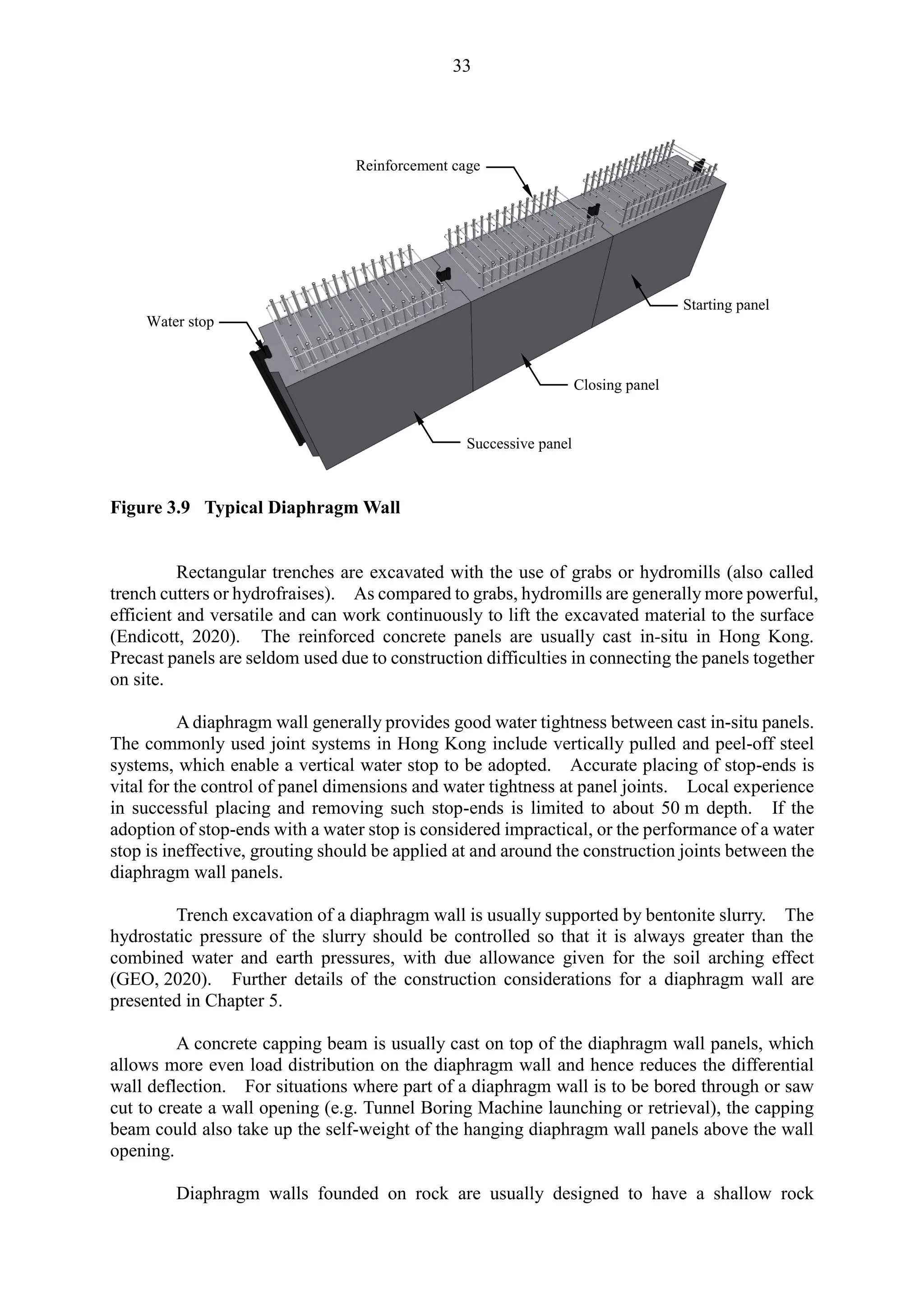
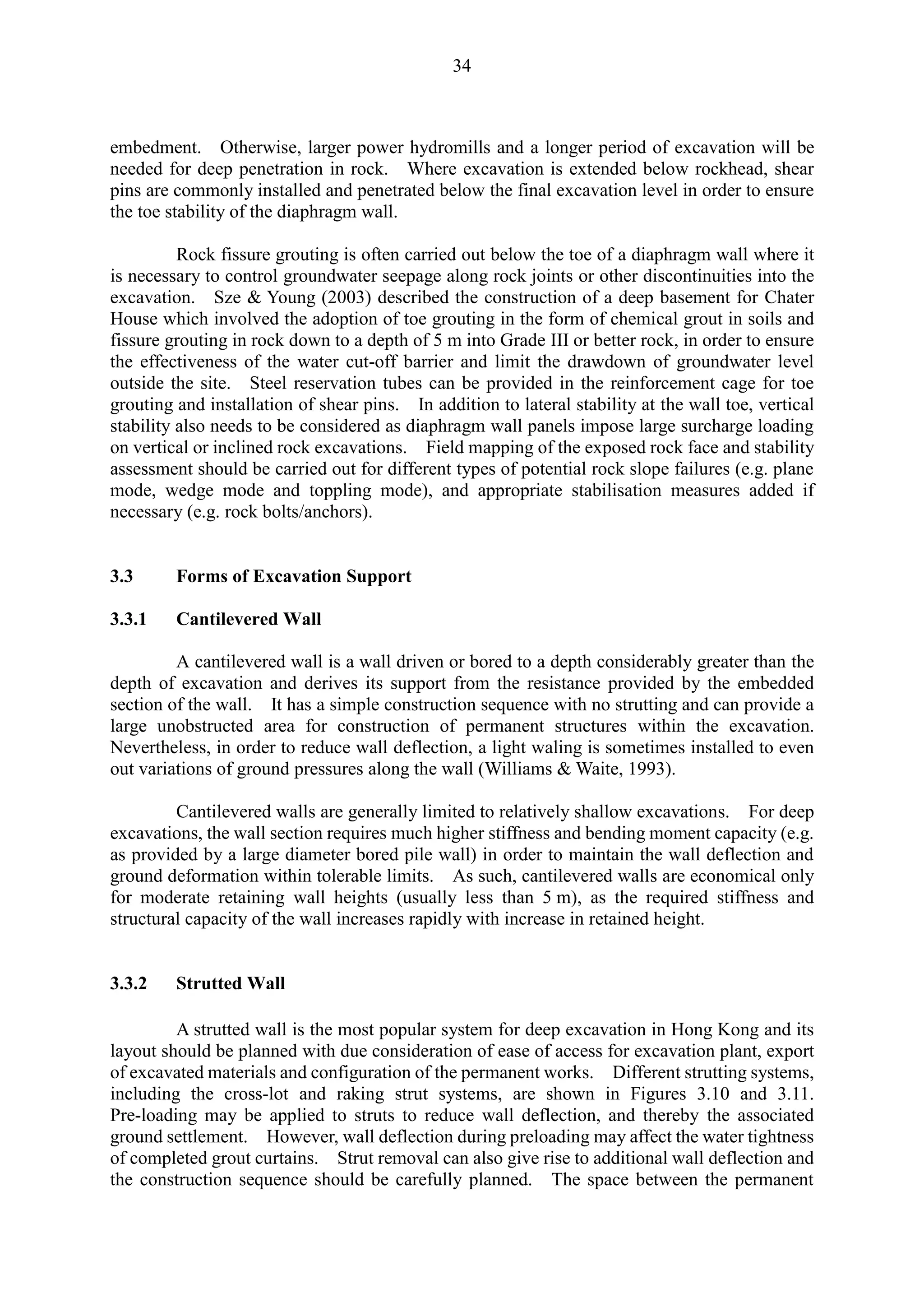
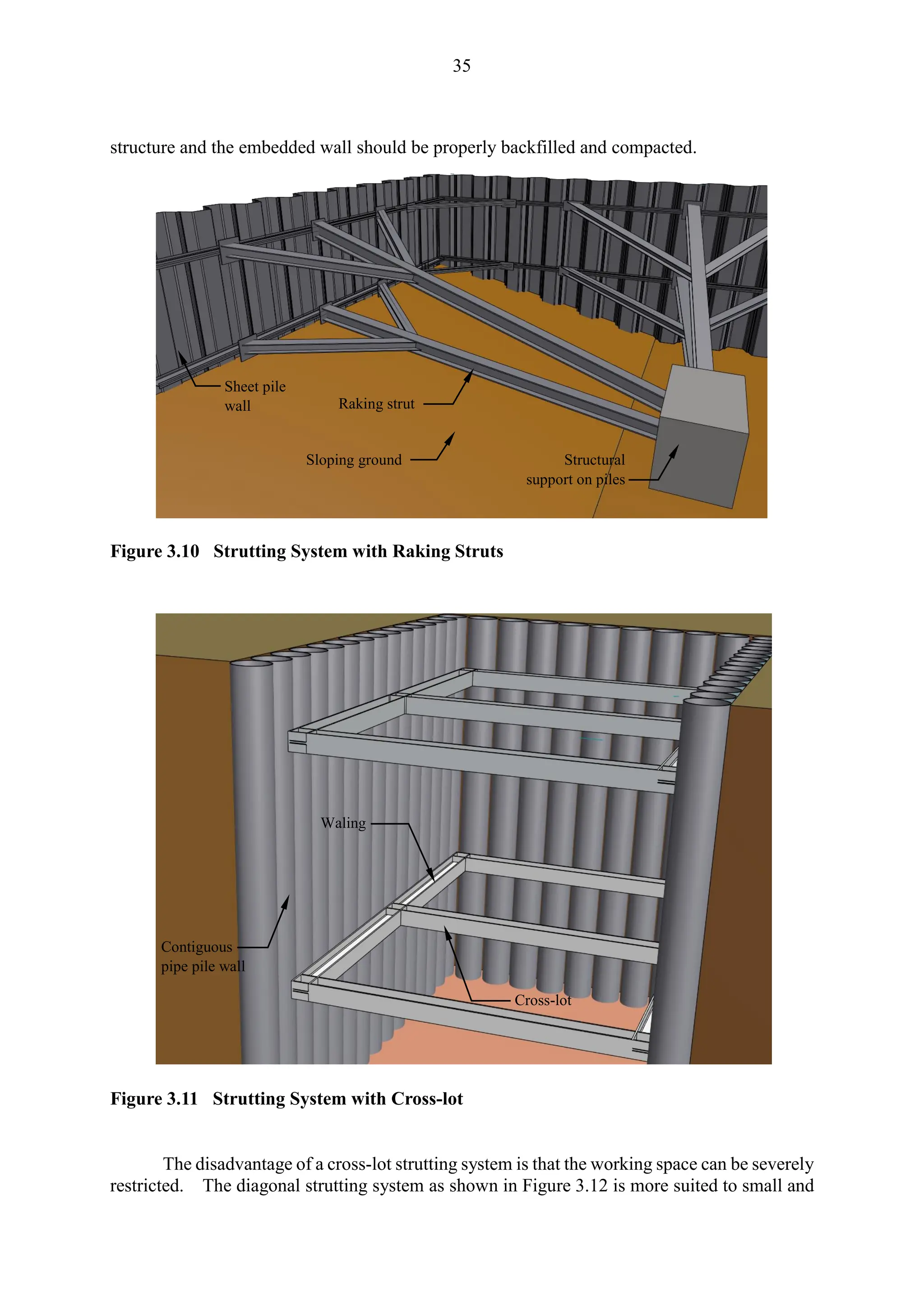
  • 127.
    127 10.2.2 Types ofInstruments Different types of instruments are available to suit the specific requirements of monitoring works, which usually include measurements of the following: (a) Movements and vibrations of sensitive receivers; (b) Groundwater level, piezometric pressure and groundwater inflow rate; (c) Deflection of the embedded wall; and (d) Loads and strains in critical structural elements of the lateral support system (e.g. pre-loaded struts, ground anchors). Table 10.1 provides a summary of various types of instruments that are commonly used to monitor the performance of ELS works. The instruments should be properly installed, calibrated and maintained. Regular checks and repairs should be conducted to ensure proper functioning of the instruments. Further guidance on calibration, installation and operation of instruments is given in the Geotechnical Manual for Slopes. Other literature on the design and specification of geotechnical instrumentation can be found in Dunnicliff (1993) and Dunnicliff et al (2012). The choice of instruments should be based on the required accuracy of the measurements, reliability and response time of the instruments and site conditions. Typical working accuracies of some commonly used monitoring methods are discussed in Geoguide 1. 10.2.3 Groundwater Monitoring Piezometers and standpipes are often adopted for measuring groundwater levels. However, their locations, length and positioning of response zones should be properly planned with due consideration given to the hydrogeological condition of the groundwater regime adjacent to the site. Where the ground conditions comprise stratified marine clay underlain by sandy soils (e.g. alluvial sand), the porewater pressure in the sandy soil may have been influenced by dewatering within the excavation. In such cases, piezometers should be installed in the sandy soil so as to identify any drop in piezometric head. 10.2.4 Horizontal Deformation Monitoring Inclinometers are often used for monitoring horizontal deformation below the ground surface induced by the excavation. They should be installed to a fixed datum, e.g. by extending to bedrock, to ensure that they do not move laterally. This will allow computation of the absolute horizontal movement at any point along the inclinometer. Inclinometer guide casings have tracking cross grooves that control the orientation of the probe. Care should be taken during installation to ensure the grooves are properly aligned with the excavation face. Inclinometers should preferably be placed in soil at varying distances from the embedded wall, and where possible, a number of inclinometer sets should be installed to assist in determining the overall influence zone of the excavation. Such an arrangement is also useful in differentiating the impact of concurrent construction activities.
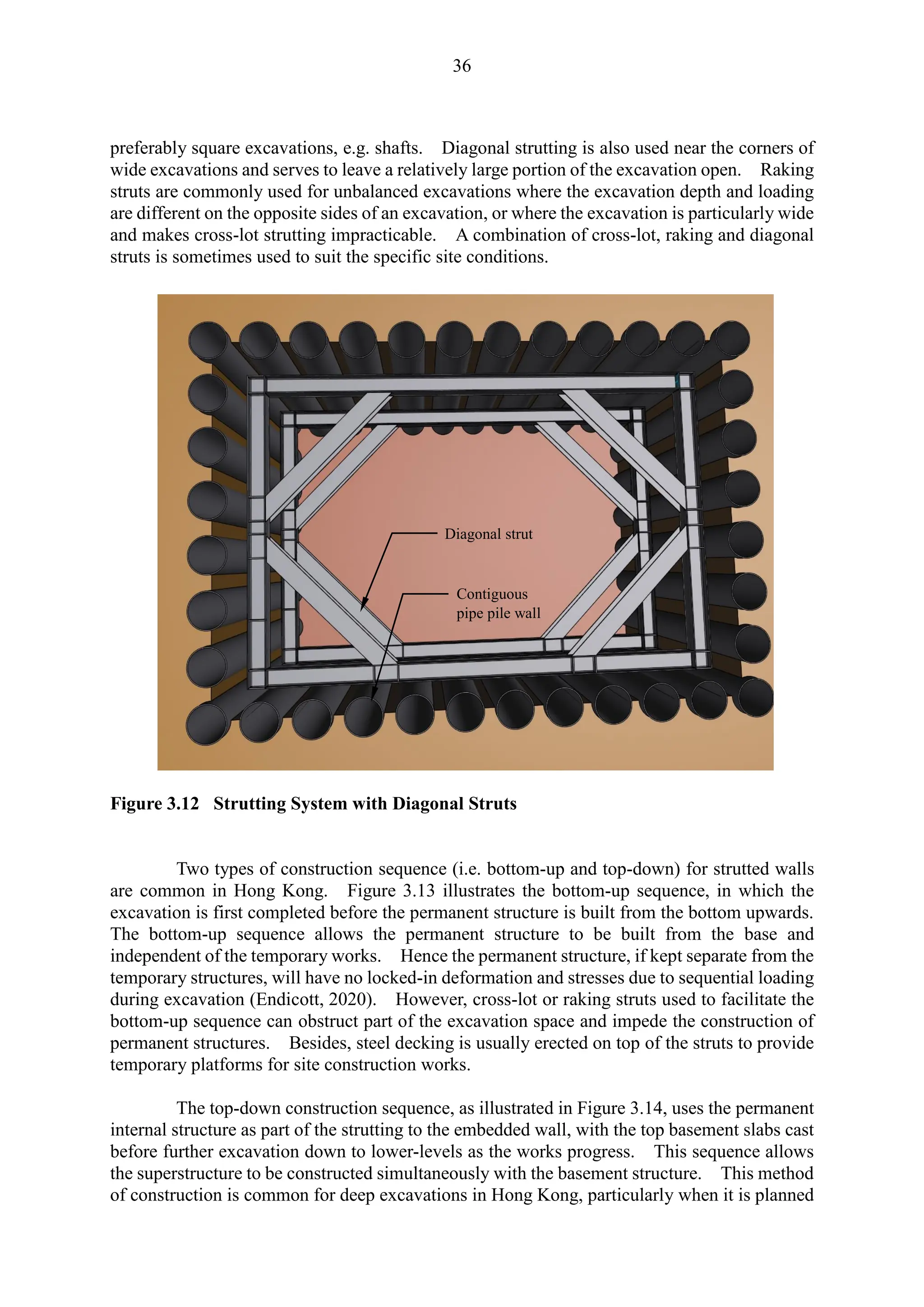
  • 128.
    128 Table 10.1 Instrumentsfor Monitoring of ELS Works Objectives Measurement Type Instruments To verify the estimated ground deformation and performance of the ELS system Ground deformation or the deflection of the exposed parts of the embedded wall  Deformation monitored by using conventional surveying methods, laser scanner, micrometer stick  Surface extensometers (e.g. tape extensometers)  Automatic deformation monitoring surveying (ADMS) by using robotic total station and target prisms Subsurface vertical deformation of the ground including heaving  Extensometers Subsurface horizontal deformation of the ground or embedded wall  Inclinometers Load and strains in the embedded wall and structural elements  Strain gauges  Load cells To monitor the change in groundwater level Groundwater level  Standpipes (can be installed with automatic groundwater monitoring devices) Piezometric pressure  Piezometers (can be installed with automatic groundwater monitoring devices) Groundwater inflow rate  Flow meter To monitor the response of sensitive receivers Total and differential movement  Movement monitored by conventional surveying methods, or an ADMS, laser scanner survey, or micrometer stick  Photogrammetric survey  Surface extensometers (e.g. tape extensometers) Tilting  Movement monitored byconventional surveying methods, or an ADMS, laser scanner, or micrometer stick  Tiltmeters or tilt sensors  Cable-free tilt sensors Cracking  Telltales  Demec gauges Vibration  Vibrographs or suitable smartphones with accelerometers Strain  Strain gauges Timing of groundwater level measurement should be properly planned such that the most critical situation could be captured. For excavation sites in reclaimed land where the groundwater table is highly influenced by tidal action, groundwater levels should be measured at least twice daily, at high tide and low tide. Where inclinometers are embedded in a bored pile wall or diaphragm wall, they are often installed in steel preservation tubes so as to minimise the subsequent drilling works. The
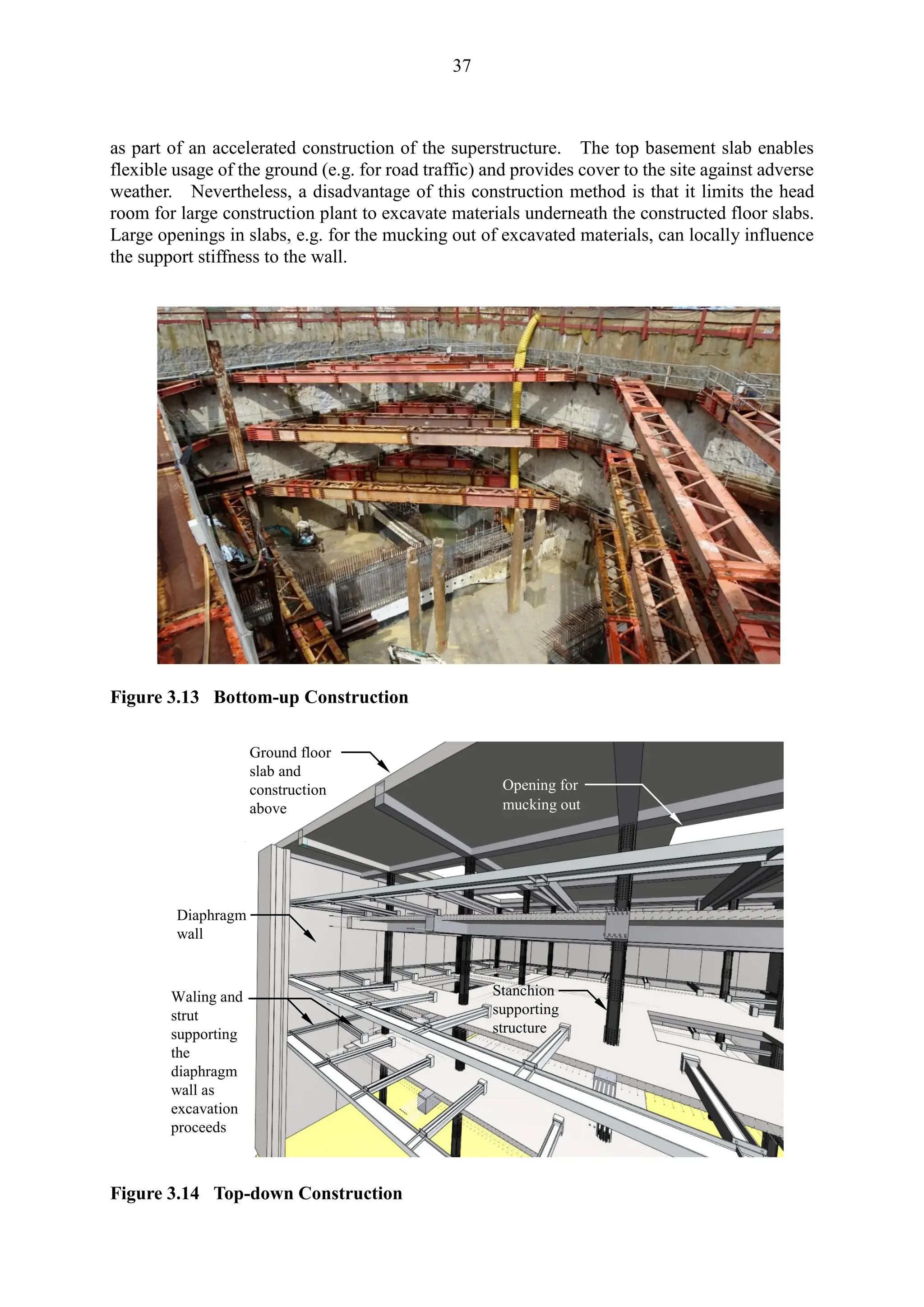
  • 129.
    129 casing guide withinthe steel preservation tube is sometimes filled with cement bentonite balls as a sealant. However, it should be noted that the stiffness of the sealant and the presence of the steel preservation tube are incompatible with the concrete placed in a bored pile wall or diaphragm wall. In such cases, the measured deflection from the inclinometer may not adequately reflect that of the embedded wall. Alternatively, inclinometers may be installed in proof core drill holes, which are sometimes specified as quality control measures. 10.3 Novel Technology The use of wireless digital technology such as the Internet-of-Things (IoT) and digital twin platforms with BIM allows instant remote access to real time monitoring data through online platforms. This shortens the time required for reporting and processing monitoring data and enhances the effectiveness of information dissemination among different decision makers and action parties involved in implementation of the monitoring plan. It can also facilitate the evaluation of the monitoring results for early decisions and quick actions. Ammar et al (2022) reported digital twin applications for real-time monitoring of water levels during dewatering for excavation works, while Haryono et al (2021) reported the application of a digital twin model in a deep shaft excavation project involving complex geology to quickly assess the potential effects of movement on construction arising from the difficult ground conditions. Real-time data can be sent to the project office which enables prompt analysis of site conditions and review of the site performance against design predictions. Real time monitoring of digital instrumentation sensors, including strain gauges and inclinometers, in a local deep excavation project in Hong Kong was reported by Toh et al (2023) for evaluating the performance of the excavation. Application of the digital sensors also extended to water level monitoring, which facilitated the deployment of faster flood risk mitigation measures (Toh et al, 2023). Furthermore, they also showcased the application of BIM throughout the construction project life cycle to assist in formulating an optimised sequence of construction. In addition, the use of digital tools, aided by block chain technology, has facilitated the making of traceable digital site supervision and monitoring records and instant uploading of such records onto an IoT server for robust record keeping purposes. It is recommended, however, that monitoring data obtained directly from digital tools should be checked regularly by conventional surveying methods in order to verify their accuracy and reliability. Advanced remote sensing techniques such as Light Detection and Ranging (LiDAR) scanning by unmanned aerial vehicles or hand-held devices have also become popular in recent years and have great potential to facilitate the interpretation of monitoring data and assess construction site progress. Li et al (2022) reported the application of handheld LiDAR scanning of the peanut-shaped deep excavation illustrated in Figure 10.1. Toh et al (2023) incorporated 3D scanning from handheld laser scanners into BIM models for clash detection. These techniques facilitate visualisation of a 3D construction sequence and are useful tools for prompt cross-checking of construction progress and compliance with the approved construction scheme. However, their positional accuracy sometimes does not match that provided by conventional surveying methods and they are currently more suitable to serve as a complementary method in monitoring deflection of an embedded wall or ground deformation.
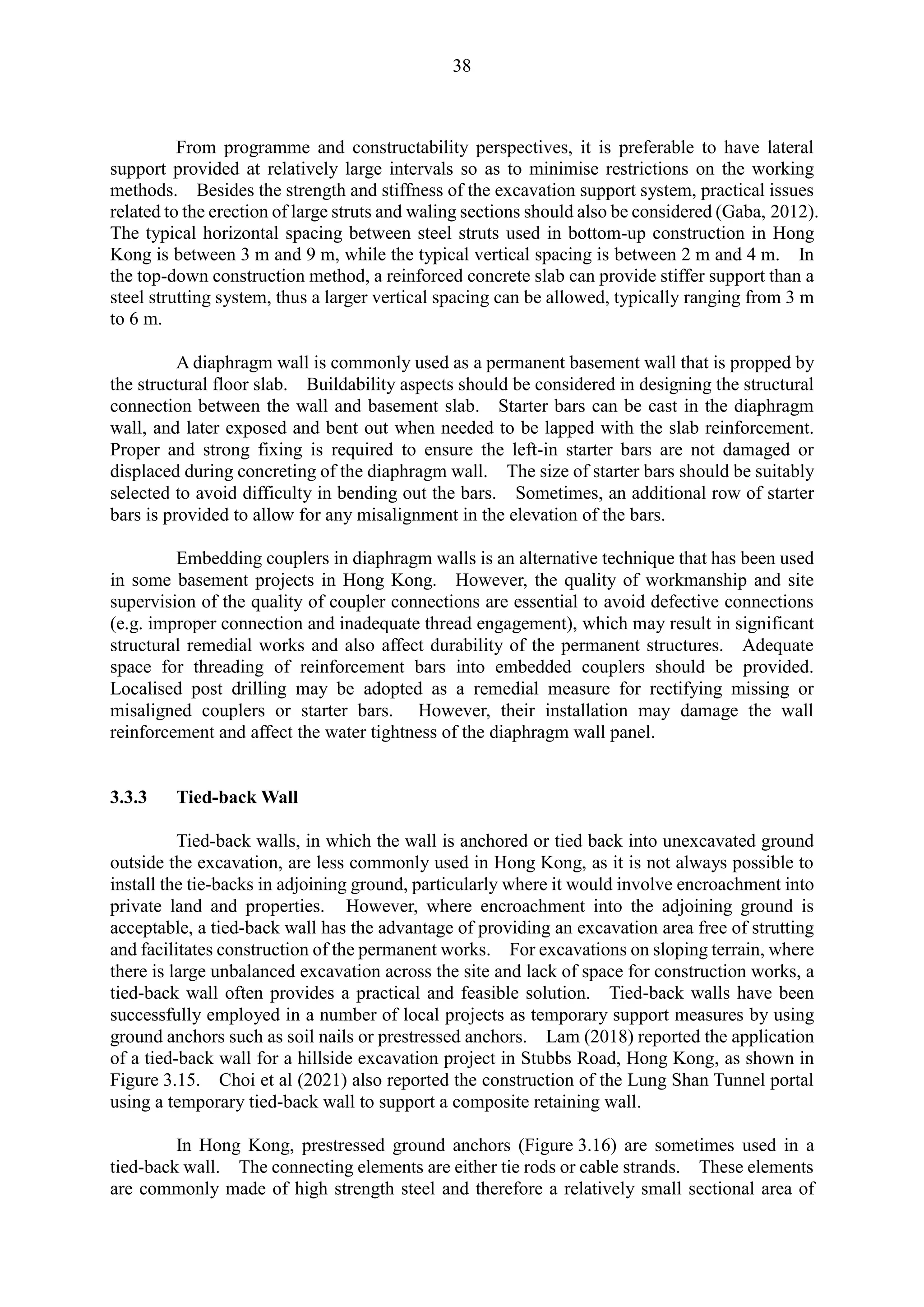
  • 130.
    130 Figure 10.1 Applicationof Handheld LiDAR Scanning in ELS Works
  • 131.
    131 References Ammar, A., Nassereddine,H., AbdulBaky, N., AbouKansour, A., Tannoury, J., Urban, H. & Schranz, C. (2022). Digital twins in the construction industry: a perspective of practitioners and building authority. Frontiers in Built Environment, vol. 8, 23 p. BD (2012). Requirements for an Excavation and Lateral Support Plan Building (Administration) Regulation 8(1)(bc) (Practice Note for Authorized Persons, Registered Structural Engineers and Registered Geotechnical Engineers PNAP APP-57). Buildings Department, HKSAR Government, 7 p. BD (2017). Code of Practice for Foundations 2017. Buildings Department, HKSAR Government, 104 p. BD (2018). Ground-borne Vibrations and Ground Settlements Arising from Pile Driving and Similar Operations (Practice Note for Authorized Persons, Registered Structural Engineers and Registered Geotechnical Engineers PNAP APP-137). Buildings Department, HKSAR Government, 7 p. BD (2022). Railway Protection under Railways Ordinance, Mass Transit Railway (Land Resumption and Related Provisions) Ordinance and Area Number 3 of the Scheduled Areas in Schedule 5 to the Buildings Ordinance (Practice Note for Authorized Persons, Registered Structural Engineers and Registered Geotechnical Engineers PNAP APP- 24). Buildings Department, HKSAR Government, 16 p. Bjerrum, L. & Eide, O. (1956). Stability of strutted excavation in clay. Géotechnique, vol. 6, pp 32-47. BSI (2006). Hydrometric Determinations - Pumping Tests for Water Wells - Considerations and Guidelines for Design, Performance and Use. (BS EN 14686:2003). British Standards Institution, 68 p. BSI (2007). Eurocode 3: Design of steel structures - Part 5: Piling (BS EN 1993-5:2007). British Standards Institution, 98 p. BSI (2022). Draft Eurocode 7: Geotechnical Design - Part 1: General Rules (Draft BS EN 1997). British Standards Institution, 103 p. Budge-Reid, A.J., Cater, R.W. & Storey, F.G. (1984). Geotechnical and construction aspects of the Hong Kong mass transit railway system. Proceedings of the Second Conference on Mass Transportation in Asia, Singapore, 30 p. Canadian Geotechnical Society (2006). Canadian Foundation Engineering Manual (Fourth edition). Canadian Geotechnical Society, 488 p. Caquot, A. & Kerisel, J. (1948). Tables for the Calculation of Passive Pressure, Active Pressure and Bearing Capacity of Foundations. (Translated from French by M.A. Bec, London). Gauthier-Villars, Paris, 121 p. Cedergren, H.R. (1989). Seepage, Drainage and Flow Nets (Third edition). John Wiley & Sons, New York, 465 p.
  • 132.
    132 Chan, A.K.C. (2003).Observations from excavations - a reflection. Proceedings of the HKIE Geotechnical Division Annual Seminar 2003, HKIE Geotechnical Division, pp 83-101. Chan, R.K.S., Phung, C.W.C. & Tse, K.C.L. (2017). An overview of deep excavation techniques in Hong Kong. Proceedings of the HKIE Geotechnical Division Annual Seminar 2017, HKIE Geotechnical Division, 6 p. Chan, W.Y., Ng, C.W., Law, D.T.K. & Chan, H.Y. (2020). The HKIE Innovation Award 2020 Grand Prize (Category II): 15-cell caterpillar cofferdam for large-scale excavation works in difficult geology: The TM-CLKL project, Hong Kong Engineer, vol. 48, pp 17. Cheung, P.Y.S., Shum, K.W. & Koo, C.H.R. (2023). Advancement in geotechnical practice. Proceedings of the HKIE Geotechnical Division Annual Seminar, 2023, HKIE Geotechnical Division, pp 168-187. Choi, K.Y.M., Li, V. & Tam, A.Y.S. (2021). An innovative design of retaining wall in Lung Shan Tunnel construction. Proceedings of the HKIE Geotechnical Division Annual Seminar 2021, Hong Kong Institution of Engineers, 9 p. Clayton, C.R.I. (1995). The Standard Penetration Test (SPT): Methods and Use (CIRIA C143). Construction Industry Research & Information Association, London, 143 p. Clough, G.W., Hansen, L.A. & Mana, A.I. (1979). Prediction of support excavation movements under marginal stability conditions in clay. Proceedings of the Third International Conference on Numerical Methods in Geomechanics, Aachen, vol. 4, pp 1485-1502. Clough, G.W. & O’Rourke, T.D. (1990). Construction induced movements of in situ walls. Proceedings of ASCE Conference on Design and Performance of Earth Retaining Structures, ASCE, New York, pp 439-470. Clough, G.W. (1975). Deep excavations and retaining structures. Proceedings of the Short Course - Seminar on Analysis and Design of Building Foundations, Bethlehem, Pennsylvania, pp 417-465. COI (2005). Report of the Committee of Inquiry into the Incident at the MRT Circle Line Worksite that Led to the Collapse of the Nicoll Highway on 20 April 2004, Committee of Inquiry, Singapore, 13 May 2005. Daly, M.P. & Powrie, W. (2001). Undrained analysis of earth berms as temporary support for embedded retaining walls. Proceeding of the Institution of Civil Engineers - Geotechnical Engineering, vol. 149, no. 4, pp 237-248. D’Appolonia, D.J. (1971). Effects of foundation construction on nearby structures. Proceedings of the Fourth Panamerican Conference on Soil Mechanics and Foundation Engineering, San Juan, Puerto Rico, vol. 1, pp 189-236. (Discussion, vol. 3, pp 171-178). Davies, J.A. (1990). The collapse of a strutted diaphragm wall. Proceedings of the Seminar on Failures in Geotechnical Engineering. Hong Kong, pp 125-135.
  • 133.
    133 Davies, R.V. &Henkel, D.J. (1980). Geotechnical problems associated with the construction of Chater Station, Hong Kong. Proceedings of the Conference on Mass Transportation in Asia, Hong Kong, paper J3, 31 p. DevB (2016). Guidance Notes of Design for Safety. Development Bureau, HKSAR Government, 68p. Duncan, J.M. & Buchignani, A.L. (1976). An Engineering Manual for Settlement Studies. Department of Civil Engineering, University of California, Berkeley, 94 p. Dunnicliff, J. (1993). Geotechnical Instrumentation for Monitoring Field Performance. John Wiley & Sons, New York, 577 p. Dunnicliff, J., Marr, W.A. & Standing, J. (2012). Principles of geotechnical monitoring. ICE Manual of Geotechnical Engineering. Volume 2: Geotechnical Design, Construction and Verification, ICE Publishing, Institution of Civil Engineers, London, pp 1363-1377. Endicott, J. (2020). Deep Excavations in Soils. CRC Press, 242 p. Evans, N.C. (1995). Stability of Submarine Slopes (GEO Report No. 47). Geotechnical Engineering Office, Civil Engineering and Development Department, HKSAR Government, 340 p. Fernie, R., Puller, D. & Courts, A. (2012). Embedded walls. ICE Manual of Geotechnical Engineering, Volume 2: Geotechnical Design, Construction and Verification, ICE Publishing, Institution of Civil Engineers, London, pp 1271-1288. Fraser, R.A. (1992). Mobilisation of stresses in deep excavations: The use of earth pressure cells at Sheung Wan Crossover. Proceedings of the Wroth Memorial Symposium, Thomas Telford, London, pp 279-292. Gaba, A. (2012). Design of retaining structures. ICE Manual of Geotechnical Engineering. Volume 2: Geotechnical Design, Construction and Verification, ICE Publishing, Institution of Civil Engineers, London, pp 955-1037. Gaba, A., Hardy, S., Doughty, L., Powrie, W. & Selematas, D. (2017). Guidance on Embedded Retaining Wall Design (CIRIA C760). Construction Industry Research & Information Association, London, 285 p. GEO (1984). Geotechnical Manual for Slopes (2nd Edition). Geotechnical Engineering Office, Civil Engineering and Development Department, HKSAR Government, 302 p. GEO (1990). Review of Design Methods for Excavations (1990) (GCO Publication No. 1/90). Geotechnical Engineering Office, Civil Engineering and Development Department, HKSAR Government, 187 p. GEO (1992). Review of Collapses and Excessive Deformation of Excavations (Administrative Report AR 2/92). Geotechnical Engineering Office, Civil Engineering and Development Department, HKSAR Government, 32 p.
  • 134.
    134 GEO (1997). ModelSpecification for Prestressed Ground Anchors, Second Edition (Geospec 1). Geotechnical Engineering Office, Civil Engineering and Development Department, HKSAR Government, 164 p. GEO (2002). QRA of Collapses and Excessive Displacements of Deep Excavations (GEO Report No. 124). Geotechnical Engineering Office, Civil Engineering and Development Department, HKSAR Government, 109 p. GEO (2006). Foundation Design and Construction (GEO Publication No. 1/2006). Geotechnical Engineering Office, Civil Engineering and Development Department, HKSAR Government, 376 p. GEO (2007). Engineering Geological Practice in Hong Kong (GEO Publication No. 1/2007). Geotechnical Engineering Office, Civil Engineering and Development Department, HKSAR Government, 278 p. GEO (2015). Seismic Hazard Analysis of the Hong Kong Region (GEO Report No. 311). Geotechnical Engineering Office, Civil Engineering and Development Department, HKSAR Government, 325 p. GEO (2017a). Guide to Site Investigation (Geoguide 2) (2017 Version). Geotechnical Engineering Office, Civil Engineering and Development Department, HKSAR Government, 349 p. GEO (2017b). Model Specification for Soil Testing (Geospec 3) (2017 Version). Geotechnical Engineering Office, Civil Engineering and Development Department, HKSAR Government, 340 p. GEO (2018). Guide to Cavern Engineering, Second Edition (Geoguide 4). Geotechnical Engineering Office, Civil Engineering and Development Department, HKSAR Government, 262 p. GEO (2020). Guide to Retaining Wall Design (Geoguide 1) (2020 Version). Geotechnical Engineering Office, Civil Engineering and Development Department, HKSAR Government, 258 p. GEO (2023a). Guide to Soil Nail Design and Construction (Geoguide 7) (Continuously Updated E-Version Released on 21 November 2023). Geotechnical Engineering Office, Civil Engineering and Development Department, HKSAR Government, 90 p. GEO (2023b). Supplementary Guidelines on Precautionary Measures for Mitigating the Risks of Excessive Ground Loss and Sinkhole Formation Associated with Deep Excavations (GEO Technical Guidance Note No. 49 (TGN 49)). Geotechnical Engineering Office, Civil Engineering and Development Department, HKSAR Government, 23 p. Georgiadis, M. & Anagnostopoulos, C. (1998). Lateral pressure on sheet pile walls due to strip load. Journal of Geotechnical and Geoenvironmental Engineering, vol. 124, 1, American Society of Civil Engineers, pp 95-98.
  • 135.
    135 Greenway, D.R., Powell,G.E. & Bell, G.S. (1986). Rock-socketed caissons for retention of an urban road. Proceedings of the International Conference on Rock Engineering and Excavation in an Urban Environment, Hong Kong, pp 173-180. (Discussion, pp 450-456). Haryono, I.S., Saw, A.L., Lee, S.W. & Wong, L.C.K. (2021). Digital twin for geotechnical engineering applications. Proceedings of the HKIE Geotechnical Division Annual Seminar 2021, HKIE Geotechnical Division, pp 59-69. Humpheson, C., Fitzpatrick, A.J. & Anderson, J.M.D. (1986). The basements and substructure for the new headquarters of the Hongkong and Shanghai Banking Corporation, Hong Kong. Proceedings of the Institution of Civil Engineers, vol. 80, pp 851-883. (Discussion, vol. 82, pp 831-858). HyD (2016). Guidance Notes - Road Inspection Manual (Report No. RD/GN/016C). Research and Development Division, Highways Department, HKSAR Government, 31 p. Jamiolkowski, M., Lancellotta, R., Pasqualini, E. & Marchetti, S. (1979). Design parameters for soft clays. Proceedings of the Seventh European Conference on Soil Mechanics, pp 21-57. Janbu, N. (1972). Slope stability computations. Embankment Dam Engineering: Casagrande Volume (edited by R.C. Hirshfield & S.J. Poulos), John Wiley & Sons, New York, pp 47-86. Jardine, R.J., Symes, M.J. & Burland, J.B. (1984). The measurement of soil stiffness in triaxial apparatus. Géotechnique, vol. 34, no. 3, pp 323-340. Kaiser, P.K. & Hewitt, K.J. (1982). The effect of groundwater flow on the stability and design of retained excavations. Canadian Geotechnical Journal, vol. 19, pp 139-153. Lai, W.W.L., Dérobert, X. & Annan, P. (2018). A review of Ground Penetrating Radar application in civil engineering: A 30-year journey from Locating and Testing to Imaging and Diagnosis. NDT & E International, vol. 96, pp 58-78. Lam, A.K.M. (2018). An engineering solution for a hillside project in Hong Kong. ICE Publishing Geotechnical Research, vol. 5, no. 3, pp 170-181. Laver, R. (2021). Construction dewatering in reclaimed land in Hong Kong - a review of best practices. HKIE Transactions, vol. 28, no. 3, pp 130-138. Lee, D.M., Pappin, J.W. & Buckler, J.G. (2001). Control of ground movement in the construction of Festival Walk. Proceedings of the 14th Southeast Asian Geotechnical Conference Hong Kong, pp 379-382. Lee, M.Y.K. (2019). A Further Review of Collapses and Excessive Deformation of Deep Excavations (GEO Discussion Note No. DN 1/2019). Geotechnical Engineering Office, Hong Kong, 39 p. Lees, A. (2016). Geotechnical Finite Element Analysis. ICE Publishing, Institution of Civil Engineers, London, 274 p.
  • 136.
    136 Leung, E.H.Y. &Ng, C.W.W. (2007). Wall and ground movements associated with deep excavations supported by cast in situ wall in mixed ground conditions. Journal of Geotechnical and Geoenvironmental Engineering, vol. 133, no. 2, pp 129-143. Leung, H.Y. (2005). The anisotropic small strain stiffness of completely decomposed tuff and its effects on deformations associated with excavations, PhD thesis, The Hong Kong University of Science and Technology, Hong Kong. Li, E.S.F., Pickles, A.R., Lee, S.W. & Sun, R.F.Y. (2004). Monitoring of ground and wall deformation associated with deep excavation in recent and old reclamation in Hong Kong, Deep Excavations - Selected Topics, Centre for Research & Professional Development, pp 83-106. Li, I., Sze, E.H.Y., Lo, F.L.C., Lin, S.Q., Tan, D.Y., Leung, A.Y.F., Chan, A.W.Y., Wong, T.C.W. & Chan, E.Y.M. (2022). Monitoring of a Peanut-shaped TBM Launching Shaft Excavation using Fibre Optics and Remote Sensing Techniques. Proceedings of the HKIE Geotechnical Division Annual Seminar 2022, HKIE Geotechnical Division, pp 400-411. Li, V., Ho, A. & Lo, C. (2018). A field trial for interlocking pipe piles. Proceedings of the HKIE Geotechnical Division Annual Seminar 2018, HKIE Geotechnical Division, pp 82-90. Li, V., Tam, A., Liu, A. & Lee, L. (2010). A Case Study of Deep Excavation in Urban Area in Hong Kong. Technical Report No. TN-03, Centre for Research & Professional Development, 17 p. Liu, A., Lee, L., Li, V. & Tam, A. (2010). Acase study of design of diaphragm wall cofferdam based on the design approach of CIRIA C580. Proceedings of the HKIE Geotechnical Division Annual Seminar 2010, HKIE Geotechnical Division, pp 75-80. Long, M. (2001). Database for retaining wall and ground movements due to deep excavations. Journal of Geotechnical and Geoenvironmental Engineering, American Society of Civil Engineers, vol. 127, issue 3, March 2001, pp 203-224. Lui, J.Y.H. & Yau, P.K.F. (1995). The performance of the deep basement for Dragon Centre. Instrumentation in geotechnical engineering. Proceedings of the HKIE Geotechnical Division Annual Seminar 1995, HKIE Geotechnical Division, pp 183-201. Malone, A.W. (1982). Moderator's Report on retaining walls and basements. Proceedings of the Seventh Southeast Asian Geotechnical Conference, Hong Kong, vol. 2, pp 249-271. Morgenstern, N.R. & Eisenstein, Z. (1970). Methods of estimating lateral loads and deformations. Proceedings of ASCE Specialty Conference on Lateral Stresses in the Ground and Design of Earth-Retaining structures, pp 51-102. Morgenstern, N.R. & Price, V.E. (1965). The analysis of stability of general slip surfaces. Géotechnique, vol. 15, no. 1, pp 79-93.
  • 137.
    137 Morton, K., Leonard,M.S.M., & Cater, R.W. (1980). Building settlements and ground movements associated with the construction of two stations of the modified initial system of the mass transit railway, Hong Kong. Proceedings of the 2nd Conference on Ground Movements and Structures, University of Cardiff, Wales, U.K., pp 788-800. MOT (2015). Specifications for Design of Highway Subgrades, JTG D30-2015, Ministry of Transport of the People’s Republic of China, China, 226 p. NAVFAC (1986a). Design Manual 7.01 - Soil Mechanics. Department of Navy, Naval Facilities Engineering Command, Washington, D.C., 348 p. NAVFAC (1986b). Design Manual 7.02 - Foundations and Earth Structures. Department of Navy, Naval Facilities Engineering Command, Washington, D.C., 244 p. NFEC (1986). Guidelines for architect/engineer construction surveillance and inspection (Title II) services, NAVFAC P-1015, Naval Facilities Engineering Command, Alexandria, VA, USA, 116 p. O’Brien, A.S. & Higgins, K.G. (2020). The Management of Advanced Numerical Modelling in Geotechnical Engineering: Good Practice (CIRIA C791). Construction Industry Research and Information Association, London, 77 p. Orazalin, Z.Y. & Whittle, A.J. (2016). 3D Finite Element Analysis of a Complex Excavation. Plaxis Bulletin, spring issue 2014, pp 16-21. Ou, C.Y. (2006). Deep Excavation Theory and Practice, Taylor & Francis Group, London, UK, 532 p. Ou, C.Y., Chiou, D.C. & Wu, T.S. (1996). Three-dimensional finite element analysis of deep excavations. Journal of Geotechnical Engineering, vol. 122, no. 5, pp 337-345. Padfield, C.J. & Mair, R.J. (1984). Design of retaining walls embedded in stiff clay. Construction Industry Research & Information Association, London, Report no. 104, 145 p. Pallet, P.F. & Filip, R. (2019). Temporary Works - Principles of Design and Construction, Second Edition, Institution of Civil Engineers, 527 p. Pappin, J.W. (2011). Circular excavations using diaphragm walls. APEC Seminar on the State-of-the-Practice of Deep Excavation Works in Malaysia, Taiwan and Hong Kong 2011, pp 111-120. Pappin, J.W., Endicott, J. & Clarke, J. (2005). Deep excavation in Hong Kong - design and construction control. Proceedings of Seminar on the State-of-the-practice of Geotechnical Engineering in Taiwan and Hong Kong, HKIE, pp 137-152. Pappin, J.W., Simpson, B., Felton, P.J. & Raison, C. (1985). Numerical analysis of flexible retaining walls. Proceedings of the Numerical Methods in Engineering Theory and Applications 85 Conference, Swansea, pp 789-802.
  • 138.
    138 Peck, R.B. (1969).Deep excavations and tunnelling in soft ground. Proceedings of the Seventh International Conference on Soil Mechanics and Foundation Engineering, Mexico City, state-of-the-art volume, pp 225-290. Pickles, A.R., Lee, S.W. & Norcliffe, B.A.W. (2003). Groundwater and ground movement around deep excavation. Proceedings of the Institution of Civil Engineers - Geotechnical Engineering, Issue GE3, Institution of Civil Engineers, London, pp 147- 158. Pickles, A.R., Lee, S.W. & Sun, R.Y.F. (2006). Ground movement of deep excavation in reclamation. Proceedings of Danube European Conference on Geotechnical Engineering, vol. 2, pp 661-666. Pickles, A. (2012). Geotechnical design of retaining walls. ICE Manual of geotechnical engineering. Volume 2: Geotechnical design, construction and verification, ICE Publishing, Institution of Civil Engineers, London, pp 981-999. Pope, R.G. & Ho, C.S. (1982). The effect of piles and caissons on groundwater flow. Hong Kong Engineer, vol. 10, no. 11, pp 25-27. Potts, D.M. & Zdravkovic, L. (1999). Finite Element Analysis in Geotechnical Engineering: Theory, Thomas Telford Ltd., London, 440 p. Potts, D.M. & Zdravkovic, L. (2001). Finite Element Analysis in Geotechnical Engineering: Application, Thomas Telford Ltd., London, 427 p. Robertson & Cabal (2022). Guide to Cone Penetration Testing, Seventh Edition, Gregg Drilling LLC, California, USA, 156 p. Robertson, P.K. & Campanella, R.G. (1983). Interpretation of cone penetration tests: sands and clays. Canadian Geotechnical Journal, vol. 20, no. 4, pp 718-733. Shirlaw, J.N. (1987). The choice of grouts for hand-dug caisson construction. Hong Kong Engineer, vol. 15, no. 2, pp 11-22. Shiu, Y.K., Yung, P.C.Y. & Wong, C.K. (1997). Design, construction and performance of a soil nailed excavation in Hong Kong. Proceedings of the Fourteenth International Conference on Soil Mechanics and Foundation Engineering, Hamburg, pp 1339-1342. Smethurst, J.A. & Powrie, W. (2008). Effective-stress analysis of berm-supported retaining walls. Proceedings of the ICE - Geotechnical Engineering, vol. 161, no. 1, Institution of Civil Engineers, London, pp 39-48. Sommerville, S.H. & Large, D.S. (1986). Control of Groundwater for Temporary Works (CIRIA C113). Construction Industry Research & Information Association, London, 87 p. Swann, L.H., Ng, A., Mackay, A.D. & Ueda, Y. (2013). The use of glass fibre reinforced polymer bars as soil nails to permit future housing development, Hong Kong Administrative Region. Proceedings of the HKIE Geotechnical Division Annual Seminar 2013, HKIE Geotechnical Division, pp 165-171.
  • 139.
    139 Sze, W.C. &Young, T.M. (2003). Design and construction of a deep basement through an existing basement at central. Proceedings of the HKIE Geotechnical Division Annual Seminar 2003, HKIE Geotechnical Division, 8 p. Sze, J.W.C. & Lau, H.C.F. (2010). ASpecial Cofferdam in a Reclaimed Site at West Kowloon. Proceedings of the HKIE Geotechnical Division Annual Seminar2010, HKIE Geotechnical Division, pp 87-92. Tamaro, G. (1981). Perimeter wall for New World Centre, Hong Kong. Journal of Construction, American Society of Civil Engineers, vol. 107, pp 193-207. Terzaghi, K. (1943). Theoretical Soil Mechanics. John Wiley & Sons, New York, 510 p. Terzaghi, K. & Peck, R.B. (1967). Soil Mechanics in Engineering Practice (Second edition). John Wiley & Sons, New York, 729 p. THB (2020). The Shatin to Central Link Project Final Report. Transport and Housing Bureau, HKSAR Government, Hong Kong, volume 1 of 2, 254 p. Toh, G.S.H., Latter, J., Wan, A.W.L., Ho, D.T.S. & Chan, E.C.L. (2023). Digitalization, Modularisation and Sensors Application of Deep Excavation Project in Urban District of Hong Kong. Proceedings of the HKIE Geotechnical Division Annual Seminar 2023, HKIE Geotechnical Division, pp 130-140. Twine, D. & Roscoe, H. (1999). Temporary Propping of Deep Excavations - Guidance on Design (CIRIA C517). Construction Industry Research & Information Association, London, 226 p. UTLC (2003). Guide to Trench Excavation (Shoring Support and Drainage Measures). Utilities Technical Liaison Committee, Highways Department and Geotechnical Engineering Office, Civil Engineering and Development Department, HKSAR Government, 42 p. Wang, Y. (2000). The characteristics of granitic saprolites at small strains, MPhil thesis, The Hong Kong University of Science and Technology, Hong Kong. Weng, X.L. & Wang, W. (2011). Influence of differential settlement on pavement structure of widened roads based on large-scale model test. Journal of Rock Mechanics and Geotechnical Engineering, vol. 3(1), pp 90-96. Williams, B.P. & Waite, D. (1993). The Design and Construction of Sheet Piled Cofferdams (Special Publication 95). Construction Industry Research & Information Association, London, 285 p. Wong, C.M. (2014). Overview of development and challenges in foundation design and construction in Hong Kong. Proceedings of the HKIE Geotechnical Division Annual Seminar 2014, HKIE Geotechnical Division, pp 27-52. Wong, H.Y. (1978). Soil strength parameter determination. Hong Kong Engineer, pp 33-39.
  • 140.
    140 Wong, K.S. &Goh, A.T.C. (2002). Basal heave stability for wide excavations. Proceedings of the Third International Symposium on Geotechnical Aspects of Underground Construction in Soft Ground, Toulouse, France, pp 699-704. Wong, L.W. (2013). Back-analyzed elastic moduli for sand and saprolite. Instrumentation in geotechnical engineering. Proceedings of the HKIE Geotechnical Division Annual Seminar, HKIE Geotechnical Division, pp 151-157. WSD (2020). Conditions of Working in the Vicinity of Waterworks Installations, Operations Section. Water Services Department, HKSAR Government, 4 p. Yau, P.K.F. & Sum, A.H.L. (2010). An analytical review of excavation and lateral support, case history in Hong Kong. Proceedings of the HKIE Geotechnical Division Annual Seminar 2010, HKIE Geotechnical Division, 8 p. Zhang, W. & Liu, H. (2021). Design of Deep Braced Excavation and Earth Retaining Systems Under Complex Built Environment - Theories and Case Studies, Springer, 448 p.
  • 141.
    141 Appendix A Databaseof Ground Deformation and Wall Deflection Monitoring Collected in Selected ELS Works Case Location ELS Works Geology(2) Maximum excavation depth (m) Maximum ground settlement (wall installation) (mm) Maximum total ground settlement (mm) Reference(1) 1 Chater Station 37 m deep and 1.2 m thick diaphragm wall, top down construction with 3 layers of support Fill/MD/CDG 27 78 182 Davies, & Henkel (1980) 2 HSBC HQ (abutting Des Vouex Road) 30 m deep and 1 m thick diaphragm wall, top down construction with 3 layers of support Fill/MD/CDG 17 17 32 Humpheson et al (1986) 3 HSBC HQ (abutting Queen’s Road Central) Fill/MD/CDG 16 17 38 4 Sheung Wan crossover 43 m deep diaphragm wall, top down construction with 4 layers of support Fill/MD/ALL/CDG 30 30 56 Fraser (1992) 5 Dragon Centre 47 m deep and 1.2 m thick diaphragm wall, top down construction with 4 layers of support Fill/MD/CDG 27 No available data 39 Lui & Yau (1995) 6 Tsuen Wan West Station (new reclamation) 22 m & 35 m deep and 1.2m thick diaphragm wall, bottom up construction with 2 layers of support Fill/MD/ALL/CDG 19 52 85 Pickles et al (2003) 7 Tsuen Wan West Station (old reclamation) Fill/MD/ALL/CDG 19 10 36 8 Redevelopment at Nathan Road redevelopment 25 m deep and 0.4 m dia. pipe pile, bottom up construction with 5 layers of support Fill//ALL/CDG 20 No available data 8 Yau & Sum (2010) 9 Development at Jordan Road 33 m deep and 1 m thick diaphragm wall, bottom up construction with 4 layers of support Fill/MD/ALL/CDG 23 No available data 20 10 Development at Luen Wo Hui 40 m deep and 1.2 m thick diaphragm wall, top down construction with 4 layers of support Fill/ALL/CDV 17 No available data 6 Leung (2005) 11 Charter House 48 m deep and 1.2 m thick diaphragm wall, top down construction with 3 layers of support Fill/MD/ALL/CDG 15 No available data 30 Sze & Young (2003) 12 Development at Murray Road 40 m deep and 1.5 m dia. bored pile wall, top down construction with 5 layers of support Fill/COLL/CDG 20 5 9 GEO study 13 Development at Wanchai 48 m deep and 0.6 m dia. pipe pile wall, bottom up construction with 12 layers of tie-backs Fill/CDG/MDG 45 No available data 5 GEO study
  • 142.
    142 Case Location ELSWorks Geology(2) Maximum excavation depth (m) Maximum ground settlement (wall installation) (mm) Maximum total ground settlement (mm) Reference(1) 14 Development at Admiralty 39 m deep and 1.2 m thick diaphragm wall, bottom up construction with 7 layers of support Fill/MD/ALL/CDG 31 30 102 GEO study 15 Development at To Kwa Wan 42 m deep and 1.2 m thick diaphragm wall, top down construction with 4 layers of support Fill/ALL/CDG 32 29 63 GEO study 16 Roadworks at Kwun Tong 49 m deep and 1.5 m thick diaphragm wall in peanut shape, bottom up construction with 6 layers of support Fill/MD/ALL/CDG 36 8 27 GEO study 17 Roadworks at the artificial island of HK Boundary Crossing Facilities 56 m deep and 1.5 m thick diaphragm wall in caterpillar shape Fill/MD/ALL/CDG 42 No available data 30 GEO study 18 Development at Hong Kong Airport 19 m deep and 0.61 m dia. pipe pile wall, bottom up construction with 3 layers of tie-backs Fill/CDG/MDG 14 No available data 11 GEO study 19 Development at Power Station 38 m deep, 0.61 m dia. pipe pile wall in circular shape Rockfill/CDG 28 25 37 GEO study 20 Development at Festival Walk 36 m deep and 1.2 m thick diaphragm wall, 2 layers of tied-backs and 5 layers of permanent slabs Fill/CDG 32 No available data 8 Lee et al (2001) & Wang, Y. (2000) 21 Argyle Station 30 m deep and 1.1 m dia. secant bored pile, top down construction with 3 layers of support Fill/MD/CDG 25 No available data 18 Morton et al (1980) 22 Wong Tai Sin Station 27 m deep and 0.9 m thick diaphragm wall, top down construction with 2 layers of support Fill/ ALL/CDG 19 14 58 23 Development at Stubbs Road 43 m deep and 3 m dia. bored pile wall, bottom up construction with 19 layers of tie-backs CDG/HDG/MDG 38 No available data 5 Lam (2018) 24 Development at Hoi Fai Road, West Kowloon 33 m deep type IV sheet pile wall, top down construction with 3 layers of support Fill/ALL/CDG/MDG 14 No available data 18 Sze & Lau (2010) 25 Development at Tseung Kwan O 44 m deep and 1 m thick diaphragm wall, bottom up construction with 3 layers of support Fill/MD/ALL/CDV 10 No available data 35 GEO study
  • 143.
    143 Case Location ELSWorks Geology(2) Maximum excavation depth (m) Maximum ground settlement (wall installation) (mm) Maximum total ground settlement (mm) Reference(1) 26 Development at Kai Tak Area 4C 32 m deep Type VIL sheet pile wall, bottom up construction with 5 layers of support Fill/MD/ALL/CDG 16 No available data 21 GEO study 27 Development at Kai Tak Area 4A 25 m deep Type IV sheet pile wall, bottom up construction with 4 layers of support Fill/MD/ALL 13 No available data 16 GEO study Notes: (1) For the references marked “GEO study”, information has been extracted by the GEO from available monitoring records of ELS works. (2) MD is marine deposits, ALL is alluvium, COLL is colluvium, CDG is completely decomposed granite, CDV is completely decomposed volcanic rock, HDG is highly decomposed granite and MDG is moderately decomposed granite.
  • 144.
    144 Acknowledgement The Civil Engineeringand Development Department is grateful to the following organisations for permission to use the following photographs in this publication: Atkins China Limited (Front cover, bottom right & Figure 3.20) Bachy Soletanche Group Limited (Figure 3.18) Gammon Construction Limited (Figure 4.1) Highways Department (Front cover, top left) Hospital Authority (Figure 3.17) Ove Arup & Partners Hong Kong Limited (Front cover, top right & Figure 3.15) Sun Hung Kai Properties Limited (Figure 4.2) The Geotechnical Division of the Hong Kong Institution of Engineers (HKIE) established a Task Force to conduct a technical review and recommend updates of the GCO Publication No. 1/90. A Technical Review Report of Design Methods for Excavation was produced by the Task Force in 2021. The Technical Review Report made suggestions on the key updates of the GCO Publication No. 1/90, which greatly facilitate the Working Group in updating this publication. The effort of the Task Force is gratefully appreciated. The HKIE Task Force was led by Ir Dr Richard Pang, with the following members contributed a great deal of time and effort to the preparation of the Technical Review Report: Ir W.L. Chan Ir Dr Tony L.F. Chen Ir Dr Johnny C.Y. Cheuk Ir Warren H.R. Dou Ir Florence W.Y. Ko Ir Dr Julian S.H. Kwan Ir Derek C.L. Kwok Ir Martin Y.K. Lee Ir Dr S.W. Lee Ir Dr Andy Y.F. Leung Ir Dr Victor K.S. Li Ir Frankie L.C. Lo Ir Dr Gavin S.H. Toh Ir Dr K.C. Wong Ir Thomas K.C. Wong Ir Terence L.Y. Yau Ir Jack Yiu
  • 145.
    GEO PUBLICATIONS ANDORDERING INFORMATION 土力工程處刊物及訂購資料 An up-to-date full list of GEO publications can be found at the CEDD Website http://www.cedd.gov.hk on the Internet under “Publications”. The following GEO publications can also be downloaded from the CEDD Website: i. Manuals, Guides and Specifications ii. GEO technical guidance notes iii. GEO reports iv. Geotechnical area studies programme v. Geological survey memoirs vi. Geological survey sheet reports 詳盡及最新的土力工程處刊物目錄,已登載於土木工程拓展署 的互聯網網頁http://www.cedd.gov.hk 的“刊物”版面之內。以下 的土力工程處刊物亦可於該網頁下載: i. 指南、指引及規格 ii. 土力工程處技術指引 iii. 土力工程處報告 iv. 岩土工程地區研究計劃 v. 地質研究報告 vi. 地質調查圖表報告 Copies of some GEO publications (except geological maps and other publications which are free of charge) can be purchased either by: 讀者可採用以下方法購買部分土力工程處刊物(地質圖及免費 刊物除外): Writing to Publications Sales Unit, Information Services Department, Room 626, 6th Floor, North Point Government Offices, 333 Java Road, North Point, Hong Kong. 書面訂購 香港北角渣華道333號 北角政府合署6樓626室 政府新聞處 刊物銷售組 or 或 − Calling the Publications Sales Section of Information Services Department (ISD) at (852) 2537 1910 − Visiting the online Government Bookstore at http:// www.bookstore.gov.hk − Downloading the order form from the ISD website at http://www.isd.gov.hk and submitting the order online or by fax to (852) 2523 7195 − Placing order with ISD by e-mail at puborder@isd.gov.hk − 致電政府新聞處刊物銷售小組訂購 (電話:(852) 2537 1910) − 進入網上「政府書店」選購,網址為 http://www.bookstore.gov.hk − 透過政府新聞處的網站 (http://www.isd.gov.hk) 於網上遞交 訂購表格,或將表格傳真至刊物銷售小組 (傳真:(852) 2523 7195) − 以電郵方式訂購 (電郵地址:puborder@isd.gov.hk) 1:100 000, 1:20 000 and 1:5 000 geological maps can be purchased from: 讀者可於下列地點購買1:100 000、1:20 000及1:5 000地質圖: Map Publications Centre/HK, Survey & Mapping Office, Lands Department, 23th Floor, North Point Government Offices, 333 Java Road, North Point, Hong Kong. Tel: (852) 2231 3187 Fax: (852) 2116 0774 香港北角渣華道333號 北角政府合署23樓 地政總署測繪處 電話: (852) 2231 3187 傳真: (852) 2116 0774 Any enquires on GEO publications should be directed to: 如對本處刊物有任何查詢,請致函: Chief Geotechnical Engineer/Planning and Development, Geotechnical Engineering Office, Civil Engineering and Development Department, Civil Engineering and Development Building, 101 Princess Margaret Road, Homantin, Kowloon, Hong Kong. Tel: (852) 2762 5351 Fax: (852) 2714 0275 E-mail: ivanli@cedd.gov.hk 香港九龍何文田公主道101號 土木工程拓展署大樓 土木工程拓展署 土力工程處 規劃及拓展部總土力工程師 電話: (852) 2762 5351 傳真: (852) 2714 0275 電子郵件: ivanli@cedd.gov.hk
  • 146.