Deep Dive Training
Energy Efficiency in Industrial Processes
Foetz, Luxembourg
© Learning Factory 2016
1
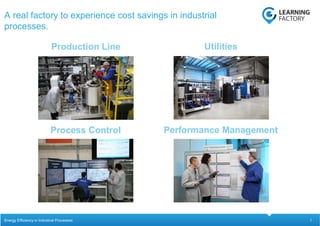
Production Line Utilities
Process Control Performance Management
A real factory to experience cost savings in industrial
processes.
Energy Efficiency in Industrial Processes
2
Since its foundation in 2013 the Learning Factory helps industrial and commercial
enterprise clients to lower their operational cost and to improve their
competitiveness.
We achieve this goal with a sustained transfer of knowledge in the fields of energy
efficiency and operational excellence.
Your Competitiveness is our mission.
A real factory to experience cost savings in industrial processes.
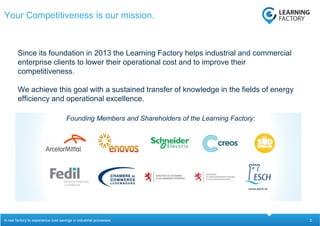
Founding Members and Shareholders of the Learning Factory:
3
The Learning Factory enables you to…
 … lower operational cost
 … improve resource productivity
 … build employees capabilities
A real factory to experience cost savings in industrial processes.
4
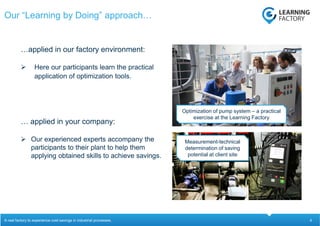
…applied in our factory environment:
 Here our participants learn the practical
application of optimization tools.
… applied in your company:
 Our experienced experts accompany the
participants to their plant to help them
applying obtained skills to achieve savings.
Our “Learning by Doing” approach…
Optimization of pump system – a practical
exercise at the Learning Factory
Measurement-technical
determination of saving
potential at client site
A real factory to experience cost savings in industrial processes.
5
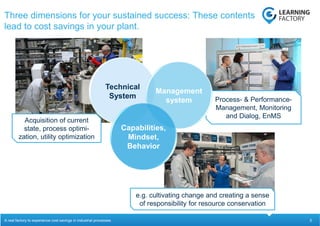
Process- & Performance-
Management, Monitoring
and Dialog, EnMS
Three dimensions for your sustained success: These contents
lead to cost savings in your plant.
A real factory to experience cost savings in industrial processes.
Technisches
System
Management
system
Fähigkeiten,
Mindset,
Verhalten
Technical
System
Management
system
Capabilities,
Mindset,
Behavior
e.g. cultivating change and creating a sense
of responsibility for resource conservation
Acquisition of current
state, process optimi-
zation, utility optimization
6
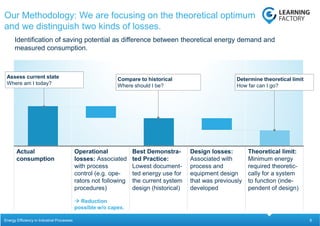
Actual
consumption
Operational
losses: Associated
with process
control (e.g. ope-
rators not following
procedures)
 Reduction
possible w/o capex.
Best Demonstra-
ted Practice:
Lowest document-
ted energy use for
the current system
design (historical)
Design losses:
Associated with
process and
equipment design
that was previously
developed
Theoretical limit:
Minimum energy
required theoretic-
cally for a system
to function (inde-
pendent of design)
Our Methodology: We are focusing on the theoretical optimum
and we distinguish two kinds of losses.
Identification of saving potential as difference between theoretical energy demand and
measured consumption.
Energy Efficiency in Industrial Processes
Assess current state
Where am I today?
Compare to historical
Where should I be?
Determine theoretical limit
How far can I go?
7
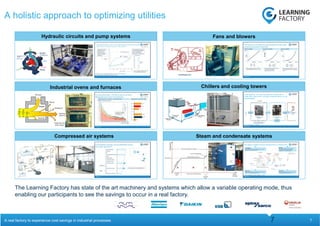
A holistic approach to optimizing utilities
Hydraulic circuits and pump systems
Industrial ovens and furnaces
Compressed air systems
Chillers and cooling towers
Fans and blowers
Steam and condensate systems
A real factory to experience cost savings in industrial processes.
The Learning Factory has state of the art machinery and systems which allow a variable operating mode, thus
enabling our participants to see the savings to occur in a real factory.
7
8
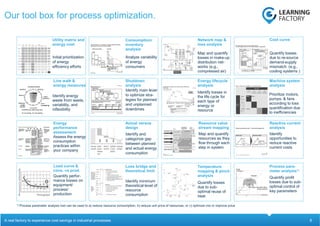
Our tool box for process optimization.
A real factory to experience cost savings in industrial processes.
Resource value
stream mapping
Map and quantify
resources as they
flow through each
step in system
Loss bridge and
theoretical limit
Identify minimum
theoretical level of
resource
consumption
Line walk &
energy measures
Identify energy
waste from waste,
variability, and
inflexibility
Load curve &
cons. vs prod.
Quantify perfor-
mance losses on
equipment/
process/
production
Process para-
meter analysis1)
Quantify profit
losses due to sub-
optimal control of
key parameters
Temperature
mapping & pinch
analysis
Quantify losses
due to sub-
optimal reuse of
heat
Network map &
loss analysis
Map and quantify
losses in make-up
distribution net-
works (e.g.,
compressed air)
Energy lifecycle
analysis
Identify losses in
the life cycle for
each type of
energy or
resource
Machine system
analysis
Prioritize motors,
pumps, & fans
according to loss
quantification due
to inefficiencies
Cost curve
Quantify losses
due to re-source
demand-supply
mismatch (e.g.,
cooling systems )
Utility matrix and
energy cost
Initial prioritization
of energy
efficiency efforts
Consumption/
inventory
analysis
Analyze variability
of energy
consumers
Shutdown
analysis
Identify main lever
to optimize stra-
tegies for planned
and unplanned
downtimes
Actual versus
design
Identify and
categorize gap
between planned
and actual energy
consumption
Reactive current
analysis
Identify
opportunities to
reduce reactive
current costs
Energy
performance
assessment
Assess the energy
consumption
practices within
your company
1) Process parameter analysis tool can be used to a) reduce resource consumption, b) reduce unit price of resources, or c) optimize mix or improve price
9
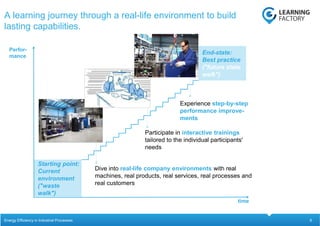
A learning journey through a real-life environment to build
lasting capabilities.
Energy Efficiency in Industrial Processes
Perfor-
mance
time
Starting point:
Current
environment
("waste
walk")
End-state:
Best practice
("future state
walk")
Dive into real-life company environments with real
machines, real products, real services, real processes and
real customers
Participate in interactive trainings
tailored to the individual participants'
needs
Experience step-by-step
performance improve-
ments
10
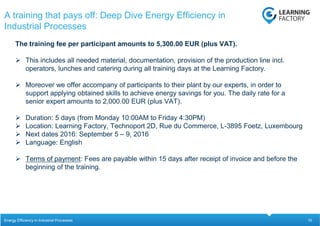
The training fee per participant amounts to 5,300.00 EUR (plus VAT).
 This includes all needed material, documentation, provision of the production line incl.
operators, lunches and catering during all training days at the Learning Factory.
 Moreover we offer accompany of participants to their plant by our experts, in order to
support applying obtained skills to achieve energy savings for you. The daily rate for a
senior expert amounts to 2,000.00 EUR (plus VAT).
 Duration: 5 days (from Monday 10:00AM to Friday 4:30PM)
 Location: Learning Factory, Technoport 2D, Rue du Commerce, L-3895 Foetz, Luxembourg
 Next dates 2016: September 5 – 9, 2016
 Language: English
 Terms of payment: Fees are payable within 15 days after receipt of invoice and before the
beginning of the training.
A training that pays off: Deep Dive Energy Efficiency in
Industrial Processes
Energy Efficiency in Industrial Processes
11
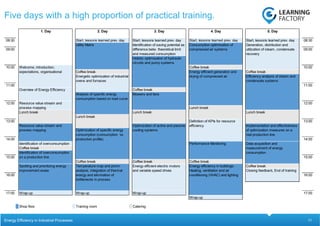
Five days with a high proportion of practical training.
Energy Efficiency in Industrial Processes
1. Day 2. Day 3. Day 4. Day 5. Day
Start, lessons learned prev. day Start, lessons learned prev. day Start, lessons learned prev. day Start, lessons learned prev. day
Coffee break
Coffee break Coffee break
Coffee break
Identification of overconsumption
Coffee break
Coffee break Coffee break Coffee break
Coffee break
Wrap-up Wrap-up Wrap-up
Wrap-up
Shop floor Training room Catering
Closing feedback, End of training
16:00 16:00
17:00 17:00
15:00 15:00
Spotting and prioritizing energy
improvement areas
Temperature map and pinch-
analysis, integration of thermal
energy and elimination of
bottlenecks in process
Energy efficient electric motors
and variable speed drives
Energy efficiency in buildings:
Heating, ventilation and air
conditioning (HVAC) and lighting
14:00
Performance Monitoring Data acquisition and
measurement of energy
consumptionIdentification of overconsumption
on a production line
13:00
Resource value stream and
process mapping
Optimization of active and passive
cooling systems
Implementation and effectiveness
of optimization measures on a
real production line
Optimization of specific energy
consumption (consumption vs.
production profile)
Lunch break
Lunch break
13:00 Definition of KPIs for resource
efficiency
14:00
Resource value stream and
process mapping
12:00
Lunch break
Lunch break Lunch break
11:00 11:00
Overview of Energy Efficiency
Analysis of specific energy
consumption based on load curve
Blowers and fans
12:00
10:00
Energy efficient generation and
drying of compressed airEnergetic optimization of industrial
ovens and furnaces
Efficiency analysis of steam and
condensate systems
Consumption optimisation of
compressed air systems
Generation, distribution and
utilization of steam, condensate
recovery
09:00 09:00
Holistic optimisation of hydraulic
circuits and pump systems
10:00 Welcome, introduction,
expectations, organisational
08:30 08:30
Utility Matrix Identification of saving potential as
difference betw. theoretical limit
and measured consumption
12
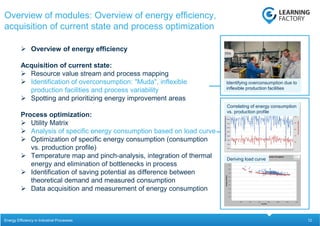
 Overview of energy efficiency
Acquisition of current state:
 Resource value stream and process mapping
 Identification of overconsumption: "Muda", inflexible
production facilities and process variability
 Spotting and prioritizing energy improvement areas
Process optimization:
 Utility Matrix
 Analysis of specific energy consumption based on load curve
 Optimization of specific energy consumption (consumption
vs. production profile)
 Temperature map and pinch-analysis, integration of thermal
energy and elimination of bottlenecks in process
 Identification of saving potential as difference between
theoretical demand and measured consumption
 Data acquisition and measurement of energy consumption
Overview of modules: Overview of energy efficiency,
acquisition of current state and process optimization
Energy Efficiency in Industrial Processes
Correlating of energy consumption
vs. production profile
Deriving load curve
Identifying overconsumption due to
inflexible production facilities
13
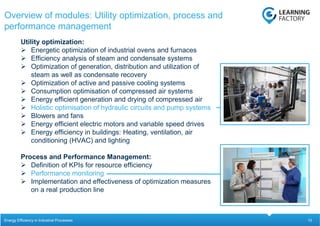
Utility optimization:
 Energetic optimization of industrial ovens and furnaces
 Efficiency analysis of steam and condensate systems
 Optimization of generation, distribution and utilization of
steam as well as condensate recovery
 Optimization of active and passive cooling systems
 Consumption optimisation of compressed air systems
 Energy efficient generation and drying of compressed air
 Holistic optimisation of hydraulic circuits and pump systems
 Blowers and fans
 Energy efficient electric motors and variable speed drives
 Energy efficiency in buildings: Heating, ventilation, air
conditioning (HVAC) and lighting
Process and Performance Management:
 Definition of KPIs for resource efficiency
 Performance monitoring
 Implementation and effectiveness of optimization measures
on a real production line
Overview of modules: Utility optimization, process and
performance management
Energy Efficiency in Industrial Processes
14
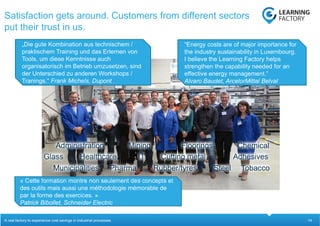
„Die gute Kombination aus technischem /
praktischem Training und das Erlernen von
Tools, um diese Kenntnisse auch
organisatorisch im Betrieb umzusetzen, sind
der Unterschied zu anderen Workshops /
Tranings.“ Frank Michels, Dupont
“Energy costs are of major importance for
the industry sustainability in Luxembourg.
I believe the Learning Factory helps
strengthen the capability needed for an
effective energy management.”
Alvaro Baudet, ArcelorMittal Belval
« Cette formation montre non seulement des concepts et
des outils mais aussi une méthodologie mémorable de
par la forme des exercices. »
Patrick Bibollet, Schneider Electric
Satisfaction gets around. Customers from different sectors
put their trust in us.
A real factory to experience cost savings in industrial processes.
Cutting metalHealthcareGlass IT Adhesives
ChemicalAdministration Mining Floorings
TobaccoPharma Rubber/tyres SteelMunicipalities
15
Your contact to the Learning Factory
A real factory to experience cost savings in industrial processes.
Christoph Emde
Trainer energy efficiency
Phone: +352 24 55 91 90
Mobile: +352 691 674 700
christoph.emde@learningfactory.lu
Learning Factory S.A.
Technoport 2D
Rue du Commerce
L-3895 Foetz
Luxembourg
Clémentine Hyeulle
Marketing & Kommunikation
Phone: +352 24 55 91 90
Mobile: +352 691 670 035
clementine.hyeulle@learningfactory.lu
Learning Factory S.A.
Technoport 2D
Rue du Commerce
L-3895 Foetz
Luxembourg
We offer our trainings in English, French and German language.
16
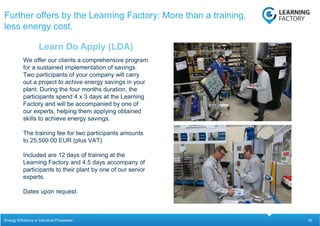
We offer our clients a comprehensive program
for a sustained implementation of savings.
Two participants of your company will carry
out a project to achive energy savings in your
plant. During the four months duration, the
participants spend 4 x 3 days at the Learning
Factory and will be accompanied by one of
our experts, helping them applying obtained
skills to achieve energy savings.
The training fee for two participants amounts
to 25,500.00 EUR (plus VAT)
Included are 12 days of training at the
Learning Factory and 4.5 days accompany of
participants to their plant by one of our senior
experts.
Dates upon request.
Learn Do Apply (LDA)
Further offers by the Learning Factory: More than a training,
less energy cost.
Energy Efficiency in Industrial Processes
17
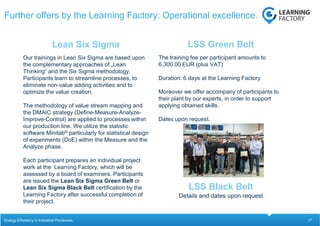
Our trainings in Lean Six Sigma are based upon
the complementary approaches of „Lean
Thinking“ and the Six Sigma methodology.
Participants learn to streamline processes, to
eliminate non-value adding activities and to
optimize the value creation.
The methodology of value stream mapping and
the DMAIC strategy (Define-Measure-Analyze-
Improve-Control) are applied to processes within
our production line. We utilize the statistic
software Minitab® particularly for statistical design
of experiments (DoE) within the Measure and the
Analyze phase.
Each participant prepares an individual project
work at the Learning Factory, which will be
assessed by a board of examiners. Participants
are issued the Lean Six Sigma Green Belt or
Lean Six Sigma Black Belt certification by the
Learning Factory after successful completion of
their project.
The training fee per participant amounts to
6,300.00 EUR (plus VAT)
Duration: 6 days at the Learning Factory
Moreover we offer accompany of participants to
their plant by our experts, in order to support
applying obtained skills.
Dates upon request.
Lean Six Sigma LSS Green Belt
Further offers by the Learning Factory: Operational excellence.
Energy Efficiency in Industrial Processes
Details and dates upon request.
LSS Black Belt
18
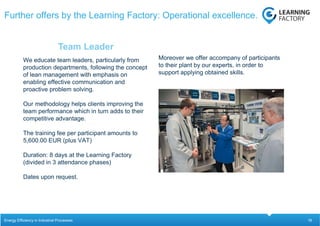
We educate team leaders, particularly from
production departments, following the concept
of lean management with emphasis on
enabling effective communication and
proactive problem solving.
Our methodology helps clients improving the
team performance which in turn adds to their
competitive advantage.
The training fee per participant amounts to
5,600.00 EUR (plus VAT)
Duration: 8 days at the Learning Factory
(divided in 3 attendance phases)
Dates upon request.
Team Leader
Further offers by the Learning Factory: Operational excellence.
Energy Efficiency in Industrial Processes
Moreover we offer accompany of participants
to their plant by our experts, in order to
support applying obtained skills.

Deep Dive Training Energy Efficiency in Industrial Processes

  • 1.
    Deep Dive Training EnergyEfficiency in Industrial Processes Foetz, Luxembourg © Learning Factory 2016
  • 2.
    1 Production Line Utilities ProcessControl Performance Management A real factory to experience cost savings in industrial processes. Energy Efficiency in Industrial Processes
  • 3.
    2 Since its foundationin 2013 the Learning Factory helps industrial and commercial enterprise clients to lower their operational cost and to improve their competitiveness. We achieve this goal with a sustained transfer of knowledge in the fields of energy efficiency and operational excellence. Your Competitiveness is our mission. A real factory to experience cost savings in industrial processes. Founding Members and Shareholders of the Learning Factory:
  • 4.
    3 The Learning Factoryenables you to…  … lower operational cost  … improve resource productivity  … build employees capabilities A real factory to experience cost savings in industrial processes.
  • 5.
    4 …applied in ourfactory environment:  Here our participants learn the practical application of optimization tools. … applied in your company:  Our experienced experts accompany the participants to their plant to help them applying obtained skills to achieve savings. Our “Learning by Doing” approach… Optimization of pump system – a practical exercise at the Learning Factory Measurement-technical determination of saving potential at client site A real factory to experience cost savings in industrial processes.
  • 6.
    5 Process- & Performance- Management,Monitoring and Dialog, EnMS Three dimensions for your sustained success: These contents lead to cost savings in your plant. A real factory to experience cost savings in industrial processes. Technisches System Management system Fähigkeiten, Mindset, Verhalten Technical System Management system Capabilities, Mindset, Behavior e.g. cultivating change and creating a sense of responsibility for resource conservation Acquisition of current state, process optimi- zation, utility optimization
  • 7.
    6 Actual consumption Operational losses: Associated with process control(e.g. ope- rators not following procedures)  Reduction possible w/o capex. Best Demonstra- ted Practice: Lowest document- ted energy use for the current system design (historical) Design losses: Associated with process and equipment design that was previously developed Theoretical limit: Minimum energy required theoretic- cally for a system to function (inde- pendent of design) Our Methodology: We are focusing on the theoretical optimum and we distinguish two kinds of losses. Identification of saving potential as difference between theoretical energy demand and measured consumption. Energy Efficiency in Industrial Processes Assess current state Where am I today? Compare to historical Where should I be? Determine theoretical limit How far can I go?
  • 8.
    7 A holistic approachto optimizing utilities Hydraulic circuits and pump systems Industrial ovens and furnaces Compressed air systems Chillers and cooling towers Fans and blowers Steam and condensate systems A real factory to experience cost savings in industrial processes. The Learning Factory has state of the art machinery and systems which allow a variable operating mode, thus enabling our participants to see the savings to occur in a real factory. 7
  • 9.
    8 Our tool boxfor process optimization. A real factory to experience cost savings in industrial processes. Resource value stream mapping Map and quantify resources as they flow through each step in system Loss bridge and theoretical limit Identify minimum theoretical level of resource consumption Line walk & energy measures Identify energy waste from waste, variability, and inflexibility Load curve & cons. vs prod. Quantify perfor- mance losses on equipment/ process/ production Process para- meter analysis1) Quantify profit losses due to sub- optimal control of key parameters Temperature mapping & pinch analysis Quantify losses due to sub- optimal reuse of heat Network map & loss analysis Map and quantify losses in make-up distribution net- works (e.g., compressed air) Energy lifecycle analysis Identify losses in the life cycle for each type of energy or resource Machine system analysis Prioritize motors, pumps, & fans according to loss quantification due to inefficiencies Cost curve Quantify losses due to re-source demand-supply mismatch (e.g., cooling systems ) Utility matrix and energy cost Initial prioritization of energy efficiency efforts Consumption/ inventory analysis Analyze variability of energy consumers Shutdown analysis Identify main lever to optimize stra- tegies for planned and unplanned downtimes Actual versus design Identify and categorize gap between planned and actual energy consumption Reactive current analysis Identify opportunities to reduce reactive current costs Energy performance assessment Assess the energy consumption practices within your company 1) Process parameter analysis tool can be used to a) reduce resource consumption, b) reduce unit price of resources, or c) optimize mix or improve price
  • 10.
    9 A learning journeythrough a real-life environment to build lasting capabilities. Energy Efficiency in Industrial Processes Perfor- mance time Starting point: Current environment ("waste walk") End-state: Best practice ("future state walk") Dive into real-life company environments with real machines, real products, real services, real processes and real customers Participate in interactive trainings tailored to the individual participants' needs Experience step-by-step performance improve- ments
  • 11.
    10 The training feeper participant amounts to 5,300.00 EUR (plus VAT).  This includes all needed material, documentation, provision of the production line incl. operators, lunches and catering during all training days at the Learning Factory.  Moreover we offer accompany of participants to their plant by our experts, in order to support applying obtained skills to achieve energy savings for you. The daily rate for a senior expert amounts to 2,000.00 EUR (plus VAT).  Duration: 5 days (from Monday 10:00AM to Friday 4:30PM)  Location: Learning Factory, Technoport 2D, Rue du Commerce, L-3895 Foetz, Luxembourg  Next dates 2016: September 5 – 9, 2016  Language: English  Terms of payment: Fees are payable within 15 days after receipt of invoice and before the beginning of the training. A training that pays off: Deep Dive Energy Efficiency in Industrial Processes Energy Efficiency in Industrial Processes
  • 12.
    11 Five days witha high proportion of practical training. Energy Efficiency in Industrial Processes 1. Day 2. Day 3. Day 4. Day 5. Day Start, lessons learned prev. day Start, lessons learned prev. day Start, lessons learned prev. day Start, lessons learned prev. day Coffee break Coffee break Coffee break Coffee break Identification of overconsumption Coffee break Coffee break Coffee break Coffee break Coffee break Wrap-up Wrap-up Wrap-up Wrap-up Shop floor Training room Catering Closing feedback, End of training 16:00 16:00 17:00 17:00 15:00 15:00 Spotting and prioritizing energy improvement areas Temperature map and pinch- analysis, integration of thermal energy and elimination of bottlenecks in process Energy efficient electric motors and variable speed drives Energy efficiency in buildings: Heating, ventilation and air conditioning (HVAC) and lighting 14:00 Performance Monitoring Data acquisition and measurement of energy consumptionIdentification of overconsumption on a production line 13:00 Resource value stream and process mapping Optimization of active and passive cooling systems Implementation and effectiveness of optimization measures on a real production line Optimization of specific energy consumption (consumption vs. production profile) Lunch break Lunch break 13:00 Definition of KPIs for resource efficiency 14:00 Resource value stream and process mapping 12:00 Lunch break Lunch break Lunch break 11:00 11:00 Overview of Energy Efficiency Analysis of specific energy consumption based on load curve Blowers and fans 12:00 10:00 Energy efficient generation and drying of compressed airEnergetic optimization of industrial ovens and furnaces Efficiency analysis of steam and condensate systems Consumption optimisation of compressed air systems Generation, distribution and utilization of steam, condensate recovery 09:00 09:00 Holistic optimisation of hydraulic circuits and pump systems 10:00 Welcome, introduction, expectations, organisational 08:30 08:30 Utility Matrix Identification of saving potential as difference betw. theoretical limit and measured consumption
  • 13.
    12  Overview ofenergy efficiency Acquisition of current state:  Resource value stream and process mapping  Identification of overconsumption: "Muda", inflexible production facilities and process variability  Spotting and prioritizing energy improvement areas Process optimization:  Utility Matrix  Analysis of specific energy consumption based on load curve  Optimization of specific energy consumption (consumption vs. production profile)  Temperature map and pinch-analysis, integration of thermal energy and elimination of bottlenecks in process  Identification of saving potential as difference between theoretical demand and measured consumption  Data acquisition and measurement of energy consumption Overview of modules: Overview of energy efficiency, acquisition of current state and process optimization Energy Efficiency in Industrial Processes Correlating of energy consumption vs. production profile Deriving load curve Identifying overconsumption due to inflexible production facilities
  • 14.
    13 Utility optimization:  Energeticoptimization of industrial ovens and furnaces  Efficiency analysis of steam and condensate systems  Optimization of generation, distribution and utilization of steam as well as condensate recovery  Optimization of active and passive cooling systems  Consumption optimisation of compressed air systems  Energy efficient generation and drying of compressed air  Holistic optimisation of hydraulic circuits and pump systems  Blowers and fans  Energy efficient electric motors and variable speed drives  Energy efficiency in buildings: Heating, ventilation, air conditioning (HVAC) and lighting Process and Performance Management:  Definition of KPIs for resource efficiency  Performance monitoring  Implementation and effectiveness of optimization measures on a real production line Overview of modules: Utility optimization, process and performance management Energy Efficiency in Industrial Processes
  • 15.
    14 „Die gute Kombinationaus technischem / praktischem Training und das Erlernen von Tools, um diese Kenntnisse auch organisatorisch im Betrieb umzusetzen, sind der Unterschied zu anderen Workshops / Tranings.“ Frank Michels, Dupont “Energy costs are of major importance for the industry sustainability in Luxembourg. I believe the Learning Factory helps strengthen the capability needed for an effective energy management.” Alvaro Baudet, ArcelorMittal Belval « Cette formation montre non seulement des concepts et des outils mais aussi une méthodologie mémorable de par la forme des exercices. » Patrick Bibollet, Schneider Electric Satisfaction gets around. Customers from different sectors put their trust in us. A real factory to experience cost savings in industrial processes. Cutting metalHealthcareGlass IT Adhesives ChemicalAdministration Mining Floorings TobaccoPharma Rubber/tyres SteelMunicipalities
  • 16.
    15 Your contact tothe Learning Factory A real factory to experience cost savings in industrial processes. Christoph Emde Trainer energy efficiency Phone: +352 24 55 91 90 Mobile: +352 691 674 700 christoph.emde@learningfactory.lu Learning Factory S.A. Technoport 2D Rue du Commerce L-3895 Foetz Luxembourg Clémentine Hyeulle Marketing & Kommunikation Phone: +352 24 55 91 90 Mobile: +352 691 670 035 clementine.hyeulle@learningfactory.lu Learning Factory S.A. Technoport 2D Rue du Commerce L-3895 Foetz Luxembourg We offer our trainings in English, French and German language.
  • 17.
    16 We offer ourclients a comprehensive program for a sustained implementation of savings. Two participants of your company will carry out a project to achive energy savings in your plant. During the four months duration, the participants spend 4 x 3 days at the Learning Factory and will be accompanied by one of our experts, helping them applying obtained skills to achieve energy savings. The training fee for two participants amounts to 25,500.00 EUR (plus VAT) Included are 12 days of training at the Learning Factory and 4.5 days accompany of participants to their plant by one of our senior experts. Dates upon request. Learn Do Apply (LDA) Further offers by the Learning Factory: More than a training, less energy cost. Energy Efficiency in Industrial Processes
  • 18.
    17 Our trainings inLean Six Sigma are based upon the complementary approaches of „Lean Thinking“ and the Six Sigma methodology. Participants learn to streamline processes, to eliminate non-value adding activities and to optimize the value creation. The methodology of value stream mapping and the DMAIC strategy (Define-Measure-Analyze- Improve-Control) are applied to processes within our production line. We utilize the statistic software Minitab® particularly for statistical design of experiments (DoE) within the Measure and the Analyze phase. Each participant prepares an individual project work at the Learning Factory, which will be assessed by a board of examiners. Participants are issued the Lean Six Sigma Green Belt or Lean Six Sigma Black Belt certification by the Learning Factory after successful completion of their project. The training fee per participant amounts to 6,300.00 EUR (plus VAT) Duration: 6 days at the Learning Factory Moreover we offer accompany of participants to their plant by our experts, in order to support applying obtained skills. Dates upon request. Lean Six Sigma LSS Green Belt Further offers by the Learning Factory: Operational excellence. Energy Efficiency in Industrial Processes Details and dates upon request. LSS Black Belt
  • 19.
    18 We educate teamleaders, particularly from production departments, following the concept of lean management with emphasis on enabling effective communication and proactive problem solving. Our methodology helps clients improving the team performance which in turn adds to their competitive advantage. The training fee per participant amounts to 5,600.00 EUR (plus VAT) Duration: 8 days at the Learning Factory (divided in 3 attendance phases) Dates upon request. Team Leader Further offers by the Learning Factory: Operational excellence. Energy Efficiency in Industrial Processes Moreover we offer accompany of participants to their plant by our experts, in order to support applying obtained skills.