Weiwei Cheng, Jens Hühn and Eyke Hüllermeier
     Knowledge Engineering & Bioinformatics Lab
   Department of Mathematics and Computer Science
          University of Marburg, Germany
Label Ranking (an example)
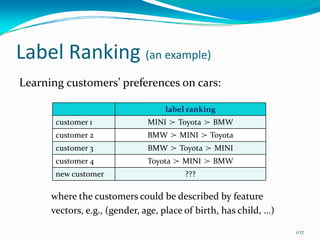
Learning customers’ preferences on cars:

                                   label ranking  
       customer 1              MINI _ Toyota _ BMW 
       customer 2              BMW _ MINI _ Toyota
       customer 3              BMW _ Toyota _ MINI
       customer 4              Toyota _ MINI _ BMW
       new customer                     ???

      where the customers could be described by feature 
      vectors, e.g., (gender, age, place of birth, has child, …)

                                                                   1/17
Label Ranking (an example)
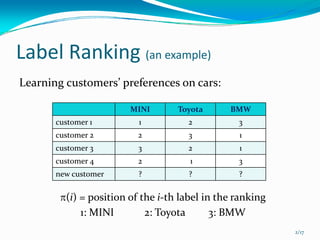
Learning customers’ preferences on cars:

                        MINI       Toyota      BMW
       customer 1         1          2           3
       customer 2         2          3           1
       customer 3         3          2           1
       customer 4         2           1          3
       new customer       ?           ?          ?


        π(i) = position of the i‐th label in the ranking
             1: MINI        2: Toyota       3: BMW
                                                           2/17
Label Ranking (more formally)
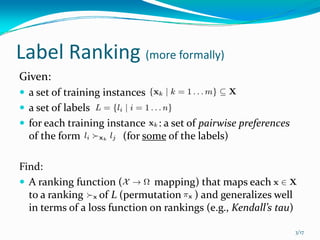
Given:
  a set of training instances 
  a set of labels
  for each training instance     : a set of pairwise preferences
  of the form                (for some of the labels)

Find:
  A ranking function (            mapping) that maps each           
  to a ranking      of L (permutation     ) and generalizes well 
  in terms of a loss function on rankings (e.g., Kendall’s tau)

                                                                   3/17
Existing Approaches
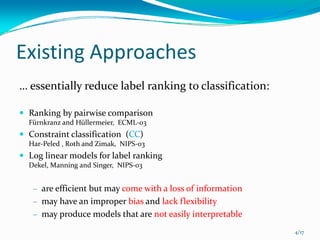
… essentially reduce label ranking to classification:

  Ranking by pairwise comparison
  Fürnkranz and Hüllermeier,  ECML‐03
  Constraint classification  (CC)
  Har‐Peled , Roth and Zimak,  NIPS‐03
  Log linear models for label ranking
  Dekel, Manning and Singer,  NIPS‐03


   − are efficient but may come with a loss of information
   − may have an improper bias and lack flexibility
   − may produce models that are not easily interpretable

                                                             4/17
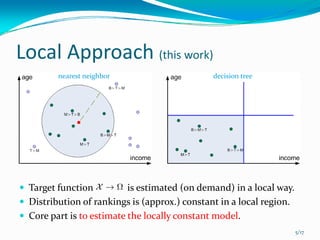
Local Approach (this work)
        nearest neighbor                      decision tree


 Target function         is estimated (on demand) in a local way.
 Distribution of rankings is (approx.) constant in a local region.
 Core part is to estimate the locally constant model.
                                                                     5/17
Local Approach (this work)
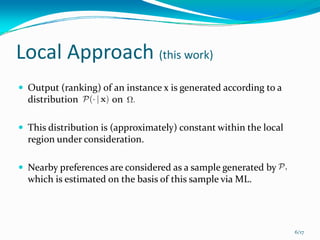
 Output (ranking) of an instance x is generated according to a 
 distribution              on 

 This distribution is (approximately) constant within the local 
 region under consideration.

 Nearby preferences are considered as a sample generated by  
 which is estimated on the basis of this sample via ML. 


                                                                   6/17
Probabilistic Model for Ranking 
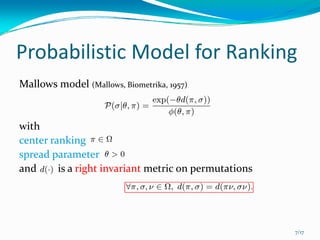
Mallows model (Mallows, Biometrika, 1957)


with 
center ranking
spread parameter
and        is a right invariant metric on permutations


                                                         7/17
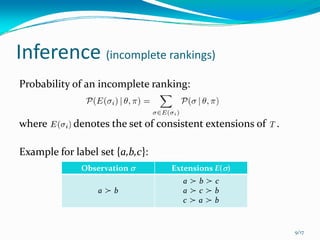
Inference (complete rankings)
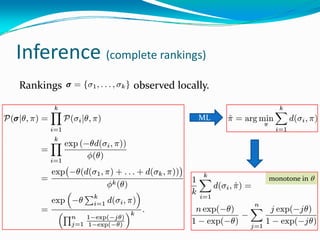
Rankings                           observed locally.

                                                 ML


                                                       monotone in θ
Inference (incomplete rankings)
Probability of an incomplete ranking:


where       denotes the set of consistent extensions of    .

Example for label set {a,b,c}:
              Observation σ       Extensions E(σ)
                                     a_b_c
                  a_b                a_c_b
                                     c_a_b


                                                               9/17
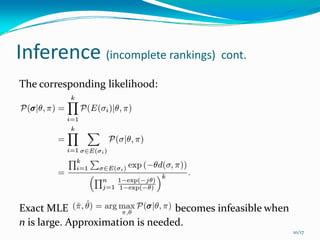
Inference (incomplete rankings)  cont.
The corresponding likelihood:


Exact MLE                                        becomes infeasible when 
n is large. Approximation is needed.
                                                                            10/17
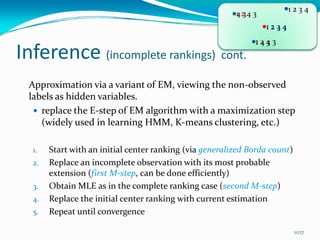
1 2 3 4
                                                         1 2 4 3
                                                         4 3
                                                                   1 2 3 4
                                                                   1 2 4 3
                                                               1 2 4 3
                                                               1 4 3
Inference (incomplete rankings)  cont.
  Approximation via a variant of EM, viewing the non‐observed 
  labels as hidden variables. 
     replace the E‐step of EM algorithm with a maximization step 
     (widely used in learning HMM, K‐means clustering, etc.)

  1.   Start with an initial center ranking (via generalized Borda count)
  2.   Replace an incomplete observation with its most probable 
       extension (first M‐step, can be done efficiently)
  3.   Obtain MLE as in the complete ranking case (second M‐step)
  4.   Replace the initial center ranking with current estimation
  5.   Repeat until convergence

                                                                               11/17
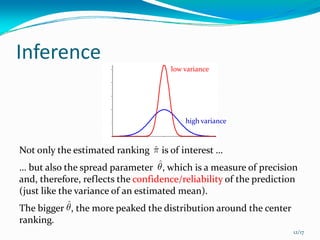
Inference
                                      low variance


                                          high variance


Not only the estimated ranking     is of interest …
… but also the spread parameter    , which is a measure of precision 
and, therefore, reflects the confidence/reliability of the prediction 
(just like the variance of an estimated mean). 
The bigger   , the more peaked the distribution around the center 
ranking.
                                                                    12/17
Label Ranking Trees
Major modifications: 
    split criterion 
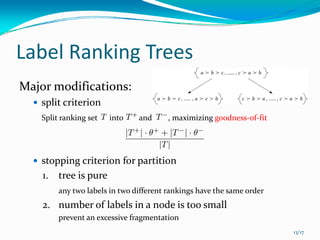
    Split ranking set      into        and        , maximizing goodness‐of‐fit


    stopping criterion for partition
    1. tree is pure
         any two labels in two different rankings have the same order
    2. number of labels in a node is too small 
         prevent an excessive fragmentation
                                                                                 13/17
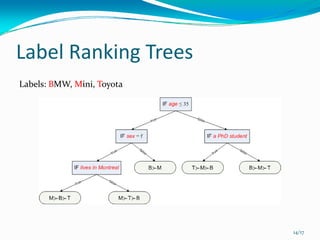
Label Ranking Trees
Labels: BMW, Mini, Toyota


                            14/17
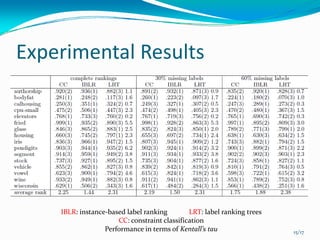
Experimental Results


    IBLR: instance‐based label ranking        LRT: label ranking trees
                      CC: constraint classification
                  Performance in terms of Kentall’s tau                  15/17
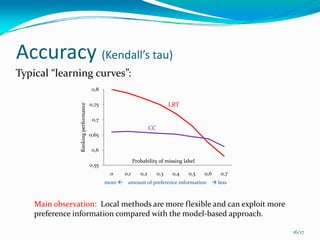
Accuracy (Kendall’s tau)
Typical “learning curves”:
                                        0,8

                                       0,75                                     LRT
                 Ranking performance


                                        0,7
                                                                     CC
                                       0,65

                                        0,6

                                                            Probability of missing label
                                       0,55
                                                0     0,1      0,2        0,3    0,4   0,5   0,6    0,7
                                              more     amount of preference information            less


    Main observation:  Local methods are more flexible and can exploit more 
    preference information compared with the model‐based approach.

                                                                                                          16/17
Take‐away Messages
  An instance‐based method for label ranking using a 
  probabilistic model.
  Suitable for complete and incomplete rankings.
  Comes with a natural measure of the reliability of a 
  prediction. Makes other types of learners possible: 
  label ranking trees.

o More efficient inference for the incomplete case. 
o Dealing with variants of the label ranking problem, such as 
  calibrated label ranking and multi‐label classification.

                                                             17/17
Google “kebi germany” for more info.

Decision tree and instance-based learning for label ranking