Decision Tree Analysis
Prof. Priyanka P. Dange
Civil Engineering Department
Sanjivani College of Engineering,
Kopargaon.
Introduction
 A decision tree is essentially a graphic diagram.
 One of the best ways to analyze a decision is to
use so-called decision trees.
 It is a useful tool for management decision
makers.
 It is useful in cases where a manager is required
to make a number of sequential decisions.
 Decision trees depict in the form of a ‘tree’, the
decision points, change events and probabilities
involved in various courses that might be
undertaken.
Why Decision Tree?
A common problem occurs in business
when a new product is introduced. Manager
must decide whether to install expensive
permanent equipment to ensure production
at the lowest possible cost or to undertake
cheaper temporary tooling that will
involve a higher manufacturing cost but
lower capital investments and will result in
lower losses if the product does not sale as
estimated.
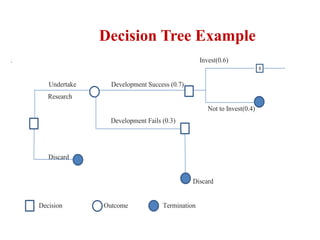
. Invest(0.6)
Undertake Development Success (0.7)
Research
Not to Invest(0.4)
Development Fails (0.3)
Discard
Discard
Decision Outcome Termination
3
Decision Tree Example
Decision Tree Analysis
This diagram is read it from left to right.
The leftmost node in a decision tree is called as a
root node or a decision node and can be
represented by small square( )
The branches emanating to the right from a
decision Node represent the set of decision
alternatives that are available. One and only one
of these alternative can be selected.
The small circles( ) in the tree are called chance
nodes.
The number shown in parentheses on each
branch of a chance node is the probability that
the outcome shown on that branch will occur at
the chance node.
The right end of each pass through the tree is
called an endpoint and each endpoint
represents the outcome of following a path
from the root node of the decision tree to that
endpoint.
Steps in Decision Tree Analysis
Identifying the problem and
alternatives.
Delineating the decision tree.
Specifying probabilities and monetary
outcomes.
Evaluating various decision
alternatives.
Thank You……

Decision Tree Analysis

  • 1.
    Decision Tree Analysis Prof.Priyanka P. Dange Civil Engineering Department Sanjivani College of Engineering, Kopargaon.
  • 2.
    Introduction  A decisiontree is essentially a graphic diagram.  One of the best ways to analyze a decision is to use so-called decision trees.  It is a useful tool for management decision makers.  It is useful in cases where a manager is required to make a number of sequential decisions.  Decision trees depict in the form of a ‘tree’, the decision points, change events and probabilities involved in various courses that might be undertaken.
  • 3.
    Why Decision Tree? Acommon problem occurs in business when a new product is introduced. Manager must decide whether to install expensive permanent equipment to ensure production at the lowest possible cost or to undertake cheaper temporary tooling that will involve a higher manufacturing cost but lower capital investments and will result in lower losses if the product does not sale as estimated.
  • 4.
    . Invest(0.6) Undertake DevelopmentSuccess (0.7) Research Not to Invest(0.4) Development Fails (0.3) Discard Discard Decision Outcome Termination 3 Decision Tree Example
  • 5.
    Decision Tree Analysis Thisdiagram is read it from left to right. The leftmost node in a decision tree is called as a root node or a decision node and can be represented by small square( ) The branches emanating to the right from a decision Node represent the set of decision alternatives that are available. One and only one of these alternative can be selected. The small circles( ) in the tree are called chance nodes.
  • 6.
    The number shownin parentheses on each branch of a chance node is the probability that the outcome shown on that branch will occur at the chance node. The right end of each pass through the tree is called an endpoint and each endpoint represents the outcome of following a path from the root node of the decision tree to that endpoint.
  • 7.
    Steps in DecisionTree Analysis Identifying the problem and alternatives. Delineating the decision tree. Specifying probabilities and monetary outcomes. Evaluating various decision alternatives.
  • 8.