DECISION
MAKINGTREE
DECISI
ON
It is the process of choosing a
course of action from among
achieve a desired
alternatives to
goal.
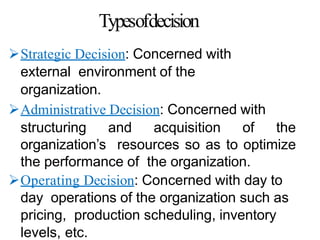
Typesofdecision
Strategic Decision: Concerned with
external environment of the
organization.
Administrative Decision: Concerned with
structuring and acquisition of the
organization’s resources so as to optimize
the performance of the organization.
Operating Decision: Concerned with day to
day operations of the organization such as
pricing, production scheduling, inventory
levels, etc.
Elementsrelatedtoall decisions
• Goals to be achieved: Objectives which the
decision maker wants to achieve by his actions
• The decision maker: Refers to an individual or an
organization
• Courses of action: Also called “Action” or
“Decision Alternatives”. They are under the
control of decision maker
• States of nature: Exhaustive list of possible future
events. Decision maker has no direct control over
the occurrence of particular event.
D
E
C
I
S
I
O
NT
R
E
E
MEANIN
G
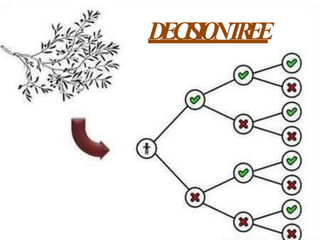
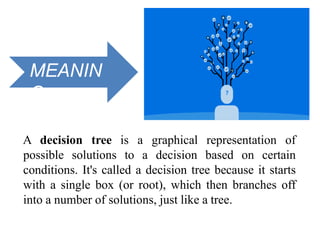
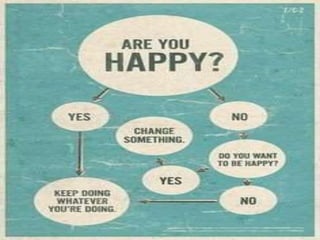
A decision tree is a graphical representation of
possible solutions to a decision based on certain
conditions. It's called a decision tree because it starts
with a single box (or root), which then branches off
into a number of solutions, just like a tree.
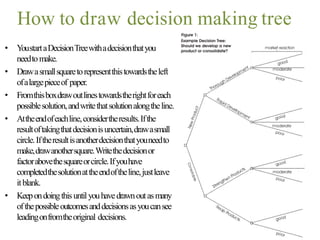
How to draw decision making tree
• Y
oustartaDecisionTreewithadecisionthatyou
needtomake.
• Drawasmallsquaretorepresentthistowardstheleft
ofalargepieceof paper.
• Fromthisboxdrawoutlinestowardstherightforeach
possiblesolution,andwritethatsolutionalongtheline.
• Attheendofeachline,considertheresults.Ifthe
resultoftakingthatdecisionisuncertain,drawasmall
circle.Iftheresultisanotherdecisionthatyouneedto
make,drawanothersquare.Writethedecisionor
factorabovethesquareorcircle.Ifyouhave
completedthesolutionattheendoftheline,justleave
itblank.
• Keepondoingthisuntilyouhavedrawnoutasmany
ofthepossibleoutcomesanddecisionsasyoucansee
leadingonfromtheoriginal decisions.
 Decision trees can be drawn by hand or created with a
graphics program or specialized software.
 Informally, decision trees are useful for focusing
discussion when a group must make a decision.
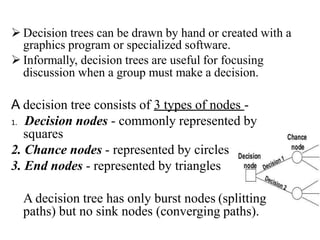
A decision tree consists of 3 types of nodes -
1. Decision nodes - commonly represented by
squares
2. Chance nodes - represented by circles
3. End nodes - represented by triangles
A decision tree has only burst nodes (splitting
paths) but no sink nodes (converging paths).
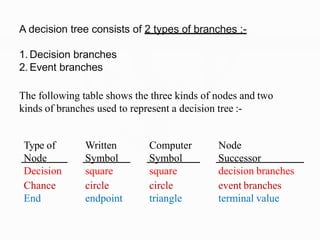
Type of
Node
Decision
Chance
End
Written
Symbol
square
circle
endpoint
Computer
Symbol
square
circle
triangle
Node
Successor
decision branches
event branches
terminal value
A decision tree consists of 2 types of branches :-
1.Decision branches
2. Event branches
The following table shows the three kinds of nodes and two
kinds of branches used to represent a decision tree :-
EXAMP
LE
Explanatio
n
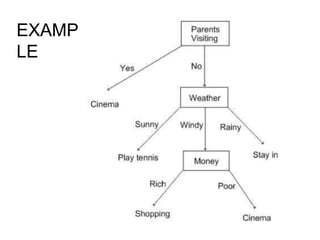
You are making your weekend plans and find out that your parents
might come to town. You'd like to have plans in place, but there are
a few unknown factors that will determine what you can, and can't,
do. Time for a decision tree.
First, you draw your decision box. This is the box that includes the
event that starts your decision tree. In this case it is your parents
coming to town. Out of that box, you have a branch for each
possible outcome. In our example, it's easy: yes or no - either your
parents come or they don't.
Your parents love the movies, so if they come to town, you'll go to
the cinema. Since the goal of the decision tree is to decide your
weekend plans, you have an answer.
But, what about if your parents don't come to town? We can go back
up to the 'no branch’ from the decision box and finish our decision
tree.
If your parents don’t come to town, you need to decide what you are
going to do. As you think of options, you realize the weather is an
important factor. So, Weather becomes your next box. Since its
spring time, you know it will be rainy, sunny or windy. Those three
possibilities become your branches.
If it’s sunny or rainy, you know what you’ll do-play tennis or stay
in, respectively. But what if it’s windy? If its windy, you want to get
out of the house, but you probably won’t able to play tennis. You
could either go for movie or shopping. What will determine whether
you go for shopping or movie. Money will determine so it will
become your branch. If you have enough money or you are rich, go
for shopping but if not, go for a movie.
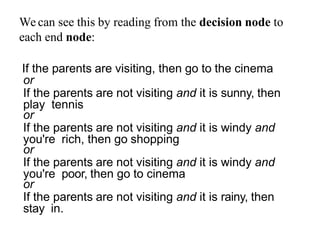
We can see this by reading from the decision node to
each end node:
If the parents are visiting, then go to the cinema
or
If the parents are not visiting and it is sunny, then
play tennis
or
If the parents are not visiting and it is windy and
you're rich, then go shopping
or
If the parents are not visiting and it is windy and
you're poor, then go to cinema
or
If the parents are not visiting and it is rainy, then
stay in.
ADVANTAGES
• Are simple to understand and interpret
People are able to understand decision tree
models after a brief explanation.
• Have value even with little hard data
Important insights can be generated based on
experts describing a situation (its alternatives,
probabilities, and costs) and their preferences for
outcomes.
• Use a white box model
If a given result is provided by a model, the
explanation for the result is easily replicated by
simple math.
• Can be combined with other decision techniques
It can be used with other techniques such
as brainstorming.
decision tree in statistics last chapter

decision tree in statistics last chapter

  • 1.
  • 2.
    DECISI ON It is theprocess of choosing a course of action from among achieve a desired alternatives to goal.
  • 3.
    Typesofdecision Strategic Decision: Concernedwith external environment of the organization. Administrative Decision: Concerned with structuring and acquisition of the organization’s resources so as to optimize the performance of the organization. Operating Decision: Concerned with day to day operations of the organization such as pricing, production scheduling, inventory levels, etc.
  • 4.
    Elementsrelatedtoall decisions • Goalsto be achieved: Objectives which the decision maker wants to achieve by his actions • The decision maker: Refers to an individual or an organization • Courses of action: Also called “Action” or “Decision Alternatives”. They are under the control of decision maker • States of nature: Exhaustive list of possible future events. Decision maker has no direct control over the occurrence of particular event.
  • 5.
  • 6.
    MEANIN G A decision treeis a graphical representation of possible solutions to a decision based on certain conditions. It's called a decision tree because it starts with a single box (or root), which then branches off into a number of solutions, just like a tree.
  • 8.
    How to drawdecision making tree • Y oustartaDecisionTreewithadecisionthatyou needtomake. • Drawasmallsquaretorepresentthistowardstheleft ofalargepieceof paper. • Fromthisboxdrawoutlinestowardstherightforeach possiblesolution,andwritethatsolutionalongtheline. • Attheendofeachline,considertheresults.Ifthe resultoftakingthatdecisionisuncertain,drawasmall circle.Iftheresultisanotherdecisionthatyouneedto make,drawanothersquare.Writethedecisionor factorabovethesquareorcircle.Ifyouhave completedthesolutionattheendoftheline,justleave itblank. • Keepondoingthisuntilyouhavedrawnoutasmany ofthepossibleoutcomesanddecisionsasyoucansee leadingonfromtheoriginal decisions.
  • 9.
     Decision treescan be drawn by hand or created with a graphics program or specialized software.  Informally, decision trees are useful for focusing discussion when a group must make a decision. A decision tree consists of 3 types of nodes - 1. Decision nodes - commonly represented by squares 2. Chance nodes - represented by circles 3. End nodes - represented by triangles A decision tree has only burst nodes (splitting paths) but no sink nodes (converging paths).
  • 10.
    Type of Node Decision Chance End Written Symbol square circle endpoint Computer Symbol square circle triangle Node Successor decision branches eventbranches terminal value A decision tree consists of 2 types of branches :- 1.Decision branches 2. Event branches The following table shows the three kinds of nodes and two kinds of branches used to represent a decision tree :-
  • 11.
  • 12.
    Explanatio n You are makingyour weekend plans and find out that your parents might come to town. You'd like to have plans in place, but there are a few unknown factors that will determine what you can, and can't, do. Time for a decision tree. First, you draw your decision box. This is the box that includes the event that starts your decision tree. In this case it is your parents coming to town. Out of that box, you have a branch for each possible outcome. In our example, it's easy: yes or no - either your parents come or they don't. Your parents love the movies, so if they come to town, you'll go to the cinema. Since the goal of the decision tree is to decide your weekend plans, you have an answer.
  • 13.
    But, what aboutif your parents don't come to town? We can go back up to the 'no branch’ from the decision box and finish our decision tree. If your parents don’t come to town, you need to decide what you are going to do. As you think of options, you realize the weather is an important factor. So, Weather becomes your next box. Since its spring time, you know it will be rainy, sunny or windy. Those three possibilities become your branches. If it’s sunny or rainy, you know what you’ll do-play tennis or stay in, respectively. But what if it’s windy? If its windy, you want to get out of the house, but you probably won’t able to play tennis. You could either go for movie or shopping. What will determine whether you go for shopping or movie. Money will determine so it will become your branch. If you have enough money or you are rich, go for shopping but if not, go for a movie.
  • 14.
    We can seethis by reading from the decision node to each end node: If the parents are visiting, then go to the cinema or If the parents are not visiting and it is sunny, then play tennis or If the parents are not visiting and it is windy and you're rich, then go shopping or If the parents are not visiting and it is windy and you're poor, then go to cinema or If the parents are not visiting and it is rainy, then stay in.
  • 15.
    ADVANTAGES • Are simpleto understand and interpret People are able to understand decision tree models after a brief explanation. • Have value even with little hard data Important insights can be generated based on experts describing a situation (its alternatives, probabilities, and costs) and their preferences for outcomes.
  • 16.
    • Use awhite box model If a given result is provided by a model, the explanation for the result is easily replicated by simple math. • Can be combined with other decision techniques It can be used with other techniques such as brainstorming.