Using Immunity Debugger to Write Exploits Security Research  Dave Aitel, Nicolas Waisman [email_address] [email_address]
Who am I? CTO, Immunity Inc. Responsible for new product development Immunity Debugger SILICA Immunity CANVAS
Software vendors now understand the value of security Over the past few years regular users have become more aware of security problems As a result 'security' has become a valuable and marketable asset Recognizing this, the computer industry has invested in both hardware and software security improvements
Immunity Debugger is a strategic answer to defensive advances ASLR, NX, /gS and high levels of automated and manual code auditing have raised the bar significantly Attackers operate at a distinct disadvantage No source code or internal documentation on structures and protocols Vulnerabilities must be created into reliable exploits
But attackers have their own resources Used to working in small teams Broad range of knowledge (Unix hackers that know Win32, etc) Exploit development knowledge is often not fed back to defensive teams, allowing for knowledge leadership over a long time period i.e. new bug classes and attack surfaces
Attackers will defeat the current generation of defensive technologies through profound and rapid tool innovation Interfaces Analysis engines Integration into existing tool-sets Teamwork and coordination
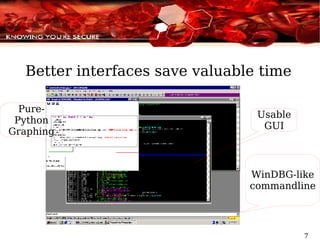
Better interfaces save valuable time WinDBG-like commandline Pure-Python Graphing Usable GUI
Python integration offers useful analysis safeseh discovery stack/heap variable sizing most importantly – custom automated binary analysis can be written cheaply and easily! Static and runtime analysis
Existing toolsets are also in Python Python x86 emulators Python exploit frameworks Python web application analysis PEID Non-python toolkits can be accessed easily via Sockets or XML-RPC
Hackers already work in teams... But their tools don't – yet Ongoing efforts include SVN + Debugger Portable function fingerprints Global RE database While previous efforts have broken ground in team binary analysis, in a year, this will be the default mode of operation
Two examples of how Immunity Debugger changes assessment and exploitation File Include/SQL Injection bugs Heap Overflows
SQL Injection/File Include Traditionally web applications are looked at via code review or remote blind assessment But complexity is rising and closed source modules are common  With ID's sql_hooker.py and sqllistener.py All SQL Queries get sent to the attacker via XML-RPC Python lets you filter on only interesting results at server side
Heap overflows are dead, long live heap overflows Common technique for reliable exploitation of heap overflows is the write4 primitive OS Vendors are well aware of this
And so... heap protection has been introduced Windows XP SP2, Windows 2003 SP1 and Vista introduced different heap validity checks to prevent unlink() write4 primitives Similar technologies are in place in glibc in Linux There are no generic ways to bypass the new heap protection mechanisms The current approaches have a lot of requirements:  How do we meet these requirements?
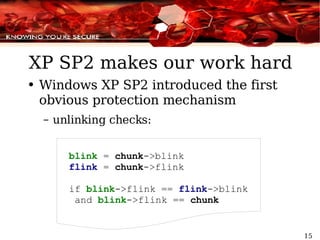
XP SP2 makes our work hard Windows XP SP2 introduced the first obvious protection mechanism unlinking checks: blink  =  chunk ->blink flink  =  chunk ->flink if  blink ->flink ==  flink ->blink and  blink ->flink ==  chunk
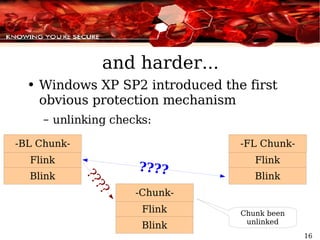
and harder... Windows XP SP2 introduced the first obvious protection mechanism unlinking checks: Chunk been unlinked
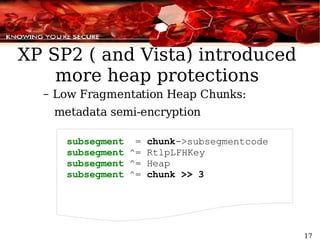
XP SP2 ( and Vista) introduced more heap protections Low Fragmentation Heap Chunks: metadata semi-encryption subsegment  =  chunk ->subsegmentcode subsegment  ^= RtlpLFHKey subsegment  ^= Heap subsegment  ^=  chunk >> 3
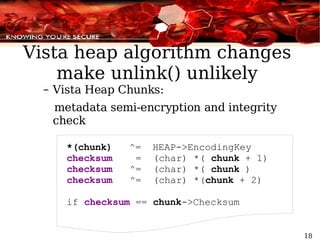
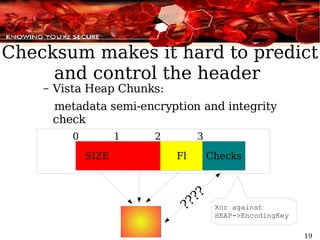
Vista heap algorithm changes make unlink() unlikely Vista Heap Chunks: metadata semi-encryption and integrity check *(chunk)  ^=  HEAP->EncodingKey checksum   =  (char) *(  chunk  + 1) checksum   ^=  (char) *(  chunk  ) checksum   ^=  (char) *( chunk  + 2) if  checksum  ==  chunk ->Checksum
Checksum makes it hard to predict and control the header  Vista Heap Chunks: metadata semi-encryption and integrity check 0 1 2 3 Xor against  HEAP->EncodingKey
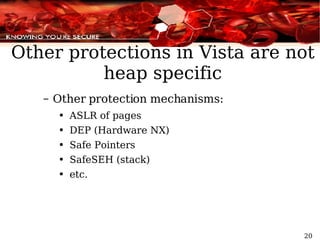
Other protections in Vista are not heap specific Other protection mechanisms: ASLR of pages DEP (Hardware NX) Safe Pointers  SafeSEH (stack) etc.
A lot of excellent work has been done to bypass heap protections Taking advantage of Freelist[0] split mechanism (“ Exploiting Freelist[0] on XP SP2”  by Brett Moore) Taking advantage of Single Linked List unlink on the Lookaside ( Oded Horovitz and Matt Connover) Heap Feng Shui in Javascript (Alexander Sotirov)
We no longer use heap algorithms to get write4 primitives Generic heap exploitation approaches are obsolete. There is no more easy write4. Sinan: “ I can make a strawberry pudding with so many prerequisites ” Application specific techniques are needed We use a methodology based on understanding and controlling the algorithm to position data carefully on the heap
We have been working on this methodology for years All good heap overflow exploits have been in careful control of the heap for years to reach the maximum amount of reliability We now also attack not the heap metadata, but the heap data itself Because our technique is specific to each program, generic heap protections can not prevent it Immunity Debugger contains powerful new tools to aid this process
Previous exploits already carefully crafted the heap Spooler Exploit:  Multiple Write4 with a combination of the Lookaside and the FreeList MS05_025: Softmemleaks to craft the proper layout for two Write4 in a row Any other reliable heap overflow These still used write4s from the heap algorithms themselves!
To establish deterministic  control over the Heap you need Understanding of the allocation algorithm Understanding of the layout you are exploiting A methodology to control the layout The proper tools to understand and control the allocation pattern of a process
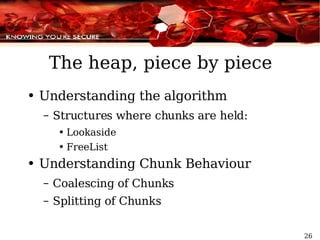
The heap, piece by piece Understanding the algorithm Structures where chunks are held: Lookaside FreeList Understanding Chunk Behaviour Coalescing of Chunks Splitting of Chunks
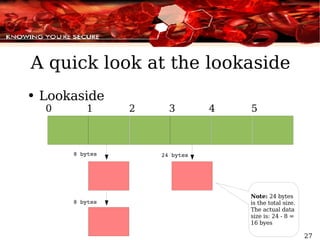
A quick look at the lookaside Lookaside 0 1 2 3 4 5 8 bytes 8 bytes 24 bytes Note:  24 bytes is the total size. The actual data size is: 24 - 8 = 16 byes
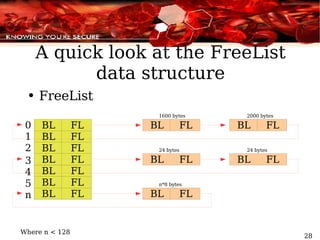
A quick look at the FreeList data structure FreeList 0 1 2 3 24 bytes 24 bytes 4 n n*8 bytes 1600 bytes 2000 bytes 5 Where n < 128
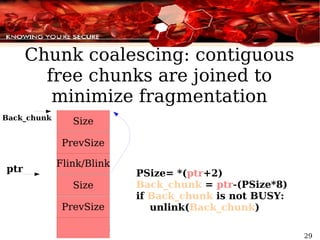
Chunk coalescing: contiguous free chunks are joined to minimize fragmentation ptr Back_chunk PSize= *( ptr +2) Back_chunk  =   ptr - (PSize*8) if  Back_chunk  is not BUSY: unlink( Back_chunk )
Chunks are split into two chunks when necessary Chunk splitting happens when a chunk of a specific size is requested and only larger chunks are available After a chunk is split, part of the chunk is returned to the process and part is inserted back into the  FreeList
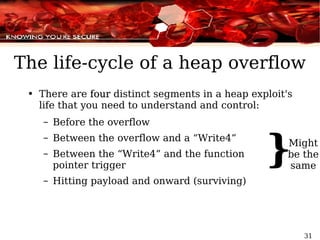
The life-cycle of a heap overflow There are  four  distinct segments in a heap exploit's  life  that you need to understand and control: Before the overflow Between the overflow and a “Write4” Between the “Write4” and the function  pointer trigger Hitting payload and onward (surviving) } Might be the same
An alternate heap overflow lifecycle that requires emphasis on surviving with a broken heap Before the overflow Between the overflow and the write4 heap corruption or write4 is used to modify a cryptographic token (public key or password) User logs in since they now know the key (or have crippled the encryption) DEP/NX is unable to prevent this kind of attack!
Heaps do not all start in the same layout With heap overflows it is not always easy to control how an overwritten chunk will affect the operation of the heap algorithm Understanding how the allocation algorithm works, it becomes apparent that doing three allocations in a row does not mean it will return three bordering chunks  Typically this problem is because of “Heap Holes”
Heap Holes Assume Vulnerable(function) A = Allocate(0x300); B = Allocate(0x300); [...] Overwrite(A); fn_ptr = B[4]; fn_ptr(“hello world”); Chunk is part of the FreeList[97]
Heap Holes Assuming Vulnerable(function) A = Allocate(0x300); B = Allocate(0x300); [...] Overwrite(A); fn_ptr = B[4]; fn_ptr(“hello world”);
Heap Holes Suppose Vulnerable(function) A = Allocate(0x300); B = Allocate(0x300); [...] Overwrite(A); fn_ptr = B[4]; fn_ptr(“hello world”);
Two types of memory leaks are used in heap exploitation A memleak is a portion of memory that is  allocated  but  not deallocated  throughout the  life of the target There are two types of memleaks: Hard: Memleaks that remain allocated throughout the entire life of the target Soft: Memleaks that remain allocated only for a set period of time (e.g. a memleak based on one connection)
Several bad coding practises lead to hard memleaks  Allocations within a try-except block that forget to free in the except block Use of RaiseException() within a function before  freeing locally bound allocations (RPC services do this a lot) Losing track of a pointer to the allocated chunk or overwriting the pointer. No sane reference is left behind for a free A certain code flow might return without freeing the locally bound allocation
Soft memory leaks are almost as useful to exploit writers Soft Memleaks are much easier to find: Every connection to a server that is not disconnected, allocates memory Variables that are set by a command and remain so until they are unset Ex:  X-LINK2STATE CHUNK=A  allocates 0x400 bytes. X-LINK2STATE  LAST  CHUNK=A  free that chunk.
We correct our heap layout with memory leaks In summary, memleaks will help us do different things: Empty the Lookaside Empty the FreeList Leaving Holes for a specific purpose } Both have the same objective: to allow us to have consecutive chunks
Heap Rule #1: Force and control the layout Assume again Vulnerable(function) A = Allocate(0x300); B = Allocate(0x300); [...] Overwrite(A); fn_ptr = B[4]; fn_ptr(“hello world”);
memleak(768) Vulnerable(function) A = Allocate(0x300); B = Allocate(0x300); [...] Overwrite(A); fn_ptr = B[4]; fn_ptr(“hello world”); Heap Rule #1: Force and control the layout Calculating size: 768 + 8 = 776 776/8 =  entry 97
memleak(768) Vulnerable(function) A = Allocate(0x300); B = Allocate(0x300); [...] Overwrite(A); fn_ptr = B[4]; fn_ptr(“hello world”); Heap Rule #1: Force and control the layout
Good exploits are the result of Intelligent Debugging With the new requirements for maximum deterministic control over the algorithm, exploiting the Win32 heap relies on intelligent debugging The need for a debugger that will fill these requirements arises
Immunity Debugger is the first debugger specifically for vulnerability development Powerful GUI WinDBG compatible commandline Powerful Python based scripting engine
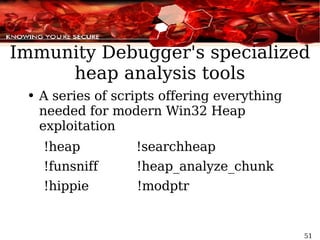
Immunity Debugger's specialized heap analysis tools A series of scripts offering everything needed for modern Win32 Heap exploitation !heap  !searchheap !funsniff  !heap_analyze_chunk !hippie  !modptr
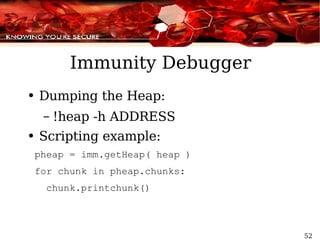
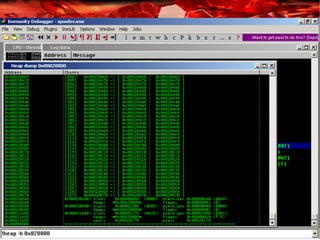
Immunity Debugger Dumping the Heap: !heap -h ADDRESS Scripting example: pheap = imm.getHeap( heap ) for chunk in pheap.chunks: chunk.printchunk()
 
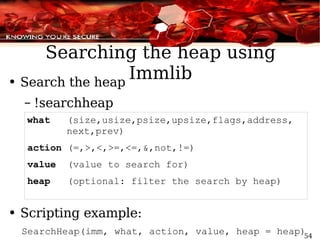
Searching the heap using Immlib Search the heap !searchheap  what  (size,usize,psize,upsize,flags,address,  next,prev) action  (=,>,<,>=,<=,&,not,!=) value  (value to search for) heap  (optional: filter the search by heap) Scripting example:  SearchHeap(imm, what, action, value, heap = heap)
Comparing a heap before and after you break it Dumping  a Broken Heap: Save state: !heap -h ADDRESS -s Restore State: !heap -h ADDRESS -r
Heap Fingerprinting To craft a correct Heap layout we need a proper understanding of the allocation pattern of different functions in the target process This means there is a need for fingerprinting the heap flow of a specific function
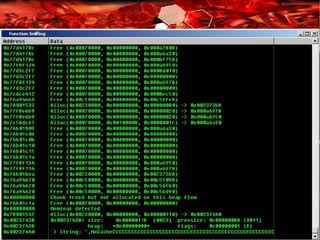
Heap Fingerprinting !funsniff <address> fingerprint the allocation pattern of the given function find memleaks double free memory freed of a chunk not belonging to our current heap flow (Important for soft memleaks)
 
Automated data type discovery using Immlib As we now know overwriting the metadata of chunks to get a unlink primitive is mostly no longer viable The next step of heap exploitation is taking advantage of the  content   of chunks We need straightforward runtime recognition of chunk content
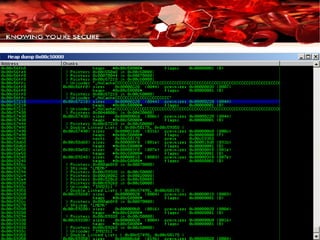
Immunity Debugger offers simple runtime analysis of heap data to find data types String/Unicode Pointers ( Function Pointer, Data pointer, Stack Pointer) Double Linked lists  Important because they have their own unlink() write4 primitives!
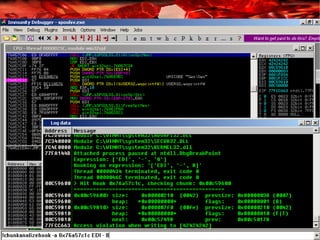
Data Discovery !heap -h HEAP_ADDRESS -d See next slide for awesome screenshot of this in action!
 
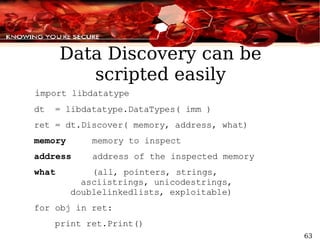
Data Discovery can be scripted easily i mport libdatatype dt  = libdatatype.DataTypes( imm ) ret = dt.Discover( memory, address, what) memory   memory to inspect address   address of the inspected memory what  (all, pointers, strings,  asciistrings, unicodestrings,  doublelinkedlists, exploitable) for obj in ret: print ret.Print()
Heap Fuzzing helps you discover a way to obtain the correct layout Sometimes controlling the layout is not as easy as you think, even though it sounds straightforward in theory From this the concept of Fuzzing the Heap arises, to help in discovering the correct layout for your process (manually or automatically)
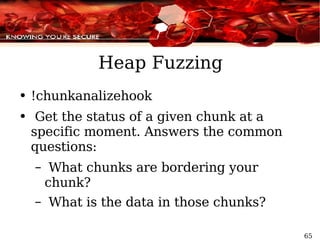
Heap Fuzzing !chunkanalizehook Get the status of a given chunk at a specific moment. Answers the common questions:  What chunks are bordering your chunk? What is the data in those chunks?
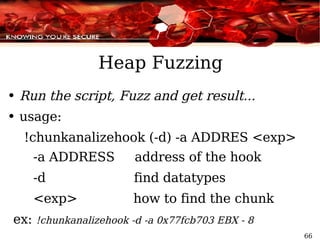
Heap Fuzzing Run the script, Fuzz and get result... usage: !chunkanalizehook (-d) -a ADDRES <exp> -a ADDRESS  address of the hook -d  find datatypes <exp>  how to find the chunk ex:  !chunkanalizehook -d -a 0x77fcb703 EBX - 8
 
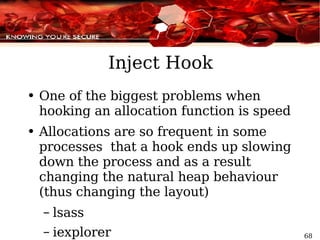
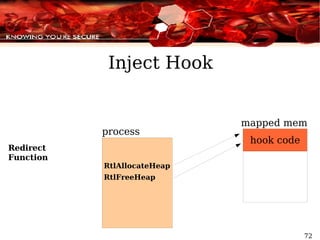
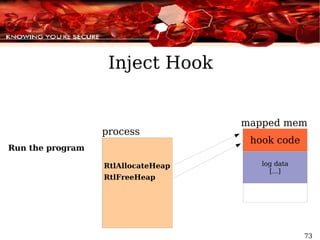
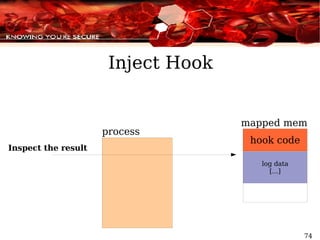
Inject Hook One of the biggest problems when hooking an allocation function is speed Allocations are so frequent in some processes  that a hook ends up slowing down the process and as a result changing the natural heap  behaviour  (thus changing the layout) lsass iexplorer
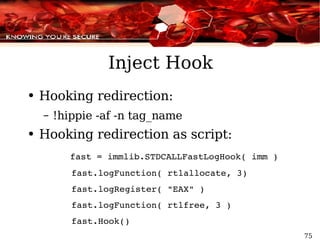
Inject Hooks into the target process speeds things up This means doing function redirection and logging the result in the debugger itself (Avoiding breakpoints, event handling, etc) Can be done automatically via Immlib
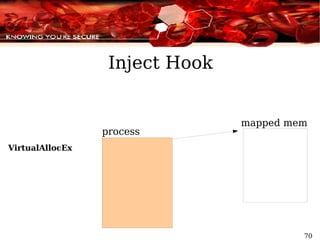
Inject Hook process VirtualAllocEx mapped mem
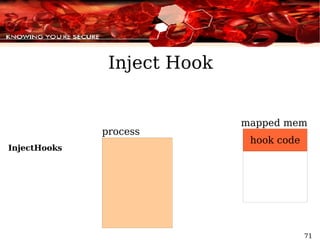
Inject Hook process InjectHooks mapped mem
Inject Hook process Redirect Function mapped mem RtlAllocateHeap RtlFreeHeap
Inject Hook process Run the program mapped mem RtlAllocateHeap RtlFreeHeap
Inject Hook process Inspect the result mapped mem
Inject Hook Hooking redirection: !hippie -af -n tag_name Hooking redirection as script: fast = immlib.STDCALLFastLogHook( imm ) fast.logFunction( rtlallocate, 3) fast.logRegister( &quot;EAX&quot; ) fast.logFunction( rtlfree, 3 ) fast.Hook()
The future In the near future ID will have a heap simulator that, when fed with heap flow fingerprints, will tell you which function calls are needed to get the correct heap layout for your target process Simple modifications to existing scripts can put memory access breakpoints at the end of every chunk to find out exactly when a heap overflow happens This is great for fuzzers
Automating exploitation Stack overflows Automation of simple exploitation techniques (bad bytes, etc) will be built into VisualSploit+ID  Anti-DEP scripts already working! Deep protocol analysis and fuzzer integration on its way
Conclusions Exploiting heap vulnerabilities has become much more costly Immunity Debugger offers tools to drastically reduce the effort needed to write reliable heap overflows  On older Windows platforms getting a reliable write4 the traditional way On newer Windows platforms by abusing program-specific data structures
Thank you for your time Contact us at: [email_address] [email_address] Security Research Team

Debugging With Id

  • 1.
    Using Immunity Debuggerto Write Exploits Security Research Dave Aitel, Nicolas Waisman [email_address] [email_address]
  • 2.
    Who am I?CTO, Immunity Inc. Responsible for new product development Immunity Debugger SILICA Immunity CANVAS
  • 3.
    Software vendors nowunderstand the value of security Over the past few years regular users have become more aware of security problems As a result 'security' has become a valuable and marketable asset Recognizing this, the computer industry has invested in both hardware and software security improvements
  • 4.
    Immunity Debugger isa strategic answer to defensive advances ASLR, NX, /gS and high levels of automated and manual code auditing have raised the bar significantly Attackers operate at a distinct disadvantage No source code or internal documentation on structures and protocols Vulnerabilities must be created into reliable exploits
  • 5.
    But attackers havetheir own resources Used to working in small teams Broad range of knowledge (Unix hackers that know Win32, etc) Exploit development knowledge is often not fed back to defensive teams, allowing for knowledge leadership over a long time period i.e. new bug classes and attack surfaces
  • 6.
    Attackers will defeatthe current generation of defensive technologies through profound and rapid tool innovation Interfaces Analysis engines Integration into existing tool-sets Teamwork and coordination
  • 7.
    Better interfaces savevaluable time WinDBG-like commandline Pure-Python Graphing Usable GUI
  • 8.
    Python integration offersuseful analysis safeseh discovery stack/heap variable sizing most importantly – custom automated binary analysis can be written cheaply and easily! Static and runtime analysis
  • 9.
    Existing toolsets arealso in Python Python x86 emulators Python exploit frameworks Python web application analysis PEID Non-python toolkits can be accessed easily via Sockets or XML-RPC
  • 10.
    Hackers already workin teams... But their tools don't – yet Ongoing efforts include SVN + Debugger Portable function fingerprints Global RE database While previous efforts have broken ground in team binary analysis, in a year, this will be the default mode of operation
  • 11.
    Two examples ofhow Immunity Debugger changes assessment and exploitation File Include/SQL Injection bugs Heap Overflows
  • 12.
    SQL Injection/File IncludeTraditionally web applications are looked at via code review or remote blind assessment But complexity is rising and closed source modules are common With ID's sql_hooker.py and sqllistener.py All SQL Queries get sent to the attacker via XML-RPC Python lets you filter on only interesting results at server side
  • 13.
    Heap overflows aredead, long live heap overflows Common technique for reliable exploitation of heap overflows is the write4 primitive OS Vendors are well aware of this
  • 14.
    And so... heapprotection has been introduced Windows XP SP2, Windows 2003 SP1 and Vista introduced different heap validity checks to prevent unlink() write4 primitives Similar technologies are in place in glibc in Linux There are no generic ways to bypass the new heap protection mechanisms The current approaches have a lot of requirements: How do we meet these requirements?
  • 15.
    XP SP2 makesour work hard Windows XP SP2 introduced the first obvious protection mechanism unlinking checks: blink = chunk ->blink flink = chunk ->flink if blink ->flink == flink ->blink and blink ->flink == chunk
  • 16.
    and harder... WindowsXP SP2 introduced the first obvious protection mechanism unlinking checks: Chunk been unlinked
  • 17.
    XP SP2 (and Vista) introduced more heap protections Low Fragmentation Heap Chunks: metadata semi-encryption subsegment = chunk ->subsegmentcode subsegment ^= RtlpLFHKey subsegment ^= Heap subsegment ^= chunk >> 3
  • 18.
    Vista heap algorithmchanges make unlink() unlikely Vista Heap Chunks: metadata semi-encryption and integrity check *(chunk) ^= HEAP->EncodingKey checksum = (char) *( chunk + 1) checksum ^= (char) *( chunk ) checksum ^= (char) *( chunk + 2) if checksum == chunk ->Checksum
  • 19.
    Checksum makes ithard to predict and control the header Vista Heap Chunks: metadata semi-encryption and integrity check 0 1 2 3 Xor against HEAP->EncodingKey
  • 20.
    Other protections inVista are not heap specific Other protection mechanisms: ASLR of pages DEP (Hardware NX) Safe Pointers SafeSEH (stack) etc.
  • 21.
    A lot ofexcellent work has been done to bypass heap protections Taking advantage of Freelist[0] split mechanism (“ Exploiting Freelist[0] on XP SP2” by Brett Moore) Taking advantage of Single Linked List unlink on the Lookaside ( Oded Horovitz and Matt Connover) Heap Feng Shui in Javascript (Alexander Sotirov)
  • 22.
    We no longeruse heap algorithms to get write4 primitives Generic heap exploitation approaches are obsolete. There is no more easy write4. Sinan: “ I can make a strawberry pudding with so many prerequisites ” Application specific techniques are needed We use a methodology based on understanding and controlling the algorithm to position data carefully on the heap
  • 23.
    We have beenworking on this methodology for years All good heap overflow exploits have been in careful control of the heap for years to reach the maximum amount of reliability We now also attack not the heap metadata, but the heap data itself Because our technique is specific to each program, generic heap protections can not prevent it Immunity Debugger contains powerful new tools to aid this process
  • 24.
    Previous exploits alreadycarefully crafted the heap Spooler Exploit: Multiple Write4 with a combination of the Lookaside and the FreeList MS05_025: Softmemleaks to craft the proper layout for two Write4 in a row Any other reliable heap overflow These still used write4s from the heap algorithms themselves!
  • 25.
    To establish deterministic control over the Heap you need Understanding of the allocation algorithm Understanding of the layout you are exploiting A methodology to control the layout The proper tools to understand and control the allocation pattern of a process
  • 26.
    The heap, pieceby piece Understanding the algorithm Structures where chunks are held: Lookaside FreeList Understanding Chunk Behaviour Coalescing of Chunks Splitting of Chunks
  • 27.
    A quick lookat the lookaside Lookaside 0 1 2 3 4 5 8 bytes 8 bytes 24 bytes Note: 24 bytes is the total size. The actual data size is: 24 - 8 = 16 byes
  • 28.
    A quick lookat the FreeList data structure FreeList 0 1 2 3 24 bytes 24 bytes 4 n n*8 bytes 1600 bytes 2000 bytes 5 Where n < 128
  • 29.
    Chunk coalescing: contiguousfree chunks are joined to minimize fragmentation ptr Back_chunk PSize= *( ptr +2) Back_chunk = ptr - (PSize*8) if Back_chunk is not BUSY: unlink( Back_chunk )
  • 30.
    Chunks are splitinto two chunks when necessary Chunk splitting happens when a chunk of a specific size is requested and only larger chunks are available After a chunk is split, part of the chunk is returned to the process and part is inserted back into the FreeList
  • 31.
    The life-cycle ofa heap overflow There are four distinct segments in a heap exploit's life that you need to understand and control: Before the overflow Between the overflow and a “Write4” Between the “Write4” and the function pointer trigger Hitting payload and onward (surviving) } Might be the same
  • 32.
    An alternate heapoverflow lifecycle that requires emphasis on surviving with a broken heap Before the overflow Between the overflow and the write4 heap corruption or write4 is used to modify a cryptographic token (public key or password) User logs in since they now know the key (or have crippled the encryption) DEP/NX is unable to prevent this kind of attack!
  • 33.
    Heaps do notall start in the same layout With heap overflows it is not always easy to control how an overwritten chunk will affect the operation of the heap algorithm Understanding how the allocation algorithm works, it becomes apparent that doing three allocations in a row does not mean it will return three bordering chunks Typically this problem is because of “Heap Holes”
  • 34.
    Heap Holes AssumeVulnerable(function) A = Allocate(0x300); B = Allocate(0x300); [...] Overwrite(A); fn_ptr = B[4]; fn_ptr(“hello world”); Chunk is part of the FreeList[97]
  • 35.
    Heap Holes AssumingVulnerable(function) A = Allocate(0x300); B = Allocate(0x300); [...] Overwrite(A); fn_ptr = B[4]; fn_ptr(“hello world”);
  • 36.
    Heap Holes SupposeVulnerable(function) A = Allocate(0x300); B = Allocate(0x300); [...] Overwrite(A); fn_ptr = B[4]; fn_ptr(“hello world”);
  • 37.
    Heap Holes SupposeVulnerable(function) A = Allocate(0x300); B = Allocate(0x300); [...] Overwrite(A); fn_ptr = B[4]; fn_ptr(“hello world”);
  • 38.
    Heap Holes SupposeVulnerable(function) A = Allocate(0x300); B = Allocate(0x300); [...] Overwrite(A); fn_ptr = B[4]; fn_ptr(“hello world”);
  • 39.
    Two types ofmemory leaks are used in heap exploitation A memleak is a portion of memory that is allocated but not deallocated throughout the life of the target There are two types of memleaks: Hard: Memleaks that remain allocated throughout the entire life of the target Soft: Memleaks that remain allocated only for a set period of time (e.g. a memleak based on one connection)
  • 40.
    Several bad codingpractises lead to hard memleaks Allocations within a try-except block that forget to free in the except block Use of RaiseException() within a function before freeing locally bound allocations (RPC services do this a lot) Losing track of a pointer to the allocated chunk or overwriting the pointer. No sane reference is left behind for a free A certain code flow might return without freeing the locally bound allocation
  • 41.
    Soft memory leaksare almost as useful to exploit writers Soft Memleaks are much easier to find: Every connection to a server that is not disconnected, allocates memory Variables that are set by a command and remain so until they are unset Ex: X-LINK2STATE CHUNK=A allocates 0x400 bytes. X-LINK2STATE LAST CHUNK=A free that chunk.
  • 42.
    We correct ourheap layout with memory leaks In summary, memleaks will help us do different things: Empty the Lookaside Empty the FreeList Leaving Holes for a specific purpose } Both have the same objective: to allow us to have consecutive chunks
  • 43.
    Heap Rule #1:Force and control the layout Assume again Vulnerable(function) A = Allocate(0x300); B = Allocate(0x300); [...] Overwrite(A); fn_ptr = B[4]; fn_ptr(“hello world”);
  • 44.
    memleak(768) Vulnerable(function) A= Allocate(0x300); B = Allocate(0x300); [...] Overwrite(A); fn_ptr = B[4]; fn_ptr(“hello world”); Heap Rule #1: Force and control the layout Calculating size: 768 + 8 = 776 776/8 = entry 97
  • 45.
    memleak(768) Vulnerable(function) A= Allocate(0x300); B = Allocate(0x300); [...] Overwrite(A); fn_ptr = B[4]; fn_ptr(“hello world”); Heap Rule #1: Force and control the layout
  • 46.
    memleak(768) Vulnerable(function) A= Allocate(0x300); B = Allocate(0x300); [...] Overwrite(A); fn_ptr = B[4]; fn_ptr(“hello world”); Heap Rule #1: Force and control the layout
  • 47.
    memleak(768) Vulnerable(function) A= Allocate(0x300); B = Allocate(0x300); [...] Overwrite(A); fn_ptr = B[4]; fn_ptr(“hello world”); Heap Rule #1: Force and control the layout
  • 48.
    memleak(768) Vulnerable(function) A= Allocate(0x300); B = Allocate(0x300); [...] Overwrite(A); fn_ptr = B[4]; fn_ptr(“hello world”); Heap Rule #1: Force and control the layout
  • 49.
    Good exploits arethe result of Intelligent Debugging With the new requirements for maximum deterministic control over the algorithm, exploiting the Win32 heap relies on intelligent debugging The need for a debugger that will fill these requirements arises
  • 50.
    Immunity Debugger isthe first debugger specifically for vulnerability development Powerful GUI WinDBG compatible commandline Powerful Python based scripting engine
  • 51.
    Immunity Debugger's specializedheap analysis tools A series of scripts offering everything needed for modern Win32 Heap exploitation !heap !searchheap !funsniff !heap_analyze_chunk !hippie !modptr
  • 52.
    Immunity Debugger Dumpingthe Heap: !heap -h ADDRESS Scripting example: pheap = imm.getHeap( heap ) for chunk in pheap.chunks: chunk.printchunk()
  • 53.
  • 54.
    Searching the heapusing Immlib Search the heap !searchheap what (size,usize,psize,upsize,flags,address, next,prev) action (=,>,<,>=,<=,&,not,!=) value (value to search for) heap (optional: filter the search by heap) Scripting example: SearchHeap(imm, what, action, value, heap = heap)
  • 55.
    Comparing a heapbefore and after you break it Dumping a Broken Heap: Save state: !heap -h ADDRESS -s Restore State: !heap -h ADDRESS -r
  • 56.
    Heap Fingerprinting Tocraft a correct Heap layout we need a proper understanding of the allocation pattern of different functions in the target process This means there is a need for fingerprinting the heap flow of a specific function
  • 57.
    Heap Fingerprinting !funsniff<address> fingerprint the allocation pattern of the given function find memleaks double free memory freed of a chunk not belonging to our current heap flow (Important for soft memleaks)
  • 58.
  • 59.
    Automated data typediscovery using Immlib As we now know overwriting the metadata of chunks to get a unlink primitive is mostly no longer viable The next step of heap exploitation is taking advantage of the content of chunks We need straightforward runtime recognition of chunk content
  • 60.
    Immunity Debugger offerssimple runtime analysis of heap data to find data types String/Unicode Pointers ( Function Pointer, Data pointer, Stack Pointer) Double Linked lists Important because they have their own unlink() write4 primitives!
  • 61.
    Data Discovery !heap-h HEAP_ADDRESS -d See next slide for awesome screenshot of this in action!
  • 62.
  • 63.
    Data Discovery canbe scripted easily i mport libdatatype dt = libdatatype.DataTypes( imm ) ret = dt.Discover( memory, address, what) memory memory to inspect address address of the inspected memory what (all, pointers, strings, asciistrings, unicodestrings, doublelinkedlists, exploitable) for obj in ret: print ret.Print()
  • 64.
    Heap Fuzzing helpsyou discover a way to obtain the correct layout Sometimes controlling the layout is not as easy as you think, even though it sounds straightforward in theory From this the concept of Fuzzing the Heap arises, to help in discovering the correct layout for your process (manually or automatically)
  • 65.
    Heap Fuzzing !chunkanalizehookGet the status of a given chunk at a specific moment. Answers the common questions: What chunks are bordering your chunk? What is the data in those chunks?
  • 66.
    Heap Fuzzing Runthe script, Fuzz and get result... usage: !chunkanalizehook (-d) -a ADDRES <exp> -a ADDRESS address of the hook -d find datatypes <exp> how to find the chunk ex: !chunkanalizehook -d -a 0x77fcb703 EBX - 8
  • 67.
  • 68.
    Inject Hook Oneof the biggest problems when hooking an allocation function is speed Allocations are so frequent in some processes that a hook ends up slowing down the process and as a result changing the natural heap behaviour (thus changing the layout) lsass iexplorer
  • 69.
    Inject Hooks intothe target process speeds things up This means doing function redirection and logging the result in the debugger itself (Avoiding breakpoints, event handling, etc) Can be done automatically via Immlib
  • 70.
    Inject Hook processVirtualAllocEx mapped mem
  • 71.
    Inject Hook processInjectHooks mapped mem
  • 72.
    Inject Hook processRedirect Function mapped mem RtlAllocateHeap RtlFreeHeap
  • 73.
    Inject Hook processRun the program mapped mem RtlAllocateHeap RtlFreeHeap
  • 74.
    Inject Hook processInspect the result mapped mem
  • 75.
    Inject Hook Hookingredirection: !hippie -af -n tag_name Hooking redirection as script: fast = immlib.STDCALLFastLogHook( imm ) fast.logFunction( rtlallocate, 3) fast.logRegister( &quot;EAX&quot; ) fast.logFunction( rtlfree, 3 ) fast.Hook()
  • 76.
    The future Inthe near future ID will have a heap simulator that, when fed with heap flow fingerprints, will tell you which function calls are needed to get the correct heap layout for your target process Simple modifications to existing scripts can put memory access breakpoints at the end of every chunk to find out exactly when a heap overflow happens This is great for fuzzers
  • 77.
    Automating exploitation Stackoverflows Automation of simple exploitation techniques (bad bytes, etc) will be built into VisualSploit+ID Anti-DEP scripts already working! Deep protocol analysis and fuzzer integration on its way
  • 78.
    Conclusions Exploiting heapvulnerabilities has become much more costly Immunity Debugger offers tools to drastically reduce the effort needed to write reliable heap overflows On older Windows platforms getting a reliable write4 the traditional way On newer Windows platforms by abusing program-specific data structures
  • 79.
    Thank you foryour time Contact us at: [email_address] [email_address] Security Research Team