Smashing the Heap under Win2k
Blackhat Briefings Windows 2002
Halvar Flake
Reverse Engineer
Blackhat Consulting
Third Generation Exploitation
Overview (I)
• Introduction
– First Generation Exploits
– Second Generation Exploits
– Third Generation Exploits
• Heap Structure Exploitation
– Generalities
– Win2k Heap Manager
– Borland C++ libc
– Demonstration
– The future of Exploitation
Third Generation Exploits
Overview (II)
• Format String Bugs
– History
– Automated Detection
– Exploitation
• Exploitation reliability
– Problem definition
– Unhandled Exception Filter Attack
– Thread Environment Structure Overwrite
– Free time for questions, answers and discussions
Third Generation Exploits
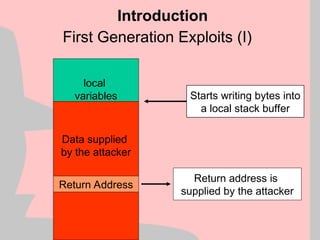
First Generation Exploits (I)
Introduction
local
variables
of a
Function
Frame Pointer
Return Address
Starts writing bytes into
a local stack buffer
Data supplied
by the attacker
Return address is
supplied by the attacker
Return Address
First Generation Exploits
• Simple stack smashes
• Documented ad nauseam
• EIP completely taken
– Hardware-specific feature (e.g. RET instruction)
• strcpy(), gets(), sprintf() …
• Trivial to exploit
• Can be detected via stress-testing
• Bug Species almost extinct
Introduction
Second generation exploits
• Cast screw-ups, off-by-one’s
• strncat(), strncpy(), manual pointer handling, …
• Fairly well documented
• EIP not overwritten, EBP manipulated
– Compiler functionality (e.g. standard function
prologue/epilogue for C compilers)
• Can be quite hard to detect, but can be detected via
stress testing
• Takes control of execution after a small detour
• Due to the hard-to-find nature, a few of these are still
around
Introduction
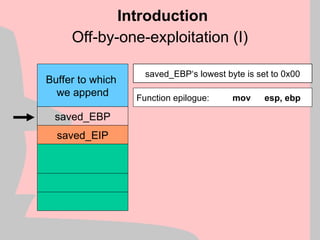
Off-by-one-exploitation (I)
Buffer to which
we append
saved_EBP
saved_EIP
saved_EBP‘s lowest byte is set to 0x00
Function epilogue: mov esp, ebp
Introduction
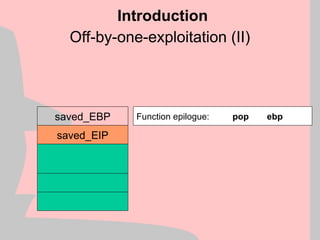
Off-by-one-exploitation (II)
Introduction
saved_EBP
saved_EIP
Function epilogue: pop ebp
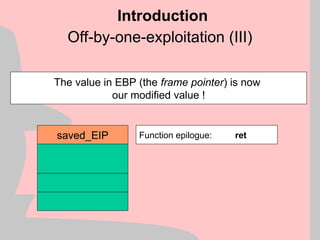
Off-by-one-exploitation (III)
Introduction
saved_EIP Function epilogue: ret
The value in EBP (the frame pointer) is now
our modified value !
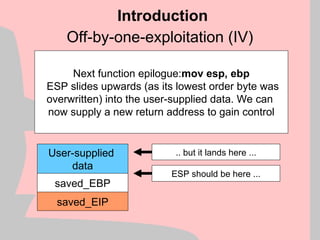
Off-by-one-exploitation (IV)
Introduction
User-supplied
data
saved_EBP
saved_EIP
Next function epilogue:mov esp, ebp
ESP slides upwards (as its lowest order byte was
overwritten) into the user-supplied data. We can
now supply a new return address to gain control
ESP should be here ...
.. but it lands here ...
Third Generation: Format Strings
• New bug class surfaced in Summer 2000
• *printf() - family functions
• Trivial to spot
• Fairly well-documented and widely exploited
• Allows reading from & writing to arbitrary addresses
• No CPU registers overwritten
– Specific libc-functionality which is documented in
the ANSI/ISO C specification
• Simple to exploit, powerful, easy to find  hunted to
extinction within a very short time
Introduction
Third Generation:
Heap Structure Exploits
• Publically documented by Solar Designer
• Takes advantage of libc-specific implementations for
malloc()/free()
– More abstract than Generation I/II, less
standardized than format string bugs
• Allows writing of arbitrary data to arbitrary addresses
• Documented in Phrack 57 / Undocumented for NT
• Hard/impossible to detect via stress testing
• Similarly hard to spot as Generation II
Introduction
Generalities on Heap Management
• Every libc/compiler has different algorithms,
philosophies & internal structures for heap
management (Vranhalia lists at least 8 different
Kernel Memory allocators under *NIX)
• Customized optimization of heap management gives
huge performance leaps for applications, thus many
large-scale applications have their own heap
management algorithms
• Operating systems (such as WinNT2kXP) may
provide their own heap management algorithms
which the application might use
Heap Structure Exploit Generalities
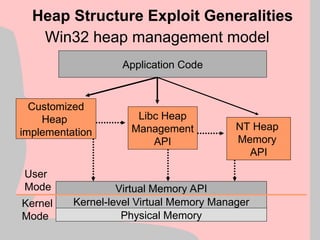
Win32 heap management model
Heap Structure Exploit Generalities
Physical Memory
Kernel-level Virtual Memory Manager
Kernel
Mode
Virtual Memory API
NT Heap
Memory
API
Libc Heap
Management
API
Application Code
Customized
Heap
implementation
User
Mode
Win2k Heap Manager (I)
Heap Structure Exploits
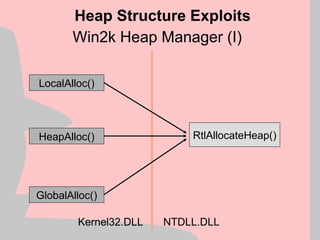
LocalAlloc()
HeapAlloc()
GlobalAlloc()
RtlAllocateHeap()
Kernel32.DLL NTDLL.DLL
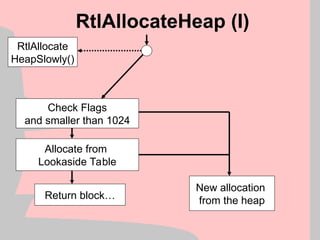
RtlAllocateHeap (I)
RtlAllocate
HeapSlowly()
Allocate from
Lookaside Table
Check Flags
and smaller than 1024
Return block…
New allocation
from the heap
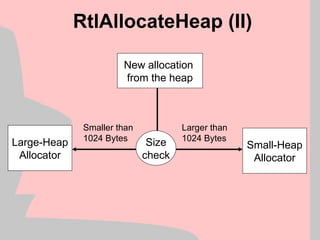
RtlAllocateHeap (II)
New allocation
from the heap
Size
check
Smaller than
1024 Bytes
Larger than
1024 Bytes
Large-Heap
Allocator
Small-Heap
Allocator
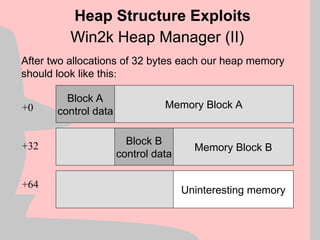
Win2k Heap Manager (II)
Heap Structure Exploits
After two allocations of 32 bytes each our heap memory
should look like this:
+0
+32
+64
Block A
control data
Block B
control data
Memory Block A
Memory Block B
Uninteresting memory
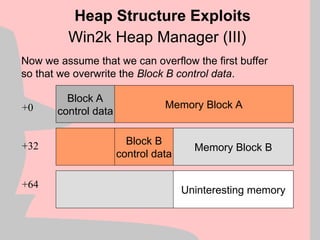
Win2k Heap Manager (III)
Heap Structure Exploits
Now we assume that we can overflow the first buffer
so that we overwrite the Block B control data.
+0
+32
+64
Block A
control data
Block B
control data
Memory Block A
Memory Block B
Uninteresting memory
Win2k Heap Manager (IV)
Heap Structure Exploits
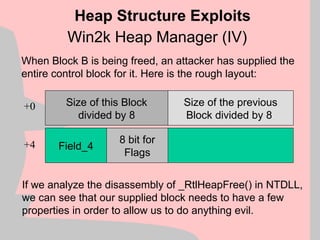
When Block B is being freed, an attacker has supplied the
entire control block for it. Here is the rough layout:
+0
+4
Size of the previous
Block divided by 8
8 bit for
Flags
Field_4
Size of this Block
divided by 8
If we analyze the disassembly of _RtlHeapFree() in NTDLL,
we can see that our supplied block needs to have a few
properties in order to allow us to do anything evil.
Win2k Heap Manager (V)
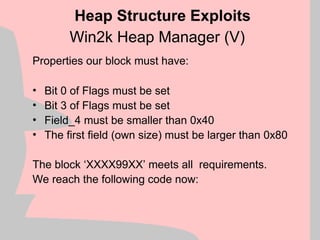
Properties our block must have:
• Bit 0 of Flags must be set
• Bit 3 of Flags must be set
• Field_4 must be smaller than 0x40
• The first field (own size) must be larger than 0x80
The block ‘XXXX99XX’ meets all requirements.
We reach the following code now:
Heap Structure Exploits
Win2k Heap Manager (VI)
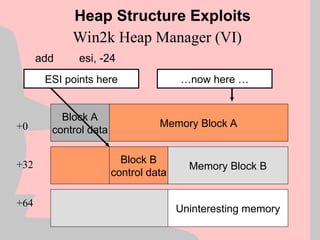
add esi, -24
Heap Structure Exploits
+0
+32
+64
Block A
control data
Block B
control data
Memory Block A
Memory Block B
Uninteresting memory
ESI points here …now here …
Win2k Heap Manager (VII)
mov eax,[esi]
mov esi, [esi+4]
Heap Structure Exploit
+0
+32
+64
Block A
control data
Block B
control data
Memory Block A
Memory Block B
Uninteresting memory
eax esi
Win2k Heap Manager (VIII)
mov [esi], eax ; Arbitrary memory overwrite
Heap Structure Exploits
+0
+32
+64
Block A
control data
Block B
control data
Memory Block A
Memory Block B
Uninteresting memory
eax esi
Win2k Heap Manager (IX)
• If we can overwrite a complete control block (or at
least 6 bytes of it) and have control over the data 24
bytes before that, we can easily write any value to
any memory location.
• It should be noted that other ways of exploiting exist
for smaller/different overruns – use your
Disassembler and your imagination.
Heap Structure Exploits
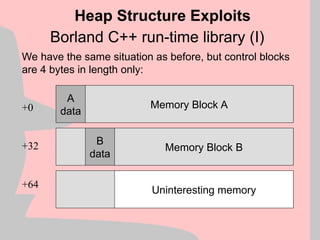
Borland C++ run-time library (I)
Heap Structure Exploits
We have the same situation as before, but control blocks
are 4 bytes in length only:
+0
+32
+64
A
data
B
data
Memory Block A
Memory Block B
Uninteresting memory
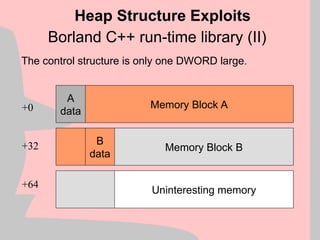
Borland C++ run-time library (II)
Heap Structure Exploits
The control structure is only one DWORD large.
+0
+32
+64
A
data
B
data
Memory Block A
Memory Block B
Uninteresting memory
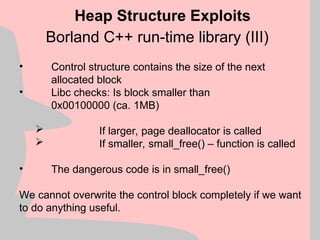
Borland C++ run-time library (III)
Heap Structure Exploits
• Control structure contains the size of the next
allocated block
• Libc checks: Is block smaller than
0x00100000 (ca. 1MB)
 If larger, page deallocator is called
 If smaller, small_free() – function is called
• The dangerous code is in small_free()
We cannot overwrite the control block completely if we want
to do anything useful.
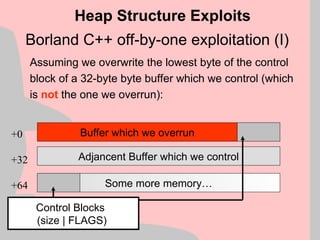
Borland C++ off-by-one exploitation (I)
Assuming we overwrite the lowest byte of the control
block of a 32-byte byte buffer which we control (which
is not the one we overrun):
Heap Structure Exploits
Buffer which we overrun
Adjancent Buffer which we control
+0
+32
+64 Some more memory…
Control Blocks
(size | FLAGS)
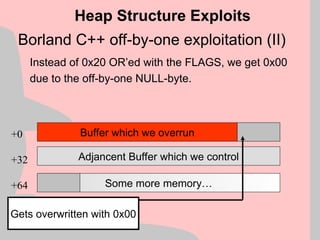
Borland C++ off-by-one exploitation (II)
Instead of 0x20 OR’ed with the FLAGS, we get 0x00
due to the off-by-one NULL-byte.
Heap Structure Exploits
Buffer which we overrun
Adjancent Buffer which we control
+0
+32
+64 Some more memory…
Gets overwritten with 0x00
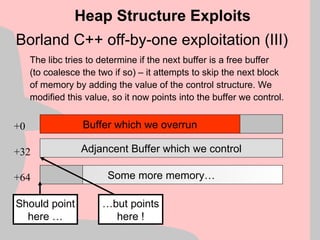
Borland C++ off-by-one exploitation (III)
The libc tries to determine if the next buffer is a free buffer
(to coalesce the two if so) – it attempts to skip the next block
of memory by adding the value of the control structure. We
modified this value, so it now points into the buffer we control.
Heap Structure Exploits
Buffer which we overrun
Adjancent Buffer which we control
+0
+32
+64 Some more memory…
Should point
here …
…but points
here !
Borland C++ off-by-one exploitation (IV)
If we have bit 0 of the first byte of our trailing buffer
set, the libc tries to coalesce the two “free” buffers
using the code:
Heap Structure Exploits
Buffer which we overrun
Adjancent Buffer which we control
+0
+32
+64 Some more memory…
EDX
mov ebx, [edx+8]
mov ecx, [edx+4]
mov [ecx+8], ebx ; arbitrary memory overwrite
Summary (I)
The only constant is change – especially in the world of bugs:
– Stack-based overflows are slowly “being hunted to near
extinction”
– Biological Analogies can be seen: A particularly valuable
and easy-to-hunt animal/bug has been hunted to near
extinction (format string bugs)
– Some bug-hunters see bugs as a natural resource which
is slowly being depleted – thus the ‘save the bugs
movements’ and more push in the underground to keep
bugs secret
Heap Structure Exploits
Summary (II)
New environments, new bugs…
– Majority of new code is C++/OOP/STL
– Pitfalls are not yet known – off-by-ones are possible, if not
in strings, with other STL constructs
– New bugs are mostly heap overruns
– Due to their elusive nature, stress testing becomes
useless: Goodbye Fuzz, Retina©, and 2 gazillion Perl-
Scripts
– Reverse Engineers are at an advantage: They can
document the inner workings of their compiler themselves
– Are you sure your JAVA runtime is working 100%ly
correctly ?
Heap Structure Exploits
Summary (III)
Future of exploitation: Application Logic Corruption
– Traditional countermeasures attempt to prevent the
execution of malicious code (StackGuard©, PaX)
– Non-executable data pages is a standard feature of new
CPU architectures – goodbye shellcode
– New bug generation allows writing of arbitrary values to
arbitrary addresses
– The attacker of the future will subvert the logic of the
application by modifying it’s variables – e.g. setting the
bool IsAuthenticated == TRUE.
– Again, Reverse Engineers are useful – exploitation of
closed-source applications without them is going to be
hard to impossible
Heap Structure Exploits
Break
Any questions ?
Heap Structure Exploits
Exploitation Reliability (I)
Exploitation of buffer overruns under modern OS’s
faces a bunch of difficulties:
– Variations in shared libraries & installs create incertainity
concerning the right return address
– Multi-threading instead of forks create incertainity
concerning the address of the stack
– Shooting down a web-server is not very stealthy
– Under NT (not 2k), services are not automatically restarted
 one try and you’re out
Methods are needed which improve reliability of
exploitation !
Reliability
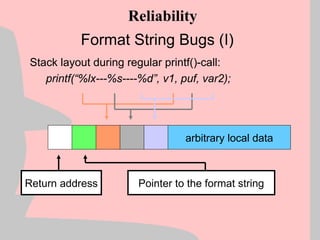
Format String Bugs (I)
Stack layout during regular printf()-call:
printf(“%lx---%s----%d”, v1, puf, var2);
Reliability
arbitrary local data
Return address Pointer to the format string
Format String Bugs (II)
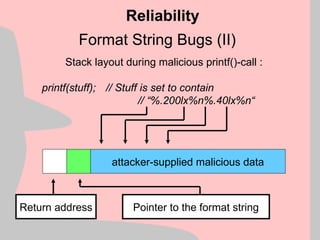
Stack layout during malicious printf()-call :
printf(stuff); // Stuff is set to contain
// “%.200lx%n%.40lx%n“
Reliability
attacker-supplied malicious data
Return address Pointer to the format string
Exploitation Reliability (II)
Windows NT/2k/ME provides a powerful feature which can be
abused to increase reliability of exploitation:
Structured Exception Handling (SEH)
As with all powerful features, this can be abused in various ways
– Two of them are:
1) Unhandled Exception Filter Attacks (UEFA)
2) Thread Exception Structure Overwrites (TESO)
Various other ways exists – where do you want to go today ?
Reliability
Exploitation Reliability (III)
Structured Exception Handling (SEH) allows an application to
handle exceptions on it’s own, similar to signal handlers
under most UNIX variants.
Two of the key types of exception handlers are:
1) Final Exception Handlers installed through a function called
SetUnhandledExceptionFilter()
2) Per-thread exception handlers installed by modifying a
structure at fs:[0] and creating handler structures on the
stack
Reliability
Exploitation Reliability (IV)
SetUnhandledExceptionFilter() installs a handler
which will be called once all other handlers have
failed, e.g. in a GPF or Page Fault (==UNIX
SIG_SEGV)
A disassembly of the relevant function in
KERNEL32.DLL looks like this:
mov ecx, [esp+lpTopLevelExceptionFilter]
mov eax, dword_77EE044C
mov dword_77EE044C, ecx
retn 4
Reliability
Exploitation Reliability (V)
Reliability
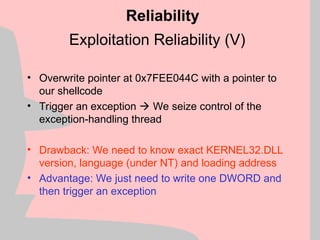
• Overwrite pointer at 0x7FEE044C with a pointer to
our shellcode
• Trigger an exception  We seize control of the
exception-handling thread
• Drawback: We need to know exact KERNEL32.DLL
version, language (under NT) and loading address
• Advantage: We just need to write one DWORD and
then trigger an exception
Exploitation Reliability (VI)
A thread creates/installs a per-thread exception handler
like this:
push offset handler
push dword fs:[0]
mov fs:[0], esp
and creates a structure on the stack which looks like this:
Reliability
Pointer to next structure
Pointer to handler code
+0
+4
Exploitation Reliability (VII)
• fs:[0] forms a linked list of these structures
• The topmost handler gets called upon exception
• If it cannot handle the exception, control is passed
down to the next handler
• Repeat the above until no more exception handlers
are left
• If we can overwrite the value at fs:[0] we can gain
control !
Reliability
Exploitation Reliability (VIII)
• Cross-segment writing is impossible with string bugs
and heap overwrites
• The structure starting at fs:[0] is called Thread
Environment Block and is documented in both the
NT DDK header files and by the Wine project
• Undocumented: The TEB’s are created at highly
predictable addresses
• By predicting these addresses and writing to the
Thread Environment Block, we can hijack exception
handlers
Reliability
Exploitation Reliability (IX)
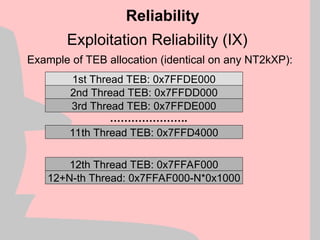
Example of TEB allocation (identical on any NT2kXP):
Reliability
1st Thread TEB: 0x7FFDE000
2nd Thread TEB: 0x7FFDD000
3rd Thread TEB: 0x7FFDE000
………………….
11th Thread TEB: 0x7FFD4000
12th Thread TEB: 0x7FFAF000
12+N-th Thread: 0x7FFAF000-N*0x1000
Exploitation Reliability (X)
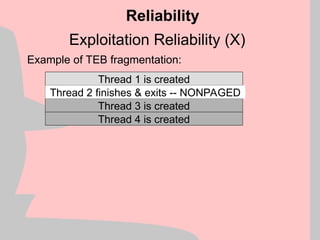
Example of TEB fragmentation:
Reliability
Thread 1 is created
Thread 2 is created
Thread 3 is created
Thread 4 is created
Thread 2 finishes & exits -- NONPAGED
Exploitation Reliability (XI)
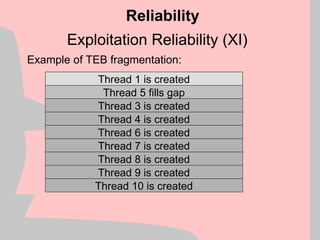
Example of TEB fragmentation:
Reliability
Thread 1 is created
Thread 5 fills gap
Thread 3 is created
Thread 4 is created
Thread 6 is created
Thread 7 is created
Thread 8 is created
Thread 9 is created
Thread 10 is created
Exploitation Reliability (XII)
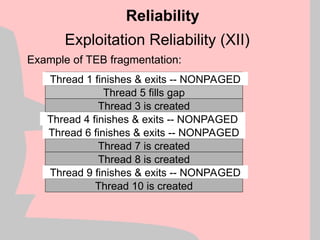
Example of TEB fragmentation:
Reliability
Thread 1 is created
Thread 5 fills gap
Thread 3 is created
Thread 4 is created
Thread 6 is created
Thread 7 is created
Thread 8 is created
Thread 9 is created
Thread 10 is created
Thread 1 finishes & exits -- NONPAGED
Thread 4 finishes & exits -- NONPAGED
Thread 6 finishes & exits -- NONPAGED
Thread 9 finishes & exits -- NONPAGED
Exploitation Reliability (XIII)
We’re facing some difficulties:
• We do not know which thread we’re working with
• Thus we do not know where ‘our’ TEB is at
• The TEB-memory is fragmented due to constant
dying/creating of threads in a production
environment
• Thus we cannot overwrite them sequentually as
odds are that we hit a page-fault before we get to
our TEB
Reliability
Exploitation Reliability (XIV)
Strategy for exploitation:
– Create large number of threads
– Let lots of them die
– Create our exploiting thread
– Create a large number of additional threads to fill
gaps
– Start overwriting TEBs sequentually
Results: 80-90% reliability independent of NT2kXP
version, service pack or hotfix
Reliability
Any Questions ?
Reliability

Third Generation Exploitation Black .ppt

  • 1.
    Smashing the Heapunder Win2k Blackhat Briefings Windows 2002 Halvar Flake Reverse Engineer Blackhat Consulting Third Generation Exploitation
  • 2.
    Overview (I) • Introduction –First Generation Exploits – Second Generation Exploits – Third Generation Exploits • Heap Structure Exploitation – Generalities – Win2k Heap Manager – Borland C++ libc – Demonstration – The future of Exploitation Third Generation Exploits
  • 3.
    Overview (II) • FormatString Bugs – History – Automated Detection – Exploitation • Exploitation reliability – Problem definition – Unhandled Exception Filter Attack – Thread Environment Structure Overwrite – Free time for questions, answers and discussions Third Generation Exploits
  • 4.
    First Generation Exploits(I) Introduction local variables of a Function Frame Pointer Return Address Starts writing bytes into a local stack buffer Data supplied by the attacker Return address is supplied by the attacker Return Address
  • 5.
    First Generation Exploits •Simple stack smashes • Documented ad nauseam • EIP completely taken – Hardware-specific feature (e.g. RET instruction) • strcpy(), gets(), sprintf() … • Trivial to exploit • Can be detected via stress-testing • Bug Species almost extinct Introduction
  • 6.
    Second generation exploits •Cast screw-ups, off-by-one’s • strncat(), strncpy(), manual pointer handling, … • Fairly well documented • EIP not overwritten, EBP manipulated – Compiler functionality (e.g. standard function prologue/epilogue for C compilers) • Can be quite hard to detect, but can be detected via stress testing • Takes control of execution after a small detour • Due to the hard-to-find nature, a few of these are still around Introduction
  • 7.
    Off-by-one-exploitation (I) Buffer towhich we append saved_EBP saved_EIP saved_EBP‘s lowest byte is set to 0x00 Function epilogue: mov esp, ebp Introduction
  • 8.
  • 9.
    Off-by-one-exploitation (III) Introduction saved_EIP Functionepilogue: ret The value in EBP (the frame pointer) is now our modified value !
  • 10.
    Off-by-one-exploitation (IV) Introduction User-supplied data saved_EBP saved_EIP Next functionepilogue:mov esp, ebp ESP slides upwards (as its lowest order byte was overwritten) into the user-supplied data. We can now supply a new return address to gain control ESP should be here ... .. but it lands here ...
  • 11.
    Third Generation: FormatStrings • New bug class surfaced in Summer 2000 • *printf() - family functions • Trivial to spot • Fairly well-documented and widely exploited • Allows reading from & writing to arbitrary addresses • No CPU registers overwritten – Specific libc-functionality which is documented in the ANSI/ISO C specification • Simple to exploit, powerful, easy to find  hunted to extinction within a very short time Introduction
  • 12.
    Third Generation: Heap StructureExploits • Publically documented by Solar Designer • Takes advantage of libc-specific implementations for malloc()/free() – More abstract than Generation I/II, less standardized than format string bugs • Allows writing of arbitrary data to arbitrary addresses • Documented in Phrack 57 / Undocumented for NT • Hard/impossible to detect via stress testing • Similarly hard to spot as Generation II Introduction
  • 13.
    Generalities on HeapManagement • Every libc/compiler has different algorithms, philosophies & internal structures for heap management (Vranhalia lists at least 8 different Kernel Memory allocators under *NIX) • Customized optimization of heap management gives huge performance leaps for applications, thus many large-scale applications have their own heap management algorithms • Operating systems (such as WinNT2kXP) may provide their own heap management algorithms which the application might use Heap Structure Exploit Generalities
  • 14.
    Win32 heap managementmodel Heap Structure Exploit Generalities Physical Memory Kernel-level Virtual Memory Manager Kernel Mode Virtual Memory API NT Heap Memory API Libc Heap Management API Application Code Customized Heap implementation User Mode
  • 15.
    Win2k Heap Manager(I) Heap Structure Exploits LocalAlloc() HeapAlloc() GlobalAlloc() RtlAllocateHeap() Kernel32.DLL NTDLL.DLL
  • 16.
    RtlAllocateHeap (I) RtlAllocate HeapSlowly() Allocate from LookasideTable Check Flags and smaller than 1024 Return block… New allocation from the heap
  • 17.
    RtlAllocateHeap (II) New allocation fromthe heap Size check Smaller than 1024 Bytes Larger than 1024 Bytes Large-Heap Allocator Small-Heap Allocator
  • 18.
    Win2k Heap Manager(II) Heap Structure Exploits After two allocations of 32 bytes each our heap memory should look like this: +0 +32 +64 Block A control data Block B control data Memory Block A Memory Block B Uninteresting memory
  • 19.
    Win2k Heap Manager(III) Heap Structure Exploits Now we assume that we can overflow the first buffer so that we overwrite the Block B control data. +0 +32 +64 Block A control data Block B control data Memory Block A Memory Block B Uninteresting memory
  • 20.
    Win2k Heap Manager(IV) Heap Structure Exploits When Block B is being freed, an attacker has supplied the entire control block for it. Here is the rough layout: +0 +4 Size of the previous Block divided by 8 8 bit for Flags Field_4 Size of this Block divided by 8 If we analyze the disassembly of _RtlHeapFree() in NTDLL, we can see that our supplied block needs to have a few properties in order to allow us to do anything evil.
  • 21.
    Win2k Heap Manager(V) Properties our block must have: • Bit 0 of Flags must be set • Bit 3 of Flags must be set • Field_4 must be smaller than 0x40 • The first field (own size) must be larger than 0x80 The block ‘XXXX99XX’ meets all requirements. We reach the following code now: Heap Structure Exploits
  • 22.
    Win2k Heap Manager(VI) add esi, -24 Heap Structure Exploits +0 +32 +64 Block A control data Block B control data Memory Block A Memory Block B Uninteresting memory ESI points here …now here …
  • 23.
    Win2k Heap Manager(VII) mov eax,[esi] mov esi, [esi+4] Heap Structure Exploit +0 +32 +64 Block A control data Block B control data Memory Block A Memory Block B Uninteresting memory eax esi
  • 24.
    Win2k Heap Manager(VIII) mov [esi], eax ; Arbitrary memory overwrite Heap Structure Exploits +0 +32 +64 Block A control data Block B control data Memory Block A Memory Block B Uninteresting memory eax esi
  • 25.
    Win2k Heap Manager(IX) • If we can overwrite a complete control block (or at least 6 bytes of it) and have control over the data 24 bytes before that, we can easily write any value to any memory location. • It should be noted that other ways of exploiting exist for smaller/different overruns – use your Disassembler and your imagination. Heap Structure Exploits
  • 26.
    Borland C++ run-timelibrary (I) Heap Structure Exploits We have the same situation as before, but control blocks are 4 bytes in length only: +0 +32 +64 A data B data Memory Block A Memory Block B Uninteresting memory
  • 27.
    Borland C++ run-timelibrary (II) Heap Structure Exploits The control structure is only one DWORD large. +0 +32 +64 A data B data Memory Block A Memory Block B Uninteresting memory
  • 28.
    Borland C++ run-timelibrary (III) Heap Structure Exploits • Control structure contains the size of the next allocated block • Libc checks: Is block smaller than 0x00100000 (ca. 1MB)  If larger, page deallocator is called  If smaller, small_free() – function is called • The dangerous code is in small_free() We cannot overwrite the control block completely if we want to do anything useful.
  • 29.
    Borland C++ off-by-oneexploitation (I) Assuming we overwrite the lowest byte of the control block of a 32-byte byte buffer which we control (which is not the one we overrun): Heap Structure Exploits Buffer which we overrun Adjancent Buffer which we control +0 +32 +64 Some more memory… Control Blocks (size | FLAGS)
  • 30.
    Borland C++ off-by-oneexploitation (II) Instead of 0x20 OR’ed with the FLAGS, we get 0x00 due to the off-by-one NULL-byte. Heap Structure Exploits Buffer which we overrun Adjancent Buffer which we control +0 +32 +64 Some more memory… Gets overwritten with 0x00
  • 31.
    Borland C++ off-by-oneexploitation (III) The libc tries to determine if the next buffer is a free buffer (to coalesce the two if so) – it attempts to skip the next block of memory by adding the value of the control structure. We modified this value, so it now points into the buffer we control. Heap Structure Exploits Buffer which we overrun Adjancent Buffer which we control +0 +32 +64 Some more memory… Should point here … …but points here !
  • 32.
    Borland C++ off-by-oneexploitation (IV) If we have bit 0 of the first byte of our trailing buffer set, the libc tries to coalesce the two “free” buffers using the code: Heap Structure Exploits Buffer which we overrun Adjancent Buffer which we control +0 +32 +64 Some more memory… EDX mov ebx, [edx+8] mov ecx, [edx+4] mov [ecx+8], ebx ; arbitrary memory overwrite
  • 33.
    Summary (I) The onlyconstant is change – especially in the world of bugs: – Stack-based overflows are slowly “being hunted to near extinction” – Biological Analogies can be seen: A particularly valuable and easy-to-hunt animal/bug has been hunted to near extinction (format string bugs) – Some bug-hunters see bugs as a natural resource which is slowly being depleted – thus the ‘save the bugs movements’ and more push in the underground to keep bugs secret Heap Structure Exploits
  • 34.
    Summary (II) New environments,new bugs… – Majority of new code is C++/OOP/STL – Pitfalls are not yet known – off-by-ones are possible, if not in strings, with other STL constructs – New bugs are mostly heap overruns – Due to their elusive nature, stress testing becomes useless: Goodbye Fuzz, Retina©, and 2 gazillion Perl- Scripts – Reverse Engineers are at an advantage: They can document the inner workings of their compiler themselves – Are you sure your JAVA runtime is working 100%ly correctly ? Heap Structure Exploits
  • 35.
    Summary (III) Future ofexploitation: Application Logic Corruption – Traditional countermeasures attempt to prevent the execution of malicious code (StackGuard©, PaX) – Non-executable data pages is a standard feature of new CPU architectures – goodbye shellcode – New bug generation allows writing of arbitrary values to arbitrary addresses – The attacker of the future will subvert the logic of the application by modifying it’s variables – e.g. setting the bool IsAuthenticated == TRUE. – Again, Reverse Engineers are useful – exploitation of closed-source applications without them is going to be hard to impossible Heap Structure Exploits
  • 36.
    Break Any questions ? HeapStructure Exploits
  • 37.
    Exploitation Reliability (I) Exploitationof buffer overruns under modern OS’s faces a bunch of difficulties: – Variations in shared libraries & installs create incertainity concerning the right return address – Multi-threading instead of forks create incertainity concerning the address of the stack – Shooting down a web-server is not very stealthy – Under NT (not 2k), services are not automatically restarted  one try and you’re out Methods are needed which improve reliability of exploitation ! Reliability
  • 38.
    Format String Bugs(I) Stack layout during regular printf()-call: printf(“%lx---%s----%d”, v1, puf, var2); Reliability arbitrary local data Return address Pointer to the format string
  • 39.
    Format String Bugs(II) Stack layout during malicious printf()-call : printf(stuff); // Stuff is set to contain // “%.200lx%n%.40lx%n“ Reliability attacker-supplied malicious data Return address Pointer to the format string
  • 40.
    Exploitation Reliability (II) WindowsNT/2k/ME provides a powerful feature which can be abused to increase reliability of exploitation: Structured Exception Handling (SEH) As with all powerful features, this can be abused in various ways – Two of them are: 1) Unhandled Exception Filter Attacks (UEFA) 2) Thread Exception Structure Overwrites (TESO) Various other ways exists – where do you want to go today ? Reliability
  • 41.
    Exploitation Reliability (III) StructuredException Handling (SEH) allows an application to handle exceptions on it’s own, similar to signal handlers under most UNIX variants. Two of the key types of exception handlers are: 1) Final Exception Handlers installed through a function called SetUnhandledExceptionFilter() 2) Per-thread exception handlers installed by modifying a structure at fs:[0] and creating handler structures on the stack Reliability
  • 42.
    Exploitation Reliability (IV) SetUnhandledExceptionFilter()installs a handler which will be called once all other handlers have failed, e.g. in a GPF or Page Fault (==UNIX SIG_SEGV) A disassembly of the relevant function in KERNEL32.DLL looks like this: mov ecx, [esp+lpTopLevelExceptionFilter] mov eax, dword_77EE044C mov dword_77EE044C, ecx retn 4 Reliability
  • 43.
    Exploitation Reliability (V) Reliability •Overwrite pointer at 0x7FEE044C with a pointer to our shellcode • Trigger an exception  We seize control of the exception-handling thread • Drawback: We need to know exact KERNEL32.DLL version, language (under NT) and loading address • Advantage: We just need to write one DWORD and then trigger an exception
  • 44.
    Exploitation Reliability (VI) Athread creates/installs a per-thread exception handler like this: push offset handler push dword fs:[0] mov fs:[0], esp and creates a structure on the stack which looks like this: Reliability Pointer to next structure Pointer to handler code +0 +4
  • 45.
    Exploitation Reliability (VII) •fs:[0] forms a linked list of these structures • The topmost handler gets called upon exception • If it cannot handle the exception, control is passed down to the next handler • Repeat the above until no more exception handlers are left • If we can overwrite the value at fs:[0] we can gain control ! Reliability
  • 46.
    Exploitation Reliability (VIII) •Cross-segment writing is impossible with string bugs and heap overwrites • The structure starting at fs:[0] is called Thread Environment Block and is documented in both the NT DDK header files and by the Wine project • Undocumented: The TEB’s are created at highly predictable addresses • By predicting these addresses and writing to the Thread Environment Block, we can hijack exception handlers Reliability
  • 47.
    Exploitation Reliability (IX) Exampleof TEB allocation (identical on any NT2kXP): Reliability 1st Thread TEB: 0x7FFDE000 2nd Thread TEB: 0x7FFDD000 3rd Thread TEB: 0x7FFDE000 …………………. 11th Thread TEB: 0x7FFD4000 12th Thread TEB: 0x7FFAF000 12+N-th Thread: 0x7FFAF000-N*0x1000
  • 48.
    Exploitation Reliability (X) Exampleof TEB fragmentation: Reliability Thread 1 is created Thread 2 is created Thread 3 is created Thread 4 is created Thread 2 finishes & exits -- NONPAGED
  • 49.
    Exploitation Reliability (XI) Exampleof TEB fragmentation: Reliability Thread 1 is created Thread 5 fills gap Thread 3 is created Thread 4 is created Thread 6 is created Thread 7 is created Thread 8 is created Thread 9 is created Thread 10 is created
  • 50.
    Exploitation Reliability (XII) Exampleof TEB fragmentation: Reliability Thread 1 is created Thread 5 fills gap Thread 3 is created Thread 4 is created Thread 6 is created Thread 7 is created Thread 8 is created Thread 9 is created Thread 10 is created Thread 1 finishes & exits -- NONPAGED Thread 4 finishes & exits -- NONPAGED Thread 6 finishes & exits -- NONPAGED Thread 9 finishes & exits -- NONPAGED
  • 51.
    Exploitation Reliability (XIII) We’refacing some difficulties: • We do not know which thread we’re working with • Thus we do not know where ‘our’ TEB is at • The TEB-memory is fragmented due to constant dying/creating of threads in a production environment • Thus we cannot overwrite them sequentually as odds are that we hit a page-fault before we get to our TEB Reliability
  • 52.
    Exploitation Reliability (XIV) Strategyfor exploitation: – Create large number of threads – Let lots of them die – Create our exploiting thread – Create a large number of additional threads to fill gaps – Start overwriting TEBs sequentually Results: 80-90% reliability independent of NT2kXP version, service pack or hotfix Reliability
  • 53.