DEVELOPING
SKILLS OF
READING
COMPREHENSIONBY
S A R A B E G A M . B
WHAT IS READING COMPREHENSION?
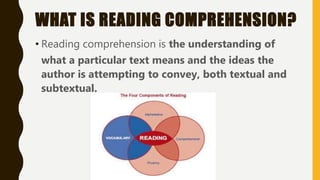
• Reading comprehension is the understanding of
what a particular text means and the ideas the
author is attempting to convey, both textual and
subtextual.
WHY READING COMPREHENSION IS
IMPORTANT
• Reading, understanding, and analyzing literature in
your English classes
• Reading and understanding texts from your other
class subjects, such as history, math, or science
• Doing well on both the written and math sections of
the SAT (or all five sections of the ACT)
• Understanding and engaging with current events
presented in written form, such as news reports
• Properly understanding and responding to any and all
other workplace correspondence, such as essays,
reports, memos, and analyses
• Simply taking pleasure in written work on your own
leisure time
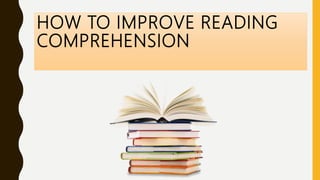
HOW TO IMPROVE READING
COMPREHENSION
STEP 1: UNDERSTAND AND RE-EVALUATE
HOW YOU’RE CURRENTLY READING
• As you read, see if you can notice when your
attention, energy, or comprehension of the
begins to flag.
• If you find that your concentration starts to lag, take a
step back on your timing before pushing yourself
more. Improvement comes with time, and it'll only
cause frustration if you try to rush it all at once.
STEP 2: IMPROVE YOUR VOCABULARY
• As you read, make sure to keep a running list of words
you don't readily recognize and make yourself a set of
flashcards with the words and their definitions.
• For Example:
Dedicate fifteen minutes two or three times a
week to and quizzing yourself on your vocab flashcards
• In order to retain your vocabulary knowledge, you must
practice a combination of practiced memorization and
make a point of using these new words in your verbal and
written communication.
STEP 3: READ FOR PLEASURE
• The best way to improve your reading comprehension
level is through practice. And the best way to practice
is to have fun with it!
• Make reading a fun activity, at least on
occasion, rather than a constant chore.
• Begin by reading texts that are slightly below your
age and grade level
• This will take pressure off of you and allow you to
relax and enjoy the story.
READING COMPREHENSION
TECHNIQUES:
 Stop When You Get Confused and Try to
Summarize What You Just Read
If You’re Struggling, Try Reading Aloud
Re-read (or Skim) Previous Sections of the Text
Skim or Read Upcoming Sections of the Text
Discuss the Text With a Friend (Even an Imaginary
Friend)
CONCLUSION:
• Improving reading comprehension takes time and
effort, but it can be done. Be patient with yourself,
work through your reading comprehension steps,
and try not to get frustrated with yourself if you feel
your progress is slow or if you feel you’re “falling
behind.” You will utilize your reading skills throughout
your life, so go at a pace that works for you, and take
care to maintain that balance between reading for
pure pleasure and reading for dedicated
improvement.
REFERENCES:
• https://blog.prepscholar.com/how-to-improve-reading-comprehension
• https://vxpert.wordpress.com/2011/09/22/tips-for-reading-comprehension/
THANK YOU

Developing skills of Reading Comprehension

  • 1.
  • 2.
    WHAT IS READINGCOMPREHENSION? • Reading comprehension is the understanding of what a particular text means and the ideas the author is attempting to convey, both textual and subtextual.
  • 3.
    WHY READING COMPREHENSIONIS IMPORTANT • Reading, understanding, and analyzing literature in your English classes • Reading and understanding texts from your other class subjects, such as history, math, or science • Doing well on both the written and math sections of the SAT (or all five sections of the ACT)
  • 4.
    • Understanding andengaging with current events presented in written form, such as news reports • Properly understanding and responding to any and all other workplace correspondence, such as essays, reports, memos, and analyses • Simply taking pleasure in written work on your own leisure time
  • 5.
    HOW TO IMPROVEREADING COMPREHENSION
  • 6.
    STEP 1: UNDERSTANDAND RE-EVALUATE HOW YOU’RE CURRENTLY READING • As you read, see if you can notice when your attention, energy, or comprehension of the begins to flag. • If you find that your concentration starts to lag, take a step back on your timing before pushing yourself more. Improvement comes with time, and it'll only cause frustration if you try to rush it all at once.
  • 7.
    STEP 2: IMPROVEYOUR VOCABULARY • As you read, make sure to keep a running list of words you don't readily recognize and make yourself a set of flashcards with the words and their definitions. • For Example: Dedicate fifteen minutes two or three times a week to and quizzing yourself on your vocab flashcards • In order to retain your vocabulary knowledge, you must practice a combination of practiced memorization and make a point of using these new words in your verbal and written communication.
  • 8.
    STEP 3: READFOR PLEASURE • The best way to improve your reading comprehension level is through practice. And the best way to practice is to have fun with it! • Make reading a fun activity, at least on occasion, rather than a constant chore. • Begin by reading texts that are slightly below your age and grade level • This will take pressure off of you and allow you to relax and enjoy the story.
  • 9.
    READING COMPREHENSION TECHNIQUES:  StopWhen You Get Confused and Try to Summarize What You Just Read If You’re Struggling, Try Reading Aloud Re-read (or Skim) Previous Sections of the Text Skim or Read Upcoming Sections of the Text Discuss the Text With a Friend (Even an Imaginary Friend)
  • 10.
    CONCLUSION: • Improving readingcomprehension takes time and effort, but it can be done. Be patient with yourself, work through your reading comprehension steps, and try not to get frustrated with yourself if you feel your progress is slow or if you feel you’re “falling behind.” You will utilize your reading skills throughout your life, so go at a pace that works for you, and take care to maintain that balance between reading for pure pleasure and reading for dedicated improvement.
  • 11.
  • 12.