University of Puerto Rico at Cayey  English Department  Cayey, Puerto Rico   How to communicate with and about people with special needs Liomarys Reyes Santos 2010
Introduction to the topic What is a person with special needs? What laws protect this population?  Why? * What is the relevance of this topic? Why is communication so important?
From policies to practices... The Americans with Disabilities Act, other laws and the efforts of many disability organizations have made strides in improving accessibility in buildings, increasing access to education, opening employment opportunities and developing realistic portrayals of persons with disabilities in television programming and motion pictures.  Where progress is still needed is in communication and interaction with people with disabilities.
WORDS First person rule “ Normal person” vs. “person without a disability”  Examples of each
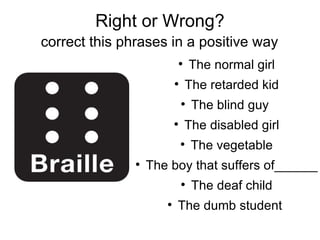
Right or Wrong?  correct this phrases in a positive way   The normal girl The retarded kid The blind guy  The disabled girl The vegetable The boy that suffers of______ The deaf child The dumb student
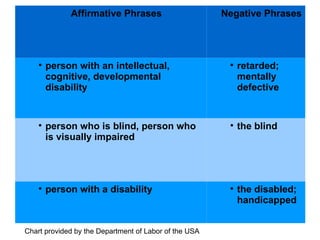
Chart provided by the Department of Labor of the USA Affirmative Phrases Negative Phrases person with an intellectual, cognitive, developmental disability retarded; mentally defective person who is blind, person who is visually impaired the blind person with a disability  the disabled; handicapped
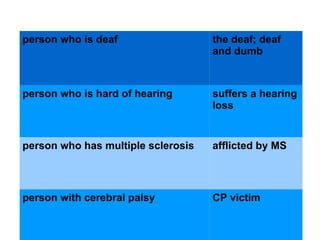
person who is deaf the deaf; deaf and dumb person who is hard of hearing  suffers a hearing loss person who has multiple sclerosis afflicted by MS person with cerebral palsy  CP victim
person with epilepsy, person with  seizure disorder epileptic person who uses a wheelchair  confined or restricted to a wheelchair person who has muscular dystrophy stricken by MD person with a physical disability, physically disabled crippled; lame; deformed unable to speak, uses synthetic speech dumb; mute person with psychiatric disability  crazy; nuts person who is successful, productive  has overcome his/her disability; is courageous (when it implies the person has courage because of having a disability)
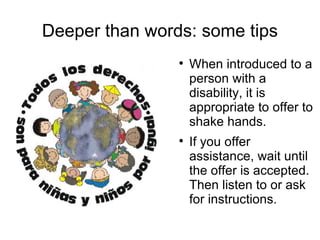
Deeper than words: some tips When introduced to a person with a disability, it is appropriate to offer to shake hands.  If you offer assistance, wait until the offer is accepted. Then listen to or ask for instructions.
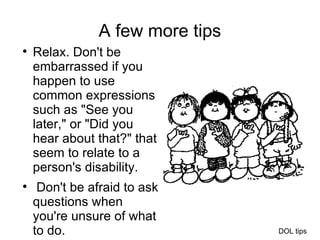
A few more tips Relax. Don't be embarrassed if you happen to use common expressions such as "See you later," or "Did you hear about that?" that seem to relate to a person's disability. Don't be afraid to ask questions when you're unsure of what to do.  DOL tips
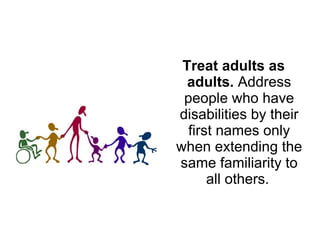
Treat adults as adults.  Address people who have disabilities by their first names only when extending the same familiarity to all others.
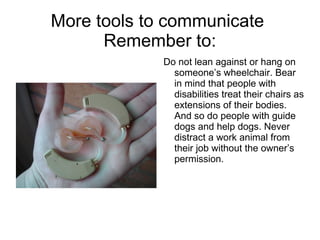
More tools to communicate  Remember to: Do not lean against or hang on someone’s wheelchair. Bear in mind that people with disabilities treat their chairs as extensions of their bodies. And so do people with guide dogs and help dogs. Never distract a work animal from their job without the owner’s permission.
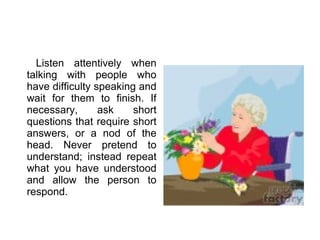
Listen attentively when talking with people who have difficulty speaking and wait for them to finish. If necessary, ask short questions that require short answers, or a nod of the head. Never pretend to understand; instead repeat what you have understood and allow the person to respond.
Tap a person who has a hearing disability on the shoulder or wave your hand to get his or her attention. Look directly at the person and speak clearly, slowly, and expressively to establish if the person can read your lips. If so, try to face the light source and keep hands, cigarettes and food away from your mouth when speaking.  Never  shout to a person. Just speak in a normal tone of voice. The Ten Commandments Tips
Conclusions: Relevance Did you know that... 40% of employed people with disabilities report said that they have encountered job discrimination?   33% of employed people with disabilities report that they have encountered "unfavorable attitudes" toward their disabilities on the job?   22% of employers cite supervisor/co-worker attitudes and stereotypes as a major barrier to employment & advancement of employees with disabilities?   15% of non-disabled people report not feel comfortable working for, or nearby, a person with a disability?   I t is no wonder that most places of employment are not effective at hiring/retaining employees with disabilities! Source:  The Ten Commandments of Communicating with People With Disabilities
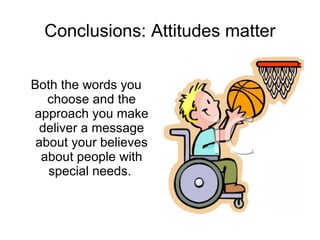
Conclusions: Attitudes matter Both the words you choose and the approach you make deliver a message about your believes about people with special needs.
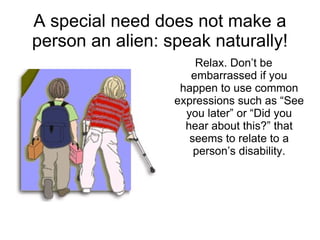
A special need does not make a person an alien: speak naturally! Relax. Don’t be embarrassed if you happen to use common expressions such as “See you later” or “Did you hear about this?” that seems to relate to a person’s disability.
References Americans with Disabilities Act   Individuals with Disabilities Education Act

How to communicate with individuals with special needs

  • 1.
    University of PuertoRico at Cayey English Department Cayey, Puerto Rico How to communicate with and about people with special needs Liomarys Reyes Santos 2010
  • 2.
    Introduction to thetopic What is a person with special needs? What laws protect this population? Why? * What is the relevance of this topic? Why is communication so important?
  • 3.
    From policies topractices... The Americans with Disabilities Act, other laws and the efforts of many disability organizations have made strides in improving accessibility in buildings, increasing access to education, opening employment opportunities and developing realistic portrayals of persons with disabilities in television programming and motion pictures. Where progress is still needed is in communication and interaction with people with disabilities.
  • 4.
    WORDS First personrule “ Normal person” vs. “person without a disability” Examples of each
  • 5.
    Right or Wrong? correct this phrases in a positive way The normal girl The retarded kid The blind guy The disabled girl The vegetable The boy that suffers of______ The deaf child The dumb student
  • 6.
    Chart provided bythe Department of Labor of the USA Affirmative Phrases Negative Phrases person with an intellectual, cognitive, developmental disability retarded; mentally defective person who is blind, person who is visually impaired the blind person with a disability the disabled; handicapped
  • 7.
    person who isdeaf the deaf; deaf and dumb person who is hard of hearing suffers a hearing loss person who has multiple sclerosis afflicted by MS person with cerebral palsy CP victim
  • 8.
    person with epilepsy,person with seizure disorder epileptic person who uses a wheelchair confined or restricted to a wheelchair person who has muscular dystrophy stricken by MD person with a physical disability, physically disabled crippled; lame; deformed unable to speak, uses synthetic speech dumb; mute person with psychiatric disability crazy; nuts person who is successful, productive has overcome his/her disability; is courageous (when it implies the person has courage because of having a disability)
  • 9.
    Deeper than words:some tips When introduced to a person with a disability, it is appropriate to offer to shake hands. If you offer assistance, wait until the offer is accepted. Then listen to or ask for instructions.
  • 10.
    A few moretips Relax. Don't be embarrassed if you happen to use common expressions such as "See you later," or "Did you hear about that?" that seem to relate to a person's disability. Don't be afraid to ask questions when you're unsure of what to do. DOL tips
  • 11.
    Treat adults asadults. Address people who have disabilities by their first names only when extending the same familiarity to all others.
  • 12.
    More tools tocommunicate Remember to: Do not lean against or hang on someone’s wheelchair. Bear in mind that people with disabilities treat their chairs as extensions of their bodies. And so do people with guide dogs and help dogs. Never distract a work animal from their job without the owner’s permission.
  • 13.
    Listen attentively whentalking with people who have difficulty speaking and wait for them to finish. If necessary, ask short questions that require short answers, or a nod of the head. Never pretend to understand; instead repeat what you have understood and allow the person to respond.
  • 14.
    Tap a personwho has a hearing disability on the shoulder or wave your hand to get his or her attention. Look directly at the person and speak clearly, slowly, and expressively to establish if the person can read your lips. If so, try to face the light source and keep hands, cigarettes and food away from your mouth when speaking. Never shout to a person. Just speak in a normal tone of voice. The Ten Commandments Tips
  • 15.
    Conclusions: Relevance Didyou know that... 40% of employed people with disabilities report said that they have encountered job discrimination? 33% of employed people with disabilities report that they have encountered "unfavorable attitudes" toward their disabilities on the job? 22% of employers cite supervisor/co-worker attitudes and stereotypes as a major barrier to employment & advancement of employees with disabilities? 15% of non-disabled people report not feel comfortable working for, or nearby, a person with a disability? I t is no wonder that most places of employment are not effective at hiring/retaining employees with disabilities! Source: The Ten Commandments of Communicating with People With Disabilities
  • 16.
    Conclusions: Attitudes matterBoth the words you choose and the approach you make deliver a message about your believes about people with special needs.
  • 17.
    A special needdoes not make a person an alien: speak naturally! Relax. Don’t be embarrassed if you happen to use common expressions such as “See you later” or “Did you hear about this?” that seems to relate to a person’s disability.
  • 18.
    References Americans withDisabilities Act Individuals with Disabilities Education Act